

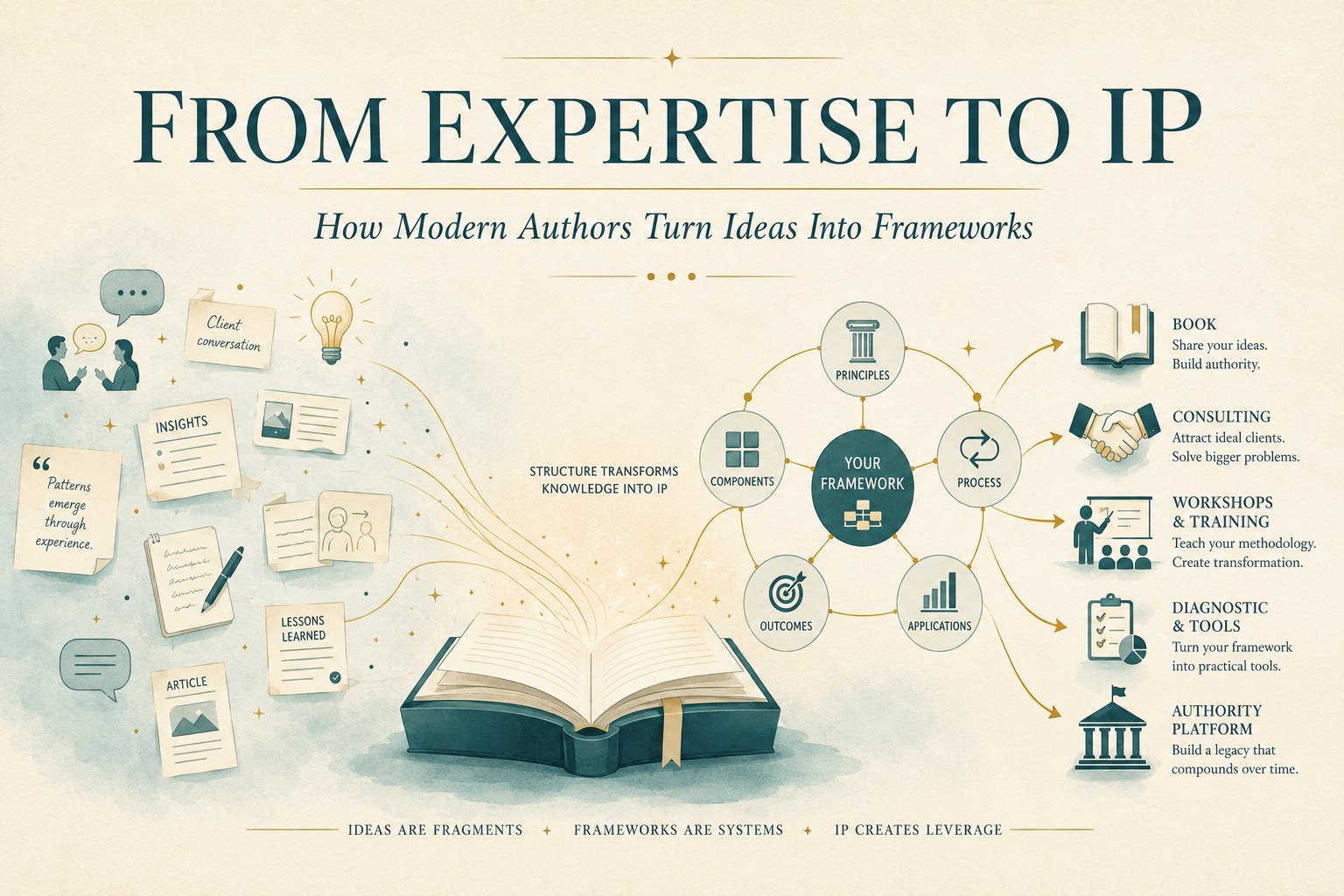
From Expertise to IP: How Modern Authors Turn Ideas Into Frameworks That Power Books, Businesses, and Authority
Why Most Experts Struggle to Turn Expertise Into Intellectual Property
Most experts don’t have an expertise problem.
They have a packaging problem.
They assume the constraint is more:
- more insights
- more content
- more experience
- more original ideas
In reality, most already have more than enough knowledge.
What’s missing is structure.
What they lack is structured intellectual property.
Why Expertise Alone Does Not Create Scalable Authority
The pattern shows up everywhere: highly capable experts possess deep experience but struggle to translate that experience into scalable authority.
Their knowledge exists in fragmented forms:
- insights shared in conversations
- lessons learned across projects
- advice delivered to clients
- presentations, articles, or workshops
All of this knowledge is real.
Much of it is valuable.
But it is rarely organized into a clear system others can understand, repeat, or reference.
Without structure, expertise doesn’t transfer.
It stays dependent on the person who holds it.
Why Ideas Alone Don’t Build Authority
Most experts respond by producing more ideas.
They publish articles.
They post insights online.
They share opinions about trends.
This activity can build visibility, but it rarely builds lasting authority.
Especially in an environment where AI can produce unlimited summaries, commentary, and explanations.
Ideas don’t create defensibility.
Structure does.
How Frameworks Turn Expertise Into Intellectual Property
AAuthority emerges when knowledge becomes structured.
A named, structured, repeatable system that explains how a specific transformation happens.
The most common form of intellectual property in business and professional knowledge is the framework.
A framework is a model that organizes ideas into a clear structure. It helps people:
- understand complex concepts
- make decisions
- apply knowledge consistently
Frameworks do something that scattered ideas cannot:
they create structure and language around expertise.
For example:
- A consultant may have hundreds of observations about leadership.
- A framework organizes those observations into a clear model leaders can use.
The knowledge already existed.
The framework made it usable, and transferable.
The Core Reframe
The key shift for most experts is simple but profound:
Ideas do not create authority.
Frameworks create authority.
Ideas are fragments. Frameworks are systems.
Ideas explain something interesting.
Frameworks explain how something works.
This is the line between personal knowledge and scalable IP.
Why This Matters
When expertise is structured, everything changes:
- Others can understand and remember the core ideas
- The thinking becomes teachable and repeatable
- The model becomes referencable language in the market
Most importantly, frameworks allow expertise to scale beyond the individual expert.
A framework can power:
- a book
- a consulting methodology
- a training program
- a diagnostic tool
- an entire business ecosystem
Without structure, none of this compounds.
The problem most experts face is not a lack of insight.
It is a packaging problem.
Why Frameworks Matter More in the AI Era
AI has changed the value of ideas.
Ideas are now abundant.
Patterns, summaries, and surface-level insights can be generated quickly and at scale.
This creates a new problem for experts.
If your expertise lives only as ideas, explanations, or generic advice, it becomes easier to replicate and harder to defend.
This is why intellectual property matters more now, not less.
In this context, intellectual property means a proprietary framework: a named, structured system that organizes how you think and how others apply that thinking.
AI can generate content around an idea.
It cannot create a truly proprietary system rooted in your experience, your pattern recognition, your methodology, and your point of view.
That is the difference.
AI flattens idea-based experts.
AI amplifies framework-based experts.
When your thinking is unstructured, AI makes you easier to imitate.
When your thinking is structured into a framework, AI makes you easier to scale.
The question is no longer whether you have good ideas.
The question is whether those ideas have been organized into something ownable.
60-Second Decision Box
If you only read one section of this guide, read this.
This guide is for you if:
- You have deep expertise but no clear framework for expressing it
- Your ideas feel strong individually but scattered together
- You want your book, offers, and positioning to come from one structured system
- You are trying to turn experience into something teachable, ownable, and scalable
This guide is not for you if:
- You are looking for better content ideas instead of a better structure
- You want to publish thought fragments rather than build intellectual property
- You believe expertise alone creates authority
- You are not willing to turn your thinking into a defined methodology
What This Guide Will Teach You
- How to extract repeatable patterns from your expertise
- How to turn those patterns into a structured framework
- How to name and position that framework as intellectual property
- How to use the framework to shape a book, offers, and a broader business ecosystem
- How to test whether your IP is strong enough to teach, sell, and scale
The Core Reframe
Expertise does not become valuable because it is deep.
It becomes valuable when it is structured.
Ideas are not yet IP.
A named framework is.
Why Ideas Don’t Scale (And Frameworks Do)
The constraint is not ideas.
The constraint is structure.
Ideas spread.
Frameworks scale.
In the AI era, structure is the asset.
Why Expertise Alone Doesn’t Scale Without Structure
Expertise typically exists in scattered forms:
- observations from years of experience
- lessons learned across projects
- advice given in conversations
- insights shared in presentations or articles
This knowledge may be valuable, but it remains difficult for others to absorb, remember, or apply.
Without structure, expertise remains personal knowledge, not transferable intellectual property.
Why Ideas Are Easy to Replicate
Individual ideas are easy to reproduce.
Two experts can arrive at the same insight.
A reader can summarize an article.
AI systems can generate thousands of similar explanations.
Ideas spread quickly, but they rarely create lasting differentiation.
They are fragments of knowledge rather than organized systems.
How Frameworks Organize and Structure Knowledge
A framework is a structured model that organizes ideas into a clear system.
Frameworks turn scattered insights into something people can understand and apply. They typically:
- group related ideas into defined components
- show relationships between concepts
- provide a repeatable way to approach a problem
Instead of presenting isolated advice, a framework explains how something works.
This structure makes complex expertise usable.
How Frameworks Build Authority
Authority emerges when people begin using a model to understand a problem.
When a framework provides clarity, it creates:
- shared language
- repeatable thinking
- a reference point others can teach and apply
Over time, the framework becomes associated with the expert who created it.
This is how expertise evolves into intellectual property—a structured system that can be taught, referenced, and scaled.
How Frameworks Power Books, Offers, and Business Systems
Once expertise is organized into a framework, it becomes the foundation for multiple assets.
The same model can drive:
- a book that explains the system
- consulting or advisory methodologies
- training programs and workshops
- diagnostics or assessments
- productized services
Instead of publishing isolated ideas, the expert distributes a coherent model.
Why Frameworks Are the Most Defensible Asset in the AI Era
Artificial intelligence can generate explanations, summaries, and content at scale.
What it cannot easily replicate is original structure.
Frameworks represent the architecture of thinking: the way knowledge is organized, named, and applied to solve a problem.
For experts building authority, books, and businesses, this structure becomes the most defensible asset they can create.
Who This Guide Is For
This guide is for professionals with real experience—but no structured IP.
It assumes the reader has spent years developing insight through real work—advising clients, leading teams, building organizations, or solving complex problems—but has not yet organized that experience into a clear framework others can understand and use.
In other words, the expertise exists.
What’s missing is the structure that makes it scalable.
Professionals This Guide Is Designed For
This guide is particularly relevant for professionals such as:
- Consultants who solve recurring problems for clients but have not formalized their thinking into a clear methodology
- Founders who have developed hard-won insights through building companies but have not structured those lessons into a model others can apply
- Advisors and coaches whose work relies on pattern recognition and judgment developed across many engagements
- Executives and operators who have led transformations or managed complex organizations and want to translate that experience into intellectual property
- Subject-matter experts who regularly teach, present, or publish ideas but have not yet organized those ideas into a coherent framework
These professionals often possess deep knowledge but still describe their thinking in fragments—insights, lessons, observations, and advice.
This guide focuses on turning that fragmented expertise into a structured system.
What This Guide Assumes About the Reader
This guide assumes the reader:
- already has substantial professional experience
- has accumulated insights across multiple projects or years of work
- wants to turn that expertise into a book, platform, or business asset
- recognizes that authority increasingly depends on ownable intellectual property, not just ideas
The guide does not assume the reader already has a framework.
In fact, it is specifically designed for experts who suspect that a framework exists within their experience—but have not yet extracted or organized it.
How This Guide Is Structured (Step-by-Step Framework Roadmap)
This guide follows a clear progression designed to move from understanding intellectual property to building and applying a framework that can power a book, offers, and a broader business ecosystem.
Each section builds on the previous one.
Guide Map
Part 1 — Understanding Intellectual Property
Part 2 — The Architecture of Frameworks
Part 3 — Extracting Patterns from Your Expertise
Part 4 — Building Your Framework
Part 5 — Naming and Positioning Your IP
Part 6 — Turning Frameworks Into Books
Part 7 — Turning Frameworks Into Offers
Part 8 — Validating Your Framework
Part 9 — The 90-Day Creation Plan
Provides a practical roadmap for building a framework within a focused timeline.
PART I — Why Frameworks Beat Ideas in the AI Era (The Modern Author Reframe)
The environment for expertise has changed.
For most of the past two decades, publishing ideas was enough to build visibility. Articles, blog posts, and social media insights helped professionals establish credibility because information was relatively scarce.
Today, information is abundant.
Artificial intelligence can generate explanations, summaries, and commentary on almost any topic in seconds. As a result, ideas alone are no longer scarce assets.
Why Ideas Are Easy to Replicate (and Hard to Own)
An idea is a single insight or observation about how something works.
Ideas spread quickly because they are easy to reproduce:
- multiple experts can reach the same conclusion
- articles can be summarized and paraphrased
- AI systems can generate similar explanations instantly
This does not make ideas unimportant.
But it does mean that ideas are difficult to own.
In a world where ideas can be generated endlessly, they rarely create durable differentiation.
Why Frameworks Are Ownable (and Ideas Are Not)
A framework is a structured model that organizes ideas into a system.
Rather than presenting isolated insights, frameworks show:
- how concepts relate to each other
- how a transformation happens
- how a problem can be solved consistently
Because frameworks require structure, naming, and design, they are far more difficult to replicate than individual ideas.
This structure makes frameworks ownable intellectual property.
When a framework becomes widely used, the model itself becomes associated with the expert who created it.
Why Frameworks Matter for Modern Authors and Thought Leaders
For professionals writing books or building authority, this shift changes the strategic goal.
Publishing ideas is no longer enough.
The modern author’s advantage comes from creating structure—models that organize thinking and give the market a language for understanding a problem.
These frameworks become the foundation for:
- books that distribute the model
- consulting or advisory methodologies
- workshops and programs
- tools and diagnostics
In this environment, ideas are abundant. Structure is scarce. That is where durable advantage comes from
How to Turn Ideas Into a Framework (Simple Process)
- Identify repeated insights across your experience
- Group those insights into patterns
- Organize patterns into a clear structure
- Name the system so it becomes memorable
- Apply the framework to books, offers, and positioning
What Intellectual Property Really Means for Authors and Experts
The term intellectual property (IP) is often misunderstood in the context of expertise.
Many professionals assume their intellectual property is simply the ideas they share—insights, advice, or lessons learned from experience. While these can be valuable, they are not intellectual property in the structural sense used by successful authors, consultants, and category builders.
In this guide, intellectual property refers to structured knowledge that consistently produces a result.
More specifically:
Intellectual property is a named, structured, repeatable system that explains how a specific transformation happens.
The distinction between ideas and structured systems is critical.
What Is NOT Intellectual Property (Common Mistakes Experts Make)
Many experts attempt to build frameworks but unintentionally produce collections of ideas instead of real intellectual property.
Intellectual property is not:
- Tips — isolated pieces of advice
- Best practices — commonly accepted recommendations
- Metaphors — helpful illustrations without operational structure
- Slogans — memorable phrases without a system behind them
- Generic step lists — loose sequences that do not explain why the steps work
These elements may help communicate expertise, but they do not organize it into a durable system.
Without structure, knowledge remains fragmented and difficult to apply consistently.
What Real Intellectual Property Looks Like (Framework-Based Systems)
Real intellectual property organizes expertise into a system that can be taught, applied, and repeated.
A strong framework typically includes several characteristics:
- A defined transformation — it explains how someone moves from a starting state to a desired outcome
- A clear structure — the components of the system are organized in a logical way
- Named elements — the model has language that people can reference and remember
- Repeatable application — others can use the system to approach similar problems
When these elements exist, the expertise becomes more than insight.
It becomes a model others can understand, adopt, and apply.
Why the Difference Between Ideas and Frameworks Matters
The difference between ideas and intellectual property determines whether expertise remains personal knowledge or becomes a scalable asset.
Ideas can be shared and discussed.
Intellectual property can be taught, licensed, built into programs, and distributed through books.
For authors and experts building long-term authority, the goal is not simply to publish insights.
The goal is to convert expertise into structured intellectual property that explains how a transformation works.
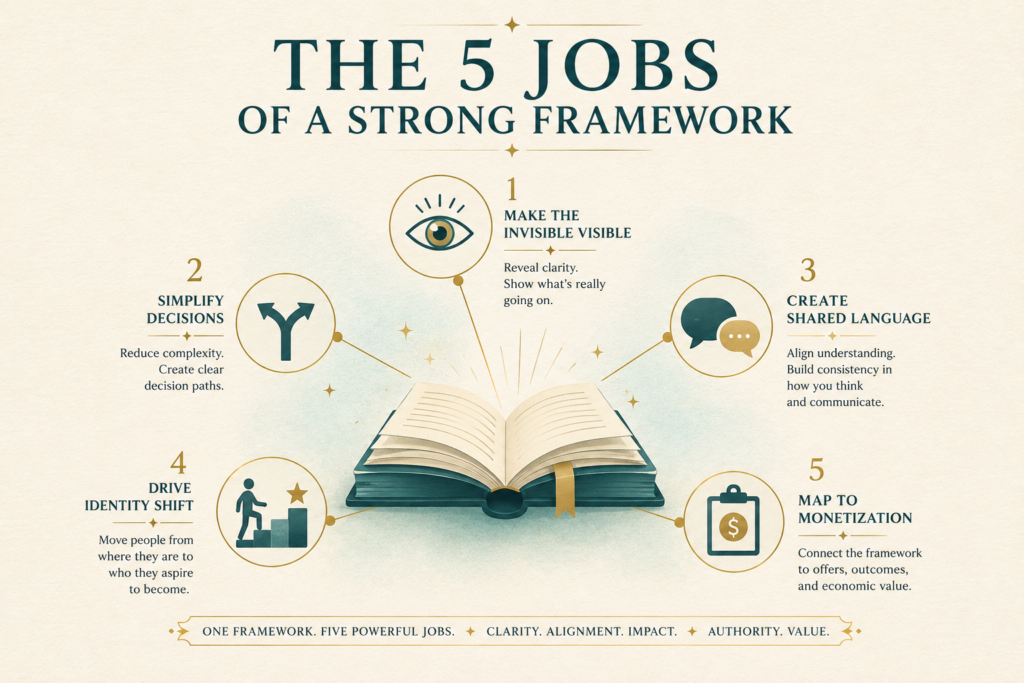
The 5 Jobs of a Strong Framework (Real Intellectual Property)
A framework is not valuable simply because it organizes ideas.
The real test of intellectual property is whether it performs a set of functional jobs. Strong frameworks consistently accomplish five things. These functions determine whether a model becomes practical intellectual property or remains a collection of interesting insights.
1. Make the Invisible Visible
Experts often rely on intuition built from years of experience. They see patterns and relationships that others cannot easily recognize.
A framework makes that hidden expertise visible.
It breaks complex thinking into structured components so others can understand how the expert approaches a problem. When done well, the framework reveals patterns that previously existed only in the expert’s judgment.
2. Simplify Decisions
Real intellectual property reduces complexity.
Instead of forcing someone to evaluate dozens of variables, a framework provides a structured way to think through a problem. The model highlights what matters most and creates a clear path for action.
This is why frameworks are widely used in consulting, leadership, and strategy—they turn ambiguous situations into structured decisions.
3. Create Shared Language
Strong frameworks introduce language that people can remember and repeat.
When components of a model are clearly named, they give the market vocabulary to discuss a problem. This shared language makes the ideas easier to reference, teach, and apply.
Over time, the terminology associated with the framework becomes part of how people describe the problem itself.
4. Create Identity Shift
Effective intellectual property helps people see themselves differently.
A framework does not only explain what to do. It helps the reader understand where they are and what they are becoming.
By defining stages, principles, or models of progress, the framework allows people to locate themselves within a larger transformation.
5. Map to Monetization
Real intellectual property naturally connects to practical application.
Because the framework explains a repeatable transformation, it can be applied through services, programs, diagnostics, or training. The structure of the framework becomes the structure of delivery.
When this happens, the intellectual property is not just educational. It becomes operational—something that can power books, consulting methodologies, and scalable offers.
Quick Diagnostic: Does Your Framework Do These Five Jobs?
If your model cannot:
- make expertise visible
- simplify decisions
- create shared language
- guide identity transformation
- connect to real-world application
Then it is likely a collection of ideas, not intellectual property.
When a framework performs these five jobs, it becomes more than insight. It becomes a system others can understand, apply, and build around.
PART II — How to Turn Insights Into a Framework (Step-by-Step Guide)
Insight alone is not enough.
Most experts can explain what they know.
Few can show how it consistently works.
This section focuses on the transition point:
where scattered insights become structured systems.
The goal is to move from:
observations → organization
thinking → structure
expertise → framework
This is where intellectual property is formed.
What follows is the process for turning patterns in your experience into a clear, repeatable framework that others can understand, apply, and buy.
How to Turn Patterns Into a Framework
Frameworks do not start as structures.
They start as patterns.
A pattern is a repeated observation in your work:
- the same problem appearing across different clients
- the same sequence producing results
- the same mistake showing up again and again
- the same decision point determining outcomes
Most experts experience these patterns.
Few capture them.
Fewer still organize them.
This is where intellectual property begins.
The Core Shift: Frameworks Are Discovered, Not Invented
The goal is not to create something new.
It is to recognize what is already there—and make it visible.
Frameworks are discovered, not invented.
They emerge when patterns are:
identified
grouped
structured
named
Step-by-Step: How to Turn Patterns Into a Framework
1. Identify Patterns
Look for repetition across your experience.
Not isolated insights, but recurring dynamics:
- what always happens first
- what tends to follow
- where things break
- what consistently works
At this stage, nothing is organized.
You are collecting signals.
2. Group Related Patterns
Patterns become useful when they are grouped.
- similar problems cluster together
- related steps form sequences
- connected ideas begin to take shape
This is where raw experience starts forming structure.
3. Structure the System
Once grouped, patterns are arranged into a coherent form.
This creates a framework:
a structured system that shows how something works from start to finish.
Structure answers:
- what are the key components
- how do they relate
- in what order they occur (if sequential)
Without structure, patterns remain observations.
With structure, they become usable.
4. Name the Framework
A framework becomes intellectual property when it is named.
Naming does three things:
- makes the system memorable
- makes it teachable
- makes it ownable
Without a name, it is still just organized thinking.
With a name, it becomes a defined asset.
What Happens When You Turn Expertise Into a Framework
When patterns are turned into a framework:
- knowledge becomes transferable
- expertise becomes teachable
- thinking becomes repeatable
- value becomes scalable
This is the point where expertise stops being internal—and starts becoming intellectual property.
The 4 Types of Frameworks (How to Choose the Right One)
Most experts overcomplicate framework design.
In practice, most effective intellectual property follows a small number of repeatable structures. Choosing the right shape is less about creativity and more about fit.
A clear structure makes expertise usable. A mismatched structure makes even strong ideas difficult to apply.
There are four common framework shapes.
1. Pillars (Principles)
A Pillars framework defines a set of core principles that must all be true for the system to work.
It organizes thinking into a small number of essential elements, each standing independently but reinforcing the whole.
Best used when the goal is clarity around what matters most—standards, beliefs, or decision criteria—rather than a step-by-step path.
The structure typically includes:
- 3–7 core pillars
- clear naming for each principle
- a short explanation of what each pillar governs
In practice, a leadership framework might define five principles that guide decision-making across situations, rather than prescribing a sequence.
The outcome is alignment. People know what to prioritize without needing constant instruction.
The most common mistake is treating pillars like a checklist or forcing an artificial order. Pillars are not steps—they are anchors.
2. Process (Sequential Steps)
A Process framework maps a transformation as a sequence of steps that must happen in order.
It shows how someone moves from a starting point to a defined outcome through a repeatable path.
Best used when the work follows a predictable progression and execution depends on sequence.
The structure typically includes:
- a clear starting state and end state
- a defined sequence of steps
- transitions that show how each step leads to the next
In practice, a go-to-market framework might move from problem definition → positioning → messaging → distribution.
The outcome is execution clarity. People know what to do next.
The most common mistake is including too many steps or steps that do not depend on sequence. If order doesn’t matter, it’s not a process.
3. Model (Interlocking System)
A Model framework explains how multiple variables interact within a system.
It focuses on relationships rather than sequence, showing how different components influence each other.
Best used when the problem is multi-dimensional and outcomes depend on balancing several factors at once.
The structure typically includes:
- key components of the system
- defined relationships between those components
- a visual or conceptual model that shows interaction
In practice, a growth model might show how product, distribution, and retention interact to drive outcomes.
The outcome is understanding. People can see how changing one variable affects the whole system.
The most common mistake is overcomplicating the model with too many elements. If it cannot be explained simply, it will not be used.
4. Spectrum (Levels of Development)
A Spectrum framework organizes expertise into levels of progression.
It shows how capability, maturity, or performance evolves over time, helping people understand where they are and what advancement looks like.
Best used when the transformation is developmental rather than procedural.
The structure typically includes:
- clearly defined levels or stages
- characteristics of each level
- a direction of movement from lower to higher states
In practice, a capability model might define beginner → intermediate → advanced → expert, with clear distinctions between each level.
The outcome is orientation. People can locate themselves and see the path forward.
The most common mistake is making levels vague or indistinguishable. If the stages are not clearly different, the framework loses value.
How to Choose the Right Framework Structure
Most frameworks fail not because of weak ideas, but because of unclear structure.
When the shape fits the nature of the expertise:
- the model becomes easier to understand
- the ideas become easier to apply
- the framework becomes easier to teach
The goal is not to invent a new structure.
The goal is to choose the one that makes the expertise clear.
Part III — Where Frameworks Come From: How to Extract Patterns From Your Expertise
Most experts believe frameworks are created.
In practice, they are extracted.
The raw material for intellectual property already exists inside your experience. The challenge is not generating new ideas—it is identifying the patterns that are already there.
Why Your Expertise Already Contains a Framework
Over time, professionals develop consistent ways of thinking and solving problems.
These show up in how you:
- diagnose situations
- prioritize decisions
- guide clients or teams
- explain complex topics
This consistency is not accidental. It is pattern recognition built through repetition.
The structure exists. It has simply not been made explicit.
Where to Find Frameworks in Your Work and Experience
Frameworks are found in places where your thinking repeats.
They typically exist across three layers:
- Delivery environments
Client conversations, workshops, interviews—any setting where you solve problems in real time - Artifacts
Past content, presentations, notes, and materials where your thinking has already been expressed - Experience layer
Lived experience, research, and worldview that shape how you interpret problems and solutions
These are not separate inputs. They are different expressions of the same underlying patterns.
What Pattern Extraction Means for Building a Framework
Ideas and patterns are not the same.
- Ideas are isolated
- Patterns repeat
- Ideas explain a moment
- Patterns explain a system
Frameworks are built from patterns.
A useful test:
If you have explained something the same way three or more times, you are no longer dealing with an idea—you are seeing a pattern.
How to Extract Patterns From Your Expertise (Repeatable Process)
Pattern extraction is the process of identifying and isolating these repeated structures.
It follows a simple logic:
- look across multiple situations, not one
- identify what repeats
- ignore what is unique
- capture the underlying structure
This process turns experience into usable material.
It shifts your focus from generating new insights to recognizing existing ones.
What Pattern Extraction Means for Building a Framework
You are not starting from zero.
You are starting from accumulated structure.
The work is not to invent.
It is to extract and organize.
When this shift happens, framework creation becomes a process of clarification—turning what you already know into structured intellectual property others can understand and apply.
The Pattern Extraction Workflow: How to Turn Experience Into a Framework
The Codex System is a structured method for turning scattered experience into repeatable patterns that form the foundation of a framework.
It is most useful when your expertise exists across many forms—client work, conversations, content, and lived experience—but has never been fully organized into a clear system others can understand and apply.
The goal is not to generate new ideas.
The goal is to extract the structure that already exists.
How the Pattern Extraction System Works
At a high level, the Codex System follows a simple progression:
Input → Pattern Extraction → Codification → Output
- Input — raw, unstructured material from your work and thinking
- Pattern extraction — identifying what consistently repeats
- Codification — organizing those patterns into a clear structure
- Output — a usable foundation for a framework
This progression moves your expertise from scattered insight to structured intellectual property.
Step 1: Collect Input From Your Experience
Begin by gathering the environments where your thinking already lives.
This typically includes:
- client conversations and notes
- workshops, presentations, and teaching materials
- past writing, outlines, or recordings
- internal documents or informal frameworks
- interviews or repeated explanations
The objective is not to evaluate or refine yet.
It is to centralize your thinking into a single working set.
Without consolidation, patterns remain invisible. With it, repetition becomes easier to detect.
Step 2: Identify Patterns That Repeat
Once your material is assembled, shift your focus from ideas to repetition.
Review the inputs and ask:
- What problems show up across multiple situations?
- What explanations do I give repeatedly?
- What solutions consistently lead to results?
- What distinctions or mental models do I return to?
At this stage, the discipline is selective attention.
You are not capturing everything.
You are capturing only what recurs across contexts.
A simple rule helps:
If you have explained something the same way three or more times, it is no longer an idea—it is a pattern.
Patterns signal underlying structure. One-off insights do not.
Step 3: Turn Patterns Into a Structured Framework
With patterns identified, the next step is to organize them into a coherent shape.
This is where raw patterns become a structural skeleton.
Focus on:
- grouping related patterns into clusters
- identifying core components
- defining how those components relate to each other
- determining whether there is a sequence, system, or progression
At this stage, you are not building a finished framework.
You are creating a simplified model of how your expertise works.
Clarity is more important than completeness.
A smaller, well-defined structure is more useful than a comprehensive but unclear one.
Example: Turning Real Experience Into a Framework
Consider an operator reviewing past projects.
Across multiple engagements, they notice a recurring progression:
unclear problem → reframed problem → structured plan → execution discipline → measurable outcome
What initially appeared as separate experiences reveals a consistent transformation.
That transformation becomes the backbone of a framework.
The insight was always present.
The structure was not.
How AI Can Help You Extract Patterns (and Its Limits)
AI can accelerate parts of this process by:
- analyzing large volumes of text quickly
- identifying repeated language and themes
- clustering similar ideas into groups
This is particularly useful when working with extensive content or transcripts.
However, AI does not determine significance.
It can surface patterns, but you decide:
- which patterns matter
- how they should be grouped
- what structure best represents the system
Judgment remains the critical layer.
What You Get After Extracting Patterns
The Codex System does not produce a finished framework.
It produces something more foundational:
- a set of repeatable patterns
- a visible transformation sequence
- an initial structural model
This is the raw architecture of intellectual property.
From this point forward, the work shifts from extraction to construction—refining, naming, and turning this structure into a defined framework.
The Biggest Mistake When Building a Framework
The most common mistake is over-inclusion.
Experts often try to capture everything they know. This creates complexity without structure.
The effectiveness of this system depends on constraint:
- prioritize what repeats
- eliminate what is situational
- reduce before you expand
Structure emerges through reduction.
When you focus only on what consistently appears, the underlying system becomes clear.
Part IV — How to Build a Framework From Your Expertise (The Assembly Process)
Extraction gives you raw structure.
Assembly turns that structure into intellectual property.
The IP Assembly System is the process of taking patterns and shaping them into a complete framework, one that can be taught, visualized, and applied consistently.
What Changes When You Start Building a Framework
In the previous step, the goal was to find what repeats.
In this step, the goal is different:
You are deciding:
- what matters most
- how it fits together
- how it should be understood by others
This is where judgment replaces discovery.
The Framework Assembly Process (Step-by-Step)
A usable framework is built by making a series of deliberate decisions:
- Define the transformation
What does this system actually change? - Set the boundaries
What is included—and just as importantly, what is not? - Select the components
What are the few parts that carry the system? - Choose the structure
How do these parts relate—sequence, pillars, model, or progression? - Name the system
What language will people use to understand and repeat it?
Each decision reduces ambiguity and increases clarity.
The Core Elements of a Strong Framework
A complete framework can be expressed through four core elements:
- The Transformation
A clear shift from a starting condition to a defined outcome - The Core Components
A small set of elements (typically 3–5) that carry the system - The Structural Logic
The relationship between components—sequence, independent pillars, interdependent system, or progression - The Naming Layer
Clear, repeatable language that allows the model to be understood, taught, and referenced
If any of these elements are unclear, the framework will be difficult to apply.
How to Simplify Your Framework Without Losing Depth
At this stage, most experts face the same tension:
They know too much.
The instinct is to include more:
- more nuances
- more edge cases
- more explanations
But frameworks do not improve by expanding.
They improve by simplifying without losing truth.
A useful constraint:
If the system cannot be explained simply, it cannot be used consistently.
Example: Turning Complex Ideas Into a Clear Framework
An expert working from extracted patterns may begin with dozens of insights.
Through assembly, those insights are reduced to:
- a small number of core components
- a clear relationship between them
- a defined transformation
What began as scattered thinking becomes a system others can understand and apply.
What a Complete Framework Looks Like
A complete framework has a few defining characteristics:
- it explains a specific transformation
- it has a clear structure
- it uses consistent language
- it can be visualized simply
- it can be applied across situations
At this point, the system is no longer informal thinking.
It becomes intellectual property.
The Biggest Mistake When Building a Framework
The most common failure at this stage is over-design.
This shows up as:
- too many components
- overly complex relationships
- language that requires explanation
The result is a framework that looks complete but is difficult to use.
The discipline of assembly is reduction.
You are not trying to capture everything.
You are trying to make the system clear enough to travel without you.
Part V — How to Name a Framework (Turn It Into Intellectual Property)
Why Most Frameworks Fail to Become Intellectual Property
Most frameworks do not fail because the underlying ideas are weak.
They fail because the system never becomes visible, repeatable, or memorable enough to function as intellectual property.
In most cases, the failure point is not strategy.
It is naming.
Why Frameworks Fail Without Clear Naming
Many experts build solid frameworks in practice.
They have:
- a clear way of thinking
- a repeatable method
- a distinct point of view
- a process that produces results
But none of this becomes real intellectual property until it can be named and referenced.
Without naming, the framework remains trapped inside explanation.
It may work well in a room, in a workshop, or in a consulting engagement. But it does not travel well beyond the expert delivering it.
What Happens When You Don’t Name Your Framework
An unnamed framework creates friction at every level.
It is harder to:
- remember
- explain
- teach
- share
- build content around
This is why many strong systems never develop market recognition.
The logic may be sound.
The method may be useful.
But if people cannot repeat the language, they cannot help the framework spread.
How Naming Turns a Framework Into Intellectual Property
Naming turns a framework from a private method into a public asset.
It gives the system:
- recall — people can remember it
- reference — people can point to it
- repeatability — people can explain it to others
- distinction — it becomes identifiable as a specific model, not generic advice
This is the threshold where a framework begins to function as intellectual property.
The Real Reason Frameworks Fail to Scale
Most experts assume the work is finished once the framework is structurally sound.
It is not.
A framework becomes IP only when it has enough linguistic precision to live outside the original creator.
If the system still has to be re-explained from scratch every time, it has not fully become intellectual property.
How to Know If Your Framework Isn’t Memorable
A simple test is this:
If people understand your framework when you explain it, but cannot repeat it afterward, the problem is usually not the framework itself.
The problem is that the framework has not yet been named clearly enough to stick.
Why Naming Matters for Authors and Experts
Without naming, a framework remains useful but invisible.
With naming, it becomes something more durable:
- a teachable model
- a recognizable asset
- a foundation for books, programs, and offers
- a system that can begin to anchor a category
Most frameworks fail to become intellectual property not because they lack insight, but because they never cross this final threshold from structure into language.
How to Name Your Framework (Step-by-Step)
A framework becomes intellectual property when it can be recognized, referenced, and repeated without you.
Naming is the layer that makes that possible.
Without naming, a framework remains internal logic.
With naming, it becomes external language.
What Naming Does (Why It Matters for Frameworks)
Naming is not cosmetic.
It performs three critical functions:
- Compression
It reduces complex ideas into language people can hold and recall - Transmission
It allows others to explain the system without needing the original source - Ownership
It creates distinction—your way of thinking becomes identifiable and separate from generic advice
This is the difference between:
- explaining a concept
- and establishing a point of view others can adopt
Where to Apply Naming in Your Framework
Naming operates across multiple layers of the system:
- The Framework Name
The umbrella identity for the entire system - Component Names
The labels for each part of the framework - The Model Name
The visual or structural representation (if distinct from the framework name) - The Diagnostic Name
The tool used to assess where someone is within the system - The Signature Program Name
The applied version of the framework in a product or service
Not every framework requires all layers immediately, but strong systems expand into them over time.
How to Create a Strong Framework Name
Effective names share a small set of characteristics:
- Short — easy to say and remember
- Distinct — not easily confused with generic terms
- Evocative — suggests meaning without requiring explanation
- Repeatable — can be used consistently across contexts
A useful test:
If someone cannot repeat the name after hearing it once, it will not spread.
How Naming Improves Your Framework Structure
Naming is not applied at the end.
It sharpens the system itself.
When you attempt to name:
- unclear components become obvious
- unnecessary complexity surfaces
- weak distinctions collapse
Naming forces precision.
If a part cannot be named clearly, it is usually not defined clearly.
Example: How Naming Makes a Framework Usable
A framework with unnamed components requires explanation every time it is used.
A named framework allows statements like:
- “You’re missing Step 3.”
- “This is a breakdown in the second pillar.”
- “You’re operating at the early stage of the spectrum.”
The system becomes conversational.
It can be referenced, diagnosed, and taught in real time.
What Happens After You Name Your Framework
Once naming is applied, the framework changes form:
- from explanation → language
- from internal logic → external system
- from insight → asset
It becomes something that can anchor:
- a book structure
- a body of content
- a set of offers
- a recognizable category
The Biggest Mistake When Naming a Framework
The most common mistake is generic naming.
This includes:
- obvious labels (“Step 1, Step 2”)
- overused terms (“strategy,” “growth,” “success”)
- long or technical phrasing
Generic names reduce memorability and eliminate differentiation.
The goal is not to describe the system perfectly.
The goal is to make it clear enough to remember and distinct enough to own.
Part VI — How to Turn Your Framework Into a Book (Step-by-Step Guide)
A strong framework does not need to be forced into a book.
It already contains the structure a book needs.
Once the intellectual property is clear, the book becomes an act of translation—turning a framework into a sequence the reader can understand, follow, and apply.
Why Frameworks Create Better Nonfiction Books
Many books fail because they are built from topics rather than structure.
They contain useful ideas, but the argument feels loose. Chapters accumulate without a clear system holding them together.
A framework solves this problem.
It gives the book:
- a central organizing idea
- a clear progression of thought
- a repeatable structure the reader can follow
This is why frameworks make strong book architecture. They create coherence before the writing begins.
How to Turn a Framework Into Book Chapters
At the simplest level, the translation works like this:
Framework component → chapter
If the framework has four pillars, the book may have four core teaching chapters.
If it has a five-step process, each step may become a chapter.
If it uses a spectrum, each level may define a section of the book.
The framework provides the backbone.
The chapters provide explanation, evidence, and application.
3 Ways to Structure a Book From a Framework
A framework can be translated into a book in several ways. Three structures are especially common.
1. Framework-First
A framework-first book puts the model at the center.
The book introduces the framework early, then devotes chapters to explaining each part in detail.
This model works best when:
- the framework itself is the core asset
- the reader needs a clear teaching structure
- the goal is to make the model memorable and usable
In this structure, the framework is not supporting the book.
The book is distributing the framework.
2. Journey
A journey book uses the framework to organize a transformation.
Instead of presenting the model immediately as a complete system, the book walks the reader through a progression from one state to another.
This model works best when:
- the transformation is developmental
- the reader needs to move through shifts in thinking or identity
- the framework is best understood through progression
The framework still shapes the book, but it is experienced through movement rather than presented only as a static model.
3. Problem-Solution
A problem-solution book uses the framework to solve a clearly defined problem.
The early part of the book clarifies the problem, why it persists, and why common approaches fail. The later part presents the framework as the solution.
This model works best when:
- the reader already feels the problem acutely
- the framework resolves a specific challenge
- the book needs a strong strategic argument before teaching the model
In this structure, the framework provides the answer to a clearly established tension.
How to Choose the Right Book Structure for Your Framework
The choice depends on what the book is trying to do.
Use a framework-first model when the framework itself is the main insight.
Use a journey model when the reader must move through a progression.
Use a problem-solution model when the problem must be clarified before the system can be fully understood.
The key is alignment.
The structure of the book should reflect the nature of the framework and the transformation it explains.
What a Framework-Based Book Looks Like
When a framework is translated well, the book becomes more than a collection of chapters.
It becomes:
- a clear teaching vehicle
- a distribution system for the intellectual property
- a structured experience for the reader
This is the advantage of building from IP first.
The book is no longer organized around whatever the author wants to say next.
It is organized around a system the reader can understand, remember, and apply.
The Role of a Book in Your Intellectual Property System
A book is not the product.
It is the primary distribution layer for your intellectual property.
Its role is to take a structured framework and make it:
- accessible at scale
- understandable to a broad audience
- transferable without your direct involvement
Why a Book Is a Distribution Tool (Not Just a Product)
By the time a framework is ready for a book, the core work is already done.
The system exists.
The structure is defined.
The language is in place.
The book does not create the intellectual property.
It packages and distributes it.
This is a critical shift.
Without this distinction, authors tend to:
- treat the book as the end goal
- over-focus on writing instead of structure
- optimize for content instead of clarity
In a modern IP system, the book plays a different role.
It is how the framework moves into the market.
What a Book Actually Does for Your Framework
A well-structured book performs three functions inside the system:
- Codification
It documents the framework in a complete and coherent form - Standardization
It ensures the system is explained consistently across contexts - Distribution
It allows the framework to reach audiences the author cannot reach directly
This is what enables the framework to scale.
Without a book, the system remains dependent on the creator.
With a book, the system begins to operate independently.
How Your Book Connects to Content, Offers, and Authority
The book sits at the center of a broader ecosystem.
It connects the framework to:
- content (articles, talks, media)
- offers (programs, services, licensing)
- positioning (category, authority, reputation)
Each of these elements draws from the same underlying system.
The book becomes the most complete expression of that system.
It acts as the reference point everything else builds from.
How This Changes the Way You Write a Book
When the book is understood as a distribution layer, the strategy shifts.
The question is no longer:
“What should I write?”
The question becomes:
“How should this framework be structured so it can be distributed clearly?”
This changes:
- how the book is outlined
- how chapters are organized
- how ideas are prioritized
The focus moves from writing more to structuring better.
The Strategic Advantage of a Framework-Driven Book
A framework-driven book creates leverage.
It allows one system to be:
- read
- taught
- referenced
- applied
across multiple contexts without being rebuilt each time.
This is what turns a book from a standalone asset into part of a scalable system.
The Biggest Mistake When Writing a Framework-Based Book
The most common mistake is treating the book as the final output.
When this happens:
- the framework is shaped around the book
- instead of the book being shaped around the framework
This leads to:
- fragmented structure
- unclear positioning
- limited reuse across offers and content
The correct sequence is the opposite.
The framework comes first.
The book distributes it.
When that order is clear, the book becomes more than a manuscript.
It becomes infrastructure for everything that follows.
Part VII — How to Turn Your Framework Into Offers (Build a Scalable Offer System)
A framework becomes valuable when it can be applied in different ways without being rebuilt each time.
This is what creates an offer system.
Not a collection of services, but a set of applications built from the same underlying logic.
How a Framework Becomes Different Offers
The framework remains constant.
What changes is how it is delivered.
- a core framework becomes a flagship program
- individual components become modules, workshops, or tools
- diagnostics become entry points
- the full system becomes advisory or implementation work
Each offer is not a new idea.
It is a different expression of the same system.
The Structure of a Framework-Based Offer System
Most framework-driven businesses naturally organize into layers.
Not by design at first—but by necessity.
Different buyers need different levels of access, support, and depth.
This typically creates a progression:
- accessible entry points for understanding the system
- guided environments for applying it
- direct support for higher-stakes implementation
- embedded or scaled versions inside organizations
Each layer serves a different purpose, but all of them reinforce the same framework.
What Keeps a Framework-Based Offer System Consistent
The strength of this model is not the number of offers.
It is the consistency across them.
Every offer should:
- use the same language
- follow the same structure
- point back to the same core framework
This creates coherence.
Instead of separate products, the market sees a unified system.
How Framework-Based Offers Change Your Business
When offers are built from a framework:
- creation becomes easier
- delivery becomes more consistent
- positioning becomes clearer
The work compounds.
Each offer strengthens the visibility and usability of the system.
Why Most Offer Systems Break Down
The breakdown usually happens when offers are created independently.
New services are added based on opportunity rather than structure.
Over time, this leads to:
- inconsistent language
- overlapping solutions
- unclear positioning
The system fragments.
The Key Rule: Every Offer Must Map to Your Framework
A useful constraint:
Every offer should be traceable back to the framework.
If it cannot be mapped clearly to the system, it is likely outside the core IP.
This constraint keeps the business aligned and prevents unnecessary complexity.
A framework does not limit what can be offered.
It ensures that everything offered is connected.
Offer Design: How to Deploy Your Framework
Offers are not separate creations.
They are deployments of the framework.
Each offer represents a way the system is applied—at a specific depth, for a specific audience, under specific conditions.
Why Offers Should Be Built From Your Framework (Not From Scratch)
Most offers are designed from scratch.
A need appears, a service is created, and over time the portfolio expands.
This approach produces activity, but not coherence.
Framework-driven offers follow a different logic.
The system already exists.
The work is not to invent something new, but to decide:
- how the framework will be applied
- how much of it will be delivered
- how much support is required for the transformation
The offer becomes a configuration of the system.
How Framework-Based Offer Design Works
When offers are treated as framework deployments, design becomes more precise.
Instead of asking:
“What should we offer?”
The question becomes:
“How should this framework be delivered in this context?”
This shift clarifies:
- scope — which parts of the framework are included
- depth — how far into the transformation the offer goes
- support — how much guidance is required
- format — how the system is experienced
Each decision is anchored in the same underlying model.
How One Framework Creates Multiple Offers
The variation between offers does not come from different ideas.
It comes from different configurations of the same system.
For example:
- a diagnostic applies the framework at an assessment level
- a workshop introduces and explains key components
- a program guides structured application
- an advisory engagement applies the system to a specific situation
The framework remains unchanged.
Only the level of application shifts.
What a Framework-Based Offer System Creates
When offers are designed this way, the business becomes structurally aligned.
- every product reinforces the same system
- every engagement uses the same language
- every delivery strengthens recognition of the framework
This creates continuity.
The market does not see separate services.
It sees a single system applied in multiple ways.
The Design Rule: Keep Offers Aligned With the Framework
A useful constraint:
An offer should be describable as a clear application of the framework.
If it cannot be mapped directly to the system, it introduces fragmentation.
Over time, these misaligned offers weaken positioning and make the business harder to scale.
The Strategic Advantage of Framework-Based Offers
Treating offers as deployments changes how the system grows.
Expansion no longer requires new ideas.
It requires new ways of applying the same framework.
This allows the business to scale without losing clarity.
The intellectual property remains the center.
Everything else becomes a way of delivering it.
The Offer Ladder: How Frameworks Scale Into Revenue
A single framework can support multiple offers without changing its structure.
What changes is the level of access, depth of application, and degree of support.
This creates an offer ladder—a structured progression where the same intellectual property is delivered in different forms.
How an Offer Ladder Is Structured
Each level represents a different way of engaging with the same system.
| Level | Offer Type | Primary Outcome |
| Low Ticket | Entry product | Access to the framework |
| Mid Ticket | Program / course | Guided application |
| High Ticket | Consulting | Full transformation |
| Premium | Advisory | Deep involvement |
| Enterprise | Licensing | Scaled implementation |
What Changes Across Different Offer Levels
The framework does not change.
Three variables do:
- Depth — how much of the framework is applied
- Support — how much guidance is provided
- Context — how tailored the application becomes
At lower levels, the focus is understanding.
At higher levels, the focus is implementation and integration.
How to Keep Your Offer Ladder Consistent
A strong offer ladder is not a list of products.
It is a progression through the same system.
Each level should:
- use the same terminology
- follow the same structure
- reinforce the same transformation
This creates continuity across the entire business.
The market encounters the framework repeatedly, at increasing levels of depth.
What a Framework-Based Offer Ladder Enables
When the ladder is built on a single framework:
- new offers do not require new ideas
- positioning remains consistent
- delivery becomes easier to standardize
The system scales without becoming fragmented.
Why Most Offer Ladders Fail
The breakdown happens when each level is treated as a separate concept.
This leads to:
- inconsistent messaging
- duplicated effort
- unclear progression for buyers
The ladder becomes a collection of offers instead of a structured path.
The Core Principle of a Strong Offer Ladder
Every level in the ladder should be a clear extension of the same framework.
If a level cannot be explained as a deeper or broader application of the system, it introduces misalignment.
A well-structured offer ladder does not expand complexity.
It expands access to the same core idea.
Part VIII — How to Validate a Framework Before Publishing (Step-by-Step Guide)
A framework is not complete when it is written.
It is complete when it is understood, used, and repeated by others.
Validation ensures the system works outside your own thinking.
What Framework Validation Actually Confirms
Validation answers three questions:
- Is the framework clear to someone else?
- Can it be applied without your constant explanation?
- Does it produce a recognizable result?
If any of these fail, the issue is structural—not stylistic.
Where to Test Your Framework in Real Situations
Validation should happen in live environments where the framework is used, not just reviewed.
Three reliable methods:
- Advisory group — a small set of target users who review and react to the framework
- Workshops — structured sessions where the framework is taught and applied in real time
- Diagnostics — tools or assessments that allow users to interact with the system independently
Each method tests a different aspect: clarity, usability, and independence.
How to Know If Your Framework Works
Strong frameworks produce consistent signals when tested.
Look for:
- participants taking structured notes (not just listening)
- repeated use of your terminology without prompting
- questions that reference the framework, not general ideas
- immediate attempts to apply the system to real situations
These indicate the framework is transferable.
Why Most Frameworks Fail During Validation
Most issues appear in three places:
- unclear components that require explanation
- inconsistent language that confuses users
- steps that cannot be followed without additional context
When this happens, the solution is not to add more content.
It is to simplify or restructure the system.
The Standard: Can Your Framework Work Without You?
A validated framework should be usable without you in the room.
Someone should be able to:
- understand the structure
- follow the sequence
- apply it to their own context
If the framework depends on your presence, it is not yet ready.
Framework Validation Checklist (Before You Publish)
Use this as a fast structural test:
- Can the framework be explained back clearly, without your help?
- Are your exact terms being used—or replaced?
- Can one part be applied immediately to a real situation?
- Where does the user hesitate or ask for clarification?
- Where does the system break without your intervention?
If any answer is unclear, the issue is in the structure—not the explanation.
What Happens After You Validate Your Framework
Once validated, the framework becomes stable.
It can be:
- written into a book
- delivered across different offers
- taught by others
- scaled without losing consistency
Validation is what turns a model into a working system.
How Validation Shows Product-Market Fit for Your Framework
Validation is not about collecting opinions.
It is about observing behavior.
A framework reaches product-market fit when people can understand it, use it, and carry it forward without relying on you.
What Product-Market Fit Looks Like for a Framework
In this context, product-market fit means:
The framework is clear enough to be adopted, strong enough to be applied, and useful enough to be repeated.
It is no longer dependent on explanation.
It begins to move on its own.
Key Signals That Your Framework Works
Strong frameworks generate observable signals during validation.
These are not subjective reactions. They are behavioral indicators:
- Language adoption — people use your terms naturally and consistently
- Unprompted repetition — the framework is explained back to others accurately
- Immediate application — users attempt to apply it to real problems without waiting
- Structured thinking — decisions and discussions begin to follow the framework
These signals indicate the system is being internalized.
What These Signals Mean
When these signals are present, the framework is no longer just understood.
It is being used as a tool.
This is the transition point:
From a concept that requires explanation
To a system that drives action
Why Feedback Alone Doesn’t Validate a Framework
Direct feedback is often misleading.
Positive reactions can reflect interest, not usability.
Common but low-signal responses include:
- “This is interesting”
- “This makes sense”
- “I like this idea”
These do not indicate product-market fit.
They indicate agreement, not adoption.
The Real Standard: Behavior Over Feedback
The standard is simple:
If the framework is working, behavior changes.
- people start using the language
- they apply the structure to their own context
- they reference it in decisions and discussions
If this does not happen, the framework is not yet aligned with real-world use.
Why You Must Validate Before Publishing
Publishing amplifies whatever exists.
If the framework is unclear, that confusion scales.
If the framework is usable, that clarity spreads.
Validation is not a final check.
It is an early signal of whether the system is ready to scale.
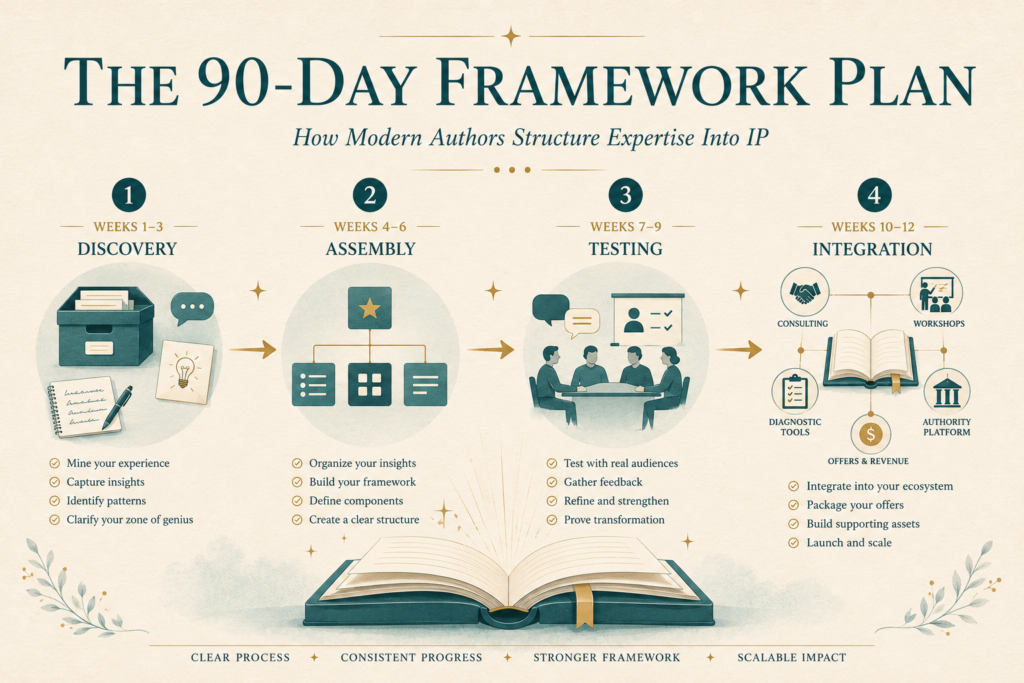
Part IX — How to Build a Framework in 90 Days (Step-by-Step Plan)
Frameworks are not built through isolated thinking.
They are built through structured iteration.
This plan organizes the process into four phases over approximately 12 weeks—moving from raw material to a usable, validated system.
Phase 1 — Discovery (Weeks 1–3)
The goal is to surface the raw material.
Focus on collecting and reviewing existing inputs:
- client conversations
- past work and content
- workshops, interviews, and notes
- repeated problems and outcomes
At this stage, do not try to structure or refine.
The objective is volume and visibility—making patterns easier to detect later.
Phase 2 — Assembly (Weeks 4–6)
The goal is to convert patterns into structure.
Begin shaping the framework:
- define the transformation (start state → end state)
- identify recurring patterns
- group patterns into a coherent structure
- choose a framework shape (process, model, pillars, or spectrum)
- name core components
By the end of this phase, the framework should exist as a clear system, not a collection of ideas.
Phase 3 — Testing (Weeks 7–9)
The goal is to validate usability.
Introduce the framework in live environments:
- small advisory groups
- workshops or working sessions
- simple diagnostics or exercises
Observe how the framework performs:
- where it is understood immediately
- where it requires explanation
- where it breaks or creates confusion
Refine the structure based on behavior, not opinion.
Phase 4 — Integration (Weeks 10–12)
The goal is to make the framework operational.
Embed the system into real use:
- align it with offers or services
- map it into a book structure
- standardize language and presentation
- create supporting materials (visuals, outlines, tools)
At this stage, the framework should be stable enough to apply consistently.
90-Day Framework Plan (Quick Overview)
Use this as a simple operating view:
- Weeks 1–3: Collect and review raw material
- Weeks 4–6: Structure and define the framework
- Weeks 7–9: Test in live environments and refine
- Weeks 10–12: Integrate into offers, book, and delivery
At any point, if progress stalls, return to the previous phase and resolve the structural gap before moving forward.
What You Get From a 90-Day Framework Plan
This process compresses what is often an unstructured effort into a defined timeline.
It ensures:
- the framework is grounded in real experience
- the structure is clear and repeatable
- the system is validated before scaling
The outcome is not just a framework.
It is a working asset—ready to support a book, offers, and long-term positioning.
Why Speed Matters When Building a Framework
Speed is not about moving faster for its own sake.
It is about reducing the time between idea → structure → real-world use.
The longer a framework stays in development, the more likely it becomes abstract, overbuilt, and disconnected from actual use.
Why Moving Too Slowly Hurts Framework Development
When there is no time constraint, frameworks tend to expand.5 JOBS OF A STRONG FRAMEWORK
More ideas are added.
More nuance is introduced.
More language is layered in.
This creates the illusion of progress.
But in practice, it delays the one thing that matters:
seeing whether the system actually works.
How Time Constraints Improve Framework Clarity
A defined window—such as 90 days—changes the behavior of the process.
It forces you to:
- decide what the framework is about
- choose a structure instead of exploring endless variations
- name components before they feel perfect
- put the system in front of real users earlier
These are the moments where clarity is created.
Not through thinking, but through commitment.
Why Most Frameworks Become Too Complex
Frameworks usually become heavy in predictable ways:
- too many components without a clear relationship
- language that tries to capture everything instead of guiding action
- delayed testing because the system is “not ready yet”
These are not quality improvements.
They are avoidance of decision-making.
The Right Way to Build a Framework (Test Early, Refine Later)
Speed changes the sequence.
Instead of:
Think → refine → perfect → test
It becomes:
Think → structure → test → refine
This shift moves the framework out of isolation and into use earlier.
A Simple Rule for Building a Framework Faster
A useful operating rule:
If the framework cannot be structured and introduced to a small group within a few weeks, it is not a time problem—it is a clarity problem.
Time does not fix unclear thinking.
Structure does.
The Real Advantage of Building a Framework Quickly
Speed does not reduce quality.
It reveals it.
By compressing the cycle, the framework is forced to prove itself sooner—before unnecessary complexity is added.
From Expert to Framework Creator (Final Shift)
Expertise is where most people begin.
It is not where durable authority is built.
Expertise matters.
But on its own, it remains personal—expressed through conversations, content, judgment, and experience.
A framework changes that.
It turns what you know into something others can understand, apply, and carry forward.
That is the real shift this guide has been building toward:
Expert → Framework Creator
This is more than a branding move.
It is a structural change in how your knowledge works.
What Changes When You Turn Expertise Into a Framework
Once expertise becomes a framework, it stops operating only through you.
It becomes:
- a system that can be taught
- a model that can be named
- an asset that can be distributed
- a method that can support books, offers, and tools
This is the difference between having insight and building intellectual property.
One stays dependent on the expert.
The other begins to scale beyond them.
Why Becoming a Framework Creator Matters
Experts are valuable because they know.
Framework creators become valuable because what they know has been structured into something repeatable.
That structure creates leverage.
It allows one body of knowledge to become:
- a book
- a consulting method
- a diagnostic
- a program
- a category-defining point of view
Over time, that is how expertise stops being episodic and starts becoming infrastructure.
From Framework Creator to Category Builder
The shift does not end with framework creation.
Once the framework is clear, named, and used, a second transition becomes possible:
Framework Creator → Category Builder
At that point, the work is no longer just about having a system.
It is about becoming the reference point for how a problem is understood.
That is how authority deepens.
Not through more content.
Not through louder promotion.
Through clearer structure that the market begins to recognize, adopt, and repeat.
The Real Outcome: Turning Expertise Into Scalable Intellectual Property
Ideas are temporary.
Expertise is valuable, but limited if it remains unstructured.
Frameworks are what make knowledge durable.
They allow your thinking to move from:
- private knowledge
- to public system
- to scalable asset
That is the real opportunity.
Not just to share what you know.
But to build a framework that can outlast the moment, travel beyond you, and become the foundation for everything that follows.
FAQs
What is a framework in a nonfiction book?
A framework is a structured system that organizes ideas into a clear model, helping readers understand, apply, and repeat a concept or process.
How do you turn expertise into a framework?
You turn expertise into a framework by identifying repeated patterns, organizing them into a clear structure, naming the system, and refining it so others can understand and apply it.
Why are frameworks important for authors?
Frameworks make books more structured, memorable, and actionable. They help authors turn ideas into intellectual property that can support offers, content, and long-term authority.
Can you build a framework without writing a book?
Yes. A framework can exist independently, but a book is often the best way to document, distribute, and scale that framework.
How long does it take to build a framework?
A clear framework can typically be developed in 60–90 days using structured iteration, testing, and refinement.
What makes a strong framework?
A strong framework has:
- a clear transformation
- defined components
- logical structure
- consistent naming
- and real-world usability
How do you validate a framework before publishing?
You validate a framework by testing it with real users and observing whether they can understand, apply, and repeat it without your help.
What is the difference between ideas and intellectual property?
Ideas are individual insights. Intellectual property is a structured, named system that explains how something works and can be consistently applied.
Turn Your Expertise Into a Framework That Scales
Most experts don’t need more ideas.
They need structure.
A framework is what turns your thinking into something that can be:
- taught
- published
- monetized
- and scaled beyond you
If you already have the expertise, the question is not what to create next.
It’s:
How do you structure what you already know into something that works without you?
That is the difference between:
- sharing ideas
- and building intellectual property
If You’re Ready to Build Your Framework
At Manuscripts, we work with founders, consultants, and operators to turn real-world expertise into:
- a clear, named framework
- a structured book that distributes it
- a system that supports offers, positioning, and long-term authority
If you’re thinking about:
- writing a book
- building a methodology
- or turning your experience into something scalable
The next step is not writing more.
It’s structuring better.

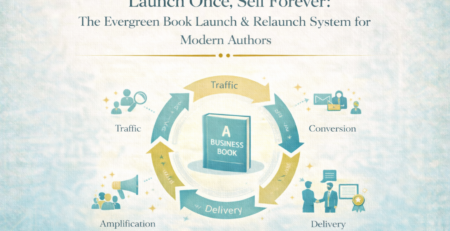





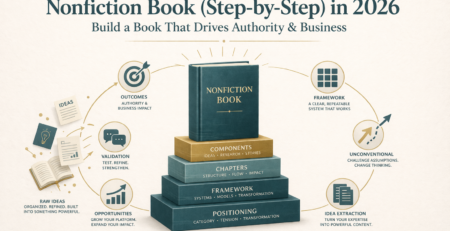




Leave a Reply