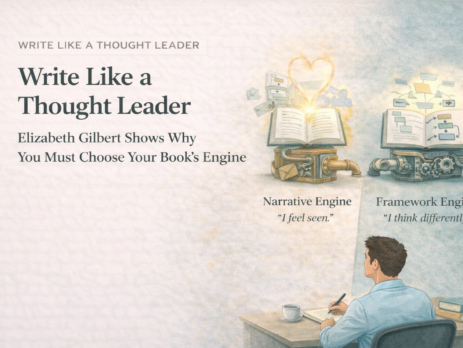
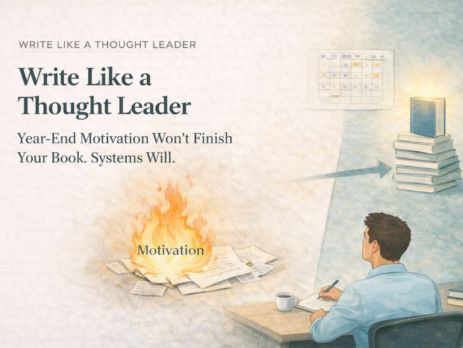
Elizabeth Gilbert’s career makes this unavoidable. Half her readers love Eat, Pray, Love. Half love Big Magic. Same author. Completely different books.
The difference isn’t tone.
It’s engine.
This is the Engine Decision Rule: choose the dominant force that carries the reader experience.
This elevates the doctrine without adding structure.
Gilbert chose the core engine of each book, memoir or thought leadership, and everything else flowed from that decision: structure, audience experience, and downstream opportunity.
If you don’t choose the engine early, the manuscript fractures.
Cleaner. Less rhetorical flourish. More structural authority.
The Split Reaction: Which Elizabeth Gilbert?
Ask people what they think of Elizabeth Gilbert and you’ll often get two very different answers.
One group talks about Eat, Pray, Love like it’s a mirror: “I felt seen.” “It captured something I couldn’t articulate.”
The other group talks about Big Magic like it’s fuel: “It changed how I think about creativity.” “It made me act.”
Same author.
Two completely different reader experiences.
That split isn’t accidental.
It’s structural.
The Trap: Trying to Write All Three Books at Once
Most authors don’t fail because their ideas are weak.
They fail because their engine is confused.
They try to write:
A memoir
A lesson book
A novelistic narrative
All inside one manuscript.
The result feels unfocused.
It has stories, but no immersive arc. It has ideas, but no structured progression. It has scenes, but no teaching spine.
Even strong material collapses under genre ambiguity.
When the engine is unclear, the chapters resist cohesion.
What Makes Big Magic Thought Leadership
Big Magic works because it teaches.
Its engine is instructional.
You can see it in the structure.
Reframe First
It begins by redefining the problem.
Fear isn’t mystical. It’s ordinary. It’s predictable.
The book opens by shifting interpretation.
Principles Drive the Chapters
Each section advances a clear claim.
The argument progresses through principles, not chronology.
Stories Support, They Don’t Lead
Personal anecdotes appear as evidence.
They illustrate the idea.
They are not the engine.
Application Is the Outcome
Readers leave with permission and practice.
Not just inspiration.
But direction.
That’s thought leadership.
It reframes.
It structures.
It teaches.
What Makes Eat, Pray, Love Creative Nonfiction
Eat, Pray, Love works because it immerses.
Its engine is narrative.
You can see it in the design.
A Bounded Time Frame
One year.
A contained arc.
Not a whole life story.
Scene + Reflection Rhythm
Experience first.
Meaning second.
The reader watches transformation unfold.
Immersion Over Instruction
There is no framework.
There is no structured lesson.
The power is proximity.
Internal Drama Drives Momentum
The tension is internal: longing, identity, reinvention.
The pages turn because the reader wants emotional resolution.
That’s creative nonfiction.
Connection precedes instruction.
Two Genres: Two Business Models
Engine choice doesn’t just shape the reading experience.
It shapes the opportunity that follows the book.
Eat, Pray, Love expanded as story.
It led to:
Film adaptation
Global media presence
Travel and cultural expansion
Those opportunities emerge naturally from narrative.
Stories scale through adaptation and emotional resonance.
Big Magic expanded as teaching.
It led to:
An evergreen thought-leadership platform
Workshops
Speaking
Creative community
Who You Write For Shapes What You Can Build
Genre defines reader expectation.
Creative nonfiction readers want:
Emotional resonance
Identification
“I feel seen.”
Thought leadership readers want:
Distinctions
Frameworks
“I think differently.”
If you blur the contract, friction appears.
If someone expects immersion and receives instruction, it feels preachy.
If someone expects instruction and receives scenes, it feels unfocused.
The engine determines what the reader is here to receive.
The Steve Fredlund Example: When It Doesn’t Feel Right
Sometimes the writing is strong.
But the genre is wrong.
Steve Fredlund initially wrote philosophy.
The ideas worked.
But it didn’t feel authentic.
The structure was instructional. The voice wanted immersion.
He pivoted to memoir.
The insight:
Even a strong draft can misalign with your natural engine.
When genre matches voice, the work flows.
When it doesn’t, friction multiplies.
The Core Decision Framework
Before drafting, decide the engine.
Not the topic. Not the tone. The engine.
Every serious book runs on one of two core forces:
The Mirror
The reader sees themselves.
Emotional immersion
Scene-driven progression
Internal transformation
“I feel understood.”
The power is recognition.
The story carries the insight.
The Map
The reader sees a path.
Distinctions and reframes
Principle-driven sections
Stories as illustration
“I know what to do.”
The power is clarity.
The framework carries the insight.
If the reader can’t tell whether they’re here to feel or to learn, clarity erodes.
Ask three questions:
What should readers say the day after finishing?
What experience should dominate: immersion or instruction?
What do you want this book to unlock after publication?
This reinforces operational clarity without adding new sections.
The Only Question That Matters
When someone finishes your book, which sentence should be true?
“I feel seen.”
Or
“I think differently.”
Choose the outcome.
Then build the engine around it.
The Real Lesson from Gilbert
Elizabeth Gilbert didn’t ask:
“What do I want to say?”
She asked:
“What does this book need to be?”
Each book had:
A clear engine
A clear audience
A clear structural form
That’s why both succeeded.
The lesson is structural:
Choose the engine first.
Structure, audience experience, and opportunity follow.
What This Means for Writing Like a Thought Leader
Thought leadership books don’t start with content.
They start with the engine.
Decide the reader experience first.
Then design the structure that delivers it.
That means:
Choose immersion or instruction Build the manuscript around that choice Let stories or frameworks carry the reader journey
Thought leadership isn’t about having ideas.
It’s about choosing the mechanism that makes those ideas travel.
That’s what Elizabeth Gilbert understood.
And that’s why her books work.
Quick FAQ
Can a book mix memoir and thought leadership? Yes, but one must still be dominant. The engine must remain clear.
Why does genre confusion weaken books? Because readers expect a specific experience. If the contract is unclear, the structure feels inconsistent.How do I choose my book’s engine? Decide what the reader should say after finishing: “I feel seen” or “I think differently.”
Eric Koester is an award-winning entrepreneurship professor at Georgetown University, bestselling author, and founder of Manuscripts, the Modern Author OS used by more than 3,000 authors. His work has helped creators turn ideas into books, books into brands, and brands into scalable businesses.
About Manuscripts
Manuscripts is the leading full-service publishing partner for modern nonfiction authors. We help founders, executives, coaches, and experts turn their books into growth engines, through positioning, coaching, developmental editing, design, AI-enhanced writing tools, and strategic launch systems. Manuscripts authors have sold thousands of books, booked paid speaking gigs, landed media features, and generated millions in business from their IP.
Work With Us
If you’re writing a book you want to matter, let’s map out your Modern Author Plan.
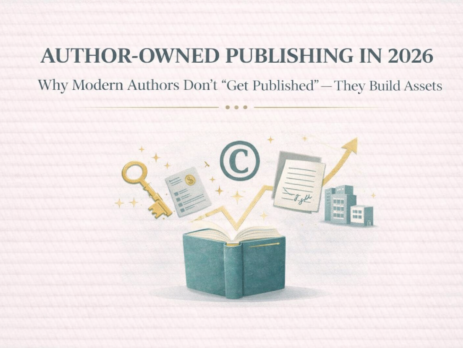
Most authors still believe the publishing story they were taught as kids:
You write a book.
A publisher chooses you.
Your book appears in bookstores.
Your career changes.
That story is outdated.
Not because books don’t matter.
Because the publishing economy has changed completely.
In 2026, the question is no longer:
Can you get published?
The question is:
Can you own what you publish?
Because ownership is the difference between:
a book that sells a few hundred copies
and a book that becomes a business asset for the next decade
This is the Modern Author shift.
Publishing Isn’t About Printing Books
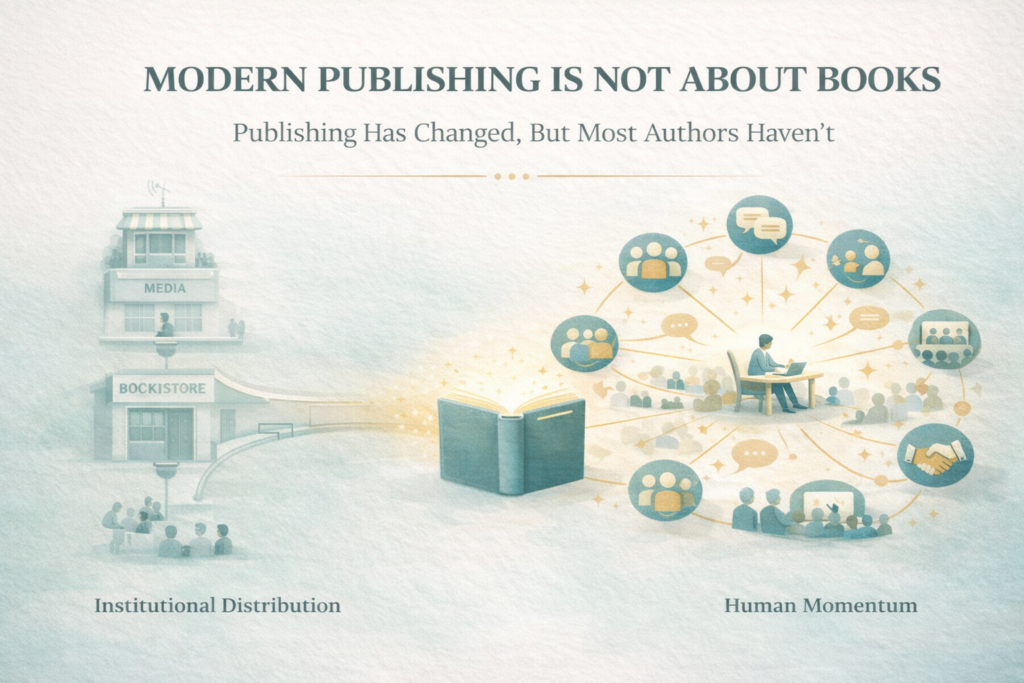
Publishing has never really been about paper.
It has always been about distribution.
For most of the last century, publishers held a monopoly on four things:
access to bookstores
production infrastructure
industry expertise
permission
If you wanted readers, you needed a gatekeeper.
Traditional publishing existed because it was the only way to scale distribution.
As we often say:
Traditional publishing was a distribution vehicle.
That’s what it was built for.
But distribution is no longer scarce.
The Distribution Monopoly Is Gone
Amazon changed everything.
Today, most books are discovered online, not in bookstores.
And the hard truth is this:
You no longer need a publisher to get your book to readers.
You need a strategy.
You need infrastructure.
You need an operating system.
Because the barrier is not printing.
The barrier is activation.
The Hidden Truth of Publishing Economics
Here is the statistic that shocks almost every first-time author:
The median traditionally published book sells roughly 250 copies in its first year.
That’s not a typo.
Two hundred and fifty.
And royalties are often around $1 per book.
Meaning the median author earns a few hundred dollars.
Most authors don’t fail because they aren’t talented.
They fail because they misunderstand what publishing actually delivers.
Traditional publishing does not guarantee:
marketing
distribution success
audience growth
meaningful ROI
It guarantees one thing:
The publisher owns the asset.
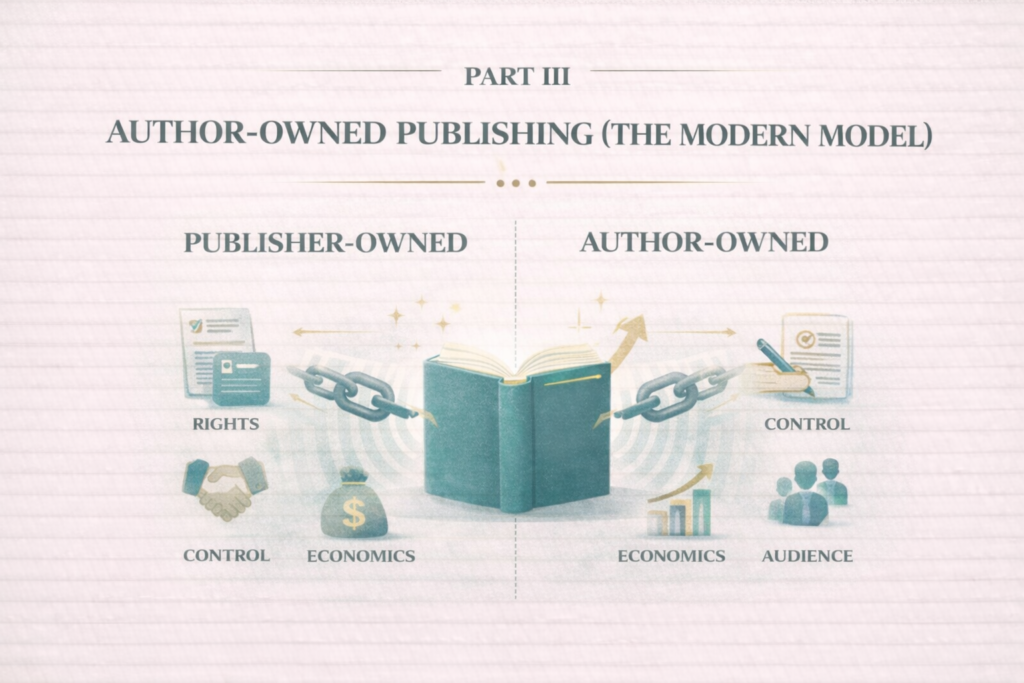
Publisher-Owned vs Author-Owned Publishing
This is the real divide.
Traditional publishing is usually publisher-owned publishing.
You trade away:
rights
control
economics
long-term upside
In exchange for:
a logo
a deal
the illusion of distribution
Most authors don’t realize what they’re signing until later.
I’ve lived this personally.
My first traditionally published book is no longer even mine.
I don’t own the copyright anymore.
That’s what publisher-owned publishing means.
And once you understand that, you never see publishing the same way again.
The Creator Economy Already Solved This
Publishing is going through the same transformation music went through.
Taylor Swift signed away her catalog at 15.
Years later, someone else owned her life’s work.
So she did the only rational thing:
She rebuilt ownership.
“Taylor’s Version” wasn’t about nostalgia.
It was about power.
Chance the Rapper refused labels entirely.
He owned his work.
He owned his distribution.
He owned his upside.
That’s the modern creator model.
Authors are next.
Author-Owned Publishing Is the Modern Model
Author-Owned Publishing means:
you retain your rights
you control your positioning
you build your audience directly
you monetize beyond retail
you own the asset you create
This doesn’t mean doing everything alone.
It means building the right professional team around an author-owned structure.
Hybrid publishing, when done correctly, is simply:
professionally supported self-publishing.
The author remains the owner.
The publisher becomes the partner.
That is the Manuscripts model.
The Modern Author Doesn’t Chase Royalties
They chase leverage.
Outside research and our internal data show the same thing:
Only 5–15% of nonfiction author income comes from retail book sales.
The other 85–95% comes from what the book unlocks:
Speaking
consulting
workshops
enterprise training
licensing
media authority
long-term trust
Modern authors don’t write books to sell books.
They write books to build platforms.
Presale Publishing Is the Missing Piece
The single biggest mistake authors make is waiting until publication to find readers.
Modern authors do the opposite.
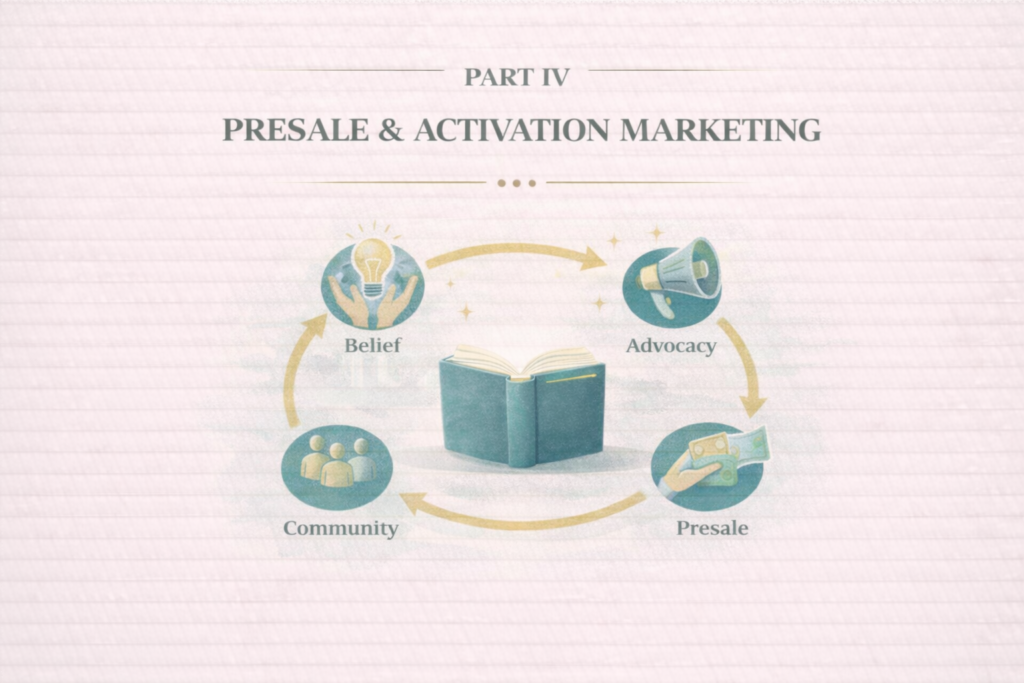
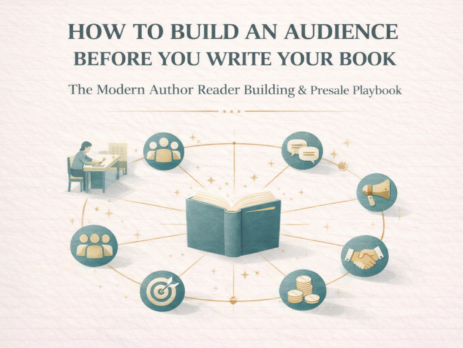
They build their reader community before the book exists.
They presell.
They activate.
They turn the book into a shared project, not a finished product.
Because something powerful happens when someone supports a book early:
They don’t just buy.
They evangelize.
When a reader buys a book after publication, they tell almost nobody.
When they buy before it’s done, they tell three to five other people.
That is the difference between a launch and a movement.
Presale-first publishing is not marketing.
It’s community formation.
It’s the foundation of Author-Owned Publishing.
This Guide Will Show You the Full Modern Publishing System
This is not a guide about “how to self-publish.”
It’s a guide about how modern authors build durable intellectual property.
Inside, you’ll learn:
the real economics of traditional vs hybrid publishing
why most books fail commercially even with publishers
what Author-Owned Publishing actually means in practice
how presale publishing creates audience before launch
the activation marketing model that outperforms ads by 100x+
how modern authors build books that generate ROI for years
why Manuscripts Press has become a top global publisher through this approach
how to publish without giving away the asset you’re creating
Publishing is no longer about getting chosen.
It’s about building something you own.
Let’s show you how.
Publishing isn’t about printing a book.
It’s about owning an asset that opens doors for the next ten years.
Most people still treat publishing as a finish line. You write a manuscript, hand it off, hope someone cares, sell a few hundred copies, and move on. If the book doesn’t “hit,” the project is quietly categorized as a miss, and the effort ends there.
That model made sense when publishing was scarce, permission-based, and controlled by a small number of gatekeepers. Today, it produces frustration because it confuses production with value.
A book is not valuable because it exists. It’s valuable because of what it enables.
The Old Model: Production Without Leverage
Under the legacy view, publishing looks like this:
Write the book
Hope a publisher accepts it
Sell a small number of copies
Move on to the next thing
Success is measured by validation and distribution. Once the book is out, the author’s role is effectively over.
The problem isn’t that this approach is wrong. It’s that it’s structurally misaligned with how serious professionals actually want books to work.
Most executives, founders, and experts are not trying to “be authors.” They’re trying to build authority, create opportunity, and extend the reach of their thinking. A model that treats the book as a one-time product can’t do that.
The Modern Shift: Publishing as Asset Ownership
Modern authors operate from a different premise: a book is infrastructure.
Instead of asking, “How do I get published?” they ask, “What asset am I building, and what should it unlock?”
That shift changes everything.
Modern authors design their books to:
Own their rights, so the work compounds instead of expiring
Own their audience, rather than renting attention at launch
Activate demand before the book exists, creating momentum instead of silence
Monetize beyond retail, turning a book into a platform rather than a receipt
The book is no longer the end product. It’s the central node in a larger system of leverage.
Publishing Is a Strategy, Not an Event
When publishing is treated as asset creation, success is no longer defined by acceptance or initial sales. It’s defined by control, longevity, and optionality.
Who owns the work? Who owns the audience relationship? What doors does the book make easier to open?
Those questions matter more than where the book is printed or how many copies move in the first month.
As Eric Koester puts it:
“Your book will open doors for you. The more strategic you are about what doors you want, the better.”
That sentence captures the modern reality. Books don’t create value equally. Strategy determines which doors open, and which never do.
This guide starts from that premise. Not how to publish a book, but how to build an asset that makes publishing worth doing at all.
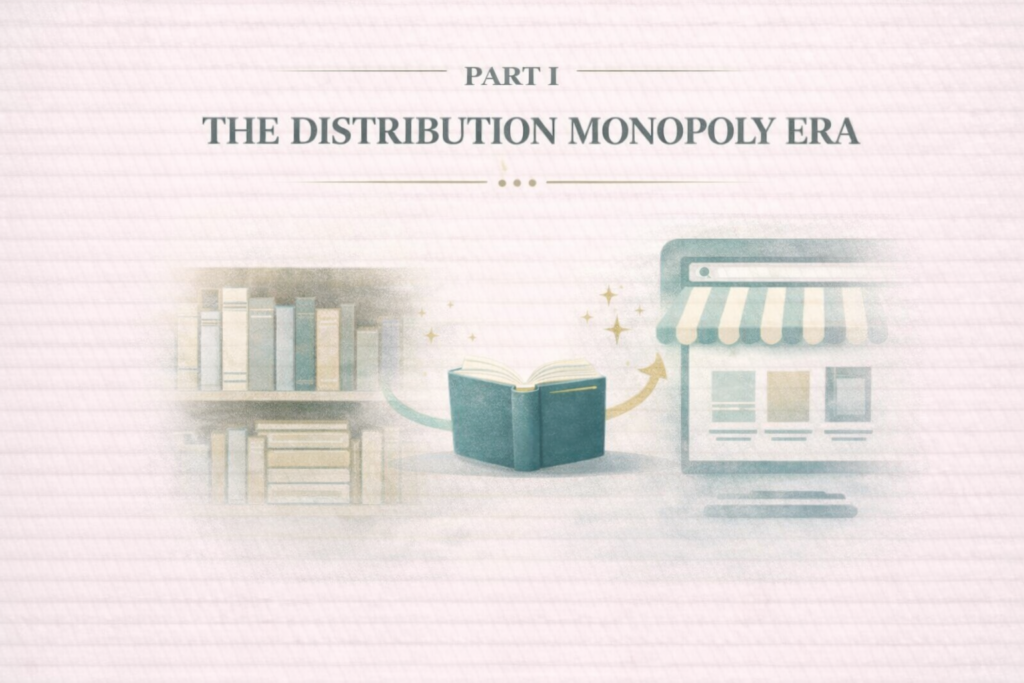
Publishing Used to Be a Distribution Monopoly
Traditional publishing wasn’t built for authors. It was built for bookstores.
For most of publishing history, books were sold in physical retail locations. That single constraint shaped the entire industry.
Readers bought books in stores. Stores didn’t want to manage relationships with thousands of individual authors. So publishers emerged as the intermediary.
Their role was not primarily cultural or creative. It was logistical.
Publishers existed to make physical distribution work at scale.
Once you understand that, the rest of the system makes sense.
What Traditional Publishing Actually Solved
Traditional publishing bundled four functions that were necessary in a bookstore-driven world:
Expertise (gatekeeping) Shelf space was scarce. Publishers filtered manuscripts to decide which books deserved access.
Production Editing, layout, printing, and cover design required specialized teams and economies of scale.
Resources Someone had to front the cost of producing inventory before a single book was sold.
Distribution Publishers had established relationships with bookstores and wholesalers that authors could not access directly.
Together, these functions formed a tightly integrated system optimized for physical retail.
That system worked, because it had to.
Why Control Concentrated
When access to readers depended on bookstores, access became scarce. Scarcity created leverage.
Publishers controlled distribution. Distribution control justified ownership of rights, long timelines, and asymmetric economics.
This wasn’t malice. It was structure.
A distribution monopoly doesn’t require bad actors. It only requires bottlenecks.
And for decades, physical distribution was the bottleneck.
The Key Reframe
Traditional publishing was really a distribution vehicle.
Once you see it that way, much of the mythology dissolves.
Publishers were not arbiters of legitimacy. They were infrastructure built for a specific era.
And that era was defined by physical access, not authorship, ownership, or long-term leverage.
Understanding this releases authors from outdated assumptions about what publishing is supposed to look like.
If the original constraint no longer defines the market, then optimizing for it no longer makes sense.
That question, what constraint matters now, is where modern authorship begins.
Publisher-Owned Publishing (The Old Trade)
The Tradeoff Authors Didn’t Understand
For decades, a traditional publishing deal has been framed as a reward. Validation. Legitimacy. Support.
In reality, it is a transaction most authors never fully see.
A traditional deal is not free validation. It is an exchange of ownership for distribution access.
In practical terms, that exchange usually looks like this:
You give up your intellectual property
You earn roughly 10% royalties
The publisher controls rights, pricing, and lifecycle decisions
What feels like recognition is actually a transfer of leverage.
Royalties, Without the Myth
Many authors assume that publishing success means earning money from book sales. The math rarely supports that belief.
Even in respectable deals, royalties are small, capped, and slow to materialize.
Eric Koester’s own experience is illustrative:
5% royalties on the first 500 copies
Rights surrendered as part of the deal
That structure isn’t unusual. It’s representative.
Royalties are not designed to reward authors for long-term value creation. They are designed to compensate contributors after ownership has already changed hands.
Once the math is visible, the fantasy dissolves.
Control Loss Is Permanent
The most misunderstood part of a traditional deal is not royalties. It’s irreversibility.
When rights are assigned to a publisher, that decision is not symbolic or temporary. It is structural.
As Eric puts it:
“I don’t own the copyright anymore… they put it in the public domain.”
That outcome is not an edge case. It is a consequence of ownership transfer.
Publishing contracts are asset decisions with long tails. They determine who controls the work years, or decades, after the launch window closes.
The Marketing Illusion
The final justification many authors hold onto is marketing.
The assumption is simple: “If a publisher takes my book, they will help sell it.”
The reality is more constrained:
No meaningful marketing dollars for most titles
No advance for roughly 98% of authors
You still do the majority of promotion
What the publisher provides is distribution access, not demand creation.
Once distribution is no longer scarce, this tradeoff stops making sense.
From Aspiration to Agency
This section is not about resentment. It’s about alignment.
If authors are responsible for the work, the promotion, and the outcome, then ownership matters.
The quiet realization this section should leave behind is simple:
If I’m doing the work anyway, I should own the upside.
That realization is what makes the modern publishing conversation possible.
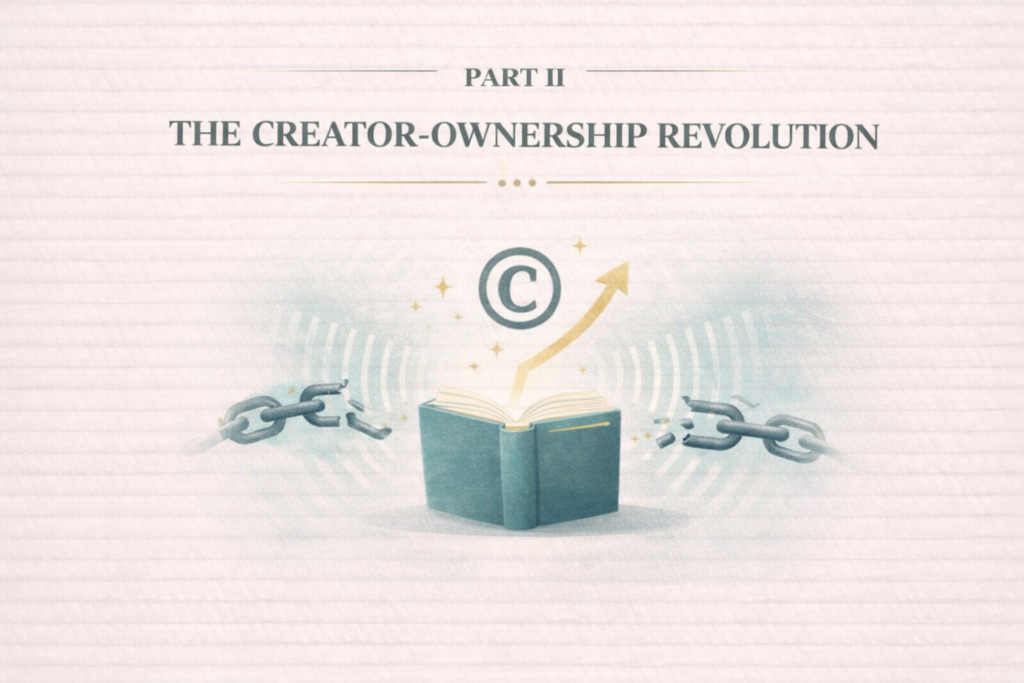
The Creator-Ownership Revolution (The Taylor Swift Moment)
Publishing Is Going Through What Music Already Did
Publishing is late to a shift that already reshaped music, film, and media.
For most of the last century, creators traded ownership for access:
access to distribution
access to audiences
access to professional infrastructure
That trade made sense when access was scarce.
But once distribution becomes abundant, once creators can reach audiences directly, the old deal stops being “the way it works” and starts becoming a choice.
That is the moment publishing is now entering.
Creator as Owner Is the New Default
Across creator industries, a clear pattern emerged:
Early creators give up rights to get in the door.
Middlemen capture the long-term value of the catalog.
The creator eventually realizes the asset wasn’t the product, it was the rights.
Ownership becomes the lever that unlocks leverage, longevity, and optionality.
Publishing is not exempt from this logic. It is simply catching up.
Taylor Swift’s Lesson: Rights Outlive LaunchesTaylor Swift’s “Taylor’s Version” era is not a pop culture curiosity. It’s a rights lesson.As a teenager, she signed a standard record deal, one that transferred ownership of her masters. Over time, those rights changed hands. Eventually her catalog was controlled by someone else.Her response was not branding. It was an ownership move:she re-recorded her workreleased it under versions she ownedrebuilt the catalog on her termsThe strategic takeaway is simple:When creators own the asset, they control the future.That is what ownership buys: not a moment, but a decade of leverage.
Chance the Rapper’s Lesson: Permission Is Optional NowTaylor’s story shows why ownership matters after success.Chance the Rapper shows something different: ownership is available from the start.When labels offered him distribution but demanded rights, he refused. He released his work independently, built momentum directly with listeners, and achieved both commercial and cultural legitimacy, without signing away control.The takeaway is not that every creator should follow the same path.It’s that the old requirement, permission first, ownership later, is no longer structurally true.
Ownership Is Power
These stories point to a governing principle that now applies to authors:
Ownership creates optionality.
Optionality creates leverage.
Leverage creates longevity.
This is why author-owned publishing is not radical. It is the normal direction of creator economies once distribution stops being a gate.
And it leads to the conclusion modern authors need to internalize:
Authors don’t need permission anymore.
Amazon Changed the Game Forever
The Only Bottleneck That Ever Mattered Was Distribution
For most of publishing history, the key constraint wasn’t writing quality. It was reader access.
If readers bought books in physical stores, then shelf space and retail placement were the gate. Publishers didn’t have power because they were better at judging ideas. They had power because they controlled the channel.
That’s why distribution was the central function traditional publishing solved. Everything else, editing, design, printing, credibility, was bundled around that core reality.
Distribution Is No Longer Exclusive
Amazon removed the need for a single intermediary to reach readers.
That does not mean “anyone can write a good book.” It means no one has exclusive control over the path between a finished manuscript and a buyer.
As Eric Koester puts it:
“You don’t have to have someone give you permission to get your book to readers.”
That sentence is the turning point. In a world where authors can reach readers directly, permission-based publishing collapses as the default strategy.
The Center of Gravity Moved Online
The modern book market is not organized around bookstore shelves.
Most books are now discovered, purchased, and delivered through online platforms. This changes what “distribution” even means:
nationwide placement is no longer required to sell nationally
discovery happens digitally, not aisle-by-aisle
reach is driven by audience access and visibility, not physical footprint
Bookstores still matter, but they are no longer the center of gravity. They are one channel inside a larger ecosystem.
Going Direct Is Not a Workaround. It’s the Default.
Once distribution is open, direct-to-reader publishing stops being a niche move and becomes normal infrastructure.
Authors can:
publish without being chosen
sell without retail placement
build demand without waiting for launch day
This is not a claim that the market is easier. It’s a claim that the gate has moved.
The bottleneck is no longer distribution access. It’s execution: strategy, positioning, audience, and momentum.
Freedom Increases Responsibility
When intermediaries stop controlling access, authors gain leverage, but they also inherit responsibility.
If you can go direct, then the decisive questions become:
do you own the rights to the asset you’re creating?
do you own an audience relationship, or are you renting attention at launch?
do you have a strategy to create demand before publication?
Amazon removed scarcity. Now the advantage shifts to the authors who know what to do with it.
Author-Owned Publishing (The Modern Model)
The Simplest Definition
Author-Owned Publishing is a model where the author retains ownership and control of the book as a long-term asset.
That means:
You keep your rights.
You keep creative control.
You keep the economic upside.
You own the system that brings the book to market.
Publishing, in this model, is no longer something that happens to you. It’s something you design and operate.
This is not a niche alternative. It is the default model once distribution is no longer scarce.
From “Getting Published” to Building Infrastructure
In the traditional model, publishing is a handoff: You finish a manuscript, pass it to a publisher, and wait.
In an author-owned model, publishing is infrastructure: You design how the book is produced, launched, distributed, and leveraged over time.
The role of the author changes accordingly:
From applicant to operator
From recipient of services to owner of a system
From one-time launch to long-term leverage
The book is no longer the endpoint. It’s the core asset inside a broader engine.
Ownership Comes With Responsibility
Author-owned publishing is not about doing everything yourself. It’s about deciding where responsibility lives.
When you own the asset:
Control replaces delegation.
Strategy replaces hope.
Systems replace gatekeepers.
This is the tradeoff. Freedom increases, but only if the author is willing to engage as an owner, not a bystander.
The Two Ownership-First Paths
There are two primary ways authors execute author-owned publishing today. They differ in how support is assembled, not in who owns the book.
Self-Publishing The author assembles and manages the team directly:
Editors
Designers
Production
Launch and distribution
The author owns everything, and coordinates everything.
Hybrid Publishing The author still owns the book, but works with a professional partner that provides the team and infrastructure.
As Eric Koester puts it:
“Hybrid publishing is essentially professionally supported self-publishing.”
In both models:
The author retains rights.
The author controls creative decisions.
The author keeps the economic upside.
The difference is operational, not philosophical.
Two Paths Within Author-Owned Publishing
Dimension
Self-Publishing
Hybrid Publishing
Rights ownership
Author owns 100%
Author owns 100%
Creative control
Author decides
Author decides
Economic upside
Author keeps all
Author keeps all
Team assembly
Author builds team
Publisher provides team
Operational load
High
Shared
Role of publisher
None
Support + infrastructure
Asset ownership
Author
Author
Choosing Support Without Surrendering Ownership
Hybrid publishing is often misunderstood as a compromise. It isn’t.
It exists to solve a practical problem: Many authors want ownership without building a publishing operation from scratch.
In an author-owned hybrid model:
Ownership stays with the author.
Support is added, not substituted.
Control is shared intentionally, not forfeited contractually.
This reframes the decision away from prestige and toward design: How much operational responsibility do you want to carry personally?
The Decision That Actually Matters
Once authors understand author-owned publishing, the question changes.
Not: “Should I try to get published?”
But: “If I own this asset, how do I want to operate it?”
That question pulls the reader forward, toward choices about:
Editorial rigor
Audience ownership
Presales and launches
Monetization systems
Those are no longer side considerations. They are the work of ownership.
The Economics Nobody Understands
Why Most Books Fail Financially (Even When They’re Good)
Most authors operate with an unspoken assumption:
If the book is good, it will sell enough copies to justify itself.
That belief is understandable. It’s also wrong.
Not because authors lack talent or effort, but because book economics collapse at the median when copies are treated as the business model.
This section exists to replace hope with math.
The Median Reality (What Actually Happens)
Forget bestsellers. Strategy is built on what usually happens, not what occasionally happens.
Median book performance today:
Publishing Path
Typical Sales
Timeframe
Traditionally published
~250 copies
First year
Self-published
~25–50 copies
Lifetime
“The median traditionally published book sells 250 copies in its first year.” “The median self-published book sells 25 to 50 copies over its lifetime.”
These are not failure cases. They are the most common outcome.
Planning as if you’ll be the exception is not optimism. It’s poor design.
The Royalty Math (Where the Illusion Breaks)
Now translate sales into income.
Scenario
Calculation
Result
Traditional royalties
250 copies × ~$1 per book
~$250 total
Self-published royalties
25–50 copies × higher margin
Still negligible
This is not slow money. It is symbolic money.
Most authors quietly lose money here, and then blame themselves.
They shouldn’t.
This Isn’t About Talent. It’s About Structure.
Books don’t fail financially because:
the idea was weak
the writing wasn’t good
the author didn’t work hard enough
They fail because selling copies is a structurally weak business model.
Books are expensive to produce
Discovery is difficult
Word of mouth does not spread after publication
Royalties cap early and arrive slowly
This is a market structure problem, not a personal one.
Why This Forces a Different Strategy
Once you accept the math, one conclusion becomes unavoidable:
If selling copies is the plan, the plan doesn’t work.
That does not mean books are worthless. It means books cannot be treated as standalone businesses.
A viable model requires that:
Copies are not the primary revenue
Readers are not the only customers
The book plugs into something larger
Until that shift happens, authors will keep optimizing a system that cannot pay them back.
That is what the next sections solve.
Presale Publishing Is the Only Model That Works
Two Launches, Not One
Most authors still plan publishing like this:
Finish the book. Publish it. Then try to market it.
That sequence feels logical, and it consistently fails.
Books do not spread after publication. They either accumulate momentum before release, or they disappear quietly after it.
This is why modern publishing requires two launches, not one:
A presale launch, where belief is activated
A publication launch, where distribution catches up
Without the first, the second rarely matters.
Why Books Don’t Spread After Publication
After a book is published, reader behavior is passive.
A typical reader:
Buys the book
Reads privately
Tells no one
There is no social signal attached to the transaction. No urgency. No identity. No reason to share.
This is not a marketing failure. It’s a human one.
Why Presales Do Spread
Presales change the behavior entirely.
A presale buyer:
Commits before the book exists
Signals belief, not consumption
Tells three to five other people
That difference matters.
People don’t share transactions. They share identity.
Buying early says:
I’m part of this
I believe in this
I was here before it was finished
That’s why presales create word-of-mouth and retail doesn’t.
As Eric Koester puts it:
“When someone buys before it’s done, they tell three to five more people.”
That’s not anecdotal. It’s behavioral.
Presale Is Structural, Not Tactical
Presale is often misunderstood as:
A funding mechanism
A preorder tactic
A discount strategy
It’s none of those.
Presale is how momentum is created before distribution. It’s how readers become advocates. It’s how belief spreads ahead of availability.
That’s why this isn’t optional.
If you want reach, presale is the model. Not a hack. Not a trick. The structure.
Eric’s emphasis is intentional:
“Definitely definitely definitely definitely.”
Inside the model, this isn’t debated. It’s settled.
What This Forces Authors to Rethink
Once this lands, a few assumptions break:
Publishing is no longer the starting line
Marketing is no longer post-release
Momentum is no longer accidental
Presale shifts the author’s job from: “How do I promote my book?” to: “How do I activate belief early?”
That question changes everything.
Because once presale is the model, the next problem becomes obvious:
How do you design presales that actually work?
That’s what comes next.
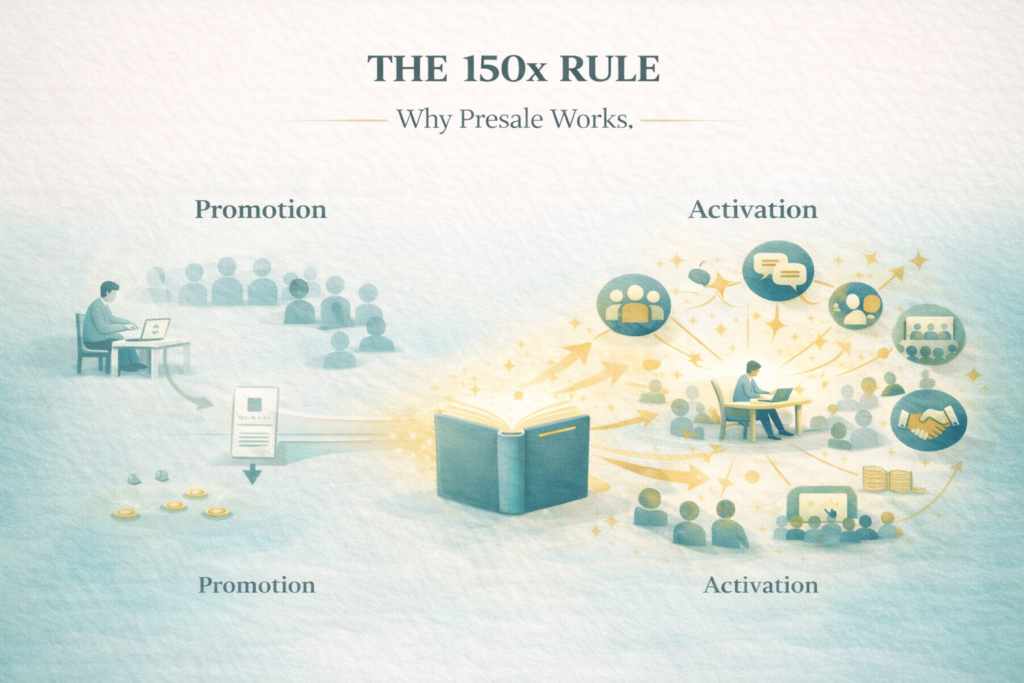
Activation Marketing (The 150× Rule)
Why How You Approach People Matters More Than How Many You Reach
By now, the pattern should be clear:
Presales matter
Early believers spread books
Audience ownership beats distribution
What still trips most authors up is this belief:
“I just need better marketing tactics.”
That’s not the problem.
The real difference is not what you say or where you say it. It’s how the relationship starts.
The gap between selling and activating is not incremental. It’s exponential.
The 150× Gap: Selling vs. Activating
Most book marketing fails for a simple reason: it starts with extraction.
Cold outreach, ads, blasts, DMs, treats attention as something to harvest. It asks for trust before any has been earned.
The economic result looks like this:
Dimension
Cold Outreach
Activation
Starting point
Stranger
Warm signal
First move
Ask
Give
Tone
Transactional
Relational
Psychology
Persuasion
Belonging
Trust level
Near zero
Pre-established
Typical outcome
~$15
~$2,000
Share behavior
None
3–5 referrals
Emotional response
Resistance
Advocacy
Identity
“I’m being sold to”
“I’m part of this”
This isn’t a copywriting problem. It’s a behavioral one.
Perks tied to retailer purchase (signed copies, community, events)
Traditional/hybrid launches, retail velocity, list strategy
This is what makes presales feel safe: they’re not improvised. They’re selectable.
Model A: Book Announcement Presale (6 Months Out)
This is the asset-building model.
You announce the book early, not to “generate buzz,” but to create a reason for the right people to join before the product is finished.
The goal is to activate belief early and build a base that compounds for years.
Common offers in Model A include:
Launch tickets (virtual or in-person)
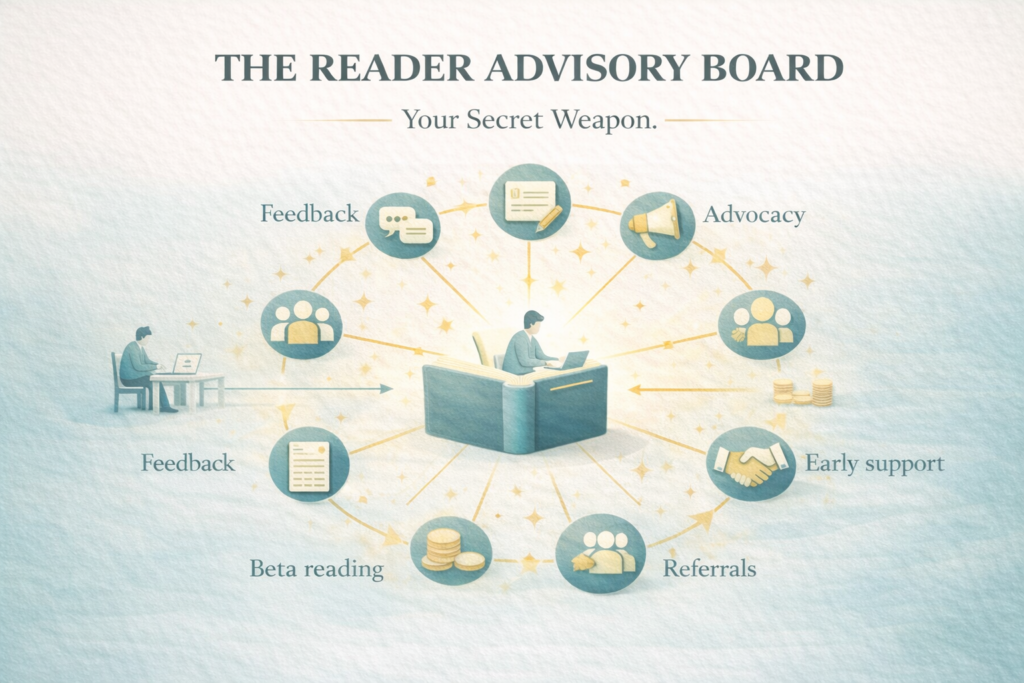
Workshops tied to the book’s topic
Early reader circles or advisory boards
Behind-the-scenes access to the work as it’s built
This model works when the author wants:
An owned audience, not rented attention
A book that functions as infrastructure, not a one-time product
Momentum before publication, not pressure after
Scott White is a clean proof point: an early book announcement presale can sell meaningful volume before publication, because the offer is participation, not a finished object.
Model B: Author Perks Presale (2–3 Months Out)
This is the distribution-optimized model.
The book is close to done. The author wants retail velocity. So presale is structured around a simple mechanic:
Buy the book through a retailer, submit proof, get a perk.
Typical perks include:
Signed copies or bookplates
Private community access
Launch events, Q&As, or bonus workshops
Limited sessions tied to the book’s theme
This is the model used by authors who are aligning toward:
Bestseller list mechanics
Retail reporting windows
Traditional launch sequencing
Eric’s point is simple: these perks are not gimmicks. They are activation devices, community access, signed copies, participation moments that make buying early feel like joining, not purchasing.
The Mechanism Behind Both Models
The models look different. The mechanism is the same.
Both work because they convert a reader into an early believer, and early believers behave differently than customers.
They commit before completion
They feel like insiders
They tell other people
The variable is not whether you activate. It’s:
when you activate
what you offer
what outcome you’re optimizing for
Proof This Isn’t ExperimentalModern presales work at every level of authorship.Scott White sold 600+ launch tickets and $40K+ before publication by announcing the book early and inviting supporters into the process.Dan Pink, Adam Grant, and Simon Sinek run retail-aligned presales, offering signed copies, community access, and events tied to retailer purchases.Different models. Same mechanism. Early belief activates demand.
Choosing the Right Model
If your priority is building a long-term asset, an owned audience and a compounding platform, start early with Model A.
If your priority is retail alignment and launch velocity, especially inside a traditional or hybrid timeline. Use Model B.
Presales aren’t risky. Waiting is.
The Extended Launch (Launch Once, Sell Forever)
Most authors plan for a single moment.
They imagine publishing as a one-and-done event: a launch week, a short spike, then silence. If the book doesn’t “hit” immediately, they assume the window closed, and the opportunity is gone.
That thinking comes from the old system.
Modern books aren’t events. They’re platforms. And platforms have recurring ignition points.
Traditional publishing often produces a spike because it’s designed around one primary release cycle. Modern author-owned publishing creates an extended runway because it treats the book as a long-term asset, one that can be reintroduced, reactivated, and resold for years without rewriting the core work.
Spike Thinking vs Asset Thinking
Spike thinking treats time as an enemy: If you miss launch week, you missed the book’s chance.
Asset thinking treats time as leverage: The book can compound because new audiences arrive continuously, and every format creates a new reason to reintroduce it.
Slow sales aren’t proof the book failed. They’re proof the launch strategy was built like a one-time event instead of an extendable system.
That is not a production checklist. It’s a leverage strategy.
Each edition is not a bonus for a book that already succeeded. Each edition is a new launch moment, a clean reason to:
re-enter the conversation
reach a different segment of readers
create a new media hook
unlock new partnerships and revenue paths
The book stays the same. The entry points multiply.
Why Relaunch Works Over Time
You don’t relaunch because the book is old. You relaunch because the audience is new.
Every year, there are:
new buyers entering the category
new organizations facing the problem
new leaders looking for frameworks
new moments that make your idea relevant again
An extended launch makes the book durable. It removes the fragility of “one shot.”
Compounding Beats Urgency
An event requires urgency. An asset rewards patience.
This is the psychological shift the extended launch creates:
less launch anxiety
less obsession with a single week of outcomes
more focus on compounding distribution through repeated activation moments
Instead of “If this doesn’t work, it’s over,” the operating truth becomes:
“This book is an engine. I can restart it on purpose.”
The Extended Launch Creates Revenue Durability
A single launch gives you one primary chance to sell. Multiple editions give you recurring chances to monetize.
That matters because most serious authors are not trying to maximize copy sales. They’re trying to integrate the book into a durable system of opportunity, where the book keeps creating value across time.
An extended launch makes the book easier to:
revisit in front of new audiences
attach to speaking, workshops, and corporate programs
keep alive inside an organization’s ongoing needs
use as a credentialing asset that remains current
The goal isn’t hype. It’s permanence.
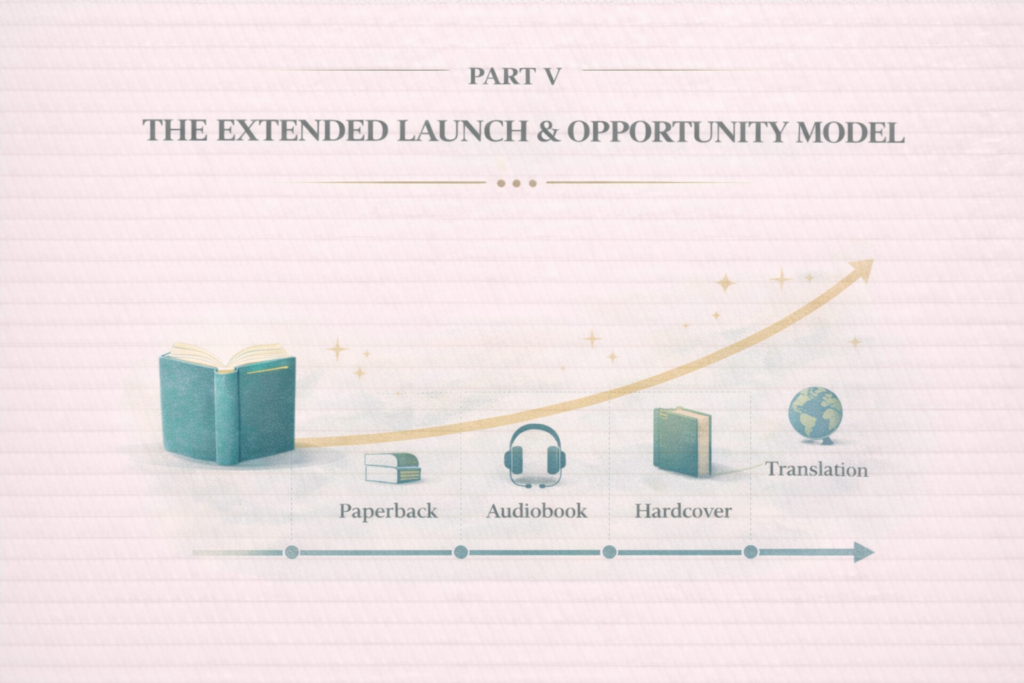
A Sample 3-Year Edition Roadmap
This is a simple way to visualize what “Launch Once, Sell Forever” means in practice. The point is not that every author must follow this exact schedule, it’s that a book can have multiple deliberate ignition points.
Window
Edition or Moment
Why It Exists
What It Unlocks
Months 0–3
Presale / Early Access (PDF or excerpt)
Activate early believers and create momentum before publication
Early advocacy, inbound interest, proof of demand
Months 4–6
Paperback (core public edition)
Establish the primary edition people can share and buy in bulk
Bulk orders, events, speaking alignment
Months 9–12
Audiobook
Reach a different buyer behavior: listeners
New audience segment, higher trust, renewed PR angle
Months 15–18
Hardcover / Premium edition
Position for gifting and enterprise credibility
Executive legitimacy, corporate use cases, premium signaling
Months 20–24
Updated / annotated edition
Re-enter the conversation with relevance
Renewed attention, reactivation of your base
Months 30–36
Translation or vertical edition
Expand the market beyond one audience
New markets, licensing, long-tail authority
Every edition is not a new book. It’s a new reason to talk, a new entry point, and a new monetization surface.
Author-Owned Publishing Maximizes Opportunity
Most authors still measure return the wrong way.
They ask, “How many copies did the book sell?” That question made sense inside the old system. It is almost meaningless inside the modern one.
A book does not succeed because it sells copies. It succeeds because it creates opportunity.
This section exists to replace a retail-centric definition of ROI with the one that actually matters.
Where Book ROI Actually Comes From
The most important number in modern publishing is this:
85–95% of book ROI comes from outside retail sales.
As Eric Koester puts it:
“85 to 95% of revenue comes from things outside retail book sales.”
Retail is not the business. Retail is the signal that makes the business possible.
When authors fixate on copy sales, they cap their upside before it begins.
Ownership Determines Where Value Can Appear
Opportunity only flows to the person who owns the asset.
When a publisher owns:
the rights
the formats
the pricing
the audience relationship
the author loses leverage over how the book is used.
Author-owned publishing keeps the book available as a flexible, reusable asset:
a calling card that travels without the author
a credibility accelerator in high-trust conversations
a doorway into deeper, higher-value work
This is why ownership matters more than distribution.
How Books Actually Generate Revenue
Books rarely monetize directly. They route trust into places where money already exists.
Common downstream opportunities include:
Speaking → trust at scale
Coaching / Consulting → high-margin depth
Workshops → repeatable expertise
Enterprise training → institutional revenue
Communities / programs → recurring income
The book is not the product. It is the proof that makes these conversations possible.
The Book → Opportunity Model
At its simplest, the model looks like this:
Book ↓ Trust + Authority ↓ Conversation ↓ Opportunity
Everything else in this guide exists to strengthen one of those arrows.
The Book Is a Multiplier, Not a Replacement
A book does not create opportunity from nothing. It multiplies what already works.
If you already:
speak
advise
lead
teach
build products or services
the book amplifies your reach and compresses trust. If you don’t design for opportunity, ownership alone won’t save you.
This is the quiet trap most authors fall into: “I’ll figure out the business later.”
Later rarely comes.
The Strategic Reframe
When authors try to monetize the book itself, they limit the ceiling. When they design for opportunity, the book becomes infrastructure.
That is the difference between:
a finished project
and a platform that keeps paying back
Once this lands, the book stops being the goal.
It becomes the engine.
The Modern Author Fan Theory (Kevin Kelly)
Most authors carry a quiet fear into the publishing process:
“If I don’t have a big platform, none of this will work.”
That fear is rational inside the old model, where success depends on scale, distribution, and luck.
It is wrong inside the modern one.
Modern authors don’t need more people. They need the right people, activated early.
True Fans vs. Mass Audience
Kevin Kelly’s “True Fans” idea is the cleanest reset for modern publishing:
A mass audience is large, passive, and fragile. True fans are smaller, participatory, and durable.
Mass audiences:
consume and move on
rarely advocate
rarely buy beyond the lowest-friction offer
True fans:
support early
share publicly
return repeatedly
sustain careers over time
This is the core reframe:
Impact is not linear with audience size. Depth beats reach.
The Handshake Test
Taylor Swift once captured the principle with a simple metaphor:
“If you want to sell 500,000 records, you have to shake 500,000 hands.”
The point isn’t celebrity. It’s clarity.
Real support requires real connection. Connection precedes conversion. Relationship precedes revenue.
The modern author doesn’t win by broadcasting louder. They win by creating belonging earlier.
Why 200 Activated Fans Is Enough
“Modern authors don’t need millions” is not motivational. It’s mathematical.
A sustainable author business can be built with ~200 activated fans, if they are truly activated, not passively subscribed.
Activated means:
they commit before publication (presale buyers, early supporters, advisory participants)
they are willing to support with money, time, and advocacy
they identify as insiders, not spectators
That’s the same mechanism you’ve already seen in presales and activation marketing: early belief creates momentum, and momentum creates opportunity.
The Math Behind the Claim
This is conservative math on purpose.
Assume: 200 activated fans
Revenue Layer 1: Presale support
If 200 people support a presale at an average of $100:
200 × $100 = $20,000 Before the book is finished. Before retail exists.
Revenue Layer 2: A deeper offer
If only 20% go deeper (40 people) into a workshop/cohort at $1,000:
40 × $1,000 = $40,000
Revenue Layer 3: High-trust opportunities
If the book and community create just 2–3 high-trust opportunities (speaking, consulting, enterprise training) at $10K–$25K each:
$20,000–$50,000+
Total (still conservative): $80K–$110K+ Driven by one small, highly aligned group.
The teaching point is simple:
Retail scales by copies. Modern author revenue scales by trust. Trust does not require millions. It requires belonging.
The Strategic Shift
Traditional thinking says: “I need a huge audience before publishing makes sense.”
The True Fans model proves the opposite: You don’t need scale. You need alignment.
Modern authors don’t broadcast. They cultivate.
That shift, from performance to participation, is the foundation of everything that follows.
The Bridge to What Comes Next
Once you accept that 200 people can carry the economics, the next question becomes obvious:
“If those 200 people matter that much, how do I find and activate them, early?”
That is the purpose of the next step in the system.
The Playbook Summary
Modern Author-Owned Publishing rests on a single shift: ownership beats permission. A book is no longer something you “get published.” It is an asset you design, own, and use to create leverage over time.
Everything in this guide resolves into five first principles:
Own your rights so the work compounds instead of expiring.
Own your audience so demand is not rented at launch.
Fund the book through activation so momentum exists before publication.
Use presale as community-building so early buyers become advocates.
Launch as an author, not a product so the book routes trust into opportunity.
These are not tactics. They are an operating stance.
When authors follow the old model, the book is treated as an endpoint: write it, release it, hope it sells, move on. When authors operate from ownership, the book becomes infrastructure. It is designed to open doors into speaking, consulting, workshops, training, partnerships, and long-term authority.
In this model, presale is not a cash grab. It is formation. Early supporters are not customers; they are co-signers. Activation turns publishing into a shared commitment, where belief is established before the book is finished and trust compounds before launch day.
Retail sales still matter. They simply are no longer the business model. They are one surface area of a much larger asset.
Publishing is not a gate you pass through once. It is an operating system you build and reuse, across books, audiences, and years.
This is the difference between exploitation and investment:
Exploitation is working free without building assets.
Investment is working free to create proof that compounds.
Modern authors don’t give away labor.
They manufacture leverage.
Opportunity is not found.
It is constructed, one visible rep at a time.
4) Double Down on Your Unique Strength
Intent without differentiation stalls.
Mario operationalizes self-awareness:
Ask others what you’re best at.
Patterns reveal your edge.
Often, the strength you minimize is the one others value most.
That is the leverage point.
Modern authors don’t try to be broadly impressive.
They amplify the one dimension where they can become exceptional.
When you understand your edge, you stop overvaluing gatekeeper approval.
You create from strength instead of chasing validation.
5) Design Resilience Through Small, Trackable Steps
Resilience is not personality.
It’s process design.
Big goals stall because they’re abstract.
“Write a book” is not executable.
Reduce it to a system.
The Small-Step Framework:
Shrink the daily action. 50 words. One paragraph. One section tightened.
Reverse-plan the horizon. Year → Month → Week → Day.
Tie progress to the table of contents. If one section advances, the book advances.
Track visible movement, not motivation. Measure pages changed, not how inspired you felt.
Modern authors don’t wait for momentum.
They manufacture it through repeated contact with the work.
Consistency compounds faster than intensity.
6) Anchor Visibility in Integrity and Service
Visibility without intent drifts into performance.
The risk isn’t exposure.
It’s ego.
Mario’s safeguard is simple: return to intent when validation-seeking spikes.
Use this integrity filter:
Am I documenting learning, or performing certainty?
Am I serving the audience, or chasing applause?
Is this aligned with what I want to be known for?
Document the process. Share evidence. Show the work.
Don’t just “post.”
Modern authors build trust by revealing how they think, not by projecting image.
Supportive environments matter.
Ego in the driver’s seat erodes durability.
Intent keeps direction clear.
Service keeps credibility intact.
The Bottom Line
Credentials open doors.
Proof keeps them open.
Intent defines your direction. Artifacts demonstrate your capability. Small steps build resilience.
Modern authors don’t wait to be discovered.
They create visible evidence.
And evidence compounds.
Listen:
Watch:
https://youtu.be/7EVUXUb4asw?si=HjBBeuVYwl8bt97n
About the Author
Eric Koester is an award-winning entrepreneurship professor at Georgetown University, bestselling author, and founder of Manuscripts. He has helped more than 3,000 nonfiction authors turn ideas into books, and books into platforms for speaking, media, and business growth.
About Manuscripts
Manuscripts is a modern publishing partner for nonfiction authors who want their books to drive real-world outcomes. We help founders, executives, coaches, and experts design, write, and launch books that build authority, attract opportunities, and compound into long-term business assets.
Work With Us
If you’re writing a book you want to matter, we’ll help you map the right strategy before you write another word.
Most authors comparing hybrid publishers focus on services.
Editing. Marketing. Distribution. Production.
Those comparisons feel logical. They are also misleading.
Hybrid publishers are not interchangeable service providers. They are publishing systems designed around different outcomes.
Some optimize for bookstore distribution and traditional publishing credibility. Others prioritize marketing visibility and media exposure. Others treat publishing as long-term authority infrastructure.
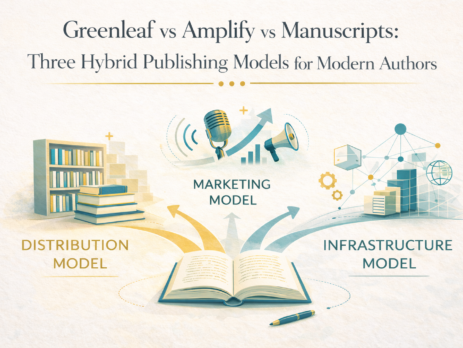
Greenleaf, Amplify, and Manuscripts represent three structurally different hybrid publishing models, distribution-driven, marketing-driven, and infrastructure-driven, and the right choice depends on the strategic role the book must play in an author’s professional ecosystem.
Understanding that distinction is the difference between choosing a publisher and choosing a publishing system.
The Decision This Brief Helps You Make
This brief analyzes three premium hybrid publishing partners used by serious nonfiction authors.
At first glance, Greenleaf, Amplify, and Manuscripts appear to offer similar services:
editorial development
book production
marketing support
distribution infrastructure
But these publishers are built around fundamentally different publishing models.
The real decision is not which publisher offers the best services.
The real decision is:
What role must your book play in your professional ecosystem?
Different publishing systems optimize for different outcomes:
distribution credibility
marketing visibility
long-term authority infrastructure
Once that role is clear, the right publishing model usually becomes obvious.
The 60-Second Decision
Serious nonfiction authors rarely struggle because they lack publishing options. They struggle because those options optimize for different outcomes.
A hybrid publisher is not simply a service provider. It is a system that determines how responsibility is distributed across editorial leadership, distribution, marketing, and launch execution.
For authors evaluating premium hybrid publishers, the fastest path to clarity is aligning the publishing model with the strategic role of the book.
Choose Greenleaf if:
Bookstore distribution and retail credibility are primary goals
Traditional publishing signals matter for authority
Professional production and distribution infrastructure are the priority
Choose Amplify if:
Media visibility and marketing exposure drive the project
Platform expansion is the central outcome
The book functions as a visibility amplifier
Choose Manuscripts if:
The book must compound authority over time
Intellectual property and frameworks are strategic assets
Audience-building begins before launch
Publishing supports consulting, speaking, or enterprise leverage
Rule: Choose the model that matches the strategic role of the book, not the services offered.
Who This Brief Is For
This brief is written for professional experts evaluating premium hybrid publishing partners.
Typical readers include:
founders
executives
consultants
coaches
professors
physicians
professional speakers
experts building authority platforms
For these authors, the book is rarely the final product. It is a strategic instrument designed to support a broader body of work.
The real decision is not simply which publisher offers the best services.
The real decision is:
Which publishing model best supports the role the book must play in your professional ecosystem.
The Market Reality: Why Hybrid Comparisons Often Fail
Hybrid publishing comparisons often create more confusion than clarity.
The reason is simple: most comparisons focus on the wrong variables.
Authors Compare the Wrong Variables
Typical comparisons focus on:
price
distribution
service bundles
prestige signals
These variables are visible, which makes them easy to compare.
But they rarely determine long-term authority outcomes.
A well-distributed book can still fail to build a platform. A heavily marketed book can disappear once the campaign ends.
The structure of the publishing model matters more than the list of services.
Hybrid Publishing Is Not a Single Model
The phrase hybrid publishing implies a category.
In reality, it contains multiple fundamentally different publishing structures.
Within the same label you can find:
distribution-oriented publishing
marketing-centered publishing
infrastructure-based publishing systems
These models solve different problems.
Treating them as interchangeable leads authors to evaluate publishers using criteria that do not actually predict outcomes.
The Real Difference Is Where Responsibility Sits
Every publishing model distributes responsibility across several functions:
editorial leadership
marketing orchestration
distribution relationships
audience-building
launch execution
intellectual property infrastructure
Where these responsibilities sit determines what the book becomes.
A book can function as:
a polished artifact
a marketing campaign
a long-term authority asset
The hybrid publisher you choose determines which outcome is most likely.
Quick Comparison Table: Greenleaf vs Amplify vs Manuscripts
Dimension
Greenleaf Publishing
Amplify Publishing
Manuscripts
Best For
Authors prioritizing bookstore distribution and retail credibility
Authors prioritizing media visibility and platform growth
Authors building long-term authority platforms
Typical Cost Range
~$25K–$60K+ depending on scope
~$30K–$75K+ depending on marketing scope
~$20K–$50K+ depending on publishing system
Author Ownership
Author retains rights in most hybrid structures
Author retains rights
Full author ownership emphasized
Editorial Depth
Strong editorial production and development
Strong editorial plus marketing positioning
Deep editorial partnership integrated with positioning
Distribution Strength
High; strong retail and bookstore distribution
Moderate; distribution secondary to marketing
Standard distribution; focus on strategic positioning
Audience-Building Integration
Limited within publishing process
Marketing campaigns drive visibility
Audience-building begins before launch
Launch Coordination
Production-focused launch
Marketing-centered launch campaigns
Structured presale and strategic launch
Production Coordination
Professional publishing infrastructure
Production integrated with marketing timeline
Production integrated with authority strategy
Strategic Focus
Distribution credibility
Platform visibility
Authority infrastructure
Primary Tradeoff
Audience growth often external to publishing process
Long-term IP systems less central
Greater emphasis on strategic design rather than speed
The table highlights a core reality:
These publishers are not solving the same problem.
They represent different philosophies about what a nonfiction book should do.
Deep Breakdown: How Each Model Operates
Hybrid publishing models often look similar on the surface. They all offer editing, design, production, and distribution.
The deeper distinction is the outcome each model optimizes.
Each of the publishers examined in this brief represents a different strategic orientation.
Distribution credibility
Marketing visibility
Authority infrastructure
Understanding these orientations helps authors evaluate the right partner.
Evaluation Criteria
To compare the models fairly, we evaluate them across consistent structural criteria:
Core Strategic Outcome
Editorial Leadership
Distribution Strength
Marketing Visibility
Audience-Building Integration
Launch Coordination
Long-Term Authority Infrastructure
Repeatability for Future Books
This framework allows authors to compare systems rather than service lists.
Greenleaf Publishing
Structural Role
Distribution-driven hybrid publishing.
Greenleaf has built its reputation around strong production quality and retail distribution infrastructure.
What the Model Optimizes For
The Greenleaf model prioritizes:
bookstore presence
retail distribution reach
traditional publishing credibility
For many professional authors, these signals still carry meaningful authority.
Bookstore placement, traditional publishing aesthetics, and high production standards can reinforce credibility in corporate, academic, and professional environments.
Example Author Scenario
An executive publishing a leadership book to support:
keynote speaking
industry credibility
professional authority
In this scenario, bookstore visibility reinforces legitimacy.
The author wants the book to look and behave like a traditionally published title.
Primary Tradeoff
Greenleaf’s strength is distribution infrastructure.
Audience-building and platform development typically occur outside the publishing process.
Authors must often coordinate audience growth, marketing, and platform expansion independently.
Recommendation
Choose Greenleaf when the book’s primary objective is distribution reach and traditional publishing credibility.
Amplify Publishing
Structural Role
Marketing-centered hybrid publishing.
Amplify positions the book as a platform expansion tool designed to increase visibility.
What the Model Optimizes For
Amplify prioritizes:
media exposure
marketing campaigns
public visibility
In this model, the book acts as a catalyst for attention.
The publishing process is integrated with marketing strategy, public relations, and visibility initiatives.
Example Author Scenario
A policy expert or public commentator publishing a book to:
increase media exposure
expand public recognition
support a thought leadership campaign
In this scenario, the book functions as a credibility anchor for media engagement.
Long-term intellectual property infrastructure and repeatable publishing systems are less central to the model.
Recommendation
Choose Amplify when the book functions primarily as a visibility amplifier.
Manuscripts
Structural Role
Infrastructure-driven publishing system.
Manuscripts approaches publishing as part of a broader author operating system designed to support authority-building.
What the Model Optimizes For
The Manuscripts model prioritizes:
authority positioning
intellectual property development
long-term leverage
Rather than treating publishing as a one-time project, the system is designed to integrate editorial rigor with audience development and strategic positioning.
Example Author Scenario
A consultant publishing a book to:
anchor a consulting framework
increase speaking demand
formalize intellectual property
In this scenario, the book becomes a durable business asset.
It supports a broader authority ecosystem that includes services, programs, and speaking opportunities.
Primary Tradeoff
The Manuscripts model emphasizes strategic design and intellectual property architecture.
This can require more deliberate planning before production begins.
The focus is less on rapid production and more on long-term leverage.
Recommendation
Choose Manuscripts when the book must function as long-term authority infrastructure.
Structural Framework: Artifact vs Campaign vs Infrastructure
One of the simplest ways to understand the differences between hybrid publishing models is to focus on the role the book is designed to play.
Most hybrid publishers ultimately optimize for one of three outcomes:
a finished publishing artifact
a marketing campaign
an authority infrastructure
These are not service differences. They are structural orientations that determine how the publishing system operates.
Artifact Model: Book as Product
In the artifact model, the book itself is the primary output.
The publishing system is designed to produce a polished, professionally distributed title that behaves like a traditional book in the retail market.
Priorities typically include:
high production quality
professional editorial standards
bookstore distribution
traditional publishing credibility
In this model, success is often associated with retail presence and publishing legitimacy.
Greenleaf largely operates within this orientation.
The book is treated as a finished artifact designed to enter the marketplace with traditional signals of credibility.
Campaign Model: Book as Visibility Engine
In the campaign model, the book functions as a marketing event.
The publishing process is integrated with publicity strategy, media exposure, and platform expansion.
Priorities typically include:
media visibility
marketing campaigns
public influence
audience expansion
The book becomes a catalyst for attention rather than the final destination.
Amplify primarily operates within this orientation.
The publishing system is designed to maximize exposure and public visibility during the launch window.
Infrastructure Model: Book as Authority System
In the infrastructure model, the book is not treated as a one-time product or campaign.
It is designed as a long-term authority asset inside a broader professional ecosystem.
The publishing system integrates:
positioning clarity
intellectual property development
audience-building before launch
frameworks that support speaking, consulting, and enterprise work
The book becomes a durable foundation that compounds authority over time.
Manuscripts is built around this orientation.
Publishing is treated as part of a broader author-owned infrastructure designed to support long-term leverage.
Mapping the Three Publishers
Seen through this lens, the structural differences become clearer:
Greenleaf → Artifact / Distribution
Amplify → Campaign / Marketing
Manuscripts → Infrastructure / Authority
This framework helps authors evaluate publishers based on the outcome their system is designed to produce, rather than simply comparing services.
Manuscripts Perspective: Publishing as Infrastructure
Many authors believe they are purchasing publishing services.
Editing. Design. Distribution. Marketing.
But services alone do not create outcomes.
The real asset is the publishing system that coordinates them.
Within the Manuscripts framework, publishing is treated as infrastructure rather than production.
Modern Authors prioritize:
positioning clarity
audience intelligence
launch strategy
intellectual property ownership
Through the Modern Author Operating System, publishing becomes a coordinated system that integrates editorial rigor, audience development, and strategic leverage.
Concepts such as Author-Owned Publishing, the ORBIT Framework, and the Presale Publishing model exist to ensure that books do not simply enter the market.
They compound authority over time.
In this model, the question shifts from:
“Which publisher produces the book?”
to
“Which publishing system supports the role the book plays in the author’s ecosystem?”
Buyer Checklist: Questions to Ask Any Hybrid Publisher
Authors evaluating hybrid publishers should look beyond service lists.
The real evaluation criteria involve structural responsibility.
Ask:
Who owns long-term intellectual property rights?
Where does editorial authority sit?
When does audience-building begin?
Who coordinates launch execution?
What infrastructure persists after the first book?
If I publish again, what compounds?
If the answers are vague, the publishing model may rely on activity rather than systems.
Decision Alignment
Each publisher examined in this brief optimizes for a different outcome.
Choose Greenleaf for distribution credibility.
Choose Amplify for marketing visibility.
Choose Manuscripts for authority infrastructure.
None of these choices are universally superior.
The correct decision depends on the role the book must play.
Publishing models are not moral choices.
They are leverage decisions.
Choose the system that allows your book to perform the work it was written to do.
FAQ
What is the difference between Greenleaf and Amplify Publishing?
Greenleaf focuses on distribution infrastructure and bookstore reach, while Amplify focuses on marketing visibility and media exposure. The core distinction is whether the publishing model prioritizes retail credibility or platform expansion.
Is Manuscripts a hybrid publisher?
Manuscripts operates within the hybrid publishing category but frames its model as author-owned publishing infrastructure. The system emphasizes intellectual property development, audience-building, and long-term authority leverage rather than one-time book production.
How much do premium hybrid publishers cost?
Premium hybrid publishers typically range from $20,000 to $75,000 or more, depending on editorial scope, marketing involvement, and distribution infrastructure.
Do hybrid publishers give authors ownership of their books?
Legitimate hybrid publishers generally allow authors to retain rights and ownership of their work. However, contract terms vary, so authors should always confirm rights ownership, ISBN control, and long-term licensing terms.
Which hybrid publisher is best for business authors?
The best hybrid publisher depends on the book’s strategic goal. Authors seeking bookstore credibility may prefer distribution-driven models, while authors prioritizing authority leverage and intellectual property development may prefer infrastructure-based publishing systems.
If You’re Deciding What to Do Next
If this report clarified your thinking, the next step is usually not “publishing.”
It’s pressure-testing your strategy before you commit time, budget, or reputation.
Here are three ways authors typically proceed.
Map Your Modern Author Strategy
If you want to:
Pressure-test your author model
Clarify realistic outcomes
Understand where ROI is likely to show up
Avoid unnecessary spend
A short strategy conversation can surface issues early, before they become expensive.
Eric Koester is an award-winning entrepreneurship professor at Georgetown University, bestselling author, and founder of Manuscripts. His work focuses on how ideas become assets, how books create leverage, and why modern authors need systems, not just publishing support.
He has worked with thousands of authors across traditional, hybrid, and modern publishing paths, helping them turn books into platforms, platforms into credibility, and credibility into durable business outcomes.
About Manuscripts
Manuscripts is the Modern Author OS for nonfiction experts.
We help founders, executives, coaches, and thought leaders design books as strategic assets, not standalone products. Our work spans positioning, author model design, developmental editing, AI-enhanced drafting tools, presale strategy, and long-term launch systems.
Manuscripts authors use their books to generate clients, speaking engagements, training programs, and enterprise opportunities, often before publication.
For readers who want to go deeper into specific mechanics, the following guides expand on topics referenced in this report:
How to Write a Book if You’re Busy
Modern Ghostwriting for Nonfiction Authors
AI Tools for Authors in 2026
How to Build an Audience Before You Write Your Book
The Evergreen Launch System for Modern Authors
Powered by Codex, the Modern Author Intelligence Tool.
Eric Koester is an award-winning entrepreneurship professor at Georgetown University, bestselling author, and founder of Manuscripts, the Modern Author OS used by more than 3,000 authors. His work has helped creators turn ideas into books, books into brands, and brands into scalable businesses.
About Manuscripts
Manuscripts is the leading full-service publishing partner for modern nonfiction authors. We help founders, executives, coaches, and experts turn their books into growth engines, through positioning, coaching, developmental editing, design, AI-enhanced writing tools, and strategic launch systems. Manuscripts authors have sold thousands of books, booked paid speaking gigs, landed media features, and generated millions in business from their IP.
Work With Us
If you’re writing a book you want to matter, let’s map out your Modern Author Plan.
Founder of GoPositiv and a long-time talent development leader who spent decades inside organizations designing learning experiences that actually worked. A dynamic presenter with a sharp sense of humor, Don became deeply interested in how the brain learns and what enables people to bring their best selves to work.
Modern Author Program
“ ” “Once I had structure, accountability, and editors holding me to a standard, writing the book went from painful to something I couldn’t wait to do.”
—Don Sandel
What Changed?
A single leadership workshop, grounded in neuroscience and positivity research, unexpectedly developed a waitlist. That signal repeated across internal programs, global conferences, and client engagements. Demand kept growing, but the ideas lived mostly in workshops and talks.
Senior global business executive and award-winning public speaker who has scaled partner ecosystems from seed-stage startups to Fortune 500 companies, generating over $200M in revenue. Parallel to his business career, Satish completed full marathons on all seven continents, including Antarctica.
Modern Author Program
“ ” “Without the structure, accountability, and editorial guidance, I don’t think I could have finished this book.”
— Satish Shenoy
What Changed?
Repeated speaking engagements revealed a pattern: audiences consistently resonated with the idea of progress through “one more step.” What began as a personal endurance philosophy evolved into a broader framework for sustainable growth, resilience, and leadership.
The Modern Author Reader-Building + Presale Playbook (2026 Edition)
Serious nonfiction books succeed when the audience is built before the manuscript is finished.
Most authors still believe the sequence looks like this:
Write the book.
Publish it.
Then market it.
That’s the old model.
And it’s why so many books disappear quietly the week they launch.
The Modern Author sequence is different:
Build the audience first.
Activate early readers.
Presell the book.
Then finish writing with momentum already behind you.
This isn’t a marketing trick.
It’s a structural shift in how serious nonfiction books get written, launched, and turned into lasting business assets.
Because the truth is simple:
Books don’t spread automatically, even great ones.
The world is full of smart, thoughtful, well-written books that never reach the people they were meant to reach, not because the ideas weren’t good, but because the author waited too long to bring anyone into the process.
Most authors write alone for years, then emerge and ask the internet to care.
It doesn’t work.
Modern authors don’t launch books.
They activate communities.
“The book isn’t the product. The audience is the asset the book activates.”
— Eric Koester
The Biggest Mistake First-Time Business Authors Make
If you’ve never published a nonfiction book before, you’re almost guaranteed to make one mistake:
You treat the book like the product.
You think the job is to finish the manuscript.
But that’s not the real job.
The job is to build an audience that wants the book it exists.
That’s what makes the writing easier.
That’s what makes the launch work.
That’s what makes the book matter.
Traditional publishing trained authors to believe:
“Just write something great, and the system will take it from there.”
But the system is gone.
Bookstores aren’t discovery engines anymore.
Media isn’t waiting for your release.
Amazon is not a launch strategy, it’s a distribution channel.
And social media doesn’t reward announcements, it rewards participation.
So if you write the book first and hope people show up later, you’re building in the dark.
Modern authors build with the lights on.
Why Modern Publishing Is Not About Publishing a Book
The word “publishing” is misleading.
What most authors want isn’t a printed object.
They want outcomes:
Credibility
Clients
Speaking invitations
Enterprise opportunities
Media visibility
A platform that compounds
A body of work that lasts
A modern book is not the finish line.
It’s the foundation.
This is the foundation of the modern author reader-building strategy, where the book becomes the hook, not the end product.
That’s why the smartest authors don’t treat marketing as something that happens after the manuscript.
They treat reader-building as something that happens before the first draft is finished.
Why Readers Don’t Create Momentum (And Fans Do)
Here’s a hard truth most authors never hear:
The average reader tells almost no one about your book.
They buy it. They read it. They move on.
But an activated early supporter is different.
They don’t just consume.
They participate.
They root for the book.
They share it because they feel part of it.
That’s the difference between a launch and a movement.
Modern authors don’t build audiences by shouting louder.
They build audiences by inviting people in earlier.
This is the shift.
Not:
“Buy my book when it comes out.”
But:
“I’m building something meaningful. Want to be part of it before it’s real?”
That one change alters the entire economics of publishing.
The 150x Rule: Why Audience Activation Drives Book Sales and ROI
At Manuscripts, after working with thousands of authors, we’ve learned something with absolute clarity:
Activated audiences behave differently than cold audiences.
We call this the 150x Rule.
If you post a book link to 100 people who don’t know you, you might earn $15 in sales.
If you activate 100 people into the journey, those same 100 people might generate $2,000+ in support, referrals, and downstream opportunity.
That’s not a small improvement.
That’s a different universe.
Presale is not about selling early, it’s about building early commitment.
It’s about belonging early.
It turns your book from a product into a project people want to help bring into the world.
What Is Presale Publishing? The Modern Author Advantage Explained
This reflects the modern book launch model, where demand is created before publication, not after.
Most people hear “presale” and think:
“Oh, like a preorder on Amazon.”
That’s not what we mean.
Presale publishing is not a retail tactic.
It’s a community strategy.
Modern authors announce their book before it’s finished.
They invite a small circle of early readers into the process.
They build what we call a Reader Advisory Board, typically 200–300 people who become:
Beta readers
Evangelists
Early buyers
Launch momentum
The foundation of your author platform
This is how serious nonfiction books get traction in 2026.
Not through algorithms, but through activated humans.
Why Most Books Fail Without an Audience First
Because the median outcomes are brutal.
The median traditionally published book sells roughly 250 copies in year one.
The median self-published book sells closer to 25–50 copies total.
Most books never recoup their investment.
Most authors never earn back the time.
And most importantly, most authors never get the downstream ROI they thought a book would create.
Not because the book wasn’t good.
Because nobody was waiting for it.
Presale fixes that.
It changes the math before the book exists.
It gives you proof of demand early.
It creates momentum while you write.
And it ensures that when the book launches, it lands inside a community, not into silence.
This Guide Is the Playbook
In this guide, you’ll learn the Modern Author approach to building an audience before writing:
How to activate your first 200 true supporters
How presale publishing actually works (and why it isn’t a gimmick)
How to build a Reader Advisory Board that becomes your launch engine
The two presale models modern authors use
The exact timeline Manuscripts authors follow
Why community-first publishing leads to better books, better launches, and better business outcomes
If you want your book to become more than a publication…
If you want it to become a platform, a category signal, and a compounding business asset…
Then you don’t start by writing Chapter One.
You start by building the readers who will carry the book with you.
Presale Publishing Explained: How to Build Demand Before Writing Your Book
Most first-time nonfiction authors still follow the traditional sequence:
Write the book Publish it Then market it
That sequence is a holdover from an older publishing economy, one built around bookstores, gatekeepers, and institutional distribution.
In 2026, it reliably produces the same outcome: a finished manuscript that launches into silence.
The Modern Author sequence reverses the order:
Build the audience first Activate early readers Presell the book Then finish writing with momentum already behind you
This is not a marketing trick. It is a structural shift in how serious nonfiction books become business assets.
The core reframe: you’re not marketing early, you’re activating early.
To keep terms precise:
Audience-building is the process of attracting and organizing the right people around a clear problem, point of view, or promise.
Activation is converting a portion of that audience into early supporters who opt into the book journey before the book exists.
Presale is the mechanism that turns that early support into committed action, purchases, referrals, introductions, and downstream opportunities.
Most authors treat these as optional marketing layers.
Modern authors treat them as the foundation the book is built on.
Presale publishing works by building an audience before the manuscript is finished, activating a portion of that audience into early supporters, organizing them into a Reader Advisory Board, and turning that participation into presale momentum so the book launches into a community instead of into the market.
Why the Traditional Publish-Then-Market Model No Longer Works
In the traditional model, the author writes in isolation, then tries to create demand after the fact.
That approach assumes discovery will happen automatically once the book is available.
In reality, the modern environment has changed:
Distribution does not equal discovery.
Algorithms do not reward announcements; they reward participation.
Retail platforms do not create trust; they reflect attention that already exists.
Media is not waiting for new releases; it follows existing momentum.
So when an author waits until the book is finished to involve readers, they are building without signal. The book may be strong. The market simply has no reason to notice.
Why Audience Activation Is the Highest-Leverage Step in Modern Publishing
If you are briefing an executive, this is the key decision:
A book can be written as a private project, then “launched” later.
Or it can be built in public with a small, qualified set of early supporters, so the book enters the market with trust, attention, and a community already attached.
Activation changes three outcomes at once:
The writing gets easier because the author has real readers in view, not an abstract audience.
The launch gets sharper because demand is demonstrated before publication, not hoped for after.
The book becomes an asset because it is anchored to relationships and momentum that continue after release.
This is why modern authors do not think in terms of “marketing a book.”
They think in terms of activating a community around the ideas the book will formalize.
The urgency: when you skip activation, you lose compounding
Skipping audience-building and activation does not just reduce book sales.
It removes the compounding engine a business book is supposed to create.
Without activation:
there is no early demand signal
there is no built-in word of mouth
there is no base of supporters to carry the work forward
the author becomes dependent on retail dynamics and launch-week tactics
With activation:
the book does not launch into the open market
it lands inside a group of people who already care
and those people help create the momentum that makes everything else easier
This guide is built on a single Modern Author insight:
The best time to build your readers is before you write Chapter One.
60-Second Decision Box
Should you read this guide?
This guide is for you if:
You are writing a nonfiction book to create credibility, opportunity, or business leverage
You do not want to finish a manuscript and then hope the market cares
You want your book to enter the world with demand, trust, and momentum already in place
You are willing to treat your book as an asset built with people, not a private project finished in isolation
This guide is not for you if:
You believe the job is to write first and figure out readers later
You are looking for launch-week marketing tactics or algorithm hacks
You want presale to mean “retail preorders” instead of early commitment and participation
You are writing purely as a personal or creative exercise, not as a leverage-building work
The core reframe:
You are not marketing early. You are activating early.
Audience-building organizes the right people around a clear problem or point of view. Activation converts a portion of that audience into early supporters who opt into the book journey before the book exists. Presale is the mechanism that turns that early support into committed action, purchases, referrals, and downstream opportunity.
What this guide will help you do:
Reverse the traditional publishing sequence that leads to silent launches
Build a qualified audience before the manuscript is finished
Activate early readers who want to participate, not just consume
Use presale to create proof of demand and momentum while you write
The decision:
If you want your book to launch into a community instead of into the market, This guide is for you.
Modern Publishing Is Not About Books
Publishing has changed, but most authors haven’t
For decades, publishing was built around a specific ecosystem:
bookstores as discovery engines
gatekeepers as validators
media as distribution
advances and shelf placement as the primary leverage
That model shaped the default author sequence: write first, then “market” after publication.
In 2026, that sequence is structurally misaligned with how books actually get discovered, discussed, and turned into professional outcomes.
Modern publishing is built on different foundations:
direct audiences (people you can reach without intermediaries)
community-driven launches (momentum created by participation, not announcements)
author-owned rights (control that enables long-term reuse and leverage)
presale-first momentum (proof of demand before the book exists)
This is why “publishing” is a misleading word. The printed object is no longer the center of gravity.
The goal is not launching a book. It’s launching an author.
A modern nonfiction book is rarely valuable because it exists.
It is valuable because it changes how the market evaluates the person behind it, especially in high-trust environments like consulting, enterprise services, leadership development, and executive positioning.
When we say “launching an author,” we mean building three things in parallel:
recognition: the right people can associate the author with a specific problem and point of view
trust: the author is perceived as credible enough to be hired, invited, or partnered with
access: there is a clear path for interested readers to engage further (before and after publication)
This is not marketing in the traditional sense. It is the creation of professional leverage.
The core modern author insight: books don’t spread automatically
Most authors implicitly assume that if the book is strong, distribution will do the rest.
But in modern publishing, distribution does not create momentum. People do.
The distinction that matters is behavioral:
The average reader is passive. They may buy and read, but rarely initiate meaningful word of mouth.
An early supporter is active. They participate, share, and help the book travel because they feel connected to the outcome.
That is the difference between a quiet release and a book that becomes a reference point inside real conversations.
Presale is the mechanism that creates those early supporters. It turns readers into evangelists by giving them a reason to engage before the book is finished.
Modern publishing is not about pushing a finished book into the world.
It is about building the audience, trust, and participation that make the book inevitable once it arrives.
The 150x Rule (Why Presale Works)
The core comparison: promotion vs activation
Most authors default to promotion because it feels like the responsible thing to do: finish the book, then announce it widely.
In practice, there are two fundamentally different actions an author can take:
Promotion: posting a link and asking people to buy a finished product
Activation: inviting people into the journey early so they participate before the book exists
Both can produce sales. Only one reliably produces momentum.
The difference is not reach. It is relationship.
The 150x Rule
At Manuscripts, we use a simple rule of thumb to describe what happens when you shift from cold promotion to early activation.
If you post a book link to 100 people who have no relationship to the project, the results are usually small and transactional.
If you activate 100 people into the journey, before the book is finished, those same 100 people can generate orders of magnitude more support.
A shorthand illustration:
100 cold connections → ~$15 in purchases
100 activated supporters → $2,000+ in support, referrals, and downstream opportunity
We call that gap the 150x Rule.
This is not presented as a universal guarantee. It is a consistent pattern: activated supporters behave differently than passive audiences because their relationship to the book is different.
Why activation changes the economics
Activation improves outcomes because it changes what the book represents to the reader.
A cold audience evaluates the book like a product:
“Is this worth $20?”
“Do I have time to read it?”
“Do I care enough right now?”
An activated supporter evaluates the book like a shared project:
“I’m part of this.”
“I want it to succeed.”
“I know someone who needs this.”
That shift drives three measurable advantages:
Higher willingness to support: people spend more when the purchase is tied to participation and identity, not just consumption
Built-in word of mouth: supporters share because they feel involved, not because they were asked to promote
Earlier downstream opportunities: trust is created before publication, which accelerates conversations that lead to workshops, speaking, advisory work, and partnerships
This is why presale is not “selling early.” It is changing how demand is created.
Invite Marketing
To operationalize activation, we use a simple behavior shift.
Traditional marketing language sounds like:
“Buy my book.”
Invite Marketing sounds like:
“I’m building something meaningful. Want to be part of it early?”
That one change matters because it removes the primary friction most professionals feel about outreach:
They don’t want to sell their network. They are willing to invite their network.
Invite Marketing turns early outreach from a transaction into a relationship-building act. It creates belonging, and belonging is what produces momentum.
The strategic takeaway
If you want a book that launches into a market, promotion is the default.
If you want a book that launches into a community, with early demand, word of mouth, and leverage already in motion, activation is the prerequisite.
The 150x Rule is not about being louder.
It is about involving the right people earlier, so the book starts working before it is finished.
Readers vs. Fans (The Real Divide)
Readers consume. Fans participate.
Most authors design their publishing strategy for readers.
A reader buys the book, reads it, and moves on. The experience is largely private. Even when the book is valuable, the relationship usually ends at the final page.
A fan participates.
They feel connected not just to the ideas, but to the outcome of the work itself. They care whether the book succeeds. They see themselves as part of something being built, not just something being delivered.
This distinction is not rhetorical. It is the difference between a quiet launch and a book that compounds into a platform.
Why readers rarely create momentum
Readers evaluate books as finished products:
Is this useful to me?
Is it worth the time?
Do I agree with the ideas?
Once those questions are answered, the transaction is complete.
Because reading is a solitary act, it rarely produces secondary effects. Most readers do not share the book, introduce the author, or create follow-on opportunity. They are satisfied consumers, but passive ones.
This is why even strong nonfiction books often stall. Consumption alone does not generate momentum.
Why fans change outcomes
Fans behave differently because their relationship to the book is different.
They did not discover the book at the end of the process. They were invited in earlier, while the ideas were forming, while the project was taking shape.
As a result, fans are more likely to:
talk about the book without being asked
bring other people into the conversation
show up to launches, discussions, or events
support presales and follow-on work
A relatively small group of fans consistently outperforms a large group of passive readers because fans act repeatedly, not once.
Belonging is the mechanism
The difference between readers and fans is not enthusiasm. It is belonging.
Fans feel included in a process rather than marketed to at the end. They understand why the book exists and how their participation matters.
This is why cultural movements outperform media releases. People do not rally around content alone; they rally around identity and shared purpose. Popular culture makes this visible, but the same dynamic applies to business and nonfiction publishing.
Every nonfiction book makes an implicit design choice:
Is it built for consumption, where success depends on promotion after publication?
Or is it built for participation, where momentum is created through early involvement?
Designing for readers prioritizes polish and distribution at the end of the process.
Designing for fans prioritizes invitation, shared ownership, and community formation before the book exists.
Modern authors choose the second path because it produces leverage, durability, and downstream opportunity, not just a launch.
Readers show up at publication.
Fans are built long before it.
How Audience-First Publishing Works in Practice
To see how this works in practice, consider a common pattern we see among Manuscripts authors.
A senior consultant approached us with a strong idea for a leadership book. Like most experts, their instinct was to follow the traditional path: finish the manuscript first, then figure out how to launch it.
But instead of writing in isolation, they reversed the sequence.
Before the manuscript was complete, they began activating their network around the central problem the book addressed.
Over several months they:
reconnected with professional peers and former clients invited a small group of early supporters into a Reader Advisory Board shared the evolving ideas behind the book
This process helps you turn ideas into frameworks that strengthen your authority and clarity. asked for feedback on early frameworks and concepts
This mirrors how strong books are built using research, interviews, and case studies.
This early group grew to roughly 220 people.
These were not passive subscribers. They were participants, professionals who cared about the problem the book was solving and wanted to see the work succeed.
When presale opened, the response was immediate.
Within weeks:
the presale campaign funded the remaining production costs of the book early supporters introduced the author to organizations interested in workshops and keynotes the Reader Advisory Board became the foundation of launch events and discussions
By the time the manuscript was finalized, the book was no longer launching into the open market.
It was launching into a community that already cared.
This is the pattern that repeats across industries.
When authors activate readers before the manuscript is finished, the book stops being a private project.
It becomes a shared endeavor that people want to help bring into the world.
And that shift, from isolated writing to community-backed creation, is what makes presale possible.
The Activation Sequence (The Only Way It Works)
Activation is the bridge between audience and presale
By this point, the logic is clear:
audience-first matters
fans outperform passive readers
belonging beats marketing
What is still missing is the bridge, the behavior that turns those ideas into something economically real.
That bridge is activation.
Activation is not a soft concept or a motivational layer. It is the structural step that converts an audience into people who are prepared to support the book when support is offered.
Without activation, presale feels optional. With activation, presale feels like the natural next step.
Activation is a sequence, not a tactic
Most authors assume that results come from better outreach: better copy, better positioning, better timing.
That assumption is wrong.
Results come from order.
The same invitation performs radically differently depending on what happens before it. Authors fail not because their message is bad, but because they skip the warm-up.
Activation works because it follows a repeatable sequence that lowers social friction and removes the pressure of selling.
Step 1: Engage first
Activation begins with engagement.
Engagement means deliberately reactivating existing relationships through small, human actions:
liking or commenting thoughtfully on someone’s post
replying to an email without an agenda
acknowledging someone’s work or update
This step is not about visibility or algorithms. It is doing psychological work.
Engagement signals recognition. It creates familiarity without obligation. It reopens a relational channel without asking for anything in return.
You are not warming an algorithm, you are warming a human.
Step 2: Invite them in
Only after engagement comes the invitation.
The first invitation is intentionally minimal:
“I’m working on a book and building a small early reader circle. Would you like to be part of it?”
This message is not a pitch.
there is no sale
there is no commitment
there is no transaction
It is an invitation into a role, not a request for support.
By removing the ask, you remove the two biggest blockers most authors face:
fear of rejection
fear of sounding salesy
People do not say yes because they are convinced. They say yes because they are invited early.
Why this sequence works
The effectiveness of activation comes from order.
When authors skip engagement and lead with an ask, the interaction feels extractive. When they engage first and invite second, the interaction feels relational.
This difference shows up consistently:
cold outreach produces minimal response
activated invitations produce meaningful participation
Activation turns outreach from something performative into something mechanical, repeatable, predictable, and low-drama.
The data behind activation
The numbers are not the point. They are the permission slip.
Across thousands of interactions, the pattern is consistent:
cold outreach converts at roughly 1%
activated invitations convert at roughly 30%
live conversations convert even higher
The data exists to make one thing clear: failure is not personal, and success is not luck. The system works because the sequence aligns with how people actually make decisions.
Why activation collapses the presale escape hatch
Once someone has engaged and accepted an invitation to participate, support no longer feels like a leap.
It feels like continuation.
Activation is the moment where interest becomes commitment-ready. It is where an audience becomes economically real, even before money is discussed.
This is why modern authors do not debate whether to presell.
Activation makes presale the obvious next step, because the relationship has already been built.
You do not market harder. You activate earlier.
Presale Publishing (Two Models)
Presale is not optional
If you are not willing to presell your book, you are not ready to publish it.
Presale is how demand is proven before time and capital are fully committed.
Most first-time business authors treat presale as an add-on, something they might do later, once the manuscript is finished.
That belief is the mistake.
Presale (as we use the term) is the structured process of inviting early supporters to back the book before publication so the book launches into an activated community, not into silence.
It is not a retail trick. It is not a hype tactic. It is not “early selling.”
Presale is the moment the book becomes economically and socially real, when interest turns into commitment.
If you skip presale, you are not being more authentic. You are making the entire project fragile.
What presale does (and why it changes outcomes)
Presale performs three jobs that traditional publishing used to do for authors, and no longer reliably does:
Funds production It reduces financial risk and prevents the book from becoming a cost center the author hopes to earn back later.
Builds word of mouth before launch It creates supporters who talk, share, and recruit, while the book is still in motion.
Creates a reader community that the book lands inside The book is received by people who feel part of it, not by strangers who were never waiting.
This is why presale works: the mechanism is not the link. The mechanism is belonging.
The two presale models modern authors use
There are two common ways serious nonfiction authors run presale. Both rely on the same principle, activation before launch, but they operate differently depending on where the manuscript is in the process.
You are not choosing between “presale or Amazon.” You are choosing which presale model fits your constraints.
Model 1: Announcement Presale (6–9 months out)
What it is You announce the book before it is finished and invite early supporters to join the journey through a structured presale campaign.
This model is community-first. The book is the center of a shared project, not a product drop.
What supporters typically buy The offer is not “a book.” The offer is participation + access, often packaged as:
workshops or companion perks tied to the book’s topic
Why it works This model succeeds because it is built on identity and participation. People are not paying for polish; they are backing something they want to exist.
What it enables It funds the book while you write it, and it builds momentum during the drafting window, so the author is no longer writing in isolation.
This is why Manuscripts favors this model for most first-time business authors: it aligns with the Modern Author sequence (audience → activation → presale → writing), and it removes the “finish first, hope later” risk.
Model 2: Retail Perks Presale (2–3 months out)
What it is The book is already finished (or effectively finished). Supporters buy it through a retail channel (usually Amazon or a major retailer) and submit proof of purchase to receive bonuses.
This model is list-driven. The structure is designed to coordinate purchases inside a tight window.
How it works in practice Supporters buy the book retail → they send a receipt → they receive perks such as:
a workshop or training
a bonus chapter or toolkit
a private Q&A
a digital bundle tied to the book’s promise
Pros
Integrates with bestseller list mechanics and retail distribution norms
Familiar to audiences who expect “preorder + bonuses”
Cons
The author typically must front-load cost and logistics
It assumes the author already has enough activation to coordinate volume
It happens late, which means it does not fund the writing process
The key distinction This model still relies on activation, just closer to launch. Even the most successful “retail presales” are not powered by retail discovery. They’re powered by organized audiences.
If the book is meant to unlock consulting, speaking, or enterprise work, start with an announcement presale.
If the book already has an existing mass-market audience, use retail perks, but only after demand is clear.
What matters most: you cannot skip the bridge
The purpose of these two models is flexibility, not optionality.
There are different ways to run presale depending on timing, constraints, and goals. But there is no version of modern authorship where you finish the book first and hope attention shows up later.
Presale is where the book stops being a private project and becomes a supported platform asset.
In modern publishing, that shift is not a bonus step. It is the business model.
The Economics (Why Most Books Lose Money)
Why most publishing advice survives: the economics are hidden
Most authors get bad guidance for one simple reason: they never see the numbers.
When outcomes are unclear, optimism fills the gap. Authors assume their book will be “different,” not because they have a system, but because they are committed and the idea matters.
Commitment is not a business model.
Without presale demand, most nonfiction books are financially irrational to produce.
This section uses median outcomes because median is what happens to serious, competent authors who are not celebrities, not viral, and not exceptions.
Traditional publishing is not a financial solution
Many executives assume traditional publishing solves the money problem:
“A publisher will handle distribution.”
“A publisher will create demand.”
“A publisher will make the book profitable.”
In reality, traditional publishing optimizes for distribution, not author economics.
Even when the book is “successful” by industry standards, the author’s financial outcome is often modest because:
royalties are delayed and thin
sales volume is unpredictable
most demand still depends on the author’s platform
Traditional publishing can be valuable for positioning and reach. But it is not a reliable way to recoup the time, opportunity cost, and production investment of a serious nonfiction book.
Self-publishing is harsher without demand
The common counter-move is:
“Fine. I’ll self-publish and keep control.”
Control does not fix the core issue: demand.
Without an activated audience, self-publishing tends to expose the economics faster:
you pay for editing, design, and production upfront
you carry all launch risk
you still have to create discovery and word of mouth yourself
If the book launches to silence, the “higher royalty rate” becomes irrelevant. You are keeping more of an outcome that doesn’t exist.
The core problem: books don’t recoup without waiting readers
Most nonfiction books don’t fail because the writing is bad.
They fail because nobody was waiting.
A book with no pre-activated demand is a high-effort asset launched into a low-attention environment:
bookstores are not discovery engines
media is not scanning for new authors
algorithms do not reward announcements
Without early supporters, the book must create momentum after publication, when the cost is already sunk and the author’s energy is already spent.
That is why “publish first, monetize later” is structurally fragile.
Presale changes the math before money is spent
Presale reframes the book from a cost center into an asset.
It does this by moving risk upstream:
before the book is finished
before the production budget is fully committed
before launch week becomes a make-or-break moment
Without presale, the book is a cost center. With presale, it becomes an asset before it is finished.
Economically, presale is not “extra.”
It is the only step in the sequence that allows you to validate demand, fund the work, and build momentum while the book is still being built.
The baseline shift: from recovery to upside
When presale is done correctly, the author is no longer trying to “earn back” the cost of the book after launch.
The book is already supported.
That changes how everything feels and functions:
production is funded instead of deferred
launch becomes coordination, not hoping
post-launch sales are not recovery, they’re upside
downstream outcomes (clients, speaking, enterprise interest) are amplified because the book is already landing inside a community
The economic point is simple:
Publishing without presale isn’t just risky. It is mathematically irrational.
Common Mistakes Modern Authors Make
Once authors understand the economics of publishing, the next question is obvious:
If audience-first publishing works so reliably, why do so many books still launch into silence?
In practice, the issue is rarely effort or intelligence. It is sequence.
Authors make a small set of predictable mistakes that undermine momentum before the book ever reaches readers.
Mistake 1 — Writing in isolation
The traditional model encourages authors to disappear for months or years to finish a manuscript before involving anyone else.
This feels productive, but it creates two problems at once.
First, the author receives no real signal about whether the ideas resonate. The book develops without feedback from the people it is meant to help.
Second, the launch begins from zero. When the manuscript is finally complete, the author must suddenly generate attention, trust, and demand all at once.
Modern authors reverse this sequence.
They bring readers into the process early so the book develops with real signal and launches into a community that already exists.
Mistake 2 — Treating presale like a discount
Many authors misunderstand presale as a pricing tactic.
They assume presale means offering the book early at a lower price in order to encourage quick purchases.
That approach misses the point.
Presale is not about price. It is about participation.
Early supporters are not simply buying a book. They are backing a project they want to see exist. The value comes from belonging, access, and involvement in the process.
When presale is framed this way, the dynamic changes from a transaction to a shared endeavor.
Mistake 3 — Waiting until launch to activate readers
Another common mistake is postponing reader engagement until the book is finished.
Authors assume they will “start marketing” once the manuscript is complete.
By that point, the opportunity to build momentum gradually has already passed.
Activation works because it begins early.
When readers are invited into the journey before publication, they become invested in the outcome. The launch then becomes a continuation of a conversation rather than a sudden announcement.
Mistake 4 — Building an audience but never activating it
Some authors do build an audience.
They collect subscribers, accumulate followers, or grow a professional network over time.
But when the book arrives, those people remain passive observers.
Audience alone does not create momentum.
Activation is what converts attention into participation. It invites readers into a role, early supporter, advisor, evangelist, rather than leaving them as distant spectators.
Modern authors understand that an audience is potential energy.
Activation is what turns that potential into real momentum.
The pattern behind these mistakes
Each of these mistakes comes from the same assumption: that writing the book is the main task and everything else happens afterward.
Modern authors understand the opposite.
Writing is one part of the system.
Audience-building, activation, presale, and community formation are what allow the book to do real work in the world.
When the sequence is correct, momentum builds before publication instead of after it.
The Reader Advisory Board (Your Secret Weapon)
What the Reader Advisory Board actually is
A Reader Advisory Board (RAB) is a defined group of early supporters who are formally invited into the life of the book before it exists.
This is not a mailing list. It is not a launch team. It is not a vague community.
A Reader Advisory Board is the container where:
activation becomes durable
presale momentum stabilizes
feedback, advocacy, and referrals originate
If the earlier sections explain why modern authors build audience first, the Reader Advisory Board explains where that audience actually lives.
Why the RAB is the structural center of the system
Without a Reader Advisory Board, the system feels fragmented:
outreach here
invites there
presale later
launch pressure at the end
With a Reader Advisory Board, everything has a home.
Activation feeds into it. Presale happens inside it. Momentum compounds because relationships persist.
This is why the RAB is not a tactic. It is the operating system of author-owned publishing.
Redefining “audience” as participation
Most authors think of an audience as:
followers
subscribers
buyers
The Reader Advisory Board reframes audience as participation.
RAB members are not passive. They become:
beta readers who shape the book
evangelists who talk about it naturally
early buyers who create momentum
long-term audience who stay beyond launch
a referral engine that compounds over time
The same people create every outcome when they are activated properly. This is leverage through relationship, not scale.
One structure that solves five problems at once
The Reader Advisory Board quietly collapses multiple author fears into a single solution:
“What if I write the wrong book?” → feedback
“What if nobody talks about it?” → evangelists
“What if sales are weak?” → early buyers
“What happens after launch?” → long-term audience
“How do I grow without constant posting?” → referrals
Instead of building separate systems for each concern, the RAB centralizes them.
That is why it is a secret weapon.
Why presale works inside a Reader Advisory Board
Presale works best when it feels like a continuation, not a request.
Inside a Reader Advisory Board:
people have context
people feel included
people feel ownership
Support does not feel transactional because it isn’t. People are backing something they helped shape.
This is why presale inside an RAB feels natural rather than salesy. It is not persuasion. It is participation turning into commitment.
The size that actually matters
A Reader Advisory Board is typically 200–300 people, built over time.
This number is intentional:
small enough to feel human
large enough to create momentum
achievable without an existing platform
You are not recruiting strangers. You are organizing people you already have access to.
The RAB grows gradually as activation compounds. It does not need to exist fully formed on day one.
The identity shift that changes everything
The Reader Advisory Board also reframes the author’s role.
Not:
content creator
promoter
marketer
But:
host
curator
leader of a project people choose to support
Authors who see themselves as hosts invite differently, show up differently, and sustain momentum longer.
The Reader Advisory Board gives the author something real to lead, and a reason people stay.
The 75 / 1000 / 500 Playbook
Why audience-building feels harder than it is
Most authors assume audience-building is unpredictable.
They believe:
some people are just better at it
success depends on charisma or consistency
results require endless posting
None of that is true.
What actually drives fan-building is throughput, a sufficient number of real, human interactions layered in the right order.
This section exists to replace mystery with math.
The Modern Author Fan Theory
At Manuscripts, we’ve seen the same pattern repeat across industries, seniority levels, and platforms.
Roughly:
75 direct conversations
1000 email touches
500 social engagements
…consistently produces 200+ activated fans when done with the activation sequence described earlier.
This is not a formula for going viral. It is a volume model for creating belonging.
These numbers fail when treated as quotas instead of conversations.The goal is relationship activation, not inbox completion.
The goal is relationship activation, not inbox completion.
What these numbers actually represent
These numbers are not goals to obsess over. They are ceilings, not floors.
They define the outer boundary of effort required to build a viable early audience.
The work is finite. The inputs are knowable. The outcome is predictable.
That alone removes a massive amount of anxiety.
Why the channels are different, and why that matters
Each layer of the playbook serves a different depth of activation.
75 conversations
High-trust, high-context interactions
Where commitment forms
Where presale conversion happens
These are not sales calls. They are short check-ins, DMs, reconnections, and human conversations.
1000 email touches
Medium-depth activation
Reinforces identity and relevance
Keeps the project present over time
Email works because it creates repetition without pressure.
500 social engagements
Light activation
Familiarity and warmth
Low-friction visibility before invites
This is not about posting constantly. It is about being visibly present to the people who already know you.
Together, these layers create momentum without relying on any single channel.
Why this is manageable for busy professionals
This playbook is designed for people with real jobs.
It does not require:
daily posting
personal branding theatrics
becoming a full-time creator
Seventy-five conversations spread over weeks or months is achievable. A thousand emails sent over time is normal business communication. Five hundred social engagements can be accumulated passively through attention, not performance.
The system bends around your life. Your life does not need to bend around the system.
Reliability is the point
When Manuscripts says this playbook “reliably produces” results, that language is intentional.
This is not:
best-case performance
top 1% outcomes
influencer math
This is what happens when the system is followed competently.
You do not need scale. You do not need virality. You need enough human contact, applied in the right sequence.
Confidence comes from completion
Before this playbook, confidence comes from hope. Motivation comes from inspiration.
After it, confidence comes from:
progress
numbers checked off
work completed
Audience-building stops being an identity project. It becomes a finite, executable phase.
And once the inputs are complete, the output follows.
When the System Works: What Happens Next
The outcome is not book sales, it’s leverage
Most authors still define success as copies sold.
That framing is too small.
When the Modern Author system is followed, the primary outcome is not a spike in book sales. It is leverage.
The book becomes a forcing function that unlocks:
speaking engagements
enterprise opportunities
partnerships
inbound demand
long-term authority
This is how authors move from book to stage, turning ideas into real-world opportunities.
Sales still matter. But they are no longer the ceiling. They are the entry point.
Why these outcomes repeat
The results in this guide are not anomalies.
They repeat because the system compounds.
Community does not consume effort the way marketing does. It multiplies it.
When people feel part of something:
one invite leads to multiple referrals
one launch leads to ongoing events
one book leads to several revenue streams
Momentum does not reset after launch week. It carries forward.
This is why Modern Author outcomes look disproportionate to the size of the audience.
The pattern across successful authors
Across industries, roles, and starting points, the same pattern appears.
In practice, the Modern Author system looks like this:
An early announcement activates people before the book exists
A Reader Advisory Board turns interest into participation
Presale creates commitment and visibility
The book launches into a waiting community
From there, downstream outcomes follow naturally:
launch events scale beyond expectations
audiences open doors the author never pitched for
the book becomes shorthand for expertise
Different authors. Same structure.
That is the signal.
Identity shift is the real transformation
The most important change is not external.
It is internal.
Before:
“I wrote a book.”
“I hope people buy it.”
After:
“I’m hosting a project people care about.”
“People are waiting for what I build next.”
This is why the line matters:
Your book becomes a community asset before it becomes a product.
That shift changes:
how the author invites others
how peers introduce them
how opportunities find them
Authority stops being claimed. It starts being granted.
Why case studies matter here
These examples are not included to impress.
They exist to remove the final objection: “But I’m different.”
Across Manuscripts authors, the same pattern appears when audience-building and activation happen before the manuscript is finished. A few examples illustrate how the system plays out in practice.
1). Executive Coach (Leadership Book) Built a Reader Advisory Board of roughly 240 early supporters drawn from past clients, professional peers, and leadership program alumni.
Ran a structured presale campaign tied to launch events and advisory access. Presale generated approximately $85,000 in early support and funded the remaining production costs.
Launch events drew more than 600 attendees, and the book became the central authority asset for the author’s consulting practice.
2). Startup Founder (Industry Playbook) Activated an early community through an existing newsletter and founder network months before the manuscript was complete.
Invited readers to participate in shaping frameworks and examples during the writing process. Presale support funded book production and created early momentum across the startup ecosystem.
After launch, the book became a gateway into enterprise advisory work and conference speaking.
3). Strategy Consultant (Professional Services Book) Reactivated dormant LinkedIn relationships and professional contacts over a 90-day activation period.
Built a Reader Advisory Board of more than 200 early supporters interested in the book’s core problem area.
Presale participation created the first wave of word-of-mouth momentum. Within months of publication, the book generated inbound consulting inquiries and workshop invitations.
4). Enterprise Leader (Management Framework Book) Invited colleagues, former clients, and leadership peers into a Reader Advisory Board during the drafting phase.
Shared early frameworks and chapter ideas with the group, creating participation and feedback loops.
Presale support created an early demand signal before the manuscript was finalized. The book later became the foundation for internal leadership programs and executive briefings.
Different backgrounds. Different industries. Different starting audiences.
Same sequence. Same outcomes.
When a pattern holds across contexts, it is no longer inspiration. It is evidence.
What comes next is not optional
This section is not a conclusion.
It is a transition.
Once the reader sees the pattern, the question is no longer if the system works. It is when they choose to follow it.
The remaining sections are not about possibility. They are about execution.
The system is already proven. What happens next depends on whether it is applied.
The Modern Author Timeline
The book is one phase, not the project
Most authors carry a quiet assumption:
Finish the manuscript, and the hard part is over.
That assumption is why so many books stall.
In modern authorship, the manuscript is only one phase inside a longer system. Writing is necessary, but it is not sufficient. What determines outcomes is how the writing phase connects to activation, presale, and launch.
A realistic Modern Author timeline separates these phases on purpose.
Two timelines most authors confuse
There are two different clocks at work:
Manuscript draft: approximately 4–6 months
Full author business and launch cycle: approximately 11–14 months
When these are collapsed into one rushed effort, authors experience:
pressure to monetize too late
financial risk concentrated at launch
burnout before momentum ever arrives
Finishing the manuscript does not mean finishing the work. It means entering the highest-leverage phase.
The pause is not delay, it is leverage
Most authors treat the space between:
“The book is written”
“The book is published”
as dead time.
In the Modern Author system, that pause is where value is created.
This is when authors:
announce the book intentionally
activate early readers
run presale campaigns
form the Reader Advisory Board
This phase turns the book from a private artifact into a public project. It is where demand is built instead of guessed.
Why this sequence prevents burnout and regret
Burnout does not come from writing. It comes from stacking everything at once.
Authors burn out when they:
write under financial pressure
rush to publish without momentum
attempt marketing and launch while emotionally depleted
A structured timeline removes that load.
By sequencing:
writing first
activation second
presale before launch
authors distribute effort instead of compressing it. Stress drops. Confidence rises. Momentum builds before publication instead of after.
Patience is a signal of professionalism
An 11–14 month cycle is not slow.
It is intentional.
Planning this way signals:
long-term thinking
seriousness about outcomes
respect for the book as an asset
This is the difference between hoping a book “does something” and designing it to do specific work in the world.
Modern authors plan like builders, not gamblers.
Where everything fits
This timeline integrates the entire system:
Audience building precedes writing completion
Activation feeds presale
Presale funds production and builds community
The Reader Advisory Board compounds beyond launch
Publishing becomes an inflection point, not a finish line
The question is no longer what to do. It is when each part happens.
Once the timeline is clear, execution stops feeling abstract. It becomes schedulable.
And that clarity is what makes the final checklist possible.
FAQ for Busy Executives
Even after understanding the Modern Author system, experienced professionals tend to ask the same practical questions before committing to an audience-first book strategy.
Here are the most common ones.
1). Do I need a large social media following to do this?
No.
The system is designed around relationships, not reach.
Most successful presale campaigns begin with people the author already knows: colleagues, clients, peers, alumni networks, and professional communities.
A Reader Advisory Board of 200–300 people is typically enough to create meaningful early momentum.
2).What if I’m not comfortable “marketing” to my network?
The system is not built around promotion.
It is built around invitation and participation.
Instead of asking people to buy something, the author invites them into the process of creating a book that addresses a shared problem.
For most professionals, this feels far more natural than traditional marketing.
3).When should I start building the audience?
Ideally, before the manuscript is finished.
Audience-building and activation work best during the writing process, when readers can still participate in shaping the ideas and frameworks.
This early involvement is what turns passive readers into active supporters.
4).Do I need to finish the manuscript before running presale?
No.
In fact, presale often works better before the manuscript is complete.
When readers support the project early, they feel invested in the outcome and more likely to advocate for the book later.
Presale becomes a signal that the book matters, not just that it exists.
5).How long does this process typically take?
For most professionals, the full Modern Author cycle runs 11–14 months from initial audience-building to launch.
The result is a book that enters the market with momentum already attached.
6).What if I already finished my manuscript?
You can still implement most of this system.
Activation and presale can begin even after the manuscript is drafted.
The key shift is involving readers before the public launch, so the book still enters the world with a community behind it.
7).Is this approach only for business authors?
It works best for nonfiction books designed to create professional leverage, such as:
consulting and advisory work speaking opportunities executive positioning industry authority category leadership
In those contexts, the book functions as a platform asset rather than just a product.
The Modern Author Presale Checklist
This guide has already done the strategic work.
If the reader closes it and waits for more certainty, the outcome is predictable: the book gets postponed, the audience never forms, and the launch becomes a last-minute request for attention.
The Modern Author system only requires one thing now: a starting sequence.
What follows is that sequence, eight steps, in order, designed to be executable without hype, jargon, or a personality transplant.
The Starting Sequence
1) Identify 100 people Build a list of real humans you already have access to: colleagues, peers, clients, former clients, collaborators, friends, and dormant connections. This is not a list of “leads.” It is a map of relationships.
2) Engage for two weeks Before you invite anyone into a book journey, re-establish presence through small interactions: replies, comments, check-ins, and acknowledgments. This creates warmth and permission without asking for anything.
3) Invite them into the Reader Advisory Board A Reader Advisory Board (RAB) is a small, intentional group of early supporters who participate in the book’s development and launch. Your invite should be simple: you’re building a book, you’re forming a small early-reader circle, and you’d like them to be part of it. No pitch. No pressure.
4) Build the RAB container Give the group a home, typically an email list and one simple community space. Name it and make it explicit. This turns “audience building” into a durable asset you can point to, manage, and grow.
5) Build the presale offer Design a small set of support options tied to participation, not discounts. Examples include: early access, acknowledgments, signed copies, launch tickets, workshops, or advisory involvement. The goal is not clever pricing. The goal is structured ways for supporters to say “I’m in.”
6) Announce with belonging language Announce before the book is finished. State what you are building and who it is for, then invite people into the journey early. This is the shift from promotion to participation: you are not asking people to buy a finished product, you are inviting them to help bring something into existence.
7) Run the campaign and activate evangelists During the presale window, communicate consistently with your Reader Advisory Board and supporters. Acknowledge participation, share progress, and make sharing natural. This is where momentum becomes self-reinforcing: one supporter turns into three introductions, one update turns into five replies.
8) Finish the manuscript with momentum Only after the audience is activated do you return to the manuscript as the final execution phase. At this point, writing is no longer speculative. Readers exist. Support exists. Demand exists. The manuscript becomes fulfillment, not a leap of faith.
What this checklist is really doing
It removes the hidden friction that keeps competent people from moving:
You are not guessing what to do next. You are following a sequence.
You are not relying on motivation. You are completing steps.
You are not “being salesy.” You are timing invitations correctly.
You are not building an audience forever. You are building an asset on purpose.
Modern authors do not wait for confidence and then act.
They act in sequence, and confidence shows up as a byproduct.
Final CTA
If you want your book to launch inside a community instead of into silence, and you’re serious about building a book that functions as a real business asset, we can help.
We’ll show you how to implement this system for your audience, your calendar, and your goals.
Map Your Modern Author Strategy
If you want to:
Pressure-test your author model
Clarify realistic outcomes
Understand where ROI is likely to show up
Avoid unnecessary spend
A short strategy conversation can surface issues early, before they become expensive.
Eric Koester is an award-winning entrepreneurship professor at Georgetown University, bestselling author, and founder of Manuscripts. His work focuses on how ideas become assets, how books create leverage, and why modern authors need systems, not just publishing support.
He has worked with thousands of authors across traditional, hybrid, and modern publishing paths, helping them turn books into platforms, platforms into credibility, and credibility into durable business outcomes.
About Manuscripts
Manuscripts is the Modern Author OS for nonfiction experts.
We help founders, executives, coaches, and thought leaders design books as strategic assets, not standalone products. Our work spans positioning, author model design, developmental editing, AI-enhanced drafting tools, presale strategy, and long-term launch systems.
Manuscripts authors use their books to generate clients, speaking engagements, training programs, and enterprise opportunities, often before publication.
For readers who want to go deeper into specific mechanics, the following guides expand on topics referenced in this report:
How to Write a Book if You’re Busy
Modern Ghostwriting for Nonfiction Authors
AI Tools for Authors in 2026
How to Build an Audience Before You Write Your Book
The Evergreen Launch System for Modern Authors
Powered by Codex, the Modern Author Intelligence Tool.
Senior marketing and strategy executive with decades of experience at companies like AWS, Intel, and Honeywell, known among peers as an “idea machine,” who had long been fascinated by how decisions actually get made, but had never consolidated that thinking into a single framework.
Modern Author Program
“ ” “The editorial process was instrumental in helping me take years of thinking about decisions and turn it into something clear, structured, and usable.”
—Jennifer Davis
What Changed?
The book became a forcing function. What had lived as fragmented insights across roles, companies, and conversations was finally organized into a coherent model for better decision-making. The result wasn’t just a book, but a repeatable way to explain, teach, and apply decision discipline across organizations.
Former Marine Corps officer, executive coach, and leadership development professional with 25+ years of experience working inside organizations, helping leaders build trust, connection, and performance. A Black man who has led in high-stakes environments where strength was assumed to mean control, Christopher had long been doing the work of redefining masculinity and leadership, but hadn’t yet put language or structure around it.
Modern Author Program
“ ” “What I realized through writing the book is that everyone is on their own journey. My job is to keep doing the work, even when vulnerability feels uncomfortable.”
—Christopher Veal
What Changed?
The book became a clarifying lens. What had existed as lived experience, coaching conversations, and internal reflection was shaped into a coherent examination of modern masculinity. Writing forced Christopher to move from personal understanding to shared language, from individual growth to collective relevance.