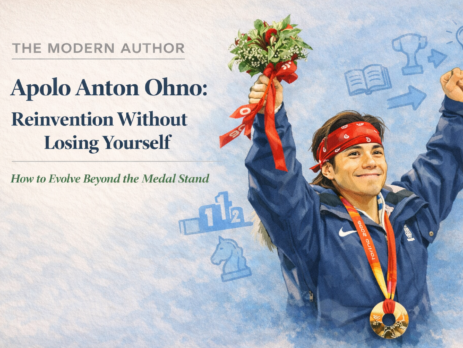
The Modern Author: Apolo Anton Ohno on Reinvention Without Losing Yourself
Most high performers assume reinvention begins with ambition.
Apolo Anton Ohno’s career suggests something more disciplined.
Reinvention becomes possible when identity separates from past achievement.
When process matters more than applause.
And when you move quickly enough that nostalgia never calcifies into paralysis.
The medals were real.
The identity built around them was stronger.
Reinvention began when he separated the two.
The Identity Problem After Success
Elite performance fuses identity to outcome.
The role becomes the self. The performance becomes the proof. What once felt like progress becomes a fixed definition.
Transition then feels less like evolution and more like erasure.
This is the hidden trap of achievement.
Reinvention rarely fails because opportunity disappears. It fails because identity hardens around what once worked.
Authors face the same dynamic.
A successful book. A recognizable niche. A defining idea that travels further than expected.
When identity is anchored to applause, expansion feels risky. When identity is anchored to the outcome, movement feels like loss.
Reinvention becomes possible only when identity detaches from result.
The Two-Week Spotlight and the Twelve-Year Process
Olympic glory lasts weeks.
Preparation lasts years.
The public sees the medal. The athlete lives the repetition, the long training sessions, the marginal gains, the ordinary days stacked deliberately.
The distinction matters because identity can attach to either.
It can attach to the visible outcome. Or it can attach to the invisible system that produced it.
If identity attaches to the spotlight, every transition feels like a fall from relevance.
If identity attaches to the process, every transition becomes a transfer of discipline.
For authors, the parallel is structural.
Launch week is brief. Writing is long. Recognition fluctuates. Craft compounds.
When identity is built on reception, reinvention feels like risk.
When identity is built on repetition, reinvention feels like continuation.
Volatility as a Training Ground
Short track speed skating is chaotic. Outcomes hinge on variables outside the athlete’s control.
Ohno learned that domination was less important than surrender, control what you can, release what you cannot.
The prize provides direction.
It does not define identity.
Publishing operates under the same volatility.
You cannot control reception. You cannot control market timing. You cannot control interpretation.
You control the draft. The hours. The decision to return tomorrow.
If your identity cannot survive a bad review, it was never anchored in process.
Goals are useful for orientation.
They are dangerous when used for validation.
Formation Creates Transferable Discipline
Discipline does not appear at the podium.
It is formed long before recognition arrives.
Ohno’s work ethic was shaped by structure, expectation, and consistent standards. Excellence was not an emotional surge. It was conditioning.
This matters for reinvention.
The same formation that built the first chapter builds the second.
For authors, this means examining what actually produced past success.
Was it discipline? Pattern recognition? Narrative instinct? Systems thinking?
The visible outcome may change.
The underlying capability often transfers.
Reinvention is not abandonment.
It is redeployment.
Velocity as Protection Against Calcification
When a defining chapter ends, stillness becomes dangerous.
Identity begins to calcify around what was.
The counterintuitive response is movement.
Testing new ideas before they feel polished. Publishing before identity feels settled. Allowing early versions to exist without narrative coherence.
Velocity generates information. It exposes transferable skills. It prevents nostalgia from becoming self-definition.
Reinvention is discovered through motion, not reflection alone.
The Diamond Principle
We tend to define ourselves by the facet that earned recognition.
One title. One niche. One visible strength.
But identity is not a flat surface. It is a diamond with multiple facets, many of which remain unpolished simply because they were not previously rewarded.
Success sharpens one edge.
Reinvention requires examining the entire structure.
What skill actually produced your past success?
Where else does that capability apply?
What facet has remained underdeveloped because it lacked applause?
What appears to be a pivot is often translation.
Discipline transfers. Pattern recognition transfers. Storytelling transfers.
Reinvention is not erasure.
It is expansion.
Writing as Reconstruction
After disruption, narrative coherence fractures.
You no longer know how to describe yourself.
Writing repairs that fracture.
Revisiting experience clarifies pattern. Articulating memory separates performance from identity. Language allows you to see what persists beyond the spotlight.
Writing is not merely a platform tool.
It is a reconstruction tool.
Modern authors use writing to integrate what was into what comes next. They build the next chapter quietly, often before it is externally recognized.
Reinvention is rarely announced.
It is accumulated.
What This Means for Modern Authors
The implication is structural.
If identity is anchored to past outcomes, you will protect them. You will optimize for preservation rather than growth. You will mistake recognition for relevance.
Reinvention requires a different operating rule.
Detach identity from applause. Anchor it in process. Accept volatility as normal. Redeploy discipline. Move before certainty arrives.
If identity can survive without spotlight, reinvention becomes possible.
If it cannot, the work becomes performance.
The Bottom Line
Reinvention is not theater.
It is disciplined re-anchoring.
Detach identity from outcome.
Anchor it in process.
Move with velocity.
Translate your formation.
Polish new facets before the world demands them.
Modern authors do not protect their last success.
They build the next version before it is confirmed.
Listen:
Watch:
About the Author
Eric Koester is an award-winning entrepreneurship professor at Georgetown University, bestselling author, and founder of Manuscripts. He has helped more than 3,000 nonfiction authors turn ideas into books, and books into platforms for speaking, media, and business growth.
About Manuscripts
Manuscripts is a modern publishing partner for nonfiction authors who want their books to drive real-world outcomes. We help founders, executives, coaches, and experts design, write, and launch books that build authority, attract opportunities, and compound into long-term business assets.
Work With Us
If you’re writing a book you want to matter, we’ll help you map the right strategy before you write another word.
Schedule a Modern Author Strategy Session