Hybrid vs. Self-Publishing (2026): The Real Difference Is Infrastructure
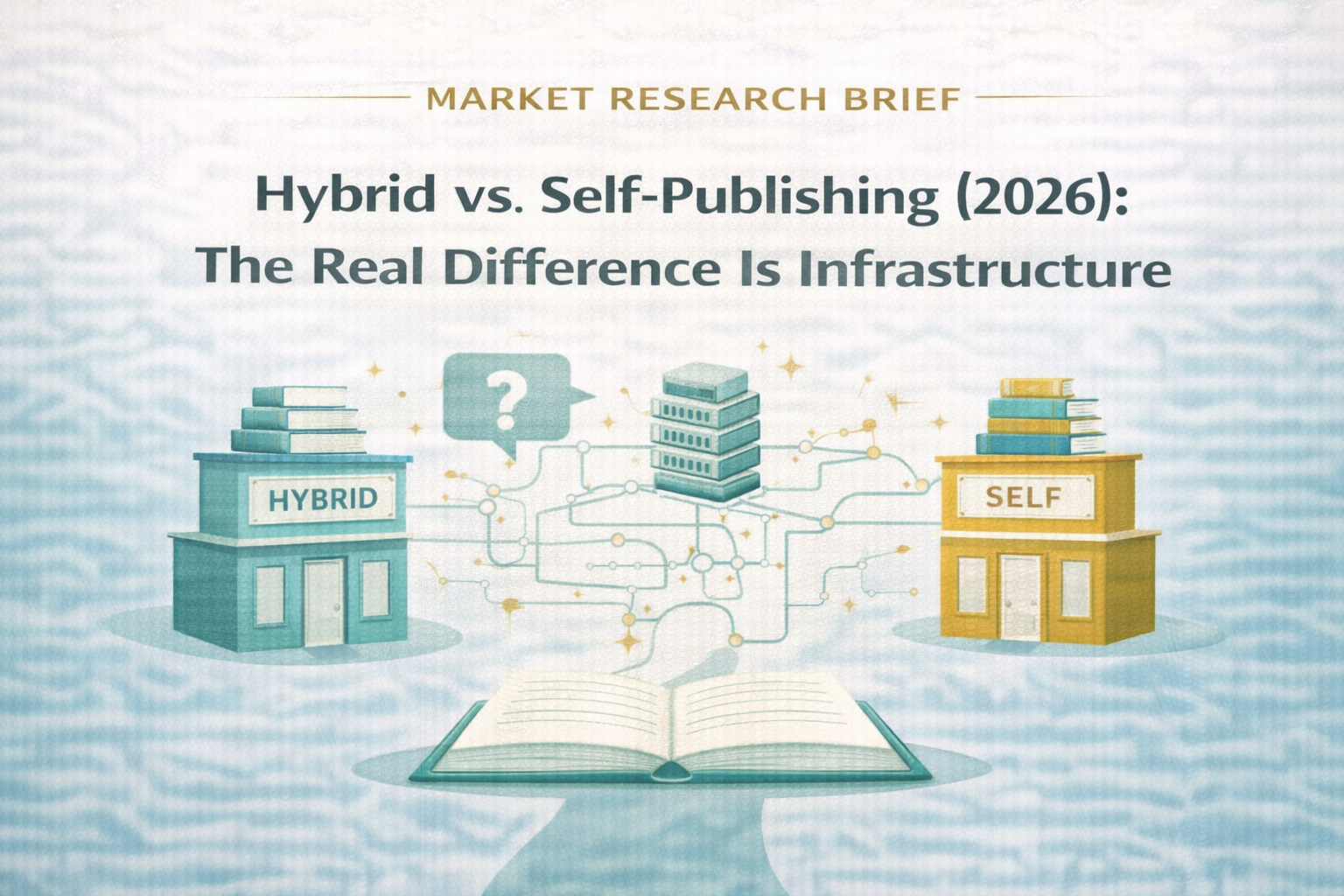
Most authors compare hybrid publishing and self-publishing as if the decision is about price or prestige.
It isn’t.
In 2026, the real question is:
Do you want to build the publishing system yourself, or borrow one that already works?
Because publishing isn’t scarce anymore.
Execution is.
This brief explains the real tradeoff:
- Hybrid publishing trades capital for focus, structure, and launch readiness.
- Self-publishing trades money saved for time, coordination, and execution risk.
If your book is meant to drive authority, clients, speaking, or enterprise opportunities, this decision is not stylistic.
It’s infrastructure.
| The 60-Second Decision: How Modern Authors Decide Between Hybrid and Self-Publishing Choose hybrid publishing if: Your book needs to work the first time You don’t want to manage 6–10 freelancers You want editorial leadership and launch coordination Your time is more valuable than the cost difference Choose self-publishing if: You want full autonomy and are willing to manage complexity You have time to iterate and learn in public The book is a lower-stakes experiment You already have strong operational execution skills Rule of thumb: If the book is a business asset, borrow a system. If the book is a sandbox, build one. |
Why the Hybrid vs. Self-Publishing Debate Is Misframed
Most discussions about hybrid versus self-publishing fixate on the wrong variables:
- price,
- control, and
- credibility.
These topics dominate forums, blog posts, and comparison charts, but they obscure the real decision authors are making.
Cost is visible. Leverage is not.
Control feels important. Outcomes matter more.
Credibility is assumed to be conferred by labels, when in reality it is earned through execution quality and consistency.
Most authors don’t fail because they choose the wrong model. They fail because they choose without understanding the operational burden. Some authors overinvest in infrastructure they do not yet need. Others underinvest, believing effort alone will compensate for missing systems.
In both cases, the failure is not effort or intelligence. It is framing.
“I tried self-publishing for 10 years. Hybrid structure changed everything.”
Dr. Laura Streyfeller
Publishing today is abundant. Execution quality, sustained attention, and follow-through are scarce. Any serious comparison between hybrid and self-publishing must start from that reality.
The Modern Author Context: Books as Leverage, Not Artifacts
Modern Authors write books as leverage, not as artifacts.
For executives, founders, consultants, coaches, professors, physicians, and mission-driven experts, a nonfiction book is almost never the end goal. It is a strategic instrument designed to serve a broader purpose.
That purpose might include:
- Establishing authority in a crowded or skeptical market
- Compounding credibility over years rather than months
- Unlocking higher-quality clients, stages, or partnerships
- Creating durable intellectual property that supports a body of work
Most conventional publishing advice assumes the book exists primarily to be read, reviewed, or ranked. It assumes the book’s success can be measured largely by copies sold.
For Modern Authors, that assumption fails. The book must work. It must integrate with a larger ecosystem of ideas, offerings, and reputation. When a book is meant to support a business, a platform, or a thought leadership agenda, the publishing model becomes an infrastructure decision rather than a stylistic preference.
In our data, fewer than 10–15% of nonfiction authors earn most of their ROI from book sales alone. The book’s real value comes from what it unlocks: clients, speaking, training, partnerships, and credibility.
Industry analyses consistently show that most traditionally published books sell only a few hundred copies in year one.
Source: Nielsen BookScan–reported publishing benchmarks.
This is why generic publishing advice so often misfires for serious nonfiction authors. It is answering a different question.
What Hybrid Publishing Actually Is (and Isn’t)
Hybrid publishing is one of the most misunderstood terms in the industry.
Legitimate hybrid publishing is not defined by price, branding, or guarantees. Hybrid publishing is best understood as author-owned publishing with professional infrastructure.
Hybrid publishing isn’t paying for a book.
It’s paying for the infrastructure to bring a book to market professionally.
It is defined by division of responsibility.
In a true hybrid publishing model:
- The author retains full ownership and rights
- The publisher provides editorial leadership, production systems, and launch coordination
- Risk is shared, but long-term control remains with the author
This structure is fundamentally different from traditional publishing, where rights are exchanged for distribution and advance capital, and from self-publishing, where the author retains ownership but also absorbs nearly all operational responsibility.
Hybrid publishing is not:
- Paying for legitimacy
- Buying distribution guarantees
- Outsourcing authorship
- A bundle of disconnected vendor tasks
A legitimate hybrid partner provides systems, editorial authority, and coordinated execution, while the author retains full ownership.
Many companies that market themselves as hybrid publishers are, in practice, service vendors with better branding. They sell tasks, not systems. The distinction matters, because authors are not actually buying editing, design, or formatting in isolation. They are buying coordination, decision-making frameworks, and error prevention.
When hybrid publishing works, it replaces fragmentation with structure.
The Leverage Trade of Hybrid Publishing
The core value of hybrid publishing is not convenience. It is compression.
Example (Common Hybrid Use Case)
A healthcare executive writing a leadership book may have the expertise, but not the bandwidth to manage editors, designers, metadata, launch sequencing, and distribution.
Hybrid publishing replaces fragmentation with a coordinated system.
Hybrid publishing allows authors to substitute capital for time, attention, and accumulated error. Instead of learning the publishing process through trial and misstep, the author steps into a system that has already been refined through repetition.
What authors are buying with a legitimate hybrid partnership includes:
- Shortened learning curves
- Editorial leadership that prevents structural mistakes
- Production workflows that are tested and repeatable
- Coordinated launch execution rather than reactive marketing
This trade matters most when the author’s primary leverage does not come from operational execution. Founders, executives, and professional experts already have high-value demands on their time. For them, every hour spent coordinating vendors or troubleshooting production is an hour diverted from their core work.
Hybrid publishing allows these authors to remain focused on thinking, positioning, and leadership while execution is handled within a system designed for outcomes rather than activity.
Example: A consultant with multiple client programs may outsource production and marketing to a hybrid publisher, ensuring the book reaches market-ready quality while their schedule remains dedicated to client growth.
Thought Leadership Leverage’s Author ROI research shows most nonfiction ROI comes from speaking, consulting, and services, not royalties.
The tradeoff is material and explicit: upfront investment. The upside is equally explicit: fewer false starts, fewer hidden failures, and a higher probability that the book enters the market in a coherent, credible form.
The Hidden Reality of Self-Publishing
Self-publishing is often described as independence. Operationally, it is general contracting. The self-publishing author handles:
- Managing editors across multiple stages
- Coordinating design, formatting, and distribution
- Making editorial decisions without external arbitration
- Planning and executing a launch with limited feedback loops
Self-publishing does not remove complexity. It relocates it.
Self-publishing can produce extraordinary books.
But only when the author is prepared to act as the project manager, publisher, and launch strategist, not just the writer.
Instead of complexity living inside a publisher’s system, it lives inside the author’s calendar and cognitive load. The author becomes the system that holds everything together.
For authors with strong operational instincts, available time, and tolerance for iteration, this can be a viable and even empowering path. For authors whose leverage comes from expertise rather than execution, it often becomes a bottleneck that slows progress and degrades quality.
The Leverage Trade of Self-Publishing
The most visible benefit of self-publishing is cost control. The less visible costs are more consequential.
These include:
- Time diverted from core expertise
- Fragmented decision-making across vendors
- Inconsistent editorial quality
- Launch effectiveness dependent on existing audience
Self-publishing rewards authors who already have distribution, patience, and the ability to manage ambiguity. It punishes authors who underestimate coordination risk or assume quality emerges naturally from effort.
This model works best for exploratory projects, early-stage thinking, or intentionally low-stakes books designed to test ideas in public. It becomes fragile when the book is expected to carry authority, credibility, or business outcomes on its own.
Example: A first-time author experimenting with a thought leadership idea may self-publish a short-form book to test messaging and audience response before committing to a full-scale launch.
Hybrid vs. Self-Publishing: A Clear Comparison
| Dimension | Hybrid Publishing | Self-Publishing |
| Best for | Authors prioritizing leverage, outcomes, and market readiness | Authors prioritizing cost control and full autonomy |
| Typical cost range | $15k–$50k+ depending on scope | $1k–$10k depending on service bundle |
| Time burden | Low; publisher handles coordination | High; author manages every stage |
| Editorial authority | Shared, guided by publisher | Fully author-controlled |
| Launch readiness | Coordinated, systematized | Dependent on author execution |
| Audience support | Integrated prelaunch strategy | Author-dependent, minimal support |
| Primary tradeoff | Capital for time, attention, and reduced risk | Money saved for time, coordination, and execution risk |
| Likelihood book enters market professionally on first release | High | Variable |
| Best for first-time business authors | Strong fit | Only if highly self-directed |
Case Study: Why Hybrid Support Matters
One of the clearest ways to understand the difference between self-publishing and high-integrity hybrid publishing is to hear it from an author who has done both.
Dr. Laura Streyfeller, a physician and longtime speaker, came to Manuscripts after spending nearly a decade trying to complete her first book on her own.
She wasn’t struggling because she lacked expertise.
She was struggling because she lacked the infrastructure that modern authors actually need:
- structure
- deadlines
- editorial partnership
- community accountability
- a publishing system built for real life
As Laura put it:
“When I wrote the first book I did… it was self-publishing the way I did it. And it took me about 10 years. I moved sentences around for 10 years trying to get it right. I had no structure and it just took forever.”
That’s the hidden truth of self-publishing for serious nonfiction authors:
The problem usually isn’t effort.
It’s isolation.
And without a system, the project expands until it becomes endless.
Laura described what changed when she entered a structured hybrid publishing model:
“Having not only the instruction, and the deadlines, and the sense of community, and the editorial help was invaluable… having somebody to help me structure my thoughts was invaluable.”
That’s what legitimate hybrid publishing actually provides at its best:
Not shortcuts.
Not outsourcing.
But a professional container that makes completion possible.
And in Laura’s case, the book became far more than a publication.
It became a way to bring together a lifetime of insight and reach a broader audience:
“The book has helped me bring together a lifelong journey… my personal journey, my professional journey… and healing of others.”
This is why the hybrid vs. self-publishing decision is not primarily about printing.
It’s about whether you want to build alone…
Or build with a team designed to help the book actually happen.
Watch Dr. Streyfeller’s Full Reflection
Dr. Laura Streyfeller on why structure and editorial partnership made the difference
The Takeaway for Modern Authors
Self-publishing can work.
But for most serious authors, the risk isn’t quality.
The risk is never finishing.
Hybrid publishing is worth considering when you want:
- a manuscript completed on a real timeline
- professional editorial guidance
- accountability and structure
- a book that carries your voice, not a ghostwriter’s
- a launch that connects the work to real readers
Or as Laura said best:
“Time isn’t something we have. It’s something we make.”
A good publishing system helps you make it.
A Practical Evaluation Checklist
Before committing, authors should answer:
- Who owns rights, ISBNs, and long-term control?
- Where does editorial authority sit?
- How is audience-building integrated before launch?
- Which systems persist after publication?
- How is success defined beyond book sales?
- What risks remain with the author?
- What capabilities am I buying—or building—for the future?
If answers are vague, the decision rests on faith rather than structure.
Hybrid Publisher Red Flags (Avoid These)
- Publisher owns ISBN or rights
- No audience-building or presale strategy
- “Guaranteed bestseller” language
- Vendor bundle, not an integrated system
- No editorial leadership (just copyediting)
The Real Divide: One-Off Books vs. Author-Owned Publishing Systems
The key distinction isn’t hybrid vs. self. It’s single-book thinking vs. system thinking.
- Single-book thinking: treats publishing as a one-time project; goal is completion.
- Author-owned systems thinking: treats publishing as an asset class; goal is repeatable leverage.
System thinking delivers:
- Reusable editorial frameworks
- Compounding audience intelligence
- Launch infrastructure that improves over time
Strategic clarity on how books support broader goals
When authors think in systems, the publishing model becomes a design choice rather than an emotional one. Hybrid and self-publishing are simply different ways of acquiring or building those systems.
Hybrid Publishing is NOT worth it if…
- You’re experimenting with your first idea
- The book has no business or platform role
- You want to learn the process hands-on
- Budget is tight and stakes are low
How Manuscripts Reframes the Decision
Manuscripts is built for authors who want the benefits of hybrid publishing, without surrendering ownership or treating the book as a one-time project.
We combine:
- Author-owned publishing
- Audience-building before launch
- Editorial rigor and coordinated execution
- Long-term business leverage strategy
This is why we call it the Modern Author Operating System, not a publishing package. Manuscripts authors have earned 450+ national and international book awards through this model.
Through the Modern Author OS, publishing is treated as an integrated discipline that connects editorial rigor, audience development, and long-term asset value. The focus is not on choosing a label, but on designing infrastructure that supports the role a book plays over time.
Concepts such as presale publishing, systematized execution, and author-owned publishing infrastructure exist to remove false tradeoffs. They allow authors to retain ownership while avoiding fragmentation, and to invest deliberately rather than reactively.
The framing shifts from “Which model should I choose?” to a more durable question:
What system best supports the role this book plays in my life and work?
Choosing Based on Leverage, Not Price
Hybrid publishing and self-publishing are not moral choices. They are leverage decisions:
- Hybrid: trades capital for focus, structure, and market readiness
- Self-publish: trades money saved for time, coordination, and risk
Neither is universally superior. The correct choice depends on:
- Whether the book must work the first time
- Whether it can iterate and learn in public
- The author’s ability to build or borrow a system to support the book’s role
Rule of Thumb:
If the book must work the first time, borrow a system.
If the book is allowed to learn in public, build one.
If you want help evaluating which model fits your book’s role, Manuscripts offers a structured publishing consult built around outcomes, not labels.
If you want a clear recommendation based on your goals, we offer a structured publishing consult for serious nonfiction authors.
No pressure, just clarity.