Write Like a Thought Leader: How Adam Grant Makes Research Go Viral

Write Like a Thought Leader: How Adam Grant Makes Research Go Viral

Most people think ideas spread because they’re well-researched.

They don’t.

They spread because the takeaway is clear.

Adam Grant understood this early. Long before he became the most cited organizational psychologist on the planet, before the TED talks and bestseller streak, his ideas traveled because people could immediately tell what he believed.

Not what he studied.

Not how careful he was.

What the point was.

That’s the lesson most smart writers miss.

People don’t share your research.

They share your conclusion.


The Adam Grant Pattern: Decide First, Prove Second

Adam Grant doesn’t start by walking readers through a study.

He:

  • states a surprising takeaway upfront
  • frames it in everyday language
  • uses research selectively to make it stick

This creates a powerful dynamic:

readers know why it matters immediately

the idea feels usable, not academic

sharing becomes easy

The key insight isn’t simplification. It’s sequencing.

Grant doesn’t dilute rigor.

He reorders it.


The Principle: Authority Comes From Judgment, Not Data

Here’s the core thought leadership principle behind Grant’s work:

People trust conclusions that feel earned, not arguments that feel endless.

Grant doesn’t ask the reader to wade through evidence to find the meaning.

He delivers the meaning first.

Then he shows his work.

That posture signals confidence. Not arrogance, judgment.

And judgment is what people follow.


Why Raw Research Doesn’t Travel

Most research-led writing dies outside expert circles for the same reason.

It leads with process instead of payoff.

Common symptoms:

  • long setup before the point
  • careful hedging that blurs relevance
  • evidence without interpretation

The reader is left thinking, “Interesting, but so what?”

Grant removes that friction.

He doesn’t make readers decode the insight. He hands it to them.


The Real Job: Turning Insight Into a Takeaway

Adam Grant isn’t just a researcher.

He’s a translator.

His real skill is converting abstract findings into conclusions people can recognize in their own lives and work.

He asks a different question than most experts:

“What should someone do differently after hearing this?”

That question forces clarity.

It turns knowledge into relevance.


The Adam Grant Virality Framework

There’s a repeatable structure underneath his most shared ideas.

It looks like this:

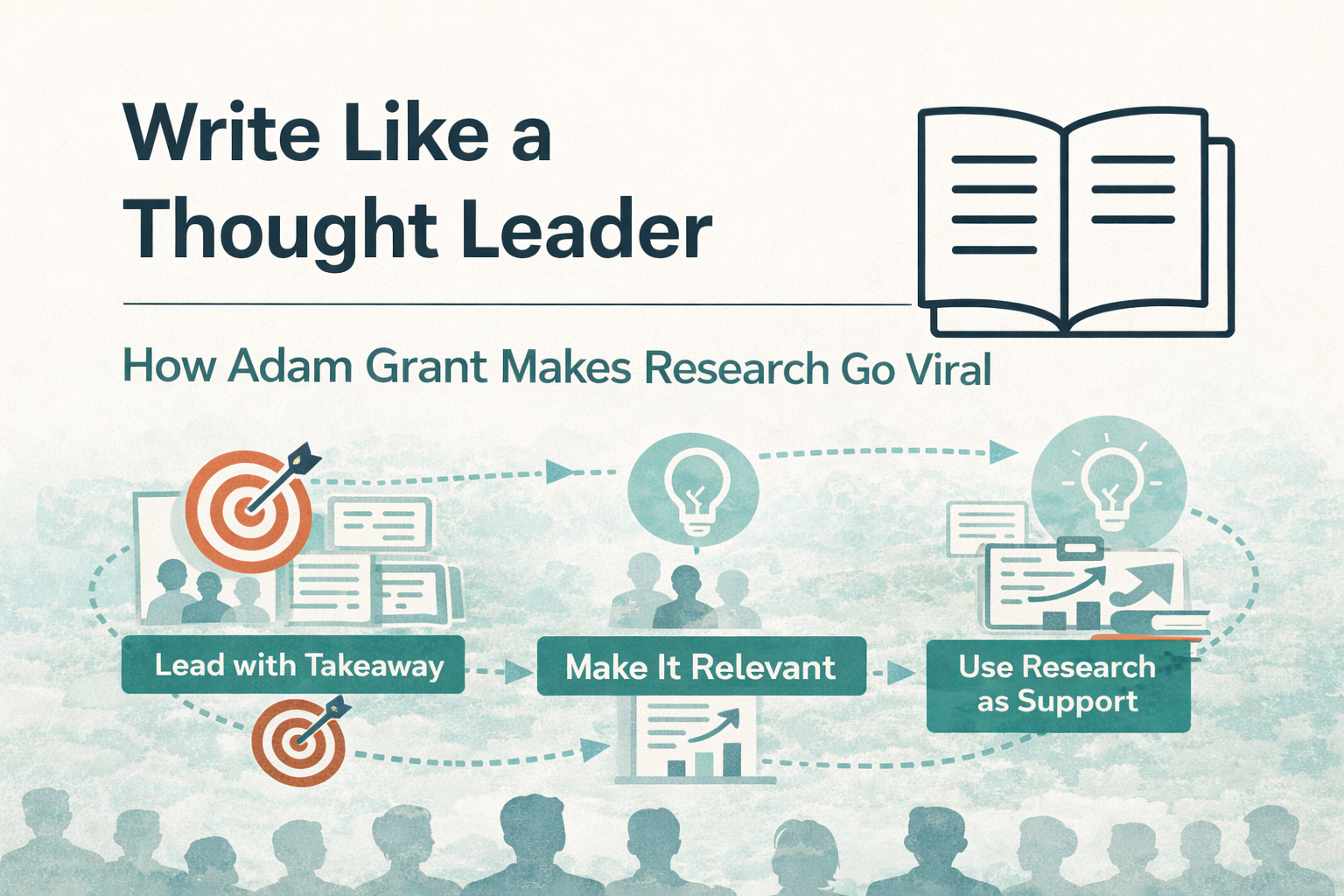
1) Lead with a counterintuitive conclusion

Start with a claim that challenges a default belief.

Example style:

“Originals don’t wait for permission. They act before they feel ready.”

No citations yet. Just the point.

Why it works:

The reader knows immediately whether this matters to them.


2) Anchor it in something familiar

Connect the takeaway to behavior people already recognize.

Work habits. Leadership mistakes. Career anxieties.

Why it works:

The idea feels personal before it feels intellectual.


3) Use research as reinforcement, not the headline

Introduce studies to support the conclusion, not replace it.

Grant is selective. He shows enough to earn trust, not so much that it overwhelms.

Why it works:

Evidence strengthens judgment instead of obscuring it.


Why Most Smart Writers Won’t Do This

The method is obvious. The resistance is emotional.

Leading with a conclusion feels risky.

Experts worry about:

  • oversimplifying
  • being challenged
  • looking less rigorous to peers

So they hedge. They bury the point. They lead with context.

Grant makes a different trade.

He accepts exposure in exchange for impact.

That choice is why his ideas leave academia and enter culture.


What It Means to Write Like a Thought Leader

Writing like a thought leader starts before the writing.

You decide what you believe.

Then you earn the right to explain why.

For authors and experts, that means:

  • state the takeaway early
  • make relevance explicit
  • use research to support judgment, not avoid it

Thought leadership isn’t showing how much you know.

It’s taking responsibility for meaning.

Adam Grant’s work spreads because he does that work for the reader.

That’s the lesson.

And that’s the standard.

A Simple Template You Can Copy

Use this when drafting a chapter, article, or post based on research or expertise:

Takeaway: “Here’s the conclusion I believe is true.”

Relevance: “Here’s why this matters in real life or work.”

Evidence: “Here’s the research or experience that supports it.”

Principle: “Here’s the general rule that keeps showing up.”

Application: “Here’s how you can use this idea.”

This is interpretation made visible.

It’s how insight becomes shareable instead of academic.


Quick FAQ

Why don’t my research-based ideas spread?

Because readers can’t immediately tell what the point is. Clarity precedes credibility.

What does Adam Grant do differently?

He leads with a conclusion, frames it in familiar terms, and uses research to support judgment, not replace it.

Is this the same as simplifying or dumbing things down?

No. It’s prioritizing meaning over method. The rigor stays. The sequencing changes.


The Bottom Line

People don’t share studies.

They share takeaways that help them think or act differently.

Adam Grant doesn’t start by proving he’s right.

He starts by deciding what the research means.

If you want to write like a thought leader, start there.

→ Schedule Your Free Strategy Call


About the Author

Eric Koester is an award-winning entrepreneurship professor at Georgetown University, bestselling author, and founder of Manuscripts, the Modern Author OS used by more than 3,000 authors. His work has helped creators turn ideas into books, books into brands, and brands into scalable businesses.

About Manuscripts

Manuscripts is the leading full-service publishing partner for modern nonfiction authors. We help founders, executives, coaches, and experts turn their books into growth engines, through positioning, coaching, developmental editing, design, AI-enhanced writing tools, and strategic launch systems. Manuscripts authors have sold thousands of books, booked paid speaking gigs, landed media features, and generated millions in business from their IP.

Work With Us

If you’re writing a book you want to matter, let’s map out your Modern Author Plan.

👉 Schedule a Modern Author Strategy Session → https://write.manuscripts.com/maa-web

👉 Explore Manuscripts Publishing Services → https://manuscripts.com/publish-with-us/

👉 See Modern Author Success Stories → https://manuscripts.com/authors/

Modern Author Resources

  • How to Write a Book if You’re Busy
  • Modern Ghostwriting for Nonfiction Authors
  • AI Tools for Authors in 2026
  • How to Build an Audience Before You Write Your Book
  • The Evergreen Launch System for Modern Authors
Powered by Codex: The Modern Author Author Intelligence Tool

Read more...

Write Like a Thought Leader: Why No One Cares About Your Success Until You Do This (Russell Brunson’s Lesson)

Most people think audiences care about credentials.

They don’t.

They care about movement.

Russell Brunson understood this early. Long before ClickFunnels was a category, before the massive stages and seven-figure launches, he talked openly about what he was building, what was working, and what wasn’t, while it was still in motion.

That’s the lesson most aspiring thought leaders miss.

People don’t care about your success after it happens.

They care when they can see it unfolding.


The Russell Brunson Pattern: Build in Public, Teach in Public

Russell Brunson doesn’t wait until something is “done” to talk about it.

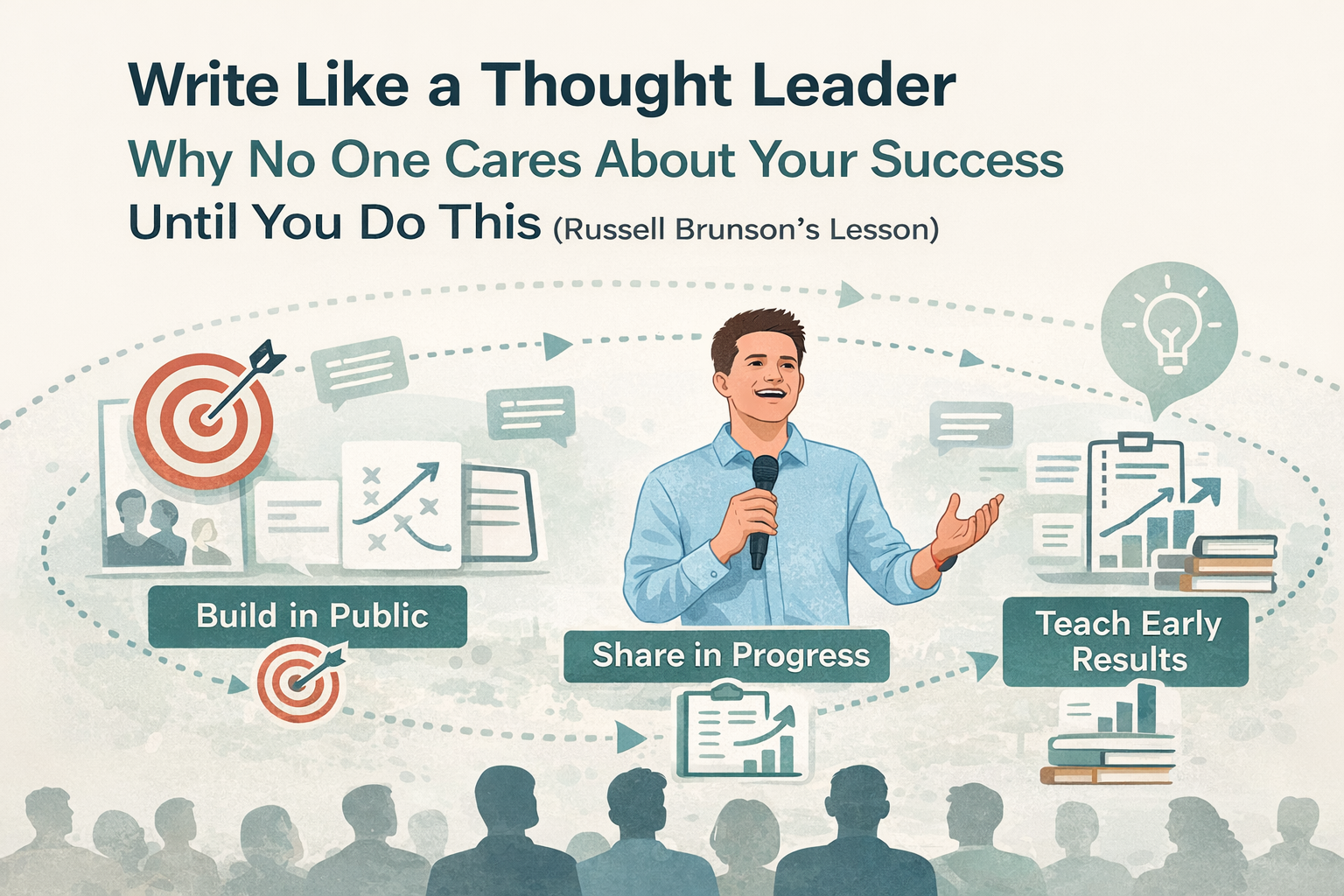
He:

  • shares frameworks as he’s using them
  • teaches concepts while they’re being tested
  • explains outcomes before they’re polished into case studies

This creates a powerful dynamic:

  • audiences feel early
  • trust builds faster
  • momentum compounds

The key insight isn’t marketing bravado. It’s psychology.

People don’t attach to finished success.

They attach to visible commitment.


The Principle: People Care When You Take Yourself Seriously

Here’s the core thought leadership principle behind this post:

People don’t validate your success. They respond to your conviction.

Russell didn’t wait for the world to crown him credible.

He acted like the work mattered before anyone else did.

That posture, repeated publicly, creates gravity.


Why This Matters for Authors

Most nonfiction authors do the opposite.

They:

  • hide until the book is “good enough”
  • wait for permission to teach
  • assume attention comes after achievement

But attention is built before the book is finished.

Russell’s style proves a counterintuitive truth:

Teaching is how you earn the right to be followed.


The “Conviction-First” Writing Framework

This is how to apply the Russell Brunson lesson directly to your book and content.

1) Lead with belief, not validation

Start chapters and posts by stating what you believe now, not what you’ve proven forever.

Example:

“Most funnels fail because people overbuild before they understand demand.”

That sentence doesn’t require universal proof. It requires ownership.

Why it works:

Belief signals leadership. Hedging signals insecurity.


2) Teach from the middle, not the finish line

Russell teaches while building, not after the case study is complete.

As an author, that means:

  • write from the testing phase
  • share partial results
  • explain what you’re trying and why

This doesn’t weaken authority. It humanizes it.

Why it works:

Readers trust people who are in the arena, not just reporting from it.


3) Show progress, not perfection

You don’t need a massive win to earn attention.

You need:

  • a direction
  • momentum
  • consistency

Russell constantly shows:

  • iterations
  • refinements
  • new versions of old ideas

Why it works:

Progress feels real. Perfection feels distant.


4) Name the pattern you’re discovering

The shift from “story” to “thought leadership” happens here.

After sharing what you’re doing, extract the insight:

  • What’s working?
  • What keeps repeating?
  • What surprised you?

This turns activity into teaching.

Example:

“Every time we simplified the message, conversion improved. Complexity was the enemy.”

Now it’s not just a story. It’s a principle.


5) Invite the reader to act alongside you

Russell’s work often feels collaborative, not declarative.

End sections with:

  • “Try this”
  • “Test this”
  • “Watch what happens when you…”

This frames the reader as a participant, not a spectator.


How This Shows Up in Manuscripts Projects

The authors who gain traction fastest don’t wait to feel “successful.”

They:

  • put "Working Title (Coming 2026" in their LinkedIn bio before they've finished their first draft
  • publish while learning
  • teach before the book is finished
  • share frameworks as living tools

Their books feel alive because they were shaped in public.

This mirrors the Russell Brunson model exactly.


Evidence That This Works

1) Pattern Evidence

Audiences consistently engage more with in-progress insights than polished retrospectives.

2) Social Evidence

Readers frequently say:

“I feel like I’m learning alongside you.”

That’s not accidental. That’s design.

3) Outcome Evidence

Authors who teach early:

  • build audiences faster
  • get better feedback
  • write stronger books because ideas are pressure-tested

Common Mistakes (and Fixes)

Mistake: Waiting to be “successful enough”

Fix: Act like the work matters now

Mistake: Over-explaining credentials

Fix: Demonstrate belief through consistent action

Mistake: Hiding drafts and ideas

Fix: Share thinking before it’s perfect


A Simple Template You Can Copy

Use this when drafting a chapter or post:

  1. Belief: “Here’s what I think is true right now.”
  2. Action: “Here’s what I’m doing to test it.”
  3. Observation: “Here’s what I’m seeing so far.”
  4. Pattern: “Here’s the principle emerging.”
  5. Invitation: “Here’s how you can try this.”

This is conviction made visible.


Quick FAQ

Why don’t people care about my success yet?

Because they can’t see your commitment in motion. Visibility precedes validation.

What did Russell Brunson do differently?

He taught while building, shared frameworks early, and acted like the work mattered before it was widely successful.

Is this the same as “building in public”?

Related, but more intentional. This is teaching in public, not just sharing updates.


The Bottom Line

People don’t rally behind finished success.

They rally behind belief, motion, and leadership.

Russell Brunson didn’t wait to be impressive.

He showed up convinced.

If you want to write like a thought leader, start there.

→ Schedule Your Free Strategy Call


About the Author

Eric Koester is an award-winning entrepreneurship professor at Georgetown University, bestselling author, and founder of Manuscripts, the Modern Author OS used by more than 3,000 authors. His work has helped creators turn ideas into books, books into brands, and brands into scalable businesses.

About Manuscripts

Manuscripts is the leading full-service publishing partner for modern nonfiction authors. We help founders, executives, coaches, and experts turn their books into growth engines, through positioning, coaching, developmental editing, design, AI-enhanced writing tools, and strategic launch systems. Manuscripts authors have sold thousands of books, booked paid speaking gigs, landed media features, and generated millions in business from their IP.

Work With Us

If you’re writing a book you want to matter, let’s map out your Modern Author Plan.

👉 Schedule a Modern Author Strategy Session → https://write.manuscripts.com/maa-web

👉 Explore Manuscripts Publishing Services → https://manuscripts.com/publish-with-us/

👉 See Modern Author Success Stories → https://manuscripts.com/authors/

Modern Author Resources

  • How to Write a Book if You’re Busy
  • Modern Ghostwriting for Nonfiction Authors
  • AI Tools for Authors in 2026
  • How to Build an Audience Before You Write Your Book
  • The Evergreen Launch System for Modern Authors
Powered by Codex: The Modern Author Author Intelligence Tool

Read more...

How to Write Like a Thought Leader: The James Clear Principles Framework for Nonfiction Authors

Great Books Aren’t Written — They’re Structured

Most first-time authors start with the wrong question:

“How do I write a great chapter?”

The better question:

“How do I structure my ideas so readers understand, remember, and act on them?”

Thought leaders don’t win because they’re better writers.

They win because their ideas are delivered through a structure that makes those ideas unavoidable.

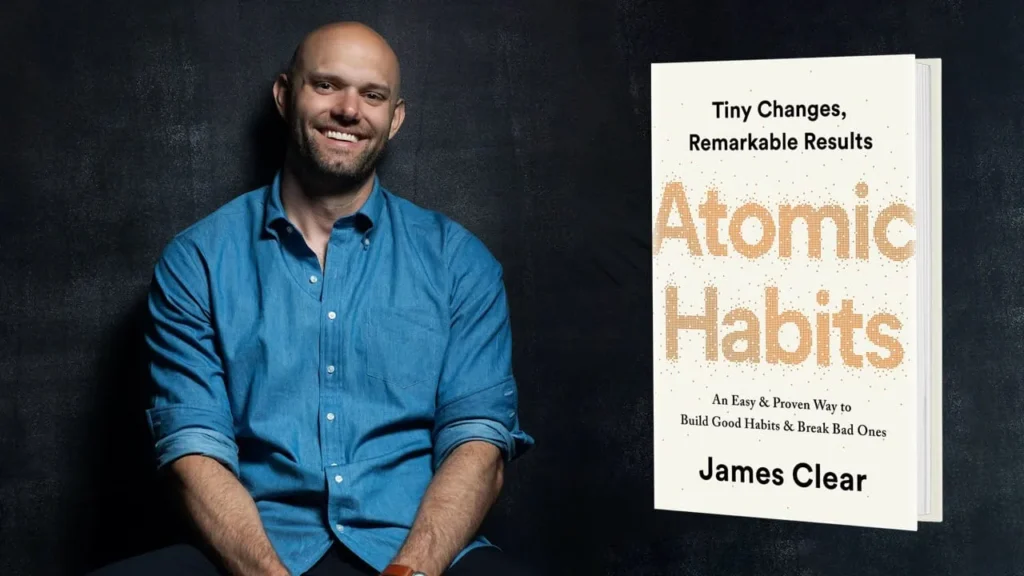
And James Clear’s Atomic Habits provides one of the cleanest, most repeatable structures modern authors can steal.

At Manuscripts, we’ve studied more than 2,500 nonfiction books inside the Modern Author OS. Across industries, voices, and genres, one pattern keeps showing up:

Readers trust frameworks more than opinions.

Readers remember stories more than arguments.

Readers act when structure makes action simple.

James Clear mastered that blend.

In this guide, you’ll learn exactly how to use Clear’s “Principles Framework” to build chapters that feel polished, persuasive, and inevitable — even if you’re busy, overwhelmed, or unsure how to organize your ideas.

This is the approach we use inside the Modern Author Accelerator and Codex AI to help authors transform scattered expertise into clean, compelling chapters.


Why Readers Trust Principles More Than Advice

Most books fail because they tell people what to do instead of showing how the world works.

Advice feels personal.

Principles feel universal.

James Clear built his book around principles like:

  • Identity drives habits
  • Environment shapes behavior
  • Small improvements compound

These aren’t tips.

These are truths.

A principle is a timeless rule about how something works.

When a reader recognizes it, you get instant credibility.

Why Principles Work So Well in Modern Thought Leadership

They:

  • Create shared language
  • Anchor your frameworks
  • Make your ideas portable
  • Encourage word-of-mouth (“She teaches the principle of X…”)
  • Position you as a category thinker, not an advice-giver

If you want to write like a thought leader, your chapters must translate your expertise into principles — then prove them with stories, data, and frameworks.


The James Clear Chapter Structure (Reverse Engineered)

We broke down Clear’s chapters across Atomic Habits and found a repeatable flow:

THE CLEAR PRINCIPLES CHAPTER MODEL

  1. Start With a Story A vivid, often surprising story that represents the principle in action.
  2. State the Principle A clear, memorable truth about how the world works.
  3. Explain the Principle Why does this principle matter? What makes it universal?
  4. Demonstrate the Principle Real-world examples, research, case studies, or analogies.
  5. Introduce a Framework A simple, visualizable system or model that operationalizes the principle.
  6. Apply the Framework Show readers what to do and how to do it.
  7. End With a Memorable Line or Punchline A repeatable idea that readers can’t forget.

This structure is extremely friendly for:

  • Busy authors
  • Business leaders
  • Consultants
  • Coaches
  • Creators
  • Anyone trying to turn expertise into IP

It reduces blank-page stress and gives your reader cognitive grip.


Build Your Chapter Around One Core Principle

Every great chapter answers one question:

“What is the single principle this chapter proves?”

If your chapter has three ideas, it’s confusing.

If it has one idea, it’s powerful.

Your principle must be:

  • True (backed by research or lived experience)
  • Simple (plain language)
  • Useful (changes behavior or perspective)
  • Memorable (easy to teach)

Examples:

  • “People don’t rise to the level of their goals. They fall to the level of their systems.”
  • “Clarity creates courage.”
  • “Positioning is what you own in the mind, not what you say in the pitch.”

Inside Codex, this is where we extract:

  • Repeated beliefs
  • Thematic patterns
  • Contrasts
  • Identity statements
  • Core insights

And then synthesize them into a clean principle.


Start With a Story (Your Anchor)

Clear opens nearly every chapter with a surprising or emotional story.

Why?

Because stories create cognitive hooks.

The story makes the principle stick.

Your story must do at least one of these:

  • Illustrate the principle in action
  • Represent a transformation
  • Set up the problem the reader is facing
  • Create tension or curiosity
  • Build trust through vulnerability

Examples from Clear:

  • The British cycling team transformation
  • The Japanese train station cleaning ritual
  • The Seinfeld chain method

Stories = stickiness.

Principles = clarity.

Frameworks = action.

That combination creates bestseller energy.


Demonstrate the Principle With Multiple Angles

James Clear doesn’t just state a principle and move on.

He proves it three ways:

1. Research or data

Gives credibility.

2. Examples or case studies

Makes it relatable.

3. Metaphors or analogies

Makes it memorable.

When we work with authors, we call this the Evidence Bundle.

One principle → three types of proof.

This is where the Manuscripts methodology shines:

we teach authors how to gather stories, turn them into data, and feed them into Codex so that each chapter writes itself.


Turn Your Principle Into a Framework

This is where most first-time authors fall short.

They give great stories.

They explain great ideas.

They forget to give readers a system.

James Clear always does.

He turns principles into:

  • 4 Laws
  • Systems
  • Rules
  • Models
  • Step-by-step processes

A framework moves readers from “I understand” to “I can use this.”

For your book:

  • Give every chapter one framework
  • Make it visual
  • Use 3–5 steps (cognitively optimal)
  • Tie each step back to the principle

This is also how you turn your book into:

  • A keynote talk
  • A workshop
  • A course
  • A coaching program
  • An enterprise training system

Frameworks = monetization.


Close With a Punchline or Insight They Can’t Forget

Clear ends each chapter with a sharp, memorable line.

These lines often end up:

  • Quoted
  • Shared
  • Highlighted
  • Used in talks
  • Referenced in articles

Examples:

  • “You do not rise to the level of your goals. You fall to the level of your systems.”
  • “Every action you take is a vote for the type of person you wish to become.”

Your closing line should be:

  • Short
  • True
  • Repeatable
  • Aligned with the principle

This becomes your intellectual signature.


Your Chapter Template (Manuscripts Version)

Here’s the Manuscripts + James Clear hybrid chapter template:


CHAPTER TITLE (Benefit + Insight)

1. Opening Story

One vivid, emotional story that sets up the idea.

2. State the Core Principle

One sentence.

3. Explain the Principle

Why it matters. Why it’s universal.

4. Demonstrate the Principle

  • Research
  • Case studies
  • Examples
  • Metaphors

5. Introduce the Framework

3–5 steps.

6. Apply the Framework

Practical, step-by-step implementation.

7. Close With a Punchline

One memorable, tweet-length idea.


Feed this to Codex and you’ll get a chapter preview in 20 seconds.


Why This Structure Works for Busy Authors

If you’re a busy modern author, you need structure that creates speed.

This model gives you:

  • A predictable chapter flow
  • A way to write in 60–90 minute bursts
  • A framework that turns scattered notes into clear structure
  • A repeatable process you can use 10–12 times
  • A blueprint for repurposing every chapter into content

This is why our Accelerator authors can write high-quality drafts in 8–14 weeks even with full-time jobs.


How Codex Accelerates This Entire Process

Codex turns the James Clear method into an automated outline generator.

Upload a transcript, notes, or a research dump and Codex will:

  • Extract potential principles
  • Map your stories to principles
  • Identify gaps
  • Cluster examples
  • Propose 3–5 frameworks
  • Generate chapter outlines
  • Rewrite principles in cleaner language
  • Produce chapter summaries, headlines, and social posts

This takes authors from overwhelm to momentum fast.


Bringing It All Together

Writing like a thought leader is not about being a genius.

It’s about having a structure that elevates your ideas.

James Clear gave modern authors one of the most effective chapter models in nonfiction.

Use it.

Adapt it.

Make it your own.

This framework, combined with Codex and the Modern Author OS, gives you everything you need to write chapters that are clear, persuasive, memorable, and actionable.

If you want to write like a thought leader, build chapters around principles.

Principles build books.

Books build opportunities.

Opportunities build a platform.


Call to Action

If you want help using the James Clear Principles Framework to write your book, schedule a free strategy call with Manuscripts.

We’ll help you:

  • Identify your core principles
  • Build your frameworks
  • Structure your chapters
  • Use Codex to accelerate your draft
  • Build your platform while writing
  • Turn your book into speaking, clients, and business growth

Schedule Your Free Strategy Call


About the Author

Eric Koester is an award-winning entrepreneurship professor at Georgetown University, bestselling author, and founder of Manuscripts, the Modern Author OS used by more than 3,000 authors. His work has helped creators turn ideas into books, books into brands, and brands into scalable businesses.

About Manuscripts

Manuscripts is the leading full-service publishing partner for modern nonfiction authors. We help founders, executives, coaches, and experts turn their books into growth engines, through positioning, coaching, developmental editing, design, AI-enhanced writing tools, and strategic launch systems. Manuscripts authors have sold thousands of books, booked paid speaking gigs, landed media features, and generated millions in business from their IP.

Work With Us

If you’re writing a book you want to matter, let’s map out your Modern Author Plan.

👉 Schedule a Modern Author Strategy Session → https://write.manuscripts.com/maa-web

👉 Explore Manuscripts Publishing Services → https://manuscripts.com/publish-with-us/

👉 See Modern Author Success Stories → https://manuscripts.com/authors/

Modern Author Resources

  • How to Write a Book if You’re Busy
  • Modern Ghostwriting for Nonfiction Authors
  • AI Tools for Authors in 2026
  • How to Build an Audience Before You Write Your Book
  • The Evergreen Launch System for Modern Authors

Powered by Codex: The Modern Author AI Tool

Read more...