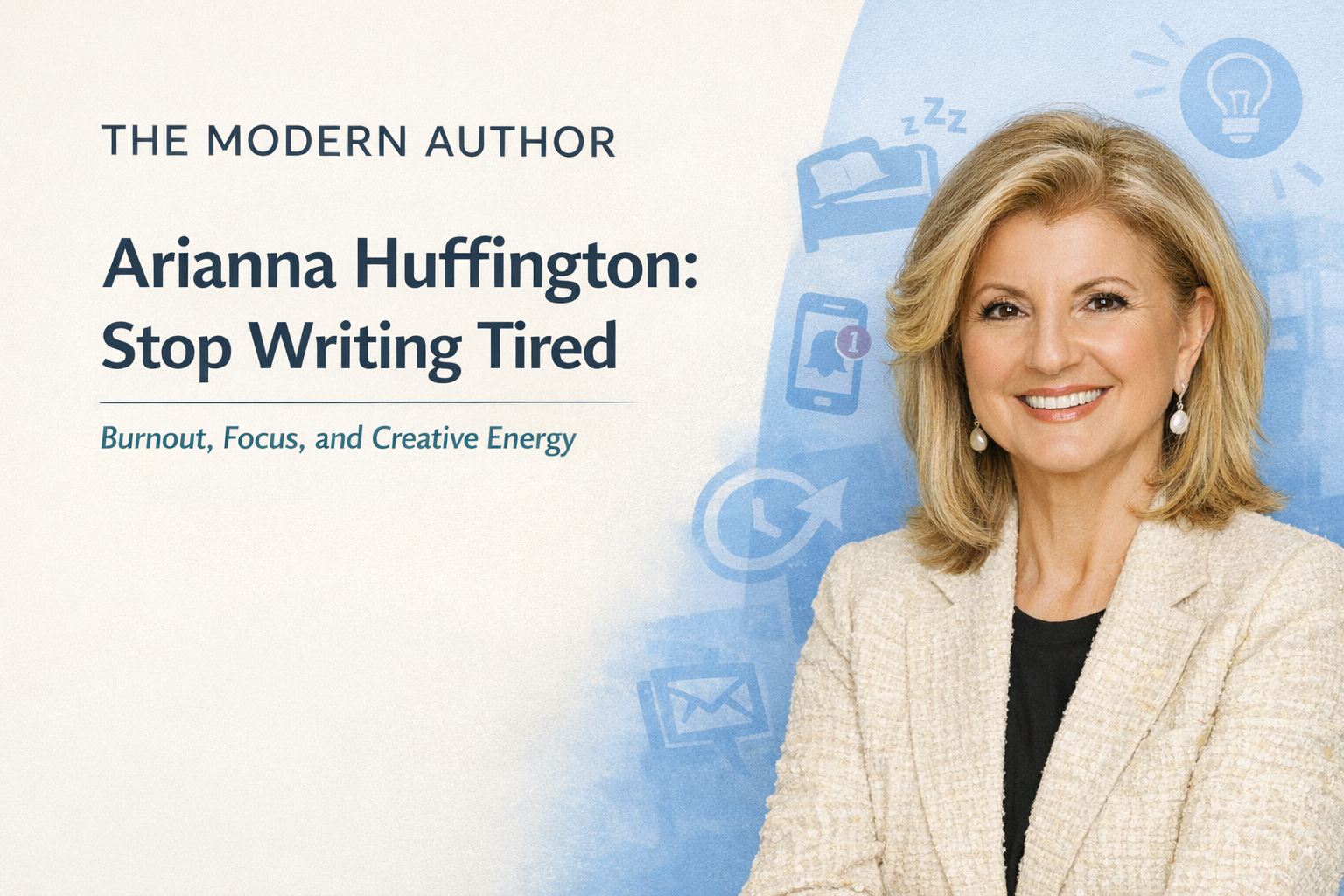
The Modern Author: Arianna Huffington on Burnout, Focus, and Creative Energy
Arianna Huffington didn’t burn out because she was weak.
She burned out because she was successful, driven, and running at full speed with no off switch.
After collapsing from exhaustion in 2007, she didn’t just recover. She rebuilt her entire philosophy of work, creativity, and leadership. That journey led to Thrive, Thrive Global, and a career-long mission to end the burnout epidemic.
This conversation isn’t about writing faster.
It’s about writing without frying your brain.
Because tired authors don’t fail from lack of talent.
They fail from diminishing returns.
And Arianna has spent years studying exactly where that line is.
Who This Is For
This is for you if:
- you’re exhausted but still pushing
- writing feels heavy instead of energizing
- focus comes in short bursts, then disappears
- your phone keeps winning
- you know the book matters, but you’re running on fumes
The Modern Author Lesson
You don’t finish meaningful books by pushing harder.
You finish them by protecting creative energy and removing silent drains.
Burnout isn’t a badge of honor.
It’s a signal that the system is broken.
5 Takeaways Authors Can Steal from Arianna Huffington
1) Burnout creates diminishing returns, not breakthroughs
The point: More effort doesn’t always mean better work.
Arianna’s insight came the hard way. She collapsed from exhaustion while running the Huffington Post, a moment that forced her to confront a truth most authors ignore:
When you’re depleted, output drops even as effort increases.
Use it as an author:
Stop measuring writing by hours. Measure it by clarity per session.
Ask:
- Did this session move the idea forward?
- Did I protect energy for the next session?
- Did I stop before quality declined?
Chapter angle:
“Why pushing harder makes your book worse.”
2) Balance is the wrong goal, recovery is the right one
The point: Creative intensity is fine. Chronic depletion is not.
Arianna doesn’t talk about “balance” the way most people do. She doesn’t believe in evenly dividing energy every day.
She believes in cycles.
Write deeply when you’re in flow. Then recharge deliberately.
Use it as an author:
Design writing seasons, not daily perfection.
- sprint when creativity is high
- recover without guilt
- stop before exhaustion becomes the norm
This keeps writing sustainable instead of punishing.
Chapter angle:
“Why creative surges are healthy and burnout is optional.”
3) Your first draft doesn’t need a keyboard
The point: Writing is thinking, not typing.
Arianna shared that for her last two books, she dictated the first draft. Not because she was lazy, but because she noticed something important:
She could speak clearly for an hour without notes.
So she stopped fighting her natural strengths.
Use it as an author:
Lower the friction to get words out.
Try:
- dictating while walking
- voice notes during commutes
- speaking sections as if explaining to a friend
Once a draft exists, editing becomes far easier.
Chapter angle:
“The fastest way to get unstuck is to stop typing.”
4) Distraction is poison for deep work
The point: Focus isn’t fragile. It’s interrupted.
Arianna is ruthless about one rule:
No notifications while writing. None.
If she wants the news, she goes and gets it. She doesn’t let it come to her.
Interruptions break creative continuity, and regaining depth takes far longer than most people realize.
Use it as an author:
Adopt one non-negotiable distraction rule for 7 days.
Examples:
- phone out of the room
- notifications off
- one writing tab only
- write before consuming anything
You don’t need perfect focus. You need protected focus.
Chapter angle:
“The hidden cost of ‘just checking’ your phone.”
5) Vulnerability isn’t optional if you’re writing about your life
The point: Readers can feel when you’re holding back.
Arianna was direct:
If you’re not willing to be vulnerable, you shouldn’t write a book that includes your life.
That doesn’t mean oversharing. It means honesty. No perfection. No performance.
Readers don’t connect to polish. They connect to truth.
Use it as an author:
Ask yourself:
- Where am I trying to look impressive?
- Where am I avoiding the real story?
- What would change if I wrote this without protecting my image?
That’s usually where the book comes alive.
Chapter angle:
“Why perfect books feel empty.”
The Modern Author Playbook
Protect Energy, Produce Clarity (7-Day Reset)
Step 1: Identify your biggest energy leak
Choose one:
- overworking
- constant notifications
- writing when exhausted
- perfectionism
- guilt-driven productivity
Step 2: Name the cost
Finish this sentence:
“When I keep doing this, my writing suffers because…”
Step 3: Choose one protection rule
Examples:
- stop writing before exhaustion
- dictate first drafts
- phone out of the room
- no editing during drafting
Step 4: Run the experiment for 7 days
No optimization. Just consistency.
Step 5: Capture proof
Each day, write one line:
“What felt easier or clearer today because I protected my energy?”
That’s how sustainable writing habits are built.
FAQs
Why do so many authors burn out while writing?
Because they treat writing like a grind instead of a creative system that requires recovery.
How do you write consistently without exhaustion?
By protecting focus, removing distractions, and stopping before diminishing returns kick in.
Is dictation really effective for book writing?
Yes. For many authors, it’s the fastest way to generate a first draft because it bypasses perfectionism and friction.
The Bottom Line
Burnout doesn’t make you serious.
Exhaustion doesn’t make you committed.
Finished books come from authors who respect their creative energy enough to protect it.
Arianna Huffington didn’t just survive burnout.
She redesigned how meaningful work gets done.
That’s the lesson modern authors can’t afford to ignore.
About the Author
Eric Koester is an award-winning entrepreneurship professor at Georgetown University, bestselling author, and founder of Manuscripts. He has helped more than 3,000 nonfiction authors turn ideas into books, and books into platforms for speaking, media, and business growth.
About Manuscripts
Manuscripts is a modern publishing partner for nonfiction authors who want their books to drive real-world outcomes. We help founders, executives, coaches, and experts design, write, and launch books that build authority, attract opportunities, and compound into long-term business assets.
Work With Us
If you’re writing a book you want to matter, we’ll help you map the right strategy before you write another word.
👉 Schedule a Modern Author Strategy Session