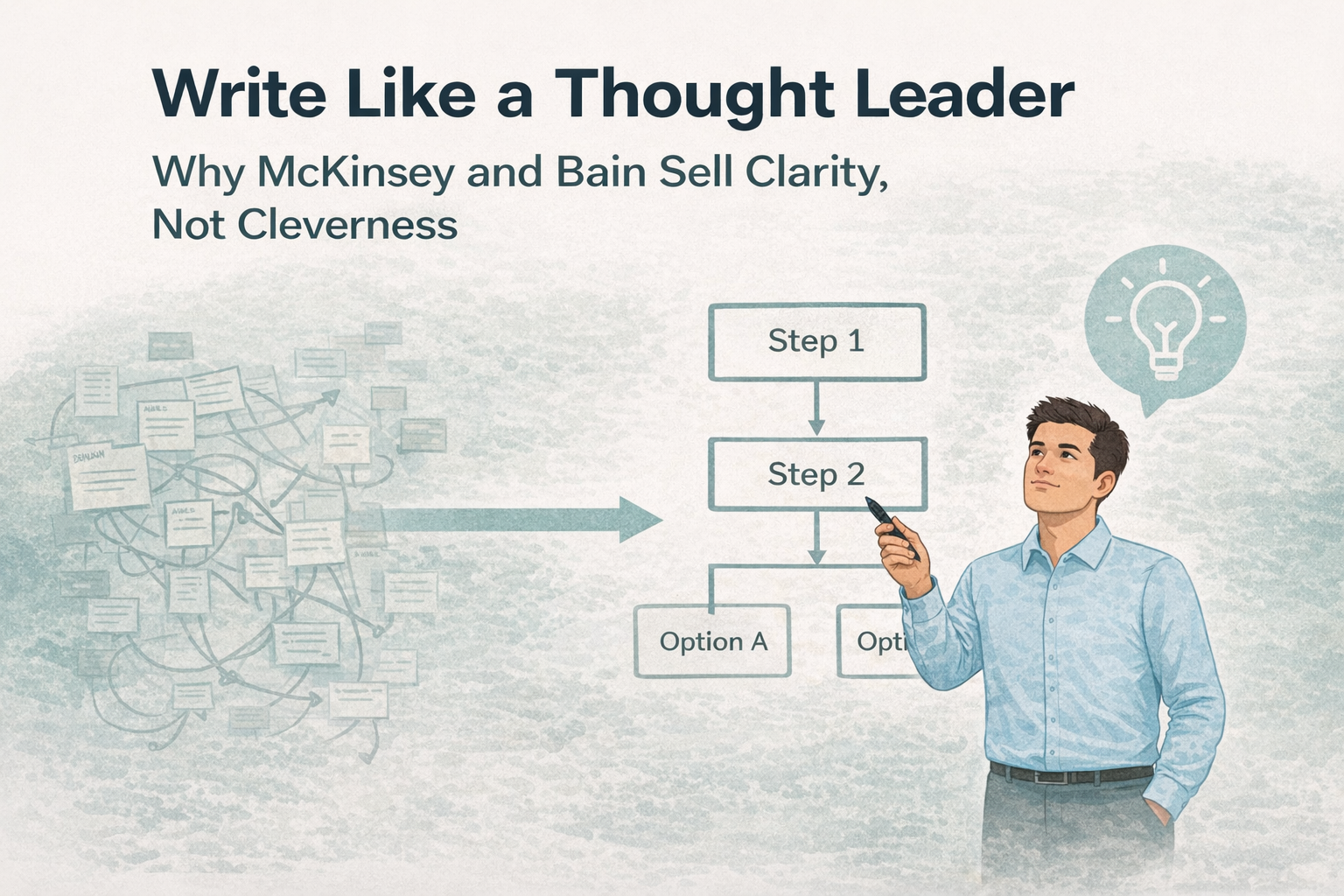
Write Like a Thought Leader: Why McKinsey and Bain Sell Clarity, Not Cleverness
Most people think McKinsey and Bain charge premium fees because they’re smarter than everyone else.
They don’t.
They charge more because they make thinking easier.
That distinction explains more about their influence than intelligence ever could. And it points to a core lesson for anyone trying to write or teach like a thought leader.
People don’t pay for complexity.
They pay for conclusions that remove it. Today’s we’re going to examine the writing principle that transformed McKinsey into the powerhouse it is today:
The Pyramid Principle.
The McKinsey Pattern: Decide First, Explain Second
Elite consulting firms don’t begin with analysis.
They begin with an answer.
A clear point of view, stated early, often before the reasoning is fully visible. The analysis exists to support the conclusion, not discover it in public.
This is the opposite of how most smart professionals are trained to communicate.
Many people lead with context, nuance, and exploration. McKinsey leads with judgment.
That sequencing difference is the product.
It was codified as the Pyramid Principle, created in the 1970s by Barbara Minto, the first female post-MBA consultant hired by McKinsey & Company
Why ‘Sounding Smart’ Backfires
Complexity feels impressive to peers. It feels expensive to everyone else.
When ideas arrive wrapped in jargon, caveats, and long setup, readers experience friction. They don’t think, “This person is deep.” They think, “This is work.”
Cognitive effort registers as cost.
That’s why “sounding smart” often erodes trust. If someone can’t explain the problem cleanly, it raises a quiet question:
Can they actually solve it?
Clarity feels decisive. Cleverness feels evasive.
What Clients Actually Buy: Cognitive Relief
McKinsey clients aren’t outsourcing intelligence.
They’re outsourcing mental load.
The real product looks like this:
- Fewer variables to track
- Clear priorities
- A simple organizing frame
- An obvious next step
This is cognitive relief. And it’s rare.
When someone replaces confusion with structure, they don’t just inform. They calm. That calm is what creates pricing power.
How Elite Consultants Structure Clarity: The Pyramid Principle
There’s a repeatable pattern underneath this effect.
It usually looks like this:
1) Lead with the conclusion
State the answer plainly. No buildup.
The reader should know what you believe immediately.
Why it works:
It signals judgment. And judgment is what people hire.
2) Impose a simple structure
Break the situation into a small number of clean parts.
Three beats four. Four beats seven.
Why it works:
Structure makes complexity feel manageable.
3) Explain only what earns explanation
Every point exists to justify the conclusion. Anything else is removed.
Why it works:
Restraint creates confidence. Exhaustiveness creates doubt.
This is why elite consultants feel sharp. Not because they know more, but because they choose more carefully.
The Pyramid Principle: Why McKinsey Starts at the Top
McKinsey’s clarity isn’t accidental. It’s engineered.
At the core of their communication is a simple rule often called the Pyramid Principle:
Start with the answer.
Support it with grouped reasons.
Explain details only if needed.
Everything flows top-down.
The conclusion sits at the top of the pyramid. Beneath it are a small number of supporting ideas. Beneath those are facts, analysis, and data.
Most people invert this.
They start at the bottom, walk the reader through everything they learned, and hope a conclusion emerges by the end.
McKinsey does the opposite. They decide first, then justify.
Why this works:
- Executives don’t have time to discover the point
- Decisions require clarity, not exploration
- Confidence comes from structure, not volume
The pyramid approach removes uncertainty for the reader. They always know where they are and why they’re being told something.
That’s why McKinsey decks feel decisive even when the problems are complex.
The structure does the thinking for the audience.
A Simple Pyramid Template You Can Copy
Use this when drafting a chapter, article, memo, or presentation.
Start at the top. Everything else earns its way in.
Conclusion (Top of the pyramid)
“Here’s the answer I believe is correct.”
If you can’t state this in one sentence, stop. You’re not ready to explain yet.
Key Reasons (Middle layer)
“These are the 2–4 reasons this conclusion holds.”
Each reason should be distinct, parallel, and easy to scan.
Supporting Evidence (Base layer)
“Here’s the data, example, or logic that supports each reason.”
Only include evidence that strengthens the conclusion. If it doesn’t, cut it.
Implication (Optional, but powerful)
“Here’s what this means for what we should do next.”
This is where clarity turns into action.
The rule is simple:
The reader should never have to guess what you’re trying to say.
This is how McKinsey writes.
This is how clarity compounds.
And this is how thought leadership becomes usable instead of impressive.
Why Most Smart Writers Avoid This
The method is visible. The resistance is internal.
Leading with a conclusion feels risky.
People worry about:
- Being wrong in public
- Oversimplifying
- Losing credibility with peers
So they hedge. They delay the point. They hide behind process.
Complexity becomes protection.
McKinsey makes a different trade. They accept exposure in exchange for usefulness. That’s why their thinking travels from boardrooms into action.
What This Means for Writing Like a Thought Leader
Writing like a thought leader starts before the writing.
You decide what you believe.
Then you earn the right to explain why.
That means:
- State the conclusion early
- Use structure to reduce load
- Treat explanation as support, not performance
Thought leadership isn’t showing how much you know.
It’s taking responsibility for clarity.
That’s what McKinsey and Bain sell.
And that’s the standard your writing has to meet if you want to be read, trusted, and remembered.
→ Schedule Your Free Strategy Call
About the Author
Eric Koester is an award-winning entrepreneurship professor at Georgetown University, bestselling author, and founder of Manuscripts, the Modern Author OS used by more than 3,000 authors. His work has helped creators turn ideas into books, books into brands, and brands into scalable businesses.
About Manuscripts
Manuscripts is the leading full-service publishing partner for modern nonfiction authors. We help founders, executives, coaches, and experts turn their books into growth engines, through positioning, coaching, developmental editing, design, AI-enhanced writing tools, and strategic launch systems. Manuscripts authors have sold thousands of books, booked paid speaking gigs, landed media features, and generated millions in business from their IP.
Work With Us
If you’re writing a book you want to matter, let’s map out your Modern Author Plan.
Schedule a Modern Author Strategy Session → https://write.manuscripts.com/maa-web
Explore Manuscripts Publishing Services → https://manuscripts.com/publish-with-us/
See Modern Author Success Stories → https://manuscripts.com/authors/
Modern Author Resources
- How to Write a Book if You’re Busy
- Modern Ghostwriting for Nonfiction Authors
- AI Tools for Authors in 2026
- How to Build an Audience Before You Write Your Book
- The Evergreen Launch System for Modern Authors
Powered by Codex: The Modern Author Author Intelligence Tool