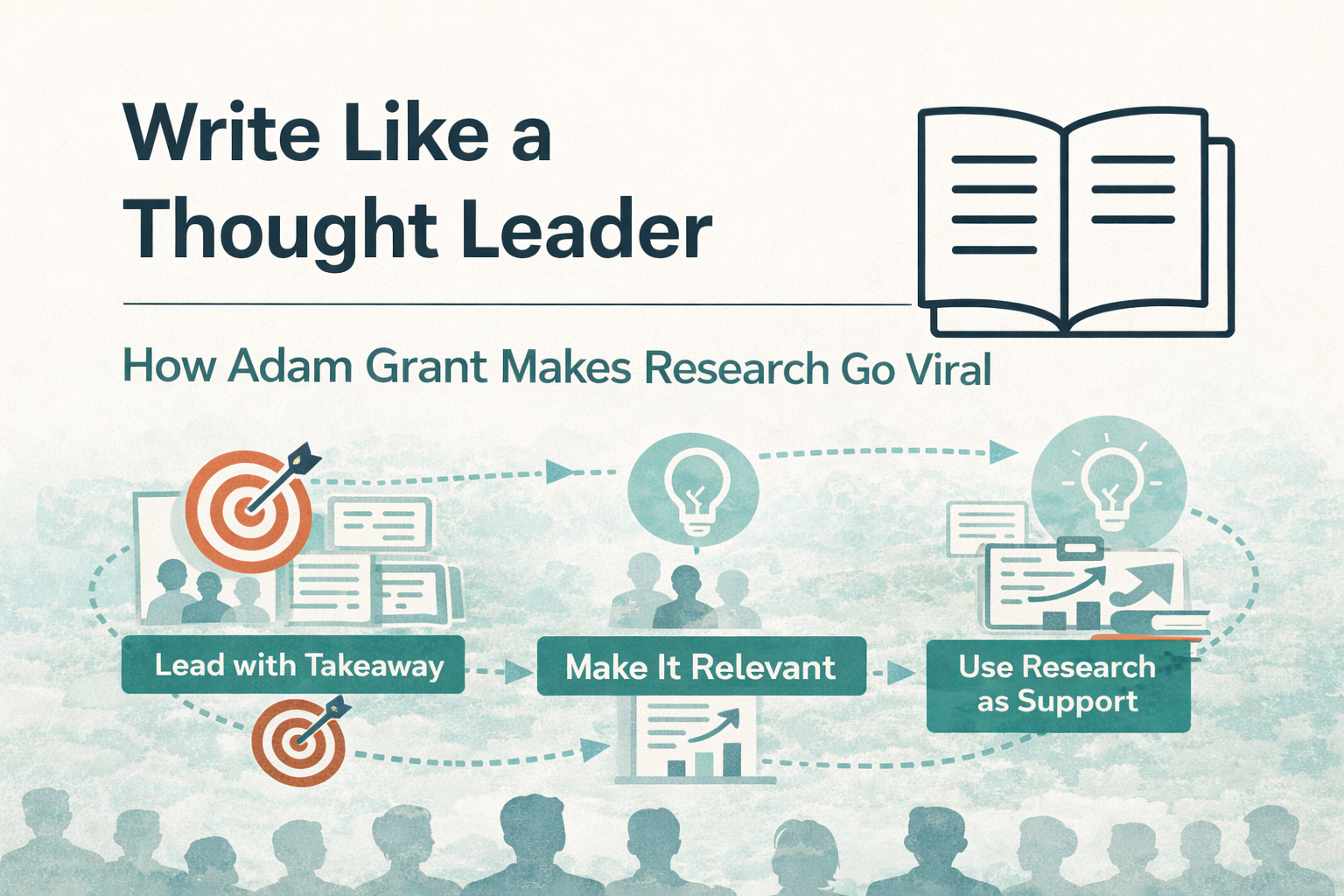
Write Like a Thought Leader: How Adam Grant Makes Research Go Viral
Most people think ideas spread because they’re well-researched.
They don’t.
They spread because the takeaway is clear.
Adam Grant understood this early. Long before he became the most cited organizational psychologist on the planet, before the TED talks and bestseller streak, his ideas traveled because people could immediately tell what he believed.
Not what he studied.
Not how careful he was.
What the point was.
That’s the lesson most smart writers miss.
People don’t share your research.
They share your conclusion.
The Adam Grant Pattern: Decide First, Prove Second
Adam Grant doesn’t start by walking readers through a study.
He:
- states a surprising takeaway upfront
- frames it in everyday language
- uses research selectively to make it stick
This creates a powerful dynamic:
readers know why it matters immediately
the idea feels usable, not academic
sharing becomes easy
The key insight isn’t simplification. It’s sequencing.
Grant doesn’t dilute rigor.
He reorders it.
The Principle: Authority Comes From Judgment, Not Data
Here’s the core thought leadership principle behind Grant’s work:
People trust conclusions that feel earned, not arguments that feel endless.
Grant doesn’t ask the reader to wade through evidence to find the meaning.
He delivers the meaning first.
Then he shows his work.
That posture signals confidence. Not arrogance, judgment.
And judgment is what people follow.
Why Raw Research Doesn’t Travel
Most research-led writing dies outside expert circles for the same reason.
It leads with process instead of payoff.
Common symptoms:
- long setup before the point
- careful hedging that blurs relevance
- evidence without interpretation
The reader is left thinking, “Interesting, but so what?”
Grant removes that friction.
He doesn’t make readers decode the insight. He hands it to them.
The Real Job: Turning Insight Into a Takeaway
Adam Grant isn’t just a researcher.
He’s a translator.
His real skill is converting abstract findings into conclusions people can recognize in their own lives and work.
He asks a different question than most experts:
“What should someone do differently after hearing this?”
That question forces clarity.
It turns knowledge into relevance.
The Adam Grant Virality Framework
There’s a repeatable structure underneath his most shared ideas.
It looks like this:
1) Lead with a counterintuitive conclusion
Start with a claim that challenges a default belief.
Example style:
“Originals don’t wait for permission. They act before they feel ready.”
No citations yet. Just the point.
Why it works:
The reader knows immediately whether this matters to them.
2) Anchor it in something familiar
Connect the takeaway to behavior people already recognize.
Work habits. Leadership mistakes. Career anxieties.
Why it works:
The idea feels personal before it feels intellectual.
3) Use research as reinforcement, not the headline
Introduce studies to support the conclusion, not replace it.
Grant is selective. He shows enough to earn trust, not so much that it overwhelms.
Why it works:
Evidence strengthens judgment instead of obscuring it.
Why Most Smart Writers Won’t Do This
The method is obvious. The resistance is emotional.
Leading with a conclusion feels risky.
Experts worry about:
- oversimplifying
- being challenged
- looking less rigorous to peers
So they hedge. They bury the point. They lead with context.
Grant makes a different trade.
He accepts exposure in exchange for impact.
That choice is why his ideas leave academia and enter culture.
What It Means to Write Like a Thought Leader
Writing like a thought leader starts before the writing.
You decide what you believe.
Then you earn the right to explain why.
For authors and experts, that means:
- state the takeaway early
- make relevance explicit
- use research to support judgment, not avoid it
Thought leadership isn’t showing how much you know.
It’s taking responsibility for meaning.
Adam Grant’s work spreads because he does that work for the reader.
That’s the lesson.
And that’s the standard.
A Simple Template You Can Copy
Use this when drafting a chapter, article, or post based on research or expertise:
Takeaway: “Here’s the conclusion I believe is true.”
Relevance: “Here’s why this matters in real life or work.”
Evidence: “Here’s the research or experience that supports it.”
Principle: “Here’s the general rule that keeps showing up.”
Application: “Here’s how you can use this idea.”
This is interpretation made visible.
It’s how insight becomes shareable instead of academic.
Quick FAQ
Why don’t my research-based ideas spread?
Because readers can’t immediately tell what the point is. Clarity precedes credibility.
What does Adam Grant do differently?
He leads with a conclusion, frames it in familiar terms, and uses research to support judgment, not replace it.
Is this the same as simplifying or dumbing things down?
No. It’s prioritizing meaning over method. The rigor stays. The sequencing changes.
The Bottom Line
People don’t share studies.
They share takeaways that help them think or act differently.
Adam Grant doesn’t start by proving he’s right.
He starts by deciding what the research means.
If you want to write like a thought leader, start there.
→ Schedule Your Free Strategy Call
About the Author
Eric Koester is an award-winning entrepreneurship professor at Georgetown University, bestselling author, and founder of Manuscripts, the Modern Author OS used by more than 3,000 authors. His work has helped creators turn ideas into books, books into brands, and brands into scalable businesses.
About Manuscripts
Manuscripts is the leading full-service publishing partner for modern nonfiction authors. We help founders, executives, coaches, and experts turn their books into growth engines, through positioning, coaching, developmental editing, design, AI-enhanced writing tools, and strategic launch systems. Manuscripts authors have sold thousands of books, booked paid speaking gigs, landed media features, and generated millions in business from their IP.
Work With Us
If you’re writing a book you want to matter, let’s map out your Modern Author Plan.
👉 Schedule a Modern Author Strategy Session → https://write.manuscripts.com/maa-web
👉 Explore Manuscripts Publishing Services → https://manuscripts.com/publish-with-us/
👉 See Modern Author Success Stories → https://manuscripts.com/authors/
Modern Author Resources
- How to Write a Book if You’re Busy
- Modern Ghostwriting for Nonfiction Authors
- AI Tools for Authors in 2026
- How to Build an Audience Before You Write Your Book
- The Evergreen Launch System for Modern Authors
Powered by Codex: The Modern Author Author Intelligence Tool