How to Write a Book Without Ghostwriting: Why Your Voice Matters (And How to Do It)
The Modern Author Mistake No One Talks About
Most serious professionals don’t write books for royalties.
They write books to:
- Attract better clients
- Command higher speaking fees
- Enter larger rooms
- Build category authority
- Create leverage that compounds
They want the book to work.
So when they discover ghostwriting, it feels like a smart shortcut.
“Why spend months writing when I can hire someone?”
On the surface, it sounds efficient.
But here’s the uncomfortable truth:
If your book is supposed to build authority,
and you didn’t write it,
you’ve weakened the very thing it was meant to create.
Because authority is not information.
Authority is ownership.
In authority-driven nonfiction, outsourcing the writing often undermines the very authority the book is meant to build.
And ownership cannot be outsourced.
Most professionals first encounter ghostwriting while researching how to write a book at all.
The services promise something appealing: someone else handles the writing while the executive simply provides ideas.
For busy founders, consultants, and executives, that promise feels like an efficient solution to a real constraint, time.
The Real Risk Isn’t the Money
Most discussions about ghostwriting focus on cost.
$30,000.
$60,000.
Sometimes more.
That’s not the real risk.
The real risk is leverage failure.
A book that doesn’t sound like you:
- Doesn’t create resonance
- Doesn’t differentiate you
- Doesn’t deepen trust
- Doesn’t compound authority
It becomes a marketing asset.
Not an authority engine.
Modern Authors don’t build marketing assets.
They build leverage systems.
What Ghostwriting Actually Means
Before evaluating ghostwriting strategically, it helps to clarify what the term actually describes.
Ghostwriting means that a third-party writer produces the manuscript on behalf of the named author.
The executive provides ideas, interviews, or source material, while the ghostwriter drafts the book.
In most arrangements, the ghostwriter:
- structures the chapters
- writes the prose
- develops transitions and explanations
- shapes the narrative and arguments
The author reviews drafts and provides feedback, but the writing itself originates from the ghostwriter.
Developmental editing operates differently.
With developmental editing, the author writes the manuscript.
An editor then strengthens the work by improving structure, clarity, and logical flow—without replacing the author’s voice.
This distinction matters because the strategic value of a nonfiction book depends heavily on attributable thinking.
If the writing originates elsewhere, the reader’s perception of authorship becomes less certain.
And when authorship weakens, authority weakens with it.
Why Your Voice Matters (And Why It Can’t Be Recreated)
Your voice is not your vocabulary.
It’s your thinking.
It’s how you:
- Frame problems
- Name patterns
- Challenge assumptions
- Tell stories
- Build frameworks
- Connect ideas others don’t se
That pattern of thinking is what clients trust.
It’s what event organizers book.
It’s what enterprise buyers pay for.
A ghostwriter can capture your information.
They cannot fully reproduce your mental models.
They cannot manufacture lived conviction.
They cannot replicate the invisible logic that makes your ideas uniquely yours.
When the voice weakens, differentiation weakens.
When differentiation weakens, authority flattens.
And when authority flattens, leverage declines.
This isn’t about pride.
It’s about economics.
The Modern Author Principle
A serious nonfiction book is not just content.
It is a credibility amplifier.
It compresses your thinking.
It clarifies your worldview.
It makes your mental models portable.
It gives the market something concrete to trust.
But only if it is yours.
This guide exists to answer one question:
Should you hire a ghostwriter, or write the book yourself with professional support?
And more importantly:
Which path builds real authority and long-term business ROI?
Let’s examine it structurally.
What This Guide Will Teach You
This is not a motivational argument against ghostwriting.
It is a structural analysis of how authority works.
Inside, you’ll learn:
- Why authority is a system built on voice, ownership, and depth
- The hidden economic costs of ghostwriting beyond the invoice
- How ghostwriting weakens differentiation and long-term leverage
- Why developmental editing strengthens authorship instead of replacing it
- The Authority ROI model that connects authorship to revenue
- A practical blueprint for writing your own book with professional support
By the end, you’ll understand something most leaders never examine:
The question is not,
“Can someone else write this for me?”
The real question is,
“Do I want to own the authority this book creates?”
Let’s examine it structurally.
How This Guide Is Structured
This guide examines the ghostwriting decision through a structural lens.
Rather than focusing only on writing mechanics, it evaluates how authorship affects authority, credibility, and long-term leverage.
The discussion unfolds in five parts:
Part I — AUTHORITY IS A STRUCTURAL SYSTEM
Why authority is not a personality trait but a structural outcome built on voice, ownership, and depth.
Part II — The Hidden Cost of Ghostwriting
Why the real tradeoffs of ghostwriting are strategic rather than financial.
Part III — The Modern Author Alternative
How developmental editing preserves authorship while strengthening the manuscript.
Part IV — The Compounding Advantage
Why writing your own book strengthens thinking, messaging, and long-term positioning.
Part V — Implementation
A practical blueprint for building an authority-generating book while maintaining executive schedules.
The goal is not simply to finish a manuscript.
The goal is to build a book that functions as authority infrastructure.
60-Second Decision Box
This Guide Is For You If
- You are writing a nonfiction book to grow authority and revenue.
- You want the book to generate clients, speaking invitations, or enterprise opportunities.
- You care about long-term leverage, not just getting a finished product published.
If you are briefing a CEO, founder, or executive, this applies when the book is intended to function as a business asset, not a personal milestone.
This Guide Is Not For You If
- You only want a finished book on Amazon.
- You have no plan to build authority beyond publication.
- You view the book as marketing collateral rather than a credibility engine.
If speed, optics, or “having a book” is the primary objective, the structural decisions in this guide will feel unnecessary.
The Core Decision
The real decision is not:
“How fast can we get this written?”
It is:
“How do we preserve authorship so the book actually builds authority?”
In the source material, ghostwriting is positioned as attractive because it promises speed and ease, “Someone else does all the writing… You just provide ideas”.
But the same source makes the central risk clear: if the book does not sound like you, it will not attract clients, speaking engagements, or authority.
This is a structural issue, not a stylistic one.
Authority is earned trust that converts into opportunity.
Authorship is intellectual ownership of the ideas, language, and frameworks inside the book.
If authority is the goal, authorship must remain intact.
- Ghostwriting substitutes ownership. A third party writes the manuscript, and the voice inevitably shifts.
- Developmental editing strengthens ownership. The author writes; an editor sharpens structure, clarity, and coherence.
The choice determines what the book becomes:
- A polished artifact that may not sound like the executive
- Or a leverage asset that reflects their actual thinking
If long-term authority and revenue are the objective, authorship is not optional.
It is structural.
PART I — AUTHORITY IS A STRUCTURAL SYSTEM
Why This Conversation Is Broken
The ghostwriting debate is usually framed as a convenience decision:
- The executive is busy.
- A ghostwriter saves time.
- The book gets done faster.
That framing is incomplete.
If the book is intended to generate clients, speaking invitations, enterprise access, or long-term positioning, the decision is not about convenience. It is about leverage architecture.
A serious nonfiction book is not just content. It is authority infrastructure.
Authority is durable trust in an individual’s judgment.
It is the kind of trust that leads to:
- Hiring decisions
- Stage invitations
- Enterprise engagements
- Referrals and board opportunities
Authority behaves like economic capital. It reduces friction in high-stakes decisions.
A book functions as a leverage layer:
- It standardizes the executive’s thinking into a transferable asset.
- It signals depth of expertise at scale.
- It allows others to evaluate judgment without a 1:1 conversation.
But this leverage only works if the reader trusts the thinking behind it.
That is where ownership becomes structural.
If the reader believes the ideas, arguments, and frameworks originate from the author, credibility increases.
If authorship is substituted, credibility weakens.
Ownership determines trust.
The Authority Leverage Model
Authority is not a personality trait.
It is a structural outcome.
If a book is intended to generate durable opportunity, clients, stages, enterprise access, it must be architected to produce authority, not just information.
This model defines how that authority is created.
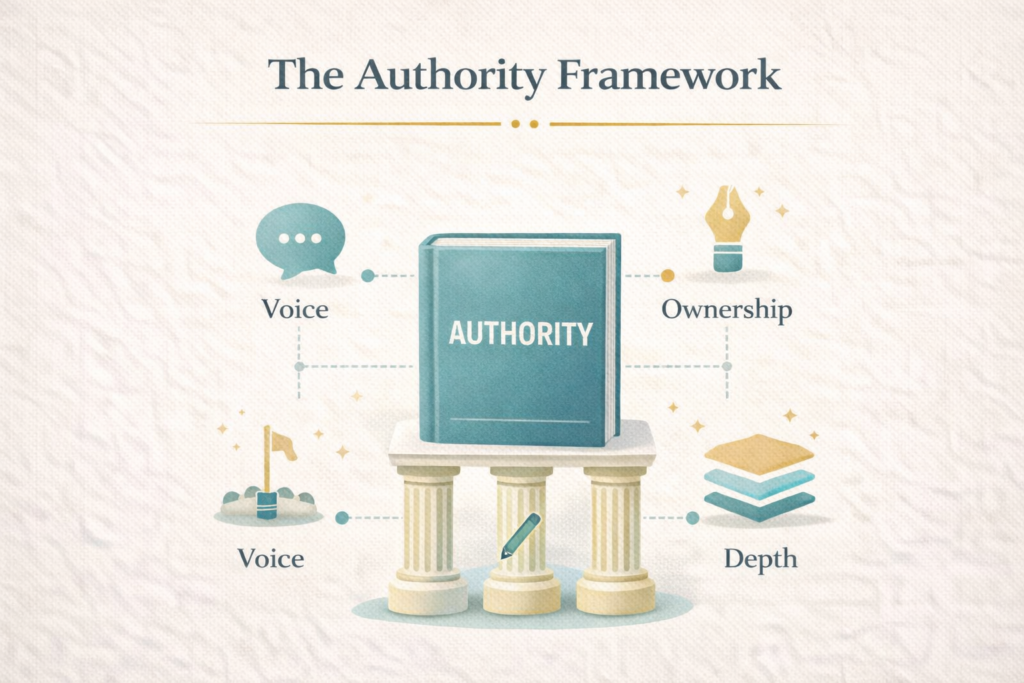
Voice × Ownership × Depth = Authority Leverage
This is a multiplicative system.
If any variable weakens materially, total leverage declines.
In practice, this is why readers often say after finishing a strong business book:
“I feel like I know how this person thinks.”
That recognition is what converts reading into opportunity, clients reach out, event organizers extend invitations, and enterprise buyers engage earlier in the decision process.
The leverage comes from trust in the author’s judgment, not just exposure to their ideas.
Why Writing Clarifies Thinking
One of the overlooked benefits of writing a book is what it does to the author’s thinking.
Ideas that feel clear in conversation often reveal gaps when placed on the page.
Writing forces several disciplines:
- assumptions become visible
- arguments must hold together logically
- distinctions must be defined clearly
- frameworks must be articulated precisely
In other words, writing converts intuition into structured judgment.
This process strengthens the three elements of the Authority Leverage Model.
Voice becomes clearer because the author must explain ideas in their own language.
Ownership strengthens because the thinking originates from the author’s reasoning process.
Depth increases because weak ideas rarely survive the discipline of writing.
This is why the act of writing often sharpens an executive’s thinking beyond the book itself.
The book becomes the artifact.
But the real value is the clarity developed in the process.
Core Principle: Authority Is Earned Through Attributable Judgment
At its core, authority leverage depends on one condition:
The reader must believe the thinking in the book is both distinct and authored by the person whose name is on the cover.
Authority is not built by information alone.
It is built when differentiated thinking is clearly attributable to a specific mind and supported by demonstrated depth.
When those conditions are met, trust compounds.
When they are not, the book becomes content, not leverage.
Key Components of the Model
Each variable performs a non-interchangeable function.
Voice → Differentiation
Voice is the author’s distinctive pattern of thinking expressed in language.
It is visible in:
- How problems are framed
- How tradeoffs are evaluated
- How frameworks are named
- How stories are chosen
- How arguments are structured
Voice prevents the book from sounding interchangeable.
In crowded categories, differentiation is not cosmetic. It is competitive insulation.
Without voice, the book may be competent.
But it will not be memorable.
Consider how differently two experts might explain the same idea.
One leader might begin with a story about a failed strategy meeting and what it revealed about leadership.
Another might begin with a framework that breaks the problem into measurable variables.
Both may be describing the same concept, but the thinking pattern behind the explanation is different.
That thinking pattern is what readers recognize as voice.
Ownership → Credibility
Ownership is clear intellectual authorship.
The reader must reasonably conclude:
- These ideas originated from this executive.
- These frameworks reflect lived experience.
- These judgments are personally held and defensible.
Ownership signals that the authority is earned, not assembled.
In enterprise environments, where scrutiny is higher and stakes are real, perceived authorship directly affects credibility.
Ownership is the load-bearing element of the model.
Depth → Trust
Depth is demonstrated substance.
It shows up when the book:
- Holds complexity without collapsing into oversimplification
- Makes meaningful distinctions
- Anticipates counterarguments
- Provides non-generic insight
Depth converts credibility into trust.
Without depth, the book reads like positioning.
With depth, it reads like judgment.
How the Model Works
The interaction is multiplicative, not additive.
- Strong voice without ownership feels performative.
- Ownership without depth feels branded but thin.
- Depth without voice feels generic and replaceable.
Authority leverage emerges only when all three reinforce each other simultaneously.
When aligned, the book becomes leverage infrastructure, capable of:
- Increasing client conversion
- Improving speaking selection probability
- Strengthening enterprise trust
- Compounding long-term opportunity
When one variable degrades, the system destabilizes.
Ghostwriting structurally compromises ownership.
Even when execution quality is high, the reader senses mediation.
And when ownership weakens, the integrity of the authority system weakens with it.
The decision, therefore, is not about writing support.
It is about preserving the structural integrity of authority.
PART II — THE HIDDEN COST OF GHOSTWRITING
The Strategic Economics
Most ghostwriting conversations focus on price.
Premium ghostwriters often charge $30,000–$60,000, sometimes more. On paper, that appears to be the primary tradeoff.
It is not.
The real evaluation should shift from:
“What does it cost?”
to:
“What does it weaken over time?”
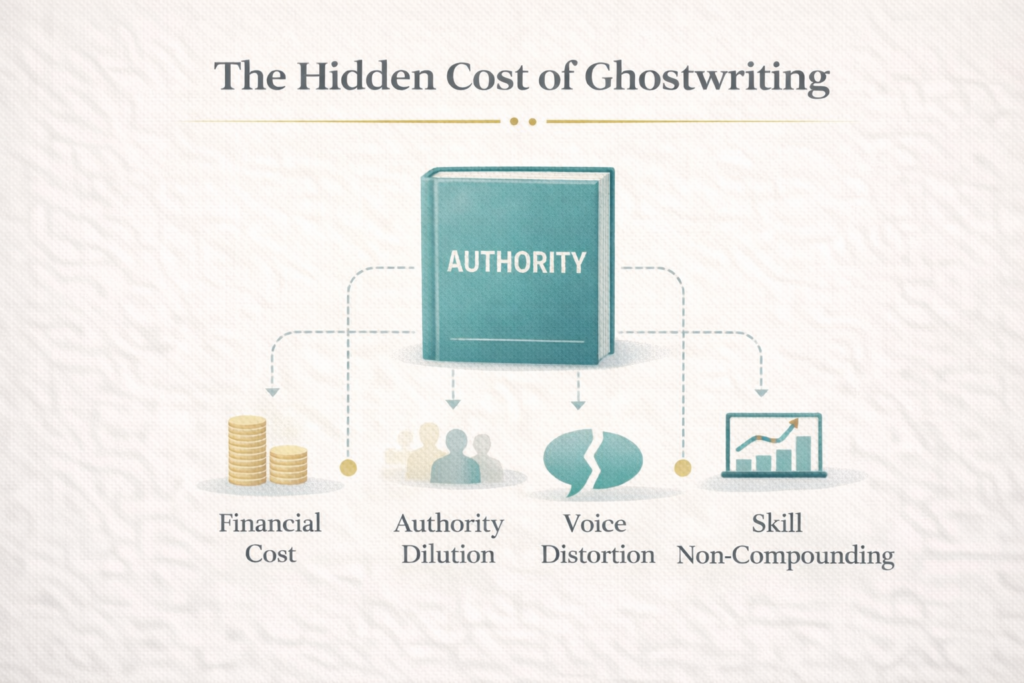
Ghostwriting introduces four structural costs.
1. Financial Delta
The direct financial difference between ghostwriting and author-led development is significant. The raw cost alone can exceed $40,000–$60,000 .
But the financial delta is only the surface layer.
2. Authority Dilution
If the book does not sound like the executive, it does not function as authority infrastructure.
As the source material makes clear, when a book does not reflect the author’s authentic voice, it fails to attract clients, speaking engagements, and authority in the market .
Authority is built on perceived authenticity. When authorship is substituted, that authenticity weakens.
3. Voice Distortion
Ghostwriters, by definition, think differently.
They bring different:
- Mental models
- Experiences
- Framework preferences
- Narrative instincts
The source highlights this structural mismatch directly: ghostwriters cannot fully capture your thinking patterns, stories, frameworks, or personality .
Even well-written manuscripts can feel disconnected from the named author .
The result is subtle but consequential: the book sounds competent, but not attributable.
4. Skill Non-Compounding
Writing is not just production. It is clarification.
When an executive writes their own book, they:
- Refine their thinking
- Sharpen their messaging
- Deepen their expertise
- Improve articulation across contexts
The source identifies this explicitly as an opportunity cost: ghostwriting prevents skill development and deeper expertise formation .
Skills that are not exercised do not compound.
Over years, this matters.
Why Voice Is a Business Asset
In the source material, voice is described as the fingerprint of the author’s writing .
In business terms, voice is strategic differentiation.
Voice includes:
- Mental models (how problems are interpreted)
- Story architecture (how experiences are framed)
- Framework naming (how ideas are packaged)
- Pattern recognition (what distinctions are emphasized)
- Language rhythm (how ideas are paced and expressed)
Readers do not connect with perfect prose. They connect with authentic voice .
That connection drives business outcomes:
- Client resonance (“I want to work with this person.”)
- Speaking selection (organizers choose voices that feel distinct and authentic)
- Enterprise trust (decision-makers respond to attributable judgment)
- Referral acceleration (memorable voices travel further)
Voice is not aesthetic.
Voice drives monetization.
Why Ghostwriting Structurally Fails
Ghostwriting does not usually fail because of grammar or structure.
It fails because of structural misalignment.
Common failure points include:
- Cognitive model mismatch
The ghostwriter interprets the topic through their own thinking patterns, not the executive’s. - Framework substitution
Unique mental models are replaced with generic or commonly used structures . - Story compression
Personal stories that signal lived experience are reduced, simplified, or excluded . - Perspective neutralization
Strong viewpoints are softened to maintain broad appeal. - Authenticity erosion
Colleagues or peers recognize that “this doesn’t sound like them” .
The end result is predictable:
A book that is technically sound but strategically generic.
Generic positioning does not create durable authority.
And without durable authority, long-term leverage declines.
PART III — THE MODERN AUTHOR ALTERNATIVE
Developmental Editing as an Amplification System
Ghostwriting attempts to manufacture a book without requiring authorship.
Developmental editing does the opposite: it preserves authorship and strengthens the manuscript until the work is publishable, without replacing the author’s voice.
Developmental editing means the author writes the book, and a professional editor improves the structure, clarity, and execution of that writing . The result is a book that sounds like the author, because it is.
This is the leverage-preserving alternative.
The Process Stack
A Modern Author process is not “write, then fix.”
It is a structured stack designed to preserve ownership while increasing quality at every stage.
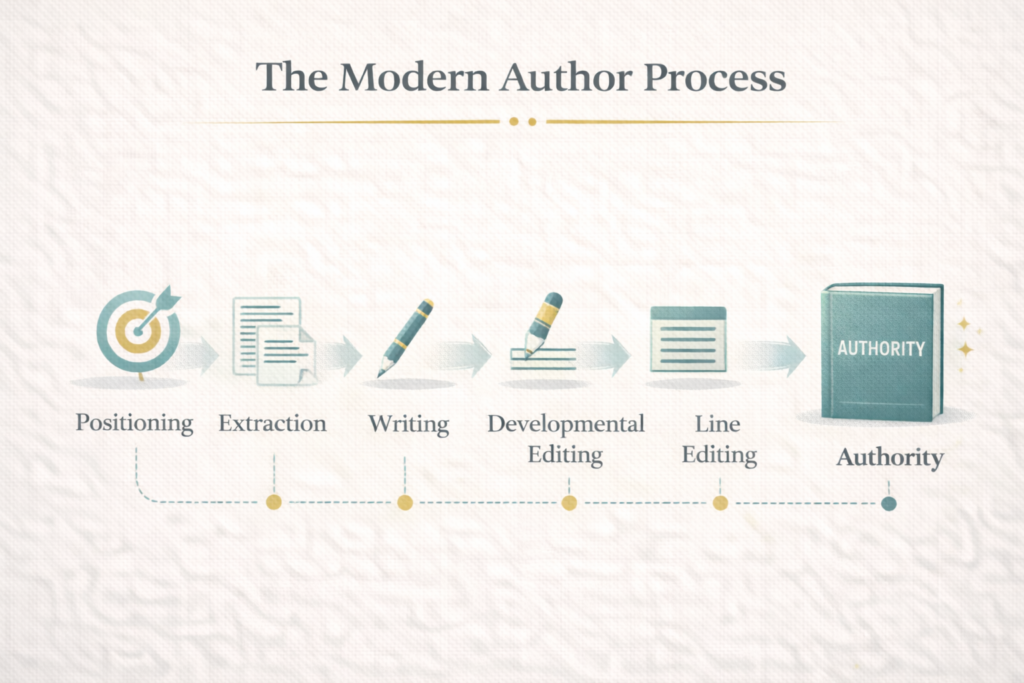
Positioning → Extraction → Writing → Developmental Editing → Line Editing → Polish
Each phase performs a distinct function. Together, they protect voice and strengthen authority.
Positioning
Define the strategic constraints before drafting.
- Who is the ideal reader?
- What does the author uniquely believe?
- What must the book accomplish in the market?
Positioning prevents wasted writing.
It creates a decision filter that guides every chapter.
Extraction
Most executives already have substantial intellectual capital distributed across:
- Talks, keynotes, workshops
- Podcasts and interviews
- Articles, memos, internal documents
Extraction organizes existing thinking and identifies what must be written new.
This reduces friction and prevents reinvention.
Writing
The author produces new material on a realistic cadence.
The baseline used in the source process is 500 words per week, manageable, repeatable, and compatible with executive schedules .
The goal is consistency, not intensity.
Ownership remains intact because the author is doing the thinking on the page.
The cadence is intentionally small.
A weekly output of roughly 500 words keeps the work compatible with executive schedules while maintaining momentum.
Over time, consistency matters more than intensity.
A steady cadence allows thinking to mature on the page without disrupting operating responsibilities.
Developmental Editing
Developmental editing strengthens the manuscript without substituting authorship .
The editor focuses on:
- Structural coherence
- Logical flow
- Gap identification
- Redundancy reduction
- Voice consistency across chapters
The editor does not replace the author’s judgment.
They clarify and amplify it.
Quality intensifies. Ownership remains intact.
Line Editing
A line editor improves sentence-level clarity, rhythm, and consistency, without altering the author’s thinking .
This ensures the prose supports credibility.
Polish
Proofreading and final preparation remove errors that undermine trust .
Credibility is fragile at this stage. Precision matters.
Executive Planning Snapshot
For internal planning, the stack can be translated into a simple governance view:
1. Positioning
- Ideal reader defined
- Core perspective articulated
- Strategic objective clarified
2. Extraction
- Existing intellectual assets inventoried
- Themes mapped to chapters
- Content gaps identified
3. Writing Cadence
- Weekly word target established
- Scheduled writing blocks protected
- Accountability mechanism set
4. Developmental Review
- Structural checkpoints defined
- Voice consistency monitored
- Gap revisions executed
5. Finalization
- Line clarity pass completed
- Proof review finalized
- Publication readiness confirmed
This is not a creative sprint.
It is authority construction.
The output is not merely “a book that reads well.”
It is a book that carries the author’s judgment clearly enough to earn trust at scale.
Authority ROI Comparison
When the book is author-owned, ROI is not measured by royalties.
It is measured by downstream leverage.
The source material makes this clear: when a book sounds like the author, readers feel connection, and that connection drives clients, speaking engagements, and authority growth .
Evaluate ROI across five structural dimensions:
- Speaking revenue
Higher invitation rates, increased fees, repeat bookings. - Client conversion
Prospects arrive pre-sold because they resonate with the author’s thinking. - Brand recall
The executive becomes associated with a defined perspective or framework. - Enterprise pipeline strength
Decision-makers trust the judgment before the first meeting. - Long-term compounding
Writing sharpens thinking, which improves positioning, messaging, and sales over time .
These outcomes are measurable.
In documented cases from the source material, author-written books have contributed to:
- $80,000+ increases in speaking revenue within the first year
- $150,000+ in new client revenue attributed to authority lift
The structural difference is attribution.
Ghostwriting can produce polished prose.
Author-owned writing produces attributable judgment.
And attributable judgment is what converts into measurable authority ROI.
Case Study Cards + Deep Narrative
Executive Coach — Revenue Lift
- Decision: choose developmental editing over ghostwriting
- Investment: $7,000 in professional support (editing/design)
- Outcome: speaking fees increased to $10K–$15K per engagement, generating $80,000 in speaking revenue in the first year
- Structural advantage: readers repeatedly reported the book “sounds exactly like you”
Consultant — Client Growth
- Decision: write with developmental support rather than hire a $40,000 ghostwriter
- Outcome: 15+ new clients in the first year, reported at $150,000+ in revenue
- Structural advantage: the first drafts were rough but authentic; editing strengthened the work without replacing voice
Founder — Rewrite Regret
- Decision: ghostwrite first ($50,000), then attempt to recover voice later
- Outcome: manuscript felt disconnected; colleagues said “this doesn’t sound like David,” requiring an additional rewrite with a developmental editor (+$8,000)
- Structural lesson: fixing ownership after substitution is expensive and avoidable
Deep Narrative: Decision → Process → Structural Difference → Measured ROI
The pattern across these cases is consistent:
- Decision: preserve authorship instead of outsourcing it
- Process: write on a manageable cadence and strengthen through developmental editing
- Structural difference: the book becomes attributable, readers feel they know the author
- Measured ROI: higher speaking income, increased client conversion, and stronger authority outcomes
PART IV — THE COMPOUNDING ADVANTAGE
Skill Compounding
Most ghostwriting discussions focus on output: the finished manuscript.
The larger strategic question is capability.
When an executive writes their own book, they are not just producing a publishable asset. They are strengthening core competencies that compound across years.
Compounding, in this context, means that small improvements in clarity and articulation create disproportionate long-term advantage because they affect every future conversation, presentation, and decision.
Writing your own book strengthens five critical capabilities.
Thinking Clarity
Writing forces structured thought.
Ideas that feel clear in conversation often reveal gaps, contradictions, or imprecision when placed on the page.
The act of drafting:
- Surfaces assumptions
- Forces sharper distinctions
- Exposes weak arguments
- Clarifies what the executive actually believes
This clarity carries forward into board discussions, strategy sessions, and media appearances.
Clear writing produces clearer thinking.
Clear thinking compounds.
Messaging Precision
Executives often have strong instincts but diffuse language.
Writing a book requires:
- Naming frameworks precisely
- Defining terms consistently
- Repeating core ideas with discipline
- Eliminating vague or inflated language
Over time, this precision strengthens:
- Keynotes
- Sales calls
- Investor conversations
- Internal communications
Messaging becomes repeatable and scalable.
Sales Effectiveness
When an executive has written their own book, they are not reciting marketing copy. They are articulating lived judgment.
That distinction affects sales conversations.
- Objections are anticipated because they were addressed in writing.
- Explanations are sharper because they have been refined through editing.
- Confidence increases because the thinking has been tested structurally.
Prospects respond to conviction backed by clarity.
Writing strengthens both.
Strategic Positioning
Positioning is not a tagline. It is the consistent articulation of:
- What the executive believes
- What they reject
- What they uniquely offer
Writing a book forces these boundaries to be defined.
Over time, this reduces category confusion and increases perceived authority.
Strong positioning compounds because every subsequent piece of content, talk, or interview reinforces the same core architecture.
Executive Confidence
Confidence built on authorship differs from confidence built on attribution.
When the executive knows:
“I wrote this. These are my ideas.”
It changes posture.
That posture influences:
- Media interviews
- Stage presence
- Enterprise negotiations
- High-stakes decision-making
Confidence rooted in authorship is durable.
Why This Compounds Across Years
Most business assets depreciate.
Capability does not.
The gains developed through author-owned writing do not end at publication. They continue to shape every future decision, conversation, and opportunity.
They accumulate because they alter how the executive thinks and communicates at the operating level.
- Clearer thinking improves strategic judgment and decision quality.
- Stronger messaging increases conversion efficiency across revenue channels.
- Sharper positioning narrows category competition and elevates perceived authority.
- Deeper confidence strengthens executive presence in high-stakes environments.
These are not marketing outcomes.
They are cognitive and strategic upgrades.
Ghostwriting may produce a finished manuscript.
Author-owned writing builds internal infrastructure.
Internal infrastructure compounds because it affects every subsequent:
- Board discussion
- Investor pitch
- Enterprise proposal
- Media interview
- Sales conversation
Over time, this creates asymmetry.
The executive who has clarified their thinking through authorship operates with tighter language, clearer frameworks, and greater conviction.
That advantage widens with repetition.
Compounding capability is not a publishing benefit.
It is a long-term strategic advantage that extends well beyond the book itself.
When Ghostwriting Might Make Sense
The argument against ghostwriting is structural, not ideological.
There are limited edge cases where ghostwriting can be appropriate.
They are narrow.
1. Pure Documentation
If the objective is archival rather than authority—capturing institutional history, preserving a legacy narrative, or documenting events for record—voice differentiation may be secondary.
In this case, the book functions as documentation, not leverage infrastructure.
Ownership matters less because authority compounding is not the goal.
2. No Authority Objective
If the executive does not intend to use the book to:
- Attract clients
- Increase speaking opportunities
- Strengthen positioning
- Build long-term leverage
Then authorship carries less strategic weight.
If the goal is symbolic (“having a book”) rather than structural (“building authority”), ghostwriting may be sufficient.
3. Unlimited Capital With No ROI Constraint
If cost is immaterial and there is no concern about return on investment, ghostwriting can be treated as a convenience expense.
Most executives, however, evaluate capital allocation through leverage.
In that context, ghostwriting is difficult to justify.
These scenarios are exceptions.
For leaders seeking authority, revenue expansion, and long-term strategic positioning, authorship is not cosmetic.
It is compounding infrastructure.
PART V — HOW TO BUILD AUTHORITY THE RIGHT WAY
Implementation Blueprint
Authority is not built by intensity.
It is built by structure.
The objective is not to “find time to write.”
The objective is to install a repeatable system that converts executive insight into durable leverage.
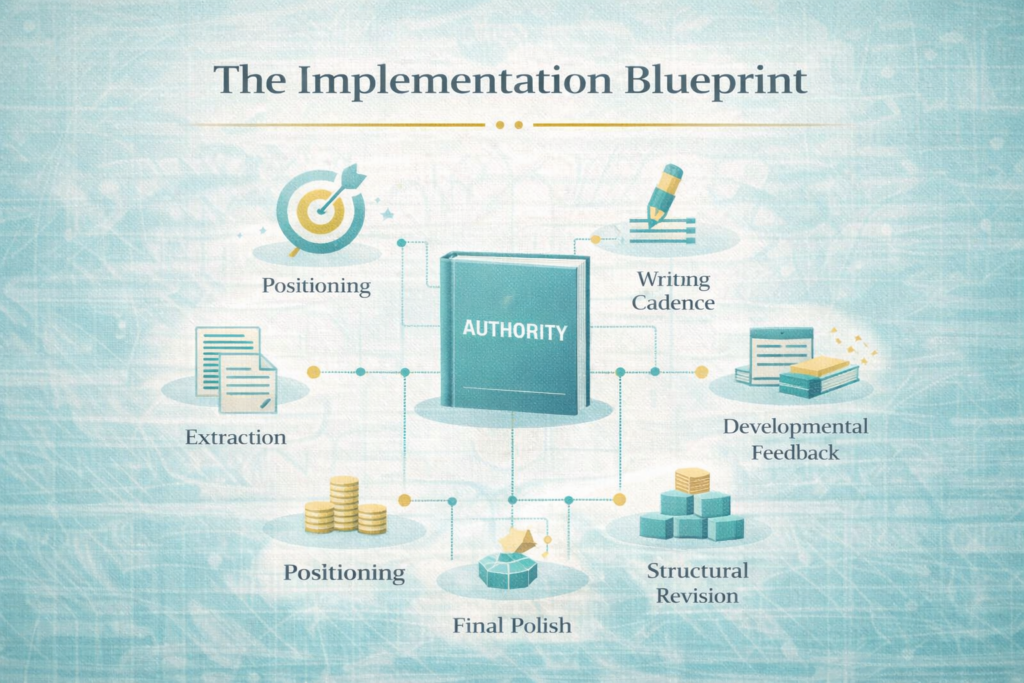
The implementation path follows six phases.
Phase 1: Positioning Clarity
Before writing begins, define strategic constraints.
- Who is the primary reader?
- What does the executive uniquely believe?
- What must this book accomplish in the market?
Without positioning clarity, writing expands without direction.
With it, every chapter has a defined purpose.
Positioning reduces drift.
It increases leverage density.
Phase 2: Content Extraction
Most executives already possess 40–60% of their book across:
- Talks and keynotes
- Podcasts and interviews
- Articles, internal memos, presentations
Extraction organizes existing intellectual capital into a coherent structure.
This reduces unnecessary drafting and accelerates momentum.
Authority is not invented.
It is consolidated.
Phase 3: 500-Word Weekly Cadence
Authority building must be compatible with executive schedules.
A sustainable baseline is 500 words per week.
At that pace:
- 10 weeks = ~5,000 new words
- 20 weeks = ~10,000 new words
Combined with extracted content, this produces a substantial manuscript without operational disruption.
This is not a sprint.
It is structured consistency.
Time math matters more than motivation.
Phase 4: Rolling Developmental Feedback
Writing without feedback increases rework.
Instead, install rolling review cycles:
- Draft
- Structural feedback
- Revision
- Proceed
Developmental feedback focuses on:
- Argument clarity
- Structural integrity
- Voice consistency
- Gap identification
This creates a feedback loop that strengthens thinking while writing progresses.
Momentum is maintained.
Authority density increases.
Phase 5: Structural Revision
Once a full draft exists, conduct a comprehensive structural review.
Questions to resolve:
- Does the argument progress logically?
- Are core frameworks consistently applied?
- Are redundancies eliminated?
- Is the voice stable across chapters?
Structural revision is where coherence becomes authority.
This phase converts drafts into architecture.
Phase 6: Final Polish
Line editing and proofreading protect credibility.
Clarity at the sentence level reinforces trust at the strategic level.
Authority can be weakened by small errors.
Precision is not cosmetic.
It is reputational.
Governance Snapshot
For internal alignment, the entire system can be reduced to an executive planning view:
1. Positioning
- Target reader defined
- Core thesis articulated
- Strategic outcome clarified
2. Asset Inventory
- Existing intellectual capital mapped
- Themes organized
- Content gaps identified
3. Writing Cadence
- Weekly word target established
- Protected writing blocks scheduled
- Accountability owner assigned
4. Feedback Loop
- Developmental review cadence set
- Structural checkpoints defined
- Voice consistency monitored
5. Revision + Finalization
- Structural revision window allocated
- Line edit and proof stages scheduled
- Publication readiness confirmed
This is not a creative sprint.
It is authority construction.
Execution Guardrails
Three constraints protect the system from failure:
Time Math Discipline
Authority is built through predictable cadence, not bursts of energy.
Momentum Over Intensity
Two to four focused hours per week is sustainable for most executives.
Early Correction Over Late Repair
Frequent structural feedback prevents expensive rewrites.
Structure reduces friction.
Reduced friction increases completion probability.
Completion enables leverage.
Manuscripts Integration
For executives seeking structured support, Manuscripts operates as authority infrastructure.
The system integrates:
- Positioning specialists for strategic clarity
- Developmental editing to strengthen structure without replacing authorship
- Codex support to organize and analyze intellectual assets
- Modern Author OS implementation to align the book with long-term leverage goals
The role is not to write for the executive.
It is to build the system that preserves ownership while elevating quality.
Calm. Strategic. System-aligned.
Authority cannot be improvised.
It must be constructed deliberately—and maintained through structure.
CLOSE — AUTHORITY CANNOT BE OUTSOURCED
The decision to ghostwrite or author your own book is not about writing preference.
It is about leverage architecture.
If the objective is durable authority, the logic is straightforward:
Leverage requires ownership.
A book only functions as authority infrastructure when it reflects attributable judgment.
Ownership creates trust.
When readers believe the thinking is authentically yours, credibility increases.
Trust drives opportunity.
Clients engage. Event organizers invite. Enterprises respond. Conversations begin at a higher level.
Opportunity compounds.
Each engagement reinforces positioning. Each appearance strengthens authority. Each client deepens reputation.
This compounding effect depends on one structural condition:
Authorship must remain intact.
Ghostwriting can produce a manuscript.
It cannot reliably produce attributable authority.
For leaders pursuing long-term leverage, clients, speaking, enterprise influence, strategic positioning, writing is not cosmetic.
It is infrastructural.
Modern Authors understand this distinction.
They do not outsource ownership.
They build it.
In authority-driven markets, the book that builds the most leverage is almost always the one the author actually wrote.
If You Intend to Build Authority That Compounds
Writing your own book does not mean writing alone.
It means preserving authorship while strengthening execution.
Authority is engineered through:
- Strategic positioning
- Structured extraction of existing intellectual capital
- Consistent writing cadence
- Developmental editing that sharpens, not replaces, voice
- Precision at the structural and sentence level
This is not a creative sprint.
It is authority construction.
Manuscripts exists to build that infrastructure.
Not to write your book for you.
But to ensure that what you write:
- Reflects your thinking
- Preserves your voice
- Strengthens your credibility
- Converts into measurable leverage
If you are serious about building authority that compounds across years, not just publishing a book, the work must be deliberate.
Ownership is the foundation.
Structure is the mechanism.
Leverage is the outcome.
Authority cannot be outsourced.
But it can be built.
If You’re Deciding What to Do Next
If this report clarified your thinking, the next step is usually not “publishing.”
It’s pressure-testing your strategy before you commit time, budget, or reputation.
Here are three ways authors typically proceed.
Map Your Modern Author Strategy
If you want to:
- Pressure-test your author model
- Clarify realistic outcomes
- Understand where ROI is likely to show up
- Avoid unnecessary spend
A short strategy conversation can surface issues early, before they become expensive.
Schedule a Modern Author Strategy Session
This is a working session, not a pitch.
Explore the Modern Publishing System
If you’re assessing:
- Whether to publish traditionally, hybrid, or independently
- How to structure presale and early activation
- What support actually reduces risk
You may want a clearer view of how the Modern Publishing System works in practice.
Explore Manuscripts Publishing Services
Study Real Author Outcomes
(For internal validation and stakeholder alignment)
If you’re preparing a recommendation for leadership, concrete examples often help.
See Modern Author Success Stories
About the Author
Eric Koester is an award-winning entrepreneurship professor at Georgetown University, bestselling author, and founder of Manuscripts. His work focuses on how ideas become assets, how books create leverage, and why modern authors need systems, not just publishing support.
He has worked with thousands of authors across traditional, hybrid, and modern publishing paths, helping them turn books into platforms, platforms into credibility, and credibility into durable business outcomes.
About Manuscripts
Manuscripts is the Modern Author OS for nonfiction experts.
We help founders, executives, coaches, and thought leaders design books as strategic assets, not standalone products. Our work spans positioning, author model design, developmental editing, AI-enhanced drafting tools, presale strategy, and long-term launch systems.
Manuscripts authors use their books to generate clients, speaking engagements, training programs, and enterprise opportunities, often before publication.
For readers who want to go deeper into specific mechanics, the following guides expand on topics referenced in this report:
- How to Write a Book if You’re Busy
- Modern Ghostwriting for Nonfiction Authors
- AI Tools for Authors in 2026
- How to Build an Audience Before You Write Your Book
- The Evergreen Launch System for Modern Authors
Powered by Codex, the Modern Author Intelligence Tool.