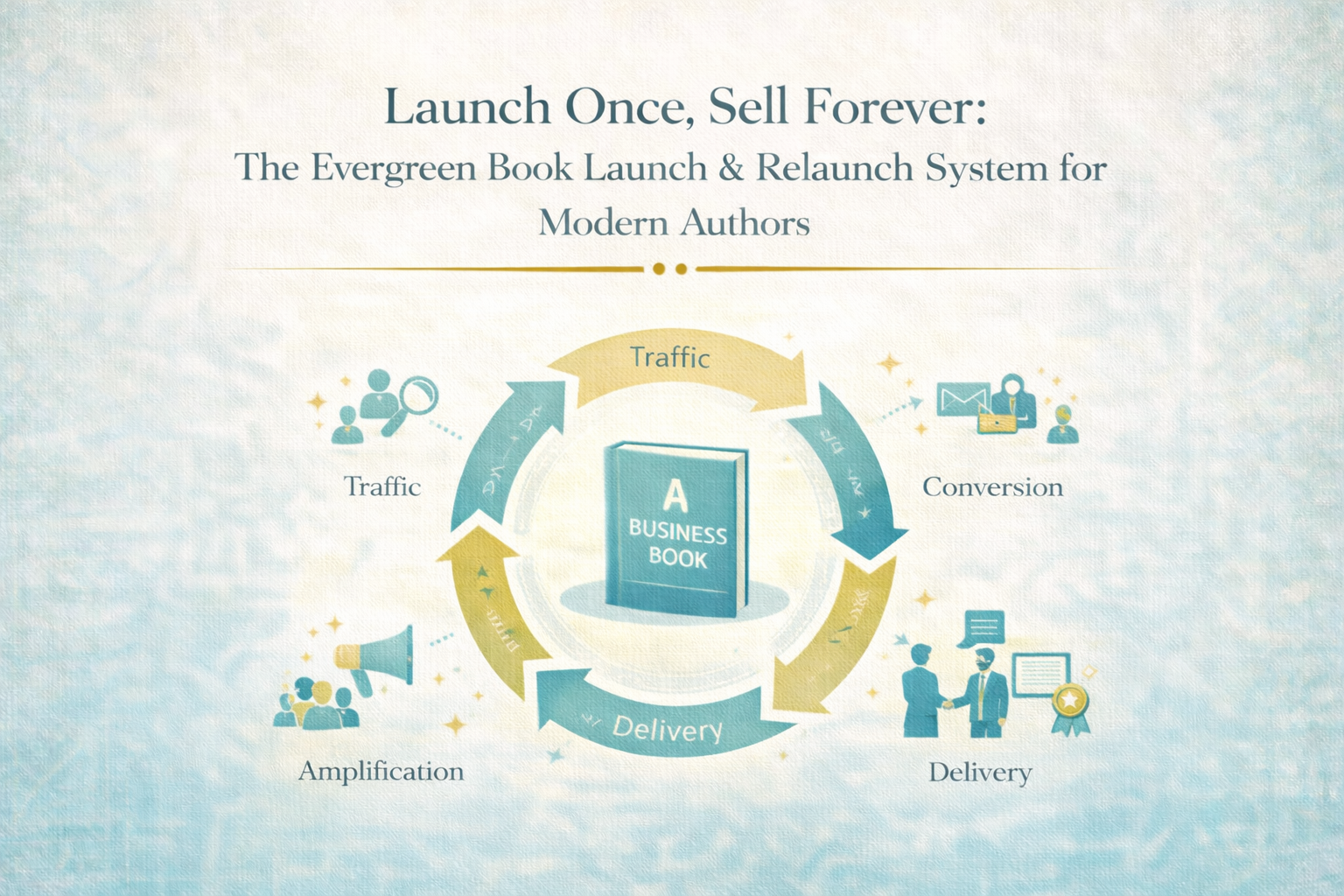
Book Marketing Strategy: Launch Once, Sell Forever (The Evergreen System for Modern Authors 2026)
The Modern Author Playbook for Building an Evergreen Book Launch Engine That Attracts Readers, Clients, and Opportunities for Years
Why Most Book Launch Strategies Fail (The Launch Myth Explained)
Most authors are taught to treat a book launch as a short promotional event.
The process usually follows a familiar pattern. The author spends months writing and preparing the manuscript. Marketing activity builds toward a specific launch week. Emails are scheduled. Social posts are planned. Interviews and webinars are arranged.
For a brief moment, demand spikes.
Friends and colleagues buy the book. Early supporters share it. The author may reach a category ranking or earn a “New Release” badge. Activity is concentrated into a narrow window of attention.
Then, within a few weeks, momentum fades.
The promotional emails stop. The launch webinars end. Content shifts to other topics. Discovery slows, and sales gradually decline. By day 30 or 60, the book is no longer actively promoted.
Many authors interpret this drop as a personal failure. They assume the launch did not work, or that they missed the critical window where the book could have gained traction.
In reality, the outcome is predictable.
The system most authors are taught to follow is designed for a short promotional burst, not for sustained discovery. When marketing activity stops, demand stops with it.
The problem is not the author.
The problem is the assumption that a book launch is a one-time campaign rather than the starting point of a longer demand system.
Under the traditional model, a launch functions like an event:
- Preparation builds toward a specific date
- Attention peaks during launch week
- Activity declines once the campaign ends
This structure almost guarantees a short sales spike followed by a sharp drop.
When authors believe this is the correct model, they concentrate their effort into a brief period and unintentionally abandon the book afterward.
The result is a common pattern across the industry: intense early activity, followed by long-term inactivity.
Understanding this pattern is the first step toward designing a launch that does not disappear after the first month.
Learn how to build an evergreen book launch using a modern author marketing system. Create an author demand engine with a book funnel system that attracts readers and clients.
“Your book launch isn’t a 30-day campaign.
It’s the ignition of a demand engine.”— Eric Koester
A Better Book Marketing Strategy: From Launch to Evergreen System
The core shift is simple: a launch is not the finish line.
It is the point of ignition.
In the traditional model, the book is treated as a one-time campaign. The author writes the manuscript, concentrates attention around launch week, and then watches demand decline once that promotion ends.
The pattern looks like this:
Traditional Model
write → launch → decline
This model assumes that demand is temporary. It treats attention as something to capture once, rather than something to build into a system.
The Modern Author model starts from a different assumption.
A book launch should initiate an evergreen system: a long-term marketing and conversion structure that continues to attract readers, generate leads, and create opportunities after the initial launch period ends.
The pattern looks like this:
Modern Author Model
launch → evergreen engine → relaunch cycles → compounding demand
In this model, the launch still matters. But its role changes.
The launch creates the initial burst of attention, proof, and momentum. The evergreen engine carries that momentum forward through ongoing discovery, conversion, and engagement. Relaunch cycles then reactivate interest at planned intervals, allowing demand to build rather than reset.
This is the central inversion:
- Launch is ignition
- Evergreen system is the long-term engine
- Relaunch cycles are structured demand refreshes
- Compounding demand is the result of running the system over time
This reframing changes how a book project should be designed.
Instead of asking, “How do we maximize launch week?”
The better question is, “How do we turn launch assets into an engine that keeps working?”
That is the Modern Author approach. The book is not managed as a short promotional event. It is built as the central asset inside a system designed to produce readers, clients, and opportunities over time.
60-Second Decision Box
Who This Guide Is For
This guide is designed for nonfiction authors who intend to use a book as part of a larger authority or opportunity strategy.
It is particularly relevant for:
- Founders and executives building thought leadership in their industry
- Consultants, advisors, and subject-matter experts who generate revenue through expertise
- Speakers and educators whose book supports client work, programs, or advisory services
- Authors who want their book to create long-term opportunities rather than short-term attention
In many organizations, the person reading this guide may be a Chief of Staff, Head of Marketing, or strategy lead evaluating how a senior executive’s book should be launched and sustained.
Decision Summary
Modern authors do not treat a book launch as a one-time promotional event.
Instead, they design an evergreen launch system—a structured engine that continues generating readers, leads, and opportunities long after the initial launch period ends.
Expected Outcomes
By the end of this guide, you will understand how to:
- Build an evergreen launch engine that continuously attracts new readers
- Convert launch assets into automated book funnels and nurture systems
- Use relaunch cycles to refresh demand without starting from zero
- Connect the book to offers, authority positioning, and revenue opportunities
What This Book Marketing Strategy Guide Covers
This guide explains the system architecture behind an evergreen book launch.
Its purpose is not to help an author create a brief burst of attention. It is to show how a book can be launched, connected to supporting assets, and operated as a long-term demand engine.
Specifically, this guide will teach you how the core parts of that system work together:
- The Evergreen Launch Flywheel
The repeating cycle that drives sustained demand through traffic, conversion, delivery, and amplification. - The Book-Centered Offer Stack
The set of offers positioned around the book so readers can move from interest to implementation to higher-value engagement. - Evergreen Funnel Architecture
The baseline funnel structure that turns discovery into email capture, book engagement, and offer progression. - The Three Launch Modes
The distinct roles of live launch, evergreen operation, and relaunch events inside a long-term launch system. - Quarterly Relaunch Strategy
The structured process for refreshing attention and demand at planned intervals without rebuilding from scratch. - Traffic Systems That Feed the Engine
The channels that keep new readers entering the system over time. - The Evergreen Content Engine
The content rhythm that supports discovery, trust, and ongoing book visibility. - Launch Optimization and Scaling
The measurement and improvement process that helps the system perform more effectively over time.
Taken together, these components form a complete operating model for a book that is intended to generate readers, leads, clients, and opportunities well beyond launch week.
Why Book Marketing Strategy Should Be a System, Not a Launch Plan
Most book launch advice focuses on tactics.
Authors are told to schedule podcast interviews, post frequently on social media, run launch-week promotions, and send a sequence of emails. These activities can create short bursts of attention, but they rarely produce sustained demand.
Tactics create activity. Systems create outcomes.
A modern book launch should therefore be designed as an operating system, not a checklist of marketing actions.
This guide refers to that operating system as a Launch Engine.
A launch engine is the integrated structure that turns a book from a one-time promotional event into a continuous demand generator. Instead of relying on a short campaign window, the system continuously attracts readers, converts attention into engagement, delivers value through the book and related assets, and amplifies results through proof and referrals.
At a structural level, the launch engine combines five components:
Launch Engine =
- Traffic — the channels that bring new people into contact with the book
- Conversion — the mechanisms that turn attention into subscribers, readers, or buyers
- Delivery — the experience that creates real value for readers and clients
- Amplification — the proof, referrals, and visibility generated by successful readers
- Relaunch cycles — planned demand spikes that reactivate the system at regular intervals
When these components operate together, the launch no longer behaves like a short campaign.
It behaves like a system.
The sections that follow explain how this system works and how each component contributes to a sustainable, long-term book launch.
The Evergreen Book Marketing System (Launch Flywheel Explained)
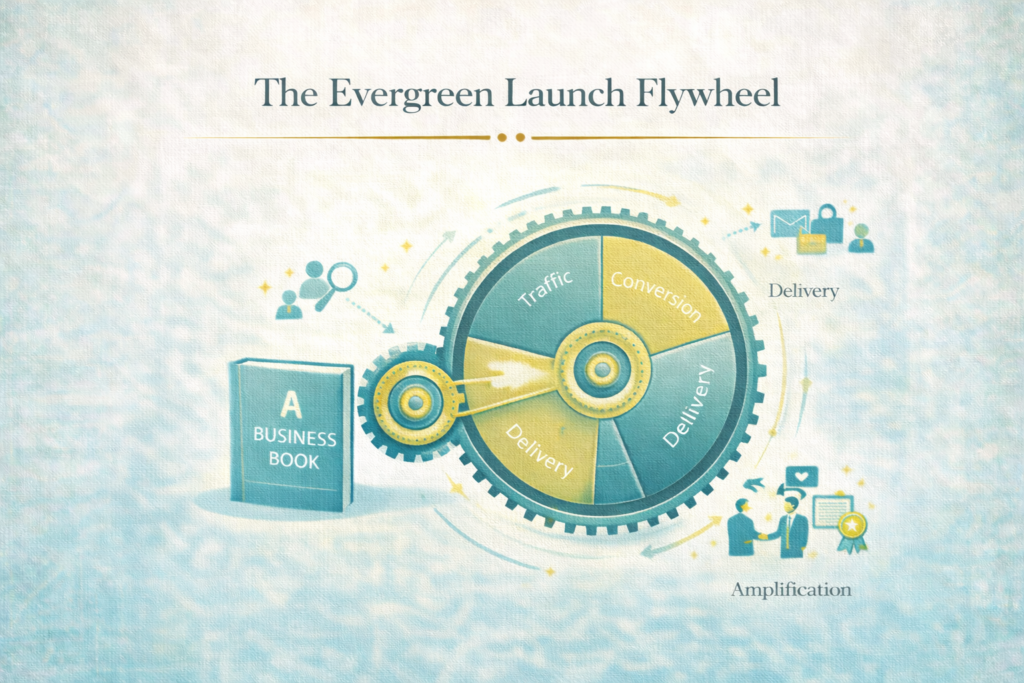
The core framework for this guide is the Evergreen Launch Flywheel.
A flywheel is a repeating system in which each stage strengthens the next. In a book launch context, that means demand is not created once and then lost. It is renewed through a continuous cycle of discovery, engagement, value delivery, and proof.
The Evergreen Launch Flywheel has four stages:
Traffic
→ Conversion
→ Delivery
→ Amplification
→ back to Traffic
Each stage has a distinct role.
Traffic brings new people into contact with the book.
Conversion turns that attention into a measurable action such as an email signup, book purchase, or inquiry.
Delivery creates value through the book and related assets so readers gain clarity, results, or next-step momentum.
Amplification turns those positive outcomes into reviews, referrals, case studies, conversations, and other forms of proof that increase future discovery.
That final stage feeds the first stage again.
This is why the model matters. A launch stops behaving like a temporary campaign when each stage is designed to support the next. Instead of relying on a single promotional burst, the system compounds over time.
Throughout this guide, this framework will be referred to as the Evergreen Launch Flywheel.
PART I — Book Launch vs Evergreen Marketing: What Actually Works
Most authors approach a book launch as a short promotional event.
This section explains why that assumption leads to declining demand after launch week. It introduces the evergreen mental model that treats a book not as a campaign, but as the ignition point of a long-term demand system.
Traditional Book Launch vs Evergreen Book Marketing Strategy
Most book launches are designed around a short promotional window.
The typical plan focuses on a burst of attention during launch week: interviews, social media promotion, email announcements, and coordinated marketing activity intended to drive a temporary spike in sales.
This model assumes that success is determined by what happens during a narrow campaign period.
In practice, this approach produces a predictable pattern:
- brief visibility
- a short sales spike
- rapid decline in discovery and demand
The issue is not the author’s effort. The issue is the model being used to evaluate success.
A modern author approaches a launch differently. Instead of optimizing for a single promotional moment, the book is positioned as the entry point to a long-term demand system.
The difference in mindset is structural.
| Traditional Launch Thinking | Evergreen Author Thinking |
| Bestseller week | Demand engine |
| Short campaign | Continuous discovery |
| Social promotion burst | Revenue per reader |
Under the traditional model, the goal is visibility during launch week.
Under the evergreen model, the goal is sustained discovery and measurable value generated by each reader over time.
This shift—from campaign thinking to system thinking—is the foundation for everything that follows in this guide.
Book Marketing Metrics That Actually Matter (Beyond Launch Week)
Traditional book launches are evaluated using short-term signals.
Authors watch launch-week sales, bestseller rankings, and social media activity to determine whether the launch “worked.” These indicators can create visibility, but they do not measure whether the book is generating sustained demand or long-term opportunity.
An evergreen launch system requires a different set of metrics.
Instead of evaluating a short promotional window, the system measures how effectively the book attracts readers, converts interest into relationships, and produces meaningful outcomes over time.
The following metrics provide that view.
Monthly New Readers
This metric measures how many new people discover and engage with the book each month.
In an evergreen system, discovery should continue well after launch. New readers should enter the ecosystem through content, referrals, search, speaking engagements, and other discovery channels.
Consistent monthly discovery is the foundation of a sustainable launch engine.
Email Subscriber Conversion
Not every reader becomes a long-term follower.
Email subscriber conversion measures the percentage of readers who choose to join the author’s audience through an email list or similar direct communication channel.
This metric indicates whether the book successfully moves readers from passive consumption to ongoing engagement.
Reader-to-Client Conversion
For many nonfiction authors, the book is part of a broader authority business.
Reader-to-client conversion measures how often readers become participants in higher-value engagements such as advisory work, consulting, programs, or speaking opportunities.
This metric reflects how effectively the book creates professional opportunity.
Revenue per Reader
Revenue per reader evaluates the total economic value generated by each reader over time.
Instead of focusing solely on book sales, this metric includes the downstream impact of readers who enroll in programs, become clients, attend events, or create referral opportunities.
It provides a more accurate picture of the book’s long-term economic contribution.
Cost per Acquisition
Cost per acquisition measures how much it costs to bring a new reader into the system.
This includes expenses associated with marketing, advertising, content production, and distribution.
When managed effectively, this metric ensures the launch engine can scale sustainably.
Together, these metrics replace launch-week vanity indicators with measurements that reflect the true performance of an evergreen book launch system.
The Book Marketing Lifecycle: Launch, Evergreen, and Relaunch Strategy
A modern book launch operates as a lifecycle, not a single campaign.
Instead of concentrating all activity into a short promotional window, modern authors design a system that moves through distinct phases over time. Each phase plays a specific role in sustaining discovery, building authority, and generating long-term opportunity.
This lifecycle can be summarized through a simple operating model:
Launch (Ignition) → Evergreen Operation (Orbit) → Strategic Relaunch (Boosters) → Expanded Evergreen Demand
| Phase | System Role | Strategic Outcome |
| Launch (Ignition) | Introduces the book to the market and activates initial demand. | Discovery, early readers, proof, and messaging validation. |
| Evergreen Operation (Orbit) | Sustains continuous discovery and engagement through ongoing traffic and funnels. | Monthly reader growth and steady lead generation. |
| Strategic Relaunch (Boosters) | Periodically increases visibility through coordinated campaigns and events. | Demand spikes, new audiences, and renewed attention. |
| Expanded Evergreen Demand | The system returns to evergreen operation with a larger audience and stronger proof. | Compounding discovery, authority, and opportunity. |
Over time, this cycle repeats as the book ecosystem grows.
Launch — Ignition
The launch phase activates the system.
During this stage, attention is concentrated around the book through coordinated visibility such as interviews, announcements, events, and promotional outreach. The goal is not simply to create a brief sales spike. Instead, the launch introduces the book to the market and establishes the foundation for the long-term demand system.
The launch phase typically focuses on:
• introducing the book to the market
• validating positioning and messaging
• attracting the first wave of readers
• generating early proof such as reviews and testimonials
In the lifecycle model, the launch functions as ignition—the moment the demand engine begins operating.
Evergreen — Orbit
After the launch window, the system transitions into evergreen operation.
Evergreen refers to the ongoing mechanisms that continue attracting readers over time. Instead of relying on temporary promotion, the book remains discoverable through sustained traffic sources such as content, referrals, partnerships, and search.
During this phase, the system works to:
• maintain continuous reader discovery
• grow the author’s audience and email subscribers
• deepen reader engagement with the book’s ideas
• connect readers to programs, services, or other opportunities
In the lifecycle model, evergreen functions as orbit—the stage where momentum is sustained and the system operates continuously.
Relaunch — Boosters
Even well-functioning evergreen systems benefit from periodic demand spikes.
A relaunch is a structured campaign that temporarily increases attention around the book. Relaunch events may include coordinated content pushes, speaking engagements, promotional campaigns, or other activities that reintroduce the book to new audiences.
Relaunches help to:
• refresh attention around the book
• reach new segments of the market
• leverage accumulated proof and case studies
• accelerate discovery at strategic intervals
In the lifecycle model, relaunches act as boosters, increasing momentum and expanding the reach of the system.
How Momentum Compounds
When these phases operate together, demand compounds over time.
The launch ignites the system.
Evergreen mechanisms sustain ongoing discovery.
Strategic relaunches periodically accelerate momentum.
Across a 12–36 month period, this lifecycle allows the book to continue generating readers, leads, and opportunities long after the initial launch window has passed.
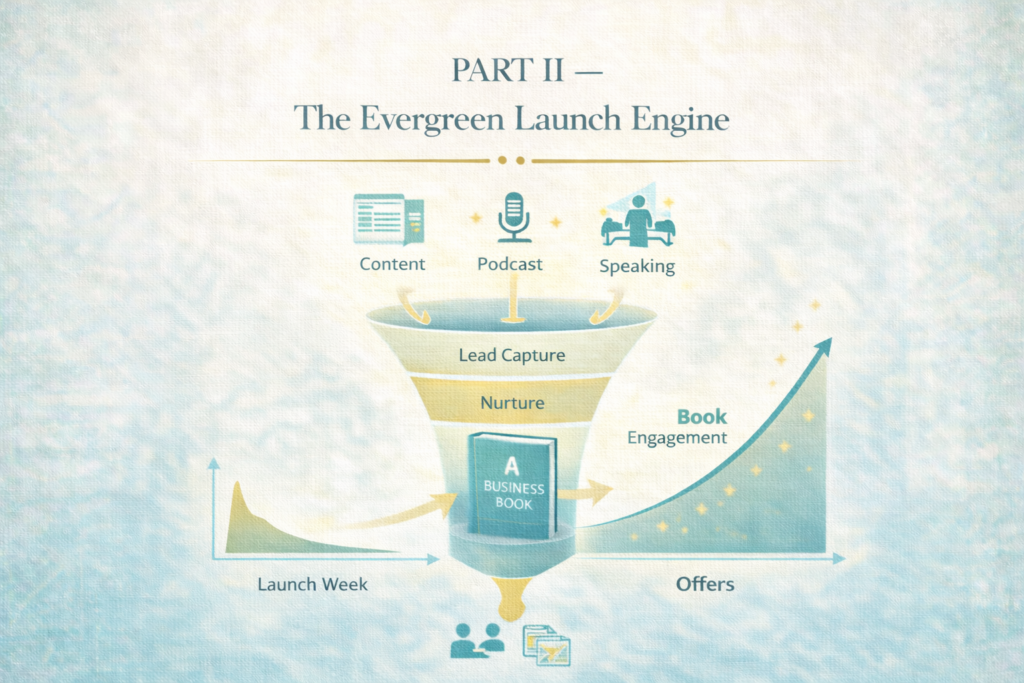
PART II — The Evergreen Book Marketing Engine (How the System Works)
A successful evergreen book launch is not driven by a single marketing tactic. It operates through a system that continuously creates discovery, engagement, and proof around the book.
In this guide, that system is called the Evergreen Launch Flywheel.
A flywheel is a self-reinforcing system in which each stage strengthens the next. Instead of restarting promotion repeatedly, the system builds momentum as activity in one stage feeds the others.
The Evergreen Launch Flywheel operates through four stages:
Traffic → Conversion → Delivery → Amplification → back to Traffic
When these stages are intentionally designed, the book becomes the center of a compounding demand system rather than a one-time promotional event.
Traffic
Definition
Refers to the channels that introduce new people to the book and the ideas behind it.
Role in the System
Traffic is the entry point to the flywheel. Without consistent discovery, the system cannot generate new readers or opportunities.
How the Book Supports It
A book functions as a powerful discovery asset because it creates multiple pathways for visibility:
• content derived from the book’s ideas
• podcast and media appearances
• speaking engagements
• referrals from readers and clients
• search-driven discovery
Each of these channels introduces new audiences to the book and begins the flywheel cycle.
Conversion
Definition
Conversion is the process of turning attention into a measurable relationship with the reader.
Role in the System
Traffic alone does not create long-term value. Conversion ensures that discovery becomes engagement.
Typical conversion actions include:
• joining an email list
• downloading a resource
• purchasing the book
• requesting additional information
How the Book Supports It
A book builds trust more effectively than most marketing assets. Readers who engage with the book’s ideas are more likely to continue the relationship by subscribing, participating in events, or exploring deeper resources.
In this stage, the book functions as a trust accelerator.
Delivery
Definition
Delivery is the stage where the reader receives the promised value.
Role in the System
This stage transforms attention into real impact. The stronger the delivery experience, the more likely readers are to apply the ideas and share the work with others.
How the Book Supports It
The book serves as the primary delivery asset by providing:
• a structured framework for solving a meaningful problem
• clear thinking and practical insights
• an intellectual foundation for deeper engagement
In many cases, the book also connects readers to implementation through programs, advisory work, or other offers.
Amplification
Occurs when successful readers expand the reach of the book through proof and visibility.
Role in the System
Amplification strengthens the flywheel by increasing credibility and introducing the book to new audiences.
How the Book Supports It
When readers gain value from the book, they naturally generate signals that expand discovery:
• reviews and recommendations
• referrals and introductions
• case studies and success stories
• speaking invitations and media opportunities
These signals return the system to the traffic stage, continuing the flywheel cycle.
When properly designed, the Evergreen Launch Flywheel allows the book to operate as a long-term demand engine that continuously generates readers, leads, and opportunities beyond the initial launch window.
How Your Book Drives the Marketing System
Within the Evergreen Launch Flywheel, the book is not simply the product being promoted. It functions as the central authority asset that enables the system to convert attention, deliver value, and generate proof.
Each stage of the flywheel depends on the book performing a specific role.
When these roles are intentionally designed, the book becomes the foundation of a long-term demand engine rather than a standalone publication.
Conversion → The Book as a Trust Builder
Where attention becomes engagement. At this point, a potential reader decides whether the author’s ideas are credible and worth deeper exploration.
Role of the Book
The book functions as a trust-building asset.
Unlike most marketing materials, a book allows the author to demonstrate:
• depth of expertise
• structured thinking
• a clear framework for solving a meaningful problem
Because readers invest time engaging with the ideas, the book accelerates credibility and increases the likelihood of continued interaction with the author’s work.
For many readers, the book becomes the moment where curiosity turns into confidence.
Delivery → The Book as a Transformation Asset
Where readers receive the promised value.
Role of the Book
The book acts as the primary transformation asset within the system.
Rather than simply sharing information, the book provides:
• a structured model or framework
• a clear explanation of the problem being solved
• guidance that allows readers to apply the ideas in their own context
This stage is where the book creates meaningful outcomes for readers. When the ideas produce clarity, results, or new opportunities, the relationship between the reader and the author deepens.
The stronger the delivery experience, the more likely readers are to continue engaging with the broader ecosystem around the book.
Amplification → The Book as a Proof Generator
When successful readers expand the reach of the work.
Role of the Book
The book generates proof signals that strengthen credibility and introduce the ideas to new audiences.
These signals typically appear as:
• reader recommendations
• online reviews
• referrals and introductions
• case studies created by clients or program participants
• invitations to speak or contribute to industry conversations
Each signal increases visibility and feeds additional attention back into the flywheel.
Over time, these signals compound. The book becomes widely referenced, recommended, and shared—creating a steady flow of new readers entering the system.
Evergreen Authority Engine
Starting Point
A first-time author with a small professional audience and limited visibility outside their immediate network.
Action
The author connected the book to a simple evergreen funnel that invited readers to download a companion resource and join a short email sequence expanding on the book’s ideas.
Result
Readers who resonated with the framework began scheduling advisory conversations and referring colleagues to the book. Within several months, the book consistently generated new consulting leads and speaking inquiries without requiring additional launch campaigns.
How to Turn Your Book Into a Revenue System (Offer Stack Strategy)
A book can generate attention on its own. But attention does not automatically become revenue.
For a book to function as a long-term business asset, it needs to sit inside a clear offer stack: a structured progression of next-step opportunities that allows readers to move from insight to implementation.
In this model, the book is not the end of the journey. It is the authority asset that introduces the reader to the problem, builds trust in the framework, and prepares readers for deeper engagement.
The Book-Centered Offer Stack
| Level | Typical Price | Purpose | Example Formats |
| Starter Offer | $47–$297 | Help readers implement the first practical step from the book with minimal friction | Workshop, toolkit, assessment, implementation guide, short training |
| Core Offer | $2,000–$10,000 | Provide structured support for applying the full framework introduced in the book | Cohort-based program, course with support, accelerator, consulting program |
| Premium Offer | $10,000+ | Deliver high-touch strategic support for readers who want faster or customized implementation | Private advisory, mastermind, executive consulting, strategic partnership |
How Readers Progress Through the Stack
Readers do not all need the same next step.
Some readers want a simple implementation tool after finishing the book. Others want structured guidance. A smaller group will want direct access and tailored support.
The purpose of the offer stack is to make those next steps clear.
A typical progression looks like this:
Book → Starter Offer → Core Offer → Premium Offer
Each step increases commitment in proportion to the reader’s readiness.
The book builds trust.
The starter offer creates initial action.
The core offer supports deeper implementation.
The premium offer accelerates results through direct collaboration.
When this structure is intentionally designed, the book becomes more than a credibility asset. It becomes the front end of a monetization ladder that supports both reader outcomes and long-term business growth.
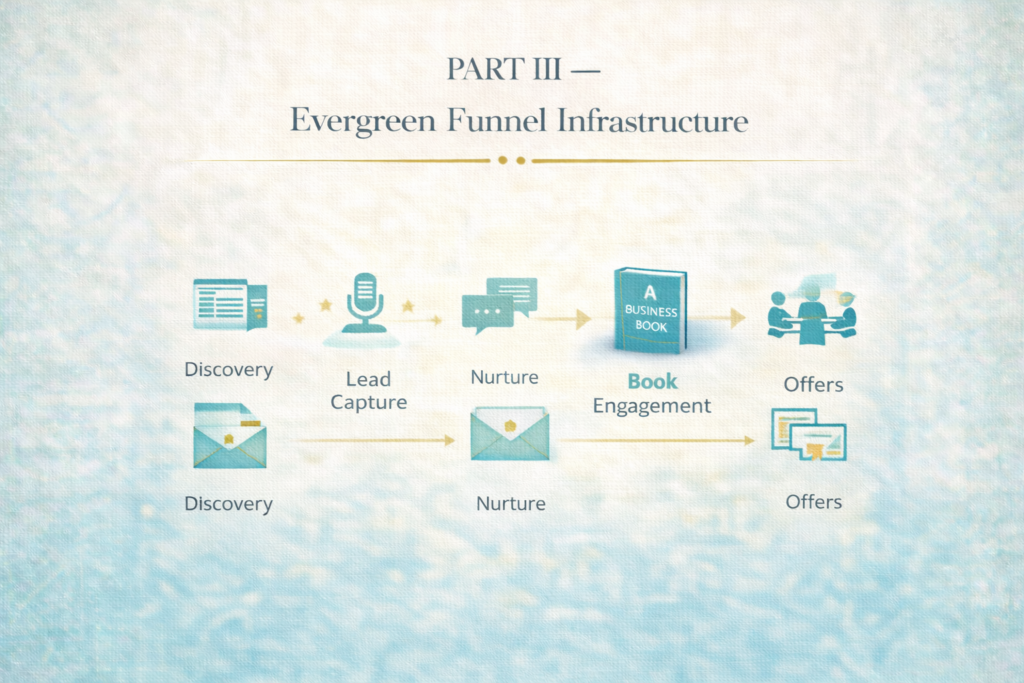
PART III — Evergreen Book Funnel Strategy (How Readers Become Clients)
An evergreen launch engine requires infrastructure that consistently converts discovery into deeper engagement.
This infrastructure is typically organized through a structured funnel that guides a reader from initial awareness to meaningful participation in the author’s ecosystem.
In a modern author system, the funnel is not primarily designed to sell the book. Its purpose is to transform traffic into subscribers, readers, and eventually clients or program participants.
The book becomes a central trust asset within that journey.
The Evergreen Book Funnel (Marketing Strategy Explained)
A simple evergreen funnel typically follows this progression:
Traffic Source → Lead Capture → Nurture Sequence → Book Engagement → Starter Offer → Core Offer
Each stage performs a specific role within the system.
Traffic Source
Introduce new audiences to the author’s ideas and direct them toward an entry point in the funnel.
Common traffic sources include:
• owned media such as newsletters, blogs, and podcasts
• earned exposure such as interviews, partnerships, or media features
• paid promotion through targeted advertising
The goal of this stage is discovery. New readers encounter the author’s ideas and are invited to take a next step.
Lead Capture
Converts anonymous visitors into known contacts.
This typically occurs through a focused entry asset such as:
• a downloadable resource
• a free chapter of the book
• a short training or webinar
• a diagnostic or assessment
In exchange for this resource, the reader provides an email address or other contact information. This step creates a direct communication channel between the author and the reader.
Nurture Sequence
Once a reader joins the email list, a nurture sequence introduces the core ideas behind the book and builds familiarity with the author’s framework.
A typical sequence may include:
• short explanations of key ideas from the book
• examples of how the framework is applied
• reader stories or implementation insights
The purpose of the nurture sequence is to deepen understanding and prepare readers to engage directly with the book.
Book Engagement
At this stage, readers encounter the book itself.
The book provides a structured explanation of the author’s thinking and delivers meaningful value to the reader.
Because the reader has already encountered the ideas through the funnel, engagement with the book typically happens with greater intent and trust than a casual discovery purchase.
The book becomes the central experience that connects readers to the broader ecosystem around the work.
Starter Offer
After readers engage with the book, many will want help implementing the ideas.
The starter offer provides a focused next step for readers who want practical guidance but are not yet ready for a larger program.
This offer is typically designed to be:
• affordable
• specific
• easy to adopt quickly
Its purpose is to help readers begin applying the framework introduced in the book.
Core Offer
Provides structured support for readers who want to implement the full system introduced in the book.
This may take the form of a cohort program, advisory engagement, or structured course.
At this stage, the funnel transitions from audience building into deeper client engagement.
The book continues to function as the intellectual foundation for the work, ensuring that participants share a common framework and language.
When these stages are intentionally designed, the funnel becomes a predictable pathway from discovery to meaningful outcomes. Traffic enters the system, readers engage with the ideas, and a portion of those readers continue into deeper levels of implementation and collaboration.
Best Entry Points for Book Marketing FunnelsEvergreen Entry Points
An evergreen funnel requires a consistent way for new readers to enter the system.
These entry mechanisms are called entry points. An entry point is the first structured interaction a potential reader has with the author’s ideas before engaging more deeply with the book or broader ecosystem.
The purpose of an entry point is to convert discovery into engagement by offering immediate value in exchange for attention or contact information.
Effective entry points typically take one of several forms.
Common Evergreen Entry Points
• Webinar
A structured teaching session that introduces the core problem and framework behind the book while inviting participants to explore the ideas more deeply.
• Free Chapter
A downloadable excerpt from the book that allows readers to experience the author’s thinking before purchasing or engaging further.
• Quiz or Assessment
An interactive diagnostic that helps readers identify their current situation or challenges, often connected to the framework introduced in the book.
• Toolkit
A collection of templates, checklists, or practical resources derived from the book’s methodology.
• Email Challenge
A short sequence of daily prompts or lessons designed to help readers begin applying the ideas from the book.
Each format provides a different way for readers to experience the author’s thinking while entering the evergreen funnel.
Start With One Entry Point
Many authors attempt to launch multiple funnels at once. This often creates unnecessary complexity and weakens performance.
A more effective approach is to start with one clear entry point that aligns with the author’s strengths and audience behavior.
For example:
• authors comfortable teaching often begin with webinars
• framework-driven books often perform well with assessments
• tactical books often convert well through toolkits or implementation guides
Once the initial funnel performs reliably, additional entry points can be introduced later.
Starting with one focused entry path allows the system to mature before expanding.
Webinar Entry Funnel
Starting Point
A subject-matter expert with a growing LinkedIn audience but limited infrastructure for converting attention into ongoing relationships.
Action
The author created a webinar that introduced the core framework from the book and invited participants to download a companion resource.
The webinar became the primary entry point for the funnel and was promoted through regular LinkedIn content and guest podcast appearances.
Result
The webinar consistently introduced new readers to the book’s ideas and generated a steady flow of email subscribers, book purchases, and advisory inquiries each week.
Book Marketing Channels: How to Drive Traffic to Your Book
An evergreen launch engine depends on a continuous flow of new people discovering the author’s ideas.
This flow is created through traffic systems—the channels that introduce new audiences to the book and guide them toward the entry points of the funnel.
Most evergreen author ecosystems rely on three traffic categories:
Owned, Earned, and Paid.
Each plays a different role in sustaining discovery and feeding the launch engine.
Owned Traffic
Comes from channels the author directly controls.
These platforms allow the author to communicate with an audience without relying on third-party distribution.
Common examples include:
• email newsletters
• personal websites or blogs
• podcasts hosted by the author
• social media accounts
• community platforms or memberships
Role in the System
Owned traffic creates the most reliable long-term discovery engine. As the audience grows, each piece of content can consistently introduce new readers to the book and related resources.
Because the author controls the platform, owned traffic often produces the most stable conversion performance.
Typical Conversion Ranges
While results vary, many authors observe:
• 10–30% of readers clicking through to a lead capture resource from email or content
• 20–40% of landing page visitors converting into email subscribers
These ranges depend on the clarity of the offer and the alignment between the content and the entry point.
Earned Traffic
Comes from visibility created by external platforms or audiences.
Instead of publishing directly to one’s own audience, the author appears in other people’s channels.
Examples include:
• podcast interviews
• guest articles or media features
• speaking engagements
• partnerships with other creators or communities
• referrals and word-of-mouth recommendations
Role in the System
Earned traffic introduces the author’s ideas to entirely new audiences. It often serves as a powerful discovery mechanism during both launch periods and evergreen operation.
Because the audience is unfamiliar with the author, earned traffic tends to produce lower conversion rates than owned channels but can reach significantly larger groups of potential readers.
Typical Conversion Ranges
Authors commonly see:
• 2–10% of listeners, viewers, or readers visiting a funnel entry point
• 15–30% of those visitors converting into email subscribers or resource downloads
Even modest conversion rates can generate meaningful growth when exposure reaches large audiences.
Paid Traffic
Uses advertising platforms to introduce new audiences to the book and funnel entry points.
Typical channels include:
• search advertising
• social media ads
• podcast or newsletter sponsorships
• content promotion platforms
Role in the System
Paid traffic allows the author to scale discovery beyond organic reach. When the funnel is already converting reliably, paid promotion can accelerate audience growth and lead generation.
Paid traffic is most effective when it amplifies a funnel that has already demonstrated strong organic performance.
Typical Conversion Ranges
While results vary by audience and platform, common benchmarks include:
• 1–5% click-through rates on ads
• 15–35% landing page conversion to email subscribers
Monitoring cost per lead and cost per acquisition helps determine whether paid traffic is sustainable within the system.
How Traffic Systems Work Together
Most evergreen launch engines rely on a combination of all three sources.
Owned traffic creates consistent engagement.
Earned traffic expands discovery to new audiences.
Paid traffic accelerates growth once the system is proven.
When these traffic streams feed the funnel consistently, the evergreen launch engine maintains a steady flow of new readers entering the system.
Evergreen Content Strategy for Book Marketing
An evergreen launch system needs a steady mechanism for creating discovery over time.
That mechanism is the content engine: a repeatable publishing rhythm that turns the book’s ideas into ongoing visibility, audience growth, and funnel traffic.
In this model, content is not separate from the book launch. It is one of the primary ways the launch engine continues operating after the initial release window.
The Core Structure
A simple evergreen content engine is built around:
1 anchor content piece per week
4 signal pieces derived from the anchor
This structure creates enough consistency to sustain discovery without requiring constant content creation from scratch.
Anchor Content
Anchor content is the primary weekly asset.
It is the long-form piece where the author teaches a substantial idea drawn from the book or its surrounding framework. Because it carries more depth, anchor content becomes the source material for everything that follows.
Common anchor formats include:
• newsletter
• LinkedIn article
• podcast episode
• video
The purpose of anchor content is to create a durable intellectual asset that can attract readers, build trust, and connect audiences to the book-centered funnel.
Signal Content
Signal content is the short-form content derived from the weekly anchor.
Its role is to extend reach by translating the core idea into multiple lightweight formats that are easier to distribute and consume.
Common signal formats include:
• clips
• quotes
• short posts
Each signal asset points back to the same central idea. Instead of introducing a new topic every time, signal content reinforces the book’s key arguments through repeated exposure across multiple touchpoints.
Why This Structure Works
Most authors struggle with content because they treat every post, email, or video as a separate creative task.
A content engine solves this by turning one meaningful idea into a small distribution system.
The weekly rhythm is simple:
1 idea → 1 anchor asset → 4 signal assets
This creates three advantages:
• it reduces content production friction
• it keeps the book’s ideas visible in the market
• it feeds traffic back into the evergreen funnel consistently
Over time, this creates a library of content that continues introducing new readers to the book.
Content-Driven Evergreen Growth
Starting Point
An author with a weekly newsletter but no structured system for turning book ideas into ongoing discovery.
Action
The author began using each newsletter edition as a weekly anchor asset, then repurposed the central idea into short LinkedIn posts, quote graphics, and short-form clips tied back to the book and funnel entry point.
Result
The content system created a steady flow of new readers discovering the book each week, while also increasing email subscribers and supporting ongoing funnel growth.
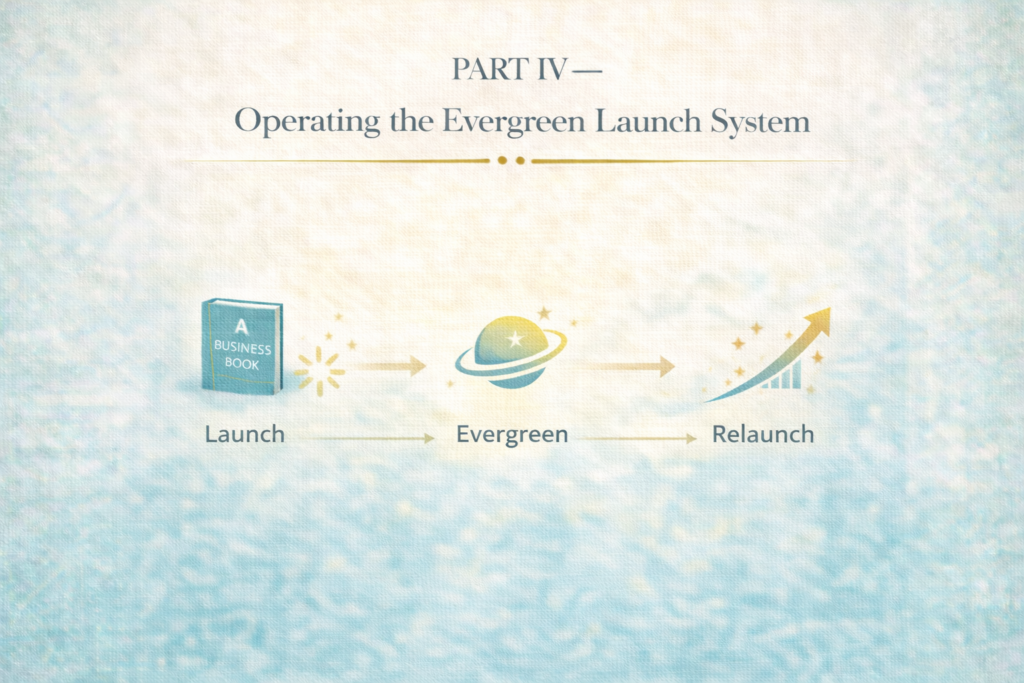
PART IV — How to Operate Your Book Marketing System Long-Term
An evergreen book launch does not operate in a single state.
It moves through three operational modes, each serving a different function in the demand engine.
These modes are not separate marketing campaigns.
They are coordinated phases of the same system.
Each phase answers a different operational question:
- How do we discover what messaging works?
- How do we maintain ongoing discovery and conversion?
- How do we periodically amplify demand?
The three modes are:
Live Launch → Evergreen Operation → Relaunch Events
Together they create a launch system that evolves rather than expires.
Live Launch
The Discovery and Asset-Building Phase
The live launch is the system’s ignition stage.
This phase concentrates attention around the book within a defined time window in order to rapidly test the market.
Instead of focusing only on short-term sales spikes, the live launch is designed to generate the inputs the evergreen system will rely on later.
The central idea is simple: the first launch teaches the system how to operate.
During this phase, the author tests positioning, messaging, and audience response while collecting the assets required for long-term marketing.
Typical components of a live launch include:
- coordinated content and announcements
- live webinars or events
- concentrated outreach
- early reader engagement
- initial funnel activation
Because activity is condensed, feedback arrives quickly. The team can see which messages resonate, which entry points convert, and which ideas create the strongest response.
The primary outputs of this phase are:
- validated positioning and messaging
- testimonials and early reviews
- launch recordings and promotional assets
- early case studies or proof points
For most authors, the live launch is best used when a book is first released or when a major new positioning shift is being introduced.
When executed well, the result is not just initial visibility.
It is a tested foundation for the evergreen system that follows.
Evergreen Operation
The Continuous Discovery Phase
Once the launch window closes, the system transitions into evergreen mode.
Evergreen operation is the long-term state of the launch engine. Instead of concentrated bursts of activity, the system runs through stable infrastructure that continuously introduces new readers to the book.
The core principle is durability.
Traffic sources, funnel entry points, nurture sequences, and content systems work together to maintain steady discovery and conversion without requiring constant relaunch effort.
In practice, evergreen operation relies on:
- ongoing traffic sources feeding the funnel
- evergreen entry points such as webinars or lead magnets
- automated nurture sequences connecting readers to the book
- the content engine generating weekly discovery
- the offer stack converting readers into clients or programs
Because these systems operate continuously, the book remains visible long after its initial launch window.
Evergreen mode is most effective when:
- the author has validated messaging from the live launch
- funnel infrastructure is in place
- content systems are operating consistently
The outcome of this phase is stable monthly discovery and lead generation, turning the book into a persistent authority asset rather than a one-time event.
Relaunch Events
The Demand Amplification Phase
Even a strong evergreen system benefits from periodic momentum spikes.
This is the role of relaunch events.
A relaunch is a concentrated promotional window layered on top of the evergreen infrastructure. Instead of rebuilding attention from scratch, the system temporarily intensifies the traffic, messaging, and engagement already in place.
The strategic idea is amplification rather than reinvention.
Typical relaunch activities include:
- short promotional campaigns
- new webinars or events
- updated positioning or angles
- refreshed content tied to the book’s ideas
- renewed outreach to existing audiences
Because the funnel, assets, and infrastructure already exist, relaunch events are far more efficient than the original launch.
Relaunches are commonly scheduled every 90 days, allowing the system to periodically create renewed visibility without disrupting evergreen operations.
They are especially useful when:
- a new case study or proof point emerges
- the author releases related content or research
- the book is tied to a seasonal or industry event
- new traffic channels are introduced
The result is a temporary surge in discovery, book sales, and lead generation, which then feeds back into the evergreen system.
How the Modes Work Together
These three modes form the operational rhythm of the evergreen launch system.
The live launch establishes messaging and creates foundational assets.
Evergreen operation sustains continuous discovery and conversion.
Relaunch events periodically amplify demand and reintroduce the book to new audiences.
Rather than fading after launch week, the book becomes a system that compounds attention, authority, and opportunity over time.
Book Relaunch Strategy: How to Restart Momentum Without Starting Over
Even strong evergreen systems benefit from periodic moments of concentrated attention.
Over time, audiences grow, new readers enter the market, and new proof accumulates around the book’s ideas. A relaunch system allows authors to reactivate this attention without rebuilding an entire launch campaign from the beginning.
The most effective approach is a Quarterly Relaunch Sprint: a short, structured promotional window that reintroduces the book and its surrounding offers to the market.
Instead of creating entirely new assets, the relaunch sprint reuses and recombines the materials already generated during the original launch and evergreen operation.
This makes the process efficient while still creating a visible surge in demand.
Why Quarterly Relaunches Work
A relaunch is not intended to replace evergreen operations.
It temporarily amplifies the existing system.
When run every 90 days, relaunches allow the author to:
- resurface the book for new audiences
- activate previously engaged readers who did not convert
- highlight new results, case studies, or insights
- reconnect the book to offers, programs, or services
Because the funnel infrastructure and messaging already exist, relaunches are significantly easier to execute than the initial launch.
The 7-Day Relaunch Sprint
A quarterly relaunch typically runs as a 7-day promotional sequence.
Each day focuses on a different element of the book’s value proposition, gradually building attention and momentum.
Day 1 — Story
Reintroduce the origin story or insight behind the book’s central idea.
Day 2 — Problem
Clarify the core problem the book helps readers understand or solve.
Day 3 — Proof
Share testimonials, reader feedback, or results that demonstrate the book’s impact.
Day 4 — Book + Offer
Connect the book directly to the relevant implementation offer or program.
Day 5 — Live Event
Host a webinar, workshop, or discussion tied to the book’s ideas.
Day 6 — Objections
Address common questions, doubts, or barriers that prevent readers from taking the next step.
Day 7 — Last Call
Close the sprint with a clear call to action tied to the book and its surrounding offer.
This structure creates a focused week of activity that renews visibility while guiding readers through a clear decision sequence.
What Relaunches Produce
When executed consistently, quarterly relaunches create predictable demand spikes inside the evergreen system.
They typically generate:
- increased book sales
- renewed audience engagement
- new email subscribers and leads
- higher enrollment in programs or services connected to the book
Instead of fading after its initial launch window, the book becomes an asset that can be reactivated repeatedly as new audiences discover its ideas.
Relaunch Demand Spike
Starting point
A book nine months after its initial launch with stable evergreen traffic but declining promotional attention.
Action
The author implemented a 7-day relaunch sprint using existing launch assets, including testimonials, webinar recordings, and email sequences.
Result
The relaunch generated a visible surge in book sales and new enrollments in the program connected to the book’s framework.
How to Measure and Improve Your Book Marketing Strategy
An evergreen launch system improves over time only if it is measured consistently.
Instead of focusing on short-term launch spikes, modern authors evaluate performance through a small set of operational metrics that reveal how the demand engine is functioning month after month.
These metrics fall into four groups:
Traffic → Conversion → Revenue → Efficiency
Together they show how effectively the system attracts attention, converts interest, generates value, and uses resources.
Traffic
Measures how many people are discovering the system.
This includes the audiences entering through content, webinars, lead magnets, partnerships, and other entry points.
Key indicators include:
• number of new visitors entering the funnel
• growth of email subscribers
• content reach and discovery
• webinar or lead magnet registrations
Traffic metrics help answer a simple question:
Is the system attracting new readers consistently?
Without a steady flow of new people entering the funnel, even a well-designed system will eventually stagnate.
Conversion
Measures how effectively interest turns into engagement and action.
This stage evaluates whether the funnel is successfully guiding readers from discovery into deeper participation.
Typical conversion indicators include:
• visitor-to-subscriber conversion rate
• subscriber-to-book purchase rate
• reader-to-program enrollment rate
• event registration and attendance rates
Conversion metrics reveal whether the messaging, positioning, and funnel experience are aligned with the audience’s needs.
If traffic is healthy but conversions are low, the issue is usually positioning, clarity, or offer alignment.
Revenue
Measure the economic output of the launch engine.
While books themselves often generate modest direct income, they frequently act as the entry point for higher-value offers connected to the author’s expertise.
Important indicators include:
• total monthly revenue generated from book-related offers
• program or service enrollments connected to the book
• revenue generated per reader entering the system
Tracking these numbers clarifies how effectively the book functions as an authority asset inside the larger offer ecosystem.
Efficiency
Help evaluate how sustainably the system operates.
These measurements reveal whether the engine is producing results at a reasonable cost and effort level.
Common indicators include:
• cost per lead or subscriber
• cost per acquisition for book buyers or program clients
• time required to operate the system
• return on marketing investment
Efficiency becomes increasingly important as the system scales.
Small improvements in efficiency often produce meaningful long-term gains.
The Monthly Optimization Rhythm
Measurement only becomes valuable when it informs regular adjustments.
Most evergreen launch systems operate on a monthly review cycle.
During this review, the team evaluates the four KPI groups and identifies small improvements to test during the next cycle.
Typical optimization questions include:
• Which traffic sources are producing the most qualified readers?
• Where are the largest drop-offs in the funnel?
• Which content or messaging is generating the strongest response?
• Which offers are converting readers into higher-value engagement?
Rather than redesigning the entire system at once, improvements are introduced gradually.
Over time, this process compounds.
Small adjustments to traffic, conversion, and offer performance steadily increase the effectiveness of the launch engine.
The 12-Month Evergreen Book Marketing Roadmap
An effective book marketing strategy does not peak at launch—it compounds over time.
In the first year, the objective is to move from short-term activity to a stable demand system. This transition typically unfolds across four stages:
Launch → Evergreen System → Optimization & Relaunch → Scaling
1. Launch (Ignition)
The launch is not the outcome. It is the input.
Its role is to introduce the book to the market, test positioning, and generate early proof. Attention is concentrated into a defined window through coordinated content, outreach, and events. Because activity is condensed, feedback arrives quickly—making it possible to identify which messages resonate and which do not.
The result is not just visibility, but a set of assets: validated positioning, testimonials, and reusable materials that will support the system that follows.
2. Evergreen System (Stability)
Once the launch window closes, the system begins.
At this stage, the book is connected to a simple but durable structure: a funnel, a primary entry point, and a consistent content engine. Instead of relying on bursts of attention, the focus shifts to continuous discovery and steady conversion.
Traffic flows into the system through content, partnerships, and other channels. A portion of that attention becomes subscribers, readers, and eventually clients or participants in deeper offers. Over time, this creates a baseline of predictable monthly engagement.
This is the point where the book stops behaving like a campaign and starts functioning as an asset.
3. Optimization and Relaunch (Momentum)
With a functioning system in place, the focus shifts to refinement and amplification.
Performance is reviewed regularly. Messaging is clarified. Weak points in the funnel are adjusted. At the same time, structured relaunch cycles are introduced to create periodic increases in visibility and demand.
These relaunches do not rebuild the system—they amplify it. Each cycle benefits from accumulated proof, improved positioning, and a larger audience, allowing demand to build rather than reset.
Over time, small improvements compound into meaningful gains in conversion, reach, and overall effectiveness.
4. Scaling and Documentation (Leverage)
As the system stabilizes, the emphasis moves to expansion and repeatability.
High-performing traffic sources are scaled. Processes are documented. Relaunch cycles become standardized. What was once a set of coordinated activities becomes an operating system that can be executed consistently.
At this stage, the book is no longer dependent on active promotion to remain visible. It operates as a long-term demand engine—continuously generating readers, opportunities, and downstream value.
The Compounding Effect
Across these stages, the dynamic shifts from effort-driven growth to system-driven growth.
The launch creates initial momentum.
The evergreen system sustains it.
Relaunch cycles accelerate it.
Scaling allows it to repeat.
The result is not a single successful launch, but a book that continues to produce readers, clients, and opportunities long after its release.
Common Book Marketing Strategy Mistakes (And How to Fix Them)
You’re right again — this section has good substance but feels heavy and repetitive. The “Before/After” blocks especially break flow and make it feel mechanical.
We’ll elevate it by:
- removing redundancy
- turning it into clean contrasts + insight
- keeping it skimmable but strategic
Common Evergreen Book Marketing Mistakes
Evergreen launch systems rarely fail because of lack of effort.
They fail because of structural misunderstandings.
Most issues emerge when authors treat evergreen as a passive marketing setup rather than an active demand system.
The patterns below appear consistently—and they limit long-term performance even when the book itself is strong.
1. Treating Evergreen as Passive Automation
“Evergreen” is often misunderstood as something that runs on autopilot.
In practice, evergreen systems require continuous input: traffic, content, and periodic relaunch cycles. When those inputs stop, discovery slows and the system stalls.
The difference is simple.
Weak systems are built once and left alone.
Effective systems are continuously fed.
2. No Clear Offer Path
Attention without direction does not create opportunity.
A book can generate readers, but without a defined next step, those readers have nowhere to go. The result is engagement without progression.
Strong systems connect the book to a structured offer path.
Readers move from insight to implementation through clearly defined stages, allowing the book to function as the entry point into a broader ecosystem.
3. Chasing Bestseller Status Instead of System Design
Short-term visibility is often mistaken for success.
Launch-week rankings, badges, and spikes in activity can create momentum, but they do not sustain it. Without supporting infrastructure, attention fades quickly.
Durable systems treat the launch as a way to gather proof and assets—not as the primary outcome. Long-term performance comes from what is built after the launch, not during it.
4. Launching Once and Then Stopping
A single launch creates a temporary surge. It does not create sustained demand.
Even strong systems lose visibility over time without periodic reactivation. Relaunch cycles are not optional—they are part of how momentum is maintained.
When structured correctly, each relaunch builds on previous results rather than restarting from zero.
5. Building Too Much, Too Early
Complexity often increases faster than performance.
Many authors attempt to deploy multiple funnels, entry points, and systems simultaneously. This fragments attention and makes it difficult to identify what is actually working.
Effective systems are built sequentially. One clear funnel, one entry point, and one working structure create a foundation that can be expanded over time.
The Structural Correction
Most evergreen launch problems are solved by simplifying the system.
At its core, a functioning model relies on a small set of aligned components:
- a clear funnel architecture
- a single primary entry point
- a consistent content engine
- structured relaunch cycles
- ongoing measurement and iteration
When these elements operate together, the book stops behaving like a campaign and begins functioning as a demand engine.
Operating Principles for Long-Term Performance
Sustained results come from consistency, not intensity.
Authors who see long-term traction tend to follow a small set of repeatable practices:
- build one system before expanding
- connect the book to a clear progression of offers
- maintain a steady content rhythm that supports discovery
- reintroduce the book through periodic relaunch cycles
- review performance regularly and adjust incrementally
When applied consistently, these principles turn a book into a durable authority asset—one that continues to generate readers, opportunities, and outcomes well beyond its initial release.
Deeper Story Example
This is a strong section conceptually — it just needs compression + sharper flow. Right now it over-explains each stage.
We’ll:
- tighten language
- remove repetition
- keep the progression clear
- make it feel more like a system insight than a breakdown
How an Evergreen Book Becomes an Opportunity Engine
The value of an evergreen launch system becomes clear when the book starts generating opportunities beyond sales.
In authority-driven models, the manuscript is not the end product—it’s the starting asset. Over time, its ideas move through a sequence of real-world application, each stage reinforcing the next.
A common pattern looks like this:
Manuscript → Keynote
The book’s core framework naturally translates into talks, workshops, and presentations.
Because the ideas are already structured, the book becomes a ready-made foundation for speaking. This expands distribution beyond traditional book discovery into live audiences and industry events.
Keynote → Clients
Exposure leads to demand.
As audiences engage with the ideas, a subset seeks deeper implementation. This turns the book into a pathway for consulting, advisory work, and structured programs.
At this stage, the book functions less as content and more as a credibility asset.
Clients → Case Studies
Implementation creates proof.
As clients apply the framework, outcomes emerge—results, testimonials, and measurable impact. These become case studies that validate the ideas in real-world contexts.
This is where the book’s authority strengthens.
Case Studies → Relaunch Momentum
Proof creates new demand.
Case studies and results provide fresh material for relaunch campaigns, content, and presentations. Each new example reinforces credibility and reintroduces the book to new audiences.
Relaunches become more effective because they are grounded in evidence, not just promotion.
The Ecosystem Loop
Over time, this progression becomes self-reinforcing:
Manuscript → Keynote → Clients → Case Studies → Relaunch → Expanded Reach
Each stage feeds the next.
Each cycle adds proof.
Each iteration expands the system.
The result is not a one-time launch, but a compounding loop of visibility, authority, and opportunity.
In this model, the book is not simply a published product.
It becomes the central intellectual asset that powers the entire system.
Manuscripts Integration
Building an evergreen launch engine requires more than writing and publishing a book.
It requires coordinated execution across positioning, funnels, content systems, and relaunch cycles.
Many authors attempt to assemble these pieces independently—often resulting in fragmented marketing activity rather than a cohesive demand engine.
Manuscripts was designed to solve this coordination problem by helping authors architect their book as a strategic authority system, not just a published product.
The role of Manuscripts is to help authors design, build, and operate the infrastructure that allows a book to generate readers, leads, and opportunities for years after publication.
Strategic Launch System Design
The first step is designing the evergreen launch architecture that supports the book.
This includes:
• defining the strategic positioning of the book
• aligning the book with the author’s authority platform
• designing the Evergreen Launch Flywheel structure
• identifying the primary funnel entry point
• mapping the offer stack connected to the book
The goal is to ensure the book fits into a clear long-term authority strategy before launch activity begins.
Connecting the Book to Offers and Positioning
Books create the most value when they are integrated into a broader authority ecosystem.
Manuscripts helps authors design how the book connects to:
• advisory or consulting work
• training programs or courses
• speaking and thought leadership
• premium services or masterminds
This ensures the book functions as a credibility asset that opens opportunities, rather than remaining an isolated publication.
Building Evergreen Funnel Infrastructure with Codex
The evergreen launch system requires reliable funnel infrastructure.
Manuscripts uses Codex, its publishing and marketing platform, to help authors build and manage this infrastructure.
This includes:
• lead capture and reader onboarding flows
• evergreen funnel architecture
• email nurture sequences connected to the book
• content distribution workflows
• conversion tracking and analytics
The objective is to create a system where new readers can continuously discover the book and move into deeper engagement.
Planning and Operating Relaunch Cycles
Even evergreen systems benefit from periodic demand spikes.
Manuscripts helps authors plan and execute structured relaunch cycles that reintroduce the book to new audiences and reinforce authority.
Typical relaunch activities include:
• webinar or presentation events
• updated case studies or results
• refreshed content campaigns
• strategic promotional windows
These relaunch cycles strengthen the overall demand engine while keeping the book visible in the market.
The Outcome
When these elements operate together, the book becomes more than a launch event.
It becomes a long-term authority system capable of continuously generating readers, clients, partnerships, and professional opportunities.
The role of Manuscripts is to help authors design and operate that system with strategic clarity and coordinated execution.
You’re Not Launching a Book, You’re Building a Marketing System
You Are Not Launching a Book
Most publishing advice treats a launch as a short promotional campaign.
Write the book.
Promote it for a few weeks.
Hope the market notices.
In practice, this approach produces a predictable pattern:
launch spike → rapid decline → disappearing visibility.
The Modern Author model operates differently.
A book launch is not the finish line.
It is the ignition point of a demand engine.
When a book is designed as part of a broader authority system, it becomes a long-term strategic asset that supports discovery, credibility, and opportunity generation.
The shift is conceptual but significant:
• The author is not simply publishing a book.
• The author is designing an authority platform.
In this model:
• the book becomes the central intellectual asset
• the launch activates the system
• the evergreen engine sustains discovery and demand
• relaunch cycles renew visibility and momentum
Over time, the book supports a growing ecosystem of speaking opportunities, advisory engagements, partnerships, and professional influence.
The most successful nonfiction books operate this way.
They are not temporary marketing events.
They are long-term authority infrastructure.
Designing Your Evergreen Launch Engine
Designing a launch-once, sell-forever system requires more than marketing tactics.
It requires aligning the book with positioning, audience strategy, funnel infrastructure, content systems, and relaunch cycles.
For many authors, coordinating these elements independently can be difficult.
Manuscripts works with founders, executives, and subject-matter experts to design and build evergreen book launch systems that support long-term authority growth.
This includes helping authors:
• architect the Evergreen Launch Flywheel
• connect the book to offers and positioning
• build evergreen funnel infrastructure using Codex
• design traffic and content systems that feed the engine
• plan and execute structured relaunch cycles
If you want to design a launch-once, sell-forever system for your book, the Manuscripts team can help you architect and execute that strategy.
Modern Author Strategy Consultation.
Map Your Modern Author Strategy
If you want to:
- Pressure-test your author model
- Clarify realistic outcomes
- Understand where ROI is likely to show up
- Avoid unnecessary spend
A short strategy conversation can surface issues early, before they become expensive.
Schedule a Modern Author Strategy Session
This is a working session, not a pitch.
Explore the Modern Publishing System
If you’re assessing:
- Whether to publish traditionally, hybrid, or independently
- How to structure presale and early activation
- What support actually reduces risk
You may want a clearer view of how the Modern Publishing System works in practice.
Explore Manuscripts Publishing Services
Study Real Author Outcomes
(For internal validation and stakeholder alignment)
If you’re preparing a recommendation for leadership, concrete examples often help.
See Modern Author Success Stories
About the Author
Eric Koester is an award-winning entrepreneurship professor at Georgetown University, bestselling author, and founder of Manuscripts. His work focuses on how ideas become assets, how books create leverage, and why modern authors need systems, not just publishing support.
He has worked with thousands of authors across traditional, hybrid, and modern publishing paths, helping them turn books into platforms, platforms into credibility, and credibility into durable business outcomes.
About Manuscripts
Manuscripts is the Modern Author OS for nonfiction experts.
We help founders, executives, coaches, and thought leaders design books as strategic assets, not standalone products. Our work spans positioning, author model design, developmental editing, AI-enhanced drafting tools, presale strategy, and long-term launch systems.
Manuscripts authors use their books to generate clients, speaking engagements, training programs, and enterprise opportunities, often before publication.
For readers who want to go deeper into specific mechanics, the following guides expand on topics referenced in this report:
- How to Write a Book if You’re Busy
- Modern Ghostwriting for Nonfiction Authors
- AI Tools for Authors in 2026
- How to Build an Audience Before You Write Your Book
- The Evergreen Launch System for Modern Authors
Powered by Codex, the Modern Author Intelligence Tool.