John Thompson has been a senior executive at GE and Northwestern Mutual, leadership coach, and team builder with more than two decades of experience across operations, sales, and leadership roles in corporate America. Known for his practical, no-excuses approach, John focuses on helping individuals and teams take ownership of their choices and outcomes.
His work centers on a simple but demanding idea: excellence is built through intentional actions, not circumstances.
Modern Author Program
“ ” “It’s not about the cards you’re dealt. What you can control is how you play your hand.”
—John Thompson
What Changed?
John didn’t write Stack Your Deck because he needed another credential.
He wrote it because he believed the message demanded commitment.
The book became a forcing function, not just a deliverable. Through the writing process, John sharpened his philosophy, clarified his voice, and proved to himself that discipline applied consistently creates momentum. On the other side, he didn’t just have a book. He had alignment.
In a world of infinite storage, knowledge is not scarce.
Search engines store it. Databases surface it. AI summarizes it.
The modern author’s value is not knowing more.
It’s finding, distilling, and patterning information into meaning that is easy to learn and use.
Distillation does three things:
It identifies the pattern underneath scattered facts.
It compresses complexity into a usable lens.
It removes what doesn’t serve the reader’s outcome.
Most books stack insights.
Distilled books create clarity.
This is the real gap.
Modern authors don’t compete with information.
They compete with confusion.
Audience First: What Makes It In, and What Stays Out
Distillation is impossible without constraint.
The constraint is audience.
Feifer starts with a simple question:
Who is this for?
Not in a demographic sense.
In a decision sense.
What problem are they trying to solve?
What change do they want?
What context are they operating in?
Those answers determine:
What makes it in
What gets cut
What gets emphasized
Without audience specificity, “smart content” becomes generic.
With it, content becomes directional.
Modern authors don’t write broadly and hope relevance emerges.
They define the reader first, and let that definition shape the manuscript.
The Predictability, Surprise Balance
Audience clarity answers what to deliver.
Packaging determines how.
Feifer’s rule is clean:
Audiences come for predictable value.
They stay for surprising delivery.
Predictability means you deliver the core need they hired you for.
Surprise means you frame it in a way they haven’t seen.
Too much predictability feels obvious.
Too much surprise feels misaligned.
The craft move is balancing both:
Same need
New angle
Modern authors don’t chase novelty.
They repackage familiarity with sharper pattern recognition.
When Audience Insight Reshapes the Work
Audience understanding is not theoretical.
It changes the asset.
In building his book, Feifer hired outside research to understand what readers were actually seeking.
The insight reframed the work.
People weren’t just curious about historical examples.
They were anxious about the future.
They were hiring the book for reassurance and resilience.
That discovery reshaped:
Which stories mattered
How they were framed
What the throughline emphasized
Even how the book was titled
Research is not about adding more information.
It’s about clarifying the emotional job the book must perform.
When that job becomes clear, structure tightens.
The Book Is Not the Finish Line
There are two mentalities.
Journalist mindset: Publishing is the finish line.
The book is the product. Sales are the metric.
Entrepreneur mindset: The book is a component.
It supports:
Speaking
Clients
Workshops
Platform growth
The real shift is this:
If the book is the end, success equals copies sold.
If the book is structural, success equals leverage created.
Many good books don’t create outcomes because they were built as ends, not tools.
Modern authors decide which game they’re playing before they draft.
Launch Is Built Long Before Publication
Launch is not a moment.
It’s the visible outcome of long-built relationships.
Feifer’s approach is relational before it’s promotional.
Build relationships early.
Ask for insights before asking for coverage.
Position “we don’t even have the book yet” as an advantage, an invitation for input.
This does two things:
Surfaces market insight before the manuscript locks.
Creates alignment before the ask.
Modern authors don’t announce loudly at the end.
They construct distribution gradually.
Earned distribution beats last-minute promotion.
The Long Game: Relationships Before the Ask
Relationships compound when tracked.
Feifer maintains a simple operating system:
Log “good contacts.” Note context. Track value delivered.
Not to extract later, but to build familiarity.
Then, when the moment matters, make one clear ask.
Not ten scattered ones.
One focused request:
Book support
Bulk buy tied to a talk
Audience share
Clarity increases response.
Modern authors don’t rely on memory.
They build infrastructure.
The Second-Time Advantage
Distillation improves with repetition.
So does visibility.
Feifer’s principle is simple:
The first rep will be rough.
The advantage comes from the second.
Stage appearances. Media interviews. Public communication.
Each repetition tightens the pattern.
Modern authors don’t wait to feel polished.
They accept early imperfection and schedule the next attempt.
Distillation, audience precision, and launch architecture only compound if the author keeps shipping reps.
Information is abundant.
Clarity is rare.
Books that simply inform fade.
Books that distill, serve a defined audience, and sit inside a larger opportunity structure compound.
That’s the difference between publishing a book, and building leverage.
Listen:
Watch:
https://youtu.be/IWwkVi27okA?si=onfgLmk_wtq0PZUC
About the Author
Eric Koester is an award-winning entrepreneurship professor at Georgetown University, bestselling author, and founder of Manuscripts. He has helped more than 3,000 nonfiction authors turn ideas into books, and books into platforms for speaking, media, and business growth.
About Manuscripts
Manuscripts is a modern publishing partner for nonfiction authors who want their books to drive real-world outcomes. We help founders, executives, coaches, and experts design, write, and launch books that build authority, attract opportunities, and compound into long-term business assets.
Work With Us
If you’re writing a book you want to matter, we’ll help you map the right strategy before you write another word.
Steve Tang is a CEO and leadership speaker who came to authorship through lived responsibility, not aspiration. During the COVID pandemic, he found himself navigating high-stakes decisions, cultural strain, and leadership ambiguity with no existing playbook.
Writing his book became a way to articulate what leadership actually requires under pressure—clarity, humanity, and values-driven decision-making—rather than performative certainty.
Modern Author Program
“ ” “The book wasn’t about selling ideas. It was about naming the kind of leadership I believe in—and standing behind it.”
—Steve Tang
What Changed?
Before the book, Steve carried his leadership philosophy internally—expressed through decisions, conversations, and culture.
The writing process forced him to externalize it.
By committing ideas to the page, he:
• Clarified his leadership worldview
• Gained confidence in naming his principles publicly
• Shifted from private operator to visible thought leader
The book didn’t create a message.
It revealed one that already existed.
Dr. Miriam “Dr. Z” Zylberglait Lisigurski is a physician and wellbeing expert who has spent her career inside the systems that reward endurance, perfection, and self-sacrifice. Like many physicians, she was trained to prioritize competence over connection and performance over presence.
Her work lives at the intersection of medicine, identity, and humanity—helping high-achieving professionals recognize burnout not as failure, but as feedback.
This book emerged not from theory, but from lived experience.
Modern Author Program
“ ” “I was trained to be a superhero. Writing this book taught me how to be human.”
—Dr. Miriam “Dr. Z” Zylberglait Lisigurski
What Changed?
Writing the book forced Dr. Z to slow down and examine what burnout was really asking of her.
Instead of positioning the book as a solution or product, she began to see it as a mirror—one that reflected patterns of over-functioning, isolation, and silent struggle common across medicine and leadership.
Through the writing process, her message shifted:
• From burnout → meaning
• From exhaustion → integration
• From coping → becoming
The book became a framework for growth, not a warning label.
Most authors don’t start with a lack of ideas. They start with too many.
Notes are scattered across documents, voice memos, slide decks, and past work. There are outlines that were started, chapters that were attempted, and fragments that feel promising but incomplete.
Progress looks like activity:
drafting a few pages
revising the same section multiple times
reorganizing ideas without clarity
But nothing fully comes together.
The issue is not effort or discipline. It’s structure.
Without a clear structure:
ideas compete instead of connect
chapters drift
progress resets every time you write
Most authors try to solve this by writing more. They assume clarity will emerge through drafting.
Instead, the opposite happens:
more content creates more confusion
revisions increase without improving direction
momentum drops as decisions become harder
The work expands, but the book does not.
The constraint is not creativity. It’s the absence of a system.
A system, in this context, means a defined structure that:
organizes your ideas
determines what belongs (and what doesn’t)
guides how each part connects to the whole
Without that structure, writing becomes guesswork. With it, the book becomes buildable.
The problem isn’t that authors can’t write. It’s that they’re trying to write without something to build from.
How to Write a Nonfiction Book (Step-by-Step)
The modern process for writing a nonfiction book follows a structured sequence:
Step 1 — Positioning Define your category, tension, and transformation.
Step 2 — Extraction Turn your existing expertise into usable material.
Step 3 — Structure Organize ideas into a clear, repeatable framework.
Step 4 — Validation Test your thinking before committing to the manuscript.
Step 5 — Build Assemble chapters using a repeatable system.
Step 6 — Alignment Ensure the manuscript functions as a coherent system.
Step 7 — Leverage Use the book to drive authority, opportunities, and business outcomes.
This guide walks through each step in order.
Why Most Advice on Writing a Nonfiction Book Fails
Most advice starts in the same place:
start writing
build a daily habit
aim for a word count
This guidance is not wrong. It’s incomplete.
It assumes the primary challenge is execution, getting words on the page. In reality, the primary challenge is structure, knowing what those words should build toward.
The standard approach follows a simple sequence:
pick a topic
start drafting
refine as you go
This is a writing-first model.
Writing-first uses drafting to figure out:
what the book is about
how ideas connect
what each chapter should do
Clarity is expected to emerge during the writing process.
In practice, this creates friction:
ideas are explored but not organized
chapters are written but not aligned
arguments evolve mid-draft, requiring rewrites
The result is predictable:
fragmented thinking
inconsistent positioning
chapters that overlap or drift
drafts that stall or get abandoned
Even when completed, the book often lacks:
a clear throughline
a distinct point of view
a usable structure for the reader
These are not writing problems. They are design problems.
How to Build a Nonfiction Book (Not Just Write One)
The most important shift in nonfiction writing is this:
You are not creating a book from scratch. You are assembling a system that produces a book.
This is the core principle of the Manuscripts Builder approach:
Build your book. Don’t write it.
A book is treated as a structured asset that is designed, engineered, and assembled in layers, not discovered through drafting.
The manuscript is not where the process starts. It is where the system becomes visible.
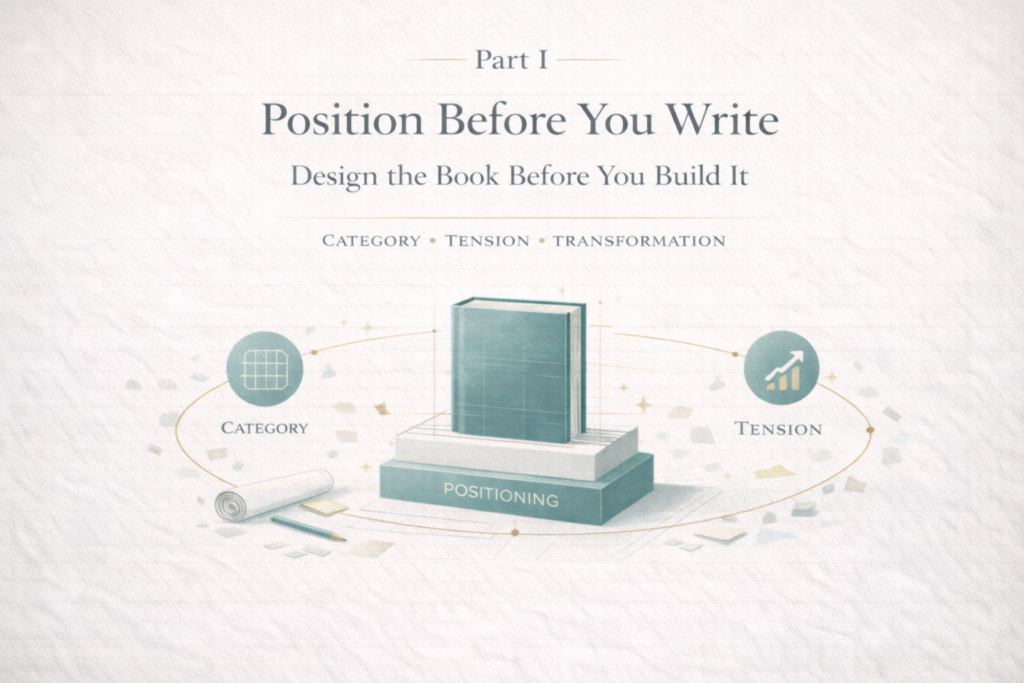
Part I — How to Position a Nonfiction Book Before Writing
Before any drafting begins, the book must be architected.
Positioning defines what the book is, who it is for, and what it is designed to produce. Without it, writing generates content. With it, writing becomes assembly.
This is Step 1 of the Manuscripts system: defining the architecture before any manuscript construction begins.
This is where the book is built in principle, so it can be built efficiently in practice.
Step 1: Define Your Category, Tension, and Transformation
A nonfiction book is anchored in three positioning elements. These are not descriptive, they are structural constraints that shape everything that follows.
Category — Where the Book Competes
Category defines the space the book enters and how it is interpreted.
It answers:
What kind of book this is
What conversation it belongs to
What existing ideas it is adjacent to
Category determines whether the book is legible to the market. If it is unclear, the book becomes difficult to place, recommend, or remember.
A clear category positions the book. A weak category forces the reader to figure it out.
Tension — What the Book Challenges
Tension defines the idea the book pushes against.
It answers:
What common belief or default approach is incomplete or wrong
Why the current way of thinking fails
Tension is what makes the book unconventional.
Without tension, the book reinforces existing thinking. With tension, the book creates contrast, attention, and change.
If the book does not challenge something, it cannot shift how the reader thinks, and cannot produce meaningful outcomes.
Transformation — The Outcome for the Reader
Transformation defines the shift the book is designed to create.
It answers:
What the reader understands differently
What the reader is able to do differently
This is the core unit of value.
A book without a clear transformation may inform. A book with a defined transformation changes behavior, decisions, and direction.
These three elements operate together:
Category positions the book
Tension differentiates the book
Transformation gives the book a job to do
At this stage, you are not generating content. You are defining constraints:
what belongs in the book
what does not
what each chapter must contribute
When this is clear, the manuscript is no longer discovered through writing. It is assembled against a defined structure.
Step 2: How to Design a Nonfiction Book Around Outcomes (Not Just Ideas)
Most nonfiction books are built around ideas—a topic, a set of insights, a collection of experiences.
That approach produces content, but not necessarily results.
An outcome-driven book starts from a different question:
What is this book designed to produce?
Authority Goal — What the Book Positions
The authority goal defines how the book positions the author.
It answers:
What the author should be known for after the book
What category or expertise the author is claiming
If undefined, the book may communicate knowledge but fail to establish a clear position in the market.
Business Outcome — What the Book Connects To
The business outcome defines how the book integrates with the author’s work.
It answers:
What part of the business the book supports
How it connects to offers, services, or strategic priorities
If undefined, the book may generate attention without converting into meaningful opportunities.
Opportunity Path — What the Book Activates
The opportunity path defines the types of outcomes the book is designed to create.
It answers:
What kinds of inbound opportunities should result
What demand the book is meant to generate
Examples include:
speaking engagements
consulting or advisory work
partnerships
platform and audience growth
If undefined, outcomes are left to chance rather than designed into the system.
These elements work together:
Authority shapes how the market perceives you
Business outcome ensures alignment with what you sell
Opportunity path defines what the book activates
This ensures the book is not a standalone asset. It becomes a system driver, strengthening positioning, feeding platform growth, and generating opportunities over time.
When outcomes are defined before writing:
content becomes selective, not exhaustive
chapters are designed to support positioning
ideas are included based on their role in the system
You are no longer asking:
“What should I write?”
You are deciding:
“What must this book accomplish?”
Part II — How to Gather and Organize Ideas for a Nonfiction Book
By this stage, the book has been positioned.
The question is no longer what the book is about. It is what the book will be built from.
Extraction is the transition from positioning → material.
You are not generating ideas. You are surfacing, selecting, and structuring thinking that already exists across your work.
This is what makes the Manuscripts system efficient: the book is built from proven material, not invented from scratch.
Step 3: How to Extract Your Ideas for a Nonfiction Book
Most authors misdiagnose the starting point.
They assume the work begins when they open a blank document. In reality, it begins by identifying what already exists.
You are not starting from zero. You are starting from accumulated experience that has already been tested, repeated, and refined.
What Extraction Produces
Extraction converts experience into usable inputs.
“Usable” means:
clear enough to be understood
specific enough to be applied
structured enough to be reused
The output is not writing. It is an idea inventory, a visible set of insights grounded in real work and ready to be structured into a system.
This inventory becomes the raw material for your framework and chapters.
Where High-Quality Inputs Come From
Not all ideas are equal. Prioritize material that has already proven its value.
Focus on:
Client work — problems solved, decisions made, patterns observed
Repeated insights — ideas you explain frequently because they consistently matter
Existing frameworks — models or systems you already use in practice
These sources matter because they are validated through use.
You are not asking, “What could I say?” You are capturing, “What already works?”
Extraction as a Constraint System
Extraction is not about collecting everything. It is about filtering for relevance to the book’s positioning and outcomes.
Use positioning as the constraint:
Does this idea support the transformation?
Does it reinforce the tension?
Does it belong inside the category you defined?
If not, it is excluded.
This is where the book begins to take shape, before any structure is applied.
The Real Shift: From Blank Page to Input System
The blank page is not a writing problem. It is a missing-input problem.
Without extraction, authors invent ideas while drafting, rely on memory, and recreate thinking they already have.
With extraction, inputs become visible, patterns can be identified, and structure can be applied cleanly.
The question shifts from:
“What should I write?”
To:
“What do I already have that belongs in this system?”
Constraint: Only include material that supports the transformation, reinforces the tension, and contributes to the intended outcomes. If it does not, it does not belong.
Step 4: Build Your Chapter Inputs (Not Drafts)
Once ideas are extracted, the next step is not writing. It is organizing those ideas into buildable components.
This is where the process shifts from thinking → assembly preparation.
What Chapter Inputs Actually Are
Chapter inputs are discrete units of thinking that support a chapter.
They are not:
paragraphs
polished sections
finished writing
They are components that can be assembled later.
Each input should be:
specific
usable
tied to a clear point
The goal is not completeness. It is structural readiness.
The Four Core Input Types
Most nonfiction books are built from a consistent set of components:
Stories — lived examples that make ideas concrete
Research — data or references that support credibility
Interviews — external perspectives that expand the thinking
Commentary — your interpretation, argument, and synthesis
These are not created during writing. They are identified and organized before it.
From Inputs to Assembly
This step defines how the manuscript will be built.
Instead of drafting from scratch, you gather only relevant inputs, organize them around ideas, and prepare them for structured assembly.
This is what makes the process repeatable across chapters. You are not relying on momentum, you are working from prepared material aligned to the system.
Existing readers create faster feedback loops and clearer validation.
Case Shift — From Scattered Expertise to Structured Inputs
Context An author with deep experience but no usable manuscript
Constraint Ideas existed across notes, conversations, and past work, but were not visible or structured
Shift Stopped drafting and extracted inputs into:
stories
insights
supporting material
Result Clear visibility into available material, faster downstream build, and reduced rewriting
What This Enables
At the end of extraction, you have:
a defined idea inventory
organized inputs by type and relevance
material aligned to positioning and outcomes
You are no longer starting from a blank page. You are building from proven thinking, structured inputs, and material already designed to support the system.
This is what makes the next stage possible: turning inputs into a framework.
This is a strong section—arguably your most important one. The thinking is sharp.
But this is also where density + repetition risk peaks again, especially with:
stacked bullets
repeated “this is a system” language
multiple “why this matters” sections
You don’t need to cut much content here. You need to tighten, merge, and control emphasis.
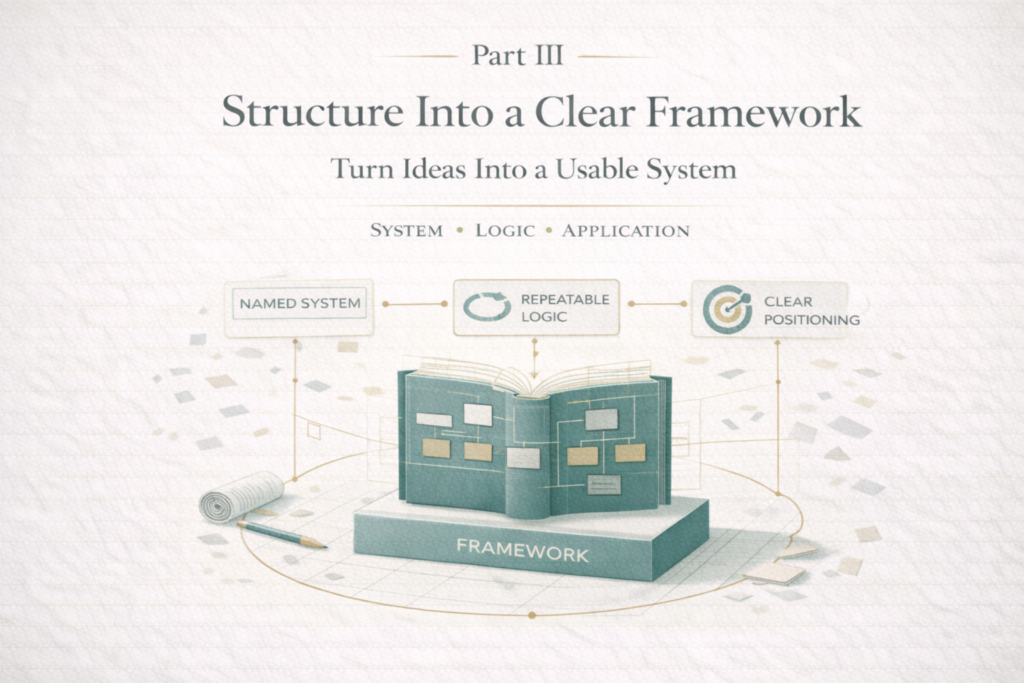
Part III — How to Structure a Nonfiction Book Into a Clear Framework
Extraction gives you material. Structure turns that material into something usable, teachable, and scalable.
Without structure, a book is a collection of ideas. With structure, it becomes a system.
This is where the book shifts:
from content → intellectual property
from insight → application
from writing → asset creation
You are no longer organizing ideas. You are engineering a system that produces outcomes.
Step 5: How to Structure a Nonfiction Book Into a Clear Framework
A framework is the structure that makes your thinking usable.
It is the core unit of a high-performing nonfiction book because it makes ideas:
understandable
repeatable
transferable
More importantly, a framework allows your ideas to leave the book and enter the real world, into conversations, decisions, and business opportunities.
What a Framework Actually Does
A framework organizes your extracted inputs into a working system.
It answers:
How do these ideas connect?
In what order should they be understood?
How can someone apply this thinking in practice?
Without a framework, ideas stay isolated, chapters feel disconnected, and the book lacks a clear outcome.
With a framework, the logic becomes visible and the thinking becomes usable.
The Three Requirements of a Strong Framework
A usable framework must meet three conditions:
1. Named System A clear, ownable label that is easy to reference, teach, and share.
2. Repeatable Logic A structure that can be applied across different situations, not tied to a single example.
3. Clear Positioning A distinct point of view that reinforces your category and differentiates your thinking.
This is where the book becomes differentiated, not by what it says, but by how it structures thinking.
Why Frameworks Drive Outcomes
Most books optimize for readability. Strong books optimize for usability.
Frameworks allow your thinking to:
travel beyond the page
be referenced by others
be applied in real-world contexts
anchor offers, services, and conversations
You are not structuring ideas for the reader to understand. You are structuring them so they can be used, taught, and extended.
Output of This Step
At the end of this step, you should have:
a defined system that organizes your ideas
a clear logic that connects each part
a structure that can be translated into chapters
This becomes the backbone of the book.
Constraint: A framework is only complete if it can be applied in real situations, explained without friction, and connected directly to your work.
Step 6: How to Structure Nonfiction Book Chapters (Lesson, Lens, Logic)
Once the framework exists, chapters are no longer standalone pieces of content. They are units inside the system.
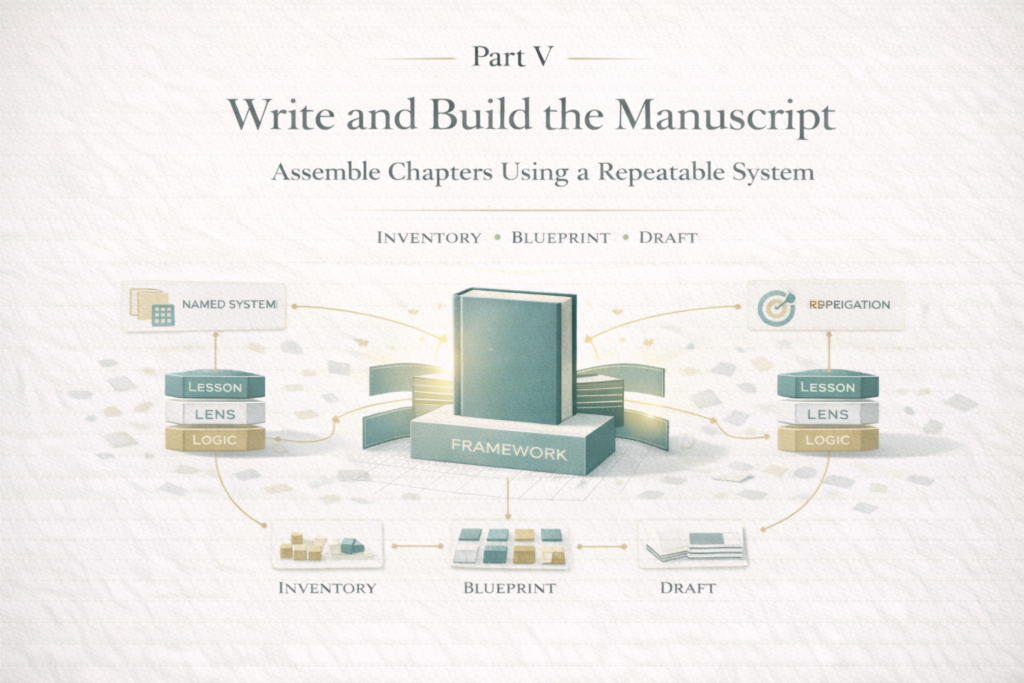
Each chapter is constructed using:
Lesson — what changes for the reader
Lens — your distinct point of view
Logic — how the idea unfolds
This is not a writing technique. It is a build system.
Lesson — What the Reader Gains
The lesson defines the outcome of the chapter.
It answers: What does the reader now understand or can now do?
Constraint: One chapter = one core lesson. If this is unclear, the chapter will drift.
Lens — Your Unconventional Point of View
The lens defines how the idea is interpreted.
It answers:
How is this different from conventional thinking?
What is your distinct way of seeing the problem?
The lens must stay consistent across the book. This is what makes the book non-generic and aligned to your positioning.
Logic — How the Chapter Moves
Logic defines how the reader progresses through the idea.
It answers:
What is the sequence of understanding?
How does the chapter move from concept → clarity → application?
The flow must match the lesson and reinforce the lens.
Each chapter is constructed, not written, using:
Lesson → defines value
Lens → defines differentiation
Logic → defines delivery
This ensures clarity, consistency, and scalability across the book.
Constraint: If a chapter does not deliver a clear lesson, reinforce your lens, and move the system forward, it should not be included.
Step 7: Define Chapter Intent Before Writing
This is where most books fail, not in writing, but in design.
Most authors build chapters around topics. But topics create content, not progress.
What Chapter Intent Defines
Chapter intent defines the role of the chapter inside the system.
It answers:
What changes for the reader in this chapter?
Why does this chapter exist in the sequence?
This shifts the unit of thinking:
from topic → function
from content → transformation
The Standard for Inclusion
Every chapter must:
move the reader forward in the transformation
directly support the book’s outcome
perform a distinct role in the system
If not, it doesn’t need rewriting. It needs removal.
Where Filler Comes From
Filler is not a writing issue. It is a structural failure.
It appears when:
intent is undefined
chapters overlap in function
ideas exist without a role
Defining intent creates constraint, what stays is functional, and what doesn’t is removed.
Case Shift — From Ideas to Structured Progression
Context Strong ideas, weak manuscript
Problem Chapters built around topics → overlap and confusion
Shift Defined chapter intent:
what each chapter must change
how it fits into the system
Result Clear progression, reduced redundancy, and stronger alignment to outcomes
Part IV — Validation (Prove the System Before You Build the Book)
At this stage, the structure exists.
Validation ensures the structure works outside your head before you commit to the manuscript.
You are not improving wording. You are not expanding content.
You are testing one thing:
Does this system create real understanding and real-world traction?
If not, writing will not fix it.
This is a gate: structure must prove itself before execution begins.
Step 8: Validate Your Ideas Before Writing the Manuscript
Validation is not feedback collection.
It is real-world testing of your thinking under pressure.
stronger emphasis on system integrity (not “editing”)
clearer connection to outcome alignment (authority + business + transformation)
more builder language (evaluation → enforcement, not reflection)
Right now it still leans slightly “editorial polish.” We’ll shift it to system verification.
Part VI — How to Edit and Align Your Nonfiction Book as a System
At this stage, the manuscript exists.
The work is no longer additive. It is integrative.
Alignment ensures the manuscript functions as a single system, not a collection of chapters.
This is the final control layer before the book becomes an asset.
Step 13: Stress Test Each Chapter Against the System
A chapter is not complete because it reads well.
It is complete only if it performs its role inside the system.
This mirrors the Manuscripts Builder process: Chapter Stress Test → not stylistic editing, but structural verification
The Three System Checks
Transformation — Does it move the outcome forward?
Does this chapter advance the reader toward the defined transformation?
If removed, does the outcome weaken?
If not, the chapter is not necessary.
Lens — Does it reinforce your positioning?
Does this chapter express your unique way of thinking?
Or does it drift into conventional explanation?
If it becomes generic, it breaks category positioning.
Argument — Does it advance the system logic?
Does this chapter move the framework forward?
Or does it repeat, stall, or fragment the progression?
If it doesn’t advance the system, it creates drag.
Enforcement Rule
If a chapter fails any check:
revise its role
reposition it in the sequence
or remove it entirely
This is not editing.
This is system enforcement.
Step 14: Align the Full Manuscript (System-Level Integrity)
Once chapters pass individually, the manuscript must be tested as a whole.
This is the Full Manuscript Check in Manuscripts Builder
The unit of evaluation shifts:
from chapter → system
System-Level Checks
Flow — Does the system progress logically?
Do chapters follow the structure of the framework?
Does each step build on the previous one?
Flow should feel inevitable, not assembled.
Redundancy — Is repetition functional or wasteful?
Does repetition reinforce key ideas?
Or duplicate them without adding value?
Reinforcement strengthens the system. Duplication weakens it.
Positioning Integrity — Does the book stay coherent?
Is the category consistent throughout?
Is the tension sustained?
Does the lens remain intact across chapters?
Drift at this stage breaks authority.
The Standard of a Finished Manuscript
A strong manuscript does not feel like:
separate chapters
loosely connected ideas
repeated explanations
It feels like:
a single system
a continuous argument
a designed transformation
Outcome Alignment (Critical Check)
At the system level, the manuscript must also answer:
Does this book clearly position the author in a defined category?
Does it demonstrate a system others can apply?
Does it map to real opportunities (speaking, advisory, platform)?
If not, the manuscript may be complete, but it is not outcome-driven.
What Alignment Produces
After this stage, the book becomes:
Coherent — every part reinforces the whole
System-driven — ideas connect into a usable framework
Outcome-aligned — the manuscript supports authority, business, and opportunity
This is the final shift.
From:
a written manuscript
To:
a structured asset that works beyond the page.
Part VII — How to Turn Your Nonfiction Book Into Authority and Opportunities
At this stage, the manuscript is complete.
The work is no longer about the book itself. It is about what the book enables.
This is the final layer of the Manuscripts system: turning a structured manuscript into an outcome-producing asset.
A nonfiction book is not the product. It is the infrastructure for authority, demand, and opportunity.
Step 15: Convert the Manuscript Into Usable Intellectual Property
A book only becomes valuable when it can be used beyond reading.
In the Manuscripts system, this is the purpose of structure:
ideas are organized into a framework
thinking is expressed through a consistent lens
knowledge is delivered as a repeatable system
This is what makes the book transferable.
What “Intellectual Property” Means in Practice
The book should allow your thinking to:
be applied in real-world contexts
be taught across different formats
be referenced without your presence
If the ideas cannot travel, the book remains static.
If they can, the book becomes leverage.
Structural Standard
A manuscript functions as intellectual property when:
the framework can be extracted and reused
the lens is consistent across all chapters
the system can be applied without additional explanation
This is not added after the book is written.
It is the result of how the book was built.
Step 16: Map the Book to Outcomes (Authority, Demand, Revenue)
Once the manuscript is structurally sound, it must be connected to outcomes.
This is not a marketing step. It is a system alignment step.
The Three Outcome Pathways
Authority — What you are known for
Does the book clearly define your category?
Does it establish a distinct point of view?
The book should make your positioning obvious.
Demand — What opportunities it attracts
Does the book create inbound interest?
Does it lead to conversations, invitations, or visibility?
The ideas should generate pull, not require constant promotion.
Revenue — What it connects to
Does the book align with your offers, services, or advisory work?
Does it make those offers easier to understand and buy?
The book should reduce friction in decision-making.
Structural Alignment (Not Promotion)
These outcomes should already be embedded in the manuscript:
chapters reinforce your positioning
frameworks align with your services or expertise
ideas create demand for deeper engagement
If this connection is weak, the issue is not distribution.
It is design.
The Final Standard
A finished manuscript is a milestone.
A system-aligned book does three things:
changes how the reader thinks (unconventional)
gives them a structure to apply (system-building)
connects directly to your work (outcome-aligned)
This is what turns authorship into leverage.
You are not publishing a book.
You are deploying a system that continues to produce value beyond the page.
Common Mistakes When Writing a Nonfiction Book (And How to Fix Them)
Most nonfiction books fail for predictable reasons.
Not because of effort. Not because of writing ability.
But because the sequence is wrong.
The Manuscripts system is designed to prevent these failure points by enforcing order: design → extract → structure → validate → build → leverage.
When that sequence breaks, the same problems appear.
Writing Too Early → Extract First
Starting with a blank page forces writing to do too much:
generate ideas
organize thinking
shape the argument
This leads to slow progress and repeated rewrites.
The correction is simple:
Do not start by writing. Start by extracting what already exists.
Build an idea inventory from:
client work
repeated insights
existing frameworks
Writing should express prepared material, not create it.
No Structure → Build the Framework First
Without structure, content accumulates but does not connect.
Chapters feel isolated. The book lacks a clear throughline.
The fix is not better writing.
It is defining a framework:
a named system
a clear sequence
a consistent logic
Structure determines whether the book is teachable and usable.
No Validation → Test Before Drafting
Unvalidated ideas feel clear internally but break under real use.
This shows up as:
confusion when explained
weak engagement
chapters that do not hold attention
The correction is to expose ideas early:
through conversations
through content
through feedback
Refine structure before committing to a full manuscript.
No Outcomes → Redesign Positioning
A book without defined outcomes becomes a collection of ideas.
It may be well-written but disconnected from:
authority
opportunities
business value
The fix is upstream:
Define:
what the book positions you as
what it connects to in your work
what opportunities it should create
This ensures the book is:
unconventional (it challenges thinking)
system-building (it provides a usable model)
outcome-aligned (it maps to your business)
These mistakes are not independent.
They compound.
Fixing them is not about working harder. It is about restoring the correct sequence.
When the sequence is correct, the process becomes predictable, and the book becomes something that works.
From Writer to System Builder: The Nonfiction Author Shift
At the beginning, the book feels like a writing project.
Something to start. Something to work on. Something to finish.
By this point, that model no longer holds.
A nonfiction book is not produced by writing effort alone. It is the output of a structured system.
The Shift
A writer focuses on producing pages.
A system builder focuses on designing outcomes.
Writers start with a blank page
Builders start with positioning
Writers generate content
Builders structure thinking
Writers hope the book works
Builders design what the book will produce
This is not a difference in skill.
It is a difference in approach.
What This Means in Practice
When you adopt the builder model:
writing becomes the final step, not the starting point
structure determines clarity before drafting begins
each chapter has a defined role in a larger system
The book is no longer something you “work on.”
It is something you construct.
The Result
Authors do not write books.
They build systems that produce books.
And those systems produce more than a manuscript:
a clear position in the market
a structured body of intellectual property
a foundation for authority, opportunities, and business outcomes
This is the shift that makes the process predictable, and the result valuable.
Final Takeaway: How to Write a Nonfiction Book That Actually Works
A nonfiction book is not the result of writing effort.
It is the result of structured thinking.
When thinking is unstructured, writing becomes slow, inconsistent, and difficult to complete. When thinking is structured, writing becomes a clear and executable step.
This is the progression:
The book is the output of your thinking
Structure organizes that thinking into a usable system
Clarity emerges from that structure
Opportunities follow from that clarity
A strong book is not defined by how well it is written.
Yes, when it is designed that way. A nonfiction book can position the author, generate demand, and lead to opportunities such as speaking, consulting, and partnerships.
How do you structure a nonfiction book?
A nonfiction book is structured around a framework. Each chapter delivers a specific lesson, reinforces a consistent perspective, and follows a logical progression.
How do you start writing a nonfiction book?
The process starts before writing. It begins with defining what the book is meant to achieve and organizing ideas into a system.
Premium CTA
If the book is being treated as a priority, the next step is not more research or drafting.
It is making the right structural decisions early:
how the book is positioned
how the framework is defined
how the manuscript will be built
how the outcomes are designed
This is where most projects either accelerate or stall.
If useful, we can work through this directly:
clarify category, tension, and transformation
shape the core framework
map the manuscript build system
align the book to authority, opportunities, and business outcomes
Modern authorship is not about speed. It is about durability.
The right next step is the one that matches your current level of commitment, resources, and ambition.
The system will still be here when you are ready to use it.What matters is not finishing a guide. What matters is building something that keeps working long after the book is published.
If You’re Deciding What to Do Next
If this report clarified your thinking, the next step is usually not “publishing.”
It’s pressure-testing your strategy before you commit time, budget, or reputation.
Here are three ways authors typically proceed.
Map Your Modern Author Strategy
If you want to:
Pressure-test your author model
Clarify realistic outcomes
Understand where ROI is likely to show up
Avoid unnecessary spend
A short strategy conversation can surface issues early, before they become expensive.
Eric Koester is an award-winning entrepreneurship professor at Georgetown University, bestselling author, and founder of Manuscripts. His work focuses on how ideas become assets, how books create leverage, and why modern authors need systems, not just publishing support.
He has worked with thousands of authors across traditional, hybrid, and modern publishing paths, helping them turn books into platforms, platforms into credibility, and credibility into durable business outcomes.
About Manuscripts
Manuscripts is the Modern Author OS for nonfiction experts.
We help founders, executives, coaches, and thought leaders design books as strategic assets, not standalone products. Our work spans positioning, author model design, developmental editing, AI-enhanced drafting tools, presale strategy, and long-term launch systems.
Manuscripts authors use their books to generate clients, speaking engagements, training programs, and enterprise opportunities, often before publication.
For readers who want to go deeper into specific mechanics, the following guides expand on topics referenced in this report:
How to Write a Book if You’re Busy
Modern Ghostwriting for Nonfiction Authors
AI Tools for Authors in 2026
How to Build an Audience Before You Write Your Book
The Evergreen Launch System for Modern Authors
Powered by Codex, the Modern Author Intelligence Tool.
Lori Mazer is a strategist and leader whose work centers on helping individuals and organizations clarify their voice, sharpen their reputation, and expand their impact.
Before writing her book, Lori brought years of real-world experience to coaching and consulting, yet she — like many high-performing professionals — understood that having ideas isn’t the same as naming and claiming them publicly.
Her book wasn’t just a milestone to check off — it became a tool she still uses to rethink, refine, and reinvent her own thinking. It helped her not only strengthen her authority, but also deepen her confidence about the value she brings.
Modern Author Program
“ ” “If you can write a book, you can pretty much do anything.”
—Lori McDowell
What Changed?
Writing the book forced Lori to confront the gap between what she knows and what she believes she deserves to say publicly.
The process moved her from tentative and self-editing (“I hope this measures up”) to a grounded authorial voice that carries her thinking forward with purpose.
Outcome signals:
• The book became a credibility engine in her professional ecosystem
• It supports her business growth and platform expansion
• It sharpened her internal clarity, not just external messaging
Dr. Ardeshir Mehran is a psychiatrist and public thinker whose work sits at the intersection of mental health, identity, and personal agency. Trained to diagnose and treat, he increasingly felt constrained by systems that prioritize comfort over truth.
Rather than dilute his ideas for safety or scale, he chose clarity.
His book emerged not as a marketing asset, but as a declaration of values—an articulation of beliefs he was no longer willing to keep private.
Modern Author Program
“ ” “I didn’t write this book to sell. I wrote it because not writing it felt like a betrayal.”
—Dr. Ardeshir Mehran
What Changed?
The writing process forced Ardeshir to confront a central tension:
Was the book meant to be accepted, or meant to be honest?
Through drafting, revision, and editorial pressure-testing, the book clarified his role—not just as a clinician, but as a voice willing to challenge prevailing narratives around mental health, identity, and responsibility.
The result wasn’t just a manuscript.
It was alignment.
Elizabeth Gilbert’s career makes this unavoidable. Half her readers love Eat, Pray, Love. Half love Big Magic. Same author. Completely different books.
The difference isn’t tone.
It’s engine.
This is the Engine Decision Rule: choose the dominant force that carries the reader experience.
This elevates the doctrine without adding structure.
Gilbert chose the core engine of each book, memoir or thought leadership, and everything else flowed from that decision: structure, audience experience, and downstream opportunity.
If you don’t choose the engine early, the manuscript fractures.
Cleaner. Less rhetorical flourish. More structural authority.
The Split Reaction: Which Elizabeth Gilbert?
Ask people what they think of Elizabeth Gilbert and you’ll often get two very different answers.
One group talks about Eat, Pray, Love like it’s a mirror: “I felt seen.” “It captured something I couldn’t articulate.”
The other group talks about Big Magic like it’s fuel: “It changed how I think about creativity.” “It made me act.”
Same author.
Two completely different reader experiences.
That split isn’t accidental.
It’s structural.
The Trap: Trying to Write All Three Books at Once
Most authors don’t fail because their ideas are weak.
They fail because their engine is confused.
They try to write:
A memoir
A lesson book
A novelistic narrative
All inside one manuscript.
The result feels unfocused.
It has stories, but no immersive arc. It has ideas, but no structured progression. It has scenes, but no teaching spine.
Even strong material collapses under genre ambiguity.
When the engine is unclear, the chapters resist cohesion.
What Makes Big Magic Thought Leadership
Big Magic works because it teaches.
Its engine is instructional.
You can see it in the structure.
Reframe First
It begins by redefining the problem.
Fear isn’t mystical. It’s ordinary. It’s predictable.
The book opens by shifting interpretation.
Principles Drive the Chapters
Each section advances a clear claim.
The argument progresses through principles, not chronology.
Stories Support, They Don’t Lead
Personal anecdotes appear as evidence.
They illustrate the idea.
They are not the engine.
Application Is the Outcome
Readers leave with permission and practice.
Not just inspiration.
But direction.
That’s thought leadership.
It reframes.
It structures.
It teaches.
What Makes Eat, Pray, Love Creative Nonfiction
Eat, Pray, Love works because it immerses.
Its engine is narrative.
You can see it in the design.
A Bounded Time Frame
One year.
A contained arc.
Not a whole life story.
Scene + Reflection Rhythm
Experience first.
Meaning second.
The reader watches transformation unfold.
Immersion Over Instruction
There is no framework.
There is no structured lesson.
The power is proximity.
Internal Drama Drives Momentum
The tension is internal: longing, identity, reinvention.
The pages turn because the reader wants emotional resolution.
That’s creative nonfiction.
Connection precedes instruction.
Two Genres: Two Business Models
Engine choice doesn’t just shape the reading experience.
It shapes the opportunity that follows the book.
Eat, Pray, Love expanded as story.
It led to:
Film adaptation
Global media presence
Travel and cultural expansion
Those opportunities emerge naturally from narrative.
Stories scale through adaptation and emotional resonance.
Big Magic expanded as teaching.
It led to:
An evergreen thought-leadership platform
Workshops
Speaking
Creative community
Who You Write For Shapes What You Can Build
Genre defines reader expectation.
Creative nonfiction readers want:
Emotional resonance
Identification
“I feel seen.”
Thought leadership readers want:
Distinctions
Frameworks
“I think differently.”
If you blur the contract, friction appears.
If someone expects immersion and receives instruction, it feels preachy.
If someone expects instruction and receives scenes, it feels unfocused.
The engine determines what the reader is here to receive.
The Steve Fredlund Example: When It Doesn’t Feel Right
Sometimes the writing is strong.
But the genre is wrong.
Steve Fredlund initially wrote philosophy.
The ideas worked.
But it didn’t feel authentic.
The structure was instructional. The voice wanted immersion.
He pivoted to memoir.
The insight:
Even a strong draft can misalign with your natural engine.
When genre matches voice, the work flows.
When it doesn’t, friction multiplies.
The Core Decision Framework
Before drafting, decide the engine.
Not the topic. Not the tone. The engine.
Every serious book runs on one of two core forces:
The Mirror
The reader sees themselves.
Emotional immersion
Scene-driven progression
Internal transformation
“I feel understood.”
The power is recognition.
The story carries the insight.
The Map
The reader sees a path.
Distinctions and reframes
Principle-driven sections
Stories as illustration
“I know what to do.”
The power is clarity.
The framework carries the insight.
If the reader can’t tell whether they’re here to feel or to learn, clarity erodes.
Ask three questions:
What should readers say the day after finishing?
What experience should dominate: immersion or instruction?
What do you want this book to unlock after publication?
This reinforces operational clarity without adding new sections.
The Only Question That Matters
When someone finishes your book, which sentence should be true?
“I feel seen.”
Or
“I think differently.”
Choose the outcome.
Then build the engine around it.
The Real Lesson from Gilbert
Elizabeth Gilbert didn’t ask:
“What do I want to say?”
She asked:
“What does this book need to be?”
Each book had:
A clear engine
A clear audience
A clear structural form
That’s why both succeeded.
The lesson is structural:
Choose the engine first.
Structure, audience experience, and opportunity follow.
What This Means for Writing Like a Thought Leader
Thought leadership books don’t start with content.
They start with the engine.
Decide the reader experience first.
Then design the structure that delivers it.
That means:
Choose immersion or instruction Build the manuscript around that choice Let stories or frameworks carry the reader journey
Thought leadership isn’t about having ideas.
It’s about choosing the mechanism that makes those ideas travel.
That’s what Elizabeth Gilbert understood.
And that’s why her books work.
Quick FAQ
Can a book mix memoir and thought leadership? Yes, but one must still be dominant. The engine must remain clear.
Why does genre confusion weaken books? Because readers expect a specific experience. If the contract is unclear, the structure feels inconsistent.How do I choose my book’s engine? Decide what the reader should say after finishing: “I feel seen” or “I think differently.”
Eric Koester is an award-winning entrepreneurship professor at Georgetown University, bestselling author, and founder of Manuscripts, the Modern Author OS used by more than 3,000 authors. His work has helped creators turn ideas into books, books into brands, and brands into scalable businesses.
About Manuscripts
Manuscripts is the leading full-service publishing partner for modern nonfiction authors. We help founders, executives, coaches, and experts turn their books into growth engines, through positioning, coaching, developmental editing, design, AI-enhanced writing tools, and strategic launch systems. Manuscripts authors have sold thousands of books, booked paid speaking gigs, landed media features, and generated millions in business from their IP.
Work With Us
If you’re writing a book you want to matter, let’s map out your Modern Author Plan.
Bob Jones is a veteran entrepreneur, executive, and innovation leader with decades of experience building consumer products, scaling businesses, and turning around underperforming public companies. His work spans early-stage ideation, customer discovery, product-market fit, and retail distribution, long before “Lean Startup” became a movement.
Deeply embedded in the MIT innovation ecosystem, Bob has spent years studying why most innovations fail, and what consistently separates the few that succeed.
This book was not written to inspire startups.
It was written to prevent avoidable failure.
Modern Author Program
“ ” “A year ago, I didn’t have a book. Today, I have a book. The results speak for themselves.”
—Bob Jones
What Changed?
For Bob, writing The Start-Up Starter Kit wasn’t about personal branding or visibility. It was about distillation.
The process forced him to:
• Articulate patterns he had internalized over decades
• Separate signal from startup mythology
• Turn tacit knowledge into a practical, teachable framework
What emerged was not a memoir or manifesto, but a field guide, grounded in real-world decision-making, tradeoffs, and consequences.
Henna Pryor is an award-winning author, keynote speaker, and executive coach who helps leaders navigate moments of social risk, visibility, and uncertainty.
As a professional speaker, Henna built her career standing in front of rooms full of people, yet privately experienced the same hesitation, self-doubt, and internal friction she now studies. Her work focuses on awkwardness not as a flaw to eliminate, but as a data-rich signal pointing to growth, identity, and belonging.
Her writing sits at the intersection of behavioral insight, leadership psychology, and lived experience, without collapsing into performance or platitudes.
Modern Author Program
“ ” “I had the words, but I was frozen. I didn’t know if they were any good anymore, or even if this was still the book I wanted to write.”
—Henna Pryor
What Changed?
During the writing of Good Awkward, Henna encountered a stall familiar to many high performers: progress followed by interruption, then paralysis.
Rather than forcing productivity, she reframed the pause as diagnostic. With editorial guidance, she re-entered the work not to add more words, but to clarify what the book was truly about.
The result was not just a finished manuscript, but a sharper argument:
awkwardness isn’t something to fix, it’s something to interpret.