Neil has advised the Federal Trade Commission, guided national debates on digital regulation, and now leads AI policy strategy at the Abundance Institute.
His book, Getting Out of Control, reframed how leaders think about innovation, governance, and complex systems.
Corrie Napier is a conflict resolution consultant, mediator, and speaker who helps leaders turn destructive conflict into constructive conversations using her B.U.I.L.D. framework.
She’s worked across cultures in China, Argentina, and Israel, and now trains organizations, teaches at Pepperdine Caruso Law, and leads Pax Napier, a consultancy focused on communication, leadership, and team alignment.
Her work sits at the intersection of:
• conflict resolution
• leadership development
• and faith-driven transformation
Her book, Fierce Hope, extends that work beyond the room, into the lives of people navigating pain, loss, and difficult seasons.
Modern Author Program
“ ” “People find this book right when they need it, and it actually changes them.”
— Corrie Napier
What Changed?
Corrie was already doing meaningful work, consulting, teaching, and helping leaders navigate conflict.
But her impact was limited to the rooms she was in, and her most personal story wasn’t reaching beyond her direct audience, and she felt a calling to speak more about faith and spirituality in her work.
She turned that story into Fierce Hope, a book designed to help people find faith and resilience in the middle of pain.
The book became the multiplier.
Readers now find it, share it, and show up already connected to her message.
It’s led to:
• a 250+ person launch movement
• 100+ early reviews
• speaking, workshops, and growing demand around her work
Catherine Connelly is a veteran tech entrepreneur who spent two decades building and scaling companies in the online dating and social discovery space. In 2020, she sold her company, The Meet Group, in a $500M acquisition.
After the exit, Catherine faced a familiar but rarely discussed challenge among high-performing founders: how to translate experience into a meaningful next chapter.
Her book, Designing Success, is not a retrospective. It’s a blueprint, distilling hard-earned lessons from building, leading, exiting, and starting again.
Modern Author Program
“ ” “I didn’t write this book to celebrate the past. I wrote it to design what came next.”
— Catherine Connelly
What Changed?
For Catherine, writing the book marked a shift from operator to architect.
The process helped her:
• Clarify what actually mattered from 20 years of building
• Separate identity from title and valuation
• Turn experience into a platform for speaking, coaching, and leadership
Joe Heitzeberg is the co-founder of Crowd Cow, a direct-to-consumer marketplace connecting customers with independent farmers producing high-quality, ethically sourced beef.
Before scaling the company, Joe wrote Craft Beef to articulate a belief system about food, transparency, and supply chains — not to promote a startup, but to define a category.
The book served as a public declaration of values at a moment when the business itself was still emerging.
Modern Author Program
“ ” “We weren’t trying to sell a book. We were trying to explain why this industry needed to change.”
— Joe Heitzeberg
What Changed?
Writing Craft Beef clarified Crowd Cow’s narrative at a foundational level:
• What they believed
• What they stood against
• Why they existed beyond product features
One year after publication, Crowd Cow raised $28M in funding.
Not because the book “caused” the raise — but because it signaled depth, conviction, and long-term thinking to the ecosystem around the company.
Ricardo Rosselló is a former Governor of Puerto Rico who led during one of the most complex crisis periods in the island’s modern history. His tenure intersected with Hurricane Maria, U.S. federal response failures, and extreme political polarization.
Rather than stepping away from public discourse, Rosselló chose to document the inside reality of leadership under pressure — including direct interactions with global political figures and the personal cost of reform-driven governance.
This book is not about legacy.
It’s about lessons future leaders can’t afford to ignore.
Modern Author Program
“ ” “If we don’t attend to the polarization in our society, there will be serious challenges to our democracies.”
—Fmr. Governor Ricardo Rosselló
What Changed?
Writing The Radical Middle forced Rosselló to confront a difficult truth:
crisis doesn’t just expose systems, it exposes values.
Through the writing process, his experiences evolved into a broader framework for leadership in polarized societies — one that rejects extremes and argues for principled, accountable governance even when the political cost is high.
Yen Verhoef is an educator and thought leader building a new model for how schools evolve inside outdated systems. Through Rebel Teaching, she challenges the inherited machinery of American education and offers a practical framework for repurposing it from within.
Her work sits at the intersection of:
• teacher leadership
• institutional change
• real-world implementation
• educational innovation at scale
Modern Author Program
“ ” “After I announced Rebel Teaching, two major school districts hired me to implement the framework before the book was even finished.”
—Yen Verhoef, PhD
What Changed?
Yen entered the writing process expecting to publish a book.
Instead, the book became a lever.
Once the Rebel Teaching framework was named clearly, schools didn’t wait for publication. They moved early, hiring her to implement the approach across entire districts.
Randi Braun is the Founder and CEO of Something Major, a coaching and training organization helping women leaders navigate power, performance, and progression at work.
Her book, Something Major: The New Playbook for Women at Work, distills years of executive coaching, leadership training, and real-world observation into a practical, modern framework for women operating inside complex organizations.
The book went on to become a Wall Street Journal Bestseller, expanding Randi’s reach well beyond her existing audience.
Modern Author Program
“ ” “I didn’t write this book to tell stories. I wrote it to give women a new operating system for work.”
—Randi Braun
What Changed?
Writing the book clarified something Randi had already been teaching for years:
women don’t need more advice, they need better systems.
The process forced precision. Ideas that lived comfortably in workshops and coaching sessions had to be sharpened, structured, and stress-tested on the page.
What emerged wasn’t just a book.
It was a platform-level asset that elevated her work, message, and market position.
Most high performers assume reinvention begins with ambition.
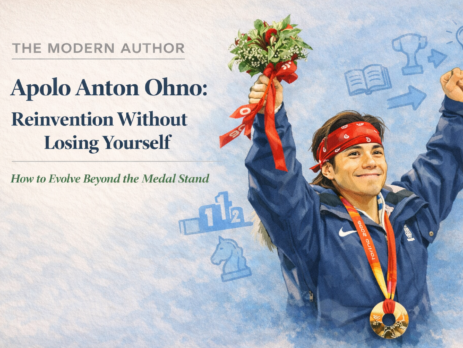
Apolo Anton Ohno’s career suggests something more disciplined.
Reinvention becomes possible when identity separates from past achievement.
When process matters more than applause.
And when you move quickly enough that nostalgia never calcifies into paralysis.
The medals were real.
The identity built around them was stronger.
Reinvention began when he separated the two.
The Identity Problem After Success
Elite performance fuses identity to outcome.
The role becomes the self. The performance becomes the proof. What once felt like progress becomes a fixed definition.
Transition then feels less like evolution and more like erasure.
This is the hidden trap of achievement.
Reinvention rarely fails because opportunity disappears. It fails because identity hardens around what once worked.
Authors face the same dynamic.
A successful book. A recognizable niche. A defining idea that travels further than expected.
When identity is anchored to applause, expansion feels risky. When identity is anchored to the outcome, movement feels like loss.
Reinvention becomes possible only when identity detaches from result.
The Two-Week Spotlight and the Twelve-Year Process
Olympic glory lasts weeks.
Preparation lasts years.
The public sees the medal. The athlete lives the repetition, the long training sessions, the marginal gains, the ordinary days stacked deliberately.
The distinction matters because identity can attach to either.
It can attach to the visible outcome. Or it can attach to the invisible system that produced it.
If identity attaches to the spotlight, every transition feels like a fall from relevance.
If identity attaches to the process, every transition becomes a transfer of discipline.
For authors, the parallel is structural.
Launch week is brief. Writing is long. Recognition fluctuates. Craft compounds.
When identity is built on reception, reinvention feels like risk.
When identity is built on repetition, reinvention feels like continuation.
Volatility as a Training Ground
Short track speed skating is chaotic. Outcomes hinge on variables outside the athlete’s control.
Ohno learned that domination was less important than surrender, control what you can, release what you cannot.
The prize provides direction.
It does not define identity.
Publishing operates under the same volatility.
You cannot control reception. You cannot control market timing. You cannot control interpretation.
You control the draft. The hours. The decision to return tomorrow.
If your identity cannot survive a bad review, it was never anchored in process.
Goals are useful for orientation.
They are dangerous when used for validation.
Formation Creates Transferable Discipline
Discipline does not appear at the podium.
It is formed long before recognition arrives.
Ohno’s work ethic was shaped by structure, expectation, and consistent standards. Excellence was not an emotional surge. It was conditioning.
This matters for reinvention.
The same formation that built the first chapter builds the second.
For authors, this means examining what actually produced past success.
Was it discipline? Pattern recognition? Narrative instinct? Systems thinking?
The visible outcome may change.
The underlying capability often transfers.
Reinvention is not abandonment.
It is redeployment.
Velocity as Protection Against Calcification
When a defining chapter ends, stillness becomes dangerous.
Identity begins to calcify around what was.
The counterintuitive response is movement.
Testing new ideas before they feel polished. Publishing before identity feels settled. Allowing early versions to exist without narrative coherence.
Velocity generates information. It exposes transferable skills. It prevents nostalgia from becoming self-definition.
Reinvention is discovered through motion, not reflection alone.
The Diamond Principle
We tend to define ourselves by the facet that earned recognition.
One title. One niche. One visible strength.
But identity is not a flat surface. It is a diamond with multiple facets, many of which remain unpolished simply because they were not previously rewarded.
Success sharpens one edge.
Reinvention requires examining the entire structure.
What skill actually produced your past success?
Where else does that capability apply?
What facet has remained underdeveloped because it lacked applause?
Revisiting experience clarifies pattern. Articulating memory separates performance from identity. Language allows you to see what persists beyond the spotlight.
Writing is not merely a platform tool.
It is a reconstruction tool.
Modern authors use writing to integrate what was into what comes next. They build the next chapter quietly, often before it is externally recognized.
Reinvention is rarely announced.
It is accumulated.
What This Means for Modern Authors
The implication is structural.
If identity is anchored to past outcomes, you will protect them. You will optimize for preservation rather than growth. You will mistake recognition for relevance.
Reinvention requires a different operating rule.
Detach identity from applause. Anchor it in process. Accept volatility as normal. Redeploy discipline. Move before certainty arrives.
If identity can survive without spotlight, reinvention becomes possible.
If it cannot, the work becomes performance.
The Bottom Line
Reinvention is not theater.
It is disciplined re-anchoring.
Detach identity from outcome.
Anchor it in process.
Move with velocity.
Translate your formation.
Polish new facets before the world demands them.
Modern authors do not protect their last success.
They build the next version before it is confirmed.
Listen:
Watch:
https://youtu.be/ee_bmBkPHAc?si=L72gp-k6AaZNCfXW
About the Author
Eric Koester is an award-winning entrepreneurship professor at Georgetown University, bestselling author, and founder of Manuscripts. He has helped more than 3,000 nonfiction authors turn ideas into books, and books into platforms for speaking, media, and business growth.
About Manuscripts
Manuscripts is a modern publishing partner for nonfiction authors who want their books to drive real-world outcomes. We help founders, executives, coaches, and experts design, write, and launch books that build authority, attract opportunities, and compound into long-term business assets.
Work With Us
If you’re writing a book you want to matter, we’ll help you map the right strategy before you write another word.
Chris Mader is an EOS Implementer and executive coach who has spent more than 30 years leading, coaching, and developing high-performing teams.
A former professional athlete turned C-suite executive, Chris has helped scale organizations beyond $100M in revenue and coached leaders across industries navigating growth, complexity, and change.
His book, Make the Adjustment, distills the leadership philosophy he’s lived and taught for decades—helping leaders respond to pressure with clarity, discipline, and intentional action.
Modern Author Program
“ ” “The only thing you can control is yourself.
Leaders who learn to adjust in real time win.”
— Chris Mader
What Changed?
After years of coaching executives one-on-one, Chris recognized a pattern:
Leaders didn’t need more motivation.
They needed a repeatable framework for behavior change.
Writing the book allowed Chris to codify what he’d learned across sports, executive leadership, and entrepreneurship—turning lived experience into a scalable leadership model.
The book became both a capstone and a catalyst: clarifying his message while expanding his platform as a coach, speaker, and advisor.
Speaker, trainer, and coach with a decade-long idea around relationships and connection who had built a solid practice but hadn’t yet turned his core philosophy into a defining, market-anchoring asset.
Modern Author Program
“ ” “The book didn’t just raise my profile, it fundamentally expanded the scope and value of the work I’m hired to do.”
—Jason Levin
What Changed?
The book became Jason’s intellectual foundation, a clear thesis on connection that elevated how he was perceived and what organizations hired him to deliver. After publication, his speaking fees increased 3–4x, the range of engagements widened, and larger, more complex organizations began pulling him into keynotes, retreats, and firm-wide programs.