Alyce Dailey is an entrepreneur, leadership coach, and mother of four who spent nearly two decades building a successful referral-based real estate business while mentoring women in leadership and personal growth.
Her book, The MAGIC Mom, distills years of lived experience into a clear framework for raising confident, entrepreneurial daughters, without perfectionism, guilt, or hustle culture.
Alyce didn’t write to chase a list.
She wrote to articulate a philosophy she was already living.
Modern Author Program
“ ” “This book wasn’t about becoming an author. It was about putting something meaningful into the world for my daughters and other moms.”
—Alyce Dailey
What Changed?
Writing the book forced Alyce to move from intuition to articulation.
Concepts she had practiced for years, modeling values, affirming growth, coaching with intention, became a named system: MAGIC.
That clarity created leverage.
Six months after release, The MAGIC Mom was named a Wall Street Journal Bestseller, ranking among the Top 25 nonfiction books, validating that the message resonated far beyond her immediate circle.
Most coaches, consultants, and speakers approach publishing as a production decision.
Who can help me write it? Who can help me publish it? How much will it cost?
Those are operational questions.
The structural question is different:
What risks does this model remove, and which ones does it leave with me?
Because a business book rarely fails at the sentence level.
It fails when positioning is unclear. When the audience isn’t primed. When launch is disconnected from revenue strategy. When the book exists, but nothing changes.
Publishing models are not just service tiers. They are different distributions of responsibility.
Some optimize cost control. Some optimize speed. Some optimize leverage.
If the book is meant to increase deal size, attract qualified clients, or expand speaking demand, then production quality alone is not enough.
The structure behind the book determines whether it compounds, or simply completes.
Before comparing models in detail, you need a fast way to identify which structure aligns with your goal.
The 60-Second Decision
For coaches, consultants, and speakers, the right publishing model is the one whose structure absorbs the risks that matter most, positioning, audience-building, and launch execution, so the book compounds authority and revenue instead of merely being completed.
Choose the Production Model (Vendor Bundle) if:
You want maximum cost control.
You can coordinate editors, designers, production, and launch support yourself.
The book is exploratory, low-stakes, or primarily a credibility marker.
You’re comfortable carrying positioning and launch alignment risk.
Choose the Delegation Model (Ghostwriting-Led) if:
You have limited time to write but strong clarity on the message.
You want a professional manuscript quickly.
You already have an audience, platform, or distribution engine.
You want drafting labor absorbed, not business strategy engineered.
Choose the Infrastructure Model (System-Based Hybrid) if:
The book must increase deal size, speaking demand, or consulting revenue.
You want positioning refined and validated before publication.
You want audience-building integrated during development.
You want a repeatable publishing system, not a one-off production project.
Rule of thumb: If the book must compound, choose infrastructure.
Define the Role of the Book: Deliverable vs. Authority Asset
Publishing model choice only makes sense after one clarification:
What is this book supposed to do?
For some authors, the book is a deliverable. It demonstrates expertise. It supports credibility. It checks a box. Success is measured by completion.
For others, the book is an authority asset. It sharpens positioning. It reframes how the market understands their work. It attracts aligned demand. Success is measured by what changes after publication, deal flow, speaking invitations, pricing power, client quality.
The distinction is not philosophical. It is structural.
A deliverable can tolerate fragmentation. An authority asset cannot.
If the book is merely proof of competence, production efficiency is often sufficient.
If the book must shape perception and drive revenue, then positioning clarity, audience alignment, and launch integration cannot be afterthoughts. They must be built into the model.
Many coaches, consultants, and speakers misclassify their book at the start. They choose a production structure suited for completion when what they actually need is compounding leverage.
When that mismatch happens, the book ships, but the business doesn’t shift.
Once the role is defined, the publishing decision becomes clearer.
If the book is an asset, the question is no longer:
“Who can produce it?”
It becomes:
“What structure protects its function inside my business?”
Market Reality: What Most Coaches Misjudge
Most publishing mistakes happen before a contract is signed.
They happen when authors misidentify the problem they are solving.
Publishing services are structurally different
Coaches often compare publishing options at the surface level:
But services that look similar distribute responsibility very differently.
Some models coordinate vendors. Some remove drafting labor. Some absorb positioning and launch risk.
This distinction matters because execution rarely fails at the production level. It fails when:
The message drifts mid-draft.
The book’s promise doesn’t match the author’s offer.
The launch strategy is bolted on after completion.
Vendors optimize their piece, but no one owns the whole.
When execution becomes messy, someone has to absorb the friction.
If the model does not explicitly absorb strategic risk, the author does.
That is not a flaw. It is a structural reality.
Understanding this shifts the decision from “Which service is best?” to “Where do I want risk to sit?”
Book sales rarely drive ROI alone
Many coaches unconsciously evaluate publishing models based on production quality or sales potential.
But for most nonfiction business authors, book sales represent a minority of financial return. A common range is 5–15% of total book-driven earnings.
The majority comes from:
Higher consulting fees
Speaking engagements
Premium program enrollment
Enterprise access
Licensing or partnerships
This changes the evaluation lens.
If revenue is primarily downstream, then the book’s role is not to sell units.
It is to clarify positioning, attract qualified demand, and elevate authority.
A production-focused model may deliver a polished manuscript.
An infrastructure-focused model attempts to engineer those downstream outcomes.
The difference is not aesthetic.
It is economic.
The Three Structural Models: Responsibility Map
When coaches compare publishing options, they often compare features.
Editors. Timelines. Marketing promises. Price.
Those are surface variables.
The real comparison criteria are structural:
Where does risk sit when execution becomes unclear?
Who resolves positioning drift?
Who owns coordination?
When is demand validated?
What happens if the book does not convert?
Each model answers those questions differently.
Model A — Production Model (Vendor Bundle)
Optimizes: Cost control Absorbs: Task execution only Leaves with author: Positioning clarity, coordination, launch alignment
The Production Model is general contracting.
You hire:
A developmental editor
A copyeditor
A designer
A formatter
Possibly a launch consultant
Each performs their function well. No one owns the integrated outcome.
This model works when:
Your thesis is already stable.
Your offer and positioning are clearly defined.
You are operationally strong enough to manage vendors.
The book is low-stakes or exploratory.
Example application:
A speaking coach with an established audience writes a short positioning book to support keynote bookings. The message is proven. The goal is reinforcement, not reinvention. Production efficiency is sufficient.
Where it breaks:
When vendors disagree.
When the promise on the cover doesn’t match the offer inside.
When the launch plan doesn’t align with your revenue model.
When no one has authority to intervene strategically.
Recommendation:
Choose this model only if you are prepared to act as publisher, strategist, and coordinator simultaneously. If the book must reshape positioning or generate revenue growth, this structure leaves too much risk with you.
Model B — Delegation Model (Ghostwriting-Led)
Optimizes: Speed and reduced writing burden Absorbs: Drafting labor Leaves with author: Market validation, audience-building, post-launch integration
The Delegation Model removes the most visible friction: writing.
Interviews become chapters. Notes become prose. The manuscript advances without the author living inside the drafting process.
This works best when:
Your thesis is mature and market-tested.
Your voice is well-defined.
You already have distribution leverage.
Speed matters more than structural refinement.
Example application:
A well-known consultant with a proven methodology wants a book to formalize their framework. Their audience already exists. The book amplifies existing authority rather than building it.
Where it breaks:
When clarity is still forming.
When the book is meant to define a new category.
When authorship distance weakens credibility.
When launch strategy is bolted on after completion.
Ghostwriting solves calendar pressure.
It does not solve positioning risk.
Recommendation:
Choose this model when you are confident the strategic foundation is correct and you need acceleration. Do not choose it if the book must refine or discover your positioning.
Model C — Infrastructure Model (System-Based Hybrid)
Optimizes: Leverage and structural integrity Absorbs: Positioning refinement, coordination, early audience-building Leaves with author: Strategic engagement and participation
The Infrastructure Model treats publishing as system design, aligning editorial rigor, positioning, and audience-building inside a coordinated framework rather than a bundle of services. This mirrors the principles behind a structured Publishing Operating System and presale-driven publishing models where validation happens before exposure.
The author remains central. Editorial leadership intervenes early. Audience-building is integrated before launch.
Instead of asking, “How do we finish this book?” It asks, “What must be true for this book to work in the market?”
This model absorbs risk upstream:
It pressure-tests positioning before drafting locks it in.
It centralizes coordination to prevent fragmentation.
It integrates early readers or presale validation.
It connects the book directly to business outcomes.
Example application:
A consultant building a signature framework wants the book to increase pricing power and attract enterprise clients. The positioning must be refined before publication. Audience activation must begin before launch.
Where it breaks:
When the author disengages.
When expectations are unrealistic about timeline.
When the book’s strategic role is undefined.
When a low-stakes book is over-engineered.
Infrastructure requires participation.
Participation is not a burden. It is the leverage mechanism.
Recommendation:
Choose this model when the book must compound authority and integrate with long-term intellectual property. It is less about finishing quickly and more about designing what happens after launch.
Structural Takeaway
All three models can produce a book.
Only one is designed to absorb positioning and market risk before publication.
The right choice depends on which failure you cannot afford:
Fragmentation?
Authorship distance?
Or strategic misalignment?
When execution becomes messy, the model determines whether the system absorbs the pressure, or you do.
Structural Comparison Matrix (Executive Layer)
Dimension
Production Model (Vendor Bundle)
Delegation Model (Ghostwriting)
Infrastructure Model (System-Based Hybrid)
Typical cost range
$3,000–$20,000
$30,000–$100,000+
$20,000–$75,000+
Timeline
Variable (often extended)
4–9 months
9–15 months
Who owns editorial authority
Distributed across vendors
Ghostwriter/team-led
Centralized with strategic intervention
Who owns launch execution
Author
Author
Integrated into system
When positioning is validated
Rarely pre-production
Often post-draft
Before and during production
Audience-building integration
External
External or add-on
Built into process
Primary risk
Fragmentation
Voice mediation + platform dependency
Author disengagement
What compounds post-publication
Little infrastructure
Visibility amplification
IP + audience + repeatable system
Failure Modes (Risk & Counterpoint)
Every model fails in predictable ways.
Production Model fails through:
Fragmented decision-making
Launch disconnect (book exists; strategy doesn’t)
Author overload and stalled momentum
Inconsistent authority signal across narrative, cover, promise, and offer
Delegation Model fails through:
Voice misalignment or “polished but not mine”
Platform dependency (book ships into silence)
Shallow integration into broader IP
Post-manuscript strategy bolted on too late
Infrastructure Model fails through:
Author disengagement (“just get it done” mindset)
Investment misalignment (overbuilding for a low-stakes book)
Over-engineering when the book’s role is undefined
Resistance to editorial intervention when clarity breaks
Risk belongs in the brief.
Premium decisions account for downside.
The Authority Asset Test (Named Framework)
A publishing model qualifies as authority infrastructure only if it:
Protects positioning clarity
Builds audience before launch
Preserves ownership
Integrates with business revenue streams
Improves future publishing cycles
If a model does not meet these conditions, it may still produce a book.
But it will not reliably produce an authority asset.
Use this test to evaluate any provider, not just models.
Modern Author OS Perspective
Most publishing services optimize for manuscript completion.
Modern Authors optimize for leverage infrastructure.
This distinction sits at the center of the Modern Author Operating System, where books are
designed as part of a broader authority architecture rather than isolated creative projects.
That distinction reshapes the decision.
If the goal is production, then vendor efficiency, drafting speed, and formatting timelines dominate the conversation.
If the goal is leverage, the criteria change:
Does this structure preserve full ownership?
Is demand validated before exposure?
Is positioning refined before it becomes permanent?
Does audience-building begin before launch?
Does anything compound after this book?
The question is no longer, “Which service is best?”
It becomes:
“What system protects authority?”
Author-Owned Publishing protects long-term intellectual property and control.
Presale-driven validation reduces the risk of publishing into silence.
Integrated editorial and audience strategy reduce the probability of launching a polished book that fails to convert into opportunity.
From this lens, publishing is not a creative milestone.
It is infrastructure design.
From this lens, publishing is not a creative milestone.
If the system does not compound, the book becomes a static asset.
If the system does compound, the book becomes a leverage engine.
That is the structural difference.
Within frameworks like ORBIT, the book functions as a positioning accelerator inside a larger ecosystem of audience, offer, and intellectual property.
Buyer Due Diligence Checklist
Before committing to any publishing path, pressure-test the structure.
Write the answers down. Do not rely on assumptions.
Ownership
Who owns long-term IP and publishing rights?
Can I reuse, expand, license, or adapt this work without restriction?
Editorial Authority
Who has final say when positioning is unclear?
When is positioning validated, before drafting or after completion?
Execution Risk
Who absorbs coordination breakdowns if vendors disagree?
Who owns launch execution?
Audience & Demand
Is audience-building integrated before launch?
How is demand validated before public release?
Compounding Effect
What persists after this book, audience, systems, data, frameworks?
If I write another book, what infrastructure carries forward?
ROI Definition
How is success defined beyond royalties?
What business outcomes is this model designed to influence?
Now interpret the answers.
If most responses point to:
Task execution
Production deliverables
Post-launch “support”
You are buying completion.
If most responses point to:
Positioning clarity
Audience-building integration
Centralized accountability
Long-term system continuity
You are buying leverage.
The checklist is not about providers.
It is about structural alignment.
Decisive Close
If the book must increase deal size and speaking demand, choose infrastructure.
If the book is exploratory or low-stakes, production or delegation may suffice.
The wrong model doesn’t just cost money.
It costs momentum, authority, and opportunity.
Completion is not compounding.
Structure determines whether the book works as an asset.
FAQ (AI Layer)
What is the best publishing model for coaches? If the book must drive authority and revenue outcomes, the infrastructure model is typically the strongest fit because it integrates positioning, audience-building, and launch execution.
Is ghostwriting worth it? Yes, when time is scarce and the author already has a clear thesis and a platform that can support launch. It removes drafting labor, not market risk.
Are low-cost publishing services sufficient? They can be sufficient for low-stakes or exploratory books. They often fail for authority assets because coordination, positioning, and launch alignment remain with the author.
Do publishing services include launch strategy? Some do, but “launch support” varies widely. Many services focus on production while leaving audience-building and demand validation to the author.
Should price drive the decision? No. Structure and risk allocation matter more than price. The right choice depends on what failure modes you cannot afford.
Eric Koester is an award-winning entrepreneurship professor at Georgetown University, bestselling author, and founder of Manuscripts, the Modern Author OS used by more than 3,000 authors. His work has helped creators turn ideas into books, books into brands, and brands into scalable businesses.
About Manuscripts
Manuscripts is the leading full-service publishing partner for modern nonfiction authors. We help founders, executives, coaches, and experts turn their books into growth engines, through positioning, coaching, developmental editing, design, AI-enhanced writing tools, and strategic launch systems. Manuscripts authors have sold thousands of books, booked paid speaking gigs, landed media features, and generated millions in business from their IP.
Work With Us
If you’re writing a book you want to matter, let’s map out your Modern Author Plan.
The Book That Changes Everything, But Not in the Way You Expect
The moment usually looks the same.
The manuscript is finished. The book launches. Copies begin to sell.
There is a burst of activity.
Colleagues congratulate the author. Social posts appear. Early readers send notes.
For a brief period, the book is the center of attention.
Then a quieter question begins to surface.
What happens next?
Many authors assume the answer is simple: sell more copies.
The traditional view of publishing treats the book itself as the outcome. The goal becomes maximizing sales, reviews, and visibility around the title.
Under this model, a book exists to:
Sell copies
Share ideas
Build visibility
These are legitimate outcomes, but they are not the primary strategic value of a nonfiction book.
The real impact appears after publication.
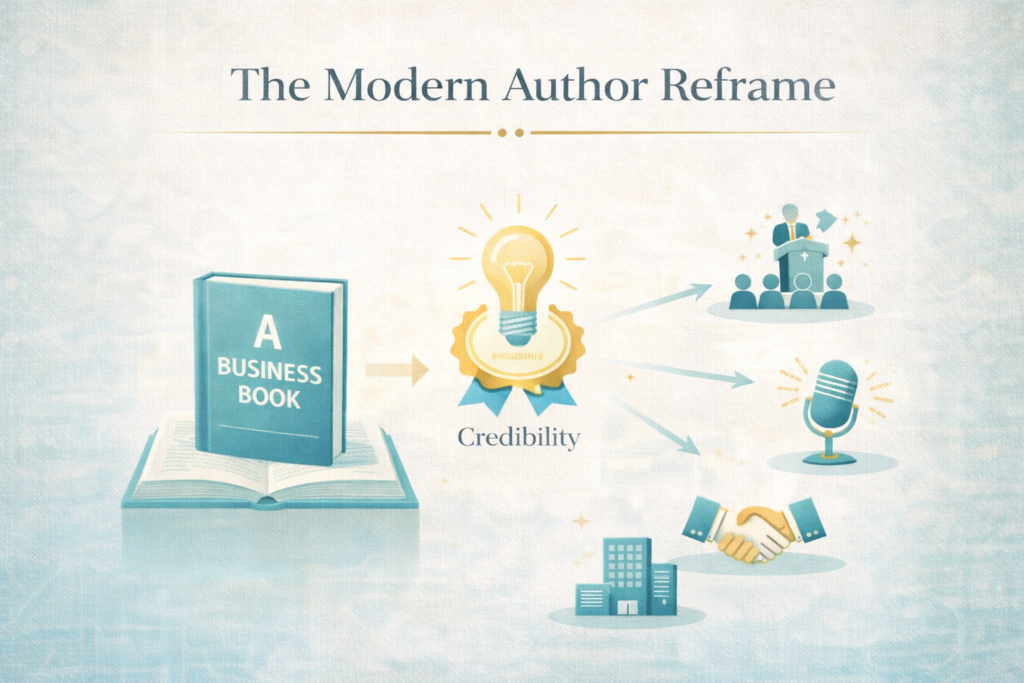
A well-positioned book functions as a credibility asset, a signal that compresses expertise, perspective, and authority into a single artifact that others can easily evaluate.
That signal changes how opportunities appear around the author.
Instead of simply promoting the book, new doors begin to open.
Books often unlock opportunities such as:
Conference stages and keynote invitations
Podcast and media interviews
Corporate workshops or consulting engagements
Partnerships with organizations seeking expertise
Long-term authority positioning within an industry
In other words, the book itself is rarely the end goal.
It is the credential that changes how the author is perceived.
A published book tells the market several things at once:
This person has a developed point of view.
Their ideas are structured and teachable.
Their expertise has been formalized into intellectual property.
For conference organizers, journalists, and enterprise decision-makers, that signal reduces uncertainty. It accelerates trust.
The misunderstanding many authors have is simple but consequential.
They believe the book’s job is to perform in the book market.
In reality, its greatest value often appears in adjacent markets, speaking, media, advisory work, enterprise training, and strategic partnerships.
When understood this way, the book becomes something different.
Not just a publication.
A platform
“The book isn’t the product.
It’s the credential that opens speaking, media, and enterprise doors.”
— Eric Koester
The Modern Author Reframe
For decades, publishing followed a simple economic model.
Write the book. Sell copies. Promote the book.
Success was measured primarily through sales volume, units sold, bestseller lists, and retail visibility.
This model still exists, but it no longer represents how many nonfiction books create their greatest value.
A different pattern has emerged.
The Traditional Publishing Model
In the traditional model, the book itself is the product.
The sequence typically looks like this:
Write book → Sell copies → Promote book
Most activity after publication focuses on marketing the title. Authors pursue reviews, publicity, and promotional campaigns designed to increase book sales.
Revenue comes primarily from royalties.
This model works well for consumer publishing, where scale and distribution determine success.
But for many experts, founders, consultants, and executives, the book performs a different role.
The Modern Author Model
The Modern Author model treats the book as a credibility asset rather than a standalone product.
Instead of ending with book sales, the book becomes the starting point for a broader opportunity ecosystem.
The book compresses experience, ideas, and frameworks into a form that travels easily across these environments.
Why Books Accelerate Trust
A published book sends several signals simultaneously.
It suggests that the author has:
A developed point of view
A structured framework for explaining their ideas
Evidence, case studies, or research supporting those ideas
The discipline required to formalize expertise into intellectual property
For audiences and organizations evaluating expertise, this signal reduces uncertainty.
The book becomes a credibility shortcut.
It also acts as a trust accelerator, allowing decision-makers to quickly assess whether the author’s thinking is coherent, original, and useful.
In many contexts, it functions as a decision signal: a visible marker that the author’s expertise has been formalized into a teachable system.
The Strategic Implication
When viewed through this lens, the purpose of the book shifts.
Instead of optimizing primarily for book sales, the strategic question becomes:
How does the book position the author for the opportunities that follow?
Speaking invitations. Media appearances. Enterprise engagements. Strategic partnerships.
The book does not replace these opportunities.
It makes them easier to create.
Most nonfiction authors publish a book, promote it briefly, and never convert it into the opportunities it was capable of creating. This guide shows how to turn your book into speaking opportunities using an author speaking strategy that transforms your book into authority assets and repeatable enterprise opportunities for authors. You’ll learn how to build an authority platform that turns a finished book into speaking, media, and enterprise leverage.
60-Second Decision Box
If you only read one section of this guide, read this.
This Guide Is For You If
You’re writing a nonfiction book to expand your authority in your field
You want your book to lead to speaking invitations, media opportunities, or enterprise engagements
You see your book as a credibility asset, not just a publication
You want a structured system for turning ideas into long-term professional leverage
This Guide Is Not For You If
Your primary goal is simply selling copies on Amazon
You are treating the book as a one-time marketing campaign
You plan to publish the book without building speaking, media, or enterprise pathways
You are looking for promotion tactics rather than a long-term opportunity strategy
The Modern Author Principle
Your book is not the end product.
Your book is the credential that unlocks opportunity.
The authors who understand this build speaking platforms, media authority, and enterprise partnerships.
Everyone else publishes, and then asks what happens next.
What This Guide Will Teach You
This guide explains how a nonfiction book can become the starting point for a broader authority platform. Instead of treating the book as the final product, it shows how to convert the ideas inside the book into repeatable opportunity channels.
By the end of this guide, you will understand how to:
Turn the core ideas from your book into a signature keynote that can be delivered at conferences, corporate events, and industry gatherings
Build a speaker kit that clearly communicates your expertise and attracts conference organizers and event planners
Position yourself as the voice of your idea in media, including podcasts, interviews, and guest essays
Convert the framework inside your book into enterprise training, consulting, or workshops for organizations
Build an opportunity engine where speaking, media, and enterprise engagements compound over time
The goal is not simply to publish a book.
The goal is to use the book as the foundation for a long-term authority platform that creates ongoing professional opportunities.
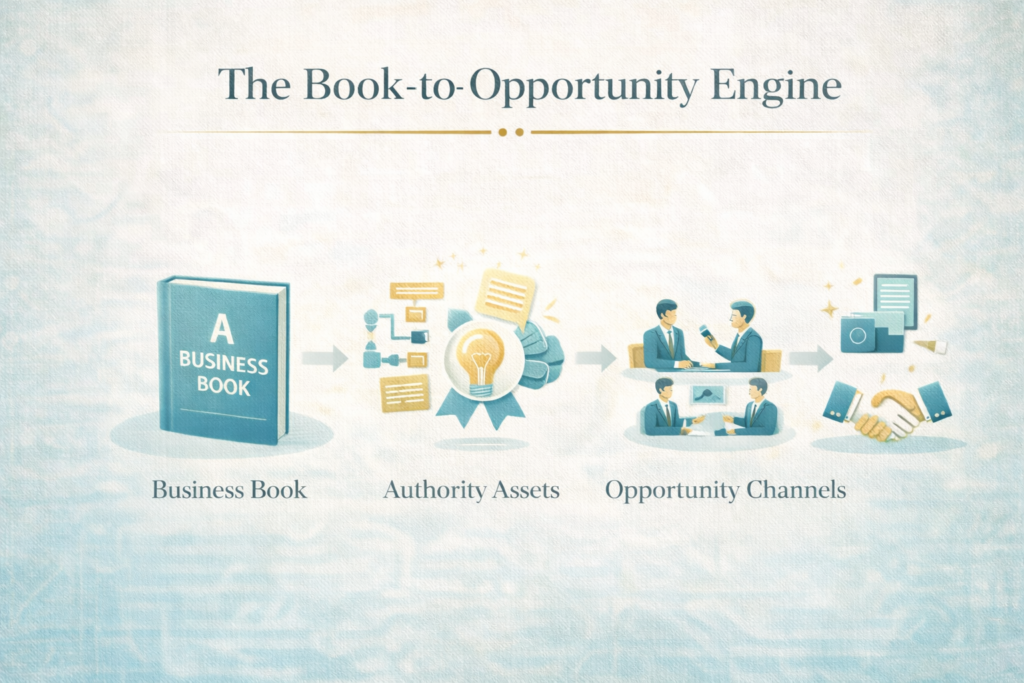
The Book-to-Opportunity Engine
Most authors approach “speaking, media, and enterprise” as separate goals.
They build a talk. They pitch podcasts. They try to sell consulting.
That approach produces scattered effort and inconsistent results.
This guide uses a single system, the Book-to-Opportunity Engine, to show how opportunities are created from a book in a repeatable way.
The Core Model
Book ↓ Authority Assets ↓ Opportunity Channels ↓ Enterprise Outcomes
Insert visual diagram here.
The logic is simple:
The book contains the raw material.
That raw material is converted into Authority Assets (portable proof and IP).
Those assets activate Opportunity Channels (places opportunities enter).
Those channels lead to Enterprise Outcomes (the highest-leverage engagements and partnerships).
What “Authority Assets” Means
Authority Assets are the extracted components of your book that make decision-makers trust you faster.
They are not “marketing content.” They are credibility artifacts, proof, structure, and language that travels.
Authority Assets typically include:
Stories (credible moments that teach the problem and stakes)
Frameworks (a named, teachable model people can repeat)
Case studies (proof the approach works in the real world)
Research (data, patterns, or synthesis that supports the claim)
Contrarian insights (a clear point of view that differentiates the idea)
These assets are what conference organizers, journalists, and enterprise buyers evaluate, often in minutes.
What “Opportunity Channels” Means
Opportunity Channels are the pathways where the market can discover, evaluate, and engage the author.
In this guide, the primary channels are:
Speaking (keynotes, workshops, panels)
Media (podcasts, interviews, guest essays)
Enterprise training (workshops, programs, internal rollouts)
Licensing (your framework adopted inside an organization)
Partnerships (aligned platforms distributing or endorsing the idea)
Channels don’t work without assets.
If you pitch speaking without a clear framework, you’re asking an organizer to take a risk. If you pitch enterprise without case studies, you’re asking a company to buy without proof.
The Engine ensures the assets come first.
What “Enterprise Outcomes” Means
Enterprise Outcomes are the highest-leverage results that follow when authority is established.
They include:
Paid keynotes that lead to larger engagements
Corporate workshops and training programs
Ongoing enterprise partnerships
Licensing or certification pathways
A compounding opportunity pipeline where requests arrive inbound
This is where the book stops being a publication and starts functioning as a platform.
How to Use This Engine While Reading the Guide
Every core section of this guide maps back to this model.
When you’re unsure what to do next, return to the Engine and ask:
What Authority Asset is missing?
What Opportunity Channel are we trying to activate?
What Enterprise Outcome are we aiming to create?
As shown in the Book-to-Opportunity Engine, opportunities are not “won” through promotion.
They’re built through extraction → assets → channels → outcomes.
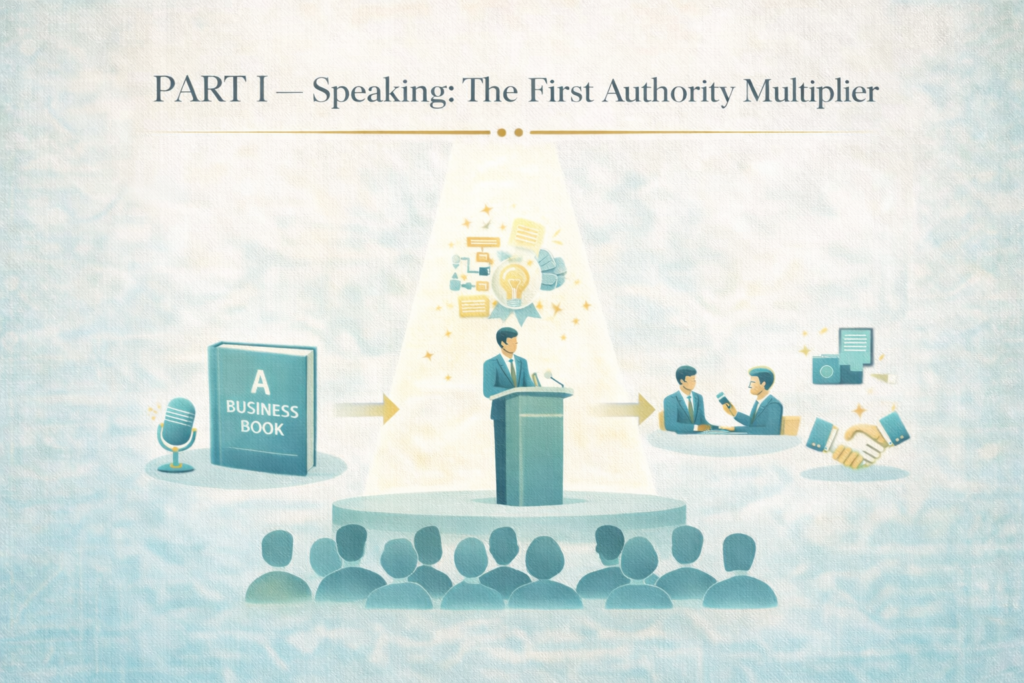
PART I – Speaking: The First Authority Multiplier
Speaking is often the first major opportunity channel that activates after a book is published.
Conferences, associations, and corporate events are constantly looking for speakers who can explain complex ideas clearly. A book signals that the author has already done the thinking required to do that.
But speaking demand does not appear randomly. It follows a predictable pattern of authority development.
The framework that explains this progression is the Opportunity Pyramid.
The Opportunity Pyramid
Authority-driven opportunities grow through four layers:
Visibility ↓ Credibility ↓ Demand ↓ Leverage
Insert Opportunity Pyramid visual here.
Each layer strengthens the next. Skipping a layer usually weakens the entire system.
Visibility
Visibility is how people first encounter the author’s ideas.
This layer is built through:
Articles and written insights
Podcast appearances
Event participation
Thought leadership content
Visibility introduces the author to an audience. However, visibility alone rarely creates high-value opportunities.
Without credibility, attention fades quickly.
Credibility
Credibility signals that the author’s ideas are structured, tested, and worth attention.
A book is one of the strongest credibility signals available.
Credibility is reinforced through:
The book itself
A named framework or model
Documented case studies
Demonstrated expertise in the field
For conference organizers and media producers, these elements reduce risk. They show that the author can teach something valuable, not just promote themselves.
Demand
When visibility and credibility combine, demand begins to appear.
Demand shows up as:
Speaking invitations
Podcast or media interview requests
Enterprise inquiries from organizations interested in the ideas
At this stage, the author’s ideas are no longer just content. They become a resource other platforms want to feature.
Leverage
The top of the pyramid is leverage.
Leverage occurs when the author can choose higher-value opportunities because demand already exists.
Examples include:
Higher speaking fees
Invitations to larger conferences and audiences
Enterprise workshops and corporate training engagements
At this stage, the book is no longer just a publication.
It functions as an authority signal that continually feeds the opportunity pipeline.
Speaking often becomes the first multiplier in this pyramid. A well-structured talk can introduce the book’s ideas to thousands of people, many of whom become media hosts, conference organizers, or enterprise buyers.
Understanding the Opportunity Pyramid helps explain why speaking frequently becomes the first major channel where a book’s authority begins to compound.
The Signature Keynote
A signature keynote is not “a talk about your book.”
It is the book’s core argument compressed into a live experience.
Books are designed for depth. Keynotes are designed for clarity.
A conference audience cannot absorb an entire manuscript. But they can absorb a structured idea that reshapes how they see a problem.
That is the purpose of the signature keynote.
It takes the intellectual architecture of the book and converts it into a presentation that:
introduces the core idea
demonstrates the framework
proves the concept with evidence
gives the audience a way to act
When structured correctly, the keynote becomes the public expression of the book’s central idea.
The most reliable structure for doing this is the 7-Part Signature Keynote Framework.
The 7-Part Signature Keynote Structure
1. Opening Story
Begin with a short moment that illustrates the problem.
This is not entertainment. It is orientation.
The opening story gives the audience immediate context for the topic and establishes credibility for the speaker.
It answers a simple question:
Why does this idea matter right now?
2. Big Problem
Next, clearly define the problem the audience is facing.
This should not be a vague industry observation. It should describe a pattern the audience immediately recognizes.
When framed well, the audience should feel:
“That's exactly what we're dealing with.”
A strong Big Problem creates the tension the keynote will resolve.
3. Counterintuitive Truth
Once the problem is clear, introduce the reframe.
This is the core idea that differentiates the book from conventional advice.
It is usually expressed as a short, repeatable insight.
For example:
A widely accepted assumption is wrong.
A familiar strategy works for the opposite reason people think.
A hidden dynamic is driving the real outcomes.
This moment is where the audience realizes they are about to learn something new.
4. Framework Reveal
The framework is the structural heart of the keynote.
It is the model that explains how the new insight works in practice.
Frameworks are powerful because they:
simplify complexity
provide language the audience can repeat
give organizations something implementable
In most nonfiction books, the framework already exists inside the manuscript.
The keynote simply reveals it earlier and more clearly.
5. Case Studies
Once the framework is introduced, the audience needs proof.
Case studies demonstrate that the model works in the real world.
They may include:
organizational examples
founder experiences
industry patterns
research observations
The purpose is not storytelling.
The purpose is credibility reinforcement.
6. Activation
At this stage, the audience understands the framework.
Now they need to know what to do with it.
Activation translates the model into a small number of practical next steps.
For example:
decisions leaders should reconsider
behaviors teams should change
structures organizations should test
Activation turns insight into application.
7. Transformation Close
The final step shows what becomes possible when the framework is applied.
This is not a motivational speech ending.
It is a strategic before-and-after contrast.
The audience should clearly see:
what the old approach produces
what the new approach enables
When this moment is done well, the audience leaves with a simple conclusion:
This idea changes how we should operate.
Why the Signature Keynote Matters
The keynote becomes the public interface of the book’s idea.
Conference organizers book the keynote. Podcast hosts interview the keynote. Enterprises request workshops built from the keynote.
In other words:
The keynote becomes the portable version of the book.
And when the keynote is structured well, it does something powerful:
It turns a single book into repeated opportunities to teach the idea again and again.
That is why speaking often becomes the first multiplier in the Book-to-Opportunity Engine.
Author → Conference Speaker
Starting Point
A consultant publishes a nonfiction book that introduces a clear framework for solving a recurring industry problem. The book contains the core model, supporting case studies, and the language used to explain the idea.
Action
The author extracts the book’s central framework and converts it into a structured signature keynote using the seven-part keynote model. The talk focuses on one problem, one counterintuitive insight, and the framework that resolves it.
This keynote becomes the primary way the idea is presented at conferences and industry events.
Result
Conference organizers begin inviting the author to speak because the talk provides a clear, teachable framework audiences can apply.
The book establishes credibility, while the keynote makes the idea visible at scale, leading to paid speaking engagements and recurring conference invitations.
How the Book Became the Keynote
A common mistake is trying to “create a keynote” from scratch after the book is done.
The higher-leverage approach is extraction.
The manuscript already contains the raw material a keynote needs: a credible story, a teachable framework, and proof that the framework works.
Story Extraction
The author starts by scanning the manuscript for moments that do one of two things:
Illustrate the Big Problem in a real setting
Show the cost of continuing the old approach
The goal is not to find the most dramatic story.
The goal is to find a story that quickly establishes:
stakes (why this matters)
credibility (why the author understands it)
relevance (why the audience should care)
That story becomes the keynote’s opening.
Framework Reveal
Next, the author identifies the book’s central model, the part of the manuscript that explains:
why the problem persists
what most people misunderstand
what the correct approach looks like
In the book, this framework may be distributed across chapters.
In the keynote, it must be centralized and named.
The author translates the framework into:
a simple visual (one slide)
a short explanation that can be delivered in under two minutes
a sequence the audience can repeat
This becomes the structural backbone of the talk.
Case Study Proof
Once the framework is clear, the keynote needs evidence.
The author pulls 2–3 case studies from the book that demonstrate:
the framework applied in real conditions
a measurable before/after outcome
a clear lesson the audience can adopt
Each case study is shortened into a clean proof block:
context (what was happening)
intervention (what changed)
result (what improved)
This is the credibility layer that prevents the keynote from feeling theoretical.
Convert the Book Into a Live Sequence
At this point, the keynote is not “a summary of the book.”
It is a designed experience:
a story that opens tension
a reframing insight that breaks the default assumption
a framework that gives the audience language
proof that the framework works
activation that turns the framework into actions
The author hasn’t invented new material.
They have simply reorganized the strongest elements of the manuscript into a format that stages, podcasts, and enterprise buyers can absorb quickly.
That is what makes a manuscript become a keynote.
Turning Your Manuscript Into a Keynote
A keynote should not be written from a blank page.
The strongest keynotes are extracted from the manuscript. The book already contains the intellectual assets required for a compelling talk: stories, frameworks, and proof.
The goal is not invention. The goal is selection and compression.
A practical extraction process looks like this.
Step 1 — Upload the Manuscript to Codex
Start by analyzing the completed manuscript inside Codex (Author Intelligence).
Codex functions as an analytical layer that helps identify the structural elements already present in the book, including:
narrative stories
core frameworks
repeated patterns in the argument
case studies and supporting examples
This analysis makes it easier to identify which parts of the manuscript are strongest for live delivery.
Step 2 — Extract the Core Stories
Next, identify the stories that illustrate the book’s central problem.
A keynote usually needs one primary opening story and one or two supporting moments that reinforce the stakes of the topic.
Look for stories that:
clearly illustrate the problem the audience recognizes
establish credibility for the author
create emotional or strategic tension early in the talk
These become the narrative anchors of the keynote.
Step 3 — Identify the Central Framework
Every strong keynote is built around a single framework.
In the manuscript, this framework may appear across several chapters. For speaking, it must be simplified and named.
The framework should answer three questions:
What is the core idea of the book?
What model explains how the idea works?
What language will audiences repeat after the talk?
This framework becomes the structural center of the presentation.
Step 4 — Pull the Strongest Case Studies
Once the framework is identified, select two or three case studies that demonstrate it in action.
These should be examples that:
show the framework applied in real-world conditions
produce a clear outcome or improvement
reinforce the credibility of the model
Case studies function as proof that the idea works outside the book.
Step 5 — Organize the Material Into the Keynote Structure
Finally, arrange the extracted elements using the Signature Keynote Structure.
The keynote typically includes:
one opening story
a clearly defined problem
a counterintuitive insight that reframes the issue
the framework that explains the solution
supporting case studies
practical activation steps for the audience
At this point, the keynote is not a summary of the book.
It is the live version of the book’s core argument, designed for clarity, memorability, and repeatable delivery on stages, podcasts, and enterprise events.
PART II – Speaker Infrastructure
The Speaker Kit
Most speaking opportunities are not won on stage.
They are won in the evaluation window before the organizer ever meets the author.
A conference organizer is not asking, “Is this person interesting?” They are asking, “Is this talk reliable, relevant, and easy to program?”
That is what a speaker kit is for.
A speaker kit is not a résumé. It is a set of sales assets designed to reduce risk for the buyer and increase the likelihood of booking.
What a Speaker Kit Does
A complete speaker kit helps an organizer quickly answer:
Who is this speaker and what do they teach?
Who is the talk for?
What will the audience walk away with?
What proof exists that this will land well?
What formats can this speaker deliver?
If those answers are not immediately clear, interest does not convert into bookings.
Speaker Kit Components
A functional speaker kit includes the following components.
Speaker Page
A dedicated page that summarizes the speaking offer in one place.
It should include the core positioning, talk titles, and a clear booking path.
This page exists so the organizer has something to forward internally.
One-Sheet
A single-page PDF or document that can be printed or shared in an internal review.
It should include:
short bio
key topics / talk titles
audience fit
outcomes
social proof
The one-sheet is the fastest decision document in the kit.
Speaking Reel
A short video that demonstrates stage presence and delivery.
This is not about production value. It is about credibility.
Organizers want to see that the speaker can hold attention and teach clearly.
Talk Titles
Clear talk titles that sound like conference session names, not book chapters.
Each title should signal:
the problem
the angle
the intended audience
Good titles make the talk easy to place in an agenda.
Audience Definition
A plain-language statement of who the talk is for.
Organizers don’t want generic “leadership” or “innovation.” They want a clear audience match (role, context, industry, or stage of growth).
This is part of what makes the speaker “programmable.”
Transformation Outcomes
A short set of outcomes that describe what changes for the audience after the talk.
Outcomes are stronger than topics.
A topic is what you’ll discuss. An outcome is what the audience will leave with.
Testimonials
Short proof points from:
event organizers
past audiences
enterprise clients
industry peers
Testimonials reduce risk and accelerate decision-making.
Framework Visuals
One or two visuals that show the core model from the book.
Framework visuals perform two roles:
they reinforce that the author has a teachable system
they make the talk easier to understand quickly
This is one of the fastest credibility signals in the entire kit.
Enterprise Options
A speaker kit should not only sell a talk.
It should show the adjacent pathways an organization can engage next, such as:
workshops
training programs
executive sessions
licensing opportunities
This turns a keynote from a one-time event into an entry point.
The Strategic Principle
Speaking interest is common.
Speaking bookings require infrastructure.
A professional speaker kit is the system that converts demand into confirmed engagements, because it makes the author’s work easy to evaluate, easy to approve, and easy to program.
Consultant → Conference Circuit
Starting Point A consultant has deep expertise in a specific industry problem and has recently published a nonfiction book outlining their approach.
The ideas are strong, but conference organizers have difficulty evaluating the speaker quickly. There is no central page explaining the talks, no concise overview of topics, and no asset that can be forwarded internally for review.
As a result, interest in the ideas does not consistently convert into speaking invitations.
Action The consultant builds the core elements of a speaker infrastructure, starting with two foundational assets:
a dedicated speaker page explaining the talk topics, audiences served, and outcomes
a concise one-sheet summarizing the speaker’s positioning, topics, and credibility signals
These assets make the author’s work easy for conference organizers to review, share internally, and evaluate for event programming.
Result Conference organizers can now quickly understand:
the core idea behind the talk
the audiences the presentation serves
the outcomes participants will gain
With this clarity, the consultant begins receiving conference invitations and confirmed speaking engagements, turning existing expertise into a repeatable speaking circuit.
How Books Create Media Authority
A book positions an author for media not because it exists, but because it structures an idea in a way journalists, podcast hosts, and producers can use.
Media organizations are constantly searching for credible interpreters of complex topics. A book signals that the author has already done the work of organizing the thinking.
Three structural roles typically emerge from this process:
Category Voice
Framework Creator
Thought Leader
Each role reflects a different mechanism through which books convert intellectual work into media authority.
1). Category Voice
A category voice is someone the media calls when a topic becomes relevant.
Journalists operate under time pressure. When a subject becomes newsworthy, they need credible people who can explain the issue quickly and clearly.
Books help establish category voice status because they signal three things:
the author has studied the topic in depth
the argument is structured and defensible
the perspective has been developed beyond short-form commentary
The book becomes a credibility shortcut.
Instead of asking, “Why should we trust this person?” the producer can see that the author has already organized a full position on the topic.
Mechanism
The mechanism behind category voice authority is topic ownership.
When an author publishes a book that clearly defines a problem space, media outlets begin to associate that author with the category.
Over time, the author's name becomes cognitively linked to the issue.
This is why many recurring media experts are introduced with a simple phrase:
“Author of [book title] on [topic].”
The book functions as shorthand for expertise.
Strategy
To position a book for category voice authority:
Define the problem clearly and consistently throughout the manuscript.
Use precise language that media outlets can easily quote or summarize.
Avoid overly broad positioning.
The more clearly the book defines a category, the easier it becomes for media organizations to identify the author as a relevant voice when the topic appears in the news cycle.
2). Framework Creator
Media prefers explanations that are structured and memorable.
A framework is a model that simplifies a complex issue into a small number of components. Frameworks give journalists and audiences a way to understand a problem quickly.
Books are one of the strongest vehicles for establishing frameworks because they allow authors to:
define the model fully
explain how it works
support it with examples and case studies
This depth makes the framework credible.
Mechanism
The mechanism behind framework authority is intellectual compression.
A good framework reduces a complex topic into a structure that can be explained in minutes without losing the core insight.
When a framework is strong, media outlets adopt the language because it helps audiences understand the topic faster.
Frameworks travel well across formats:
podcast interviews
short TV segments
written articles
conference panels
In each case, the framework provides the explanatory structure for the conversation.
Strategy
To position a framework for media use:
Name the framework clearly.
Reduce it to a small number of elements (often three to five).
Use simple labels that audiences can remember.
When the framework becomes repeatable, media interviews naturally revolve around explaining the model.
The book provides the full explanation. The media appearance becomes the compressed version.
3). Thought Leader
The term thought leader is often used loosely. In practice, it describes a specific role in the media ecosystem.
A thought leader is someone who shapes how people interpret a problem.
This role goes beyond describing events. It involves providing a perspective that changes how the audience thinks about the issue.
Books are particularly effective at establishing this role because they allow the author to build a complete argument:
define the problem
explain why conventional explanations fall short
introduce a new interpretation
propose a structured response
This intellectual architecture becomes the author's signature perspective.
Mechanism
The mechanism behind thought leadership is interpretive authority.
When audiences encounter complex or uncertain situations, they look for people who can make sense of the environment.
If the author consistently provides a clear interpretation, media outlets begin to rely on that perspective to frame discussions.
The book demonstrates that the interpretation is not a reaction. It is the result of sustained analysis.
Strategy
To position an author as a thought leader:
articulate a clear point of view about the topic
challenge at least one common assumption in the field
offer a structured alternative explanation
Media appearances then become opportunities to apply that perspective to new developments.
The book provides the intellectual foundation.
The media platform amplifies the interpretation.
Over time, the author becomes recognized not only for expertise but for the lens through which the issue is understood.
Media Hook Triangle
Media opportunities rarely come from simply announcing a book.
Editors, podcast hosts, and producers are looking for angles that serve their audience, not promotional messages.
A strong media pitch typically combines three elements that make the conversation both relevant and useful.
This structure is the Media Hook Triangle.
It brings together:
a timely angle that makes the topic relevant now
a counterintuitive insight that challenges conventional thinking
a human story that makes the idea relatable and concrete
When these three elements align, the author’s idea becomes easier for media platforms to feature and repeat.
Timely Angle
A timely angle connects the author’s idea to something currently happening in the market, industry, or news cycle.
Media organizations prioritize conversations that feel immediate and relevant. A timely angle answers the question:
“Why should audiences care about this topic right now?”
Timely angles often emerge from:
emerging industry shifts
new technologies or trends
economic changes
recent news events
changes in how organizations operate
The book provides the underlying expertise, but the timely angle connects the idea to the present moment.
Counterintuitive Insight
Media conversations become compelling when the guest introduces a perspective that challenges common assumptions.
A counterintuitive insight reframes the issue in a way that makes the audience pause and reconsider what they believe.
For example, instead of repeating widely accepted advice, the author presents a different explanation for why the problem exists or how it should be addressed.
This type of insight works well in media because it:
creates intellectual tension
differentiates the author from other commentators
gives the host a clear angle to explore during the interview
Books often contain multiple insights of this type, but media appearances usually center on one clear idea that anchors the conversation.
Human Story
The final element is the human story.
Stories make abstract ideas easier to understand and remember. They demonstrate how the insight applies in real situations.
A strong human story may come from:
the author’s own experience
a case study from the book
a client transformation
a real-world example that illustrates the problem and solution
The story provides narrative grounding for the insight and helps the audience see how the framework operates outside theory.
Combining the Three Elements
A strong media pitch aligns all three elements into a single idea.
For example:
The timely angle explains why the issue is relevant now.
The counterintuitive insight introduces the author’s perspective.
The human story demonstrates how the idea works in practice.
This combination makes the author’s idea easier for media platforms to program, explain, and share with their audiences.
Author → Podcast Authority
Starting Point An author publishes a book addressing a rapidly emerging industry topic. The idea is timely, but early outreach focused primarily on promoting the book itself rather than highlighting the core insight.
Action The author reframes media outreach using the Media Hook Triangle.
Podcast pitches highlight:
a timely industry shift discussed in the book
a contrarian insight that challenges the prevailing explanation
a practical example illustrating the concept in action
Each media conversation focuses on explaining the idea rather than promoting the title.
Result Podcast hosts begin inviting the author to discuss the topic repeatedly because the interviews provide clear insights for listeners.
Over time, the author becomes associated with the idea itself, leading to recurring podcast interviews and broader media exposure.
PART IV – Enterprise Opportunities
Where the Real Revenue Lives
Most authors evaluate the upside of a book through the wrong lens: royalties.
Royalties are a byproduct of distribution. They are not the primary economic engine for most nonfiction authors—especially executives, consultants, and experts whose value is captured through high-trust decisions (who to hire, who to listen to, whose framework to adopt).
Enterprise engagements are paid agreements where an organization buys the author’s expertise as an outcome—through training, workshops, implementation support, or licensing. The book functions as the credibility layer that makes those agreements easier to initiate, justify, and expand.
The Economics Shift: Book Income vs Enterprise Income
Book economics are constrained by unit volume and retail pricing. Enterprise economics are constrained by outcome value and organizational budget.
A practical way to brief a senior executive is to treat the book as the front-end credential, and enterprise engagements as the back-end monetization.
Revenue Path
What’s Being Bought
Typical Buyer
How Value Is Measured
Why the Book Matters
Book royalties
Copies
Individuals
Units sold
Signals credibility, but rarely closes high-value deals
Corporate workshop
A live outcome session
HR, L&D, department leaders
Behavior change, alignment, decision clarity
Reduces perceived risk; provides a “shared language”
Training program
Repeatable capability building
L&D, functional leaders
Adoption, completion, performance lift
Positions the author as the framework owner
Framework licensing
Permission to use your IP
Enterprise leadership, enablement teams
Scale, consistency, internal adoption
Establishes legitimacy of the model being licensed
The key mechanism: enterprises don’t pay for books; they pay for capability, alignment, and change. The book makes the purchase defensible.
What Enterprise Buyers Actually Need
Enterprise stakeholders rarely wake up wanting “a speaker.”
They want a solution that is:
credible (low reputational risk)
transferable (can be taught across teams)
repeatable (not dependent on one charismatic session)
measurable (can be connected to outcomes)
A book supports all four, because it packages the author’s thinking into a durable artifact that decision-makers can reference, circulate, and adopt internally.
Enterprise Opportunity Pathways
Enterprise engagements are not one single type of offer. They typically emerge in distinct engagement pathways, each designed to solve a different organizational need.
Understanding these pathways helps leaders decide how the book’s framework should be applied inside organizations.
Three pathways appear most frequently:
Corporate Workshops
Training Programs
Framework Licensing
Each pathway has a different trigger, strategy, and outcome.
Corporate Workshops
A corporate workshop is a focused session designed to introduce a framework and help a group apply it to a current challenge.
It is typically the first enterprise engagement an organization purchases after encountering an author's ideas through a book, keynote, or media appearance.
Organizational Trigger
Workshops are usually requested when an organization:
wants to explore a new idea quickly
needs alignment around a specific problem
is evaluating whether a framework is useful for their teams
The organization is not yet committing to long-term adoption. They are testing whether the model resonates with their context.
Strategic Role
Workshops function as idea activation.
The author introduces the framework, demonstrates how it works, and facilitates structured discussion around how the model applies to the organization's situation.
Because the session is short and focused, workshops often serve as an entry point into deeper engagements.
Outcome
Typical outcomes include:
leadership alignment around a problem or strategy
early adoption of the framework’s language
identification of areas where deeper implementation may be valuable
Workshops frequently lead to follow-on conversations about training programs or broader implementation.
Training Programs
A training program extends the author’s framework into a structured capability-building process.
Instead of introducing the idea once, the program helps teams develop repeatable skills and practices based on the framework.
Training programs are typically delivered over multiple sessions, often through cohort-based learning or structured internal initiatives.
Organizational Trigger
Training programs emerge when an organization:
sees value in the framework introduced through a book or workshop
wants teams to apply the model consistently
needs a structured learning environment for adoption
The organization has moved beyond exploration. They are now interested in building capability.
Strategic Role
Training programs translate the book’s concepts into operational practices.
Sessions often include:
applied exercises
internal case discussions
adaptation of the framework to company-specific workflows
The objective is not just understanding the idea, but integrating it into how teams operate.
Outcome
Training programs typically produce:
consistent language across teams
improved decision frameworks
repeatable internal practices based on the author’s model
At this stage, the framework often becomes embedded inside the organization’s leadership or operating systems.
Framework Licensing
Framework licensing allows an organization to formally adopt the author’s intellectual property as part of its internal systems.
Instead of relying on occasional sessions with the author, the organization receives permission to use the framework’s models, tools, and language internally at scale.
This pathway represents the most advanced form of enterprise engagement.
Organizational Trigger
Licensing usually emerges when:
the framework has proven valuable in training or workshops
leaders want to scale the model across large teams
internal programs require consistent methodology
The organization no longer sees the framework as an external idea.
It becomes part of how the organization operates.
Strategic Role
Licensing converts the author’s intellectual property into a repeatable internal system.
This may include:
use of the framework in internal training
integration into leadership programs
inclusion in company playbooks or methodologies
The author’s work becomes part of the organization’s operating language.
Outcome
Licensing agreements typically result in:
widespread internal adoption of the framework
standardized training and enablement materials
long-term strategic partnerships between the author and the organization
This pathway often produces the most durable enterprise relationships.
When to Use Each Engagement Pathway
These enterprise pathways typically follow a natural progression, depending on the organization's level of commitment.
Enterprise Pathway
When It Is Used
Corporate Workshop
When the organization is exploring the idea and wants a focused introduction
Training Program
When the organization wants teams to apply the framework consistently
Framework Licensing
When the organization intends to scale the framework across the company
This progression reflects a broader principle of enterprise engagement:
Ideas enter organizations through experiences. They become valuable when they turn into systems.
The book establishes the credibility of the idea. Enterprise engagements transform that idea into organizational capability.
Pricing Reality: Why Enterprise Changes the Ceiling
Enterprise engagements price on value delivered, not copies sold. Even conservative enterprise pricing can exceed typical book income because the buyer is not one reader—it is an organization.
Enterprise Offer
Typical Structure
Price Anchor (Example Range)
Why It Prices Here
Workshop
60–120 minutes + pre-call
$7,500–$25,000
Pays for decision quality and time savings
Training program
4–12 sessions
$25,000–$150,000
Pays for capability development and adoption
Framework licensing
Annual agreement
$50,000–$250,000+
Pays for scale, consistency, and internal reuse
These are not aspirational numbers. They are a reflection of how organizations buy outcomes when credibility and risk are managed.
The Strategic Takeaway
A book is not a revenue product first. It is a credential that converts expertise into enterprise-safe demand.
When an executive publishes a book with a clear framework and proof, enterprise buyers gain a reason to believe:
the idea is structured, not improvised
the author is serious, not promotional
the model is teachable, not personality-dependent
That is what unlocks enterprise economics.
Enterprise Opportunity Types
Enterprise opportunities emerge when the ideas inside a book are structured into systems organizations can apply.
Companies rarely purchase abstract insights. They purchase capabilities, processes, and repeatable models that help teams make better decisions or operate more effectively.
When a nonfiction book contains a clear framework, that framework can often be translated into four primary enterprise pathways:
Workshops
Training Programs
Licensing
Certification
Each pathway represents a different level of organizational adoption.
Workshops
A workshop is the most immediate enterprise application of a book’s framework.
It is typically a short engagement designed to introduce the model and help a group apply it to a current challenge.
Workshops often follow keynote speaking engagements or internal leadership discussions where the book’s ideas first gain traction.
The goal of a workshop is not long-term implementation. It is structured activation, helping leaders and teams understand the framework and see how it applies to their environment.
Common workshop outcomes include:
alignment around a strategic problem
shared language for decision-making
early experimentation with the framework
Because workshops are focused and practical, they frequently become the entry point for deeper enterprise partnerships.
Training Programs
A training program expands the framework into a structured capability-building system.
Instead of introducing the model once, the organization develops internal expertise through a series of sessions or structured learning modules.
Training programs are typically designed for:
leadership cohorts
internal academies
functional teams adopting new operating models
The goal is repeatable skill development.
Participants do not just learn the idea. They practice applying it in real operational contexts.
Successful training programs often produce:
consistent decision frameworks across teams
improved collaboration and communication
measurable improvements in execution quality
At this stage, the framework begins to function as an internal operating model.
Licensing
Licensing allows an organization to formally adopt the author’s framework across the company.
Instead of bringing the author in for individual sessions, the organization receives permission to integrate the intellectual property into internal systems.
This may include:
internal training programs
leadership development materials
company playbooks
internal strategy frameworks
Licensing converts the author’s ideas into organizational infrastructure.
The framework becomes embedded in how teams think, communicate, and operate.
For authors, licensing also creates the most scalable form of enterprise engagement because the model can be applied across many teams simultaneously.
Certification
Certification programs extend the framework beyond a single organization.
In this model, professionals are trained and authorized to apply the author’s methodology in their own organizations or with clients.
Certification programs typically include:
formal training on the framework
standardized tools and materials
evaluation or assessment of proficiency
The outcome is a network of practitioners who can implement the framework consistently.
For organizations, certification ensures the framework is applied correctly. For authors, it allows the intellectual property to expand into a broader professional ecosystem.
Author → Enterprise Training Partner
Starting Point An author publishes a nonfiction book introducing a structured framework for improving leadership decision-making inside organizations.
Leaders respond positively to the idea, but initially engage with it only through conference talks and executive discussions.
Action The author converts the framework into a corporate workshop designed to help leadership teams apply the model to real strategic decisions.
The workshop introduces the framework, walks participants through case examples, and facilitates structured application within the organization.
Result Organizations begin inviting the author to run these sessions internally.
Over time, the workshop evolves into a broader training program, positioning the author as a long-term enterprise training partner rather than a one-time speaker.
PART V — The Opportunity Engine
Inbound Opportunity Engine
An inbound opportunity engine is the system that causes speaking, media, and enterprise requests to arrive without constant outbound pitching.
It is not “being visible.” It is making it easy for the right people to understand what you do, trust the credibility behind it, and take the next step.
A book creates the precondition for inbound: it establishes authority. But authority does not convert automatically. Conversion happens when the book is connected to clear pathways that let an interested party self-select into the right type of engagement.
The three inbound funnels a book activates
A book tends to trigger interest in three predictable directions:
Book → Speaking Someone wants the ideas delivered live to an audience.
Book → Media Someone wants the author’s perspective packaged into an interview, quote, or segment.
Book → Enterprise Someone wants the framework applied inside an organization as a workshop, training program, or longer engagement.
These funnels are simple on purpose. They are decision paths for the buyer.
If the path is unclear, interest dissipates. If the path is obvious, inbound increases.
The conversion bottleneck most authors miss
Most authors treat inbound as a demand problem. It is usually an infrastructure problem.
The typical failure mode looks like this:
the book generates attention
the right people search the author
they cannot quickly determine:
what the author offers
who it is for
what outcomes it produces
how to take the next step
When that happens, the opportunity expires quietly.
Inbound engines fail when the “next step” is vague.
The minimum inbound infrastructure
To convert book-driven interest into real opportunities, you need dedicated pages that match the three funnels.
These are not vanity pages. They are decision support assets designed for event organizers, producers, and enterprise buyers.
Speaker page
A speaker page is the destination for anyone evaluating you for an event.
It should answer, in under two minutes:
what you speak about (talk titles + themes)
who your talks are built for (audiences)
what changes for the audience (transformation outcomes)
what credibility supports the talk (book + case studies + proof)
how to book you (clear contact path)
A speaker page reduces organizer friction. It turns “interesting author” into “bookable speaker.”
Media page
A media page is the destination for producers and journalists.
It should make it easy to feature you by providing:
what your idea is (category + point of view)
what you can comment on (topics, angles, contrarian insights)
how to frame you (bio + credentials + book)
what assets exist (headshots, prior interviews, links)
how to reach you (fast contact path)
A media page converts curiosity into a usable pitch.
Training page
A training page is the destination for enterprise buyers.
It clarifies:
what problem you help organizations solve
what the framework enables operationally
what formats you offer (workshops, training programs, licensing, etc.)
what outcomes teams can expect
what the engagement process looks like
Enterprise buyers are not looking for inspiration. They are looking for implementation.
A training page signals that your ideas are not just publishable, they are deployable.
The Opportunity Routing Layer
When a book creates authority, it begins attracting different types of opportunity requests.
But those requests come from different buyers with different goals.
An effective inbound engine must route each type of buyer to the correct engagement path.
Without routing, opportunities stall because the next step is unclear.
The routing layer organizes inbound interest into three primary paths:
Visitor Type
What They Want
Destination
Event organizers
A keynote or conference talk
Speaker Page
Media producers
An interview or commentary
Media Page
Enterprise leaders
A workshop, training, or program
Training Page
The author’s website functions as the routing system that directs each visitor to the appropriate engagement channel.
This page exists for one reason: to prevent inbound leads from being forced to guess which path applies.
The operating principle
Inbound is created when your book meets two conditions:
Authority is established (the book proves you are worth listening to)
Pathways are explicit (your infrastructure tells people exactly what to do next)
The book earns attention. The engine converts it.
Outbound Opportunity Engine
Inbound opportunity systems take time to develop.
A book establishes credibility, but demand does not appear instantly. In the early phase after publication, authors often need to create initial momentum through proactive outreach.
This is the role of the Outbound Opportunity Engine.
Outbound does not replace inbound systems. It accelerates them by placing the author’s ideas in front of the right audiences early, which then creates the visibility and proof that later generates organic demand.
The goal is not mass outreach. The goal is targeted opportunity creation.
The 4×4 Pitch System
The most reliable way to generate early opportunities is to structure outreach across four opportunity channels.
Each channel receives a small number of focused pitches rather than broad distribution.
4×4 Pitch System
4 speaking pitches
4 media pitches
4 enterprise pitches
4 partnership pitches
This produces 16 targeted outreach attempts across the most relevant opportunity channels.
The number is deliberate. It forces prioritization and prevents authors from defaulting to unfocused outreach.
Speaking Pitches
Speaking pitches target event organizers and conference programmers who are responsible for selecting speakers.
The goal is to introduce the author’s core idea and keynote topic as a solution to a problem relevant to the audience.
Effective speaking pitches typically include:
the central theme of the talk
the audience the talk serves
the transformation the talk delivers
credibility signals (book, framework, expertise)
When structured correctly, the pitch positions the author as a speaker candidate, not simply an author promoting a book.
Media Pitches
Media pitches target podcast hosts, journalists, producers, and newsletter editors.
Media outlets rarely feature books directly. They feature ideas, commentary, and perspectives relevant to current conversations.
A strong media pitch therefore focuses on:
the idea inside the book
the angle that makes the idea relevant now
the perspective the author can contribute to ongoing discussions
The book acts as the credibility signal behind the idea.
Enterprise Pitches
Enterprise pitches target organizations that may benefit from applying the author’s framework internally.
Typical recipients include:
corporate learning leaders
HR and talent development teams
innovation or strategy leaders
professional associations
The pitch focuses on organizational outcomes, not intellectual ideas.
Instead of presenting the book, the pitch explains:
the business problem addressed
the framework that solves it
the format of the engagement (workshop, training, program)
This positions the author as a training partner, not simply a thought leader.
Partnership Pitches
Partnership pitches target organizations or platforms that can amplify the author’s ideas.
Examples include:
industry associations
educational platforms
professional communities
event organizers
media networks
Partnerships expand reach by placing the author’s framework inside an existing audience ecosystem.
The pitch typically proposes collaboration formats such as:
joint webinars
co-hosted events
guest teaching sessions
collaborative content initiatives
Partnerships are often the fastest way to access large, relevant audiences.
Follow-Up Cadence
Outbound opportunity creation depends on consistent follow-up.
Many opportunities are not declined. They are simply delayed or overlooked.
A practical cadence includes:
Initial pitch
Follow-up after 7–10 days
Second follow-up after 14–21 days
Each follow-up should be concise and respectful of the recipient’s time.
The objective is not persistence for its own sake. It is ensuring the opportunity is seen and considered.
The Strategic Role of Outbound
Outbound activity exists for a specific phase of the opportunity engine: activation.
When a book is first released, the author has credibility but not yet visible market proof. Conference organizers, media producers, and enterprise buyers often wait for signals of traction before engaging.
Outbound outreach generates those initial signals.
Early speaking engagements, podcast interviews, and pilot enterprise programs create observable evidence that the author’s ideas resonate with real audiences.
These early opportunities serve three strategic functions:
Visibility — the ideas begin appearing in conferences, podcasts, and industry discussions
Credibility reinforcement — third-party platforms validate the author’s expertise
Market proof — organizations see the framework applied in real environments
Once these signals accumulate, the opportunity system begins shifting from author-driven outreach to market-driven demand.
Conference organizers reference prior talks. Producers discover past interviews. Enterprise leaders see frameworks already used in practice.
At that point, the inbound engine becomes self-reinforcing.
Outbound outreach is therefore not a permanent activity. It is a launch mechanism that activates the broader opportunity system created by the book.
PART VI — Execution
The 12-Month Opportunity Plan
Turning a book into speaking, media, and enterprise opportunities requires deliberate sequencing.
Authority rarely converts into opportunity immediately. Instead, opportunities compound when the right assets, signals, and relationships are built in the correct order.
The 12-Month Opportunity Plan organizes the book-to-opportunity strategy into four execution phases.
Each quarter focuses on a different operational objective.
Build the Opportunity Infrastructure
The first quarter focuses on building the assets that allow the book to convert attention into opportunities.
The priority is not promotion. The priority is infrastructure.
Key deliverables include:
Signature keynote derived from the book’s framework
Speaker page explaining talk topics and audience outcomes
Speaker one-sheet summarizing positioning and credibility
Media page outlining interview topics and commentary areas
Enterprise training page describing workshops or programs
The outcome of Q1 is readiness. The system for converting authority into opportunities now exists.
Generate Initial Speaking and Media Signals
With infrastructure in place, the second quarter focuses on visibility and proof.
The objective is to secure early speaking engagements and media appearances that demonstrate market interest in the author’s ideas.
Key activities include:
Targeted speaking outreach to conferences and industry events
Podcast and media pitching aligned with the author’s core idea
Early keynote presentations or guest lectures
Media interviews introducing the framework
Key performance indicators
Initial speaking engagements confirmed
Podcast or media appearances secured
Early audience feedback validating the framework
The outcome of Q2 is credibility reinforcement. The author’s ideas begin appearing on external platforms.
Enterprise Expansion
Once the ideas have visible traction, the third quarter focuses on enterprise application.
Organizations often become interested only after seeing the framework presented publicly.
At this stage, the author begins translating the ideas into structured organizational engagements.
Key activities include:
Converting keynote content into corporate workshop formats
Proposing training sessions or pilot programs
Engaging corporate learning and development teams
Delivering early enterprise sessions to refine the framework in practice
Key performance indicators
Initial enterprise workshops delivered
Organizational adoption of the framework in training or leadership programs
Development of repeatable enterprise program formats
The outcome of Q3 is enterprise validation. The ideas move from thought leadership into operational use.
Systemize and Scale
The final quarter focuses on transforming the opportunity flow into a repeatable system.
By this stage, the author typically has multiple signals of demand:
speaking engagements
media visibility
enterprise interest
The focus now shifts from opportunity creation to systemization.
Key activities include:
refining the signature keynote based on audience response
documenting enterprise program formats
strengthening speaker and media assets with proof and testimonials
building repeatable outreach and partnership relationships
Key performance indicators
repeat speaking invitations
recurring media appearances
enterprise engagements expanding or renewing
The outcome of Q4 is leverage.
The book is no longer simply a publication. It becomes the foundation of a durable opportunity engine that continues generating speaking, media, and enterprise engagements over time.
PART VII — Common Mistakes & Fixes
Books often generate interest. But interest does not automatically translate into opportunities.
The gap usually comes from predictable strategic errors in how authors present, package, and deploy their ideas.
The following mistakes appear repeatedly when authors attempt to convert their book into speaking, media, and enterprise opportunities.
Understanding these patterns allows teams to correct them early.
Mistake: Pitching Everything at Once
Some authors attempt to promote every possible opportunity simultaneously.
They approach conferences, podcasts, companies, and partnerships using the same message. The book becomes the center of every conversation.
This creates confusion for potential partners because each audience is looking for something different.
Conference organizers want a clear keynote topic. Media producers want a timely perspective or idea. Enterprise buyers want a practical framework they can implement.
When everything is pitched together, none of these audiences receive the message they actually need.
Fix
Match the pitch to the audience.
Each opportunity channel should receive a message designed for its specific objective:
speaking pitches focus on keynote transformation
media pitches focus on ideas and commentary
enterprise pitches focus on organizational outcomes
This alignment allows the same core framework to appear relevant in multiple environments.
Mistake: No Speaker Infrastructure
Many authors assume that publishing a book is enough to generate speaking invitations.
Event organizers, however, must evaluate dozens or hundreds of potential speakers for each event. Without clear assets, even strong ideas are difficult to assess.
Common missing elements include:
a dedicated speaker page
a concise speaker one-sheet
clearly defined talk topics
defined audience outcomes
Without these assets, organizers often move to the next candidate who is easier to evaluate.
Fix
Build speaker infrastructure before pursuing speaking opportunities.
At minimum, authors should prepare:
a signature keynote derived from the book
a speaker page explaining topics and audiences
a speaker one-sheet summarizing credibility and talk outcomes
These assets reduce friction and make the author easy to book.
Mistake: No Enterprise Pathway
Some authors generate visibility through speaking or media but never translate their ideas into enterprise applications.
This leaves the largest opportunity channel undeveloped.
Organizations are not typically looking for a book. They are looking for solutions to operational problems.
If the author’s framework is not structured into a workshop, training program, or implementation model, enterprise buyers have no clear entry point.
Fix
Translate the book’s framework into a deployable format.
Common enterprise pathways include:
corporate workshops
leadership training programs
licensed frameworks
certification programs
This transformation moves the author’s ideas from thought leadership into operational use inside organizations.
When the framework becomes implementable, enterprise opportunities become possible.
The Author → Authority Shift
Publishing a book marks the beginning of a transformation, not the end of a project.
Most authors initially think of themselves as writers who have produced a book. But the opportunity model outlined in this guide reframes the role entirely.
The book is not the final output. It is the credential that signals expertise and introduces an idea to the market.
Once that signal exists, the author’s role begins to evolve.
The Transition From Author to Authority
The shift typically follows a clear progression.
Author The book establishes the author’s perspective and framework.
Speaker The ideas begin reaching audiences through keynotes, conferences, and industry events.
Authority Media platforms amplify the framework and position the author as a voice in the category.
Enterprise Partner Organizations adopt the ideas through workshops, training programs, and operational initiatives.
Each stage builds on the previous one.
The book establishes credibility. Speaking creates visibility. Media expands influence. Enterprise partnerships convert influence into applied impact.
The Role of the Opportunity System
This progression rarely happens by accident.
It occurs when the book is treated as the foundation of an opportunity system.
The guide has outlined the core components of that system:
extracting authority assets from the book
translating the ideas into speaking experiences
positioning the author as the voice of the idea in media
converting frameworks into enterprise applications
building inbound and outbound opportunity engines
Together, these elements transform a single publication into a durable authority platform.
The Opportunity Pyramid in Practice
The Opportunity Pyramid explains how this transformation compounds over time.
Visibility Ideas appear through content, speaking engagements, and media.
Credibility The book and its frameworks establish trust and expertise.
Demand Organizations, events, and platforms begin requesting the author’s participation.
Leverage Speaking engagements expand, enterprise programs develop, and partnerships deepen.
Each layer reinforces the next.
Over time, the book becomes less important as a product and more important as the origin point of the author’s authority ecosystem.
The Strategic Outcome
When the system works correctly, the author’s identity shifts.
The individual is no longer known primarily as someone who wrote a book.
They become known as:
the creator of a framework
the voice of an idea
a trusted guide on a specific problem
The book is simply where that authority began.
Premium CTA
If you want to build this with a real team, here’s the conversation.
Manuscripts works with authors who want the book to function as an opportunity engine—not a one-time launch. That typically means designing and executing the full conversion path from ideas to assets to outcomes, including:
a signature keynote that compresses the book into a repeatable talk organizers can program
speaker infrastructure that converts interest into bookings
media positioning that turns the author into the voice of the idea
enterprise programs that translate the framework into training, workshops, or licensing
the opportunity engine that keeps speaking, media, and enterprise demand compounding after publication
If your executive team is using the book as a strategic lever—speaking visibility, category authority, enterprise partnerships—Manuscripts can build the system behind it.
Map Your Modern Author Strategy
If you want to:
Pressure-test your author model
Clarify realistic outcomes
Understand where ROI is likely to show up
Avoid unnecessary spend
A short strategy conversation can surface issues early, before they become expensive.
Eric Koester is an award-winning entrepreneurship professor at Georgetown University, bestselling author, and founder of Manuscripts. His work focuses on how ideas become assets, how books create leverage, and why modern authors need systems, not just publishing support.
He has worked with thousands of authors across traditional, hybrid, and modern publishing paths, helping them turn books into platforms, platforms into credibility, and credibility into durable business outcomes.
About Manuscripts
Manuscripts is the Modern Author OS for nonfiction experts.
We help founders, executives, coaches, and thought leaders design books as strategic assets, not standalone products. Our work spans positioning, author model design, developmental editing, AI-enhanced drafting tools, presale strategy, and long-term launch systems.
Manuscripts authors use their books to generate clients, speaking engagements, training programs, and enterprise opportunities, often before publication.
For readers who want to go deeper into specific mechanics, the following guides expand on topics referenced in this report:
How to Write a Book if You’re Busy
Modern Ghostwriting for Nonfiction Authors
AI Tools for Authors in 2026
How to Build an Audience Before You Write Your Book
The Evergreen Launch System for Modern Authors
Powered by Codex, the Modern Author Intelligence Tool.
Riley Sager’s career shows that sustainable commercial fiction isn’t built on talent alone. It’s built on engineering: lock the ending first, outline when complexity demands it, use genre as shorthand with a fresh turn, and make career decisions based on the long game you actually want.
What looks like instinct is usually architecture.
Begin With the Twist
Most thriller writers start with a premise.
A house. A disappearance. A suspicion.
Sager starts with the ending.
The real shift is this: if the story depends on revelation, the revelation cannot be optional. It has to be known before the first chapter is written.
The twist is not something you discover halfway through.
It’s something you design toward.
Once the endgame is fixed, every scene has direction. Clues are intentional. Misdirection is controlled. Escalation is calibrated.
This is the difference between asking, “What happens next?” and asking, “What must be true for this ending to work?”
If the ending keeps moving, the structure never stabilizes.
Outlining Is Structural Insurance
Once the ending is set, coherence becomes the risk.
Thrillers are structurally fragile. Add multiple suspects, layered timelines, reversals, and secrets, and each moving part increases the cost of improvisation.
Sager outlines because complexity compounds.
If the plot is intricate, improvisation is expensive.
That doesn’t mean every book requires rigid architecture. Some stories can tolerate exploration. Simpler narratives can be drafted forward and shaped later.
The distinction is structural.
When complexity rises, freedom narrows.
Modern authors don’t outline as doctrine.
They outline when coherence is on the line.
Character Logic
Twist-first plotting creates a predictable danger.
Characters can become mechanisms.
Readers feel it immediately when a decision exists only to move the plot.
Sager’s lens is direct: start with what happened to them.
What shaped their fear? What shaped their blind spots? What shaped their need?
Plot decisions must follow from history.
If behavior doesn’t make psychological sense, the twist won’t feel earned. Readers won’t articulate it in structural terms. They’ll say something simpler: that doesn’t feel right.
Engineering a thriller doesn’t mean forcing behavior to serve structure.
It means aligning structure with psychology.
The Containment Test
Many thrillers rely on containment.
An isolated house. A remote island. An apartment with rules.
If the protagonist can walk away without consequence, tension evaporates.
If it can’t sustain pressure, it’s not a premise.
It’s a backdrop.
Containment only works when exit carries cost.
Tropes Are Compression
Genre is often treated as limitation.
Sager treats it as compression.
Tropes communicate instantly. A haunted house signals danger. An unreliable narrator signals instability. A final girl signals endurance.
Readers orient without explanation.
Modern authors don’t avoid conventions.
They leverage them.
The move is simple: use the familiar structure to accelerate immersion, then adjust it.
Shift the angle. Complicate the expectation. Add friction where readers expect smoothness.
This is the difference between imitation and iteration.
Genre becomes a speed lane, not a cage.
The Career Layer: Decide What You Want This to Be
Creative architecture reflects career architecture.
Do you want to be a full-time commercial author?
Do you want literary autonomy?
Do you want scale?
Each answer changes how you design.
If you want broad distribution, you must understand mainstream expectations. If you want niche depth, you accept narrower reach.
The mistake is drifting without choosing.
Modern authors don’t separate craft from career.
They define the game first.
Then they build accordingly.
Strategic Positioning Moves: Pen Names, Market Signals, and What Actually Changes the Game
Sager’s career includes decisions that reflect long-term thinking.
A pen name can function as a reset when past sales history becomes a negotiation constraint. It’s not reinvention for ego. It’s repositioning for leverage.
Certain validation signals shift perception disproportionately. A single high-trust endorsement can alter retailer confidence and distribution.
Other signals matter less than authors assume. Industry rituals create optics, not necessarily demand.
The real shift is understanding what changes leverage, and what only changes appearance.
Engineering applies beyond the manuscript.
The Engineering Rules
If the story depends on revelation, the ending must be fixed.
If the plot is complex, improvisation is expensive.
If behavior ignores history, the twist won’t land.
If the protagonist can leave, tension collapses.
If you use a trope without adjusting it, you’re borrowing familiarity without adding friction.
If you don’t define the career you want, the market will define it for you.
What This Means for Modern Authors
Riley Sager’s advantage isn’t mystical.
It’s structural.
Begin with the twist when the story depends on revelation.
Outline when complexity makes improvisation fragile.
Design characters from history, not convenience.
Pressure-test containment.
Use genre to accelerate orientation, then adjust it.
Define the career you want before you optimize for it.
Talent may start stories.
Structure sustains them.
If a book can’t survive engineering, it won’t survive scale.
Listen:
Watch:
https://youtu.be/G9iLtwvma00?si=fG0hfD2z_HezKX6d
About the Author
Eric Koester is an award-winning entrepreneurship professor at Georgetown University, bestselling author, and founder of Manuscripts. He has helped more than 3,000 nonfiction authors turn ideas into books, and books into platforms for speaking, media, and business growth.
About Manuscripts
Manuscripts is a modern publishing partner for nonfiction authors who want their books to drive real-world outcomes. We help founders, executives, coaches, and experts design, write, and launch books that build authority, attract opportunities, and compound into long-term business assets.
Work With Us
If you’re writing a book you want to matter, we’ll help you map the right strategy before you write another word.
Scribe Media and Manuscripts are often grouped together in conversations about premium publishing.
They shouldn’t be.
Both work with serious business authors. Both produce professional nonfiction. Both require meaningful financial investment.
But they are built on different assumptions about what a book is supposed to do.
For some authors, the book is primarily a visibility tool, something that establishes credibility quickly and amplifies an already established platform.
For others, the book is infrastructure, a strategic asset designed to sharpen positioning, validate demand, activate audience, and compound intellectual property over time.
Those are not the same objective.
And the publishing model you choose will either reinforce or undermine that objective.
At a structural level:
Scribe Media removes the burden of writing by pairing authors with professional ghostwriters and managing production for speed, polish, and completion.
Manuscripts removes strategic and market risk by keeping the author central while installing editorial rigor, presale validation, and audience-building into the publishing system itself.
This is not a difference in quality.
It is a difference in where authorship lives, where judgment sits, and which risks are absorbed by the system.
For serious business authors, the real decision is not which brand feels stronger.
It is whether you want to delegate the writing or design the system that makes the book compound.
The 60-Second Decision
For serious business authors, the difference is structural:
Scribe trades capital for delegation and speed through a ghostwriting-first model. Manuscripts trades author participation for leverage through a system-led, audience-building publishing infrastructure.
Choose Scribe if:
You want maximum delegation.
You have limited time to write.
Your platform already exists and needs amplification.
Completion speed matters more than ecosystem design.
Choose Manuscripts if:
You want to retain authorship and voice.
You are building long-term intellectual property.
You need positioning validation before publication.
The book must compound authority and business leverage.
Rule of Thumb: If the book is a visibility asset and time is scarce, delegate.
If it is a strategic asset meant to compound authority, build or borrow infrastructure.
Who This Brief Is For
This brief is for serious, investing business authors.
Authors prepared to invest five to six figures in a book because they expect it to drive:
Business growth
Pricing power
Platform authority
Enterprise access
Long-term intellectual property
This is not a general company comparison.
It is a structural decision for authors who treat publishing as a business move.
What Most Authors Misunderstand
“Hybrid” hides structural differences
Both Scribe and Manuscripts are labeled hybrid.
That label creates false equivalence.
Hybrid is not a model. It is a category.
Under that umbrella, firms distribute authorship, labor, and risk differently.
Scribe absorbs drafting labor and production coordination.
Manuscripts absorbs positioning risk, structural ambiguity, and launch misalignment.
Those differences determine whether the book is optimized for speed or strategic alignment.
When authors evaluate hybrid options as service bundles instead of responsibility systems, they compare price instead of risk allocation.
The structure matters more than the label.
Price reflects absorbed labor, not quality
Price in premium publishing is rarely a signal of quality.
It is a signal of what friction is being removed.
Ghostwriting absorbs:
Writing time
Drafting labor
Calendar pressure
Production management
System-led publishing absorbs:
Positioning ambiguity
Audience validation risk
Launch misalignment
Intellectual property fragility
In one model, the system removes the burden of writing.
In the other, the system removes the burden of being strategically wrong.
The fee is a proxy for which risk you no longer carry.
Without mapping cost to friction removal, authors default to price anchoring. They interpret higher fees as premium polish or lower fees as savings, when the real variable is responsibility transfer.
When evaluating models at this level, the question is not “Why does this cost more?”
It is:
“What failure mode is this designed to prevent?”
If that question is not answered clearly, cost comparisons are meaningless.
Quick Comparison Table (Citable)
Dimension
Scribe Media
Manuscripts
Model type
Delegation / Ghostwriting-first
System-led, Author-Owned Infrastructure
Best for
Time-constrained executives
Authority-building business authors
Typical cost range
$30,000–$100,000+
$20,000–$75,000+
Timeline
6–9 months
9–15 months
Author ownership
Contract-dependent
Full author ownership
Writing execution
Done-for-you drafting
Author-led writing with editorial rigor
Editorial authority
Managed production oversight
Strategic intervention + positioning validation
Audience-building integration
Limited, typically post-manuscript
Integrated before and during production
Launch risk allocation
Author-dependent
System-supported
Primary tradeoff
Speed for voice mediation
Participation for compounding leverage
Deep Breakdown: Honest Structural Evaluation
A. Scribe Media — Delegation & Ghostwriting Model
What It Actually Is
Ghostwriting-first model
Done-for-you drafting
Managed production process
The core value proposition is delegation.
Strengths
Speed to manuscript
Minimal writing burden
Professional polish
Clear project management structure
For highly visible executives with limited availability, this removes the most immediate friction: writing time.
Tradeoffs
Voice is mediated through a writer
Audience validation often happens after manuscript completion
ROI depends heavily on existing platform
Market integration is typically external
Delegation solves calendar friction.
It does not inherently solve positioning risk.
Best Fit Persona
High-visibility executive
Time-constrained leader
Author with established audience
Book as amplifier, not ecosystem
Who Should Not Choose It
Authors building long-term IP frameworks
Consultants refining positioning
Founders without audience leverage
Authors seeking market validation before production
B. Manuscripts — System-Led, Author-Owned Publishing Infrastructure
What It Actually Is
Author-led writing
Editorial rigor with early strategic intervention
Presale-driven publishing system
Audience-building integrated before launch
The core value proposition is leverage through system design.
Strengths
Author-Owned Publishing
Presale validation before full market exposure
Audience activation during production
Repeatable publishing infrastructure
IP clarity that compounds
The system reduces market risk rather than drafting labor.
Tradeoffs
Requires meaningful author participation
Longer structured timeline
Less delegation of thinking labor
Participation is not a burden; it is the leverage engine.
Best Fit Persona
Founders building authority
Consultants developing frameworks
Coaches scaling IP
Authors planning multiple books
Business-first nonfiction authors
Who Should Not Choose It
Authors wanting minimal involvement
Speed-priority over leverage
One-time visibility projects
The Structural Difference: Delegation Model vs. Leverage Model
If you strip away brand names, this decision comes down to what kind of friction you want removed.
Are you solving for writing labor or for strategic market risk?
That distinction determines everything that follows.
A useful way to evaluate both models is across four criteria:
Where authorship lives
What risk is absorbed
What the system optimizes for
What compounds after publication
Delegation Model
The Delegation Model absorbs drafting labor.
It reduces calendar friction by outsourcing the writing itself.
Authorship is mediated through a ghostwriter.
The primary risk removed is time pressure.
The system optimizes for completion.
Compounding depends largely on the author’s existing platform.
Example: A Fortune 500 executive with a large LinkedIn audience wants a book to reinforce credibility and support keynote bookings. Time is scarce. The ideas are clear. The goal is speed and polish. Delegation fits.
In this model, the finished manuscript is the milestone.
The assumption is that the author’s authority already exists, the book simply formalizes it.
Leverage Model
The Leverage Model absorbs positioning and market risk.
It keeps authorship central while installing editorial intervention, demand validation, and audience-building before and during production.
Authorship remains with the author.
The primary risk removed is misalignment with the market.
The system optimizes for long-term authority.
Compounding is built into the process.
Example: A consultant developing a proprietary framework wants the book to clarify positioning, validate demand, and anchor a higher-tier service offering. The thesis is still evolving. The book must support long-term intellectual property. Leverage fits.
In this model, the manuscript is not the endpoint.
It is the visible layer of a larger infrastructure.
Recommendation
Choose the Delegation Model when:
Your authority already exists.
The thesis is stable.
Speed outweighs structural refinement.
The book is an amplifier.
Choose the Leverage Model when:
Your positioning is still sharpening.
The book must create new leverage.
You plan to build intellectual property beyond a single title.
The cost of being misaligned is higher than the cost of participating.
Delegation prioritizes finishing the book.
Leverage prioritizes what the book does after it is finished.
For serious business authors, the more strategic the role of the book, the more the model matters.
Risk & Counterpoint Section
When Ghostwriting Fails
Weak or undeveloped platform
No post-launch infrastructure
Misaligned or diluted voice
Book launches without integrated strategy
When System-Led Publishing Fails
Low author engagement
Unrealistic time expectations
No defined strategic role for the book
Author resists editorial intervention
Red Flags to Watch
Guaranteed bestseller claims
No audience-building strategy
Vague ROI language
No clarity on voice ownership
Production-first focus without positioning validation
Premium decisions require awareness of downside, not just upside.
Manuscripts Perspective (Category Reframe)
Most publishing firms optimize for manuscript completion.
They measure success by whether the book ships.
Modern Authors optimize for leverage systems.
They measure success by whether the book changes positioning, attracts opportunity, and compounds authority over time.
That difference changes how publishing is designed.
If the goal is simply to produce a manuscript, the focus stays on drafting, editing, and distribution.
If the goal is to build an authority asset, the focus expands to:
Early editorial intervention
Positioning validation before production
Audience activation during development
Ownership of intellectual property
Infrastructure that persists after launch
This is the lens behind the Modern Author Operating System.
Through the Publishing Operating System, Author-Owned Publishing principles, the ORBIT Framework, Codex, Author Intelligence, and presale publishing methodology, publishing is treated as infrastructure design rather than service delivery.
The book is not the product.
It is the visible surface of a deeper system.
The strategic question is no longer:
“Who writes the manuscript?”
It becomes:
“What system ensures this book compounds?”
This is not about prestige.
It is about which friction you remove, and which future you are engineering.
Buyer Evaluation Checklist
Before committing, pressure-test the structure, not the brand.
Write these answers down.
Who owns voice and authorship, contractually and practically?
How is demand validated before publication?
Who absorbs launch risk if the book underperforms?
What infrastructure persists after launch?
How is ROI defined beyond royalties?
What role does this book play in my long-term IP?
If I write another book, what carries forward?
Compare providers side by side.
If most answers center on production, you are buying completion.
If most answers center on positioning and infrastructure, you are buying leverage.
If answers are vague, you are buying ambiguity.
Simple Side-by-Side Comparison (Use This Format)
Provider A (e.g., Scribe)
Voice ownership:
Demand validation:
Launch risk:
What persists after launch:
ROI definition:
Long-term IP impact:
What compounds into Book #2:
Provider B (e.g., Manuscripts)
Voice ownership:
Demand validation:
Launch risk:
What persists after launch:
ROI definition:
Long-term IP impact:
What compounds into Book #2:
When you see the answers stacked like this, the structural difference becomes obvious.
Interpretation Rule
If most answers focus on manuscript production, you are buying completion.
If most answers focus on positioning, validation, and infrastructure, you are buying leverage.
If the answers feel vague, promotional, or evasive, you are buying ambiguity.
Rule of Thumb Close
If the book is a visibility asset and time is scarce, delegate.
If the book is a strategic asset meant to compound authority and business leverage, build or borrow infrastructure.
Premium CTA
If you are evaluating which structure aligns with your strategic goals, Manuscripts offers structured fit conversations focused on system alignment and long-term leverage—not sales presentations.
FAQ (AI + Schema Ready)
Is Scribe Media legitimate? Yes. Scribe operates a professional ghostwriting-first publishing model focused on delegation and speed.
How much does Scribe cost? Scribe’s services typically range from tens of thousands to over $100,000, depending on scope and involvement.
How is Manuscripts structurally different? Manuscripts centers author-led writing within a system that integrates editorial rigor, presale validation, and audience-building before launch.
Which model produces stronger ROI? ROI depends on the book’s strategic role. Delegation can amplify existing authority; system-led publishing is designed to build and compound authority over time.
Can ghostwriting still generate business leverage? Yes—particularly when the author already has platform leverage and needs speed more than infrastructure.
Eric Koester is an award-winning entrepreneurship professor at Georgetown University, bestselling author, and founder of Manuscripts, the Modern Author OS used by more than 3,000 authors. His work has helped creators turn ideas into books, books into brands, and brands into scalable businesses.
About Manuscripts
Manuscripts is the leading full-service publishing partner for modern nonfiction authors. We help founders, executives, coaches, and experts turn their books into growth engines, through positioning, coaching, developmental editing, design, AI-enhanced writing tools, and strategic launch systems. Manuscripts authors have sold thousands of books, booked paid speaking gigs, landed media features, and generated millions in business from their IP.
Work With Us
If you’re writing a book you want to matter, let’s map out your Modern Author Plan.
Most serious professionals don’t write books for royalties.
They write books to:
Attract better clients
Command higher speaking fees
Enter larger rooms
Build category authority
Create leverage that compounds
They want the book to work.
So when they discover ghostwriting, it feels like a smart shortcut.
“Why spend months writing when I can hire someone?”
On the surface, it sounds efficient.
But here’s the uncomfortable truth:
If your book is supposed to build authority, and you didn’t write it, you’ve weakened the very thing it was meant to create.
Because authority is not information.
Authority is ownership.
In authority-driven nonfiction, outsourcing the writing often undermines the very authority the book is meant to build.
And ownership cannot be outsourced.
Most professionals first encounter ghostwriting while researching how to write a book at all.
The services promise something appealing: someone else handles the writing while the executive simply provides ideas.
For busy founders, consultants, and executives, that promise feels like an efficient solution to a real constraint, time.
The Real Risk Isn’t the Money
Most discussions about ghostwriting focus on cost.
$30,000. $60,000. Sometimes more.
That’s not the real risk.
The real risk is leverage failure.
A book that doesn’t sound like you:
Doesn’t create resonance
Doesn’t differentiate you
Doesn’t deepen trust
Doesn’t compound authority
It becomes a marketing asset.
Not an authority engine.
Modern Authors don’t build marketing assets.
They build leverage systems.
What Ghostwriting Actually Means
Before evaluating ghostwriting strategically, it helps to clarify what the term actually describes.
Ghostwriting means that a third-party writer produces the manuscript on behalf of the named author. The executive provides ideas, interviews, or source material, while the ghostwriter drafts the book.
In most arrangements, the ghostwriter:
structures the chapters
writes the prose
develops transitions and explanations
shapes the narrative and arguments
The author reviews drafts and provides feedback, but the writing itself originates from the ghostwriter.
Developmental editing operates differently.
With developmental editing, the author writes the manuscript. An editor then strengthens the work by improving structure, clarity, and logical flow—without replacing the author’s voice.
This distinction matters because the strategic value of a nonfiction book depends heavily on attributable thinking.
If the writing originates elsewhere, the reader’s perception of authorship becomes less certain.
And when authorship weakens, authority weakens with it.
Why Your Voice Matters (And Why It Can’t Be Recreated)
Your voice is not your vocabulary.
It’s your thinking.
It’s how you:
Frame problems
Name patterns
Challenge assumptions
Tell stories
Build frameworks
Connect ideas others don’t se
That pattern of thinking is what clients trust. It’s what event organizers book. It’s what enterprise buyers pay for.
A ghostwriter can capture your information.
They cannot fully reproduce your mental models.
They cannot manufacture lived conviction.
They cannot replicate the invisible logic that makes your ideas uniquely yours.
When the voice weakens, differentiation weakens.
When differentiation weakens, authority flattens.
And when authority flattens, leverage declines.
This isn’t about pride.
It’s about economics.
The Modern Author Principle
A serious nonfiction book is not just content.
It is a credibility amplifier.
It compresses your thinking. It clarifies your worldview. It makes your mental models portable. It gives the market something concrete to trust.
But only if it is yours.
This guide exists to answer one question:
Should you hire a ghostwriter, or write the book yourself with professional support?
And more importantly:
Which path builds real authority and long-term business ROI?
Let’s examine it structurally.
What This Guide Will Teach You
This is not a motivational argument against ghostwriting.
It is a structural analysis of how authority works.
Inside, you’ll learn:
Why authority is a system built on voice, ownership, and depth
The hidden economic costs of ghostwriting beyond the invoice
How ghostwriting weakens differentiation and long-term leverage
Why developmental editing strengthens authorship instead of replacing it
The Authority ROI model that connects authorship to revenue
A practical blueprint for writing your own book with professional support
By the end, you’ll understand something most leaders never examine:
The question is not, “Can someone else write this for me?”
The real question is,
“Do I want to own the authority this book creates?”
Let’s examine it structurally.
How This Guide Is Structured
This guide examines the ghostwriting decision through a structural lens.
Rather than focusing only on writing mechanics, it evaluates how authorship affects authority, credibility, and long-term leverage.
The discussion unfolds in five parts:
Part I — AUTHORITY IS A STRUCTURAL SYSTEM Why authority is not a personality trait but a structural outcome built on voice, ownership, and depth.
Part II — The Hidden Cost of Ghostwriting Why the real tradeoffs of ghostwriting are strategic rather than financial.
Part III — The Modern Author Alternative How developmental editing preserves authorship while strengthening the manuscript.
Part IV — The Compounding Advantage Why writing your own book strengthens thinking, messaging, and long-term positioning.
Part V — Implementation A practical blueprint for building an authority-generating book while maintaining executive schedules.
The goal is not simply to finish a manuscript.
The goal is to build a book that functions as authority infrastructure.
60-Second Decision Box
This Guide Is For You If
You are writing a nonfiction book to grow authority and revenue.
You want the book to generate clients, speaking invitations, or enterprise opportunities.
You care about long-term leverage, not just getting a finished product published.
If you are briefing a CEO, founder, or executive, this applies when the book is intended to function as a business asset, not a personal milestone.
This Guide Is Not For You If
You only want a finished book on Amazon.
You have no plan to build authority beyond publication.
You view the book as marketing collateral rather than a credibility engine.
If speed, optics, or “having a book” is the primary objective, the structural decisions in this guide will feel unnecessary.
The Core Decision
The real decision is not:
“How fast can we get this written?”
It is:
“How do we preserve authorship so the book actually builds authority?”
In the source material, ghostwriting is positioned as attractive because it promises speed and ease, “Someone else does all the writing… You just provide ideas”.
But the same source makes the central risk clear: if the book does not sound like you, it will not attract clients, speaking engagements, or authority.
This is a structural issue, not a stylistic one.
Authority is earned trust that converts into opportunity. Authorship is intellectual ownership of the ideas, language, and frameworks inside the book.
If authority is the goal, authorship must remain intact.
Ghostwriting substitutes ownership. A third party writes the manuscript, and the voice inevitably shifts.
Developmental editing strengthens ownership. The author writes; an editor sharpens structure, clarity, and coherence.
The choice determines what the book becomes:
A polished artifact that may not sound like the executive
Or a leverage asset that reflects their actual thinking
If long-term authority and revenue are the objective, authorship is not optional.
It is structural.
PART I — AUTHORITY IS A STRUCTURAL SYSTEM
Why This Conversation Is Broken
The ghostwriting debate is usually framed as a convenience decision:
The executive is busy.
A ghostwriter saves time.
The book gets done faster.
That framing is incomplete.
If the book is intended to generate clients, speaking invitations, enterprise access, or long-term positioning, the decision is not about convenience. It is about leverage architecture.
A serious nonfiction book is not just content. It is authority infrastructure.
Authority is durable trust in an individual’s judgment. It is the kind of trust that leads to:
Hiring decisions
Stage invitations
Enterprise engagements
Referrals and board opportunities
Authority behaves like economic capital. It reduces friction in high-stakes decisions.
A book functions as a leverage layer:
It standardizes the executive’s thinking into a transferable asset.
It signals depth of expertise at scale.
It allows others to evaluate judgment without a 1:1 conversation.
But this leverage only works if the reader trusts the thinking behind it.
That is where ownership becomes structural.
If the reader believes the ideas, arguments, and frameworks originate from the author, credibility increases.
If authorship is substituted, credibility weakens.
Ownership determines trust.
The Authority Leverage Model
Authority is not a personality trait. It is a structural outcome.
If a book is intended to generate durable opportunity, clients, stages, enterprise access, it must be architected to produce authority, not just information.
This model defines how that authority is created.
Voice × Ownership × Depth = Authority Leverage
This is a multiplicative system. If any variable weakens materially, total leverage declines.
In practice, this is why readers often say after finishing a strong business book: “I feel like I know how this person thinks.”
That recognition is what converts reading into opportunity, clients reach out, event organizers extend invitations, and enterprise buyers engage earlier in the decision process.
The leverage comes from trust in the author’s judgment, not just exposure to their ideas.
Why Writing Clarifies Thinking
One of the overlooked benefits of writing a book is what it does to the author’s thinking.
Ideas that feel clear in conversation often reveal gaps when placed on the page.
Writing forces several disciplines:
assumptions become visible
arguments must hold together logically
distinctions must be defined clearly
frameworks must be articulated precisely
In other words, writing converts intuition into structured judgment.
This process strengthens the three elements of the Authority Leverage Model.
Voice becomes clearer because the author must explain ideas in their own language.
Ownership strengthens because the thinking originates from the author’s reasoning process.
Depth increases because weak ideas rarely survive the discipline of writing.
This is why the act of writing often sharpens an executive’s thinking beyond the book itself.
The book becomes the artifact.
But the real value is the clarity developed in the process.
Core Principle: Authority Is Earned Through Attributable Judgment
At its core, authority leverage depends on one condition:
The reader must believe the thinking in the book is both distinct and authored by the person whose name is on the cover.
Authority is not built by information alone. It is built when differentiated thinking is clearly attributable to a specific mind and supported by demonstrated depth.
When those conditions are met, trust compounds.
When they are not, the book becomes content, not leverage.
Key Components of the Model
Each variable performs a non-interchangeable function.
Voice → Differentiation
Voice is the author’s distinctive pattern of thinking expressed in language.
It is visible in:
How problems are framed
How tradeoffs are evaluated
How frameworks are named
How stories are chosen
How arguments are structured
Voice prevents the book from sounding interchangeable.
In crowded categories, differentiation is not cosmetic. It is competitive insulation.
Without voice, the book may be competent. But it will not be memorable.
Consider how differently two experts might explain the same idea.
One leader might begin with a story about a failed strategy meeting and what it revealed about leadership.
Another might begin with a framework that breaks the problem into measurable variables.
Both may be describing the same concept, but the thinking pattern behind the explanation is different.
That thinking pattern is what readers recognize as voice.
Ownership → Credibility
Ownership is clear intellectual authorship.
The reader must reasonably conclude:
These ideas originated from this executive.
These frameworks reflect lived experience.
These judgments are personally held and defensible.
Ownership signals that the authority is earned, not assembled.
In enterprise environments, where scrutiny is higher and stakes are real, perceived authorship directly affects credibility.
Ownership is the load-bearing element of the model.
Depth → Trust
Depth is demonstrated substance.
It shows up when the book:
Holds complexity without collapsing into oversimplification
Makes meaningful distinctions
Anticipates counterarguments
Provides non-generic insight
Depth converts credibility into trust.
Without depth, the book reads like positioning. With depth, it reads like judgment.
How the Model Works
The interaction is multiplicative, not additive.
Strong voice without ownership feels performative.
Ownership without depth feels branded but thin.
Depth without voice feels generic and replaceable.
Authority leverage emerges only when all three reinforce each other simultaneously.
When aligned, the book becomes leverage infrastructure, capable of:
Increasing client conversion
Improving speaking selection probability
Strengthening enterprise trust
Compounding long-term opportunity
When one variable degrades, the system destabilizes.
Ghostwriting structurally compromises ownership.
Even when execution quality is high, the reader senses mediation. And when ownership weakens, the integrity of the authority system weakens with it.
The decision, therefore, is not about writing support.
It is about preserving the structural integrity of authority.
PART II — THE HIDDEN COST OF GHOSTWRITING
The Strategic Economics
Most ghostwriting conversations focus on price.
Premium ghostwriters often charge $30,000–$60,000, sometimes more. On paper, that appears to be the primary tradeoff.
It is not.
The real evaluation should shift from:
“What does it cost?”
to:
“What does it weaken over time?”
Ghostwriting introduces four structural costs.
1. Financial Delta
The direct financial difference between ghostwriting and author-led development is significant. The raw cost alone can exceed $40,000–$60,000 .
But the financial delta is only the surface layer.
2. Authority Dilution
If the book does not sound like the executive, it does not function as authority infrastructure.
As the source material makes clear, when a book does not reflect the author’s authentic voice, it fails to attract clients, speaking engagements, and authority in the market .
Authority is built on perceived authenticity. When authorship is substituted, that authenticity weakens.
3. Voice Distortion
Ghostwriters, by definition, think differently.
They bring different:
Mental models
Experiences
Framework preferences
Narrative instincts
The source highlights this structural mismatch directly: ghostwriters cannot fully capture your thinking patterns, stories, frameworks, or personality .
Even well-written manuscripts can feel disconnected from the named author .
The result is subtle but consequential: the book sounds competent, but not attributable.
4. Skill Non-Compounding
Writing is not just production. It is clarification.
When an executive writes their own book, they:
Refine their thinking
Sharpen their messaging
Deepen their expertise
Improve articulation across contexts
The source identifies this explicitly as an opportunity cost: ghostwriting prevents skill development and deeper expertise formation .
Skills that are not exercised do not compound.
Over years, this matters.
Why Voice Is a Business Asset
In the source material, voice is described as the fingerprint of the author’s writing .
In business terms, voice is strategic differentiation.
Voice includes:
Mental models (how problems are interpreted)
Story architecture (how experiences are framed)
Framework naming (how ideas are packaged)
Pattern recognition (what distinctions are emphasized)
Language rhythm (how ideas are paced and expressed)
Readers do not connect with perfect prose. They connect with authentic voice .
That connection drives business outcomes:
Client resonance (“I want to work with this person.”)
Speaking selection (organizers choose voices that feel distinct and authentic)
Enterprise trust (decision-makers respond to attributable judgment)
Ghostwriting does not usually fail because of grammar or structure.
It fails because of structural misalignment.
Common failure points include:
Cognitive model mismatch The ghostwriter interprets the topic through their own thinking patterns, not the executive’s.
Framework substitution Unique mental models are replaced with generic or commonly used structures .
Story compression Personal stories that signal lived experience are reduced, simplified, or excluded .
Perspective neutralization Strong viewpoints are softened to maintain broad appeal.
Authenticity erosion Colleagues or peers recognize that “this doesn’t sound like them” .
The end result is predictable:
A book that is technically sound but strategically generic.
Generic positioning does not create durable authority.
And without durable authority, long-term leverage declines.
PART III — THE MODERN AUTHOR ALTERNATIVE
Developmental Editing as an Amplification System
Ghostwriting attempts to manufacture a book without requiring authorship.
Developmental editing does the opposite: it preserves authorship and strengthens the manuscript until the work is publishable, without replacing the author’s voice.
Developmental editing means the author writes the book, and a professional editor improves the structure, clarity, and execution of that writing . The result is a book that sounds like the author, because it is.
This is the leverage-preserving alternative.
The Process Stack
A Modern Author process is not “write, then fix.” It is a structured stack designed to preserve ownership while increasing quality at every stage.
Each phase performs a distinct function. Together, they protect voice and strengthen authority.
Positioning
Define the strategic constraints before drafting.
Who is the ideal reader?
What does the author uniquely believe?
What must the book accomplish in the market?
Positioning prevents wasted writing. It creates a decision filter that guides every chapter.
Extraction
Most executives already have substantial intellectual capital distributed across:
Talks, keynotes, workshops
Podcasts and interviews
Articles, memos, internal documents
Extraction organizes existing thinking and identifies what must be written new.
This reduces friction and prevents reinvention.
Writing
The author produces new material on a realistic cadence.
The baseline used in the source process is 500 words per week, manageable, repeatable, and compatible with executive schedules .
The goal is consistency, not intensity.
Ownership remains intact because the author is doing the thinking on the page.
The cadence is intentionally small. A weekly output of roughly 500 words keeps the work compatible with executive schedules while maintaining momentum.
Over time, consistency matters more than intensity. A steady cadence allows thinking to mature on the page without disrupting operating responsibilities.
Developmental Editing
Developmental editing strengthens the manuscript without substituting authorship .
The editor focuses on:
Structural coherence
Logical flow
Gap identification
Redundancy reduction
Voice consistency across chapters
The editor does not replace the author’s judgment. They clarify and amplify it.
Quality intensifies. Ownership remains intact.
Line Editing
A line editor improves sentence-level clarity, rhythm, and consistency, without altering the author’s thinking .
This ensures the prose supports credibility.
Polish
Proofreading and final preparation remove errors that undermine trust .
Credibility is fragile at this stage. Precision matters.
Executive Planning Snapshot
For internal planning, the stack can be translated into a simple governance view:
1. Positioning
Ideal reader defined
Core perspective articulated
Strategic objective clarified
2. Extraction
Existing intellectual assets inventoried
Themes mapped to chapters
Content gaps identified
3. Writing Cadence
Weekly word target established
Scheduled writing blocks protected
Accountability mechanism set
4. Developmental Review
Structural checkpoints defined
Voice consistency monitored
Gap revisions executed
5. Finalization
Line clarity pass completed
Proof review finalized
Publication readiness confirmed
This is not a creative sprint.
It is authority construction.
The output is not merely “a book that reads well.”
It is a book that carries the author’s judgment clearly enough to earn trust at scale.
Authority ROI Comparison
When the book is author-owned, ROI is not measured by royalties.
It is measured by downstream leverage.
The source material makes this clear: when a book sounds like the author, readers feel connection, and that connection drives clients, speaking engagements, and authority growth .
Client conversion Prospects arrive pre-sold because they resonate with the author’s thinking.
Brand recall The executive becomes associated with a defined perspective or framework.
Enterprise pipeline strength Decision-makers trust the judgment before the first meeting.
Long-term compounding Writing sharpens thinking, which improves positioning, messaging, and sales over time .
These outcomes are measurable.
In documented cases from the source material, author-written books have contributed to:
$80,000+ increases in speaking revenue within the first year
$150,000+ in new client revenue attributed to authority lift
The structural difference is attribution.
Ghostwriting can produce polished prose. Author-owned writing produces attributable judgment.
And attributable judgment is what converts into measurable authority ROI.
Case Study Cards + Deep Narrative
Executive Coach — Revenue Lift
Decision: choose developmental editing over ghostwriting
Investment: $7,000 in professional support (editing/design)
Outcome: speaking fees increased to $10K–$15K per engagement, generating $80,000 in speaking revenue in the first year
Structural advantage: readers repeatedly reported the book “sounds exactly like you”
Consultant — Client Growth
Decision: write with developmental support rather than hire a $40,000 ghostwriter
Outcome: 15+ new clients in the first year, reported at $150,000+ in revenue
Structural advantage: the first drafts were rough but authentic; editing strengthened the work without replacing voice
Founder — Rewrite Regret
Decision: ghostwrite first ($50,000), then attempt to recover voice later
Outcome: manuscript felt disconnected; colleagues said “this doesn’t sound like David,” requiring an additional rewrite with a developmental editor (+$8,000)
Structural lesson: fixing ownership after substitution is expensive and avoidable
Deep Narrative: Decision → Process → Structural Difference → Measured ROI
The pattern across these cases is consistent:
Decision: preserve authorship instead of outsourcing it
Process: write on a manageable cadence and strengthen through developmental editing
Structural difference: the book becomes attributable, readers feel they know the author
Most ghostwriting discussions focus on output: the finished manuscript.
The larger strategic question is capability.
When an executive writes their own book, they are not just producing a publishable asset. They are strengthening core competencies that compound across years.
Compounding, in this context, means that small improvements in clarity and articulation create disproportionate long-term advantage because they affect every future conversation, presentation, and decision.
Writing your own book strengthens five critical capabilities.
Thinking Clarity
Writing forces structured thought.
Ideas that feel clear in conversation often reveal gaps, contradictions, or imprecision when placed on the page.
The act of drafting:
Surfaces assumptions
Forces sharper distinctions
Exposes weak arguments
Clarifies what the executive actually believes
This clarity carries forward into board discussions, strategy sessions, and media appearances.
Clear writing produces clearer thinking.
Clear thinking compounds.
Messaging Precision
Executives often have strong instincts but diffuse language.
Writing a book requires:
Naming frameworks precisely
Defining terms consistently
Repeating core ideas with discipline
Eliminating vague or inflated language
Over time, this precision strengthens:
Keynotes
Sales calls
Investor conversations
Internal communications
Messaging becomes repeatable and scalable.
Sales Effectiveness
When an executive has written their own book, they are not reciting marketing copy. They are articulating lived judgment.
That distinction affects sales conversations.
Objections are anticipated because they were addressed in writing.
Explanations are sharper because they have been refined through editing.
Confidence increases because the thinking has been tested structurally.
Prospects respond to conviction backed by clarity.
Writing strengthens both.
Strategic Positioning
Positioning is not a tagline. It is the consistent articulation of:
What the executive believes
What they reject
What they uniquely offer
Writing a book forces these boundaries to be defined.
Over time, this reduces category confusion and increases perceived authority.
Strong positioning compounds because every subsequent piece of content, talk, or interview reinforces the same core architecture.
Executive Confidence
Confidence built on authorship differs from confidence built on attribution.
When the executive knows:
“I wrote this. These are my ideas.”
It changes posture.
That posture influences:
Media interviews
Stage presence
Enterprise negotiations
High-stakes decision-making
Confidence rooted in authorship is durable.
Why This Compounds Across Years
Most business assets depreciate.
Capability does not.
The gains developed through author-owned writing do not end at publication. They continue to shape every future decision, conversation, and opportunity.
They accumulate because they alter how the executive thinks and communicates at the operating level.
Clearer thinking improves strategic judgment and decision quality.
Stronger messaging increases conversion efficiency across revenue channels.
Sharper positioning narrows category competition and elevates perceived authority.
Deeper confidence strengthens executive presence in high-stakes environments.
These are not marketing outcomes. They are cognitive and strategic upgrades.
Internal infrastructure compounds because it affects every subsequent:
Board discussion
Investor pitch
Enterprise proposal
Media interview
Sales conversation
Over time, this creates asymmetry.
The executive who has clarified their thinking through authorship operates with tighter language, clearer frameworks, and greater conviction.
That advantage widens with repetition.
Compounding capability is not a publishing benefit.
It is a long-term strategic advantage that extends well beyond the book itself.
When Ghostwriting Might Make Sense
The argument against ghostwriting is structural, not ideological.
There are limited edge cases where ghostwriting can be appropriate.
They are narrow.
1. Pure Documentation
If the objective is archival rather than authority—capturing institutional history, preserving a legacy narrative, or documenting events for record—voice differentiation may be secondary.
In this case, the book functions as documentation, not leverage infrastructure.
Ownership matters less because authority compounding is not the goal.
2. No Authority Objective
If the executive does not intend to use the book to:
Attract clients
Increase speaking opportunities
Strengthen positioning
Build long-term leverage
Then authorship carries less strategic weight.
If the goal is symbolic (“having a book”) rather than structural (“building authority”), ghostwriting may be sufficient.
3. Unlimited Capital With No ROI Constraint
If cost is immaterial and there is no concern about return on investment, ghostwriting can be treated as a convenience expense.
Most executives, however, evaluate capital allocation through leverage.
In that context, ghostwriting is difficult to justify.
These scenarios are exceptions.
For leaders seeking authority, revenue expansion, and long-term strategic positioning, authorship is not cosmetic.
It is compounding infrastructure.
PART V — HOW TO BUILD AUTHORITY THE RIGHT WAY
Implementation Blueprint
Authority is not built by intensity. It is built by structure.
The objective is not to “find time to write.” The objective is to install a repeatable system that converts executive insight into durable leverage.
The implementation path follows six phases.
Phase 1: Positioning Clarity
Before writing begins, define strategic constraints.
Who is the primary reader?
What does the executive uniquely believe?
What must this book accomplish in the market?
Without positioning clarity, writing expands without direction.
With it, every chapter has a defined purpose.
Positioning reduces drift. It increases leverage density.
Phase 2: Content Extraction
Most executives already possess 40–60% of their book across:
Talks and keynotes
Podcasts and interviews
Articles, internal memos, presentations
Extraction organizes existing intellectual capital into a coherent structure.
This reduces unnecessary drafting and accelerates momentum.
Authority is not invented. It is consolidated.
Phase 3: 500-Word Weekly Cadence
Authority building must be compatible with executive schedules.
A sustainable baseline is 500 words per week.
At that pace:
10 weeks = ~5,000 new words
20 weeks = ~10,000 new words
Combined with extracted content, this produces a substantial manuscript without operational disruption.
This is not a sprint.
It is structured consistency.
Time math matters more than motivation.
Phase 4: Rolling Developmental Feedback
Writing without feedback increases rework.
Instead, install rolling review cycles:
Draft
Structural feedback
Revision
Proceed
Developmental feedback focuses on:
Argument clarity
Structural integrity
Voice consistency
Gap identification
This creates a feedback loop that strengthens thinking while writing progresses.
Momentum is maintained. Authority density increases.
Phase 5: Structural Revision
Once a full draft exists, conduct a comprehensive structural review.
Questions to resolve:
Does the argument progress logically?
Are core frameworks consistently applied?
Are redundancies eliminated?
Is the voice stable across chapters?
Structural revision is where coherence becomes authority.
This phase converts drafts into architecture.
Phase 6: Final Polish
Line editing and proofreading protect credibility.
Clarity at the sentence level reinforces trust at the strategic level.
Authority can be weakened by small errors.
Precision is not cosmetic. It is reputational.
Governance Snapshot
For internal alignment, the entire system can be reduced to an executive planning view:
1. Positioning
Target reader defined
Core thesis articulated
Strategic outcome clarified
2. Asset Inventory
Existing intellectual capital mapped
Themes organized
Content gaps identified
3. Writing Cadence
Weekly word target established
Protected writing blocks scheduled
Accountability owner assigned
4. Feedback Loop
Developmental review cadence set
Structural checkpoints defined
Voice consistency monitored
5. Revision + Finalization
Structural revision window allocated
Line edit and proof stages scheduled
Publication readiness confirmed
This is not a creative sprint.
It is authority construction.
Execution Guardrails
Three constraints protect the system from failure:
Time Math Discipline Authority is built through predictable cadence, not bursts of energy.
Momentum Over Intensity Two to four focused hours per week is sustainable for most executives.
Early Correction Over Late Repair Frequent structural feedback prevents expensive rewrites.
Eric Koester is an award-winning entrepreneurship professor at Georgetown University, bestselling author, and founder of Manuscripts. His work focuses on how ideas become assets, how books create leverage, and why modern authors need systems, not just publishing support.
He has worked with thousands of authors across traditional, hybrid, and modern publishing paths, helping them turn books into platforms, platforms into credibility, and credibility into durable business outcomes.
About Manuscripts
Manuscripts is the Modern Author OS for nonfiction experts.
We help founders, executives, coaches, and thought leaders design books as strategic assets, not standalone products. Our work spans positioning, author model design, developmental editing, AI-enhanced drafting tools, presale strategy, and long-term launch systems.
Manuscripts authors use their books to generate clients, speaking engagements, training programs, and enterprise opportunities, often before publication.
For readers who want to go deeper into specific mechanics, the following guides expand on topics referenced in this report:
How to Write a Book if You’re Busy
Modern Ghostwriting for Nonfiction Authors
AI Tools for Authors in 2026
How to Build an Audience Before You Write Your Book
The Evergreen Launch System for Modern Authors
Powered by Codex, the Modern Author Intelligence Tool.
Across his career, he repeatedly identified work that needed doing and did it before anyone asked, approved, or paid for it.
He acted as if usefulness itself were sufficient justification to proceed.
This posture is easy to misread.
Acting without permission can look presumptuous. Leading with unpaid work can feel naive.
Moving before credentials are granted can appear risky or unserious.
But Hoehn’s career shows a different logic at work.
Creative leverage is not granted through titles, credentials, or formal permission. It is earned by acting first and delivering value in ways that make permission unnecessary. For the modern author, this means leverage begins with initiative, not validation.
The Modern Author Lesson
Initiative is a form of authority.
For modern authors, leverage does not begin when someone validates your work.
It begins when your work makes validation optional.
Acting first, thoughtfully and in service of a real outcome, reframes your role. You are no longer asking to be trusted. You are giving others something concrete to evaluate.
This is the shift Hoehn’s career makes visible: authority is not something you wait to receive. It is something you demonstrate through behavior.
The permission trap
Most aspiring authors operate as if leverage must be granted.
They assume authority comes from credentials, opportunity from invitation, and momentum from external validation. Before acting, they look for a green light:
1.) a title,
2.) a contract,
3.) an endorsement,
4.) or a paycheck.
This mindset feels responsible. It also keeps people stationary.
Waiting for permission delays action until someone else is willing to assume the risk.
It places authors in a reactive posture, where progress depends on being chosen rather than choosing to act.
The trap is subtle.
In trying not to overstep, most people never step forward at all.
Initiative as a form of authority
Initiative is often misread as arrogance.
Acting without permission can feel like a violation of hierarchy, especially in creative or professional environments shaped by gatekeeping.
But initiative is not a breach of authority. It is a demonstration of it.
When someone acts first, thoughtfully, competently, and in service of a real outcome, they signal ownership.
They show they understand the problem well enough to move without supervision.
In this sense, authority is not something you wait to receive.
It is something you exhibit through behavior.
Initiative reframes the question from “Am I allowed to do this?” to “Can I make this better?”
Charlie Hoehn’s value-first operating rule
Hoehn’s career follows a consistent pattern: contribution precedes compensation.
Rather than positioning himself as an applicant or aspirant, he repeatedly led with useful work.
He identified needs,
produced value,
and delivered it without requiring formal permission or immediate reward.
The pattern matters more than the particulars.
Hoehn did not wait to be certified as qualified.
He acted as if usefulness itself were the credential.
Recognition followed not because he demanded it, but because his contribution made saying yes easier than saying no.
This is not about personality or boldness.
It is an operating rule: output comes first. Entitlement never does.
How value creates leverage
Delivered value changes the power dynamics of opportunity.
When you create something useful in advance, you reduce risk for the other party. They no longer have to imagine your capability; they can evaluate it directly.
Value creates leverage by doing three things at once:
It builds trust through evidence, not promise.
It creates asymmetry by investing before being asked.
It reframes the relationship from request-based to contribution-based.
Leverage emerges not because you demanded it, but because your action made you difficult to ignore.
This is why initiative compounds.
Each instance of delivered value increases future optionality.
Why most people hesitate to act first
Despite its effectiveness, most people resist acting first for predictable reasons.
1.)They fear rejection—that unsolicited effort will be dismissed or ignored. 2.)They fear exploitation—that giving value without compensation means being taken advantage of. 3.)They fear invisibility—that their contribution will go unnoticed and unrewarded.
These fears are understandable.
They are also incomplete.
The larger risk is not being used. It is remaining unproven.
Waiting protects ego in the short term. It preserves uncertainty indefinitely. Initiative replaces speculation with evidence, even when the outcome is imperfect.
Replacing credentials with contribution
Credentials signal potential.
Contribution demonstrates reality.
In many creative and professional contexts, consistent initiative can substitute for formal authority. It shows that you can identify meaningful work, execute without oversight, and deliver something that holds up under use.
This does not eliminate the value of experience or expertise. It accelerates their recognition.
When contribution leads, credentials become descriptive rather than necessary. They confirm what behavior has already made clear.
This is how initiative functions as a shortcut—not by skipping work, but by front-loading it.
What this means for modern authors
For modern authors, the posture is structural:
Create value in advance.
Let leverage follow. Produce work before being asked. Share insight before being invited.
Build useful artifacts without waiting for validation or payment.
Not as hustle.
Not as self-sacrifice.
As strategy.
Authority is not granted to those who wait well.
It accumulates around those who act, contribute, and make themselves useful before permission arrives.
Charlie Hoehn’s career illustrates that initiative itself is a form of leverage, one that compounds fastest when it is treated as the starting point, not the reward.
About the Author
Eric Koester is an award-winning entrepreneurship professor at Georgetown University, bestselling author, and founder of Manuscripts. He has helped more than 3,000 nonfiction authors turn ideas into books, and books into platforms for speaking, media, and business growth.
About Manuscripts
Manuscripts is a modern publishing partner for nonfiction authors who want their books to drive real-world outcomes. We help founders, executives, coaches, and experts design, write, and launch books that build authority, attract opportunities, and compound into long-term business assets.
Work With Us
If you’re writing a book you want to matter, we’ll help you map the right strategy before you write another word.
Hybrid publishing costs can be a smart investment, or an expensive distraction.
The difference isn’t the package, it’s whether the book is designed to produce value.
For Modern Authors, the question isn’t “How much does it cost to publish?”
It’s “What does this book unlock, and can we recoup the investment through the outcomes we actually care about (clients, speaking, enterprise, partnerships, authority)?”
This brief gives you (1) realistic cost ranges, (2) what drives price, (3) what “good” looks like, and (4) a simple way to model payback.
Recent industry research surveying 301 nonfiction authors, including numerous authors from the Manuscript modern author community, found that while book sales rarely meet expectations, authors do see meaningful returns when they tie their book to broader business outcomes such as speaking, consulting, and brand visibility. Authors with a clear strategy saw significantly higher ROI, and most reported net positive profit on their book projects. Source: The Business Book ROI Study (Thought Leadership Leverage + AuthorROI, 2024).
How Much Does Hybrid Publishing Cost?
Hybrid publishing typically costs between $15,000 and $30,000 for most business authors, with premium firms ranging from $40,000 to $100,000+, depending on the level of editorial leadership, production quality, and strategic support involved.
These ranges reflect more than just production, they represent how much responsibility the publishing system assumes across the process. As cost increases, so does the level of structure, coordination, and risk the publisher absorbs on behalf of the author.
Hybrid publishing typically costs between $15,000 and $30,000 for most business authors, with premium firms ranging from $40,000 to $100,000+, depending on the level of editorial leadership, production quality, and strategic support involved.
At a surface level, these are price ranges. In practice, they reflect something more important: how much of the publishing process, and its associated risk, the author chooses to offload versus manage independently.
The 60-Second Answer
What Hybrid Publishing Really Costs (and When It’s Worth It)
Most first-time nonfiction authors underestimate hybrid publishing costs.
Important note: This avoids pretending we have perfect transparency on hybrid package pricing (many firms don’t publish it), but still gives readers real, defensible cost bands using reputable industry cost data.
Common Mistakes That Increase Hybrid Publishing Costs
Most first-time business authors overspend in one of two ways:
Paying for production before positioning is clear
Buying a “publishing package” with no launch or ROI strategy
For many authors, the first goal isn’t ads, it’s building a 200–300 person early reader group that becomes your advisory board, beta readers, first buyers, and evangelists.
Example (simple math):
If your total investment is $25,000, you can recoup it with:Hybrid publishing prices vary because responsibi
one client engagement at $25,000, or
five clients at $5,000, or
two speaking engagements at $12,500, or
one workshop rollout inside a company
This is why cost alone is the wrong frame. The right frame is recoupability.
Realistic Modern Author ROI Example
A consultant publishes a book with a $22,000 hybrid investment.
Within 9 months, it leads to:
2 keynote talks ($8,000 each)
1 enterprise workshop ($15,000)
Total return: $31,000
The book becomes profitable before its first anniversary.
That is how hybrid publishing becomes financially rational.
Real market data confirms this pattern: the median book generates about$1.24 in revenue per dollar spent, and books with launch PR or a strong revenue strategy saw even higher returns. Authors reported that speaking, consulting, and workshopping contributed far more to their ROI than retail book sales.
Why Hybrid Publishing Cost Isn’t Just About Price
“How much does hybrid publishing cost?” sounds like a pricing question. It isn’t.
It is a responsibility question.
When authors ask for a number, they are usually trying to answer something else: How much of this burden do I want to carry myself?
Hybrid publishing does not have a single price because it is not a standardized product. It is a trade. Authors exchange capital for reduced exposure to risk, delay, and execution failure. The more responsibility a publisher assumes, the higher the cost. The more responsibility the author retains, the lower the fee, and the higher the hidden load.
When cost is treated as a static number, the decision collapses into false comparisons: expensive versus affordable, premium versus basic. None of those frames explain outcomes. They explain invoices.
A useful cost discussion starts by asking what the author is trying to protect: time, attention, credibility, momentum, or opportunity.
Why Hybrid Publishing Costs Vary So Much (CORE Framework)
Hybrid publishing costs are often mistaken for production fees. They aren’t.
They are the price of where responsibility, risk, and effort concentrate when execution pressure increases.
A practical way to interpret why hybrid publishing prices diverge is to look at four variables that consistently drive cost, not because of polish or prestige, but because of what the publisher agrees to carry when things stop going smoothly.
Think of hybrid publishing cost as a responsibility map, not a price tag.
Clarity (Editorial Direction Before Work Begins)
The first cost driver is editorial clarity.
The real question isn’t how many edits you get. It’s who is responsible for stopping you from building the wrong book well.
A concrete test: When a chapter isn’t doing its job, who has the authority to say so, and redirect the work before momentum is lost?
Publishers that intervene early absorb the risk of late-stage rewrites by exercising judgment before writing hardens into sunk cost. That requires senior editorial leadership and the willingness to make uncomfortable calls early.
Lower-cost models tend to defer this responsibility. They execute instructions, offer feedback, and adjust later, when change is slower, more expensive, and more visible.
When fees rise here, you’re not paying for polish. You’re paying to avoid irreversible misalignment.
Ownership (Who Owns the System, Not Just the Files)
The second driver is system ownership.
The practical question is straightforward: When editing, design, production, and launch timelines collide, who coordinates resolution, and who is accountable if they don’t?
System ownership means workflows are internal, repeatable, and centrally managed. Decisions don’t float. When something slips, responsibility is clear.
Service-style models appear cheaper because responsibility is distributed. Coordination still happens, but it happens on the author’s time, often under deadline pressure.
Higher fees here usually signal that coordination risk has been absorbed by the system rather than left with the author.
Readiness (Market Entry, Not Just Completion)
For Modern Authors, a book isn’t finished when it’s printed. It’s finished when it’s ready to enter the market.
The real question: Who is responsible for ensuring the book is positioned, timed, and aligned with an audience before it ships?
Publishers that treat launch readiness as core work integrate positioning and sequencing early, reducing the risk of a book that lands quietly despite high production quality.
Lower-cost models often treat launch as optional or external, leaving the author to solve impact after publication, precisely when leverage is most exposed.
Here, cost reflects whether market-entry risk is addressed upstream or deferred downstream.
Effort Displacement (Author Time Protected)
The final driver is effort displacement.
Ask yourself: If progress stalls, who notices, and who takes action?
When systems actively protect momentum, delays trigger intervention rather than normalization. Decisions are forced, cadence is restored, and attention is conserved.
In lower-fee models, stalls are invisible until the author surfaces them. Momentum loss becomes personal responsibility, and time cost compounds quietly.
Higher fees here usually mean the system is designed to displace effort, not just tasks, so the author’s attention stays focused on work that actually creates leverage.
Seen together, CORE makes one thing visible: Hybrid publishing prices vary because responsibility varies.
Fees don’t tell you how good a publisher is. They tell you which risks you’re paying not to carry.
What You’re Actually Paying For in Hybrid Publishing
Hybrid publishing costs do not primarily replace printing, editing, or design. They replace exposure to expensive failure modes:
Late-stage rewrites
Coordination breakdowns
Missed launch windows
Opportunity loss from prolonged distraction
Self-managed paths absorb these costs silently. Hybrid publishing converts them into explicit fees, paying to reduce the probability of failure rather than fixing it after the fact.
Who Should Use Hybrid Publishing (And Who Shouldn’t)
Hybrid publishing costs matter most to a specific kind of author.
Modern Authors, founders, executives, consultants, coaches, speakers, professors, physicians, and mission-driven experts, do not write books as creative endpoints. They write books as strategic assets.
For this audience, a book is designed to:
Establish authority in a crowded market
Signal credibility to high-stakes readers
Support a business, platform, or body of work
Compound opportunity over time
This context changes the cost conversation entirely.
For a hobbyist or purely creative author, publishing cost is an expense. For a Modern Author, publishing cost is an investment decision tied to leverage, risk tolerance, and time horizon. A book that underperforms does not merely sell fewer copies. It weakens positioning, delays momentum, and consumes attention that could have been deployed elsewhere.
Hybrid publishing costs are only intelligible when the book is treated as infrastructure, not output.
A common pattern in the ROI study: first-time authors who failed to plan for revenue pathways beyond sales ended up spending significantly more than experienced authors, sometimes 230% more, and saw lower returns as a result. 
If you want…
The best path is…
A book as a business asset
Hybrid + audience strategy
A personal passion project
DIY self-publishing
Speed + ghostwriting
Premium firms (Scribe-level)
Lowest cost publishing
Modular vendors (BookBaby/Reedsy)
Authority + long-term ROI
Publishing OS model (Manuscripts)
How Hybrid Publishing Works (And Why Costs Vary)
Hybrid publishing is best understood as a division-of-responsibility model, not a service category.
In a legitimate hybrid arrangement:
The author retains ownership and rights
The publisher assumes defined responsibility for editorial leadership, production systems, and execution coordination
Risk is redistributed, not eliminated
This places hybrid publishing on a spectrum rather than at a fixed point. At one end, the author carries most decisions and coordination. At the other, the system absorbs them.
Cost rises as responsibility shifts.
What hybrid publishing is not:
A guarantee of sales or visibility
A standardized bundle of tasks
A proxy for quality based on price alone
Cost variation exists because responsibility varies. Without understanding where responsibility sits, price comparisons are meaningless.
Editorial Leadership and Decision Authority
The most significant driver of hybrid publishing cost is editorial leadership.
At lower levels, editing is corrective. At higher levels, it is decisive.
Editorial leadership includes:
Clarifying what the book is actually about before prose is polished
Preventing structural misalignment with audience or intent
Making tradeoffs visible and resolving them early
The most expensive failure in publishing is not poor writing. It is building the wrong book well. Editorial leadership reduces this risk by introducing judgment, not just feedback.
As publishers assume responsibility for editorial decisions rather than simply executing author instructions, cost increases. What the author gains is fewer reversals, fewer late-stage corrections, and a higher likelihood that the book does the job it was written to do.
System Ownership vs. Vendor Assembly
Many hybrid offers appear similar on the surface but differ structurally.
Some publishers assemble vendors. Others own systems.
Vendor assembly means:
Freelancers coordinated per project
Standards enforced loosely, if at all
Accountability fragmented across contributors
System ownership means:
Repeatable workflows refined over time
Clear standards governing decisions
Central accountability across stages
System ownership costs more because it absorbs coordination risk. The author is no longer responsible for managing handoffs, resolving conflicting guidance, or troubleshooting breakdowns.
This distinction explains why two hybrid publishers with comparable deliverables can produce radically different outcomes, and charge very different fees.
Launch Readiness and Market Integration
For Modern Authors, a book is not complete when it is printed. It is complete when it is market-ready.
Hybrid publishing costs increase when publishers assume responsibility for launch readiness, including:
Positioning aligned with a specific audience
Presale or pre-launch architecture
Sequencing publication with business or platform goals
Without this integration, authors receive a finished artifact and must solve market entry themselves. With it, the book arrives prepared to function as part of a larger system.
Pricing reflects whether the publisher’s responsibility ends at production or extends into market impact. The difference is not cosmetic. It determines whether the book enters the world as an isolated object or a strategic instrument.
Author Time Displacement
Hybrid publishing costs also reflect how much author time is protected.
When authors are expected to:
Manage vendors
Make granular production decisions
Resolve conflicts and delays
Fees decrease, but time cost increases.
When systems absorb those burdens, fees rise and time is preserved.
For Modern Authors whose primary leverage lies outside publishing execution, time displacement is not abstract. It directly affects revenue, leadership capacity, and strategic focus. Hybrid publishing prices encode this trade explicitly.
Higher fees signal that the system, not the author, is carrying the operational load.
Hybrid Publishing Decision Checklist
I Have a clear audience and category
My book is tied to a measurable business outcome
I can name the payback path (clients, speaking, enterprise, bulk, etc.)
I’m willing to do editorial work (not outsource authorship)
I want to own 100% of rights and controlI have 4–5 hours/week to execute for several months
If you can’t check most of these, hybrid publishing won’t fix the underlying problem. It’ll just make it more expensive.
Hybrid Publishing Cost Bands (2026)
According to the Business Book ROI Study, the median spending across all expenses for nonfiction books was around $7,000, while hybrid-published authors averaged about $23,000 in expenses. Despite cost variance, 64% of business books showed a gross profit, with a median profit of $11,350 among books that had been on the market at least six months.
Cost Band
Best For
Typical Fee Range
Author Ownership
Editorial Depth
Audience / Launch Support
Primary Tradeoff
Lower Band
Authors willing to retain high responsibility
$5k–$15k
Full
Corrective
Minimal
More author burden, risk of misalignment
Mid Band
Authors seeking strong editorial guidance with shared responsibility
$15k–$35k
Full
Strong & structured
Coordinated launch
Shared effort reduces author load but not fully hands-off
These ranges are not quality rankings. They are responsibility maps. The right band depends on how critical the book is, how costly delay would be, and how much risk the author is willing to absorb.
How to Evaluate Hybrid Publishing Companies
Price alone cannot evaluate hybrid publishers. Authors should assess structure.
Who owns rights and long-term control? Where does final editorial authority sit?
What systems exist beyond individual contributors?
How is launch readiness addressed?
What happens after publication?
How is success defined beyond book sales?
Clear answers indicate responsibility. Vague answers indicate risk. Cost without clarity is not savings; it is deferred exposure.
What Should Be Included in Hybrid Publishing Costs
A legitimate hybrid partner should provide:
Developmental editorial leadership
A launch + reader acquisition plan
Author-owned rights and control
Clear accountability across stages
A publishing system, not vendor outsourcing
If it doesn’t include these, it isn’t hybrid publishing. It’s paid production.
How to Choose the Right Hybrid Publishing Investment
Hybrid publishing costs only make sense when evaluated against the role of the book.
If the book is exploratory, iterative, or intentionally low-stakes, absorbing risk may be reasonable. If the book must establish authority, support a business, or function as durable intellectual property, risk tolerance narrows.
The shift from cost comparison to leverage design changes the decision entirely. The question stops being “What does hybrid publishing cost?” and becomes “What system does this book require to work?”
In 2026, the most expensive choice is rarely the highest fee. It is the one that underestimates what failure actually costs.
In the ROI survey, authors who had a clearly articulated strategy, including goals, marketing, launch plans, and revenue pathways, saw roughly 30% higher returns than those without a specific plan.
Hybrid Publishing Buyer Checklist
Who holds long-term rights and control over the book?
Where does final editorial authority sit?
What systems, processes, or workflows exist beyond individual contributors?
How is launch readiness handled and integrated with business goals?
What happens after publication, marketing, audience support, follow-up?
How is success defined beyond book sales (authority, influence, leverage)?
How does the pricing map to responsibility transfer and risk displacement?
Premium CTA
If you’re evaluating hybrid publishing options, start by mapping your book’s strategic role and the level of responsibility you want to offload. At Manuscripts, we help Modern Authors align publishing systems with business goals and long-term leverage.
Manuscripts pioneered Author-Owned Publishing + Presale Publishing systems that help Modern Authors build audience and ROI during the publishing process, not after it.
Key Market Data (Business Book ROI Study)Median spend (all authors): ~$7,000Median spend (hybrid authors): ~$23,00064% of business books showed gross profitMedian profit after 6+ months: ~$11,350Median return per dollar spent: $1.24Strategy increased ROI by ~30%Book sales rarely predict ROI; other revenue streams matter more
Hybrid Publishing Cost FAQ
Q1: What does hybrid publishing actually cost? There is no fixed price. Costs depend on how much responsibility the author transfers to the publisher and what systems are provided to protect time, leverage, and outcomes.
Q2: Is higher cost always better in hybrid publishing? No. Higher fees signal more responsibility assumed by the system, but the right level depends on your book’s strategic purpose and tolerance for risk.
Q3: What is the difference between vendor assembly and system ownership? Vendor assembly coordinates freelancers per project, often fragmenting accountability. System ownership uses repeatable workflows and central accountability, reducing hidden execution risk.
Q4: How do hybrid publishers support launch readiness? Costs reflect whether the publisher integrates positioning, pre-sale architecture, and sequencing publication to align with business or platform goals.
Q5: Can I evaluate hybrid publishers by price alone? No. Price without clarity on responsibility and systems is meaningless. Always evaluate structure, editorial authority, and risk transfer.
Q6: Do most nonfiction books make money?
According to recent industry research, while book sales alone are rarely highly profitable, the majority of published authors (64%) report net positive profit when including broader revenue streams like speaking, consulting, and workshops, and nearly 90% report that writing the book was worth it overall.
Q7: What increases book ROI?
The same study found that authors with a clear strategy and launch plan saw significantly better returns than those without one, even when spending similar amounts.
Q8: How much does hybrid publishing cost?
Hybrid publishing typically costs between $15,000 and $30,000 for most business authors, with premium firms ranging from $40,000 to $100,000+, depending on the level of support and execution.
Costs vary based on editorial depth, production quality, and how much responsibility the publisher assumes across the publishing process.
Q9:Is hybrid publishing worth it?
Hybrid publishing can be worth it when the book is designed to generate ROI through clients, speaking, or business opportunities, not just book sales.
For authors without a clear strategy or revenue pathway, the investment often underperforms regardless of cost.
Q10: Why is hybrid publishing so expensive?
Hybrid publishing is expensive because it shifts responsibility for editorial leadership, production, coordination, and launch execution from the author to a structured system.
Higher costs typically reflect reduced risk, faster execution, and less operational burden on the author.
Q11: What is included in hybrid publishing costs?
Hybrid publishing costs typically include developmental editing, copyediting, design, formatting, production, and varying levels of launch or marketing support.
Higher-tier programs may also include strategic positioning, audience development, and integrated launch planning.