Most writers think a book should feel smoother the more experienced they become.
It shouldn’t.
If writing a serious book feels easy, it’s probably not deep enough.
Simon Sinek makes this standard uncomfortable but clear: depth is the value of a book. And depth is demanding.
That demand isn’t a flaw in the process.
It’s the point.
Serious books don’t just organize ideas. They reshape how readers think. And reshaping requires friction,for the reader and for the author.
Writers who endure understand this.
They embrace difficulty. They reinvent their process. They ignore short-term rankings. They play the long game.
If it feels hard, you may be doing it right.
Writing Should Feel Hard
Most writers interpret difficulty as resistance.
Simon interprets it as signal.
A serious book does not simply explain an idea. It reshapes how someone sees the world. That level of reshaping requires intellectual and emotional strain.
Depth creates three kinds of pressure:
1. Cognitive pressure You must refine, cut, and clarify beyond your first draft.
2. Structural pressure The argument must hold over hundreds of pages, not a few paragraphs.
3. Personal pressure You must decide what you truly believe, and stand behind it.
Surface-level work feels smooth.
Depth introduces friction.
If writing feels uncomfortable, it may mean you are moving beyond commentary into transformation.
Difficulty is not a warning.
It is the cost of depth.
Most Ideas Don’t Deserve a Book
Not every insight warrants a book.
Many ideas belong in:
An article
A keynote
A thread
A podcast
A book requires sustained depth.
Simon’s critique is blunt: social visibility does not equal intellectual weight.
Publishers often confuse audience size with substance.
Authors often do the same.
A book demands:
An idea that can withstand expansion
An argument that compounds across chapters
A perspective that transforms the reader
If the concept exhausts itself quickly, it doesn’t need better marketing.
It needs more development, or a smaller format.
Raising the standard for what deserves a book is what separates serious authors from content producers.
Where You Start and Where You End Cannot Be the Same
A serious book must move the reader.
Transformation is the metric.
That transformation has structure:
Shift in understanding The reader sees a problem differently.
Shift in standards The reader raises what they expect of themselves.
Shift in behavior The reader acts differently because of the new lens.
But you cannot produce that shift without undergoing it.
If the author remains unchanged by the writing process, the reader likely will too.
Depth is not about length.
It is about distance traveled.
A real book takes the reader somewhere new.
And the author must go there first.
Reinvent Your Writing Process Each Time
Writers often assume consistency equals discipline.
Simon challenges that.
Flow changes. Life circumstances change. Creative seasons change.
The process that worked before may no longer fit who you are now.
Writer’s block is not always laziness.
Sometimes it signals misalignment between your current demands and your old method.
Serious authors revisit:
When they write
Where they write
How they draft
How they revise
Reinvention is not instability.
It is responsiveness to growth.
If the book is meant to stretch you, your process may need to stretch too.
Stop Playing the Ranking Game
The publishing world rewards visible spikes.
Bestseller lists can be gamed. Algorithms can be optimized. Launch tactics can create artificial momentum.
But short-term spikes are finite games.
Word-of-mouth is infinite.
Simon’s mindset distinction matters here:
Finite goals chase rankings.
Infinite goals chase impact.
A serious author asks:
Will this book still be recommended five years from now?
Will it be referenced in conversations I’m not in?
Will it continue to shape thinking after the launch fades?
Depth compounds over time.
Tactics decay.
If you measure success by rankings alone, difficulty feels irrational.
If you measure success by endurance, difficulty becomes necessary.
Worthy Rivals as Mirrors
Envy often signals comparison.
Simon reframes it as information.
A worthy rival exposes where you can grow.
Their strengths highlight your edges:
Clarity
Courage
Depth
Craft
The goal is not to defeat them.
It is to elevate yourself.
Serious writing is long-term development.
Rivals sharpen standards.
They remind you that mastery is an ongoing process, not a single launch.
If difficulty discourages you, rivalry will feel threatening.
If growth motivates you, rivalry becomes fuel.
The Real Standard of a Serious Author
A serious author operates by different rules.
They:
Write ideas that can sustain depth
Accept difficulty as part of value creation
Adapt their process as they evolve
Ignore vanity metrics
Use rivalry as a mirror
Play an infinite game
Writing a real book should feel consequential.
Because it is.
It requires intellectual rigor. It demands personal clarity. It asks for long-term commitment.
If the process feels light, the impact likely will be too.
Depth is demanding.
That is precisely why it matters.
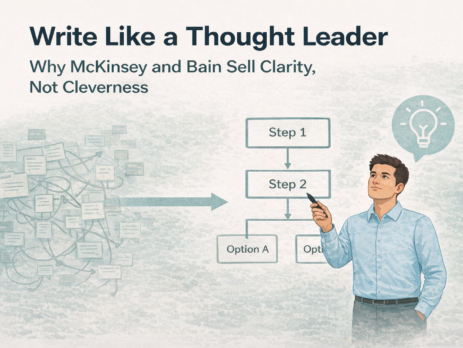
What This Means for Writing Like a Thought Leader
Writing like a thought leader begins before the writing feels comfortable.
You decide what standard your ideas must meet.
Then you earn the right to publish them.
That means accepting a few uncomfortable rules.
First, difficulty is not a signal to simplify your ambition.
It’s a signal that the idea may finally be stretching far enough.
Second, not every insight deserves a book.
Modern authors don’t write books to express ideas. They write books to reshape thinking.
If the idea cannot sustain depth across chapters, it belongs in a smaller format.
Third, transformation is the real metric.
A serious book changes how the reader sees the problem, how they set their standards, and how they act afterward.
If the reader finishes exactly where they started, the work was commentary, not authorship.
Finally, durability matters more than visibility.
Rankings measure a moment.
Recommendation measures impact.
The real test of a serious book is simple:
Will people still be telling others to read it years from now?
That is the standard Simon Sinek operates by.
And it’s the standard serious thought leaders adopt if they want their work to outlast the launch.
Eric Koester is an award-winning entrepreneurship professor at Georgetown University, bestselling author, and founder of Manuscripts, the Modern Author OS used by more than 3,000 authors. His work has helped creators turn ideas into books, books into brands, and brands into scalable businesses.
About Manuscripts
Manuscripts is the leading full-service publishing partner for modern nonfiction authors. We help founders, executives, coaches, and experts turn their books into growth engines, through positioning, coaching, developmental editing, design, AI-enhanced writing tools, and strategic launch systems. Manuscripts authors have sold thousands of books, booked paid speaking gigs, landed media features, and generated millions in business from their IP.
Work With Us
If you’re writing a book you want to matter, let’s map out your Modern Author Plan.
Why Building an Audience Stops So Many Authors From Starting
You have the idea.
Maybe it started as a recurring client question. Maybe it’s a framework you’ve used for years. Maybe you have a rough outline. A few draft pages. Notes in a folder you keep revisiting.
Then the momentum breaks.
Not because you doubt the idea.
Because a simpler question lands:
Who will read this?
And the internal dialogue shows up fast:
I don’t have an audience.
I don’t have a following.
I don’t have a newsletter.
I don’t have a platform.
For serious professionals, this fear is rarely vanity.
It’s risk management.
Publishing feels like public exposure. If no one reads, the effort becomes waste. If the book lands quietly, it feels like a signal of irrelevance.
So the project stalls at the same place every time:
Not at writing. At distribution.
This is the structural misunderstanding.
Most authors assume they need to build an audience at scale before they earn the right to publish.
They assume the book is downstream of platform.
That assumption is what stops the work before it starts.
“The most successful nonfiction books are not written for audiences.
They are written with them.”
— Eric Koester
How to Build an Audience Before Writing a Book
The assumption that stops most authors is straightforward:
You need a large audience before you can publish a successful book.
This belief leads many professionals to delay writing until they feel they have “earned” the right to publish through platform growth.
In practice, this assumption produces the opposite result: the audience never arrives, and the book never starts.
The structural issue is not the author’s idea.
It is the model they are following.
Old Model: Audience First, Book Later
The traditional belief about publishing follows a linear sequence:
Build an audience → Grow followers → Write the book → Publish → Hope the audience buys
This model assumes that audience scale must come first.
For most professionals, this is unrealistic. Building a large online following requires sustained content production, algorithm visibility, and years of platform growth.
Even when an audience exists, conversion to book buyers is uncertain.
The result is a fragile launch: a finished manuscript with no guaranteed readers.
Modern Author Model: Readers First, Audience Later
The Modern Author model reverses the sequence.
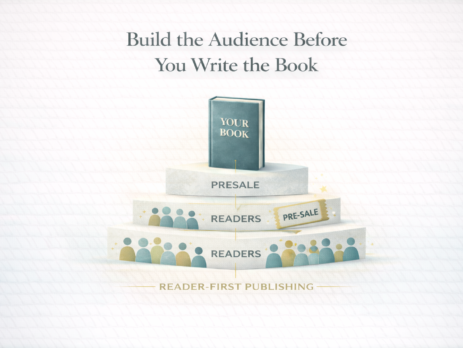
Activate relationships → Validate the idea → Run presales → Write with readers
Instead of trying to reach thousands of strangers, the focus shifts to a smaller group of committed readers.
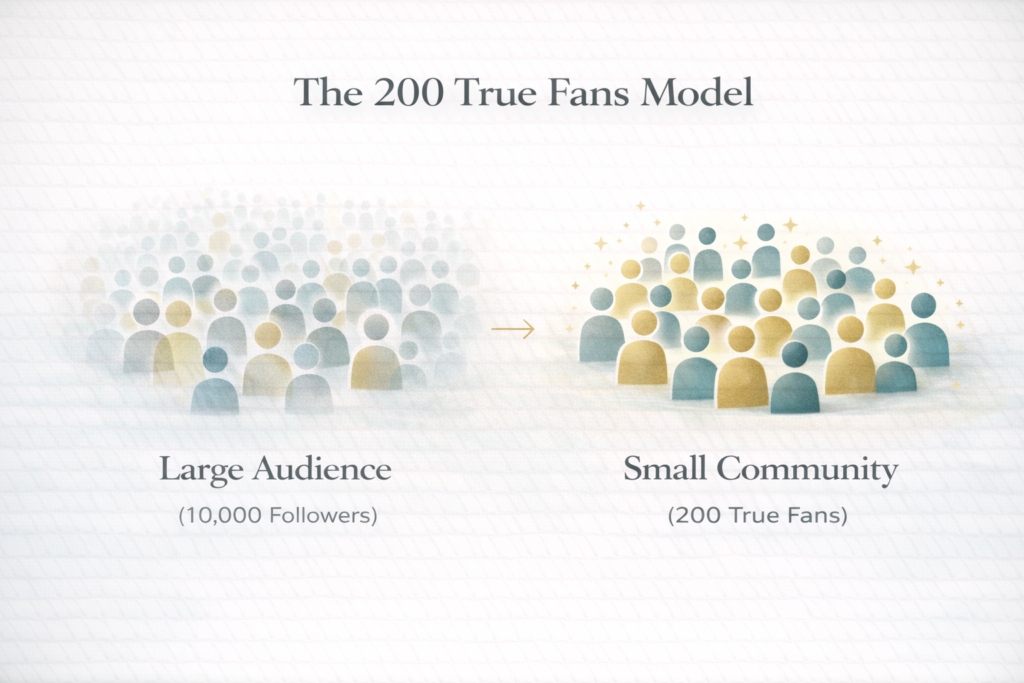
This guide calls these readers true fans.
A true fan is someone who:
cares about the topic of the book
buys the book when it releases
participates in early conversations
recommends the book to others
In practice, a successful nonfiction book does not require a massive audience.
It requires 200–300 true fans.
When these readers are activated early, they can:
validate whether the idea resonates
provide feedback during the writing process
purchase the book before publication
generate momentum at launch
The book no longer depends on platform size. This is how modern authors think about books, not as standalone outputs, but as systems that connect to real outcomes
It grows from a defined community around the idea.
The objective shifts from becoming an influencer to activating committed readers before the manuscript is finished.
Build an audience before writing a book is the modern path to successful nonfiction publishing, because demand, not platform size, determines launch outcomes.
For authors, building an audience is not about scale, it’s about identifying and activating the right readers early.
This guide teaches the true fans model, invite marketing, reader advisory boards, and presale publishing so you can validate your idea, fund production, and write with readers instead of in isolation.
Building an audience as an author does not mean chasing followers or growing a large platform. In this guide, audience building means identifying committed readers early, validating the idea, and creating demand before the manuscript is finished.
60-Second Decision Box
Who This Guide Is For
This guide is for nonfiction authors who:
are coaches, consultants, founders, or serious professionals
want their book to create authority or business leverage
believe they must build a large audience before they can write
If your goal is a book that drives clients, speaking invitations, or long-term positioning, the audience question is not optional. It is upstream.
The Core Insight
You do not need a large platform to publish a successful book.
You need a small community of 200–300 true fans, people who will buy, participate early, and help create momentum at launch.
This guide teaches a reader-first approach: activate demand before the manuscript is finished.
What This Guide Will Teach You
Building an audience for a book does not require scale. It requires structure.
This guide introduces a set of practical systems that allow serious nonfiction authors to validate demand, activate committed readers, and fund their book before the manuscript is finished.
Each system addresses a specific constraint in the publishing process.
Modern Fan Theory
A realistic audience target that replaces the “big platform” myth by focusing on 200–300 committed readers who will buy, participate, and advocate for the book.
Invite Marketing
A relationship-first outreach approach that activates existing networks through direct invitations rather than relying on algorithm-driven broadcasting.
Reader Advisory Board
A small group of ideal readers who provide structured feedback during the writing process and become the core community around the book.
Presale Ladder
A tiered presale structure that validates demand, funds production, and creates launch momentum before publication.
Write-As-You-Grow Model
An integrated writing process where reader conversations inform the manuscript while the audience grows alongside the book.
The 90-Day Audience Activation Plan
A structured timeline for mapping relationships, activating early readers, and running a presale within a manageable three-month window.
Together, these systems replace the traditional publishing assumption that audience must come first.
Instead, they show how authors can build momentum, validation, and community while the book is still being written.
A Reader-First Audience Building System for Authors
Most audience-building advice treats it as a marketing activity.
Post more content. Chase the algorithm. Grow follower counts. Hope the audience eventually converts into readers.
For most nonfiction authors, especially professionals with demanding careers, this model fails. It assumes years of content production before a book is even written, and it confuses visibility with reader commitment.
Modern Author publishing approaches the problem differently.
Instead of trying to attract a large anonymous audience, authors use a structured audience-building system to identify committed readers, validate the book’s idea, and create early demand before publication.
This system is not a collection of tactics. It is a publishing process that moves from relationships to readers, and from readers to a funded book.
Together, these components create a repeatable path from idea → reader validation → presale momentum → funded book launch.
As shown in the Modern Author Reader Engine, the goal is not to build a massive following. It is to activate the right readers early enough that the book launches with momentum already in place.
Visual System Anchor
The Modern Author Reader Engine
Audience building for a nonfiction book is not a marketing activity added at the end of the process.
It is a structured publishing system that begins with relationships and progresses through a series of reinforcing stages that transform early interest into a funded book and a momentum-driven launch.
The Modern Author Reader Engine illustrates how this system operates.
Relationships → Three Circles of Fans → Reader Advisory Board → Early Interest List → Presale Ladder → Funded Book → Launch with 200–300 Fans → Business Outcomes
Each stage performs a distinct function in the system.
Relationships are the starting asset. Every professional already has a network of colleagues, clients, and peers who care about the problems they work on.
These relationships are then organized through the Three Circles of Fans framework, which maps potential early supporters across close relationships, professional networks, and extended connections.
From this mapped network, a small group of ideal readers forms the Reader Advisory Board, a structured feedback group that validates the problem, tests the book’s positioning, and helps shape the manuscript early.
Reader interest generated through these interactions becomes the Early Interest List, a small but highly relevant group of people who want to follow the book’s development.
The Presale Ladder converts this interest into structured early commitments, allowing authors to validate demand and fund the book’s production before publication.
When presales cover production costs, the result is a Funded Book, a project supported by real reader demand rather than speculative marketing.
At launch, the book already has 200–300 committed fans who buy early, participate in events, and help generate initial momentum.
This early momentum produces the final stage of the engine: Business Outcomes such as client opportunities, speaking invitations, partnerships, and long-term authority.
Each stage strengthens the next.
Relationships become readers. Readers become supporters. Supporters become launch momentum.
As shown in the Modern Author Reader Engine, the goal is not to build a massive audience.
It is to activate the right readers early enough that the book launches with demand already in motion.
PART I — Modern Fan Theory
The Audience Building Myth
Many professionals delay writing a book because they believe they need a large platform first.
They assume successful publishing requires thousands of followers, a large email list, or a significant social media presence.
This assumption is widespread, but structurally incorrect.
Books do not succeed because an author has a large audience. They succeed because a small number of the right readers care enough to participate early.
Modern publishing outcomes are driven by reader commitment, not follower counts.
The following comparisons illustrate the most common misconceptions.
Myth
Reality
You need 10,000 followers before publishing a book.
You need 200 readers who care about the topic and will support the launch.
A large social media platform is required to sell books.
A small network of committed readers can create sufficient launch momentum.
Audience growth must happen before the book idea is validated.
Authors can validate demand early through conversations and reader participation.
Book launches depend on broadcast visibility.
Successful launches are driven by activated readers who buy early and spread the word.
The implication is straightforward.
Authors do not need to become influencers before writing a book.
They need to identify and activate a small community of readers who care deeply about the problem the book solves.
This principle is the foundation of Modern Fan Theory, which reframes audience size from a visibility metric into a relationship metric.
What a True Fan Actually Is
True Fan A person who:
buys your book
shows up for events or live discussions
refers others who are likely to care
follows your work over time, not just once
A true fan is not a follower.
They are a committed reader, someone who is willing to exchange attention, money, and advocacy for the work you are building.
Operationally, the test is simple: a true fan takes action before the book is finished, not after it is published.
Rule of thumb: A true fan buys once, shows up once, and tells two people.
The Three Circles of Fans
Most professionals already have the raw material for their first 200–300 true fans. The challenge is rarely audience size. The challenge is audience visibility.
Authors assume they must build an audience from scratch. In practice, the first audience usually already exists inside the author’s professional and personal network. It simply has not been mapped.
The Three Circles of Fans framework makes this visible. It organizes existing relationships into three layers based on proximity and likelihood of early participation.
Circle 1 — Inner Circle
The Inner Circle includes close relationships with strong trust.
These are people who already know you well: colleagues, collaborators, mentors, friends, and long-time professional contacts. They may not all be ideal readers, but they are the most likely to support the project early.
Their role in the system is simple: early encouragement and initial participation.
Because trust already exists, this group often becomes the first group to join advisory boards, early discussions, or initial launch events.
Circle 2 — Professional Network
The second circle includes broader professional relationships.
These are people who recognize your work but may not interact with you regularly: former clients, peers in your industry, conference contacts, LinkedIn connections, or past collaborators.
This circle frequently contains the largest concentration of ideal readers, because these individuals are already aligned with your field of expertise.
As the project becomes visible, this group becomes a major source of advisory board members, early readers, and presale supporters.
Circle 3 — Referral Network
The outer circle forms through introductions and referrals.
These individuals may not know you yet, but they match the reader profile for the book. They enter the network through recommendations from the first two circles.
This layer becomes the mechanism through which the audience expands beyond the author’s direct relationships.
Reader Mapping Template
To make the framework actionable, begin by mapping potential supporters across the three circles.
Readers can use the following simple template.
Circle 1 — Inner Circle (Close Relationships) List people who know you well and would likely support the project early.
Circle 2 — Professional Network (Industry and Work Relationships) List colleagues, clients, peers, and professional contacts aligned with your topic.
Circle 3 — Referral Network (Potential Introductions) List individuals who could be introduced through your existing network.
The goal of this exercise is not precision. It is visibility.
Most authors discover that their initial audience is not something they must build from zero. It already exists within their network, and can be activated once it is clearly mapped.
The Economics of 200 True Fans
The assumption behind most audience-building advice is simple: a book needs a large audience to succeed.
In practice, the economics of publishing tell a different story.
Books do not require thousands of buyers to become viable. A small group of committed readers can generate enough early demand to fund production, validate the idea, and create launch momentum.
This is the logic behind the 200 True Fans model.
A true fan is not a passive follower. A true fan is a reader who is willing to support the project early, through presales, events, or participation in the writing process.
When even a modest number of these readers participate, the financial impact becomes meaningful.
Supporters
Average Spend
Result
200
$75
$15,000
150
$100
$15,000
These numbers are intentionally conservative.
A presale purchase may include early access to the book, participation in reader sessions, or bundled experiences tied to the project. The average spend reflects these early-support formats rather than the price of a single retail book.
The key insight is structural:
A book does not need a massive audience to become financially viable. It needs a small community of committed readers who participate early.
Once that initial group exists, the launch is no longer dependent on visibility alone. It is supported by a base of readers who are invested in the book’s success.
Authority Data Moment
The 200-Fan Reality
The idea that a book requires a massive platform often collapses when examined through real examples.
Many successful nonfiction launches begin with small, professional networks, not large online audiences. What matters is not follower count but the ability to activate relationships around a clear idea and a structured project.
The following case illustrates how a modest network can translate into meaningful early demand.
Consultant Presale Launch
Starting Point
~300 professional contacts
No email list
Limited social media activity
Action
Mapped contacts using the Three Circles of Fans framework
Invited 30 peers and clients to join a Reader Advisory Board
Hosted several feedback sessions to refine the book’s positioning
Opened a structured presale to the advisory board and extended network
Result
160 presale buyers
$16,000 raised before manuscript completion
The key takeaway is structural.
The author did not build a large audience before writing the book. Instead, they activated an existing professional network, converted early supporters into readers, and used presales to validate and fund the project.
This pattern appears repeatedly in modern nonfiction publishing: a small group of committed readers can generate both financial viability and launch momentum.
PART II — Invite Marketing
Broadcast Marketing vs Invite Marketing
Most “build your audience” advice assumes you are running a media business.
It prescribes scale tactics, publish constantly, chase reach, optimize for algorithms, and treats attention as the prerequisite for readership.
For serious nonfiction authors, that model is structurally mismatched. It is slow to compound, hard to sustain alongside real work, and unreliable at converting strangers into committed readers.
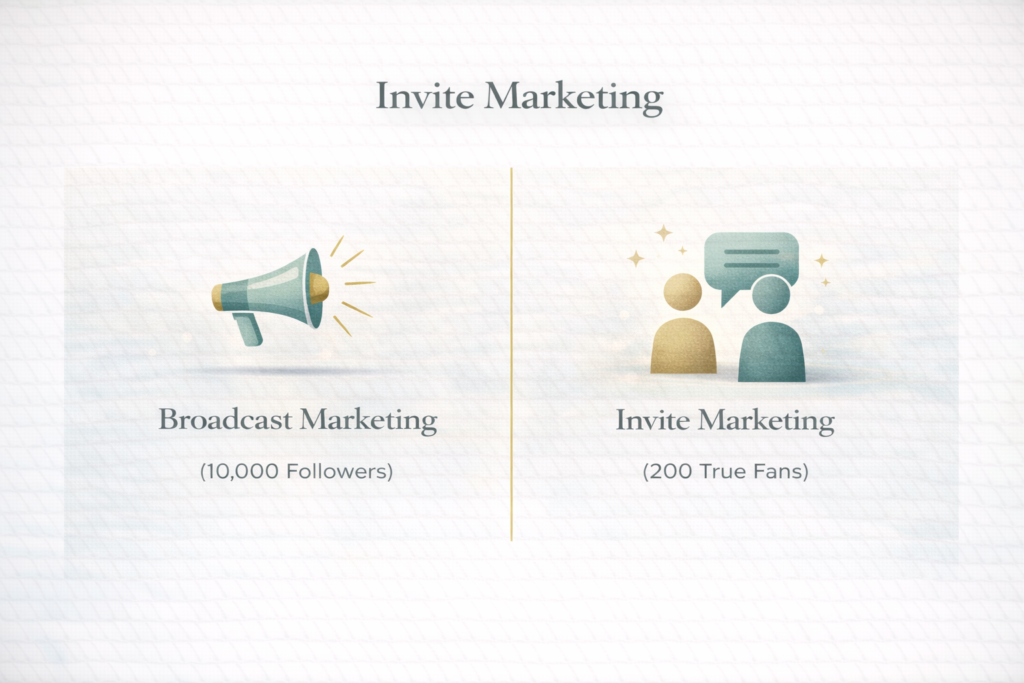
Invite Marketing is the alternative: relationship-based activation. It treats your existing network as the starting asset and uses direct outreach to convert relevance into participation.
Broadcast Marketing
Invite Marketing
Social posts designed for reach
Direct outreach designed for response
Algorithm dependent
Relationship based
High volume, low signal
Low volume, high signal
Passive “hope they see it”
Active “ask them in”
Weak conversion to action
High conversion to participation
The distinction is not stylistic. It is economic.
Broadcast marketing competes for attention. Invite marketing creates commitment, the raw input required for advisory boards, interest lists, presales, and a reader-led launch.
Invite Marketing: A Smarter Way to Build an Audience for a Book
Invite marketing works when invitations are designed, not improvised.
A typical post about a book is a broadcast. It is open-ended, optional, and easy to ignore.
An invitation is different. It is a direct request to a specific person to participate in a defined stage of the book project.
This shift matters. Books do not gain early momentum through attention alone. They gain momentum through activated readers, people who agree to contribute feedback, participate in discussions, and eventually support the book’s launch.
The Invite Marketing Framework provides a simple structure for these invitations. Every effective invite contains four components.
Personal — Why This Person
The invitation begins with relevance.
Explain why this individual was selected. The recipient should immediately understand why their perspective matters.
Common reasons include:
they represent the ideal reader
they have experience in the subject area
their feedback has been valuable in the past
This is not flattery. It is context. People respond more readily when the invitation reflects genuine alignment with their expertise or interests.
Clear — What the Invitation Is
Define the container.
People do not join “a book project.” They join a specific activity within the project.
Examples include:
a Reader Advisory Board
an early interest list
a small feedback session
a topic roundtable
Clarity reduces hesitation because the commitment is understandable.
Specific — The Role They Play
The invitation must define the action being requested.
Vague language, such as “I’d appreciate your support”, creates uncertainty. Clear requests create decisions.
Examples of specific roles include:
reviewing a one-page concept
attending a 45-minute discussion session
providing feedback on a chapter draft
sharing the questions they would want the book to answer
When the role is clear, the recipient can quickly decide whether they can participate.
Time-Bound — What Happens Next
Effective invitations include a timeline.
Specify:
when a response is needed
how they should reply
what the next step will be if they accept
A time-bound invitation signals that the book is a structured project, not an open-ended request for help.
Invite Structure (Reference Template)
Most invitations follow a simple progression:
Why you → What this project is → The role you could play → Next step
When these four elements are present, invitations convert reliably. Recipients understand why they were invited, what participation involves, and how their contribution fits into the larger book project.
The Four Core Invitation Types
Invite marketing activates readers through a sequence of targeted invitations. Each invitation recruits people into a specific role within the book-building process.
Rather than relying on broad announcements, authors use structured invitations to engage individuals who are well positioned to contribute insight, feedback, or early support.
Four invitation types appear consistently across successful book projects.
Reader Advisory Board Invitation
Purpose Recruit a small group of readers who will provide structured feedback during the development of the book.
Audience Peers, colleagues, or professionals who represent the intended reader of the book.
Outcome A core group of 10–25 readers who help test ideas, refine positioning, and strengthen the manuscript before publication.
Structure Example
Why you are inviting them
Explanation of the Reader Advisory Board
The type of feedback you are seeking
The expected commitment (number of sessions or interactions)
Interest List Invitation
Purpose Identify readers who want to follow the progress of the book and receive early updates.
Audience Professional contacts, community members, or individuals who have expressed interest in the topic.
Outcome A list of engaged readers who are likely to participate in early discussions, feedback opportunities, and presale offers.
Structure Example
Brief description of the book idea
Why the topic matters to the audience
Invitation to follow the project’s development
Simple method for joining the interest list
Launch Event Invitation
Purpose Invite readers to participate in the early public conversation around the book.
Audience Members of the interest list, advisory board participants, and professional contacts interested in the topic.
Outcome A live or virtual gathering that introduces the book concept, shares early insights, and expands awareness among potential readers.
Structure Example
Context for the event and the book project
What participants will gain from attending
Date and format of the event
How to confirm participation
Project Participation Invitation
Purpose Engage readers directly in shaping specific parts of the book.
Audience Individuals with relevant experience or perspectives related to the book’s themes.
Outcome Contributions such as questions, insights, examples, or reactions that help refine the book’s ideas.
Structure Example
Description of the specific topic or chapter
The type of input being requested
How the contribution will be used
Timeline for submitting feedback
Each invitation type activates a different form of participation. Together, they transform a passive network into an engaged community of early readers supporting the development and launch of the book.
PART III — Reader Advisory Board
What a Reader Advisory Board Is
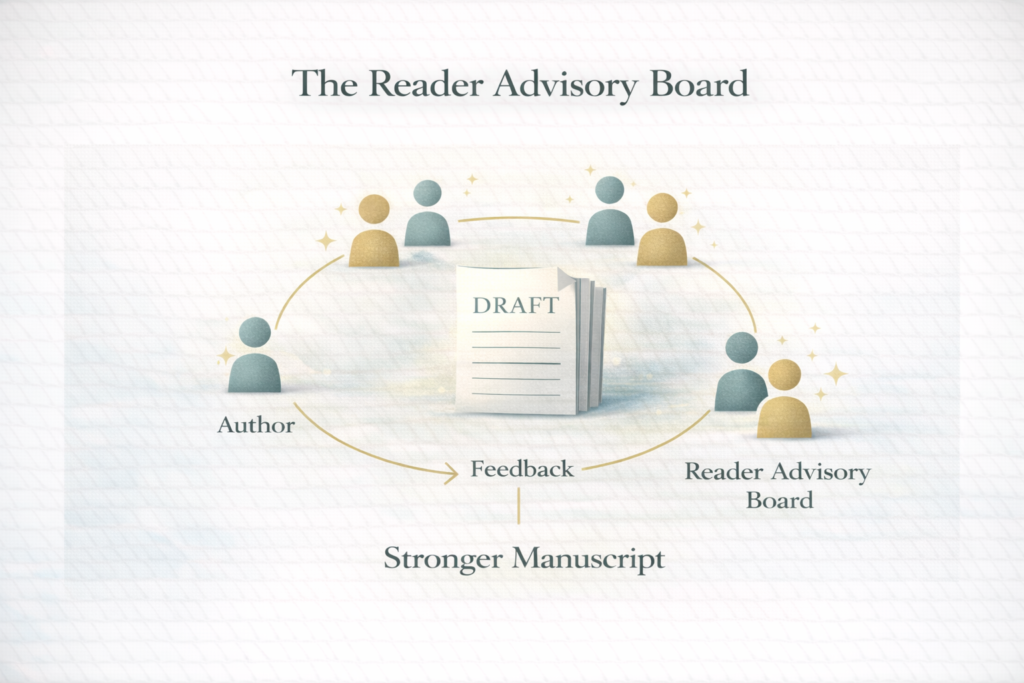
A Reader Advisory Board is a small group of engaged readers who participate in the development of the book before publication.
Instead of writing in isolation and presenting a finished manuscript to the market, the author works with a structured group of readers who provide feedback throughout the writing process.
A typical Reader Advisory Board includes:
10–25 members
3–5 structured interactions or meetings
Feedback provided at key stages of development
This structure turns the writing process into a collaborative testing environment.
The board serves three functions within the book project:
Reader Lab
A structured environment for testing the book’s core elements with real readers.
Ideas, positioning, titles, frameworks, and early chapters can be evaluated against the perspective of people who represent the intended audience. This reduces guesswork and allows the manuscript to evolve in response to genuine reader insight.
Early Community
A small group that becomes familiar with the project long before publication.
Through discussions and feedback sessions, advisory members gain early visibility into the book’s ideas and development. This creates a natural foundation of engaged readers who understand the project and its purpose.
Launch Team
Participants who often become the book’s first advocates.
Because they have contributed to the development process, advisory members are more likely to support presales, participate in launch events, and introduce the book to their own networks.
When used well, the Reader Advisory Board ensures the book is shaped not only by the author’s expertise but also by the real questions, language, and priorities of its intended readers.
These early readers often become the first layer of authority and opportunity creation
The effectiveness of a Reader Advisory Board depends on the composition of the group.
The goal is not simply to gather supportive voices. The goal is to assemble a small group of readers who closely resemble the book’s intended audience and who are willing to provide candid, thoughtful feedback during the development process.
Advisory members should represent the real readers the book is written for, not only the author’s closest colleagues or friends.
Selection Checklist
When identifying potential advisory board members, prioritize individuals who meet the following criteria:
Represent the ideal reader Their role, experience, or perspective aligns with the audience the book intends to serve.
Willing to provide honest feedback They are comfortable offering constructive criticism rather than only encouragement.
Reachable and responsive They can realistically participate in discussions or provide feedback during the writing process.
Bring diverse perspectives Members represent different viewpoints within the target audience, helping surface varied questions, concerns, and interpretations.
A well-composed advisory board reflects the range of readers the book hopes to reach, allowing the author to test ideas against multiple perspectives rather than a single viewpoint.
Avoid filling the board exclusively with close friends or enthusiastic supporters. While supportive readers are valuable, a board composed only of familiar voices often produces limited insight.
The objective is not agreement, it is informed reader perspective.
How Advisory Boards Shape the Book
A Reader Advisory Board improves the book by introducing structured reader feedback at key stages of development.
Instead of waiting until publication to learn how readers respond to the ideas, the author receives input during the writing process. This allows positioning, structure, and messaging to be refined before the manuscript is finalized.
Advisory boards typically interact with the project through a small number of focused sessions.
Meeting 1 — Problem Validation
The first session tests the core problem the book addresses.
Advisory members evaluate whether the challenge described in the book reflects real experiences within the intended audience. This stage helps confirm that the book is solving a problem readers recognize and care about.
Feedback often surfaces:
gaps in how the problem is framed
additional questions readers expect the book to answer
language that better reflects how the audience describes the issue
Meeting 2 — Title and Outline Testing
The second session focuses on the book’s positioning and structure.
Advisory members react to the working title, subtitle, and chapter outline. Their responses help clarify which ideas resonate most strongly and which sections require refinement.
This stage strengthens:
the clarity of the book’s promise
the logical flow of the argument
the relevance of individual chapters
Meeting 3 — Chapter Feedback
Once early chapters are drafted, advisory members review selected sections of the manuscript.
Their feedback highlights areas where explanations are unclear, examples need strengthening, or ideas require further development. This stage ensures the manuscript communicates its insights in a way that readers can easily understand and apply.
Optional Session — Cover and Launch Planning
Some authors hold an additional session to gather reactions to early cover concepts or to discuss the upcoming launch.
Because advisory members have followed the project throughout development, they often provide useful perspective on how the book will appear to new readers.
Founder Book Refinement
Starting point Draft outline but unclear positioning
Action Ran three advisory board sessions with 15 readers
Result Title and framework clarified Book later generated enterprise speaking invitations
PART IV — The Presale Ladder
Presales for Authors: How to Validate and Fund a Book Before Publishing
Most authors interpret presales as a request for support.
That framing creates the wrong incentives:
it turns the outreach into a favor
it attracts sympathy buyers instead of committed readers
it delays the real work of validating whether the book is wanted
In the Modern Author model, presales are something different.
They are an early market test that also funds production.
Misconception: Presales are begging
In the common model, presales sound like: “I’m writing a book, would you buy it to help me?”
That message positions the buyer as doing the author a favor.
It signals uncertainty about whether the book is worth buying on its own.
Reality: Presales are selling early access
A presale is a structured offer to a specific reader: “You care about this problem. I’m building the book to solve it. You can get early access and participate before it launches.”
The reader is not “supporting the author.”
They are purchasing a defined outcome:
early access to the ideas
participation in shaping the work
priority inclusion in the launch experience
Why this matters
When presales are framed correctly, they do two jobs at once:
Validation If readers buy early, before the book exists in final form, you have proof the positioning is strong and the problem is real.
Funding Presales convert interest into resources that pay for editing, design, and launch execution without relying on the author’s personal budget.
Presales are not a marketing tactic.
They are the foundation of a momentum-driven launch
They are a decision tool: a way to confirm that the book has demand before the manuscript is locked.
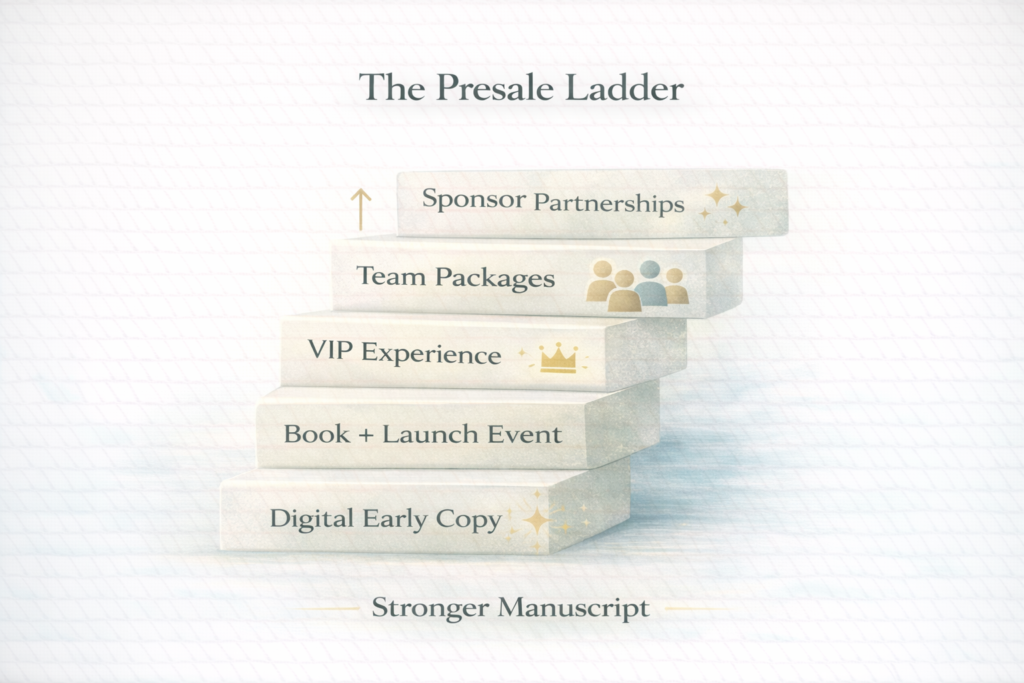
The Presale Ladder Model
A presale ladder organizes early offers into multiple participation levels, allowing readers to support the book according to their level of interest, access, and organizational role.
Instead of offering a single purchase option, the ladder converts different forms of engagement, individual reading, community participation, professional access, and organizational adoption, into structured tiers.
Each tier serves a different type of reader and plays a different role in validating and funding the book.
Digital Early Copy
Purpose Provide early access to the ideas for readers who want the content before public release.
Target Audience Individual readers interested in the topic but not seeking direct interaction with the author.
Ladder Flow This is typically the entry point of the presale ladder, capturing baseline demand from the widest portion of the audience.
Ideal Use Case
Testing market interest
Building early reader momentum
Validating positioning and topic relevance
Strengths
Lowest barrier to entry
Broad participation
Fast signal of demand
Limitations
Generates limited revenue per participant
Provides minimal direct reader interaction
Book + Launch Event
Purpose Create a shared moment around the book by combining the purchase with a live discussion or launch session.
Target Audience Readers who want context, explanation, or interaction around the book’s ideas.
Ladder Flow Sits above the basic book tier by adding experience-based participation.
Ideal Use Case
Creating early community engagement
Building momentum for the official launch
Turning readers into active participants
Strengths
Strengthens reader connection
Encourages group participation
Increases perceived value of the purchase
Limitations
Requires coordination of event logistics
Participation depends on scheduling availability
VIP Experience
Purpose Provide direct access to the author through a small-group conversation, private briefing, or facilitated discussion.
Target Audience Highly engaged readers who want deeper access to the author’s thinking.
Ladder Flow A limited-access tier designed for high-engagement participants.
Ideal Use Case
Creating premium participation opportunities
Deepening relationships with key supporters
Generating higher-value presale revenue
Strengths
High perceived value
Strong relationship building
Effective for authority positioning
Limitations
Limited capacity
Requires the author’s direct time and attention
Team Packages
Purpose Allow organizations to bring the book’s ideas into their teams through bundled purchases.
Target Audience Managers, department leaders, or executives who want the ideas adopted inside their organization.
Ladder Flow Expands the ladder from individual participation to organizational adoption.
Ideal Use Case
Leadership development programs
Team reading initiatives
Internal training discussions
Strengths
Significantly increases revenue per transaction
Expands the book’s reach across teams
Strengthens the book’s business relevance
Limitations
Requires organizational interest in the topic
May require additional facilitation or support
Sponsor Partnerships
Purpose Allow aligned organizations to support distribution of the book to a defined audience.
Target Audience Partners who benefit from association with the ideas or audience.
Ladder Flow The highest level of the presale ladder, focused on distribution partnerships and ecosystem support.
Ideal Use Case
Industry associations supporting member education
Corporate sponsors aligned with the book’s topic
Organizations funding wider distribution
Strengths
Enables large-scale distribution
Can significantly fund production and launch
Builds institutional credibility
Limitations
Requires strong audience alignment
Partnership negotiation may take longer to structure
Presale Economics
A well-structured presale can realistically fund the core production costs of a nonfiction book.
Instead of waiting until publication to recover expenses, the Modern Author model converts early reader commitment into resources that support the production process. When presales are tied to a clear problem and a defined audience, even a relatively small group of readers can finance the essential stages of publishing.
Typical book production costs include:
Editing Developmental and line editing to refine the manuscript’s structure, clarity, and argument.
Cover Design Professional design that communicates the book’s positioning and improves discoverability.
Layout and Formatting Interior formatting for print and digital editions to ensure readability and production readiness.
Proofreading Final review of the manuscript to correct errors and ensure publication quality.
These elements represent the foundational investment required to move a manuscript from draft to finished book.
Presales allow those costs to be covered before publication by converting early interest into committed purchases. Even modest participation from a defined audience can generate sufficient funding.
For example, if early readers participate through a presale ladder that includes individual and higher-engagement tiers, the combined revenue can finance the book’s production while simultaneously validating demand for the topic.
Leadership Author Presale Ladder
Starting point Small professional network
Action Created a three-tier presale ladder
Result $22K presale revenue Book production fully funded
PART V — Community-First Audience Building for Authors
Why Content-First Audience Building Fails Authors
Most advice about building an audience for a book begins with content production.
The typical recommendation is to start publishing regularly, posting daily, launching a podcast, or growing a newsletter, until an audience eventually forms. Only after that audience exists does the book enter the picture.
For many professionals, this sequence creates an immediate misalignment.
The people most likely to write high-value nonfiction, executives, founders, consultants, and operators, are not full-time content creators. Their time is already allocated to leadership, operations, clients, and decision-making.
Content-first growth assumes a production rhythm that rarely fits those realities.
Common advice often includes:
Post daily on social platforms
Start a podcast
Publish a weekly newsletter
Maintain constant visibility across channels
These tactics can work for creators whose primary role is content production. For professionals writing a book alongside an existing career, the model introduces three structural problems.
1. It turns the book into a media production schedule
A book is a finite project. Content-first growth treats the author like a media company.
Instead of focusing on developing the manuscript and engaging future readers, the author inherits a continuous obligation, new ideas, new posts, and constant publishing.
For most professionals, that pace quickly becomes unsustainable.
2. It optimizes for reach rather than relevance
Content systems reward visibility. Books require something different: qualified readers who care about the problem the book solves.
A large following can produce attention without producing commitment. Visibility alone does not guarantee that readers will buy, discuss, or recommend the book.
3. It delays validation until the manuscript is finished
Content-first strategies postpone the most important question:
Will anyone actually buy this book?
When validation happens only after the manuscript is complete, repositioning the book becomes far more difficult.
For Modern Authors, audience building follows a different logic.
The goal is not constant visibility.
The goal is not to grow an audience, it’s to build the right audience for the book.
The goal is early reader participation, people who engage with the ideas while the book is still being developed.
The Community-First Alternative
If content-first growth prioritizes broadcasting, the Modern Author model prioritizes hosting.
A community-first approach builds an audience through structured interaction with a small group of readers who care about the problem the book explores. Instead of attempting to reach thousands of people through continuous content production, the author focuses on developing meaningful engagement with a smaller, relevant group.
The objective is not visibility. The objective is participation.
In this model, readers are invited into the development of the book itself. They contribute questions, react to ideas, and provide feedback that shapes the direction of the manuscript.
This approach produces two outcomes simultaneously:
a community of engaged readers
a book that reflects real reader needs and language
Because interaction happens directly with potential readers, engagement tends to be deeper and more useful than typical social media engagement metrics.
Examples of Community Touchpoints
Community-first audience building relies on structured interaction formats. These formats allow readers to participate without requiring the author to maintain a constant content production schedule.
Common examples include:
Office hours calls Informal sessions where readers ask questions related to the book’s topic.
Reader roundtables Small-group discussions where participants react to ideas, frameworks, or early concepts from the book.
Topic salons Structured conversations focused on one specific theme or problem explored in the manuscript.
Audio updates Short recorded reflections where the author shares progress or emerging ideas with the reader community.
Each format emphasizes dialogue rather than distribution.
Why Community Depth Matters More Than Scale
A book does not require millions of impressions to succeed.
It requires a relatively small group of readers who:
care about the topic
engage with the ideas
support the project when the book becomes available
Community-first audience building aligns with this reality. Instead of optimizing for reach, it optimizes for relationship depth, the kind of engagement that later supports presales, launch participation, and long-term readership.
In practice, a small community that actively participates in the book’s development often produces stronger outcomes than a much larger but passive audience.
The Reader Feedback Loop
A community-first publishing process creates a continuous reader feedback loop. This loop ensures that the ideas inside the book are shaped by real reader questions rather than developed entirely in isolation.
The core principle is simple: instead of completing the manuscript first and seeking feedback later, the author gathers reader insight while the book is being developed.
This interaction helps refine the book’s positioning, clarify concepts, and ensure the content reflects the language and challenges of the intended audience.
How the Feedback Loop Works
The reader feedback loop typically follows a repeating cycle:
Reader Conversations The author engages with readers through structured interactions such as advisory board meetings, roundtables, or office hours discussions.
Idea Refinement Insights from those conversations help clarify which ideas resonate most strongly and which concepts require adjustment or simplification.
Chapter Development The author develops sections or chapters based on the refined ideas.
Feedback Integration Early readers review or react to these sections, providing additional insight that strengthens the next iteration of the manuscript.
This process repeats throughout the development of the book.
The Reader Feedback Loop Model
The reader feedback loop operates as a structured development cycle. Instead of writing the entire manuscript before receiving feedback, the author tests ideas continuously with early readers.
This cycle ensures that the book evolves alongside real reader insight.
The Reader Feedback Loop
1. Reader Conversations Direct interaction with readers through advisory boards, roundtables, or topic discussions surfaces the questions and problems that matter most to the audience.
↓
2. Idea Refinement Insights from these conversations clarify positioning, strengthen frameworks, and reveal which ideas resonate most strongly.
↓
3. Chapter Development The author converts the refined ideas into structured chapters, sections, or frameworks inside the manuscript.
↓
4. Reader Feedback Early readers review concepts, respond to sections, and highlight areas that require clarification or expansion.
↓
5. Improved Manuscript Each cycle strengthens the manuscript by aligning the ideas more closely with the audience’s language, needs, and real-world experience.
Because this loop operates throughout the writing process, the manuscript is tested and refined long before publication.
Why the Loop Improves Book Quality
Traditional writing models rely heavily on the author’s internal perspective. While this can produce strong ideas, it often delays audience validation until late in the publishing process.
A reader feedback loop changes that dynamic.
Because readers participate early:
unclear ideas surface quickly
language becomes aligned with reader vocabulary
frameworks improve through real-world testing
The result is a manuscript that is both clearer and more relevant to the audience it intends to serve.
Why Generic Newsletters Fail Authors
Many professionals assume that starting a newsletter is the natural first step in building an audience for a book.
In practice, most newsletters fail to create meaningful engagement because they lack a clear project behind them. Without a defined purpose, the newsletter becomes a stream of general commentary rather than a structured relationship with readers.
The issue is not the format itself. The issue is the absence of a concrete publishing objective.
A newsletter that promises broad insights, such as leadership ideas, productivity tips, or industry commentary, competes with thousands of similar publications. Readers may subscribe, but sustained engagement tends to remain low because the content does not connect to a specific outcome.
The Problem With Generic Newsletter Promises
Generic newsletters often rely on vague value propositions.
Examples include:
Weak Promise
“Get leadership insights.” “Weekly thoughts on business and strategy.” “Reflections on growth and innovation.”
These promises are broad and open-ended. They do not tell readers why the newsletter exists, what role the reader plays, or what outcome the communication is building toward.
As a result, readers passively consume the content, if they engage at all.
The Project-Based Alternative
Newsletters become far more effective when they are tied to a clear publishing project.
A project-based newsletter invites readers to participate in the development of a specific book. Instead of broadcasting general ideas, the communication centers on the progress of the manuscript and the questions the book aims to answer.
For example:
Stronger Promise
“Follow the writing of this book and help shape the final version.”
This type of invitation changes the reader’s role. Instead of being a passive subscriber, the reader becomes a participant in the development process.
When newsletters are connected to a defined book project, they create:
clearer expectations for readers
stronger engagement around ideas
a natural pathway toward presales and launch participation
In this model, the newsletter is not an independent media channel. It is a communication layer within the broader reader-building system that supports the development and eventual launch of the book.
PART VI — Write-As-You-Grow
The traditional publishing process assumes that the manuscript must be completed before meaningful interaction with readers begins.
In this model, authors spend months, sometimes years, writing in isolation. Only after the manuscript is finished do they begin the process of finding an audience, marketing the book, and testing whether the ideas resonate.
The Write-As-You-Grow model reverses this sequence.
Instead of writing privately and searching for readers later, the author develops a small community first and integrates reader insight throughout the writing process. This approach ensures that the book evolves alongside the audience it intends to serve.
The Write-As-You-Grow Model for Building an Audience While Writing
The difference between the two approaches can be understood as a shift in sequence.
Traditional Publishing Model
Modern Author Model
Write the manuscript
Build early readers
Publish the book
Test ideas through reader conversations
Begin marketing
Write with reader feedback
Attempt to find readers
Launch with existing reader support
In the traditional model, audience discovery happens after publication. In the modern model, audience interaction begins before the manuscript is complete.
Why the Sequence Matters
Changing the order of these steps produces three important advantages.
First, ideas are validated earlier. Reader conversations reveal which concepts resonate and which require refinement before they become fixed in the manuscript.
Second, the writing process becomes more focused. Instead of guessing what readers may find useful, the author develops chapters based on the questions and problems already surfaced by the community.
Third, the book launches with momentum. Because readers have already participated in the development process, they are more likely to support presales, attend events, and recommend the book within their networks.
The result is a book that is not only better aligned with reader needs but also supported by a small community that helped shape it.
The Write-As-You-Grow Loop
The Write-As-You-Grow model works because it turns “audience building” into an operating system for improving the manuscript.
Instead of treating reader engagement as marketing that begins after publication, it treats reader engagement as input that shapes what gets written, how it’s framed, and what gets emphasized.
This loop is the mechanism.
The loop, step-by-step
1) Reader discussion You convene conversations with people who resemble the intended reader, Advisory Board sessions, small roundtables, 1:1 calls, or topic salons. The goal is not approval. It’s signal: what they’re confused by, what they already believe, what language they use, and what they actually want solved.
2) Idea capture You convert conversation into usable writing material. Capture:
the exact questions readers ask (these become section headings)
the objections they raise (these become clarifying paragraphs)
the phrases they repeat (these become your positioning language)
the examples they request (these become your case frames)
This is where most authors lose the value: they talk to readers, then rely on memory. The loop only works when the output is recorded and reusable.
3) Chapter development You write the next chapter (or revise the current one) using what the conversations revealed:
sharpen the promise of the chapter around the real problem readers named
remove sections that answer questions no one is asking
add explanations where confusion appeared
choose language that matches how readers describe the problem
This stage keeps the manuscript from drifting into “what the author finds interesting” instead of “what the reader needs.”
4) Reader validation You bring the updated thinking back to readers, often in a lightweight form:
a short outline
a 2–3 page excerpt
a single framework slide
a draft chapter section
The goal is not line edits. It’s confirmation that the framing holds: Does this match how you see the problem? Would this change your behavior? What still feels unclear?
Then the loop repeats.
Simple Write-As-You-Grow Loop Model
Reader discussion → Idea capture → Chapter development → Reader validation → Stronger manuscript
As shown in the Modern Author Reader Engine, this loop is what turns early relationships into both a better book and a launch-ready reader base.
By the time the manuscript is complete, the core ideas, language, and structure have already been pressure-tested with the people the book is for.
Weekly Operating Rhythm
A Write-As-You-Grow system works only if it fits inside a predictable weekly cadence. The goal is not to “do more.” The goal is to run a repeatable loop that advances the manuscript while continuously incorporating reader insight.
Each week should move three things forward:
Writing progress
Reader signal
System organization
This structure allows professionals to develop a stronger manuscript without requiring daily content production or large time commitments.
Writing Session
The writing session is a protected block dedicated to producing one clear unit of progress.
Examples of a writing unit:
a chapter subsection
a framework explanation
a refined introduction
a case example
The objective is measurable progress, not perfect prose. Each session should produce a section that can later be reviewed or tested with readers.
Small, consistent units accumulate into a finished manuscript.
Reader Interaction
Reader interaction is where the author gathers insight from people who resemble the intended audience.
Typical formats include:
a short advisory board call
a small reader roundtable
a focused conversation with 3–5 readers
a brief discussion about a specific chapter idea
The purpose is not promotion. It is signal gathering.
Authors should listen for:
questions readers ask naturally
objections or confusion
the language readers use to describe the problem
examples readers request
These signals reveal where ideas need clarification or refinement.
System Organization
System organization ensures that insights from reader conversations actually improve the manuscript.
During this short weekly step, the author should:
capture key questions and phrases from reader discussions
tag insights to relevant chapters or sections
decide what changes should be reflected in the next writing session
Without this step, feedback remains informal conversation rather than becoming actionable manuscript improvement.
A Simple Weekly Cadence
A practical weekly rhythm might look like this:
Early week — Writing session Draft or revise one manuscript unit.
Midweek — Reader interaction Host a short conversation to test ideas or gather reader perspective.
End of week — System organization Capture insights and determine what will change in the next writing session.
This cadence keeps writing, reader input, and refinement moving forward together.
For professionals managing demanding schedules, this structure provides steady progress without requiring daily publishing or constant audience activity.
Writer-Audience Feedback Loop
Starting point Early manuscript draft
Action Shared chapters with an advisory board and integrated reader feedback weekly
Result Major sections rewritten from reader insight 200+ presale buyers at launch
PART VII — AI + Codex for Reader Insight
Using AI for Audience Discovery
One of the most common challenges authors face early in the writing process is understanding how readers actually describe the problem the book is solving.
Authors often begin with their own language, industry terminology, internal frameworks, or professional shorthand. Readers, however, frequently use different words, ask different questions, and frame the problem differently.
AI tools can help surface these patterns quickly.
In this guide, AI refers to tools that analyze large volumes of public questions, discussions, and language patterns across search engines, forums, and professional networks. Used correctly, these tools help authors identify:
the questions readers repeatedly ask
the words readers use to describe the problem
the misconceptions readers hold
the specific outcomes readers are seeking
This insight helps authors refine positioning and ensure the manuscript addresses real reader needs rather than assumed ones.
What AI Helps You Discover
Used early in the process, AI tools help authors identify:
Common reader questions that can become chapter sections
Language patterns readers use to describe the problem
Misconceptions or confusion that require explanation
Specific outcomes readers want, which clarify the book’s promise
These signals help shape:
chapter structure
framework explanations
section headings
positioning language
Instead of guessing what readers care about, authors can begin with observable patterns.
Example AI Discovery Prompts
Authors can use simple prompts to surface reader language and questions.
Example Prompt 1
What are the most common questions professionals ask about writing a nonfiction book?
Purpose: identify questions that may become chapter topics.
Example Prompt 2
What problems do consultants face when trying to build an audience for a book?
Purpose: surface real-world friction points the manuscript should address.
Example Prompt 3
How do professionals describe the challenge of writing a book while working full-time?
Purpose: capture the language readers use when explaining the problem.
AI does not replace reader conversations. It accelerates the discovery of patterns that can then be tested through advisory boards, reader discussions, and presale engagement.
Used this way, AI becomes a research assistant, helping authors align the manuscript with the real questions readers are already asking.
Codex as Audience Intelligence
AI tools help authors discover broad patterns in public questions. Codex serves a different role.
Codex analyzes the specific conversations and feedback generated during the writing process, reader advisory sessions, roundtables, messages, and early presale interactions, and converts them into structured insight that can directly inform the manuscript.
In this guide, Codex refers to a system that organizes reader input so recurring themes, language patterns, and questions become visible.
Instead of relying on memory or scattered notes, authors can systematically identify what readers actually care about.
What Codex Analyzes
Codex processes the conversations that occur during audience-building and the Write-As-You-Grow process.
Typical inputs include:
Reader Advisory Board discussions
reader roundtables or office hours conversations
written feedback on outlines or chapter drafts
questions submitted by early interest list members
These inputs contain the raw signals that reveal where the manuscript should improve.
Three Core Codex Functions
Codex converts reader input into usable insight through three primary functions.
Language extraction
Codex identifies the phrases readers repeatedly use when describing the problem.
This helps authors align the manuscript with the reader’s language rather than relying on internal terminology or industry jargon.
Question clustering
Recurring reader questions are grouped together so authors can see which issues appear most frequently.
These clusters often indicate:
sections that require clearer explanation
missing chapters
objections that must be addressed directly
Idea organization
Feedback, questions, and insights are organized into themes that correspond to sections of the manuscript.
This allows authors to connect reader input directly to:
chapter revisions
framework clarifications
new sections that address emerging questions
How Codex Improves the Manuscript
Used consistently, Codex helps authors transform informal reader feedback into structured guidance for the book.
Instead of reacting to isolated comments, authors can identify patterns such as:
where readers consistently misunderstand a concept
which ideas generate the strongest engagement
what examples readers request most often
These patterns provide a clear signal about where the manuscript should expand, simplify, or reframe ideas.
Codex in the Write-As-You-Grow System
Within the Modern Author Reader Engine, Codex supports the feedback loop between reader interaction and manuscript development.
Reader conversations generate input. Codex organizes that input into patterns. Authors use those patterns to refine chapters and frameworks.
This ensures that the book evolves in response to real reader needs rather than assumptions.
For a detailed explanation of how Codex processes reader insight, see the Codex AI guide.
PART VIII — The 90-Day Plan to Build an Audience Before Writing a Book
The purpose of this plan is not to “grow a platform.” It is to move a book project from idea → validated concept → funded manuscript within a defined window.
This is what shifts the book from a speculative project to an author-owned asset
Most authors attempt to build an audience indefinitely before writing. This plan reverses that logic.
In 90 days, the author does three things in sequence:
Identify the first readers who match the intended audience
Validate the book’s positioning through structured conversations
Activate those relationships through a presale that funds production
Each month performs a different function in the system.
Month 1 identifies readers. Month 2 validates the book. Month 3 activates the audience.
This structure prevents the two most common failure modes:
writing a manuscript without reader validation
attempting a launch without a committed audience
Month 1 — Map and Invite
Objective: Convert vague “potential readers” into a defined, reachable audience.
Most professionals already know far more potential readers than they realize. The first month is about making that network visible and activating the first layer of engagement.
Step 1 — Map the Three Circles of Fans
Identify people across three relationship layers:
Inner Circle Close professional relationships who already trust your thinking.
Second Circle Colleagues, clients, and professional contacts who know your work but interact less frequently.
Outer Circle New connections and referrals introduced through existing relationships.
Target outcome:
25–50 names identified in each circle
a working list of people who match the intended reader profile
This mapping process converts a vague sense of “network” into a concrete audience map.
Step 2 — Create the Early Interest List
The Interest List becomes the central record of people following the project.
The list should capture:
name
email
professional role
reason they are interested in the topic
This list will later become the foundation of the presale invitation sequence.
Step 3 — Form the Reader Advisory Board
Invite a small group of readers who resemble the book’s intended audience.
Recommended structure:
10–25 participants
3–5 structured conversations
feedback across positioning, outline, and chapter development
The advisory board serves three roles simultaneously:
Reader lab — testing ideas and positioning
Early community — people following the project’s development
Launch nucleus — the first group likely to support the presale
Output by the end of Month 1
a mapped network of reachable readers
a functioning Interest List
a confirmed Advisory Board with the first session scheduled
Month 2 — Position and Design
Objective: Use reader conversations to refine the book’s promise and design the presale structure.
At this stage the goal is not writing volume. The goal is clarity of positioning.
Step 1 — Run Advisory Board Session #1: Problem Validation
Focus the conversation on one question:
What problem does the reader believe they are trying to solve?
Capture:
the language readers use to describe the problem
what solutions they have already tried
where existing advice fails them
This conversation reveals whether the book’s framing matches real reader experience.
Step 2 — Test Title and Positioning
Present a small set of possible titles or positioning statements.
Observe:
which phrasing readers repeat back naturally
which language creates confusion
which promise generates curiosity
The correct positioning will almost always mirror the language readers already use.
Step 3 — Run Advisory Board Session #2: Outline Validation
Present the draft outline and ask:
Does this feel like the book you would want?
What feels missing?
What sections feel unnecessary?
This stage often reveals where the manuscript should simplify or expand.
Step 4 — Design the Presale Ladder
Construct a simple set of early offers that allow readers to support the book before publication.
Typical tiers might include:
early digital access
signed book + launch event
small-group workshop
team or organizational packages
The goal is not complexity. The goal is clear value tied to the book’s ideas.
Output by the end of Month 2
a validated positioning statement
an outline refined through reader input
a presale ladder ready to present to early supporters
Month 3 — Launch the Presale
Objective: Activate relationships and convert early supporters into buyers.
This phase is not broad marketing. It is relationship activation.
Step 1 — Activate the Inner Circle
Begin with the people most likely to support the project.
Send direct invitations explaining:
the book’s promise
the presale opportunity
how their support helps bring the project to life
Early buyers create the first momentum signal.
Step 2 — Expand to the Second Circle
Once early support is visible, expand outreach to the wider professional network.
Use the same structured invitation approach used with the inner circle.
Track responses and referrals carefully.
Step 3 — Mobilize the Advisory Board
Advisory board members often become the first advocates.
Invite them to:
participate in the presale
recommend the book to peers
invite one additional reader into the project
This step often expands the audience through trusted introductions.
Step 4 — Close the Presale Window
At the end of the presale period:
confirm the total revenue raised
finalize the list of buyers and supporters
document the commitments associated with each tier
This closes the activation phase and transitions the project fully into the writing stage.
Output by the end of Month 3
a funded or partially funded production budget
a committed community of early readers
a launch-ready group of supporters
What the 90-Day Plan Produces
At the end of this process, the author no longer has:
an isolated manuscript idea
an undefined audience
uncertainty about demand
Instead, the author has:
a validated book concept
a community of 200+ early supporters
presale revenue funding the book’s production
The book is no longer a speculative project.
It is a project already supported by the people it is meant to serve.
Closing Reframe
The Modern Author Identity Shift
Many professionals delay writing a book for one reason:
They believe authorship requires an existing audience.
The assumption is simple:
First build a platform. Then write the book. Then hope the audience converts into readers.
This guide demonstrates a different structure.
A successful nonfiction book does not require a massive audience.
It requires a defined group of readers who care about the idea early.
In the Modern Author model, the writer is not broadcasting to strangers.
The writer is hosting a project.
That project gathers people around a shared problem, question, or idea.
These readers are not passive followers. They are participants in the development of the work.
They help:
validate the problem the book addresses
shape the language used to explain it
refine the frameworks inside the manuscript
support the book when it launches
Over time, this group becomes the book’s first community.
A small group of 200–300 true fans can:
fund the book through presales
provide real-world feedback during development
introduce the work to new readers through trusted networks
This approach changes the author’s role.
The author is no longer someone trying to accumulate followers.
The author becomes the host of an intellectual project supported by people who care about the outcome.
This shift has practical consequences.
Instead of asking:
“How do I build the right audience for this book?”
The more useful question becomes:
“Who should be part of this project from the beginning?”
When authors invite readers into the process early, three things happen:
ideas improve through real feedback
demand is validated before the manuscript is finished
the book launches with committed supporters already in place
The result is a different publishing dynamic.
The book is not released into silence.
It is released to a community that helped shape it.
This is the core principle of reader-first publishing.
You are not trying to become an influencer.
You are building a community around an idea that matters.
And when that community forms early, the book begins long before publication.
FAQ
Do you need to build an audience before writing a book? No. You don’t need a large audience, you need a small group of committed readers who care about the topic and can validate the idea early.
What does building an audience for a book actually mean? It means identifying and activating readers who are likely to engage, provide feedback, and support the book before it is published.
How many readers do you need before publishing a nonfiction book? For most nonfiction authors, 200–300 committed readers are enough to create launch momentum, validate demand, and support presales.
A Conversation If You Want to Build This With a Team
Some authors build this system independently.
Others prefer to build it with guidance, structure, and editorial support.
If you are exploring how to apply this model to your own book project, the next step is simply a conversation.
A conversation about:
the idea you want to write about
the audience the book should serve
the structure that could help the project succeed
If building a reader-first book with the support of a team is useful to you, that is the conversation we have every day.
Final Reminder for Decision-Makers
Successful nonfiction books are not launched into empty markets.
They are built with readers before the manuscript is finished.
That happens when three conditions are designed intentionally:
reader demand is validated early
early supporters participate in the development of the book
writing is treated as structured execution, not private exploration
When those conditions are in place, a book does more than publish.
It launches with momentum.
For most professional authors, the requirement is not a large platform.
It is a defined community of 200–300 committed readers who care about the problem the book solves.
When that community forms early:
the idea is validated before the manuscript is complete
production can be funded through presales
the book launches with supporters already in place
This is the difference between writing a book and launching one.
The rest is execution.
If You’re Deciding What to Do Next
If this report clarified your thinking, the next step is usually not “publishing.”
It’s pressure-testing your strategy before you commit time, budget, or reputation.
Here are three ways authors typically proceed.
Map Your Modern Author Strategy
If you want to:
Pressure-test your author model
Clarify realistic outcomes
Understand where ROI is likely to show up
Avoid unnecessary spend
A short strategy conversation can surface issues early, before they become expensive.
Eric Koester is an award-winning entrepreneurship professor at Georgetown University, bestselling author, and founder of Manuscripts. His work focuses on how ideas become assets, how books create leverage, and why modern authors need systems, not just publishing support.
He has worked with thousands of authors across traditional, hybrid, and modern publishing paths, helping them turn books into platforms, platforms into credibility, and credibility into durable business outcomes.
About Manuscripts
Manuscripts is the Modern Author OS for nonfiction experts.
We help founders, executives, coaches, and thought leaders design books as strategic assets, not standalone products. Our work spans positioning, author model design, developmental editing, AI-enhanced drafting tools, presale strategy, and long-term launch systems.
Manuscripts authors use their books to generate clients, speaking engagements, training programs, and enterprise opportunities, often before publication.
For readers who want to go deeper into specific mechanics, the following guides expand on topics referenced in this report:
How to Write a Book if You’re Busy
Modern Ghostwriting for Nonfiction Authors
AI Tools for Authors in 2026
How to Build an Audience Before You Write Your Book
The Evergreen Launch System for Modern Authors
Powered by Codex, the Modern Author Intelligence Tool.
Daniel Handler has never treated solitude as a problem to be solved.
Across his work, both under his own name and as Lemony Snicket, long stretches of
aloneness are not explained away, filled, or apologized for. They are protected.
The work is not shaped in conversation. It is not refined in public. It does not begin with feedback.
Before it is shared, it is allowed to be strange, unresolved, and private.
This is not an accident of temperament. It is a working condition.
Handler’s career shows that solitude is not a creative deficit to escape,
but a necessary condition that enables original thinking, imaginative risk, and lasting literary work.
For the modern author, this reframes loneliness from a weakness into a strategic creative advantage.
What looks like withdrawal from the outside is better understood as insulation from premature influence.
Why most authors resist loneliness
Most authors experience loneliness as a warning signal.
If you are alone too much, something must be wrong.
You are not networking enough.
You are not visible enough.
You are not collaborating enough.
You are falling behind.
Solitude is easily confused with isolation, and isolation is easily confused with failure.
In a culture that equates productivity with interaction, being alone looks unproductive at best and suspicious at worst.
Silence feels like stagnation. Distance feels like disconnection.
So authors try to eliminate loneliness instead of understanding it.
They fill it with messages, meetings, feedback, and noise, often without noticing what disappears along with it.
The false promise of constant connection
Modern creative culture quietly teaches a simple equation:
more connection equals better work.
More feedback sharpens your thinking.
More collaboration strengthens your ideas.
More visibility keeps you relevant.
The promise sounds reasonable. It is also incomplete.
Constant connection optimizes for alignment, not originality. It rewards ideas that are legible, agreeable, and immediately intelligible.
It favors work that survives reaction rather than work that requires incubation.Literature does not emerge from consensus environments.
It emerges from conditions where ideas can develop without being instantly explained, defended, or improved by committee.
Daniel Handler’s operating principle
Handler, writing both as himself and as Lemony Snicket, treats solitude not as an accident of personality, but as a chosen creative constraint.
For him, solitude is not a mood or a preference. It is a functional requirement of serious imaginative work.
It creates space to think badly before thinking well. To explore ideas before justifying them. To let tone, voice, and moral ambiguity form without needing to make them socially acceptable.
This is not withdrawal from the world.
Handler is deeply engaged with readers, culture, and public life. But the work itself is shaped elsewhere.
Before it becomes shareable, it is allowed to be incoherent, uncomfortable, and unfinished.
Solitude as a mechanism for insight and risk
Solitude works because it removes premature social constraint.
When no one is watching, ideas can wander without needing a destination. A thought that feels strange, dark, or impractical is allowed to continue instead of being corrected.
That freedom enables:
Intellectual play without explanation
Emotional honesty without performance
Experimentation without immediate judgment
In social settings, even generous ones, authors unconsciously pre-edit.
They sense what will confuse, offend, or bore. They soften edges before the work has a chance to find its shape.
Solitude delays reaction long enough for something truer to form.
Why solitude produces braver work
Bravery in writing is not confidence.
It is distance from reaction.
When feedback is immediate:
Authors optimize for safety.
They choose familiar structures.
They explain too much.
They resolve tension too quickly.
Solitude introduces a necessary delay between creation and response.
That delay allows risk to survive long enough to become coherent.
Handler’s work frequently trusts readers with discomfort, moral ambiguity, and unresolved tension.
Those choices are easier to sustain when they are not negotiated in real time.
Solitude does not make work better by default.
It makes work riskier. And risk is a prerequisite for originality.
Loneliness as a working condition, not a personal failure
The critical shift is interpretive.
Loneliness is often treated as a verdict:
something is wrong with you or your process.
Handler’s career suggests a different frame.
Loneliness is not a character flaw. It is a working condition.
It is what serious thinking feels like before it becomes communicable. It is the cost of sitting with ideas long enough to let them change shape.
This does not mean seeking isolation for its own sake.
It means refusing to treat the discomfort of being alone as evidence that you are failing.
Often, it is evidence that the work is underway.
What this means for modern authors
For modern authors:
1). the lesson is structural, not emotional.
2).Treat solitude as infrastructure, not a side effect.
That means designing time where no feedback is expected or allowed. Allowing ideas to remain private until they are internally coherent.
Separating creation from reaction as distinct phases. Resisting the urge to resolve loneliness with noise.
Solitude is not where you withdraw from your audience.
It is where you earn something worth bringing back to them.
Authors who never tolerate loneliness produce work that feels crowded, shaped too early by expectation.
Authors who understand solitude use it deliberately.
They do not escape it.
They work inside it long enough to produce something that lasts.
Listen:
Watch:
https://youtu.be/ufzqKbNStLw?si=iKbH1gO3qo1SvNrR
About the Author
Eric Koester is an award-winning entrepreneurship professor at Georgetown University, bestselling author, and founder of Manuscripts. He has helped more than 3,000 nonfiction authors turn ideas into books, and books into platforms for speaking, media, and business growth.
About Manuscripts
Manuscripts is a modern publishing partner for nonfiction authors who want their books to drive real-world outcomes. We help founders, executives, coaches, and experts design, write, and launch books that build authority, attract opportunities, and compound into long-term business assets.
Work With Us
If you’re writing a book you want to matter, we’ll help you map the right strategy before you write another word.
Most discussions about hybrid publishing fixate on the wrong variable.
Cost.
Authors compare $20,000 to $5,000 and assume the decision is financial.
It isn’t.
The real question is not whether hybrid publishing is expensive.
It is whether it removes the risks that would otherwise weaken the book’s authority, positioning, and downstream revenue.
Hybrid publishing is worth it for business authors only when the model reduces strategic risk and builds leverage infrastructure, not when it simply improves production quality.
Because for serious nonfiction authors, the book is not the asset.
The system behind it is what drives results.
This brief explains how to evaluate that system correctly.
The 60-Second Decision
Hybrid publishing earns its cost when it removes the risks that threaten authority and revenue, not when it simply produces a finished manuscript.
Hybrid Is Worth It If:
The book has a defined business role (authority, revenue expansion, repositioning).
Editorial leadership clarifies intellectual property before exposure, especially in models balancing ghostwriting vs author-led publishing.
Audience-building begins before launch.
Launch execution is integrated, not outsourced after production.
The publishing system persists beyond one book.
Hybrid Is Not Worth It If:
ROI is expected from royalties alone.
The goal is completion, not leverage.
Positioning is unclear and untested.
The model offers production services without infrastructure.
Audience-building is absent.
Rule of Thumb: Pay for risk reduction and infrastructure, not polish.
Who This Brief Is For
This guide is for business authors evaluating hybrid publishing as a $15,000–$75,000+ strategic investment.
Specifically:
Founders building category authority
Consultants refining proprietary frameworks
Coaches scaling premium offers
Executives formalizing intellectual property
Speakers expanding enterprise demand
If your book is meant to influence pricing power, deal flow, or long-term IP, this decision is structural, not stylistic.
If your goal is creative fulfillment or passive royalties, hybrid ROI will likely disappoint.
What Most Business Authors Misunderstand About Hybrid Publishing
Hybrid publishing is not priced for editing.
It is priced for risk absorption.
A legitimate hybrid model absorbs some combination of:
Developmental editorial judgment
Positioning validation
Workflow coordination
Launch sequencing
Execution accountability
If those risks remain with the author, the book may ship, but ROI will remain fragile.
Hybrid earns its cost only when it reduces strategic fragility.
Why Book Royalties Don’t Drive ROI for Business Authors
For serious nonfiction business authors, royalties are rarely the primary return.
A consistent industry pattern: only 5–15% of total book-related earnings come from unit sales.
The majority of economic impact typically flows from what the book unlocks:
Higher consulting retainers
Increased speaking fees
Premium program enrollment
Enterprise contracts
Licensing and strategic partnerships
This distinction changes the evaluation framework entirely.
If royalties represent a minority of upside, then optimizing for copy volume is misaligned with how business books actually create value.
The real ROI driver is authority transfer—how effectively the book strengthens your positioning in the market.
Does the book:
Strengthen positioning?
Increase pricing power?
Attract higher-quality demand?
Shorten sales cycles?
Legitimize premium offers?
If the answer is no, improved production quality will not rescue the investment.
Hybrid publishing should be evaluated on leverage mechanics, not unit sales projections.
Polish improves perception.
Leverage improves revenue.
Only one compounds.
This is why the modern book launch model prioritizes demand generation and authority over unit sales.
The Real Question Behind Hybrid Publishing ROI: Where Does Risk Sit?
Hybrid publishing is often compared to self-publishing as a price tradeoff—but modern author-owned publishing models redefine that comparison entirely.
That comparison is incomplete.
The real question is where authority risk sits.
Authority risk is the risk that a book:
Enters the market mispositioned
Fails to attract qualified demand
Weakens pricing power
Creates no durable system beyond itself
Hybrid publishing earns its cost only when it reduces this risk.
To evaluate that, use the Authority Risk Model.
The Authority Risk Model
Positioning Risk
Is the intellectual property clear before exposure?
If positioning is vague, untested, or misaligned with revenue strategy, publishing amplifies the wrong signal.
Hybrid earns ROI when:
Developmental editorial leadership intervenes early
Intellectual property is pressure-tested
Category placement is clarified before launch
If hybrid improves prose but not positioning clarity, authority risk remains intact.
Coordination Risk
Who owns execution when complexity increases?
Publishing requires alignment across editorial, design, metadata, distribution, and launch sequencing.
When accountability is fragmented, strategic drift increases.
Hybrid reduces coordination risk when:
Workflow is centralized
Editorial authority is clearly defined
Launch integration is built into development
If the author remains the general contractor, hybrid may reduce effort, but not structural risk.
Exposure Risk
What happens at launch?
Launch exposure magnifies structure.
If positioning is unclear or audience-building absent, launch accelerates mediocrity.
Hybrid reduces exposure risk when:
Audience-building begins pre-launch
Demand is validated before publication
Messaging aligns with pricing and offer design
If launch is reactive, ROI becomes unpredictable.
Persistence Risk
What survives after publication?
The most overlooked variable in hybrid ROI is durability.
Does the book leave behind:
Sharpened positioning
Audience assets
Repeatable editorial systems
Strengthened IP defensibility
Reduced friction for future cycles
If nothing persists beyond the manuscript, hybrid is an expense.
If infrastructure persists, hybrid becomes capital allocation.
The Hybrid Publishing ROI Equation (Explained Simply)
If capital only improves polish, authority risk remains.
Polish is visible. Infrastructure compounds.
Not All Hybrid Publishing Models Are Equal: What Actually Drives ROI
“Hybrid publishing” is a label. Underneath that label are structurally different models.
System-Based Hybrid
Positioning validated early
Editorial leadership strategic
Audience-building integrated before launch
Coordinated launch execution
Infrastructure persists beyond publication
Service-Led Hybrid
Production-focused
Editorial largely tactical
Launch addressed post-draft
Limited long-term system persistence
Self-Publishing
Full ownership
Full coordination burden
High execution variability
ROI depends on whether positioning and audience-building are integrated before launch.
Production improves the artifact. Infrastructure improves the outcome.
Structural Comparison Matrix
Variable
System-Based Hybrid
Service-Led Hybrid
Self-Publishing
Typical Cost Range
$20k–$75k+
$15k–$40k
$3k–$15k
Who Owns Editorial Judgment
Centralized strategic lead
Production oversight
Author
When Positioning Is Validated
Before exposure
Often post-draft
Author-dependent
Who Owns Launch Execution
Integrated system
Often author-supported
Author
Audience Integration Timing
Pre-launch
Post-production or optional
Author-managed
Primary Risk
Author disengagement
Strategic misalignment
Fragmentation
Infrastructure Persistence
High
Limited
Variable
Likelihood of Leverage Compounding
High
Moderate
Variable
The only question that matters:
Where does risk sit when execution becomes complex?
When Hybrid Publishing Actually Delivers ROI for Business Authors
Hybrid publishing earns its investment under specific business conditions.
Authority Expansion
Hybrid produces ROI when:
A proprietary framework is sharpened
Intellectual property becomes defensible
Consulting or speaking rates increase
Positioning is clarified before exposure
If hybrid does not strengthen intellectual clarity, it does not strengthen leverage.
Market Repositioning
Hybrid produces ROI when:
Entering a new vertical
Redefining category positioning
Accelerating credibility in a competitive market
Repositioning without validation increases reputational risk.
Hybrid must intervene at the strategic level, not merely the production level.
Infrastructure Compounding
Hybrid produces ROI when:
Multiple books are planned
Courses, licensing, or speaking pathways are integrated
Audience-building begins before launch—ideally, you build an audience before you write your book.
Editorial systems improve with each cycle
Completion is a milestone. Infrastructure is a multiplier.
When Hybrid Publishing Is NOT Worth the Investment
Hybrid rarely justifies its cost when:
The book has no defined business role
Positioning is unclear but untested
Audience-building is absent
ROI is expected from royalties alone
The model does not absorb coordination risk
Completing a book is not the same as creating compounding results. Completion is not compounding.
If the manuscript is the only durable outcome, ROI is fragile.
Why Infrastructure Persistence Is the Most Overlooked ROI Driver
The most underestimated ROI driver is what survives after launch.
Infrastructure includes:
Refined positioning clarity
An audience built pre-launch
A repeatable editorial system
Strengthened IP defensibility
Reduced friction for future publishing cycles
If nothing persists beyond the manuscript, ROI becomes transactional.
Hybrid publishing is worth it when it leaves the author structurally stronger than before.
Manuscripts Perspective
Most hybrid publishers optimize for manuscript production.
Modern Authors optimize for authority systems.
That difference reframes the entire category.
Traditional publishing models, whether hybrid or self, are typically organized around production stages:
Write. Edit. Design. Launch.
But serious nonfiction authors are not buying stages.
They are allocating capital to reduce strategic risk.
From a Modern Author lens, publishing is not a service stack. It is infrastructure design.
The visible book is the artifact.
The invisible system determines whether that artifact compounds.
That system includes:
Early-stage positioning clarity before exposure
Editorial leadership that protects intellectual property
Audience-building integrated during development, not after launch
Coordinated execution across channels
Ownership structures that preserve long-term control
Most publishing firms optimize for completion.
Modern Authors optimize for compounding leverage.
That is the real category divide.
Under this lens, hybrid publishing is not inherently superior to self-publishing.
It is superior only when it functions as:
Risk compression
System integration
Authority acceleration
If hybrid behaves like an elevated vendor bundle, it is production with branding.
If hybrid behaves like infrastructure, it becomes capital allocation.
The decision is not:
“Which model is best?”
It is:
“Does this structure strengthen my authority system over time?”
When authors shift from project thinking to system thinking, the hybrid question becomes clearer.
Production answers: “How do we ship this book?”
Infrastructure answers: “How does this book increase leverage across cycles?”
The former completes manuscripts.
The latter compounds careers.
Hybrid publishing is worth it when it belongs to the second category.
Buyer Checklist
Before committing, answer these in writing:
Do I retain 100% IP ownership?
When is positioning validated, before drafting or after?
Who owns launch execution?
Is audience-building integrated before publication?
What infrastructure persists after this book?
If I publish again, what compounds?
If answers focus on production tasks, you are buying completion.
If they focus on positioning, coordination, and long-term system strength, you are buying leverage.
If you're evaluating options, this guide on how to choose a publishing partner breaks down what to look for.
Rule of Thumb
Hybrid publishing earns its cost when capital converts into compounding infrastructure.
If it delivers polish without persistence, it is expensive decoration.
FAQ
Is hybrid publishing better than self-publishing for business authors? Hybrid publishing can be better when it reduces positioning, coordination, and launch risk. If it only improves production quality, the difference from self-publishing is mostly cost—not outcome.
How much does it cost to self-publish a business book? Self-publishing typically costs between $3,000 and $15,000 depending on editing, design, and marketing support. However, lower cost often means higher execution responsibility and risk for the author.
Where should you publish a nonfiction business book? The best publishing path depends on your goals. Business authors focused on authority and revenue often choose models that integrate positioning, audience-building, and launch—not just distribution.
Can you self-publish a book on Amazon and still build authority? Yes, but distribution alone does not create authority. Without strong positioning, audience-building, and a clear business strategy, publishing on Amazon is unlikely to drive meaningful ROI.
Is a self-published book automatically copyrighted? Yes. In most countries, your book is protected by copyright as soon as it is created. However, formal registration can strengthen legal protection if disputes arise..
Senior global HR executive preparing for a major career transition who had deep experience and research but lacked a structured way to turn it into a defining body of work.
Modern Author Program
“ ”
“The book took years of thinking and research and finally turned it into a coherent framework I could stand behind as I transitioned into my next chapter.”
— Navid Nazemian
What Changed?
The book became the intellectual bridge between Navid’s corporate career and his next chapter as a world-class executive coach. What had been fragmented research and experience crystallized into a clear point of view, enabling a confident transition, global credibility, and recognition at the highest levels of the profession. Named the #1 Executive Coach by CEO Today in 2024 and 2025.
Cal Newport’s writing works because it doesn’t stop at insight. It designs behavior. If you want to write like a thought leader, this is the difference that matters. It gives readers clear rules for action, so they don’t just understand the idea, they know what to do next.
Why most smart ideas don’t change behavior
Explanation feels like progress. It isn’t.
Most writing ends when the concept makes sense. The reader nods, feels informed, and returns to reality, where nothing is constrained, decided, or redesigned.
That’s the failure mode:
Ideas stall when they stop at explanation instead of prescribing action.
If the writing doesn’t answer the reader’s real question, what changes now? the idea stays optional.
Optional ideas don’t change behavior.
The hidden difference between insight and behavior change
Insight is passive.
Behavior change is engineered.
Many people who want to write like a thought leader focus on sounding intelligent.
But thought leadership isn’t about sounding smart, it’s about shaping decisions.
Understanding tells a reader what’s true. Behavior change requires decisions that make a different future more likely.
That’s why behavior change depends on:
Constraints (what’s no longer allowed)
Commitments (what will happen even when motivation fades)
Defaults (what happens without extra willpower)
Without those, the idea is just an observation.
Newport’s writing doesn’t just describe what matters.
It forces a choice.
What Cal Newport actually sells: rules, not concepts
Newport is often described as a productivity thinker.
But what he actually produces is more specific:
Operating rules.
He takes an abstract principle and turns it into a concrete constraint readers can live inside. That’s the mechanism.
You can see it clearly in his best-known ideas:
Deep Work isn’t “focus more.” It’s “block time, protect it, and treat distraction as a policy failure.”
Rules do what concepts can’t:
Remove ambiguity
Reduce decision fatigue
Create consistent behavior without constant self-talk
Most writers offer inspiration.
Newport offers structure.
That’s why his readers change.
This is the difference between sounding authoritative and building real positioning. If you're serious about long-term influence, your positioning strategy as an author matters more than volume.
The Behavior-Shifting Rule Framework (Newport’s real method)
There’s a repeatable structure underneath Newport’s behavior-changing writing.
It’s simple. And it’s transferable.
This same principle applies when designing your book’s structure or strategy. In our complete guide to building a nonfiction book strategy, we break down how constraints shape stronger outcomes.
The framework
Problem: Name a concrete friction or failure readers already experience. Principle: State the governing idea that reframes that problem. Rules: Translate the principle into a small set of explicit actions or defaults.
This is how insight becomes behavior.
To write like a thought leader, you must move beyond explanation and translate principles into constraints your reader can actually follow.
Writer-use template (fill in the blanks)
Problem: “Most people ___, which leads to ___.” Principle: “The better approach is ___.” Rules:
Do: ___
Stop: ___
Default: ___
How writers apply it
Decide what behavior should change after reading
Choose one principle that justifies that change
Express it as rules or constraints, not advice
If a reader has to invent their own next step, you didn’t finish the job.
The goal isn’t for readers to agree.
It’s for them to act.
Why writers avoid giving rules
Rules feel dangerous.
They sound prescriptive. They invite disagreement. They create edge cases. They risk being wrong.
So writers retreat into safer territory: explanation.
Many modern authors fall into this trap because they optimize for sounding insightful instead of shaping behavior. If you're building authority in today’s landscape, understanding the modern author publishing model is essential.
They describe the problem. They share nuance. They offer possibilities. They avoid telling the reader what to do.
That keeps the writer protected.
It also keeps the reader unchanged.
Behavior-shifting writing requires the writer to take a stance and accept tradeoffs. Newport does that consistently.
That’s why his work moves people instead of merely informing them.
Writing that moves people means taking responsibility for outcomes
Thought leadership isn’t about sharing ideas.
It’s about guiding behavior.
If nothing changes after someone reads your work, the writing may be smart, but it isn’t complete.
Cal Newport’s work sets a higher bar. He doesn’t just explain what matters. He designs rules that make different behavior more likely.
Ideas don’t change behavior. Defaults do.
If you want to write like a thought leader, stop explaining and start designing rules your reader can follow tomorrow.
Eric Koester is an award-winning entrepreneurship professor at Georgetown University, bestselling author, and founder of Manuscripts, the Modern Author OS used by more than 3,000 authors. His work has helped creators turn ideas into books, books into brands, and brands into scalable businesses.
About Manuscripts
Manuscripts is the leading full-service publishing partner for modern nonfiction authors. We help founders, executives, coaches, and experts turn their books into growth engines, through positioning, coaching, developmental editing, design, AI-enhanced writing tools, and strategic launch systems. Manuscripts authors have sold thousands of books, booked paid speaking gigs, landed media features, and generated millions in business from their IP.
Work With Us
If you’re writing a book you want to matter, let’s map out your Modern Author Plan.
A Strategic Playbook for Turning a Book Into Revenue, Authority, and Long-Term Leverage
A Modern Author Shift
Most people still believe a book is the product.
They think the goal is:
Sell copies
Hit a list
Earn royalties
Hope the book “does something” for their career
That model is outdated.
In 2026, the book is not the business.
The book is the asset.
It’s the most powerful credibility engine still available in the modern economy, but only if you understand what it actually does.
A serious nonfiction book doesn’t pay you because someone buys it on Amazon.
It pays you because it unlocks everything that comes after:
Clients
Speaking
Workshops
Enterprise deals
Licensing
Partnerships
Media
Category authority
That’s the real game.
And modern authors are playing it very differently than traditional publishing ever taught.
The Truth About Book ROI
Here’s the uncomfortable reality:
Most nonfiction authors do not earn meaningful income from book sales alone.
Even successful books rarely generate life-changing royalties.
Outside research and our internal Author ROI data align on the same pattern:
Only a small minority of an author’s lifetime earnings comes directly from retail book sales.
From our author surveys in the Manuscripts author community, only 5-15% of earnings come from retail book sales. The vast majority comes from what the book enables:
Consulting offers
Coaching programs
Keynotes
Corporate training
Professional services
Intellectual property expansion
In other words:
The book is the hook.
The business is what it pulls toward.
Modern authors don’t write books to become writers.
They write books to become business assets.
The Book Is the Hook
A modern nonfiction book does not generate value because someone buys it.
It generates value because it unlocks what comes next:
The book is not the business. The book is the leverage layer.
Modern authors don’t write books to become writers. They write books to become undeniable.
A Modern Author Doesn’t Publish Books
They Build Leverage Systems
A book is still one of the highest-trust artifacts in the world.
It’s a credential that can’t be faked.
It signals:
Depth
Authority
Discipline
Original thinking
Seriousness
That’s why a single book can do what ten years of content often cannot.
But here’s the mistake:
Most authors treat the book like a finish line.
Modern authors treat it like an engine.
They design it as a platform asset from day one.
They ask different questions:
What does this book unlock?
Who does it attract?
What opportunities does it create?
What system does it feed?
What revenue models does it support?
This is not about “writing a book.”
This is about building an ecosystem around your expertise.
The 60-Second Decision Box If you only read one section of this guide, read this.
This guide is for you if:
- You’re writing a nonfiction book to grow your business or career - You want your book to lead to clients, speaking, or enterprise opportunities - You care about authority, not just publishing - You want a book that becomes an asset, not a vanity project
This guide is not for you if:
- You only want to sell copies on Amazon - You want AI to write the book for you - You’re looking for shortcuts instead of strategy - You’re publishing without a long-term plan
The Modern Author Principle: Your book is not the product. Your book is the leverage layer.
The authors who understand this win. Everyone else publishes and hopes.
Why This Guide Exists
We wrote this because the publishing industry is stuck in the wrong conversation.
Most advice still focuses on:
Writing faster
Getting an agent
Selling more copies
Launch week tactics
Vanity metrics
But modern authors are facing a different reality:
They don’t want a book.
They want what a book unlocks.
And the biggest question they’re really asking is:
“How do I turn my expertise into something that scales?”
That’s monetization.
Not in a gimmicky way.
In a real way.
In a modern way.
A way that creates:
Predictable revenue
Long-term authority
A category-defining platform
A system you can build on for years
This guide is the playbook.
What You’ll Learn in This Guide
This is not theory.
This is a tactical system.
Inside, you’ll learn:
The Book-as-Leverage Framework modern authors use
The 3-offer monetization architecture behind high-ROI books
How to design a book backward from revenue and impact
The most common monetization mistakes authors make
The difference between royalties and real author income
How speaking, consulting, and enterprise deals actually emerge
How modern authors turn one book into a multi-year platform
By the end, you’ll understand something most authors never do:
A book is not a project.
It’s infrastructure.
One Core Reframe Before We Begin
If you remember nothing else:
A modern nonfiction book is not a product.
It is the highest-trust business development asset you can create.
It is the hook.
And everything that matters comes after.
Let’s build the system.
A Strategic Playbook for Revenue, Offers, and Long-Term Impact
This guide starts from a different assumption than most publishing advice.
It does not treat the book as a product whose success is measured by copies sold. It treats the book as a strategic business asset, designed to unlock authority, demand, and revenue beyond the book itself.
In this model, a book is not the outcome. It is the leverage layer.
That distinction matters because most authors evaluate success using the wrong metric. They ask whether the book sold. Modern authors ask what the book enabled.
This guide is written for readers who are prepared to think about authorship as infrastructure, not as a creative milestone, a résumé line, or a royalty play.
If the premise feels slightly uncomfortable, that’s expected. It means you are now looking at the economics of authorship through the correct lens.
Modern author monetization playbook: turn a nonfiction book into a business asset that drives revenue through offers, consulting, speaking, and scalable systems, not royalties alone.
Case Study: Founder / Builder Model featuring Nate Androsky The book as business development infrastructure
Who this is for Founders and operators who already have a real business, but lack a single, coherent asset that explains their point of view.
What Nate did Nate used his book as a way to clarify and codify how he thinks about leadership and organizational design, not as a standalone product.
The book was positioned early and used consistently:
- in conversations - in introductions - in how his work was framed publicly
The book was not treated as a launch-first event. It was treated as infrastructure.
What the book actually did The book:
- shortened explanation cycles - reduced the need to “re-prove” credibility - made it easier for senior leaders to engage with his ideas
It became a reference point that carried his thinking into rooms he wasn’t physically in yet.
Why this matters The book didn’t create demand out of thin air. It removed friction from demand that already existed.
That’s the Book Is the Hook model in a founder context.
https://www.youtube.com/watch?v=lIeEvzjdVZo
Why Monetization Matters
A. Traditional Assumptions vs. Modern Reality
Most first-time business authors inherit a traditional publishing mental model, often without realizing it.
It tends to sound like this:
“If I sell enough copies, the book will pay for itself.”
“If the book is good, the market will reward it.”
“An advance or royalties will justify the time.”
Those beliefs are not naïve. They’re outdated.
They come from a world where the book was treated as the primary product. In 2026, for most serious nonfiction authors, the book is more valuable as a business asset than as a standalone retail item.
Definition (for this guide):Monetization means the revenue and opportunities a book activates beyond direct sales, offers, engagements, contracts, and repeatable systems that the book makes easier to win.
B. What the Data Actually Shows
The key pattern is simple: most books sell fewer copies than authors expect, and the economics of royalties rarely carry the full business case. In fact, in our study of authors' external beliefs about book sales, they overestimated first-year book sales by an average of 40x.
Even publishers and industry operators who are supportive of authors routinely point to the same reality: a large share of new books sell well under 1,000 copies across their lifetime, especially when you include the long tail of titles entering the market each year.
Royalty math reinforces the point. A “typical” traditional royalty structure is often expressed around 10% on hardbacks and ~7.5% on paperbacks, and it can be reduced by discounting and other contract mechanics.
Manuscripts’ Author ROI research shows a consistent downstream pattern: for many modern business authors, the majority of total income is not created by retail book sales, but by what the book enables, consulting, speaking, training, cohorts, licensing, and enterprise deals (often 85–95% of total author income, depending on the business model).
The strategic takeaway is not “books don’t matter.” It’s the opposite:
Books matter more than ever, but not because of royalties. They matter because a book is still one of the highest-trust credibility signals in the market, and trust is what converts attention into revenue.
Royalties vs Real Author Income Most nonfiction authors overestimate royalties and underestimate leverage.
Royalties
- unpredictable - slow - usually a small fraction of total income
Real author income
- consulting and advisory work - speaking and workshops - training, cohorts, licensing - enterprise and partnership deals
Across modern author businesses, 85–95% of total income typically comes from what the book enables, not from selling the book itself.
The book does not pay you like a product. It pays you like a credential that opens doors.
C. What This Means for You
If this is how author income actually works, it changes what “success” means, and therefore how you design the book.
Success is not primarily:
Copies sold
Lists hit
Royalty statements
Launch-week metrics
Success is:
The book attracts the right readers (people with real problems and real budgets)
The book builds trust efficiently (authority without repeated selling)
The book creates clear next steps into paid work (offers and pathways that fit)
The book compounds into an ecosystem (repeatable revenue and opportunity over time)
This is why, in a modern author business, income is best understood as activation, not extraction.
A well-designed nonfiction book doesn’t “earn” money the way a product earns money. It activates the conditions where money follows: demand, credibility, and a reason for the right buyers to engage.
Once this is clear, the rest of the guide becomes less optional. If royalties are rarely the main driver, then monetization is not a marketing add-on at the end.
It is a design requirement from the beginning.
Case Study: The Consultant / Advisor Model featuring Andrea Goulet ROI begins with public commitment, not publication
Who this is for Consultants and advisors who assume ROI comes after the book is finished.
What Andrea did Andrea made her book visible before it was complete.
She didn’t wait for:
- final edits - a launch date - a finished manuscript
Instead, the book became part of her public identity early:
- website - bios - conversations
What changed Once the book was visible:
- people began referencing it in conversations - inbound interest increased - authority was assumed rather than explained
None of this required selling the book. It came from clarity and commitment.
Why this matters This demonstrates that ROI timing is not tied to printing or publishing.
It’s tied to positioning and visibility.
https://youtu.be/XrS_-m9IdCU
The Manuscripts Model: Books Built for Leverage
At Manuscripts, we’ve worked with thousands of serious nonfiction authors.
The authors who succeed don’t just “finish a manuscript.”
They build a business-shaped book.
They design the book around outcomes:
A keynote
A consulting offer
A workshop
A curriculum
A licensing model
An enterprise product
They don’t write and then figure it out later.
They architect leverage from the beginning.
That is what makes the Modern Author different.
Leverage.
The Book-as-Leverage Framework
Modern author monetization looks complex from the outside because it shows up in many forms: content, email, speaking, consulting, courses, enterprise work. The mistake is treating each of those as separate problems.
In practice, they all follow the same underlying system.
For a nonfiction book to create money, authority, and long-term opportunity, it must sit inside a four-stage leverage model:
Attention → Trust → Offer → Ecosystem
This framework is not a metaphor. It describes cause and effect. Every sustainable author business, regardless of industry, format, or personality, moves through these same stages.
The rest of this guide is an application of this model.
The Book-as-Leverage Stack Every successful modern author system follows the same sequence:
Attention → Trust → Offer → Ecosystem
Attention creates proximity The book creates trust Offers convert trust into outcomes Ecosystems compound results over time
Most monetization failures happen when authors skip layers.
Attention without trust → noise Trust without offers → respect, no revenue Offers without an ecosystem → spikes, no durability
The book sits in the Trust layer. That’s why it matters so much, and why it cannot be treated as a product.
Attention
Attention is how people discover you.
This includes:
Content and thought leadership
Speaking appearances
Media, podcasts, and referrals
Social distribution and audience building
Attention’s job is singular: bring the right people into proximity.
What attention does not do:
It does not create trust on its own
It does not close deals
It does not explain your methodology in depth
This distinction matters because many authors over-invest in visibility while under-building what comes next. Attention without structure creates noise, not leverage.
Trust
Trust is where the book does its real work.
In this framework, the book sits squarely in the Trust layer.
The book’s role is to:
Demonstrate depth, not frequency
Show how you think, not just what you know
Prove that your ideas work in real conditions
A serious nonfiction book accelerates trust because it forces coherence. It shows:
You understand the problem systemically
You can articulate a method, not just opinions
You can guide someone from confusion to clarity
This is why books still matter in 2026. They compress credibility in a way that short-form content cannot.
The book is not designed to extract revenue. It is designed to make the next step feel obvious.
Offer
Revenue happens only when there is a clear offer.
An offer is the mechanism that converts trust into outcomes. It gives readers a way to:
Implement faster
Avoid common mistakes
Get support, structure, or accountability
Offers can take many forms, programs, consulting, training, licensing, but they all share one requirement: intentional design.
What does not count as an offer:
Inspiration
Popularity
High engagement without a next step
This layer exists to normalize monetization as professional behavior. If the book establishes trust, the offer simply gives the reader a path forward.
There is nothing promotional about this. It is structural.
Ecosystem
The ecosystem is where leverage compounds.
An ecosystem is the set of follow-on opportunities that emerge once attention, trust, and offers are working together. This can include:
Repeat engagements and retained work
Expanded programs and higher-value clients
Enterprise deals, partnerships, and licensing
Long-term authority within a category
At this stage, the book becomes an anchor asset. It continues to create optionality without requiring repeated launches or constant reinvention.
This is why modern authors think beyond one-time wins. The goal is not a successful book launch. The goal is a system that keeps working.
Case Study: Joe Heitzeberg featuring Business Owner / Builder Model The book as category and narrative asset
Who this is for Founders using a book to shape how their company is understood.
The book wasn’t written to sell copies. It was written to explain the business’s worldview.
What changed The book helped:
- align partners - clarify the company’s stance - support broader visibility
It became a durable asset the business could build on.
Why this matter
This shows how books function as market-facing narrative assets, not marketing campaigns.
https://youtu.be/28flk0k6ntA
How to Use This Framework
Every strategic decision in the sections that follow maps back to one of these layers:
Offer ladders live in the Offer layer
Archetypes describe different Offer and Ecosystem shapes
Backwards book design strengthens the Trust layer
Reader journeys explain movement between Trust and Offer
If something feels confusing later, return to this model and ask: Which layer is this serving, and what is it responsible for?
If you can sketch this system from memory, you have the correct mental model. Everything else in this guide builds on it.
Why the Stack Matters
Most monetization failures happen because authors try to skip layers.
Common breakdowns look like this:
Attention without Trust → lots of interest, no conversion
Trust without Offers → respect with no revenue
Offers without an Ecosystem → short spikes, no durability
The Book-as-Leverage Stack prevents those errors by forcing sequence.
You don’t add monetization to a book. You design upward through the stack.
Everything that follows in this guide, offers, archetypes, reader journeys, presale, and workflows, exists to strengthen one or more of these layers.
Once you see the stack clearly, monetization stops feeling abstract.
It becomes an engineering problem.
The 3-Offer Monetization Architecture
Modern author monetization becomes overwhelming when it is treated as an open-ended creative exercise. Courses, coaching, speaking, consulting, memberships, licensing, without structure, everything feels possible, and nothing feels clear.
The purpose of this architecture is to close that loop.
You do not need many offers. You need three that work together.
This model collapses infinite options into a finite, complete system.
The 3-Offer Monetization Architecture
You do not need many offers. You need three that work together.
Each tier has a job. Confusing those jobs creates underpricing, burnout, or stalled revenue.
The Three Tiers at a Glance
Tier
Offer Type
Typical Price
Primary Function
Foundational
Templates, toolkits, diagnostics
$29–$99
Build trust, lower friction, qualify interest
Core
Signature program or service
$500–$5,000
Primary revenue engine
Premium
High-touch or enterprise work
$10,000+
Depth, leverage, long-term opportunity
Each tier has a distinct job. Confusing those jobs is what causes underpricing, overbuilding, and stalled revenue.
Foundational: Entry and Qualification
Foundational offers exist to help a little.
They are designed to:
Lower the barrier to engagement
Demonstrate practical value quickly
Identify who is serious enough to go further
Examples include:
Implementation templates
Diagnostic tools
Short workshops or toolkits
Foundational offers are not meant to carry the business financially. Their role is directional, not dominant. They create momentum and trust without demanding commitment.
When this tier is missing, authors rely on free content to do work it cannot do.
Core: Transformation and Revenue
Core offers are where the business is built.
They are designed to:
Deliver a clear, meaningful outcome
Solve the primary problem the book addresses
Support implementation at the right depth
Common forms include:
Signature programs
Cohort-based experiences
Consulting or advisory services tied to the book’s methodology
For most modern authors, this tier generates the majority of revenue. That is not a failure of ambition but it is how leverage works. One strong core offer outperforms many fragmented ones.
If revenue feels unstable, the issue is usually here.
Premium: Depth and Optionality
Premium offers exist to help deeply.
They are designed for:
Readers or organizations with urgency and scale
Situations where access, customization, or responsibility increases
Long-term relationships, not volume
Examples include:
Enterprise engagements
Retained advisory work
Licensing or high-touch implementation
This tier creates leverage, not pressure. It is not required for everyone, but when it exists, it expands what the book makes possible without increasing complexity elsewhere.
How the Three Tiers Work Together
This architecture is not about individual offers. It is about flow.
Foundational offers reduce friction and build confidence
Core offers deliver transformation and sustain the business
Premium offers compound trust into long-term opportunity
Revenue emerges from movement between tiers, not from a single perfect product. Each step increases responsibility, access, and impact.
Seen this way, monetization is not escalation for its own sake. It is service at the appropriate depth.
What to Notice Before You Design
This model adapts across industries and roles. A coach, a consultant, and a founder may offer different things, but they still operate within the same three-tier structure.
The constraint is intentional:
You are choosing three, not collecting options
Each tier must earn its place
Anything outside this system is optional, not required
With this architecture in place, monetization stops feeling infinite. It becomes designed.
Everything that follows, archetypes, ladders, reader journeys, builds on this foundation.
Case Study: Navid Nazemian featuring Executive → Advisor Transition The book as a credibility bridge
Who this is for Senior executives moving into advisory, board, or thought leadership roles.
What Navid did Navid’s book helped translate deep executive experience into:
- a visible point of view - a coherent narrative - an external-facing authority asset
The book made his expertise accessible without diminishing its depth.
What the book actually did It:
- reframed how others understood his experience - made advisory conversations easier to initiate - served as a bridge between roles
Why this matters
For executives, books don’t prove intelligence. They make judgment transferable.
https://youtu.be/iHmpMqi6wvs
Monetization Archetypes by Author Persona
The most common monetization mistake modern authors make is not tactical. It’s structural.
They copy an offer model that worked for someone else, without noticing that the model was built around a different kind of author.
Monetization only works when it matches the way you create value: how you prefer to work, how you deliver outcomes, and what kind of access you can sustainably provide. That is what “archetype” means in this guide:
Definition (for this guide): An archetype is the author persona that determines which offer formats will feel natural, scalable, and sustainable for you.
This section is not about identity. It is about alignment.
How to Use Archetypes
Use archetypes to answer three questions before you design offers:
Where do I create the most value? In direct interaction, structured teaching, public presence, or behind-the-scenes execution?
What kind of work do I want to repeat? Programs, projects, events, curriculum, partnerships, or retained relationships?
What trade-offs am I willing to accept? Travel, delivery intensity, long sales cycles, product upkeep, or audience-building requirements?
Once those are clear, the 3-offer architecture becomes easier to implement without forcing formats that don’t fit.
Coach
Best for: authors who create value through transformation, guidance, and ongoing support.
Strength: continuity and behavior change Trade-off: delivery intensity and relationship management
Typical offer path (3-tier):
Foundational: Assessment, starter workshop, or toolkit that helps a reader self-diagnose ($29–$99)
Core: Cohort program or signature coaching experience tied directly to the book’s method ($500–$5,000)
Premium: High-touch 1:1 coaching, leadership advisory, or private implementation support ($10K+)
What the book should do: establish a philosophy, define a method, and make the reader think, “I want help implementing this.”
Speaker
Best for: authors who create value through amplification, persuasion, and live experience.
Strength: reach and authority at scale Trade-off: event dependence, travel, and calendar volatility
Typical offer path (3-tier):
Foundational: Talk-based templates, pre-keynote briefing kit, or a short training derived from the book ($29–$99)
Core: Workshops, offsites, or paid trainings built from the book’s core framework ($500–$5,000)
Premium: Keynotes, executive sessions, or enterprise engagements ($10K+)
What the book should do: act as a credential and message container that is clear enough that event organizers can immediately see the talk inside it.
Teacher
Best for: authors who create value through curriculum, systems, and repeatable learning.
Strength: scalability and repeatability Trade-off: product upkeep and continuous refinement
Typical offer path (3-tier):
Foundational: Templates, learning guides, or short modules that reduce friction to start ($29–$99)
Core: Course, cohort, or certification-style program that teaches implementation ($500–$5,000)
Premium: Licensing, certification cohorts, or enterprise training agreements ($10K+)
What the book should do: define a transferable system that can be taught in modules: each chapter reinforces a step, not just an idea.
Builder
Best for: founders and operators whose ideas are best expressed as playbooks, systems, and enterprise outcomes.
Strength: leverage through scope and organizational adoption Trade-off: longer sales cycles and higher complexity deals
Typical offer path (3-tier):
Foundational: Toolkits, assessments, or playbook add-ons that give teams a starting point ($29–$99)
Core: Implementation program, advisory engagement, or structured rollout package ($500–$5,000 for individuals; higher for teams)
Premium: Enterprise licensing, partnerships, or strategic consulting engagements ($10K+)
What the book should do: make your method legible to decision-makers. The reader should be able to imagine rolling it out inside an organization.
Guide
Best for: authors who create value through ongoing strategic direction and retained proximity.
Strength: long-term relationships and compounding trust Trade-off: limited capacity and selective client fit
Typical offer path (3-tier):
Foundational: Diagnostic, roadmap template, or clarity toolkit ($29–$99)
Core: Retainer-style advisory, structured working sessions, or ongoing strategic support ($500–$5,000)
Premium: Executive-level retainer, facilitated retreats, or deep strategic partnership ($10K+)
What the book should do: position you as the person who can see the full system. The promise is not motivation. It is navigation.
Storyteller
Best for: authors who create value through narrative, worldview, and audience resonance.
Strength: emotional trust and cultural reach Trade-off: monetization often depends on audience scale and distribution
Typical offer path (3-tier):
Foundational: Companion resources, narrative-based workshops, or audience products ($29–$99)
Core: Cohorts, community-based programs, or creative curriculum ($500–$5,000)
Premium: Sponsorship partnerships, media projects, or premium experiences ($10K+)
What the book should do: create identification and belief. Readers should feel understood before they feel sold to.
Catalyst
Best for: authors who create value by convening people, driving momentum, and creating platforms.
Strength: network effects and partnership leverage Trade-off: operational complexity and coordination
Typical offer path (3-tier):
Foundational: Frameworks, playbooks, or sponsor-ready assets ($29–$99)
Core: Programs, memberships, or cohorts that organize action ($500–$5,000)
Premium: Sponsorship frameworks, partnerships, or enterprise programs ($10K+)
What the book should do: articulate a movement or system that other people want to join and fund.
The Point of This Section
There is no universally “best” monetization model.
There is only the model that fits:
Your strengths
Your preferred delivery style
The kind of outcomes you can reliably produce
The trade-offs you are willing to live with
This is what prevents resentment and burnout. It is also what makes revenue predictable.
Once you know your archetype, you can design three offers that feel natural, rather than forcing yourself into someone else’s business.
Case Study: Speaker / Thought Leader Modelfeaturing Jason Levin Books pre-sell trust, not services
Who this is for Speakers who already get on stages but want higher trust, better alignment, and stronger positioning.
What Jason did Jason’s book was designed to:
- articulate a clear point of view - frame the problem he speaks about - give audiences a way to “do homework” before engaging
The book wasn’t pushed as a sales tool. It was positioned as an extension of his thinking.
What the book actually changed Organizers and audiences arrived:
- more aligned - more confident in his authority - less skeptical
The book acted as a trust transfer mechanism.
Why this matters
For speakers, books don’t create audiences. They upgrade the quality of attention.
https://youtu.be/1_6PZ3bm3Zo
Designing the Book From the Offer Backward
Most authors follow the same pattern: they write what they know, finish the manuscript, and then ask what, if anything, it can sell.
This section teaches the inverse.
A modern nonfiction book is not designed around content. It is designed around an outcome.
When the outcome is clear, the book stops being a collection of ideas and starts functioning as infrastructure.
A. Define the Outcome First
Before you outline chapters, you must define the transformation your offers deliver.
Outcome (for this guide): the concrete change in the reader’s work or life after engaging with your offer, not inspiration, not insight, but capability.
This discipline matters because without a defined outcome:
Chapters wander
Ideas accumulate without direction
The book informs, but does not prepare
A clear outcome acts as the north star. Every chapter either moves the reader closer to that outcome, or it does not belong.
B. Map Offer → Chapters → Content
Once the outcome is defined, the book can be designed as a sequence that prepares someone to say yes.
The constraint is simple: write to belief shifts, not topic coverage.
People rarely fail to act because they lack information. They fail because they hold the wrong beliefs... about the problem, about themselves, or about what implementation actually requires.
Use the following worksheet to map your book intentionally:
Offer Design Worksheet
Offer promise What result does this offer reliably deliver?
Key beliefs challenged What must the reader stop believing before they are ready to act?
Supporting content Which ideas, examples, or explanations help replace those beliefs?
Transition points Where does the reader naturally realize the cost of doing this alone?
Each line does a different job. Together, they turn chapters into stepping stones.
What Monetization Actually Means Here
Monetization is not manipulation. It is not hype. It is not extracting value from readers.
In this guide, monetization means:
- designing clear next steps - reducing implementation risk - allowing serious readers to go further - creating sustainable outcomes for both sides
A book that creates trust without a path forward wastes that trust.
Offers are not pressure. They are structure.
Chapters as Stepping Stones
In a monetization-aware book, chapters are not topics. They are moves.
Each chapter should exist to:
Challenge a limiting belief
Teach a necessary skill
Demonstrate that the method works
Increase readiness for the next step
This eliminates:
Redundant theory
Front-loaded exposition
Strong ideas that lead nowhere
The book becomes directional. Momentum replaces volume.
Where Monetization Actually Belongs
Offers do not belong at the end of the book.
They belong at transition points, moments when the reader:
Understands what to do
Recognizes what it will take
Sees where support would reduce risk or time
At these moments, an invitation feels natural. Not because it is persuasive, but because it is useful.
This is how monetization remains aligned with trust.
Workbook Sketch: Offer-to-Book Design
The workbook is not supplemental. It is the executable layer of this system.
Below is a simplified sketch of the worksheet used to design a book backward from its offers. This can be embedded in the guide or offered as a downloadable resource.
Offer-to-Book Design Worksheet
1. Offer Definition
Offer name:
Primary outcome delivered:
Who this offer is for:
What success looks like after completion:
2. Beliefs That Must Change
What does the reader currently believe that keeps them stuck?
What must they believe instead to move forward?
What objections or fears must be resolved?
3. Skills or Understanding Required
What must the reader know how to do?
What concepts must become clear?
What decisions must they feel confident making?
4. Chapter Mapping
Chapter
Belief Shift
Skill Taught
Evidence Provided
Chapter 1
Chapter 2
Chapter 3
5. Transition Points
Where does the reader realize implementation is harder alone?
Where would guidance, tools, or accountability reduce risk?
Which chapters naturally lead into an invitation to the offer?
This worksheet turns writing into design. It makes the relationship between book and offer explicit, intentional, and repeatable.
When authors use this process, the book no longer hopes to convert. It prepares readers to choose.
Why the Workbook Matters
The worksheet is not supplemental. It is structural proof.
It:
Converts insight into design
Reduces cognitive load
Makes the process repeatable across books and offers
Most importantly, it signals that this is not an artistic gamble. It is a system.
When you design the book from the offer backward, writing becomes an act of strategy. The manuscript no longer hopes to work.
It is built to.
Reader Journey That Converts
Most authors write as if readers behave predictably: start at page one, read straight through, absorb the argument, and reach the ending ready to act.
That is not how nonfiction is consumed, especially by busy professionals.
A book converts when it respects different reader intentions instead of forcing one path. The goal is not to make every reader buy. The goal is to help the right readers recognize themselves and move forward without friction.
A. Reader Types
Readers do not arrive with the same goal. In practice, most fall into one of three categories.
Browsers
Browsers are scanning for clarity and credibility.
They want:
A clean mental model
Proof that you understand the problem
Language they can reuse internally
They may:
Skim sections
Skip frameworks
Never finish the book
Browsers are not a failure mode. They create leverage by sharing the book, referencing it, and reinforcing your authority in conversations where you are not present.
Implementers
Implementers are trying to apply the ideas on their own.
They want:
Frameworks they can execute
Examples that reduce ambiguity
Tools, checklists, and sequences
They often read unevenly, jumping to the parts that help them move. Many do not buy immediately. They build trust through use.
Implementers are valuable because they become:
Future buyers when they hit complexity
Strong referral sources
Proof that your methodology works
Buyers
Buyers are actively seeking help.
They want:
A clear next step
Confidence that you can deliver the outcome
A low-friction way to engage
Buyers are not “more convinced.” They are simply at a different point in readiness. The book’s job is to remove uncertainty and make the path forward obvious.
Case Study: Speaker / Educator Model featuring Rachell Kitchen The book clarifies the offer, the stage captures the value
Who this is for Authors who confuse “selling the book” with monetization.
What Rachell did Rachell’s book was not positioned as the thing to buy.
It was positioned as:
- the intellectual foundation - the credibility layer - the entry point to deeper engagement
The book made her work legible. The stage made it valuable.
What changed Speaking opportunities became clearer pathways into:
This section shows how the same monetization logic plays out across different roles and industries. The goal is not to showcase exceptional individuals. It is to demonstrate that outcomes repeat when structure repeats.
Each example follows the same pattern: Book → First Offer → Expansion
Executive Coach: Book → Cohort Programs → Retainer Clients
What the book positions The book establishes a clear leadership methodology and reframes a common executive problem in operational terms. Its primary job is trust: showing that the author can diagnose complex human and organizational dynamics with precision.
First monetized offer A cohort-based leadership program tied directly to the book’s framework.
Follow-on revenue Senior leaders who complete the cohort convert into:
Ongoing advisory retainers
Private leadership support
Team-level engagements
Revenue path (illustrative)
Stage
Offer
Typical Range
Role
Entry
Diagnostic / Toolkit
$49–$99
Qualify seriousness
Core
Leadership Cohort
$1,500–$3,000
Primary revenue
Expansion
Executive Retainer
$15K–$50K/year
Long-term leverage
What this teaches The book does not “sell coaching.” It makes the cost of unsupported leadership visible, so help feels timely and appropriate.
Founder: Book → Enterprise Licensing → Brand Partnerships
What the book positions The book functions as a founder playbook. It names a repeatable system that other organizations want to adopt, not just understand.
First monetized offer An implementation package or licensing model that allows teams to apply the framework internally.
Follow-on revenue As adoption grows:
Enterprise licensing expands
Strategic partnerships emerge
Brand collaborations become viable
Revenue path (illustrative)
Stage
Offer
Typical Range
Role
Entry
Assessment / Playbook
$29–$99
Internal champion
Core
Team Implementation
$3,000–$10,000
Revenue validation
Expansion
Enterprise License
$25K+
Scaled leverage
What this teaches The book is not a marketing asset. It is a specification document. Revenue scales because the system can be adopted without the founder’s constant presence.
Subject-Matter Expert: Book → Training Series → Recurring Revenue
What the book positions The book defines a domain clearly enough that it can be taught, not just referenced. It establishes the author as a translator of complexity.
First monetized offer A structured training series that walks readers through implementation step by step.
Follow-on revenue Recurring income through:
Updated training cohorts
Certification or continuing education
Institutional or organizational subscriptions
Revenue path (illustrative)
Stage
Offer
Typical Range
Role
Entry
Templates / Guides
$29–$79
Build trust
Core
Training Series
$500–$2,000
Revenue engine
Expansion
Licensing / Subscription
$10K+/year
Predictability
What this teaches The book creates authority. The training creates outcomes. Revenue grows because the expert’s knowledge is systematized, not exhausted.
What These Playbooks Have in Common
Despite different roles and industries, the underlying logic is identical:
The book establishes trust and frames the problem
The first offer delivers structured implementation
The expansion layer compounds relationships and revenue
In none of these cases is the book the primary revenue line. It is the asset that makes every other line easier to earn.
This is the critical reset: You do not need massive reach. You need clear positioning, the right offer sequence, and patience.
Once those are in place, monetization becomes predictable.
Presale & Monetization
Many authors treat audience building, presale, and monetization as separate activities. They are not.
They are the same system at different moments:
Audience building creates attention and trust
Presale converts trust into belief strong enough to act
Monetization expands that belief into offers and long-term relationships
Seen this way, presale is not an isolated “launch tactic.” It is the first monetization layer of the entire author business.
Presale Is a Belief Test
Presale is often framed as an early sales push. That framing is misleading.
Presale’s primary job is to answer one question:
Who believes strongly enough to commit before the market validates this book?
That is why presale matters. Early buyers are not just revenue. They are:
The first proof of demand
The first upgrade pool for future offers
The first source of testimonials, feedback, and case studies
Presale is the filter, not the finish line.
A. Announcement Campaigns
Announcement campaigns work when they are treated as participation invitations, not broadcasts.
The goal is not to inform the audience that a book exists. The goal is to help the right people self-identify as part of the journey.
Effective announcements do three things:
Define who the book is for (and who it is not)
Name the problem with enough precision that readers feel seen
Invite early participation: “If this matters to you, raise your hand.”
When announcements are designed this way, attention becomes identity. The reader is no longer consuming content. They are opting into a process.
B. Presale Cohorts
A presale cohort is a structured group of early supporters who purchase before launch and engage intentionally, often through updates, discussions, prompts, or companion materials.
This cohort is not a “buyer list.” It is the seed of the ecosystem.
A presale cohort creates leverage because it:
Validates positioning in real time
Produces feedback that improves the book and offer design
Generates early language you can reuse in marketing and sales
Creates the first community that future offers can serve
Monetization does not begin after publishing. It begins with the first cohort that commits.
C. Early Incentives That Support the Offer Ladder
Presale incentives are often treated as bonuses. In a monetization system, they serve a more specific function:
They are on-ramps to your future offers.
Early incentives should:
Preview the depth of the paid work
Train the reader to implement, not just consume
Signal what comes next in the ecosystem
Examples of incentive types that support the ladder:
A diagnostic or self-assessment that clarifies readiness
A workbook or template set that enables first implementation
A private session, briefing, or Q&A that creates direct access
Avoid incentives that disconnect from the business. If the incentive does not lead toward your core offer, it creates noise and attracts the wrong buyer.
How Presale Connects to Audience Building
Presale is where audience strategy proves itself.
If you want presale to work, audience building cannot start at the end. It must begin before the manuscript is finished, with positioning and trust-building designed intentionally.
That guide exists because presale is not a launch trick. It is the output of correct ordering.
Why This Reduces “Salesy” Fear
Many authors hesitate to ask for money early because they fear it will feel transactional.
Presale feels natural when the reader already has:
Trust in your competence
Clarity about the problem
A sense of belonging to the journey
At that point, money is not pressure. It is alignment.
Presale becomes a signal of commitment, and the start of the ecosystem the book is meant to activate.
Common Mistakes & How to Fix Them
By this point, the risk is no longer misunderstanding the system. The risk is reverting to familiar habits under pressure.
The mistakes below are not failures of effort or intelligence. They are predictable outcomes of misaligned structure. Each one is paired with a direct correction you can apply immediately.
Mistake: Treating the Book as a Standalone Product
Fix: Design chapters to lead into offers and clear next steps.
When the book is treated as the product, monetization becomes an afterthought. Chapters focus on completeness instead of readiness, and the offers feel bolted on, if they appear at all.
Correction: Design the book as a trust layer, not a revenue endpoint. Each chapter should either:
Shift a belief
Prove the method works
Increase readiness for implementation
Offers then appear at natural transition points, where help reduces risk or time. Monetization feels earned because the book has prepared the reader to say yes.
Mistake: Writing Everything for Everyone
Fix: Write different chapters for different reader types.
Many authors dilute their work trying to serve all readers equally. The result is a book that feels safe, but never decisive.
Correction: Accept that readers self-select:
Some chapters build credibility for browsers
Some chapters enable action for implementers
Some chapters surface commitment for buyers
Strategic unevenness is not a flaw. It is how conversion scales without pressure.
Mistake: Underpricing Out of Uncertainty
Fix: Price based on outcomes, not effort or page count.
Underpricing is rarely about generosity. It is usually about unclear scope or discomfort with value signaling.
Correction: Anchor price to:
The outcome delivered
The risk reduced
The speed or reliability gained
Serious outcomes require serious pricing. Price communicates commitment and sets expectations for engagement quality.
Mistake: Hiding Offers to Avoid Feeling “Salesy”
Fix: Make next steps obvious where clarity peaks.
Authors often bury offers because they fear damaging trust. The opposite happens. Readers who are ready feel abandoned.
Correction: Place offers where the reader:
Understands what to do
Sees the cost of doing it alone
Is actively deciding what comes next
At that moment, an offer is not a pitch. It is relief.
Mistake: Overbuilding Before Validating
Fix: Let belief precede scale.
Many authors jump to high-ticket programs or complex ecosystems before validating demand. This creates frustration and sunk-cost pressure.
Correction: Sequence matters:
Start with a clear core offer
Validate through presale and early cohorts
Expand only after trust and proof exist
Momentum comes from progression, not ambition.
Mistake: Disconnecting Incentives from the Business
Fix: Design every incentive as a path toward deeper engagement.
Bonuses and giveaways often attract attention without advancing monetization.
Correction: Ensure incentives:
Preview paid depth
Train implementation behavior
Signal what comes next in the offer ladder
If an incentive does not point forward, it introduces noise.
The Point of This Section
These mistakes are common because they feel familiar. They are what authors default to when decisions feel exposed or uncomfortable.
The fixes are not complicated. They are structural.
If you notice one of these patterns emerging, correct it immediately and keep moving. The system works when it is followed, and breaks in predictable ways when it is not.
AI, Tools & Workflow Support
AI is now embedded in most modern workflows. The opportunity is real, so is the risk.
Used well, AI reduces friction and increases output without sacrificing quality. Used poorly, it produces generic positioning, diluted voice, and books that feel interchangeable.
The core rule is simple:
AI accelerates good thinking. It does not replace it.
This section defines where AI belongs in the Modern Author system, and where it does not.
The Boundary: Thinking vs. Execution
A monetized book depends on decisions that cannot be delegated.
Human responsibility (non-delegable):
Positioning: what the book stands for and who it is for
Promise: the outcome the reader is buying into
Judgment: what to include, what to exclude, what to emphasize
Worldview: the underlying model that makes the book feel earned and specific
AI responsibility (delegable):
Drafting from clear inputs
Organizing and restructuring content
Rewriting for clarity, tone, and compression
Expanding supporting material once the core decisions are made
This division protects the book’s differentiation. Strategy comes from the author. AI exists to reduce execution cost.
Codex as Infrastructure, Not Authorship
Codex (and similar tools) should be treated as a force multiplier for systems, not a shortcut to avoid doing the work.
Codex is most valuable after you have made the key decisions:
What you believe
What the reader must believe
What the offer is
What the structure is
At that point, Codex can help you move faster without collapsing quality.
If you use AI to “find the idea” or “invent the framework,” you often get the same result everyone else gets: content that sounds plausible but lacks authority.
The Manuscripts stance is consistent: design first, automate second.
Where AI Actually Creates Leverage
AI works best when it is given known inputs and asked to produce bounded outputs. The following use cases reliably increase speed without sacrificing substance.
Drafting offer language from existing decisions
Use AI to generate drafts once you have defined:
The offer outcome
The audience
The scope and constraints
The price tier and delivery format
AI can help produce options for:
Program descriptions
Sales page sections
Email copy tied to specific CTAs
Title and subtitle variations
The author’s job is to select and refine, not accept outputs unedited.
Rewriting for clarity, structure, and tone
AI is effective for editorial improvement when you specify what “better” means:
Shorter, clearer sentences
Stronger headings
Reduced repetition
More direct argumentation
Consistent terminology across sections
This is operational leverage. The thinking stays intact while the presentation improves.
Suggesting FAQs from real objections
Once you know the reader’s objections, AI can help generate FAQ candidates and clean answers.
Best practice:
Feed it actual objections from sales calls, emails, or Q&A
Ask it to propose questions in the reader’s language
Edit the answers for accuracy and stance
Mapping content to the monetization model
AI is useful for systematization tasks:
Tagging chapters by reader type (browser / implementer / buyer)
Identifying transition points where offers belong
Checking alignment between the offer promise and the chapter sequence
Ensuring each section teaches one thing and earns its place
This is where AI becomes workflow infrastructure: it helps you keep a complex system coherent.
Speed Without Credibility Loss
Serious professionals often avoid AI because it feels:
Inauthentic
Low-status
Misaligned with authority
That concern is valid when AI is used as authorship.
But using AI to reduce execution time is not cutting corners. It is operational maturity, if the underlying thinking is sound.
The standard is not “did you write every word yourself.” The standard is “does this work hold up under scrutiny.”
Guardrails: Prevent Brand Dilution and Voice Collapse
AI outputs are drafts. Editorial judgment always wins.
To keep authority intact:
Do not publish AI text without revision
Maintain consistent language for your key concepts
Avoid generic phrasing that could belong to any author
Keep your point of view explicit and repeatable
Authority comes from coherence over time. AI must serve that coherence, not flatten it.
Tools Follow the System
AI should sit beneath your hierarchy:
Strategy → Structure → System → Tools
If that order reverses, quality collapses. The output may increase, but differentiation disappears.
Used correctly, AI helps serious authors move faster and stay credible, because it accelerates execution while the author retains responsibility for the thinking.
Workbook & Checklist
This guide is only useful if it results in decisions.
The workbook exists to move the reader from understanding the system to designing their version of it. Reading creates insight. Writing creates commitment. Once these worksheets are filled out, the book is no longer an abstract idea, but it is a defined leverage system.
The workbook is designed to be completed independently. The reader should not need to reread the guide to use it. Each section removes ambiguity by forcing specific choices in a specific order.
Offer Design Worksheet
This worksheet locks in the monetization architecture before any additional writing or promotion happens.
It forces clarity on:
Primary outcome: What changes for the reader if the core offer works
Offer tiers: Foundational, Core, and Premium
Scope boundaries: What each offer does, and does not, include
Delivery format: Program, service, cohort, licensing, or hybrid
Pricing logic: Price tied to outcome and responsibility, not effort or length
By the end of this worksheet, the reader should be able to answer one question clearly: What am I actually selling, and to whom?
Reader Journey Map
This worksheet aligns the book with real reader behavior instead of idealized reading patterns.
It maps:
Browsers: Where credibility and resonance are established
Implementers: Where frameworks, tools, and self-application live
Buyers: Where readiness, friction, and transition points occur
The output is a simple behavioral map that shows:
Which chapters serve which reader type
Where readers naturally raise their hand
How different actions signal different levels of readiness
This prevents two common failures: hiding offers too long or pushing them too early.
Revenue Calculator
This worksheet replaces hope with math.
It models:
Audience size assumptions
Conversion rates by reader type
Expected participation at each offer tier
Annualized revenue ranges based on conservative inputs
The goal is not precision. The goal is plausibility.
When completed, the reader should see clearly that:
Massive reach is not required
High revenue comes from alignment, not volume
Small, well-designed systems outperform vague ambition
This reframes success as design, not luck.
Chapter → Offer Linkage Table
This worksheet prevents disconnected writing.
Each chapter is mapped against:
Primary belief it must shift
Skill or framework it teaches
Which offer it supports
Whether it introduces, deepens, or transitions
If a chapter cannot justify its role in this table, it does not belong in the book.
The result is a manuscript where:
Every chapter earns its place
Monetization feels inevitable, not inserted
The book reads as a sequence, not a collection
How to Use This Workbook
The workbook is meant to be completed in order:
Offer design
Reader journey
Revenue modeling
Chapter linkage
Skipping steps creates downstream confusion. Completing them creates momentum.
Once filled out, the reader should be able to:
Explain their book-and-offer system to another executive
Defend pricing and scope decisions confidently
Identify exactly what still needs to be built
At that point, the system is real.
Why This Exists
Most guides explain. Few enable.
This workbook signals a different standard:
Monetization is a design discipline
Books are infrastructure
Serious outcomes require explicit systems
Completing this workbook is the dividing line between learning about leverage and building it.
Conclusion: From Book to Leverage System
Modern authors don’t publish books. They launch leverage systems.
That is the governing idea beneath everything in this guide. Not as a slogan, but as an operating principle. A book is not the product. It is the mechanism that activates authority, trust, offers, and long-term opportunity.
If this guide has done its job, the reader no longer sees a book as a finished artifact. They see it as infrastructure.
Redefining What “Success” Actually Means
Traditional publishing metrics are easy to measure and easy to misinterpret.
Royalties, advances, launch-week sales, and rankings are lagging indicators. They say little about whether a book is doing the work it was written to do.
Modern author success is measured differently:
Are the right opportunities being created?
Are the right people raising their hand?
Are offers converting without pressure?
Is revenue becoming more predictable over time?
When a book is designed as leverage, money follows activation, not hype. Authority compounds. Optionality expands. The system keeps working long after the launch window closes.
This Is a Long-Term Operating Model
This approach is intentionally unexciting in one way: it does not rely on spikes.
There is no dependence on virality, bestseller lists, or perfect timing. Instead, the model rewards:
Clear positioning
Thoughtful design
Consistent execution
Patience
That steadiness is not a weakness. It is professionalism.
Books written this way age well. Offers mature. Ecosystems deepen. The author’s role becomes more focused, not more exhausting.
What to Do Next
The next step is not more learning. It is design.
If you have not already done so:
Complete the workbook
Make the offers explicit
Map the reader journey
Pressure-test the revenue math
Clarify which parts of the system already exist, and which do not
Once those decisions are made, the path forward becomes obvious. Execution becomes simpler because the thinking is finished.
Continuing Forward, With or Without Help
Some readers will take this system and implement it independently. Others will want support designing, building, or accelerating it.
Both paths are valid.
Manuscripts exists for authors who want a structured partner in this process, one that treats books as serious infrastructure and monetization as professional design. Codex exists to accelerate execution once decisions are clear.
Neither is required to begin. The system stands on its own.
A Final Principle
A book can change how people think. A system changes how you operate.
Modern authors choose the second, and use the first to get there.
Frequently Asked Questions: Book Is the Hook
What does “Book Is the Hook” actually mean?
“Book Is the Hook” means the book is not the product.
It is the mechanism that creates trust, credibility, and demand for what comes next.
In the modern author model:
the book opens conversations
the book frames authority
the book lowers resistance
Revenue comes from clients, speaking, training, partnerships, or platforms that the book enables, not from book sales themselves.
Can a book really generate clients?
Yes, when it is designed as a leverage asset.
Books generate clients by:
pre-selling trust
clarifying how the author thinks
aligning the reader with a specific problem and point of view
Books that fail to generate clients are usually:
broadly positioned
written without a clear offer path
treated as finished products instead of system components
A book does not “convert” clients.
It makes the conversation inevitable.
Is selling the book the goal?
No.
For most modern nonfiction authors, selling the book is a vanity metric, not a business metric.
In high-performing author businesses:
book sales typically represent a small fraction of total revenue
the majority of value comes from what the book unlocks
The book’s job is not to maximize copies sold.
Its job is to maximize credibility per reader.
How do modern authors actually make money from a book?
Modern authors monetize through:
consulting or advisory work
speaking and workshops
training programs or cohorts
enterprise engagements
licensing or partnerships
The book creates trust and alignment.
Offers capture the value.
This is why monetization must be designed before writing begins.
Do I need a large audience for this to work?
No.
Audience size matters less than:
relevance
clarity of positioning
alignment with a real problem
Many successful modern authors start with:
small professional networks
narrow audiences
high credibility within a specific context
A focused book scales better than a popular one with no clear use.
Is this model only for coaches?
No.
The Book Is the Hook model works across multiple author types:
consultants and advisors
speakers and thought leaders
trainers and educators
founders and business owners
What changes is how the book is used, not whether it works.
Books amplify the existing model.
They don’t replace it.
Is ghostwriting compatible with Book Is the Hook?
Sometimes, but with limits.
Ghostwriting can help with execution speed, but it does not:
design monetization pathways
validate positioning
activate authority early
If ghostwriting is used, the author must still:
own the strategy
define the offers
control how the book is positioned and deployed
Without that, the book may exist without leverage.
Does this mean I have to “sell” aggressively?
No.
Book Is the Hook reduces selling pressure.
Because the book:
aligns the reader
demonstrates judgment
frames the problem clearly
conversations feel collaborative, not transactional.
The book doesn’t push people to buy.
It pulls the right people closer.
What kind of book works best for this model?
Books that:
take a clear point of view
solve a specific problem
introduce frameworks or ways of thinking
are easy to reference in conversation
Broad memoirs or idea collections only work if they are explicitly connected to a clear outcome path.
Clarity beats cleverness.
How is this different from traditional publishing advice?
Traditional publishing advice focuses on:
distribution
prestige
copies sold
Book Is the Hook focuses on:
leverage
authority
outcomes
Both can coexist, but they optimize for different results.
If clients, speaking, or business impact matter, the book must be designed differently from the start.
Who is this guide for?
This guide is for:
professionals already committed to writing a book
authors who care about leverage, not just completion
advisors helping leaders make smart book decisions
It is not for:
hobbyist writers
people seeking passive income from book sales alone
authors unwilling to engage with monetization design
The Core Takeaway
A modern business book does not create value by being published.
It creates value by:
shaping authority
changing conversations
making opportunities easier to say yes to
That is what “Book Is the Hook” actually means.
Next Steps
If this guide did its job, you now have clarity and not just urgency.
You understand how modern author monetization actually works. You can see where your book fits inside a larger leverage system. You know what needs to be designed, not guessed.
What comes next depends on how you want to execute.
Path 1: Build the System With Support
If you are building a book as serious business infrastructure, and want a structured partner in that process, the next step is to explore the Modern Author Operating System.
This is not a course or a launch playbook. It is an integrated system for:
Designing books as leverage
Translating authority into durable offers
Building ecosystems that compound over time
Executing with editorial rigor and strategic clarity
This path is for authors who want depth, alignment, and long-term thinking, and who prefer not to design everything alone.
Path 2: Build Independently With the Tools
If you are ready to execute on your own, the next step is to download the Workbook & Monetization Templates.
These tools allow you to:
Finalize your offer architecture
Map the reader journey intentionally
Pressure-test revenue assumptions
Align chapters directly to outcomes and offers
This path is not a lesser option. It is for disciplined builders who want to apply the system independently and move forward with confidence.
A Final Note on Readiness
There is no deadline here.
Modern authorship is not about speed. It is about durability.
The right next step is the one that matches your current level of commitment, resources, and ambition.
The system will still be here when you are ready to use it.What matters is not finishing a guide. What matters is building something that keeps working long after the book is published.
If You’re Deciding What to Do Next
If this report clarified your thinking, the next step is usually not “publishing.”
It’s pressure-testing your strategy before you commit time, budget, or reputation.
Here are three ways authors typically proceed.
Map Your Modern Author Strategy
If you want to:
Pressure-test your author model
Clarify realistic outcomes
Understand where ROI is likely to show up
Avoid unnecessary spend
A short strategy conversation can surface issues early, before they become expensive.
Eric Koester is an award-winning entrepreneurship professor at Georgetown University, bestselling author, and founder of Manuscripts. His work focuses on how ideas become assets, how books create leverage, and why modern authors need systems, not just publishing support.
He has worked with thousands of authors across traditional, hybrid, and modern publishing paths, helping them turn books into platforms, platforms into credibility, and credibility into durable business outcomes.
About Manuscripts
Manuscripts is the Modern Author OS for nonfiction experts.
We help founders, executives, coaches, and thought leaders design books as strategic assets, not standalone products. Our work spans positioning, author model design, developmental editing, AI-enhanced drafting tools, presale strategy, and long-term launch systems.
Manuscripts authors use their books to generate clients, speaking engagements, training programs, and enterprise opportunities, often before publication.
For readers who want to go deeper into specific mechanics, the following guides expand on topics referenced in this report:
How to Write a Book if You’re Busy
Modern Ghostwriting for Nonfiction Authors
AI Tools for Authors in 2026
How to Build an Audience Before You Write Your Book
The Evergreen Launch System for Modern Authors
Powered by Codex, the Modern Author Intelligence Tool.
Debbie’s career shows that creative confidence is not a prerequisite for serious work, but a byproduct of sustained action taken in the presence of uncertainty.
Debbie Millman has built a career without waiting to feel ready.
Uncertainty appears throughout her work. Fear never fully disappears. Doubt remains present across projects, roles, and transitions.
But none of it is granted veto power.
She does not pause until clarity arrives. She does not require internal certainty before proceeding. She continues to operate while confidence is incomplete.
This is not a personality trait or an unusual level of bravery. It is an operating rule.
Millman’s career shows that creative confidence is not a prerequisite for serious work, but a byproduct of sustained action taken in the presence of uncertainty.
What looks like courage in retrospect is better understood as persistence without emotional permission.
The myth of courage as the starting point
Many creative careers stall because people misunderstand where confidence comes from.
They assume it must arrive first.
That before you begin, something internal needs to resolve: fear quieted, doubt reduced, conviction secured. Courage, in this framing, is treated as the starting condition.
It’s an attractive story because it turns hesitation into a character issue. If you’re not moving, you must be lacking bravery.
But that story misidentifies the problem.
Most aspiring authors are not unwilling to work. They are unwilling to work without an emotional guarantee that the effort will justify itself. They wait to feel like the kind of person who succeeds at the work before allowing themselves to do it.
They wait for confidence.
And in waiting, they confuse delay with discernment.
Confidence is a result, not a prerequisite
The reality is simpler and less comforting: confidence does not precede action. It follows it.
Confidence is not a trait you acquire in advance. It is evidence accumulated over time. It forms only after you have taken repeated steps that prove you can continue even when outcomes remain unclear.
This inversion is easy to miss because it runs counter to how we like to narrate creative success.
We prefer stories where internal clarity produces external momentum.
In practice, momentum produces clarity.
Debbie Millman’s long arc of persistence
Millman’s career makes this inversion visible.
Across her work—as a designer, interviewer, teacher, and author—fear is present, but it is never granted veto power. Uncertainty appears repeatedly, but it does not determine whether she proceeds.
She does not wait to feel ready.
She continues to operate until readiness becomes unnecessary.
This is not a personality trait or an unusual level of self-belief. It is an operating rule: action continues even when confidence is incomplete.
Her career is not built on eliminating doubt, but on refusing to let doubt dictate behavior.
Repetition as the confidence engine
Millman’s approach treats confidence as a lagging indicator. The signal comes after the behavior, not before it.
Action generates information. Information allows adjustment. Adjustment builds self-trust. What people later call confidence is simply familiarity with the fact that movement is possible even when certainty is absent.
This is why repetition matters more than motivation.
Repeated action produces psychological stability not because it feels good, but because it reduces ambiguity. Each instance of showing up adds data:
You can begin without clarity.
You can finish without assurance.
You can publish without knowing how it will be received.
Over time, the brain updates its beliefs—not through affirmation, but through demonstration.
Why waiting for confidence stalls creative work
Waiting for confidence interrupts this process.
When authors delay action until they feel certain, the work accumulates symbolic weight. The project becomes a referendum on talent. Each attempt carries the pressure of justification.
The fewer times you act, the higher the stakes feel.
This is how hesitation hardens into stagnation.
The problem is not fear itself. The problem is treating fear as a prerequisite filter rather than a background condition.
Choosing persistence over certainty
Millman’s persistence outperforms this loop because it breaks the dependency.
Action no longer waits for emotional permission. Uncertainty is treated as a normal condition of making anything that matters, not a problem to be solved in advance.
This reframes persistence itself.
Persistence is not merely a work ethic. It is an uncertainty-management strategy. It allows you to continue producing without requiring the internal environment to be calm, confident, or resolved.
The goal is not to eliminate fear.
The goal is to build a practice that does not depend on fear’s absence.
What this means for modern authors
For modern authors, the implication is structural.
Confidence should not be used as a gate. It should be treated as a signal that may or may not arrive later. Progress is better measured by continuity than by conviction.
Write before you feel ready. Publish before you feel certain. Return tomorrow even if today felt disorganized or incomplete.
Not as motivational slogans, but as a causal sequence.
Millman’s career demonstrates that the real advantage is not bravery, clarity, or self-belief at the outset.
It is the ability to remain in motion while uncertainty persists.
Confidence arrives eventually for those who stay long enough to earn it—but the work cannot wait for its permission.
Listen:
Watch:
https://youtu.be/Ch37ee9FcAI?si=JW1yaGhzdnpcyzrg
About the Author
Eric Koester is an award-winning entrepreneurship professor at Georgetown University, bestselling author, and founder of Manuscripts. He has helped more than 3,000 nonfiction authors turn ideas into books, and books into platforms for speaking, media, and business growth.
About Manuscripts
Manuscripts is a modern publishing partner for nonfiction authors who want their books to drive real-world outcomes. We help founders, executives, coaches, and experts design, write, and launch books that build authority, attract opportunities, and compound into long-term business assets.
Work With Us
If you’re writing a book you want to matter, we’ll help you map the right strategy before you write another word.
Most authors compare hybrid publishing and self-publishing as if the decision is about price or prestige.
It isn’t.
In 2026, the real question is:
Do you want to build the publishing system yourself, or borrow one that already works?
Because publishing isn’t scarce anymore.
Execution is.
This brief explains the real tradeoff:
Hybrid publishing trades capital for focus, structure, and launch readiness.
Self-publishing trades money saved for time, coordination, and execution risk.
If your book is meant to drive authority, clients, speaking, or enterprise opportunities, this decision is not stylistic.
It’s infrastructure.
The 60-Second Decision: How Modern Authors Decide Between Hybrid and Self-Publishing
Choose hybrid publishing if:
Your book needs to work the first time You don’t want to manage 6–10 freelancers You want editorial leadership and launch coordination Your time is more valuable than the cost difference
Choose self-publishing if:
You want full autonomy and are willing to manage complexity You have time to iterate and learn in public The book is a lower-stakes experiment You already have strong operational execution skills
Rule of thumb: If the book is a business asset, borrow a system. If the book is a sandbox, build one.
Why the Hybrid vs. Self-Publishing Debate Is Misframed
Most discussions about hybrid versus self-publishing fixate on the wrong variables:
price,
control, and
credibility.
These topics dominate forums, blog posts, and comparison charts, but they obscure the real decision authors are making.
Cost is visible. Leverage is not.
Control feels important. Outcomes matter more.
Credibility is assumed to be conferred by labels, when in reality it is earned through execution quality and consistency.
Most authors don’t fail because they choose the wrong model. They fail because they choose without understanding the operational burden. Some authors overinvest in infrastructure they do not yet need. Others underinvest, believing effort alone will compensate for missing systems.
In both cases, the failure is not effort or intelligence. It is framing.
“I tried self-publishing for 10 years. Hybrid structure changed everything.”
Dr. Laura Streyfeller
Publishing today is abundant. Execution quality, sustained attention, and follow-through are scarce. Any serious comparison between hybrid and self-publishing must start from that reality.
The Modern Author Context: Books as Leverage, Not Artifacts
Modern Authors write books as leverage, not as artifacts.
For executives, founders, consultants, coaches, professors, physicians, and mission-driven experts, a nonfiction book is almost never the end goal. It is a strategic instrument designed to serve a broader purpose.
That purpose might include:
Establishing authority in a crowded or skeptical market
Compounding credibility over years rather than months
Unlocking higher-quality clients, stages, or partnerships
Creating durable intellectual property that supports a body of work
Most conventional publishing advice assumes the book exists primarily to be read, reviewed, or ranked. It assumes the book’s success can be measured largely by copies sold.
For Modern Authors, that assumption fails. The book must work. It must integrate with a larger ecosystem of ideas, offerings, and reputation. When a book is meant to support a business, a platform, or a thought leadership agenda, the publishing model becomes an infrastructure decision rather than a stylistic preference.
In our data, fewer than 10–15% of nonfiction authors earn most of their ROI from book sales alone. The book’s real value comes from what it unlocks: clients, speaking, training, partnerships, and credibility.
Industry analyses consistently show that most traditionally published books sell only a few hundred copies in year one.
This is why generic publishing advice so often misfires for serious nonfiction authors. It is answering a different question.
What Hybrid Publishing Actually Is (and Isn’t)
Hybrid publishing is one of the most misunderstood terms in the industry.
Legitimate hybrid publishing is not defined by price, branding, or guarantees. Hybrid publishing is best understood as author-owned publishing with professional infrastructure.
Hybrid publishing isn’t paying for a book.
It’s paying for the infrastructure to bring a book to market professionally.
It is defined by division of responsibility.
In a true hybrid publishing model:
The author retains full ownership and rights
The publisher provides editorial leadership, production systems, and launch coordination
Risk is shared, but long-term control remains with the author
This structure is fundamentally different from traditional publishing, where rights are exchanged for distribution and advance capital, and from self-publishing, where the author retains ownership but also absorbs nearly all operational responsibility.
Hybrid publishing is not:
Paying for legitimacy
Buying distribution guarantees
Outsourcing authorship
A bundle of disconnected vendor tasks
A legitimate hybrid partner provides systems, editorial authority, and coordinated execution, while the author retains full ownership.
Many companies that market themselves as hybrid publishers are, in practice, service vendors with better branding. They sell tasks, not systems. The distinction matters, because authors are not actually buying editing, design, or formatting in isolation. They are buying coordination, decision-making frameworks, and error prevention.
When hybrid publishing works, it replaces fragmentation with structure.
The Leverage Trade of Hybrid Publishing
The core value of hybrid publishing is not convenience. It is compression.
Example (Common Hybrid Use Case) A healthcare executive writing a leadership book may have the expertise, but not the bandwidth to manage editors, designers, metadata, launch sequencing, and distribution.
Hybrid publishing replaces fragmentation with a coordinated system.
Hybrid publishing allows authors to substitute capital for time, attention, and accumulated error. Instead of learning the publishing process through trial and misstep, the author steps into a system that has already been refined through repetition.
What authors are buying with a legitimate hybrid partnership includes:
Shortened learning curves
Editorial leadership that prevents structural mistakes
Production workflows that are tested and repeatable
Coordinated launch execution rather than reactive marketing
This trade matters most when the author’s primary leverage does not come from operational execution. Founders, executives, and professional experts already have high-value demands on their time. For them, every hour spent coordinating vendors or troubleshooting production is an hour diverted from their core work.
Hybrid publishing allows these authors to remain focused on thinking, positioning, and leadership while execution is handled within a system designed for outcomes rather than activity.
Example: A consultant with multiple client programs may outsource production and marketing to a hybrid publisher, ensuring the book reaches market-ready quality while their schedule remains dedicated to client growth.
Thought Leadership Leverage’s Author ROI research shows most nonfiction ROI comes from speaking, consulting, and services, not royalties.
The tradeoff is material and explicit: upfront investment. The upside is equally explicit: fewer false starts, fewer hidden failures, and a higher probability that the book enters the market in a coherent, credible form.
The Hidden Reality of Self-Publishing
Self-publishing is often described as independence. Operationally, it is general contracting. The self-publishing author handles:
Managing editors across multiple stages
Coordinating design, formatting, and distribution
Making editorial decisions without external arbitration
Planning and executing a launch with limited feedback loops
Self-publishing does not remove complexity. It relocates it.
Self-publishing can produce extraordinary books.
But only when the author is prepared to act as the project manager, publisher, and launch strategist, not just the writer.
Instead of complexity living inside a publisher’s system, it lives inside the author’s calendar and cognitive load. The author becomes the system that holds everything together.
For authors with strong operational instincts, available time, and tolerance for iteration, this can be a viable and even empowering path. For authors whose leverage comes from expertise rather than execution, it often becomes a bottleneck that slows progress and degrades quality.
The Leverage Trade of Self-Publishing
The most visible benefit of self-publishing is cost control. The less visible costs are more consequential.
These include:
Time diverted from core expertise
Fragmented decision-making across vendors
Inconsistent editorial quality
Launch effectiveness dependent on existing audience
Self-publishing rewards authors who already have distribution, patience, and the ability to manage ambiguity. It punishes authors who underestimate coordination risk or assume quality emerges naturally from effort.
This model works best for exploratory projects, early-stage thinking, or intentionally low-stakes books designed to test ideas in public. It becomes fragile when the book is expected to carry authority, credibility, or business outcomes on its own.
Example: A first-time author experimenting with a thought leadership idea may self-publish a short-form book to test messaging and audience response before committing to a full-scale launch.
Hybrid vs. Self-Publishing: A Clear Comparison
Dimension
Hybrid Publishing
Self-Publishing
Best for
Authors prioritizing leverage, outcomes, and market readiness
Authors prioritizing cost control and full autonomy
Typical cost range
$15k–$50k+ depending on scope
$1k–$10k depending on service bundle
Time burden
Low; publisher handles coordination
High; author manages every stage
Editorial authority
Shared, guided by publisher
Fully author-controlled
Launch readiness
Coordinated, systematized
Dependent on author execution
Audience support
Integrated prelaunch strategy
Author-dependent, minimal support
Primary tradeoff
Capital for time, attention, and reduced risk
Money saved for time, coordination, and execution risk
Likelihood book enters market professionally on first release
High
Variable
Best for first-time business authors
Strong fit
Only if highly self-directed
Case Study: Why Hybrid Support Matters
One of the clearest ways to understand the difference between self-publishing and high-integrity hybrid publishing is to hear it from an author who has done both.
Dr. Laura Streyfeller, a physician and longtime speaker, came to Manuscripts after spending nearly a decade trying to complete her first book on her own.
She wasn’t struggling because she lacked expertise.
She was struggling because she lacked the infrastructure that modern authors actually need:
structure
deadlines
editorial partnership
community accountability
a publishing system built for real life
As Laura put it:
“When I wrote the first book I did… it was self-publishing the way I did it. And it took me about 10 years. I moved sentences around for 10 years trying to get it right. I had no structure and it just took forever.”
That’s the hidden truth of self-publishing for serious nonfiction authors:
The problem usually isn’t effort.
It’s isolation.
And without a system, the project expands until it becomes endless.
Laura described what changed when she entered a structured hybrid publishing model:
“Having not only the instruction, and the deadlines, and the sense of community, and the editorial help was invaluable… having somebody to help me structure my thoughts was invaluable.”
That’s what legitimate hybrid publishing actually provides at its best:
Not shortcuts.
Not outsourcing.
But a professional container that makes completion possible.
And in Laura’s case, the book became far more than a publication.
It became a way to bring together a lifetime of insight and reach a broader audience:
“The book has helped me bring together a lifelong journey… my personal journey, my professional journey… and healing of others.”
This is why the hybrid vs. self-publishing decision is not primarily about printing.
It’s about whether you want to build alone…
Or build with a team designed to help the book actually happen.
Watch Dr. Streyfeller’s Full Reflection
Dr. Laura Streyfeller on why structure and editorial partnership made the difference
https://youtu.be/hua6vXW_ylk
The Takeaway for Modern Authors
Self-publishing can work.
But for most serious authors, the risk isn’t quality.
The risk is never finishing.
Hybrid publishing is worth considering when you want:
a manuscript completed on a real timeline
professional editorial guidance
accountability and structure
a book that carries your voice, not a ghostwriter’s
a launch that connects the work to real readers
Or as Laura said best:
“Time isn’t something we have. It’s something we make.”
A good publishing system helps you make it.
A Practical Evaluation Checklist
Before committing, authors should answer:
Who owns rights, ISBNs, and long-term control?
Where does editorial authority sit?
How is audience-building integrated before launch?
Which systems persist after publication?
How is success defined beyond book sales?
What risks remain with the author?
What capabilities am I buying—or building—for the future?
If answers are vague, the decision rests on faith rather than structure.
Hybrid Publisher Red Flags (Avoid These)
Publisher owns ISBN or rights
No audience-building or presale strategy
“Guaranteed bestseller” language
Vendor bundle, not an integrated system
No editorial leadership (just copyediting)
The Real Divide: One-Off Books vs. Author-Owned Publishing Systems
The key distinction isn’t hybrid vs. self. It’s single-book thinking vs. system thinking.
Single-book thinking: treats publishing as a one-time project; goal is completion.
Author-owned systems thinking: treats publishing as an asset class; goal is repeatable leverage.
System thinking delivers:
Reusable editorial frameworks
Compounding audience intelligence
Launch infrastructure that improves over time
Strategic clarity on how books support broader goals When authors think in systems, the publishing model becomes a design choice rather than an emotional one. Hybrid and self-publishing are simply different ways of acquiring or building those systems.
Hybrid Publishing is NOT worth it if…
You’re experimenting with your first idea
The book has no business or platform role
You want to learn the process hands-on
Budget is tight and stakes are low
How Manuscripts Reframes the Decision
Manuscripts is built for authors who want the benefits of hybrid publishing, without surrendering ownership or treating the book as a one-time project.
We combine:
Author-owned publishing
Audience-building before launch
Editorial rigor and coordinated execution
Long-term business leverage strategy
This is why we call it the Modern Author Operating System, not a publishing package. Manuscripts authors have earned 450+ national and international book awards through this model.
Through the Modern Author OS, publishing is treated as an integrated discipline that connects editorial rigor, audience development, and long-term asset value. The focus is not on choosing a label, but on designing infrastructure that supports the role a book plays over time.
Concepts such as presale publishing, systematized execution, and author-owned publishing infrastructure exist to remove false tradeoffs. They allow authors to retain ownership while avoiding fragmentation, and to invest deliberately rather than reactively.
The framing shifts from “Which model should I choose?” to a more durable question:
What system best supports the role this book plays in my life and work?
Choosing Based on Leverage, Not Price
Hybrid publishing and self-publishing are not moral choices. They are leverage decisions:
Hybrid: trades capital for focus, structure, and market readiness
Self-publish: trades money saved for time, coordination, and risk
Neither is universally superior. The correct choice depends on:
Whether the book must work the first time
Whether it can iterate and learn in public
The author’s ability to build or borrow a system to support the book’s role
Rule of Thumb:
If the book must work the first time, borrow a system.
If the book is allowed to learn in public, build one.
If you want help evaluating which model fits your book’s role, Manuscripts offers a structured publishing consult built around outcomes, not labels.
If you want a clear recommendation based on your goals, we offer a structured publishing consult for serious nonfiction authors.
Most people think McKinsey and Bain charge premium fees because they’re smarter than everyone else.
They don’t.
They charge more because they make thinking easier.
That distinction explains more about their influence than intelligence ever could. And it points to a core lesson for anyone trying to write or teach like a thought leader.
People don’t pay for complexity.
They pay for conclusions that remove it. Today's we're going to examine the writing principle that transformed McKinsey into the powerhouse it is today:
The Pyramid Principle.
The McKinsey Pattern: Decide First, Explain Second
Elite consulting firms don’t begin with analysis.
They begin with an answer.
A clear point of view, stated early, often before the reasoning is fully visible. The analysis exists to support the conclusion, not discover it in public.
This is the opposite of how most smart professionals are trained to communicate.
Many people lead with context, nuance, and exploration. McKinsey leads with judgment.
That sequencing difference is the product.
It was codified as the Pyramid Principle, created in the 1970s by Barbara Minto, the first female post-MBA consultant hired by McKinsey & Company
Why 'Sounding Smart' Backfires
Complexity feels impressive to peers. It feels expensive to everyone else.
When ideas arrive wrapped in jargon, caveats, and long setup, readers experience friction. They don’t think, “This person is deep.” They think, “This is work.”
Cognitive effort registers as cost.
That’s why “sounding smart” often erodes trust. If someone can’t explain the problem cleanly, it raises a quiet question:
Can they actually solve it?
Clarity feels decisive. Cleverness feels evasive.
What Clients Actually Buy: Cognitive Relief
McKinsey clients aren’t outsourcing intelligence.
They’re outsourcing mental load.
The real product looks like this:
Fewer variables to track
Clear priorities
A simple organizing frame
An obvious next step
This is cognitive relief. And it’s rare.
When someone replaces confusion with structure, they don’t just inform. They calm. That calm is what creates pricing power.
How Elite Consultants Structure Clarity: The Pyramid Principle
There’s a repeatable pattern underneath this effect.
It usually looks like this:
1) Lead with the conclusion
State the answer plainly. No buildup.
The reader should know what you believe immediately.
Why it works:
It signals judgment. And judgment is what people hire.
2) Impose a simple structure
Break the situation into a small number of clean parts.
Three beats four. Four beats seven.
Why it works:
Structure makes complexity feel manageable.
3) Explain only what earns explanation
Every point exists to justify the conclusion. Anything else is removed.
Eric Koester is an award-winning entrepreneurship professor at Georgetown University, bestselling author, and founder of Manuscripts, the Modern Author OS used by more than 3,000 authors. His work has helped creators turn ideas into books, books into brands, and brands into scalable businesses.
About Manuscripts
Manuscripts is the leading full-service publishing partner for modern nonfiction authors. We help founders, executives, coaches, and experts turn their books into growth engines, through positioning, coaching, developmental editing, design, AI-enhanced writing tools, and strategic launch systems. Manuscripts authors have sold thousands of books, booked paid speaking gigs, landed media features, and generated millions in business from their IP.
Work With Us
If you’re writing a book you want to matter, let’s map out your Modern Author Plan.