

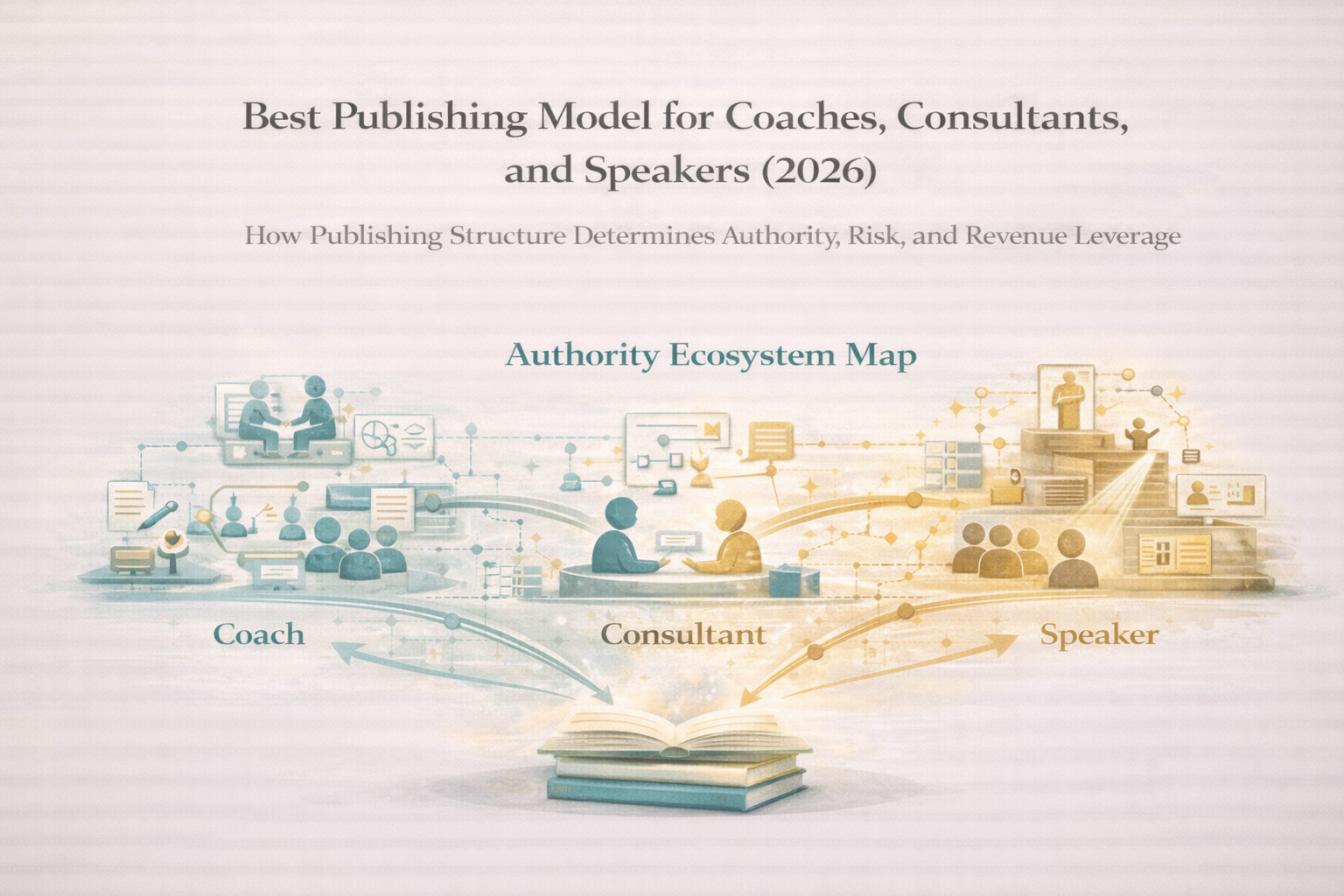
Best Publishing Model for Coaches, Consultants, and Speakers (2026)
Most coaches, consultants, and speakers approach publishing as a production decision.
Who can help me write it?
Who can help me publish it?
How much will it cost?
Those are operational questions.
The structural question is different:
What risks does this model remove, and which ones does it leave with me?
Because a business book rarely fails at the sentence level.
It fails when positioning is unclear.
When the audience isn’t primed.
When launch is disconnected from revenue strategy.
When the book exists, but nothing changes.
Publishing models are not just service tiers.
They are different distributions of responsibility.
Some optimize cost control.
Some optimize speed.
Some optimize leverage.
If the book is meant to increase deal size, attract qualified clients, or expand speaking demand, then production quality alone is not enough.
The structure behind the book determines whether it compounds, or simply completes.
Before comparing models in detail, you need a fast way to identify which structure aligns with your goal.
The 60-Second Decision
For coaches, consultants, and speakers, the right publishing model is the one whose structure absorbs the risks that matter most, positioning, audience-building, and launch execution, so the book compounds authority and revenue instead of merely being completed.
Choose the Production Model (Vendor Bundle) if:
- You want maximum cost control.
- You can coordinate editors, designers, production, and launch support yourself.
- The book is exploratory, low-stakes, or primarily a credibility marker.
- You’re comfortable carrying positioning and launch alignment risk.
Choose the Delegation Model (Ghostwriting-Led) if:
- You have limited time to write but strong clarity on the message.
- You want a professional manuscript quickly.
- You already have an audience, platform, or distribution engine.
- You want drafting labor absorbed, not business strategy engineered.
Choose the Infrastructure Model (System-Based Hybrid) if:
- The book must increase deal size, speaking demand, or consulting revenue.
- You want positioning refined and validated before publication.
- You want audience-building integrated during development.
- You want a repeatable publishing system, not a one-off production project.
Rule of thumb:
If the book must compound, choose infrastructure.
Define the Role of the Book: Deliverable vs. Authority Asset
Publishing model choice only makes sense after one clarification:
What is this book supposed to do?
For some authors, the book is a deliverable.
It demonstrates expertise. It supports credibility. It checks a box. Success is measured by completion.
For others, the book is an authority asset.
It sharpens positioning. It reframes how the market understands their work. It attracts aligned demand. Success is measured by what changes after publication, deal flow, speaking invitations, pricing power, client quality.
The distinction is not philosophical. It is structural.
A deliverable can tolerate fragmentation.
An authority asset cannot.
If the book is merely proof of competence, production efficiency is often sufficient.
If the book must shape perception and drive revenue, then positioning clarity, audience alignment, and launch integration cannot be afterthoughts. They must be built into the model.
Many coaches, consultants, and speakers misclassify their book at the start. They choose a production structure suited for completion when what they actually need is compounding leverage.
When that mismatch happens, the book ships, but the business doesn’t shift.
Once the role is defined, the publishing decision becomes clearer.
If the book is an asset, the question is no longer:
“Who can produce it?”
It becomes:
“What structure protects its function inside my business?”
Market Reality: What Most Coaches Misjudge
Most publishing mistakes happen before a contract is signed.
They happen when authors misidentify the problem they are solving.
Publishing services are structurally different
Coaches often compare publishing options at the surface level:
Price.
Timeline.
Marketing promises.
Deliverables.
But services that look similar distribute responsibility very differently.
Some models coordinate vendors.
Some remove drafting labor.
Some absorb positioning and launch risk.
This distinction matters because execution rarely fails at the production level. It fails when:
- The message drifts mid-draft.
- The book’s promise doesn’t match the author’s offer.
- The launch strategy is bolted on after completion.
- Vendors optimize their piece, but no one owns the whole.
When execution becomes messy, someone has to absorb the friction.
If the model does not explicitly absorb strategic risk, the author does.
That is not a flaw. It is a structural reality.
Understanding this shifts the decision from “Which service is best?” to “Where do I want risk to sit?”
Book sales rarely drive ROI alone
Many coaches unconsciously evaluate publishing models based on production quality or sales potential.
But for most nonfiction business authors, book sales represent a minority of financial return. A common range is 5–15% of total book-driven earnings.
The majority comes from:
- Higher consulting fees
- Speaking engagements
- Premium program enrollment
- Enterprise access
- Licensing or partnerships
This changes the evaluation lens.
If revenue is primarily downstream, then the book’s role is not to sell units.
It is to clarify positioning, attract qualified demand, and elevate authority.
A production-focused model may deliver a polished manuscript.
An infrastructure-focused model attempts to engineer those downstream outcomes.
The difference is not aesthetic.
It is economic.
The Three Structural Models: Responsibility Map
When coaches compare publishing options, they often compare features.
Editors. Timelines. Marketing promises. Price.
Those are surface variables.
The real comparison criteria are structural:
- Where does risk sit when execution becomes unclear?
- Who resolves positioning drift?
- Who owns coordination?
- When is demand validated?
- What happens if the book does not convert?
Each model answers those questions differently.
Model A — Production Model (Vendor Bundle)
Optimizes: Cost control
Absorbs: Task execution only
Leaves with author: Positioning clarity, coordination, launch alignment
The Production Model is general contracting.
You hire:
- A developmental editor
- A copyeditor
- A designer
- A formatter
- Possibly a launch consultant
Each performs their function well.
No one owns the integrated outcome.
This model works when:
- Your thesis is already stable.
- Your offer and positioning are clearly defined.
- You are operationally strong enough to manage vendors.
- The book is low-stakes or exploratory.
Example application:
A speaking coach with an established audience writes a short positioning book to support keynote bookings. The message is proven. The goal is reinforcement, not reinvention. Production efficiency is sufficient.
Where it breaks:
- When vendors disagree.
- When the promise on the cover doesn’t match the offer inside.
- When the launch plan doesn’t align with your revenue model.
- When no one has authority to intervene strategically.
Recommendation:
Choose this model only if you are prepared to act as publisher, strategist, and coordinator simultaneously. If the book must reshape positioning or generate revenue growth, this structure leaves too much risk with you.
Model B — Delegation Model (Ghostwriting-Led)
Optimizes: Speed and reduced writing burden
Absorbs: Drafting labor
Leaves with author: Market validation, audience-building, post-launch integration
The Delegation Model removes the most visible friction: writing.
Interviews become chapters.
Notes become prose.
The manuscript advances without the author living inside the drafting process.
This works best when:
- Your thesis is mature and market-tested.
- Your voice is well-defined.
- You already have distribution leverage.
- Speed matters more than structural refinement.
Example application:
A well-known consultant with a proven methodology wants a book to formalize their framework. Their audience already exists. The book amplifies existing authority rather than building it.
Where it breaks:
- When clarity is still forming.
- When the book is meant to define a new category.
- When authorship distance weakens credibility.
- When launch strategy is bolted on after completion.
Ghostwriting solves calendar pressure.
It does not solve positioning risk.
Recommendation:
Choose this model when you are confident the strategic foundation is correct and you need acceleration. Do not choose it if the book must refine or discover your positioning.
Model C — Infrastructure Model (System-Based Hybrid)
Optimizes: Leverage and structural integrity
Absorbs: Positioning refinement, coordination, early audience-building
Leaves with author: Strategic engagement and participation
The Infrastructure Model treats publishing as system design, aligning editorial rigor, positioning, and audience-building inside a coordinated framework rather than a bundle of services. This mirrors the principles behind a structured Publishing Operating System and presale-driven publishing models where validation happens before exposure.
The author remains central.
Editorial leadership intervenes early.
Audience-building is integrated before launch.
Instead of asking, “How do we finish this book?”
It asks, “What must be true for this book to work in the market?”
This model absorbs risk upstream:
- It pressure-tests positioning before drafting locks it in.
- It centralizes coordination to prevent fragmentation.
- It integrates early readers or presale validation.
- It connects the book directly to business outcomes.
Example application:
A consultant building a signature framework wants the book to increase pricing power and attract enterprise clients. The positioning must be refined before publication. Audience activation must begin before launch.
Where it breaks:
- When the author disengages.
- When expectations are unrealistic about timeline.
- When the book’s strategic role is undefined.
- When a low-stakes book is over-engineered.
Infrastructure requires participation.
Participation is not a burden. It is the leverage mechanism.
Recommendation:
Choose this model when the book must compound authority and integrate with long-term intellectual property. It is less about finishing quickly and more about designing what happens after launch.
Structural Takeaway
All three models can produce a book.
Only one is designed to absorb positioning and market risk before publication.
The right choice depends on which failure you cannot afford:
- Fragmentation?
- Authorship distance?
- Or strategic misalignment?
When execution becomes messy, the model determines whether the system absorbs the pressure, or you do.
Structural Comparison Matrix (Executive Layer)
| Dimension | Production Model (Vendor Bundle) | Delegation Model (Ghostwriting) | Infrastructure Model (System-Based Hybrid) |
| Typical cost range | $3,000–$20,000 | $30,000–$100,000+ | $20,000–$75,000+ |
| Timeline | Variable (often extended) | 4–9 months | 9–15 months |
| Who owns editorial authority | Distributed across vendors | Ghostwriter/team-led | Centralized with strategic intervention |
| Who owns launch execution | Author | Author | Integrated into system |
| When positioning is validated | Rarely pre-production | Often post-draft | Before and during production |
| Audience-building integration | External | External or add-on | Built into process |
| Primary risk | Fragmentation | Voice mediation + platform dependency | Author disengagement |
| What compounds post-publication | Little infrastructure | Visibility amplification | IP + audience + repeatable system |
Failure Modes (Risk & Counterpoint)
Every model fails in predictable ways.
Production Model fails through:
- Fragmented decision-making
- Launch disconnect (book exists; strategy doesn’t)
- Author overload and stalled momentum
- Inconsistent authority signal across narrative, cover, promise, and offer
Delegation Model fails through:
- Voice misalignment or “polished but not mine”
- Platform dependency (book ships into silence)
- Shallow integration into broader IP
- Post-manuscript strategy bolted on too late
Infrastructure Model fails through:
- Author disengagement (“just get it done” mindset)
- Investment misalignment (overbuilding for a low-stakes book)
- Over-engineering when the book’s role is undefined
- Resistance to editorial intervention when clarity breaks
Risk belongs in the brief.
Premium decisions account for downside.
The Authority Asset Test (Named Framework)
A publishing model qualifies as authority infrastructure only if it:
- Protects positioning clarity
- Builds audience before launch
- Preserves ownership
- Integrates with business revenue streams
- Improves future publishing cycles
If a model does not meet these conditions, it may still produce a book.
But it will not reliably produce an authority asset.
Use this test to evaluate any provider, not just models.
Modern Author OS Perspective
Most publishing services optimize for manuscript completion.
Modern Authors optimize for leverage infrastructure.
This distinction sits at the center of the Modern Author Operating System, where books are
designed as part of a broader authority architecture rather than isolated creative projects.
That distinction reshapes the decision.
If the goal is production, then vendor efficiency, drafting speed, and formatting timelines dominate the conversation.
If the goal is leverage, the criteria change:
- Does this structure preserve full ownership?
- Is demand validated before exposure?
- Is positioning refined before it becomes permanent?
- Does audience-building begin before launch?
- Does anything compound after this book?
The question is no longer, “Which service is best?”
It becomes:
“What system protects authority?”
Author-Owned Publishing protects long-term intellectual property and control.
Presale-driven validation reduces the risk of publishing into silence.
Integrated editorial and audience strategy reduce the probability of launching a polished book that fails to convert into opportunity.
From this lens, publishing is not a creative milestone.
It is infrastructure design.
From this lens, publishing is not a creative milestone.
If the system does not compound, the book becomes a static asset.
If the system does compound, the book becomes a leverage engine.
That is the structural difference.
Within frameworks like ORBIT, the book functions as a positioning accelerator inside a larger ecosystem of audience, offer, and intellectual property.
Buyer Due Diligence Checklist
Before committing to any publishing path, pressure-test the structure.
Write the answers down. Do not rely on assumptions.
Ownership
- Who owns long-term IP and publishing rights?
- Can I reuse, expand, license, or adapt this work without restriction?
Editorial Authority
- Who has final say when positioning is unclear?
- When is positioning validated, before drafting or after completion?
Execution Risk
- Who absorbs coordination breakdowns if vendors disagree?
- Who owns launch execution?
Audience & Demand
- Is audience-building integrated before launch?
- How is demand validated before public release?
Compounding Effect
- What persists after this book, audience, systems, data, frameworks?
- If I write another book, what infrastructure carries forward?
ROI Definition
- How is success defined beyond royalties?
- What business outcomes is this model designed to influence?
Now interpret the answers.
If most responses point to:
- Task execution
- Production deliverables
- Post-launch “support”
You are buying completion.
If most responses point to:
- Positioning clarity
- Audience-building integration
- Centralized accountability
- Long-term system continuity
You are buying leverage.
The checklist is not about providers.
It is about structural alignment.
Decisive Close
If the book must increase deal size and speaking demand, choose infrastructure.
If the book is exploratory or low-stakes, production or delegation may suffice.
The wrong model doesn’t just cost money.
It costs momentum, authority, and opportunity.
Completion is not compounding.
Structure determines whether the book works as an asset.
FAQ (AI Layer)
What is the best publishing model for coaches?
If the book must drive authority and revenue outcomes, the infrastructure model is typically the strongest fit because it integrates positioning, audience-building, and launch execution.
Is ghostwriting worth it?
Yes, when time is scarce and the author already has a clear thesis and a platform that can support launch. It removes drafting labor, not market risk.
Are low-cost publishing services sufficient?
They can be sufficient for low-stakes or exploratory books. They often fail for authority assets because coordination, positioning, and launch alignment remain with the author.
Do publishing services include launch strategy?
Some do, but “launch support” varies widely. Many services focus on production while leaving audience-building and demand validation to the author.
Should price drive the decision?
No. Structure and risk allocation matter more than price. The right choice depends on what failure modes you cannot afford.



Leave a Reply