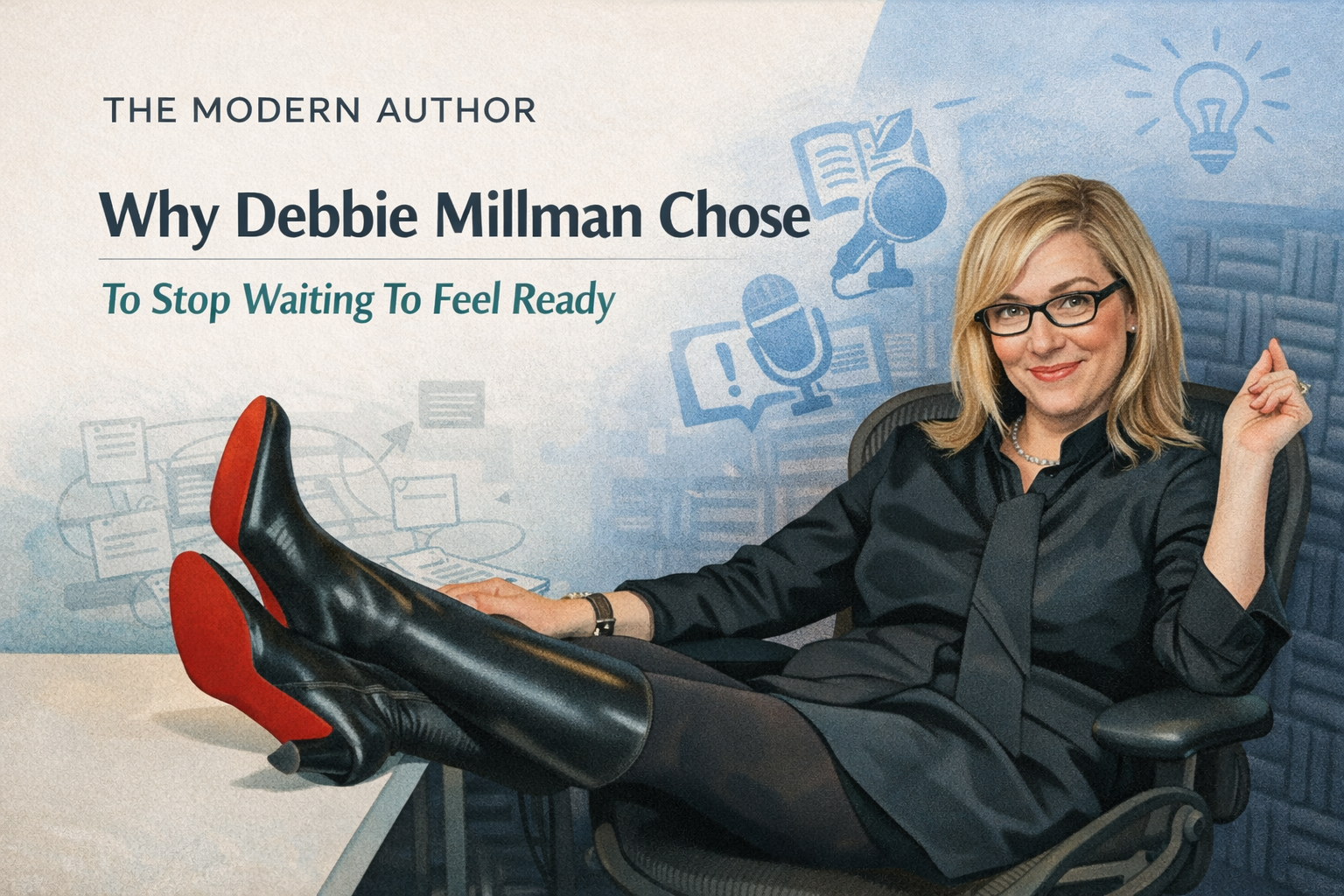
The Modern Author: Why Debbie Millman Chose To Stop Waiting To Feel Ready

Debbie’s career shows that creative confidence is not a prerequisite for serious work, but a byproduct of sustained action taken in the presence of uncertainty.

Debbie Millman has built a career without waiting to feel ready.

Uncertainty appears throughout her work. Fear never fully disappears. Doubt remains present across projects, roles, and transitions.

But none of it is granted veto power.

She does not pause until clarity arrives. She does not require internal certainty before proceeding. She continues to operate while confidence is incomplete.

This is not a personality trait or an unusual level of bravery. It is an operating rule.

Millman’s career shows that creative confidence is not a prerequisite for serious work, but a byproduct of sustained action taken in the presence of uncertainty.

What looks like courage in retrospect is better understood as persistence without emotional permission.


The myth of courage as the starting point

Many creative careers stall because people misunderstand where confidence comes from.

They assume it must arrive first.

That before you begin, something internal needs to resolve: fear quieted, doubt reduced, conviction secured. Courage, in this framing, is treated as the starting condition.

It’s an attractive story because it turns hesitation into a character issue. If you’re not moving, you must be lacking bravery.

But that story misidentifies the problem.

Most aspiring authors are not unwilling to work. They are unwilling to work without an emotional guarantee that the effort will justify itself. They wait to feel like the kind of person who succeeds at the work before allowing themselves to do it.

They wait for confidence.

And in waiting, they confuse delay with discernment.


Confidence is a result, not a prerequisite

The reality is simpler and less comforting: confidence does not precede action. It follows it.

Confidence is not a trait you acquire in advance. It is evidence accumulated over time. It forms only after you have taken repeated steps that prove you can continue even when outcomes remain unclear.

This inversion is easy to miss because it runs counter to how we like to narrate creative success.

We prefer stories where internal clarity produces external momentum.

In practice, momentum produces clarity.


Debbie Millman’s long arc of persistence

Millman’s career makes this inversion visible.

Across her work—as a designer, interviewer, teacher, and author—fear is present, but it is never granted veto power. Uncertainty appears repeatedly, but it does not determine whether she proceeds.

She does not wait to feel ready.

She continues to operate until readiness becomes unnecessary.

This is not a personality trait or an unusual level of self-belief. It is an operating rule: action continues even when confidence is incomplete.

Her career is not built on eliminating doubt, but on refusing to let doubt dictate behavior.


Repetition as the confidence engine

Millman’s approach treats confidence as a lagging indicator. The signal comes after the behavior, not before it.

Action generates information. Information allows adjustment. Adjustment builds self-trust. What people later call confidence is simply familiarity with the fact that movement is possible even when certainty is absent.

This is why repetition matters more than motivation.

Repeated action produces psychological stability not because it feels good, but because it reduces ambiguity. Each instance of showing up adds data:

  • You can begin without clarity.
  • You can finish without assurance.
  • You can publish without knowing how it will be received.

Over time, the brain updates its beliefs—not through affirmation, but through demonstration.


Why waiting for confidence stalls creative work

Waiting for confidence interrupts this process.

When authors delay action until they feel certain, the work accumulates symbolic weight. The project becomes a referendum on talent. Each attempt carries the pressure of justification.

The fewer times you act, the higher the stakes feel.

This is how hesitation hardens into stagnation.

The problem is not fear itself. The problem is treating fear as a prerequisite filter rather than a background condition.


Choosing persistence over certainty

Millman’s persistence outperforms this loop because it breaks the dependency.

Action no longer waits for emotional permission. Uncertainty is treated as a normal condition of making anything that matters, not a problem to be solved in advance.

This reframes persistence itself.

Persistence is not merely a work ethic. It is an uncertainty-management strategy. It allows you to continue producing without requiring the internal environment to be calm, confident, or resolved.

The goal is not to eliminate fear.

The goal is to build a practice that does not depend on fear’s absence.


What this means for modern authors

For modern authors, the implication is structural.

Confidence should not be used as a gate. It should be treated as a signal that may or may not arrive later. Progress is better measured by continuity than by conviction.

Write before you feel ready.
Publish before you feel certain.
Return tomorrow even if today felt disorganized or incomplete.

Not as motivational slogans, but as a causal sequence.

Millman’s career demonstrates that the real advantage is not bravery, clarity, or self-belief at the outset.

It is the ability to remain in motion while uncertainty persists.

Confidence arrives eventually for those who stay long enough to earn it—but the work cannot wait for its permission.

Listen:

Watch:

https://youtu.be/Ch37ee9FcAI?si=JW1yaGhzdnpcyzrg

About the Author

Eric Koester is an award-winning entrepreneurship professor at Georgetown University, bestselling author, and founder of Manuscripts. He has helped more than 3,000 nonfiction authors turn ideas into books, and books into platforms for speaking, media, and business growth.

About Manuscripts

Manuscripts is a modern publishing partner for nonfiction authors who want their books to drive real-world outcomes. We help founders, executives, coaches, and experts design, write, and launch books that build authority, attract opportunities, and compound into long-term business assets.

Work With Us

If you’re writing a book you want to matter, we’ll help you map the right strategy before you write another word.

 Schedule a Modern Author Strategy Session
https://write.manuscripts.com/maa-web

Read more...
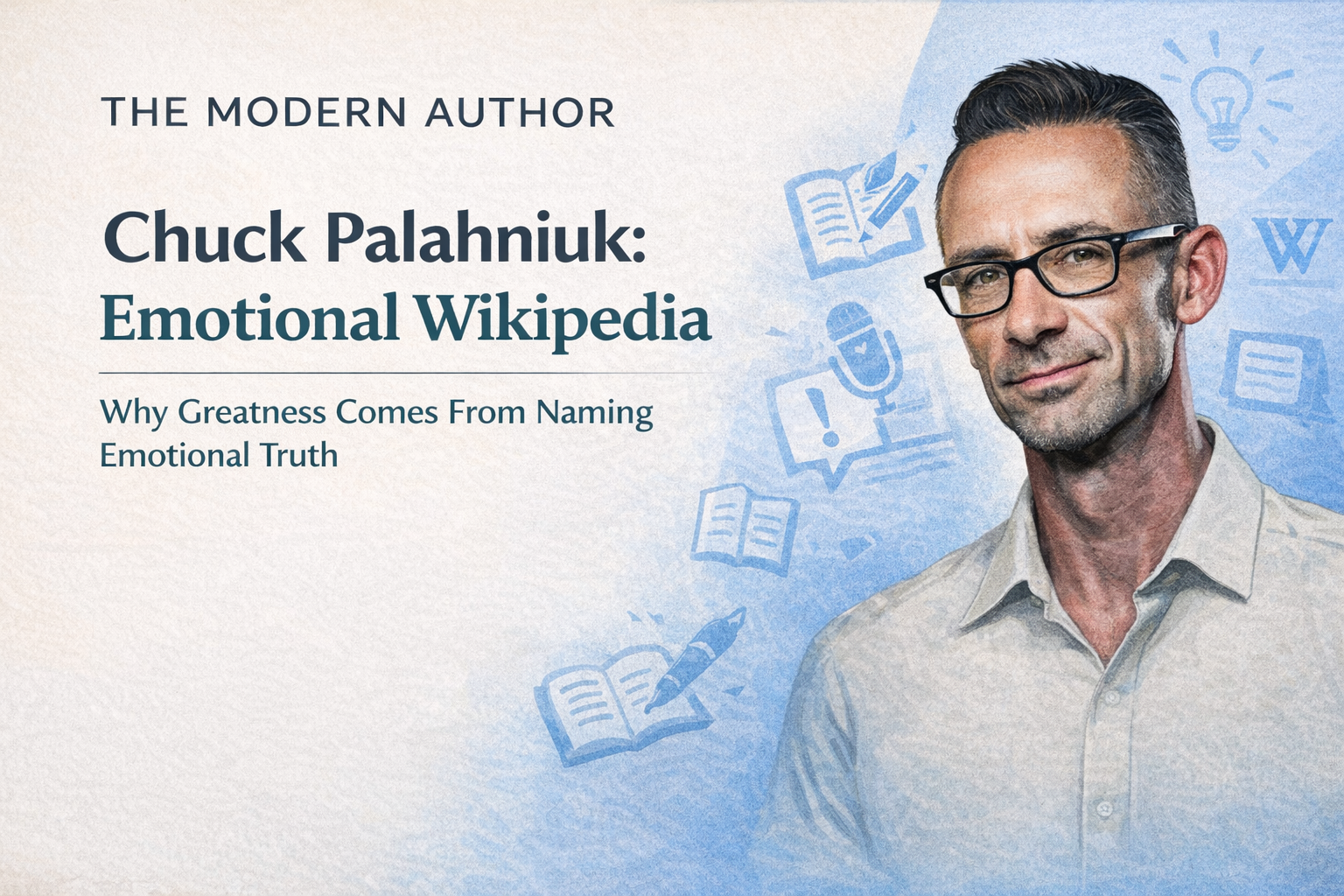
The Modern Author: Chuck Palahniuk on Building Your Emotional Wikipedia

The Modern Author: Chuck Palahniuk on Building Your Emotional Wikipedia

Most writers think authority comes from research.

Chuck Palahniuk thinks that’s backwards.

In his words, “now that we have the internet, and you can just go to Wikipedia… who cares?” What buys trust now isn’t trivia. It’s what he calls emotional authority, the ability to “state… an emotional truth that people are aware of, but nobody has ever stated… out loud.” 

That’s the real punch of this conversation. Palahniuk isn’t teaching you to become smarter. He’s teaching you to become more accurate about human experience, and to build writing that lands.

Who this is for

This is for you if:

  • you keep “researching” because it feels like progress
  • your drafts feel technically fine but emotionally flat
  • you write linearly and stall out halfway through
  • you’ve avoided workshops because you don’t want feedback
  • you want writing that gets a reaction, not a polite nod 

The Modern Author lesson

Authority isn’t what you know.

Authority is what you can name.

Palahniuk’s “new Wikipedia” is emotional Wikipedia, a catalog of unspoken, universal experiences people secretly carry around, until a writer puts it in words and they feel immediate relief: “oh, you read my mind.” 

6 takeaways authors can steal from Chuck Palahniuk

1) Stop collecting facts. Start naming emotional truths.

Chuck’s core claim is blunt: Wikipedia-level knowledge doesn’t impress anyone anymore.

What does?

Being able to say the thing everyone recognizes but nobody has phrased. He calls it “a different kind of emotional authority.” When you do it well, readers feel seen and they trust you. 

Use it as an author: stop asking, “What should I research?”

Start asking, “What do people feel, but never admit out loud?”

2) “Emotional Wikipedia” comes from being around humans, not being online.

Palahniuk’s method isn’t mystical. It’s social.

He says emotional authority comes from “having to be with people and listened to them at parties or bars or workshops where people tell their secrets.” Then you watch the room, you see the relief when others recognize themselves. 

His perfect example is the “big box of porn in the woods” story, the kind of oddly specific experience everyone had, nobody talked about, and everyone instantly recognizes. 

Use it as an author: build a practice of collecting confessions, not quotes.

3) Write scenes like songs, not chapters like railroads.

Fight Club started as a short story written “in a single afternoon.”

The structural move mattered more than the violence. He wanted a device that let him “jump around” cleanly, without the boring connective tissue, because “the wordiness… always bored me.” 

He models punchy writing after lyrics: chorus, bridge, repeating refrains, clear signals for transitions. In his view, people didn’t fall for Fight Club because it was “about fighting.” They fell for it because it “read like a song.” 

Use it as an author: design structure that makes momentum automatic.

4) Build books from “favorite scenes,” not from linear endurance.

Chuck asks a question that should mess with your process:

Do you remember a movie “linearly from beginning to end”? No. You remember scenes. You fast-forward through the parts you hate. 

He’s actively trying to get away from linear writing and toward books that work like stitched scenes, like The Joy Luck Club, “a whole bunch of beautiful short stories… with a very tentative sort of line.” 

And for working writers, this is practical, not just artistic. Writing in scenes gives you “satisfaction and completion,” and you don’t have to “carry the algebraic equation in your head all the time.” 

Use it as an author: treat each scene as a unit that can stand alone and serve the larger arc.

5) The best feedback is physical, not polite.

Palahniuk doesn’t romanticize workshops, he weaponizes them.

When you read live, you get the only feedback that matters: the “unselfconscious… emotional reaction.” Laughs. Gasps. Groans. Dread. 

He’s ruthless about what doesn’t matter: once feedback becomes “intellectualized,” with people saying “I really liked how you depicted the dog,” he calls it “bullshit.” 

He even gives you a craft tool most writers miss: you learn timing. Where the laugh hits. Where to pause. And if you “step on that laugh,” you lose the room. 

Use it as an author: optimize for the body, not the brain. Your reader’s nervous system is the judge.

6) Don’t write to “fix the world.” Write to model a new possibility.

His closing advice is a gut-check for mission-driven writers:

“It’s always a mistake… if you write something with the intention of fixing the world.” The better goal is to “model a new possibility.” 

That’s a higher standard than preaching. It forces you to create something people want to live inside, not something they’re supposed to agree with.

Use it as an author: build an example people can feel, not a solution you can argue.

What to avoid (if you want Palahniuk-level impact)

  • Research as camouflage. If you’re “learning” to avoid stating what you actually believe, you’re stalling. 
  • Linear loyalty. If a section bores you, it’s probably filler your readers will skip. 
  • Workshop-safe writing. If your work can’t provoke an audible reaction, it won’t stick. 
  • Moral performance. “Fixing the world” pushes you into sermons. Modeling possibility pulls you into art. 

The Modern Author playbook

Emotional Wikipedia (a 7-day practice)

Day 1: Start a “Relief List.”

Write 20 experiences people rarely admit out loud. Make them specific. Weird counts.

Day 2: Collect 10 secrets.

From conversations, comments, emails, workshop rooms. You’re listening for shame, relief, and recognition. 

Day 3: Write one scene like a song.

Add a repeating device (a rule, a refrain, a pattern) that signals jumps without “wordy transitions.” 

Day 4: Write a second scene that could stand alone.

Aim for completion. Don’t write connective tissue.

Day 5: Read it out loud to a human.

Not silently. Not to yourself. Out loud, with someone in the room.

Day 6: Track the room.

Where did they laugh? Where did they shift? Where did silence thicken? That’s your edit map. 

Day 7: Rewrite for reaction.

Cut anything that exists to “explain.” Keep what makes people feel exposed, seen, or implicated.

The bottom line

Palahniuk’s edge isn’t shock. It’s accuracy.

He earns authority by saying the thing people recognize instantly, and by structuring writing so it hits like a song, not a lecture.

If you want your writing to land harder, stop trying to sound smart.

Start trying to be true. 

Listen:

Watch:

https://youtu.be/8O7eHUG1AFc?si=ppWAl0Iiiuuv3j7v

About the Author

Eric Koester is an award-winning entrepreneurship professor at Georgetown University, bestselling author, and founder of Manuscripts. He has helped more than 3,000 nonfiction authors turn ideas into books, and books into platforms for speaking, media, and business growth.

About Manuscripts

Manuscripts is a modern publishing partner for nonfiction authors who want their books to drive real-world outcomes. We help founders, executives, coaches, and experts design, write, and launch books that build authority, attract opportunities, and compound into long-term business assets.

Work With Us

If you’re writing a book you want to matter, we’ll help you map the right strategy before you write another word.

👉 Schedule a Modern Author Strategy Session
https://write.manuscripts.com/maa-web

Read more...

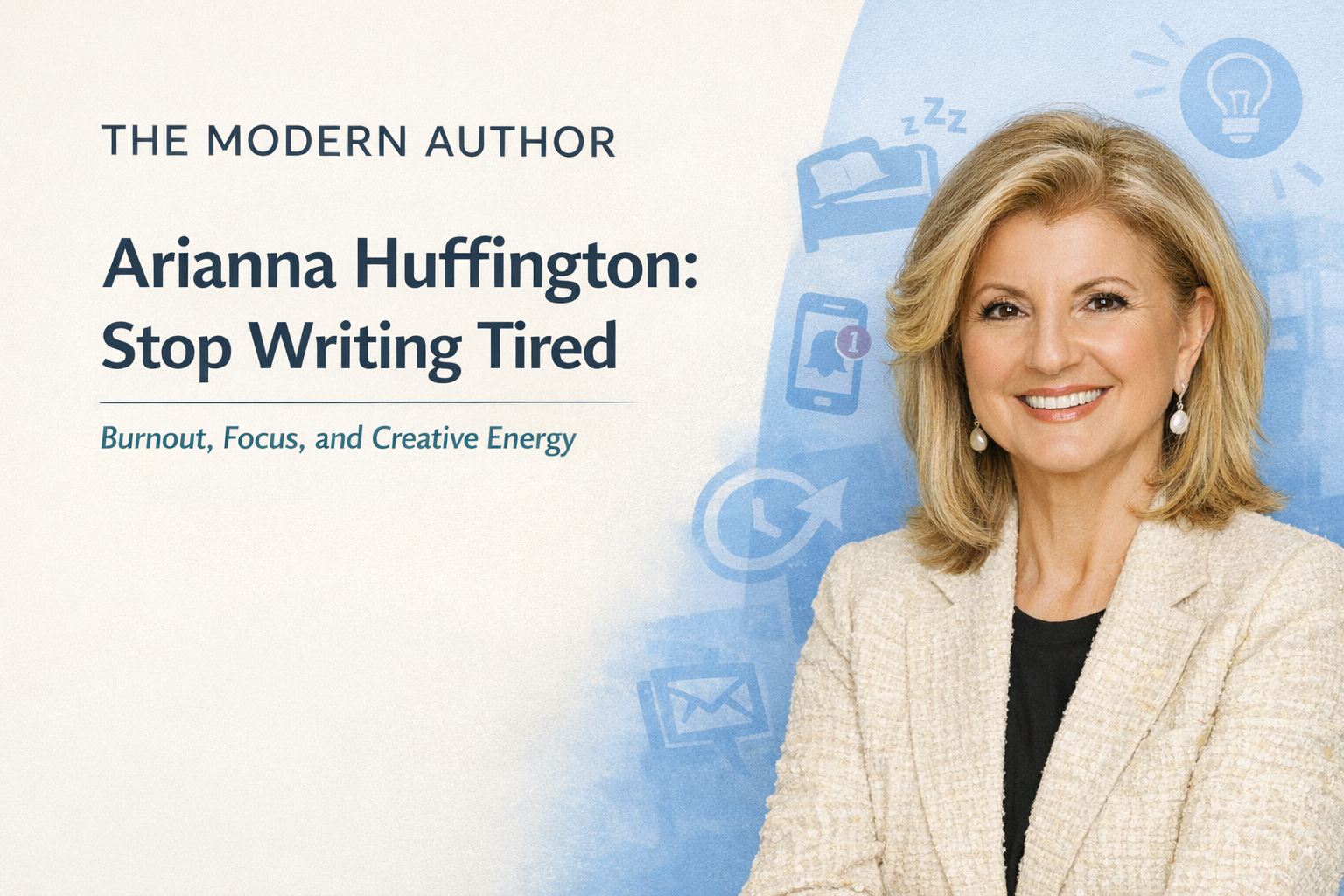
The Modern Author: Arianna Huffington on Burnout, Focus, and Creative Energy

Arianna Huffington didn’t burn out because she was weak.

She burned out because she was successful, driven, and running at full speed with no off switch.

After collapsing from exhaustion in 2007, she didn’t just recover. She rebuilt her entire philosophy of work, creativity, and leadership. That journey led to Thrive, Thrive Global, and a career-long mission to end the burnout epidemic.

This conversation isn’t about writing faster.

It’s about writing without frying your brain.

Because tired authors don’t fail from lack of talent.

They fail from diminishing returns.

And Arianna has spent years studying exactly where that line is.


Who This Is For

This is for you if:

  • you’re exhausted but still pushing
  • writing feels heavy instead of energizing
  • focus comes in short bursts, then disappears
  • your phone keeps winning
  • you know the book matters, but you’re running on fumes

The Modern Author Lesson

You don’t finish meaningful books by pushing harder.

You finish them by protecting creative energy and removing silent drains.

Burnout isn’t a badge of honor.

It’s a signal that the system is broken.


5 Takeaways Authors Can Steal from Arianna Huffington

1) Burnout creates diminishing returns, not breakthroughs

The point: More effort doesn’t always mean better work.

Arianna’s insight came the hard way. She collapsed from exhaustion while running the Huffington Post, a moment that forced her to confront a truth most authors ignore:

When you’re depleted, output drops even as effort increases.

Use it as an author:

Stop measuring writing by hours. Measure it by clarity per session.

Ask:

  • Did this session move the idea forward?
  • Did I protect energy for the next session?
  • Did I stop before quality declined?

Chapter angle:

“Why pushing harder makes your book worse.”


2) Balance is the wrong goal, recovery is the right one

The point: Creative intensity is fine. Chronic depletion is not.

Arianna doesn’t talk about “balance” the way most people do. She doesn’t believe in evenly dividing energy every day.

She believes in cycles.

Write deeply when you’re in flow. Then recharge deliberately.

Use it as an author:

Design writing seasons, not daily perfection.

  • sprint when creativity is high
  • recover without guilt
  • stop before exhaustion becomes the norm

This keeps writing sustainable instead of punishing.

Chapter angle:

“Why creative surges are healthy and burnout is optional.”


3) Your first draft doesn’t need a keyboard

The point: Writing is thinking, not typing.

Arianna shared that for her last two books, she dictated the first draft. Not because she was lazy, but because she noticed something important:

She could speak clearly for an hour without notes.

So she stopped fighting her natural strengths.

Use it as an author:

Lower the friction to get words out.

Try:

  • dictating while walking
  • voice notes during commutes
  • speaking sections as if explaining to a friend

Once a draft exists, editing becomes far easier.

Chapter angle:

“The fastest way to get unstuck is to stop typing.”


4) Distraction is poison for deep work

The point: Focus isn’t fragile. It’s interrupted.

Arianna is ruthless about one rule:

No notifications while writing. None.

If she wants the news, she goes and gets it. She doesn’t let it come to her.

Interruptions break creative continuity, and regaining depth takes far longer than most people realize.

Use it as an author:

Adopt one non-negotiable distraction rule for 7 days.

Examples:

  • phone out of the room
  • notifications off
  • one writing tab only
  • write before consuming anything

You don’t need perfect focus. You need protected focus.

Chapter angle:

“The hidden cost of ‘just checking’ your phone.”


5) Vulnerability isn’t optional if you’re writing about your life

The point: Readers can feel when you’re holding back.

Arianna was direct:

If you’re not willing to be vulnerable, you shouldn’t write a book that includes your life.

That doesn’t mean oversharing. It means honesty. No perfection. No performance.

Readers don’t connect to polish. They connect to truth.

Use it as an author:

Ask yourself:

  • Where am I trying to look impressive?
  • Where am I avoiding the real story?
  • What would change if I wrote this without protecting my image?

That’s usually where the book comes alive.

Chapter angle:

“Why perfect books feel empty.”


The Modern Author Playbook

Protect Energy, Produce Clarity (7-Day Reset)

Step 1: Identify your biggest energy leak

Choose one:

  • overworking
  • constant notifications
  • writing when exhausted
  • perfectionism
  • guilt-driven productivity

Step 2: Name the cost

Finish this sentence:

“When I keep doing this, my writing suffers because…”

Step 3: Choose one protection rule

Examples:

  • stop writing before exhaustion
  • dictate first drafts
  • phone out of the room
  • no editing during drafting

Step 4: Run the experiment for 7 days

No optimization. Just consistency.

Step 5: Capture proof

Each day, write one line:

“What felt easier or clearer today because I protected my energy?”

That’s how sustainable writing habits are built.


FAQs

Why do so many authors burn out while writing?

Because they treat writing like a grind instead of a creative system that requires recovery.

How do you write consistently without exhaustion?

By protecting focus, removing distractions, and stopping before diminishing returns kick in.

Is dictation really effective for book writing?

Yes. For many authors, it’s the fastest way to generate a first draft because it bypasses perfectionism and friction.


The Bottom Line

Burnout doesn’t make you serious.

Exhaustion doesn’t make you committed.

Finished books come from authors who respect their creative energy enough to protect it.

Arianna Huffington didn’t just survive burnout.

She redesigned how meaningful work gets done.

That’s the lesson modern authors can’t afford to ignore.

https://youtu.be/kOw5Y_4dA5Y

About the Author

Eric Koester is an award-winning entrepreneurship professor at Georgetown University, bestselling author, and founder of Manuscripts. He has helped more than 3,000 nonfiction authors turn ideas into books, and books into platforms for speaking, media, and business growth.

About Manuscripts

Manuscripts is a modern publishing partner for nonfiction authors who want their books to drive real-world outcomes. We help founders, executives, coaches, and experts design, write, and launch books that build authority, attract opportunities, and compound into long-term business assets.

Work With Us

If you’re writing a book you want to matter, we’ll help you map the right strategy before you write another word.

👉 Schedule a Modern Author Strategy Session
https://write.manuscripts.com/maa-web
Read more...

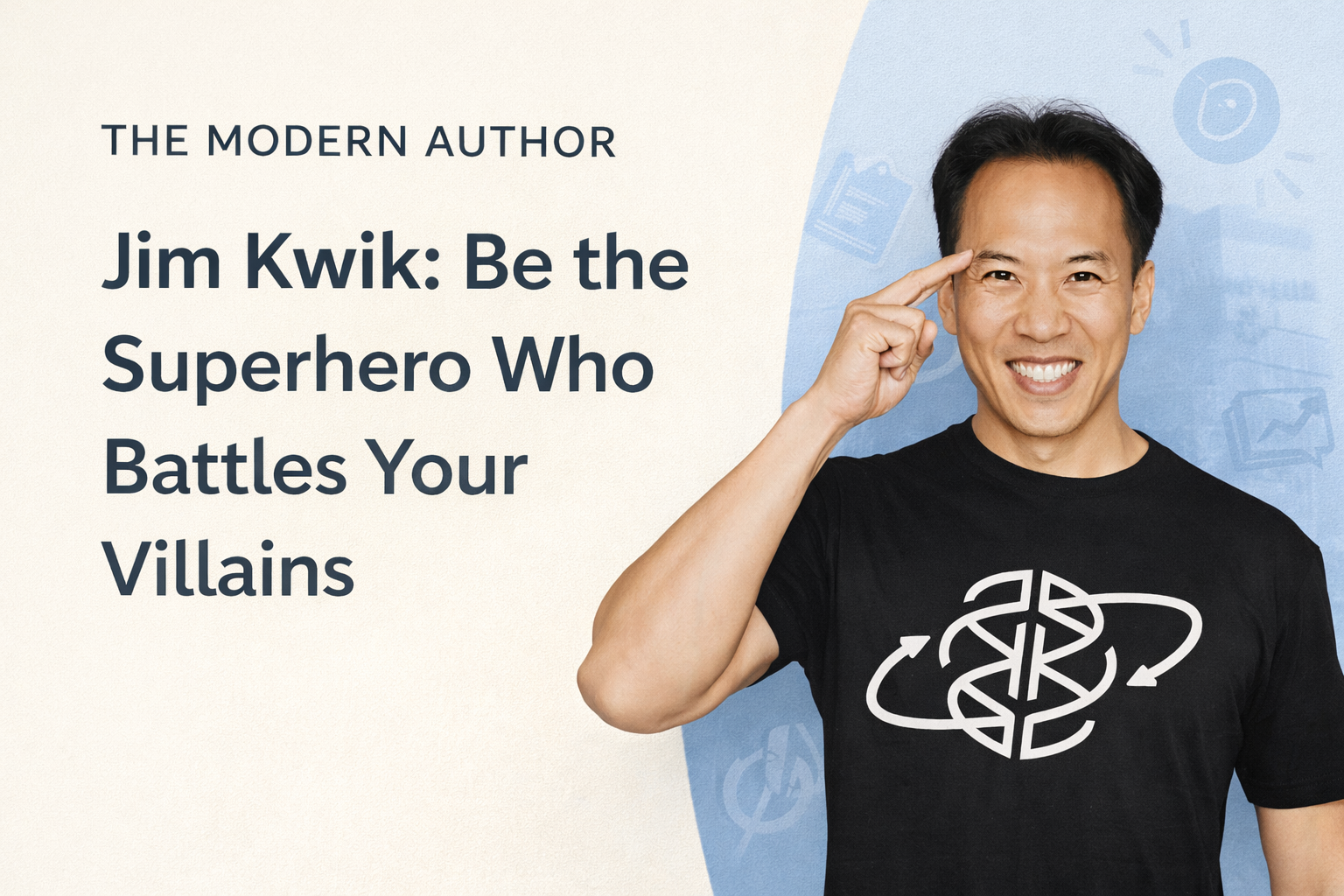
The Modern Author: How Jim Kwik Became the Superhero Who Battled His Villains

Jim Kwik didn’t start out confident. He wanted to be invisible. He sat behind the biggest kid in class because he didn’t have the answers.

And then he built a career teaching people how to learn, focus, and remember, basically the exact skills that authors need when they’re trying to write something real.

That’s the point of this episode. You’re not broken. You’re training.

Who this is for

This is for you if:

  • imposter syndrome keeps you quiet
  • perfectionism slows you down
  • distraction eats your writing time
  • you’re writing alone and it feels heavy

The Modern Author lesson

You don’t defeat writing resistance with motivation. You defeat it by naming the villain and training one superpower at a time.


5 takeaways authors can steal from Jim Kwik

1) Your labels become your limits

The point: the story you believe about yourself shapes what you attempt.

Kwik’s moment: he was labeled “the boy with the broken brain,” and that label became a box.

Use it as an author: write down the label you’re operating under, then rewrite it as a skill you’re building.

Quick reframe examples

  • “I’m not a real writer” → “I’m a writer in reps.”
  • “I’m bad at structure” → “I’m learning structure through templates.”
  • “I can’t focus” → “I’m rebuilding focus stamina.”

Chapter angle: “The labels that quietly kill books before they’re written.”


2) Self-awareness is a superpower

The point: you can’t fix patterns you refuse to see.

Kwik’s idea: curiosity and self-awareness come first, then courage to be yourself.

Use it as an author: identify your default sabotage pattern:

  • do you hide?
  • do you over-research?
  • do you polish instead of produce?
  • do you start new chapters to avoid finishing?

Chapter angle: “Your writing pattern isn’t random, it’s a protection strategy.”


3) Community beats loneliness, and loneliness kills momentum

The point: writing alone is dangerous, not romantic.

Kwik’s warning: chronic loneliness has real cognitive cost, and community shapes who you become.

Use it as an author: stop trying to “be strong.” Build one consistent touchpoint:

  • weekly writing sprint with 2–5 people
  • a co-working block
  • a weekly draft share

If you don’t have that yet, do what he suggests: be that person for someone else first.

Chapter angle: “The social system behind every finished book.”


4) Focus is a behavior, not a personality trait

The point: attention isn’t something you have, it’s something you do.

Kwik’s framing: focus is fixed on goal until successful. Multitasking is just task switching, and it costs time, accuracy, and energy.

Use it as an author: pick one focus rule and keep it for 7 days:

  • 25 minutes write, 5 minutes break (repeat)
  • phone stays out of the room
  • one chapter section per sprint, no switching

Chapter angle: “Why smart authors still don’t finish, and how focus fixes it.”


5) Your dominant question drives your output

The point: the question you repeat controls what you notice and what you do.

Kwik’s example: he sees top performers driven by a dominant question. Will Smith’s was “How do I make this moment more magical?”

Use it as an author: choose a dominant question that produces pages:

  • “What’s the simplest version of this idea?”
  • “What would make this section more useful?”
  • “What would I tell a smart friend over coffee?”
  • “How do I write the next paragraph, not the whole book?”

Chapter angle: “The hidden mental script that writes your book for you.”


The Modern Author Playbook

“Name Your Villain, Train Your Superpower” (7-day plan)

Step 1: Pick one villain

Choose one:

  • imposter syndrome
  • perfectionism
  • distraction
  • loneliness
  • overthinking

Step 2: Write its script

Finish this sentence:

“When I try to write, this villain says…”

Step 3: Choose one counter-move

Match the villain to a superpower:

  • Imposter syndrome → visibility reps (share imperfect drafts)
  • Perfectionism → shipping reps (publish ugly v1s)
  • Distraction → focus reps (Pomodoro + phone out of room)
  • Loneliness → community reps (weekly sprint)
  • Overthinking → clarity reps (write the simplest version first)

Step 4: Do 7 reps

One rep per day. Small is fine. Consistent is the point.

Step 5: Capture proof

End each day with one line:

“What did I do today that a person who finishes books would do?”

That line rewires identity.


FAQs

What’s the biggest reason people don’t finish writing a book?

Most people don’t fail on ideas, they fail on consistency because villains like perfectionism, imposter syndrome, and distraction win the daily battle.

How do you beat imposter syndrome while writing?

Treat it like a villain, not your identity. Build proof through small visibility reps and consistent writing sprints.

What’s a good daily writing routine for busy professionals?

Use 25-minute writing sprints with 5-minute breaks, and remove your phone from the room.

What does Jim Kwik mean by “dominant question”?

It’s the question you repeatedly ask yourself, consciously or not, that directs your focus and shapes your behavior.


Listen and watch

Julia Cameron on How to Silence Your Inner Critic - Book Is the Hook

Creative blocks aren’t a lack of talent. They’re usually a lack of permission. In this live, in-class conversation, Julia Cameron, author of The Artist’s Way, explains why simple, repetitive practices like Morning Pages are still the most effective way to unblock creativity. She breaks down how perfectionism shuts writers down, how the inner critic loses its power through daily practice, and why starting exactly where you are matters more than finding the perfect system. This episode is especially valuable for writers and creators who feel stuck, overwhelmed, or quietly afraid of getting it wrong.
  1. Julia Cameron on How to Silence Your Inner Critic
  2. Marc Randolph on Why Ideas Don’t Matter (Iteration Does)
  3. Seth Godin on Why Writing Is a Practice, Not a Performance
  4. Simon Sinek on Why Writing a Book Should Feel Hard
  5. The moment your story stops being performative and starts being useful
https://www.youtube.com/watch?v=RBgUdGPMgWM

About the Author

Eric Koester is an award-winning entrepreneurship professor at Georgetown University, bestselling author, and founder of Manuscripts. He has helped more than 3,000 nonfiction authors turn ideas into books, and books into platforms for speaking, media, and business growth.

About Manuscripts

Manuscripts is a modern publishing partner for nonfiction authors who want their books to drive real-world outcomes. We help founders, executives, coaches, and experts design, write, and launch books that build authority, attract opportunities, and compound into long-term business assets.

Work With Us

If you’re writing a book you want to matter, we’ll help you map the right strategy before you write another word.

👉 Schedule a Modern Author Strategy Session
https://write.manuscripts.com/maa-web

Read more...