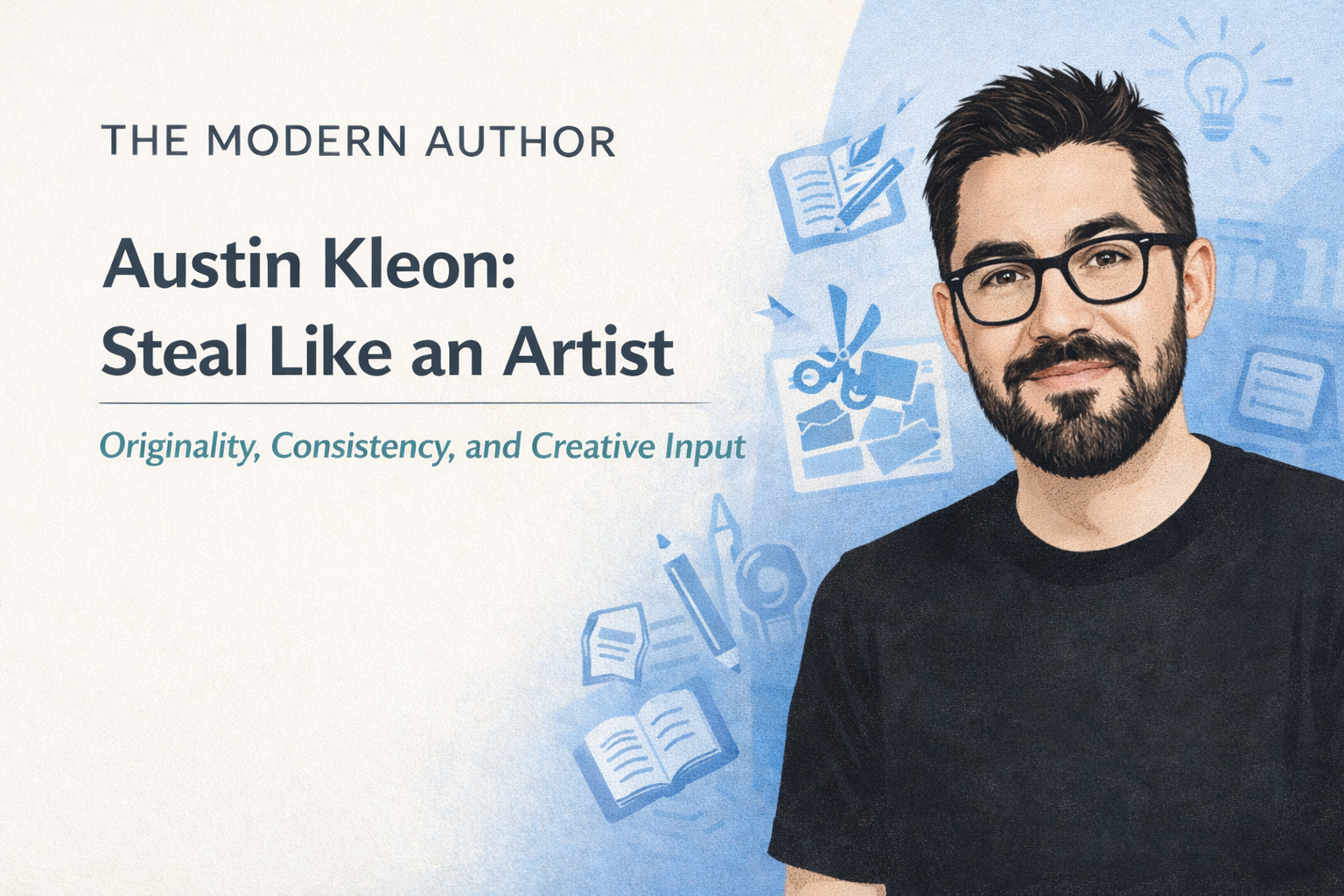
The Modern Author: Why Austin Kleon Wants You To Steal Like an Artist To Write Like Yourself
Most authors don’t get stuck because they lack ideas.
They get stuck because they’re afraid their ideas aren’t original.
They’ve read too much. They’ve seen too much. They’ve watched too many people “own” the topic already. So they do the safest thing.
They wait.
Austin Kleon is the antidote to that.
His whole body of work is basically one message: you don’t create from nothing. You create from what you collect, what you love, and what you choose to remix.
Originality isn’t purity. It’s taste plus consistency.
And this episode is packed with practical stuff busy authors can steal immediately.

Who this is for
This is for you if:
- you’re afraid your book idea is “too similar”
- you’ve got a messy desk, a messy brain, and a messy draft
- you consume a ton of input but don’t ship enough output
- you keep trying to act like an “author” instead of doing author verbs
- you want a system for voice, structure, and consistency without getting fake
The Modern Author lesson
You don’t become original by avoiding influence.
You become original by building a personal collection system, then publishing consistently from it.
Austin doesn’t teach “be creative.” He teaches “be a collector with taste, then show your work.”
That’s the whole game.
5 takeaways authors can steal from Austin Kleon
1) Your mess isn’t a flaw, it’s a collage engine
Austin’s take on his messy desk is the kind of permission most writers need.
He wants the studio to look like a collage because occasionally two things bump into each other and create a third thing.
That’s not chaos. That’s recombination.
Use it as an author: stop treating your scattered notes as failure. Treat them as raw materials.
Quick move: make a “collision list” once a week
- What are 2 ideas that don’t normally go together?
- What happens if you force them into the same chapter?
Chapter angle: “Why your mess might be the reason your book is original.”
2) Don’t hide behind titles, focus on verbs
This is one of the most useful lines in the whole conversation.
Austin says titles mess you up. They make you ask, “What would an author do?”
That question is poison. It creates performance instead of production.
Replace it with verbs:
- read
- collect
- sketch
- draft
- remix
- share
Use it as an author: write down your “author verbs” for the week and do those, even if you feel like an imposter.
Chapter angle: “Stop trying to be a writer. Start doing writer verbs.”
3) Consistency is volume, not perfection
Austin tells the pottery class story: one group tries to make one perfect pot, the other makes tons of pots. The high-volume group wins on quality too.
The point is brutal and true.
The “one perfect book” approach is why people never publish.
Use it as an author: write fewer “masterpieces” and ship more reps.
Quick rule: you’re not writing a book, you’re making pots.
- one section
- one story
- one page
- one ugly draft
Chapter angle: “The one-perfect-pot mindset kills books.”
4) Input beats output, and most authors have the ratio backwards
Austin goes hard on this: great writers are prodigious readers.
He even mentions Stephen King writing for a few hours, then reading all afternoon.
A lot of struggling authors are trying to output their way to a voice, without enough input to feed it.
Use it as an author: track input/output for a week.
Simple target: 2:1 input-to-output
- 40 minutes reading
- 20 minutes writing
This fixes voice faster than another writing app ever will.
Chapter angle: “Reading is your creative fuel, not a procrastination habit.”
5) Your “collection system” is the real book system
Austin says something most authors never think about:
Everyone talks about keeping notebooks. Almost nobody talks about what they do with them.
That’s the missing piece.
A notebook without retrieval is just hoarding. The magic is collecting, then re-reading, then extracting.
Use it as an author: build a two-step system
- capture
- resurface
If you can’t quickly find your best stories, ideas, and metaphors, your book will feel thin.
Chapter angle: “A book is just organized retrieval.”
The Modern Author playbook
Steal Like an Artist, Write Like Yourself (a 7-day reset)
Step 1: Start your Swipe File
Create one doc called “Book Ingredients.” Add five headings:
- stories
- frameworks
- metaphors
- research
- lines you’d underline
Step 2: Build a “taste list”
Write 10 creators you genuinely love. Then write:
- what you’re stealing from each (structure, tone, pacing, clarity)
No shame. This is how voice forms.
Step 3: Make the desk a collage
Pick 10 artifacts from your life:
- old notes
- client emails
- talks
- posts
- journal entries
- screenshots
Put them in one place.
Step 4: Write one 500-word “collision”
Choose two artifacts that shouldn’t connect. Force them into the same page.
Step 5: Publish one imperfect rep
A post, a section, a mini-essay, a story. Something small. Something real.
Step 6: Track your ratios
For one week:
- minutes read
- minutes wrote
- minutes scrolled
If scrolling wins, you found the leak.
Step 7: End the week with one question
“What did I do this week that a person who finishes books would do?”
That line builds identity, and identity builds consistency.
FAQs
How do I “steal like an artist” without copying?
Steal structure, not sentences. Steal formats, not paragraphs. Steal methods, not claims. Your lived examples and voice do the original work.
What if my idea already exists?
Good. That means there’s demand. Your job is to make it yours through taste, story, and the specific reader you’re serving.
How do I find my voice faster?
Increase high-quality input, then ship more reps. Voice is a side effect of volume plus taste.
Listen and watch
About the Author
Eric Koester is an award-winning entrepreneurship professor at Georgetown University, bestselling author, and founder of Manuscripts. He has helped more than 3,000 nonfiction authors turn ideas into books, and books into platforms for speaking, media, and business growth.
About Manuscripts
Manuscripts is a modern publishing partner for nonfiction authors who want their books to drive real-world outcomes. We help founders, executives, coaches, and experts design, write, and launch books that build authority, attract opportunities, and compound into long-term business assets.
Work With Us
If you’re writing a book you want to matter, we’ll help you map the right strategy before you write another word.
👉 Schedule a Modern Author Strategy Session