

From Book to Stage: How to Turn Your Book Into Speaking, Media, and Enterprise Opportunities
The Book That Changes Everything, But Not in the Way You Expect
The moment usually looks the same.
The manuscript is finished.
The book launches.
Copies begin to sell.
There is a burst of activity.
Colleagues congratulate the author.
Social posts appear.
Early readers send notes.
For a brief period, the book is the center of attention.
Then a quieter question begins to surface.
What happens next?
Many authors assume the answer is simple:
sell more copies.
The traditional view of publishing treats the book itself as the outcome. The goal becomes maximizing sales, reviews, and visibility around the title.
Under this model, a book exists to:
- Sell copies
- Share ideas
- Build visibility
These are legitimate outcomes, but they are not the primary strategic value of a nonfiction book.
The real impact appears after publication.
A well-positioned book functions as a credibility asset, a signal that compresses expertise, perspective, and authority into a single artifact that others can easily evaluate.
That signal changes how opportunities appear around the author.
Instead of simply promoting the book, new doors begin to open.
Books often unlock opportunities such as:
- Conference stages and keynote invitations
- Podcast and media interviews
- Corporate workshops or consulting engagements
- Partnerships with organizations seeking expertise
- Long-term authority positioning within an industry
In other words, the book itself is rarely the end goal.
It is the credential that changes how the author is perceived.
A published book tells the market several things at once:
- This person has a developed point of view.
- Their ideas are structured and teachable.
- Their expertise has been formalized into intellectual property.
For conference organizers, journalists, and enterprise decision-makers, that signal reduces uncertainty. It accelerates trust.
The misunderstanding many authors have is simple but consequential.
They believe the book’s job is to perform in the book market.
In reality, its greatest value often appears in adjacent markets, speaking, media, advisory work, enterprise training, and strategic partnerships.
When understood this way, the book becomes something different.
Not just a publication.
A platform
“The book isn’t the product.
It’s the credential that opens speaking, media, and enterprise doors.”
— Eric Koester
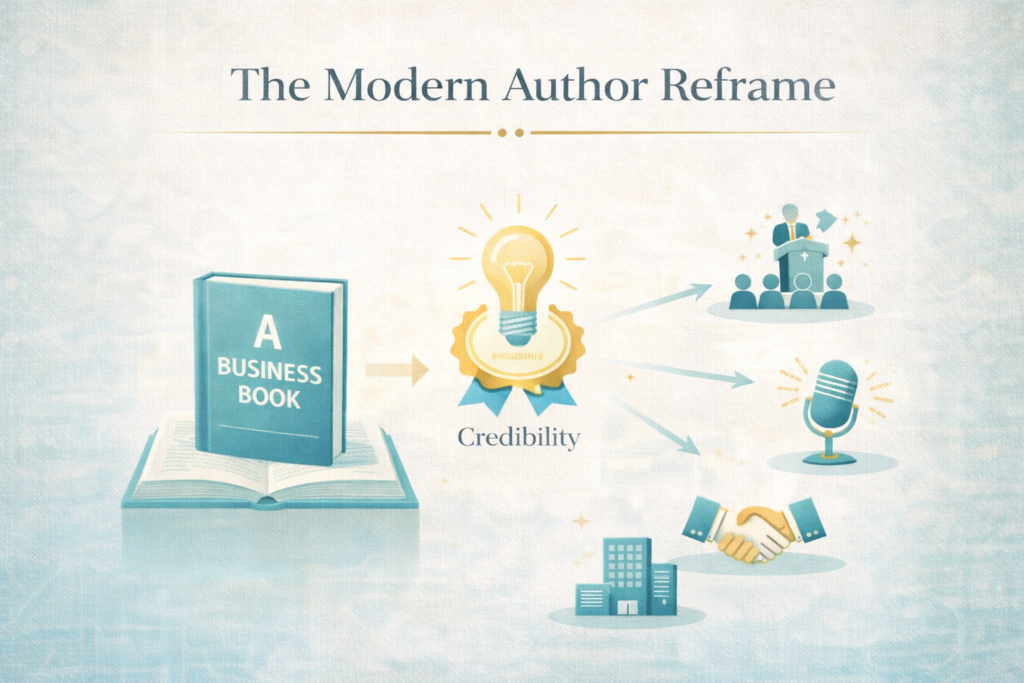
The Modern Author Reframe
For decades, publishing followed a simple economic model.
Write the book.
Sell copies.
Promote the book.
Success was measured primarily through sales volume, units sold, bestseller lists, and retail visibility.
This model still exists, but it no longer represents how many nonfiction books create their greatest value.
A different pattern has emerged.
The Traditional Publishing Model
In the traditional model, the book itself is the product.
The sequence typically looks like this:
Write book
→ Sell copies
→ Promote book
Most activity after publication focuses on marketing the title. Authors pursue reviews, publicity, and promotional campaigns designed to increase book sales.
Revenue comes primarily from royalties.
This model works well for consumer publishing, where scale and distribution determine success.
But for many experts, founders, consultants, and executives, the book performs a different role.
The Modern Author Model
The Modern Author model treats the book as a credibility asset rather than a standalone product.
Instead of ending with book sales, the book becomes the starting point for a broader opportunity ecosystem.
The sequence changes:
Write book
→ Establish credibility
→ Generate opportunities
→ Build leverage
In this model, the book signals expertise and structured thinking to the market. It becomes a reference point others can evaluate quickly.
That signal influences how decision-makers perceive the author.
Conference organizers.
Journalists.
Corporate leaders.
Partnership teams.
The book compresses experience, ideas, and frameworks into a form that travels easily across these environments.
Why Books Accelerate Trust
A published book sends several signals simultaneously.
It suggests that the author has:
- A developed point of view
- A structured framework for explaining their ideas
- Evidence, case studies, or research supporting those ideas
- The discipline required to formalize expertise into intellectual property
For audiences and organizations evaluating expertise, this signal reduces uncertainty.
The book becomes a credibility shortcut.
It also acts as a trust accelerator, allowing decision-makers to quickly assess whether the author’s thinking is coherent, original, and useful.
In many contexts, it functions as a decision signal: a visible marker that the author’s expertise has been formalized into a teachable system.
The Strategic Implication
When viewed through this lens, the purpose of the book shifts.
Instead of optimizing primarily for book sales, the strategic question becomes:
How does the book position the author for the opportunities that follow?
Speaking invitations.
Media appearances.
Enterprise engagements.
Strategic partnerships.
The book does not replace these opportunities.
It makes them easier to create.
Most nonfiction authors publish a book, promote it briefly, and never convert it into the opportunities it was capable of creating. This guide shows how to turn your book into speaking opportunities using an author speaking strategy that transforms your book into authority assets and repeatable enterprise opportunities for authors. You’ll learn how to build an authority platform that turns a finished book into speaking, media, and enterprise leverage.
60-Second Decision Box
If you only read one section of this guide, read this.
This Guide Is For You If
- You’re writing a nonfiction book to expand your authority in your field
- You want your book to lead to speaking invitations, media opportunities, or enterprise engagements
- You see your book as a credibility asset, not just a publication
- You want a structured system for turning ideas into long-term professional leverage
This Guide Is Not For You If
- Your primary goal is simply selling copies on Amazon
- You are treating the book as a one-time marketing campaign
- You plan to publish the book without building speaking, media, or enterprise pathways
- You are looking for promotion tactics rather than a long-term opportunity strategy
The Modern Author Principle
Your book is not the end product.
Your book is the credential that unlocks opportunity.
The authors who understand this build speaking platforms, media authority, and enterprise partnerships.
Everyone else publishes, and then asks what happens next.
What This Guide Will Teach You
This guide explains how a nonfiction book can become the starting point for a broader authority platform. Instead of treating the book as the final product, it shows how to convert the ideas inside the book into repeatable opportunity channels.
By the end of this guide, you will understand how to:
- Turn the core ideas from your book into a signature keynote that can be delivered at conferences, corporate events, and industry gatherings
- Build a speaker kit that clearly communicates your expertise and attracts conference organizers and event planners
- Position yourself as the voice of your idea in media, including podcasts, interviews, and guest essays
- Convert the framework inside your book into enterprise training, consulting, or workshops for organizations
- Build an opportunity engine where speaking, media, and enterprise engagements compound over time
The goal is not simply to publish a book.
The goal is to use the book as the foundation for a long-term authority platform that creates ongoing professional opportunities.
The Book-to-Opportunity Engine
Most authors approach “speaking, media, and enterprise” as separate goals.
They build a talk.
They pitch podcasts.
They try to sell consulting.
That approach produces scattered effort and inconsistent results.
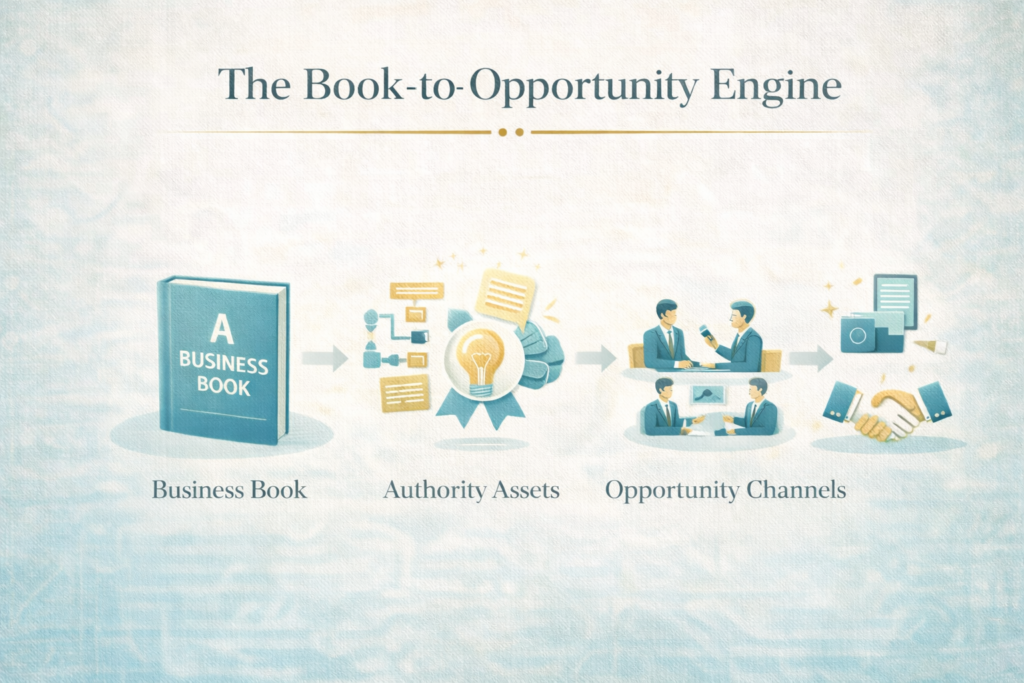
This guide uses a single system, the Book-to-Opportunity Engine, to show how opportunities are created from a book in a repeatable way.
The Core Model
Book
↓
Authority Assets
↓
Opportunity Channels
↓
Enterprise Outcomes
Insert visual diagram here.
The logic is simple:
- The book contains the raw material.
- That raw material is converted into Authority Assets (portable proof and IP).
- Those assets activate Opportunity Channels (places opportunities enter).
- Those channels lead to Enterprise Outcomes (the highest-leverage engagements and partnerships).
What “Authority Assets” Means
Authority Assets are the extracted components of your book that make decision-makers trust you faster.
They are not “marketing content.”
They are credibility artifacts, proof, structure, and language that travels.
Authority Assets typically include:
- Stories (credible moments that teach the problem and stakes)
- Frameworks (a named, teachable model people can repeat)
- Case studies (proof the approach works in the real world)
- Research (data, patterns, or synthesis that supports the claim)
- Contrarian insights (a clear point of view that differentiates the idea)
These assets are what conference organizers, journalists, and enterprise buyers evaluate, often in minutes.
What “Opportunity Channels” Means
Opportunity Channels are the pathways where the market can discover, evaluate, and engage the author.
In this guide, the primary channels are:
- Speaking (keynotes, workshops, panels)
- Media (podcasts, interviews, guest essays)
- Enterprise training (workshops, programs, internal rollouts)
- Licensing (your framework adopted inside an organization)
- Partnerships (aligned platforms distributing or endorsing the idea)
Channels don’t work without assets.
If you pitch speaking without a clear framework, you’re asking an organizer to take a risk.
If you pitch enterprise without case studies, you’re asking a company to buy without proof.
The Engine ensures the assets come first.
What “Enterprise Outcomes” Means
Enterprise Outcomes are the highest-leverage results that follow when authority is established.
They include:
- Paid keynotes that lead to larger engagements
- Corporate workshops and training programs
- Ongoing enterprise partnerships
- Licensing or certification pathways
- A compounding opportunity pipeline where requests arrive inbound
This is where the book stops being a publication and starts functioning as a platform.
How to Use This Engine While Reading the Guide
Every core section of this guide maps back to this model.
When you’re unsure what to do next, return to the Engine and ask:
- What Authority Asset is missing?
- What Opportunity Channel are we trying to activate?
- What Enterprise Outcome are we aiming to create?
As shown in the Book-to-Opportunity Engine, opportunities are not “won” through promotion.
They’re built through extraction → assets → channels → outcomes.
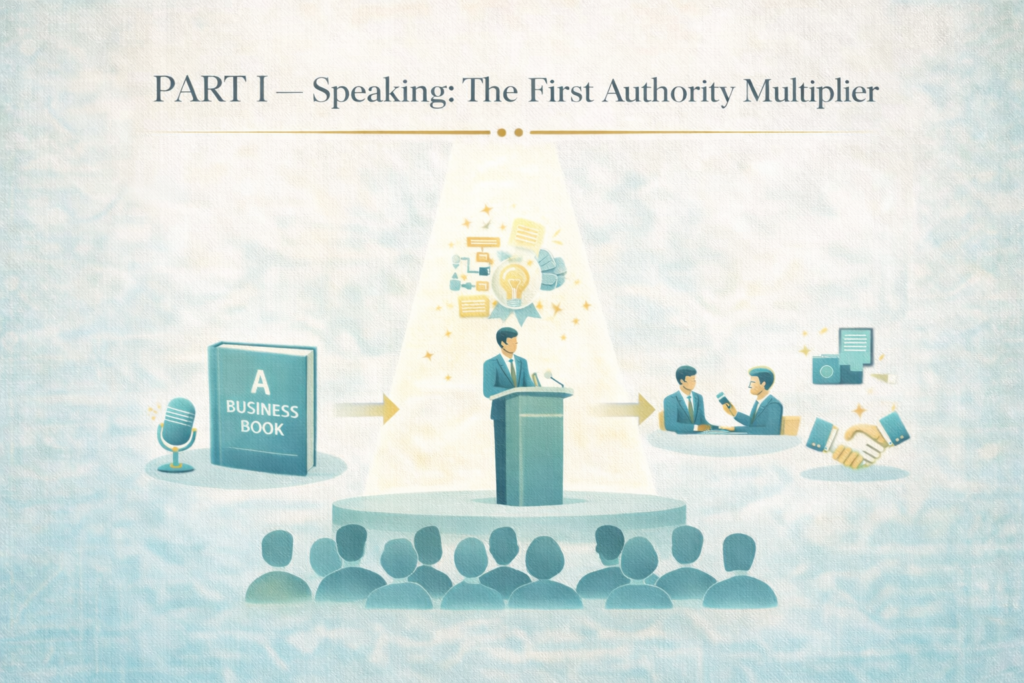
PART I – Speaking: The First Authority Multiplier
Speaking is often the first major opportunity channel that activates after a book is published.
Conferences, associations, and corporate events are constantly looking for speakers who can explain complex ideas clearly. A book signals that the author has already done the thinking required to do that.
But speaking demand does not appear randomly.
It follows a predictable pattern of authority development.
The framework that explains this progression is the Opportunity Pyramid.
The Opportunity Pyramid
Authority-driven opportunities grow through four layers:
Visibility
↓
Credibility
↓
Demand
↓
Leverage
Insert Opportunity Pyramid visual here.
Each layer strengthens the next. Skipping a layer usually weakens the entire system.
Visibility
Visibility is how people first encounter the author’s ideas.
This layer is built through:
- Articles and written insights
- Podcast appearances
- Event participation
- Thought leadership content
Visibility introduces the author to an audience.
However, visibility alone rarely creates high-value opportunities.
Without credibility, attention fades quickly.
Credibility
Credibility signals that the author’s ideas are structured, tested, and worth attention.
A book is one of the strongest credibility signals available.
Credibility is reinforced through:
- The book itself
- A named framework or model
- Documented case studies
- Demonstrated expertise in the field
For conference organizers and media producers, these elements reduce risk.
They show that the author can teach something valuable, not just promote themselves.
Demand
When visibility and credibility combine, demand begins to appear.
Demand shows up as:
- Speaking invitations
- Podcast or media interview requests
- Enterprise inquiries from organizations interested in the ideas
At this stage, the author’s ideas are no longer just content.
They become a resource other platforms want to feature.
Leverage
The top of the pyramid is leverage.
Leverage occurs when the author can choose higher-value opportunities because demand already exists.
Examples include:
- Higher speaking fees
- Invitations to larger conferences and audiences
- Enterprise workshops and corporate training engagements
At this stage, the book is no longer just a publication.
It functions as an authority signal that continually feeds the opportunity pipeline.
Speaking often becomes the first multiplier in this pyramid.
A well-structured talk can introduce the book’s ideas to thousands of people, many of whom become media hosts, conference organizers, or enterprise buyers.
Understanding the Opportunity Pyramid helps explain why speaking frequently becomes the first major channel where a book’s authority begins to compound.
The Signature Keynote
A signature keynote is not “a talk about your book.”
It is the book’s core argument compressed into a live experience.
Books are designed for depth.
Keynotes are designed for clarity.
A conference audience cannot absorb an entire manuscript.
But they can absorb a structured idea that reshapes how they see a problem.
That is the purpose of the signature keynote.
It takes the intellectual architecture of the book and converts it into a presentation that:
- introduces the core idea
- demonstrates the framework
- proves the concept with evidence
- gives the audience a way to act
When structured correctly, the keynote becomes the public expression of the book’s central idea.
The most reliable structure for doing this is the 7-Part Signature Keynote Framework.
The 7-Part Signature Keynote Structure
1. Opening Story
Begin with a short moment that illustrates the problem.
This is not entertainment.
It is orientation.
The opening story gives the audience immediate context for the topic and establishes credibility for the speaker.
It answers a simple question:
Why does this idea matter right now?
2. Big Problem
Next, clearly define the problem the audience is facing.
This should not be a vague industry observation.
It should describe a pattern the audience immediately recognizes.
When framed well, the audience should feel:
“That’s exactly what we’re dealing with.”
A strong Big Problem creates the tension the keynote will resolve.
3. Counterintuitive Truth
Once the problem is clear, introduce the reframe.
This is the core idea that differentiates the book from conventional advice.
It is usually expressed as a short, repeatable insight.
For example:
- A widely accepted assumption is wrong.
- A familiar strategy works for the opposite reason people think.
- A hidden dynamic is driving the real outcomes.
This moment is where the audience realizes they are about to learn something new.
4. Framework Reveal
The framework is the structural heart of the keynote.
It is the model that explains how the new insight works in practice.
Frameworks are powerful because they:
- simplify complexity
- provide language the audience can repeat
- give organizations something implementable
In most nonfiction books, the framework already exists inside the manuscript.
The keynote simply reveals it earlier and more clearly.
5. Case Studies
Once the framework is introduced, the audience needs proof.
Case studies demonstrate that the model works in the real world.
They may include:
- organizational examples
- founder experiences
- industry patterns
- research observations
The purpose is not storytelling.
The purpose is credibility reinforcement.
6. Activation
At this stage, the audience understands the framework.
Now they need to know what to do with it.
Activation translates the model into a small number of practical next steps.
For example:
- decisions leaders should reconsider
- behaviors teams should change
- structures organizations should test
Activation turns insight into application.
7. Transformation Close
The final step shows what becomes possible when the framework is applied.
This is not a motivational speech ending.
It is a strategic before-and-after contrast.
The audience should clearly see:
- what the old approach produces
- what the new approach enables
When this moment is done well, the audience leaves with a simple conclusion:
This idea changes how we should operate.
Why the Signature Keynote Matters
The keynote becomes the public interface of the book’s idea.
Conference organizers book the keynote.
Podcast hosts interview the keynote.
Enterprises request workshops built from the keynote.
In other words:
The keynote becomes the portable version of the book.
And when the keynote is structured well, it does something powerful:
It turns a single book into repeated opportunities to teach the idea again and again.
That is why speaking often becomes the first multiplier in the Book-to-Opportunity Engine.
Author → Conference Speaker
Starting Point
A consultant publishes a nonfiction book that introduces a clear framework for solving a recurring industry problem. The book contains the core model, supporting case studies, and the language used to explain the idea.
Action
The author extracts the book’s central framework and converts it into a structured signature keynote using the seven-part keynote model.
The talk focuses on one problem, one counterintuitive insight, and the framework that resolves it.
This keynote becomes the primary way the idea is presented at conferences and industry events.
Result
Conference organizers begin inviting the author to speak because the talk provides a clear, teachable framework audiences can apply.
The book establishes credibility, while the keynote makes the idea visible at scale, leading to paid speaking engagements and recurring conference invitations.
How the Book Became the Keynote
A common mistake is trying to “create a keynote” from scratch after the book is done.
The higher-leverage approach is extraction.
The manuscript already contains the raw material a keynote needs:
a credible story, a teachable framework, and proof that the framework works.
Story Extraction
The author starts by scanning the manuscript for moments that do one of two things:
- Illustrate the Big Problem in a real setting
- Show the cost of continuing the old approach
The goal is not to find the most dramatic story.
The goal is to find a story that quickly establishes:
- stakes (why this matters)
- credibility (why the author understands it)
- relevance (why the audience should care)
That story becomes the keynote’s opening.
Framework Reveal
Next, the author identifies the book’s central model, the part of the manuscript that explains:
- why the problem persists
- what most people misunderstand
- what the correct approach looks like
In the book, this framework may be distributed across chapters.
In the keynote, it must be centralized and named.
The author translates the framework into:
- a simple visual (one slide)
- a short explanation that can be delivered in under two minutes
- a sequence the audience can repeat
This becomes the structural backbone of the talk.
Case Study Proof
Once the framework is clear, the keynote needs evidence.
The author pulls 2–3 case studies from the book that demonstrate:
- the framework applied in real conditions
- a measurable before/after outcome
- a clear lesson the audience can adopt
Each case study is shortened into a clean proof block:
- context (what was happening)
- intervention (what changed)
- result (what improved)
This is the credibility layer that prevents the keynote from feeling theoretical.
Convert the Book Into a Live Sequence
At this point, the keynote is not “a summary of the book.”
It is a designed experience:
- a story that opens tension
- a reframing insight that breaks the default assumption
- a framework that gives the audience language
- proof that the framework works
- activation that turns the framework into actions
The author hasn’t invented new material.
They have simply reorganized the strongest elements of the manuscript into a format that stages, podcasts, and enterprise buyers can absorb quickly.
That is what makes a manuscript become a keynote.
Turning Your Manuscript Into a Keynote
A keynote should not be written from a blank page.
The strongest keynotes are extracted from the manuscript.
The book already contains the intellectual assets required for a compelling talk: stories, frameworks, and proof.
The goal is not invention.
The goal is selection and compression.
A practical extraction process looks like this.
Step 1 — Upload the Manuscript to Codex
Start by analyzing the completed manuscript inside Codex (Author Intelligence).
Codex functions as an analytical layer that helps identify the structural elements already present in the book, including:
- narrative stories
- core frameworks
- repeated patterns in the argument
- case studies and supporting examples
This analysis makes it easier to identify which parts of the manuscript are strongest for live delivery.
Step 2 — Extract the Core Stories
Next, identify the stories that illustrate the book’s central problem.
A keynote usually needs one primary opening story and one or two supporting moments that reinforce the stakes of the topic.
Look for stories that:
- clearly illustrate the problem the audience recognizes
- establish credibility for the author
- create emotional or strategic tension early in the talk
These become the narrative anchors of the keynote.
Step 3 — Identify the Central Framework
Every strong keynote is built around a single framework.
In the manuscript, this framework may appear across several chapters.
For speaking, it must be simplified and named.
The framework should answer three questions:
- What is the core idea of the book?
- What model explains how the idea works?
- What language will audiences repeat after the talk?
This framework becomes the structural center of the presentation.
Step 4 — Pull the Strongest Case Studies
Once the framework is identified, select two or three case studies that demonstrate it in action.
These should be examples that:
- show the framework applied in real-world conditions
- produce a clear outcome or improvement
- reinforce the credibility of the model
Case studies function as proof that the idea works outside the book.
Step 5 — Organize the Material Into the Keynote Structure
Finally, arrange the extracted elements using the Signature Keynote Structure.
The keynote typically includes:
- one opening story
- a clearly defined problem
- a counterintuitive insight that reframes the issue
- the framework that explains the solution
- supporting case studies
- practical activation steps for the audience
At this point, the keynote is not a summary of the book.
It is the live version of the book’s core argument, designed for clarity, memorability, and repeatable delivery on stages, podcasts, and enterprise events.
PART II – Speaker Infrastructure
The Speaker Kit
Most speaking opportunities are not won on stage.
They are won in the evaluation window before the organizer ever meets the author.
A conference organizer is not asking, “Is this person interesting?”
They are asking, “Is this talk reliable, relevant, and easy to program?”
That is what a speaker kit is for.
A speaker kit is not a résumé.
It is a set of sales assets designed to reduce risk for the buyer and increase the likelihood of booking.
What a Speaker Kit Does
A complete speaker kit helps an organizer quickly answer:
- Who is this speaker and what do they teach?
- Who is the talk for?
- What will the audience walk away with?
- What proof exists that this will land well?
- What formats can this speaker deliver?
If those answers are not immediately clear, interest does not convert into bookings.
Speaker Kit Components
A functional speaker kit includes the following components.
Speaker Page
A dedicated page that summarizes the speaking offer in one place.
It should include the core positioning, talk titles, and a clear booking path.
This page exists so the organizer has something to forward internally.
One-Sheet
A single-page PDF or document that can be printed or shared in an internal review.
It should include:
- short bio
- key topics / talk titles
- audience fit
- outcomes
- social proof
The one-sheet is the fastest decision document in the kit.
Speaking Reel
A short video that demonstrates stage presence and delivery.
This is not about production value.
It is about credibility.
Organizers want to see that the speaker can hold attention and teach clearly.
Talk Titles
Clear talk titles that sound like conference session names, not book chapters.
Each title should signal:
- the problem
- the angle
- the intended audience
Good titles make the talk easy to place in an agenda.
Audience Definition
A plain-language statement of who the talk is for.
Organizers don’t want generic “leadership” or “innovation.”
They want a clear audience match (role, context, industry, or stage of growth).
This is part of what makes the speaker “programmable.”
Transformation Outcomes
A short set of outcomes that describe what changes for the audience after the talk.
Outcomes are stronger than topics.
A topic is what you’ll discuss.
An outcome is what the audience will leave with.
Testimonials
Short proof points from:
- event organizers
- past audiences
- enterprise clients
- industry peers
Testimonials reduce risk and accelerate decision-making.
Framework Visuals
One or two visuals that show the core model from the book.
Framework visuals perform two roles:
- they reinforce that the author has a teachable system
- they make the talk easier to understand quickly
This is one of the fastest credibility signals in the entire kit.
Enterprise Options
A speaker kit should not only sell a talk.
It should show the adjacent pathways an organization can engage next, such as:
- workshops
- training programs
- executive sessions
- licensing opportunities
This turns a keynote from a one-time event into an entry point.
The Strategic Principle
Speaking interest is common.
Speaking bookings require infrastructure.
A professional speaker kit is the system that converts demand into confirmed engagements, because it makes the author’s work easy to evaluate, easy to approve, and easy to program.
Consultant → Conference Circuit
Starting Point
A consultant has deep expertise in a specific industry problem and has recently published a nonfiction book outlining their approach.
The ideas are strong, but conference organizers have difficulty evaluating the speaker quickly.
There is no central page explaining the talks, no concise overview of topics, and no asset that can be forwarded internally for review.
As a result, interest in the ideas does not consistently convert into speaking invitations.
Action
The consultant builds the core elements of a speaker infrastructure, starting with two foundational assets:
- a dedicated speaker page explaining the talk topics, audiences served, and outcomes
- a concise one-sheet summarizing the speaker’s positioning, topics, and credibility signals
These assets make the author’s work easy for conference organizers to review, share internally, and evaluate for event programming.
Result
Conference organizers can now quickly understand:
- the core idea behind the talk
- the audiences the presentation serves
- the outcomes participants will gain
With this clarity, the consultant begins receiving conference invitations and confirmed speaking engagements, turning existing expertise into a repeatable speaking circuit.
How Books Create Media Authority
A book positions an author for media not because it exists, but because it structures an idea in a way journalists, podcast hosts, and producers can use.
Media organizations are constantly searching for credible interpreters of complex topics.
A book signals that the author has already done the work of organizing the thinking.
Three structural roles typically emerge from this process:
- Category Voice
- Framework Creator
- Thought Leader
Each role reflects a different mechanism through which books convert intellectual work into media authority.
1). Category Voice
A category voice is someone the media calls when a topic becomes relevant.
Journalists operate under time pressure. When a subject becomes newsworthy, they need credible people who can explain the issue quickly and clearly.
Books help establish category voice status because they signal three things:
- the author has studied the topic in depth
- the argument is structured and defensible
- the perspective has been developed beyond short-form commentary
The book becomes a credibility shortcut.
Instead of asking, “Why should we trust this person?” the producer can see that the author has already organized a full position on the topic.
Mechanism
The mechanism behind category voice authority is topic ownership.
When an author publishes a book that clearly defines a problem space, media outlets begin to associate that author with the category.
Over time, the author’s name becomes cognitively linked to the issue.
This is why many recurring media experts are introduced with a simple phrase:
“Author of [book title] on [topic].”
The book functions as shorthand for expertise.
Strategy
To position a book for category voice authority:
- Define the problem clearly and consistently throughout the manuscript.
- Use precise language that media outlets can easily quote or summarize.
- Avoid overly broad positioning.
The more clearly the book defines a category, the easier it becomes for media organizations to identify the author as a relevant voice when the topic appears in the news cycle.
2). Framework Creator
Media prefers explanations that are structured and memorable.
A framework is a model that simplifies a complex issue into a small number of components.
Frameworks give journalists and audiences a way to understand a problem quickly.
Books are one of the strongest vehicles for establishing frameworks because they allow authors to:
- define the model fully
- explain how it works
- support it with examples and case studies
This depth makes the framework credible.
Mechanism
The mechanism behind framework authority is intellectual compression.
A good framework reduces a complex topic into a structure that can be explained in minutes without losing the core insight.
When a framework is strong, media outlets adopt the language because it helps audiences understand the topic faster.
Frameworks travel well across formats:
- podcast interviews
- short TV segments
- written articles
- conference panels
In each case, the framework provides the explanatory structure for the conversation.
Strategy
To position a framework for media use:
- Name the framework clearly.
- Reduce it to a small number of elements (often three to five).
- Use simple labels that audiences can remember.
When the framework becomes repeatable, media interviews naturally revolve around explaining the model.
The book provides the full explanation.
The media appearance becomes the compressed version.
3). Thought Leader
The term thought leader is often used loosely. In practice, it describes a specific role in the media ecosystem.
A thought leader is someone who shapes how people interpret a problem.
This role goes beyond describing events. It involves providing a perspective that changes how the audience thinks about the issue.
Books are particularly effective at establishing this role because they allow the author to build a complete argument:
- define the problem
- explain why conventional explanations fall short
- introduce a new interpretation
- propose a structured response
This intellectual architecture becomes the author’s signature perspective.
Mechanism
The mechanism behind thought leadership is interpretive authority.
When audiences encounter complex or uncertain situations, they look for people who can make sense of the environment.
If the author consistently provides a clear interpretation, media outlets begin to rely on that perspective to frame discussions.
The book demonstrates that the interpretation is not a reaction.
It is the result of sustained analysis.
Strategy
To position an author as a thought leader:
- articulate a clear point of view about the topic
- challenge at least one common assumption in the field
- offer a structured alternative explanation
Media appearances then become opportunities to apply that perspective to new developments.
The book provides the intellectual foundation.
The media platform amplifies the interpretation.
Over time, the author becomes recognized not only for expertise but for the lens through which the issue is understood.
Media Hook Triangle
Media opportunities rarely come from simply announcing a book.
Editors, podcast hosts, and producers are looking for angles that serve their audience, not promotional messages.
A strong media pitch typically combines three elements that make the conversation both relevant and useful.
This structure is the Media Hook Triangle.
It brings together:
- a timely angle that makes the topic relevant now
- a counterintuitive insight that challenges conventional thinking
- a human story that makes the idea relatable and concrete
When these three elements align, the author’s idea becomes easier for media platforms to feature and repeat.
Timely Angle
A timely angle connects the author’s idea to something currently happening in the market, industry, or news cycle.
Media organizations prioritize conversations that feel immediate and relevant. A timely angle answers the question:
“Why should audiences care about this topic right now?”
Timely angles often emerge from:
- emerging industry shifts
- new technologies or trends
- economic changes
- recent news events
- changes in how organizations operate
The book provides the underlying expertise, but the timely angle connects the idea to the present moment.
Counterintuitive Insight
Media conversations become compelling when the guest introduces a perspective that challenges common assumptions.
A counterintuitive insight reframes the issue in a way that makes the audience pause and reconsider what they believe.
For example, instead of repeating widely accepted advice, the author presents a different explanation for why the problem exists or how it should be addressed.
This type of insight works well in media because it:
- creates intellectual tension
- differentiates the author from other commentators
- gives the host a clear angle to explore during the interview
Books often contain multiple insights of this type, but media appearances usually center on one clear idea that anchors the conversation.
Human Story
The final element is the human story.
Stories make abstract ideas easier to understand and remember.
They demonstrate how the insight applies in real situations.
A strong human story may come from:
- the author’s own experience
- a case study from the book
- a client transformation
- a real-world example that illustrates the problem and solution
The story provides narrative grounding for the insight and helps the audience see how the framework operates outside theory.
Combining the Three Elements
A strong media pitch aligns all three elements into a single idea.
For example:
- The timely angle explains why the issue is relevant now.
- The counterintuitive insight introduces the author’s perspective.
- The human story demonstrates how the idea works in practice.
This combination makes the author’s idea easier for media platforms to program, explain, and share with their audiences.
Author → Podcast Authority
Starting Point
An author publishes a book addressing a rapidly emerging industry topic. The idea is timely, but early outreach focused primarily on promoting the book itself rather than highlighting the core insight.
Action
The author reframes media outreach using the Media Hook Triangle.
Podcast pitches highlight:
- a timely industry shift discussed in the book
- a contrarian insight that challenges the prevailing explanation
- a practical example illustrating the concept in action
Each media conversation focuses on explaining the idea rather than promoting the title.
Result
Podcast hosts begin inviting the author to discuss the topic repeatedly because the interviews provide clear insights for listeners.
Over time, the author becomes associated with the idea itself, leading to recurring podcast interviews and broader media exposure.
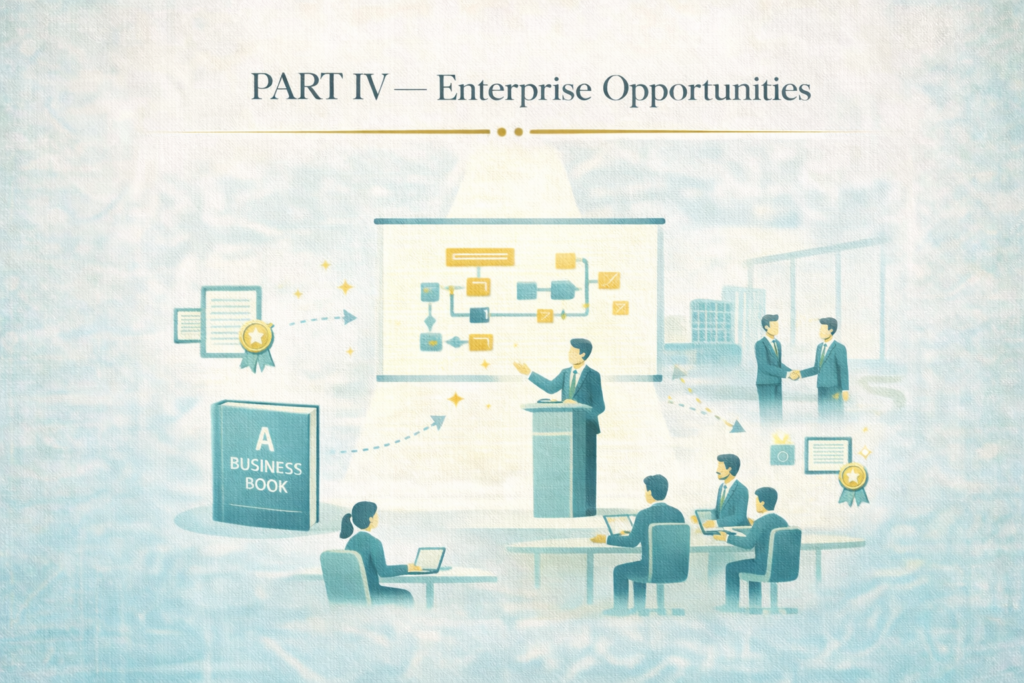
PART IV – Enterprise Opportunities
Where the Real Revenue Lives
Most authors evaluate the upside of a book through the wrong lens: royalties.
Royalties are a byproduct of distribution. They are not the primary economic engine for most nonfiction authors—especially executives, consultants, and experts whose value is captured through high-trust decisions (who to hire, who to listen to, whose framework to adopt).
Enterprise engagements are paid agreements where an organization buys the author’s expertise as an outcome—through training, workshops, implementation support, or licensing. The book functions as the credibility layer that makes those agreements easier to initiate, justify, and expand.
The Economics Shift: Book Income vs Enterprise Income
Book economics are constrained by unit volume and retail pricing. Enterprise economics are constrained by outcome value and organizational budget.
A practical way to brief a senior executive is to treat the book as the front-end credential, and enterprise engagements as the back-end monetization.
| Revenue Path | What’s Being Bought | Typical Buyer | How Value Is Measured | Why the Book Matters |
| Book royalties | Copies | Individuals | Units sold | Signals credibility, but rarely closes high-value deals |
| Corporate workshop | A live outcome session | HR, L&D, department leaders | Behavior change, alignment, decision clarity | Reduces perceived risk; provides a “shared language” |
| Training program | Repeatable capability building | L&D, functional leaders | Adoption, completion, performance lift | Positions the author as the framework owner |
| Framework licensing | Permission to use your IP | Enterprise leadership, enablement teams | Scale, consistency, internal adoption | Establishes legitimacy of the model being licensed |
The key mechanism: enterprises don’t pay for books; they pay for capability, alignment, and change. The book makes the purchase defensible.
What Enterprise Buyers Actually Need
Enterprise stakeholders rarely wake up wanting “a speaker.”
They want a solution that is:
- credible (low reputational risk)
- transferable (can be taught across teams)
- repeatable (not dependent on one charismatic session)
- measurable (can be connected to outcomes)
A book supports all four, because it packages the author’s thinking into a durable artifact that decision-makers can reference, circulate, and adopt internally.
Enterprise Opportunity Pathways
Enterprise engagements are not one single type of offer.
They typically emerge in distinct engagement pathways, each designed to solve a different organizational need.
Understanding these pathways helps leaders decide how the book’s framework should be applied inside organizations.
Three pathways appear most frequently:
- Corporate Workshops
- Training Programs
- Framework Licensing
Each pathway has a different trigger, strategy, and outcome.
Corporate Workshops
A corporate workshop is a focused session designed to introduce a framework and help a group apply it to a current challenge.
It is typically the first enterprise engagement an organization purchases after encountering an author’s ideas through a book, keynote, or media appearance.
Organizational Trigger
Workshops are usually requested when an organization:
- wants to explore a new idea quickly
- needs alignment around a specific problem
- is evaluating whether a framework is useful for their teams
The organization is not yet committing to long-term adoption.
They are testing whether the model resonates with their context.
Strategic Role
Workshops function as idea activation.
The author introduces the framework, demonstrates how it works, and facilitates structured discussion around how the model applies to the organization’s situation.
Because the session is short and focused, workshops often serve as an entry point into deeper engagements.
Outcome
Typical outcomes include:
- leadership alignment around a problem or strategy
- early adoption of the framework’s language
- identification of areas where deeper implementation may be valuable
Workshops frequently lead to follow-on conversations about training programs or broader implementation.
Training Programs
A training program extends the author’s framework into a structured capability-building process.
Instead of introducing the idea once, the program helps teams develop repeatable skills and practices based on the framework.
Training programs are typically delivered over multiple sessions, often through cohort-based learning or structured internal initiatives.
Organizational Trigger
Training programs emerge when an organization:
- sees value in the framework introduced through a book or workshop
- wants teams to apply the model consistently
- needs a structured learning environment for adoption
The organization has moved beyond exploration.
They are now interested in building capability.
Strategic Role
Training programs translate the book’s concepts into operational practices.
Sessions often include:
- applied exercises
- internal case discussions
- adaptation of the framework to company-specific workflows
The objective is not just understanding the idea, but integrating it into how teams operate.
Outcome
Training programs typically produce:
- consistent language across teams
- improved decision frameworks
- repeatable internal practices based on the author’s model
At this stage, the framework often becomes embedded inside the organization’s leadership or operating systems.
Framework Licensing
Framework licensing allows an organization to formally adopt the author’s intellectual property as part of its internal systems.
Instead of relying on occasional sessions with the author, the organization receives permission to use the framework’s models, tools, and language internally at scale.
This pathway represents the most advanced form of enterprise engagement.
Organizational Trigger
Licensing usually emerges when:
- the framework has proven valuable in training or workshops
- leaders want to scale the model across large teams
- internal programs require consistent methodology
The organization no longer sees the framework as an external idea.
It becomes part of how the organization operates.
Strategic Role
Licensing converts the author’s intellectual property into a repeatable internal system.
This may include:
- use of the framework in internal training
- integration into leadership programs
- inclusion in company playbooks or methodologies
The author’s work becomes part of the organization’s operating language.
Outcome
Licensing agreements typically result in:
- widespread internal adoption of the framework
- standardized training and enablement materials
- long-term strategic partnerships between the author and the organization
This pathway often produces the most durable enterprise relationships.
When to Use Each Engagement Pathway
These enterprise pathways typically follow a natural progression, depending on the organization’s level of commitment.
| Enterprise Pathway | When It Is Used |
| Corporate Workshop | When the organization is exploring the idea and wants a focused introduction |
| Training Program | When the organization wants teams to apply the framework consistently |
| Framework Licensing | When the organization intends to scale the framework across the company |
This progression reflects a broader principle of enterprise engagement:
Ideas enter organizations through experiences.
They become valuable when they turn into systems.
The book establishes the credibility of the idea.
Enterprise engagements transform that idea into organizational capability.
Pricing Reality: Why Enterprise Changes the Ceiling
Enterprise engagements price on value delivered, not copies sold. Even conservative enterprise pricing can exceed typical book income because the buyer is not one reader—it is an organization.
| Enterprise Offer | Typical Structure | Price Anchor (Example Range) | Why It Prices Here |
| Workshop | 60–120 minutes + pre-call | $7,500–$25,000 | Pays for decision quality and time savings |
| Training program | 4–12 sessions | $25,000–$150,000 | Pays for capability development and adoption |
| Framework licensing | Annual agreement | $50,000–$250,000+ | Pays for scale, consistency, and internal reuse |
These are not aspirational numbers. They are a reflection of how organizations buy outcomes when credibility and risk are managed.
The Strategic Takeaway
A book is not a revenue product first. It is a credential that converts expertise into enterprise-safe demand.
When an executive publishes a book with a clear framework and proof, enterprise buyers gain a reason to believe:
- the idea is structured, not improvised
- the author is serious, not promotional
- the model is teachable, not personality-dependent
That is what unlocks enterprise economics.
Enterprise Opportunity Types
Enterprise opportunities emerge when the ideas inside a book are structured into systems organizations can apply.
Companies rarely purchase abstract insights.
They purchase capabilities, processes, and repeatable models that help teams make better decisions or operate more effectively.
When a nonfiction book contains a clear framework, that framework can often be translated into four primary enterprise pathways:
- Workshops
- Training Programs
- Licensing
- Certification
Each pathway represents a different level of organizational adoption.
Workshops
A workshop is the most immediate enterprise application of a book’s framework.
It is typically a short engagement designed to introduce the model and help a group apply it to a current challenge.
Workshops often follow keynote speaking engagements or internal leadership discussions where the book’s ideas first gain traction.
The goal of a workshop is not long-term implementation.
It is structured activation, helping leaders and teams understand the framework and see how it applies to their environment.
Common workshop outcomes include:
- alignment around a strategic problem
- shared language for decision-making
- early experimentation with the framework
Because workshops are focused and practical, they frequently become the entry point for deeper enterprise partnerships.
Training Programs
A training program expands the framework into a structured capability-building system.
Instead of introducing the model once, the organization develops internal expertise through a series of sessions or structured learning modules.
Training programs are typically designed for:
- leadership cohorts
- internal academies
- functional teams adopting new operating models
The goal is repeatable skill development.
Participants do not just learn the idea.
They practice applying it in real operational contexts.
Successful training programs often produce:
- consistent decision frameworks across teams
- improved collaboration and communication
- measurable improvements in execution quality
At this stage, the framework begins to function as an internal operating model.
Licensing
Licensing allows an organization to formally adopt the author’s framework across the company.
Instead of bringing the author in for individual sessions, the organization receives permission to integrate the intellectual property into internal systems.
This may include:
- internal training programs
- leadership development materials
- company playbooks
- internal strategy frameworks
Licensing converts the author’s ideas into organizational infrastructure.
The framework becomes embedded in how teams think, communicate, and operate.
For authors, licensing also creates the most scalable form of enterprise engagement because the model can be applied across many teams simultaneously.
Certification
Certification programs extend the framework beyond a single organization.
In this model, professionals are trained and authorized to apply the author’s methodology in their own organizations or with clients.
Certification programs typically include:
- formal training on the framework
- standardized tools and materials
- evaluation or assessment of proficiency
The outcome is a network of practitioners who can implement the framework consistently.
For organizations, certification ensures the framework is applied correctly.
For authors, it allows the intellectual property to expand into a broader professional ecosystem.
Author → Enterprise Training Partner
Starting Point
An author publishes a nonfiction book introducing a structured framework for improving leadership decision-making inside organizations.
Leaders respond positively to the idea, but initially engage with it only through conference talks and executive discussions.
Action
The author converts the framework into a corporate workshop designed to help leadership teams apply the model to real strategic decisions.
The workshop introduces the framework, walks participants through case examples, and facilitates structured application within the organization.
Result
Organizations begin inviting the author to run these sessions internally.
Over time, the workshop evolves into a broader training program, positioning the author as a long-term enterprise training partner rather than a one-time speaker.
PART V — The Opportunity Engine
Inbound Opportunity Engine
An inbound opportunity engine is the system that causes speaking, media, and enterprise requests to arrive without constant outbound pitching.
It is not “being visible.”
It is making it easy for the right people to understand what you do, trust the credibility behind it, and take the next step.
A book creates the precondition for inbound: it establishes authority.
But authority does not convert automatically. Conversion happens when the book is connected to clear pathways that let an interested party self-select into the right type of engagement.
The three inbound funnels a book activates
A book tends to trigger interest in three predictable directions:
- Book → Speaking
Someone wants the ideas delivered live to an audience. - Book → Media
Someone wants the author’s perspective packaged into an interview, quote, or segment. - Book → Enterprise
Someone wants the framework applied inside an organization as a workshop, training program, or longer engagement.
These funnels are simple on purpose.
They are decision paths for the buyer.
If the path is unclear, interest dissipates.
If the path is obvious, inbound increases.
The conversion bottleneck most authors miss
Most authors treat inbound as a demand problem.
It is usually an infrastructure problem.
The typical failure mode looks like this:
- the book generates attention
- the right people search the author
- they cannot quickly determine:
- what the author offers
- who it is for
- what outcomes it produces
- how to take the next step
When that happens, the opportunity expires quietly.
Inbound engines fail when the “next step” is vague.
The minimum inbound infrastructure
To convert book-driven interest into real opportunities, you need dedicated pages that match the three funnels.
These are not vanity pages.
They are decision support assets designed for event organizers, producers, and enterprise buyers.
Speaker page
A speaker page is the destination for anyone evaluating you for an event.
It should answer, in under two minutes:
- what you speak about (talk titles + themes)
- who your talks are built for (audiences)
- what changes for the audience (transformation outcomes)
- what credibility supports the talk (book + case studies + proof)
- how to book you (clear contact path)
A speaker page reduces organizer friction.
It turns “interesting author” into “bookable speaker.”
Media page
A media page is the destination for producers and journalists.
It should make it easy to feature you by providing:
- what your idea is (category + point of view)
- what you can comment on (topics, angles, contrarian insights)
- how to frame you (bio + credentials + book)
- what assets exist (headshots, prior interviews, links)
- how to reach you (fast contact path)
A media page converts curiosity into a usable pitch.
Training page
A training page is the destination for enterprise buyers.
It clarifies:
- what problem you help organizations solve
- what the framework enables operationally
- what formats you offer (workshops, training programs, licensing, etc.)
- what outcomes teams can expect
- what the engagement process looks like
Enterprise buyers are not looking for inspiration.
They are looking for implementation.
A training page signals that your ideas are not just publishable, they are deployable.
The Opportunity Routing Layer
When a book creates authority, it begins attracting different types of opportunity requests.
But those requests come from different buyers with different goals.
An effective inbound engine must route each type of buyer to the correct engagement path.
Without routing, opportunities stall because the next step is unclear.
The routing layer organizes inbound interest into three primary paths:
| Visitor Type | What They Want | Destination |
| Event organizers | A keynote or conference talk | Speaker Page |
| Media producers | An interview or commentary | Media Page |
| Enterprise leaders | A workshop, training, or program | Training Page |
The author’s website functions as the routing system that directs each visitor to the appropriate engagement channel.
Then the pages make more sense
After this table, your sections become clearer:
Speaker Page
(for event organizers)
Media Page
(for producers and journalists)
Training Page
(for enterprise buyers)
Work-With-Me Page
(the routing hub that connects them)
Now the logic is visible:
Book → Attention → Visitor arrives → Routing Layer → Correct opportunity funnel
This page exists for one reason:
to prevent inbound leads from being forced to guess which path applies.
The operating principle
Inbound is created when your book meets two conditions:
- Authority is established (the book proves you are worth listening to)
- Pathways are explicit (your infrastructure tells people exactly what to do next)
The book earns attention.
The engine converts it.
Outbound Opportunity Engine
Inbound opportunity systems take time to develop.
A book establishes credibility, but demand does not appear instantly.
In the early phase after publication, authors often need to create initial momentum through proactive outreach.
This is the role of the Outbound Opportunity Engine.
Outbound does not replace inbound systems.
It accelerates them by placing the author’s ideas in front of the right audiences early, which then creates the visibility and proof that later generates organic demand.
The goal is not mass outreach.
The goal is targeted opportunity creation.
The 4×4 Pitch System
The most reliable way to generate early opportunities is to structure outreach across four opportunity channels.
Each channel receives a small number of focused pitches rather than broad distribution.
4×4 Pitch System
- 4 speaking pitches
- 4 media pitches
- 4 enterprise pitches
- 4 partnership pitches
This produces 16 targeted outreach attempts across the most relevant opportunity channels.
The number is deliberate.
It forces prioritization and prevents authors from defaulting to unfocused outreach.
Speaking Pitches
Speaking pitches target event organizers and conference programmers who are responsible for selecting speakers.
The goal is to introduce the author’s core idea and keynote topic as a solution to a problem relevant to the audience.
Effective speaking pitches typically include:
- the central theme of the talk
- the audience the talk serves
- the transformation the talk delivers
- credibility signals (book, framework, expertise)
When structured correctly, the pitch positions the author as a speaker candidate, not simply an author promoting a book.
Media Pitches
Media pitches target podcast hosts, journalists, producers, and newsletter editors.
Media outlets rarely feature books directly.
They feature ideas, commentary, and perspectives relevant to current conversations.
A strong media pitch therefore focuses on:
- the idea inside the book
- the angle that makes the idea relevant now
- the perspective the author can contribute to ongoing discussions
The book acts as the credibility signal behind the idea.
Enterprise Pitches
Enterprise pitches target organizations that may benefit from applying the author’s framework internally.
Typical recipients include:
- corporate learning leaders
- HR and talent development teams
- innovation or strategy leaders
- professional associations
The pitch focuses on organizational outcomes, not intellectual ideas.
Instead of presenting the book, the pitch explains:
- the business problem addressed
- the framework that solves it
- the format of the engagement (workshop, training, program)
This positions the author as a training partner, not simply a thought leader.
Partnership Pitches
Partnership pitches target organizations or platforms that can amplify the author’s ideas.
Examples include:
- industry associations
- educational platforms
- professional communities
- event organizers
- media networks
Partnerships expand reach by placing the author’s framework inside an existing audience ecosystem.
The pitch typically proposes collaboration formats such as:
- joint webinars
- co-hosted events
- guest teaching sessions
- collaborative content initiatives
Partnerships are often the fastest way to access large, relevant audiences.
Follow-Up Cadence
Outbound opportunity creation depends on consistent follow-up.
Many opportunities are not declined.
They are simply delayed or overlooked.
A practical cadence includes:
- Initial pitch
- Follow-up after 7–10 days
- Second follow-up after 14–21 days
Each follow-up should be concise and respectful of the recipient’s time.
The objective is not persistence for its own sake.
It is ensuring the opportunity is seen and considered.
The Strategic Role of Outbound
Outbound activity exists for a specific phase of the opportunity engine: activation.
When a book is first released, the author has credibility but not yet visible market proof.
Conference organizers, media producers, and enterprise buyers often wait for signals of traction before engaging.
Outbound outreach generates those initial signals.
Early speaking engagements, podcast interviews, and pilot enterprise programs create observable evidence that the author’s ideas resonate with real audiences.
These early opportunities serve three strategic functions:
- Visibility — the ideas begin appearing in conferences, podcasts, and industry discussions
- Credibility reinforcement — third-party platforms validate the author’s expertise
- Market proof — organizations see the framework applied in real environments
Once these signals accumulate, the opportunity system begins shifting from author-driven outreach to market-driven demand.
Conference organizers reference prior talks.
Producers discover past interviews.
Enterprise leaders see frameworks already used in practice.
At that point, the inbound engine becomes self-reinforcing.
Outbound outreach is therefore not a permanent activity.
It is a launch mechanism that activates the broader opportunity system created by the book.
PART VI — Execution
The 12-Month Opportunity Plan
Turning a book into speaking, media, and enterprise opportunities requires deliberate sequencing.
Authority rarely converts into opportunity immediately.
Instead, opportunities compound when the right assets, signals, and relationships are built in the correct order.
The 12-Month Opportunity Plan organizes the book-to-opportunity strategy into four execution phases.
Each quarter focuses on a different operational objective.
Build the Opportunity Infrastructure
The first quarter focuses on building the assets that allow the book to convert attention into opportunities.
The priority is not promotion.
The priority is infrastructure.
Key deliverables include:
- Signature keynote derived from the book’s framework
- Speaker page explaining talk topics and audience outcomes
- Speaker one-sheet summarizing positioning and credibility
- Media page outlining interview topics and commentary areas
- Enterprise training page describing workshops or programs
- Work-with-me routing page connecting engagement paths
Key performance indicators
- Core opportunity infrastructure completed
- Clear positioning of the author’s central idea
- At least one keynote structure finalized
The outcome of Q1 is readiness.
The system for converting authority into opportunities now exists.
Generate Initial Speaking and Media Signals
With infrastructure in place, the second quarter focuses on visibility and proof.
The objective is to secure early speaking engagements and media appearances that demonstrate market interest in the author’s ideas.
Key activities include:
- Targeted speaking outreach to conferences and industry events
- Podcast and media pitching aligned with the author’s core idea
- Early keynote presentations or guest lectures
- Media interviews introducing the framework
Key performance indicators
- Initial speaking engagements confirmed
- Podcast or media appearances secured
- Early audience feedback validating the framework
The outcome of Q2 is credibility reinforcement.
The author’s ideas begin appearing on external platforms.
Enterprise Expansion
Once the ideas have visible traction, the third quarter focuses on enterprise application.
Organizations often become interested only after seeing the framework presented publicly.
At this stage, the author begins translating the ideas into structured organizational engagements.
Key activities include:
- Converting keynote content into corporate workshop formats
- Proposing training sessions or pilot programs
- Engaging corporate learning and development teams
- Delivering early enterprise sessions to refine the framework in practice
Key performance indicators
- Initial enterprise workshops delivered
- Organizational adoption of the framework in training or leadership programs
- Development of repeatable enterprise program formats
The outcome of Q3 is enterprise validation.
The ideas move from thought leadership into operational use.
Systemize and Scale
The final quarter focuses on transforming the opportunity flow into a repeatable system.
By this stage, the author typically has multiple signals of demand:
- speaking engagements
- media visibility
- enterprise interest
The focus now shifts from opportunity creation to systemization.
Key activities include:
- refining the signature keynote based on audience response
- documenting enterprise program formats
- strengthening speaker and media assets with proof and testimonials
- building repeatable outreach and partnership relationships
Key performance indicators
- repeat speaking invitations
- recurring media appearances
- enterprise engagements expanding or renewing
The outcome of Q4 is leverage.
The book is no longer simply a publication.
It becomes the foundation of a durable opportunity engine that continues generating speaking, media, and enterprise engagements over time.
PART VII — Common Mistakes & Fixes
Books often generate interest.
But interest does not automatically translate into opportunities.
The gap usually comes from predictable strategic errors in how authors present, package, and deploy their ideas.
The following mistakes appear repeatedly when authors attempt to convert their book into speaking, media, and enterprise opportunities.
Understanding these patterns allows teams to correct them early.
Mistake: Pitching Everything at Once
Some authors attempt to promote every possible opportunity simultaneously.
They approach conferences, podcasts, companies, and partnerships using the same message.
The book becomes the center of every conversation.
This creates confusion for potential partners because each audience is looking for something different.
Conference organizers want a clear keynote topic.
Media producers want a timely perspective or idea.
Enterprise buyers want a practical framework they can implement.
When everything is pitched together, none of these audiences receive the message they actually need.
Fix
Match the pitch to the audience.
Each opportunity channel should receive a message designed for its specific objective:
- speaking pitches focus on keynote transformation
- media pitches focus on ideas and commentary
- enterprise pitches focus on organizational outcomes
This alignment allows the same core framework to appear relevant in multiple environments.
Mistake: No Speaker Infrastructure
Many authors assume that publishing a book is enough to generate speaking invitations.
Event organizers, however, must evaluate dozens or hundreds of potential speakers for each event.
Without clear assets, even strong ideas are difficult to assess.
Common missing elements include:
- a dedicated speaker page
- a concise speaker one-sheet
- clearly defined talk topics
- defined audience outcomes
Without these assets, organizers often move to the next candidate who is easier to evaluate.
Fix
Build speaker infrastructure before pursuing speaking opportunities.
At minimum, authors should prepare:
- a signature keynote derived from the book
- a speaker page explaining topics and audiences
- a speaker one-sheet summarizing credibility and talk outcomes
These assets reduce friction and make the author easy to book.
Mistake: No Enterprise Pathway
Some authors generate visibility through speaking or media but never translate their ideas into enterprise applications.
This leaves the largest opportunity channel undeveloped.
Organizations are not typically looking for a book.
They are looking for solutions to operational problems.
If the author’s framework is not structured into a workshop, training program, or implementation model, enterprise buyers have no clear entry point.
Fix
Translate the book’s framework into a deployable format.
Common enterprise pathways include:
- corporate workshops
- leadership training programs
- licensed frameworks
- certification programs
This transformation moves the author’s ideas from thought leadership into operational use inside organizations.
When the framework becomes implementable, enterprise opportunities become possible.
The Author → Authority Shift
Publishing a book marks the beginning of a transformation, not the end of a project.
Most authors initially think of themselves as writers who have produced a book.
But the opportunity model outlined in this guide reframes the role entirely.
The book is not the final output.
It is the credential that signals expertise and introduces an idea to the market.
Once that signal exists, the author’s role begins to evolve.
The Transition From Author to Authority
The shift typically follows a clear progression.
Author
The book establishes the author’s perspective and framework.
Speaker
The ideas begin reaching audiences through keynotes, conferences, and industry events.
Authority
Media platforms amplify the framework and position the author as a voice in the category.
Enterprise Partner
Organizations adopt the ideas through workshops, training programs, and operational initiatives.
Each stage builds on the previous one.
The book establishes credibility.
Speaking creates visibility.
Media expands influence.
Enterprise partnerships convert influence into applied impact.
The Role of the Opportunity System
This progression rarely happens by accident.
It occurs when the book is treated as the foundation of an opportunity system.
The guide has outlined the core components of that system:
- extracting authority assets from the book
- translating the ideas into speaking experiences
- positioning the author as the voice of the idea in media
- converting frameworks into enterprise applications
- building inbound and outbound opportunity engines
Together, these elements transform a single publication into a durable authority platform.
The Opportunity Pyramid in Practice
The Opportunity Pyramid explains how this transformation compounds over time.
Visibility
Ideas appear through content, speaking engagements, and media.
Credibility
The book and its frameworks establish trust and expertise.
Demand
Organizations, events, and platforms begin requesting the author’s participation.
Leverage
Speaking engagements expand, enterprise programs develop, and partnerships deepen.
Each layer reinforces the next.
Over time, the book becomes less important as a product and more important as the origin point of the author’s authority ecosystem.
The Strategic Outcome
When the system works correctly, the author’s identity shifts.
The individual is no longer known primarily as someone who wrote a book.
They become known as:
- the creator of a framework
- the voice of an idea
- a trusted guide on a specific problem
The book is simply where that authority began.
Premium CTA
If you want to build this with a real team, here’s the conversation.
Manuscripts works with authors who want the book to function as an opportunity engine—not a one-time launch. That typically means designing and executing the full conversion path from ideas to assets to outcomes, including:
- a signature keynote that compresses the book into a repeatable talk organizers can program
- speaker infrastructure that converts interest into bookings
- media positioning that turns the author into the voice of the idea
- enterprise programs that translate the framework into training, workshops, or licensing
- the opportunity engine that keeps speaking, media, and enterprise demand compounding after publication
If your executive team is using the book as a strategic lever—speaking visibility, category authority, enterprise partnerships—Manuscripts can build the system behind it.
Map Your Modern Author Strategy
If you want to:
- Pressure-test your author model
- Clarify realistic outcomes
- Understand where ROI is likely to show up
- Avoid unnecessary spend
A short strategy conversation can surface issues early, before they become expensive.
Schedule a Modern Author Strategy Session
This is a working session, not a pitch.
Explore the Modern Publishing System
If you’re assessing:
- Whether to publish traditionally, hybrid, or independently
- How to structure presale and early activation
- What support actually reduces risk
You may want a clearer view of how the Modern Publishing System works in practice.
Explore Manuscripts Publishing Services
Study Real Author Outcomes
(For internal validation and stakeholder alignment)
If you’re preparing a recommendation for leadership, concrete examples often help.
See Modern Author Success Stories
About the Author
Eric Koester is an award-winning entrepreneurship professor at Georgetown University, bestselling author, and founder of Manuscripts. His work focuses on how ideas become assets, how books create leverage, and why modern authors need systems, not just publishing support.
He has worked with thousands of authors across traditional, hybrid, and modern publishing paths, helping them turn books into platforms, platforms into credibility, and credibility into durable business outcomes.
About Manuscripts
Manuscripts is the Modern Author OS for nonfiction experts.
We help founders, executives, coaches, and thought leaders design books as strategic assets, not standalone products. Our work spans positioning, author model design, developmental editing, AI-enhanced drafting tools, presale strategy, and long-term launch systems.
Manuscripts authors use their books to generate clients, speaking engagements, training programs, and enterprise opportunities, often before publication.
For readers who want to go deeper into specific mechanics, the following guides expand on topics referenced in this report:
- How to Write a Book if You’re Busy
- Modern Ghostwriting for Nonfiction Authors
- AI Tools for Authors in 2026
- How to Build an Audience Before You Write Your Book
- The Evergreen Launch System for Modern Authors
Powered by Codex, the Modern Author Intelligence Tool.





Leave a Reply