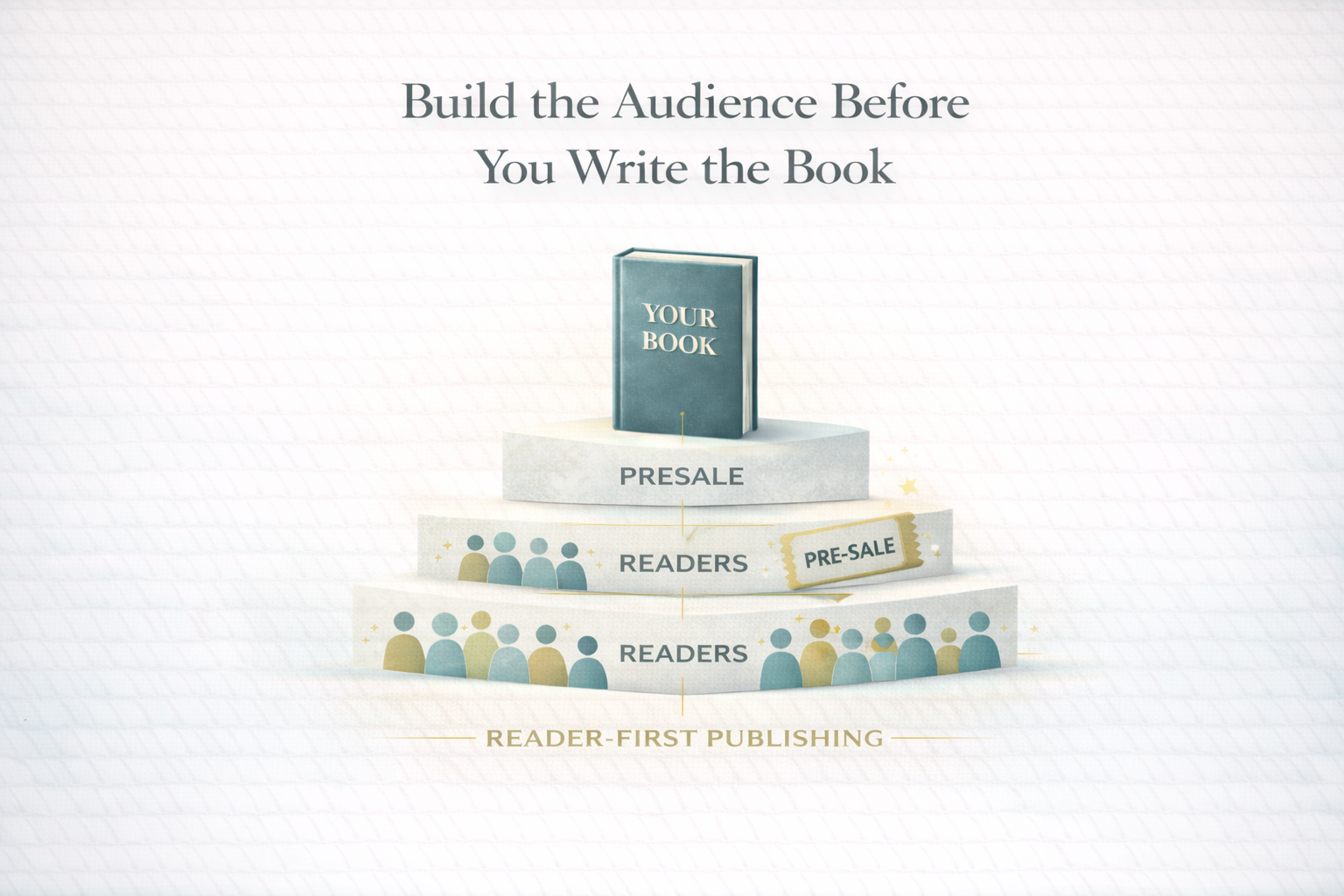
How to Build an Audience BEFORE You Write Your Book: The Modern Author Playbook for 200 True Fans, Presales, and Reader-First Publishing
The Fear That Stops Most Authors
You have the idea.
Maybe it started as a recurring client question.
Maybe it’s a framework you’ve used for years.
Maybe you have a rough outline. A few draft pages. Notes in a folder you keep revisiting.
Then the momentum breaks.
Not because you doubt the idea.
Because a simpler question lands:
Who will read this?
And the internal dialogue shows up fast:
- I don’t have an audience.
- I don’t have a following.
- I don’t have a newsletter.
- I don’t have a platform.
For serious professionals, this fear is rarely vanity.
It’s risk management.
Publishing feels like public exposure.
If no one reads, the effort becomes waste.
If the book lands quietly, it feels like a signal of irrelevance.
So the project stalls at the same place every time:
Not at writing.
At distribution.
This is the structural misunderstanding.
Most authors assume audience is something you must build at scale before you earn the right to publish.
They assume the book is downstream of platform.
That assumption is what stops the work before it starts.
“The most successful nonfiction books are not written for audiences.
They are written with them.”
— Eric Koester
The Modern Author Reframe
The assumption that stops most authors is straightforward:
You need a large audience before you can publish a successful book.
This belief leads many professionals to delay writing until they feel they have “earned” the right to publish through platform growth.
In practice, this assumption produces the opposite result: the audience never arrives, and the book never starts.
The structural issue is not the author’s idea.
It is the model they are following.
Old Model: Audience First, Book Later
The traditional belief about publishing follows a linear sequence:
Build an audience
→ Grow followers
→ Write the book
→ Publish
→ Hope the audience buys
This model assumes that audience scale must come first.
For most professionals, this is unrealistic. Building a large online following requires sustained content production, algorithm visibility, and years of platform growth.
Even when an audience exists, conversion to book buyers is uncertain.
The result is a fragile launch: a finished manuscript with no guaranteed readers.
Modern Author Model: Readers First, Audience Later
The Modern Author model reverses the sequence.
Activate relationships
→ Validate the idea
→ Run presales
→ Write with readers
Instead of trying to reach thousands of strangers, the focus shifts to a smaller group of committed readers.
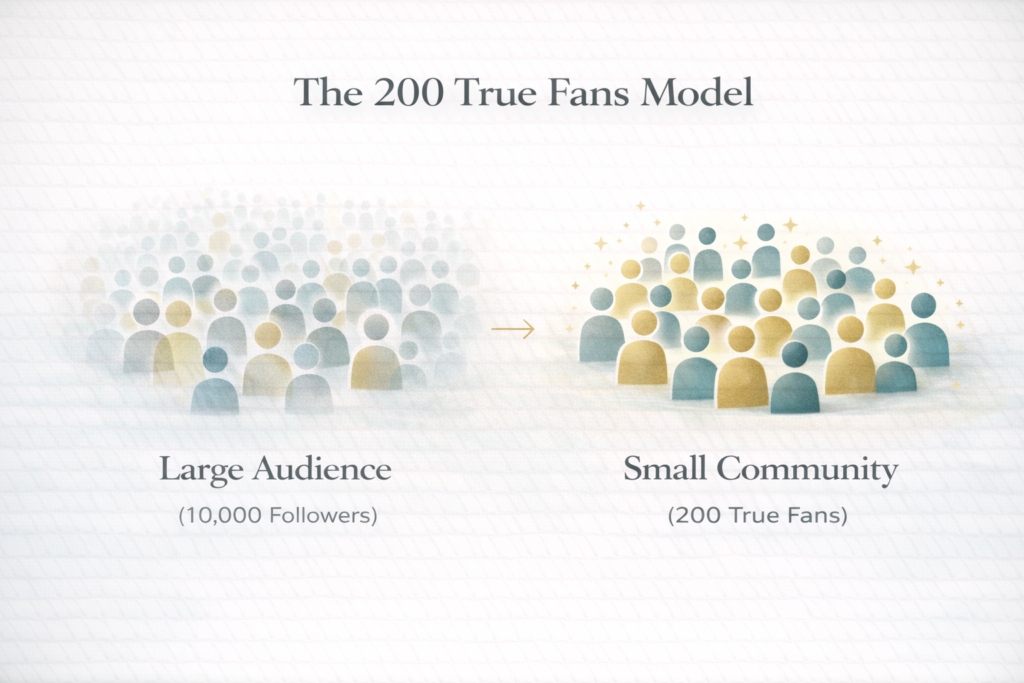
This guide calls these readers true fans.
A true fan is someone who:
- cares about the topic of the book
- buys the book when it releases
- participates in early conversations
- recommends the book to others
In practice, a successful nonfiction book does not require a massive audience.
It requires 200–300 true fans.
When these readers are activated early, they can:
- validate whether the idea resonates
- provide feedback during the writing process
- purchase the book before publication
- generate momentum at launch
The book no longer depends on platform size.
It grows from a defined community around the idea.
The objective shifts from becoming an influencer to activating committed readers before the manuscript is finished.
Build an audience before writing a book is the modern path to successful nonfiction publishing, because demand, not platform size, determines launch outcomes. This guide teaches the true fans model, invite marketing, reader advisory boards, and presale publishing so you can validate your idea, fund production, and write with readers instead of in isolation.
60-Second Decision Box
Who This Guide Is For
This guide is for nonfiction authors who:
- are coaches, consultants, founders, or serious professionals
- want their book to create authority or business leverage
- believe they must build a large audience before they can write
If your goal is a book that drives clients, speaking invitations, or long-term positioning, the audience question is not optional. It is upstream.
The Core Insight
You do not need a large platform to publish a successful book.
You need a small community of 200–300 true fans, people who will buy, participate early, and help create momentum at launch.
This guide teaches a reader-first approach: activate demand before the manuscript is finished.
What This Guide Will Teach You
Building an audience for a book does not require scale.
It requires structure.
This guide introduces a set of practical systems that allow serious nonfiction authors to validate demand, activate committed readers, and fund their book before the manuscript is finished.
Each system addresses a specific constraint in the publishing process.
Modern Fan Theory
A realistic audience target that replaces the “big platform” myth by focusing on 200–300 committed readers who will buy, participate, and advocate for the book.
Invite Marketing
A relationship-first outreach approach that activates existing networks through direct invitations rather than relying on algorithm-driven broadcasting.
Reader Advisory Board
A small group of ideal readers who provide structured feedback during the writing process and become the core community around the book.
Presale Ladder
A tiered presale structure that validates demand, funds production, and creates launch momentum before publication.
Write-As-You-Grow Model
An integrated writing process where reader conversations inform the manuscript while the audience grows alongside the book.
The 90-Day Audience Activation Plan
A structured timeline for mapping relationships, activating early readers, and running a presale within a manageable three-month window.
Together, these systems replace the traditional publishing assumption that audience must come first.
Instead, they show how authors can build momentum, validation, and community while the book is still being written.
The Modern Author Reader-Building System
Most advice about building an audience treats it as a marketing activity.
Post more content.
Chase the algorithm.
Grow follower counts.
Hope the audience eventually converts into readers.
For most nonfiction authors, especially professionals with demanding careers, this model fails. It assumes years of content production before a book is even written, and it confuses visibility with reader commitment.
Modern Author publishing approaches the problem differently.
Instead of trying to attract a large anonymous audience, authors activate a structured reader-building system designed to identify committed readers, validate the book’s idea, and create early demand before publication.
This system is not a collection of tactics.
It is a publishing process that moves from relationships to readers, and from readers to a funded book.
Together, these components create a repeatable path from idea → reader validation → presale momentum → funded book launch.
As shown in the Modern Author Reader Engine, the goal is not to build a massive following.
It is to activate the right readers early enough that the book launches with momentum already in place.
Visual System Anchor
The Modern Author Reader Engine
Audience building for a nonfiction book is not a marketing activity added at the end of the process.
It is a structured publishing system that begins with relationships and progresses through a series of reinforcing stages that transform early interest into a funded book and a momentum-driven launch.
The Modern Author Reader Engine illustrates how this system operates.
Relationships
→ Three Circles of Fans
→ Reader Advisory Board
→ Early Interest List
→ Presale Ladder
→ Funded Book
→ Launch with 200–300 Fans
→ Business Outcomes
Each stage performs a distinct function in the system.
Relationships are the starting asset. Every professional already has a network of colleagues, clients, and peers who care about the problems they work on.
These relationships are then organized through the Three Circles of Fans framework, which maps potential early supporters across close relationships, professional networks, and extended connections.
From this mapped network, a small group of ideal readers forms the Reader Advisory Board, a structured feedback group that validates the problem, tests the book’s positioning, and helps shape the manuscript early.
Reader interest generated through these interactions becomes the Early Interest List, a small but highly relevant group of people who want to follow the book’s development.
The Presale Ladder converts this interest into structured early commitments, allowing authors to validate demand and fund the book’s production before publication.
When presales cover production costs, the result is a Funded Book, a project supported by real reader demand rather than speculative marketing.
At launch, the book already has 200–300 committed fans who buy early, participate in events, and help generate initial momentum.
This early momentum produces the final stage of the engine: Business Outcomes such as client opportunities, speaking invitations, partnerships, and long-term authority.
Each stage strengthens the next.
Relationships become readers.
Readers become supporters.
Supporters become launch momentum.
As shown in the Modern Author Reader Engine, the goal is not to build a massive audience.
It is to activate the right readers early enough that the book launches with demand already in motion.
PART I — Modern Fan Theory
The Audience Myth
Many professionals delay writing a book because they believe they need a large platform first.
They assume successful publishing requires thousands of followers, a large email list, or a significant social media presence.
This assumption is widespread, but structurally incorrect.
Books do not succeed because an author has a large audience.
They succeed because a small number of the right readers care enough to participate early.
Modern publishing outcomes are driven by reader commitment, not follower counts.
The following comparisons illustrate the most common misconceptions.
| Myth | Reality |
| You need 10,000 followers before publishing a book. | You need 200 readers who care about the topic and will support the launch. |
| A large social media platform is required to sell books. | A small network of committed readers can create sufficient launch momentum. |
| Audience growth must happen before the book idea is validated. | Authors can validate demand early through conversations and reader participation. |
| Book launches depend on broadcast visibility. | Successful launches are driven by activated readers who buy early and spread the word. |
The implication is straightforward.
Authors do not need to become influencers before writing a book.
They need to identify and activate a small community of readers who care deeply about the problem the book solves.
This principle is the foundation of Modern Fan Theory, which reframes audience size from a visibility metric into a relationship metric.
What a True Fan Actually Is
True Fan
A person who:
- buys your book
- shows up for events or live discussions
- refers others who are likely to care
- follows your work over time, not just once
A true fan is not a follower.
They are a committed reader, someone who is willing to exchange attention, money, and advocacy for the work you are building.
Operationally, the test is simple: a true fan takes action before the book is finished, not after it is published.
Rule of thumb: A true fan buys once, shows up once, and tells two people.
The Three Circles of Fans
Most professionals already have the raw material for their first 200–300 true fans. The challenge is rarely audience size. The challenge is audience visibility.
Authors assume they must build an audience from scratch. In practice, the first audience usually already exists inside the author’s professional and personal network. It simply has not been mapped.
The Three Circles of Fans framework makes this visible. It organizes existing relationships into three layers based on proximity and likelihood of early participation.
Circle 1 — Inner Circle
The Inner Circle includes close relationships with strong trust.
These are people who already know you well: colleagues, collaborators, mentors, friends, and long-time professional contacts. They may not all be ideal readers, but they are the most likely to support the project early.
Their role in the system is simple: early encouragement and initial participation.
Because trust already exists, this group often becomes the first group to join advisory boards, early discussions, or initial launch events.
Circle 2 — Professional Network
The second circle includes broader professional relationships.
These are people who recognize your work but may not interact with you regularly: former clients, peers in your industry, conference contacts, LinkedIn connections, or past collaborators.
This circle frequently contains the largest concentration of ideal readers, because these individuals are already aligned with your field of expertise.
As the project becomes visible, this group becomes a major source of advisory board members, early readers, and presale supporters.
Circle 3 — Referral Network
The outer circle forms through introductions and referrals.
These individuals may not know you yet, but they match the reader profile for the book. They enter the network through recommendations from the first two circles.
This layer becomes the mechanism through which the audience expands beyond the author’s direct relationships.
Reader Mapping Template
To make the framework actionable, begin by mapping potential supporters across the three circles.
Readers can use the following simple template.
Circle 1 — Inner Circle (Close Relationships)
List people who know you well and would likely support the project early.
Circle 2 — Professional Network (Industry and Work Relationships)
List colleagues, clients, peers, and professional contacts aligned with your topic.
Circle 3 — Referral Network (Potential Introductions)
List individuals who could be introduced through your existing network.
The goal of this exercise is not precision. It is visibility.
Most authors discover that their initial audience is not something they must build from zero. It already exists within their network, and can be activated once it is clearly mapped.
The Economics of 200 True Fans
The assumption behind most audience-building advice is simple: a book needs a large audience to succeed.
In practice, the economics of publishing tell a different story.
Books do not require thousands of buyers to become viable. A small group of committed readers can generate enough early demand to fund production, validate the idea, and create launch momentum.
This is the logic behind the 200 True Fans model.
A true fan is not a passive follower. A true fan is a reader who is willing to support the project early, through presales, events, or participation in the writing process.
When even a modest number of these readers participate, the financial impact becomes meaningful.
| Supporters | Average Spend | Result |
| 200 | $75 | $15,000 |
| 150 | $100 | $15,000 |
These numbers are intentionally conservative.
A presale purchase may include early access to the book, participation in reader sessions, or bundled experiences tied to the project. The average spend reflects these early-support formats rather than the price of a single retail book.
The key insight is structural:
A book does not need a massive audience to become financially viable.
It needs a small community of committed readers who participate early.
Once that initial group exists, the launch is no longer dependent on visibility alone. It is supported by a base of readers who are invested in the book’s success.
Authority Data Moment
The 200-Fan Reality
The idea that a book requires a massive platform often collapses when examined through real examples.
Many successful nonfiction launches begin with small, professional networks, not large online audiences. What matters is not follower count but the ability to activate relationships around a clear idea and a structured project.
The following case illustrates how a modest network can translate into meaningful early demand.
Consultant Presale Launch
Starting Point
- ~300 professional contacts
- No email list
- Limited social media activity
Action
- Mapped contacts using the Three Circles of Fans framework
- Invited 30 peers and clients to join a Reader Advisory Board
- Hosted several feedback sessions to refine the book’s positioning
- Opened a structured presale to the advisory board and extended network
Result
- 160 presale buyers
- $16,000 raised before manuscript completion
The key takeaway is structural.
The author did not build a large audience before writing the book.
Instead, they activated an existing professional network, converted early supporters into readers, and used presales to validate and fund the project.
This pattern appears repeatedly in modern nonfiction publishing: a small group of committed readers can generate both financial viability and launch momentum.
PART II — Invite Marketing
Broadcast Marketing vs Invite Marketing
Most “build your audience” advice assumes you are running a media business.
It prescribes scale tactics, publish constantly, chase reach, optimize for algorithms, and treats attention as the prerequisite for readership.
For serious nonfiction authors, that model is structurally mismatched. It is slow to compound, hard to sustain alongside real work, and unreliable at converting strangers into committed readers.
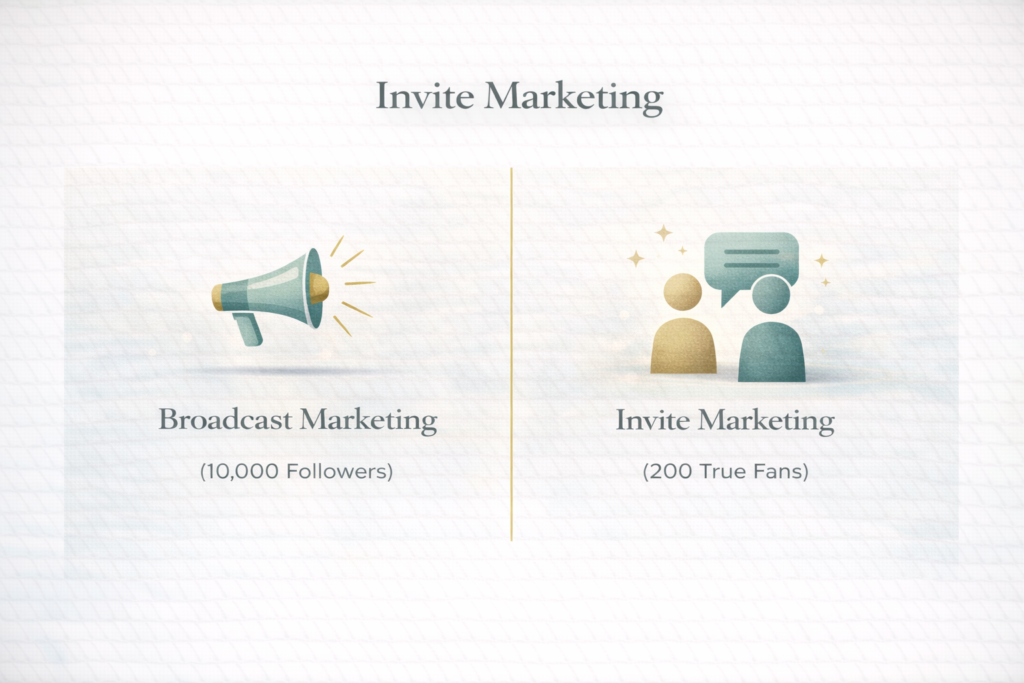
Invite Marketing is the alternative: relationship-based activation. It treats your existing network as the starting asset and uses direct outreach to convert relevance into participation.
| Broadcast Marketing | Invite Marketing |
| Social posts designed for reach | Direct outreach designed for response |
| Algorithm dependent | Relationship based |
| High volume, low signal | Low volume, high signal |
| Passive “hope they see it” | Active “ask them in” |
| Weak conversion to action | High conversion to participation |
The distinction is not stylistic. It is economic.
Broadcast marketing competes for attention. Invite marketing creates commitment, the raw input required for advisory boards, interest lists, presales, and a reader-led launch.
The Invite Marketing Framework
Invite marketing works when invitations are designed, not improvised.
A typical post about a book is a broadcast. It is open-ended, optional, and easy to ignore.
An invitation is different. It is a direct request to a specific person to participate in a defined stage of the book project.
This shift matters.
Books do not gain early momentum through attention alone. They gain momentum through activated readers, people who agree to contribute feedback, participate in discussions, and eventually support the book’s launch.
The Invite Marketing Framework provides a simple structure for these invitations.
Every effective invite contains four components.
Personal — Why This Person
The invitation begins with relevance.
Explain why this individual was selected. The recipient should immediately understand why their perspective matters.
Common reasons include:
- they represent the ideal reader
- they have experience in the subject area
- their feedback has been valuable in the past
This is not flattery. It is context.
People respond more readily when the invitation reflects genuine alignment with their expertise or interests.
Clear — What the Invitation Is
Define the container.
People do not join “a book project.” They join a specific activity within the project.
Examples include:
- a Reader Advisory Board
- an early interest list
- a small feedback session
- a topic roundtable
Clarity reduces hesitation because the commitment is understandable.
Specific — The Role They Play
The invitation must define the action being requested.
Vague language, such as “I’d appreciate your support”, creates uncertainty. Clear requests create decisions.
Examples of specific roles include:
- reviewing a one-page concept
- attending a 45-minute discussion session
- providing feedback on a chapter draft
- sharing the questions they would want the book to answer
When the role is clear, the recipient can quickly decide whether they can participate.
Time-Bound — What Happens Next
Effective invitations include a timeline.
Specify:
- when a response is needed
- how they should reply
- what the next step will be if they accept
A time-bound invitation signals that the book is a structured project, not an open-ended request for help.
Invite Structure (Reference Template)
Most invitations follow a simple progression:
Why you → What this project is → The role you could play → Next step
When these four elements are present, invitations convert reliably.
Recipients understand why they were invited, what participation involves, and how their contribution fits into the larger book project.
The Four Core Invitation Types
Invite marketing activates readers through a sequence of targeted invitations.
Each invitation recruits people into a specific role within the book-building process.
Rather than relying on broad announcements, authors use structured invitations to engage individuals who are well positioned to contribute insight, feedback, or early support.
Four invitation types appear consistently across successful book projects.
Reader Advisory Board Invitation
Purpose
Recruit a small group of readers who will provide structured feedback during the development of the book.
Audience
Peers, colleagues, or professionals who represent the intended reader of the book.
Outcome
A core group of 10–25 readers who help test ideas, refine positioning, and strengthen the manuscript before publication.
Structure Example
- Why you are inviting them
- Explanation of the Reader Advisory Board
- The type of feedback you are seeking
- The expected commitment (number of sessions or interactions)
Interest List Invitation
Purpose
Identify readers who want to follow the progress of the book and receive early updates.
Audience
Professional contacts, community members, or individuals who have expressed interest in the topic.
Outcome
A list of engaged readers who are likely to participate in early discussions, feedback opportunities, and presale offers.
Structure Example
- Brief description of the book idea
- Why the topic matters to the audience
- Invitation to follow the project’s development
- Simple method for joining the interest list
Launch Event Invitation
Purpose
Invite readers to participate in the early public conversation around the book.
Audience
Members of the interest list, advisory board participants, and professional contacts interested in the topic.
Outcome
A live or virtual gathering that introduces the book concept, shares early insights, and expands awareness among potential readers.
Structure Example
- Context for the event and the book project
- What participants will gain from attending
- Date and format of the event
- How to confirm participation
Project Participation Invitation
Purpose
Engage readers directly in shaping specific parts of the book.
Audience
Individuals with relevant experience or perspectives related to the book’s themes.
Outcome
Contributions such as questions, insights, examples, or reactions that help refine the book’s ideas.
Structure Example
- Description of the specific topic or chapter
- The type of input being requested
- How the contribution will be used
- Timeline for submitting feedback
Each invitation type activates a different form of participation.
Together, they transform a passive network into an engaged community of early readers supporting the development and launch of the book.
PART III — Reader Advisory Board
What a Reader Advisory Board Is
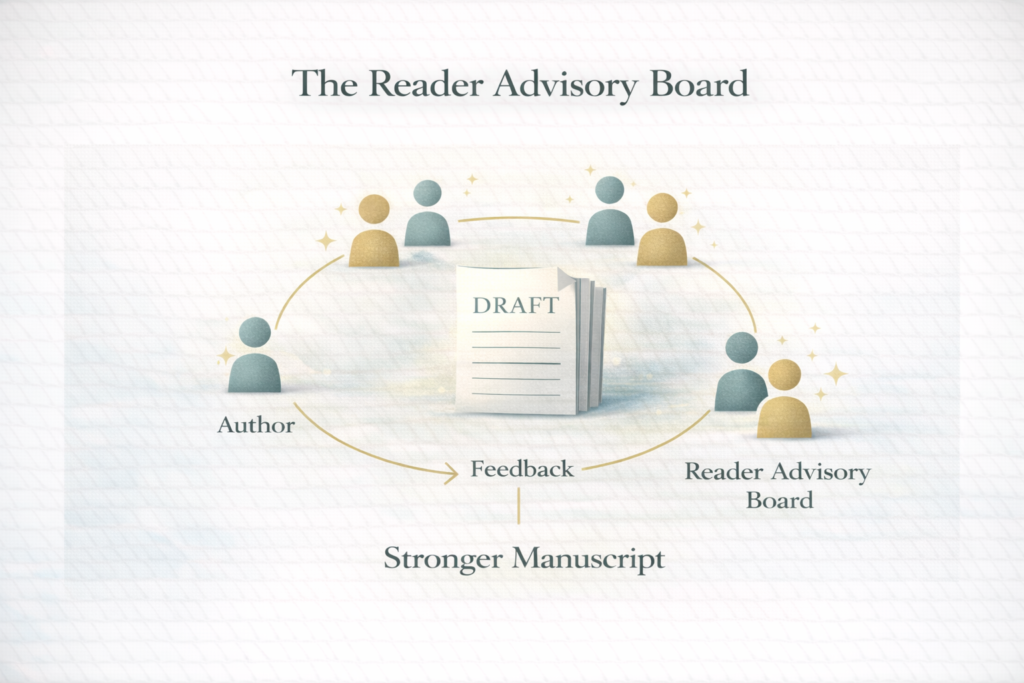
A Reader Advisory Board is a small group of engaged readers who participate in the development of the book before publication.
Instead of writing in isolation and presenting a finished manuscript to the market, the author works with a structured group of readers who provide feedback throughout the writing process.
A typical Reader Advisory Board includes:
- 10–25 members
- 3–5 structured interactions or meetings
- Feedback provided at key stages of development
This structure turns the writing process into a collaborative testing environment.
The board serves three functions within the book project:
Reader Lab
A structured environment for testing the book’s core elements with real readers.
Ideas, positioning, titles, frameworks, and early chapters can be evaluated against the perspective of people who represent the intended audience.
This reduces guesswork and allows the manuscript to evolve in response to genuine reader insight.
Early Community
A small group that becomes familiar with the project long before publication.
Through discussions and feedback sessions, advisory members gain early visibility into the book’s ideas and development.
This creates a natural foundation of engaged readers who understand the project and its purpose.
Launch Team
Participants who often become the book’s first advocates.
Because they have contributed to the development process, advisory members are more likely to support presales, participate in launch events, and introduce the book to their own networks.
When used well, the Reader Advisory Board ensures the book is shaped not only by the author’s expertise but also by the real questions, language, and priorities of its intended readers.
Selecting Advisory Board Members
The effectiveness of a Reader Advisory Board depends on the composition of the group.
The goal is not simply to gather supportive voices. The goal is to assemble a small group of readers who closely resemble the book’s intended audience and who are willing to provide candid, thoughtful feedback during the development process.
Advisory members should represent the real readers the book is written for, not only the author’s closest colleagues or friends.
Selection Checklist
When identifying potential advisory board members, prioritize individuals who meet the following criteria:
- Represent the ideal reader
Their role, experience, or perspective aligns with the audience the book intends to serve. - Willing to provide honest feedback
They are comfortable offering constructive criticism rather than only encouragement. - Reachable and responsive
They can realistically participate in discussions or provide feedback during the writing process. - Bring diverse perspectives
Members represent different viewpoints within the target audience, helping surface varied questions, concerns, and interpretations.
A well-composed advisory board reflects the range of readers the book hopes to reach, allowing the author to test ideas against multiple perspectives rather than a single viewpoint.
Avoid filling the board exclusively with close friends or enthusiastic supporters.
While supportive readers are valuable, a board composed only of familiar voices often produces limited insight.
The objective is not agreement, it is informed reader perspective.
How Advisory Boards Shape the Book
A Reader Advisory Board improves the book by introducing structured reader feedback at key stages of development.
Instead of waiting until publication to learn how readers respond to the ideas, the author receives input during the writing process. This allows positioning, structure, and messaging to be refined before the manuscript is finalized.
Advisory boards typically interact with the project through a small number of focused sessions.
Meeting 1 — Problem Validation
The first session tests the core problem the book addresses.
Advisory members evaluate whether the challenge described in the book reflects real experiences within the intended audience. This stage helps confirm that the book is solving a problem readers recognize and care about.
Feedback often surfaces:
- gaps in how the problem is framed
- additional questions readers expect the book to answer
- language that better reflects how the audience describes the issue
Meeting 2 — Title and Outline Testing
The second session focuses on the book’s positioning and structure.
Advisory members react to the working title, subtitle, and chapter outline. Their responses help clarify which ideas resonate most strongly and which sections require refinement.
This stage strengthens:
- the clarity of the book’s promise
- the logical flow of the argument
- the relevance of individual chapters
Meeting 3 — Chapter Feedback
Once early chapters are drafted, advisory members review selected sections of the manuscript.
Their feedback highlights areas where explanations are unclear, examples need strengthening, or ideas require further development. This stage ensures the manuscript communicates its insights in a way that readers can easily understand and apply.
Optional Session — Cover and Launch Planning
Some authors hold an additional session to gather reactions to early cover concepts or to discuss the upcoming launch.
Because advisory members have followed the project throughout development, they often provide useful perspective on how the book will appear to new readers.
Founder Book Refinement
Starting point
Draft outline but unclear positioning
Action
Ran three advisory board sessions with 15 readers
Result
Title and framework clarified
Book later generated enterprise speaking invitations
PART IV — The Presale Ladder
Reframing Presales
Most authors interpret presales as a request for support.
That framing creates the wrong incentives:
- it turns the outreach into a favor
- it attracts sympathy buyers instead of committed readers
- it delays the real work of validating whether the book is wanted
In the Modern Author model, presales are something different.
They are an early market test that also funds production.
Misconception: Presales are begging
In the common model, presales sound like:
“I’m writing a book, would you buy it to help me?”
That message positions the buyer as doing the author a favor.
It signals uncertainty about whether the book is worth buying on its own.
Reality: Presales are selling early access
A presale is a structured offer to a specific reader:
“You care about this problem. I’m building the book to solve it. You can get early access and participate before it launches.”
The reader is not “supporting the author.”
They are purchasing a defined outcome:
- early access to the ideas
- participation in shaping the work
- priority inclusion in the launch experience
Why this matters
When presales are framed correctly, they do two jobs at once:
Validation
If readers buy early, before the book exists in final form, you have proof the positioning is strong and the problem is real.
Funding
Presales convert interest into resources that pay for editing, design, and launch execution without relying on the author’s personal budget.
Presales are not a marketing tactic.
They are a decision tool: a way to confirm that the book has demand before the manuscript is locked.
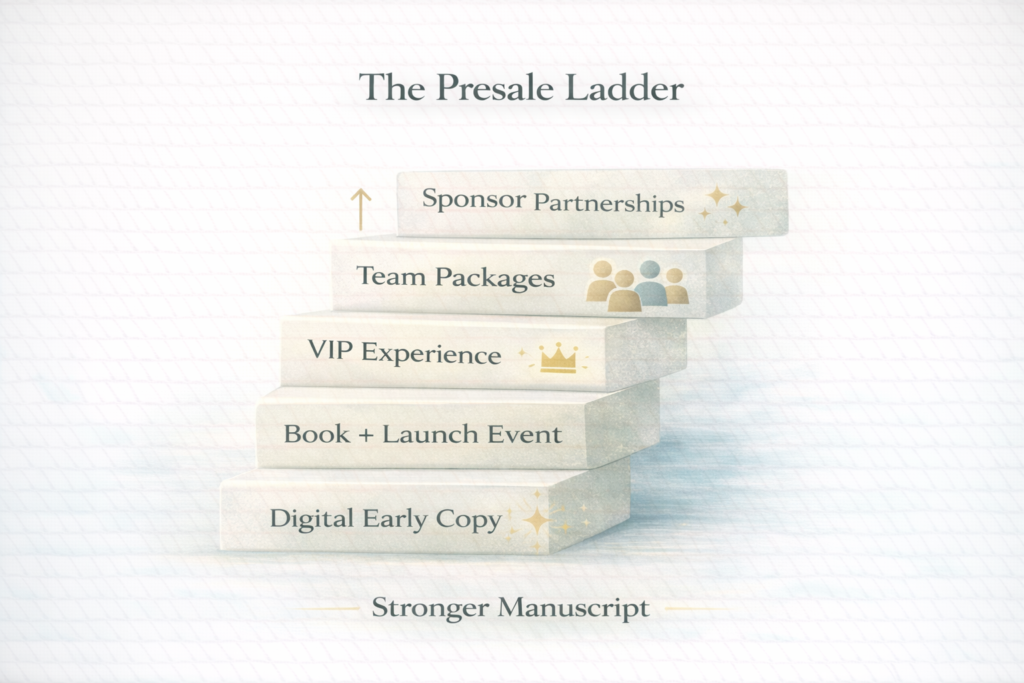
The Presale Ladder Model
A presale ladder organizes early offers into multiple participation levels, allowing readers to support the book according to their level of interest, access, and organizational role.
Instead of offering a single purchase option, the ladder converts different forms of engagement, individual reading, community participation, professional access, and organizational adoption, into structured tiers.
Each tier serves a different type of reader and plays a different role in validating and funding the book.
Digital Early Copy
Purpose
Provide early access to the ideas for readers who want the content before public release.
Target Audience
Individual readers interested in the topic but not seeking direct interaction with the author.
Ladder Flow
This is typically the entry point of the presale ladder, capturing baseline demand from the widest portion of the audience.
Ideal Use Case
- Testing market interest
- Building early reader momentum
- Validating positioning and topic relevance
Strengths
- Lowest barrier to entry
- Broad participation
- Fast signal of demand
Limitations
- Generates limited revenue per participant
- Provides minimal direct reader interaction
Book + Launch Event
Purpose
Create a shared moment around the book by combining the purchase with a live discussion or launch session.
Target Audience
Readers who want context, explanation, or interaction around the book’s ideas.
Ladder Flow
Sits above the basic book tier by adding experience-based participation.
Ideal Use Case
- Creating early community engagement
- Building momentum for the official launch
- Turning readers into active participants
Strengths
- Strengthens reader connection
- Encourages group participation
- Increases perceived value of the purchase
Limitations
- Requires coordination of event logistics
- Participation depends on scheduling availability
VIP Experience
Purpose
Provide direct access to the author through a small-group conversation, private briefing, or facilitated discussion.
Target Audience
Highly engaged readers who want deeper access to the author’s thinking.
Ladder Flow
A limited-access tier designed for high-engagement participants.
Ideal Use Case
- Creating premium participation opportunities
- Deepening relationships with key supporters
- Generating higher-value presale revenue
Strengths
- High perceived value
- Strong relationship building
- Effective for authority positioning
Limitations
- Limited capacity
- Requires the author’s direct time and attention
Team Packages
Purpose
Allow organizations to bring the book’s ideas into their teams through bundled purchases.
Target Audience
Managers, department leaders, or executives who want the ideas adopted inside their organization.
Ladder Flow
Expands the ladder from individual participation to organizational adoption.
Ideal Use Case
- Leadership development programs
- Team reading initiatives
- Internal training discussions
Strengths
- Significantly increases revenue per transaction
- Expands the book’s reach across teams
- Strengthens the book’s business relevance
Limitations
- Requires organizational interest in the topic
- May require additional facilitation or support
Sponsor Partnerships
Purpose
Allow aligned organizations to support distribution of the book to a defined audience.
Target Audience
Partners who benefit from association with the ideas or audience.
Ladder Flow
The highest level of the presale ladder, focused on distribution partnerships and ecosystem support.
Ideal Use Case
- Industry associations supporting member education
- Corporate sponsors aligned with the book’s topic
- Organizations funding wider distribution
Strengths
- Enables large-scale distribution
- Can significantly fund production and launch
- Builds institutional credibility
Limitations
- Requires strong audience alignment
- Partnership negotiation may take longer to structure
Presale Economics
A well-structured presale can realistically fund the core production costs of a nonfiction book.
Instead of waiting until publication to recover expenses, the Modern Author model converts early reader commitment into resources that support the production process. When presales are tied to a clear problem and a defined audience, even a relatively small group of readers can finance the essential stages of publishing.
Typical book production costs include:
- Editing
Developmental and line editing to refine the manuscript’s structure, clarity, and argument. - Cover Design
Professional design that communicates the book’s positioning and improves discoverability. - Layout and Formatting
Interior formatting for print and digital editions to ensure readability and production readiness. - Proofreading
Final review of the manuscript to correct errors and ensure publication quality.
These elements represent the foundational investment required to move a manuscript from draft to finished book.
Presales allow those costs to be covered before publication by converting early interest into committed purchases. Even modest participation from a defined audience can generate sufficient funding.
For example, if early readers participate through a presale ladder that includes individual and higher-engagement tiers, the combined revenue can finance the book’s production while simultaneously validating demand for the topic.
Leadership Author Presale Ladder
Starting point
Small professional network
Action
Created a three-tier presale ladder
Result
$22K presale revenue
Book production fully funded
PART V — Community-First Audience Building
Why Content-First Growth Fails Authors
Most advice about building an audience for a book begins with content production.
The typical recommendation is to start publishing regularly, posting daily, launching a podcast, or growing a newsletter, until an audience eventually forms. Only after that audience exists does the book enter the picture.
For many professionals, this sequence creates an immediate misalignment.
The people most likely to write high-value nonfiction, executives, founders, consultants, and operators, are not full-time content creators. Their time is already allocated to leadership, operations, clients, and decision-making.
Content-first growth assumes a production rhythm that rarely fits those realities.
Common advice often includes:
- Post daily on social platforms
- Start a podcast
- Publish a weekly newsletter
- Maintain constant visibility across channels
These tactics can work for creators whose primary role is content production. For professionals writing a book alongside an existing career, the model introduces three structural problems.
1. It turns the book into a media production schedule
A book is a finite project. Content-first growth treats the author like a media company.
Instead of focusing on developing the manuscript and engaging future readers, the author inherits a continuous obligation, new ideas, new posts, and constant publishing.
For most professionals, that pace quickly becomes unsustainable.
2. It optimizes for reach rather than relevance
Content systems reward visibility. Books require something different: qualified readers who care about the problem the book solves.
A large following can produce attention without producing commitment. Visibility alone does not guarantee that readers will buy, discuss, or recommend the book.
3. It delays validation until the manuscript is finished
Content-first strategies postpone the most important question:
Will anyone actually buy this book?
When validation happens only after the manuscript is complete, repositioning the book becomes far more difficult.
For Modern Authors, audience building follows a different logic. The goal is not constant visibility. The goal is early reader participation, people who engage with the ideas while the book is still being developed.
The Community-First Alternative
If content-first growth prioritizes broadcasting, the Modern Author model prioritizes hosting.
A community-first approach builds an audience through structured interaction with a small group of readers who care about the problem the book explores. Instead of attempting to reach thousands of people through continuous content production, the author focuses on developing meaningful engagement with a smaller, relevant group.
The objective is not visibility.
The objective is participation.
In this model, readers are invited into the development of the book itself. They contribute questions, react to ideas, and provide feedback that shapes the direction of the manuscript.
This approach produces two outcomes simultaneously:
- a community of engaged readers
- a book that reflects real reader needs and language
Because interaction happens directly with potential readers, engagement tends to be deeper and more useful than typical social media engagement metrics.
Examples of Community Touchpoints
Community-first audience building relies on structured interaction formats. These formats allow readers to participate without requiring the author to maintain a constant content production schedule.
Common examples include:
- Office hours calls
Informal sessions where readers ask questions related to the book’s topic. - Reader roundtables
Small-group discussions where participants react to ideas, frameworks, or early concepts from the book. - Topic salons
Structured conversations focused on one specific theme or problem explored in the manuscript. - Audio updates
Short recorded reflections where the author shares progress or emerging ideas with the reader community.
Each format emphasizes dialogue rather than distribution.
Why Community Depth Matters More Than Scale
A book does not require millions of impressions to succeed.
It requires a relatively small group of readers who:
- care about the topic
- engage with the ideas
- support the project when the book becomes available
Community-first audience building aligns with this reality. Instead of optimizing for reach, it optimizes for relationship depth, the kind of engagement that later supports presales, launch participation, and long-term readership.
In practice, a small community that actively participates in the book’s development often produces stronger outcomes than a much larger but passive audience.
The Reader Feedback Loop
A community-first publishing process creates a continuous reader feedback loop. This loop ensures that the ideas inside the book are shaped by real reader questions rather than developed entirely in isolation.
The core principle is simple: instead of completing the manuscript first and seeking feedback later, the author gathers reader insight while the book is being developed.
This interaction helps refine the book’s positioning, clarify concepts, and ensure the content reflects the language and challenges of the intended audience.
How the Feedback Loop Works
The reader feedback loop typically follows a repeating cycle:
- Reader Conversations
The author engages with readers through structured interactions such as advisory board meetings, roundtables, or office hours discussions. - Idea Refinement
Insights from those conversations help clarify which ideas resonate most strongly and which concepts require adjustment or simplification. - Chapter Development
The author develops sections or chapters based on the refined ideas. - Feedback Integration
Early readers review or react to these sections, providing additional insight that strengthens the next iteration of the manuscript.
This process repeats throughout the development of the book.
The Reader Feedback Loop Model
The reader feedback loop operates as a structured development cycle. Instead of writing the entire manuscript before receiving feedback, the author tests ideas continuously with early readers.
This cycle ensures that the book evolves alongside real reader insight.
The Reader Feedback Loop
1. Reader Conversations
Direct interaction with readers through advisory boards, roundtables, or topic discussions surfaces the questions and problems that matter most to the audience.
↓
2. Idea Refinement
Insights from these conversations clarify positioning, strengthen frameworks, and reveal which ideas resonate most strongly.
↓
3. Chapter Development
The author converts the refined ideas into structured chapters, sections, or frameworks inside the manuscript.
↓
4. Reader Feedback
Early readers review concepts, respond to sections, and highlight areas that require clarification or expansion.
↓
5. Improved Manuscript
Each cycle strengthens the manuscript by aligning the ideas more closely with the audience’s language, needs, and real-world experience.
Because this loop operates throughout the writing process, the manuscript is tested and refined long before publication.
Why the Loop Improves Book Quality
Traditional writing models rely heavily on the author’s internal perspective. While this can produce strong ideas, it often delays audience validation until late in the publishing process.
A reader feedback loop changes that dynamic.
Because readers participate early:
- unclear ideas surface quickly
- language becomes aligned with reader vocabulary
- frameworks improve through real-world testing
The result is a manuscript that is both clearer and more relevant to the audience it intends to serve.
Why Generic Newsletters Fail Authors
Many professionals assume that starting a newsletter is the natural first step in building an audience for a book.
In practice, most newsletters fail to create meaningful engagement because they lack a clear project behind them. Without a defined purpose, the newsletter becomes a stream of general commentary rather than a structured relationship with readers.
The issue is not the format itself. The issue is the absence of a concrete publishing objective.
A newsletter that promises broad insights, such as leadership ideas, productivity tips, or industry commentary, competes with thousands of similar publications. Readers may subscribe, but sustained engagement tends to remain low because the content does not connect to a specific outcome.
The Problem With Generic Newsletter Promises
Generic newsletters often rely on vague value propositions.
Examples include:
Weak Promise
“Get leadership insights.”
“Weekly thoughts on business and strategy.”
“Reflections on growth and innovation.”
These promises are broad and open-ended. They do not tell readers why the newsletter exists, what role the reader plays, or what outcome the communication is building toward.
As a result, readers passively consume the content, if they engage at all.
The Project-Based Alternative
Newsletters become far more effective when they are tied to a clear publishing project.
A project-based newsletter invites readers to participate in the development of a specific book. Instead of broadcasting general ideas, the communication centers on the progress of the manuscript and the questions the book aims to answer.
For example:
Stronger Promise
“Follow the writing of this book and help shape the final version.”
This type of invitation changes the reader’s role. Instead of being a passive subscriber, the reader becomes a participant in the development process.
When newsletters are connected to a defined book project, they create:
- clearer expectations for readers
- stronger engagement around ideas
- a natural pathway toward presales and launch participation
In this model, the newsletter is not an independent media channel. It is a communication layer within the broader reader-building system that supports the development and eventual launch of the book.
PART VI — Write-As-You-Grow
The traditional publishing process assumes that the manuscript must be completed before meaningful interaction with readers begins.
In this model, authors spend months, sometimes years, writing in isolation. Only after the manuscript is finished do they begin the process of finding an audience, marketing the book, and testing whether the ideas resonate.
The Write-As-You-Grow model reverses this sequence.
Instead of writing privately and searching for readers later, the author develops a small community first and integrates reader insight throughout the writing process. This approach ensures that the book evolves alongside the audience it intends to serve.
The Old Model vs the Modern Model
The difference between the two approaches can be understood as a shift in sequence.
| Traditional Publishing Model | Modern Author Model |
| Write the manuscript | Build early readers |
| Publish the book | Test ideas through reader conversations |
| Begin marketing | Write with reader feedback |
| Attempt to find readers | Launch with existing reader support |
In the traditional model, audience discovery happens after publication. In the modern model, audience interaction begins before the manuscript is complete.
Why the Sequence Matters
Changing the order of these steps produces three important advantages.
First, ideas are validated earlier. Reader conversations reveal which concepts resonate and which require refinement before they become fixed in the manuscript.
Second, the writing process becomes more focused. Instead of guessing what readers may find useful, the author develops chapters based on the questions and problems already surfaced by the community.
Third, the book launches with momentum. Because readers have already participated in the development process, they are more likely to support presales, attend events, and recommend the book within their networks.
The result is a book that is not only better aligned with reader needs but also supported by a small community that helped shape it.
The Write-As-You-Grow Loop
The Write-As-You-Grow model works because it turns “audience building” into an operating system for improving the manuscript.
Instead of treating reader engagement as marketing that begins after publication, it treats reader engagement as input that shapes what gets written, how it’s framed, and what gets emphasized.
This loop is the mechanism.
The loop, step-by-step
1) Reader discussion
You convene conversations with people who resemble the intended reader, Advisory Board sessions, small roundtables, 1:1 calls, or topic salons.
The goal is not approval. It’s signal: what they’re confused by, what they already believe, what language they use, and what they actually want solved.
2) Idea capture
You convert conversation into usable writing material. Capture:
- the exact questions readers ask (these become section headings)
- the objections they raise (these become clarifying paragraphs)
- the phrases they repeat (these become your positioning language)
- the examples they request (these become your case frames)
This is where most authors lose the value: they talk to readers, then rely on memory. The loop only works when the output is recorded and reusable.
3) Chapter development
You write the next chapter (or revise the current one) using what the conversations revealed:
- sharpen the promise of the chapter around the real problem readers named
- remove sections that answer questions no one is asking
- add explanations where confusion appeared
- choose language that matches how readers describe the problem
This stage keeps the manuscript from drifting into “what the author finds interesting” instead of “what the reader needs.”
4) Reader validation
You bring the updated thinking back to readers, often in a lightweight form:
- a short outline
- a 2–3 page excerpt
- a single framework slide
- a draft chapter section
The goal is not line edits. It’s confirmation that the framing holds: Does this match how you see the problem? Would this change your behavior? What still feels unclear?
Then the loop repeats.
Simple Write-As-You-Grow Loop Model
Reader discussion
→ Idea capture
→ Chapter development
→ Reader validation
→ Stronger manuscript
As shown in the Modern Author Reader Engine, this loop is what turns early relationships into both a better book and a launch-ready reader base.
By the time the manuscript is complete, the core ideas, language, and structure have already been pressure-tested with the people the book is for.
Weekly Operating Rhythm
A Write-As-You-Grow system works only if it fits inside a predictable weekly cadence.
The goal is not to “do more.” The goal is to run a repeatable loop that advances the manuscript while continuously incorporating reader insight.
Each week should move three things forward:
- Writing progress
- Reader signal
- System organization
This structure allows professionals to develop a stronger manuscript without requiring daily content production or large time commitments.
Writing Session
The writing session is a protected block dedicated to producing one clear unit of progress.
Examples of a writing unit:
- a chapter subsection
- a framework explanation
- a refined introduction
- a case example
The objective is measurable progress, not perfect prose.
Each session should produce a section that can later be reviewed or tested with readers.
Small, consistent units accumulate into a finished manuscript.
Reader Interaction
Reader interaction is where the author gathers insight from people who resemble the intended audience.
Typical formats include:
- a short advisory board call
- a small reader roundtable
- a focused conversation with 3–5 readers
- a brief discussion about a specific chapter idea
The purpose is not promotion. It is signal gathering.
Authors should listen for:
- questions readers ask naturally
- objections or confusion
- the language readers use to describe the problem
- examples readers request
These signals reveal where ideas need clarification or refinement.
System Organization
System organization ensures that insights from reader conversations actually improve the manuscript.
During this short weekly step, the author should:
- capture key questions and phrases from reader discussions
- tag insights to relevant chapters or sections
- decide what changes should be reflected in the next writing session
Without this step, feedback remains informal conversation rather than becoming actionable manuscript improvement.
A Simple Weekly Cadence
A practical weekly rhythm might look like this:
Early week — Writing session
Draft or revise one manuscript unit.
Midweek — Reader interaction
Host a short conversation to test ideas or gather reader perspective.
End of week — System organization
Capture insights and determine what will change in the next writing session.
This cadence keeps writing, reader input, and refinement moving forward together.
For professionals managing demanding schedules, this structure provides steady progress without requiring daily publishing or constant audience activity.
Writer-Audience Feedback Loop
Starting point
Early manuscript draft
Action
Shared chapters with an advisory board and integrated reader feedback weekly
Result
Major sections rewritten from reader insight
200+ presale buyers at launch
PART VII — AI + Codex for Reader Insight
Using AI for Audience Discovery
One of the most common challenges authors face early in the writing process is understanding how readers actually describe the problem the book is solving.
Authors often begin with their own language, industry terminology, internal frameworks, or professional shorthand. Readers, however, frequently use different words, ask different questions, and frame the problem differently.
AI tools can help surface these patterns quickly.
In this guide, AI refers to tools that analyze large volumes of public questions, discussions, and language patterns across search engines, forums, and professional networks. Used correctly, these tools help authors identify:
- the questions readers repeatedly ask
- the words readers use to describe the problem
- the misconceptions readers hold
- the specific outcomes readers are seeking
This insight helps authors refine positioning and ensure the manuscript addresses real reader needs rather than assumed ones.
What AI Helps You Discover
Used early in the process, AI tools help authors identify:
- Common reader questions that can become chapter sections
- Language patterns readers use to describe the problem
- Misconceptions or confusion that require explanation
- Specific outcomes readers want, which clarify the book’s promise
These signals help shape:
- chapter structure
- framework explanations
- section headings
- positioning language
Instead of guessing what readers care about, authors can begin with observable patterns.
Example AI Discovery Prompts
Authors can use simple prompts to surface reader language and questions.
Example Prompt 1
What are the most common questions professionals ask about writing a nonfiction book?
Purpose: identify questions that may become chapter topics.
Example Prompt 2
What problems do consultants face when trying to build an audience for a book?
Purpose: surface real-world friction points the manuscript should address.
Example Prompt 3
How do professionals describe the challenge of writing a book while working full-time?
Purpose: capture the language readers use when explaining the problem.
AI does not replace reader conversations.
It accelerates the discovery of patterns that can then be tested through advisory boards, reader discussions, and presale engagement.
Used this way, AI becomes a research assistant, helping authors align the manuscript with the real questions readers are already asking.
Codex as Audience Intelligence
AI tools help authors discover broad patterns in public questions.
Codex serves a different role.
Codex analyzes the specific conversations and feedback generated during the writing process, reader advisory sessions, roundtables, messages, and early presale interactions, and converts them into structured insight that can directly inform the manuscript.
In this guide, Codex refers to a system that organizes reader input so recurring themes, language patterns, and questions become visible.
Instead of relying on memory or scattered notes, authors can systematically identify what readers actually care about.
What Codex Analyzes
Codex processes the conversations that occur during audience-building and the Write-As-You-Grow process.
Typical inputs include:
- Reader Advisory Board discussions
- reader roundtables or office hours conversations
- written feedback on outlines or chapter drafts
- questions submitted by early interest list members
These inputs contain the raw signals that reveal where the manuscript should improve.
Three Core Codex Functions
Codex converts reader input into usable insight through three primary functions.
Language extraction
Codex identifies the phrases readers repeatedly use when describing the problem.
This helps authors align the manuscript with the reader’s language rather than relying on internal terminology or industry jargon.
Question clustering
Recurring reader questions are grouped together so authors can see which issues appear most frequently.
These clusters often indicate:
- sections that require clearer explanation
- missing chapters
- objections that must be addressed directly
Idea organization
Feedback, questions, and insights are organized into themes that correspond to sections of the manuscript.
This allows authors to connect reader input directly to:
- chapter revisions
- framework clarifications
- new sections that address emerging questions
How Codex Improves the Manuscript
Used consistently, Codex helps authors transform informal reader feedback into structured guidance for the book.
Instead of reacting to isolated comments, authors can identify patterns such as:
- where readers consistently misunderstand a concept
- which ideas generate the strongest engagement
- what examples readers request most often
These patterns provide a clear signal about where the manuscript should expand, simplify, or reframe ideas.
Codex in the Write-As-You-Grow System
Within the Modern Author Reader Engine, Codex supports the feedback loop between reader interaction and manuscript development.
Reader conversations generate input.
Codex organizes that input into patterns.
Authors use those patterns to refine chapters and frameworks.
This ensures that the book evolves in response to real reader needs rather than assumptions.
For a detailed explanation of how Codex processes reader insight, see the Codex AI guide.
PART VIII — The 90-Day Audience Plan
The purpose of this plan is not to “grow a platform.”
It is to move a book project from idea → validated concept → funded manuscript within a defined window.
Most authors attempt to build an audience indefinitely before writing.
This plan reverses that logic.
In 90 days, the author does three things in sequence:
- Identify the first readers who match the intended audience
- Validate the book’s positioning through structured conversations
- Activate those relationships through a presale that funds production
Each month performs a different function in the system.
Month 1 identifies readers.
Month 2 validates the book.
Month 3 activates the audience.
This structure prevents the two most common failure modes:
- writing a manuscript without reader validation
- attempting a launch without a committed audience
Month 1 — Map and Invite
Objective: Convert vague “potential readers” into a defined, reachable audience.
Most professionals already know far more potential readers than they realize.
The first month is about making that network visible and activating the first layer of engagement.
Step 1 — Map the Three Circles of Fans
Identify people across three relationship layers:
Inner Circle
Close professional relationships who already trust your thinking.
Second Circle
Colleagues, clients, and professional contacts who know your work but interact less frequently.
Outer Circle
New connections and referrals introduced through existing relationships.
Target outcome:
- 25–50 names identified in each circle
- a working list of people who match the intended reader profile
This mapping process converts a vague sense of “network” into a concrete audience map.
Step 2 — Create the Early Interest List
The Interest List becomes the central record of people following the project.
The list should capture:
- name
- professional role
- reason they are interested in the topic
This list will later become the foundation of the presale invitation sequence.
Step 3 — Form the Reader Advisory Board
Invite a small group of readers who resemble the book’s intended audience.
Recommended structure:
- 10–25 participants
- 3–5 structured conversations
- feedback across positioning, outline, and chapter development
The advisory board serves three roles simultaneously:
- Reader lab — testing ideas and positioning
- Early community — people following the project’s development
- Launch nucleus — the first group likely to support the presale
Output by the end of Month 1
- a mapped network of reachable readers
- a functioning Interest List
- a confirmed Advisory Board with the first session scheduled
Month 2 — Position and Design
Objective: Use reader conversations to refine the book’s promise and design the presale structure.
At this stage the goal is not writing volume.
The goal is clarity of positioning.
Step 1 — Run Advisory Board Session #1: Problem Validation
Focus the conversation on one question:
What problem does the reader believe they are trying to solve?
Capture:
- the language readers use to describe the problem
- what solutions they have already tried
- where existing advice fails them
This conversation reveals whether the book’s framing matches real reader experience.
Step 2 — Test Title and Positioning
Present a small set of possible titles or positioning statements.
Observe:
- which phrasing readers repeat back naturally
- which language creates confusion
- which promise generates curiosity
The correct positioning will almost always mirror the language readers already use.
Step 3 — Run Advisory Board Session #2: Outline Validation
Present the draft outline and ask:
- Does this feel like the book you would want?
- What feels missing?
- What sections feel unnecessary?
This stage often reveals where the manuscript should simplify or expand.
Step 4 — Design the Presale Ladder
Construct a simple set of early offers that allow readers to support the book before publication.
Typical tiers might include:
- early digital access
- signed book + launch event
- small-group workshop
- team or organizational packages
The goal is not complexity.
The goal is clear value tied to the book’s ideas.
Output by the end of Month 2
- a validated positioning statement
- an outline refined through reader input
- a presale ladder ready to present to early supporters
Month 3 — Launch the Presale
Objective: Activate relationships and convert early supporters into buyers.
This phase is not broad marketing.
It is relationship activation.
Step 1 — Activate the Inner Circle
Begin with the people most likely to support the project.
Send direct invitations explaining:
- the book’s promise
- the presale opportunity
- how their support helps bring the project to life
Early buyers create the first momentum signal.
Step 2 — Expand to the Second Circle
Once early support is visible, expand outreach to the wider professional network.
Use the same structured invitation approach used with the inner circle.
Track responses and referrals carefully.
Step 3 — Mobilize the Advisory Board
Advisory board members often become the first advocates.
Invite them to:
- participate in the presale
- recommend the book to peers
- invite one additional reader into the project
This step often expands the audience through trusted introductions.
Step 4 — Close the Presale Window
At the end of the presale period:
- confirm the total revenue raised
- finalize the list of buyers and supporters
- document the commitments associated with each tier
This closes the activation phase and transitions the project fully into the writing stage.
Output by the end of Month 3
- a funded or partially funded production budget
- a committed community of early readers
- a launch-ready group of supporters
What the 90-Day Plan Produces
At the end of this process, the author no longer has:
- an isolated manuscript idea
- an undefined audience
- uncertainty about demand
Instead, the author has:
- a validated book concept
- a community of 200+ early supporters
- presale revenue funding the book’s production
The book is no longer a speculative project.
It is a project already supported by the people it is meant to serve.
Closing Reframe
The Modern Author Identity Shift
Many professionals delay writing a book for one reason:
They believe authorship requires an existing audience.
The assumption is simple:
First build a platform.
Then write the book.
Then hope the audience converts into readers.
This guide demonstrates a different structure.
A successful nonfiction book does not require a massive audience.
It requires a defined group of readers who care about the idea early.
In the Modern Author model, the writer is not broadcasting to strangers.
The writer is hosting a project.
That project gathers people around a shared problem, question, or idea.
These readers are not passive followers.
They are participants in the development of the work.
They help:
- validate the problem the book addresses
- shape the language used to explain it
- refine the frameworks inside the manuscript
- support the book when it launches
Over time, this group becomes the book’s first community.
A small group of 200–300 true fans can:
- fund the book through presales
- provide real-world feedback during development
- introduce the work to new readers through trusted networks
This approach changes the author’s role.
The author is no longer someone trying to accumulate followers.
The author becomes the host of an intellectual project supported by people who care about the outcome.
This shift has practical consequences.
Instead of asking:
“How do I build an audience?”
The more useful question becomes:
“Who should be part of this project from the beginning?”
When authors invite readers into the process early, three things happen:
- ideas improve through real feedback
- demand is validated before the manuscript is finished
- the book launches with committed supporters already in place
The result is a different publishing dynamic.
The book is not released into silence.
It is released to a community that helped shape it.
This is the core principle of reader-first publishing.
You are not trying to become an influencer.
You are building a community around an idea that matters.
And when that community forms early, the book begins long before publication.
A Conversation If You Want to Build This With a Team
Some authors build this system independently.
Others prefer to build it with guidance, structure, and editorial support.
If you are exploring how to apply this model to your own book project, the next step is simply a conversation.
A conversation about:
- the idea you want to write about
- the audience the book should serve
- the structure that could help the project succeed
If building a reader-first book with the support of a team is useful to you, that is the conversation we have every day.
Final Reminder for Decision-Makers
Successful nonfiction books are not launched into empty markets.
They are built with readers before the manuscript is finished.
That happens when three conditions are designed intentionally:
- reader demand is validated early
- early supporters participate in the development of the book
- writing is treated as structured execution, not private exploration
When those conditions are in place, a book does more than publish.
It launches with momentum.
For most professional authors, the requirement is not a large platform.
It is a defined community of 200–300 committed readers who care about the problem the book solves.
When that community forms early:
- the idea is validated before the manuscript is complete
- production can be funded through presales
- the book launches with supporters already in place
This is the difference between writing a book and launching one.
The rest is execution.
If You’re Deciding What to Do Next
If this report clarified your thinking, the next step is usually not “publishing.”
It’s pressure-testing your strategy before you commit time, budget, or reputation.
Here are three ways authors typically proceed.
Map Your Modern Author Strategy
If you want to:
- Pressure-test your author model
- Clarify realistic outcomes
- Understand where ROI is likely to show up
- Avoid unnecessary spend
A short strategy conversation can surface issues early, before they become expensive.
Schedule a Modern Author Strategy Session
This is a working session, not a pitch.
Explore the Modern Publishing System
If you’re assessing:
- Whether to publish traditionally, hybrid, or independently
- How to structure presale and early activation
- What support actually reduces risk
You may want a clearer view of how the Modern Publishing System works in practice.
Explore Manuscripts Publishing Services
Study Real Author Outcomes
(For internal validation and stakeholder alignment)
If you’re preparing a recommendation for leadership, concrete examples often help.
See Modern Author Success Stories
About the Author
Eric Koester is an award-winning entrepreneurship professor at Georgetown University, bestselling author, and founder of Manuscripts. His work focuses on how ideas become assets, how books create leverage, and why modern authors need systems, not just publishing support.
He has worked with thousands of authors across traditional, hybrid, and modern publishing paths, helping them turn books into platforms, platforms into credibility, and credibility into durable business outcomes.
About Manuscripts
Manuscripts is the Modern Author OS for nonfiction experts.
We help founders, executives, coaches, and thought leaders design books as strategic assets, not standalone products. Our work spans positioning, author model design, developmental editing, AI-enhanced drafting tools, presale strategy, and long-term launch systems.
Manuscripts authors use their books to generate clients, speaking engagements, training programs, and enterprise opportunities, often before publication.
For readers who want to go deeper into specific mechanics, the following guides expand on topics referenced in this report:
- How to Write a Book if You’re Busy
- Modern Ghostwriting for Nonfiction Authors
- AI Tools for Authors in 2026
- How to Build an Audience Before You Write Your Book
- The Evergreen Launch System for Modern Authors
Powered by Codex, the Modern Author Intelligence Tool.