Best Hybrid Publishing Companies for Business Authors (2026): A Strategic Comparison
Hybrid publishing companies are often compared based on reputation, cost, or visibility. For business authors, those factors matter far less than where responsibility sits when execution pressure increases.
This brief is for business- and authority-driven nonfiction authors, founders, executives, consultants, coaches, speakers, professors, physicians, and mission-driven experts, who are evaluating hybrid publishers as strategic partners, not service vendors. For many business authors, the goal is not simply to publish a book, but to create an asset that generates authority, demand, and long-term opportunities.
It is written for authors who:
- Expect a book to support business, reputation, or intellectual property
- Care about credibility, positioning, and downstream outcomes
- Are willing to invest, but want to invest intelligently
- Need clarity without marketing noise
If your primary goal is exposure, validation, or checking “author” off a list, this brief will feel overly strict.
If your goal is to build authority without wasting time or momentum, it should feel grounding.
Hybrid publishing is not about who is “best.”
It is about where responsibility sits when execution pressure increases.
In 2026, the best hybrid publishers for business authors are system owners, because they absorb editorial judgment, execution responsibility, and launch risk in order to protect the author’s time, authority, and long-term leverage.
This distinction matters because, for most nonfiction business authors, book sales represent only a small portion of total return. The real value shows up downstream, in clients, speaking, partnerships, credibility, and intellectual property. A book that is well produced but poorly positioned rarely fulfills that role.
When authors choose publishers based on reputation, aesthetics, or promises, they optimize for comfort signals instead of structural fit. Publishing is unforgiving to that mistake, especially for first-time authors, who often underestimate how much positioning, sequencing, and launch design a serious business book actually requires.
If your book is meant to establish authority, support a business, or anchor long-term intellectual property, this brief will show you how to evaluate hybrid publishers the way a strategist would: by system design, not surface signals, so you can choose with confidence instead of hope.
The 60-Second Decision: Which Hybrid Publisher Is Right for You?
In 2026, the best hybrid publishers for business authors are not defined by reputation, price, or brand recognition, but by where responsibility sits when editorial, execution, and launch risk increase.
If you only read one section, read this.
Most business authors don’t need “the best publisher.”
They need the right publishing model for what they’re actually trying to achieve.Here’s the simplest way to decide:
| If you want… | The best fit is… |
| A traditional-style publishing partner with strong distribution and bookstore reach | Greenleaf / Amplify |
| A respected leadership publisher with credibility in business circles | Berrett-Koehler |
| A premium brand-name imprint experience (high cost, selective, prestige-driven) | Forbes Books |
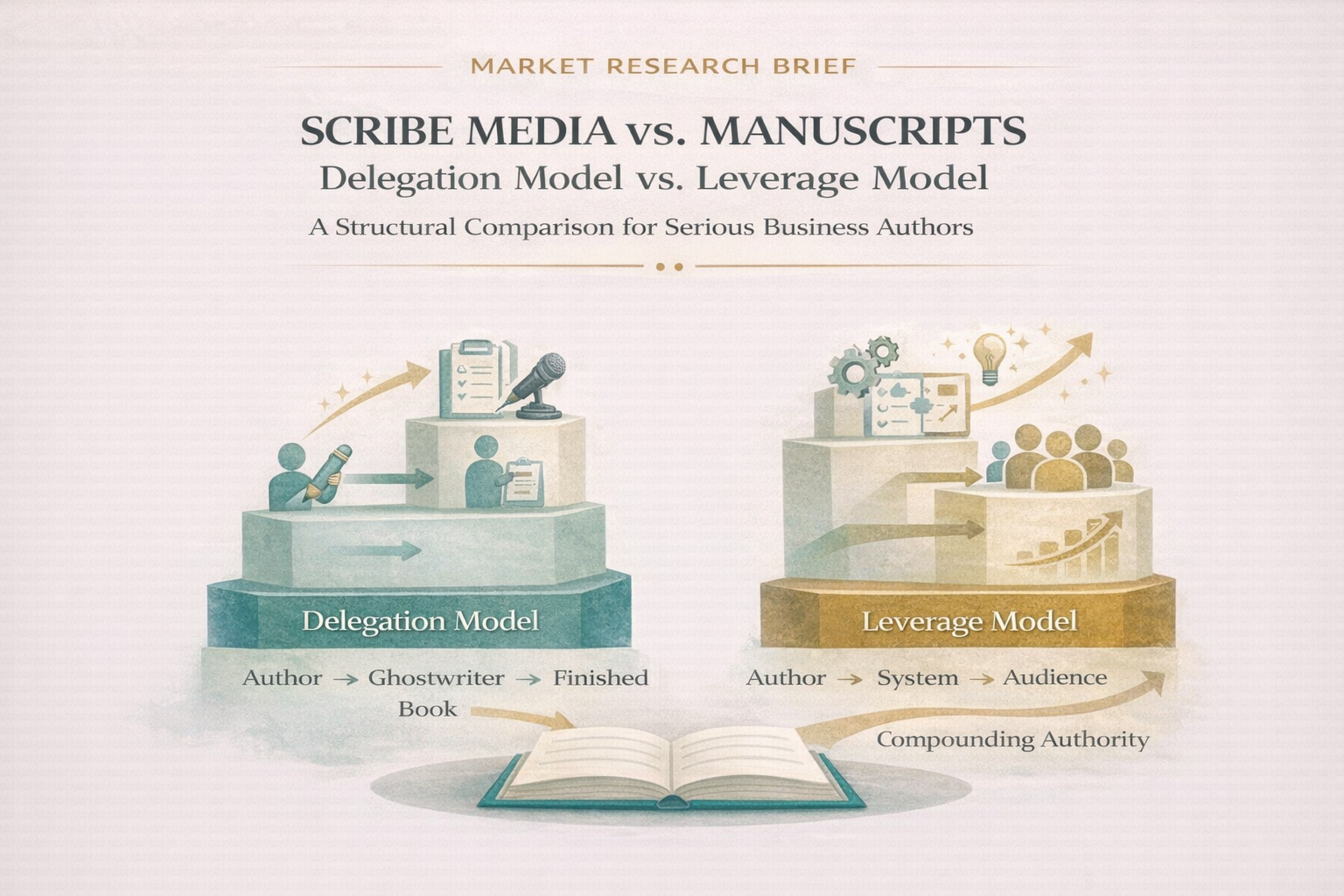
| A ghostwriting-first, done-for-you business book machine | Scribe Media |
| A modern, author-owned publishing model built around presale + audience + ROI | Manuscripts Press |
Now ask yourself one honest question:
Are you publishing this book primarily for credibility, or for leverage?
- If the goal is legacy and prestige, traditional hybrid models may fit.
If the goal is clients, speaking, enterprise deals, and long-term revenue, you need a publisher built for modern author ROI.
Quick Comparison Table
| Dimension | System-Owned Hybrid Publisher | Service-Style Hybrid Publisher |
| Best for | High-stakes business & authority books | Exploratory or lower-risk projects |
| Typical cost range | $30,000–$150,000+ | $10,000–$40,000 |
| Timeline | 9–15 months (structured) | 6–12 months (variable) |
| Author ownership | 100% | 100% |
| Editorial depth | Decisive, strategic leadership | Corrective or fragmented |
| Audience + launch support | Integrated and intentional | Limited or optional |
| Who owns launch execution? | Publisher-led, system-owned | Author-led or externally assembled |
| Primary risk | Higher investment, lower execution risk | Lower cost, higher author coordination risk |
| Primary tradeoff | Capital exchanged for focus and outcome protection | Money saved exchanged for time, attention, and risk |
Interpretation:
This table shows where responsibility lands when timelines slip, guidance conflicts, or launch pressure increases.
Why this works:
- Preserves a reference-manual feel
- Appeals to skimmers and executives
The 6 Hybrid Publishers Business Authors Actually Compare in 2026
If you’re writing a serious nonfiction book, the competitive landscape is smaller than it looks.
Most firms that appear in “hybrid publisher” searches are:
- Service vendors selling discrete tasks
- Paid production houses with limited accountability
- Marketing-led upsell funnels
- Print-first operations optimized for volume
For business authors building authority, there are only a handful of publishers that reliably appear in the same strategic decision set. These firms are not interchangeable. Each represents a distinct publishing philosophy and responsibility model.
The relevant comparison group in 2026 includes:
- Greenleaf Book Group
- Amplify Publishing Group
- Berrett-Koehler
- Forbes Books
- Scribe Media
- Manuscripts Press
The question is not which is best.
It is which system matches the role the book must play.
1). Greenleaf Book Group
Positioning: Traditional-quality hybrid publishing with strong distribution credibility
Greenleaf is widely respected for production standards and bookstore reach. It appeals to authors who want a publishing experience that closely resembles traditional publishing while retaining ownership.
In recent years, Greenleaf has become part of a larger consolidated publishing group. This brings scale and infrastructure, but may also shift the experience from founder-led partnership toward a more standardized operating model.
Structural strength: Production quality and distribution experience
Watch-out: Less emphasis on author coaching, positioning, or launch ownership; marketing execution often remains author-led
2). Amplify Publishing Group
Positioning: Media-oriented hybrid publishing with broad infrastructure
Amplify offers packaging, reach, and a recognizable hybrid model attractive to authors prioritizing visibility. Like Greenleaf, Amplify now operates within a larger consolidated organization following private equity–backed acquisition.
For some authors, this provides access to greater resources. For others, it introduces more uniform processes and less bespoke attention at the execution layer.
Structural strength: Scale, packaging, and publishing infrastructure
Watch-out: Editorial judgment and launch ownership can be diffuse; authors should clarify where accountability actually sits
3). Berrett-Koehler
Positioning: Mission-driven leadership and thought leadership publishing
Berrett-Koehler occupies a distinct niche. It is trusted in leadership, organizational, and values-driven business categories, and carries strong brand credibility in those spaces.
It is best suited for authors prioritizing intellectual positioning and shelf presence over speed or founder-style execution.
Structural strength: Brand trust and leadership credibility
Watch-out: Not designed for rapid execution or business-first ROI outcomes
4). Forbes Books (Selective, High-Cost)
Positioning: Prestige and brand association for high-profile executives
Forbes Books operates as a premium, selective imprint aimed at executives using a book as a visibility and status asset. Pricing reflects brand halo and PR positioning more than execution support.
ROI depends heavily on the author’s existing platform and ability to convert attention into outcomes.
Structural strength: Brand association and perceived prestige
Watch-out: Very high investment; limited system ownership beyond publication itself
5).Scribe Media
Positioning: Ghostwriting-first, done-for-you business book production
Scribe is known for speed, process discipline, and delegation. It works well for busy executives who want to offload writing and move quickly to a finished product.
The tradeoff is distance from authorship and long-term IP development. The system is optimized for delivery, not for building author-owned publishing capability.
Structural strength: Execution speed and writing delegation
Watch-out: Less emphasis on voice development, audience-building, or post-book leverage
6). Manuscripts Press
Positioning: Author-owned, presale-first publishing for Modern Authors
Manuscripts Press is built around a different assumption: that the book is a business asset, not a one-time project. The model emphasizes presale community-building, early editorial rigor, and systems that compound across books.
Rather than optimizing for delivery alone, Manuscripts is designed to preserve authorship, build demand before launch, and reduce execution risk while keeping ownership with the author. This approach starts with audience-building before publication, rather than treating marketing as something that begins after the manuscript is finished.
Structural strength: System ownership aligned to long-term author leverage
Watch-out: Requires active author participation and structured execution
Industry Note: Consolidation Matters
In the last few years, hybrid publishing has seen increased private equity–backed consolidation, including acquisitions involving both Greenleaf and Amplify.
Consolidation is not inherently negative. It can bring stronger infrastructure and operational stability. But it does change the operating model:
- Processes may become more standardized
- Attention may be spread across larger author rosters
- Accountability can shift from founder-led judgment to managerial throughput
For authors, the key question is not ownership structure, it’s execution reality:
Will your publisher feel like a bespoke system that owns outcomes, or a scaled operation that delivers outputs?
That distinction matters more than branding.
Decision Lens (Carry This Forward)
All six publishers above can produce a professional book.
They differ in where responsibility lives when things don’t go as planned.
That is the axis this brief uses for comparison, not reputation, not aesthetics, and not promises.
If you want, next we can:
- Tighten this into one-page publisher snapshots
- Add a “Who should not choose this publisher” line per firm
- Or run the LEVER Framework explicitly across all six
Comparing the Top Hybrid Publishing Companies in 2026
| Publisher | Best For | Typical Investment | Primary Strength | Watch-Out / Tradeoff |
| Greenleaf Book Group | Authors who want a traditional-quality publishing partner with strong distribution | $15K–$40K+ | Production + bookstore credibility | Less coaching/accountability, marketing still on authorNow part of a larger consolidated publishing group, which may affect personalization over time |
| Amplify Publishing Group | Authors prioritizing reach + media-style hybrid publishing | $12K–$35K | Distribution + packaging | More publisher-led, less author system supportBacked by a larger parent organization following recent consolidation, which can introduce more standardized processes |
| Berrett-Koehler | Mission-driven business authors seeking thought leadership credibility | Varies (selective + hybrid models) | Brand trust + leadership shelf presence | Not built for fast founder-style execution |
| Forbes Books | High-status executives using a book as PR + prestige | $75K–$150K+ | Brand halo + visibility | Very expensive, ROI depends on platform |
| Scribe Media | Busy executives who want speed + ghostwriting infrastructure | $40K–$100K+ | Process + writing delegation | Less author-owned voice development, premium pricing |
| Manuscripts Press | Modern Authors building ROI through presale + audience-first publishing | $4K–$15K | Author-Owned + Presale Publishing system | Requires author participation + structured execution |
The Market Reality (What Most Authors Misunderstand)
Misunderstanding #1: “Best” means most famous
In hybrid publishing, brand recognition is a weak proxy for outcomes. Well-known firms often optimize for volume and throughput, not for author leverage or decision quality. Visibility is easy to market. Structure is not.
Misunderstanding #2: Hybrid publishers are interchangeable
They are not. Hybrid publishing spans a wide spectrum, from system-owned publishers that absorb responsibility to service-style operators that assemble vendors. Treating them as interchangeable leads authors to compare prices without understanding what those prices actually represent.
The result is predictable: authors overpay for polish or underinvest in systems.
How to Choose the Right Hybrid Publisher
Before choosing a hybrid publisher, answer these five questions:
- Do I want to write the book myself, or delegate writing?
- Do I already have an audience, or do I need to build one?
- Is this book mainly for prestige, or for ROI?
- Do I need accountability and coaching, or just production?
- Do I want author ownership and control, or publisher-led structure?
Different publishers optimize for different answers.
That’s why “best hybrid publisher” is the wrong question.
How to Choose Between These Publishers (Fast Decision Guide)
Use this simple filter:
Choose Greenleaf if…
You want the closest thing to a traditional publisher experience, with high production quality and distribution strength.
Choose Amplify if…
You want a hybrid partner with strong packaging and broad publishing infrastructure.
Choose Berrett-Koehler if…
You’re writing a leadership or mission-driven business book and care deeply about credibility in that space.
Choose Forbes Books if…
You’re buying visibility, brand association, and prestige, and cost is not the constraint.
Choose Scribe Media if…
You want the fastest path to a book through ghostwriting and you already have a platform to monetize afterward.
Choose Manuscripts Press if…
You want to build your audience during the publishing process and treat the book as a business asset from day one.
The Modern Author Context: Business Books as Leverage
Modern Authors, founders, executives, consultants, coaches, speakers, professors, physicians, and mission-driven experts, do not write nonfiction books as creative endpoints. They write books as leverage.
For this audience, a book is expected to:
- Establish authority in a competitive market
- Signal credibility to high-stakes readers
- Support a business, platform, or intellectual property stack
- Compound opportunity over time
In this context, publishing success is not measured by copies sold alone. It is measured by downstream effects: trust gained, conversations opened, opportunities accelerated.
Generic reviews, prestige signals, and bold promises rarely reveal how a publisher handles ambiguity, protects author focus, or absorbs execution risk when stakes are high.
The best hybrid publisher for a business author is the one that preserves leverage, not the one that looks impressive.
What Is a Hybrid Publisher? A Better Way to Evaluate Publishing Partners
Hybrid publishing is best understood as a division-of-responsibility model, not a label.
In any hybrid arrangement, three burdens must be carried:
- Editorial judgment
- Execution coordination
- Launch and market risk
Different publishers distribute these burdens differently. Some absorb them centrally. Others leave them largely with the author while executing tasks on request.
Two publishers may both call themselves “hybrid” while operating at opposite ends of the responsibility spectrum. One functions as a system. The other functions as a service broker.
Without identifying where responsibility actually sits, it is impossible to evaluate quality, cost, or fit.
Two Hybrid Archetypes That Matter
For business authors, most hybrid publishers fall into one of two structural archetypes.
System-Owned Hybrids
These publishers own workflows, standards, and decision-making processes. They assume responsibility for outcomes, not just outputs.
Typical characteristics:
- Centralized editorial authority
- Owned production systems
- Clear accountability across stages
- Integrated launch readiness
Service-Style Hybrids
These publishers assemble services around the author. They coordinate vendors but leave judgment and risk decentralized.
Typical characteristics:
- Task-based execution
- Fragmented accountability
- Editorial decisions deferred to the author
- Launch treated as optional or external
Neither archetype is inherently right or wrong. The difference is fit. High-stakes business books demand systems. Lower-stakes or exploratory projects may tolerate services.
The mistake is evaluating both as if they solve the same problem.
How to Evaluate Hybrid Publishing Companies Using the LEVER Framework
Most hybrid publishers sound similar in sales conversations. Everyone claims to offer editorial support, end-to-end production, and launch guidance. Those phrases are meaningless unless you understand how responsibility is actually distributed.
The LEVER Framework isolates the five variables that determine whether a hybrid publisher functions as a true system, or a dressed-up service bundle that leaves the author carrying the real risk.
L — Leadership (Editorial Authority)
Who has the authority to say “this isn’t working”?
Strong hybrid publishers exercise judgment early. They intervene on positioning, structure, and scope before prose hardens into sunk cost. Weak ones avoid decisions to preserve goodwill, pushing risk later, where fixes are slower and more visible.
Concrete test:
When a chapter undermines the book’s goal, who makes the call to cut, reframe, or rebuild it?
For business authors, editorial leadership is not loss of control.
It is prevention of expensive mistakes.
E — Execution (System Ownership)
Who owns the workflow end to end?
System-owned publishers run internal processes with clear standards and centralized accountability. When something breaks, responsibility is obvious. Service-style hybrids assemble vendors per project, diffusing ownership and leaving the author to reconcile conflicts.
Concrete test:
When edits, design, and launch timelines collide, who coordinates the resolution, and who absorbs the delay?
Execution failures rarely come from lack of talent.
They come from fragmentation.
V — Velocity (Momentum Protection)
Who is responsible for keeping the project moving?
A real system operates on cadence. Delays are flagged and corrected, not normalized. When velocity depends on the author remembering to follow up or self-diagnosing stalls, execution is already fragile.
Concrete test:
If nothing progresses for several weeks, who notices, and what happens next?
Velocity matters because stalled books bleed attention, confidence, and credibility long before they miss a launch date.
E — Entry (Market Readiness)
Who owns what happens when the book enters the world?
For business authors, publication is not the finish line. Market entry is. Strong hybrid publishers integrate audience, positioning, and timing decisions before production is complete. Weak ones deliver a finished artifact and declare success.
Concrete test:
When the book ships, is there a defined path to readers, or just files and congratulations?
Launch readiness is not marketing.
It is risk management at the moment leverage is most exposed.
R — Rights (Author-Owned Alignment)
Who is stronger after publication?
The strongest hybrid publishers preserve full author ownership, rights, ISBNs, files, and independence. So each book compounds leverage rather than resetting it. Business authors rarely write only one book. Each engagement should leave them structurally better positioned for the next.
Concrete test:
After publication, can you reuse the system, or are you starting from zero again?
What LEVER Makes Visible
Two publishers may look identical on a website.
Both may offer editing, design, and distribution at similar price points.
LEVER reveals the difference marketing language hides:
- One intervenes early, owns execution, protects momentum, and designs for market entry.
- The other delivers tasks, defers judgment, and leaves outcomes to chance.
Both call themselves hybrid.
Only one actually carries the weight.
For exploratory or low-stakes books, lighter systems may be sufficient.
For books that must establish authority and work the first time, system ownership is structurally safer, even at higher upfront cost.
That is what LEVER clarifies:
not who sounds impressive, but who absorbs responsibility when it matters.
Publisher Profiles (The Serious Six)
Greenleaf Book Group
Greenleaf is widely respected for production quality and distribution strength. In recent years, it has become part of a larger consolidated publishing group, which may shift the experience for some authors from boutique partnership toward a more scaled operational model.
Amplify Publishing Group
Amplify offers strong hybrid infrastructure and reach. Like many firms in the category, it now operates within a larger consolidated organization, which may bring additional resources but also a more standardized process depending on the author experience.
Berrett-Koehler
A leadership-focused publisher with deep credibility in business, mission-driven, and organizational books. Best for authors prioritizing brand trust.
Forbes Books
A prestige-driven publishing model aimed at high-profile executives. Premium pricing, selective positioning, and strong PR halo.
Scribe Media
A leading business-book firm known for ghostwriting and speed. Ideal for executives who want delegation and fast execution.
Manuscripts Press
An Author-Owned Publishing model built around presale community-building, editorial rigor, and long-term author ROI. Designed for Modern Authors.
The Hidden Difference: Audience-Built vs. Print-Then-Marketing Publishing
| Most hybrid publishers follow this sequence:Write → Edit → Print → Distribute → Hope marketing works Modern publishing is different:Audience → Presale → Draft → Publish → Launch with buyers already committed This is why Manuscripts Press has pioneered Presale Publishing and Author-Owned Publishing as a modern alternative. Distribution is not the hard part anymore. Demand is. |
Deep Breakdown: Honest Tradeoffs
The most expensive failure in publishing is not poor writing. It is building the wrong book well.
System-owned hybrids reduce this risk through early editorial authority, centralized accountability, and integrated launch design. The tradeoff is higher upfront capital.
Service-style hybrids reduce cost but increase author burden. The hidden costs appear later: rewrites, delays, fragmented launches, and opportunity loss.
Neither model is universally superior. The correct choice depends on how much the book must work the first time.
The Manuscripts Perspective (Modern Author OS Lens)
From the Modern Author OS perspective, “best hybrid publisher” is the wrong abstraction.
The right question is:
What system best supports the role this book plays in my life and work?
Publishing is treated as infrastructure, not output, connecting editorial rigor, audience intelligence, launch architecture, and long-term asset value.
This is why Manuscripts emphasizes author-owned publishing, systems over services, and books as durable business assets rather than isolated artifacts.
In practice, this means Manuscripts is designed so that authors finish the process with a clearer point of view, a built audience, and a repeatable publishing system, not just a finished book.
Buyer Checklist: Questions to Ask Any Hybrid Publisher
Before choosing a hybrid publisher, business authors should be able to answer:
- Who owns rights, ISBNs, and long-term control?
- Where does final editorial authority sit?
- What systems exist beyond individual contributors?
- How is launch readiness integrated before publication?
- What happens after the book is published?
- How is success defined beyond book sales?
- How does pricing map to responsibility and risk transfer?
Clear answers indicate structure. Vague answers indicate deferred risk.
Question to Ask Any Consolidated Publisher
If you’re evaluating a larger hybrid firm, ask:
- Who is my day-to-day lead?
- How many authors does that person manage at once?
- What parts are handled in-house vs outsourced?
- How customized is the launch strategy?
Big infrastructure is useful.
But execution still comes down to ownership and attention.
Red Flags in Hybrid Publishing
Avoid publishers who:
- Won’t clearly show who owns ISBNs, files, and long-term rights
- Outsource most of the work with no single accountable lead
- Treat launch readiness as an optional add-on rather than a core function
- Promise bestseller outcomes or guaranteed results
- Can’t define success beyond printing and distribution
Big infrastructure can look impressive.
But when accountability is unclear, the risk hasn’t disappeared, it’s just been shifted back to the author.
Risk & Counterpoint: When System-Owned Hybrids Are the Wrong Choice
System-owned hybrid publishers are not universally superior.
They are optimized for outcome protection, which makes them the wrong tool in certain conditions.
They are often a poor fit when:
- The book is intentionally exploratory or provisional
- Positioning is still being discovered rather than executed
- Speed of iteration matters more than coherence or polish
- The author’s primary goal is to build internal publishing capability
- The book is low-stakes and allowed to evolve in public
In these cases, the structure that protects high-stakes outcomes can become friction. A system designed to enforce standards, sequencing, and launch readiness may feel constraining when the real objective is learning, testing, or rapid experimentation.
System-owned hybrids also introduce real, non-trivial risks:
- Higher capital exposure before market validation
- Incentive misalignment if the publisher’s system prioritizes throughput over fit
- Over-structuring projects that do not yet warrant full infrastructure
This is the tradeoff authors must acknowledge clearly:
Paying for a system does not replace author clarity.
It replaces chaos, fragmentation, and execution drift, but it cannot supply conviction, point of view, or strategic intent.
For authors who already have clarity and need protection, systems are leverage.
For authors still discovering what the book is, systems can be premature.
The mistake is not choosing a system-owned hybrid.
The mistake is choosing one before the book has earned that level of structure.
The Rule to Carry Forward
Hybrid publishing is not a moral choice. It is a leverage decision.
If the book must work the first time, borrow a system.
If the book is allowed to be learned in public, build one.
The simplest test of the “best” hybrid publisher is this:
When something goes wrong, does the publisher absorb the problem, or hand you a task list?
Industry Note: Consolidation in Hybrid Publishing
| In the last few years, hybrid publishing has seen increased consolidation, including private equity-backed mergers among major firms. For authors, this isn’t automatically negative. But it does change the operating model: -Larger firms may bring stronger infrastructure -Smaller firms often bring more founder-led attention -Consolidation can introduce more standardized workflows over time The key question to ask is simple: Will your publishing partner feel like a bespoke team, or a scaled production operation? That distinction matters more than branding. |
The Right Publisher Is the One That Owns the Outcome
Hybrid publishing is not a commodity.
It’s a strategic partnership.
The best publisher for you depends on whether you need:
- distribution
- prestige
- ghostwriting
- accountability
- audience-building
- ROI execution
If you want a publishing partner built for Modern Authors, Manuscripts Press is designed around that system.
FAQ
Who are the best hybrid publishers for business authors?
Those that provide strong editorial authority, system ownership, and launch readiness while preserving full author ownership.
Are expensive hybrid publishers always better?
No. Higher cost usually signals more responsibility transfer, not guaranteed outcomes.
Do legitimate hybrid publishers take royalties or rights?
No. Legitimate hybrid publishers preserve full author ownership.
Can self-publishing ever be better for business authors?
Yes, when the book is exploratory, low-stakes, or the author has strong internal systems.
What’s the biggest mistake authors make choosing hybrid publishers?
Optimizing for brand prestige or price instead of responsibility and risk transfer.
What are hybrid publishing companies?
Hybrid publishing companies provide professional publishing services while allowing authors to retain ownership of their intellectual property and royalties. They differ significantly in how much responsibility they assume for editorial leadership, execution, launch support, and long-term author success.
How do you choose a hybrid publisher?
The best hybrid publisher depends on your goals, level of support required, and desired business outcomes. Business authors should evaluate responsibility ownership, editorial leadership, launch support, and long-term leverage rather than comparing price alone.
Are all hybrid publishing companies the same?
No. Some hybrid publishing companies operate as system-owned publishing partners, while others function primarily as service providers. The difference often determines how much execution risk remains with the author.
Related Guides for Modern Authors
If you’re evaluating hybrid publishers, these adjacent decisions often determine whether the book actually performs.
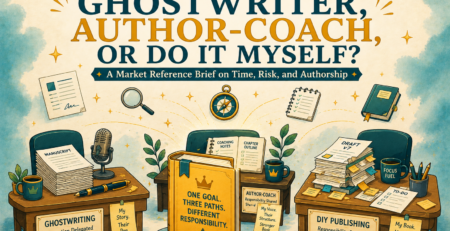
- Should You Write Your Book Yourself, Get a Coach, or Hire a Ghostwriter? A Few Things to Consider… How authorship, editorial judgment, and execution responsibility shift across creation models, and what that implies for time, risk, and leverage.
- Navigating the Publishing Maze: Hybrid vs. Self-Publishing How structural differences between hybrid and self-publishing models impact responsibility for editorial decisions, go-to-market risk, and author workload.
- What is a Presale Campaign and Why Does It Matter? How presale publishing sequences audience building, validation, and launch readiness, changing when leverage is actually created versus when the book ships.
- The Four Types Of Book Publishing Explained How major publishing models (traditional, self, hybrid, assisted) distribute responsibility for editorial authority, production execution, and market access.
Each guide addresses a different decision layer, but they are designed to work together as part of a single publishing system.