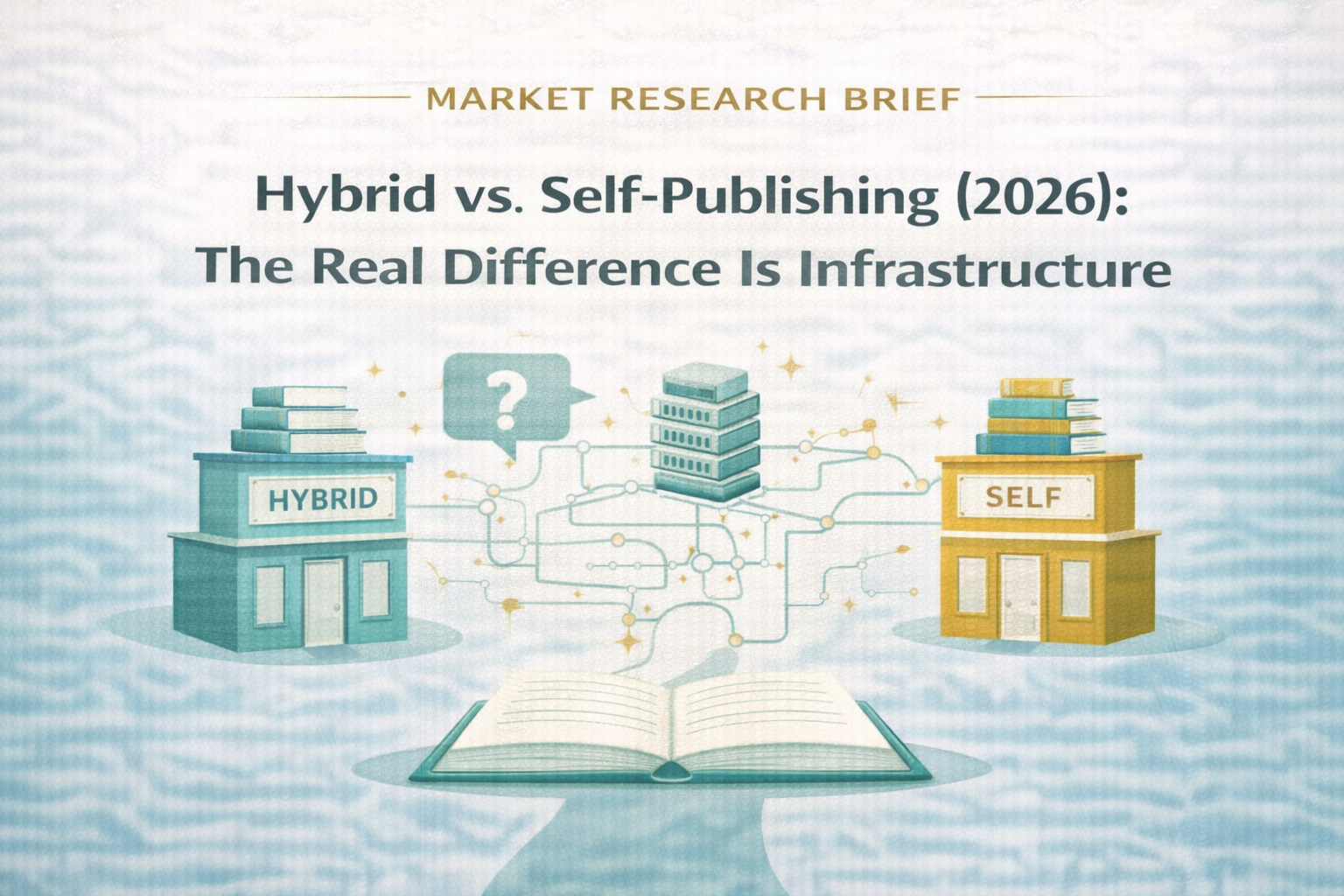
Most authors compare hybrid publishing and self-publishing as if the decision is about price or prestige.
It isn’t.
In 2026, the real question is:
Do you want to build the publishing system yourself, or borrow one that already works?
Because publishing isn’t scarce anymore.
Execution is.
This brief explains the real tradeoff:
Hybrid publishing trades capital for focus, structure, and launch readiness.
Self-publishing trades money saved for time, coordination, and execution risk.
If your book is meant to drive authority, clients, speaking, or enterprise opportunities, this decision is not stylistic.
It’s infrastructure.
The 60-Second Decision: How Modern Authors Decide Between Hybrid and Self-Publishing
Choose hybrid publishing if:
Your book needs to work the first time You don’t want to manage 6–10 freelancers You want editorial leadership and launch coordination Your time is more valuable than the cost difference
Choose self-publishing if:
You want full autonomy and are willing to manage complexity You have time to iterate and learn in public The book is a lower-stakes experiment You already have strong operational execution skills
Rule of thumb: If the book is a business asset, borrow a system. If the book is a sandbox, build one.
Why the Hybrid vs. Self-Publishing Debate Is Misframed
Most discussions about hybrid versus self-publishing fixate on the wrong variables:
price,
control, and
credibility.
These topics dominate forums, blog posts, and comparison charts, but they obscure the real decision authors are making.
Cost is visible. Leverage is not.
Control feels important. Outcomes matter more.
Credibility is assumed to be conferred by labels, when in reality it is earned through execution quality and consistency.
Most authors don’t fail because they choose the wrong model. They fail because they choose without understanding the operational burden. Some authors overinvest in infrastructure they do not yet need. Others underinvest, believing effort alone will compensate for missing systems.
In both cases, the failure is not effort or intelligence. It is framing.
“I tried self-publishing for 10 years. Hybrid structure changed everything.”
Dr. Laura Streyfeller
Publishing today is abundant. Execution quality, sustained attention, and follow-through are scarce. Any serious comparison between hybrid and self-publishing must start from that reality.
The Modern Author Context: Books as Leverage, Not Artifacts
Modern Authors write books as leverage, not as artifacts.
For executives, founders, consultants, coaches, professors, physicians, and mission-driven experts, a nonfiction book is almost never the end goal. It is a strategic instrument designed to serve a broader purpose.
That purpose might include:
Establishing authority in a crowded or skeptical market
Compounding credibility over years rather than months
Unlocking higher-quality clients, stages, or partnerships
Creating durable intellectual property that supports a body of work
Most conventional publishing advice assumes the book exists primarily to be read, reviewed, or ranked. It assumes the book’s success can be measured largely by copies sold.
For Modern Authors, that assumption fails. The book must work. It must integrate with a larger ecosystem of ideas, offerings, and reputation. When a book is meant to support a business, a platform, or a thought leadership agenda, the publishing model becomes an infrastructure decision rather than a stylistic preference.
In our data, fewer than 10–15% of nonfiction authors earn most of their ROI from book sales alone. The book’s real value comes from what it unlocks: clients, speaking, training, partnerships, and credibility.
Industry analyses consistently show that most traditionally published books sell only a few hundred copies in year one.
This is why generic publishing advice so often misfires for serious nonfiction authors. It is answering a different question.
What Hybrid Publishing Actually Is (and Isn’t)
Hybrid publishing is one of the most misunderstood terms in the industry.
Legitimate hybrid publishing is not defined by price, branding, or guarantees. Hybrid publishing is best understood as author-owned publishing with professional infrastructure.
Hybrid publishing isn’t paying for a book.
It’s paying for the infrastructure to bring a book to market professionally.
It is defined by division of responsibility.
In a true hybrid publishing model:
The author retains full ownership and rights
The publisher provides editorial leadership, production systems, and launch coordination
Risk is shared, but long-term control remains with the author
This structure is fundamentally different from traditional publishing, where rights are exchanged for distribution and advance capital, and from self-publishing, where the author retains ownership but also absorbs nearly all operational responsibility.
Hybrid publishing is not:
Paying for legitimacy
Buying distribution guarantees
Outsourcing authorship
A bundle of disconnected vendor tasks
A legitimate hybrid partner provides systems, editorial authority, and coordinated execution, while the author retains full ownership.
Many companies that market themselves as hybrid publishers are, in practice, service vendors with better branding. They sell tasks, not systems. The distinction matters, because authors are not actually buying editing, design, or formatting in isolation. They are buying coordination, decision-making frameworks, and error prevention.
When hybrid publishing works, it replaces fragmentation with structure.
The Leverage Trade of Hybrid Publishing
The core value of hybrid publishing is not convenience. It is compression.
Example (Common Hybrid Use Case) A healthcare executive writing a leadership book may have the expertise, but not the bandwidth to manage editors, designers, metadata, launch sequencing, and distribution.
Hybrid publishing replaces fragmentation with a coordinated system.
Hybrid publishing allows authors to substitute capital for time, attention, and accumulated error. Instead of learning the publishing process through trial and misstep, the author steps into a system that has already been refined through repetition.
What authors are buying with a legitimate hybrid partnership includes:
Shortened learning curves
Editorial leadership that prevents structural mistakes
Production workflows that are tested and repeatable
Coordinated launch execution rather than reactive marketing
This trade matters most when the author’s primary leverage does not come from operational execution. Founders, executives, and professional experts already have high-value demands on their time. For them, every hour spent coordinating vendors or troubleshooting production is an hour diverted from their core work.
Hybrid publishing allows these authors to remain focused on thinking, positioning, and leadership while execution is handled within a system designed for outcomes rather than activity.
Example: A consultant with multiple client programs may outsource production and marketing to a hybrid publisher, ensuring the book reaches market-ready quality while their schedule remains dedicated to client growth.
Thought Leadership Leverage’s Author ROI research shows most nonfiction ROI comes from speaking, consulting, and services, not royalties.
The tradeoff is material and explicit: upfront investment. The upside is equally explicit: fewer false starts, fewer hidden failures, and a higher probability that the book enters the market in a coherent, credible form.
The Hidden Reality of Self-Publishing
Self-publishing is often described as independence. Operationally, it is general contracting. The self-publishing author handles:
Managing editors across multiple stages
Coordinating design, formatting, and distribution
Making editorial decisions without external arbitration
Planning and executing a launch with limited feedback loops
Self-publishing does not remove complexity. It relocates it.
Self-publishing can produce extraordinary books.
But only when the author is prepared to act as the project manager, publisher, and launch strategist, not just the writer.
Instead of complexity living inside a publisher’s system, it lives inside the author’s calendar and cognitive load. The author becomes the system that holds everything together.
For authors with strong operational instincts, available time, and tolerance for iteration, this can be a viable and even empowering path. For authors whose leverage comes from expertise rather than execution, it often becomes a bottleneck that slows progress and degrades quality.
The Leverage Trade of Self-Publishing
The most visible benefit of self-publishing is cost control. The less visible costs are more consequential.
These include:
Time diverted from core expertise
Fragmented decision-making across vendors
Inconsistent editorial quality
Launch effectiveness dependent on existing audience
Self-publishing rewards authors who already have distribution, patience, and the ability to manage ambiguity. It punishes authors who underestimate coordination risk or assume quality emerges naturally from effort.
This model works best for exploratory projects, early-stage thinking, or intentionally low-stakes books designed to test ideas in public. It becomes fragile when the book is expected to carry authority, credibility, or business outcomes on its own.
Example: A first-time author experimenting with a thought leadership idea may self-publish a short-form book to test messaging and audience response before committing to a full-scale launch.
Hybrid vs. Self-Publishing: A Clear Comparison
Dimension
Hybrid Publishing
Self-Publishing
Best for
Authors prioritizing leverage, outcomes, and market readiness
Authors prioritizing cost control and full autonomy
Typical cost range
$15k–$50k+ depending on scope
$1k–$10k depending on service bundle
Time burden
Low; publisher handles coordination
High; author manages every stage
Editorial authority
Shared, guided by publisher
Fully author-controlled
Launch readiness
Coordinated, systematized
Dependent on author execution
Audience support
Integrated prelaunch strategy
Author-dependent, minimal support
Primary tradeoff
Capital for time, attention, and reduced risk
Money saved for time, coordination, and execution risk
Likelihood book enters market professionally on first release
High
Variable
Best for first-time business authors
Strong fit
Only if highly self-directed
Case Study: Why Hybrid Support Matters
One of the clearest ways to understand the difference between self-publishing and high-integrity hybrid publishing is to hear it from an author who has done both.
Dr. Laura Streyfeller, a physician and longtime speaker, came to Manuscripts after spending nearly a decade trying to complete her first book on her own.
She wasn’t struggling because she lacked expertise.
She was struggling because she lacked the infrastructure that modern authors actually need:
structure
deadlines
editorial partnership
community accountability
a publishing system built for real life
As Laura put it:
“When I wrote the first book I did… it was self-publishing the way I did it. And it took me about 10 years. I moved sentences around for 10 years trying to get it right. I had no structure and it just took forever.”
That’s the hidden truth of self-publishing for serious nonfiction authors:
The problem usually isn’t effort.
It’s isolation.
And without a system, the project expands until it becomes endless.
Laura described what changed when she entered a structured hybrid publishing model:
“Having not only the instruction, and the deadlines, and the sense of community, and the editorial help was invaluable… having somebody to help me structure my thoughts was invaluable.”
That’s what legitimate hybrid publishing actually provides at its best:
Not shortcuts.
Not outsourcing.
But a professional container that makes completion possible.
And in Laura’s case, the book became far more than a publication.
It became a way to bring together a lifetime of insight and reach a broader audience:
“The book has helped me bring together a lifelong journey… my personal journey, my professional journey… and healing of others.”
This is why the hybrid vs. self-publishing decision is not primarily about printing.
It’s about whether you want to build alone…
Or build with a team designed to help the book actually happen.
Watch Dr. Streyfeller’s Full Reflection
Dr. Laura Streyfeller on why structure and editorial partnership made the difference
https://youtu.be/hua6vXW_ylk
The Takeaway for Modern Authors
Self-publishing can work.
But for most serious authors, the risk isn’t quality.
The risk is never finishing.
Hybrid publishing is worth considering when you want:
a manuscript completed on a real timeline
professional editorial guidance
accountability and structure
a book that carries your voice, not a ghostwriter’s
a launch that connects the work to real readers
Or as Laura said best:
“Time isn’t something we have. It’s something we make.”
A good publishing system helps you make it.
A Practical Evaluation Checklist
Before committing, authors should answer:
Who owns rights, ISBNs, and long-term control?
Where does editorial authority sit?
How is audience-building integrated before launch?
Which systems persist after publication?
How is success defined beyond book sales?
What risks remain with the author?
What capabilities am I buying—or building—for the future?
If answers are vague, the decision rests on faith rather than structure.
Hybrid Publisher Red Flags (Avoid These)
Publisher owns ISBN or rights
No audience-building or presale strategy
“Guaranteed bestseller” language
Vendor bundle, not an integrated system
No editorial leadership (just copyediting)
The Real Divide: One-Off Books vs. Author-Owned Publishing Systems
The key distinction isn’t hybrid vs. self. It’s single-book thinking vs. system thinking.
Single-book thinking: treats publishing as a one-time project; goal is completion.
Author-owned systems thinking: treats publishing as an asset class; goal is repeatable leverage.
System thinking delivers:
Reusable editorial frameworks
Compounding audience intelligence
Launch infrastructure that improves over time
Strategic clarity on how books support broader goals When authors think in systems, the publishing model becomes a design choice rather than an emotional one. Hybrid and self-publishing are simply different ways of acquiring or building those systems.
Hybrid Publishing is NOT worth it if…
You’re experimenting with your first idea
The book has no business or platform role
You want to learn the process hands-on
Budget is tight and stakes are low
How Manuscripts Reframes the Decision
Manuscripts is built for authors who want the benefits of hybrid publishing, without surrendering ownership or treating the book as a one-time project.
We combine:
Author-owned publishing
Audience-building before launch
Editorial rigor and coordinated execution
Long-term business leverage strategy
This is why we call it the Modern Author Operating System, not a publishing package. Manuscripts authors have earned 450+ national and international book awards through this model.
Through the Modern Author OS, publishing is treated as an integrated discipline that connects editorial rigor, audience development, and long-term asset value. The focus is not on choosing a label, but on designing infrastructure that supports the role a book plays over time.
Concepts such as presale publishing, systematized execution, and author-owned publishing infrastructure exist to remove false tradeoffs. They allow authors to retain ownership while avoiding fragmentation, and to invest deliberately rather than reactively.
The framing shifts from “Which model should I choose?” to a more durable question:
What system best supports the role this book plays in my life and work?
Choosing Based on Leverage, Not Price
Hybrid publishing and self-publishing are not moral choices. They are leverage decisions:
Hybrid: trades capital for focus, structure, and market readiness
Self-publish: trades money saved for time, coordination, and risk
Neither is universally superior. The correct choice depends on:
Whether the book must work the first time
Whether it can iterate and learn in public
The author’s ability to build or borrow a system to support the book’s role
Rule of Thumb:
If the book must work the first time, borrow a system.
If the book is allowed to learn in public, build one.
If you want help evaluating which model fits your book’s role, Manuscripts offers a structured publishing consult built around outcomes, not labels.
If you want a clear recommendation based on your goals, we offer a structured publishing consult for serious nonfiction authors.
Most Business Books Don’t Fail, They Just Don’t Do Anything
Most business books don’t flop.
They don’t get bad reviews.
They don’t embarrass their authors.
They don’t even disappear entirely.
They simply… exist.
They get published.
They get politely praised.
They sit on shelves, get referenced occasionally, and slowly stop mattering.
For smart, accomplished professionals, this is the most common outcome. And it’s not because the book was poorly written.
It’s because the goal was wrong.
Why “Publishing a Book” Is the Wrong Goal
Publishing is an event.
Authority, leverage, and client acquisition are systems.
When a senior executive or founder says, “I want to write a book,” what they usually mean is something else:
I want to be taken more seriously.
I want inbound conversations instead of outbound selling.
I want opportunities to find me.
I want this body of knowledge to work harder than I do.
A finished book does not automatically do any of that.
A strategically designed book can.
The mistake most professionals make is treating publishing as the finish line, instead of asking what the book is supposed to unlock once it exists.
The Hidden Disappointment Pattern
Across founders, executives, consultants, and thought leaders, a quiet pattern shows up again and again:
The book is solid.
The author is credible.
The launch goes fine.
Nothing meaningful changes afterward.
No increase in deal flow.
No clear lift in speaking or advisory work.
No sustained leverage.
This is especially common among high performers, because they assume competence is enough. They believe that if the ideas are strong, the outcomes will follow.
They usually don’t.
Not because the market is unfair.
Because the book was never designed to do the job they wanted it to do.
Why Clients, Not Copies, Is the Only Metric That Matters
For business authors, book sales are rarely the point.
Clients, partnerships, influence, and opportunities are.
In practice:
Royalties are a rounding error.
Credibility is the asset.
The book is the mechanism that changes conversations.
When books work, they do one thing exceptionally well:
They lower friction between expertise and opportunity.
When they don’t, it’s almost always because success was measured by the wrong scoreboard.
What This Guide Will Give You (That Publishers and Ghostwriters Won’t)
Most publishing advice focuses on execution:
writing quality
speed
production
distribution
Publishers and ghostwriters are paid to help books exist.
They are not paid to ensure the book generates clients.
This guide focuses on what happens before and around the writing, because that’s where outcomes are decided.
Specifically, it will help you:
distinguish writing a book from building a business asset
understand how books actually generate client ROI
identify which author model fits the intended outcome
avoid the common traps that lead to impressive but inert books
design a strategy where leverage appears before publication, not years after
This is not a guide to writing better prose.
It’s a guide to making sure the book, once written, actually works.
The Reframe That Matters
If you’re advising a senior leader, the question is not:
Can they write a book?
The real question is:
What should this book make easier, faster, or more inevitable once it exists?
Everything that follows starts there.
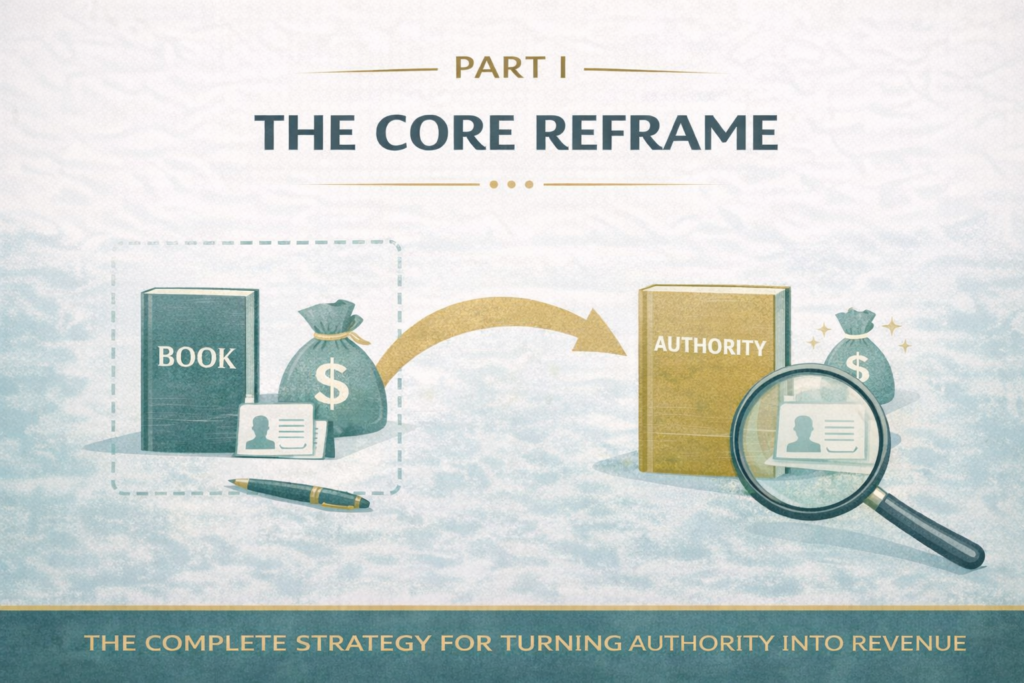
Part I: The Core Reframe
Writing a Book vs Building a Business Asset
Before strategy, publishing method, or writing process comes a more fundamental distinction.
Most business books are written to be finished.
The books that actually generate clients are designed to function.
This difference explains why so many smart, credible professionals publish books that earn respect but fail to change outcomes. It’s not a failure of effort or intelligence. It’s a failure of framing.
Writing a book and building a business asset are not the same activity. They require different decisions, different sequencing, and different success metrics.
This section establishes that distinction clearly, because everything that follows depends on it.
1. Why Writing a Book Rarely Gets You Clients
Among senior professionals, the assumption is understandable.
If someone is experienced, thoughtful, and respected, documenting that expertise in a book should naturally lead to more opportunity. More visibility. More inbound interest.
In reality, it rarely does.
The Myth of Passive Authority
Passive authority is the belief that credibility, once published, converts on its own.
The logic looks like this:
Write a smart book
Become known as an expert
Let the market respond
This model assumes that authority is discovered automatically. That readers, clients, or decision-makers will connect the dots without guidance.
That assumption no longer holds.
Authority today does not spread passively. It must be framed, activated, and used.
Why Credibility Doesn’t Automatically Convert
High-trust buying decisions don’t begin with credentials.
They begin with relevance.
A prospective client is not asking:
“Is this person intelligent?”
“Is this book well written?”
They are asking:
“Is this for someone like me?”
“Does this address a problem I recognize?”
“Can this person help me now?”
A book can demonstrate intelligence without answering any of those questions.
When that happens, credibility exists, but it doesn’t move anything forward.
How Most Books Die Quietly After Launch
The most common failure mode for business books is not public failure. It’s quiet irrelevance.
The pattern is familiar:
The book is completed and published
The launch performs adequately
There is a brief spike in attention
The book recedes into the background
The author remains credible.
Their opportunities remain largely unchanged.
Nothing breaks. Nothing improves.
This outcome is especially common among capable professionals, because the book feels successful. It earns praise. It signals expertise. It just doesn’t do any work.
Impressive vs Useful
There is a practical distinction that matters more than quality.
Impressive books:
signal intelligence
showcase experience
earn compliments
feel complete
Useful books:
change how conversations start
frame problems in specific ways
create natural entry points for engagement
make the author easier to hire, trust, or recommend
Most business books are optimized to impress and expected to become useful by accident.
That rarely happens.
The Core Contrast
This guide draws a hard line between two ways of thinking about a book:
Book as artifact A finished object that represents what the author knows.
Book as system component A working asset designed to create leverage over time.
Writing a book produces an artifact.
Designing a book produces an asset.
Clients come from the second.
The Hidden Risk Profile of Business Books
Most professionals assume writing a book is a low-risk move.
It isn’t.
It’s a high-variance asset with asymmetric outcomes.
Why Business Books Feel Safer Than They Are
Writing a book feels low-risk because:
it’s familiar it’s intellectually rewarding it doesn’t require public failure upfront progress feels private and controllable
But those same qualities hide the real risk.
The risk isn’t that the book will be bad. The risk is that it will be irrelevant.
The Two Types of Risk Most Authors Confuse
Perceived Risk (What Authors Worry About):
“What if I can’t finish?” “What if it’s not good enough?” “What if people judge it?”
Actual Risk (What Actually Hurts Outcomes):
Writing privately for too long Waiting to validate relevance Activating too late Designing the book without a clear outcome path
Most disappointment comes from the second category, not the first.
Why Strategy Is Risk Reduction, Not Complexity
Modern Author strategy exists to:
reduce downside variance surface learning early shorten feedback loops pull ROI forward in time
It does not add work. It removes blind spots.
Authors who delay strategy often spend more time, not less, and end up with fewer outcomes.
The Core Reframe
Writing a book is not the risky part.
Writing a book without designing how it will be used is.
When the book is treated as an asset instead of an artifact: relevance is tested early authority activates sooner effort compounds instead of dissipates
That’s not ambition. That’s risk management.
2. What It Means to Build a Book-Shaped Business Asset
If writing a book produces an artifact, building a book-shaped business asset produces leverage.
The difference is not philosophical. It’s operational.
A book-shaped business asset is designed to work in the real world, long before it’s finished and long after it’s published.
What a Book-Shaped Business Asset Actually Is
A book-shaped business asset is a book that has a defined role inside a larger system.
It is built to:
change how the author is perceived
create consistent entry points for conversation
reduce friction in trust-based decisions
support specific business or career outcomes
The book is not the destination.
It is infrastructure.
When designed this way, the book doesn’t sit on a shelf waiting to be discovered. It actively participates in how opportunities form.
How Assets Behave Differently Than Products
This distinction matters.
Products are evaluated at the point of purchase.
Assets create value repeatedly over time.
A book treated as a product optimizes for:
launch performance
sales volume
rankings and reviews
A book treated as an asset optimizes for:
credibility transfer
demand creation
conversation velocity
long-term positioning
Two books can sell the same number of copies and produce radically different outcomes for their authors, because one was designed to function as an asset and the other was not.
Why Timing, Positioning, and Use Matter More Than Prose
For business books, writing quality is a baseline requirement, not a differentiator.
What determines whether a book works is:
Timing: when the book enters the author’s public narrative
Positioning: how clearly the book frames a specific problem
Use: how the book is deployed in real conversations
A strategically positioned book with competent prose will outperform a beautifully written book with no defined role.
This is uncomfortable for authors who believe craft alone drives outcomes. It is clarifying for authors who want the book to do something concrete.
How Modern Authors Think Before They Write
Modern authors reverse the traditional sequence.
Instead of asking:
“How do I write this?”
“How fast can I finish?”
“Who should publish it?”
They ask:
“What should change once this book exists?”
“Who should this book make it easier to talk to?”
“What decisions should this influence?”
“How will this be used before and after publication?”
Writing becomes execution.
Strategy happens first.
This is the core logic behind the Busy Author System, which treats the manuscript as one component of a broader leverage strategy, not the starting point.
Why This Reframe Matters
When a book is designed as an asset:
progress becomes visible earlier
ROI appears sooner
burnout decreases
finishing becomes easier, not harder
The book stops feeling fragile.
It has a job.
And because it has a job, every decision about what belongs in it becomes easier.
Anchor Definition
For clarity, this guide uses the following definition throughout:
A book-shaped business asset is a book designed to actively create credibility, demand, and opportunity, not just document expertise.
If the book only starts working after publication, it was designed too late.
Book as Artifact vs Book as Asset
Most business books fail not because they’re poorly written, but because they’re designed as artifacts instead of assets.
This single distinction explains the majority of outcome variance.
Book as Artifact (The Traditional Mental Model)
A book is treated as:
a finished object a credential a personal milestone something to “get done”
Primary focus
manuscript quality publisher brand launch moment sales numbers
How success is measured
copies sold rankings reviews media mentions
When ROI is expected
after publication often 12–36 months later, if at all
Who owns outcomes
the publisher the market luck and timing
Result: A book that exists, looks impressive, and quietly stops working.
Book as Asset (The Modern Author Model)
A book is treated as:
infrastructure a leverage tool a conversation catalyst a system component
Primary focus
outcome design positioning and relevance early activation how the book is used
How success is measured
conversations started clients acquired speaking unlocked opportunities created
When ROI is expected
during the writing process often within 30–90 days of public positioning
Who owns outcomes
the author the strategy the system
Result: A book that compounds authority, reduces friction, and keeps paying off.
The One-Line Reframe That Matters
An artifact proves you wrote a book. An asset makes something else easier to say yes to.
Modern authors don’t write better books. They design books that work.
Why this callout matters: Once this distinction clicks, every downstream decision becomes simpler:
You stop asking, “How do I finish this book?” And start asking, “What should this book do once it exists?”
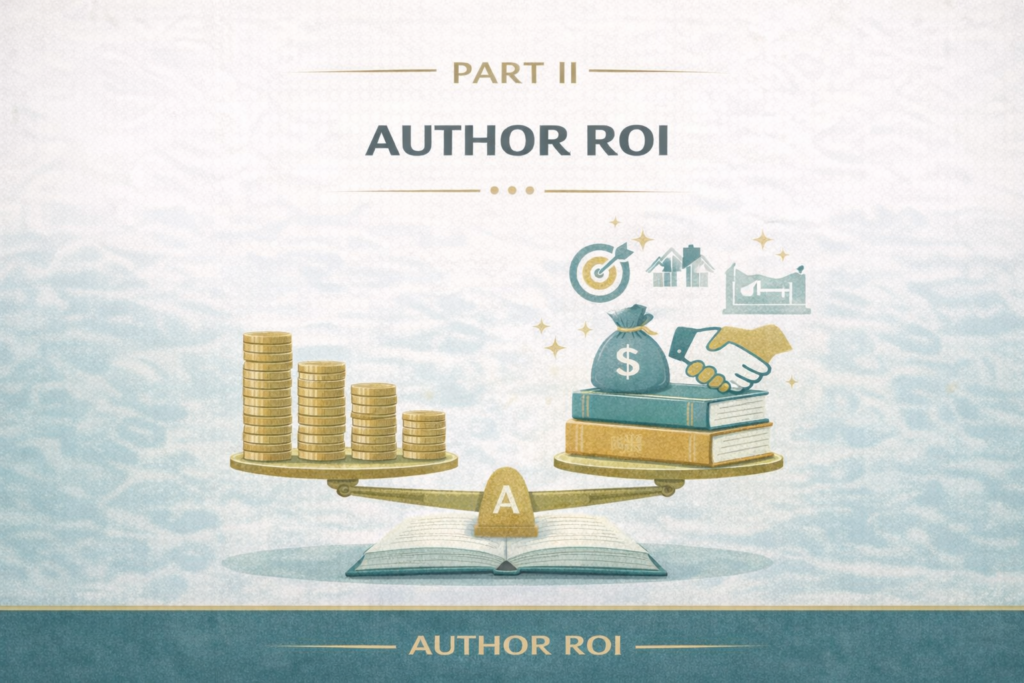
Part II: Author ROI
How Business Books Actually Generate Clients
Once the book is reframed as an asset, a different question becomes unavoidable:
How does this actually pay off?
This is where most business book conversations go off the rails.
Not because people are naive about money, but because they’re measuring the wrong thing, at the wrong time, with the wrong expectations.
This section establishes a clear, defensible definition of Author ROI, grounded in how business books actually work in the real world. Not how they’re marketed. Not how they’re reviewed. How they create opportunity.
4. What “Author ROI” Really Means (And What It Doesn’t)
For business authors, return on investment is rarely found where people look first.
Why Royalties Are the Wrong Scorecard
Royalties are easy to count.
They are also deeply misleading.
For most business books:
royalties represent a small fraction of total value
sales volume does not correlate strongly with opportunity creation
“successful” books often generate minimal direct revenue
This is not a failure of publishing.
It’s a misunderstanding of the book’s role.
A business book is not a retail product optimized for margin. It is a credibility engine designed to change access, perception, and trust.
Measuring its success by royalties alone is like measuring a keynote by ticket sales instead of contracts signed afterward.
The Five Real ROI Streams for Business Authors
When books work, they generate return across multiple channels, often simultaneously.
Across Manuscripts projects and broader industry data, five ROI streams appear consistently.
Client acquisition New consulting, advisory, or service engagements attributed to the book.
Speaking and workshops Paid keynotes, offsites, or training sessions unlocked by authority.
Training and cohorts Group programs, courses, or certifications anchored to the book’s ideas.
Enterprise and advisory work Board roles, retained advisory positions, or long-term engagements.
Partnerships and platform effects Media, collaborations, distribution deals, or ecosystem leverage.
Book sales may support these streams. They rarely drive them.
How ROI Shows Up Before Publication
One of the most counterintuitive patterns in modern authorship is timing.
For strategically designed books, ROI often begins before the book is finished.
Not because the market is impatient.
Because authority activates when the book becomes real.
Once a book is publicly named and positioned:
conversations change
assumptions shift
inbound interest increases
opportunities reference the book directly
This early ROI is not speculative. It’s structural.
The book signals commitment, focus, and leadership before a single copy ships.
What Counts as Success at 90, 180, and 365 Days
To evaluate ROI accurately, it has to be measured over time, not at a single moment.
At 90 days, success looks like:
increased inbound conversations
clearer positioning
early advisory or speaking interest
evidence that the book changes how the author is perceived
At 180 days, success looks like:
validated demand
repeatable conversations
defined offers tied to the book
reduced friction in selling or pitching
At 365 days, success looks like:
durable revenue streams
compounding opportunity
the book functioning as a reference point
authority that continues to pay off
None of these require bestseller status.
What Author ROI Is Not
To avoid false confidence, it’s important to be explicit.
Author ROI is not:
word count
manuscript completion
private praise
rankings without downstream impact
These are progress markers, not returns.
ROI is about changed access, changed conversations, and changed outcomes.
Definitions Author ROI: The total business and career value generated by a book across clients, speaking, training, advisory work, and partnerships. Early ROI: Measurable opportunity created before publication through positioning, visibility, and activation. Downstream ROI: Value created after publication through continued use of the book as a credibility asset.
These definitions matter because they determine how decisions are made upstream.
Once ROI is defined correctly, the next question becomes practical:
Which paths actually produce these outcomes, and for whom?
That’s where we go next, with the Author ROI Stack.
When ROI Actually Shows Up (And Why Waiting Until Publication Is a Strategic Error)
Most authors assume ROI is a post-publication event.
That assumption quietly delays outcomes by years.
In practice, ROI from business books appears in three distinct phases, and the earliest one is the most important.
Phase 1: Pre-Publication ROI (0–90 Days)
This is where modern authors win.
ROI shows up as:
inbound conversations speaking or podcast invitations advisory or consulting interest shifts in how peers introduce or reference you
What triggers it:
publicly naming the book claiming the topic in bios and profiles visible commitment to the idea
Key insight: Authority activates when the book becomes real, not when it’s finished.
Phase 2: Early Post-Publication ROI (3–12 Months)
This is the phase most authors expect, and many never reach.
ROI shows up as:
client conversions paid speaking training or cohort demand enterprise or advisory work
What drives it:
clarity of positioning how the book is used in conversations how well it aligns with the author’s model
Key insight: Books don’t “launch” ROI. They compound what was activated earlier.
Phase 3: Long-Tail Leverage (12+ Months)
This is where books become true assets.
ROI shows up as:
repeat opportunities referrals AI and search discovery durable authority
What sustains it:
consistent visibility systemized use of the book ongoing relevance
Key insight: Long-tail ROI only compounds if early activation occurred.
The Cost of Getting This Backwards
Authors who wait until publication to activate:
delay learning miss positioning feedback compress all risk into one moment often mistake silence for neutrality
Silence is not neutral. It erodes relevance.
The Strategic Reframe
ROI is not something you wait for. It is something you design for.
Modern authors pull ROI forward in time by:
activating early validating relevance letting the book work while it’s still being written
That is not aggressive. It’s efficient.
5. The Author ROI Stack
How Clients Actually Come From Books
Once ROI is defined correctly, the mechanics become clearer.
Business books do not generate value through a single channel. They create a stack of reinforcing opportunities, each building on the authority the book establishes.
Understanding this stack matters, because different authors benefit from different layers, and confusing them leads to misaligned expectations.
The Five Layers of the Author ROI Stack
When books produce meaningful business outcomes, value typically shows up across the following layers.
Not all authors use all five.
But high-ROI books almost always activate more than one.
1. Client Acquisition
This is the most immediate and visible ROI stream.
Books create clients by:
reframing the author as a category expert
pre-answering questions before conversations begin
reducing skepticism in trust-based decisions
In practice, the book often becomes part of the first interaction:
“I’ve been reading your book.”
“Your perspective resonated with our situation.”
“We’d like to explore working together.”
The book doesn’t close the deal.
It changes the starting point.
2. Speaking and Workshops
Speaking is one of the most common accelerators of book-driven ROI.
Books:
legitimize the author as a speaker
provide a clear point of view
give event organizers something concrete to reference
This leads to:
paid keynotes
executive offsites
internal workshops
For many authors, speaking becomes the bridge between visibility and client acquisition.
3. Training and Cohorts
For authors operating at scale, books often anchor group delivery.
This includes:
cohort-based programs
internal training
certifications or curricula
The book:
standardizes language
establishes a shared framework
reduces onboarding friction
Here, the book functions as intellectual infrastructure.
4. Enterprise and Advisory Work
At higher levels of authority, books unlock access rather than volume.
This shows up as:
retained advisory roles
board positions
enterprise consulting
long-term strategic engagements
In these contexts, the book signals judgment, not tactics.
It positions the author as someone worth listening to when decisions matter.
5. Partnerships and Platform Effects
The final layer compounds everything else.
Books create:
media opportunities
partnerships
ecosystem leverage
platform growth
These outcomes rarely appear immediately, but they increase the surface area for opportunity over time.
The book becomes a durable reference point.
How the Stack Actually Works
The ROI stack is not linear.
It is reinforcing.
Speaking leads to clients.
Clients lead to enterprise work.
Enterprise work leads to partnerships.
Partnerships amplify authority.
The book sits underneath all of it, quietly lowering friction at each step.
A Critical Decision Lens
Not every ROI layer fits every author.
Coaches and consultants often benefit most from client acquisition and speaking.
Trainers and educators rely heavily on training and cohorts.
Business owners and speakers activate the full stack.
Memoir-driven authors require intentional pathways to access any layer.
Understanding which layers matter prevents chasing the wrong outcomes.
Why This Matters for Strategy
Most book disappointment comes from expecting one layer to do the work of another.
For example:
expecting book sales to create enterprise deals
expecting prestige to replace positioning
expecting reach to substitute for relevance
When the stack is understood clearly, strategy becomes simpler.
The next question is not whether books work.
It’s why some books activate this stack consistently, while others never do.
That’s the variance problem, and it’s where we go next.
6. The High-Variance Reality of Business Books
At this point, it should be clear that business books can generate meaningful ROI.
What’s less obvious, and more important, is that outcomes vary dramatically.
Some books unlock six- and seven-figure opportunities.
Others struggle to justify their time and cost.
This variance is not random.
Why Averages Mislead
Industry averages paint an optimistic picture.
When you look at large datasets, the “average” business book appears to perform well. Total returns often exceed costs by a wide margin.
That headline number is real.
It’s also dangerous without context.
A small number of books produce very large outcomes. Those outliers pull the average up. They make the opportunity look safer and more predictable than it actually is.
For decision-making, averages describe possibility, not probability.
Why Medians Feel Disappointing
Medians tell a different story.
When you remove the outliers, the typical experience feels far less dramatic:
modest book sales
limited downstream impact
slower or unclear ROI
This gap between average and median is where disappointment lives.
Smart professionals read about high-performing books and assume competence will get them there. When outcomes land closer to the median, the book feels underwhelming, even if nothing went “wrong.”
What Separates High-ROI Books From “Nice to Have” Books
Across Manuscripts projects and broader industry analysis, the same differentiators appear repeatedly.
High-ROI books tend to have:
a clearly defined outcome before writing begins
a named point of view that frames a specific problem
early visibility and activation
a clear path from authority to opportunity
Low-ROI books tend to be:
broadly positioned
privately written
evaluated only at publication
disconnected from a specific business or career model
The difference is not talent or effort.
It’s design.
Strategy vs Talent
One of the most persistent myths in publishing is that better writing leads to better outcomes.
For business books, this is rarely true.
Competent writing is necessary.
It is not sufficient.
Books that outperform do so because:
strategy was decided early
positioning was tested publicly
demand was validated before risk peaked
Talent improves clarity.
Strategy determines impact.
Why This Matters for Advisors and Decision-Makers
For senior leaders and the people advising them, the implication is simple:
Writing a book is not a binary decision.
It’s a risk profile.
Variance is not eliminated by choosing a prestigious publisher or hiring a strong writer. It is reduced by making the right strategic decisions early.
This is why Guide #1 focuses on economics and variance, and why this guide focuses on execution and leverage.
Together, they explain not just whether a business book can work, but how to design one that does.
With ROI defined and variance explained, the next step is practical:
How do you execute in a way that compresses timelines, reduces risk, and activates the ROI stack while the book is still being written?
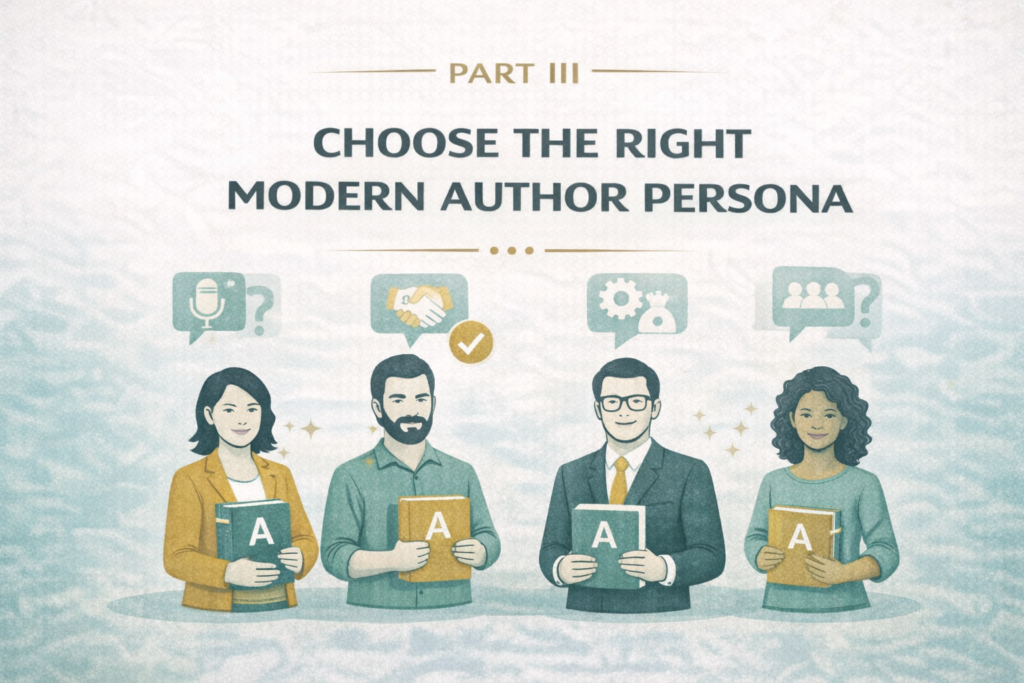
Part III: Choose the Right Modern Author Persona
Why Your Model Determines Your Results
By now, one pattern should be unmistakable.
Books don’t fail because authors lack insight.
They fail because the book is misaligned with how the author actually creates value.
This is where many smart professionals get tripped up. They assume that a good book will “figure itself out” once it’s published. In reality, books amplify whatever model already exists, whether or not that model was made explicit.
This section introduces the concept of Modern Author Personas, not as labels, but as operating realities. Each persona has different strengths, constraints, and ceilings. Understanding which one applies is not limiting. It’s liberating.
Without this clarity, authors often expect outcomes their model cannot support.
7. The Four Modern Author Personas
Across Manuscripts projects and interviews with successful business authors, four dominant personas appear consistently.
These are not personality types.
They are leverage models.
Each persona defines:
how authority converts into opportunity
where ROI shows up fastest
what kind of scale is realistic
what a book can and cannot do
No persona is inherently better than the others. But they are not interchangeable.
Coach / Consultant
What this persona is optimized for
High-trust, one-to-one work
Deep problem-solving
Personalized transformation
Books work well here as credibility accelerators. They shorten the trust curve and improve the quality of inbound conversations.
Where this persona struggles
Scale is limited by time
Revenue growth often requires more hours, not more leverage
Demand can quickly exceed capacity
Without intentional design, the book creates more conversations than the author can sustain.
What a coach or consultant can realistically expect from a book
Faster client acquisition
Higher-quality leads
Improved close rates
Modest but meaningful ROI
Books here rarely create massive scale on their own. They make existing work easier and more valuable.
Trainer / Educator
What this persona is optimized for
Group delivery
Repeatable frameworks
Curriculum-driven value
Books often become the backbone of workshops, programs, and internal training.
Where this persona struggles
Requires infrastructure beyond the book
Marketing and delivery systems matter
Word-of-mouth alone is rarely sufficient
Without systems, demand stalls.
What a trainer or educator can realistically expect from a book
Strong mid-term ROI
Leverage through cohorts or programs
Clear expansion paths
The book performs best when paired with delivery mechanisms.
Speaker / Thought Leader
What this persona is optimized for
Attention leverage
Idea-driven authority
High-visibility opportunities
Books function as credentials. They legitimize perspectives and unlock stages.
Where this persona struggles
Requires consistent visibility
Positioning mistakes are amplified
Momentum decays without activation
Books don’t create speaking opportunities automatically. They enable them.
What a speaker can realistically expect from a book
Faster access to stages
Higher speaking fees
Compounding authority
This persona often sees the fastest ROI when the book is activated early.
Builder / Business Owner
What this persona is optimized for
Platform-driven leverage
Product and ecosystem growth
Strategic optionality
Books here are not endpoints. They are wedges into markets.
Where this persona struggles
Overcomplicating the book
Treating it as a product instead of infrastructure
Delaying visibility while building privately
Execution discipline matters more than polish.
What a builder or business owner can realistically expect from a book
Broad opportunity creation
Long-term compounding ROI
Multiple monetization paths
This persona has the highest upside, but only with clear strategy.
Why This Classification Matters
Most book disappointment comes from mismatch.
Coaches expect scale without changing delivery
Speakers expect authority without visibility
Builders expect momentum without activation
When the persona is named, expectations become realistic. Strategy becomes clearer. The book becomes easier to design.
The next step is understanding why some personas scale naturally while others hit ceilings, and how books either reinforce or constrain those outcomes.
Which Author Models Actually Scale (And Which Ones Cap Out Without Structural Changes)
Not all author models scale the same way.
Books don’t change that reality. They amplify it.
Understanding this upfront prevents unrealistic expectations and misaligned strategies.
Models That Cap Out Without Structural Change Coach / Consultant (One-to-One)
What scales:
authority lead quality close rates
What caps out:
time delivery capacity revenue without leverage shifts
When authors expect scale from a capped model, the book feels disappointing.
When expectations match the model, outcomes feel earned.
The Strategic Takeaway
The question is not: “Can this book scale?”
It’s: “What part of my model should this book amplify?”
Once that answer is clear, strategy becomes simpler and frustration disappears.
8. Why Some Personas Scale and Others Cap Out
Once the author persona is clear, the pattern behind book outcomes becomes easier to explain.
Some books create pipelines.
Others create calendars.
Both can be valuable.
They are not the same thing.
The difference has less to do with ambition or effort and more to do with the underlying economics of the author’s model.
One-to-One vs One-to-Many Economics
At the core of this distinction is how value is delivered.
One-to-one models exchange time for outcomes.
Coaching
Consulting
Advisory work
Books in these models tend to:
improve lead quality
shorten sales cycles
increase close rates
They do not automatically increase capacity.
Without a shift in delivery model, success creates constraint.
One-to-many models exchange attention for scale.
Speaking
Training
Platforms
Products
Books in these models tend to:
expand reach
unlock distribution
compound over time
The same book that caps out in a one-to-one model can scale dramatically in a one-to-many model.
Time Leverage vs Attention Leverage
This is the practical tradeoff most authors never make explicit.
Time leverage means:
higher value per hour
deeper engagement
limited scalability
Attention leverage means:
broader reach
repeatable delivery
higher upside
Books amplify whichever leverage the author already uses.
They do not convert one into the other by default.
Authors who expect a book to magically transform their model are often disappointed, not because the book failed, but because the model remained unchanged.
Why Some Books Create Pipelines
Books create pipelines when:
the author model supports scale
the book is positioned as a credential
demand flows into repeatable offers
In these cases:
inbound increases
opportunities stack
authority compounds
The book feeds a system that can absorb growth.
Why Other Books Create Calendars
Books create calendars when:
the author model depends on personal availability
delivery is customized and time-bound
scale requires more hours, not more leverage
In these cases:
demand increases
schedules fill
capacity tightens
The book works, but it works differently.
This is not failure.
It is a constraint that must be acknowledged.
The Expectation Gap That Causes Disappointment
Most disappointment comes from expecting pipeline behavior from a calendar model.
Coaches expect scale without changing delivery
Consultants expect leverage without restructuring offers
Memoirists expect opportunity without pathways
The book delivers exactly what the model allows. Nothing more.
Why This Section Exists
This distinction is uncomfortable, but necessary.
Without it:
authors chase the wrong outcomes
advisors misjudge success
books are blamed for structural limitations
With it:
expectations become realistic
strategy becomes intentional
outcomes feel earned, not accidental
The next step is translating this understanding into concrete book design choices, so that each persona gets a book that actually fits.
9. Persona-to-Book Fit
What Your Book Should Do Based on Your Model
Once the author persona is clear, the book becomes easier to design.
Not easier to write, easier to aim.
Most underperforming business books aren’t weak. They’re misfit. They try to do work their author model can’t support, or they leave leverage on the table by playing too small.
This section translates persona into design choices, so expectations, structure, and outcomes stay aligned.
What Coaches and Consultants Should Emphasize
For coaches and consultants, the book’s primary job is not scale. It’s trust acceleration.
The book should:
narrow the problem it addresses
demonstrate judgment, not breadth
show how the author thinks in real situations
make the author feel safe to hire
The strongest books in this category:
speak directly to a defined client type
avoid overgeneralization
frame the author as a guide, not a guru
What to avoid:
chasing reach at the expense of relevance
writing “for everyone”
expecting the book to replace delivery work
When designed correctly, the book shortens sales cycles and improves client quality. It does not eliminate the need for conversations.
What Trainers and Educators Should Optimize For
For trainers and educators, the book is intellectual infrastructure.
The book should:
codify a clear framework
introduce shared language
support repeatable delivery
function as curriculum, not commentary
Strong books here:
are modular
are easy to teach from
make group learning easier to facilitate
What to avoid:
writing in a way that’s hard to extract into programs
over-indexing on narrative without structure
assuming the book alone creates scale
When aligned, the book becomes the spine of workshops, cohorts, and training programs.
What Speakers and Thought Leaders Should Optimize For
For speakers, the book is a credential.
The book should:
articulate a clear point of view
challenge existing assumptions
be easy to reference from a stage
signal relevance in current conversations
The most effective books in this category:
are concise in their positioning
are quotable
make the author’s stance unmistakable
What to avoid:
overloading the book with implementation detail
waiting until publication to claim authority
assuming visibility appears automatically
Here, the book opens doors. Speaking closes them.
What Builders and Business Owners Should Avoid
For builders and business owners, the temptation is complexity.
The book should:
clarify the problem the business exists to solve
establish category authority
create optionality, not obligation
Strong books in this category:
are strategically narrow
support a larger ecosystem
leave room for expansion
What to avoid:
treating the book as a product roadmap
over-explaining the business
delaying visibility while building privately
The book is not the business. It is the wedge.
Why Memoirs Require Explicit Pathways
Memoirs occupy a special category.
They can be powerful. They are rarely self-directing.
A memoir must be intentionally connected to:
speaking
influence
advocacy
advisory or platform work
Without that connection, the book may resonate deeply but struggle to convert into opportunity.
Story creates trust.
Pathways create outcomes.
The Moment of Recognition
At this point, most readers recognize themselves.
They see:
why certain outcomes felt unrealistic
why previous books underperformed
why certain strategies felt forced
This is the moment when strategy replaces hope.
The book no longer needs to do everything.
It needs to do the right thing for the model it sits inside.
With the persona clarified and expectations aligned, the question shifts again:
How do modern authors execute in a way that activates ROI early, reduces risk, and fits real-world constraints?
Here is Part IV: the introduction and Section 10 only, written to continue cleanly from Part III, same advisor-grade tone, clear competitive contrast, no forward bleed into Sections 11 or 12.
Part IV: The Strategy Most Publishers Don’t Talk About
Because They Don’t Get Paid For It
By this point, one thing should be obvious.
If a business book fails to generate clients, it is rarely because the author chose the “wrong” publisher or hired the “wrong” writer.
It’s because no one was responsible for designing client ROI in the first place.
10. Why Publishers and Ghostwriters Can’t Design Client ROI
Most publishing advice is sincere.
Much of it is competent.
Very little of it is aligned with client outcomes.
That’s not because publishers or ghostwriters are careless. It’s because of how they are incentivized.
What Publishers Are Actually Incentivized to Do
Publishers are built to:
acquire manuscripts
produce books
distribute copies
maximize sales through existing channels
Their success metrics are:
units sold
rankings
media coverage
retail performance
None of these require:
understanding the author’s business model
designing conversion pathways
aligning the book to specific client outcomes
Publishers don’t ignore ROI.
They simply define it differently.
For them, ROI ends at the book.
Why Ghostwriting Optimizes for Speed, Not Leverage
Ghostwriters are paid to solve a different problem.
They are hired to:
extract ideas quickly
produce a polished manuscript
minimize the author’s time investment
Speed and quality matter.
Leverage is secondary.
A ghostwritten book can be:
well structured
well written
professionally produced
And still fail to generate meaningful business outcomes.
Why?
Because:
the author wasn’t required to clarify positioning
early activation didn’t happen
the book wasn’t integrated into real conversations
ownership of the ideas remained abstract
Ghostwriting solves execution friction.
It does not solve strategic alignment.
The Structural Blind Spot in Traditional Publishing Advice
Both publishers and ghostwriters tend to assume the same thing:
Once the book exists, the author will figure out how to use it.
This is where most books stall.
The hardest decisions, the ones that determine ROI, happen before writing:
What problem the book actually solves
Who it is meant to influence
How authority converts into opportunity
When visibility should begin
These decisions fall outside the scope of most publishing engagements.
So they don’t get made.
Why This Gap Persists at the High End
Premium services often make the problem worse, not better.
High-end hybrid publishers and ghostwriting firms offer:
beautiful production
strong editorial support
polished positioning language
What they rarely offer is:
outcome design
author model alignment
early activation strategy
presale validation
ROI timing discipline
These services feel complete.
They just stop short of where results are created.
A Direct Contrast
This is the difference between how most premium providers operate and how modern authors think.
Traditional publishing and ghostwriting:
Optimize for speed, polish, and distribution
Treat writing as the core activity
Expect outcomes after publication
Modern author strategy:
Optimizes for leverage and timing
Treats writing as execution
Expects ROI during the writing process
Neither approach is inherently wrong.
But only one is designed to produce clients.
Why This Matters for Decision-Makers
For senior advisors and executives, this distinction is critical.
Hiring a strong publisher or ghostwriter may reduce workload.
It does not remove the need for strategy.
If client ROI is the goal, someone must be responsible for designing it. Publishers and ghostwriters are not built to do that work.
That responsibility sits upstream.
And when it’s ignored, even excellent books underperform.
Next, we’ll look at the most common downstream consequence of this blind spot: waiting until the book is done to activate demand, and why that decision quietly kills momentum.
11. The Fatal Mistake: Waiting Until the Book Is Done
Once client ROI is not designed upfront, a predictable mistake follows.
Authors wait.
They wait to talk about the book.
They wait to test positioning.
They wait to activate demand.
They wait until the manuscript feels finished.
This delay feels responsible.
It is usually the most expensive decision in the process.
Why Late Activation Kills Momentum
Books don’t suddenly become relevant at publication.
They become relevant when people begin to associate the author with the idea.
When authors write privately for months or years:
credibility remains static
learning is delayed
interest dissipates
timing is missed
By the time the book appears, the market has already moved on.
Momentum does not arrive at launch.
It accumulates before it.
How Credibility Decays While You Write Privately
Silence has a cost.
When an author is not visible:
their perspective is replaced by someone else’s
conversations happen without them
authority migrates to louder or earlier voices
This is especially costly for senior professionals whose expertise is already in demand.
The book is meant to concentrate authority.
Writing privately does the opposite.
The Cost of Learning Too Late
The most valuable insights about a book rarely come from writing alone.
They come from:
reactions
questions
confusion
resistance
unexpected resonance
When those signals arrive after publication, it’s too late to adjust.
Late learning leads to:
missed positioning opportunities
underperforming launches
books that feel “close” but not decisive
Early activation turns the writing process into a feedback loop. Late activation turns it into a reveal.
Why This Mistake Feels Rational
Waiting feels safe.
No one can criticize an unfinished book
No positioning mistakes are visible
No commitment is required
But safety is not neutrality.
It’s delay.
And delay in a fast-moving attention environment quietly erodes opportunity.
The Strategic Alternative
Modern authors treat visibility as part of the writing process, not a reward for finishing it.
They:
name the book early
claim the space publicly
let positioning evolve with feedback
activate demand while stakes are low
This doesn’t add pressure.
It removes it.
Because once the book is already working, finishing it becomes easier.
The Transition That Matters
If waiting until the book is done is the mistake, the alternative has to be intentional.
That alternative is not “marketing earlier.”
It’s designing activation into the strategy from the start.
That’s what presale publishing does.
12. Presale Publishing
Why Modern Authors Activate Demand Early
Presale publishing is often misunderstood.
It’s frequently framed as a marketing tactic, a launch trick, or a way to juice rankings. In reality, presale publishing is something much more foundational.
It is a strategy for validating demand, activating authority, and pulling ROI forward in time.
For modern authors, presale is not optional. It is how risk is managed.
Presale as Validation, Not Marketing
At its core, presale answers a single question early:
Will real people commit to this idea?
That commitment matters more than attention.
Presale:
tests positioning before it’s locked in
reveals what resonates and what doesn’t
creates early advocates, not just buyers
converts interest into signal
Marketing amplifies demand.
Presale confirms it exists.
Why Modern Authors Use Presale Strategically
Modern authors activate presale because it solves problems that publishing alone cannot.
Presale:
makes the book real before it’s finished
forces clarity around audience and outcome
creates momentum without relying on algorithms
shortens the distance between effort and feedback
Instead of hoping the book lands, presale lets authors see it landing while there’s still time to adjust.
This Is Not New. It’s Intentional.
Many of today’s most effective business authors use presale deliberately.
Adam Grant opened presales roughly 12 months before publication
Dan Pink activated presale roughly four months before publication
The timelines vary.
The principle does not.
These authors weren’t trying to sell copies early. They were claiming authority, validating relevance, and concentrating demand.
What Presale Actually Does (And What It Doesn’t) Presale is one of the most misunderstood strategies in modern publishing.
Most people think it’s about selling copies early. That’s not what matters.
Presale is not a marketing tactic. It’s a strategic validation mechanism.
What Presale Actually Does
When done correctly, presale:
Validates relevance early Real people commit before the book is finished. That signal is stronger than interest or praise. Sharpens positioning Questions, objections, and enthusiasm reveal what the book should emphasize, and what it should drop. Activates authority before publication The book becomes part of how the author is introduced and referenced while it’s still being written. Pulls ROI forward in time Conversations, invitations, and opportunities often begin during presale, not after launch. Creates early advocates Presale readers become amplifiers, not just buyers.
What Presale Does Not Do
Presale does not:
guarantee bestseller status replace distribution manufacture demand compensate for poor positioning work without visibility
Presale amplifies what already resonates. It exposes what doesn’t.
That’s why it’s valuable.
Why Modern Authors Use Presale Differently
Traditional publishers use presale to manage inventory.
Modern authors use presale to manage risk.
They don’t ask: “How many copies can I sell early?”
They ask: “Who is willing to commit to this idea right now, and why?”
That answer informs every downstream decision.
The Pattern at the High End
High-performing business authors use presale intentionally.
Adam Grant opened presales roughly 12 months before publication Dan Pink activated presale roughly four months before publication
Different timelines. Same logic.
Presale wasn’t about hype. It was about claiming the space early.
The Strategic Reframe
If no one is willing to commit before the book is finished, the problem is not timing.
It’s positioning.
Presale doesn’t create demand. It reveals it.
That’s why it belongs upstream.
How Presale Pulls ROI Forward
When presale is designed correctly, ROI begins upstream.
Authors begin to see:
inbound conversations
speaking and podcast invitations
advisory and consulting interest
clearer market positioning
This happens not because the book is finished, but because the book is credible.
Credibility does not require completion.
It requires commitment.
What Presale Signals Actually Matter
Not all presale signals are equal.
What matters most:
who commits, not how many
why they engage, not just that they do
what questions they ask
how the book changes conversations
These signals inform:
positioning
structure
emphasis
eventual offers
Presale turns writing into a feedback loop instead of a guess.
Presale Publishing (Named System)
Presale Publishing is the practice of:
publicly naming and positioning the book
activating early readers
validating demand
using feedback to refine direction
creating momentum before publication
Traditional publishing uses presale to manage inventory.
Modern authors use presale to manage risk, relevance, and ROI.
Why This Matters in 2026
Three forces make presale publishing critical now:
Attention moves faster than production Waiting until launch means entering the conversation late.
Discovery is fragmented Early activation creates surface area across platforms and AI systems.
ROI expectations have shifted upstream Authors expect leverage during the process, not years later.
Presale aligns effort with reality.
The Strategic Takeaway
Presale publishing is not about selling early.
It’s about learning early, activating early, and earning credibility before risk peaks.
If a book can’t attract committed readers before it’s finished, it’s not ready to scale.
With presale established as a core strategy, the next step is execution:
how modern authors activate ROI while they’re still writing, within real-world constraints.
Here is Part V: the introduction and Section 13 only, written to flow directly from Part IV, same voice, same audience, and grounded in execution without drifting into tactics yet.
Part V: The Modern Author Execution Path
How Clients Start Appearing While You’re Still Writing
Up to this point, the work has been strategic.
You’ve clarified:
what the book is meant to do
how ROI actually works
which author model applies
why early activation matters
why presale changes the risk profile
The question now becomes practical:
How does this actually get executed, in real time, by busy professionals?
This part introduces the Modern Author execution path, not as a productivity system, but as a leverage system. It explains how authors begin seeing tangible outcomes while the manuscript is still in progress, without adding chaos or burnout.
Execution here is not about writing faster.
It’s about sequencing the right moves early.
13. The 90-Day Leverage Window
For modern authors, the most important phase of the entire book process is not the final draft.
It’s the first 90 days.
This window determines whether the book becomes an asset or remains a private project.
What Must Happen in the First 90 Days
The goal of the first 90 days is not volume.
It is activation.
Specifically, three things must occur:
The book must become public Not published, but named, positioned, and visible.
The author’s identity must shift From “experienced professional” to “the person writing the book on this topic.”
The market must respond Through questions, interest, conversations, or early commitment.
If these conditions are met, the book begins working early. If they are delayed, leverage is postponed and risk increases.
The Identity Shift That Triggers Authority
Authority does not appear at publication.
It appears at the moment of commitment.
Once a book is publicly named and positioned:
assumptions change
conversations reframe
credibility accelerates
The author is no longer evaluated only on past experience. They are evaluated on direction.
This identity shift is subtle, but powerful. It changes how peers, prospects, and partners engage.
Importantly, it does not require a finished manuscript.
Why Bios and Positioning Matter More Than Drafts
In the first 90 days, what’s written publicly matters more than what’s written privately.
Bios, profiles, and positioning:
signal focus
communicate authority
anchor perception
Draft chapters do none of those things.
A strong draft sitting in a folder creates no leverage.
A clearly positioned book claim, visible in the right places, does.
This is why modern authors update public-facing language early:
LinkedIn bios
personal sites
speaker pages
media profiles
These changes are not cosmetic. They are structural.
How This Connects to the Busy Author System
The Busy Author System is designed around this exact reality.
Instead of:
writing in isolation
waiting for perfection
hoping for impact later
It prioritizes:
early clarity
visible commitment
fast feedback
reduced downside risk
The first 90 days are not about finishing the book.
They are about making sure the book is worth finishing.
The Strategic Implication
If nothing changes externally in the first 90 days, something upstream is missing.
Momentum is not a byproduct of writing more.
It is the result of claiming space intentionally.
Once leverage begins appearing early, execution becomes easier. Writing stops feeling speculative. The book already has a job.
Next, we’ll define exactly what must exist before heavy writing begins, so effort compounds instead of dissipates.
14. What You Must Have Built Before Heavy Writing Begins
One of the most common causes of burnout is starting to write too early.
Not because writing is hard, but because writing without a clear end state turns effort into uncertainty.
Modern authors delay heavy drafting until a specific set of assets exists. These assets make the manuscript inevitable instead of fragile.
The Book-Shaped Business Asset (Pre-Writing Checklist)
Before committing to sustained writing, the following elements should be in place.
This is not optional. It is protective.
1. A Clearly Positioned Book Concept
At this stage, the book does not need perfect language. It needs clarity.
Specifically:
a working title and subtitle
a defined audience
a clear problem the book addresses
a point of view that differentiates it
If the book cannot be described succinctly, writing will drift.
2. A Defined Outcome Path
The author should be able to answer, without hesitation:
What should this book make easier?
Who should it change the conversation with?
How does credibility convert into opportunity?
This does not require a full business plan. It requires intent.
Without this clarity, the manuscript becomes exploratory instead of purposeful.
3. Structural Clarity About the Book
Before heavy drafting begins:
the table of contents should be complete
each chapter should have a clear job
the author should know what belongs in the book and what does not
This prevents over-writing, re-writing, and second-guessing.
Writing becomes execution, not discovery.
4. Early Readers and Advocates
A modern book is not written for a hypothetical audience.
By this stage, the author should have:
identified early readers
invited feedback
activated a small group of supporters
These readers do not need to see polished chapters. They provide signal, not validation.
Their presence stabilizes momentum.
5. Initial ROI Signals
Heavy writing should begin only after the book has demonstrated early external impact.
This may include:
inbound conversations
speaking or podcast inquiries
consulting or advisory interest
clear shifts in how the author is perceived
These signals confirm that the book is functioning as an asset, not just an idea.
Why This Sequence Matters
When these elements exist, writing changes psychologically.
The book:
already has an audience
already has relevance
already has momentum
The manuscript no longer feels speculative.
This is why modern authors finish more consistently. They are not writing into a void.
The Operational Reality
This approach does not slow the process. It accelerates it.
Authors who rush into drafting often stall later.
Authors who build these assets first tend to finish faster and with less friction.
Writing becomes the last major uncertainty, not the first.
The Strategic Takeaway
If heavy writing feels overwhelming, it is often a signal that something upstream is missing.
Build the asset first.
Then write into it.
Next, we’ll look at how clients actually discover authors through books, and why discovery today looks nothing like it did even a few years ago.
What Must Exist Before You Write Seriously (The Pre-Writing Gate That Prevents Burnout)
Most authors don’t burn out because writing is hard.
They burn out because they start writing before the book is stable.
Modern authors treat heavy writing as a later phase, not the first one.
Do Not Begin Sustained Writing Until These Exist
Before committing to regular drafting, the following must be true:
1. The book has a clear job You can articulate, in one sentence:
what this book is meant to make possible who it should change conversations with
If the book’s job is unclear, writing will wander.
2. The author model is explicit You know whether this book supports:
one-to-one work one-to-many delivery speaking platform or business growth
Books amplify models. They don’t invent them.
3. The book is publicly named and positioned This does not mean published.
It means:
the book has a working title it appears in bios or profiles people can reference it
Private books feel optional. Public books feel inevitable.
4. Early readers or advocates exist At least a small group has:
raised their hand expressed interest reacted to the idea
You are no longer writing into silence.
5. Some external signal has appeared This may include:
inbound questions conversations shifting invitations or interest clearer resonance
If nothing changes externally, something upstream is missing.
Why This Gate Matters
Starting to write without these conditions:
increases abandonment invites over-editing creates second-guessing turns writing into exploration instead of execution
Waiting to write is not procrastination here.
It’s sequencing.
The Strategic Reframe
Heavy writing should feel supported, not heroic.
When the book already has:
relevance visibility momentum
writing becomes the easiest part of the process.
15. How Clients Actually Find You Through a Book
By the time a client reaches out, the book has usually already done its work.
Not by selling itself, but by quietly reshaping how the author is discovered, evaluated, and trusted.
This section explains how that discovery actually happens today, because most assumptions about “book visibility” are outdated.
How Buyers Discover Expertise Now
Modern buyers do not discover expertise through bookstores.
They discover it through:
search
AI systems
podcasts and interviews
conference stages
referrals and peer recommendations
The book sits underneath all of these channels.
It gives each one something to point to.
The Book as a Credibility Amplifier
In practice, the book does not function as a standalone discovery asset.
It functions as an amplifier.
When someone encounters the author through:
a LinkedIn post
a podcast appearance
a panel or keynote
a referral introduction
The book:
confirms seriousness
signals depth
lowers skepticism
shortens the trust curve
The discovery channel creates awareness.
The book converts awareness into credibility.
AI, Search, and the New Discovery Layer
In 2026, a growing share of discovery happens without the author present at all.
AI systems:
summarize expertise
recommend sources
cite frameworks
surface authority
Books designed as assets perform better in this environment because:
they have clear positioning
they contain named frameworks
they answer explicit questions
they are referenced across platforms
The book becomes machine-legible authority.
Why Structure Beats Style for Discoverability
Search engines and AI systems reward clarity, not elegance.
Books that are:
tightly positioned
clearly structured
explicit in their claims
supported by public content
are more likely to be cited, summarized, and referenced.
This is why modern authors care deeply about:
how ideas are named
how frameworks are presented
how questions are answered publicly
The book feeds the ecosystem.
The ecosystem feeds the book.
The SEO and AI Payoff (Without Tactics)
Authors don’t need to “optimize for algorithms” in a gimmicky way.
They need to:
be clear about what they stand for
publish consistent language
anchor ideas to recognizable concepts
maintain a visible public footprint
When the book is aligned with public positioning, discovery compounds.
The book stops being something people stumble upon.
It becomes something systems surface.
The Strategic Implication
Clients rarely say:
“I found your book and decided to hire you.”
They say:
“I’ve seen your work everywhere.”
“Your name keeps coming up.”
“Someone sent me your book.”
That ambient credibility is not accidental.
It is the result of a book that was designed to amplify discovery instead of waiting for it.
Where This Leaves the Author
At this stage in the process:
the book is public
authority is visible
discovery is active
clients are beginning to appear
Writing is no longer speculative.
It is now reinforcing something that already works.
With execution clarified, the final step is consolidation:
how all of these pieces come together into a coherent, repeatable system for modern authors.
Here is Part VI: the introduction and Section 16 only, written to continue cleanly from Part V, same senior-advisor tone, focused on conversion mechanics rather than tactics or hype.
Part VI: From Book to Clients
Turning Authority Into Conversations
At this point, the book is doing something.
It’s visible.
It’s positioned.
It’s shaping perception.
What remains is the most misunderstood step in the entire process: conversion.
Not conversion in the marketing sense. Conversion in the human sense.
This part explains how authority created by a book turns into real conversations, without pitching, pressure, or performative selling. It clarifies why books change the starting point of client interactions, and why that shift matters more than any launch metric.
16. The Client Conversion Path
From Reader to Conversation
Books do not convert clients the way funnels do.
They don’t persuade through urgency.
They don’t overcome objections one by one.
They don’t close.
They do something more subtle and more powerful.
They reframe the relationship before the first conversation ever happens.
How Books Lower Sales Resistance
Most sales resistance comes from uncertainty:
Is this person credible?
Do they understand my situation?
Are they going to try to sell me something?
Is this worth my time?
A well-designed business book answers these questions indirectly.
By the time a prospective client reaches out:
they’ve seen how the author thinks
they’ve internalized the author’s framework
they’ve already self-qualified
The book doesn’t remove the need for a conversation.
It removes the need to convince.
Why the Book Reframes the First Call
Without a book, the first call often starts at the bottom:
explaining background
establishing credibility
earning attention
justifying the conversation
With a book, the first call starts somewhere else.
Often it sounds like:
“I’ve been following your thinking.”
“Your book reframed how I see this problem.”
“We’re already aligned on the issue. Now we want to explore options.”
The book compresses the trust curve.
It turns the first call from a pitch into a working session.
The Difference Between “Pitching” and “Being Pulled”
This distinction matters more than most authors realize.
Pitching requires:
framing value explicitly
overcoming skepticism
managing objections
proving relevance
Being pulled happens when:
the problem is already accepted
the author is already trusted
the conversation feels inevitable
Books don’t push prospects forward.
They pull aligned people closer.
This is why high-performing business authors rarely talk about “selling their services.” Their services are the obvious next step once the book has done its work.
Why This Path Feels Effortless (When It Works)
When conversion is working properly:
fewer conversations are needed
conversations are higher quality
decisions happen faster
outcomes feel mutual, not transactional
This is not accidental.
It is the natural result of authority that has been:
clearly positioned
publicly activated
consistently reinforced
The book doesn’t replace selling.
It changes its nature.
The Strategic Takeaway
If client conversations still feel heavy after the book is visible, the issue is rarely persuasion.
It’s alignment.
The book may be:
too broad
poorly positioned
disconnected from a clear outcome path
When the book is doing its job, conversion feels less like selling and more like recognition.
Next, we’ll look at why stages accelerate this effect, and why books and speaking together outperform almost every other trust-building channel for high-value services.
17. Book → Stage → Clients
Why Stages Accelerate Trust
If books reframe conversations, stages compress them.
For high-trust services, nothing accelerates credibility faster than being seen, live, in context, with ideas that already carry weight.
This is why the book-to-stage path shows up repeatedly among high-ROI authors.
Why Stages Change the Trust Equation
Stages do something books alone cannot.
They:
demonstrate command in real time
create social proof instantly
transfer trust at scale
When someone hears an author speak after encountering their book, the authority multiplies.
The book establishes depth.
The stage confirms presence.
Together, they remove doubt.
How Books Unlock Speaking Opportunities
Most speaking opportunities do not come from pitching event organizers.
They come from signals.
A book:
gives organizers a reason to pay attention
provides a clear topic and framing
reduces perceived risk
Even unpublished books do this when they are clearly positioned.
Organizers are not evaluating literary merit.
They are evaluating relevance and reliability.
A book communicates both.
Why Speaking Outperforms Ads for High-Trust Services
For professional services, ads create awareness.
They rarely create trust.
Speaking does the opposite.
In a single session:
skepticism is addressed
judgment is demonstrated
alignment is tested
credibility is transferred
This is why speaking consistently outperforms paid acquisition for:
consulting
advisory work
enterprise services
high-ticket coaching
The audience doesn’t feel marketed to.
They feel informed.
The Reinforcing Loop
When books and stages work together, a loop forms:
The book opens doors to stages
The stage drives demand for the book
The book reframes post-event conversations
Conversations convert into clients
Each element reinforces the others.
This loop compounds authority instead of spending it.
The Advisor’s Lens
For senior advisors evaluating book strategy, this matters.
A book that is not designed to support speaking:
limits its leverage
slows ROI
caps opportunity
Conversely, a book designed with stage-readiness in mind:
clarifies messaging
simplifies delivery
accelerates trust transfer
The book does not have to be finished to unlock this loop.
It has to be clear.
Strategic Implication
Authors who want clients should not ask:
“How do I market my book?”
They should ask:
“Where does this book belong on a stage?”
When that question is answered early, the rest becomes easier.
Next, we’ll address one final reframing mistake that undermines many otherwise strong strategies: treating book success as a marketing problem instead of a demand problem.
18. Why “Marketing Your Book” Is the Wrong Frame
One phrase causes more confusion than almost any other in business publishing:
“How do I market my book?”
The question sounds reasonable.
It’s also usually the wrong one.
Books that generate clients don’t succeed because they were marketed better. They succeed because demand already existed, and the book made that demand easier to act on.
Why Modern Authors Don’t Run Book Launches
Traditional book launches are built around visibility spikes.
They aim to:
concentrate attention
drive short-term sales
create momentary buzz
For business authors, this often produces noise without outcomes.
Modern authors rarely run launches in the traditional sense because:
spikes decay quickly
rankings don’t correlate with opportunity
attention without intent doesn’t convert
Instead, modern authors focus on sustained activation.
The book is introduced early, reinforced often, and integrated into ongoing conversations.
Why Distribution ≠ Demand
Distribution answers one question:
Can people find this book?
Demand answers a different one:
Do the right people care?
Most underperforming books fail at demand, not distribution.
They are:
broadly available
professionally produced
easy to buy
And still irrelevant to the people the author actually wants to work with.
Marketing increases reach.
Positioning creates pull.
What Actually Creates Deal Flow
Across high-performing authors, deal flow comes from a small number of consistent behaviors:
Clear positioning that names a specific problem
Public visibility during the writing process
Repeated association between the author and the idea
Contextual use of the book in conversations, stages, and referrals
None of these look like “marketing” in the traditional sense.
They look like clarity plus consistency.
The Reframe That Matters
Instead of asking:
“How do I market my book?”
Modern authors ask:
“How does this book change how people talk about me?”
That shift changes everything.
Marketing tries to convince.
Demand recognizes.
Why This Is Liberating
This reframing reduces pressure.
Authors stop:
chasing algorithms
manufacturing urgency
performing for attention
They start:
reinforcing authority
deepening alignment
letting the book do its quiet work
The book becomes a stable asset, not a campaign.
The Strategic Takeaway
Books that generate clients are not pushed into the world.
They are placed into systems where trust already matters:
conversations
stages
referrals
decisions
When demand is designed upstream, marketing becomes optional instead of mandatory.
With this reframing in place, the final step is consolidation:
bringing everything together into a single, coherent execution model that busy professionals can actually follow.
Part VII: Choosing Your 2026 Book Strategy
How to Decide What Path Actually Makes Sense
At this point, the goal is no longer inspiration.
It’s decision clarity.
You now understand:
why most business books underperform
how ROI actually shows up
why author model matters
how early activation changes outcomes
why execution beats publishing pedigree
What remains is choosing a path that fits the author’s constraints, goals, and appetite for leverage.
This part exists to help advisors and decision-makers make that call deliberately.
19. The Strategic Decision Matrix
How to Choose Your Path Without Guesswork
Most book strategy mistakes are not made out of ignorance.
They’re made because too many variables are considered at once:
publisher prestige
writing speed
budget
visibility
outcomes
time constraints
The solution is not more information.
It’s a cleaner decision framework.
Step One: Clarify the Primary Outcome
Before evaluating publishers, writing models, or timelines, one question must be answered:
What should this book make easier once it exists?
Common answers include:
attracting higher-quality clients
unlocking speaking opportunities
supporting enterprise or advisory work
repositioning professional identity
building a scalable platform
If the outcome is vague, every downstream decision will be too.
Step Two: Identify the Author Persona
Next, identify which leverage model applies.
Coach / Consultant
Trainer / Educator
Speaker / Thought Leader
Builder / Business Owner
This is not about aspiration.
It’s about current operating reality.
The book should amplify the model that already exists, not attempt to replace it.
Step Three: Decide When ROI Needs to Appear
Timing is a strategic choice.
Some authors can wait years.
Most cannot.
Clarify:
whether ROI must appear during writing
whether early validation is required
how much risk is acceptable
Authors who need early ROI should not choose paths that delay activation.
Step Four: Match Strategy to Constraints
Finally, align strategy with real constraints:
available time
available budget
tolerance for visibility
desire for control vs delegation
There is no universally “best” path.
There is only the path that fits the situation.
The Advisor’s Shortcut
For senior advisors, this matrix simplifies guidance.
If:
outcomes matter more than prestige
ROI needs to appear before publication
the author is time-constrained
leverage is the goal
Then the strategy must prioritize:
early activation
clear positioning
asset-first design
execution support beyond writing
Any approach that ignores these realities will underperform, regardless of brand name.
Why This Section Exists
Most business book regret comes from misalignment, not execution failure.
When the strategy fits:
writing feels purposeful
momentum appears early
outcomes feel earned
finishing becomes inevitable
When it doesn’t, even strong books disappoint.
Next, we’ll translate this decision clarity into a concrete recommendation framework, so readers can see exactly what to do next based on where they land.
20. The Three Viable Paths for 2026
And Why Most Authors Choose the Wrong One
Once strategy is clarified, the landscape simplifies quickly.
Despite the number of publishing options on the surface, there are really only three viable paths for business authors in 2026. Each works under specific conditions. Each fails when misapplied.
The mistake most authors make is choosing based on prestige or convenience instead of fit.
Path One: Prestige-First Publishing
(Traditional and Brand-Name Hybrid)
This path optimizes for:
institutional credibility
external validation
perceived legitimacy
It works best when:
the author already has a large platform
outcomes are long-term and indirect
ROI timing is flexible
prestige itself is the primary asset
Where it breaks down:
slow timelines delay activation
little control over positioning
ROI design is not part of the engagement
leverage depends heavily on external forces
This path can work.
It just requires patience, tolerance for ambiguity, and acceptance that outcomes may lag effort.
Path Two: Speed-First Execution
(Ghostwriting and Done-for-You Publishing)
This path optimizes for:
minimal time investment
fast manuscript completion
professional polish
It works best when:
the author already has demand
positioning is already proven
the book is reinforcing an existing machine
Where it breaks down:
leverage is assumed, not designed
early activation is skipped
the book feels detached from the author’s real work
ROI depends on post-publication improvisation
Speed solves execution friction.
It does not solve strategic friction.
Path Three: Asset-First Strategy
(The Modern Author Model)
This path optimizes for:
early ROI
leverage over time
control over positioning
reduced downside risk
It works best when:
the book must generate outcomes, not just exist
ROI needs to appear during writing
the author is time-constrained but outcome-driven
strategy matters more than speed or prestige
Where it requires commitment:
early visibility
active participation
strategic decision-making upfront
This path treats the book as infrastructure, not output.
Why Most Authors Choose Poorly
Most authors don’t choose incorrectly because they lack intelligence.
They choose incorrectly because:
they underestimate variance
they overvalue completion
they assume outcomes will “figure themselves out”
Each path looks reasonable in isolation. Only one aligns with early leverage and controlled risk.
The Advisor’s Framing
For advisors and operators helping senior leaders decide, the framing is simple:
If the goal is legacy or validation, prestige-first paths can work.
If the goal is speed alone, execution-first paths can suffice.
If the goal is clients, leverage, and ROI, asset-first strategy is required.
This is not a value judgment.
It’s a fit assessment.
The Strategic Takeaway
The right path reduces regret.
When strategy, model, and constraints are aligned, authors don’t second-guess the process. They recognize progress early.
The final step is deciding whether the author wants help executing this path, or whether they intend to assemble it themselves.
21. When to Get Help (And What Kind Actually Matters)
Once the path is clear, the remaining decision is not whether to write the book.
It’s how much of the strategy and execution the author should own, and how much should be supported.
This is where many smart professionals make a quiet mistake. They assume “getting help” is a binary choice. In reality, the type of help matters more than the amount.
The Three Types of Help Authors Actually Need
Most book engagements bundle very different forms of support together. It’s useful to separate them.
1. Execution help
This includes:
writing support
editing
production
publishing logistics
Execution help reduces friction. It does not design outcomes.
2. Strategy help
This includes:
positioning
outcome design
persona alignment
ROI timing
activation sequencing
Strategy help determines whether the book works at all.
3. Accountability and momentum support
This includes:
structured milestones
feedback loops
community or peer pressure
decision support during uncertainty
This is what makes finishing likely instead of aspirational.
Most underperforming books had execution help.
Most high-performing books had strategy and accountability first.
When DIY Makes Sense
A fully self-directed path can work when:
the author already has clear positioning
demand is proven
outcomes are defined
visibility is already active
writing discipline is strong
In these cases, external help is optional.
The risk is not failure.
The risk is slower learning and delayed ROI.
When Publishing Services Are Enough
Traditional publishing services can work when:
prestige is the primary goal
ROI is long-term and indirect
timelines are flexible
the author is comfortable improvising outcomes later
The book may be successful on paper, even if leverage arrives slowly.
When a Modern Author System Matters
A structured, asset-first system becomes valuable when:
outcomes matter more than optics
ROI needs to appear during writing
the author is time-constrained
early validation is required
leverage is the goal
In these cases, execution without strategy is expensive.
What authors are really buying is not writing help.
They are buying certainty about direction.
The Advisor’s Perspective
For senior advisors guiding this decision, the key question is not:
“Who should write the book?”
It’s:
“Who is responsible for making sure the book actually does something?”
If the answer is “no one,” the book will underperform regardless of who executes it.
The Final Clarity Point
Getting help is not a sign of weakness.
Getting the wrong help is a common failure mode.
The right support:
reduces risk
shortens timelines
increases confidence
improves outcomes
At this stage, the author should feel one of two things:
confident enough to proceed independently
clear that a system would materially improve results
Both are valid outcomes.
From here, the next step is simple:
either begin executing with intention, or evaluate systems built specifically for modern authors who want their book to generate real leverage.
That decision does not require urgency.
It requires honesty.
Part VIII: The Modern Author System
Why This Is a System, Not a Tactic
By now, the pattern should be unmistakable.
The books that generate clients, leverage, and long-term ROI are not better marketed.
They are better designed.
What separates modern author outcomes from traditional publishing disappointment is not effort, talent, or even ambition. It’s the presence of a system.
This part makes that system explicit.
22. The Modern Author System (Overview)
The Modern Author System exists to solve a specific problem:
How do accomplished, time-constrained professionals use a book to create real leverage without taking unnecessary risk?
It does this by treating the book as one component inside a larger operating model, not as a standalone creative project.
The system is composed of five interlocking elements. Each one matters. None of them work well in isolation.
1. Outcome Design
Everything begins with outcomes.
Before writing starts, the system defines:
what the book is meant to unlock
who it should change conversations with
how authority should convert into opportunity
This prevents the most common failure mode: finishing a strong book that has no clear job.
Outcome design turns writing into execution, not exploration.
2. Author Model Alignment
The system explicitly aligns the book to how the author actually creates value.
It accounts for:
coach vs speaker vs builder dynamics
one-to-one vs one-to-many economics
realistic scale ceilings
delivery constraints
This alignment ensures the book amplifies the existing model instead of fighting it.
Books don’t fix broken models.
They magnify functional ones.
3. Early Activation
The system activates authority before the book is finished.
This includes:
naming and positioning the book publicly
triggering the identity shift
validating demand through early readers and presale
creating feedback loops while stakes are low
Early activation reduces risk and pulls ROI forward in time.
The book starts working before completion.
4. Publishing as Execution
In the Modern Author System, publishing is not strategy.
It is execution.
Once positioning, outcomes, and activation are in place:
writing becomes focused
editing becomes efficient
publishing becomes predictable
This reverses the traditional sequence and eliminates the need to “figure it out later.”
5. Post-Publication Leverage
The system treats publication as the midpoint, not the finish line.
After publication, the book is:
used in conversations
deployed on stages
referenced in partnerships
surfaced by search and AI systems
reinforced through ongoing visibility
Leverage compounds because the book was designed for use, not applause.
System Anchor
The Modern Author System is built on a single principle:
A business book should reduce friction between expertise and opportunity.
Everything else is implementation detail.
23. Why This System Exists
This system was not invented in theory.
It emerged from patterns observed across hundreds of modern authors, including traditionally published ones, who shared the same frustration:
They did everything “right,” and the book still underperformed.
The system exists to solve three structural problems.
To Reduce Variance
Business books are high-variance assets.
Some outperform dramatically.
Many quietly underperform.
The system does not guarantee success.
It reduces avoidable failure.
By forcing clarity early, testing positioning publicly, and aligning books to real models, variance narrows.
Fewer authors end up surprised by disappointing outcomes.
To Compress ROI Timelines
Traditional publishing treats ROI as a post-publication concern.
The Modern Author System treats ROI as a design constraint.
By activating authority early and validating demand upstream:
outcomes appear sooner
learning happens faster
risk peaks later
This matters for professionals who cannot afford multi-year ambiguity.
To Make Books Manageable for Busy Professionals
Most accomplished professionals don’t fail to write books because they lack discipline.
They fail because the process feels unbounded, risky, and disconnected from outcomes.
The system:
reduces cognitive load
creates visible progress early
prevents wasted effort
turns writing into a finite, purposeful project
Busy people finish when the work feels worth it.
The Final Context
This is not a writing system.
It is not a publishing shortcut.
It is not a marketing framework.
It is an operating system for authors who want their book to matter in the real world.
At this point, the reader should not feel hyped.
They should feel oriented.
They should understand:
what works
what doesn’t
why outcomes vary
what path fits their reality
The only remaining step is deciding how to proceed.
Part IX: If You’re Serious About Clients
How to Decide What to Do Next
At this point, the reader should not be asking, “Should I write a book?”
They should be asking something more precise.
What do I actually want this book to do, and what am I willing to trade to get it?
This final section exists to make that decision explicit.
No hype.
No universal answers.
Just clear tradeoffs.
24. A Simple Decision Framework
Most book strategy confusion comes from trying to optimize for incompatible outcomes at the same time.
This framework forces a choice.
If You Want Clients Fast
You should prioritize:
early activation
clear positioning
visible commitment
conversation-driven ROI
This path requires:
public visibility before publication
willingness to test positioning
tolerance for imperfect drafts
Tradeoff:
less prestige signaling
more personal involvement early
This path works best for:
consultants
advisors
speakers
founders with services
If You Want Scale
You should prioritize:
one-to-many delivery models
frameworks that travel
repeatable offers
ecosystem leverage
This path requires:
infrastructure beyond the book
patience
operational follow-through
Tradeoff:
slower initial ROI
more complexity
This path works best for:
educators
trainers
platform builders
If You Want Prestige
You should prioritize:
institutional validation
traditional signals of authority
long-term credibility
This path requires:
patience
comfort with limited control
acceptance of delayed outcomes
Tradeoff:
slower ROI
less leverage per unit of effort
This path works best for:
executives
academics
legacy-driven authors
If You Want Optionality
You should prioritize:
asset-first design
early demand validation
flexible positioning
control over execution
This path requires:
strategic clarity
early visibility
active participation
Tradeoff:
more decisions upfront
less outsourcing of thinking
This path works best for:
modern professionals who want leverage without locking into a single outcome
The Point of the Framework
There is no “best” answer.
There is only alignment.
Books disappoint when authors expect one path to deliver outcomes it was never designed to produce.
Which Path Fits You Best? A Clear Decision Matrix for Business Authors
There are multiple ways to publish a business book.
Only one will feel “right” once outcomes, constraints, and tradeoffs are made explicit.
Use this matrix to decide deliberately.
If Your Primary Goal Is Clients (Soon)
You should prioritize: early activation clear positioning visible commitment conversation-driven ROI
This path requires: public visibility before publication tolerance for imperfect drafts active involvement early
Tradeoff: less prestige signaling more strategic responsibility
Best fit: consultants advisors speakers founders with services
If Your Primary Goal Is Scale
You should prioritize: one-to-many delivery frameworks that travel repeatable programs or platforms
This path requires: infrastructure beyond the book marketing systems operational follow-through
Tradeoff: slower initial ROI higher complexity
Best fit: educators trainers platform builders
If Your Primary Goal Is Prestige
You should prioritize: institutional validation traditional publishing signals long-term credibility
This path requires: patience comfort with limited control acceptance of delayed outcomes
Tradeoff: slower leverage minimal ROI design support
Best fit: executives academics legacy-driven authors
If Your Primary Goal Is Optionality
You should prioritize: asset-first design early demand validation control over positioning flexibility over outcomes
This path requires: clarity upfront early visibility willingness to make decisions early
Tradeoff: more thinking before writing fewer decisions delegated
Best fit: modern professionals who want leverage without locking into a single outcome
The Point of the Matrix
There is no “best” path.
There is only alignment.
Most book regret comes from trying to optimize for:
speed and prestige scale and hands-off execution clients and invisibility
Confusion is usually a sign of misalignment, not lack of information.
25. What to Do If You’re Writing in 2026
Writing a business book in 2026 is not the same as writing one even a few years ago.
The environment has changed.
Ignoring those changes is expensive.
Why Strategy Matters More Now
Publishing has been democratized.
Distribution is no longer the bottleneck.
Meaning:
more books exist
attention is fragmented
undifferentiated ideas disappear faster
In this environment, execution without strategy produces noise, not leverage.
Strategy is no longer optional.
It is the primary differentiator.
Why AI Changes Discovery, Not Authority
AI systems:
surface information
summarize ideas
recommend sources
They do not confer trust.
Authority still comes from:
judgment
clarity
relevance
lived experience
Books that work in an AI-driven world are not optimized for machines. They are designed for humans and structured clearly enough to be referenced by systems.
AI accelerates discovery.
It does not replace credibility.
Why Early Activation Is Non-Negotiable
In a fast-moving attention economy:
waiting is costly
silence erodes relevance
late learning compounds mistakes
Early activation:
validates demand
sharpens positioning
reduces downside risk
pulls ROI forward
This is no longer an edge case.
It is the baseline for serious authors.
The Final Orientation
If you are writing a book in 2026 and want it to generate clients:
do not wait to be finished to be visible
do not confuse writing with strategy
do not outsource thinking
do not measure success too late
Design the outcome first.
Activate early.
Write into something that already works.
Conclusion: The Only Question That Matters
At this point, the question is no longer whether you can write a book.
Most accomplished professionals can.
The real question is simpler, and harder:
What should this book make possible once it exists?
That question determines everything.
It determines:
how the book is positioned
when it becomes visible
who it resonates with
how authority converts into opportunity
whether the effort compounds or dissipates
When authors ask, “Can I write a book?” they optimize for completion.
When they ask, “What should this book make possible?” they optimize for leverage.
That shift is the difference between a book that exists and a book that works.
Business books do not create value by being finished.
They create value by:
changing conversations
lowering resistance
reframing trust
making opportunities easier to say yes to
Clients, speaking, partnerships, and long-term optionality are not downstream accidents. They are upstream design choices.
If this guide has done its job, the path should now feel clearer.
You don’t need:
more motivation
better writing advice
a louder launch
You need:
a defined outcome
a clear author model
early activation
a system that reduces risk and compresses ROI
That is what modern authors do differently.
They don’t write books to prove something.
They write books to make something possible.
And once that question is answered honestly, the rest beomes execution.
Frequently Asked Questions
Can a business book really get me clients?
Yes, but not automatically.
A business book generates clients when it is designed as a leverage asset, not when it is simply published. In practice, books create clients by lowering trust friction, reframing conversations, and positioning the author as a credible authority before the first interaction.
Books that fail to generate clients are usually:
broadly positioned
activated too late
disconnected from a clear outcome path
Books that work begin influencing conversations before publication, often within 90 days of being publicly announced.
Is ghostwriting worth it for client acquisition?
Usually not, on its own.
Ghostwriting optimizes for speed and polish. Client acquisition depends on strategy, positioning, and early activation, which most ghostwriting engagements do not include.
Ghostwriting can work for client acquisition only if:
the author already has proven positioning
demand already exists
the book is reinforcing an existing conversion system
Without those conditions, ghostwriting often produces a well-written book that looks impressive but does little to change outcomes.
How long does it take to see ROI from a book?
For strategically designed business books, ROI often begins before the book is finished.
In modern author models:
early ROI can appear within 30–90 days of public positioning
downstream ROI typically compounds over 6–12 months
long-term leverage can persist for years
Books that wait until publication to activate often delay ROI by 12–36 months, if it appears at all.
The difference is timing, not quality.
Do I need a large audience first?
No.
A large audience helps distribution. It is not required for authority.
Many high-performing business authors begin with:
small but relevant networks
focused professional credibility
clear positioning
What matters more than audience size is:
relevance to a specific problem
clarity of point of view
visibility during the writing process
Books built for the right audience scale better than books written for everyone.
Is traditional publishing better for credibility?
Sometimes, but credibility alone does not create clients.
Traditional publishing can signal legitimacy, especially in academic or institutional contexts. However, it rarely designs or supports client ROI.
For professionals seeking clients, leverage, or business outcomes:
credibility without activation underperforms
delayed timelines increase risk
control over positioning is limited
Traditional publishing works best when prestige is the primary goal. It is not inherently superior for client acquisition.
What kind of book works best for consulting or speaking?
Books that:
address a clearly defined problem
articulate a strong point of view
demonstrate judgment, not just knowledge
are easy to reference in conversation or from a stage
For consultants and speakers, the most effective books are:
narrowly positioned
outcome-oriented
designed to support conversations, not replace them
Framework-driven books outperform memoirs or broad thought leadership for client acquisition unless those formats are explicitly connected to a clear pathway.
Final Clarification for Decision-Makers
Business books do not generate clients by accident.
They do so when:
outcomes are designed upfront
author model and book strategy are aligned
visibility begins early
writing is treated as execution, not exploration
When those conditions are met, books become one of the most durable client acquisition assets available to senior professionals.
If You’re Deciding What to Do Next
If this report clarified your thinking, the next step is usually not “publishing.”
It’s pressure-testing your strategy before you commit time, budget, or reputation.
Here are three ways authors typically proceed.
Map Your Modern Author Strategy
If you want to:
Pressure-test your author model
Clarify realistic outcomes
Understand where ROI is likely to show up
Avoid unnecessary spend
A short strategy conversation can surface issues early, before they become expensive.
Eric Koester is an award-winning entrepreneurship professor at Georgetown University, bestselling author, and founder of Manuscripts. His work focuses on how ideas become assets, how books create leverage, and why modern authors need systems, not just publishing support.
He has worked with thousands of authors across traditional, hybrid, and modern publishing paths, helping them turn books into platforms, platforms into credibility, and credibility into durable business outcomes.
About Manuscripts
Manuscripts is the Modern Author OS for nonfiction experts.
We help founders, executives, coaches, and thought leaders design books as strategic assets, not standalone products. Our work spans positioning, author model design, developmental editing, AI-enhanced drafting tools, presale strategy, and long-term launch systems.
Manuscripts authors use their books to generate clients, speaking engagements, training programs, and enterprise opportunities, often before publication.
For readers who want to go deeper into specific mechanics, the following guides expand on topics referenced in this report:
How to Write a Book if You’re Busy
Modern Ghostwriting for Nonfiction Authors
AI Tools for Authors in 2026
How to Build an Audience Before You Write Your Book
The Evergreen Launch System for Modern Authors
Powered by Codex, the Modern Author Intelligence Tool.