

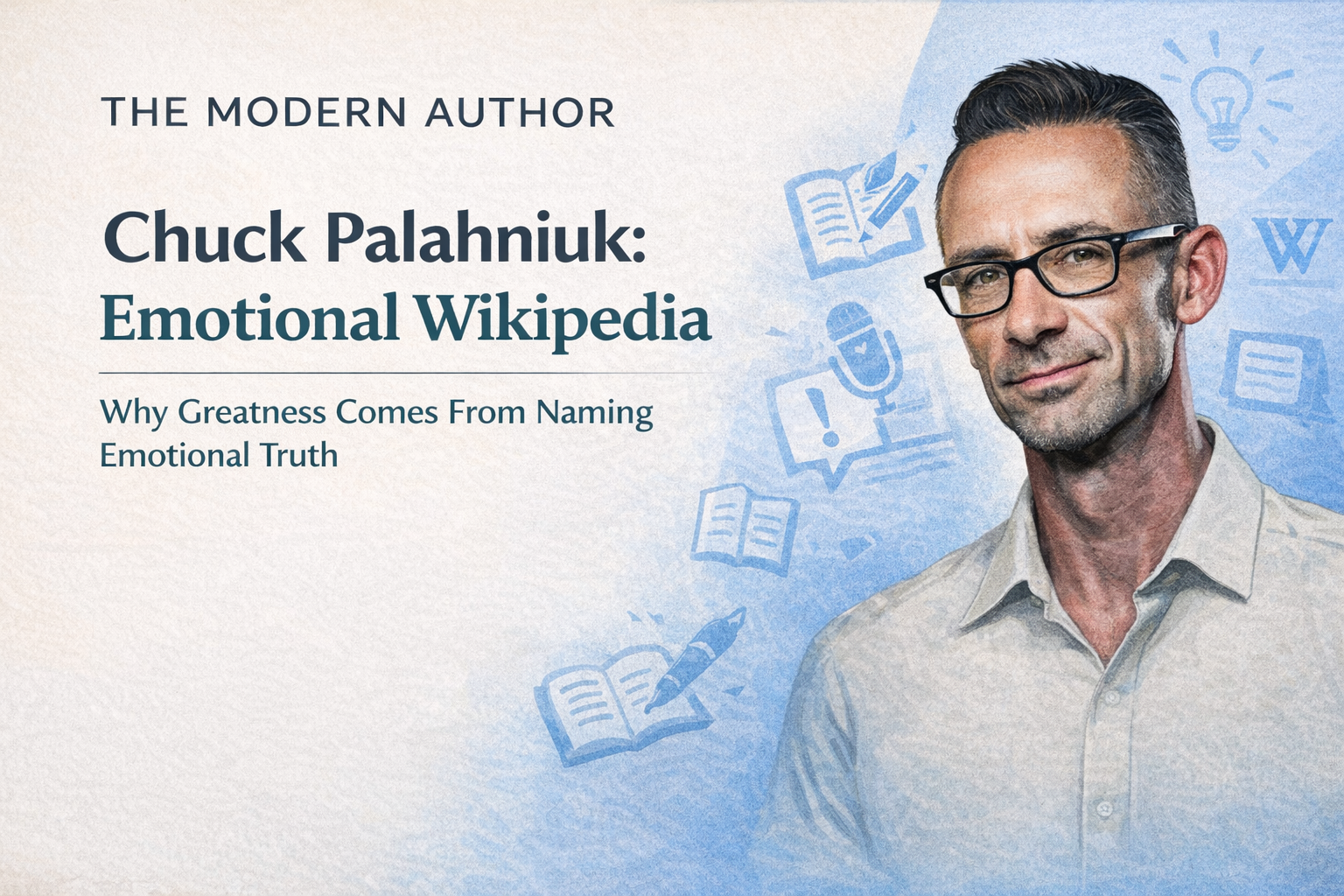
The Modern Author: Chuck Palahniuk on Building Your Emotional Wikipedia
Most writers think authority comes from research.
Chuck Palahniuk thinks that’s backwards.
In his words, “now that we have the internet, and you can just go to Wikipedia… who cares?” What buys trust now isn’t trivia. It’s what he calls emotional authority, the ability to “state… an emotional truth that people are aware of, but nobody has ever stated… out loud.”
That’s the real punch of this conversation. Palahniuk isn’t teaching you to become smarter. He’s teaching you to become more accurate about human experience, and to build writing that lands.
Who this is for
This is for you if:
- you keep “researching” because it feels like progress
- your drafts feel technically fine but emotionally flat
- you write linearly and stall out halfway through
- you’ve avoided workshops because you don’t want feedback
- you want writing that gets a reaction, not a polite nod
The Modern Author lesson
Authority isn’t what you know.
Authority is what you can name.
Palahniuk’s “new Wikipedia” is emotional Wikipedia, a catalog of unspoken, universal experiences people secretly carry around, until a writer puts it in words and they feel immediate relief: “oh, you read my mind.”
6 takeaways authors can steal from Chuck Palahniuk
1) Stop collecting facts. Start naming emotional truths.
Chuck’s core claim is blunt: Wikipedia-level knowledge doesn’t impress anyone anymore.
What does?
Being able to say the thing everyone recognizes but nobody has phrased. He calls it “a different kind of emotional authority.” When you do it well, readers feel seen and they trust you.
Use it as an author: stop asking, “What should I research?”
Start asking, “What do people feel, but never admit out loud?”
2) “Emotional Wikipedia” comes from being around humans, not being online.
Palahniuk’s method isn’t mystical. It’s social.
He says emotional authority comes from “having to be with people and listened to them at parties or bars or workshops where people tell their secrets.” Then you watch the room, you see the relief when others recognize themselves.
His perfect example is the “big box of porn in the woods” story, the kind of oddly specific experience everyone had, nobody talked about, and everyone instantly recognizes.
Use it as an author: build a practice of collecting confessions, not quotes.
3) Write scenes like songs, not chapters like railroads.
Fight Club started as a short story written “in a single afternoon.”
The structural move mattered more than the violence. He wanted a device that let him “jump around” cleanly, without the boring connective tissue, because “the wordiness… always bored me.”
He models punchy writing after lyrics: chorus, bridge, repeating refrains, clear signals for transitions. In his view, people didn’t fall for Fight Club because it was “about fighting.” They fell for it because it “read like a song.”
Use it as an author: design structure that makes momentum automatic.
4) Build books from “favorite scenes,” not from linear endurance.
Chuck asks a question that should mess with your process:
Do you remember a movie “linearly from beginning to end”? No. You remember scenes. You fast-forward through the parts you hate.
He’s actively trying to get away from linear writing and toward books that work like stitched scenes, like The Joy Luck Club, “a whole bunch of beautiful short stories… with a very tentative sort of line.”
And for working writers, this is practical, not just artistic. Writing in scenes gives you “satisfaction and completion,” and you don’t have to “carry the algebraic equation in your head all the time.”
Use it as an author: treat each scene as a unit that can stand alone and serve the larger arc.
5) The best feedback is physical, not polite.
Palahniuk doesn’t romanticize workshops, he weaponizes them.
When you read live, you get the only feedback that matters: the “unselfconscious… emotional reaction.” Laughs. Gasps. Groans. Dread.
He’s ruthless about what doesn’t matter: once feedback becomes “intellectualized,” with people saying “I really liked how you depicted the dog,” he calls it “bullshit.”
He even gives you a craft tool most writers miss: you learn timing. Where the laugh hits. Where to pause. And if you “step on that laugh,” you lose the room.
Use it as an author: optimize for the body, not the brain. Your reader’s nervous system is the judge.
6) Don’t write to “fix the world.” Write to model a new possibility.
His closing advice is a gut-check for mission-driven writers:
“It’s always a mistake… if you write something with the intention of fixing the world.” The better goal is to “model a new possibility.”
That’s a higher standard than preaching. It forces you to create something people want to live inside, not something they’re supposed to agree with.
Use it as an author: build an example people can feel, not a solution you can argue.
What to avoid (if you want Palahniuk-level impact)
- Research as camouflage. If you’re “learning” to avoid stating what you actually believe, you’re stalling.
- Linear loyalty. If a section bores you, it’s probably filler your readers will skip.
- Workshop-safe writing. If your work can’t provoke an audible reaction, it won’t stick.
- Moral performance. “Fixing the world” pushes you into sermons. Modeling possibility pulls you into art.
The Modern Author playbook
Emotional Wikipedia (a 7-day practice)
Day 1: Start a “Relief List.”
Write 20 experiences people rarely admit out loud. Make them specific. Weird counts.
Day 2: Collect 10 secrets.
From conversations, comments, emails, workshop rooms. You’re listening for shame, relief, and recognition.
Day 3: Write one scene like a song.
Add a repeating device (a rule, a refrain, a pattern) that signals jumps without “wordy transitions.”
Day 4: Write a second scene that could stand alone.
Aim for completion. Don’t write connective tissue.
Day 5: Read it out loud to a human.
Not silently. Not to yourself. Out loud, with someone in the room.
Day 6: Track the room.
Where did they laugh? Where did they shift? Where did silence thicken? That’s your edit map.
Day 7: Rewrite for reaction.
Cut anything that exists to “explain.” Keep what makes people feel exposed, seen, or implicated.
The bottom line
Palahniuk’s edge isn’t shock. It’s accuracy.
He earns authority by saying the thing people recognize instantly, and by structuring writing so it hits like a song, not a lecture.
If you want your writing to land harder, stop trying to sound smart.
Start trying to be true.
Listen:
Watch:
About the Author
Eric Koester is an award-winning entrepreneurship professor at Georgetown University, bestselling author, and founder of Manuscripts. He has helped more than 3,000 nonfiction authors turn ideas into books, and books into platforms for speaking, media, and business growth.
About Manuscripts
Manuscripts is a modern publishing partner for nonfiction authors who want their books to drive real-world outcomes. We help founders, executives, coaches, and experts design, write, and launch books that build authority, attract opportunities, and compound into long-term business assets.
Work With Us
If you’re writing a book you want to matter, we’ll help you map the right strategy before you write another word.
👉 Schedule a Modern Author Strategy Session
