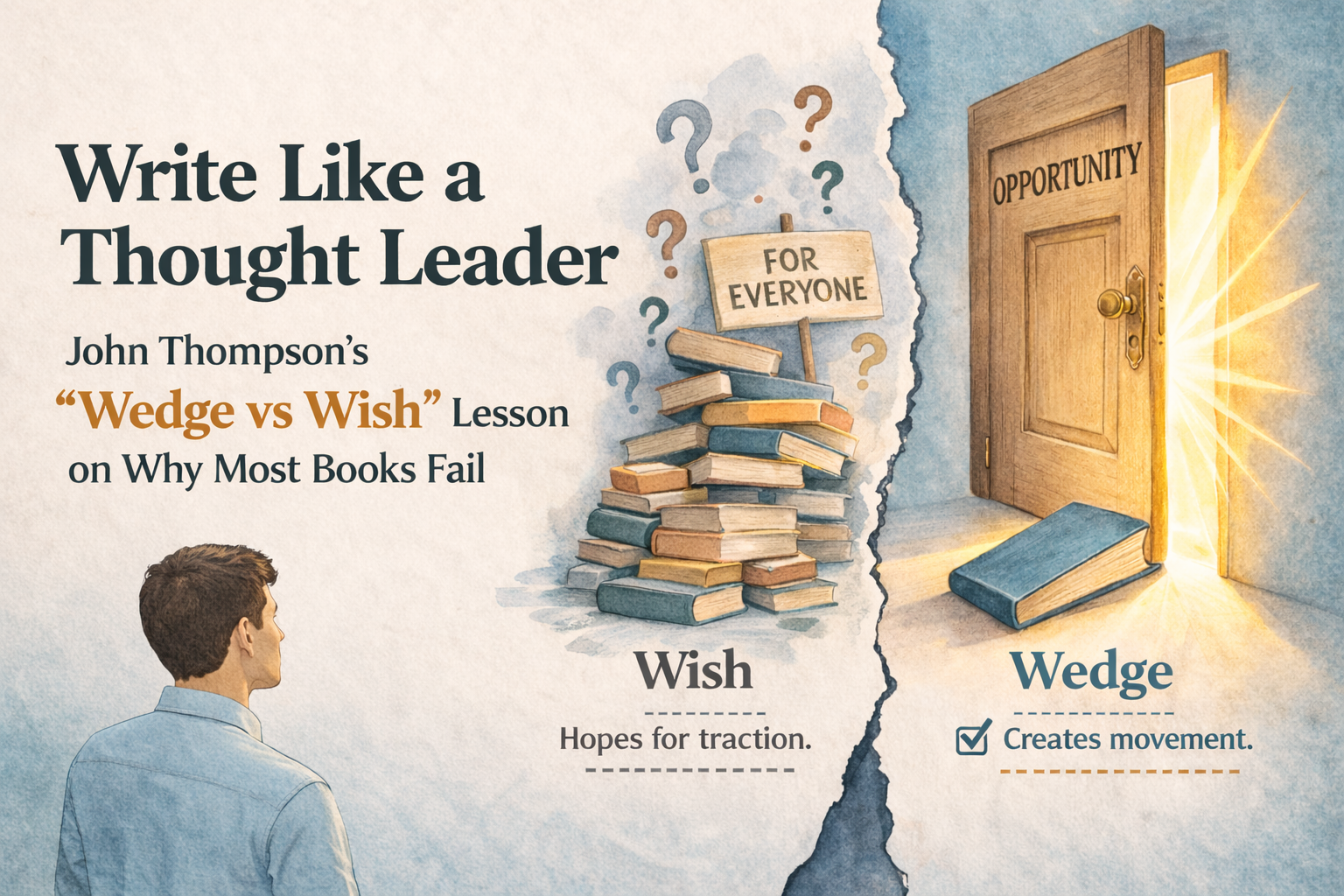
Write Like a Thought Leader: John Thompson’s “Wedge vs Wish” Lesson on Why Most Books Fail
Most book failures are not promotion failures.
They are design failures.
If a book is not intentionally built to open a specific door, it becomes a wish instead of a wedge.
Most authors run the same post-mortem after publishing.
The book “just didn’t take off.”
So they blame:
Marketing
Timing
Platform size
That diagnosis assumes the book worked and exposure was the issue.
In most cases, exposure wasn’t the constraint.
The design was.
The Wrong Post-Mortem: “It Just Didn’t Take Off”
When a book underperforms, authors rarely question architecture.
They question execution.
“I should have launched harder.”
“I needed better PR.”
“My audience wasn’t big enough.”
All downstream explanations.
But a book can be well written, professionally produced, and actively promoted, and still fail to change anything meaningful for the author.
Because it was never designed to open anything specific.
Promotion amplifies signal.
It cannot create strategic intent after the fact.
A marketing plan can expand reach.
It cannot fix a book that lacks direction.
The Core Distinction: Wedge vs. Wish
There are two kinds of books.
A wish is an expressive artifact hoping for traction.
It is broad.
Thoughtful.
Often “for everyone.”
It assumes that if the content is strong and the visibility is high, something good will eventually happen.
A wedge works differently.
A wedge is a deliberately shaped tool designed to open a specific opportunity.
It is built with intent.
Its job is not to be admired.
Its job is to unlock movement.
John Thompson’s Career Coach book illustrates the difference.
It wasn’t positioned as a general reflection on work. It targeted a specific reader with a defined problem.
That clarity naturally led into coaching, speaking, and advisory work.
The book didn’t simply exist.
It positioned Thompson inside a professional lane.
And once that positioning was clear, the next step became obvious.
A wish asks the market to care.
A wedge creates momentum.
What a Wedge Is Designed to Do
The wedge metaphor only matters if it becomes practical.
A wedge book is designed to do three things.
Target a specific audience
Not “people interested in growth.”
A reader who recognizes themselves immediately.
Clarity about the reader creates alignment.
Address a defined problem
Not a theme.
A problem that already carries urgency.
Books that solve urgent problems move faster.
Point toward a next conversation
The book aligns the author with a role, service, or domain.
It clarifies where the relationship should go next.
In Thompson’s case, the book positioned him clearly as a guide in a specific professional space.
The result wasn’t just readership.
It was opportunity.
That is what it means for a book to open a door.
Not attention.
Direction.
A wedge does not chase visibility.
It creates movement.
Why Most Books Become Wishes
Most books become wishes because authors optimize for completion instead of consequence.
Common patterns include:
Writing broadly to appeal to everyone
Breadth feels bigger.
In practice, it produces blur.
Avoiding specificity to seem more universal
Specificity feels restrictive, so positioning gets diluted.
Writing to publish rather than to unlock
The goal becomes finishing the manuscript.
Not engineering the outcome.
None of these choices are malicious.
They are simply misaligned with leverage.
When the intent is vague, the outcome will be too.
A wish leaves the result to chance.
A wedge designs the result in advance.
The Leverage Design Test
You don’t need a complex system to evaluate this.
You need sharper questions.
What door is this book meant to open?
For whom, specifically?
What opportunity should follow naturally after the final page?
Would the right reader instantly recognize that this book is for them?
If the answers are unclear, the book is signaling broadly instead of strategically.
And that means the problem isn’t promotion.
It’s design.
Books that create leverage start with clarity about the outcome.
Everything else follows from there.
Design Backward, Not Forward
Most authors design forward.
They start with the question:
“What do I want to say?”
Wedge books start somewhere else.
They begin with a different question:
“What is this built to unlock?”
Once the door is clear, the manuscript becomes the tool that opens it.
The ideas align.
The positioning sharpens.
The opportunities become coherent.
Because a book that isn’t engineered for an outcome can be marketed flawlessly and still change nothing.
A wish hopes.
A wedge unlocks.
What This Means for Writing Like a Thought Leader
Writing like a thought leader starts with intention.
Before the first chapter is written, the outcome must be clear.
What door should this book open?
Who should it matter to?
What opportunity should it naturally create?
That means:
Define the reader precisely
Write toward a specific problem
Design the book around the next conversation
Thought leadership doesn’t begin with expression.
It begins with direction.
Because a wish hopes the market will care.
A wedge creates movement.
→ Schedule Your Free Strategy Call
About the Author
Eric Koester is an award-winning entrepreneurship professor at Georgetown University, bestselling author, and founder of Manuscripts, the Modern Author OS used by more than 3,000 authors. His work has helped creators turn ideas into books, books into brands, and brands into scalable businesses.
About Manuscripts
Manuscripts is the leading full-service publishing partner for modern nonfiction authors. We help founders, executives, coaches, and experts turn their books into growth engines, through positioning, coaching, developmental editing, design, AI-enhanced writing tools, and strategic launch systems. Manuscripts authors have sold thousands of books, booked paid speaking gigs, landed media features, and generated millions in business from their IP.
Work With Us
If you’re writing a book you want to matter, let’s map out your Modern Author Plan.
Schedule a Modern Author Strategy Session → https://write.manuscripts.com/maa-web
Explore Manuscripts Publishing Services → https://manuscripts.com/publish-with-us/
See Modern Author Success Stories → https://manuscripts.com/authors/
Modern Author Resources
- How to Write a Book if You’re Busy
- Modern Ghostwriting for Nonfiction Authors
- AI Tools for Authors in 2026
- How to Build an Audience Before You Write Your Book
- The Evergreen Launch System for Modern Authors