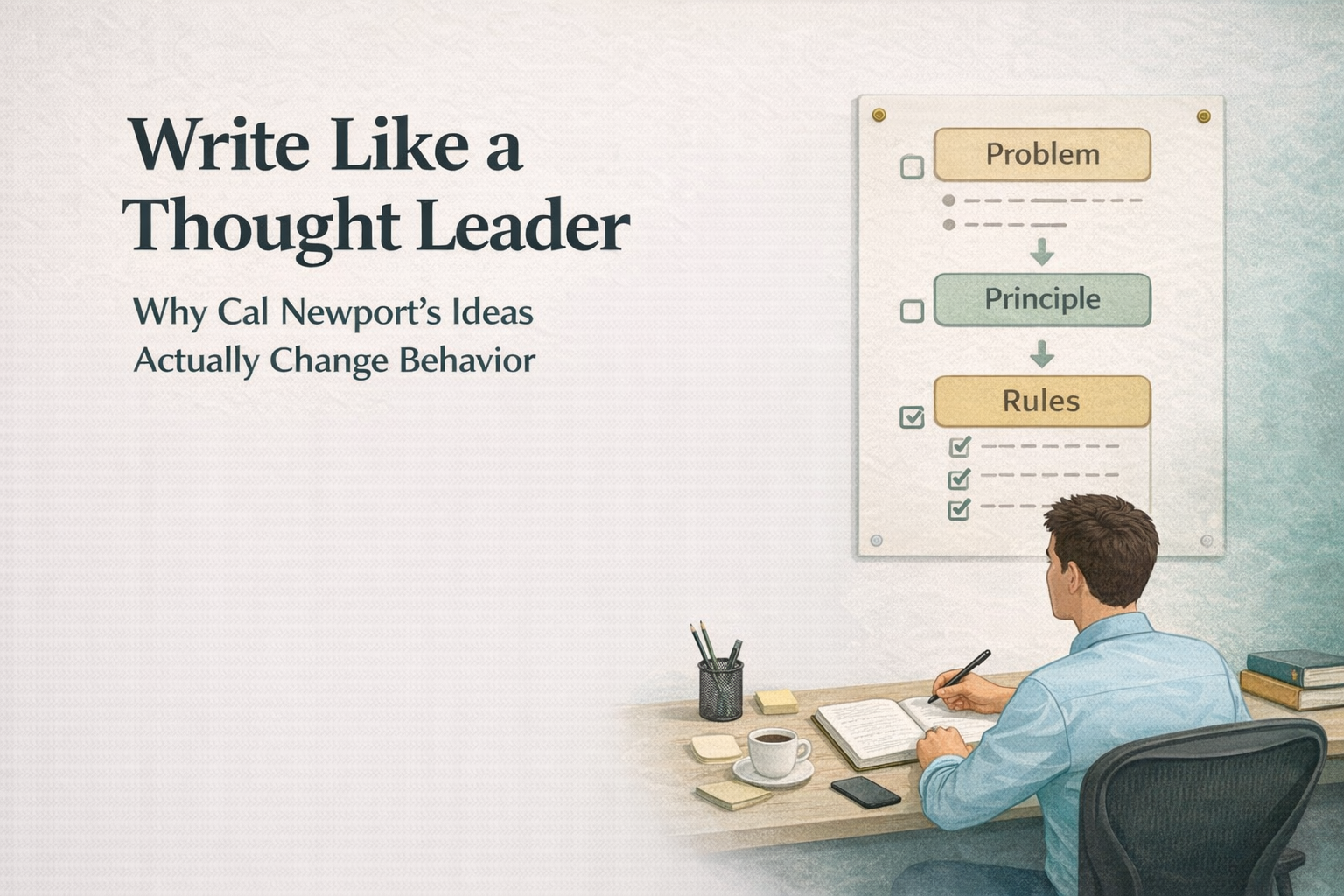
Write Like a Thought Leader: Why Cal Newport’s Ideas Actually Change Behavior
Most smart ideas don’t change what people do.
They explain.
They clarify.
They convince.
And then the reader goes back to the same habits.
Cal Newport’s writing works because it doesn’t stop at insight. It designs behavior. If you want to write like a thought leader, this is the difference that matters. It gives readers clear rules for action, so they don’t just understand the idea, they know what to do next.
Why most smart ideas don’t change behavior
Explanation feels like progress. It isn’t.
Most writing ends when the concept makes sense. The reader nods, feels informed, and returns to reality, where nothing is constrained, decided, or redesigned.
That’s the failure mode:
Ideas stall when they stop at explanation instead of prescribing action.
If the writing doesn’t answer the reader’s real question, what changes now? the idea stays optional.
Optional ideas don’t change behavior.
The hidden difference between insight and behavior change
Insight is passive.
Behavior change is engineered.
Many people who want to write like a thought leader focus on sounding intelligent.
But thought leadership isn’t about sounding smart, it’s about shaping decisions.
Understanding tells a reader what’s true. Behavior change requires decisions that make a different future more likely.
That’s why behavior change depends on:
- Constraints (what’s no longer allowed)
- Commitments (what will happen even when motivation fades)
- Defaults (what happens without extra willpower)
Without those, the idea is just an observation.
Newport’s writing doesn’t just describe what matters.
It forces a choice.
What Cal Newport actually sells: rules, not concepts
Newport is often described as a productivity thinker.
But what he actually produces is more specific:
Operating rules.
He takes an abstract principle and turns it into a concrete constraint readers can live inside. That’s the mechanism.
You can see it clearly in his best-known ideas:
Deep Work isn’t “focus more.”
It’s “block time, protect it, and treat distraction as a policy failure.”
Rules do what concepts can’t:
- Remove ambiguity
- Reduce decision fatigue
- Create consistent behavior without constant self-talk
Most writers offer inspiration.
Newport offers structure.
That’s why his readers change.
This is the difference between sounding authoritative and building real positioning. If you’re serious about long-term influence, your positioning strategy as an author matters more than volume.
The Behavior-Shifting Rule Framework (Newport’s real method)
There’s a repeatable structure underneath Newport’s behavior-changing writing.
It’s simple. And it’s transferable.
This same principle applies when designing your book’s structure or strategy. In our complete guide to building a nonfiction book strategy, we break down how constraints shape stronger outcomes.
The framework
Problem: Name a concrete friction or failure readers already experience.
Principle: State the governing idea that reframes that problem.
Rules: Translate the principle into a small set of explicit actions or defaults.
This is how insight becomes behavior.
To write like a thought leader, you must move beyond explanation and translate principles into constraints your reader can actually follow.
Writer-use template (fill in the blanks)
Problem: “Most people ___, which leads to ___.”
Principle: “The better approach is ___.”
Rules:
- Do: ___
- Stop: ___
- Default: ___
How writers apply it
- Decide what behavior should change after reading
- Choose one principle that justifies that change
- Express it as rules or constraints, not advice
If a reader has to invent their own next step, you didn’t finish the job.
The goal isn’t for readers to agree.
It’s for them to act.
Why writers avoid giving rules
Rules feel dangerous.
They sound prescriptive. They invite disagreement. They create edge cases. They risk being wrong.
So writers retreat into safer territory: explanation.
Many modern authors fall into this trap because they optimize for sounding insightful instead of shaping behavior. If you’re building authority in today’s landscape, understanding the modern author publishing model is essential.
They describe the problem. They share nuance. They offer possibilities. They avoid telling the reader what to do.
That keeps the writer protected.
It also keeps the reader unchanged.
Behavior-shifting writing requires the writer to take a stance and accept tradeoffs. Newport does that consistently.
That’s why his work moves people instead of merely informing them.
Writing that moves people means taking responsibility for outcomes
Thought leadership isn’t about sharing ideas.
It’s about guiding behavior.
If nothing changes after someone reads your work, the writing may be smart, but it isn’t complete.
Cal Newport’s work sets a higher bar. He doesn’t just explain what matters. He designs rules that make different behavior more likely.
Ideas don’t change behavior.
Defaults do.
If you want to write like a thought leader, stop explaining and start designing rules your reader can follow tomorrow.
→ Schedule Your Free Strategy Call
About the Author
Eric Koester is an award-winning entrepreneurship professor at Georgetown University, bestselling author, and founder of Manuscripts, the Modern Author OS used by more than 3,000 authors. His work has helped creators turn ideas into books, books into brands, and brands into scalable businesses.
About Manuscripts
Manuscripts is the leading full-service publishing partner for modern nonfiction authors. We help founders, executives, coaches, and experts turn their books into growth engines, through positioning, coaching, developmental editing, design, AI-enhanced writing tools, and strategic launch systems. Manuscripts authors have sold thousands of books, booked paid speaking gigs, landed media features, and generated millions in business from their IP.
Work With Us
If you’re writing a book you want to matter, let’s map out your Modern Author Plan.
Schedule a Modern Author Strategy Session → https://write.manuscripts.com/maa-web
Explore Manuscripts Publishing Services → https://manuscripts.com/publish-with-us/
See Modern Author Success Stories → https://manuscripts.com/authors/
Modern Author Resources
- How to Write a Book if You’re Busy
- Modern Ghostwriting for Nonfiction Authors
- AI Tools for Authors in 2026
- How to Build an Audience Before You Write Your Book
- The Evergreen Launch System for Modern Authors