

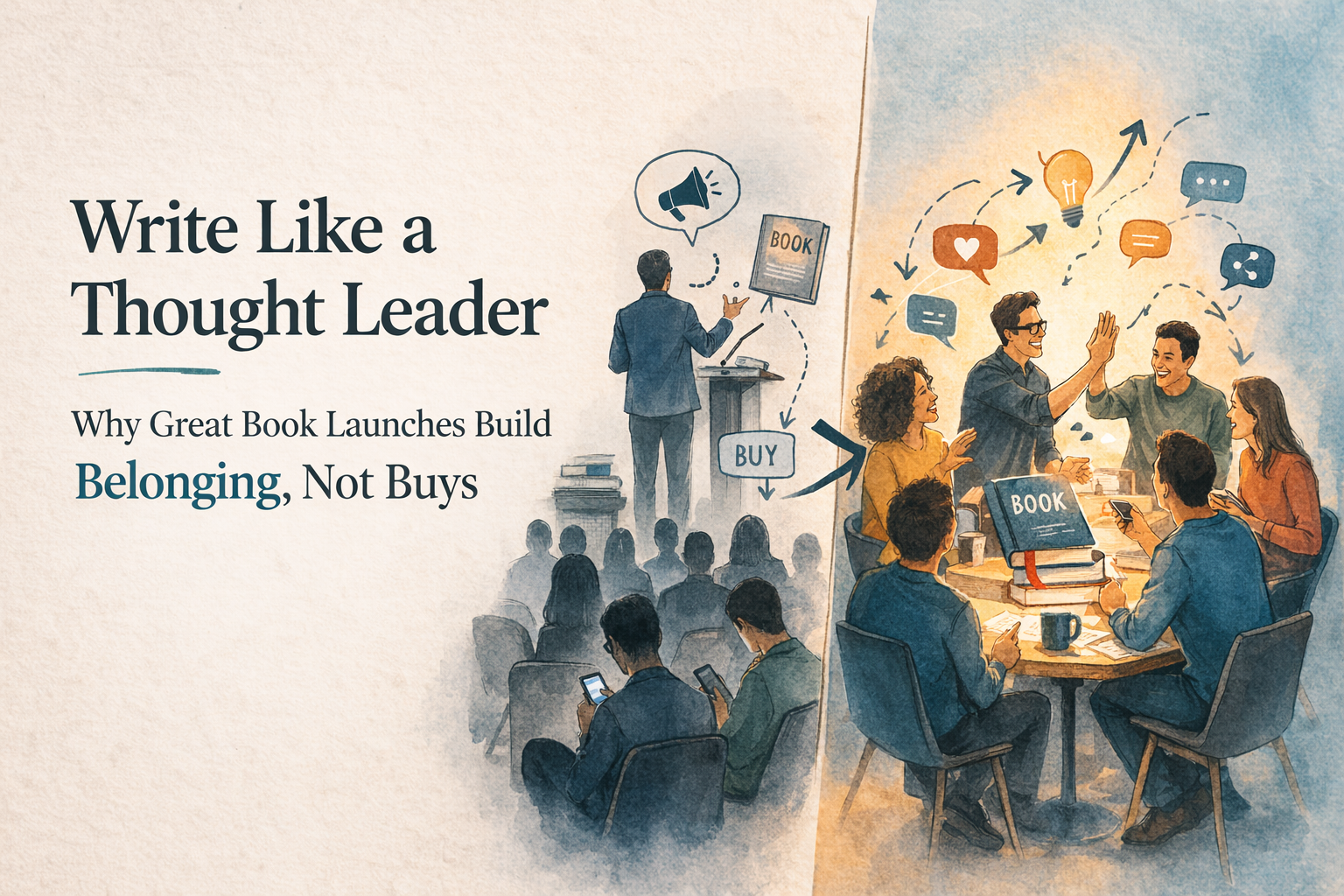
Write Like a Thought Leader: Why Great Book Launches Build Belonging, Not Buys
Most authors launch the same way.
Pick a date.
Post about it.
Ask people to buy.
It feels organized.
It feels professional.
It no longer works.
Modern launches don’t succeed by asking an audience to purchase.
They succeed by turning early believers into distributors.
The shift isn’t tactical.
It’s structural.
The best launches don’t start with a publishing date.
They start with a fan-first announcement event designed to build belonging long before the book arrives.
The Quiet Ta-Da Launch Is Dead
The default launch model looks like this:
- Finish manuscript
- Set publishing date
- Send emails
- Post on social
- Ask for support
It treats people like an audience.
Spectators.
Observers of your milestone.
But modern launches no longer reward announcements.
They reward mobilization.
Announcements ask for attention.
Mobilization creates ownership.
Most authors default to announcements because they feel controlled.
You choose the date.
You prepare the assets.
You press publish.
Mobilization feels different.
It requires conversation.
Participation.
Shared ownership.
That feels messier than a calendar invite.
But the psychology is simple:
If people feel like they’re watching you publish, they scroll.
If they feel like they’re part of something, they participate.
The Core Reframe: Publishing Date vs Announcement Event
There are always two dates in a modern book launch.
The publishing date.
And the announcement event.
Publishing date is for readers.
Announcement event is for fans.
Readers buy.
Fans show up.
Fans recruit.
Fans distribute.
A publishing date is transactional.
An announcement event is communal.
Most authors optimize for the first.
Great launches design for the second.
The Hormozi Playbook
Hormozi didn’t just release a book.
He created a gathering.
What he did differently:
- Invited fans into the process (behind-the-scenes, debates, previews)
- Framed it as a shared goal: “We break the record together”
- Hosted a live interactive event
- Offered a donate-200-books option that turned buyers into micro-distributors
The tactics mattered.
But the mechanism mattered more.
He didn’t amplify attention.
He mobilized belief.
When people feel ownership of the result, distribution becomes voluntary.
Believers don’t just buy.
They recruit.
The Theory: Kevin Kelly’s 1,000 True Fans
This dynamic isn’t new.
Kevin Kelly described it decades ago.
You don’t need millions of readers.
You need true fans.
A small number of committed supporters can sustain and spread a creator’s work.
The mechanism is predictable:
- True fans buy early.
- Early buyers signal credibility.
- Credibility increases visibility.
- Fans refer others (often 3–5 each).
Audience impressions dissipate.
Fan referrals compound.
Launch strategies built on audience reach hope for attention.
Launch strategies built on fans engineer momentum.
The Taylor Swift Belonging Machine
Taylor Swift doesn’t release albums.
She builds worlds.
Fans don’t just consume the work.
They decode it.
They discuss it.
They extend it.
The mechanics look like entertainment.
But structurally they create something deeper:
Participation.
Fans feel like insiders.
The album isn’t simply hers.
It becomes their era.
Participation outperforms persuasion.
The Super Mentors Model
The same principles apply without celebrity.
For Super Mentors, the launch wasn’t loud.
It was curated.
- Partnerships fueled presales
- Free distribution through universities
- A scorecard asset fans shared
- Shared language people adopted
- Announcement to a room that already believed
The focus wasn’t volume.
It was belief.
Belief generates amplification.
Noise fades quickly.
The Fan-First Launch Arc
Great launches aren’t moments.
They’re arcs.
Momentum builds gradually as readers move from awareness to participation to ownership.
The most effective launches follow a predictable pattern:
A period of identity formation.
A phase of early believer activation.
A stretch where belonging deepens.
And finally a shared announcement moment.
This arc usually unfolds over roughly 120 days.
Not because the number is magical.
But because belonging takes time to compound.
The Four Phases of the Fan-First Launch Arc
Phase 1 (Days 0–30): Define Fan Identity
Before you promote anything, define:
- Who is the ideal fan?
- What belief should be installed by launch day?
- What repeatable phrases describe the book?
Avoid clever language.
Use language people can repeat.
If fans can’t articulate what the book stands for, they can’t spread it.
Phase 2 (Days 31–60): Activate Early Believers
Build a small beta circle (20–50 people).
Give them:
- Sneak peeks
- Early chapters
- A live workshop
Ask one question:
“What stuck 24 hours later?”
That’s your signal.
Layer in:
- Personal outreach (DM, text, email)
- A small seed team of evangelists
Early believers create emotional investment.
Emotional investment creates advocacy.
Phase 3 (Days 61–100): Build a Pre-Sale Experience
Don’t just open preorders.
Design an experience.
- Bonuses for early action
- Bulk options for teams
- Behind-the-scenes drip content
- Fan challenges
- Open DMs for questions answered at launch
You’re not asking yet.
You’re deepening belonging.
Engagement converts without pressure.
Phase 4 (Days 101–120): Make the Launch Live
Turn launch into an event.
- Livestream
- Feature fans
- Offer something live-only
- Create recap clips
Even 10–25 engaged people can generate energy.
Small rooms can produce big momentum.
The goal isn’t spectacle.
It’s shared memory.
Post-Launch Compounding: Don’t Let the Book Go Quiet
Launch is ignition.
Not conclusion.
Afterward:
- Republish clips and recordings
- Turn the core framework into a lead magnet
- Host a challenge or community discussion
- Offer certification or licensing
- Create a remix kit for fans
Fans extend lifespan.
Audience attention decays.
Design for compounding.
Great Launches Build Belonging
Great launches don’t rely on:
- Hype
- Bigger platforms
- PR bursts
- Louder posts
They rely on something quieter and more powerful:
Belonging.
Co-ownership.
Shared language.
The goal is not:
“We launched.”
The goal is readers saying:
“This book is ours.”
When that happens, distribution stops being something you request.
It becomes something people choose.
→ Schedule Your Free Strategy Call
About the Author
Eric Koester is an award-winning entrepreneurship professor at Georgetown University, bestselling author, and founder of Manuscripts, the Modern Author OS used by more than 3,000 authors. His work has helped creators turn ideas into books, books into brands, and brands into scalable businesses.
About Manuscripts
Manuscripts is the leading full-service publishing partner for modern nonfiction authors. We help founders, executives, coaches, and experts turn their books into growth engines, through positioning, coaching, developmental editing, design, AI-enhanced writing tools, and strategic launch systems. Manuscripts authors have sold thousands of books, booked paid speaking gigs, landed media features, and generated millions in business from their IP.
Work With Us
If you’re writing a book you want to matter, let’s map out your Modern Author Plan.
Schedule a Modern Author Strategy Session → https://write.manuscripts.com/maa-web
Explore Manuscripts Publishing Services → https://manuscripts.com/publish-with-us/
See Modern Author Success Stories → https://manuscripts.com/authors/
Modern Author Resources
- How to Write a Book if You’re Busy
- Modern Ghostwriting for Nonfiction Authors
- AI Tools for Authors in 2026
- How to Build an Audience Before You Write Your Book
- The Evergreen Launch System for Modern Authors
Powered by Codex: The Modern Author Author Intelligence Tool





Leave a Reply