

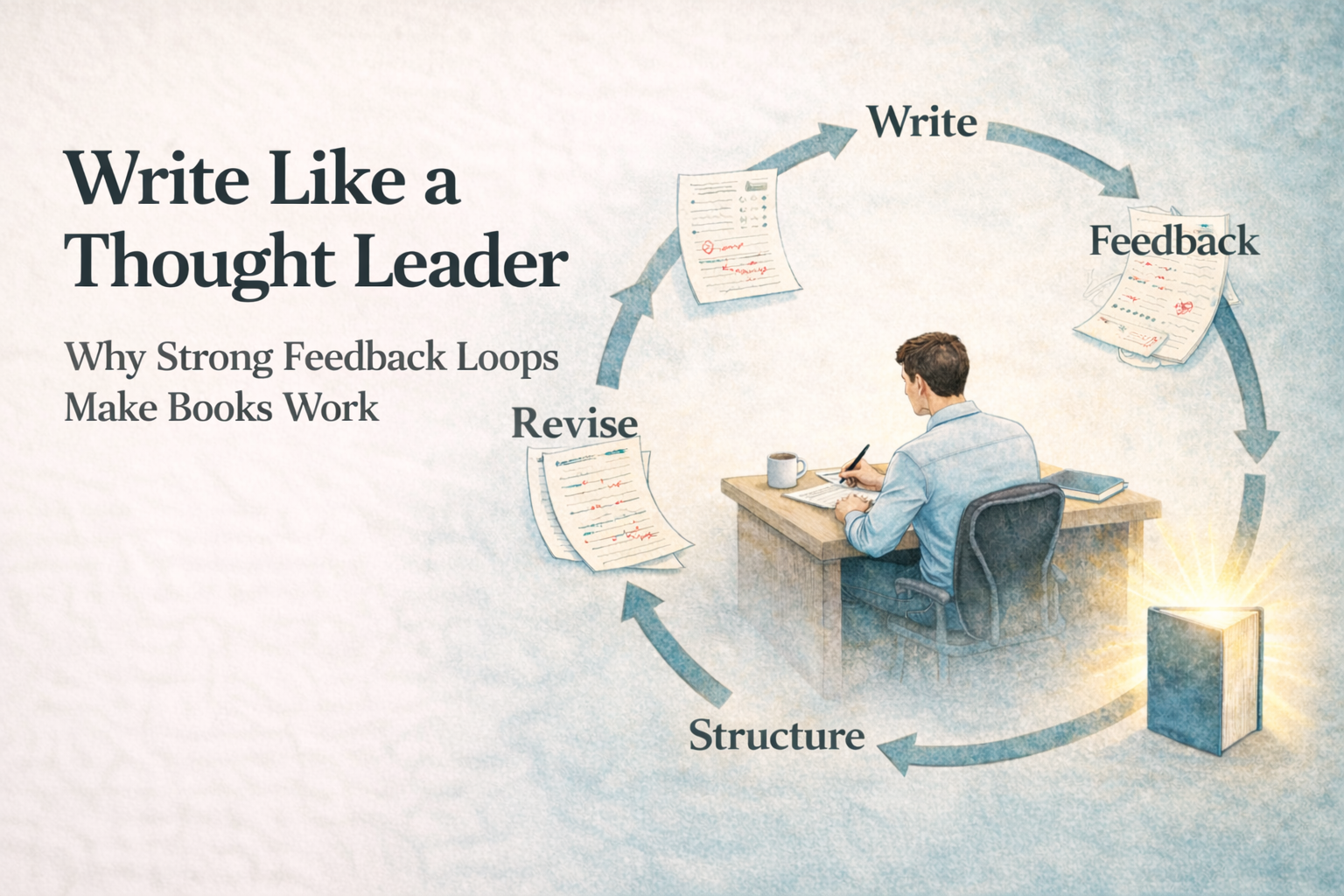
Write Like a Thought Leader: Why Strong Feedback Loops Make Books Work
Most authors aren’t afraid of writing a book.
They’re afraid of finishing one.
More specifically:
“What if I finish this… and nothing changes?”
No new opportunities.
No speaking invitations.
No authority lift.
No leverage.
The fear isn’t effort.
It’s impact.
If you’re afraid your finished book still won’t work, the fix isn’t more writing or better marketing.
The real shift is structural feedback early enough to shape the book while it’s still flexible.
Books rarely fail because the author didn’t try hard enough.
They fail because the architecture was never challenged while it could still change.
The Question Behind the Question: “What if I finish and nothing changes?”
When someone asks how to make their book “work,” they’re not asking about prose quality.
They’re asking about consequence.
Will this create:
- Opportunity?
- Authority?
- A clear positioning shift?
- A platform they can build on?
Modern authors don’t fear blank pages.
They fear invisible results.
That fear leads to the wrong response:
- More polishing
- More rewriting
- More isolation
But isolation amplifies blind spots.
If no one challenges the structure, the structure doesn’t improve.
Writing alone produces pages.
Feedback produces architecture.
The Georgetown Signal: Motivation + Outline Still Isn’t Enough
Even when writers have structure, motivation, and accountability, completion still breaks down.
A Georgetown University writing experiment illustrates this clearly.
Students were given:
- Clear topics
- Structured outlines
- Motivation
- Accountability
- A publishing pathway
After the first semester, 45% finished publishable drafts.
Which means 55% did not.
They had ideas.
They had structure.
They had incentive.
Completion still failed more than half the time.
The assumption most writers make is simple:
“If I have the ingredients, I’ll get the outcome.”
The data suggests otherwise.
Ingredients don’t guarantee architecture.
A motivated writer can still build the wrong structure.
Ingredients don’t guarantee architecture.
The Missing Variable: Developmental Support as the Completion Lever
Follow-up findings revealed a consistent pattern.
82% of successful authors reported working with a developmental editor during drafting.
So the intervention changed.
Students were paired with a developmental editor for eight weekly sessions.
The result:
34 out of 35 finished and published.
Same talent pool.
Same motivation level.
Different feedback loop.
Completion didn’t rise because students cared more.
It rose because someone corrected the structure in real time.
Effort increases output.
Feedback increases alignment.
This is what we might call the Feedback Loop Principle:
Books improve fastest when structural feedback happens during construction, not after completion.
Because architecture improves through iteration, not isolation.
What a Developmental Editor Actually Does (And What They Don’t)
Most writers misfile editing.
They assume editing means grammar.
That’s copyediting.
Developmental editing is architecture.
Think house, not paint.
Developmental Editor = Architect
Clarifies the central argument
Tests structural logic
Defines chapter purpose
Identifies weak links
Aligns the reader journey
Copyeditor / Proofreader = Finishing Work
- Grammar
- Syntax
- Surface polish
If the foundation is misaligned, polish only makes the flaw permanent.
A book can read cleanly and still fail structurally.
Clarity on the page is not the same as coherence in the argument.
Why Feedback Loops Change Everything (Mechanism, Not Motivation)
The power of developmental editing isn’t emotional support.
It’s structural correction.
Strong feedback loops reshape a manuscript in five ways.
1) Drift gets corrected early
Weak framing and logical gaps are identified before they multiply.
2) Chapters earn their place
Each section has a job. Redundancy drops.
3) Revision becomes directional
You strengthen specific weak joints instead of rewriting blindly.
4) The reader journey becomes visible
You see confusion before it reaches the market.
5) Confidence becomes earned
Clarity replaces second-guessing.
If no one tests the architecture, the architecture remains assumed.
Assumed structure rarely survives contact with readers.
The Modern Author Stakes: Books as Assets Raise the Cost of Ambiguity
For modern authors, a book isn’t just expression.
It’s infrastructure.
A strong book supports:
- Speaking stages
- Consulting offers
- Framework activation
- Corporate partnerships
- Category positioning
If the book must power downstream opportunity, it cannot be structurally vague.
A polished manuscript without a tight argument doesn’t convert into:
- Clear offers
- Teachable frameworks
- Repeatable systems
If it can’t sustain activation, it’s not an asset.
It’s a document.
The real shift is simple:
Modern authors don’t need prettier prose.
They need tighter architecture.
The Practical Rule: Early Feedback Beats Late Fixes
Most writers wait to share until it feels “good enough.”
That instinct is backwards.
Developmental feedback is most valuable when the structure is still movable.
Once chapters harden:
Reordering feels expensive
Cutting feels painful
Ego attaches to sentences
The operational rule is simple:
If you’ve drafted multiple chapters without structural feedback, you’ve likely waited too long.
Early feedback prevents wasted rewrites.
Late feedback forces structural surgery.
One is efficient.
The other is expensive.
Redefine “Work” as Reader-Experience + Structural Clarity
A book works when:
The argument is coherent
The structure is intentional
The reader journey is designed
Each chapter advances a clear promise
That outcome rarely emerges from isolated polishing.
It emerges from consistent external perspective applied early.
The fear was:
“What if I finish and nothing changes?”
The answer isn’t more effort.
It’s better loops.
Writing produces pages.
Feedback produces books that work.
What This Means for Writing Like a Thought Leader
Writing like a thought leader rarely happens in isolation.
Strong ideas don’t emerge from polishing.
They emerge from pressure.
Pressure from readers.
Pressure from structure.
Pressure from feedback that tests the argument while it’s still forming.
That means:
Invite structural feedback early
Treat critique as iteration, not correction
Let readers expose confusion before the manuscript hardens
Thought leadership doesn’t come from protecting your draft.
It comes from refining the architecture in public.
Because writing produces pages.
Feedback produces books that work.
→ Schedule Your Free Strategy Call
About the Author
Eric Koester is an award-winning entrepreneurship professor at Georgetown University, bestselling author, and founder of Manuscripts, the Modern Author OS used by more than 3,000 authors. His work has helped creators turn ideas into books, books into brands, and brands into scalable businesses.
About Manuscripts
Manuscripts is the leading full-service publishing partner for modern nonfiction authors. We help founders, executives, coaches, and experts turn their books into growth engines, through positioning, coaching, developmental editing, design, AI-enhanced writing tools, and strategic launch systems. Manuscripts authors have sold thousands of books, booked paid speaking gigs, landed media features, and generated millions in business from their IP.
Work With Us
If you’re writing a book you want to matter, let’s map out your Modern Author Plan.
Schedule a Modern Author Strategy Session → https://write.manuscripts.com/maa-web
Explore Manuscripts Publishing Services → https://manuscripts.com/publish-with-us/
See Modern Author Success Stories → https://manuscripts.com/authors/
Modern Author Resources
- How to Write a Book if You’re Busy
- Modern Ghostwriting for Nonfiction Authors
- AI Tools for Authors in 2026
- How to Build an Audience Before You Write Your Book
- The Evergreen Launch System for Modern Authors









Leave a Reply