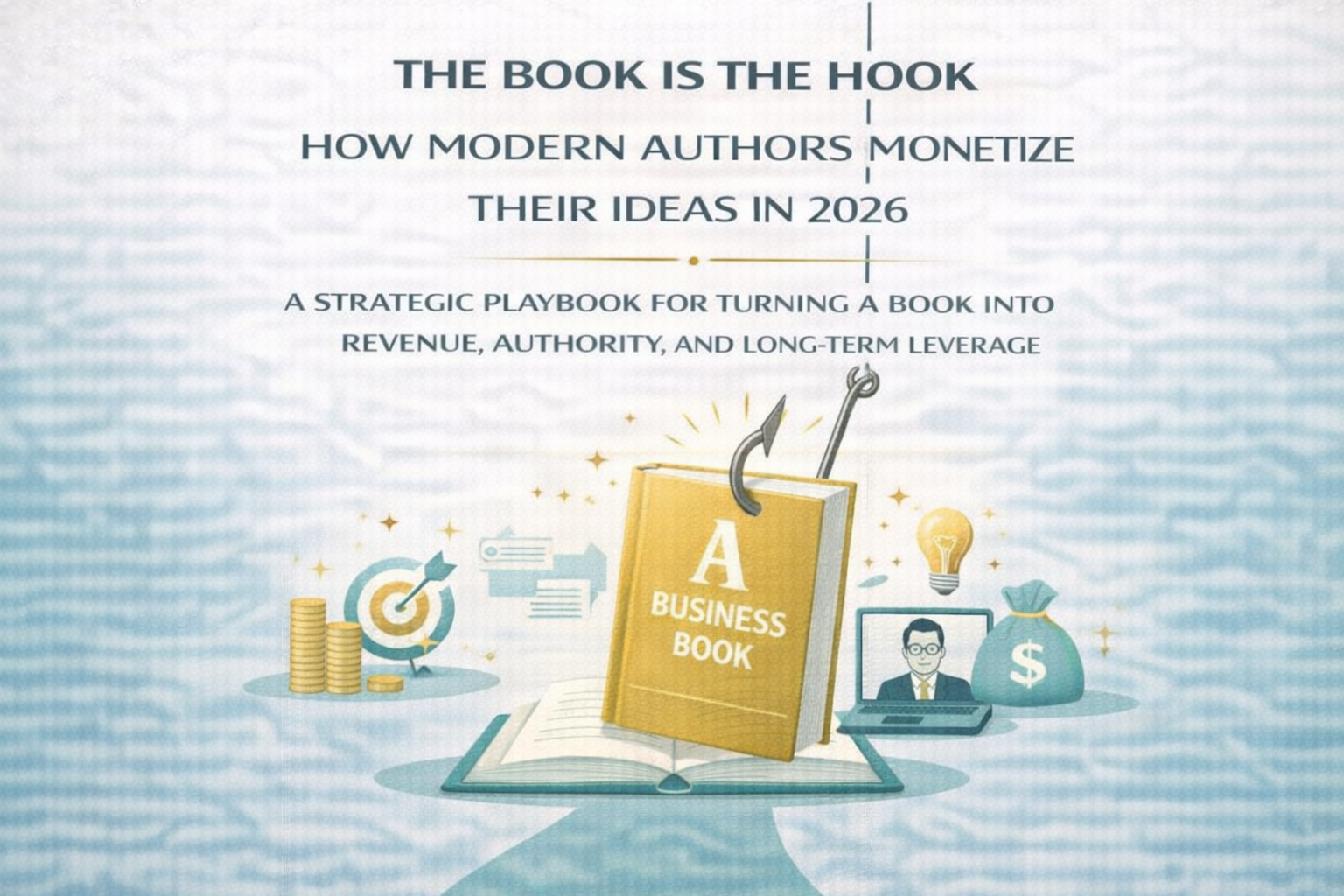
The Book Is the Hook: How Modern Authors Monetize Their Ideas in 2026
A Strategic Playbook for Turning a Book Into Revenue, Authority, and Long-Term Leverage
A Modern Author Shift
Most people still believe a book is the product.
They think the goal is:
- Sell copies
- Hit a list
- Earn royalties
- Hope the book “does something” for their career
That model is outdated.
In 2026, the book is not the business.
The book is the asset.
It’s the most powerful credibility engine still available in the modern economy, but only if you understand what it actually does.
A serious nonfiction book doesn’t pay you because someone buys it on Amazon.
It pays you because it unlocks everything that comes after:
- Clients
- Speaking
- Workshops
- Enterprise deals
- Licensing
- Partnerships
- Media
- Category authority
That’s the real game.
And modern authors are playing it very differently than traditional publishing ever taught.
The Truth About Book ROI
Here’s the uncomfortable reality:
Most nonfiction authors do not earn meaningful income from book sales alone.
Even successful books rarely generate life-changing royalties.
Outside research and our internal Author ROI data align on the same pattern:
Only a small minority of an author’s lifetime earnings comes directly from retail book sales.
From our author surveys in the Manuscripts author community, only 5-15% of earnings come from retail book sales. The vast majority comes from what the book enables:
- Consulting offers
- Coaching programs
- Keynotes
- Corporate training
- Professional services
- Intellectual property expansion
In other words:
The book is the hook.
The business is what it pulls toward.
Modern authors don’t write books to become writers.
They write books to become business assets.
The Book Is the Hook
Modern authors don’t write books to become writers.
A modern nonfiction book does not generate value because someone buys it.
It generates value because it unlocks what comes next:
– clients
– speaking
– workshops
– enterprise work
– licensing
– partnerships
– long-term authority
The book is not the business.
The book is the leverage layer.
They write books to become undeniable.
A Modern Author Doesn’t Publish Books
They Build Leverage Systems
A book is still one of the highest-trust artifacts in the world.
It’s a credential that can’t be faked.
It signals:
- Depth
- Authority
- Discipline
- Original thinking
- Seriousness
That’s why a single book can do what ten years of content often cannot.
But here’s the mistake:
Most authors treat the book like a finish line.
Modern authors treat it like an engine.
They design it as a platform asset from day one.
They ask different questions:
- What does this book unlock?
- Who does it attract?
- What opportunities does it create?
- What system does it feed?
- What revenue models does it support?
This is not about “writing a book.”
This is about building an ecosystem around your expertise.
| The 60-Second Decision Box If you only read one section of this guide, read this. This guide is for you if: – You’re writing a nonfiction book to grow your business or career – You want your book to lead to clients, speaking, or enterprise opportunities – You care about authority, not just publishing – You want a book that becomes an asset, not a vanity project This guide is not for you if: – You only want to sell copies on Amazon – You want AI to write the book for you – You’re looking for shortcuts instead of strategy – You’re publishing without a long-term plan The Modern Author Principle: Your book is not the product. Your book is the leverage layer. The authors who understand this win. Everyone else publishes and hopes. |
Why This Guide Exists
We wrote this because the publishing industry is stuck in the wrong conversation.
Most advice still focuses on:
- Writing faster
- Getting an agent
- Selling more copies
- Launch week tactics
- Vanity metrics
But modern authors are facing a different reality:
They don’t want a book.
They want what a book unlocks.
And the biggest question they’re really asking is:
“How do I turn my expertise into something that scales?”
That’s monetization.
Not in a gimmicky way.
In a real way.
In a modern way.
A way that creates:
- Predictable revenue
- Long-term authority
- A category-defining platform
- A system you can build on for years
This guide is the playbook.
What You’ll Learn in This Guide
This is not theory.
This is a tactical system.
Inside, you’ll learn:
- The Book-as-Leverage Framework modern authors use
- The 3-offer monetization architecture behind high-ROI books
- How to design a book backward from revenue and impact
- The most common monetization mistakes authors make
- The difference between royalties and real author income
- How speaking, consulting, and enterprise deals actually emerge
- How modern authors turn one book into a multi-year platform
By the end, you’ll understand something most authors never do:
A book is not a project.
It’s infrastructure.
One Core Reframe Before We Begin
If you remember nothing else:
A modern nonfiction book is not a product.
It is the highest-trust business development asset you can create.
It is the hook.
And everything that matters comes after.
Let’s build the system.
A Strategic Playbook for Revenue, Offers, and Long-Term Impact
This guide starts from a different assumption than most publishing advice.
It does not treat the book as a product whose success is measured by copies sold.
It treats the book as a strategic business asset, designed to unlock authority, demand, and revenue beyond the book itself.
In this model, a book is not the outcome.
It is the leverage layer.
That distinction matters because most authors evaluate success using the wrong metric. They ask whether the book sold. Modern authors ask what the book enabled.
This guide is written for readers who are prepared to think about authorship as infrastructure, not as a creative milestone, a résumé line, or a royalty play.
If the premise feels slightly uncomfortable, that’s expected.
It means you are now looking at the economics of authorship through the correct lens.
Modern author monetization playbook: turn a nonfiction book into a business asset that drives revenue through offers, consulting, speaking, and scalable systems, not royalties alone.
Case Study: Founder / Builder Model featuring Nate Androsky
That’s the Book Is the Hook model in a founder context.
The book as business development infrastructure
Who this is for
Founders and operators who already have a real business, but lack a single, coherent asset that explains their point of view.
What Nate did
Nate used his book as a way to clarify and codify how he thinks about leadership and organizational design, not as a standalone product.
The book was positioned early and used consistently:
– in conversations
– in introductions
– in how his work was framed publicly
The book was not treated as a launch-first event. It was treated as infrastructure.
What the book actually did
The book:
– shortened explanation cycles
– reduced the need to “re-prove” credibility
– made it easier for senior leaders to engage with his ideas
It became a reference point that carried his thinking into rooms he wasn’t physically in yet.
Why this matters
The book didn’t create demand out of thin air.
It removed friction from demand that already existed.
Why Monetization Matters
A. Traditional Assumptions vs. Modern Reality
Most first-time business authors inherit a traditional publishing mental model, often without realizing it.
It tends to sound like this:
- “If I sell enough copies, the book will pay for itself.”
- “If the book is good, the market will reward it.”
- “An advance or royalties will justify the time.”
Those beliefs are not naïve. They’re outdated.
They come from a world where the book was treated as the primary product. In 2026, for most serious nonfiction authors, the book is more valuable as a business asset than as a standalone retail item.
Definition (for this guide): Monetization means the revenue and opportunities a book activates beyond direct sales, offers, engagements, contracts, and repeatable systems that the book makes easier to win.
B. What the Data Actually Shows
The key pattern is simple: most books sell fewer copies than authors expect, and the economics of royalties rarely carry the full business case. In fact, in our study of authors’ external beliefs about book sales, they overestimated first-year book sales by an average of 40x.
Even publishers and industry operators who are supportive of authors routinely point to the same reality: a large share of new books sell well under 1,000 copies across their lifetime, especially when you include the long tail of titles entering the market each year.
Royalty math reinforces the point. A “typical” traditional royalty structure is often expressed around 10% on hardbacks and ~7.5% on paperbacks, and it can be reduced by discounting and other contract mechanics.
Manuscripts’ Author ROI research shows a consistent downstream pattern: for many modern business authors, the majority of total income is not created by retail book sales, but by what the book enables, consulting, speaking, training, cohorts, licensing, and enterprise deals (often 85–95% of total author income, depending on the business model).
The strategic takeaway is not “books don’t matter.” It’s the opposite:
Books matter more than ever, but not because of royalties. They matter because a book is still one of the highest-trust credibility signals in the market, and trust is what converts attention into revenue.
Royalties vs Real Author Income
The book does not pay you like a product.
Most nonfiction authors overestimate royalties and underestimate leverage.
Royalties
– unpredictable
– slow
– usually a small fraction of total income
Real author income
– consulting and advisory work
– speaking and workshops
– training, cohorts, licensing
– enterprise and partnership deals
Across modern author businesses, 85–95% of total income typically comes from what the book enables, not from selling the book itself.
It pays you like a credential that opens doors.
C. What This Means for You
If this is how author income actually works, it changes what “success” means, and therefore how you design the book.
Success is not primarily:
- Copies sold
- Lists hit
- Royalty statements
- Launch-week metrics
Success is:
- The book attracts the right readers (people with real problems and real budgets)
- The book builds trust efficiently (authority without repeated selling)
- The book creates clear next steps into paid work (offers and pathways that fit)
- The book compounds into an ecosystem (repeatable revenue and opportunity over time)
This is why, in a modern author business, income is best understood as activation, not extraction.
A well-designed nonfiction book doesn’t “earn” money the way a product earns money.
It activates the conditions where money follows: demand, credibility, and a reason for the right buyers to engage.
Once this is clear, the rest of the guide becomes less optional. If royalties are rarely the main driver, then monetization is not a marketing add-on at the end.
It is a design requirement from the beginning.
Case Study: The Consultant / Advisor Model featuring Andrea Goulet
It’s tied to positioning and visibility.
ROI begins with public commitment, not publication
Who this is for
Consultants and advisors who assume ROI comes after the book is finished.
What Andrea did
Andrea made her book visible before it was complete.
She didn’t wait for:
– final edits
– a launch date
– a finished manuscript
Instead, the book became part of her public identity early:
– website
– bios
– conversations
What changed
Once the book was visible:
– people began referencing it in conversations
– inbound interest increased
– authority was assumed rather than explained
None of this required selling the book. It came from clarity and commitment.
Why this matters
This demonstrates that ROI timing is not tied to printing or publishing.
The Manuscripts Model: Books Built for Leverage
At Manuscripts, we’ve worked with thousands of serious nonfiction authors.
Founders. Executives. Professors. Physicians. Coaches.
And the pattern is clear:
The authors who succeed don’t just “finish a manuscript.”
They build a business-shaped book.
They design the book around outcomes:
- A keynote
- A consulting offer
- A workshop
- A curriculum
- A licensing model
- An enterprise product
They don’t write and then figure it out later.
They architect leverage from the beginning.
That is what makes the Modern Author different.
Leverage.
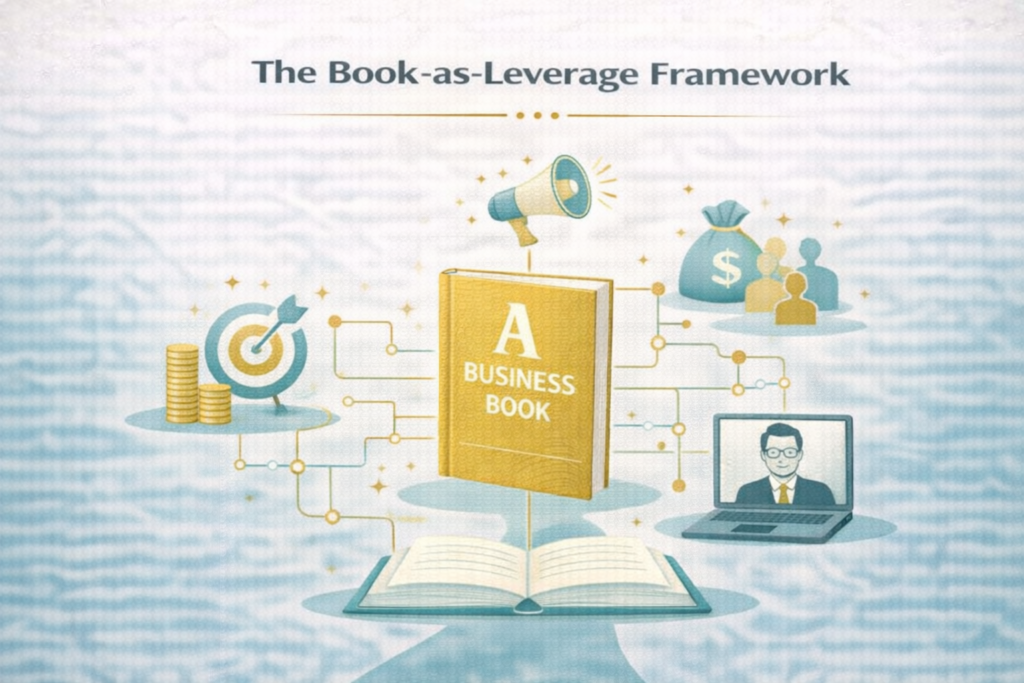
The Book-as-Leverage Framework
Modern author monetization looks complex from the outside because it shows up in many forms: content, email, speaking, consulting, courses, enterprise work. The mistake is treating each of those as separate problems.
In practice, they all follow the same underlying system.
For a nonfiction book to create money, authority, and long-term opportunity, it must sit inside a four-stage leverage model:
Attention → Trust → Offer → Ecosystem
This framework is not a metaphor. It describes cause and effect. Every sustainable author business, regardless of industry, format, or personality, moves through these same stages.
The rest of this guide is an application of this model.
The Book-as-Leverage Stack
The book sits in the Trust layer.
Every successful modern author system follows the same sequence:
Attention → Trust → Offer → Ecosystem
Attention creates proximity
The book creates trust
Offers convert trust into outcomes
Ecosystems compound results over time
Most monetization failures happen when authors skip layers.
Attention without trust → noise
Trust without offers → respect, no revenue
Offers without an ecosystem → spikes, no durability
That’s why it matters so much, and why it cannot be treated as a product.
Attention
Attention is how people discover you.
This includes:
- Content and thought leadership
- Speaking appearances
- Media, podcasts, and referrals
- Social distribution and audience building
Attention’s job is singular: bring the right people into proximity.
What attention does not do:
- It does not create trust on its own
- It does not close deals
- It does not explain your methodology in depth
This distinction matters because many authors over-invest in visibility while under-building what comes next. Attention without structure creates noise, not leverage.
Trust
Trust is where the book does its real work.
In this framework, the book sits squarely in the Trust layer.
The book’s role is to:
- Demonstrate depth, not frequency
- Show how you think, not just what you know
- Prove that your ideas work in real conditions
A serious nonfiction book accelerates trust because it forces coherence. It shows:
- You understand the problem systemically
- You can articulate a method, not just opinions
- You can guide someone from confusion to clarity
This is why books still matter in 2026. They compress credibility in a way that short-form content cannot.
The book is not designed to extract revenue.
It is designed to make the next step feel obvious.
Offer
Revenue happens only when there is a clear offer.
An offer is the mechanism that converts trust into outcomes. It gives readers a way to:
- Implement faster
- Avoid common mistakes
- Get support, structure, or accountability
Offers can take many forms, programs, consulting, training, licensing, but they all share one requirement: intentional design.
What does not count as an offer:
- Inspiration
- Popularity
- High engagement without a next step
This layer exists to normalize monetization as professional behavior. If the book establishes trust, the offer simply gives the reader a path forward.
There is nothing promotional about this. It is structural.
Ecosystem
The ecosystem is where leverage compounds.
An ecosystem is the set of follow-on opportunities that emerge once attention, trust, and offers are working together. This can include:
- Repeat engagements and retained work
- Expanded programs and higher-value clients
- Enterprise deals, partnerships, and licensing
- Long-term authority within a category
At this stage, the book becomes an anchor asset. It continues to create optionality without requiring repeated launches or constant reinvention.
This is why modern authors think beyond one-time wins. The goal is not a successful book launch. The goal is a system that keeps working.
Case Study: Joe Heitzeberg featuring Business Owner / Builder Model
This shows how books function as market-facing narrative assets, not marketing campaigns.
The book as category and narrative asset
Who this is for
Founders using a book to shape how their company is understood.
What Joe did
Joe’s book supported:
– narrative clarity
– category positioning
– long-term brand coherence
The book wasn’t written to sell copies.
It was written to explain the business’s worldview.
What changed
The book helped:
– align partners
– clarify the company’s stance
– support broader visibility
It became a durable asset the business could build on.
Why this matter
How to Use This Framework
Every strategic decision in the sections that follow maps back to one of these layers:
- Offer ladders live in the Offer layer
- Archetypes describe different Offer and Ecosystem shapes
- Backwards book design strengthens the Trust layer
- Reader journeys explain movement between Trust and Offer
If something feels confusing later, return to this model and ask:
Which layer is this serving, and what is it responsible for?
If you can sketch this system from memory, you have the correct mental model. Everything else in this guide builds on it.
Why the Stack Matters
Most monetization failures happen because authors try to skip layers.
Common breakdowns look like this:
- Attention without Trust → lots of interest, no conversion
- Trust without Offers → respect with no revenue
- Offers without an Ecosystem → short spikes, no durability
The Book-as-Leverage Stack prevents those errors by forcing sequence.
You don’t add monetization to a book.
You design upward through the stack.
Everything that follows in this guide, offers, archetypes, reader journeys, presale, and workflows, exists to strengthen one or more of these layers.
Once you see the stack clearly, monetization stops feeling abstract.
It becomes an engineering problem.
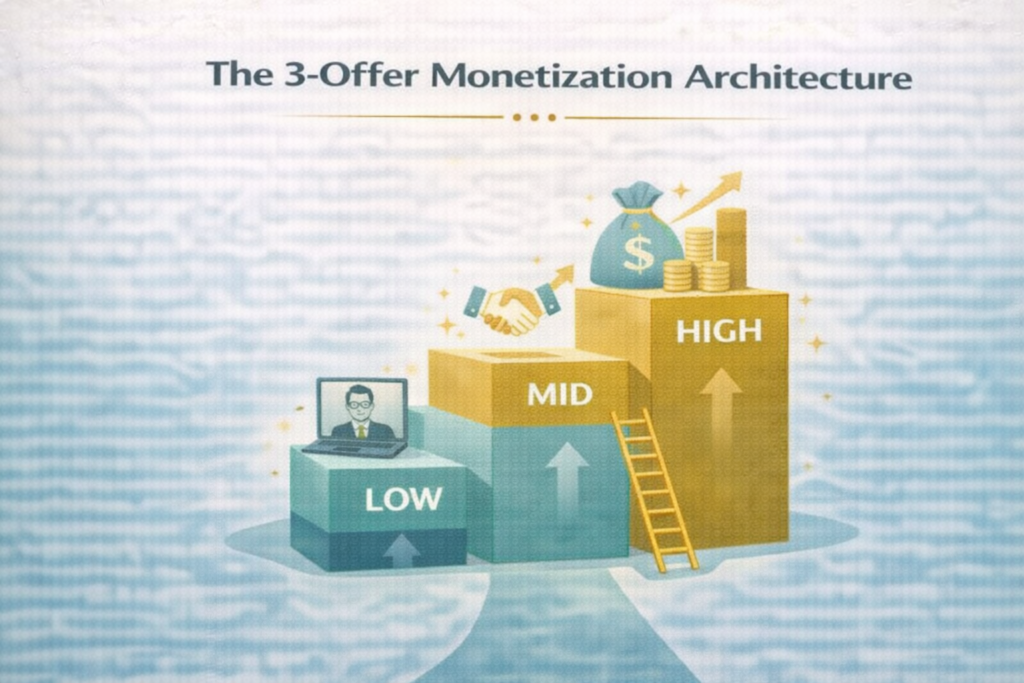
The 3-Offer Monetization Architecture
Modern author monetization becomes overwhelming when it is treated as an open-ended creative exercise. Courses, coaching, speaking, consulting, memberships, licensing, without structure, everything feels possible, and nothing feels clear.
The purpose of this architecture is to close that loop.
You do not need many offers.
You need three that work together.
This model collapses infinite options into a finite, complete system.
The 3-Offer Monetization Architecture
Each tier has a job.
You do not need many offers.
You need three that work together.
Foundational ($29–$99): build trust, reduce friction, qualify interest
Core ($500–$5,000): primary revenue engine
Premium ($10,000+): depth, leverage, optionality
Confusing those jobs creates underpricing, burnout, or stalled revenue.
The Three Tiers at a Glance
| Tier | Offer Type | Typical Price | Primary Function |
| Foundational | Templates, toolkits, diagnostics | $29–$99 | Build trust, lower friction, qualify interest |
| Core | Signature program or service | $500–$5,000 | Primary revenue engine |
| Premium | High-touch or enterprise work | $10,000+ | Depth, leverage, long-term opportunity |
Each tier has a distinct job. Confusing those jobs is what causes underpricing, overbuilding, and stalled revenue.
Foundational: Entry and Qualification
Foundational offers exist to help a little.
They are designed to:
- Lower the barrier to engagement
- Demonstrate practical value quickly
- Identify who is serious enough to go further
Examples include:
- Implementation templates
- Diagnostic tools
- Short workshops or toolkits
Foundational offers are not meant to carry the business financially. Their role is directional, not dominant. They create momentum and trust without demanding commitment.
When this tier is missing, authors rely on free content to do work it cannot do.
Core: Transformation and Revenue
Core offers are where the business is built.
They are designed to:
- Deliver a clear, meaningful outcome
- Solve the primary problem the book addresses
- Support implementation at the right depth
Common forms include:
- Signature programs
- Cohort-based experiences
- Consulting or advisory services tied to the book’s methodology
For most modern authors, this tier generates the majority of revenue. That is not a failure of ambition but it is how leverage works. One strong core offer outperforms many fragmented ones.
If revenue feels unstable, the issue is usually here.
Premium: Depth and Optionality
Premium offers exist to help deeply.
They are designed for:
- Readers or organizations with urgency and scale
- Situations where access, customization, or responsibility increases
- Long-term relationships, not volume
Examples include:
- Enterprise engagements
- Retained advisory work
- Licensing or high-touch implementation
This tier creates leverage, not pressure. It is not required for everyone, but when it exists, it expands what the book makes possible without increasing complexity elsewhere.
How the Three Tiers Work Together
This architecture is not about individual offers. It is about flow.
- Foundational offers reduce friction and build confidence
- Core offers deliver transformation and sustain the business
- Premium offers compound trust into long-term opportunity
Revenue emerges from movement between tiers, not from a single perfect product. Each step increases responsibility, access, and impact.
Seen this way, monetization is not escalation for its own sake. It is service at the appropriate depth.
What to Notice Before You Design
This model adapts across industries and roles. A coach, a consultant, and a founder may offer different things, but they still operate within the same three-tier structure.
The constraint is intentional:
- You are choosing three, not collecting options
- Each tier must earn its place
- Anything outside this system is optional, not required
With this architecture in place, monetization stops feeling infinite. It becomes designed.
Everything that follows, archetypes, ladders, reader journeys, builds on this foundation.
Case Study: Navid Nazemian featuring Executive → Advisor Transition
For executives, books don’t prove intelligence.
The book as a credibility bridge
Who this is for
Senior executives moving into advisory, board, or thought leadership roles.
What Navid did
Navid’s book helped translate deep executive experience into:
– a visible point of view
– a coherent narrative
– an external-facing authority asset
The book made his expertise accessible without diminishing its depth.
What the book actually did
It:
– reframed how others understood his experience
– made advisory conversations easier to initiate
– served as a bridge between roles
Why this matters
They make judgment transferable.
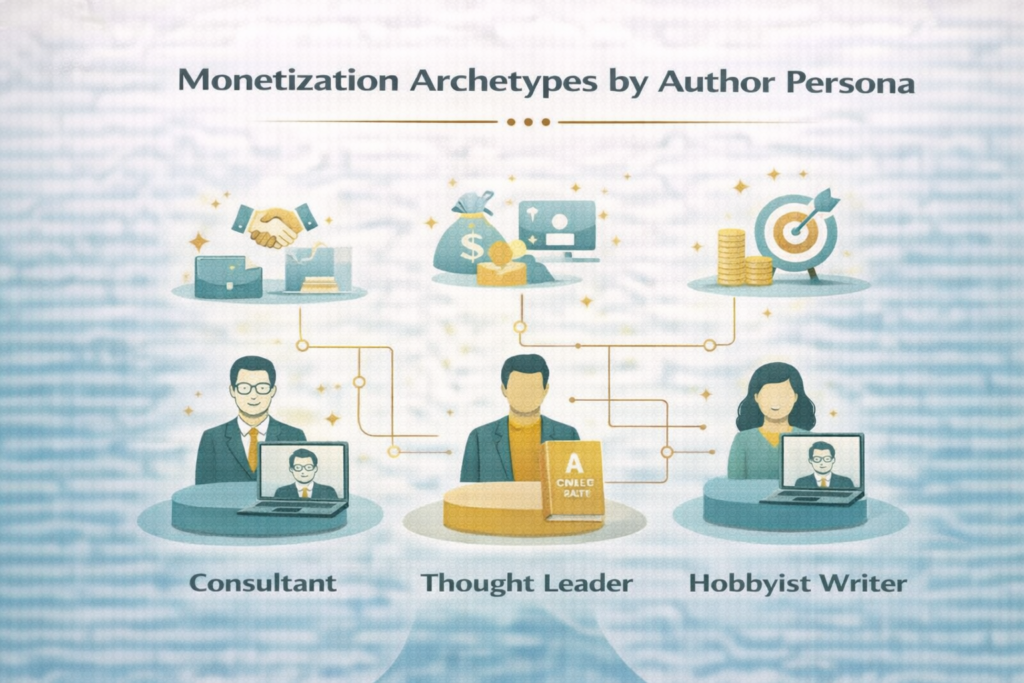
Monetization Archetypes by Author Persona
The most common monetization mistake modern authors make is not tactical. It’s structural.
They copy an offer model that worked for someone else, without noticing that the model was built around a different kind of author.
Monetization only works when it matches the way you create value: how you prefer to work, how you deliver outcomes, and what kind of access you can sustainably provide. That is what “archetype” means in this guide:
Definition (for this guide): An archetype is the author persona that determines which offer formats will feel natural, scalable, and sustainable for you.
This section is not about identity. It is about alignment.
How to Use Archetypes
Use archetypes to answer three questions before you design offers:
- Where do I create the most value?
In direct interaction, structured teaching, public presence, or behind-the-scenes execution? - What kind of work do I want to repeat?
Programs, projects, events, curriculum, partnerships, or retained relationships? - What trade-offs am I willing to accept?
Travel, delivery intensity, long sales cycles, product upkeep, or audience-building requirements?
Once those are clear, the 3-offer architecture becomes easier to implement without forcing formats that don’t fit.
Coach
Best for: authors who create value through transformation, guidance, and ongoing support.
Strength: continuity and behavior change
Trade-off: delivery intensity and relationship management
Typical offer path (3-tier):
- Foundational: Assessment, starter workshop, or toolkit that helps a reader self-diagnose ($29–$99)
- Core: Cohort program or signature coaching experience tied directly to the book’s method ($500–$5,000)
- Premium: High-touch 1:1 coaching, leadership advisory, or private implementation support ($10K+)
What the book should do: establish a philosophy, define a method, and make the reader think, “I want help implementing this.”
Speaker
Best for: authors who create value through amplification, persuasion, and live experience.
Strength: reach and authority at scale
Trade-off: event dependence, travel, and calendar volatility
Typical offer path (3-tier):
- Foundational: Talk-based templates, pre-keynote briefing kit, or a short training derived from the book ($29–$99)
- Core: Workshops, offsites, or paid trainings built from the book’s core framework ($500–$5,000)
- Premium: Keynotes, executive sessions, or enterprise engagements ($10K+)
What the book should do: act as a credential and message container that is clear enough that event organizers can immediately see the talk inside it.
Teacher
Best for: authors who create value through curriculum, systems, and repeatable learning.
Strength: scalability and repeatability
Trade-off: product upkeep and continuous refinement
Typical offer path (3-tier):
- Foundational: Templates, learning guides, or short modules that reduce friction to start ($29–$99)
- Core: Course, cohort, or certification-style program that teaches implementation ($500–$5,000)
- Premium: Licensing, certification cohorts, or enterprise training agreements ($10K+)
What the book should do: define a transferable system that can be taught in modules: each chapter reinforces a step, not just an idea.
Builder
Best for: founders and operators whose ideas are best expressed as playbooks, systems, and enterprise outcomes.
Strength: leverage through scope and organizational adoption
Trade-off: longer sales cycles and higher complexity deals
Typical offer path (3-tier):
- Foundational: Toolkits, assessments, or playbook add-ons that give teams a starting point ($29–$99)
- Core: Implementation program, advisory engagement, or structured rollout package ($500–$5,000 for individuals; higher for teams)
- Premium: Enterprise licensing, partnerships, or strategic consulting engagements ($10K+)
What the book should do: make your method legible to decision-makers. The reader should be able to imagine rolling it out inside an organization.
Guide
Best for: authors who create value through ongoing strategic direction and retained proximity.
Strength: long-term relationships and compounding trust
Trade-off: limited capacity and selective client fit
Typical offer path (3-tier):
- Foundational: Diagnostic, roadmap template, or clarity toolkit ($29–$99)
- Core: Retainer-style advisory, structured working sessions, or ongoing strategic support ($500–$5,000)
- Premium: Executive-level retainer, facilitated retreats, or deep strategic partnership ($10K+)
What the book should do: position you as the person who can see the full system. The promise is not motivation. It is navigation.
Storyteller
Best for: authors who create value through narrative, worldview, and audience resonance.
Strength: emotional trust and cultural reach
Trade-off: monetization often depends on audience scale and distribution
Typical offer path (3-tier):
- Foundational: Companion resources, narrative-based workshops, or audience products ($29–$99)
- Core: Cohorts, community-based programs, or creative curriculum ($500–$5,000)
- Premium: Sponsorship partnerships, media projects, or premium experiences ($10K+)
What the book should do: create identification and belief. Readers should feel understood before they feel sold to.
Catalyst
Best for: authors who create value by convening people, driving momentum, and creating platforms.
Strength: network effects and partnership leverage
Trade-off: operational complexity and coordination
Typical offer path (3-tier):
- Foundational: Frameworks, playbooks, or sponsor-ready assets ($29–$99)
- Core: Programs, memberships, or cohorts that organize action ($500–$5,000)
- Premium: Sponsorship frameworks, partnerships, or enterprise programs ($10K+)
What the book should do: articulate a movement or system that other people want to join and fund.
The Point of This Section
There is no universally “best” monetization model.
There is only the model that fits:
- Your strengths
- Your preferred delivery style
- The kind of outcomes you can reliably produce
- The trade-offs you are willing to live with
This is what prevents resentment and burnout. It is also what makes revenue predictable.
Once you know your archetype, you can design three offers that feel natural, rather than forcing yourself into someone else’s business.
Case Study: Speaker / Thought Leader Model featuring Jason Levin
For speakers, books don’t create audiences.
Books pre-sell trust, not services
Who this is for
Speakers who already get on stages but want higher trust, better alignment, and stronger positioning.
What Jason did
Jason’s book was designed to:
– articulate a clear point of view
– frame the problem he speaks about
– give audiences a way to “do homework” before engaging
The book wasn’t pushed as a sales tool.
It was positioned as an extension of his thinking.
What the book actually changed
Organizers and audiences arrived:
– more aligned
– more confident in his authority
– less skeptical
The book acted as a trust transfer mechanism.
Why this matters
They upgrade the quality of attention.
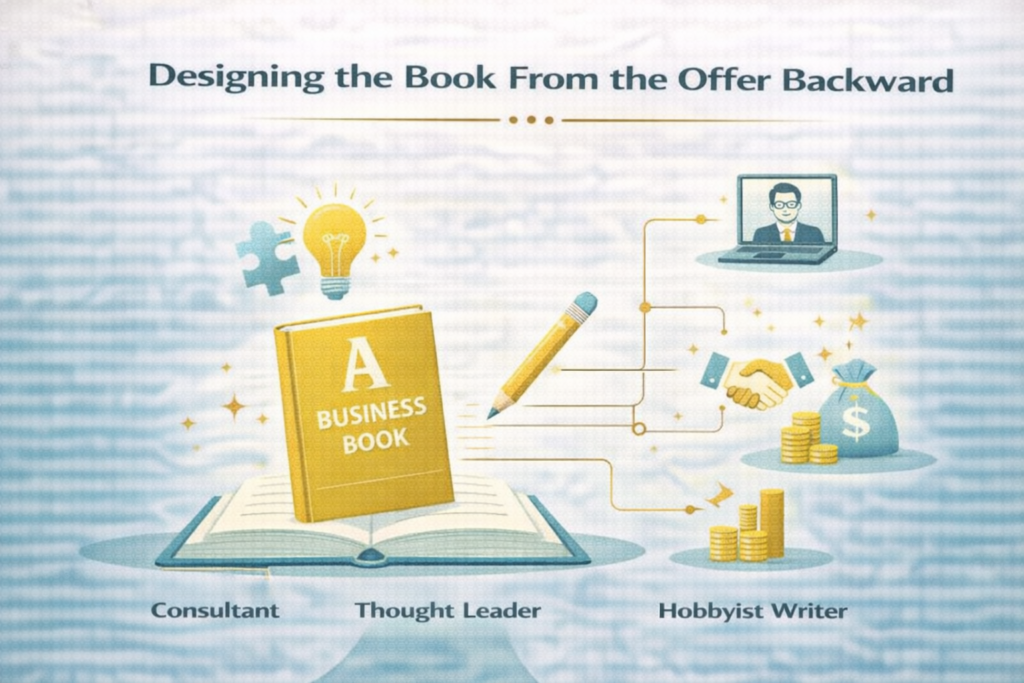
Designing the Book From the Offer Backward
Most authors follow the same pattern: they write what they know, finish the manuscript, and then ask what, if anything, it can sell.
This section teaches the inverse.
A modern nonfiction book is not designed around content.
It is designed around an outcome.
When the outcome is clear, the book stops being a collection of ideas and starts functioning as infrastructure.
A. Define the Outcome First
Before you outline chapters, you must define the transformation your offers deliver.
Outcome (for this guide): the concrete change in the reader’s work or life after engaging with your offer, not inspiration, not insight, but capability.
This discipline matters because without a defined outcome:
- Chapters wander
- Ideas accumulate without direction
- The book informs, but does not prepare
A clear outcome acts as the north star. Every chapter either moves the reader closer to that outcome, or it does not belong.
B. Map Offer → Chapters → Content
Once the outcome is defined, the book can be designed as a sequence that prepares someone to say yes.
The constraint is simple: write to belief shifts, not topic coverage.
People rarely fail to act because they lack information. They fail because they hold the wrong beliefs… about the problem, about themselves, or about what implementation actually requires.
Use the following worksheet to map your book intentionally:
Offer Design Worksheet
- Offer promise
What result does this offer reliably deliver? - Key beliefs challenged
What must the reader stop believing before they are ready to act? - Supporting content
Which ideas, examples, or explanations help replace those beliefs? - Transition points
Where does the reader naturally realize the cost of doing this alone?
Each line does a different job. Together, they turn chapters into stepping stones.
What Monetization Actually Means Here
Offers are not pressure.
Monetization is not manipulation.
It is not hype.
It is not extracting value from readers.
In this guide, monetization means:
– designing clear next steps
– reducing implementation risk
– allowing serious readers to go further
– creating sustainable outcomes for both sides
A book that creates trust without a path forward wastes that trust.
They are structure.
Chapters as Stepping Stones
In a monetization-aware book, chapters are not topics. They are moves.
Each chapter should exist to:
- Challenge a limiting belief
- Teach a necessary skill
- Demonstrate that the method works
- Increase readiness for the next step
This eliminates:
- Redundant theory
- Front-loaded exposition
- Strong ideas that lead nowhere
The book becomes directional. Momentum replaces volume.
Where Monetization Actually Belongs
Offers do not belong at the end of the book.
They belong at transition points, moments when the reader:
- Understands what to do
- Recognizes what it will take
- Sees where support would reduce risk or time
At these moments, an invitation feels natural. Not because it is persuasive, but because it is useful.
This is how monetization remains aligned with trust.
Workbook Sketch: Offer-to-Book Design
The workbook is not supplemental. It is the executable layer of this system.
Below is a simplified sketch of the worksheet used to design a book backward from its offers. This can be embedded in the guide or offered as a downloadable resource.
Offer-to-Book Design Worksheet
1. Offer Definition
- Offer name:
- Primary outcome delivered:
- Who this offer is for:
- What success looks like after completion:
2. Beliefs That Must Change
- What does the reader currently believe that keeps them stuck?
- What must they believe instead to move forward?
- What objections or fears must be resolved?
3. Skills or Understanding Required
- What must the reader know how to do?
- What concepts must become clear?
- What decisions must they feel confident making?
4. Chapter Mapping
| Chapter | Belief Shift | Skill Taught | Evidence Provided |
| Chapter 1 | |||
| Chapter 2 | |||
| Chapter 3 |
5. Transition Points
- Where does the reader realize implementation is harder alone?
- Where would guidance, tools, or accountability reduce risk?
- Which chapters naturally lead into an invitation to the offer?
This worksheet turns writing into design. It makes the relationship between book and offer explicit, intentional, and repeatable.
When authors use this process, the book no longer hopes to convert.
It prepares readers to choose.
Why the Workbook Matters
The worksheet is not supplemental. It is structural proof.
It:
- Converts insight into design
- Reduces cognitive load
- Makes the process repeatable across books and offers
Most importantly, it signals that this is not an artistic gamble. It is a system.
When you design the book from the offer backward, writing becomes an act of strategy. The manuscript no longer hopes to work.
It is built to.
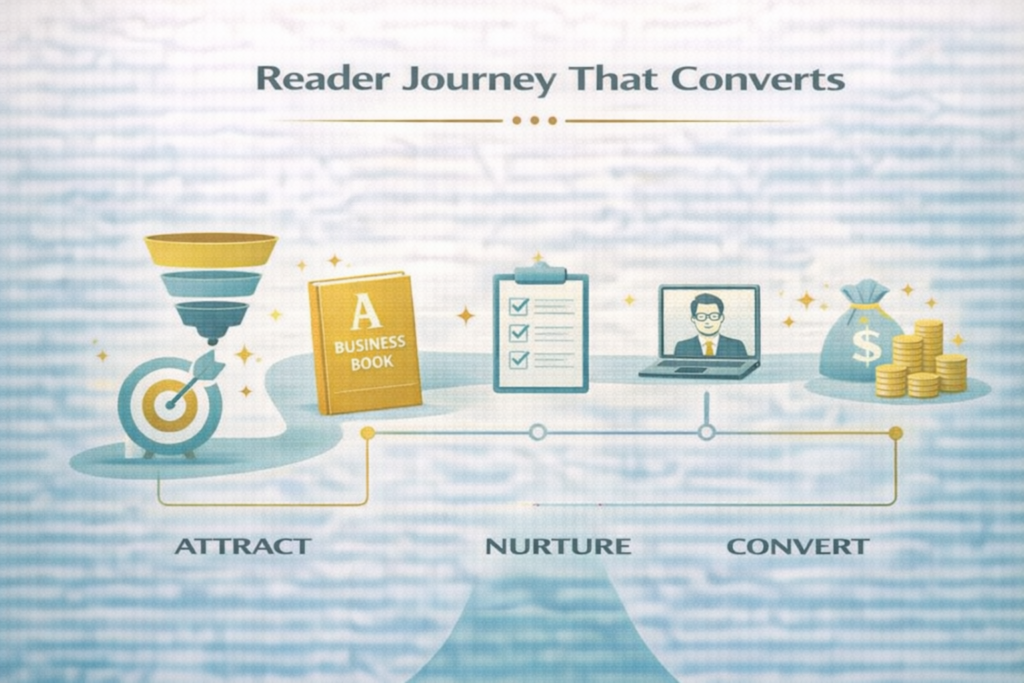
Reader Journey That Converts
Most authors write as if readers behave predictably: start at page one, read straight through, absorb the argument, and reach the ending ready to act.
That is not how nonfiction is consumed, especially by busy professionals.
A book converts when it respects different reader intentions instead of forcing one path. The goal is not to make every reader buy. The goal is to help the right readers recognize themselves and move forward without friction.
A. Reader Types
Readers do not arrive with the same goal. In practice, most fall into one of three categories.
Browsers
Browsers are scanning for clarity and credibility.
They want:
- A clean mental model
- Proof that you understand the problem
- Language they can reuse internally
They may:
- Skim sections
- Skip frameworks
- Never finish the book
Browsers are not a failure mode. They create leverage by sharing the book, referencing it, and reinforcing your authority in conversations where you are not present.
Implementers
Implementers are trying to apply the ideas on their own.
They want:
- Frameworks they can execute
- Examples that reduce ambiguity
- Tools, checklists, and sequences
They often read unevenly, jumping to the parts that help them move. Many do not buy immediately. They build trust through use.
Implementers are valuable because they become:
- Future buyers when they hit complexity
- Strong referral sources
- Proof that your methodology works
Buyers
Buyers are actively seeking help.
They want:
- A clear next step
- Confidence that you can deliver the outcome
- A low-friction way to engage
Buyers are not “more convinced.” They are simply at a different point in readiness. The book’s job is to remove uncertainty and make the path forward obvious.
Case Study: Speaker / Educator Model featuring Rachell Kitchen
This is a clean example of Book Is the Hook:
The book clarifies the offer, the stage captures the value
Who this is for
Authors who confuse “selling the book” with monetization.
What Rachell did
Rachell’s book was not positioned as the thing to buy.
It was positioned as:
– the intellectual foundation
– the credibility layer
– the entry point to deeper engagement
The book made her work legible.
The stage made it valuable.
What changed
Speaking opportunities became clearer pathways into:
– workshops
– deeper engagements
– ongoing relationships
The book created the context.
The offer captured the value.
Why this matters
the book opens the door, something else walks through it.
B. How to Write Toward Each Reader Type
A conversion-oriented book does not treat every chapter equally. It assigns different jobs to different parts of the manuscript.
Write for Browsers: clarity first
Browsers decide quickly whether you are worth their attention.
Prioritize:
- A clear framing early
- Section headers that can be skimmed
- Short summaries that reduce cognitive load
What matters most is not depth. It is coherence.
Write for Implementers: structure and tools
Implementers need the book to function as a working manual.
Prioritize:
- Step-by-step frameworks
- Definitions that reduce ambiguity
- Worksheets and checklists that translate ideas into action
This is where trust compounds. When readers use your material successfully, they stop evaluating you as an author and start viewing you as a guide.
Write for Buyers: decision support and next steps
Buyers need a mechanism to engage.
Prioritize:
- Clear transition points where the reader recognizes the cost of going alone
- Diagnostics or resources that help them self-identify
- A specific next step that matches their level of readiness
The goal is not to persuade. It is to remove friction.
How Books Convert Without Feeling Like Funnels
A book becomes a funnel when it tries to force conversion.
A book becomes a leverage system when it enables self-selection.
Readers should be able to raise their hand through actions that match their intent:
- Browsers share and reference the book
- Implementers use frameworks and download tools
- Buyers request the next step because it reduces risk and time
This is ethical conversion through clarity. The offer is not a pitch. It is relief.
Connecting Reader Signals to Offers
Reader behavior is a readiness signal. Your monetization system should respond to those signals.
Examples:
- A reader who downloads a worksheet is signaling implementation intent
- A reader who requests templates is signaling urgency and willingness to act
- A reader who engages with a diagnostic is signaling buyer readiness
Those signals can map cleanly to:
- Email list segmentation
- Offer timing
- Tiered pricing and escalation paths
This is what makes monetization efficient and respectful. The book does not push. It guides.
The Practical Outcome
When you write for real reader behavior:
- You stop over-explaining to everyone
- You stop hiding offers out of fear
- You place invitations where they naturally belong
Conversion becomes a byproduct of alignment. The right readers feel understood, supported, and ready to proceed.
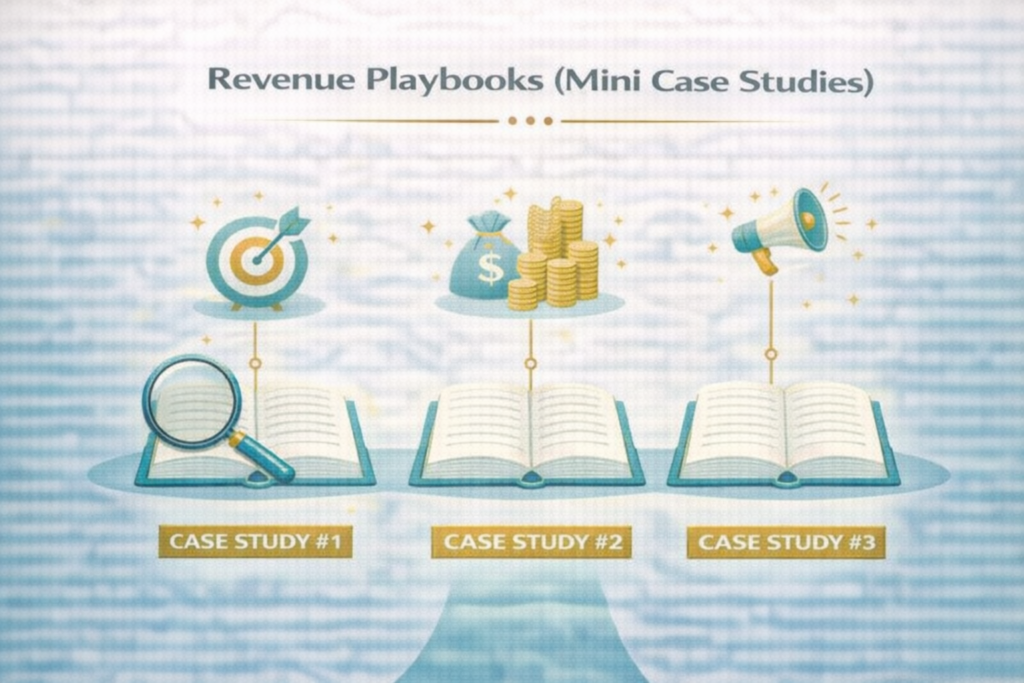
Revenue Playbooks (Mini Case Studies)
Frameworks create clarity. Playbooks create confidence.
This section shows how the same monetization logic plays out across different roles and industries. The goal is not to showcase exceptional individuals. It is to demonstrate that outcomes repeat when structure repeats.
Each example follows the same pattern:
Book → First Offer → Expansion
Executive Coach: Book → Cohort Programs → Retainer Clients
What the book positions
The book establishes a clear leadership methodology and reframes a common executive problem in operational terms. Its primary job is trust: showing that the author can diagnose complex human and organizational dynamics with precision.
First monetized offer
A cohort-based leadership program tied directly to the book’s framework.
Follow-on revenue
Senior leaders who complete the cohort convert into:
- Ongoing advisory retainers
- Private leadership support
- Team-level engagements
Revenue path (illustrative)
| Stage | Offer | Typical Range | Role |
| Entry | Diagnostic / Toolkit | $49–$99 | Qualify seriousness |
| Core | Leadership Cohort | $1,500–$3,000 | Primary revenue |
| Expansion | Executive Retainer | $15K–$50K/year | Long-term leverage |
What this teaches
The book does not “sell coaching.” It makes the cost of unsupported leadership visible, so help feels timely and appropriate.
Founder: Book → Enterprise Licensing → Brand Partnerships
What the book positions
The book functions as a founder playbook. It names a repeatable system that other organizations want to adopt, not just understand.
First monetized offer
An implementation package or licensing model that allows teams to apply the framework internally.
Follow-on revenue
As adoption grows:
- Enterprise licensing expands
- Strategic partnerships emerge
- Brand collaborations become viable
Revenue path (illustrative)
| Stage | Offer | Typical Range | Role |
| Entry | Assessment / Playbook | $29–$99 | Internal champion |
| Core | Team Implementation | $3,000–$10,000 | Revenue validation |
| Expansion | Enterprise License | $25K+ | Scaled leverage |
What this teaches
The book is not a marketing asset. It is a specification document. Revenue scales because the system can be adopted without the founder’s constant presence.
Subject-Matter Expert: Book → Training Series → Recurring Revenue
What the book positions
The book defines a domain clearly enough that it can be taught, not just referenced. It establishes the author as a translator of complexity.
First monetized offer
A structured training series that walks readers through implementation step by step.
Follow-on revenue
Recurring income through:
- Updated training cohorts
- Certification or continuing education
- Institutional or organizational subscriptions
Revenue path (illustrative)
| Stage | Offer | Typical Range | Role |
| Entry | Templates / Guides | $29–$79 | Build trust |
| Core | Training Series | $500–$2,000 | Revenue engine |
| Expansion | Licensing / Subscription | $10K+/year | Predictability |
What this teaches
The book creates authority. The training creates outcomes. Revenue grows because the expert’s knowledge is systematized, not exhausted.
What These Playbooks Have in Common
Despite different roles and industries, the underlying logic is identical:
- The book establishes trust and frames the problem
- The first offer delivers structured implementation
- The expansion layer compounds relationships and revenue
In none of these cases is the book the primary revenue line. It is the asset that makes every other line easier to earn.
This is the critical reset:
You do not need massive reach.
You need clear positioning, the right offer sequence, and patience.
Once those are in place, monetization becomes predictable.
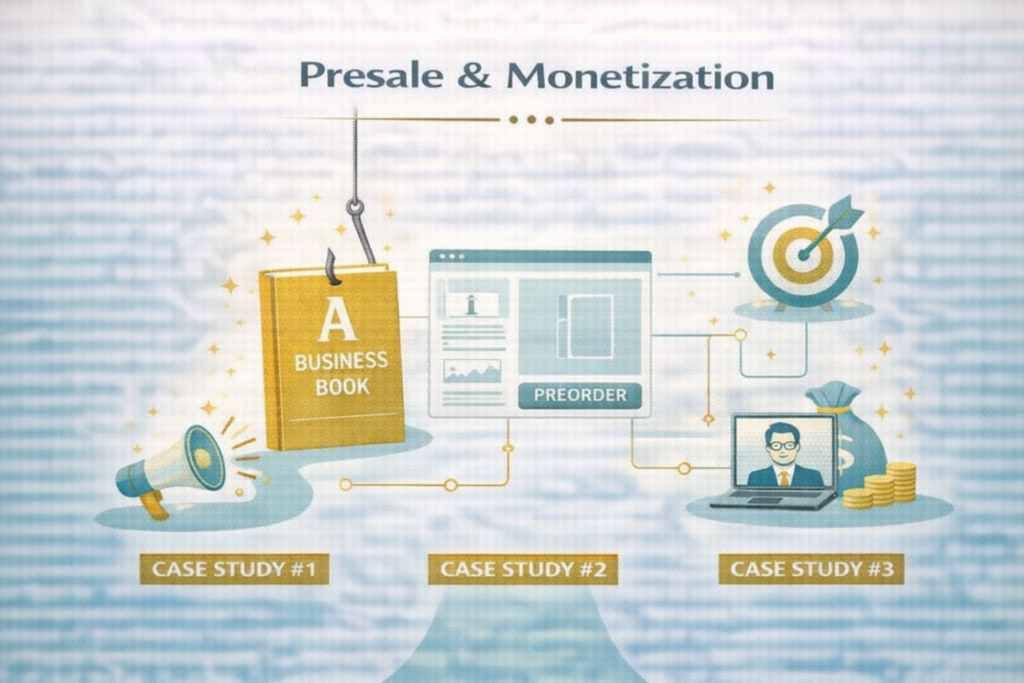
Presale & Monetization
Many authors treat audience building, presale, and monetization as separate activities. They are not.
They are the same system at different moments:
- Audience building creates attention and trust
- Presale converts trust into belief strong enough to act
- Monetization expands that belief into offers and long-term relationships
Seen this way, presale is not an isolated “launch tactic.” It is the first monetization layer of the entire author business.
Presale Is a Belief Test
Presale is often framed as an early sales push. That framing is misleading.
Presale’s primary job is to answer one question:
Who believes strongly enough to commit before the market validates this book?
That is why presale matters. Early buyers are not just revenue. They are:
- The first proof of demand
- The first upgrade pool for future offers
- The first source of testimonials, feedback, and case studies
Presale is the filter, not the finish line.
A. Announcement Campaigns
Announcement campaigns work when they are treated as participation invitations, not broadcasts.
The goal is not to inform the audience that a book exists.
The goal is to help the right people self-identify as part of the journey.
Effective announcements do three things:
- Define who the book is for (and who it is not)
- Name the problem with enough precision that readers feel seen
- Invite early participation: “If this matters to you, raise your hand.”
When announcements are designed this way, attention becomes identity. The reader is no longer consuming content. They are opting into a process.
B. Presale Cohorts
A presale cohort is a structured group of early supporters who purchase before launch and engage intentionally, often through updates, discussions, prompts, or companion materials.
This cohort is not a “buyer list.” It is the seed of the ecosystem.
A presale cohort creates leverage because it:
- Validates positioning in real time
- Produces feedback that improves the book and offer design
- Generates early language you can reuse in marketing and sales
- Creates the first community that future offers can serve
Monetization does not begin after publishing. It begins with the first cohort that commits.
C. Early Incentives That Support the Offer Ladder
Presale incentives are often treated as bonuses. In a monetization system, they serve a more specific function:
They are on-ramps to your future offers.
Early incentives should:
- Preview the depth of the paid work
- Train the reader to implement, not just consume
- Signal what comes next in the ecosystem
Examples of incentive types that support the ladder:
- A diagnostic or self-assessment that clarifies readiness
- A workbook or template set that enables first implementation
- A private session, briefing, or Q&A that creates direct access
Avoid incentives that disconnect from the business. If the incentive does not lead toward your core offer, it creates noise and attracts the wrong buyer.
How Presale Connects to Audience Building
Presale is where audience strategy proves itself.
If you want presale to work, audience building cannot start at the end. It must begin before the manuscript is finished, with positioning and trust-building designed intentionally.
For the full sequence, see: How to Build an Audience BEFORE You Write Your Book.
That guide exists because presale is not a launch trick. It is the output of correct ordering.
Why This Reduces “Salesy” Fear
Many authors hesitate to ask for money early because they fear it will feel transactional.
Presale feels natural when the reader already has:
- Trust in your competence
- Clarity about the problem
- A sense of belonging to the journey
At that point, money is not pressure. It is alignment.
Presale becomes a signal of commitment, and the start of the ecosystem the book is meant to activate.
Common Mistakes & How to Fix Them
By this point, the risk is no longer misunderstanding the system.
The risk is reverting to familiar habits under pressure.
The mistakes below are not failures of effort or intelligence. They are predictable outcomes of misaligned structure. Each one is paired with a direct correction you can apply immediately.
Mistake: Treating the Book as a Standalone Product
Fix: Design chapters to lead into offers and clear next steps.
When the book is treated as the product, monetization becomes an afterthought. Chapters focus on completeness instead of readiness, and the offers feel bolted on, if they appear at all.
Correction:
Design the book as a trust layer, not a revenue endpoint. Each chapter should either:
- Shift a belief
- Prove the method works
- Increase readiness for implementation
Offers then appear at natural transition points, where help reduces risk or time. Monetization feels earned because the book has prepared the reader to say yes.
Mistake: Writing Everything for Everyone
Fix: Write different chapters for different reader types.
Many authors dilute their work trying to serve all readers equally. The result is a book that feels safe, but never decisive.
Correction:
Accept that readers self-select:
- Some chapters build credibility for browsers
- Some chapters enable action for implementers
- Some chapters surface commitment for buyers
Strategic unevenness is not a flaw. It is how conversion scales without pressure.
Mistake: Underpricing Out of Uncertainty
Fix: Price based on outcomes, not effort or page count.
Underpricing is rarely about generosity. It is usually about unclear scope or discomfort with value signaling.
Correction:
Anchor price to:
- The outcome delivered
- The risk reduced
- The speed or reliability gained
Serious outcomes require serious pricing. Price communicates commitment and sets expectations for engagement quality.
Mistake: Hiding Offers to Avoid Feeling “Salesy”
Fix: Make next steps obvious where clarity peaks.
Authors often bury offers because they fear damaging trust. The opposite happens. Readers who are ready feel abandoned.
Correction:
Place offers where the reader:
- Understands what to do
- Sees the cost of doing it alone
- Is actively deciding what comes next
At that moment, an offer is not a pitch. It is relief.
Mistake: Overbuilding Before Validating
Fix: Let belief precede scale.
Many authors jump to high-ticket programs or complex ecosystems before validating demand. This creates frustration and sunk-cost pressure.
Correction:
Sequence matters:
- Start with a clear core offer
- Validate through presale and early cohorts
- Expand only after trust and proof exist
Momentum comes from progression, not ambition.
Mistake: Disconnecting Incentives from the Business
Fix: Design every incentive as a path toward deeper engagement.
Bonuses and giveaways often attract attention without advancing monetization.
Correction:
Ensure incentives:
- Preview paid depth
- Train implementation behavior
- Signal what comes next in the offer ladder
If an incentive does not point forward, it introduces noise.
The Point of This Section
These mistakes are common because they feel familiar. They are what authors default to when decisions feel exposed or uncomfortable.
The fixes are not complicated. They are structural.
If you notice one of these patterns emerging, correct it immediately and keep moving. The system works when it is followed, and breaks in predictable ways when it is not.
AI, Tools & Workflow Support
AI is now embedded in most modern workflows. The opportunity is real, so is the risk.
Used well, AI reduces friction and increases output without sacrificing quality.
Used poorly, it produces generic positioning, diluted voice, and books that feel interchangeable.
The core rule is simple:
AI accelerates good thinking. It does not replace it.
This section defines where AI belongs in the Modern Author system, and where it does not.
The Boundary: Thinking vs. Execution
A monetized book depends on decisions that cannot be delegated.
Human responsibility (non-delegable):
- Positioning: what the book stands for and who it is for
- Promise: the outcome the reader is buying into
- Judgment: what to include, what to exclude, what to emphasize
- Worldview: the underlying model that makes the book feel earned and specific
AI responsibility (delegable):
- Drafting from clear inputs
- Organizing and restructuring content
- Rewriting for clarity, tone, and compression
- Expanding supporting material once the core decisions are made
This division protects the book’s differentiation. Strategy comes from the author. AI exists to reduce execution cost.
Codex as Infrastructure, Not Authorship
Codex (and similar tools) should be treated as a force multiplier for systems, not a shortcut to avoid doing the work.
Codex is most valuable after you have made the key decisions:
- What you believe
- What the reader must believe
- What the offer is
- What the structure is
At that point, Codex can help you move faster without collapsing quality.
If you use AI to “find the idea” or “invent the framework,” you often get the same result everyone else gets: content that sounds plausible but lacks authority.
The Manuscripts stance is consistent:
design first, automate second.
Where AI Actually Creates Leverage
AI works best when it is given known inputs and asked to produce bounded outputs. The following use cases reliably increase speed without sacrificing substance.
Drafting offer language from existing decisions
Use AI to generate drafts once you have defined:
- The offer outcome
- The audience
- The scope and constraints
- The price tier and delivery format
AI can help produce options for:
- Program descriptions
- Sales page sections
- Email copy tied to specific CTAs
- Title and subtitle variations
The author’s job is to select and refine, not accept outputs unedited.
Rewriting for clarity, structure, and tone
AI is effective for editorial improvement when you specify what “better” means:
- Shorter, clearer sentences
- Stronger headings
- Reduced repetition
- More direct argumentation
- Consistent terminology across sections
This is operational leverage. The thinking stays intact while the presentation improves.
Suggesting FAQs from real objections
Once you know the reader’s objections, AI can help generate FAQ candidates and clean answers.
Best practice:
- Feed it actual objections from sales calls, emails, or Q&A
- Ask it to propose questions in the reader’s language
- Edit the answers for accuracy and stance
Mapping content to the monetization model
AI is useful for systematization tasks:
- Tagging chapters by reader type (browser / implementer / buyer)
- Identifying transition points where offers belong
- Checking alignment between the offer promise and the chapter sequence
- Ensuring each section teaches one thing and earns its place
This is where AI becomes workflow infrastructure: it helps you keep a complex system coherent.
Speed Without Credibility Loss
Serious professionals often avoid AI because it feels:
- Inauthentic
- Low-status
- Misaligned with authority
That concern is valid when AI is used as authorship.
But using AI to reduce execution time is not cutting corners. It is operational maturity, if the underlying thinking is sound.
The standard is not “did you write every word yourself.”
The standard is “does this work hold up under scrutiny.”
Guardrails: Prevent Brand Dilution and Voice Collapse
AI outputs are drafts. Editorial judgment always wins.
To keep authority intact:
- Do not publish AI text without revision
- Maintain consistent language for your key concepts
- Avoid generic phrasing that could belong to any author
- Keep your point of view explicit and repeatable
Authority comes from coherence over time. AI must serve that coherence, not flatten it.
Tools Follow the System
AI should sit beneath your hierarchy:
Strategy → Structure → System → Tools
If that order reverses, quality collapses. The output may increase, but differentiation disappears.
Used correctly, AI helps serious authors move faster and stay credible, because it accelerates execution while the author retains responsibility for the thinking.
Workbook & Checklist
This guide is only useful if it results in decisions.
The workbook exists to move the reader from understanding the system to designing their version of it. Reading creates insight. Writing creates commitment. Once these worksheets are filled out, the book is no longer an abstract idea, but it is a defined leverage system.
The workbook is designed to be completed independently. The reader should not need to reread the guide to use it. Each section removes ambiguity by forcing specific choices in a specific order.
Offer Design Worksheet
This worksheet locks in the monetization architecture before any additional writing or promotion happens.
It forces clarity on:
- Primary outcome: What changes for the reader if the core offer works
- Offer tiers: Foundational, Core, and Premium
- Scope boundaries: What each offer does, and does not, include
- Delivery format: Program, service, cohort, licensing, or hybrid
- Pricing logic: Price tied to outcome and responsibility, not effort or length
By the end of this worksheet, the reader should be able to answer one question clearly:
What am I actually selling, and to whom?
Reader Journey Map
This worksheet aligns the book with real reader behavior instead of idealized reading patterns.
It maps:
- Browsers: Where credibility and resonance are established
- Implementers: Where frameworks, tools, and self-application live
- Buyers: Where readiness, friction, and transition points occur
The output is a simple behavioral map that shows:
- Which chapters serve which reader type
- Where readers naturally raise their hand
- How different actions signal different levels of readiness
This prevents two common failures: hiding offers too long or pushing them too early.
Revenue Calculator
This worksheet replaces hope with math.
It models:
- Audience size assumptions
- Conversion rates by reader type
- Expected participation at each offer tier
- Annualized revenue ranges based on conservative inputs
The goal is not precision. The goal is plausibility.
When completed, the reader should see clearly that:
- Massive reach is not required
- High revenue comes from alignment, not volume
- Small, well-designed systems outperform vague ambition
This reframes success as design, not luck.
Chapter → Offer Linkage Table
This worksheet prevents disconnected writing.
Each chapter is mapped against:
- Primary belief it must shift
- Skill or framework it teaches
- Which offer it supports
- Whether it introduces, deepens, or transitions
If a chapter cannot justify its role in this table, it does not belong in the book.
The result is a manuscript where:
- Every chapter earns its place
- Monetization feels inevitable, not inserted
- The book reads as a sequence, not a collection
How to Use This Workbook
The workbook is meant to be completed in order:
- Offer design
- Reader journey
- Revenue modeling
- Chapter linkage
Skipping steps creates downstream confusion. Completing them creates momentum.
Once filled out, the reader should be able to:
- Explain their book-and-offer system to another executive
- Defend pricing and scope decisions confidently
- Identify exactly what still needs to be built
At that point, the system is real.
Why This Exists
Most guides explain. Few enable.
This workbook signals a different standard:
- Monetization is a design discipline
- Books are infrastructure
- Serious outcomes require explicit systems
Completing this workbook is the dividing line between learning about leverage and building it.
Conclusion: From Book to Leverage System
Modern authors don’t publish books.
They launch leverage systems.
That is the governing idea beneath everything in this guide. Not as a slogan, but as an operating principle. A book is not the product. It is the mechanism that activates authority, trust, offers, and long-term opportunity.
If this guide has done its job, the reader no longer sees a book as a finished artifact. They see it as infrastructure.
Redefining What “Success” Actually Means
Traditional publishing metrics are easy to measure and easy to misinterpret.
Royalties, advances, launch-week sales, and rankings are lagging indicators. They say little about whether a book is doing the work it was written to do.
Modern author success is measured differently:
- Are the right opportunities being created?
- Are the right people raising their hand?
- Are offers converting without pressure?
- Is revenue becoming more predictable over time?
When a book is designed as leverage, money follows activation, not hype. Authority compounds. Optionality expands. The system keeps working long after the launch window closes.
This Is a Long-Term Operating Model
This approach is intentionally unexciting in one way: it does not rely on spikes.
There is no dependence on virality, bestseller lists, or perfect timing. Instead, the model rewards:
- Clear positioning
- Thoughtful design
- Consistent execution
- Patience
That steadiness is not a weakness. It is professionalism.
Books written this way age well. Offers mature. Ecosystems deepen. The author’s role becomes more focused, not more exhausting.
What to Do Next
The next step is not more learning. It is design.
If you have not already done so:
- Complete the workbook
- Make the offers explicit
- Map the reader journey
- Pressure-test the revenue math
- Clarify which parts of the system already exist, and which do not
Once those decisions are made, the path forward becomes obvious. Execution becomes simpler because the thinking is finished.
Continuing Forward, With or Without Help
Some readers will take this system and implement it independently. Others will want support designing, building, or accelerating it.
Both paths are valid.
Manuscripts exists for authors who want a structured partner in this process, one that treats books as serious infrastructure and monetization as professional design. Codex exists to accelerate execution once decisions are clear.
Neither is required to begin. The system stands on its own.
A Final Principle
A book can change how people think.
A system changes how you operate.
Modern authors choose the second, and use the first to get there.
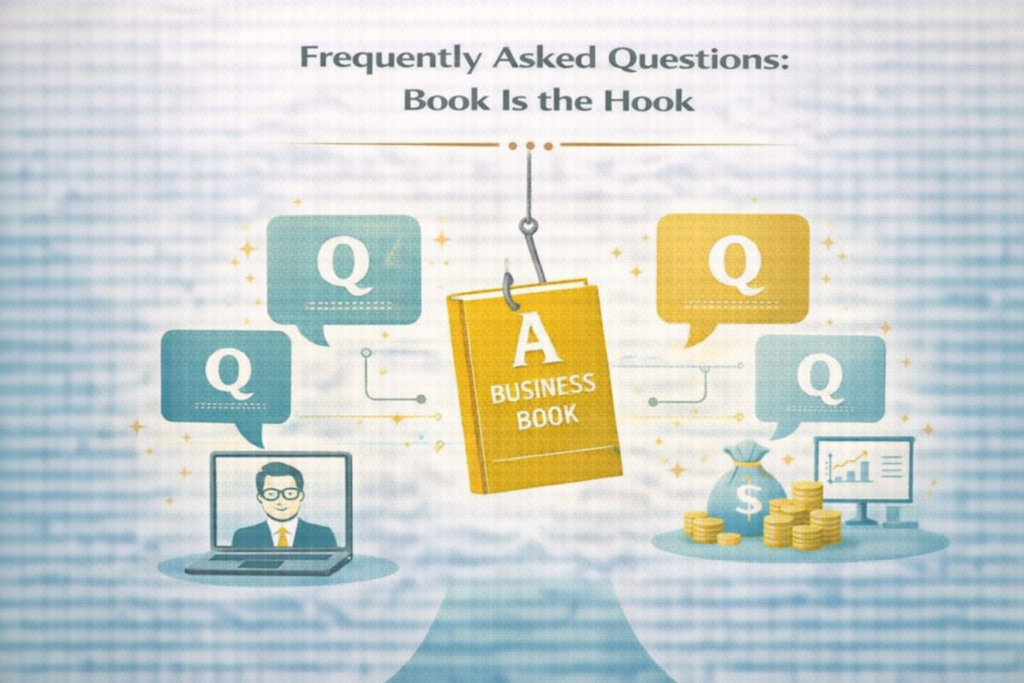
Frequently Asked Questions: Book Is the Hook
What does “Book Is the Hook” actually mean?
“Book Is the Hook” means the book is not the product.
It is the mechanism that creates trust, credibility, and demand for what comes next.
In the modern author model:
- the book opens conversations
- the book frames authority
- the book lowers resistance
Revenue comes from clients, speaking, training, partnerships, or platforms that the book enables, not from book sales themselves.
Can a book really generate clients?
Yes, when it is designed as a leverage asset.
Books generate clients by:
- pre-selling trust
- clarifying how the author thinks
- aligning the reader with a specific problem and point of view
Books that fail to generate clients are usually:
- broadly positioned
- written without a clear offer path
- treated as finished products instead of system components
A book does not “convert” clients.
It makes the conversation inevitable.
Is selling the book the goal?
No.
For most modern nonfiction authors, selling the book is a vanity metric, not a business metric.
In high-performing author businesses:
- book sales typically represent a small fraction of total revenue
- the majority of value comes from what the book unlocks
The book’s job is not to maximize copies sold.
Its job is to maximize credibility per reader.
How do modern authors actually make money from a book?
Modern authors monetize through:
- consulting or advisory work
- speaking and workshops
- training programs or cohorts
- enterprise engagements
- licensing or partnerships
The book creates trust and alignment.
Offers capture the value.
This is why monetization must be designed before writing begins.
Do I need a large audience for this to work?
No.
Audience size matters less than:
- relevance
- clarity of positioning
- alignment with a real problem
Many successful modern authors start with:
- small professional networks
- narrow audiences
- high credibility within a specific context
A focused book scales better than a popular one with no clear use.
Is this model only for coaches?
No.
The Book Is the Hook model works across multiple author types:
- consultants and advisors
- speakers and thought leaders
- trainers and educators
- founders and business owners
What changes is how the book is used, not whether it works.
Books amplify the existing model.
They don’t replace it.
Is ghostwriting compatible with Book Is the Hook?
Sometimes, but with limits.
Ghostwriting can help with execution speed, but it does not:
- design monetization pathways
- validate positioning
- activate authority early
If ghostwriting is used, the author must still:
- own the strategy
- define the offers
- control how the book is positioned and deployed
Without that, the book may exist without leverage.
Does this mean I have to “sell” aggressively?
No.
Book Is the Hook reduces selling pressure.
Because the book:
- aligns the reader
- demonstrates judgment
- frames the problem clearly
conversations feel collaborative, not transactional.
The book doesn’t push people to buy.
It pulls the right people closer.
What kind of book works best for this model?
Books that:
- take a clear point of view
- solve a specific problem
- introduce frameworks or ways of thinking
- are easy to reference in conversation
Broad memoirs or idea collections only work if they are explicitly connected to a clear outcome path.
Clarity beats cleverness.
How is this different from traditional publishing advice?
Traditional publishing advice focuses on:
- distribution
- prestige
- copies sold
Book Is the Hook focuses on:
- leverage
- authority
- outcomes
Both can coexist, but they optimize for different results.
If clients, speaking, or business impact matter, the book must be designed differently from the start.
Who is this guide for?
This guide is for:
- professionals already committed to writing a book
- authors who care about leverage, not just completion
- advisors helping leaders make smart book decisions
It is not for:
- hobbyist writers
- people seeking passive income from book sales alone
- authors unwilling to engage with monetization design
The Core Takeaway
A modern business book does not create value by being published.
It creates value by:
- shaping authority
- changing conversations
- making opportunities easier to say yes to
That is what “Book Is the Hook” actually means.
Next Steps
If this guide did its job, you now have clarity and not just urgency.
You understand how modern author monetization actually works. You can see where your book fits inside a larger leverage system. You know what needs to be designed, not guessed.
What comes next depends on how you want to execute.
Path 1: Build the System With Support
If you are building a book as serious business infrastructure, and want a structured partner in that process, the next step is to explore the Modern Author Operating System.
This is not a course or a launch playbook. It is an integrated system for:
- Designing books as leverage
- Translating authority into durable offers
- Building ecosystems that compound over time
- Executing with editorial rigor and strategic clarity
This path is for authors who want depth, alignment, and long-term thinking, and who prefer not to design everything alone.
Path 2: Build Independently With the Tools
If you are ready to execute on your own, the next step is to download the Workbook & Monetization Templates.
These tools allow you to:
- Finalize your offer architecture
- Map the reader journey intentionally
- Pressure-test revenue assumptions
- Align chapters directly to outcomes and offers
This path is not a lesser option. It is for disciplined builders who want to apply the system independently and move forward with confidence.
A Final Note on Readiness
There is no deadline here.
Modern authorship is not about speed. It is about durability.
The right next step is the one that matches your current level of commitment, resources, and ambition.
The system will still be here when you are ready to use it.What matters is not finishing a guide.
What matters is building something that keeps working long after the book is published.
If You’re Deciding What to Do Next
If this report clarified your thinking, the next step is usually not “publishing.”
It’s pressure-testing your strategy before you commit time, budget, or reputation.
Here are three ways authors typically proceed.
Map Your Modern Author Strategy
If you want to:
- Pressure-test your author model
- Clarify realistic outcomes
- Understand where ROI is likely to show up
- Avoid unnecessary spend
A short strategy conversation can surface issues early, before they become expensive.
Schedule a Modern Author Strategy Session
This is a working session, not a pitch.
Explore the Modern Publishing System
If you’re assessing:
- Whether to publish traditionally, hybrid, or independently
- How to structure presale and early activation
- What support actually reduces risk
You may want a clearer view of how the Modern Publishing System works in practice.
Explore Manuscripts Publishing Services
Study Real Author Outcomes
(For internal validation and stakeholder alignment)
If you’re preparing a recommendation for leadership, concrete examples often help.
See Modern Author Success Stories
About the Author
Eric Koester is an award-winning entrepreneurship professor at Georgetown University, bestselling author, and founder of Manuscripts. His work focuses on how ideas become assets, how books create leverage, and why modern authors need systems, not just publishing support.
He has worked with thousands of authors across traditional, hybrid, and modern publishing paths, helping them turn books into platforms, platforms into credibility, and credibility into durable business outcomes.
About Manuscripts
Manuscripts is the Modern Author OS for nonfiction experts.
We help founders, executives, coaches, and thought leaders design books as strategic assets, not standalone products. Our work spans positioning, author model design, developmental editing, AI-enhanced drafting tools, presale strategy, and long-term launch systems.
Manuscripts authors use their books to generate clients, speaking engagements, training programs, and enterprise opportunities, often before publication.
For readers who want to go deeper into specific mechanics, the following guides expand on topics referenced in this report:
- How to Write a Book if You’re Busy
- Modern Ghostwriting for Nonfiction Authors
- AI Tools for Authors in 2026
- How to Build an Audience Before You Write Your Book
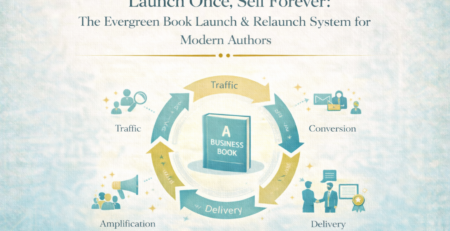
- The Evergreen Launch System for Modern Authors
Powered by Codex, the Modern Author Intelligence Tool.