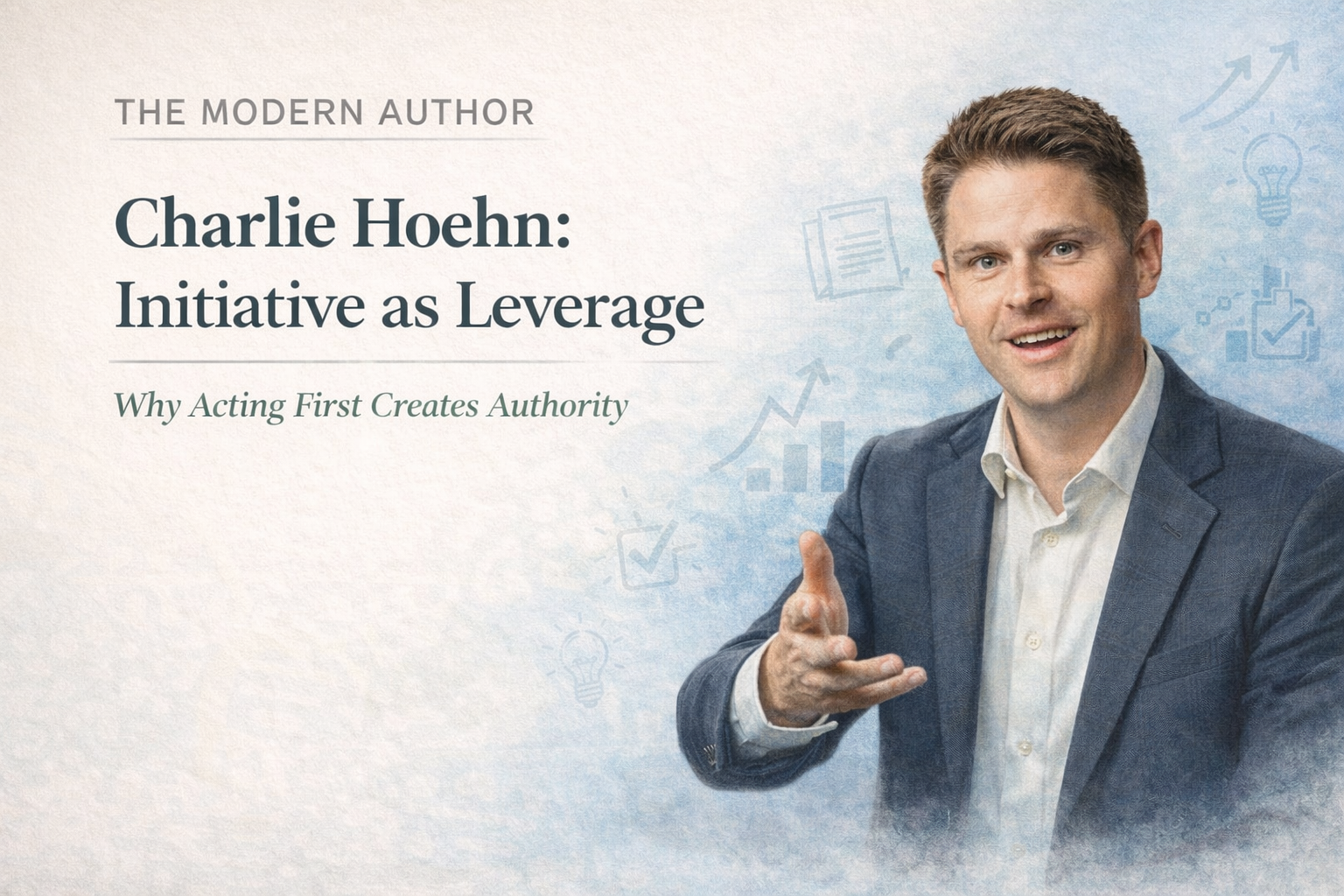
The Modern Author: Why Charlie Hoehn Leads With Value Instead of Waiting for Permission
Charlie Hoehn did not wait to be invited.
Across his career, he repeatedly identified work that needed doing and did it before anyone asked, approved, or paid for it.
He acted as if usefulness itself were sufficient justification to proceed.
This posture is easy to misread.
Acting without permission can look presumptuous. Leading with unpaid work can feel naive.
Moving before credentials are granted can appear risky or unserious.
But Hoehn’s career shows a different logic at work.
Creative leverage is not granted through titles, credentials, or formal permission. It is earned by acting first and delivering value in ways that make permission unnecessary.
For the modern author, this means leverage begins with initiative, not validation.
The Modern Author Lesson
Initiative is a form of authority.
For modern authors, leverage does not begin when someone validates your work.
It begins when your work makes validation optional.
Acting first, thoughtfully and in service of a real outcome, reframes your role. You are no longer asking to be trusted. You are giving others something concrete to evaluate.
This is the shift Hoehn’s career makes visible: authority is not something you wait to receive. It is something you demonstrate through behavior.
The permission trap
Most aspiring authors operate as if leverage must be granted.
They assume authority comes from credentials, opportunity from invitation, and momentum from external validation. Before acting, they look for a green light:
1.) a title,
2.) a contract,
3.) an endorsement,
4.) or a paycheck.
This mindset feels responsible. It also keeps people stationary.
Waiting for permission delays action until someone else is willing to assume the risk.
It places authors in a reactive posture, where progress depends on being chosen rather than choosing to act.
The trap is subtle.
In trying not to overstep, most people never step forward at all.
Initiative as a form of authority
Initiative is often misread as arrogance.
Acting without permission can feel like a violation of hierarchy, especially in creative or professional environments shaped by gatekeeping.
But initiative is not a breach of authority. It is a demonstration of it.
When someone acts first, thoughtfully, competently, and in service of a real outcome, they signal ownership.
They show they understand the problem well enough to move without supervision.
In this sense, authority is not something you wait to receive.
It is something you exhibit through behavior.
Initiative reframes the question from “Am I allowed to do this?” to “Can I make this better?”
Charlie Hoehn’s value-first operating rule
Hoehn’s career follows a consistent pattern: contribution precedes compensation.
Rather than positioning himself as an applicant or aspirant, he repeatedly led with useful work.
- He identified needs,
- produced value,
- and delivered it without requiring formal permission or immediate reward.
The pattern matters more than the particulars.
Hoehn did not wait to be certified as qualified.
He acted as if usefulness itself were the credential.
Recognition followed not because he demanded it, but because his contribution made saying yes easier than saying no.
This is not about personality or boldness.
It is an operating rule: output comes first. Entitlement never does.
How value creates leverage
Delivered value changes the power dynamics of opportunity.
When you create something useful in advance, you reduce risk for the other party. They no longer have to imagine your capability; they can evaluate it directly.
Value creates leverage by doing three things at once:
- It builds trust through evidence, not promise.
- It creates asymmetry by investing before being asked.
- It reframes the relationship from request-based to contribution-based.
Leverage emerges not because you demanded it, but because your action made you difficult to ignore.
This is why initiative compounds.
Each instance of delivered value increases future optionality.
Why most people hesitate to act first
Despite its effectiveness, most people resist acting first for predictable reasons.
1.)They fear rejection—that unsolicited effort will be dismissed or ignored.
2.)They fear exploitation—that giving value without compensation means being taken advantage of.
3.)They fear invisibility—that their contribution will go unnoticed and unrewarded.
These fears are understandable.
They are also incomplete.
The larger risk is not being used. It is remaining unproven.
Waiting protects ego in the short term. It preserves uncertainty indefinitely. Initiative replaces speculation with evidence, even when the outcome is imperfect.
Replacing credentials with contribution
Credentials signal potential.
Contribution demonstrates reality.
In many creative and professional contexts, consistent initiative can substitute for formal authority. It shows that you can identify meaningful work, execute without oversight, and deliver something that holds up under use.
This does not eliminate the value of experience or expertise. It accelerates their recognition.
When contribution leads, credentials become descriptive rather than necessary. They confirm what behavior has already made clear.
This is how initiative functions as a shortcut—not by skipping work, but by front-loading it.
What this means for modern authors
For modern authors, the posture is structural:
Create value in advance.
Let leverage follow. Produce work before being asked.
Share insight before being invited.
Build useful artifacts without waiting for validation or payment.
- Not as hustle.
- Not as self-sacrifice.
- As strategy.
Authority is not granted to those who wait well.
It accumulates around those who act, contribute, and make themselves useful before permission arrives.
Charlie Hoehn’s career illustrates that initiative itself is a form of leverage, one that compounds fastest when it is treated as the starting point, not the reward.
About the Author
Eric Koester is an award-winning entrepreneurship professor at Georgetown University, bestselling author, and founder of Manuscripts. He has helped more than 3,000 nonfiction authors turn ideas into books, and books into platforms for speaking, media, and business growth.
About Manuscripts
Manuscripts is a modern publishing partner for nonfiction authors who want their books to drive real-world outcomes. We help founders, executives, coaches, and experts design, write, and launch books that build authority, attract opportunities, and compound into long-term business assets.
Work With Us
If you’re writing a book you want to matter, we’ll help you map the right strategy before you write another word.
Schedule a Modern Author Strategy Session