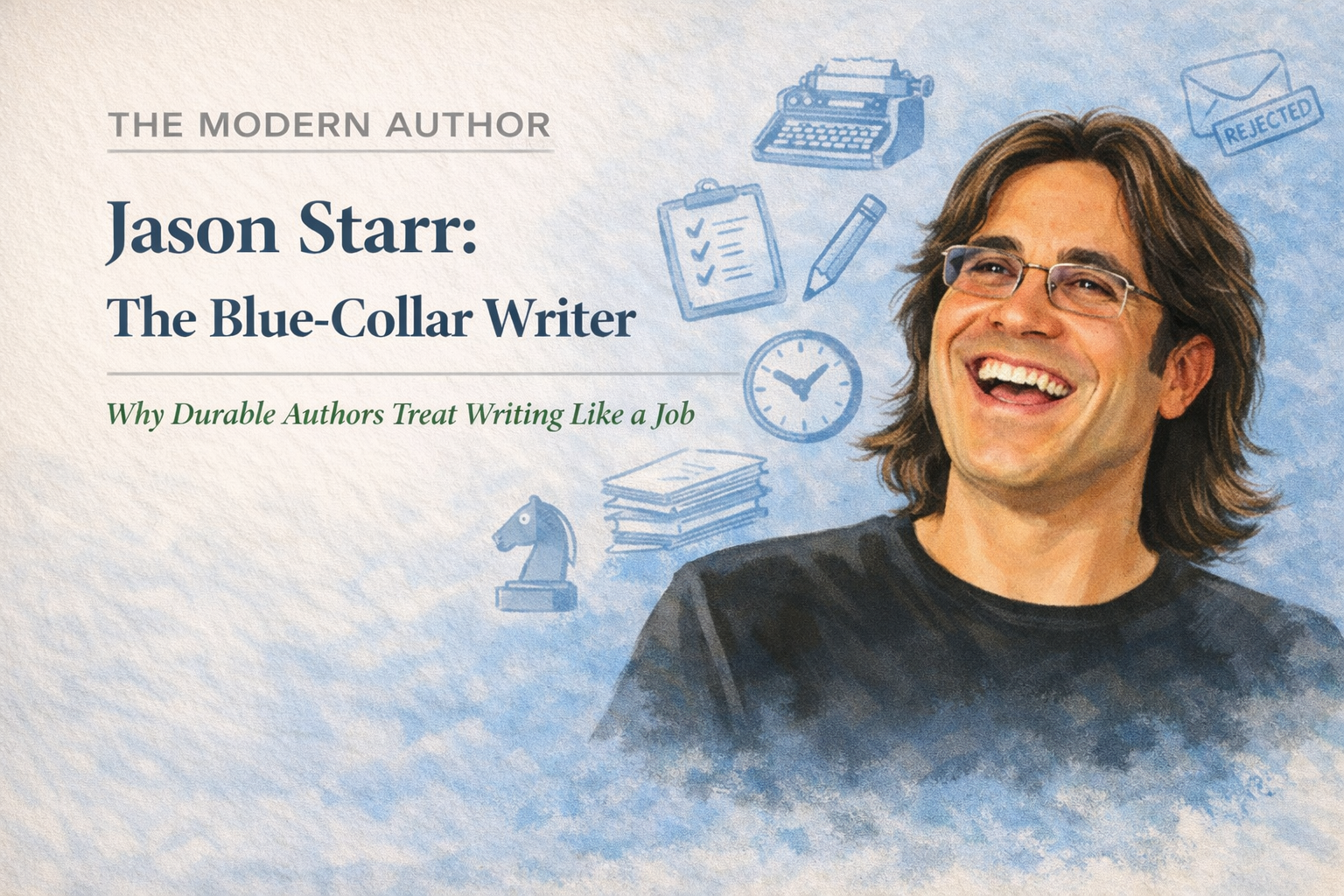
The Modern Author: Jason Starr on Writing Like a Blue-Collar Professional
Most aspiring authors treat writing like a creative mood.
Jason Starr treats it like a job.
His durability as a working writer comes from a simple rule:
tolerate constant micro-rejection,
show up daily anyway,
and generate material from lived familiarity instead of waiting for perfect conditions.
That’s the difference between wanting to write, and building a writing life.
Who This Is For
This is for you if:
- you’ve felt discouraged by rejection or silence
- you write in bursts but struggle with consistency
- you over-research instead of drafting
- you’re waiting to “feel ready” before committing
- you want a writing career, not just a finished manuscript
The Modern Author Lesson
The real shift is from romanticizing writing to operationalizing it.
Modern authors don’t wait for momentum.
They manufacture it.
And they don’t treat rejection as a verdict.
They treat it as background noise.
6 Takeaways Authors Can Steal from Jason Starr
1) Normalize Micro-Rejection
Rejection is not a dramatic event in a writing life.
It’s the baseline.
Editors pass. Agents decline. Readers criticize. Projects stall. Even established writers hear “no” constantly.
The mistake is interpreting friction as failure.
Modern authors expect resistance.
When rejection feels normal, it stops feeling personal.
Durability begins when “no” stops meaning “stop.”
2) Treat Writing Like a Blue-Collar Job
Starr frames writing as blue-collar work.
That framing removes illusion.
Blue-collar work is steady. Repetitive. Consistent.
Show up daily.
That can mean drafting, revising, outlining, tightening scenes, or restructuring chapters.
Intensity will fluctuate.
Commitment cannot.
Modern authors don’t rely on creative surges.
They build progress through small daily contact with the work.
3)The Commitment Engine: Talent + Reps + Enjoyment
Talent matters.
But talent without repetition produces nothing durable.
Starr’s formula is simple:
- Talent gets you started.
- Reps build competence.
- Enjoyment sustains repetition.
Without enjoyment, discipline burns out.
Without reps, talent stagnates.
Modern authors don’t depend on willpower alone.
They create conditions where repetition is psychologically sustainable, even when the material is dark or commercially uncertain.
4) Start with Familiar Material, Research After
“Write what you know” is not limiting advice.
It’s a production strategy.
Familiar worlds reduce friction.
Lived experience increases specificity.
Momentum builds faster.
Research supports the work.
It should not delay it.
Many aspiring writers reverse the order. They research to feel prepared. They outline to feel safe. They postpone drafting until the world feels complete.
Modern authors start from familiarity and expand outward.
Pages first.
Research second.
5) Keep Producing Until the Market Catches Up
Early projects are not wasted.
They are inventory.
Your second or third book may become the first one that lands.
But that only happens if you keep producing.
Markets shift.
Tastes change.
Gatekeepers rotate.
Control what you can control: output.
Modern authors don’t treat early work as failure.
They treat it as portfolio.
Durability is staying active long enough for preparation and opportunity to intersect.
6) Filter Feedback Intelligently
Feedback can sharpen a manuscript.
It can also derail it.
Starr’s decision rule is clean:
Ignore one-off opinions.
Pay attention when the same issue repeats across readers.
A single comment is data.
A pattern is direction.
Modern authors don’t let isolated reactions hijack momentum.
They adjust when signals repeat.
This protects both the work and the writer.
What to Avoid
If you want a durable writing career, avoid:
- treating rejection as a verdict
- waiting for ideal creative conditions
- researching instead of drafting
- overcorrecting based on single opinions
- mistaking intensity for consistency
Writing careers are not built on bursts.
They are built on repetition.
The Bottom Line
Writing is not fragile work.
It is repetitive work.
Normalize rejection.
Show up daily.
Start from familiarity.
Build sustainable reps.
Filter feedback wisely.
Modern authors don’t wait for confidence.
They build tolerance.
And tolerance compounds.
Listen:
Watch:
About the Author
Eric Koester is an award-winning entrepreneurship professor at Georgetown University, bestselling author, and founder of Manuscripts. He has helped more than 3,000 nonfiction authors turn ideas into books, and books into platforms for speaking, media, and business growth.
About Manuscripts
Manuscripts is a modern publishing partner for nonfiction authors who want their books to drive real-world outcomes. We help founders, executives, coaches, and experts design, write, and launch books that build authority, attract opportunities, and compound into long-term business assets.
Work With Us
If you’re writing a book you want to matter, we’ll help you map the right strategy before you write another word.
Schedule a Modern Author Strategy Session