

Traditional Publishing vs Self Publishing: Why Modern Authors Choose Ownership in 2026
Most authors still believe the publishing story they were taught as kids:
You write a book.
A publisher chooses you.
Your book appears in bookstores.
Your career changes.
That story is outdated.
Not because books don’t matter.
Because the publishing economy has changed completely.
In 2026, the question is no longer:
Can you get published?
The question is:
Can you own what you publish?
Because ownership is the difference between:
- a book that sells a few hundred copies
- and a book that becomes a business asset for the next decade
This is the Modern Author shift.
Publishing Isn’t About Printing Books
Publishing has never really been about paper.
It has always been about distribution.
For most of the last century, publishers held a monopoly on four things:
- access to bookstores
- production infrastructure
- industry expertise
- permission
If you wanted readers, you needed a gatekeeper.
Traditional publishing existed because it was the only way to scale distribution.
As we often say:
Traditional publishing was a distribution vehicle.
That’s what it was built for.
But distribution is no longer scarce.
The Distribution Monopoly Is Gone
Amazon changed everything.
Today, most books are discovered online, not in bookstores.
And the hard truth is this:
You no longer need a publisher to get your book to readers.
You need a strategy.
You need infrastructure.
You need an operating system.
Because the barrier is not printing.
The barrier is activation.
The Hidden Truth of Publishing Economics
Here is the statistic that shocks almost every first-time author:
The median traditionally published book sells roughly 250 copies in its first year.
That’s not a typo.
Two hundred and fifty.
And royalties are often around $1 per book.
Meaning the median author earns a few hundred dollars.
Most authors don’t fail because they aren’t talented.
They fail because they misunderstand what publishing actually delivers.
Traditional publishing does not guarantee:
- marketing
- distribution success
- audience growth
- meaningful ROI
It guarantees one thing:
The publisher owns the asset.
Traditional Publishing vs Self Publishing: The Real Ownership Difference
This is the real divide.
Traditional publishing is usually publisher-owned publishing.
You trade away:
- rights
- control
- economics
- long-term upside
In exchange for:
- a logo
- a deal
- the illusion of distribution
Most authors don’t realize what they’re signing until later.
I’ve lived this personally.
My first traditionally published book is no longer even mine.
I don’t own the copyright anymore.
That’s what publisher-owned publishing means.
And once you understand that, you never see publishing the same way again.
Why Modern Creators Choose Ownership Over Traditional Publishing
Publishing is going through the same transformation music went through.
Taylor Swift signed away her catalog at 15.
Years later, someone else owned her life’s work.
So she did the only rational thing:
She rebuilt ownership.
“Taylor’s Version” wasn’t about nostalgia.
It was about power.
Chance the Rapper refused labels entirely.
He owned his work.
He owned his distribution.
He owned his upside.
That’s the modern creator model.
Authors are next.
What Is Author-Owned Publishing?
Author-Owned Publishing means:
- you retain your rights
- you control your positioning
- you build your audience directly
- you monetize beyond retail
- you own the asset you create
This doesn’t mean doing everything alone.
It means building the right professional team around an author-owned structure.
Hybrid publishing, when done correctly, is simply:
professionally supported self-publishing.
The author remains the owner.
The publisher becomes the partner.
That is the Manuscripts model.
Why Modern Authors Care More About Ownership Than Royalties
They chase leverage.
Outside research and our internal data show the same thing:
Only 5–15% of nonfiction author income comes from retail book sales.
The other 85–95% comes from what the book unlocks:
- Speaking
- consulting
- workshops
- enterprise training
- licensing
- media authority
- long-term trust
Modern authors don’t write books to sell books.
They write books to build platforms.
Why Pre-Launch Publishing Creates Better Book Launches
The single biggest mistake authors make is waiting until publication to find readers.
Modern authors do the opposite.
They build their reader community before the book exists.
They presell.
They activate.
They turn the book into a shared project, not a finished product.
Because something powerful happens when someone supports a book early:
They don’t just buy.
They evangelize.
When a reader buys a book after publication, they tell almost nobody.
When they buy before it’s done, they tell three to five other people.
That is the difference between a launch and a movement.
Presale-first publishing is not marketing.
It’s community formation.
The strongest modern launches are designed as long-term systems rather than one-time release events.
It’s the foundation of Author-Owned Publishing.
This Guide Will Show You the Full Modern Publishing System
This is not a guide about “how to self-publish.”
It’s a guide about how modern authors build durable intellectual property.
Inside, you’ll learn:
- the real economics of traditional vs hybrid publishing
- why most books fail commercially even with publishers
- what Author-Owned Publishing actually means in practice
- how presale publishing creates audience before launch
- the activation marketing model that outperforms ads by 100x+
- how modern authors build books that generate ROI for years
- why Manuscripts Press has become a top global publisher through this approach
- how to publish without giving away the asset you’re creating
Publishing is no longer about getting chosen.
It’s about building something you own.
Let’s show you how.
Publishing isn’t about printing a book.
It’s about owning an asset that opens doors for the next ten years.
Most people still treat publishing as a finish line. You write a manuscript, hand it off, hope someone cares, sell a few hundred copies, and move on. If the book doesn’t “hit,” the project is quietly categorized as a miss, and the effort ends there.
That model made sense when publishing was scarce, permission-based, and controlled by a small number of gatekeepers. Today, it produces frustration because it confuses production with value.
A book is not valuable because it exists.
It’s valuable because of what it enables.
The Old Model: Production Without Leverage
Under the legacy view, publishing looks like this:
- Write the book
- Hope a publisher accepts it
- Sell a small number of copies
- Move on to the next thing
Success is measured by validation and distribution. Once the book is out, the author’s role is effectively over.
The problem isn’t that this approach is wrong.
It’s that it’s structurally misaligned with how serious professionals actually want books to work.
Most executives, founders, and experts are not trying to “be authors.” They’re trying to build authority, create opportunity, and extend the reach of their thinking. A model that treats the book as a one-time product can’t do that.
Why Modern Authors Treat Books as Business Assets
Modern authors operate from a different premise:
a book is infrastructure.
Instead of asking, “How do I get published?” they ask, “What asset am I building, and what should it unlock?”
That shift changes everything.
Modern authors design their books to:
- Own their rights, so the work compounds instead of expiring
- Own their audience, rather than renting attention at launch
- Activate demand before the book exists, creating momentum instead of silence
- Monetize beyond retail, turning a book into a platform rather than a receipt
The book is no longer the end product.
It’s the central node in a larger system of leverage.
Modern authors increasingly use books as long-term authority and opportunity assets.
Publishing Is a Strategy, Not an Event
When publishing is treated as asset creation, success is no longer defined by acceptance or initial sales. It’s defined by control, longevity, and optionality.
Who owns the work?
Who owns the audience relationship?
What doors does the book make easier to open?
Those questions matter more than where the book is printed or how many copies move in the first month.
As Eric Koester puts it:
| “Your book will open doors for you. The more strategic you are about what doors you want, the better.” |
That sentence captures the modern reality. Books don’t create value equally. Strategy determines which doors open, and which never do.
This guide starts from that premise.
Not how to publish a book, but how to build an asset that makes publishing worth doing at all.
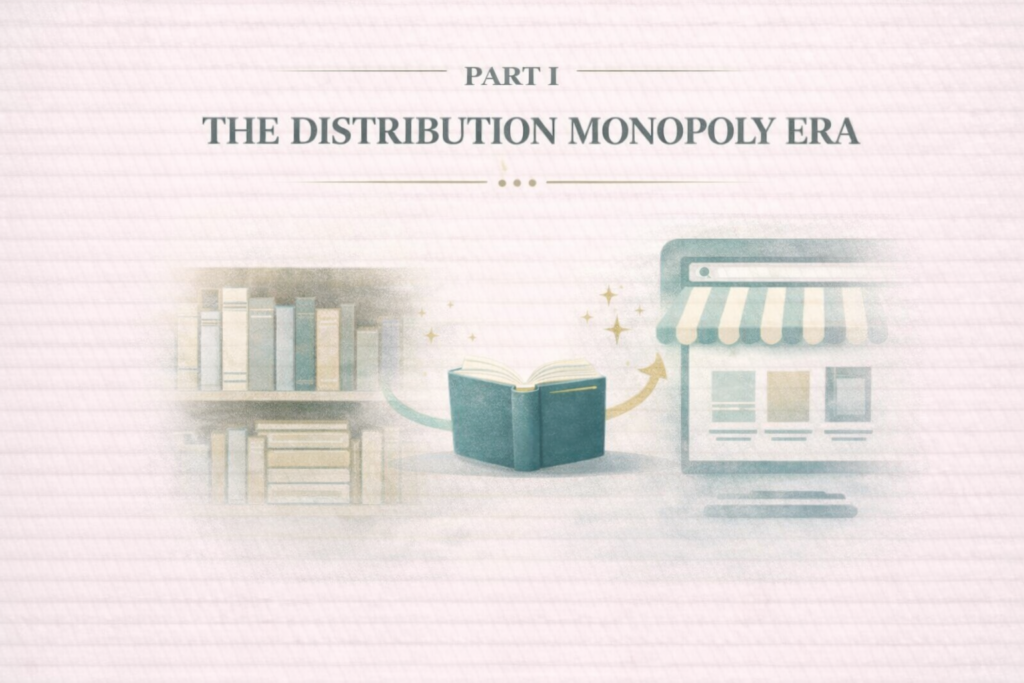
Publishing Used to Be a Distribution Monopoly
Traditional publishing wasn’t built for authors.
It was built for bookstores.
For most of publishing history, books were sold in physical retail locations. That single constraint shaped the entire industry.
Readers bought books in stores.
Stores didn’t want to manage relationships with thousands of individual authors.
So publishers emerged as the intermediary.
Their role was not primarily cultural or creative.
It was logistical.
Publishers existed to make physical distribution work at scale.
Once you understand that, the rest of the system makes sense.
What Traditional Publishing Actually Solved
Traditional publishing bundled four functions that were necessary in a bookstore-driven world:
- Expertise (gatekeeping)
Shelf space was scarce. Publishers filtered manuscripts to decide which books deserved access. - Production
Editing, layout, printing, and cover design required specialized teams and economies of scale. - Resources
Someone had to front the cost of producing inventory before a single book was sold. - Distribution
Publishers had established relationships with bookstores and wholesalers that authors could not access directly.
Together, these functions formed a tightly integrated system optimized for physical retail.
That system worked, because it had to.
Why Control Concentrated
When access to readers depended on bookstores, access became scarce.
Scarcity created leverage.
Publishers controlled distribution.
Distribution control justified ownership of rights, long timelines, and asymmetric economics.
This wasn’t malice. It was structure.
A distribution monopoly doesn’t require bad actors.
It only requires bottlenecks.
And for decades, physical distribution was the bottleneck.
The Key Reframe
Why Traditional Publishing Was Built Around Distribution
Once you see it that way, much of the mythology dissolves.
Publishers were not arbiters of legitimacy.
They were infrastructure built for a specific era.
And that era was defined by physical access, not authorship, ownership, or long-term leverage.
Understanding this releases authors from outdated assumptions about what publishing is supposed to look like.
If the original constraint no longer defines the market,
then optimizing for it no longer makes sense.
That question, what constraint matters now, is where modern authorship begins.
Publisher-Owned Publishing (The Old Trade)
What Authors Give Up in Traditional Publishing
For decades, a traditional publishing deal has been framed as a reward.
Validation. Legitimacy. Support.
In reality, it is a transaction most authors never fully see.
A traditional deal is not free validation.
It is an exchange of ownership for distribution access.
In practical terms, that exchange usually looks like this:
- You give up your intellectual property
- You earn roughly 10% royalties
- The publisher controls rights, pricing, and lifecycle decisions
What feels like recognition is actually a transfer of leverage.
Royalties, Without the Myth
Many authors assume that publishing success means earning money from book sales.
The math rarely supports that belief.
Even in respectable deals, royalties are small, capped, and slow to materialize.
Eric Koester’s own experience is illustrative:
- 5% royalties on the first 500 copies
- Rights surrendered as part of the deal
That structure isn’t unusual. It’s representative.
Royalties are not designed to reward authors for long-term value creation.
They are designed to compensate contributors after ownership has already changed hands.
Once the math is visible, the fantasy dissolves.
Control Loss Is Permanent
The most misunderstood part of a traditional deal is not royalties.
It’s irreversibility.
When rights are assigned to a publisher, that decision is not symbolic or temporary.
It is structural.
As Eric puts it:
| “I don’t own the copyright anymore… they put it in the public domain.” |
That outcome is not an edge case. It is a consequence of ownership transfer.
Publishing contracts are asset decisions with long tails.
They determine who controls the work years, or decades, after the launch window closes.
Why Traditional Publishers Rarely Handle Book Marketing
The final justification many authors hold onto is marketing.
The assumption is simple:
“If a publisher takes my book, they will help sell it.”
The reality is more constrained:
- No meaningful marketing dollars for most titles
- No advance for roughly 98% of authors
- You still do the majority of promotion
What the publisher provides is distribution access, not demand creation.
Once distribution is no longer scarce, this tradeoff stops making sense.
From Aspiration to Agency
This section is not about resentment.
It’s about alignment.
If authors are responsible for the work, the promotion, and the outcome, then ownership matters.
The quiet realization this section should leave behind is simple:
If I’m doing the work anyway, I should own the upside.
That realization is what makes the modern publishing conversation possible.
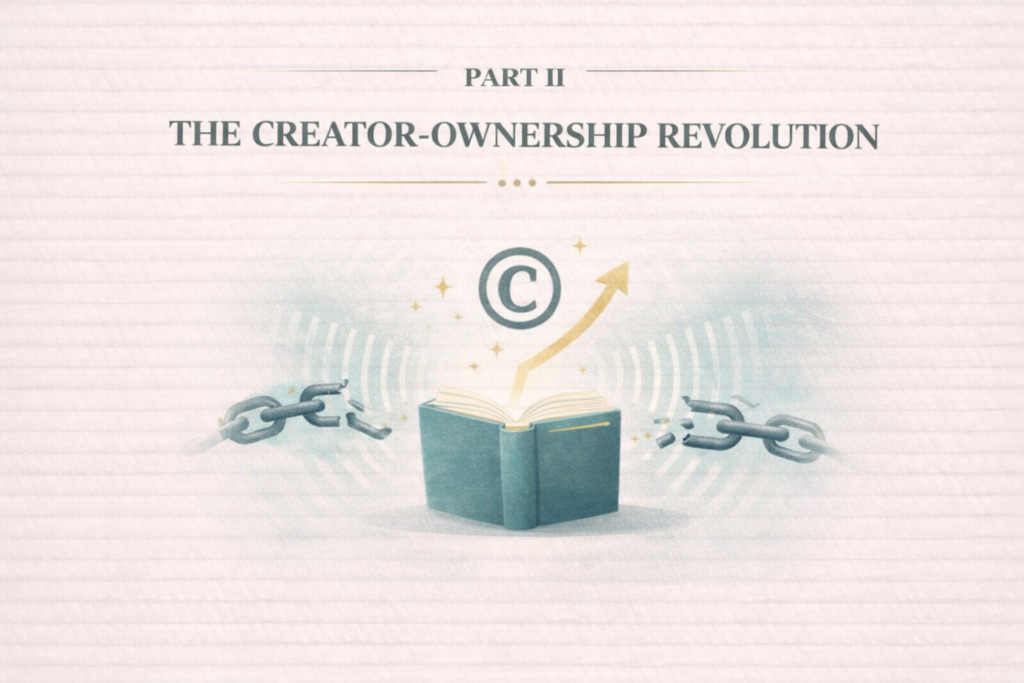
The Creator-Ownership Revolution (The Taylor Swift Moment)
Publishing Is Going Through What Music Already Did
Publishing is late to a shift that already reshaped music, film, and media.
For most of the last century, creators traded ownership for access:
- access to distribution
- access to audiences
- access to professional infrastructure
That trade made sense when access was scarce.
But once distribution becomes abundant, once creators can reach audiences directly, the old deal stops being “the way it works” and starts becoming a choice.
That is the moment publishing is now entering.
Why More Authors Are Choosing Author-Owned Publishing
Across creator industries, a clear pattern emerged:
- Early creators give up rights to get in the door.
- Middlemen capture the long-term value of the catalog.
- The creator eventually realizes the asset wasn’t the product, it was the rights.
- Ownership becomes the lever that unlocks leverage, longevity, and optionality.
Publishing is not exempt from this logic.
It is simply catching up.
| Taylor Swift’s Lesson: Rights Outlive LaunchesTaylor Swift’s “Taylor’s Version” era is not a pop culture curiosity. It’s a rights lesson.As a teenager, she signed a standard record deal, one that transferred ownership of her masters. Over time, those rights changed hands. Eventually her catalog was controlled by someone else.Her response was not branding. It was an ownership move:she re-recorded her workreleased it under versions she ownedrebuilt the catalog on her termsThe strategic takeaway is simple:When creators own the asset, they control the future.That is what ownership buys: not a moment, but a decade of leverage. |
| Chance the Rapper’s Lesson: Permission Is Optional NowTaylor’s story shows why ownership matters after success.Chance the Rapper shows something different: ownership is available from the start.When labels offered him distribution but demanded rights, he refused. He released his work independently, built momentum directly with listeners, and achieved both commercial and cultural legitimacy, without signing away control.The takeaway is not that every creator should follow the same path.It’s that the old requirement, permission first, ownership later, is no longer structurally true. |
Ownership Is Power
These stories point to a governing principle that now applies to authors:
- Ownership creates optionality.
- Optionality creates leverage.
- Leverage creates longevity.
This is why author-owned publishing is not radical.
It is the normal direction of creator economies once distribution stops being a gate.
And it leads to the conclusion modern authors need to internalize:
| Authors don’t need permission anymore. |
How Amazon Changed Traditional Publishing Forever
The Only Bottleneck That Ever Mattered Was Distribution
For most of publishing history, the key constraint wasn’t writing quality.
It was reader access.
If readers bought books in physical stores, then shelf space and retail placement were the gate. Publishers didn’t have power because they were better at judging ideas. They had power because they controlled the channel.
That’s why distribution was the central function traditional publishing solved. Everything else, editing, design, printing, credibility, was bundled around that core reality.
Distribution Is No Longer Exclusive
Amazon removed the need for a single intermediary to reach readers.
That does not mean “anyone can write a good book.”
It means no one has exclusive control over the path between a finished manuscript and a buyer.
As Eric Koester puts it:
“You don’t have to have someone give you permission to get your book to readers.”
That sentence is the turning point. In a world where authors can reach readers directly, permission-based publishing collapses as the default strategy.
The Center of Gravity Moved Online
The modern book market is not organized around bookstore shelves.
Most books are now discovered, purchased, and delivered through online platforms. This changes what “distribution” even means:
- nationwide placement is no longer required to sell nationally
- discovery happens digitally, not aisle-by-aisle
- reach is driven by audience access and visibility, not physical footprint
Bookstores still matter, but they are no longer the center of gravity. They are one channel inside a larger ecosystem.
Going Direct Is Not a Workaround. It’s the Default.
Once distribution is open, direct-to-reader publishing stops being a niche move and becomes normal infrastructure.
Authors can:
- publish without being chosen
- sell without retail placement
- build demand without waiting for launch day
This is not a claim that the market is easier. It’s a claim that the gate has moved.
The bottleneck is no longer distribution access.
It’s execution: strategy, positioning, audience, and momentum.
Freedom Increases Responsibility
When intermediaries stop controlling access, authors gain leverage, but they also inherit responsibility.
If you can go direct, then the decisive questions become:
- do you own the rights to the asset you’re creating?
- do you own an audience relationship, or are you renting attention at launch?
- do you have a strategy to create demand before publication?
Amazon removed scarcity.
Now the advantage shifts to the authors who know what to do with it.
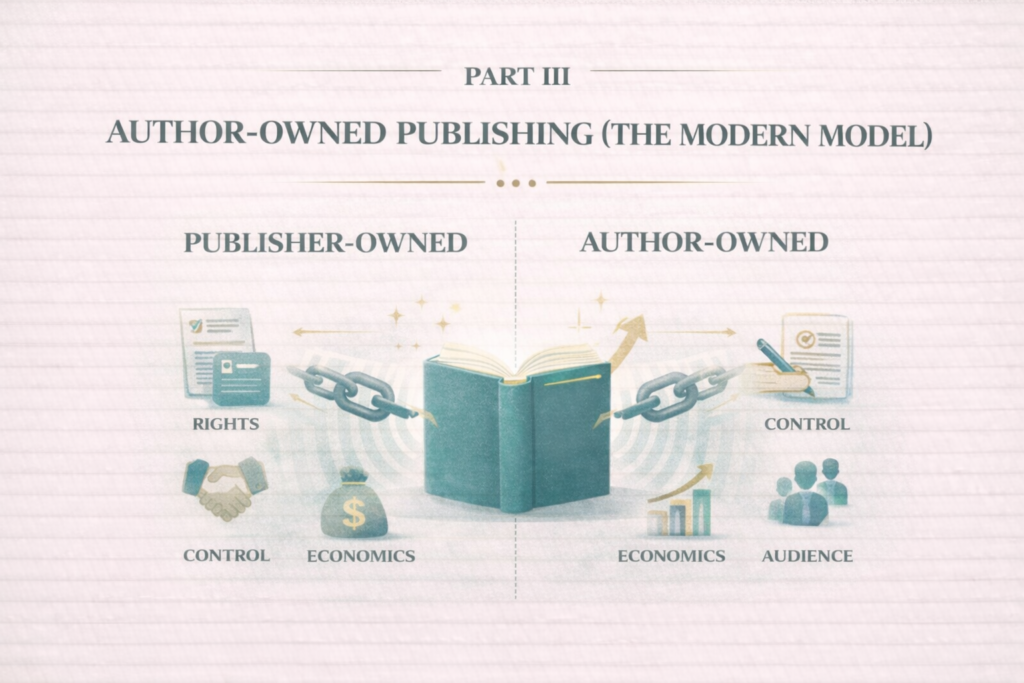
Author-Owned Publishing (The Modern Model)
The Simplest Definition
Author-Owned Publishing is a model where the author retains ownership and control of the book as a long-term asset.
That means:
- You keep your rights.
- You keep creative control.
- You keep the economic upside.
- You own the system that brings the book to market.
Publishing, in this model, is no longer something that happens to you.
It’s something you design and operate.
This is not a niche alternative.
It is the default model once distribution is no longer scarce.
From “Getting Published” to Building Infrastructure
In the traditional model, publishing is a handoff:
You finish a manuscript, pass it to a publisher, and wait.
In an author-owned model, publishing is infrastructure:
You design how the book is produced, launched, distributed, and leveraged over time.
The role of the author changes accordingly:
- From applicant to operator
- From recipient of services to owner of a system
- From one-time launch to long-term leverage
The book is no longer the endpoint.
It’s the core asset inside a broader engine.
Ownership Comes With Responsibility
Author-owned publishing is not about doing everything yourself.
It’s about deciding where responsibility lives.
When you own the asset:
- Control replaces delegation.
- Strategy replaces hope.
- Systems replace gatekeepers.
This is the tradeoff.
Freedom increases, but only if the author is willing to engage as an owner, not a bystander.
Hybrid Publishing vs Self Publishing: What’s the Difference?
There are two primary ways authors execute author-owned publishing today.
They differ in how support is assembled, not in who owns the book.
Self-Publishing
The author assembles and manages the team directly:
- Editors
- Designers
- Production
- Launch and distribution
The author owns everything, and coordinates everything.
Hybrid Publishing
The author still owns the book, but works with a professional partner that provides the team and infrastructure.
As Eric Koester puts it:
“Hybrid publishing is essentially professionally supported self-publishing.”
In both models:
- The author retains rights.
- The author controls creative decisions.
- The author keeps the economic upside.
The difference is operational, not philosophical.
Two Paths Within Author-Owned Publishing
| Dimension | Self-Publishing | Hybrid Publishing |
| Rights ownership | Author owns 100% | Author owns 100% |
| Creative control | Author decides | Author decides |
| Economic upside | Author keeps all | Author keeps all |
| Team assembly | Author builds team | Publisher provides team |
| Operational load | High | Shared |
| Role of publisher | None | Support + infrastructure |
| Asset ownership | Author | Author |
Choosing Support Without Surrendering Ownership
Hybrid publishing is often misunderstood as a compromise.
It isn’t.
It exists to solve a practical problem:
Many authors want ownership without building a publishing operation from scratch.
In an author-owned hybrid model:
- Ownership stays with the author.
- Support is added, not substituted.
- Control is shared intentionally, not forfeited contractually.
This reframes the decision away from prestige and toward design:
How much operational responsibility do you want to carry personally?
The Decision That Actually Matters
Once authors understand author-owned publishing, the question changes.
Not:
“Should I try to get published?”
But:
“If I own this asset, how do I want to operate it?”
That question pulls the reader forward, toward choices about:
- Editorial rigor
- Audience ownership
- Presales and launches
- Monetization systems
Those are no longer side considerations.
They are the work of ownership.
The Economics Nobody Understands
Why Most Traditionally Published Books Fail Financially (Even When They’re Good)
Most authors operate with an unspoken assumption:
If the book is good, it will sell enough copies to justify itself.
That belief is understandable.
It’s also wrong.
Not because authors lack talent or effort, but because book economics collapse at the median when copies are treated as the business model.
This section exists to replace hope with math.
The Median Reality (What Actually Happens)
Forget bestsellers. Strategy is built on what usually happens, not what occasionally happens.
Median book performance today:
| Publishing Path | Typical Sales | Timeframe |
| Traditionally published | ~250 copies | First year |
| Self-published | ~25–50 copies | Lifetime |
“The median traditionally published book sells 250 copies in its first year.”
“The median self-published book sells 25 to 50 copies over its lifetime.”
These are not failure cases.
They are the most common outcome.
Planning as if you’ll be the exception is not optimism.
It’s poor design.
The Royalty Math (Where the Illusion Breaks)
Now translate sales into income.
| Scenario | Calculation | Result |
| Traditional royalties | 250 copies × ~$1 per book | ~$250 total |
| Self-published royalties | 25–50 copies × higher margin | Still negligible |
This is not slow money.
It is symbolic money.
Most authors quietly lose money here, and then blame themselves.
They shouldn’t.
This Isn’t About Talent. It’s About Structure.
Books don’t fail financially because:
- the idea was weak
- the writing wasn’t good
- the author didn’t work hard enough
They fail because selling copies is a structurally weak business model.
- Books are expensive to produce
- Discovery is difficult
- Word of mouth does not spread after publication
- Royalties cap early and arrive slowly
This is a market structure problem, not a personal one.
Why This Forces a Different Strategy
Once you accept the math, one conclusion becomes unavoidable:
If selling copies is the plan, the plan doesn’t work.
That does not mean books are worthless.
It means books cannot be treated as standalone businesses.
A viable model requires that:
- Copies are not the primary revenue
- Readers are not the only customers
- The book plugs into something larger
Until that shift happens, authors will keep optimizing a system that cannot pay them back.
That is what the next sections solve.
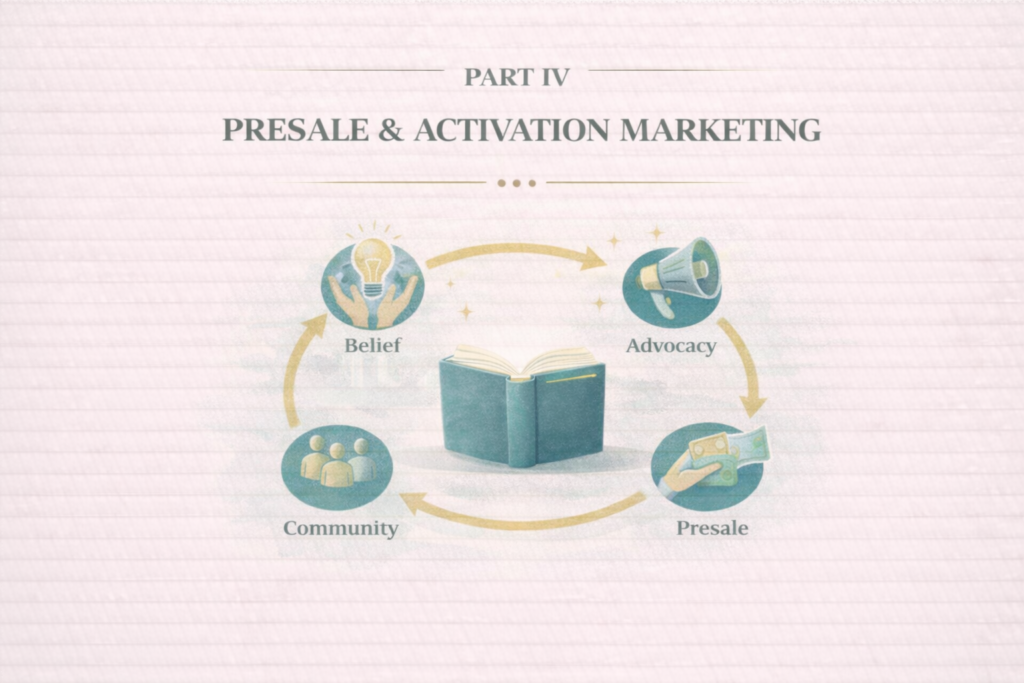
Why Pre-Launch Publishing Outperforms Traditional Book Launches
Two Launches, Not One
Most authors still plan publishing like this:
Finish the book.
Publish it.
Then try to market it.
That sequence feels logical, and it consistently fails.
Books do not spread after publication.
They either accumulate momentum before release, or they disappear quietly after it.
This is why modern publishing requires two launches, not one:
- A presale launch, where belief is activated
- A publication launch, where distribution catches up
Without the first, the second rarely matters.
Why Books Don’t Spread After Publication
After a book is published, reader behavior is passive.
A typical reader:
- Buys the book
- Reads privately
- Tells no one
There is no social signal attached to the transaction.
No urgency. No identity. No reason to share.
This is not a marketing failure.
It’s a human one.
Why Presales Do Spread
Presales change the behavior entirely.
A presale buyer:
- Commits before the book exists
- Signals belief, not consumption
- Tells three to five other people
That difference matters.
People don’t share transactions.
They share identity.
Buying early says:
- I’m part of this
- I believe in this
- I was here before it was finished
That’s why presales create word-of-mouth and retail doesn’t.
As Eric Koester puts it:
“When someone buys before it’s done, they tell three to five more people.”
That’s not anecdotal.
It’s behavioral.
Presale Is Structural, Not Tactical
Presale is often misunderstood as:
- A funding mechanism
- A preorder tactic
- A discount strategy
It’s none of those.
Presale is how momentum is created before distribution.
It’s how readers become advocates.
It’s how belief spreads ahead of availability.
That’s why this isn’t optional.
If you want reach, presale is the model.
Not a hack. Not a trick. The structure.
Eric’s emphasis is intentional:
“Definitely definitely definitely definitely.”
Inside the model, this isn’t debated.
It’s settled.
What This Forces Authors to Rethink
Once this lands, a few assumptions break:
- Publishing is no longer the starting line
- Marketing is no longer post-release
- Momentum is no longer accidental
Presale shifts the author’s job from:
“How do I promote my book?”
to:
“How do I activate belief early?”
That question changes everything.
Because once presale is the model, the next problem becomes obvious:
How do you design presales that actually work?
That’s what comes next.
Why Audience Activation Matters More Than Traditional Book Marketing
Why How You Approach People Matters More Than How Many You Reach
By now, the pattern should be clear:
- Presales matter
- Early believers spread books
- Audience ownership beats distribution
What still trips most authors up is this belief:
“I just need better marketing tactics.”
That’s not the problem.
The real difference is not what you say or where you say it.
It’s how the relationship starts.
The gap between selling and activating is not incremental.
It’s exponential.
The 150× Gap: Selling vs. Activating
Most book marketing fails for a simple reason: it starts with extraction.
Cold outreach, ads, blasts, DMs, treats attention as something to harvest. It asks for trust before any has been earned.
The economic result looks like this:
| Dimension | Cold Outreach | Activation |
| Starting point | Stranger | Warm signal |
| First move | Ask | Give |
| Tone | Transactional | Relational |
| Psychology | Persuasion | Belonging |
| Trust level | Near zero | Pre-established |
| Typical outcome | ~$15 | ~$2,000 |
| Share behavior | None | 3–5 referrals |
| Emotional response | Resistance | Advocacy |
| Identity | “I’m being sold to” | “I’m part of this” |
This isn’t a copywriting problem.
It’s a behavioral one.
Cold outreach signals extraction.
Activation signals inclusion.
That’s where the 150× difference comes from.
What “Activation” Actually Means
Activation is not marketing in the traditional sense.
It’s relationship design.
At its core:
Activation = belonging psychology, not selling.
People don’t respond to pitches.
Audience-building works best when readers are involved before publication instead of after launch.
They respond to recognition, participation, and identity.
That’s why activation reliably produces:
- Higher willingness to pay
- Organic referrals
- Early advocacy
With fewer people, not more.
The Activation Loop (How Belief Is Created Before Money)
Activation follows a predictable sequence. When authors skip steps, results collapse.
Step 1: Observe (Signal Before Speech)
You start by paying attention:
- Reading what someone writes
- Understanding what they care about
- Seeing how they already identify
Purpose: Establish relevance without intrusion.
Step 2: Engage First (No Ask)
You respond:
- Like, comment, or reply
- Publicly or privately
- With no pitch, link, or agenda
Purpose: Signal recognition and generosity.
This flips the power dynamic.
Step 3: Name the Work (Context, Not Offer)
You reference what you’re building:
“I’m working on a book about X.”
Not:
- “Can I sell you something?”
- “Can you help me?”
Purpose: Invite curiosity without pressure.
Step 4: Invite Belonging (Not Purchase)
You extend a low-friction invitation:
“I’m inviting a small group into the early reader circle.”
Key rules:
- No transaction yet
- No scarcity language
- No pitch deck
Purpose: Shift the relationship from audience to insider.
Step 5: Early Commitment (Presale or Participation)
Only after belonging is established:
- Presale support
- Advisory board access
- Early workshop or preview
Purpose: Commitment activates advocacy.
Step 6: Evangelism (The Flywheel)
Because they joined early, people:
- Tell friends
- Share publicly
- Recruit others organically
Purpose: Growth without marketing.
People don’t share products.
They share participation.
Why Activation Scales Value, Not Volume
Activation doesn’t increase reach.
It increases depth.
That’s why the outcomes are so different.
With activation:
- Fewer people are needed
- Trust is preloaded
- Willingness to pay rises
- Referral behavior appears naturally
This reframes growth away from:
- Lists
- Reach
- Algorithms
And toward:
- Relationship density
- Signal
- Identity
How the 150× Rule Connects Directly to Presales
Presales work because they are an activation mechanism, not a sales tactic.
A presale buyer isn’t just purchasing early.
They are signaling:
- Belief
- Taste
- Alignment
That signal changes behavior.
The Economics Stack
Cold Buyer
- Low trust
- Low identity
- Low willingness to pay
- Zero referral behavior
Activated Presale Buyer
- High trust
- Insider identity
- High willingness to pay
- 3–5 organic referrals
That delta is the 150× Rule in action.
The Hidden Multiplier
If:
- One presale supporter contributes $100–$250
- Each tells 3–5 people
- Those people arrive pre-warmed
Then:
- Customer acquisition cost collapses
- Conversion rates spike
- Offers naturally expand (events, workshops, consulting)
Presale isn’t about cash flow.
It’s about trust compression.
The Line to Anchor This Section
The 150× Rule exists because presale buyers aren’t customers, they’re co-signers.
That sentence connects:
- Activation
- Presales
- Word of mouth
- Monetization
All at once.
When this lands, the reader stops thinking:
“I need more reach.”
And starts thinking:
“I need earlier belief.”
That shift is what makes everything that follows work.
The Two Presale Models Modern Authors Use
Presale is not a trick. It’s the only reliable way to make a book spread.
What most authors still lack is structure.
They know presale matters, but they don’t know which presale model to run, when to run it, or what each model is designed to achieve.
Modern authors typically choose between two proven approaches. Both work. They just optimize for different outcomes.
The Two Models at a Glance
| Model | Timing | Primary Goal | What You Sell | What It’s Best For |
| Model A: Book Announcement Presale | ~6 months out | Build audience + community before the book exists | Tickets, workshops, early access, participation | Author-owned publishing, momentum, funding, relationship depth |
| Model B: Author Perks Presale | ~2–3 months out | Align presale with retail + bestseller mechanics | Perks tied to retailer purchase (signed copies, community, events) | Traditional/hybrid launches, retail velocity, list strategy |
This is what makes presales feel safe: they’re not improvised. They’re selectable.
Model A: Book Announcement Presale (6 Months Out)
This is the asset-building model.
You announce the book early, not to “generate buzz,” but to create a reason for the right people to join before the product is finished.
The goal is to activate belief early and build a base that compounds for years.
Common offers in Model A include:
- Launch tickets (virtual or in-person)
- Workshops tied to the book’s topic
- Early reader circles or advisory boards
- Behind-the-scenes access to the work as it’s built
This model works when the author wants:
- An owned audience, not rented attention
- A book that functions as infrastructure, not a one-time product
- Momentum before publication, not pressure after
Scott White is a clean proof point: an early book announcement presale can sell meaningful volume before publication, because the offer is participation, not a finished object.
Model B: Author Perks Presale (2–3 Months Out)
This is the distribution-optimized model.
The book is close to done. The author wants retail velocity. So presale is structured around a simple mechanic:
Buy the book through a retailer, submit proof, get a perk.
Typical perks include:
- Signed copies or bookplates
- Private community access
- Launch events, Q&As, or bonus workshops
- Limited sessions tied to the book’s theme
This is the model used by authors who are aligning toward:
- Bestseller list mechanics
- Retail reporting windows
- Traditional launch sequencing
Eric’s point is simple: these perks are not gimmicks. They are activation devices, community access, signed copies, participation moments that make buying early feel like joining, not purchasing.
The Mechanism Behind Both Models
The models look different. The mechanism is the same.
Both work because they convert a reader into an early believer, and early believers behave differently than customers.
- They commit before completion
- They feel like insiders
- They tell other people
The variable is not whether you activate. It’s:
- when you activate
- what you offer
- what outcome you’re optimizing for
| Proof This Isn’t ExperimentalModern presales work at every level of authorship.Scott White sold 600+ launch tickets and $40K+ before publication by announcing the book early and inviting supporters into the process.Dan Pink, Adam Grant, and Simon Sinek run retail-aligned presales, offering signed copies, community access, and events tied to retailer purchases.Different models. Same mechanism. Early belief activates demand. |
Choosing the Right Model
If your priority is building a long-term asset, an owned audience and a compounding platform, start early with Model A.
If your priority is retail alignment and launch velocity, especially inside a traditional or hybrid timeline. Use Model B.
Presales aren’t risky.
Waiting is.
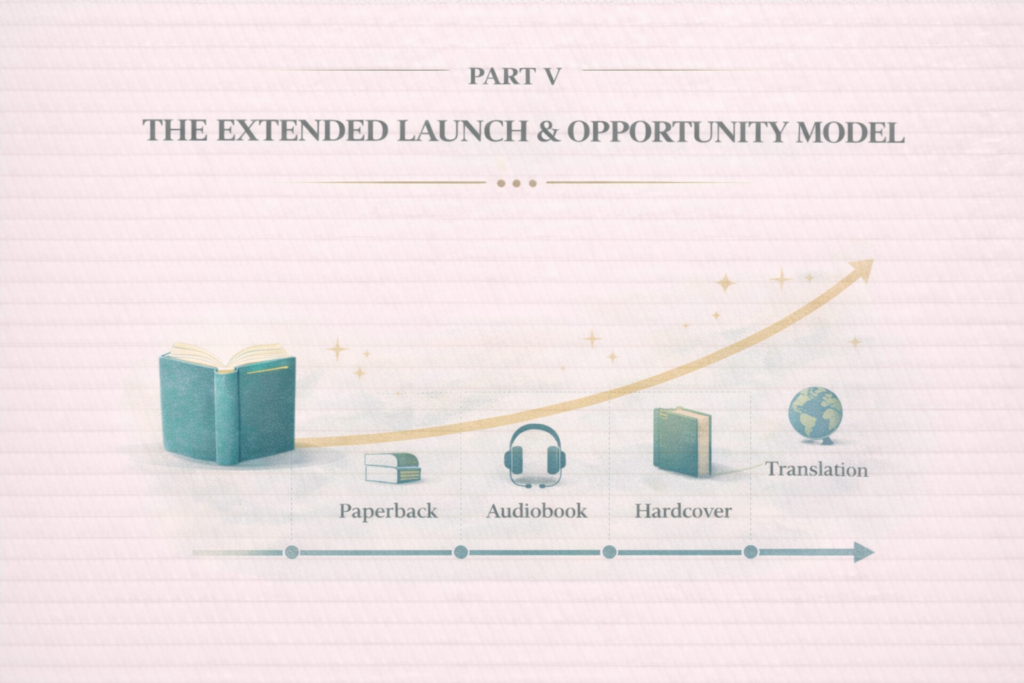
The Extended Launch (Launch Once, Sell Forever)
Most authors plan for a single moment.
They imagine publishing as a one-and-done event: a launch week, a short spike, then silence. If the book doesn’t “hit” immediately, they assume the window closed, and the opportunity is gone.
That thinking comes from the old system.
Modern books aren’t events. They’re platforms. And platforms have recurring ignition points.
Traditional publishing often produces a spike because it’s designed around one primary release cycle. Modern author-owned publishing creates an extended runway because it treats the book as a long-term asset, one that can be reintroduced, reactivated, and resold for years without rewriting the core work.
Spike Thinking vs Asset Thinking
Spike thinking treats time as an enemy:
If you miss launch week, you missed the book’s chance.
Asset thinking treats time as leverage:
The book can compound because new audiences arrive continuously, and every format creates a new reason to reintroduce it.
Slow sales aren’t proof the book failed.
They’re proof the launch strategy was built like a one-time event instead of an extendable system.
Editions Are Strategic Levers, Not Formats
Eric’s sequence captures the core idea:
“Paperback first… audiobook later… hardcover later… translation later.”
That is not a production checklist. It’s a leverage strategy.
Each edition is not a bonus for a book that already succeeded.
Each edition is a new launch moment, a clean reason to:
- re-enter the conversation
- reach a different segment of readers
- create a new media hook
- unlock new partnerships and revenue paths
The book stays the same. The entry points multiply.
Why Relaunch Works Over Time
You don’t relaunch because the book is old.
You relaunch because the audience is new.
Every year, there are:
- new buyers entering the category
- new organizations facing the problem
- new leaders looking for frameworks
- new moments that make your idea relevant again
An extended launch makes the book durable. It removes the fragility of “one shot.”
Compounding Beats Urgency
An event requires urgency.
An asset rewards patience.
This is the psychological shift the extended launch creates:
- less launch anxiety
- less obsession with a single week of outcomes
- more focus on compounding distribution through repeated activation moments
Instead of “If this doesn’t work, it’s over,” the operating truth becomes:
“This book is an engine. I can restart it on purpose.”
The Extended Launch Creates Revenue Durability
A single launch gives you one primary chance to sell.
Multiple editions give you recurring chances to monetize.
That matters because most serious authors are not trying to maximize copy sales. They’re trying to integrate the book into a durable system of opportunity, where the book keeps creating value across time.
An extended launch makes the book easier to:
- revisit in front of new audiences
- attach to speaking, workshops, and corporate programs
- keep alive inside an organization’s ongoing needs
- use as a credentialing asset that remains current
The goal isn’t hype. It’s permanence.
A Sample 3-Year Edition Roadmap
This is a simple way to visualize what “Launch Once, Sell Forever” means in practice. The point is not that every author must follow this exact schedule, it’s that a book can have multiple deliberate ignition points.
| Window | Edition or Moment | Why It Exists | What It Unlocks |
| Months 0–3 | Presale / Early Access (PDF or excerpt) | Activate early believers and create momentum before publication | Early advocacy, inbound interest, proof of demand |
| Months 4–6 | Paperback (core public edition) | Establish the primary edition people can share and buy in bulk | Bulk orders, events, speaking alignment |
| Months 9–12 | Audiobook | Reach a different buyer behavior: listeners | New audience segment, higher trust, renewed PR angle |
| Months 15–18 | Hardcover / Premium edition | Position for gifting and enterprise credibility | Executive legitimacy, corporate use cases, premium signaling |
| Months 20–24 | Updated / annotated edition | Re-enter the conversation with relevance | Renewed attention, reactivation of your base |
| Months 30–36 | Translation or vertical edition | Expand the market beyond one audience | New markets, licensing, long-tail authority |
Every edition is not a new book.
It’s a new reason to talk, a new entry point, and a new monetization surface.
Why Author-Owned Publishing Creates More Long-Term Opportunity
Most authors still measure return the wrong way.
They ask, “How many copies did the book sell?”
That question made sense inside the old system. It is almost meaningless inside the modern one.
A book does not succeed because it sells copies.
It succeeds because it creates opportunity.
This section exists to replace a retail-centric definition of ROI with the one that actually matters.
Where Book ROI Actually Comes From
The most important number in modern publishing is this:
85–95% of book ROI comes from outside retail sales.
As Eric Koester puts it:
| “85 to 95% of revenue comes from things outside retail book sales.” |
Retail is not the business.
Retail is the signal that makes the business possible.
When authors fixate on copy sales, they cap their upside before it begins.
Ownership Determines Where Value Can Appear
Opportunity only flows to the person who owns the asset.
When a publisher owns:
- the rights
- the formats
- the pricing
- the audience relationship
the author loses leverage over how the book is used.
Author-owned publishing keeps the book available as a flexible, reusable asset:
- a calling card that travels without the author
- a credibility accelerator in high-trust conversations
- a doorway into deeper, higher-value work
This is why ownership matters more than distribution.
How Books Actually Generate Revenue
Books rarely monetize directly.
They route trust into places where money already exists.
Common downstream opportunities include:
- Speaking → trust at scale
- Coaching / Consulting → high-margin depth
- Workshops → repeatable expertise
- Enterprise training → institutional revenue
- Communities / programs → recurring income
The book is not the product.
It is the proof that makes these conversations possible.
The Book → Opportunity Model
At its simplest, the model looks like this:
Book
↓
Trust + Authority
↓
Conversation
↓
Opportunity
That’s the entire system.
Retail sales validate seriousness.
Trust transfers credibility.
Conversations unlock revenue.
Everything else in this guide exists to strengthen one of those arrows.
The Book Is a Multiplier, Not a Replacement
A book does not create opportunity from nothing.
It multiplies what already works.
If you already:
- speak
- advise
- lead
- teach
- build products or services
the book amplifies your reach and compresses trust.
If you don’t design for opportunity, ownership alone won’t save you.
This is the quiet trap most authors fall into:
“I’ll figure out the business later.”
Later rarely comes.
The Strategic Reframe
When authors try to monetize the book itself, they limit the ceiling.
When they design for opportunity, the book becomes infrastructure.
That is the difference between:
- a finished project
- and a platform that keeps paying back
Once this lands, the book stops being the goal.
It becomes the engine.
The Modern Author Fan Theory (Kevin Kelly)
Most authors carry a quiet fear into the publishing process:
“If I don’t have a big platform, none of this will work.”
That fear is rational inside the old model, where success depends on scale, distribution, and luck.
It is wrong inside the modern one.
Modern authors don’t need more people.
They need the right people, activated early.
True Fans vs. Mass Audience
Kevin Kelly’s “True Fans” idea is the cleanest reset for modern publishing:
A mass audience is large, passive, and fragile.
True fans are smaller, participatory, and durable.
Mass audiences:
- consume and move on
- rarely advocate
- rarely buy beyond the lowest-friction offer
True fans:
- support early
- share publicly
- return repeatedly
- sustain careers over time
This is the core reframe:
Impact is not linear with audience size.
Depth beats reach.
The Handshake Test
Taylor Swift once captured the principle with a simple metaphor:
“If you want to sell 500,000 records, you have to shake 500,000 hands.”
The point isn’t celebrity. It’s clarity.
Real support requires real connection.
Connection precedes conversion.
Relationship precedes revenue.
The modern author doesn’t win by broadcasting louder.
They win by creating belonging earlier.
Why 200 Activated Fans Is Enough
“Modern authors don’t need millions” is not motivational. It’s mathematical.
A sustainable author business can be built with ~200 activated fans, if they are truly activated, not passively subscribed.
Activated means:
- they commit before publication (presale buyers, early supporters, advisory participants)
- they are willing to support with money, time, and advocacy
- they identify as insiders, not spectators
That’s the same mechanism you’ve already seen in presales and activation marketing:
early belief creates momentum, and momentum creates opportunity.
The Math Behind the Claim
This is conservative math on purpose.
Assume: 200 activated fans
Revenue Layer 1: Presale support
If 200 people support a presale at an average of $100:
200 × $100 = $20,000
Before the book is finished. Before retail exists.
Revenue Layer 2: A deeper offer
If only 20% go deeper (40 people) into a workshop/cohort at $1,000:
40 × $1,000 = $40,000
Revenue Layer 3: High-trust opportunities
If the book and community create just 2–3 high-trust opportunities
(speaking, consulting, enterprise training) at $10K–$25K each:
$20,000–$50,000+
Total (still conservative): $80K–$110K+
Driven by one small, highly aligned group.
The teaching point is simple:
Retail scales by copies. Modern author revenue scales by trust.
Trust does not require millions. It requires belonging.
FAQ
What is the difference between traditional publishing and self publishing?
Traditional publishing typically gives publishers control over rights, royalties, and distribution, while self publishing allows authors to retain ownership, creative control, and long-term economic upside.
What is hybrid publishing?
Hybrid publishing is a professionally supported publishing model where authors retain ownership while receiving editorial, production, and launch support from a publishing partner.
Do authors keep their rights in traditional publishing?
In most traditional publishing contracts, publishers receive significant rights and control over the book, including distribution, pricing, and long-term ownership terms.
Why do many modern authors choose self publishing?
Modern authors increasingly choose self publishing because it allows them to retain ownership, control audience relationships, and monetize beyond retail book sales.
What is author-owned publishing?
Author-owned publishing is a publishing model where the author keeps ownership of the intellectual property, audience relationship, and long-term business value connected to the book.
Is traditional publishing still worth it in 2026?
Traditional publishing can still work for some authors, but many nonfiction authors now prioritize ownership, audience-building, and long-term leverage over distribution access alone.
What is the difference between hybrid publishing and traditional publishing?
Traditional publishing typically owns the rights and controls the publishing process, while hybrid publishing allows authors to keep ownership while receiving professional support.
The Strategic Shift
Traditional thinking says:
“I need a huge audience before publishing makes sense.”
The True Fans model proves the opposite:
You don’t need scale. You need alignment.
Modern authors don’t broadcast.
They cultivate.
That shift, from performance to participation, is the foundation of everything that follows.
The Bridge to What Comes Next
Once you accept that 200 people can carry the economics, the next question becomes obvious:
“If those 200 people matter that much, how do I find and activate them, early?”
That is the purpose of the next step in the system.
The Playbook Summary
Modern Author-Owned Publishing rests on a single shift: ownership beats permission.
A book is no longer something you “get published.” It is an asset you design, own, and use to create leverage over time.
Everything in this guide resolves into five first principles:
- Own your rights so the work compounds instead of expiring.
- Own your audience so demand is not rented at launch.
- Fund the book through activation so momentum exists before publication.
- Use presale as community-building so early buyers become advocates.
- Launch as an author, not a product so the book routes trust into opportunity.
These are not tactics. They are an operating stance.
When authors follow the old model, the book is treated as an endpoint: write it, release it, hope it sells, move on. When authors operate from ownership, the book becomes infrastructure. It is designed to open doors into speaking, consulting, workshops, training, partnerships, and long-term authority.
In this model, presale is not a cash grab. It is formation. Early supporters are not customers; they are co-signers. Activation turns publishing into a shared commitment, where belief is established before the book is finished and trust compounds before launch day.
Retail sales still matter. They simply are no longer the business model. They are one surface area of a much larger asset.
Publishing is not a gate you pass through once.
It is an operating system you build and reuse, across books, audiences, and years.



Comment (1)
[…] Author-owned publishing protects long-term intellectual property and control, ensuring the book remains a compounding asset. […]
Comments are closed.