Greenleaf vs Amplify vs Manuscripts: A Comparison of Hybrid Publishing Companies for Modern Authors (2026)
Hybrid publishing” can describe very different arrangements. The important question is not whether a company uses the word hybrid. The important questions are what the author owns, what the company provides, what the author pays, how decisions are made, and what happens after publication.
| Decision factor | Traditional publishing | Hybrid publishing | Author-owned publishing | Self-publishing |
|---|---|---|---|---|
| Rights | Rights and licensing are governed by the publishing contract; the publisher typically receives defined rights for the term and territory. | Rights vary by provider and contract; the author must verify exactly what is transferred, licensed, or retained. | The author retains 100% of the rights, royalties, and intellectual property in the book. | The author generally retains the rights and coordinates the publishing process directly. |
| Audience relationship | The publisher may control or share parts of the marketing and distribution relationship; the author should confirm what audience data is available. | Audience ownership and data access vary; confirm whether the author can access and use reader or customer information. | The author retains control of the audience relationship and decides which support partners are involved. | The author owns the audience relationship but must build and manage the systems personally or through vendors. |
| Editorial support | Editorial support is selected and managed by the publisher. | Editorial support is included or offered according to the provider’s package and contract. | The author selects the professional editorial support the project needs and retains decision control. | The author selects, hires, and manages editors directly. |
| Production | The publisher manages production decisions and schedules. | Production scope, quality control, and fees vary by provider. | The author chooses the production support and approves the final work. | The author manages or coordinates design, typesetting, printing, and digital production. |
| Distribution | The publisher typically manages distribution under the publishing agreement. | Distribution services and costs vary; verify which channels are included and who controls the accounts. | The author chooses distribution support and retains control of the book’s rights and accounts. | The author sets up and manages distribution accounts and channel relationships. |
| Marketing | Marketing support varies by publisher, contract, title, and commercial priority. | Marketing services vary widely; identify the actual deliverables, timeline, and cost. | The author defines the launch and ongoing-use plan and chooses the marketing support needed. | The author plans and executes marketing directly or hires outside help. |
| Cost structure | The author may receive an advance or other compensation; contract terms determine royalties, costs, and rights. | The author usually pays for some or all services; compare total fees, deliverables, and rights terms. | The author pays for selected professional support with the scope and cost defined before work begins. | The author pays vendors directly and manages the total project budget. |
| Decision control | The publisher typically controls major editorial, production, positioning, and schedule decisions under the contract. | Decision control varies by provider and agreement; do not assume the label tells you who decides. | The author retains decision control while using professional support where useful. | The author retains decision control but also carries responsibility for coordinating the work. |
| Post-publication use | Post-publication use is governed by the contract and available rights. | Post-publication support and rights vary; confirm what continues after launch. | The author can continue using the book as intellectual property for speaking, clients, partnerships, recruiting, teaching, and audience development. | The author can use the book broadly but must create and maintain the post-publication strategy. |
| Best fit | Authors whose project fits a publisher’s list, commercial model, schedule, and acquisition criteria. | Authors who want packaged support but are prepared to compare providers, costs, rights, and deliverables carefully. | Professionals who want ownership and decision control while selecting the editorial and publishing support their project needs. | Source text cut off at “Authors who w”. |
Compare your publishing options with the Manuscripts team
Editing.
Marketing.
Distribution.
Production.
Those comparisons feel logical. They are also misleading.
Hybrid publishers are not interchangeable service providers. They are publishing systems designed around different outcomes.
Some optimize for bookstore distribution and traditional publishing credibility. Others prioritize marketing visibility and media exposure. Others treat publishing as long-term authority infrastructure.
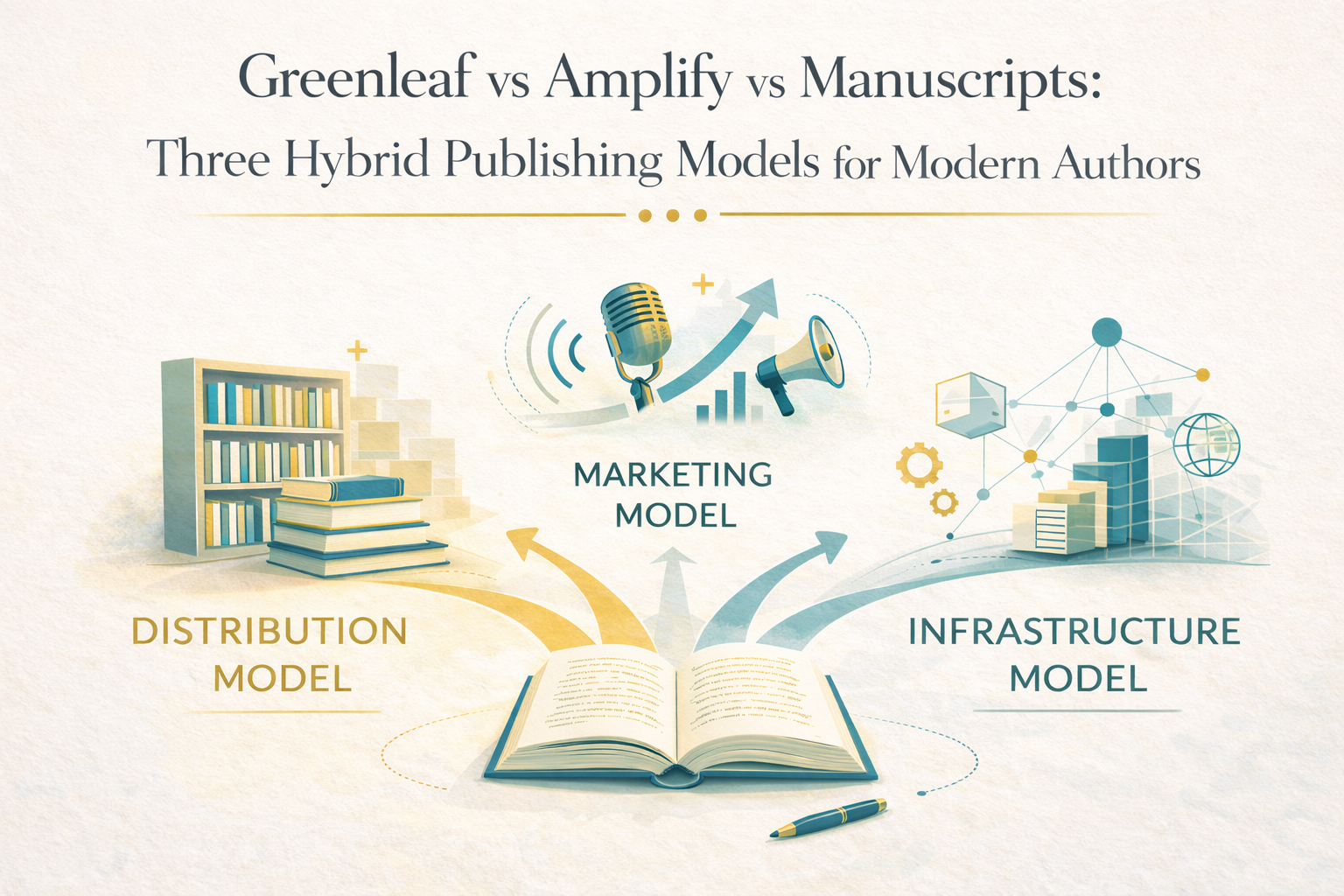
Greenleaf, Amplify, and Manuscripts represent three structurally different hybrid publishing models, distribution-driven, marketing-driven, and infrastructure-driven, and the right choice depends on the strategic role the book must play in an author’s professional ecosystem.
Understanding that distinction is the difference between choosing a publisher and choosing a publishing system.
The Decision This Brief Helps You Make
This brief analyzes three premium hybrid publishing partners used by serious nonfiction authors.
At first glance, Greenleaf, Amplify, and Manuscripts appear to offer similar services:
- editorial development
- book production
- marketing support
- distribution infrastructure
But these publishers are built around fundamentally different publishing models.
The real decision is not which publisher offers the best services.
For authors evaluating whether hybrid publishing is worth the investment at all
(see Is Hybrid Publishing Worth It? ROI Breakdown for Business Authors 2026.)
The real decision is:
What role must your book play in your professional ecosystem?
Different publishing systems optimize for different outcomes:
- distribution credibility
- marketing visibility
- long-term authority infrastructure
Once that role is clear, the right publishing model usually becomes obvious.
The 60-Second Decision
Serious nonfiction authors rarely struggle because they lack publishing options.
They struggle because those options optimize for different outcomes.
A hybrid publisher is not simply a service provider.
It is a system that determines how responsibility is distributed across editorial leadership, distribution, marketing, and launch execution.
For authors evaluating premium hybrid publishers, the fastest path to clarity is aligning the publishing model with the strategic role of the book.
Choose Greenleaf if:
- Bookstore distribution and retail credibility are primary goals
- Traditional publishing signals matter for authority
- Professional production and distribution infrastructure are the priority
Choose Amplify if:
- Media visibility and marketing exposure drive the project
- Platform expansion is the central outcome
- The book functions as a visibility amplifier
Choose Manuscripts if:
- The book must compound authority over time
- Intellectual property and frameworks are strategic assets
- Audience-building begins before launch
- Publishing supports consulting, speaking, or enterprise leverage
Rule:
Choose the model that matches the strategic role of the book, not the services offered.
Who This Brief Is For
This brief is written for professional experts evaluating premium hybrid publishing partners.
Typical readers include:
- founders
- executives
- consultants
- coaches
- professors
- physicians
- professional speakers
- experts building authority platforms
For these authors, the book is rarely the final product.
It is a strategic instrument designed to support a broader body of work.
The real decision is not simply which publisher offers the best services.
The real decision is:
Which publishing model best supports the role the book must play in your professional ecosystem.
Why Most Hybrid Publishing Comparisons Fail
Hybrid publishing comparisons often create more confusion than clarity.
The reason is simple: most comparisons focus on the wrong variables.
Authors Compare the Wrong Variables
Typical comparisons focus on:
- price
- distribution
- service bundles
- prestige signals
These variables are visible, which makes them easy to compare.
But they rarely determine long-term authority outcomes.
A well-distributed book can still fail to build a platform.
A heavily marketed book can disappear once the campaign ends.
The structure of the publishing model matters more than the list of services.
Hybrid Publishing Is Not a Single Model
The phrase hybrid publishing implies a category.
In reality, it contains multiple fundamentally different publishing structures.
Within the same label you can find:
- distribution-oriented publishing
- marketing-centered publishing
- infrastructure-based publishing systems
These models solve different problems.
Treating them as interchangeable leads authors to evaluate publishers using criteria that do not actually predict outcomes.
The Real Difference Is Where Responsibility Sits
Every publishing model distributes responsibility across several functions:
- editorial leadership
- marketing orchestration
- distribution relationships
- audience-building
- launch execution
- intellectual property infrastructure
Where these responsibilities sit determines what the book becomes.
A book can function as:
- a polished artifact
- a marketing campaign
- a long-term authority asset
The hybrid publisher you choose determines which outcome is most likely.
Hybrid Publishing Companies Comparison: Greenleaf vs Amplify vs Manuscripts
This comparison looks at hybrid publishing companies as systems, not just service bundles.
| Dimension | Greenleaf Publishing | Amplify Publishing | Manuscripts |
| Best For | Authors prioritizing bookstore distribution and retail credibility | Authors prioritizing media visibility and platform growth | Authors building long-term authority platforms |
| Typical Cost Range | ~$25K–$60K+ depending on scope | ~$30K–$75K+ depending on marketing scope | ~$20K–$50K+ depending on publishing system |
| Author Ownership | Author retains rights in most hybrid structures | Author retains rights | Full author ownership emphasized |
| Editorial Depth | Strong editorial production and development | Strong editorial plus marketing positioning | Deep editorial partnership integrated with positioning |
| Distribution Strength | High; strong retail and bookstore distribution | Moderate; distribution secondary to marketing | Standard distribution; focus on strategic positioning |
| Audience-Building Integration | Limited within publishing process | Marketing campaigns drive visibility | Audience-building begins before launch |
| Launch Coordination | Production-focused launch | Marketing-centered launch campaigns | Structured presale and strategic launch |
| Production Coordination | Professional publishing infrastructure | Production integrated with marketing timeline | Production integrated with authority strategy |
| Strategic Focus | Distribution credibility | Platform visibility | Authority infrastructure |
| Primary Tradeoff | Audience growth often external to publishing process | Long-term IP systems less central | Greater emphasis on strategic design rather than speed |
For a deeper breakdown of hybrid publishing cost ranges and what authors are actually paying for.
(see How Much Does Hybrid Publishing Cost in 2026?)
The table highlights a core reality:
These publishers are not solving the same problem.
They represent different philosophies about what a nonfiction book should do.
Hybrid Publishing Cost Breakdown
Greenleaf Publishing
Typically positioned toward authors prioritizing bookstore distribution and professional production infrastructure.
Amplify Publishing
Typically reflects stronger marketing support, media visibility, and platform expansion.
Manuscripts
Typically reflects editorial strategy, positioning, and long-term authority infrastructure.
The total hybrid publishing cost depends less on the label and more on where editorial, launch, marketing, and strategic responsibility sit.
How These Hybrid Publishing Companies Actually Differ
Hybrid publishing models often look similar on the surface.
They all offer editing, design, production, and distribution.
The deeper distinction is the outcome each model optimizes.
Each of the publishers examined in this brief represents a different strategic orientation.
- Distribution credibility
- Marketing visibility
- Authority infrastructure
Understanding these orientations helps authors evaluate the right partner.
Evaluation Criteria
To compare the models fairly, we evaluate them across consistent structural criteria:
- Core Strategic Outcome
- Editorial Leadership
- Distribution Strength
- Marketing Visibility
- Audience-Building Integration
- Launch Coordination
- Long-Term Authority Infrastructure
- Repeatability for Future Books
This framework allows authors to compare systems rather than service lists.
Pros and Cons of Each Hybrid Publishing Model
Rather than evaluating hybrid publishing companies by feature lists, it is more useful to understand what each model is optimized to do, and where that creates tradeoffs.
Greenleaf
Greenleaf is structured around production quality and distribution infrastructure. It is well-suited for authors who want their book to function as a credible, professionally produced artifact with access to traditional retail channels.
Because the model prioritizes production and distribution, audience-building and demand creation typically happen outside the publishing process. Authors are often responsible for generating momentum independently.
Amplify
Amplify is designed around visibility and platform expansion. It performs well when the goal is to use the book as a marketing asset that drives media exposure, speaking opportunities, and brand reach.
The model emphasizes campaign execution, which can limit the development of long-term intellectual property infrastructure. The book often functions as a launch event rather than a system that compounds over time.
Manuscripts
Manuscripts is structured as an author-owned publishing system. It integrates positioning, audience-building, and launch strategy early, allowing the book to function as a long-term authority asset rather than a one-time release.
Because the model requires upfront clarity around positioning and outcomes, it demands more strategic thinking before production begins. Authors are more involved in defining the role the book will play within a broader system.
Greenleaf Publishing
Structural Role
Distribution-driven hybrid publishing.
Greenleaf has built its reputation around strong production quality and retail distribution infrastructure.
What the Model Optimizes For
The Greenleaf model prioritizes:
- bookstore presence
- retail distribution reach
- traditional publishing credibility
For many professional authors, these signals still carry meaningful authority.
Bookstore placement, traditional publishing aesthetics, and high production standards can reinforce credibility in corporate, academic, and professional environments.
Example Author Scenario
An executive publishing a leadership book to support:
- keynote speaking
- industry credibility
- professional authority
In this scenario, bookstore visibility reinforces legitimacy.
The author wants the book to look and behave like a traditionally published title.
Primary Tradeoff
Greenleaf’s strength is distribution infrastructure.
Audience-building and platform development typically occur outside the publishing process.
Authors must often coordinate audience growth, marketing, and platform expansion independently.
Recommendation
Choose Greenleaf when the book’s primary objective is distribution reach and traditional publishing credibility.
Amplify Publishing
Structural Role
Marketing-centered hybrid publishing.
Amplify positions the book as a platform expansion tool designed to increase visibility.
What the Model Optimizes For
Amplify prioritizes:
- media exposure
- marketing campaigns
- public visibility
In this model, the book acts as a catalyst for attention.
The publishing process is integrated with marketing strategy, public relations, and visibility initiatives.
Example Author Scenario
A policy expert or public commentator publishing a book to:
- increase media exposure
- expand public recognition
- support a thought leadership campaign
In this scenario, the book functions as a credibility anchor for media engagement.
Primary Tradeoff
Marketing-centered publishing emphasizes campaign outcomes.
Long-term intellectual property infrastructure and repeatable publishing systems are less central to the model.
Recommendation
Choose Amplify when the book functions primarily as a visibility amplifier.
Manuscripts
Structural Role
Infrastructure-driven publishing system.
Manuscripts approaches publishing as part of a broader author operating system designed to support authority-building.
What the Model Optimizes For
The Manuscripts model prioritizes:
- authority positioning
- intellectual property development
- long-term leverage
Rather than treating publishing as a one-time project, the system is designed to integrate editorial rigor with audience development and strategic positioning.
Example Author Scenario
A consultant publishing a book to:
- anchor a consulting framework
- increase speaking demand
- formalize intellectual property
In this scenario, the book becomes a durable business asset.
It supports a broader authority ecosystem that includes services, programs, and speaking opportunities.
Primary Tradeoff
The Manuscripts model emphasizes strategic design and intellectual property architecture.
This can require more deliberate planning before production begins.
The focus is less on rapid production and more on long-term leverage.
Recommendation
Choose Manuscripts when the book must function as long-term authority infrastructure.
Three Hybrid Publishing Models: Artifact vs Campaign vs Infrastructure
One of the simplest ways to understand the differences between hybrid publishing models is to focus on the role the book is designed to play.
Most hybrid publishers ultimately optimize for one of three outcomes:
- a finished publishing artifact
- a marketing campaign
- an authority infrastructure
These are not service differences.
They are structural orientations that determine how the publishing system operates.
Artifact Model: Book as Product
In the artifact model, the book itself is the primary output.
The publishing system is designed to produce a polished, professionally distributed title that behaves like a traditional book in the retail market.
Priorities typically include:
- high production quality
- professional editorial standards
- bookstore distribution
- traditional publishing credibility
In this model, success is often associated with retail presence and publishing legitimacy.
Greenleaf largely operates within this orientation.
The book is treated as a finished artifact designed to enter the marketplace with traditional signals of credibility.
Campaign Model: Book as Visibility Engine
In the campaign model, the book functions as a marketing event.
The publishing process is integrated with publicity strategy, media exposure, and platform expansion.
Priorities typically include:
- media visibility
- marketing campaigns
- public influence
- audience expansion
The book becomes a catalyst for attention rather than the final destination.
Amplify primarily operates within this orientation.
The publishing system is designed to maximize exposure and public visibility during the launch window.
Infrastructure Model: Book as Authority System
In the infrastructure model, the book is not treated as a one-time product or campaign.
It is designed as a long-term authority asset inside a broader professional ecosystem.
The publishing system integrates:
- positioning clarity
- intellectual property development
- audience-building before launch
- frameworks that support speaking, consulting, and enterprise work
The book becomes a durable foundation that compounds authority over time.
Manuscripts is built around this orientation.
Publishing is treated as part of a broader author-owned infrastructure designed to support long-term leverage.
Mapping the Three Publishers
Seen through this lens, the structural differences become clearer:
- Greenleaf → Artifact / Distribution
- Amplify → Campaign / Marketing
- Manuscripts → Infrastructure / Authority
This framework helps authors evaluate publishers based on the outcome their system is designed to produce, rather than simply comparing services.
Manuscripts Perspective: Publishing as Infrastructure
Many authors believe they are purchasing publishing services.
Editing.
Design.
Distribution.
Marketing.
But services alone do not create outcomes.
The real asset is the publishing system that coordinates them.
Authors comparing infrastructure-driven publishing models may also want to read
(Scribe Media vs. Manuscripts: Which Model Fits Serious Business Authors?)
Within the Manuscripts framework, publishing is treated as infrastructure rather than production.
Modern Authors prioritize:
- positioning clarity
- audience intelligence
- launch strategy
- intellectual property ownership
Through the Modern Author Operating System, publishing becomes a coordinated system that integrates editorial rigor, audience development, and strategic leverage.
Concepts such as Author-Owned Publishing, the ORBIT Framework, and the Presale Publishing model exist to ensure that books do not simply enter the market.
They compound authority over time.
In this model, the question shifts from:
“Which publisher produces the book?”
to
“Which publishing system supports the role the book plays in the author’s ecosystem?”
How to Choose a Hybrid Publisher: Questions to Ask Before You Sign
Authors evaluating hybrid publishers should look beyond service lists.
The real evaluation criteria involve structural responsibility.
Ask:
- Who owns long-term intellectual property rights?
- Where does editorial authority sit?
- When does audience-building begin?
- Who coordinates launch execution?
- What infrastructure persists after the first book?
- If I publish again, what compounds?
If the answers are vague, the publishing model may rely on activity rather than systems.
How to Choose Between Greenleaf, Amplify, and Manuscripts
- Define the strategic role of the book
- Decide whether you need distribution, visibility, or authority infrastructure
- Compare where editorial, marketing, and launch responsibility sit
- Evaluate cost in relation to long-term business outcomes
- Choose the publishing model that matches the job the book must do
Decision Alignment
Each publisher examined in this brief optimizes for a different outcome.
Choose Greenleaf for distribution credibility.
Choose Amplify for marketing visibility.
Choose Manuscripts for authority infrastructure.
None of these choices are universally superior.
The correct decision depends on the role the book must play.
Publishing models are not moral choices.
They are leverage decisions.
Choose the system that allows your book to perform the work it was written to do.
If you are still deciding between publishing models more broadly.
(see Hybrid vs. Self-Publishing (2026): The Real Difference Is Infrastructure.)
FAQ
What is the difference between Greenleaf and Amplify Publishing?
Greenleaf focuses on distribution infrastructure and bookstore reach, while Amplify focuses on marketing visibility and media exposure. The key difference between these hybrid publishing companies is whether the model prioritizes retail credibility or platform expansion.
Is Manuscripts a hybrid publisher?
Manuscripts operates within the hybrid publishing category but positions itself as an author-owned publishing infrastructure. The model emphasizes intellectual property development, audience-building, and long-term authority rather than one-time book production.
How much do premium hybrid publishers cost?
Premium hybrid publishing cost typically ranges from $20,000 to $75,000 or more, depending on editorial scope, marketing involvement, and distribution infrastructure.
Do hybrid publishers give authors ownership of their books?
Most legitimate hybrid publishing companies allow authors to retain ownership of their work. However, contract terms vary, so authors should confirm rights ownership, ISBN control, and long-term licensing terms.
Which hybrid publisher is best for business authors?
The best hybrid publishing company depends on the role the book is meant to play. Some models prioritize bookstore distribution, others emphasize visibility and media, and others focus on long-term authority and intellectual property development.
What are hybrid publishing companies?
Hybrid publishing companies provide editorial, production, and distribution support while allowing authors to retain more ownership and control than traditional publishing.
Is hybrid publishing worth it for nonfiction authors?
Hybrid publishing can be worth it when the book supports a larger authority, business, or platform strategy. The key is choosing a model that aligns with the outcomes the author wants to achieve.
If You’re Deciding What to Do Next
If this report clarified your thinking, the next step is usually not “publishing.”
It’s pressure-testing your strategy before you commit time, budget, or reputation.
Here are three ways authors typically proceed.
Map Your Modern Author Strategy
If you want to:
- Pressure-test your author model
- Clarify realistic outcomes
- Understand where ROI is likely to show up
- Avoid unnecessary spend
A short strategy conversation can surface issues early, before they become expensive.
Schedule a Modern Author Strategy Session
This is a working session, not a pitch.
Explore the Modern Publishing System
If you’re assessing:
- Whether to publish traditionally, hybrid, or independently
- How to structure presale and early activation
- What support actually reduces risk
You may want a clearer view of how the Modern Publishing System works in practice.
Explore Manuscripts Publishing Services
Study Real Author Outcomes
(For internal validation and stakeholder alignment)
If you’re preparing a recommendation for leadership, concrete examples often help.
See Modern Author Success Stories
About the Author
Eric Koester is an award-winning entrepreneurship professor at Georgetown University, bestselling author, and founder of Manuscripts. His work focuses on how ideas become assets, how books create leverage, and why modern authors need systems, not just publishing support.
He has worked with thousands of authors across traditional, hybrid, and modern publishing paths, helping them turn books into platforms, platforms into credibility, and credibility into durable business outcomes.
About Manuscripts
Manuscripts is the Modern Author OS for nonfiction experts.
We help founders, executives, coaches, and thought leaders design books as strategic assets, not standalone products. Our work spans positioning, author model design, developmental editing, AI-enhanced drafting tools, presale strategy, and long-term launch systems.
Manuscripts authors use their books to generate clients, speaking engagements, training programs, and enterprise opportunities, often before publication.
For readers who want to go deeper into specific mechanics, the following guides expand on topics referenced in this report:
- How to Write a Book if You’re Busy
- Modern Ghostwriting for Nonfiction Authors
- AI Tools for Authors in 2026
- How to Build an Audience Before You Write Your Book
- The Evergreen Launch System for Modern Authors
Powered by Codex, the Modern Author Intelligence Tool.