

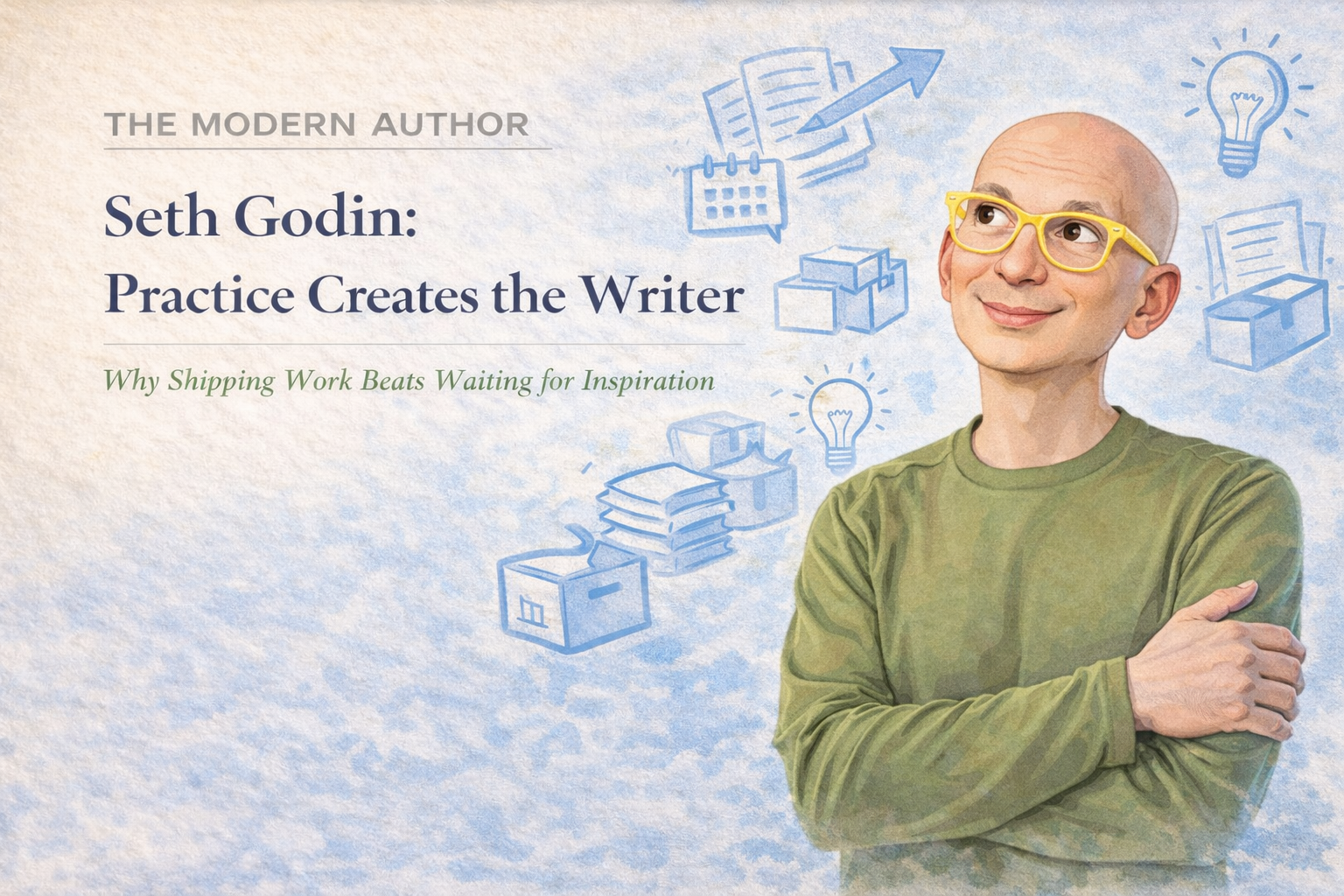
The Modern Author: Seth Godin on Practice, Permanence, and Shipping Anyway
Most people think writer’s block is the problem.
Seth Godin thinks writer’s block is an excuse.
The real obstacle isn’t a lack of ideas.
It’s the fear of putting bad writing into permanent form.
In this session, Seth reframes writing as a daily practice of contribution, where clarity only arrives after you start, ship, and improve in public.
Who This Is For
This is for you if:
- you keep waiting to feel ready before you start writing
- you call it “writer’s block” when you’re really afraid of being wrong
- you overthink permanence and underproduce pages
- you want to write something that lasts, but hesitate to commit
- you’re consuming more than you’re shipping
The Modern Author Lesson
The real shift is simple:
Writing is not performance.
It is practice.
Modern authors don’t wait for clarity.
They generate clarity through repetition.
They don’t eliminate fear.
They outnumber it with bad pages.
They don’t become writers and then write.
They write, and become writers.
6 Moves Modern Authors Can Steal from Seth Godin
Remember: Writing Is Not Speaking
Speaking happens in real time. It self-corrects. It disappears.
Writing is different.
Writing must stand on its own across time and distance. You cannot adjust mid-sentence based on someone’s expression. You cannot clarify what you “meant” after the fact.
That’s why writing feels heavier.
It carries responsibility.
And that weight isn’t a flaw in the system.
It’s the point.
Name the Real Fear: Permanence
A book feels permanent.
Black and white. Fixed.
When you write something down, you are doing three things:
- Clarifying what you believe
- Recording it publicly
- Agreeing to stand behind it
That permanence raises the stakes.
Not because you lack ideas, but because Writing removes the safety of ambiguity. You cannot soften it with tone. You cannot adjust it mid-delivery.
The hesitation isn’t about writing.
It’s about commitment.
Here’s the decision rule:
When you stall, ask:
Am I unclear? Or am I unwilling to stand behind what I’m about to say?
Unclear can be solved with drafting.
Unwilling requires courage.
Modern authors accept permanence as the price of clarity. They publish knowing revision is allowed.
Evasion is not.
Replace “Writer’s Block” with Its Real Name
Writer’s block isn’t real.
Fear of bad writing is.
“Writer’s block” is a polite label for something more specific:
the fear of putting imperfect work into permanent form.
Notice the pattern:
- If it might be bad, you delay.
- If it might be judged, you research.
- If it might be permanent, you stall.
The problem isn’t a lack of ideas.
It’s the expectation that the first draft must justify your identity.
People with writer’s block don’t have too few ideas.
They have too few bad pages.
They have too much attachment to sounding smart.
Remove the expectation of brilliance.
Replace it with a requirement for volume.
The block dissolves.
Produce the Bad Pages First
If you produce enough bad writing, the good writing takes care of itself.
This is mechanism, not motivation.
You learn structure by writing.
You discover clarity by seeing confusion.
You refine ideas by revisiting them.
Each time you open the file, it gets a little clearer.
Clarity is not a prerequisite.
It is a byproduct of repetition.
Commit to the Practice (Not the Performance)
You don’t need another talk.
You don’t need better tools.
You need a commitment to practice.
Practice means:
- Writing something worth learning
- Writing something worth teaching
- Writing something worth sharing
It means showing up even when the work isn’t good yet.
Shipping creative work is the practice.
Polishing endlessly is performance.
Modern authors prioritize contribution over appearance.
Let Identity Follow Behavior
You do not become a writer and then start writing.
You write, and that makes you a writer.
Seth’s identity model works in reverse of how most people think.
Most people assume:
- Get permission
- Earn credentials
- Feel legitimate
- Then begin
The practice model flips it:
- Show up
- Produce work
- Ship consistently
- Let identity catch up
Identity is not a prerequisite.
It is a side effect.
If you commit to the practice, you are the thing.
Not because someone said so.
Because repetition built it.
Modern authors don’t wait for permission.
They accumulate evidence.
And evidence compounds faster than validation.
The Bottom Line
You don’t need motivation.
You need reps.
Start where you are.
Write badly.
Open the file tomorrow and make it clearer for the next reader.
Modern authors don’t wait to feel ready.
They practice until readiness becomes irrelevant.
Listen:
Watch:
About the Author
Eric Koester is an award-winning entrepreneurship professor at Georgetown University, bestselling author, and founder of Manuscripts. He has helped more than 3,000 nonfiction authors turn ideas into books, and books into platforms for speaking, media, and business growth.
About Manuscripts
Manuscripts is a modern publishing partner for nonfiction authors who want their books to drive real-world outcomes. We help founders, executives, coaches, and experts design, write, and launch books that build authority, attract opportunities, and compound into long-term business assets.
Work With Us
If you’re writing a book you want to matter, we’ll help you map the right strategy before you write another word.
Schedule a Modern Author Strategy Session










Leave a Reply