

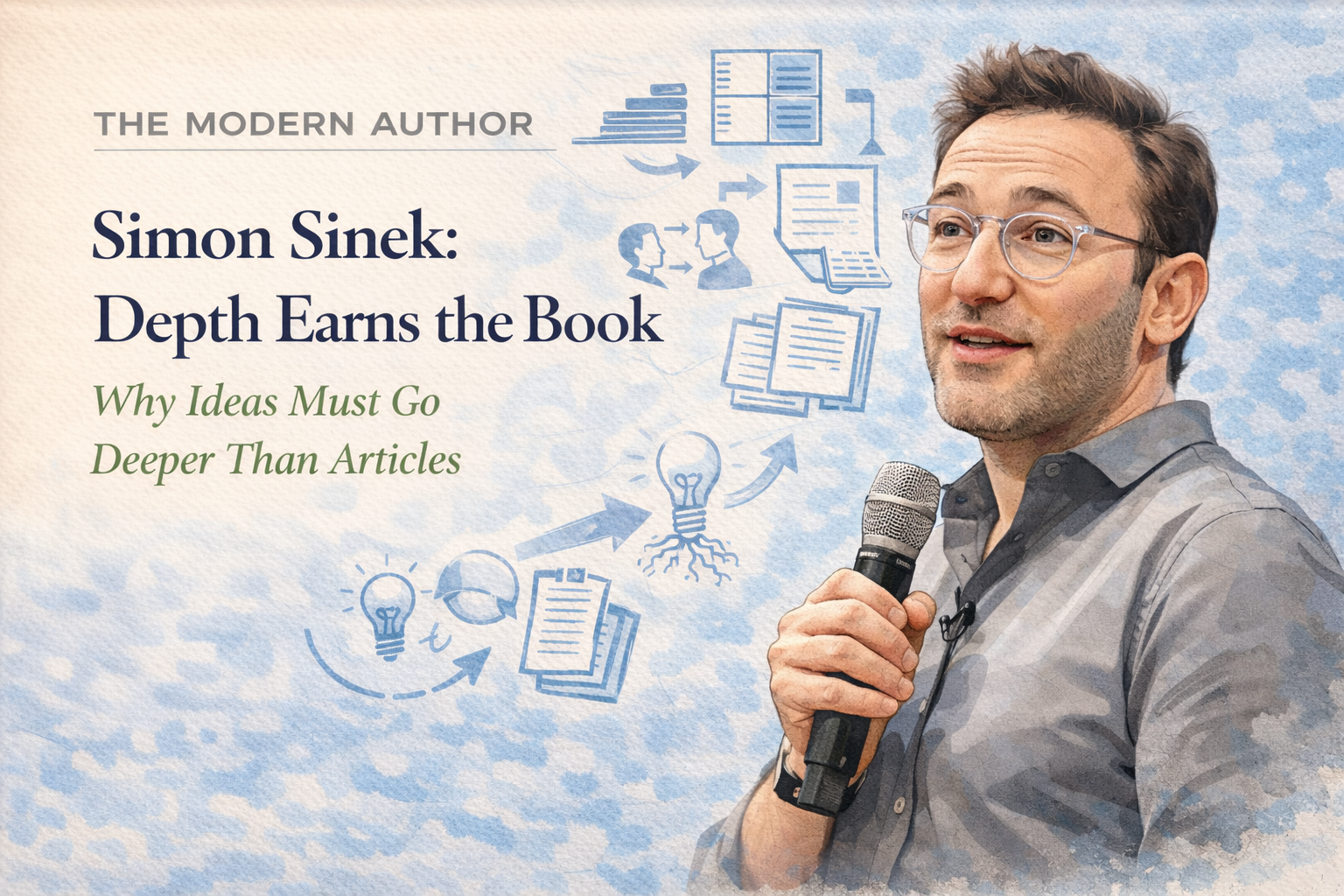
The Modern Author: Simon Sinek on Depth, Difficulty, and Writing Books That Deserve to Exist
Simon Sinek’s Modern Author lesson is simple but demanding:
Not every idea deserves a book.
A book must earn its depth. It must take the reader somewhere new. It must feel difficult because real craft is difficult. And it must be written by someone willing to reinvent their process instead of protecting their past success.
For Sinek, the standard isn’t visibility.
It’s transformation.
Who This Is For
This is for you if:
- you’re wondering whether your idea is truly book-worthy
- your manuscript feels easy but thin
- you’re struggling with “writer’s block” on a second or third book
- you’re tempted to optimize for bestseller lists instead of depth
- you want to build something that lasts longer than a launch cycle
The Modern Author Lesson
The real shift is this:
A book is not a longer article.
It is a deeper journey.
Modern authors don’t write books because they can.
They write them because the idea demands depth, and because they are willing to do the harder work required to earn it.
8 Moves Modern Authors Can Steal from Simon Sinek
1). Most Ideas Don’t Deserve a Book
Platform can create the illusion of book-worthiness.
You give a strong talk.
You write a viral article.
An audience responds.
But that doesn’t automatically mean the idea can sustain 250 pages.
Many ideas are powerful at article length. They illuminate. They inspire. They travel well in a keynote.
A book requires more.
Sinek’s filter is uncomfortable but clarifying:
Is there enough depth here to justify a reader’s sustained attention?
If the core insight can be fully expressed in 10 pages, it may not be a book. It may be an excellent essay.
Modern authors don’t confuse attention with depth.
They apply the filter before they commit.
2). The Only Real Value of a Book Is Depth
A book earns its existence by doing something a keynote, thread, or article cannot.
It goes deeper.
Not longer. Deeper.
Depth means you can:
- explore nuance instead of flattening it into a slogan
- examine contradictions instead of ignoring them
- build an argument through progression instead of assertion
An article can introduce an idea.
A talk can inspire action.
A book must transform understanding.
That is the standard.
If the reader finishes in the same place they started, only with more stories or more examples, the format was misused. The idea may have been strong. It simply wasn’t book-length strong.
This is where many Modern Authors misjudge the medium.
Platform traction is not proof of depth.
A viral post is not evidence of durability.
Before committing to a manuscript, apply the internal filter:
- Can this idea sustain complexity?
- Can it survive contradiction?
- Can it carry a reader through meaningful movement?
(See: The Transformation Test, start and end cannot be the same place.)
Depth is not volume. It is excavation.
It requires revisiting assumptions, complicating your own thesis, and resisting the urge to oversimplify for speed.
Modern authors treat depth as the bar.
Everything else, format, marketing, platform, is secondary.
3). The Transformation Test: Start and End Can’t Be the Same Place
Sinek’s structural standard is uncompromising:
The reader at the end must not be the same as the reader at the beginning.
A real book creates movement.
The opening introduces a tension, assumption, or unresolved problem.
The middle complicates that assumption.
The ending resolves it in a way that meaningfully alters perception.
If the conclusion simply restates the premise, with better stories, the book was shallow. It informed. It did not transform.
Transformation is the measurable test of depth.
Before you write 200 pages, run this diagnostic:
Beginning:
“My reader currently believes ______.”
Middle:
“They encounter evidence, tension, or contradiction that challenges ______.”
End:
“They now see ______ differently, and therefore will ______ differently.”
If you cannot articulate that shift clearly, the idea may not yet be book-length ready.
This doesn’t mean the idea is weak.
It means it hasn’t earned depth yet.
Modern authors design books around movement, not repetition.
4) If It Feels Easy, It’s Probably Shallow
Depth is difficult.
If writing the book feels smooth from beginning to end, that may not be a sign of mastery. It may be a signal that you are staying at the surface.
Struggle is often diagnostic.
When you hit resistance, you are usually confronting nuance, contradiction, or incomplete thinking. That tension is the work.
An “easy book” is often a collection of familiar points arranged comfortably.
A demanding book forces the author to confront complexity, and refine it.
Modern authors don’t pathologize difficulty.
They recognize it as evidence that they are attempting something real.
5). The Real Enemy Isn’t Writer’s Block, It’s an Outdated Method
Sinek reframes writer’s block.
Often, you’re not blocked.
You’re trying to write the way you used to write.
You are a different person than you were during your last book. Your experience has expanded. Your thinking has matured. Your environment has changed.
But you’re attempting to apply the same process.
When the method no longer matches the moment, friction appears.
Modern authors diagnose the process, not their talent.
6). Reinvent the Process Every Book
One of Sinek’s more uncomfortable admissions is this:
What worked before didn’t work again.
The conditions that produced flow on one book failed on the next. The rhythm changed. The energy changed. The constraints changed.
He didn’t interpret that as decline.
He interpreted it as evolution.
Sometimes momentum required pressure.
Sometimes it required self-imposed constraint.
Sometimes it required a completely different environment.
The mistake would have been assuming the old method was permanent.
Writers often treat their first successful process as sacred. They defend it. They try to replicate it. When it stops working, they assume something is wrong with them.
Sinek flips that logic.
The process is not fixed. The writer isn’t static. The work isn’t identical.
Each book introduces a new set of intellectual and emotional demands. Which means the architecture of focus must adapt.
Instead of asking:
Why isn’t my old system working?
Ask:
What does this book require?
Does it need isolation or conversation?
Deadlines or spaciousness?
External pressure or internal incubation?
The answer may differ every time.
Modern authors don’t protect their previous routine.
They design the process that creates momentum for this book, not the last one.
7). Don’t Chase the Algorithm, Chase Recommendation-Quality
Bestseller lists can be gamed.
Algorithms can be optimized.
Rankings can be influenced.
But recommendation cannot be faked at scale.
A book lasts when readers tell other people to read it.
Not because it trended.
Because it mattered.
Short-term metrics reward visibility.
Enduring books earn advocacy.
Modern authors optimize for recommendation-quality, depth, clarity, usefulness, instead of vanity signals.
8).Worthy Rivals: Use Competition as a Mirror
Sinek’s concept of the “worthy rival” reframes competition.
A worthy rival is someone who triggers you, not because you dislike them, but because they expose a gap in your capability.
Instead of treating them as a scoreboard opponent, treat them as a mirror.
What do they do better?
Where are they stronger?
What weakness in you is being revealed?
The goal isn’t to defeat them.
It’s to grow.
You can admire them. Even collaborate with them. The function is developmental.
Modern authors use rivalry as feedback, not validation.
The Bottom Line
A book must earn its existence.
It must go deeper than an article.
It must transform the reader.
It must feel difficult.
It must require a process reinvented for this moment.
It must be strong enough to be recommended.
And it must be written by someone willing to treat rivals as mirrors, not enemies.
Modern authors don’t write books because the platform suggests they can.
They write them because the idea demands depth, and they are willing to do the work required to deliver
Listen:
Watch:





Leave a Reply