

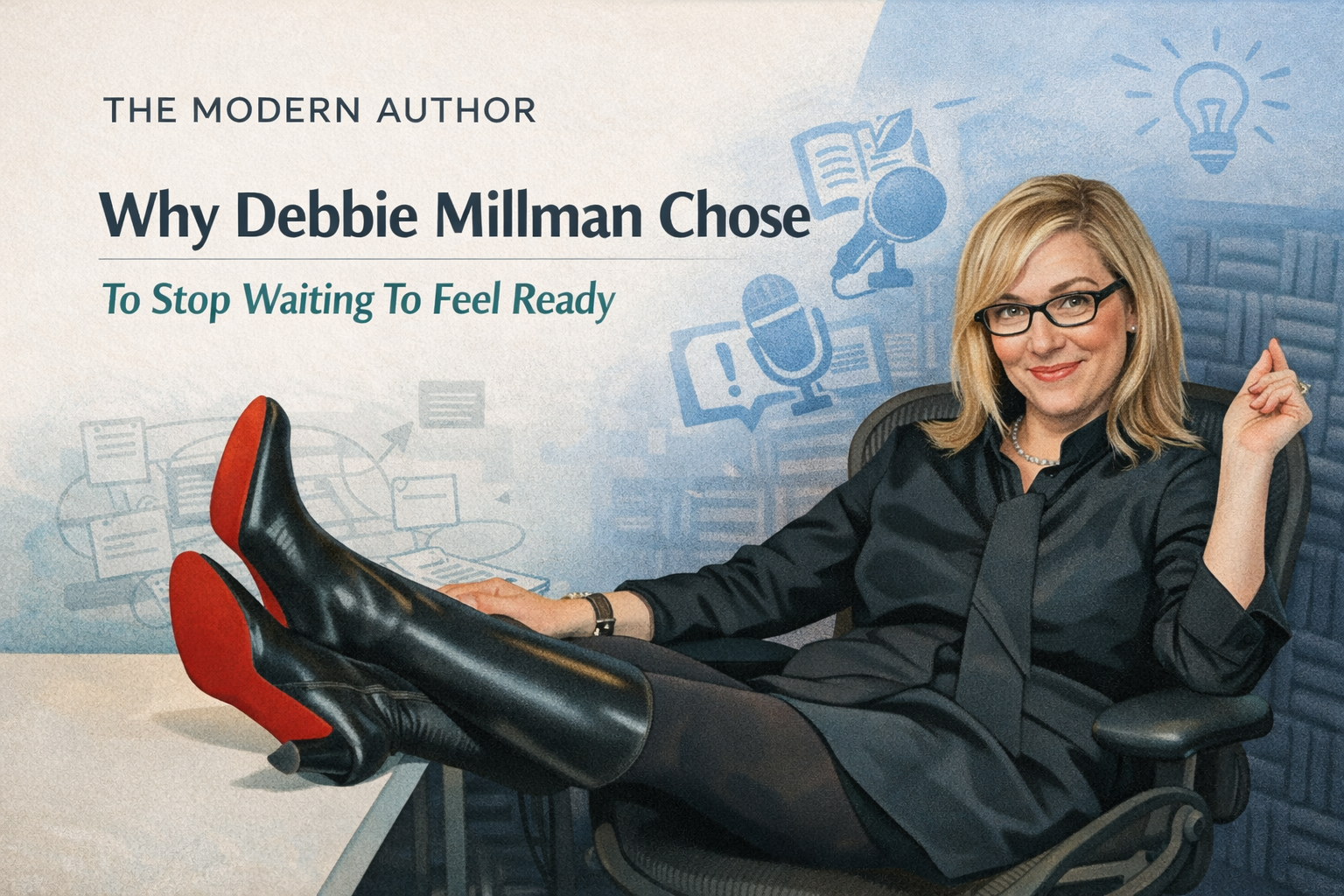
The Modern Author: Why Debbie Millman Chose To Stop Waiting To Feel Ready
Debbie’s career shows that creative confidence is not a prerequisite for serious work, but a byproduct of sustained action taken in the presence of uncertainty.
Debbie Millman has built a career without waiting to feel ready.
Uncertainty appears throughout her work. Fear never fully disappears. Doubt remains present across projects, roles, and transitions.
But none of it is granted veto power.
She does not pause until clarity arrives. She does not require internal certainty before proceeding. She continues to operate while confidence is incomplete.
This is not a personality trait or an unusual level of bravery. It is an operating rule.
Millman’s career shows that creative confidence is not a prerequisite for serious work, but a byproduct of sustained action taken in the presence of uncertainty.
What looks like courage in retrospect is better understood as persistence without emotional permission.
The myth of courage as the starting point
Many creative careers stall because people misunderstand where confidence comes from.
They assume it must arrive first.
That before you begin, something internal needs to resolve: fear quieted, doubt reduced, conviction secured. Courage, in this framing, is treated as the starting condition.
It’s an attractive story because it turns hesitation into a character issue. If you’re not moving, you must be lacking bravery.
But that story misidentifies the problem.
Most aspiring authors are not unwilling to work. They are unwilling to work without an emotional guarantee that the effort will justify itself. They wait to feel like the kind of person who succeeds at the work before allowing themselves to do it.
They wait for confidence.
And in waiting, they confuse delay with discernment.
Confidence is a result, not a prerequisite
The reality is simpler and less comforting: confidence does not precede action. It follows it.
Confidence is not a trait you acquire in advance. It is evidence accumulated over time. It forms only after you have taken repeated steps that prove you can continue even when outcomes remain unclear.
This inversion is easy to miss because it runs counter to how we like to narrate creative success.
We prefer stories where internal clarity produces external momentum.
In practice, momentum produces clarity.
Debbie Millman’s long arc of persistence
Millman’s career makes this inversion visible.
Across her work—as a designer, interviewer, teacher, and author—fear is present, but it is never granted veto power. Uncertainty appears repeatedly, but it does not determine whether she proceeds.
She does not wait to feel ready.
She continues to operate until readiness becomes unnecessary.
This is not a personality trait or an unusual level of self-belief. It is an operating rule: action continues even when confidence is incomplete.
Her career is not built on eliminating doubt, but on refusing to let doubt dictate behavior.
Repetition as the confidence engine
Millman’s approach treats confidence as a lagging indicator. The signal comes after the behavior, not before it.
Action generates information. Information allows adjustment. Adjustment builds self-trust. What people later call confidence is simply familiarity with the fact that movement is possible even when certainty is absent.
This is why repetition matters more than motivation.
Repeated action produces psychological stability not because it feels good, but because it reduces ambiguity. Each instance of showing up adds data:
- You can begin without clarity.
- You can finish without assurance.
- You can publish without knowing how it will be received.
Over time, the brain updates its beliefs—not through affirmation, but through demonstration.
Why waiting for confidence stalls creative work
Waiting for confidence interrupts this process.
When authors delay action until they feel certain, the work accumulates symbolic weight. The project becomes a referendum on talent. Each attempt carries the pressure of justification.
The fewer times you act, the higher the stakes feel.
This is how hesitation hardens into stagnation.
The problem is not fear itself. The problem is treating fear as a prerequisite filter rather than a background condition.
Choosing persistence over certainty
Millman’s persistence outperforms this loop because it breaks the dependency.
Action no longer waits for emotional permission. Uncertainty is treated as a normal condition of making anything that matters, not a problem to be solved in advance.
This reframes persistence itself.
Persistence is not merely a work ethic. It is an uncertainty-management strategy. It allows you to continue producing without requiring the internal environment to be calm, confident, or resolved.
The goal is not to eliminate fear.
The goal is to build a practice that does not depend on fear’s absence.
What this means for modern authors
For modern authors, the implication is structural.
Confidence should not be used as a gate. It should be treated as a signal that may or may not arrive later. Progress is better measured by continuity than by conviction.
Write before you feel ready.
Publish before you feel certain.
Return tomorrow even if today felt disorganized or incomplete.
Not as motivational slogans, but as a causal sequence.
Millman’s career demonstrates that the real advantage is not bravery, clarity, or self-belief at the outset.
It is the ability to remain in motion while uncertainty persists.
Confidence arrives eventually for those who stay long enough to earn it—but the work cannot wait for its permission.
Listen:
Watch:
About the Author
Eric Koester is an award-winning entrepreneurship professor at Georgetown University, bestselling author, and founder of Manuscripts. He has helped more than 3,000 nonfiction authors turn ideas into books, and books into platforms for speaking, media, and business growth.
About Manuscripts
Manuscripts is a modern publishing partner for nonfiction authors who want their books to drive real-world outcomes. We help founders, executives, coaches, and experts design, write, and launch books that build authority, attract opportunities, and compound into long-term business assets.
Work With Us
If you’re writing a book you want to matter, we’ll help you map the right strategy before you write another word.
Schedule a Modern Author Strategy Session
 There are 2 types:
1. Professional accountability
2. Peer accountability
Professional, you pay for:
- Someone from a publisher
- A writing consultant
- Editors
A peer can be a friend.
There are 2 types:
1. Professional accountability
2. Peer accountability
Professional, you pay for:
- Someone from a publisher
- A writing consultant
- Editors
A peer can be a friend.
 If you're looking for a path to elevate your voice or enhance your personal or business brand, focus on depth over frequency.
