Created Credibility: Why Publishing Matters More Than Credentials in the Modern Economy
For most of the last century, credibility followed a predictable path.
You earned credentials.
You joined respected institutions.
You accumulated titles.
You built a résumé designed to signal competence.
And for a long time, that system worked.
Institutions solved a fundamental trust problem.
Most people could not directly evaluate expertise.
So they evaluated signals instead:
- Where you studied
- Where you worked
- What title you held
- Which organizations endorsed you
These signals acted as shortcuts for trust.
The challenge is that many professionals are still operating inside a trust system that no longer functions the way it once did.
The internet changed something far more important than communication.
It changed how credibility is created.
Today, people can inspect expertise directly.
They can read your ideas.
Evaluate your thinking.
Compare your work.
Share your insights.
All without ever encountering the institutions behind them.
As a result, authority is no longer distributed exclusively through organizations.
Increasingly, it is created through visible evidence of expertise.
This does not make credentials irrelevant.
Credentials still matter.
What has changed is their monopoly on trust.
A professional no longer has to rely entirely on institutional affiliation to establish authority.
They can create assets that allow others to evaluate their thinking directly.
Publishing is one of the most powerful ways to do that.
It transforms expertise into visible proof.
It makes ideas discoverable.
It allows knowledge to travel beyond existing networks.
And it creates evidence that can continue generating trust long after it is produced.
That shift has profound implications for careers, opportunity, and professional leverage.
Because one of the most important economic changes of the modern era is this:
Credibility is increasingly created rather than borrowed.
This guide is not really about writing a book.
It is about understanding why books have become some of the most valuable credibility assets in the modern economy.
The Real Shift Most Professionals Miss
Most people think technology changed business.
The deeper change is that technology changed trust.
For most of modern economic history, institutions controlled discoverability. If someone wanted to evaluate expertise, they often relied on proxies such as degrees, titles, employers, certifications, or affiliations.
Those signals helped answer a simple question:
Why should I trust this person?
In a world where expertise was difficult to inspect directly, institutional validation served an important purpose.
The internet fundamentally changed that dynamic.
Today, expertise can be evaluated without institutional mediation. Ideas can be published instantly, shared globally, discovered through search, and assessed on their own merits.
As a result, discoverability has become increasingly decentralized.
An individual no longer needs a large institution to distribute their thinking. They can create visibility themselves through published work, intellectual assets, and public proof of expertise.
That single shift changes far more than marketing.
It changes:
- careers
- opportunity
- authority
- positioning
- expertise markets
Professionals are no longer competing solely on what they have earned.
They are increasingly competing on what they have created.
This distinction matters because discoverability often precedes opportunity. People cannot engage with expertise they cannot find. They cannot evaluate thinking they cannot see.
The professionals who understand this build leverage by making their expertise visible.
The professionals who ignore it often continue competing primarily through credentials in a marketplace that increasingly rewards proof.
The most important change of the digital era is not simply that information moves faster.
It is that trust can now be built directly between expertise and the people who need it.
That is the shift most professionals still underestimate.
The Decision in 60 Seconds
This Guide Is For You If
- You have deep expertise but struggle to differentiate yourself in a crowded market.
- You rely heavily on credentials, institutional affiliations, or professional reputation to establish trust.
- You want your ideas to become discoverable assets rather than remain confined to your existing network.
- You believe a book should create authority, opportunity, and long-term leverage, not just book sales.
This Guide Is Not For You If
- You are only interested in the mechanics of publishing.
- You view a book primarily as a creative or personal project.
- You believe credentials alone are sufficient to establish authority.
- You are not interested in making your expertise visible beyond your current audience.
Core Decision Insight
The modern economy increasingly rewards visible proof over institutional affiliation.
Credentials can signal competence, but published work creates discoverability. It allows people to find, evaluate, share, and trust your expertise without requiring an introduction, referral, or institutional endorsement.
Publishing is one of the most powerful ways to transform expertise into discoverable authority.
The Question This Guide Answers
If institutions no longer control credibility the way they once did, how should modern professionals build trust, authority, and opportunity today?
Why This Matters to Modern Authors
Modern authors are not simply publishing books.
They are creating visible proof.
In a world where expertise can be evaluated directly, the challenge is rarely a lack of knowledge. The challenge is making that knowledge discoverable, understandable, and credible to people who do not already know you.
A book helps solve that problem.
It transforms expertise from something that exists privately inside a person’s experience into something that can be found, evaluated, referenced, and shared.
This is why modern authorship is fundamentally different from traditional publishing.
The book itself matters, but the larger value often comes from what the book represents:
- Proof of expertise
- Evidence of original thinking
- A visible body of work
- A durable authority asset
The most effective authors understand that publishing is not simply about producing a manuscript.
It is about creating an asset that continues generating trust long after the writing is finished.
Viewed through this lens, a book becomes more than a publication.
It becomes a mechanism for converting expertise into authority, visibility, and long-term professional leverage. That is the lens through which this guide should be read.
What This Guide Will Teach You
Most discussions about publishing focus on how to write, publish, or market a book.
This guide focuses on a different question:
Why has publishing become such a powerful credibility mechanism in the modern economy?
To answer that question, we’ll examine how credibility has evolved from something primarily granted by institutions to something increasingly created through visible proof.
Along the way, you’ll learn:
- Why borrowed credibility dominated the industrial economy and why credentials became such powerful trust signals.
- Why visible proof increasingly outperforms credentials in a world where expertise can be evaluated directly.
- How publishing transforms expertise into discoverable authority that can be found, evaluated, and shared.
- Why books remain uniquely powerful credibility assets despite the rise of new media.
- How publishing creates opportunity asymmetry, where relatively small acts of creation can generate disproportionate professional outcomes.
- Why books function as leverage assets that continue creating value long after publication.
- How modern authors build systems of credibility rather than treating books as isolated projects.
By the end of this guide, the goal is not simply to help you think differently about publishing.
It is to help you understand why publishing has become one of the most effective ways to transform expertise into authority, visibility, opportunity, and long-term professional leverage.
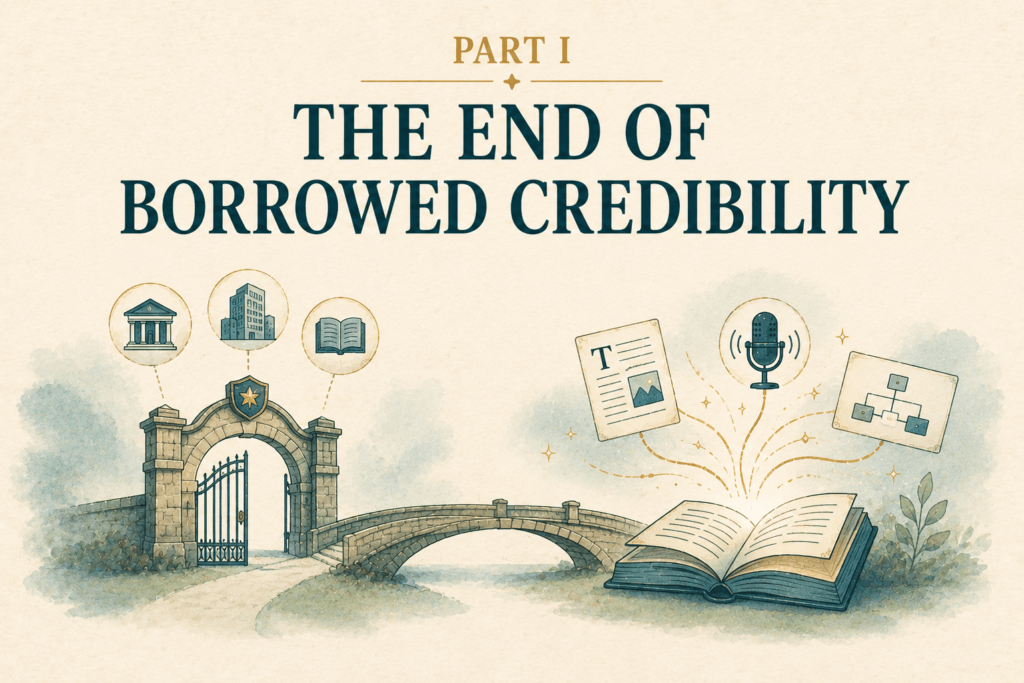
PART I — The End of Borrowed Credibility
Before we can understand why publishing has become such a powerful credibility asset, we need to understand the system it is gradually replacing.
For most of modern history, credentials, institutional affiliations, and professional titles were not arbitrary status symbols.
They solved a real problem.
People needed a way to evaluate expertise when direct proof was difficult to access.
Institutions became the infrastructure that made trust possible at scale.
To understand why created credibility is becoming more valuable today, we first need to understand why borrowed credibility mattered so much in the first place.
The Trust Problem Institutions Used to Solve
Before the internet, trust was expensive.
Evaluating expertise required time, proximity, and access to information that most people simply did not have. If you needed to determine whether someone was qualified, credible, or trustworthy, direct evaluation was often impractical.
As a result, societies developed shortcuts.
Institutions became one of the most important trust mechanisms ever created. Universities, professional organizations, employers, publishers, and credentialing bodies helped reduce uncertainty by signaling that an individual had passed a recognized standard.
Why Credentials Became Powerful Signals
A signal is a visible indicator used to infer something that cannot be easily observed directly.
In economics and organizational theory, this is often referred to as signaling theory: when direct evaluation is difficult, people rely on observable indicators to make decisions.
A degree signaled education.
A prestigious employer signaled competence.
A professional title signaled expertise.
An institutional affiliation signaled credibility.
These signals did not guarantee quality, but they reduced the cost of evaluating trustworthiness.
How Trust Worked Before the Internet
For much of modern history, institutions controlled access to visibility.
Most people could not easily inspect someone’s thinking, review their work, or evaluate their expertise independently. Information moved slowly, distribution channels were limited, and audiences were largely dependent on institutional gatekeepers.
As a result, credibility was often borrowed from the institutions someone belonged to.
The question was not:
“What has this person created?”
It was:
“Who approved this person?”
In that environment, credentials and affiliations were rational proxies for trust.
They helped people make decisions when direct proof was difficult to access.
Understanding this context is important because it explains why credentials became so valuable, and why so many professionals still rely on them today, even as the underlying trust system has changed.
The Traditional Success Playbook
Once institutions became the primary mechanism for establishing trust, a predictable path to professional success emerged.
The objective was not simply to become capable.
It was to accumulate signals that demonstrated capability to other people.
For much of the industrial economy, the playbook looked like this:
- Earn credentials.
- Join respected institutions.
- Accumulate status signals.
- Advance through established systems.
Each step reinforced the next.
Credentials helped open doors to institutions.
Institutional affiliation increased credibility.
Titles, promotions, and professional recognition created additional trust signals.
Over time, these signals compounded into reputation.
Why This Model Worked
The traditional success playbook aligned with how information moved.
Most expertise was difficult to observe directly. As a result, employers, clients, investors, and audiences often relied on proxies when making decisions.
They evaluated where someone studied.
They evaluated where someone worked.
They evaluated who had already approved them.
In many cases, these signals were more visible than the person’s actual work.
As a result, professional advancement often depended on accumulating increasingly powerful forms of borrowed credibility rather than making expertise publicly visible.
The Logic Behind the System
Importantly, this was not a flawed system.
It was an efficient response to the realities of the time.
When expertise was difficult to inspect, institutional validation reduced uncertainty and accelerated trust.
The professionals who succeeded were often those who learned how to navigate these systems effectively.
The result was a world where opportunity frequently followed credentials, affiliations, and status signals because those were the most reliable indicators available.
When Institutions Lost Their Monopoly on Trust
For most of modern history, institutions controlled three critical functions of credibility:
- Visibility — deciding who would be seen.
- Discoverability — determining who could be found.
- Evaluation — signaling who could be trusted.
Universities, employers, publishers, media organizations, and professional associations acted as intermediaries between expertise and the market.
If someone wanted to assess your capabilities, they often could not inspect your work directly.
Instead, they evaluated the institutions that had already evaluated you.
The Internet Changed Visibility
The internet dramatically reduced the cost of making ideas public.
Professionals no longer needed access to major media platforms, publishing houses, or institutional channels to share expertise.
Individuals could publish directly.
Ideas could reach audiences without passing through traditional gatekeepers.
Visibility became increasingly accessible to individuals rather than being controlled primarily by institutions.
The Internet Changed Discoverability
Before digital search, most expertise remained local and relationship-dependent.
People discovered experts through referrals, credentials, employers, or professional networks.
Today, expertise can be discovered through articles, podcasts, research, newsletters, videos, books, and other published assets.
A professional can now become visible to someone they have never met, in a market they have never entered, without relying on institutional distribution.
The Internet Changed Evaluation
Perhaps the most important shift is that people can increasingly evaluate expertise directly.
Instead of relying exclusively on titles, affiliations, or credentials, they can examine someone’s thinking for themselves.
They can read the article.
Watch the presentation.
Listen to the interview.
Study the framework.
Read the book.
The work itself becomes available as evidence.
Trust Became More Direct
Institutions still matter.
Credentials still matter.
Organizations still matter.
But they no longer possess a monopoly on trust.
For the first time at scale, expertise can become visible, discoverable, and evaluable without institutional mediation.
That shift fundamentally changes how authority is built.
People are increasingly trusted not only because of where they come from, but because of what they have publicly created.
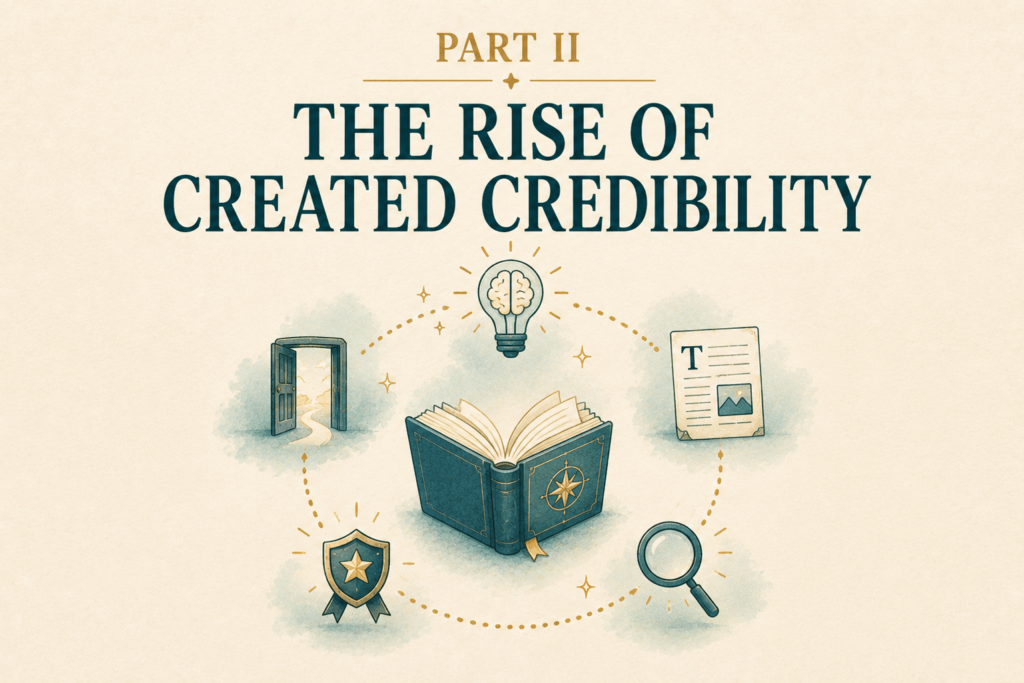
PART II — The Rise of Created Credibility
From Credentials to Proof
For most of the industrial economy, credibility was largely borrowed.
People assessed competence indirectly through the institutions, organizations, and credentials attached to an individual. A degree, title, employer, or affiliation served as a shortcut for trust because evaluating expertise directly was often difficult, expensive, or impossible.
Today, that dynamic is changing.
The internet has dramatically increased the visibility of expertise, making it easier for people to evaluate thinking, knowledge, and capability firsthand. As a result, authority is increasingly built through visible proof rather than institutional association.
The Two Credibility Models
Borrowed Credibility is trust acquired through association with respected institutions or recognized status signals.
It is built through:
- Credentials
- Affiliations
- Titles
- Institutional reputation
Created Credibility is trust earned through publicly visible evidence of expertise.
It is built through:
- Published thinking
- Visible proof
- Intellectual assets
- Discoverable expertise
- A public body of work
Neither model is inherently wrong.
The shift is that created credibility has become increasingly accessible and increasingly valuable.
Borrowed Credibility vs. Created Credibility
| Borrowed Credibility | Created Credibility |
| Credentials | Proof |
| Institution | Platform |
| Resume | Body of Work |
| Permission | Ownership |
| Title | Demonstrated Expertise |
| Affiliation | Published Thinking |
| Gatekeepers | Discoverability |
| Status Signals | Visible Evidence |
Why the Shift Matters
Borrowed credibility depends on external validation.
Created credibility depends on observable evidence.
A credential may suggest competence.
A published body of work demonstrates it.
A title may imply expertise.
Visible thinking allows others to evaluate expertise directly.
This does not mean credentials no longer matter. It means credentials increasingly compete with something they rarely competed with before: publicly available proof.
The New Question
For decades, professional advancement was often shaped by questions such as:
Where did you study?
Where do you work?
What title do you hold?
Those questions still matter.
But a new question is becoming increasingly important:
What have you created?
Published ideas, frameworks, research, books, articles, and intellectual assets provide evidence that can be discovered, evaluated, shared, and referenced long after they are created.
Key Insight
The modern economy increasingly rewards visible evidence over implied competence.
The professionals who understand this shift focus not only on accumulating credentials, but on creating proof that makes their expertise visible to the market.
Why Visible Thinking Compounds
Not all credibility assets behave the same way over time.
Credentials typically function as signals. They communicate that someone met a standard, completed a program, or earned recognition from a trusted institution. They can be valuable, but their value is largely established at the moment they are earned.
Published thinking behaves differently.
When expertise is converted into articles, frameworks, research, presentations, newsletters, podcasts, or books, it becomes a public asset that can continue creating value long after it is created.
1. Published Work Becomes Searchable
Searchable assets can be discovered repeatedly without requiring introductions or direct relationships.
A credential exists on a résumé or profile.
A published idea can appear in search results, recommendations, citations, and conversations years after it was first created.
2. Published Work Becomes Discoverable
Discoverability is the ability for expertise to be found by people who do not already know you.
Each published asset increases the number of entry points through which others can encounter your thinking.
Over time, expertise becomes easier to find because there is more evidence available for the market to discover.
3. Published Work Becomes Shareable
Ideas can move farther than their creators.
A framework can be forwarded.
An article can be referenced.
A book can be recommended.
A concept can circulate through networks that the original author never directly reaches.
This allows expertise to travel beyond the limits of personal relationships and existing audiences.
4. Published Work Becomes Cumulative
Perhaps the most important advantage is that published assets accumulate.
Each article adds to a body of work.
Each framework strengthens positioning.
Each book expands the evidence available for others to evaluate.
The result is not a collection of isolated outputs but a growing repository of proof.
The Difference Between Signals and Assets
A credential signals competence.
A body of published work demonstrates it.
Credentials can open doors.
Published proof can continue creating opportunities long after the credential was earned.
That is why visible thinking compounds while most status signals remain relatively static.
Key Insight
A credential remains largely fixed after it is earned.
Proof continues working after it is created.
The professionals who build the greatest long-term authority are often those who systematically convert expertise into visible assets that remain searchable, discoverable, shareable, and cumulative over time.
Why Creators Are Increasingly Outperforming Credential-Holders
For much of the industrial economy, institutional pedigree was one of the strongest predictors of opportunity.
Elite universities, prestigious employers, and recognized credentials served as proxies for talent, capability, and future potential.
Those signals still matter.
But they increasingly compete with something far more visible: creation.
The Market Can Evaluate Creators Directly
The internet has made it possible for people to assess expertise without relying exclusively on institutional validation.
They can read articles.
Study frameworks.
Listen to interviews.
Review research.
Join communities.
Read books.
As a result, many of the advantages once provided primarily by credentials can now be supplemented, or in some cases surpassed, by a visible body of work.
Creation Produces Evidence
Credentials often signal what someone has done.
Creation demonstrates what someone can do.
A creator’s work provides evidence that can be evaluated directly by the market.
Ideas become visible.
Thinking becomes inspectable.
Capability becomes easier to verify.
This changes how authority is built and how opportunities are distributed.
The Forbes 30 Under 30 Pattern
One of the patterns highlighted in Eric Koester’s research is that many high-performing professionals increasingly distinguish themselves not through institutional pedigree alone, but through what they create.
Founders build companies.
Writers publish ideas.
Researchers share insights.
Community builders gather audiences.
Operators create systems.
Their advantage often comes from visible output rather than affiliation alone.
The market responds to demonstrated capability.
Why This Creates Competitive Advantage
Creation generates assets that continue working after they are produced.
A published framework can be shared.
A book can be recommended.
A body of work can be discovered years later.
Each asset creates additional opportunities for expertise to be found, evaluated, and trusted.
Credentials may open doors.
Creation creates more doors.
The Emerging Advantage
This is not a shift from credentials to creation.
It is a shift from credentials alone to credentials plus proof.
The professionals gaining the greatest leverage are often those who combine expertise with visible evidence of that expertise.
Key Insight
In the modern economy, creation increasingly functions as a form of credibility.
The people who consistently publish, build, teach, and create visible proof are often rewarded not because they possess more expertise, but because their expertise is easier for the market to see.
Visual System Anchor: The Created Credibility Flywheel
The shift from borrowed credibility to created credibility can be understood as a compounding system.
Under the traditional model, institutions distributed trust.
Under the modern model, published proof creates trust.
The more expertise is converted into visible assets, the easier it becomes for the market to discover, evaluate, and trust that expertise. Over time, this creates a self-reinforcing cycle.
The Credibility Transformation Model
Expertise
↓
Published Assets
↓
Discoverability
↓
Authority
↓
Opportunity
↓
Expanded Visibility
↓
More Discoverable Expertise
How the Flywheel Works
| Stage | What Happens |
| Expertise | Knowledge, experience, and insight are developed through work and practice. |
| Published Assets | Expertise is converted into visible forms such as articles, frameworks, research, podcasts, or books. |
| Discoverability | People can find and evaluate the work without requiring introductions or referrals. |
| Authority | Repeated exposure to credible work increases trust and perceived expertise. |
| Opportunity | Speaking, partnerships, media, consulting, recruiting, and business opportunities emerge. |
| Expanded Visibility | New opportunities expose the work to larger audiences. |
| More Discoverable Expertise | Additional visibility drives more discovery, restarting the cycle at a larger scale. |
Why the Flywheel Matters
Most professionals focus on accumulating expertise.
Far fewer focus on making that expertise discoverable.
The result is that valuable knowledge often remains trapped inside organizations, networks, or individual careers.
Publishing changes this dynamic by transforming expertise into assets that can continue working long after they are created. Each asset increases the probability that future opportunities, audiences, and relationships will emerge.
Strategic Insight
Under the old economy, institutions distributed credibility.
Under the modern economy, published proof creates a compounding flywheel that continuously generates authority and opportunity.
Why This Matters
The goal is not simply to publish.
The goal is to convert expertise into assets that continue creating visibility, trust, and opportunity long after the work is finished.
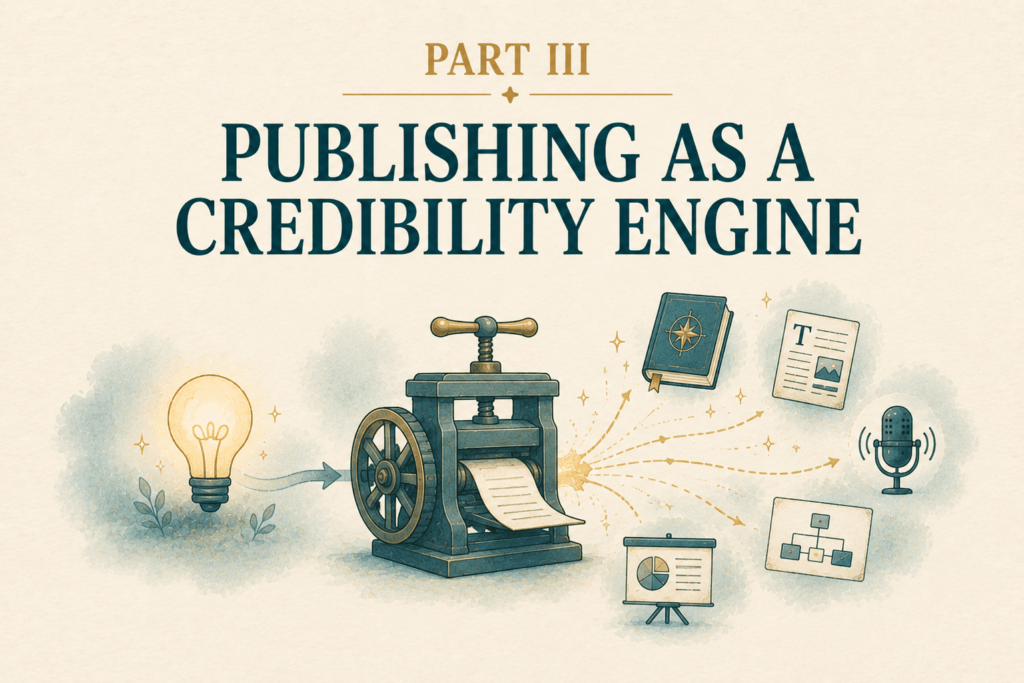
PART III — Publishing as a Credibility Engine
If credibility is increasingly created rather than borrowed, the next question becomes obvious:
How is credibility actually created?
The answer is not expertise alone.
Many professionals possess extraordinary knowledge, experience, and judgment. Yet much of that expertise remains invisible to the people who would value it most.
In the modern economy, expertise creates potential value.
Visibility creates realized value.
Publishing is one of the most effective mechanisms for making expertise visible. It transforms knowledge into assets that can be discovered, evaluated, shared, and trusted without requiring direct access to the expert.
This is why publishing matters far beyond books, articles, or content creation.
At its core, publishing is a credibility engine.
It converts expertise into proof, proof into authority, and authority into opportunity.
Publishing Turns Expertise Into Public Infrastructure
Most expertise begins as private knowledge.
It exists inside experience, conversations, projects, decisions, and accumulated judgment. It may create significant value, but its impact is often limited to the people who already have access to it.
Publishing changes that.
When expertise is published, it becomes public infrastructure: assets that can be discovered, evaluated, referenced, and shared without requiring direct access to the expert.
From Knowledge to Asset
Publishing transforms expertise from something a person knows into something the market can encounter.
A framework can be referenced.
An article can be shared.
Research can be cited.
A book can be discovered years after it is written.
The expertise itself may not change, but its accessibility changes dramatically.
What Publishing Creates
Publishing creates several forms of leverage simultaneously:
| Outcome | What It Creates |
| Discoverability | People can find expertise without an introduction. |
| Proof | Ideas become visible evidence rather than unverified claims. |
| Authority | Consistent public thinking increases trust and perceived expertise. |
| Positioning | Expertise becomes associated with specific ideas and categories. |
| Leverage | Published assets continue creating value after they are created. |
Each outcome strengthens the others.
Greater discoverability creates more opportunities for evaluation. Evaluation builds trust. Trust strengthens authority. Authority improves positioning. Strong positioning creates additional leverage.
Why This Matters
Many professionals think of publishing as a marketing activity.
Marketing typically focuses on attracting attention.
Publishing does something more fundamental.
It creates durable evidence of expertise that can continue influencing how people evaluate, trust, and remember someone long after the original work is published.
Strategic Reframe
Publishing is not primarily a mechanism for promotion.
It is a mechanism for credibility creation.
The goal is not simply to distribute information.
The goal is to transform expertise into public assets that continue generating discoverability, authority, positioning, and leverage over time.
The Difference Between Private Expertise and Public Proof
Many professionals assume that expertise automatically creates authority.
It does not.
Expertise creates the potential for value. Authority emerges only when that expertise becomes visible, understandable, and discoverable to other people.
This distinction explains why highly capable professionals are often overlooked while others with similar, or sometimes lesser, expertise attract disproportionate opportunities.
The difference is rarely knowledge.
The difference is visibility.
The Invisible Expert Problem
Across nearly every industry, there are professionals with decades of experience, deep judgment, and valuable insights whose expertise remains largely invisible outside their immediate network.
Their knowledge exists.
Their capability exists.
Their experience exists.
But very little of it can be discovered by people who have never met them.
As a result, opportunities depend heavily on introductions, referrals, existing relationships, and institutional affiliation. Without those mechanisms, much of their expertise remains hidden from the broader market.
Private Expertise vs. Public Proof
| Private Expertise | Public Proof |
| Exists in your head | Exists in public |
| Requires introductions | Can be discovered |
| Difficult to evaluate | Easy to evaluate |
| Trust develops slowly | Trust develops faster |
| Limited by network | Scales beyond network |
| Invisible to strangers | Visible to the market |
The critical difference is not the quality of the expertise.
It is whether the market can see it.
Publishing Creates Evidence
Publishing transforms knowledge into evidence.
Articles, frameworks, research, presentations, podcasts, and books allow other people to evaluate thinking directly rather than relying on credentials, titles, or reputation alone.
Instead of asking whether someone might be knowledgeable, the market can inspect the work itself.
This reduces uncertainty and accelerates trust because proof exists before a conversation ever takes place.
The market cannot reward expertise it cannot discover.
Expertise creates potential value.
Proof creates market value.
Publishing does not create expertise.
Publishing makes expertise visible.
Why Books Still Matter More Than Most Media
The modern credibility ecosystem offers no shortage of ways to publish ideas.
Professionals can post on social media, appear on podcasts, publish newsletters, record videos, or contribute articles.
All of these formats can create visibility.
Very few create the same credibility signal as a book.
The reason is not reach.
It is concentration.
Books Concentrate Expertise
Most media formats communicate individual ideas.
A book communicates a body of thinking.
It requires an author to organize knowledge, structure arguments, synthesize experience, and present a coherent perspective.
As a result, a book signals more than knowledge.
It signals the ability to transform knowledge into a complete intellectual asset.
What Books Signal
When someone publishes a serious nonfiction book, the market often infers several things simultaneously:
| Signal | What It Suggests |
| Depth | The author has explored the subject extensively |
| Seriousness | The ideas matter enough to develop fully |
| Commitment | Significant effort was invested in the work |
| Structure | The thinking has been organized and clarified |
| Long-Term Thinking | The author is building beyond short-term attention |
These signals are not created by marketing.
They are embedded in the format itself.
Books Create Durable Proof
Many forms of content are consumed and forgotten quickly.
Books tend to function differently.
They are referenced, shared, recommended, gifted, cited, and revisited over long periods of time.
A podcast episode may demonstrate expertise for an hour.
A book can demonstrate expertise for years.
This durability makes books unusually effective as credibility assets because the proof remains accessible long after it is created.
Concentrated Proof
A book is not necessarily the fastest medium.
It is rarely the easiest medium.
But it remains one of the strongest forms of concentrated proof available to professionals.
A well-positioned book communicates expertise, judgment, commitment, and intellectual ownership in a way few other formats can replicate.
In an economy increasingly driven by visible evidence, books continue to occupy a unique role.
They are not simply content.
They are concentrated proof.
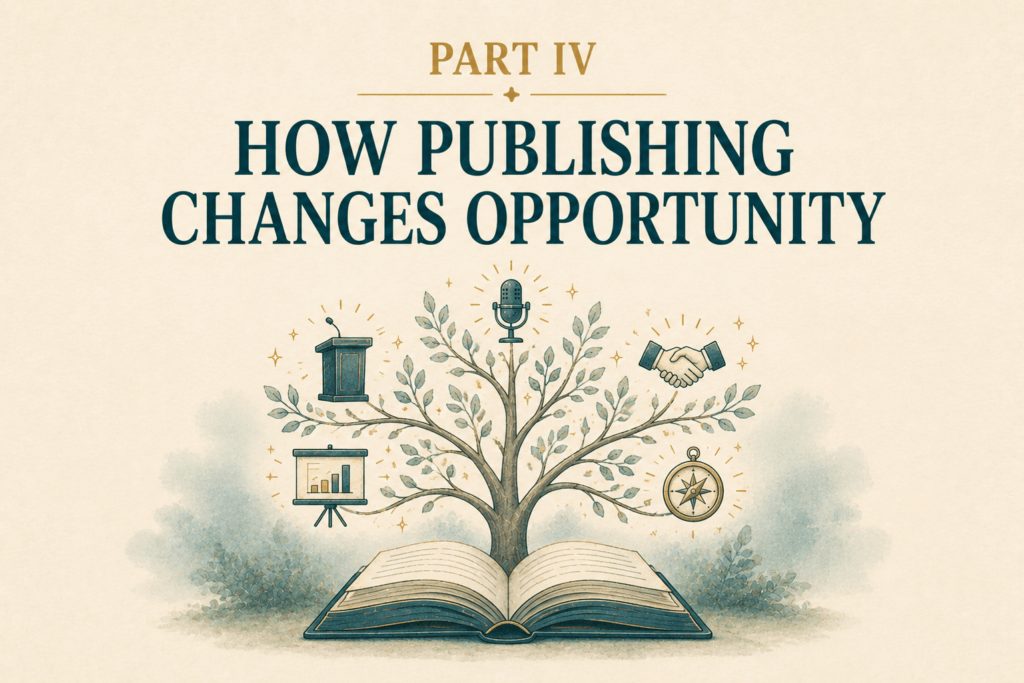
PART IV — How Publishing Changes Opportunity
Most people evaluate publishing through the lens of content.
They ask whether a book sells.
Whether an article gets read.
Whether a podcast reaches an audience.
Those questions matter.
But they often miss the larger effect.
Publishing does more than distribute ideas.
It changes how opportunities find you.
When expertise becomes visible, discoverable, and easy to evaluate, the market begins interacting with you differently.
People can find your thinking before meeting you.
Trust can begin before introductions occur.
Authority can develop before a conversation starts.
The result is a shift from pursuing opportunities to attracting them.
This section explores how publishing creates that shift, and why the outcomes generated by visible proof are often far larger than the publishing activity itself.
Why Books Create Disproportionate Outcomes
Most professional activities produce outcomes that are roughly proportional to the effort invested.
A meeting creates a conversation.
A presentation reaches a specific audience.
A networking event generates a limited number of new relationships.
Publishing often behaves differently.
The effort required to create a book is substantial, but the outcomes frequently extend far beyond the book itself.
This is an example of opportunity asymmetry, a situation where a single asset creates results that are disproportionately larger than the initial investment.
The Book Is Rarely the Final Outcome
Most people evaluate a book by asking:
- How many copies did it sell?
- How much revenue did it generate?
- Did it become a bestseller?
These questions focus on the book as the outcome.
In practice, the book often functions as the catalyst.
The most significant results frequently emerge after publication, when the book begins influencing how the market perceives the author.
How Opportunity Asymmetry Works
A book can create a chain of secondary effects:
- A reader invites the author to speak.
- A podcast host requests an interview.
- A company reaches out about consulting.
- A journalist discovers the author’s work.
- A prospective client develops trust before the first conversation.
None of these opportunities are guaranteed.
But they become more likely because the book creates visible proof that others can discover, evaluate, and share.
The asset creates outcomes beyond its original purpose.
Why Books Create Leverage
Leverage occurs when one effort continues producing value long after the work is completed.
A book can be read by thousands of people without requiring the author’s direct participation.
It can create trust before a meeting occurs.
It can communicate expertise while the author is focused elsewhere.
Unlike many professional activities that stop producing value when the activity ends, a book can continue generating visibility and credibility for years.
The Strategic Implication
The value of publishing should not be measured solely by book sales.
It should also be measured by the opportunities the book makes possible.
A book that generates a speaking invitation, strategic partnership, career opportunity, or long-term positioning advantage may create more value than its direct sales ever reveal.
This is why publishing often produces disproportionate outcomes.
The book is a finite project.
The opportunities it creates are often not.
Will McDonald and Demonstrated Capability
One of the clearest examples of created credibility comes from Will McDonald.
His story illustrates a broader shift occurring throughout the modern economy: demonstrated capability increasingly matters more than institutional pedigree.
For much of the industrial era, opportunity often flowed through credentials.
Degrees, affiliations, and institutional reputation served as proxies for competence because evaluating individuals directly was difficult.
The internet changed that constraint.
Today, people can often assess capability by examining what someone has created.
They can read the work.
Review the thinking.
Evaluate the proof.
Observe the results.
This changes the role of credentials.
Credentials may still provide signals.
But signals are no longer the only evidence available.
Demonstration Reduces Uncertainty
Demonstrated capability is evidence that a person can do the work, not simply evidence that they were trained to do the work.
That distinction matters.
When expertise becomes visible through published thinking, frameworks, research, writing, or books, evaluation becomes easier.
Trust can develop through observation rather than introduction.
Decision-makers no longer need to rely exclusively on pedigree because they can inspect the work itself.
Why This Matters
The lesson is not that credentials have become irrelevant.
The lesson is that visible proof often carries greater weight than credentials alone.
A resume describes expertise.
Published work demonstrates it.
An affiliation implies capability.
Visible proof allows others to evaluate capability directly.
As discoverability becomes increasingly important, professionals who create evidence of their expertise gain an advantage over those who rely solely on institutional signals.
The market increasingly rewards what can be seen, evaluated, and shared.
That is the power of demonstrated capability.
Monica and the Power of Positioning
Monica’s story illustrates a different advantage of publishing.
While many people think books primarily demonstrate expertise, books often create value by changing how expertise is perceived.
This is the power of positioning.
Positioning is the process by which the market categorizes, remembers, and evaluates an individual relative to alternatives.
Two professionals may possess similar levels of expertise.
Yet the one with a clearly articulated body of work is often perceived differently.
Not because they know more.
Because their expertise is easier to understand.
Expertise Alone Does Not Create Positioning
Many accomplished professionals operate from a position of broad competence.
They have experience.
They have results.
They have credibility.
But they are difficult to categorize.
The market struggles to answer a simple question:
“What are they known for?”
This creates a visibility problem.
People rarely recommend, remember, or refer what they cannot easily describe.
A Book Creates a Category Signal
A book forces expertise into a visible and recognizable form.
Ideas become structured.
Frameworks become identifiable.
Expertise becomes associated with a specific set of concepts.
As a result, the market gains a clearer understanding of who the author is, what they believe, and why their perspective matters.
The book becomes more than proof of competence.
It becomes a positioning asset.
How Positioning Changes Opportunity
Once expertise becomes easier to categorize, it becomes easier to reference, recommend, and discover.
This changes how opportunities emerge.
Instead of being evaluated solely through credentials or professional history, the individual becomes associated with a distinct body of ideas.
That distinction often creates disproportionate visibility relative to experience alone.
The expertise may remain largely unchanged.
What changes is how the market understands it.
The Real Lesson
The value of publishing is not limited to demonstrating what you know.
Publishing can change what you become known for.
And in a market increasingly driven by discoverability, memorability, and visible expertise, that shift in positioning can be as valuable as the expertise itself.
Deeper Story Example: From Invisible Expertise to Category Authority
Many professionals possess deep expertise that remains largely invisible outside their immediate network.
The challenge is not capability.
The challenge is discoverability.
Publishing changes that dynamic by transforming private expertise into public proof.
| Before Publishing | After Publishing |
| Expertise exists privately | Expertise exists publicly |
| Opportunities depend on introductions | Opportunities can emerge through discovery |
| Trust develops through personal access | Trust can begin before direct contact |
| Knowledge remains difficult to evaluate | Thinking becomes visible and assessable |
| Insights stay inside conversations | Ideas become shareable assets |
| Referrals drive most opportunities | Content creates additional opportunity pathways |
| Recognition depends on existing networks | Recognition can extend beyond existing networks |
| Expertise is largely invisible to strangers | Expertise becomes visible to the market |
| Known by people who already know you | Known for ideas that can travel independently |
| Category authority remains undeveloped | Category authority begins to emerge |
The expertise itself has not changed.
The experience, knowledge, and capability already existed.
What changes is visibility.
Articles, frameworks, research, and eventually a book convert private knowledge into public evidence that others can discover, evaluate, reference, and share.
As visibility increases, opportunities often begin to follow.
Speaking invitations emerge.
Partnership conversations become easier.
Media opportunities increase.
Professional positioning strengthens.
The underlying expertise remains largely the same.
The market’s ability to see it changes completely.
Publishing does not create expertise. It makes expertise discoverable.
The Visibility Advantage
Most professionals assume the primary value of publishing is the content itself.
In reality, the greatest value often comes from what publishing changes around the content.
Publishing changes visibility.
And visibility changes how expertise is perceived, remembered, and evaluated.
Expertise Is Not Enough if Nobody Can Find It
Expertise has value only when other people can discover it.
A professional may possess deep knowledge, extensive experience, and proven capability.
But if that expertise remains difficult to find, difficult to evaluate, or difficult to describe, its impact remains limited.
Publishing increases the surface area of expertise.
It creates more opportunities for people to encounter, assess, and remember your work.
How Publishing Changes Market Perception
| Without Published Work | With Published Work |
| Difficult to discover | Easier to discover |
| Known primarily through introductions | Can be found independently |
| Expertise is assumed | Expertise is visible |
| Ideas remain private | Ideas become public assets |
| Limited memorability | Stronger category association |
| Evaluated through credentials | Evaluated through demonstrated thinking |
| Visibility depends on network proximity | Visibility extends beyond existing networks |
| Authority develops slowly | Authority scales more efficiently |
The expertise may remain unchanged.
What changes is the market’s ability to see it.
Visibility Creates Strategic Advantages
Publishing improves four forms of professional leverage:
- Memorability — People remember individuals associated with specific ideas.
- Positioning — Expertise becomes attached to a category, problem, or point of view.
- Discoverability — New audiences can find the work without requiring introductions.
- Authority — Public evidence makes expertise easier to trust and evaluate.
These advantages compound over time because published work continues creating visibility long after it is released.
The Real Opportunity
Many professionals believe the book is the opportunity.
It is usually not.
The speaking invitation is an opportunity.
The partnership is an opportunity.
The media appearance is an opportunity.
The client conversation is an opportunity.
The strategic relationship is an opportunity.
The book often functions as the mechanism that makes those opportunities more likely.
Its greatest contribution is not that it exists.
It is that it changes how the market sees the person behind it.
The book is rarely the opportunity. The positioning is.
PART V — Books as Leverage Assets
Why Books Keep Working After Publication
Most professional activities stop producing value when the activity ends.
A speech reaches the people in the room.
A meeting ends when participants leave.
A consulting engagement concludes when the project is complete.
Books operate differently.
Once published, they continue creating value long after the work of writing is finished.
Books Travel
Most expertise is constrained by proximity.
People must know you, meet you, or be introduced to you before they can benefit from your thinking.
A book removes that constraint.
Ideas can move across organizations, industries, geographies, and networks without requiring the author’s presence.
The expertise becomes portable.
Books Scale
Most professional impact is tied directly to time.
There are only so many meetings, conversations, presentations, and engagements one person can participate in.
A book allows expertise to reach far more people than direct interaction alone.
The same idea can be read, referenced, recommended, and shared repeatedly without requiring additional effort from the author.
Books Generate Trust Asynchronously
Asynchronous trust develops when people gain confidence in expertise without direct interaction.
A reader can spend hours engaging with an author’s thinking before the first conversation ever occurs.
They can evaluate ideas.
Assess credibility.
Understand perspective.
Build familiarity.
The trust-building process begins before contact is made.
Books Compound
Unlike many professional activities, books continue producing value over time.
A book can be discovered years after publication.
It can generate introductions, opportunities, conversations, and referrals long after launch.
Each new reader creates the possibility of additional visibility, additional sharing, and additional opportunity.
The result is a compounding asset rather than a one-time event.
| Traditional Professional Activity | Book as a Leverage Asset |
| Limited by the author’s time | Scales beyond the author’s time |
| Impact ends when activity ends | Impact can continue indefinitely |
| Requires direct participation | Creates value without direct involvement |
| Reaches a limited audience | Can reach expanding audiences over time |
| Trust develops through interaction | Trust can develop before interaction |
| Produces short-term outcomes | Can create long-term opportunities |
The strategic value of a book is not confined to publication day.
Its value comes from the ability to keep creating visibility, trust, and opportunity long after the work itself is complete.
The Hidden Economics of Authority
Most people evaluate a book as a revenue-producing asset.
They focus on copies sold, royalties earned, or launch performance.
Those metrics matter.
But they often capture only a fraction of a book’s total economic value.
The larger return frequently comes from the authority the book creates.
Authority Creates Secondary Opportunities
A book makes expertise easier to discover, evaluate, and trust.
As visibility increases, new opportunities often emerge around the published work.
These opportunities may include:
- Speaking engagements
- Consulting projects
- Strategic partnerships
- Media appearances
- Advisory roles
- Career advancement opportunities
- Business development conversations
In many cases, the book itself is not the opportunity.
The book creates the conditions that make the opportunity possible.
Why These Outcomes Compound Over Time
Most professional activities stop creating value when the activity ends.
A presentation reaches a specific audience.
A meeting ends when participants leave.
A project concludes when the engagement is complete.
Books continue working after publication.
A reader may discover a book months later.
A conference organizer may encounter it years later.
A potential client may receive it through a referral long after launch.
Because books remain discoverable, they continue creating opportunities long after the original effort is complete.
The Difference Between Revenue and Leverage
| Direct Book Economics | Authority Economics |
| Book sales | Speaking invitations |
| Royalties | Consulting opportunities |
| Launch performance | Strategic partnerships |
| Reader acquisition | Media visibility |
| Short-term revenue | Long-term leverage |
| Transactional value | Opportunity creation |
Both forms of value matter.
But for many professionals, the larger return comes from the second column.
The economic power of a book is often not what it sells.
It is what it unlocks.
A Book Is Not the Product
Most people evaluate a book the same way they evaluate any other product.
They focus on publication.
Sales.
Distribution.
Launch performance.
The book is treated as the final output of the process.
That perspective is understandable.
But it often misses where the majority of a book’s strategic value is created.
The Common View vs. The Strategic View
A traditional publishing mindset evaluates the book itself.
A strategic publishing mindset evaluates the outcomes the book makes possible.
| Common View of a Book | Strategic View of a Book |
| Product | Asset |
| One-time project | Long-term infrastructure |
| Creative output | Credibility engine |
| Launch event | Leverage system |
| Information | Proof |
| Book sales | Opportunity creation |
| Finished work | Compounding asset |
Both views recognize that a book has value.
The difference is where that value is believed to reside.
Why Modern Authors Think Differently
Modern Authors view books as assets that continue working after publication.
The book becomes a permanent piece of visible proof.
It strengthens positioning.
Supports authority.
Creates discoverability.
Makes expertise easier to evaluate.
And increases the likelihood of future opportunities.
The book itself may remain unchanged.
Its influence continues to expand as more people encounter, reference, share, and engage with it.
The Asset Continues Working
Most projects stop creating value when the work is finished.
Books operate differently.
A book can influence decisions, shape perception, create introductions, and generate opportunities years after publication.
Its usefulness is not limited to launch week.
It becomes part of the author’s long-term credibility infrastructure.
The Real Measure of Success
Book sales matter.
But they are only one measurement.
For many professionals, the more important question is what the book enables.
Does it strengthen authority?
Improve positioning?
Create opportunities?
Expand visibility?
Increase leverage?
These outcomes often generate more long-term value than the direct economics of the book itself.
The greatest value of a book frequently comes after publication.
A book should not be evaluated primarily by what it sells.
It should be evaluated by what it makes possible.
PART VI — The Modern Author’s Credibility System
The Biggest Barrier Is No Longer Technical
For most of modern history, building authority required access to systems that were difficult to enter.
Publishing was controlled by gatekeepers.
Distribution was limited.
Visibility was expensive.
Reaching large audiences often depended on institutions granting access.
Today, most of those constraints have largely disappeared.
The tools for publishing, distributing ideas, and building visibility are widely available.
The technical barriers are lower than they have ever been.
The Constraint Has Shifted
Many professionals assume they still need permission before their ideas deserve attention.
They wait for:
- Another credential
- A larger title
- A more prestigious affiliation
- Formal recognition
- External validatio
The assumption is that credibility must be granted before it can be demonstrated.
That assumption increasingly belongs to an earlier era.
The Psychological Legacy of the Old System
The industrial economy trained people to pursue credibility through institutions.
Success often followed a predictable sequence:
Learn.
Qualify.
Receive recognition.
Advance.
For decades, this model made sense because institutions controlled visibility.
Today, visibility can be created independently.
Yet many professionals continue operating as though authority still requires institutional approval.
The result is a growing gap between capability and visibility.
Expertise Is No Longer the Limiting Factor
Many professionals already possess substantial expertise.
They have experience.
They have insights.
They have frameworks.
They have accumulated years of practical knowledge.
What they often lack is visible proof.
Not because the expertise does not exist.
Because it has never been transformed into assets that other people can discover, evaluate, and trust.
The New Challenge
The modern challenge is not gaining access to tools.
It is adopting a different model of credibility.
A model in which authority is built through visible thinking, published proof, and owned intellectual assets rather than waiting for recognition from external institutions.
For many professionals, the greatest obstacle is no longer technical.
It is the belief that permission must come before creation.
Modern Authors Create Proof Instead of Chasing Approval
The traditional path to credibility was largely based on approval.
You accumulated credentials.
Earned promotions.
Joined respected organizations.
Collected signals that suggested competence.
Authority was often inferred from affiliation.
The modern environment rewards something different.
Authority increasingly comes from visible proof.
Not what someone says about your expertise.
What others can evaluate for themselves.
The Shift From Validation to Evidence
Many professionals still operate as though credibility must be granted before it can be demonstrated.
Modern Authors reverse that sequence.
They publish ideas.
Document frameworks.
Share insights.
Create intellectual assets.
An intellectual asset is a piece of work that captures expertise in a form that others can discover, evaluate, reference, and share.
The goal is not merely to possess knowledge.
The goal is to make knowledge visible.
Proof Scales Better Than Reputation
Reputation is often constrained by network reach.
People must know you, meet you, or receive a recommendation from someone they trust.
Proof operates differently.
Published work can be discovered without an introduction.
A framework can be shared.
An article can be referenced.
A book can be evaluated by someone you’ve never met.
The expertise remains the same.
The accessibility of that expertise changes dramatically.
Modern Authors Build Assets
Rather than accumulating only credentials, Modern Authors create assets that continue working after they are published.
These assets include:
- Intellectual assets
- Visible proof
- Discoverable expertise
- Owned credibility
Each asset increases the surface area through which expertise can be found and evaluated.
Over time, these assets compound.
They strengthen discoverability.
Increase authority.
And create new opportunities for the ideas, and the person behind them, to reach a wider audience.
Credibility Becomes Something You Own
Institutional credibility is often borrowed.
It depends on an organization, title, or affiliation.
Created credibility is owned.
It resides in the body of work itself.
This is why publishing has become such a powerful strategic activity for modern professionals.
It transforms expertise from something people must assume into something they can see.
The Modern Author Is Building a System
Many professionals approach authorship as a project.
They write a book.
Publish it.
Promote it.
Then move on to something else.
Modern Authors operate differently.
They view a book not as a standalone achievement, but as one component within a larger credibility system.
What Is a Credibility System?
A credibility system is a collection of intellectual assets that work together to make expertise more visible, discoverable, and trustworthy over time.
Rather than relying on a single credential, title, or publication, the system continuously reinforces authority through multiple forms of proof.
The goal is not simply to create content.
The goal is to create assets that compound.
The Book Is the Anchor Asset
Books occupy a unique role because they concentrate expertise into a durable, high-signal format.
But books rarely operate alone.
They often support and strengthen other assets, including:
- Articles
- Frameworks
- Research
- Presentations
- Interviews
- Podcasts
- Educational content
- Speaking engagements
Each asset reinforces the others.
The book strengthens credibility.
The surrounding assets increase discoverability.
Together, they create a larger body of proof.
Systems Compound More Effectively Than Individual Assets
A single asset can create visibility.
A system can sustain it.
When multiple assets point toward the same expertise, authority becomes easier to recognize and trust.
Ideas become easier to find.
Frameworks become easier to reference.
Expertise becomes easier to evaluate.
Over time, the system generates cumulative advantages that are difficult to achieve through isolated efforts.
From Publishing a Book to Building Infrastructure
This is the fundamental shift in how Modern Authors think.
The objective is not simply to publish.
It is to build infrastructure for credibility.
Each published asset increases the visibility of the others.
Each piece of proof strengthens the broader body of work.
And each addition makes expertise more discoverable to the people who need to find it.
The strongest authors do not build individual books.
They build interconnected systems of authority.
Related Systems Inside the Manuscripts Ecosystem
A book can create meaningful authority on its own.
But its greatest value emerges when it operates as part of a larger system.
The most effective authors do not treat publishing as an isolated activity. They connect publishing to positioning, audience development, intellectual asset creation, and long-term visibility.
Each component strengthens the others.
Together, they create a compounding authority ecosystem.
Modern Author OS
The Modern Author Operating System is built around a simple premise:
Publishing is not the destination.
It is one component of a broader authority-building strategy.
A book may establish credibility, but credibility becomes more valuable when it is connected to audience growth, professional positioning, content creation, and opportunity generation.
The goal is not simply to publish a book.
The goal is to build an enduring body of work.
Modern Publishing OS
Publishing decisions influence far more than publication itself.
They shape:
- Positioning
- Visibility
- Discoverability
- Long-term leverage
Questions about format, messaging, audience, intellectual property, and distribution are ultimately strategic decisions.
Publishing is not merely production.
It is infrastructure design.
Codex and Author Intelligence
Expertise becomes more valuable when it can be organized, surfaced, and reused.
Many professionals possess years of knowledge that remain fragmented across conversations, documents, presentations, and personal experience.
Author intelligence systems help transform expertise into structured intellectual assets that can be:
- Organized
- Retrieved
- Repurposed
- Expanded
- Published
The objective is not simply to preserve knowledge.
It is to increase the usefulness and reach of that knowledge over time.
Related Areas of Strategic Development
Publishing becomes more effective when connected to adjacent systems, including:
- Audience Building for Modern Authors
- Author Positioning
- Framework Extraction
- Modern Publishing Strategy
- Authority Through Books
Each discipline contributes to the same objective: transforming expertise into discoverable authority.
The System-Level Perspective
The strongest authors do not build books in isolation.
They build interconnected systems that reinforce visibility, credibility, positioning, and opportunity.
The book remains important.
But its greatest power comes from the role it plays within a larger architecture of authority.
PART VII — The Future Belongs to Creators
The rules of credibility have changed.
Institutions still matter.
Credentials still matter.
But they no longer control trust the way they once did.
Today, professionals can create proof directly.
They can publish ideas.
Build intellectual assets.
Make expertise discoverable.
And establish authority through visible work.
That is the shift this guide has been tracing.
The future does not belong only to people with the strongest résumés.
It belongs to people who can turn what they know into evidence the market can find, evaluate, and trust.
What This Means for Modern Professionals
For much of the industrial era, professional advancement depended heavily on institutional signals.
Where you studied.
Where you worked.
What title you held.
Which organizations endorsed you.
Those signals still matter.
But they no longer carry the same monopoly on trust they once did.
Today, expertise can be evaluated more directly.
Ideas can be discovered independently.
Proof can be accessed without an introduction.
The New Competitive Advantage
The professionals gaining the greatest leverage are often not those with the strongest credentials.
They are the ones who make their expertise visible.
They publish.
They create intellectual assets.
They develop bodies of work that others can discover, evaluate, reference, and share.
As a result, authority increasingly comes from demonstrated expertise rather than implied expertise.
The Market Is Asking a Different Question
Historically, credibility was often established through affiliation.
The market wanted to know:
“Where did you work?”
“Where did you study?”
“Who endorsed you?”
Increasingly, a different question matters:
“What have you created?”
Published ideas.
Frameworks.
Research.
Articles.
Books.
These assets provide evidence that others can evaluate directly.
From Accumulating Signals to Creating Assets
Many professionals continue investing primarily in credentials.
Modern Authors invest in assets.
Credentials may open doors.
Assets continue working after they are created.
They increase discoverability.
Strengthen authority.
Expand visibility.
And create opportunities that extend beyond existing networks.
A Different Way to Build a Career
This shift is not simply about publishing.
It is about adopting a different model of professional leverage.
Instead of relying exclusively on borrowed credibility, professionals can create credibility through visible proof.
The modern economy increasingly rewards those who make their expertise visible.
Not just those who possess it.
If This Guide Resonated
The central idea of this guide is simple:
The modern economy increasingly rewards visible proof over institutional affiliation.
Credentials still matter.
Experience still matters.
Expertise still matters.
But expertise creates the most value when it becomes discoverable, evaluable, and visible to the people who need to find it.
That is the role publishing can play.
Not simply creating a book.
Creating proof.
Creating positioning.
Creating leverage.
Creating a body of work that continues generating authority and opportunity long after publication.
The Goal Is Not a Book
For many professionals, a book is not the destination.
It is the foundation of a larger credibility system.
A system that transforms expertise into:
- Discoverable proof
- Authority
- Positioning
- Opportunity
- Long-term leverage
The strongest authors do not think only about publication.
They think about the infrastructure they are building around their ideas.
Continue Exploring
If you want to go deeper into the systems behind modern authority-building, explore:
- Modern Author OS
- Modern Publishing OS
- Codex and Author Intelligence
- Audience Building for Modern Authors
- Authority Positioning Guides
Each explores a different aspect of transforming expertise into assets that compound over time.
Building a Credibility System
Publishing is no longer simply a way to share ideas.
It is increasingly a way to create durable professional leverage.
If you are thinking about how to transform expertise into discoverable authority, position a senior leader as a category expert, or build a long-term credibility system around a body of work, that is the work Manuscripts was built to support.