Why Most Book Outlines Fail: How to Write a Book Outline That Actually Works
The Real Reason Your Book Outline Isn’t Working, and the Outcome-First Framework That Fixes It
Why Most Book Outlines Fail Before Writing Begins
“Most outlines don’t fail in the middle. They fail at the beginning.”
For most authors, learning how to write a book outline feels like the first real step forward.
Chapters get named. Sections get organized. Ideas start to take shape.
It feels like progress.
But this is where the problem begins.
An outline can create the appearance of clarity without actually providing it. You see structure on the page, so it’s easy to assume the thinking behind it is sound. The work feels organized, so it feels correct.
In reality, nothing has been proven yet.
Early Structure Creates False Confidence
When a book outline is built too early, it locks in decisions before the core problem is understood.
- Chapters are defined before the destination is clear
- Ideas are grouped without knowing how they should progress
- The structure looks complete, but the logic is untested
This creates a subtle form of risk: confidence without direction.
At this stage, the outline is not guiding the book. It is constraining it.
The Breakdown Happens Later
The consequences don’t show up immediately.
They appear during drafting:
- Chapters feel disconnected or repetitive
- The message becomes unclear
- Progress slows as decisions become harder, not easier
What looked like a strong start turns into constant restructuring.
Authors often interpret this as a writing problem.
It isn’t.
It’s a structural problem caused by how the outline was created.
A Book Is Not a Document, It’s a Leverage System
A nonfiction book is not simply a collection of ideas organized into chapters.
It is a system designed to produce a result, for the reader and for the author.
- For the reader: a clear transformation in thinking, capability, or perspective
- For the author: authority, opportunity, and long-term leverage
When you treat a book as a system, the role of the outline changes.
It is no longer a way to organize content.
It becomes a way to engineer a result.
Structure Without Outcome Is Wasted Effort
If there is no defined outcome, structure has nothing to serve.
You can build chapters, sections, and sequences, but they are arbitrary.
They may look coherent, but they won’t hold under pressure.
That is why so many book outlines collapse during execution.
Not because the author lacked discipline.
But because the outline was built on structure instead of outcome.
And when structure comes first, failure is delayed, not prevented.
60-Second Decision Box
Which Starting Point Are You Using?
Structure-first outlining
You begin by organizing ideas into chapters.
- You start with topics you want to include
- You group ideas into sections and name chapters early
- You focus on what the book will contain
Outcome-first outlining
You begin by defining the result the book must create.
- You start with a clear end state for the reader
- You define what must change from beginning to end
- You focus on what the book must accomplish
Who This Guide Is For
This guide is for nonfiction authors who are not writing for expression alone, but for outcome.
Specifically, it applies to professionals who are using a book as a strategic asset:
- Founders and executives
- Consultants and advisors
- Operators, leaders, and subject-matter experts
In this context, a book is not just a piece of content. It is a tool for building authority, shaping thinking, and creating long-term opportunity.
This guide assumes you are already:
- Thinking about how to write a book outline, or actively building one
- Organizing ideas into chapters or attempting to structure a manuscript
- Trying to turn expertise into something coherent and usable
It is designed for authors who have moved past the question of whether to write, and are now focused on how to make the book work.
This guide is not for:
- Fiction writers
- Authors focused primarily on literary craft or style
- Beginners looking for step-by-step writing instruction
If your goal is to produce a book that drives clarity, credibility, and real-world outcomes, this guide is relevant.
The Modern Author Reframe
Most approaches to a book outline treat it as an organizational tool.
You take what you know, group it into categories, and arrange those categories into chapters.
This is organizing ideas.
It is useful for managing information, but it does not guarantee that the book will work.
Outlining Is Not Organizing Ideas
Organizing ideas answers the question: What do I want to include?
- What topics should be covered
- What examples or insights should be added
- How content can be grouped into sections
This produces a structured document.
But a structured document is not the same as a coherent book.
Without a clear progression, chapters can exist without a defined role, and the overall structure can look complete while lacking direction.
Outlining Is Designing Reader Transformation
A stronger approach starts with a different question: What must change for the reader?
In this context, outlining becomes a design process.
- The reader begins in a specific state (what they know, believe, or struggle with)
- The book is responsible for moving them to a new state
- Every chapter exists to make that progression possible
This is not about what the book contains.
It is about what the book does.
The Shift in Responsibility
When outlining is treated as transformation design, the role of the author changes.
The task is no longer to organize knowledge.
The task is to construct a sequence that reliably produces an outcome.
This shift makes structure meaningful.
Instead of arranging ideas, the outline becomes a deliberate system for moving the reader from where they are to where they need to be.
What This Guide Will Teach You
This guide is designed to clarify why most book outlines fail, and what must be true for them to work.
It is not a step-by-step process for how to write a book outline.
Instead, it focuses on the underlying logic that determines whether an outline will hold or break during execution.
What You’ll Understand
- Why most outlines fail
Not at the level of effort, but at the level of starting point and structure - The flawed thinking behind structure-first outlining
How organizing ideas too early creates false clarity and weak progression - The missing foundations behind a strong outline
Why audience, outcome, and positioning determine whether structure works - The concept of Working Backwards
A different way of thinking about how outlines are formed, starting from the result rather than the content - How effective structure actually emerges
Why strong outlines are not constructed first, but developed from a clear progression
What This Guide Does Not Cover
- Step-by-step instructions for writing a book outline
- Templates or fill-in frameworks
- Tactical outlining methods
The goal is not to give you a format to follow.
The goal is to help you think in a way that makes any format work.
Why Most Authors Struggle to Write a Book Outline
Most authors try to fix their outline by improving the structure.
They reorganize chapters.
They refine sections.
They look for better ways to arrange ideas.
But the issue is not how the outline is built.
It is where it begins.
Outlining is a neutral tool. It does exactly what it is asked to do.
If it starts from scattered ideas, it produces organized confusion.
If it starts from unclear intent, it produces unstable structure.
What appears to be a structure problem is actually a starting-point problem.
Until that changes, no outline will hold.
How to Write a Book Outline Using an Outcome-First Framework
A strong book outline is not created by adding structure.
It emerges from a defined progression.
At its core is a simple but non-negotiable sequence:
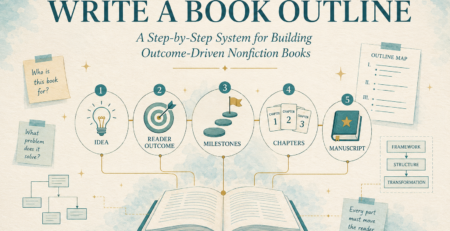
Outcome → Transformation → Milestones → Chapters
- Outcome — the specific result the book must create for the reader
- Transformation — the shift in thinking, capability, or perspective required to reach that result
- Milestones — the critical stages that move the reader through that shift
- Chapters — the visible structure that delivers those stages
This sequence works because it reverses the default approach.
Instead of asking, “What should this chapter include?”
It asks, “What must happen before the reader reaches the outcome?”
Each layer constrains the next.
- The outcome defines the transformation
- The transformation determines the milestones
- The milestones shape the chapters
Nothing is arbitrary. Nothing is added for completeness.
Structure is no longer guessed.
It is derived.
This is why outcome-first outlines hold under pressure.
They are not built forward from ideas.
They are built backward from a result.

PART I — Why Most Book Outlines Fail
The Real Problem with Most Book Outlines
Most authors assume their book outline fails because the structure is wrong.
So they try to fix the structure.
They rewrite chapter titles.
They reorganize sections.
They search for a better way to write a book outline.
They test different formats or templates.
This feels like progress.
But across thousands of nonfiction book projects, the pattern is consistent:
The outline is rarely the root problem.
The starting point is.
What the Data Actually Shows
After working with thousands of nonfiction authors, founders, executives, consultants, and operators, a clear pattern emerges:
- Most stalled manuscripts began with early outlining
- Most rewrites happen after the first “complete” outline is built
- Most abandoned projects had structure before they had clarity
In contrast:
- The majority of completed manuscripts did not start with chapters
- They started with defined outcomes and clear progression
This is not a stylistic preference.
It is a structural difference in how the book is built.
Why Outlining Isn’t the Issue
An outline is a tool.
It organizes decisions that have already been made.
It does not make those decisions for you.
If the author has clarity, the outline becomes precise.
If the author lacks clarity, the outline becomes unstable.
This is why two outlines can look equally organized, but behave very differently during drafting.
One accelerates writing.
The other creates friction, hesitation, and constant revision.
The difference is not formatting.
It is what the outline is built from.
The Starting Point Determines the Outcome
Every outline begins somewhere.
That starting point determines:
- what gets included
- how ideas are grouped
- how chapters are sequenced
- what the book ultimately does for the reader
When the starting point is content, topics, ideas, expertise, the structure becomes descriptive.
It reflects what the author knows.
But nonfiction books that create authority are not descriptive.
They are directional.
They move the reader from one state to another.
If that movement is not defined first, the outline has no stable logic to follow.
Why Structure-First Outlines Break
Structure-first outlining creates a specific failure pattern:
- Chapters are defined before the destination is clear
- Ideas are grouped without knowing their role
- The sequence is based on convenience, not progression
At first, this feels productive.
The outline looks complete.
But during drafting, the weaknesses surface:
- Chapters overlap or repeat
- The message becomes harder to articulate
- Sections need constant restructuring
- The book expands without becoming clearer
This is not a writing problem.
It is a structural consequence of starting too early.
The Template Illusion
Many authors try to solve this by finding a better template.
A writing book outline template can improve presentation.
It can make the outline cleaner, more organized, more familiar.
But it cannot define:
- what the book is actually for
- what the reader must gain
- what progression is required
- what belongs in the book, and what does not
Templates organize content.
They do not create direction.
This is why template-driven outlines often feel strong at the beginning and fragile under pressure.
They provide structure before the logic exists.
The Real Diagnosis
If a book outline is not working, the issue is rarely:
- lack of effort
- lack of discipline
- lack of formatting
The issue is that the outline was built before the core decisions were made.
Before:
- the outcome was defined
- the transformation was clear
- the progression was designed
An outline built on unclear foundations will always require rework.
Because it is trying to organize something that has not yet been decided.
The outline is not failing.
It is revealing the problem upstream.
And until the starting point changes, the result will not.
Why Structure-First Book Outlines Break During Drafting
Structure-first thinking means building a book outline by starting with content.
You begin with what you know, ideas, topics, frameworks, past work, and then organize that material into chapters.
This approach feels intuitive.
It uses existing knowledge.
It produces visible progress quickly.
It creates a sense of movement early in the process.
But structurally, it introduces a critical flaw:
The structure is built before the purpose is defined.
Content-First Creates Arbitrary Structure
When an outline starts from content, the grouping of ideas is driven by convenience, not necessity.
- Topics are clustered because they seem related
- Chapters are created because there is “enough” material
- Sections are added to ensure coverage
This produces a structure that reflects the author’s inventory, not the reader’s journey.
The result is arbitrary organization.
It answers: What do I have to say?
It does not answer: What must happen for the reader?
That distinction has direct consequences.
Without a defined progression, there is no reliable way to decide:
- what belongs in the book
- what should be removed
- what must come first
- what must come later
The outline may look complete, but it cannot make decisions.
And when an outline cannot make decisions, the author is forced to keep re-deciding the structure during writing.
Chapters Exist Without Progression
A strong nonfiction book requires progression.
Each chapter should move the reader forward, building understanding, shifting perspective, or enabling action.
In structure-first outlines, chapters often exist independently.
They are:
- informative, but not directional
- complete on their own, but not interdependent
- ordered logically, but not necessarily sequentially
This creates a revealing pattern:
You can rearrange chapters without breaking the book.
At first, this feels like flexibility.
In practice, it is a structural weakness.
If the order does not matter, the progression has not been defined.
And if progression is not defined, the book cannot reliably produce a result.
The reader may finish individual chapters, but not experience a clear transformation from beginning to end.
Why This Leads to Rework
The consequences of structure-first thinking do not appear immediately.
They emerge during drafting.
As the author begins writing, gaps become visible:
- ideas repeat across chapters
- key concepts appear too early or too late
- sections feel disconnected from the core message
- the overall argument becomes harder to articulate
At this point, the outline starts to shift.
Chapters are merged, split, or moved.
Sections are rewritten or removed.
New structure is introduced to resolve inconsistencies.
This is not refinement.
It is reconstruction.
Decisions that should have been made once at the beginning are now being made repeatedly during execution.
Across nonfiction projects, this is one of the most consistent patterns:
Outlines built from content require significant rework once real writing begins.
Not because the author made mistakes in formatting.
But because the structure was never anchored to a defined progression.
The Hidden Cost of Structure-First Thinking
Structure-first outlining creates an illusion of progress.
The outline looks complete.
The chapters are named.
The book appears planned.
But the underlying decisions have not been made.
This shifts the burden forward.
What should have been a one-time architectural decision becomes an ongoing operational cost during writing.
- More time spent reorganizing instead of drafting
- More cognitive load from repeated decisions
- More risk of abandoning the project mid-way
This is why many manuscripts stall in the middle.
The structure cannot support the work it is being asked to do.
Not because outlining failed.
But because structure was asked to do the job of clarity.
Symptoms of a Failing Book Outline
A failing book outline is rarely obvious at the beginning.
It usually looks structured.
It may appear complete.
It often gives the impression that the book is ready to be written.
The failure becomes visible when the outline is used.
Disconnected Chapters
Chapters do not clearly connect to each other.
They may work in isolation, but not as a sequence.
What this looks like:
- Chapters feel self-contained rather than progressive
- Transitions feel forced or artificial
- You cannot clearly explain why Chapter 3 comes before Chapter 4
What it means:
If chapters can be reordered without breaking the book, the structure is not driving progression.
The outline is organizing content, but not guiding movement.
An Unclear Message
The book becomes harder to summarize as it develops.
You have ideas, but no single, stable argument.
What this looks like:
- Difficulty explaining what the book is really about
- Different chapters making different points
- The core message shifting as you write
What it means:
Without a defined progression, the book accumulates insights but never forms a coherent direction.
Clarity should increase during writing.
If it decreases, the structure is not aligned to a single outcome.
Repetition Across Chapters
The same ideas begin to appear in multiple places.
Not intentionally, but because boundaries are unclear.
What this looks like:
- Similar explanations repeated across chapters
- Key ideas reintroduced instead of built upon
- Chapters overlapping in purpose
What it means:
Chapters do not have defined roles.
When structure is weak, repetition compensates for missing progression.
The manuscript gets longer, but not clearer.
Constant Restructuring During Drafting
The outline keeps changing as you write.
Not occasionally, but continuously.
What this looks like:
- Chapters being moved, merged, or split repeatedly
- Sections rewritten to “make things fit”
- New structure introduced mid-draft
What it means:
The outline is not stable enough to guide decisions.
Instead of reducing effort, it increases it.
Each change forces you to revisit earlier work, slowing progress and increasing friction.
The Pattern Behind These Symptoms
Individually, these issues can seem manageable.
Together, they point to a consistent failure pattern:
- Structure exists, but does not guide decisions
- Chapters exist, but do not build on each other
- Ideas exist, but are not moving toward a result
At this stage, the problem is not execution.
The outline is not functioning as a system.
It is only organizing content, not controlling direction.
Diagnose Your Current Book Outline
Most authors don’t realize their outline is failing.
It looks structured.
It feels thought-through.
It gives the impression that the hard work is done.
This section is designed to remove that ambiguity.
Use the checklist below to assess your current outline.
Structure-First Signals
If your outline was built from structure-first thinking, you will recognize multiple signals below.
1. The outline started with chapters, not outcomes
- You began by naming chapters or sections
- You focused on what to include, not what the book must accomplish
- The “end result” of the book is unclear or loosely defined
Implication:
The structure is organizing content without a defined destination.
2. Chapters are based on topics, not progression
- Each chapter covers a subject or theme
- Chapters feel complete on their own
- You can rearrange chapters without breaking the book
Implication:
The outline is descriptive, not directional. It does not move the reader toward a result.
3. You cannot clearly explain the reader transformation
Reader transformation = the change in thinking, capability, or perspective from the beginning of the book to the end.
- You can describe what the book covers, but not what it changes
- The “before” and “after” state of the reader is unclear
- Different chapters imply different outcomes
Implication:
The outline lacks a unifying purpose.
4. The message becomes less clear as the outline grows
- Adding more detail creates more complexity, not more clarity
- New sections introduce new directions rather than strengthening one
- The core idea becomes harder to summarize
Implication:
The structure is expanding without tightening.
5. You have already restructured the outline multiple times
- Chapters have been moved, merged, or renamed repeatedly
- You’ve created multiple versions of the outline
- Each revision feels like a reset rather than an improvement
Implication:
The outline is being solved during iteration, not driven by a clear foundation.
6. You are relying on a template to “fix” the structure
- You’ve tried different book outline templates
- You are adjusting format rather than clarifying purpose
- The outline looks better, but still feels unstable
Implication:
The problem is upstream from structure.
Make the Call
If you recognize one or two of these signals, the outline may still be salvageable.
If you recognize most of them, the issue is not refinement.
The outline was built from the wrong starting point.
At that stage, continuing to improve the structure will not resolve the problem.
It will extend it.
PART II — The Missing Foundations
No Clear Audience
A clear audience is the specific group of readers the book is written for.
Without a defined audience, the outline has no reference point for decisions.
This is where most outlines begin to drift.
When the audience is described as “everyone” or left implicit:
- Chapters become broad to appeal to more people
- Ideas are included because they are generally useful
- Language becomes less precise to avoid excluding readers
The result is a generic structure.
The outline may look complete, but it lacks constraint.
And without constraint, there is no reliable way to decide:
- what belongs in the book
- what should be removed
- what level of depth is required
This shows up directly in the outline:
- Chapters try to cover too much
- Sections feel loosely defined
- The structure expands instead of sharpening
A book outline requires a specific reader to function.
Without that, structure becomes guesswork.
No Defined Outcome
A defined outcome is the specific change the reader experiences after finishing the book.
This includes a clear “before” state and a clear “after” state.
Without this, the outline has no direction.
Chapters may still be organized.
They may follow a logical order.
But they are not moving toward a result.
This creates a progression failure.
- Chapters introduce ideas, but do not build toward a transformation
- The sequence is based on topics, not movement
- The end of the book does not resolve a clearly defined change
In practice, this means:
- The reader learns, but does not arrive
- The book informs, but does not convert insight into outcome
- The structure exists, but does not lead anywhere
A functional outline requires a defined destination.
Without that destination, chapters cannot form a coherent path.
No Positioning
Positioning is the distinct perspective or angle the book takes on its subject.
It defines how the book is different from other books in the same space.
Without positioning, the outline becomes interchangeable.
- Ideas are correct, but not differentiated
- Chapters resemble what other books already cover
- The structure follows familiar patterns without a clear reason
This weakens the outline in two ways.
First, it removes prioritization.
If the perspective is not defined, there is no basis for deciding which ideas matter more.
Everything feels equally important.
Second, it weakens coherence.
Without a unifying point of view, chapters do not reinforce a central argument.
They accumulate rather than compound.
This results in:
- A structure that feels assembled rather than designed
- Chapters that could belong to multiple books
- An outline that lacks a clear identity
A strong outline reflects a specific way of thinking.
Without positioning, it defaults to a collection of ideas rather than a coherent system.
The Data Behind Why Book Outlines Fail
Most book outlines do not fail because authors lack effort.
They fail because they are built on the wrong assumptions.
Across nonfiction publishing and Manuscripts-supported projects, three patterns appear consistently.
Low Completion Rates Signal a Structural Problem
Industry-wide, the majority of nonfiction book projects are never completed.
Estimates consistently show that over 90% of attempted nonfiction books do not reach publication.
This is not primarily a time or discipline issue.
If it were, completion rates would correlate with experience, writing skill, or available time.
They do not.
The more consistent variable is structural clarity.
Projects that begin with unclear direction, no defined audience, outcome, or positioning, are significantly more likely to stall mid-way.
The outline exists, but it cannot support sustained execution.
Outline Rewrites Are the Norm, Not the Exception
In Manuscripts-supported projects, one of the most common early signals of failure is repeated outline revision.
Authors frequently:
- create multiple versions of their outline
- reorganize chapters after drafting begins
- reset structure after partial progress
This is not iterative refinement.
It is structural instability.
When an outline is built from structure-first thinking, key decisions are deferred.
Those decisions resurface during writing, forcing rework.
By contrast, outlines built from clear foundations tend to remain stable, with changes focused on refinement rather than reconstruction.
Lack of Positioning Correlates with Weak Outcomes
Positioning is the distinct perspective or angle that defines how a book is different.
Across both published books and unpublished manuscripts, a clear pattern emerges:
Books without strong positioning tend to:
- resemble existing content in their category
- struggle to maintain a coherent structure
- fail to create meaningful differentiation
This shows up early in the outline.
Without positioning:
- chapters become interchangeable
- ideas lack prioritization
- structure follows familiar patterns without a clear reason
Even when completed, these books often underperform, because the structure does not reinforce a clear, differentiated point of view.
What the Data Actually Indicates
Taken together, these patterns point to a consistent conclusion:
- Most books fail before writing is complete
- Most outlines require rework after drafting begins
- Most weak books lack clear positioning from the start
These are not independent issues.
They share a common cause.
The outline was built before the foundational decisions were made.
When the starting assumptions are unclear, the structure cannot hold.
And when the structure cannot hold, the book does not progress.
PART III — Why Starting with Chapters Is Wrong
The Hidden Constraint of Chapters
Most authors begin a book outline by asking a reasonable question:
“What should the chapters be?”
It feels like the right place to start.
Chapters are visible.
Chapters make the book feel real.
Chapters turn scattered ideas into something that looks like a manuscript.
But starting with chapters creates a hidden constraint.
It forces structural decisions before the book’s logic is clear.
Chapters Create Premature Commitment
A chapter title feels temporary, but it quickly becomes a commitment.
Once a chapter exists, the author starts defending it.
They look for material to fill it.
They adjust other sections around it.
They begin treating it as necessary because it is already in the outline.
This is how weak structure hardens too early.
The outline begins to serve the chapters instead of the chapters serving the book.
Chapter-First Outlines Become Reactive
When chapters are chosen before the reader’s progression is clear, the outline has to keep reacting.
A new idea appears, so a chapter gets added.
Two chapters overlap, so they get merged.
A section feels important, so it gets moved.
A missing topic appears, so the sequence changes again.
This can look like refinement.
But often, it is the outline trying to compensate for decisions that were made too soon.
The author is not improving the structure.
They are repeatedly renegotiating it.
The Real Problem
Chapters are not the foundation of a strong book outline.
They are the visible result of deeper decisions.
If those deeper decisions have not been made, chapters become placeholders for uncertainty.
They may give the book shape, but they do not give it direction.
That is why starting with chapters feels productive at first and expensive later.
It creates structure before the book is ready to carry it.
Why Most Book Outline Templates Fail
A book outline template is a predefined structure for organizing chapters and sections.
It provides a format to follow.
This can be useful for presentation.
But it introduces a critical limitation.
Templates organize content.
They do not define purpose.
Templates Solve for Form, Not Direction
Most templates answer structural questions:
- How many chapters should there be
- How a book is divided into parts
- What a standard outline looks like
They do not answer directional questions:
- What the book must accomplish
- What the reader must experience
- What progression is required from beginning to end
This creates a mismatch.
The template provides structure before the logic of the book is clear.
As a result, the outline begins to fill the template rather than follow a defined path.
The False Sense of Progress
Templates create early momentum.
The outline looks complete.
Chapters are named.
The book appears structured.
This creates a sense that the hard work has been done.
But the underlying decisions have not been made.
- The audience may still be unclear
- The outcome may still be undefined
- The positioning may still be weak
Because the structure exists, these gaps are harder to detect.
The outline feels finished, even though it is not functional.
Why Template-Driven Outlines Break
When drafting begins, the limitations of the template appear.
- Chapters do not clearly build on each other
- Sections overlap or repeat
- The sequence does not lead to a defined result
At this point, the author has to adjust the structure.
They modify the template.
They add or remove sections.
They reorganize the outline.
This is not a failure of execution.
It is the consequence of starting with form instead of purpose.
The Core Issue
Templates assume that structure can be applied before the book’s logic is defined.
In practice, this reverses the order required for a strong outline.
The structure looks correct.
But it is not anchored to a specific outcome.
Without that anchor, the outline cannot guide decisions or maintain coherence.
It becomes a well-formatted document rather than a working system.
Broken vs Working Outline
| Broken Outline (Topic-Based) | Working Outline (Progression-Based) | |
| Starting Point | What should this book include? | What must change for the reader? |
| Structure Logic | Groups ideas by similarity | Sequences steps toward an outcome |
| Chapter Role | Covers a topic | Moves the reader forward |
| Order of Chapters | Flexible / interchangeable | Fixed / sequence matters |
| Content Pattern | Repetition across chapters | Each chapter has a distinct job |
| Clarity Over Time | Decreases as content grows | Increases as structure compounds |
| What It Produces | Organized information | Directed transformation |
A topic-based outline answers:
“What do I want to say?”
A progression-based outline answers:
“What must happen next?”

PART IV — The Working Backwards Reframe
A Better Question
Most outlines begin with a structural question:
What should come first?
This assumes the structure already exists, and that the task is to arrange it.
A more effective starting point replaces that entirely:
What must happen before the reader reaches the outcome?
This shifts outlining from arranging content to sequencing change.
Instead of deciding what to include, the author is forced to define what must occur, step by step, for the reader to move from their current state to a different one.
The question changes the direction of thinking:
- From ordering ideas → to mapping progression
- From filling chapters → to enabling movement
- From content selection → to outcome alignment
This is the inflection point where most outlines either remain static, or become functional.
Outcome-First Thinking
Outcome-first thinking defines an outline as a reverse-engineered system.
It starts with the outcome, the specific state the reader should reach by the end of the book.
From there, it works backward to identify the transformation required, and then the steps needed to make that transformation possible.
The structure follows this logic:
- Outcome → What the reader can do, think, or achieve differently
- Transformation → What must change for that outcome to occur
- Steps → The sequence required to produce that change
Chapters are no longer containers for topics.
They become dependent steps within a system.
This changes how structure behaves:
- It becomes directional, not descriptive
- It enforces sequence, not flexibility
- It aligns decisions to a defined end state
An outline built this way does not begin with chapters.
It produces them, as a result of the outcome it is designed to create.
What Changes When You Think Backwards
Thinking backwards changes the outline before it changes the writing.
It gives the author a different basis for decisions.
Instead of asking whether an idea is interesting, familiar, or important, the author can ask whether it helps move the reader toward the intended result.
That single shift improves three things immediately: clarity, structure, and speed.
Clarity Improves
Clarity improves because the book is no longer defined by what it contains.
It is defined by what it must accomplish.
That makes decisions easier.
- Ideas that support the outcome become easier to keep
- Ideas that distract from the outcome become easier to remove
- Chapters that do not serve the progression become easier to question
The author is no longer trying to include everything they know.
They are deciding what the reader needs in order to change.
Structure Gets Stronger
Structure improves because chapters stop functioning as containers for topics.
They become parts of a sequence.
Each chapter has a role to play in the reader’s movement from one state to another.
This creates a stronger outline because:
- chapters build on each other
- repetition becomes easier to identify
- gaps in logic become visible earlier
- the order of ideas starts to matter
A strong outline should not feel interchangeable.
If every chapter has a specific job, the structure becomes harder to rearrange, and more likely to hold during drafting.
Speed Increases
Speed improves because fewer decisions have to be remade.
In a structure-first outline, the author keeps asking:
- Where should this go?
- Does this belong here?
- Should this be a chapter or a section?
- Is this idea necessary?
Thinking backwards reduces that friction.
The outcome becomes the filter.
The progression becomes the guide.
The outline does not remove all complexity, but it reduces avoidable rework.
That is why outcome-first outlining often feels slower at the beginning and faster once execution starts.
The author is not rushing structure.
They are removing the confusion that slows the book down later.

PART V — How Strong Structure Actually Emerges
Structure as a Result, Not a Starting Point
Most authors treat structure as something they need to create before they can write.
They assume the outline must come first.
But in a strong nonfiction book, structure is not invented upfront.
It emerges from progression.
Progression means the ordered movement a reader must make from their starting point to the outcome the book is designed to create.
When that movement is clear, structure becomes easier to see.
- The beginning shows where the reader starts
- The middle shows what must change
- The end shows what the reader is now able to understand, decide, or do
This removes pressure from the outline.
The author no longer has to guess the perfect structure in advance.
The structure is derived from the movement the book must produce.
That is why outcome-first outlines tend to feel more stable.
They are not trying to organize everything the author knows.
They are revealing the path the reader needs to take.
Strong structure does not come from arranging ideas beautifully.
It comes from sequencing change clearly.
Chapters as Steps in a Journey
A chapter is not a container for a topic.
It is a step in a progression.
Progression means the sequence of changes a reader must go through to reach the defined outcome. Each chapter exists to move the reader forward in that sequence.
If a chapter does not create movement, it does not belong in the outline.
This changes how chapters are evaluated.
Instead of asking, “Is this important?” the question becomes:
What must the reader understand, decide, or shift before they can move to the next step?
A necessary chapter does one of three things:
- Introduces a required idea the reader cannot skip
- Resolves a point of confusion that would block progress
- Enables a decision or shift needed for the next stage
When chapters are defined this way, structure becomes coherent.
There are no isolated sections.
There is no redundancy.
Each chapter earns its place by advancing the reader.
The outline stops being a list of subjects.
It becomes a sequence of movement.
Case Study Card 1 — Broken Outline
Scenario: A consultant starts with a topic-driven outline.
The early outline looks organized:
- Chapter 1: Leadership
- Chapter 2: Communication
- Chapter 3: Culture
- Chapter 4: Decision-Making
- Chapter 5: Change
At first, the structure feels reasonable.
Each chapter represents something the author knows well. Each topic could support useful stories, frameworks, and lessons.
But once drafting begins, the outline starts to break.
What goes wrong:
- Leadership appears in every chapter
- Communication overlaps with culture
- Decision-making shows up too early and too late
- The central argument becomes harder to explain
- The chapter order feels flexible because no true sequence exists
The issue is not that the topics are weak.
The issue is that the outline is organized around categories, not progression.
The author eventually has to rebuild the structure, not because the ideas are wrong, but because the outline never defined what the reader was supposed to move toward.
Pattern:
A topic-driven outline can look complete while still lacking flow.
Case Study Card 2 — Outcome-First Outline
Scenario: The same author begins again, but this time starts with the reader outcome.
Instead of asking, “What topics should I include?” the author asks:
What must the reader be able to understand or do by the end of the book?
The answer becomes clear:
The reader should be able to lead through complexity without relying on constant control.
That outcome changes the outline.
Now the structure is no longer built around broad topics. It is built around the reader’s required progression.
The milestones become:
- Recognize why control fails in complex environments
- Understand what creates trust under uncertainty
- Learn how communication shapes alignment
- Build decision systems that reduce bottlenecks
- Lead change without becoming the center of every decision
The chapters now have jobs.
Each one moves the reader closer to the outcome.
What changes:
- Repetition decreases
- Chapter order matters
- The central argument becomes easier to explain
- The outline starts to feel stable
- The book becomes easier to brief, write, and defend
Pattern:
An outcome-first outline creates clarity because every chapter serves a defined movement.
Case Study Card 3 — Manuscripts Author Example
Scenario: A Manuscripts author comes in with years of expertise, but the first outline is built around everything they know.
The material is strong.
There are client stories, repeated insights, frameworks, talks, and examples from years of professional work.
But the outline is crowded.
It reads like a catalog of expertise rather than a guided reader journey.
The problem:
- Too many ideas compete for priority
- Chapters overlap because the author’s knowledge is interconnected
- The book feels impressive, but hard to summarize
- The structure does not clearly show what changes for the reader
The shift happens when the outline is rebuilt around transformation.
Instead of asking what the author knows, the process asks what the reader must move through.
That creates a different structure.
The author’s expertise does not disappear.
It gets organized around purpose.
The result:
- The book becomes easier to explain
- The chapters become easier to sequence
- The strongest ideas rise to the surface
- Supporting material has a clear place
- The outline becomes a decision system, not just a planning document
Pattern:
When the outcome is defined, expertise stops overwhelming the outline. It starts serving the reader’s transformation.
A Book Outline Is a Strategic Framework
A book outline is not a static document.
It is not something you create once and then follow.
And it is not a checklist of topics to cover.
A strategic framework is different.
It defines direction, constraints, and priorities.
It clarifies what the book must achieve and what it must exclude.
This changes how the outline functions.
Instead of describing the book, it guides it.
It becomes:
- A system for deciding what belongs and what does not
- A reference point for maintaining coherence across chapters
- A structure that aligns every part of the book to a single outcome
Because it is strategic, it remains active throughout the process.
As new ideas emerge, the outline is used to evaluate them.
As chapters are drafted, the outline ensures they still serve the intended progression.
As the manuscript evolves, the outline maintains alignment.
The result is not rigidity.
It is clarity with control.
The outline stops being a planning artifact.
It becomes the framework that holds the book together.
The Outline as a Decision System
A strong book outline does more than organize material.
It makes decisions.
A decision system is a structure that helps determine what belongs, what does not, and what must happen next.
This is the operational role of the outline.
It prevents the manuscript from becoming a collection of every useful idea the author has.
- It Decides What Belongs
Every serious nonfiction author has more material than the book can hold.
There are stories, frameworks, examples, insights, and arguments that may all feel valuable.
The outline creates a filter.
An idea belongs only if it serves the reader’s progression toward the outcome.
If it does not, it may be useful elsewhere, but it does not belong in the book.
- It Removes Noise
Noise is content that may be interesting but does not move the book forward.
This includes:
- examples that repeat a point already made
- sections added for completeness rather than necessity
- ideas that showcase expertise but do not serve the reader
- chapters that expand the book without strengthening the argument
A strong outline makes removal easier.
It gives the author a reason to cut without feeling like the idea is lost.
The question becomes simple:
Does this make the book clearer, stronger, or more useful?
If not, it is noise.
- It Prevents Drift
Drift happens when the book slowly moves away from its central outcome.
It often begins quietly.
A chapter expands.
A side idea becomes important.
A useful example starts shaping the argument instead of supporting it.
Without a decision system, drift feels like development.
With a strong outline, drift becomes visible.
The outline keeps the book aligned by constantly returning to the same standard:
Does this still move the reader toward the intended result?
That is what makes the outline valuable throughout the entire process.
It is not just a plan for the book.
It is the system that keeps the book on track.
The Key Realization
A structure-first outline cannot be repaired by continuing to build on it.
The flaw is not in the chapters themselves.
It is in the starting assumption that produced them.
When an outline begins without a defined outcome, every decision that follows is misaligned:
- Chapters are added based on relevance, not necessity
- Order is shaped by intuition, not progression
- Ideas accumulate without a clear role in the whole
This creates a false sense of advancement.
The outline grows, but the book does not become clearer.
At this stage, most authors attempt to improve the structure by editing within it:
- rearranging chapters
- merging sections
- refining transitions
But these actions operate inside the same flawed system.
They increase effort without correcting direction.
This is the irreversible point:
You cannot fix a forward-built outline by continuing forward.
The only viable move is to stop extending the structure and rebuild it from the correct starting point.
Not from chapters.
From outcome.
What Comes Next
This guide clarifies the failure pattern and replaces it with a different way of thinking.
The next step is to apply that thinking to construction.
The following guide walks through that process directly:
How to Write a Book Outline Using the Working Backwards Framework
This is where the outline becomes operational:
- the outcome is defined with precision
- the reader’s transformation is mapped
- milestones are identified as required shifts
- chapters emerge as necessary steps
If this guide changed how you evaluate an outline, the next guide shows how to build one that holds.
Deeper Story Example — From Confusion to Clarity
A senior operator begins with a familiar starting point:
A document filled with ideas.
Years of experience have produced:
- frameworks used in practice
- repeated advice given to teams
- internal presentations and notes
- examples from real decisions and outcomes
The first outline reflects that reality.
It is built by grouping what already exists.
Chapters are organized around themes:
strategy, execution, leadership, communication, culture.
On review, the outline appears complete.
There is no lack of substance.
But there is no clear movement.
What breaks:
- The central message is difficult to summarize
- Chapters feel interchangeable in order
- Key ideas repeat across sections
- The reader’s progression is unclear
- Drafting creates more content, but not more direction
The problem is not quality.
It is orientation.
The outline is built around the author’s knowledge, not the reader’s transformation.
The shift begins with a single constraint:
Define what changes for the reader.
Not what they learn.
What is different for them at the end.
This creates a clear outcome.
From that outcome, the outline is rebuilt.
Not by reorganizing existing chapters, but by identifying what must happen before the result is possible.
The structure changes:
- Early chapters address the reader’s current assumptions
- Middle chapters introduce the required shifts in thinking
- Later chapters operationalize those shifts into decisions and actions
Existing material is not discarded.
It is repositioned.
Some ideas become central.
Others are removed because they do not serve the progression.
What becomes clear:
- The book can be explained in a single sentence
- Each chapter has a defined role
- The sequence becomes fixed because it reflects dependency
- Drafting accelerates because decisions are already made
- The outline holds as the manuscript grows
The transformation is not from empty to complete.
It is from scattered to structured.
From content-driven to outcome-driven.
The difference is not more effort.
It is a different starting point.
How Modern Authors Build Outlines That Work
Strong outlines do not come from inspiration or isolated effort.
They come from a repeatable way of thinking, supported by a structured editorial process.
At Manuscripts, outlining is treated as a system, not a one-time task.
Structured Thinking Before Structure
The starting point is not chapters.
It is clarity.
Structured thinking means defining, in order:
- who the book is for (specific audience)
- what changes for them (clear outcome)
- how that change happens (logical transformation)
This creates a fixed reference point for every decision that follows.
Without this layer, structure becomes subjective.
With it, structure becomes constrained and directional.
Editorial Process as a Constraint System
An editorial process is the sequence of decisions that turns thinking into structure.
Instead of asking “what should we include,” the process asks:
- Does this move the reader toward the outcome?
- Is this step necessary for the transformation?
- Does this belong here, or is it noise?
This shifts outlining from accumulation to filtration.
The outline becomes:
- tighter, because unnecessary ideas are removed
- clearer, because each section has a defined role
- more stable, because decisions are made upstream
Consistency Over Iteration
Most outlines rely on repeated rewriting.
A structured thinking + editorial process reduces the need for rework by aligning decisions early.
The result is not a perfect outline on the first pass.
It is an outline that holds under pressure:
- new ideas can be evaluated against the system
- changes do not break the overall structure
- drafting builds forward instead of resetting direction
Modern authors do not treat outlining as a document to complete.
They treat it as a system that governs how the book is built.
Conclusion: Outcome Before Structure
Most book outlines fail for a simple reason: they are built to organize content, not to create change.
An outline that starts with topics will always struggle to hold.
It may look complete, but it lacks direction.
Chapters exist, but they do not move the reader anywhere meaningful.
A working outline operates differently.
It begins with a defined transformation, what the reader becomes by the end of the book, and uses that as the standard for every decision that follows.
This shifts the role of the outline:
- from organizing ideas → to guiding progression
- from listing topics → to sequencing necessary steps
- from static structure → to a system that holds the book together
When transformation is clear, structure becomes constrained.
When structure is constrained, clarity increases.
When clarity increases, the book moves forward without constant rework.
The outline no longer needs to be forced.
It emerges.
And once it emerges from the right starting point, it holds.
FAQ
What is a book outline?
A book outline is a structured plan for how a book progresses from beginning to end. Weak outlines organize topics. Strong outlines map a clear progression that leads the reader to a defined outcome.
Why do most book outlines fail?
Most book outlines fail because they start with structure instead of outcome. When authors begin with chapters or topic lists, there is no clear direction. The outline may look complete, but it does not lead anywhere meaningful.
How do you write a book outline?
A strong book outline starts with the reader’s outcome, then works backward through transformation, milestones, and chapters. This ensures every section contributes to a clear progression.
What is the biggest mistake when creating a book outline?
The biggest mistake is starting with chapters. This forces premature decisions before clarity exists, leading to constant restructuring as the author tries to fix direction during drafting.
Do I need a book outline before I start writing?
Yes, but only if it is built correctly. A strong outline reduces rewriting by guiding decisions. A weak outline increases confusion because it lacks a clear progression.
Should I use a book outline template?
Book outline templates can help organize content, but they cannot define audience, outcome, or progression. Templates work best after the foundational decisions have been made.
What is the “Working Backwards” approach to outlining?
The Working Backwards approach starts with the end result. Instead of asking what to write first, it asks what must happen for the reader to reach the outcome. The structure is then built in reverse so every part serves a purpose.
How is this different from a typical book outline template?
Most templates organize content but do not define purpose. They help structure chapters but do not clarify audience, outcome, or progression. This creates the illusion of progress without solving the core problem.
Can I fix my existing book outline?
If the outline was built from structure-first thinking, continuing forward rarely fixes it. Rearranging chapters improves organization, not direction. In most cases, it requires rebuilding from the correct starting point.
What makes a strong book outline?
A strong outline is defined by progression. Each chapter moves the reader toward a specific outcome and has a necessary role in that movement. If a section can be removed without impact, it does not belong.
Is this approach only for nonfiction books?
Yes. This approach is designed for nonfiction books built for authority, positioning, and real-world outcomes, where the goal is to create change in the reader.
Where should I start if I want to build my outline correctly?
Start by defining the audience, the outcome, and the transformation. Once those are clear, the structure becomes easier to build and far more stable.
Premium CTA
If your current outline feels organized but unstable, the next step is not to keep rearranging chapters.
It is to pressure-test the foundation.
Before a serious nonfiction book moves into drafting, the core decisions need to be clear:
- who the book is for
- what outcome it is designed to create
- what transformation the reader must experience
- what structure can reliably carry that progression
This is the work Manuscripts helps Modern Authors do.
Not by adding more content.
By clarifying the system underneath the book.
For founders, executives, consultants, and expert authors, the cost of a weak outline is not just wasted writing time. It is a book that consumes attention without creating authority, opportunity, or leverage.
A stronger outline begins with a better starting point.
Outcome first.
Structure second.
If you are preparing to write a book and want the structure to hold, begin by making sure the book is designed around the right outcome.