The Modern Author Flywheel: A Thought Leadership Strategy for Building Compounding Authority
Many accomplished professionals eventually arrive at the same conclusion:
“I should write a book.”
It feels like the natural next milestone.
Years of experience have produced valuable ideas. A book seems like the logical way to organize them, share them, and establish authority.
The book gets written.
It launches.
People congratulate the author.
The campaign ends.
Then an unexpected question appears:
Now what?
For many professionals, the answer is surprisingly unclear.
The book was treated as the destination rather than the beginning of a larger system.
That pattern extends far beyond publishing. It shapes how many experts approach thought leadership as a whole. Each initiative is treated as an individual project with its own beginning, middle, and end. A book is followed by a speaking engagement. A speaking engagement is followed by a newsletter. A newsletter is followed by another launch.
Each project may be successful on its own.
But success rarely compounds because the projects were never designed to strengthen one another.
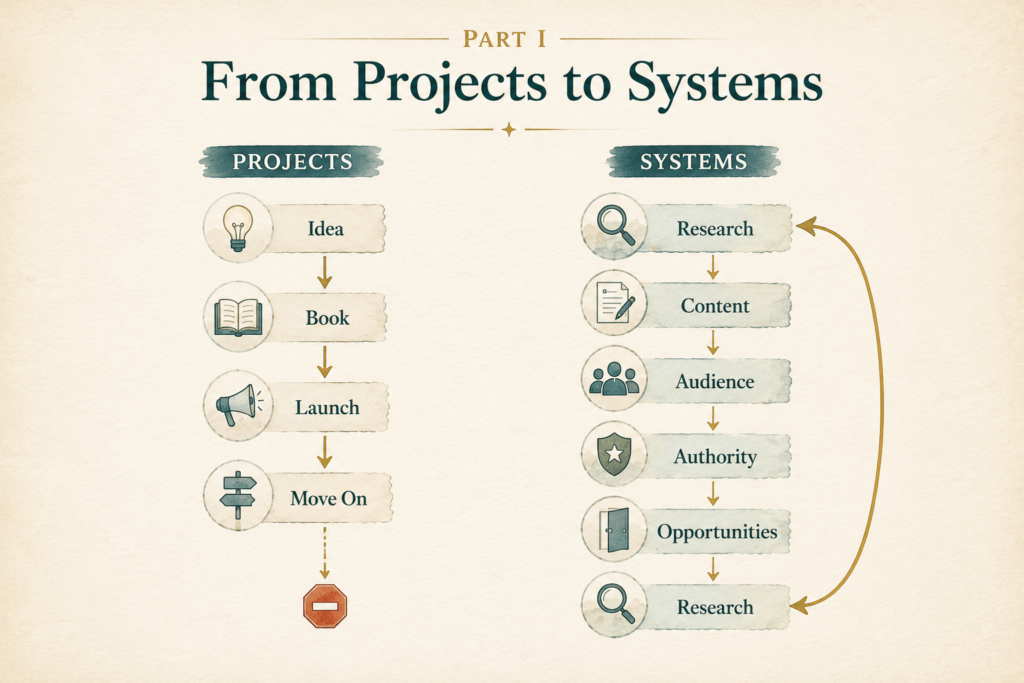
Traditional thought leadership often follows a familiar sequence:
- Idea
- Book
- Launch
- Move On
This approach certainly produces outcomes.
Books are published.
Articles are written.
Audiences grow.
Opportunities appear.
The challenge is that each achievement often depends on starting over.
Every new project requires new momentum.
A new message.
A new campaign.
A new burst of attention.
Over time, authority becomes increasingly dependent on continual production rather than cumulative progress.
Modern Authors approach the problem differently.
They do not begin by asking what the next project should be.
They begin by asking what kind of system they are building.
Instead of treating books, research, content, speaking, and audience development as separate initiatives, they design them to function as interconnected parts of a larger operating model.
The sequence looks very different:
- Research
- Content
- Audience
- Authority
- Opportunities
- Research
- Repeat
The system never truly ends because every stage produces the conditions for the next.
Research generates new ideas.
Ideas become content.
Content attracts an audience.
An audience creates authority.
Authority creates opportunities.
Those opportunities generate new experience, new questions, and new research that strengthen the next cycle.
The output of one stage becomes the input for the next.
This is the central inversion that shapes the rest of this guide.
Most professionals think authority is built by completing impressive projects.
Modern Authors recognize that authority grows through systems that continuously improve themselves.
None of these creates lasting thought leadership in isolation. Their greatest value comes from how they contribute to a larger system that becomes stronger with every cycle.
But none of them creates lasting thought leadership in isolation.
Their greatest value comes from how they contribute to a larger system that becomes stronger with every cycle.
That is why enduring authority rarely belongs to the people who complete the most projects.
It belongs to the people who build systems where every project increases the value of everything that came before it.
Authority, in other words, is not the result of isolated achievements.
It is the result of a system that continuously compounds.
Why Thought Leadership Needs a New Operating Model
Most conversations about thought leadership are organized around individual disciplines.
One expert teaches how to write a book.
Another focuses on publishing.
Someone else specializes in book marketing.
Others teach audience growth, speaking, monetization, or personal branding.
Each discipline addresses a legitimate challenge.
Each offers valuable expertise.
But they are almost always presented as separate problems to solve.
That assumption is where many authority-building efforts begin to break apart.
Professionals become increasingly capable at individual activities while struggling to connect them into something that grows stronger over time. They improve one part of the system without understanding how it should reinforce everything else they are building.
As a result, thought leadership often becomes a collection of successful initiatives rather than a coherent authority strategy.
This guide takes a different approach.
It is not a guide about mastering another discipline.
It is not primarily about:
- writing books
- publishing
- book marketing
- audience building
- speaking
- monetization
Each of those topics matters.
Each deserves its own strategy.
What they rarely explain is how they should work together.
That is the purpose of an operating model.
An operating model is the underlying architecture that determines how independent activities reinforce one another to create a larger outcome.
Rather than asking, “How can I become better at publishing?” it asks a different question:
“How should publishing strengthen everything else I’m building?”
The same question applies to every authority asset.
Instead of optimizing each one independently, an operating model defines how they work together.
It answers questions such as:
- How should research improve future content?
- How should content deepen audience relationships?
- How should a book strengthen speaking opportunities?
- How should client work generate better intellectual capital?
- How should every new opportunity make the entire system stronger?
Without that architecture, even successful initiatives remain largely isolated.
A well-written book may generate credibility without creating future intellectual capital.
A growing audience may produce attention without strengthening expertise.
Speaking engagements may increase visibility without improving the ideas that created them.
Each effort succeeds on its own.
Few of them compound.
An operating model changes that dynamic.
Instead of treating books, research, content, audience, authority, and opportunities as separate achievements, it connects them into a system where every output becomes an input for the next stage.
Success is no longer measured by the performance of an individual initiative.
It is measured by how much stronger the entire authority system becomes because that initiative exists.
That is the perspective this guide develops.
Not another methodology for publishing or marketing.
An operating model that explains how every authority asset can work together to create compounding thought leadership.
The Decision in 60 Seconds
Before investing more time in new tactics, answer one question:
Is your challenge a lack of execution, or a lack of integration?
Many accomplished professionals already know how to create valuable work. They can publish articles, deliver presentations, write newsletters, appear on podcasts, or even publish books.
The issue is not that they lack activity.
The issue is that each activity often operates independently, producing value for a single initiative without strengthening everything else they are building.
This guide is designed to help you determine whether that is the challenge you are trying to solve.
This Guide Is for You If…
You will likely benefit from this guide if you recognize one or more of these patterns:
- Your authority-building efforts feel disconnected rather than cumulative.
- Every new project feels like starting over instead of building on previous work.
- You are thinking beyond short-term visibility and building expertise that should appreciate over time.
- You want every asset you create to increase the value of every other asset.
This Guide Is Not for You If…
This guide is probably not the right resource if your immediate need is to:
- Learn how to publish a book.
- Find book marketing tactics or launch strategies.
- Build an audience using specific marketing techniques.
- Solve a single stage of the author journey without considering how it connects to the larger system.
Those are important topics, but they answer different questions.
This guide addresses a broader strategic challenge: how individual authority-building activities reinforce one another over time.
The distinction is important because successful thought leadership is rarely constrained by a shortage of tactics.
More often, it is constrained by the absence of a system that connects those tactics into a coherent whole.
When publishing, content creation, audience development, speaking, research, and professional opportunities operate independently, each produces an isolated outcome.
When they are intentionally connected, each one increases the value of everything that follows.
That is the decision at the center of this guide.
You are not deciding whether to add another tactic.
You are deciding whether to continue building individual projects—or begin building a system.
Projects create isolated outcomes.
Systems create compounding authority.
Why This Matters to Modern Authors
Many professionals measure the strength of their thought leadership by the quality of their individual outputs.
Was the book well written?
Did the keynote resonate?
Did the newsletter grow?
Did the podcast perform?
These are worthwhile questions.
But they focus on evaluating individual assets rather than the system those assets belong to.
A Modern Author approaches authority differently.
A Modern Author is not simply someone who publishes a book or shares expertise consistently. A Modern Author intentionally develops intellectual assets that become more valuable because they are connected to one another.
That shift changes what gets optimized.
Instead of asking how to make each asset perform better on its own, Modern Authors ask how every asset can strengthen the entire authority ecosystem.
The difference is subtle, but significant.
Traditional thinking often optimizes individual assets:
- A better book.
- A larger audience.
- A more successful keynote.
- A stronger newsletter.
Modern Authors optimize the relationships between those assets:
- A book that creates better speaking opportunities.
- Speaking engagements that generate new research and ideas.
- Research that strengthens future content.
- Content that attracts the right audience.
- An audience that creates opportunities for deeper work.
Each asset continues to matter.
What changes is the objective.
Modern Authors maximize the performance of the entire ecosystem. The goal is to increase the value of the entire system every time a new asset is created.
This is what makes systems thinking the defining capability of a Modern Author.
Systems thinking is the practice of designing how individual parts interact so the whole becomes stronger than the sum of its components. Rather than viewing books, content, research, audiences, and professional opportunities as separate achievements, it treats them as interconnected elements of a single authority system.
Viewed this way, success is not measured only by what an individual asset accomplishes.
It is also measured by what that asset makes possible next.
A book should contribute to more than book sales.
A keynote should contribute to more than audience applause.
A research project should contribute to more than a single publication.
Each should strengthen the relationships that make future work more valuable than the work that came before it.
That is why Modern Authors do not optimize individual assets.
They optimize the relationships between assets.
What This Guide Will Teach You
This guide is not designed to help you execute one part of thought leadership more effectively.
It is designed to help you understand the operating system that makes every part work together.
By the end of this guide, you should be able to answer five strategic questions.
1. Why does traditional thought leadership eventually stall?
You’ll understand why project-based authority often becomes fragmented, campaign-driven, and dependent on continually creating something new.
2. What is the true asset behind enduring authority?
You’ll learn why intellectual capital—not books, content, or visibility—is the strategic resource that gives every authority asset long-term value.
3. How does the Modern Author Flywheel create compounding authority?
You’ll see how research, content, audience, authority, opportunities, and experience reinforce one another through a continuous operating system rather than a series of disconnected initiatives.
4. How do all the Manuscripts Guides fit together?
You’ll understand why publishing, audience building, speaking, monetization, and related strategies are not standalone playbooks, but interconnected parts of a larger authority architecture.
5. Why do some experts build leverage while others continually start over?
You’ll learn why lasting authority comes from strengthening the relationships between assets so every cycle of work increases the value of the next.
By the time you finish this guide, you should no longer see thought leadership as a sequence of projects to complete.
You should see it as a system designed to compound expertise, authority, and opportunity over time.
Part I — From Projects to Systems
Thought leadership rarely plateaus because experienced professionals run out of ideas.
More often, it plateaus because each success is treated as a destination instead of becoming the foundation for what comes next.
To understand why some experts continually gain authority while others feel trapped in an endless cycle of launching, promoting, and starting over, we first need to examine the limitations of the traditional project-based approach.
Why Traditional Thought Leadership Eventually Plateaus
Most professionals do not set out to build fragmented authority.
It emerges gradually.
A book is published.
A launch campaign follows.
Then attention shifts to the next initiative—a keynote, a podcast, a newsletter, a research report, or another book.
Each project may succeed on its own.
Each contributes something valuable.
Yet over time, many professionals begin to notice an unsettling pattern.
Despite years of productive work, building authority never seems to become easier.
Every new initiative still demands the same level of planning, promotion, and energy as the one before it.
Momentum fades.
The cycle begins again.
This is one of the defining limitations of project-based thought leadership—an approach that treats each authority-building effort as an independent objective rather than part of a larger system.
As a result, authority often becomes:
- Fragmented. Books, content, speaking, research, and professional expertise evolve independently instead of reinforcing one another.
- Campaign-driven. Visibility rises during launches or major initiatives, then declines until the next project begins.
- Difficult to sustain. Growth depends on continually producing new work rather than building on existing assets.
- Dependent on constant reinvention. Every project requires new momentum because previous successes contribute less than they should to future opportunities.
None of these outcomes necessarily indicate poor execution.
In fact, they often occur despite excellent execution.
An executive can write an outstanding book.
A consultant can build a respected newsletter.
A founder can become a sought-after speaker.
Each achievement may accomplish exactly what it was designed to do.
The limitation lies elsewhere.
Individual successes do not automatically strengthen one another.
Without intentional connections between them, every project reaches a natural endpoint. Once its immediate objective has been achieved, much of its value remains locked within that single initiative.
The consequence is subtle but significant.
Authority grows through effort, but not necessarily through accumulation.
Professionals become increasingly accomplished without becoming proportionally more leveraged.
Their body of work expands.
Their authority system does not.
This explains why traditional thought leadership eventually reaches a plateau.
The challenge is rarely a shortage of expertise, effort, or opportunity.
It is the absence of a structure that allows each achievement to make the next one stronger.
The Shift From Publishing Strategy to Systems Thinking
A publishing strategy is designed to help complete a publishing project.
It answers questions such as:
- What should the book accomplish?
- How should it be produced?
- How will it reach the right readers?
- What should happen around the launch?
Those questions matter.
But they remain project questions.
They are organized around the successful completion and performance of a specific asset.
Systems thinking begins with a different objective.
Systems thinking is the practice of designing how separate activities interact so they continue producing value beyond any single project.
Instead of asking only, “How do we make this book successful?” it asks:
“How should this book strengthen everything that comes after it?”
That shift changes the role of the project.
A book is no longer treated as a self-contained achievement with a defined beginning and end. It becomes part of a larger structure that should continue generating insight, visibility, credibility, relationships, and opportunity after publication.
The same principle applies to every authority-building effort.
A project is designed to produce an output.
A system is designed to keep producing momentum.
Completing Projects
Project-based thinking is organized around delivery.
The central objective is to finish the manuscript, publish the article, deliver the keynote, or complete the campaign.
Success is measured by whether the asset was produced and how well it performed within its immediate context.
This approach can create excellent work.
But once the project is complete, the structure supporting it often dissolves.
The team moves on.
The campaign ends.
The learning remains undocumented.
The relationships between that project and future work are left to chance.
Building Systems
Systems thinking is organized around continuity.
The objective is not only to complete the work, but to design what the work should make possible next.
That means considering:
- what knowledge the project captures
- what new questions it reveals
- what relationships it strengthens
- what future work it can support
- what processes should continue after completion
The distinction is not that systems eliminate projects.
Systems give projects a larger function.
A project can still have a deadline, budget, team, and measurable outcome. But its value is judged not only by what it delivers now. It is also judged by how effectively it contributes to future momentum.
This is the strategic shift required for sustainable thought leadership.
Publishing remains important.
But publishing alone is not the operating model.
It is one activity inside a broader system designed to keep turning completed work into new value.
Projects produce outputs. Systems produce momentum.
Why Compounding Is the Real Competitive Advantage
Most thought leadership strategies emphasize volume.
Publish more consistently.
Appear in more places.
Reach more people.
Create more content.
These activities can increase visibility. But visibility alone does not create a durable advantage.
The more important question is whether each cycle of work makes the next cycle more valuable.
That is the logic of compounding authority.
Compounding authority occurs when the value created by one period of work is retained, strengthened, and carried forward into the next. Instead of repeatedly rebuilding momentum, the professional begins each new initiative with more credibility, clearer ideas, stronger relationships, and greater strategic leverage than before.
This creates a fundamentally different growth pattern.
Volume adds activity.
Compounding adds accumulated advantage.
More Output Does Not Guarantee More Authority
A professional can publish for years without creating meaningful compounding.
The work may be thoughtful.
The cadence may be consistent.
The audience may even grow.
But when each article, appearance, campaign, or project functions independently, its value remains largely contained within that moment.
The next initiative still requires a new idea, a new push, and a new source of attention.
This is linear growth: more effort produces more output, but the underlying system does not become significantly stronger.
Compounding changes that relationship.
The work already completed begins to reduce the effort and increase the value of what comes next.
Previous ideas create a stronger foundation.
Past visibility improves recognition.
Established credibility makes new opportunities easier to secure.
Earlier experience improves judgment.
The professional is no longer beginning from the same position each time.
Consistency Creates Repetition. Compounding Creates Leverage.
Consistency matters because authority cannot develop through occasional activity alone.
But consistency is not the final objective.
It is possible to repeat the same cycle indefinitely without improving the quality of the system behind it.
Compounding requires more than continued production. It requires retained value.
Each cycle must contribute something that remains useful:
- clearer thinking
- stronger evidence
- deeper expertise
- more trusted relationships
- greater credibility
- better access to future opportunities
When those gains are preserved and connected, authority begins to function as an appreciating asset rather than a temporary result.
The advantage is not simply that the professional has done more.
It is that every previous cycle now contributes to the performance of the next one.
Compounding Changes the Economics of Authority
In a project-based model, growth remains closely tied to current effort.
When activity slows, momentum slows with it.
In a compounding model, earlier work continues to create value after the original project has ended. The professional gains more from each future investment because it is supported by everything already built.
This changes the economics of thought leadership.
The return on one initiative is no longer limited to its immediate outcome.
Its full value includes the advantage it creates for subsequent work.
Over time, this produces a widening gap between professionals who continually generate activity and those who build cumulative authority.
One keeps adding outputs.
The other keeps increasing leverage.
That is why volume is not the real competitive advantage.
Compounding is.
Authority becomes strategically valuable when every cycle leaves the professional better positioned for the next.
Part II — Intellectual Capital Is the Foundation
If authority compounds, something must be compounding.
It isn’t the number of books you’ve published.
It isn’t the amount of content you’ve created.
It isn’t even the size of your audience.
Those are outcomes.
The asset that grows more valuable with every cycle is something deeper.
It is intellectual capital.
The True Asset Is Intellectual Capital
Most thought leadership is evaluated through its visible outputs.
The book.
The article.
The keynote.
The newsletter.
The research report.
These assets matter because they make expertise visible. But they are not the source of the value.
They are expressions of it.
The deeper asset is intellectual capital: the organized body of ideas, insights, frameworks, evidence, and experience that gives an expert’s work coherence, distinctiveness, and practical value.
To understand why this matters, it helps to separate four concepts that are often treated as interchangeable.
Expertise
The knowledge and judgment developed through education, practice, and experience.
A senior executive may have decades of expertise in leadership, operations, investing, organizational change, or industry transformation.
But expertise often remains implicit.
It may exist as instinct, pattern recognition, or accumulated judgment without being clearly articulated or organized.
Information
Consists of facts, observations, data, and lessons.
It can be collected, shared, and referenced.
Information supports authority, but information alone is rarely distinctive. Other professionals may have access to the same research, market data, or industry knowledge.
Its value depends on how it is interpreted and connected.
Content
The visible form used to communicate ideas.
Books, articles, newsletters, presentations, videos, and reports are all forms of content.
Content makes thinking accessible.
But producing more content does not necessarily deepen the thinking behind it. A professional can publish frequently while continuing to repeat the same loosely organized ideas.
Intellectual Capital
Emerges when expertise and information are developed into a coherent body of thinking.
It includes:
- clearly articulated ideas
- distinctive interpretations
- repeatable frameworks
- useful language and concepts
- supporting evidence
- lessons refined through experience
This organization makes expertise transferable.
What once existed only in the executive’s judgment can now be explained, taught, tested, applied, and extended.
That is what gives intellectual capital strategic value.
A single piece of content may attract attention for a week, a month, or a launch cycle.
A strong body of intellectual capital can continue generating valuable work for years.
It can support new arguments without requiring the author to begin from nothing.
It can create consistency across different formats without making every asset repetitive.
It can also deepen as new experience reveals better evidence, sharper distinctions, and more useful applications.
This is why the central objective of thought leadership cannot be content production alone.
The more important objective is to strengthen the thinking that makes valuable content possible.
Content is an expression.
Intellectual capital is the asset.
Everything Else Is an Expression of Intellectual Capital
Once intellectual capital becomes the primary asset, the way you view every other authority-building activity begins to change.
Books are no longer the destination.
Articles are no longer isolated pieces of content.
Keynotes are no longer one-time presentations.
Instead, they become different ways of expressing the same underlying body of thinking.
This is one of the most important shifts in the Modern Author approach.
Professionals often organize their work around formats.
They have a publishing strategy.
A speaking strategy.
A newsletter strategy.
A content strategy.
Each initiative develops on its own timeline, with its own objectives and its own workflow.
The result is often a collection of successful assets that share surprisingly little connection.
A Modern Author reverses that process.
Instead of asking, “What should I create next?” the question becomes:
“How can my existing intellectual capital be expressed most effectively?”
That shift changes the role of every authority asset.
A book becomes a structured expression of your thinking.
A keynote becomes a spoken expression of the same ideas.
A newsletter explores those ideas in smaller, ongoing conversations.
Research deepens and validates them.
Client engagements test them in practice.
Workshops teach others how to apply them.
Although each format serves a different purpose, they all originate from the same source.
One body of intellectual capital can produce many valuable expressions:
- Books that organize complex ideas into a coherent argument.
- Articles that explore individual insights in greater depth.
- Newsletters that develop thinking through regular dialogue.
- Keynotes that communicate ideas to live audiences.
- Workshops that translate concepts into application.
- Research that expands and strengthens existing knowledge.
- Client engagements that refine ideas through real-world experience.
The relationship is important.
These assets are not competing for your attention.
They are reinforcing one another because they all draw from—and contribute to—the same intellectual foundation.
This is why strong thought leaders often appear remarkably consistent across different mediums.
Their books, presentations, interviews, newsletters, and conversations do not feel like separate bodies of work.
They feel like different windows into the same body of thinking.
That consistency is not the result of repeating the same message.
It is the result of developing intellectual capital deeply enough that it can be expressed in many forms without losing its coherence.
When the underlying asset becomes stronger, every expression becomes stronger with it.
And because each new expression can also clarify, refine, and expand the underlying ideas, the relationship is no longer one-way.
The intellectual capital produces the assets.
The assets, in turn, help strengthen the intellectual capital that produced them.
Why Most Experts Build More Content Instead of More Assets
Most experts do not struggle to produce ideas.
They struggle to convert those ideas into assets that retain value.
The default response is usually more content.
Another article.
Another post.
Another newsletter.
Another presentation.
The activity creates the appearance of momentum. But when each piece is planned, produced, and distributed independently, very little of that momentum carries forward.
The expert remains busy.
The authority system remains weak.
Content Is Designed to Be Published
Content is typically organized around an immediate communication need.
It answers a question.
Supports a campaign.
Responds to a current issue.
Fills a publishing schedule.
Once it has been released, attention shifts to the next piece.
This does not make the content unimportant. It means its value is often limited by the way it was created.
A useful article can attract attention.
A strong newsletter can deepen trust.
A thoughtful presentation can influence a room.
But if the central ideas are not captured, organized, and connected to a larger body of work, most of that value remains inside the original format.
The next piece still begins with a blank page.
An Asset Is Designed to Keep Creating Value
A strategic intellectual asset is an organized idea, framework, argument, body of evidence, or method that can continue supporting future work.
Its value is not exhausted when it is first published.
It can be:
- refined through new evidence
- expanded into deeper analysis
- adapted across formats
- applied in different contexts
- connected to related ideas
- used to support future decisions and opportunities
The difference is not simply quality.
It is reusability, connectivity, and durability.
Content communicates an idea once.
An intellectual asset gives that idea a structure that allows it to keep working.
Why Output Becomes the Default
Content production is easier to see and measure than asset development.
A team can count articles, posts, videos, downloads, impressions, and publishing frequency.
It is harder to measure whether the executive’s thinking has become more coherent, more distinctive, or more reusable.
This encourages teams to optimize what is visible.
The content calendar fills.
The publishing cadence improves.
The volume increases.
But the underlying body of thinking may remain largely unchanged.
High activity can therefore conceal a strategic weakness: the organization is producing more expressions without strengthening the source from which those expressions come.
The Real Test Is What Remains
The value of a piece of work should not be judged only by what happens when it is published.
It should also be judged by what remains afterward.
Did the work clarify an important idea?
Did it create language the organization can continue using?
Did it strengthen a larger argument?
Did it add evidence to an existing point of view?
Did it make future content, speaking, research, or decision-making easier?
When the answer is no, the work may still generate attention. But it has created limited lasting leverage.
When the answer is yes, the work has contributed to an asset larger than itself.
That is the distinction Modern Authors must learn to make.
More content creates more activity.
Interconnected intellectual assets create stronger authority.
Part III — The Modern Author Flywheel
The previous section established an important principle: intellectual capital is the asset that appreciates over time.
That naturally leads to the next question.
How does intellectual capital actually become more valuable?
Ideas do not compound simply because they exist. Expertise does not automatically deepen because another year passes. Even a valuable framework can become stagnant if it is never expressed, tested, challenged, and refined.
For authority to compound, there must be a system that continually transforms experience into better thinking—and better thinking into stronger authority.
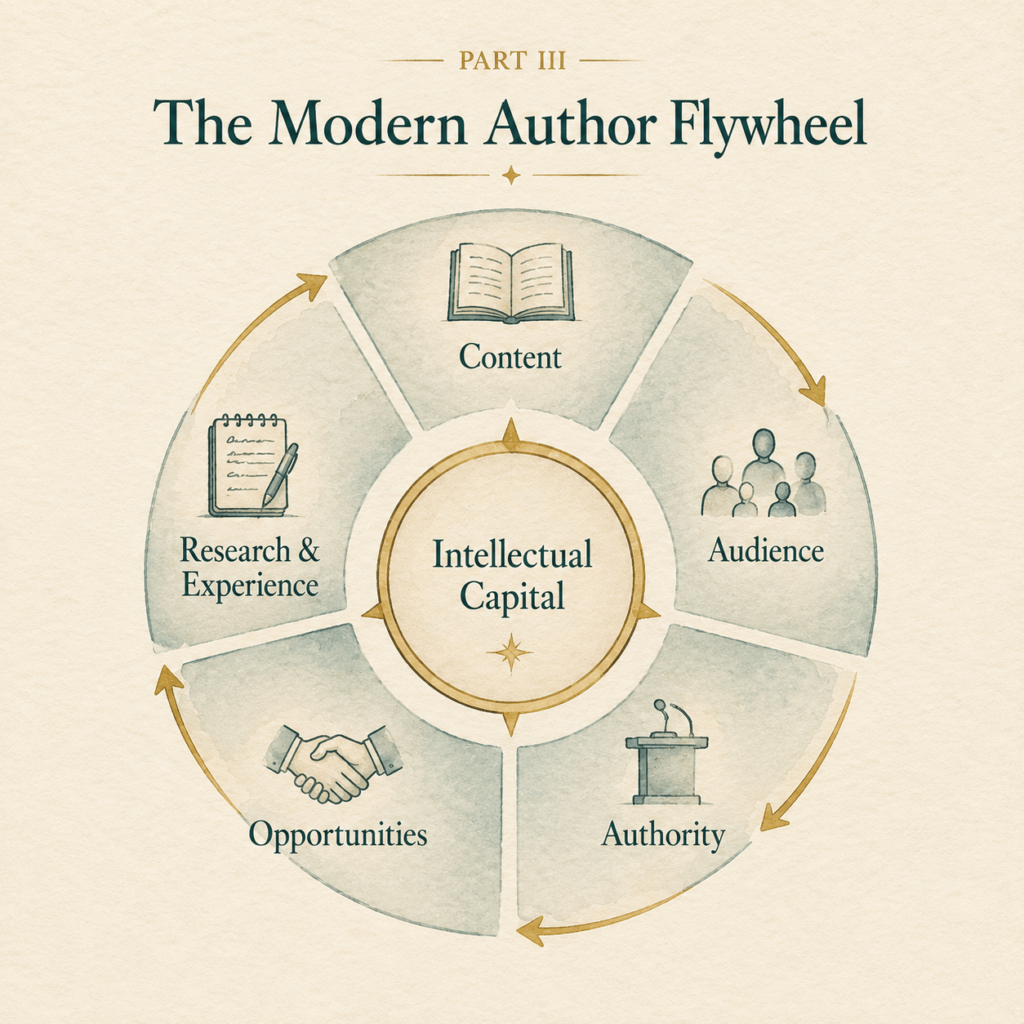
That system is the Modern Author Flywheel.
Rather than treating thought leadership as a sequence of disconnected initiatives, the Flywheel explains how every authority-building activity reinforces the next. It provides the operating model that connects intellectual capital, content, audience, authority, opportunities, and new experience into one continuously improving system.
Everything discussed so far has prepared for this framework.
Everything that follows builds upon it.
Introducing the Modern Author Flywheel
The Modern Author Flywheel is a systems model for building compounding authority.
Rather than asking how to make a single book, keynote, or newsletter successful, it asks a broader question:
How can every authority asset strengthen the next one?
Instead of viewing expertise as something that is repeatedly packaged into new projects, the Flywheel treats expertise as a strategic asset that should become more valuable every time it moves through the system.
At its simplest, the Flywheel follows this progression:
Intellectual Capital
↓
Content
↓
Audience
↓
Authority
↓
Opportunities
↓
Research & Experience
↓
Stronger Intellectual Capital
Notice where the system ends.
It doesn’t end with content.
It doesn’t end with visibility.
It doesn’t even end with opportunity.
It ends by strengthening the very asset that started the cycle.
That distinction is what separates a flywheel from a traditional workflow.
A Flywheel Is Designed to Improve the System
A workflow moves work from beginning to completion.
A flywheel uses completed work to improve the system that produces future work.
That difference changes the purpose of every stage.
Each component exists because it performs a distinct role within the larger operating model:
- Intellectual Capital provides the original thinking, frameworks, and insights that give the system value.
- Content expresses that thinking in forms other people can discover, understand, and engage with.
- Audience creates ongoing interaction with those ideas, allowing them to reach the people they are intended to serve.
- Authority develops as the market repeatedly experiences valuable, trustworthy thinking.
- Opportunities create situations where those ideas can be applied in increasingly meaningful ways.
- Research & Experience generate new observations, evidence, questions, and lessons that improve the original intellectual capital.
The output of one stage becomes the input for the next.
Every completed cycle leaves the system with more knowledge than it had before.
Why the Cycle Returns to Intellectual Capital
Many authority-building models implicitly assume that opportunity is the destination.
A book leads to speaking.
Speaking leads to consulting.
Consulting leads to revenue.
The process appears complete.
The Modern Author Flywheel treats opportunity differently.
Opportunity is not where the system finishes.
It is where the next cycle begins.
Every meaningful opportunity creates new intellectual inputs, including:
- patterns observed through client work
- questions raised by audiences
- evidence gathered through implementation
- refinements to existing frameworks
- language that explains complex ideas more clearly
- new problems worth investigating
When those insights are intentionally captured and organized, they strengthen the underlying intellectual capital.
The next book begins with better thinking.
The next keynote communicates stronger ideas.
The next article becomes more insightful.
The next opportunity becomes more valuable.
The system continually improves itself because every cycle expands the foundation on which the next cycle is built.
A Different Pattern of Growth
This creates a fundamentally different model of authority building.
Instead of repeatedly producing new outputs from the same body of expertise, the Modern Author Flywheel continually expands the expertise itself.
Over time, the professional gains more than additional visibility.
They develop:
- clearer thinking
- stronger frameworks
- deeper evidence
- better language
- richer experience
- greater strategic leverage
The result is not simply more content.
It is a stronger intellectual asset capable of producing increasingly valuable content, opportunities, and authority.
That is the defining purpose of the Modern Author Flywheel.
Its objective is not to maximize activity.
Its objective is to ensure that every completed cycle leaves the underlying intellectual capital stronger than it was before.
Understanding Every Stage of the Flywheel
The Modern Author Flywheel is intentionally simple.
Only six components make up the system.
Yet each performs a distinct function that cannot simply be replaced by another stage.
This is why the Flywheel should be understood as an operating system, not a sequence of tasks.
An operating system defines how different components interact to produce a larger outcome. No single component creates compounding authority on its own. The Flywheel works because each stage prepares the conditions for the next while simultaneously strengthening the system as a whole.
If one stage is neglected, the Flywheel continues to turn—but with less momentum. If several stages become disconnected, the system gradually begins to resemble the project-based approach discussed earlier in this guide.
Understanding the role of each component makes it easier to see why lasting authority depends on relationships rather than isolated activities.
1. Intellectual Capital: The Strategic Asset
Every Flywheel begins with intellectual capital.
As established in the previous section, intellectual capital is the organized body of thinking that gives an expert’s work its value. It includes the frameworks, ideas, distinctions, evidence, language, and practical experience that make a perspective both useful and distinctive.
Without intellectual capital, there is nothing meaningful for the Flywheel to circulate.
Everything else exists to express, strengthen, or expand this underlying asset.
2. Content: Making Intellectual Capital Visible
Intellectual capital creates value only when it can be shared.
Content is the mechanism that makes thinking accessible to other people.
This includes many forms of expression, such as:
- books
- articles
- newsletters
- keynote presentations
- podcasts
- research reports
- videos
Each format serves a different purpose, but they all perform the same strategic function.
They transform internal knowledge into ideas that others can discover, understand, and engage with.
Content, however, should never become the objective.
Its purpose is to express intellectual capital—not replace it.
3. Audience: Creating Ongoing Engagement
Publishing content does not automatically create authority.
Ideas become influential only when they reach the right people and generate meaningful engagement.
An audience is more than a collection of followers or subscribers.
It is a community that consistently engages with an author’s ideas, asks better questions, provides feedback, and creates opportunities for those ideas to spread.
This interaction serves two important purposes:
- It expands the reach of intellectual capital.
- It provides signals about which ideas are most useful, memorable, and valuable.
An audience therefore becomes an active participant in strengthening the Flywheel rather than simply consuming its outputs.
4. Authority: Building Trusted Expertise
Authority emerges when valuable ideas are experienced consistently over time.
It is not claimed.
It is earned through repeated demonstrations of useful thinking.
This distinction matters because authority is often confused with visibility.
Someone may be widely known without being widely trusted.
Likewise, an expert may possess deep credibility within a specific field without attracting a large public audience.
The Flywheel is designed to develop the second form.
Authority grows when people repeatedly experience:
- thoughtful analysis
- practical insight
- reliable frameworks
- consistent expertise
- ideas that continue proving useful over time
In other words, authority is the market’s response to intellectual capital that has been expressed and validated repeatedly.
5. Opportunities: Putting Ideas Into Practice
As authority grows, new opportunities naturally emerge.
These opportunities may include:
- advisory relationships
- consulting engagements
- executive briefings
- keynote presentations
- media appearances
- board appointments
- strategic partnerships
- research collaborations
Although these outcomes are often treated as the goal of thought leadership, the Flywheel assigns them a different role.
Opportunities are valuable because they place ideas into real-world environments where they can be challenged, applied, refined, and expanded.
The purpose is not simply to create more work.
It is to create better intellectual capital.
6. Research & Experience: Strengthening the Foundation
Every opportunity generates new learning.
Client engagements reveal patterns.
Executive conversations expose new questions.
Implementation uncovers practical challenges.
Research validates assumptions or disproves them.
Collectively, these experiences become the raw material for the next generation of thinking.
Rather than allowing those insights to disappear after a project ends, the Modern Author captures and integrates them into the existing body of intellectual capital.
This is the stage that closes the loop.
Experience becomes insight.
Insight becomes stronger intellectual capital.
The next cycle begins with a more sophisticated foundation than the previous one.
The Flywheel Works Through Relationships
Each stage of the Flywheel performs a unique role.
More importantly, each stage strengthens the others.
The relationships can be summarized as follows:
| Stage | Primary Contribution |
| Intellectual Capital | Creates the ideas that give the system value. |
| Content | Makes those ideas visible and accessible. |
| Audience | Engages with, tests, and amplifies the ideas. |
| Authority | Builds trust through repeated demonstrations of valuable thinking. |
| Opportunities | Applies ideas in increasingly meaningful contexts. |
| Research & Experience | Generates new knowledge that strengthens future intellectual capital. |
Viewed independently, each component appears to solve a different problem.
Viewed together, they form a single operating system.
The strength of the Flywheel does not come from any one stage performing exceptionally well.
It comes from every stage reinforcing the next, allowing the entire system to become more valuable with every completed cycle.
Why the Flywheel Accelerates Over Time
Not every cycle of the Modern Author Flywheel produces the same result.
The first cycle establishes a foundation.
The next few cycles build momentum.
Over time, however, something more significant begins to happen.
The system itself becomes more valuable.
This is the defining characteristic of a flywheel.
Unlike a linear process, where each project starts from roughly the same point, a flywheel retains the value created by previous work. Every completed cycle strengthens the intellectual capital, relationships, credibility, and experience that fuel the next one.
The result is not simply more output.
It is a system that becomes increasingly capable of producing better outcomes with every rotation.
The Three Stages of Compounding
The Flywheel does not accelerate all at once.
Its long-term advantage emerges through three distinct stages.
| Stage | Primary Outcome | What the System Is Building |
| Early Cycles | Visibility | Initial awareness, foundational assets, and audience engagement |
| Middle Cycles | Leverage | Stronger authority, better opportunities, and connected assets |
| Later Cycles | Self-Reinforcement | A system that continually improves its own intellectual capital |
Each stage builds upon the one before it.
Trying to skip a stage often results in fragmented authority rather than compounding authority.
Stage One: Visibility Creates the Foundation
Every flywheel begins with relatively little momentum.
In the early stages, most effort goes toward making intellectual capital visible.
Books are published.
Articles are written.
Newsletters are sent.
Ideas begin reaching an audience.
At this point, the visible outcomes often appear modest.
The audience is still growing.
Authority is still developing.
Opportunities arrive gradually rather than consistently.
This can make the system feel slow.
Yet something important is happening beneath the surface.
Every completed cycle is creating assets the next cycle can build upon, including:
- clearer frameworks
- stronger messaging
- better examples
- audience feedback
- additional published work
- practical experience communicating ideas
The primary objective of the early Flywheel is not maximum influence.
It is establishing the foundation that future cycles will strengthen.
Stage Two: Visibility Becomes Leverage
As additional cycles accumulate, the Flywheel begins producing something more valuable than attention.
It begins producing leverage.
Leverage is the ability to create greater outcomes because previous work continues contributing value.
Instead of every opportunity depending on new effort, earlier investments begin supporting future ones.
For example:
- A published book strengthens keynote presentations.
- Speaking engagements attract new audience members.
- Audience conversations improve future articles.
- Consulting engagements refine existing frameworks.
- Better frameworks increase the value of future books.
Individual assets stop operating independently.
They begin reinforcing one another.
This is the transition from activity to architecture.
The system is no longer producing isolated successes.
It is producing interconnected advantages.
Stage Three: The System Becomes Self-Reinforcing
Eventually, the Flywheel reaches a point where every completed cycle naturally improves the next.
The system begins generating resources that strengthen itself.
Each opportunity produces new experience.
Each experience expands intellectual capital.
Stronger intellectual capital produces better content.
Better content attracts a more engaged audience.
A stronger audience contributes to greater authority.
Greater authority creates higher-quality opportunities.
The cycle repeats with a stronger foundation than before.
The pattern can be visualized like this:
| After Every Completed Cycle… | The System Gains… |
| Intellectual capital expands | Better frameworks, distinctions, and evidence |
| Content improves | Greater clarity and stronger messaging |
| Audience relationships deepen | More engagement and richer feedback |
| Authority increases | Higher trust and broader recognition |
| Opportunities improve | More strategic and higher-value work |
| Experience accumulates | New insights that strengthen future thinking |
Notice what changes.
The Flywheel is no longer driven primarily by effort.
It is increasingly driven by accumulated capability.
Every rotation improves the quality of future rotations.
Why Compounding Is Difficult to See
One reason many professionals abandon systems too early is that compounding rarely appears dramatic in the beginning.
Early progress often feels linear.
Results seem proportional to effort.
But systems rarely reveal their full value after a single cycle.
They reveal it after repeated cycles have accumulated enough intellectual capital, trust, experience, and connected assets to reinforce one another.
This is why project thinking frequently underestimates systems thinking.
Projects measure immediate outputs.
Systems measure retained value.
Projects ask whether today’s work was completed.
Systems ask whether today’s work improved tomorrow’s capabilities.
Those are fundamentally different measures of success.
Compounding Changes the Nature of Authority
The greatest benefit of the Modern Author Flywheel is not simply that it produces more books, more content, or more opportunities.
It changes how authority itself grows.
Instead of rebuilding credibility with every new initiative, each completed cycle contributes to a growing body of intellectual capital that makes future work more insightful, more persuasive, and more valuable.
Over time, authority becomes less dependent on producing constant activity and more dependent on the strength of the system behind that activity.
That is when the Flywheel achieves its intended purpose.
It no longer requires every new project to create momentum.
The momentum already exists because each completed cycle has strengthened the system that produces the next.

Part IV — Connecting Every Authority Asset
The Modern Author Flywheel becomes most useful when it changes how individual assets are understood.
A book, newsletter, keynote, research report, or consulting engagement may appear to be a separate initiative. Each has its own format, audience, timeline, and measure of success.
But inside a compounding authority system, these are not independent projects.
They are connected expressions of the same intellectual capital.
Their strategic value therefore depends on more than how well each one performs on its own. It depends on whether each asset contributes to a larger system—one that expands reach, strengthens authority, creates new opportunities, and returns new learning to the intellectual foundation.
This shift is especially important when considering the role of a book.
For many professionals, the book is treated as the central achievement.
For a Modern Author, it is a powerful component of a much larger architecture.
Books Are One Component of a Larger System
A serious nonfiction book can be one of the most valuable assets an expert creates.
It can organize years of experience into a coherent body of thinking. It can communicate that thinking at a depth few other formats allow. It can give readers, colleagues, clients, and decision-makers a stable reference point for understanding what the author knows and how they see the world.
But a book does not complete an authority system.
It strengthens one.
That distinction matters because the way a book is designed, used, and evaluated changes depending on whether it is treated as a finished project or as part of a continuing Flywheel.
What a Book Contributes to the Flywheel
Within the Modern Author Flywheel, a book makes three especially important contributions.
1. It Creates Structure
Most experts develop their knowledge gradually.
It accumulates through years of work, observation, research, teaching, and problem-solving. The ideas may be valuable, but they often remain distributed across presentations, conversations, notes, articles, and experience.
A book requires that knowledge to be organized.
The author must determine:
- which ideas are foundational
- how those ideas relate to one another
- what sequence makes the thinking understandable
- where distinctions need to be clarified
- which frameworks deserve to be formalized
- what evidence supports the central argument
This process creates more than a manuscript.
It creates structure around the author’s intellectual capital.
Ideas that were once intuitive become explicit. Patterns that were previously scattered become connected. Experience becomes a body of thinking that other people can understand, reference, and apply.
That structure strengthens every future expression of the author’s work because the underlying ideas are no longer being reconstructed from memory each time.
2. It Concentrates Authority
Authority grows when expertise becomes clear, credible, and consistently useful.
A book supports that process by presenting an extended argument rather than a series of isolated observations. It gives the author enough space to define a problem, introduce a perspective, develop a framework, address complexity, and demonstrate depth.
This concentration matters.
A single article may reveal an insight.
A keynote may communicate a powerful idea.
A book can show how the entire body of thinking holds together.
That does not make the book the only source of authority. It makes the book a particularly durable expression of it.
The book becomes a reference point that helps others understand:
- what the author believes
- what problems they are equipped to solve
- how their ideas differ from prevailing assumptions
- what evidence and experience support their position
- why their thinking deserves continued attention
In this way, the book does not manufacture authority.
It gives existing intellectual capital a form through which authority can be more easily recognized.
3. It Creates Long-Term Intellectual Property
A book also converts intellectual capital into intellectual property.
Intellectual property is thinking that has been developed into a defined, ownable, and reusable form. In a nonfiction context, this may include named frameworks, models, methods, distinctions, terminology, or organizing principles that can continue creating value beyond the original manuscript.
This is one reason a book can remain strategically useful long after publication.
Its ideas can inform:
- future content
- presentations
- executive briefings
- training programs
- advisory work
- research agendas
- internal communication
- future books
The manuscript becomes a durable source from which other expressions can be created.
But that durability depends on whether the book is connected to the broader authority system.
A book left isolated may remain a valuable artifact.
A book embedded in the Flywheel becomes working intellectual infrastructure.
The Difference Between a Book Project and a Book System
The distinction becomes clearer when the two approaches are compared directly.
| Book as a Project | Book Inside the Flywheel |
| The manuscript is the primary objective. | The manuscript strengthens a larger body of intellectual capital. |
| Publication marks completion. | Publication begins a new cycle of expression, engagement, and learning. |
| Success is concentrated around the launch. | Value continues accumulating through repeated use. |
| The book stands largely on its own. | The book informs and strengthens other authority assets. |
| New initiatives require new starting points. | Future initiatives begin from an established intellectual foundation. |
The difference is not the quality of the book.
It is the architecture surrounding it.
A well-written book can still underperform strategically if it remains disconnected from the author’s other work. It may establish credibility, yet fail to shape future content. It may attract attention, yet generate little new learning. It may articulate important ideas, yet remain separate from the conversations and experiences that could improve them.
In those cases, the book creates value.
But the value does not fully circulate.
Publication Is a Transition, Not a Finish Line
Traditional publishing logic often directs nearly all attention toward completion.
Finish the manuscript.
Publish the book.
Execute the launch.
Achieve the milestone.
These are meaningful accomplishments. But inside the Flywheel, publication is not the moment when the system stops.
It is the moment when the intellectual capital enters a wider environment.
Readers encounter the ideas.
Audiences respond to the language.
Organizations apply the frameworks.
Decision-makers raise new questions.
The author begins to see which arguments resonate, which distinctions require refinement, and which ideas create the most meaningful opportunities.
That response is part of the book’s value.
A book is not only a container for what the author already knows. It is also a mechanism for discovering what the author should investigate, clarify, or develop next.
This is why the strongest books often continue evolving after publication—not because the published text changes, but because the body of intellectual capital surrounding it becomes more sophisticated.
A Book Can Anchor the System Without Becoming the Entire System
Positioning the book as one component does not diminish its importance.
It clarifies its role.
A book can serve as the most substantial expression of an author’s thinking. It can provide the structure from which many other assets draw. It can establish language, frameworks, and intellectual property that remain useful for years.
But it cannot perform every function required for compounding authority.
A book alone does not create continuous audience engagement.
It does not automatically translate credibility into meaningful application.
It does not capture every lesson produced after publication.
It does not, by itself, ensure that new experience returns to strengthen the underlying intellectual capital.
Those outcomes depend on the larger system in which the book operates.
The strategic question is therefore not simply:
How do we produce a successful book?
It is:
How will this book strengthen the authority system before, during, and after publication?
That question places the book in its proper role.
It is not the completion of the Modern Author Flywheel.
It is one of the most powerful assets available for setting that Flywheel in motion.
Every Asset Strengthens Every Other Asset
An authority asset creates value in two ways.
The first is direct.
A book may establish credibility. A newsletter may maintain audience engagement. A keynote may communicate an idea at scale. A consulting engagement may solve an important problem.
The second form of value is less visible but more important to the Modern Author Flywheel.
Each asset can improve the performance of every other asset around it.
A book can strengthen a keynote.
A keynote can grow a newsletter.
A newsletter can reveal which ideas deserve deeper research.
Research can improve consulting.
Consulting can expose patterns that shape future ideas.
The system becomes more valuable not because it contains more assets, but because the assets are designed to reinforce one another.
From a Portfolio of Assets to an Authority System
Many accomplished professionals already possess several authority assets.
They may have:
- a published book
- a regular newsletter
- a speaking platform
- proprietary research
- advisory or consulting work
- a pipeline of future ideas
Yet these assets often operate independently.
The book is managed as a publishing initiative.
The newsletter is treated as a marketing channel.
Speaking is handled as a separate business-development activity.
Research remains inside internal documents or presentations.
Consulting knowledge stays within individual client engagements.
Future ideas are stored in disconnected notes.
This creates a portfolio, but not necessarily a system.
A portfolio contains multiple assets.
An authority system creates deliberate relationships among them.
The distinction is important because standalone performance has natural limits. A book can only reach so many readers on its own. A keynote ends when the presentation ends. A newsletter must continually earn attention. Research creates limited strategic value if it remains isolated from the author’s public thinking.
Connection extends the useful life of each asset.
It allows one investment of intellectual effort to support multiple expressions, audiences, and opportunities without reducing every initiative to simple repurposing.
Connection Is More Than Repurposing
Repurposing usually means adapting the same material into another format.
A chapter becomes an article.
A keynote becomes a series of social posts.
A research report becomes a webinar.
This can improve efficiency, but it does not automatically create a connected authority system.
Connection goes further.
An asset is connected when it changes the quality, reach, or usefulness of another asset.
For example:
- A book gives a keynote greater structure and intellectual depth.
- A keynote reveals which ideas audiences find most compelling.
- A newsletter creates an ongoing environment for developing those ideas.
- Research adds evidence and specificity to the newsletter and the book.
- Consulting tests whether the frameworks work under real conditions.
- The resulting observations shape future ideas and expressions.
The objective is not merely to publish the same idea in more places.
It is to allow every expression and application of the idea to improve the larger body of work.
How the Assets Reinforce One Another
The relationships within the system are multidirectional.
A book does not simply lead to speaking.
Speaking may also improve the way the book’s ideas are explained.
A newsletter does not simply promote research.
Audience questions may determine what the author should research next.
Consulting does not simply monetize authority.
It can expose where an existing framework is incomplete, difficult to apply, or more valuable than the author initially recognized.
The major relationships can be understood this way:
| Authority Asset | What It Contributes to the System | What It Receives From the System |
| Books | Structure, depth, credibility, and durable intellectual property | Better evidence, clearer language, audience insight, and tested ideas |
| Newsletters | Continuity, audience relationships, and a regular environment for developing ideas | Frameworks, research, stories, questions, and themes from other assets |
| Speaking | Reach, concentrated communication, and direct audience response | Stronger arguments, established language, and credibility from published work |
| Research | Evidence, differentiation, and new insight | Questions, patterns, and hypotheses generated through audiences and applied work |
| Consulting | Real-world application, implementation knowledge, and exposure to complex problems | Authority, frameworks, and ideas that create demand for the engagement |
| Future Ideas | The next generation of intellectual capital and authority assets | Inputs gathered across the entire system |
No asset is only an output.
Each is also an input into something else.
That is what allows the Flywheel to retain and redistribute value.
The Book Becomes More Valuable When It Is Connected
A book provides a useful illustration because it is often treated as a self-contained achievement.
Viewed independently, the book’s value may be measured through sales, reviews, media attention, or launch performance.
Viewed as part of the Flywheel, its value is broader.
The book can:
- establish the foundational language for a newsletter
- provide the architecture for a keynote or workshop
- make research easier to interpret
- give consulting engagements a shared methodology
- create questions that lead to future ideas
- give audiences a deeper entry point into the author’s thinking
At the same time, the book becomes stronger because of those surrounding assets.
Research gives its claims greater credibility.
Consulting gives its frameworks practical relevance.
Speaking improves the clarity of its central arguments.
Newsletters reveal which ideas continue resonating over time.
The book anchors the system, while the system extends and strengthens the book.
The Value Is in the Relationships
This changes how authority assets should be evaluated.
The conventional question is:
How well did this asset perform?
The systems question is:
What did this asset strengthen?
A newsletter with a modest audience may still be highly valuable if it consistently generates language, questions, and ideas that improve a keynote or future book.
A speaking engagement may matter beyond its immediate audience if it creates new relationships, sharpens a framework, or reveals where the author’s thinking needs greater precision.
A consulting engagement may produce more than revenue if it improves the ideas later expressed through research, writing, or teaching.
This does not mean individual performance becomes irrelevant.
It means standalone metrics provide an incomplete picture.
An asset may create value through:
- Direct performance — what the asset accomplishes on its own.
- Transfer value — what it contributes to other assets.
- System value — how it improves the strength and continuity of the entire authority ecosystem.
The third form of value is often the most durable.
Interconnection Creates Leverage
When assets remain isolated, every initiative requires separate effort.
The author must develop a new idea for the article, a new argument for the keynote, a new framework for the consulting engagement, and a new direction for the next book.
The workload grows, but the intellectual foundation does not necessarily become stronger.
A connected system behaves differently.
One body of research may strengthen a book, newsletter, keynote, and client engagement.
One audience question may lead to an article, improve a framework, and clarify a future presentation.
One consulting pattern may shape new research and reveal the subject of a future book.
The system does not eliminate work.
It increases the amount of value retained from that work.
This is the practical meaning of leverage within the Flywheel: previous intellectual effort continues contributing to future outcomes because the assets are connected by design.
The strategic objective is therefore not to build the largest possible collection of authority assets.
It is to create an architecture in which every asset leaves the others stronger.
Isolated assets create individual results.
Connected assets create compounding authority.
Opportunities Become New Intellectual Capital
Many professionals think of opportunities as the destination of thought leadership.
A book creates speaking engagements.
Speaking generates consulting work.
Consulting leads to advisory roles.
Research attracts media attention.
From this perspective, opportunities are the reward for building authority.
The Modern Author Flywheel reaches a different conclusion.
Opportunities are not the end of the system.
They are the beginning of its next cycle.
Their greatest strategic value is not the revenue they generate, the visibility they create, or the relationships they produce. Their greatest value is the new intellectual capital they make possible.
That is the closing loop of the Flywheel.
Every Opportunity Contains New Knowledge
An opportunity is more than an engagement.
It is an environment where ideas encounter reality.
Frameworks are tested.
Assumptions are challenged.
Language becomes more precise.
Unexpected questions emerge.
Patterns that were invisible in theory become obvious in practice.
This is why opportunities should be viewed as learning environments rather than simply business outcomes.
Every meaningful engagement leaves the author with something that did not exist before.
It might be:
- a clearer distinction
- a better explanation
- a recurring client challenge
- an unexpected implementation pattern
- evidence that strengthens an existing framework
- a new question worth investigating
None of these insights existed until the ideas were applied.
Experience is not merely validating intellectual capital.
It is expanding it.
From Experience to Intellectual Capital
Experience does not automatically improve the Flywheel.
Learning only compounds when it is deliberately captured, organized, and integrated into the author’s body of thinking.
This transformation can be understood as a progression rather than a single event.
| What Happens | What It Produces |
| Client work exposes new patterns. | New observations emerge. |
| Research explores those observations. | Evidence begins to accumulate. |
| Case studies demonstrate how the ideas perform in practice. | Confidence and clarity increase. |
| Frameworks evolve to reflect what has been learned. | The thinking becomes more sophisticated. |
| The refined thinking becomes part of the author’s intellectual capital. | The next Flywheel begins from a stronger foundation. |
Notice what changes.
The opportunity itself eventually ends.
The intellectual capital created from that opportunity remains.
That retained value is what allows the Flywheel to compound.
The System Learns From Itself
Traditional project thinking often separates execution from learning.
A project is completed.
Results are measured.
The team moves on to the next initiative.
The Flywheel follows a different pattern.
Every completed engagement contributes knowledge back into the system.
The relationship can be visualized as a continuous learning cycle.
| Experience Creates… | Which Improves… |
| Better observations | Future research |
| Better research | Stronger frameworks |
| Stronger frameworks | More valuable content |
| Better content | Greater authority |
| Greater authority | Higher-quality opportunities |
| Better opportunities | Richer experience |
Unlike a marketing funnel, where value moves in one direction toward a final conversion, the Flywheel continually returns value to its point of origin.
Every cycle strengthens the intellectual foundation from which the next cycle begins.
Case Studies Are More Than Proof
Case studies illustrate this principle particularly well.
They are often treated as evidence used to persuade future clients or readers.
They certainly perform that role.
But within the Flywheel, their strategic contribution is much larger.
A thoughtful case study helps the author discover:
- which parts of a framework work consistently
- where implementation becomes difficult
- which assumptions require refinement
- what language clients naturally use
- what outcomes matter most in practice
In other words, the case study teaches the author as much as it teaches the audience.
It transforms practical experience into organized knowledge that can improve every future expression of the author’s work.
The Flywheel Rewards Reflection, Not Just Activity
This is why two professionals can have similar experience yet develop very different levels of authority.
One accumulates experience.
The other accumulates intellectual capital.
The difference lies in reflection.
The Modern Author does not simply complete engagements and move forward.
They ask:
- What did this experience teach me?
- Which assumptions became stronger?
- Which assumptions became weaker?
- What new patterns emerged?
- How should my frameworks evolve?
- What deserves to become part of my long-term intellectual capital?
These questions convert activity into strategic assets.
Without reflection, experience remains isolated.
With reflection, experience becomes intellectual capital.
The Flywheel Improves Through Experience
The final stage of the Modern Author Flywheel is therefore not really an ending.
It is the mechanism that allows the entire system to become progressively more intelligent.
Books lead to conversations.
Conversations lead to opportunities.
Opportunities generate experience.
Experience produces new research, stronger case studies, and more refined frameworks.
Those insights return to strengthen the author’s intellectual capital, making every future book, article, keynote, newsletter, and engagement more valuable than the last.
That is the defining difference between a project and a Flywheel.
A project finishes when the work is complete.
A Flywheel becomes stronger because the work was completed.
The system does not merely produce authority.
It continually improves the thinking that makes authority possible.
Part V — The Architecture of the Manuscripts Ecosystem
Up to this point, the Modern Author Flywheel has been presented as a strategic model for building compounding authority.
But a framework only becomes useful when it can guide real decisions.
That is where the broader Manuscripts ecosystem comes in.
The Flywheel is not simply another diagram within the Guide.
It is the architectural blueprint that connects every Manuscripts Guide into a single operating system.
Each guide addresses a different strategic challenge that Modern Authors face. On their own, they solve important problems. Together, they create an integrated system where every improvement strengthens the rest of the ecosystem.
This is why the Guides were never intended to function as a collection of standalone playbooks.
They are designed as complementary parts of the same authority architecture.
Every Manuscripts Guide Solves One Part of the Flywheel
Most publishing resources are organized by topic.
One book explains publishing.
Another focuses on marketing.
A different course teaches speaking or audience growth.
Each resource is useful within its own category, but the relationship between them is often left for the author to figure out.
The Manuscripts ecosystem was designed differently.
Instead of organizing knowledge around publishing categories, it organizes knowledge around the Modern Author Flywheel.
Every Guide strengthens a different component of the system.
Taken together, they help authors build an authority ecosystem where intellectual capital, audience, authority, opportunities, and long-term leverage continuously reinforce one another.
This is an important distinction.
The Flywheel is not an additional Guide that sits alongside the others.
It is the architecture that explains why every other Guide exists.
The Flywheel Provides Context
Every strategy becomes more valuable when its role within the larger system is clear.
Without that context, even excellent advice can become fragmented.
An author may improve audience growth without strengthening intellectual capital.
They may launch a successful book without creating lasting authority.
They may generate speaking opportunities without capturing the insights those experiences produce.
Each initiative succeeds independently while the overall system remains disconnected.
The Flywheel changes that perspective.
Instead of asking:
“How do I execute this strategy?”
The Modern Author also asks:
“Which part of the authority system does this strategy strengthen?”
That shift transforms individual tactics into architectural decisions.
Mapping the Guides to the Flywheel
Each Manuscripts Guide contributes to a specific part of the Modern Author Flywheel.
| Manuscripts Guide | Primary Flywheel Contribution |
| Working Backwards | Strengthens intellectual capital by helping authors organize ideas before writing. |
| Audience Before Book | Builds audience development before publication, allowing ideas to gain traction earlier. |
| Book Marketing | Expands visibility and distribution so intellectual capital reaches more people. |
| Launch Once, Sell Forever | Sustains momentum beyond publication through long-term distribution strategies. |
| From Book to Stage | Transforms authority into speaking opportunities and broader influence. |
| Monetize Your Ideas | Converts intellectual capital into business leverage through strategic offers and services. |
| Author-Owned Publishing | Preserves ownership and control of the intellectual assets that power the Flywheel. |
Viewed independently, each Guide answers a specific question.
Viewed together, they explain how an authority system is designed, strengthened, and sustained over time.
The Guides Become Stronger Together
The relationship between the Guides is not sequential.
It is systemic.
For example:
- Working Backwards improves the quality of the intellectual capital that eventually becomes a book.
- Audience Before Book ensures those ideas already have an engaged community before publication.
- Book Marketing increases the reach of that intellectual capital after it is published.
- Launch Once, Sell Forever keeps those ideas creating value long after launch.
- From Book to Stage allows the same intellectual capital to influence new audiences through speaking.
- Monetize Your Ideas helps translate authority into meaningful professional opportunities.
- Author-Owned Publishing protects the long-term ownership of the assets that support the entire system.
Each Guide solves a different strategic problem.
The Flywheel explains why solving those problems together creates exponentially greater value than solving them in isolation.
From a Library of Guides to an Operating System
This perspective also changes what the Manuscripts library represents.
It is not intended to be a catalogue of unrelated resources.
It is an operating system for Modern Authors.
An operating system is a coordinated set of principles that enables many different activities to work together efficiently toward a larger objective.
In this case, that objective is not publishing a single successful book.
It is building a body of intellectual capital that continually produces stronger content, deeper audience relationships, greater authority, better opportunities, and richer experience over time.
Each Guide improves one capability.
The Flywheel ensures those capabilities reinforce one another.
The Architecture Is the Competitive Advantage
The individual Guides are valuable because they solve important problems.
The Flywheel makes them strategically valuable because it explains how those solutions connect.
Without an architecture, authors accumulate advice.
With an architecture, they build a system.
That is ultimately the role of the Modern Author Flywheel.
It provides the organizing logic behind the entire Manuscripts ecosystem, allowing every Guide to contribute to a single objective: building a compounding authority system where every improvement strengthens the next.
Why Every Strategy Becomes Stronger Inside the Flywheel
A strategy rarely fails because it is ineffective.
More often, it underperforms because it is expected to create value on its own.
An audience-building strategy may successfully attract attention but never strengthen the author’s intellectual capital.
A book launch may generate momentum that quickly fades because it is disconnected from a broader authority system.
A speaking strategy may create visibility without contributing to future research or thought leadership.
Each initiative succeeds according to its own objectives.
Yet the overall authority system remains no stronger than before.
The Modern Author Flywheel changes how strategy is evaluated.
Instead of asking whether a strategy works, it asks a more important question:
How does this strategy strengthen the rest of the system?
When every strategic decision reinforces multiple parts of the Flywheel, individual efforts stop producing isolated outcomes and begin creating compounding value.
A Strategy Is More Than an Activity
Within the Modern Author Flywheel, a strategy is not simply a plan for accomplishing a specific objective.
It is a deliberate investment intended to strengthen the long-term authority ecosystem.
This means the value of a strategy should not be measured only by its immediate result.
It should also be measured by what it leaves behind.
Does it strengthen intellectual capital?
Does it deepen audience relationships?
Does it create reusable intellectual property?
Does it generate insights that improve future work?
Does it make the next cycle of the Flywheel stronger than the last?
If the answer is yes, the strategy continues creating value long after its original objective has been achieved.
The Difference Between Isolated and Flywheel Thinking
The contrast becomes clearer when common strategic activities are viewed through the lens of the Flywheel.
| Isolated Strategy | Flywheel Strategy |
| Publish content. | Build intellectual capital that produces better content over time. |
| Launch campaigns. | Create momentum that continues beyond a single launch. |
| Promote individual assets. | Connect assets so each one increases the value of the others. |
| Grow an audience. | Strengthen an ecosystem where audience, authority, and ideas continually reinforce one another. |
| Complete projects. | Build a system that compounds with every completed cycle. |
Notice that the activities themselves do not necessarily change.
What changes is the purpose behind them.
The Flywheel transforms strategies from isolated initiatives into investments that strengthen the architecture of the entire authority system.
Integration Creates Compounding Value
Integration is the process of designing strategies so that each one contributes to multiple parts of the Flywheel rather than serving only a single objective.
A book launch, for example, can be planned solely around publication.
Or it can be designed to accomplish much more.
It can strengthen:
- the author’s intellectual property by formalizing original thinking
- audience relationships by creating ongoing discussion
- future speaking opportunities by establishing a central body of work
- consulting engagements by providing a shared framework
- research by exposing new questions from readers
- future books through the insights gathered after publication
The launch itself remains one initiative.
Its long-term contribution becomes much larger because it improves several parts of the authority ecosystem simultaneously.
The same principle applies to every other strategy.
A newsletter should not merely distribute ideas.
It should refine them.
Research should not only produce information.
It should improve future frameworks.
Speaking should not simply increase visibility.
It should reveal which ideas deserve further development.
Every strategy becomes more valuable when it creates benefits that extend beyond its immediate objective.
The Flywheel Changes Strategic Decision-Making
This integrated perspective also changes how strategic decisions are made.
Instead of evaluating initiatives independently, Modern Authors begin evaluating them through their contribution to the system.
Questions shift from:
- How many people will this reach?
- How many books will this sell?
- How many leads will this generate?
To questions such as:
- How will this strengthen our intellectual capital?
- Which existing assets will become more valuable because of this initiative?
- What new knowledge will this strategy produce?
- How will this improve the next cycle of the Flywheel?
These questions encourage decisions that prioritize long-term capability over short-term activity.
The result is a stronger authority ecosystem with every completed cycle.
The Architecture Creates the Advantage
This is why the Modern Author Flywheel should be understood as an operating architecture rather than a collection of best practices.
Individual strategies remain important.
Publishing matters.
Audience development matters.
Speaking matters.
Marketing matters.
Research matters.
Business development matters.
But none of these strategies reaches its full potential when executed in isolation.
Their greatest value emerges when they reinforce one another through a shared system.
The Flywheel provides that system.
It ensures that every successful initiative leaves behind stronger intellectual capital, deeper authority, richer relationships, and greater strategic leverage than existed before.
Over time, this creates a fundamental difference between isolated execution and integrated execution.
One produces successful projects.
The other builds an authority ecosystem that becomes more capable, more resilient, and more valuable with every strategic decision.
The Flywheel as the Modern Author Operating System
Throughout this Guide, the Modern Author Flywheel has been presented as a framework for understanding how authority compounds.
It is more than that.
It is an operating system.
An operating system is the underlying model that coordinates decisions across an entire environment. Rather than prescribing individual tactics, it provides a consistent way to determine how those tactics should work together toward a larger objective.
For Modern Authors, that objective is not publishing a successful book, growing a larger audience, or generating more opportunities in isolation.
It is building an authority ecosystem that becomes more valuable with every cycle.
The Flywheel provides the operating logic for accomplishing that objective.
Every future publishing, marketing, audience, and business decision can be evaluated against the same question:
Will this strengthen the Flywheel?
That single question transforms isolated activities into coordinated system design.
An Operating System Changes How Decisions Are Made
Most experts make strategic decisions one initiative at a time.
Should we publish another article?
Should we launch a podcast?
Should we invest in speaking?
Should we write another book?
Should we focus on audience growth?
Each question is reasonable.
The problem is that each is often answered independently.
The Flywheel introduces a different decision-making model.
Instead of evaluating opportunities on their individual merits, Modern Authors evaluate them according to their contribution to the entire authority ecosystem.
The questions become:
- Does this strengthen our intellectual capital?
- Does it improve an existing authority asset?
- Does it create stronger relationships with our audience?
- Will it generate experience that improves future thinking?
- Does it make the next cycle of the Flywheel stronger than the current one?
The emphasis shifts from choosing the next activity to strengthening the system that produces all future activities.
Every Decision Has Two Outcomes
One of the practical advantages of an operating system is that it encourages every decision to be evaluated at two levels.
The first is the immediate result.
The second is the long-term contribution to the system.
For example:
| Immediate Outcome | System Outcome |
| Publish a book | Strengthen the foundation for future content, speaking, research, and business opportunities |
| Grow an audience | Create a larger environment for testing and refining ideas |
| Deliver a keynote | Generate insights that improve frameworks and future publications |
| Complete a consulting engagement | Produce experience that becomes new intellectual capital |
| Conduct research | Strengthen the thinking that informs every future authority asset |
This second perspective is what distinguishes an operating system from a collection of tactics.
Every initiative is designed to leave the ecosystem stronger than it was before.
The Flywheel Creates Strategic Consistency
As an author’s work expands, the number of available opportunities also expands.
Books lead to speaking.
Speaking leads to advisory work.
Research creates media opportunities.
New audiences suggest new products.
New partnerships generate additional possibilities.
Without an operating system, these opportunities can pull the author in different directions.
Growth becomes reactive.
The Flywheel provides a consistent strategic filter.
Rather than asking whether an opportunity is attractive, the Modern Author asks whether it strengthens the authority ecosystem.
Some opportunities increase short-term visibility while weakening long-term focus.
Others may appear modest in isolation but significantly strengthen intellectual capital, deepen audience relationships, or improve future authority assets.
The Flywheel makes these trade-offs easier to recognize because every decision is evaluated against the same architectural objective.
Strategic consistency does not come from pursuing every opportunity.
It comes from pursuing the opportunities that reinforce the system.
The Operating System Outlasts Individual Strategies
Strategies change.
New publishing platforms emerge.
Marketing channels evolve.
Audience behaviors shift.
Technologies improve.
Business models adapt.
An operating system endures because it exists at a higher level than any individual tactic.
The Modern Author Flywheel does not prescribe a specific marketing channel or publishing model.
Instead, it provides enduring principles for deciding how any new strategy should contribute to the authority ecosystem.
This makes the Flywheel resilient.
Authors can adopt new tools, experiment with new formats, and respond to changing markets without abandoning the architecture that creates compounding authority.
The individual strategies may evolve.
The operating system remains stable.
The Flywheel Becomes the Blueprint for Every Future Strategy
This is why the Modern Author Flywheel serves as the foundation of the Manuscripts ecosystem.
It is not simply another framework to understand.
It is the model through which every future framework should be interpreted.
Whether the topic is publishing, audience development, speaking, intellectual property, research, or business leverage, the underlying question remains the same:
How does this strengthen the authority ecosystem?
When that question becomes the organizing principle behind every strategic decision, the Flywheel ceases to be a diagram.
It becomes the operating system behind the Modern Author’s work.
Every new asset is designed to strengthen existing assets.
Every opportunity generates new intellectual capital.
Every cycle begins from a stronger foundation than the one before.
That is what makes the Modern Author Flywheel more than a framework.
It is the enduring blueprint for building authority that compounds over years rather than campaigns.

Part VI — Building a Compounding Authority Ecosystem
The Modern Author Flywheel explains how authority compounds.
The Manuscripts ecosystem explains where different strategies fit within that process.
The final step is putting that thinking into practice.
Not by adding more tactics.
Not by producing more content.
But by designing an authority ecosystem where every investment of time, expertise, and intellectual effort strengthens everything that comes after it.
This is where the Flywheel becomes practical.
Instead of asking what to create next, Modern Authors begin asking how every new asset can make the entire system stronger.
Designing an Authority Ecosystem Instead of a Content Calendar
Many professionals organize their thought leadership around a content calendar.
A content calendar is a publishing schedule that determines what will be created and when. Its primary purpose is consistency, ensuring that articles, newsletters, videos, podcasts, or social posts are produced on a regular cadence.
A content calendar is useful.
It helps teams stay organized, maintain publishing discipline, and sustain audience engagement.
But it answers only one question:
What should we publish next?
The Modern Author Flywheel introduces a different question.
What should the next asset strengthen?
That distinction changes the purpose of planning.
The objective is no longer to maintain a steady flow of outputs.
It is to continuously strengthen the authority ecosystem.
Outputs Create Activity. Relationships Create Momentum.
Publishing more content often feels like progress because visible activity increases.
More articles.
More newsletters.
More podcasts.
More videos.
More speaking engagements.
Yet activity alone does not guarantee that authority becomes more valuable over time.
The reason is simple.
Individual outputs create value only once.
Relationships between outputs continue creating value long after the original work has been completed.
A newsletter that deepens the ideas introduced in a book creates more value than a newsletter developed in isolation.
Research that improves a consulting framework strengthens every future presentation built from that framework.
A keynote that generates questions leading to stronger intellectual capital contributes value far beyond the event itself.
The individual assets matter.
The relationships between them matter more.
Design the Connections Before the Content
An authority ecosystem is intentionally designed around the movement of intellectual capital.
Rather than beginning with formats, it begins with relationships.
Instead of asking:
- What should we post this week?
- What should we publish next month?
- What should we promote this quarter?
The planning process becomes:
- Which ideas deserve deeper development?
- Which existing assets should become more valuable?
- Which experiences should generate new intellectual capital?
- Which relationships within the Flywheel need to become stronger?
The resulting content calendar may look similar on the surface.
Articles are still written.
Books are still published.
Newsletters are still distributed.
The difference is that each asset exists because it strengthens the system—not simply because it fills an empty publishing slot.
Every Asset Should Leave the System Stronger
Designing an authority ecosystem means expecting every initiative to create more than its immediate outcome.
Each new asset should contribute to future work.
For example:
| Asset Created | Lasting Contribution to the Ecosystem |
| A book | Establishes frameworks, language, and intellectual property that support future content and opportunities. |
| A newsletter | Refines ideas through ongoing audience engagement and identifies themes worth expanding. |
| Research | Produces evidence and insights that strengthen every future authority asset. |
| A keynote | Tests communication, reveals audience questions, and improves future frameworks. |
| Consulting work | Generates practical experience that becomes new intellectual capital. |
Notice that none of these assets ends with its immediate purpose.
Each one leaves something behind that improves the next cycle of the Flywheel.
That retained value is the foundation of compounding authority.
Think Like a Systems Designer
This shift also changes the role of the Modern Author.
Rather than acting primarily as a creator of content, the Modern Author becomes a designer of systems.
A systems designer asks questions such as:
- Where should new intellectual capital enter the ecosystem?
- Which assets should reinforce one another?
- Where are valuable insights being lost?
- Which initiatives create lasting leverage instead of temporary activity?
- How can today’s work improve tomorrow’s thinking?
These questions move attention away from publishing frequency and toward architectural quality.
The result is a system that becomes increasingly coherent as it grows.
The Calendar Serves the Ecosystem
None of this suggests abandoning planning or publishing discipline.
Content calendars remain valuable.
Campaigns remain valuable.
Editorial schedules remain valuable.
The difference is their role.
In a traditional model, the calendar determines the work.
Within the Modern Author Flywheel, the ecosystem determines the work, and the calendar becomes the tool used to execute it.
The schedule exists to support the system—not the other way around.
This is a subtle but important shift.
When planning begins with the ecosystem, every article, newsletter, keynote, research project, and book becomes part of a larger strategy that continuously strengthens itself.
The goal is no longer to produce a consistent stream of content.
It is to build an authority ecosystem where every asset increases the value of every other asset, allowing momentum and authority to compound year after year.
The Modern Author Identity Shift
Every framework in this Guide ultimately leads to a single conclusion.
The greatest transformation is not learning how to publish a book.
It is learning how to think differently about authority.
Throughout this Guide, the conversation has steadily moved away from individual activities and toward the system that makes those activities valuable.
From projects to systems.
From content to intellectual capital.
From isolated assets to connected assets.
From one-time opportunities to continuous learning.
From tactics to an operating system.
The Identity Determines the Strategy
Most professionals do not begin their thought leadership journey by asking how to build an authority ecosystem.
They begin by asking how to create something.
A book.
An article.
A keynote.
A newsletter.
A podcast.
A course.
The assumption is understandable.
If authority appears to come from visible outputs, then producing more outputs seems like the logical path forward.
But over time, that way of thinking creates an endless cycle of production.
Each new project feels like another beginning.
Each success must be recreated.
Each finished asset eventually demands another.
The work never truly compounds because the underlying system never changes.
The Modern Author adopts a different identity.
Instead of identifying as someone who creates content, they identify as someone who develops intellectual capital and builds systems that continually increase its value.
That single shift changes every strategic decision that follows.
From Creator to System Builder
The transition can be understood as a progression in how authority itself is viewed.
| Earlier Belief | Modern Author Mindset |
| I need to create more content. | I need to strengthen the system that creates future content. |
| My next project will build my authority. | My authority grows as every project strengthens the ecosystem. |
| Success comes from producing consistently. | Success comes from compounding intellectual capital consistently. |
| Each initiative should achieve its own objective. | Every initiative should strengthen everything that follows. |
The activities may remain familiar.
Books are still written.
Research is still conducted.
Newsletters are still published.
Speaking engagements still occur.
What changes is the purpose behind them.
Each activity becomes part of a larger system rather than an isolated accomplishment.
The Modern Author Sees Value Differently
This identity also changes how value is recognized.
Traditional thinking tends to measure visible outcomes.
Books sold.
Subscribers gained.
Keynotes delivered.
Clients acquired.
These are important indicators of progress.
But they are not the only outcomes that matter.
The Modern Author also pays attention to what cannot always be measured immediately.
Has the intellectual capital become stronger?
Has the framework become clearer?
Have relationships between assets become more connected?
Has the authority ecosystem become more capable than it was before?
These questions focus attention on the long-term health of the system rather than the short-term performance of individual projects.
Every Cycle Becomes an Investment
Once this identity shift occurs, work begins to feel fundamentally different.
A book is no longer viewed as a finished product.
It becomes a source of future research, conversations, speaking opportunities, and refined thinking.
A consulting engagement is no longer only client work.
It becomes new intellectual capital.
A newsletter is no longer simply a communication channel.
It becomes a place where ideas mature.
Every completed initiative contributes something back to the ecosystem.
Instead of consuming momentum, the work generates more of it.
The author is no longer managing a series of disconnected projects.
They are investing in a system that becomes more valuable every time it is used.
The Defining Characteristic of a Modern Author
Ultimately, becoming a Modern Author is not defined by publishing a book, building an audience, or expanding a business.
Those achievements matter, but they are outcomes of a deeper way of thinking.
A Modern Author recognizes that their most valuable asset is not any single publication, platform, or opportunity.
It is the intellectual capital they continue to develop and the system they have designed to help that intellectual capital grow.
That system allows ideas to mature instead of disappearing.
It allows experience to become knowledge instead of remaining isolated.
It allows every new asset to strengthen every existing one.
Most importantly, it ensures that authority is not rebuilt from the beginning with every new initiative.
It compounds.
That is the identity shift at the heart of the Modern Author Flywheel.
The question is no longer:
“What should I create next?”
It becomes:
“How can I strengthen the system that will create everything that comes next?”
Related Systems Inside the Manuscripts Ecosystem
The Modern Author Flywheel is designed to answer one fundamental question:
How does authority compound over time?
That question is foundational, but it is not the only question a Modern Author must answer.
Building long-term authority also requires decisions about publishing, intellectual capital, business strategy, technology, and the systems that connect them.
Those decisions are addressed throughout the broader Manuscripts ecosystem.
The important point is this:
The Flywheel is not intended to replace those systems.
It is intended to connect them.
Each framework solves a different strategic problem.
Together, they form a coordinated operating architecture for building, managing, and expanding intellectual capital over time.
The Modern Author Operating System
The Modern Author Operating System is the collection of principles, frameworks, and strategic models that guide how Modern Authors build authority.
Rather than treating publishing, audience growth, intellectual property, and business development as separate disciplines, it views them as interconnected capabilities within a single system.
The Flywheel serves as the central operating model inside that broader architecture.
It explains how ideas move through the system and become increasingly valuable with each completed cycle.
Other frameworks help strengthen specific capabilities within that process.
In other words:
- The Modern Author Operating System defines the overall architecture.
- The Modern Author Flywheel explains how authority compounds within that architecture.
- Supporting frameworks improve individual capabilities without disconnecting them from the larger system.
Each operates at a different level while contributing to the same objective.
The Modern Publishing OS
Publishing is one capability within the authority ecosystem.
It is not the ecosystem itself.
The Modern Publishing OS addresses the strategic decisions involved in transforming intellectual capital into durable publishing assets.
Those decisions include questions such as:
- How should ideas be organized before writing?
- Which publishing model best supports long-term ownership?
- How should publication contribute to the broader authority system?
- How can a book continue creating value after launch?
These are publishing decisions.
The Flywheel provides the context for making them.
Rather than viewing publication as a finish line, the Modern Publishing OS treats publishing as one stage within a continuously compounding authority system.
The result is greater alignment between publishing decisions and long-term strategic objectives.
Codex and Author Intelligence
As intellectual capital expands, another challenge emerges.
Knowledge becomes increasingly difficult to organize, retrieve, refine, and reuse.
This is where Codex and Author Intelligence become important components of the Manuscripts ecosystem.
Rather than focusing on publishing or audience growth, these systems focus on managing the author’s accumulated thinking.
Their purpose is to help Modern Authors:
- preserve intellectual capital as it grows
- organize frameworks, research, and supporting evidence
- identify relationships across ideas
- make existing knowledge easier to retrieve and develop
- continuously improve the quality of future intellectual assets
The Flywheel explains why intellectual capital compounds.
Codex and Author Intelligence help ensure that expanding intellectual capital remains structured, accessible, and useful as the ecosystem grows.
Related Manuscripts Guides
The individual Manuscripts Guides should also be viewed through this systems perspective.
Each Guide develops one strategic capability.
Some strengthen intellectual capital.
Others improve publishing.
Others expand audience development, opportunity creation, business leverage, or long-term distribution.
None of them is intended to operate independently.
Each extends the work of the Flywheel by helping Modern Authors improve one specific part of the authority ecosystem while remaining connected to the larger architecture.
This is why the Guides function more like components within an operating system than chapters in an unrelated library.
Each framework contributes to a shared objective:
Building an authority ecosystem that becomes more intelligent, more connected, and more valuable over time.
One Architecture, Many Systems
As the Manuscripts ecosystem continues to grow, new frameworks will inevitably be added.
New technologies will emerge.
New publishing models will develop.
New strategic capabilities will become important.
The underlying architecture does not need to change.
Every new system can be evaluated by the same principle:
How does it strengthen the Modern Author Flywheel?
If it improves the quality of intellectual capital, strengthens the relationships between authority assets, increases the effectiveness of the Flywheel, or helps the ecosystem compound more effectively, it belongs within the Modern Author Operating System.
This is the role of the Manuscripts ecosystem.
Not to offer disconnected advice.
Not to create isolated methodologies.
But to provide an integrated architecture where every framework, every Guide, and every supporting system contributes to the same long-term objective: building enduring authority through continuously compounding intellectual capital.
FAQs
What is a thought leadership strategy?
A thought leadership strategy is a long-term approach for turning expertise into trusted authority. Rather than focusing on individual tactics like publishing or promotion, it connects intellectual capital, content, audience, and opportunities into a system that compounds over time.
What is the Modern Author Flywheel?
The Modern Author Flywheel is a strategic operating model that explains how intellectual capital, content, audience, authority, opportunities, and experience reinforce one another. Each completed cycle strengthens the next, allowing authority to compound rather than restart with every project.
Why does traditional thought leadership eventually plateau?
Traditional thought leadership often treats books, content, speaking, and marketing as separate projects. Without a system connecting them, each initiative creates value independently instead of strengthening future work.
What is intellectual capital, and why is it important?
Intellectual capital is the organized body of ideas, frameworks, evidence, and experience that gives an expert’s work lasting value. Unlike individual pieces of content, it can be refined, expanded, and expressed repeatedly across multiple authority assets.
Is the Modern Author Flywheel only for authors?
No. The Flywheel is designed for executives, founders, consultants, coaches, physicians, professors, and other professionals who want to build long-term authority. A book is one important expression of intellectual capital, but the Flywheel applies to an entire authority ecosystem.
How is the Modern Author Flywheel different from a marketing funnel?
A marketing funnel moves people toward a conversion. The Modern Author Flywheel continually feeds new experience back into intellectual capital, allowing the system to improve itself with every cycle.
Where does a book fit within the Modern Author Flywheel?
A book is one of the most valuable assets in the Flywheel because it structures intellectual capital, concentrates authority, and creates durable intellectual property. It strengthens the system but is not the endpoint of it.
Why should I focus on an authority ecosystem instead of a content calendar?
A content calendar organizes publishing activity. An authority ecosystem organizes relationships between assets so that every article, book, keynote, and research project increases the value of the others and contributes to long-term authority.
What makes a Modern Author different from a traditional thought leader?
A Modern Author focuses on building systems rather than completing projects. Instead of measuring success by individual outputs, they strengthen the intellectual capital and relationships that make future work more valuable.
How do the Manuscripts Guides work together?
Each Manuscripts Guide develops a specific capability—such as intellectual capital, publishing, audience development, or business leverage. The Modern Author Flywheel provides the architecture that connects these Guides into a single operating system for building compounding authority.
Continue Building Your Modern Author Flywheel
A successful nonfiction book can create opportunities.
A well-designed authority system creates opportunities continuously.
That is the central idea behind the Modern Author Flywheel.
Throughout this Guide, you’ve seen that lasting thought leadership is not built by producing more content or completing more projects. It is built by strengthening the relationships between your intellectual capital, your authority assets, your audience, and the opportunities that continuously generate new insight.
The Flywheel is not something you finish.
It is something you continue to strengthen.
Every refinement to your thinking.
Every improvement to your intellectual capital.
Every connection between existing assets.
Every decision that reinforces the system instead of creating another disconnected project.
Each one increases the long-term value of everything you’ve already built.
Consider Your Next Decision
Before investing in another book, campaign, platform, or initiative, ask a different set of questions:
- Is our intellectual capital becoming stronger with every project?
- Are our existing assets reinforcing one another or operating independently?
- Does each initiative create lasting strategic value beyond its immediate objective?
- Are we building an authority ecosystem that becomes more valuable every year?
Those questions often reveal that the next step is not creating something new.
It is strengthening what already exists.
Build the System Behind the Success
Many professionals already possess the expertise required to become recognized authorities.
What they often lack is an operating system that allows their expertise to compound.
The Manuscripts ecosystem is designed to help solve that challenge.
Whether the work involves developing intellectual capital, structuring a book, designing an authority strategy, building an audience before publication, organizing research, or creating long-term business leverage, every framework is designed to strengthen the same underlying objective:
A Modern Author Flywheel that grows more capable, more connected, and more valuable with every cycle.
Your Next Stage as a Modern Author
The goal is no longer to complete another publishing project.
The goal is to design an authority system that continues creating value long after each project is finished.
That means strengthening your intellectual capital before producing more content.
Connecting existing assets before creating new ones.
Designing systems before launching campaigns.
Building momentum that compounds instead of attention that fades.
Modern Authors are not defined by the number of books they publish or the volume of content they produce.
They are defined by the quality of the system they build around their expertise.
Build that system well, and every future book, article, keynote, research project, client engagement, and opportunity becomes part of something larger than itself.
It becomes another turn of the Flywheel.
And with every turn, your authority becomes more enduring, more coherent, and more difficult to replicate.
If You’re Deciding What to Do Next
If this report clarified your thinking, the next step is usually not “publishing.”
It’s pressure-testing your strategy before you commit time, budget, or reputation.
Here are three ways authors typically proceed.
Map Your Modern Author Strategy
If you want to:
- Pressure-test your author model
- Clarify realistic outcomes
- Understand where ROI is likely to show up
- Avoid unnecessary spend
A short strategy conversation can surface issues early, before they become expensive.
👉 Schedule a Modern Author Strategy Session
This is a working session, not a pitch.
Explore the Modern Publishing System
If you’re assessing:
- Whether to publish traditionally, hybrid, or independently
- How to structure presale and early activation
- What support actually reduces risk
You may want a clearer view of how the Modern Publishing System works in practice.
👉 Explore Manuscripts Publishing Services
Study Real Author Outcomes
(For internal validation and stakeholder alignment)
If you’re preparing a recommendation for leadership, concrete examples often help.
👉 See Modern Author Success Stories
About the Author
Eric Koester is an award-winning entrepreneurship professor at Georgetown University, bestselling author, and founder of Manuscripts. His work focuses on how ideas become assets, how books create leverage, and why modern authors need systems, not just publishing support.
He has worked with thousands of authors across traditional, hybrid, and modern publishing paths, helping them turn books into platforms, platforms into credibility, and credibility into durable business outcomes.
About Manuscripts
Manuscripts is the Modern Author OS for nonfiction experts.
We help founders, executives, coaches, and thought leaders design books as strategic assets, not standalone products. Our work spans positioning, author model design, developmental editing, AI-enhanced drafting tools, presale strategy, and long-term launch systems.
Manuscripts authors use their books to generate clients, speaking engagements, training programs, and enterprise opportunities, often before publication.
For readers who want to go deeper into specific mechanics, the following guides expand on topics referenced in this report:
- How to Write a Book if You’re Busy
- Modern Ghostwriting for Nonfiction Authors
- AI Tools for Authors in 2026
- How to Build an Audience Before You Write Your Book
- The Evergreen Launch System for Modern Authors
Powered by Codex, the Modern Author Intelligence Tool.