How to Build an Author Brain: Create an AI Knowledge Base for Your Writing, Research, and Ideas.
Most experienced authors do not begin with an empty page.
They begin with years of thinking.
A decade of presentations.
Hundreds of conversations.
Articles written for different audiences.
Research gathered for projects that have long since ended.
Notes from meetings, interviews, conferences, and moments when an idea suddenly became clear.
Frameworks developed while solving real problems.
Stories told so many times they have become part of how the author explains the world.
And perhaps a previous book, or several.
So when an executive decides to write a book, the obvious assumption is that the next challenge is generating the ideas that will go into it.
Often, the opposite is true.
The ideas already exist.
The problem is finding them.
Years of Expertise Create an Invisible Archive
Think about where an experienced professional’s thinking actually lives.
It may be scattered across:
- documents and notes
- presentations and workshops
- articles and newsletters
- research and source material
- interview and podcast transcripts
- previous books and manuscripts
- frameworks and models
- stories and examples
- professional observations
- unfinished arguments and ideas
Each artifact captured something at a particular moment.
A presentation may contain the clearest explanation of an idea the author has been developing for years.
A transcript may contain a story they have never written down anywhere else.
An old article may contain the first version of an argument that later became central to their work.
A forgotten research folder may contain evidence that suddenly matters to a new book.
An unfinished note may contain three sentences that become the beginning of an important framework.
The problem is that these materials were usually created to accomplish something at the time.
They were not created to remain accessible as one connected body of thinking.
So the author’s knowledge accumulates.
But access to that knowledge does not necessarily improve with it.
The More You Know, the Harder It Can Become to Remember What You Know
Early in a career, remembering your intellectual history may be relatively easy.
There simply is not that much of it.
After ten, twenty, or thirty years of work, that changes.
You may remember developing an idea without remembering where you wrote it.
You may know you once found research supporting an argument but have no idea which project contains it.
You may reconstruct an explanation from scratch because you cannot locate the stronger version you developed three years earlier.
You may begin researching a question only to discover later that you had already explored it extensively.
And sometimes you do not remember the earlier work at all.
That is the strange consequence of accumulated expertise:
The more intellectual material you create, the easier it becomes for valuable thinking to disappear inside your own body of work.
The knowledge still exists.
Your ability to retrieve it when it matters does not.
You Probably Do Not Have an Idea Problem
This distinction changes the starting question for an author.
The problem is often framed as:
I don’t have enough ideas.
But for an experienced author, executive, researcher, or expert, a more accurate problem may be:
I cannot reliably access everything I have already thought.
That is an intellectual retrieval problem.
And it matters because every time previous thinking becomes inaccessible, the author is forced to operate with only the portion of their expertise they can remember in the moment.
Years of accumulated intellectual work effectively disappear from the current project.
The author starts over when they could have started further ahead.
Your Old Work Is Not Just an Archive
There is another way to think about all those documents, presentations, transcripts, notes, books, and unfinished ideas.
They are not merely old files.
Together, they form an intellectual memory.
They preserve what the author has noticed.
What they have learned.
What they have questioned.
What they have explained repeatedly.
What they once believed.
What they later changed their mind about.
And what they began developing but never finished.
Seen this way, the opportunity is not simply to organize an archive more neatly.
It is to make that intellectual memory usable again.
Because the most valuable idea for the book you are writing next may not be something you need to invent.
It may already be sitting somewhere in the work you have spent years creating.
The real question is whether you can bring it back when you need it.
Don’t Ask AI to Know You. Give It Access to What You Know.
Most people use AI through a simple model:
Question → AI’s general knowledge → Answer
That can be useful.
But it has an obvious limitation for authors, executives, researchers, and other experts whose most valuable context does not exist inside the model’s general knowledge.
AI may know the subject.
It does not automatically know your history with the subject.
It does not inherently know:
- which arguments you have developed over years
- which examples you return to repeatedly
- how your position has changed
- which frameworks belong to your work
- what you have already researched
- which stories carry particular meaning
- where an unfinished idea appeared before
- how one piece of your thinking connects to another
That context exists somewhere else.
It exists across the body of work you have already created.
The Better Model Is Context Before Generation
An AI knowledge base is a persistent collection of source material that AI can access to retrieve relevant information and bring it into the current task.
For an author, that changes the working model:
Question → Author’s accumulated knowledge + relevant context → Retrieval and connection → Current work
The difference is significant.
In the first model, AI primarily answers from what it generally knows.
In the second, AI can work with material that represents what you know.
That does not mean the system suddenly understands the author in some complete or human sense.
It means the right intellectual context is available when the work requires it.
If you are developing an argument about leadership, for example, the useful context may include a presentation from five years ago, a story from an interview transcript, research from a previous project, and a note where you challenged your own earlier position.
Without access to those materials, AI can still discuss leadership.
But it cannot reliably bring your intellectual history into the conversation.
An Author Brain Makes Intellectual History Available
This is the purpose of what we call an Author Brain.
An Author Brain is an AI knowledge environment built around an author’s accumulated thinking.
Its value is not that it stores everything the author has ever created.
Its value is that relevant parts of that history can participate in current intellectual work.
Instead of beginning only with the prompt in front of the AI, the system can also draw from the author’s accumulated:
- writing
- research
- stories
- observations
- frameworks
- transcripts
- notes
- examples
- arguments
- evolving ideas
The author is no longer relying exclusively on memory to decide what prior thinking matters.
The knowledge environment helps make that thinking available again.
The Goal Is Access, Not Artificial Familiarity
It is tempting to describe a sophisticated AI system by saying:
“The AI knows me.”
That framing is misleading.
The more useful question is:
What does the AI have access to when it helps me think?
If it has only a short prompt and its general knowledge, the available context is thin.
If it can work from a well-developed body of the author’s previous thinking, the available context becomes much richer.
That distinction matters because strong AI assistance does not require pretending that the model has absorbed the author’s identity.
It requires building the conditions for relevant author knowledge to be available when needed.
The objective is not:
Make AI magically understand the author.
It is:
Make the author’s intellectual history accessible to the work happening now.
That is the bridge from a generic AI knowledge base to an Author Brain.
Don’t ask AI to know you.
Give it access to the body of work that already represents how you think.
The Decision in 60 Seconds
You probably do not need more information.
You may need better access to the information you already have.
The distinction matters because an experienced author can possess years of valuable thinking and still struggle to use it when a new project begins.
You Probably Need an Author Brain If…
- You regularly remember having written something but cannot remember where it lives.
- Your ideas are spread across documents, notes, presentations, articles, transcripts, research, and previous projects.
- You repeatedly rebuild explanations you know you have already developed before.
- Years of research rarely participate in the work you are doing now.
- Valuable talks, interviews, drafts, and notes exist but are rarely revisited.
- You can sense connections across different periods of your work but cannot reliably surface them when needed.
If several of these are true, the issue is probably not that your body of knowledge is too small.
It is that your intellectual history is difficult to retrieve and reconnect.
You Probably Do Not Need This Guide If…
This Guide is not primarily about:
- using AI to generate a book for you
- collecting better AI writing prompts
- comparing knowledge-management software
- finding another place to store files
- building a content-repurposing workflow
Those are different problems.
An Author Brain is designed for a more specific one:
valuable thinking already exists, but too little of it remains available to the work happening now.
The Real Diagnostic Question
Ask yourself:
When I begin a new piece of intellectual work, how much of what I have already learned can I actually bring back into the room?
If the answer depends on memory, manual searching, or accidentally rediscovering an old document, your knowledge is present but not reliably usable.
That is an intellectual retrieval problem.
The distinction is simple:
If the knowledge does not exist, you need to learn more.
If the knowledge exists but becomes difficult to find, reconnect, and use, you need better intellectual retrieval.
What This Guide Will Teach You
This Guide explains how to turn a scattered body of intellectual material into an Author Brain: an AI-supported knowledge environment where previous thinking can remain available to current and future work.
You will learn:
- What an AI knowledge base is — and how it differs from ordinary file storage or document search.
- What makes an Author Brain different from an archive — by shifting the goal from preserving information to making accumulated thinking usable.
- What belongs inside an Author Brain — including writing, research, stories, notes, transcripts, frameworks, observations, and evolving ideas.
- How to capture and organize accumulated intellectual material — without creating unnecessary administrative complexity.
- How AI makes previous thinking retrievable — so relevant arguments, examples, research, and observations can surface when they matter.
- How connections across old ideas create intellectual continuity — helping authors see recurring themes, evolving positions, and relationships across different periods of their work.
- How to apply accumulated knowledge to current work — so previous thinking can actively contribute to books, articles, talks, frameworks, research, and new intellectual exploration.
- How to keep an Author Brain useful as your thinking evolves — by continuously incorporating new material without allowing the system to become another passive archive.
The goal is not to create a larger repository of information.
It is to build a knowledge environment where more of what you have already learned can remain available to what you think next.
Part I — The Knowledge Problem Experienced Authors Actually Have
Experienced authors rarely suffer from a shortage of material.
The opposite is usually true.
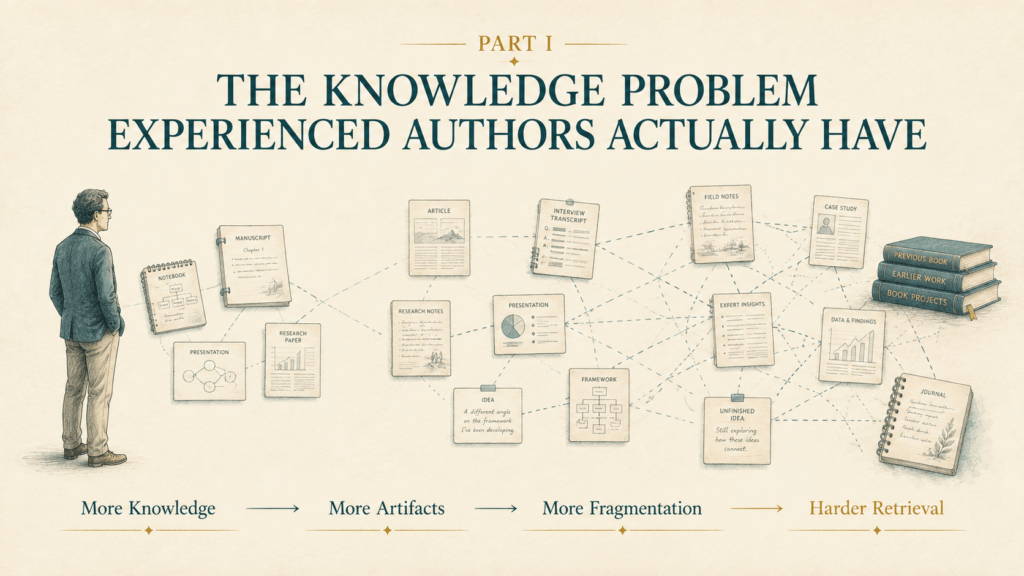
Years of work create an expanding intellectual record: ideas developed in presentations, observations captured in notes, arguments tested in articles, lessons drawn from projects, research gathered for one purpose and forgotten when that project ends.
The difficulty is that this knowledge does not accumulate in one place or in one form.
It spreads.
And as the volume of material grows, the author’s ability to remember what exists, where it lives, and when it might matter begins to fall behind.
That creates a specific knowledge problem.
The author may possess substantial intellectual capital while being unable to reliably bring the right part of it into the present moment.
The challenge is not simply accumulation.
It is access.
More Experience Creates More Intellectual Fragmentation
Expertise does not usually develop inside a single document.
It accumulates across years of intellectual work.
A senior executive may develop one important insight while solving a client problem, sharpen it during a leadership meeting, explain it differently in a presentation, revisit it in an interview, and eventually incorporate part of it into an article or book.
Over time, that thinking becomes distributed across many kinds of artifacts:
- Projects — decisions, analyses, lessons, and recurring problems encountered through real work.
- Conversations — explanations, questions, and observations that emerge in meetings or discussions.
- Writing — articles, newsletters, essays, drafts, and previous books.
- Research — studies, notes, source material, references, and annotated findings.
- Presentations — frameworks, examples, language, and arguments developed for specific audiences.
- Interviews — stories, explanations, and positions articulated in response to questions.
- Teaching — concepts refined through workshops, lectures, courses, or advisory work.
- Previous publications — ideas that may later evolve, combine, or become relevant in a different context.
Each artifact may preserve something useful.
The problem is that the knowledge becomes increasingly distributed across them.
The pattern is predictable:
More knowledge → More artifacts → More fragmentation → Harder retrieval
At first, memory compensates.
The author remembers approximately where an idea appeared.
They can recall the presentation that contained a useful framework or the article where a particular argument was developed.
But that approach becomes less reliable as the body of work expands.
A decade of intellectual activity may produce hundreds or thousands of potentially relevant artifacts.
No individual can keep all of those relationships available in working memory.
Expertise Can Grow Faster Than Access to It
This creates an important distinction.
Accumulating knowledge and being able to use accumulated knowledge are different capabilities.
An author may continue becoming more experienced while simultaneously becoming less able to access the full value of that experience on demand.
The knowledge still exists.
But it may be trapped inside an old presentation, buried in a transcript, separated from related research, or attached to a project the author no longer remembers to search.
That is intellectual fragmentation.
It does not mean the author’s thinking lacks coherence.
It means the evidence of that thinking has become distributed across too many places, formats, and moments to remain reliably accessible through memory alone.
The result is a growing gap between what the author has learned and what the author can readily bring back into current work.
For experienced authors, that gap is often the real knowledge-management problem.
The goal is not merely to continue accumulating more information.
It is to make sure that accumulated knowledge remains usable as the body of work grows.
Storage Is Not Knowledge
Most experienced authors already have a system for storing information.
Their work may live across Google Drive, Dropbox, notes applications, email, presentation archives, shared folders, and document repositories. Some of those systems may be carefully organized. Others may have accumulated organically over years.
Either way, the information exists.
But having information and being able to use what you know are not the same capability.
A storage system is designed primarily to preserve files. It can tell you where a document lives, what it was called, or when it was created.
That works when you already know what you are looking for.
The harder problem begins when you know you have thought about something before, but cannot remember where, when, or in what form.
You may remember developing an argument three years ago without remembering the presentation that contains it. You may know a previous project produced useful research without remembering which document holds the relevant insight. You may recognize that a current idea connects to something you wrote years earlier without knowing where that earlier thinking lives.
The knowledge has not disappeared.
Your ability to access it at the moment it becomes useful has.
Storage and Knowledge Infrastructure Solve Different Problems
This is the distinction that matters.
Storage asks:
Where is the file?
Knowledge infrastructure asks a different set of questions:
- What have I already thought about this?
- What previous work matters to the question in front of me now?
- Where have I encountered this idea before?
- What does this connect to?
Those questions are not fundamentally about documents.
They are about intellectual context.
Imagine an executive beginning work on a book about organizational change. Somewhere across fifteen years of work may be a board presentation containing an early version of the argument, notes from a leadership retreat, research commissioned for a previous initiative, a conference transcript, and an unpublished essay that approached the same problem from another direction.
A conventional archive may preserve all five.
That does not mean those five sources will participate in the book.
For that to happen, the relevant thinking has to become accessible when the author is working on the idea again.
That is the difference between stored information and usable intellectual memory.
The Standard Is Not Whether You Can Find a Document
A well-organized folder structure can make files easier to locate. Search can make documents easier to discover.
Both are useful.
But neither, by itself, answers the more important question:
Can the knowledge accumulated across those documents participate in what the author is thinking now?
That is the standard a knowledge system should meet.
If years of writing, research, presentations, notes, and conversations remain technically accessible but rarely influence current work, the problem is not that the information has been lost.
It has been preserved without becoming sufficiently usable.
For an author, that distinction matters because the value of accumulated expertise is not measured by how many files have survived.
It is measured by how much of that intellectual history remains available when the next argument, chapter, question, or idea demands it.
The purpose of an AI knowledge base is therefore not simply to store more knowledge.
It is to make accumulated knowledge available to current thinking.
Part II — From AI Knowledge Base to Author Brain
The phrase AI knowledge base can sound more technical than the problem it is meant to solve.
At its simplest, the idea is not about building a complicated AI system.
It is about creating an environment where accumulated knowledge can remain available, searchable, and useful after the moment in which it was originally created.
For authors, that distinction matters.
The goal is not merely to preserve documents.
It is to make previous thinking easier to bring back into current work.
What Is an AI Knowledge Base?
An AI knowledge base is a persistent, organized collection of source material that can be accessed with AI to retrieve relevant information, surface connections, and bring useful context into the work being done now.
The important word is persistent.
A normal AI interaction often begins with whatever information is included in the current conversation.
An AI knowledge base creates a more durable intellectual environment. The underlying material remains available so the user does not have to repeatedly reconstruct the same context from memory.
A useful AI knowledge base therefore performs five core functions:
- Collects knowledge persistently
Important source material is preserved beyond a single conversation, project, or moment of use. - Organizes that knowledge sufficiently
Material retains enough structure and context to remain understandable as the collection grows. - Retrieves relevant material
The system can surface information related to the question or task at hand without requiring the user to remember the exact file or location. - Provides AI-assisted access
AI helps interpret the request, identify potentially relevant material, and bring useful sources or ideas forward. - Makes knowledge usable in context
Retrieved material is not valuable merely because it can be found. It becomes valuable when it can inform the current question, decision, argument, or piece of work.
The Difference Between Search and AI-Assisted Retrieval
Traditional search usually depends on the user knowing enough to look for the right thing.
You may need to remember a filename.
A keyword.
A folder.
A phrase you used three years ago.
AI-assisted retrieval can work from the meaning of the current question instead.
Instead of asking:
Where is that document I wrote about leadership transitions?
you can ask:
What have I previously written about what changes when a founder stops being the primary decision-maker?
The system can then look across relevant source material for prior arguments, observations, examples, or research connected to that idea.
That is a meaningful shift.
The unit of retrieval is no longer only the file.
It can be the thinking contained inside the file.
An AI Knowledge Base Is More Than Stored Information
A folder full of documents is not automatically an AI knowledge base.
Neither is a large collection of notes.
Storage preserves information.
An AI knowledge base adds the ability to make that stored material available when its relevance may not be obvious in advance.
A useful way to think about the distinction is:
Stored source material + organization + AI-assisted retrieval + contextual use = AI knowledge base
The AI layer does not replace the source material.
It helps make that source material easier to access and reconnect.
For an author, that means years of writing, research, transcripts, notes, and ideas no longer have to remain useful only when someone remembers exactly where they were stored.
They can become part of a knowledge environment designed to surface relevant thinking when it matters.
What Is an Author Brain?
An Author Brain is an AI-enabled knowledge environment built around an author’s accumulated intellectual work.
It brings together the material that already represents how the author thinks:
- writing and previous publications
- research and source material
- stories and examples
- frameworks and models
- notes and observations
- interviews and transcripts
- arguments and explanations
- unfinished and evolving ideas
But simply collecting those materials does not create an Author Brain.
The defining difference is that the knowledge inside them becomes available to participate in current intellectual work.
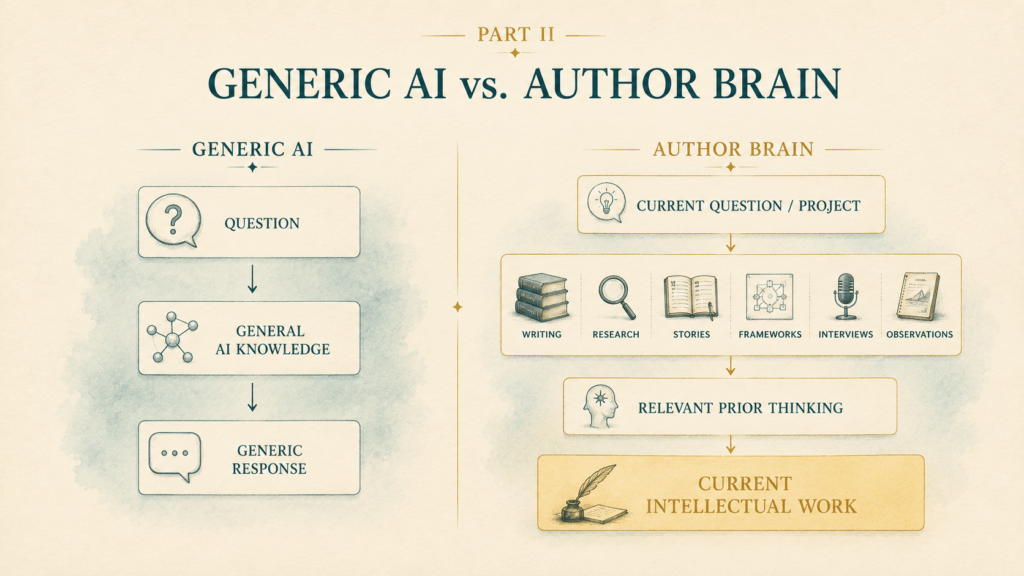
Generic AI Starts With What the Model Knows. An Author Brain Starts With What the Author Has Already Thought.
Most interactions with AI begin from a blank context.
The author asks a question. The AI draws primarily from its general training and whatever information has been supplied in that particular interaction.
An Author Brain changes the starting point.
Instead of asking AI to generate from scratch, the author gives it access to a body of source material that reflects years of actual thinking, writing, research, experience, and intellectual development.
The difference looks like this:
Generic AI
Question
↓
AI’s general knowledge
↓
Generated response
Author Brain
Current question or project
↓
Author’s accumulated intellectual work
↓
Relevant prior thinking
↓
Current intellectual work
This does not mean the AI somehow learns to become the author.
It means the author’s own knowledge becomes part of the context available when the author is working.
That is a much more useful standard.
The Author Brain Preserves Context, Not Just Content
A useful Author Brain contains more than finished documents.
An experienced author’s thinking may be distributed across a book brief, research notes, interview transcripts, presentations, previous articles, frameworks, stories, chapter ideas, examples, observations, and unfinished arguments.
Each contains information.
But it also contains context.
A framework may reveal how the author organizes a problem. A story may demonstrate a principle the author repeatedly teaches. An interview may contain language that sharpened an argument. An older article may preserve an earlier version of an idea that has since changed.
This context is part of the author’s intellectual history.
That is why the goal is not simply to upload everything an author has ever created into an AI system. The goal is to preserve enough of the author’s intellectual environment that previous work remains meaningful when it is encountered again.
For an executive developing a book, for example, that environment might include:
- the central problem the book is addressing
- existing frameworks used to explain that problem
- research gathered over several years
- stories from professional experience
- transcripts from relevant conversations
- previous writing on related subjects
- examples and evidence supporting key arguments
- ideas that have been tested but not yet fully developed
Individually, these are source materials.
Together, they begin to represent a body of thinking.
The Author Remains the Builder
This distinction matters especially when AI becomes part of the system.
An Author Brain is not designed to transfer intellectual responsibility from the author to the AI.
The author still determines what they believe.
The author still decides which arguments matter, which evidence is credible, which stories belong, which distinctions are meaningful, and how an idea should develop.
AI has a different role: helping the author work with the intellectual material already available.
That means the system is oriented toward retrieval and construction rather than undirected generation.
Instead of asking:
What can AI write about this subject?
the more useful question becomes:
What have I already written, learned, observed, researched, or developed that should inform what I am working on now?
That shift keeps the author’s expertise at the center of the process.
The Real Purpose Is Continued Intellectual Development
The ultimate value of an Author Brain is not that it remembers more files.
It is that the author no longer has to treat every new intellectual project as if their previous thinking were inaccessible.
A book can draw from years of research.
A new argument can encounter an older version of itself.
A framework can reconnect with the experiences that originally produced it.
An unfinished observation can become relevant several years after it was captured.
Previous work can become input for current thought rather than remaining trapped inside the project where it first appeared.
That is the Manuscripts distinction:
An Author Brain is not simply a record of what an author has created.
It is an AI-accessible environment for what the author has thought, learned, observed, tested, and developed over time, so that accumulated knowledge can continue participating in what the author thinks next.
An Archive and an Author Brain Are Not the Same Thing
Most experienced authors already have an archive.
They have years of documents, presentations, research, transcripts, articles, notes, interviews, frameworks, and unfinished ideas stored somewhere.
That archive may be extensive. It may even be well organized.
But an archive and an Author Brain perform fundamentally different jobs.
An archive is designed primarily to preserve what already exists.
An Author Brain is designed to make that accumulated knowledge useful to what the author is thinking now.
That distinction changes what a knowledge system needs to do.
Preservation Is Not the Same as Activation
Consider an executive who has spent 20 years developing a point of view about organizational change.
Their archive might contain:
- presentations from leadership meetings
- research collected for previous initiatives
- transcripts from interviews and talks
- articles written at different points in their career
- notes from important conversations
- stories from successful and failed transformations
- frameworks developed for teams or clients
An archive can preserve all of this.
With enough searching, someone may even locate the right document.
But locating a document is not the same as recovering the thinking inside it.
The more useful questions are different:
Where has this executive addressed this idea before?
Which previous arguments are relevant to the book now?
What stories or evidence have they already accumulated around it?
Has their position changed over time?
What ideas developed in separate projects actually belong together?
Those are questions about intellectual usefulness, not file location.
That is the standard an Author Brain is designed to meet.
Archive vs. Author Brain
| Archive | Author Brain |
| Stores information | Activates knowledge |
| Organized around files | Organized around intellectual usefulness |
| Search finds documents | Retrieval surfaces relevant thinking |
| Preserves past work | Connects past and current work |
| Information remains largely isolated | Relationships can emerge across sources |
| Primary goal: preservation | Primary goal: intellectual continuity |
Neither system makes the other unnecessary.
Preservation still matters. Original sources need to remain available, understandable, and intact.
The difference is what happens after something has been preserved.
In an archive, a presentation from five years ago remains a presentation from five years ago until someone deliberately finds and reopens it.
In an Author Brain, the thinking inside that presentation can become relevant because a current question, argument, or project makes it useful again.
The value shifts from having the material to being able to bring the right knowledge back into active thought.
The Difference Is in the Movement of Knowledge
A traditional archive generally follows a short path:
Store → Search → Find
Something is created. It is saved. Later, someone searches for it and, ideally, finds it.
That works when the objective is document retrieval.
An Author Brain requires a broader movement:
Capture → Store → Organize → Retrieve → Connect → Apply
The important difference is what happens after storage.
Knowledge must remain retrievable. Relevant thinking must be capable of resurfacing. Material from different sources must be able to reconnect. And what is recovered must be usable in current intellectual work.
That is why simply moving thousands of existing files into an AI-enabled environment does not automatically create an Author Brain.
The functional test is not:
How much of the author’s work have we stored?
It is:
Can the author’s accumulated knowledge meaningfully participate in the work being developed now?
If the answer is no, the system may be an excellent archive.
It is not yet an Author Brain.

Part III — What Belongs Inside an Author Brain
An Author Brain does not begin with software.
It begins with the intellectual material the author has already created.
For an experienced executive, founder, professor, physician, consultant, or expert, that material rarely lives in one place or one format. Some of it has been published. Some of it was spoken once in a meeting or interview. Some exists only as notes, unfinished drafts, old research, frameworks, examples, or observations accumulated over years.
The first task is therefore not to create more knowledge.
It is to recognize the forms in which valuable knowledge already exists.
Start With the Intellectual Work You Already Have
Building an Author Brain can sound like a large knowledge-management project.
In practice, the starting point is much simpler:
Begin with the body of thinking you have already produced.
For most experienced authors, the raw material is already substantial. It may simply be distributed across dozens of projects, formats, and periods of their career.
A useful way to identify that material is to look across five categories of intellectual work.
1. Published Thinking
This is the material the author has already made public.
It may include:
- books
- articles
- newsletters
- essays
- social writing
Published work matters because it often captures ideas that have already reached a relatively developed form.
It can preserve arguments the author has defended publicly, language they have refined over time, examples they repeatedly use, and positions they may want to revisit or extend.
But published material should not be treated only as finished output.
Inside an Author Brain, it can also function as a record of what the author believed, emphasized, and articulated at a particular point in time.
2. Spoken Thinking
Some of an author’s most valuable ideas never begin as writing.
They emerge while answering a question in an interview.
Explaining a difficult concept during a workshop.
Responding to a client or colleague.
Presenting an idea onstage.
Teaching something repeatedly.
That makes spoken material an important source of intellectual knowledge, including:
- podcast transcripts
- interviews
- talks
- presentations
- workshops
Spoken thinking often contains explanations, analogies, stories, and distinctions that may never have been captured in formal writing.
A strong Author Brain gives that material a second life by preserving the thinking inside the conversation rather than allowing it to disappear with the event itself.
3. Working Thinking
Not every valuable idea has reached a finished form.
Authors often have years of partially developed thinking sitting inside:
- notes
- drafts
- research
- outlines
- unfinished ideas
- observations
This material can be especially important because it preserves thinking that is still in motion.
A published article may show where an argument ended.
Working material can show where it came from, which alternatives were considered, what questions remained unresolved, or which ideas never received enough attention to become finished work.
An Author Brain should therefore preserve more than polished conclusions.
It should also retain useful thinking while it is still developing.
4. Structured Thinking
Experienced authors frequently develop ways of organizing what they know.
Those structures may include:
- frameworks
- methodologies
- models
- terminology
- recurring arguments
This category matters because structured thinking often represents accumulated expertise that has already been compressed into a reusable form.
A framework may encode years of experience.
A recurring distinction may capture an insight the author has explained dozens of times.
A piece of terminology may represent a concept that appears across multiple projects even when the language around it has changed.
These structures help reveal not only what the author knows, but how they tend to organize and explain what they know.
5. Experiential Knowledge
Some of the most valuable material in an Author Brain may never have existed as formal content at all.
It comes from experience.
That includes:
- stories
- examples
- lessons
- professional observations
- recurring problems
A founder may have watched the same organizational failure occur across several companies.
A physician may notice the same misconception repeatedly among patients.
A consultant may develop an instinct for a problem long before that instinct becomes a formal framework.
Those observations are part of the author’s intellectual history even if they have never been published.
They are often the raw material from which stronger explanations, arguments, and frameworks eventually emerge.
Think in Intellectual Material, Not File Types
The practical shift is to stop asking only:
What files do we have?
And start asking:
Where has this author’s thinking already been expressed?
The answer may span a book chapter, an old slide deck, a podcast transcript, a private note, an unfinished outline, a recurring client story, and a framework developed years ago.
Those materials may look unrelated when viewed as files.
Intellectually, they may belong to the same body of thought.
That is the opportunity.
An Author Brain does not require an author to manufacture a new knowledge base from zero.
It begins by recognizing that much of the knowledge already exists.
The work is to make that accumulated thinking available again.
Not Every File Deserves to Become Knowledge
Once authors recognize how much intellectual material they already possess, the next temptation is predictable:
Put everything into the system.
That is usually a mistake.
An Author Brain becomes useful because it contains material with intellectual value, not because it contains the largest possible number of files.
A calendar attachment, an old administrative document, a duplicate presentation, and a transcript of a substantive conversation may all be files.
They are not equally valuable as knowledge.
The goal is therefore not indiscriminate collection.
It is curation: deciding which materials preserve thinking that may matter again.
Prioritize Intellectual Value, Not File Volume
A useful addition to an Author Brain should have some reason to participate in future thinking.
That reason may be obvious, as with a published article that contains a developed argument.
Or it may be less obvious, as with a set of notes containing an observation the author has never fully explored.
In either case, prioritize material with:
- Intellectual relevance — it contains an idea, argument, question, lesson, example, or perspective connected to the author’s work.
- Contextual meaning — enough surrounding information exists to understand why the material mattered and what it was responding to.
- Potential future usefulness — the material could reasonably inform another book, article, presentation, argument, question, or line of inquiry.
- Connection to the author’s expertise — it contributes to the subjects, problems, experiences, or ideas the author repeatedly works with.
- Evidence of evolving thinking — it captures an earlier position, unresolved question, emerging distinction, or refinement that helps show how an idea developed.
This standard matters because more information does not automatically create more usable knowledge.
A larger collection can actually make the system noisier if low-value material competes with the thinking the author genuinely wants to recover.
Use a Simple Knowledge Filter
Before adding material to the Author Brain, ask whether it helps preserve something intellectually meaningful.
Does this material capture:
- Something I believe?
A position, conviction, interpretation, or argument that reflects how I think. - Something I learned?
A lesson from research, experience, failure, experimentation, or observation. - Something I observed?
A pattern, behavior, recurring problem, anomaly, or question worth remembering. - Something I repeatedly explain?
A distinction, example, story, framework, or explanation that has become part of how I communicate my expertise. - Something I may need to develop again?
An unfinished idea, unresolved question, partial argument, or line of thinking that could become important later.
If the answer is yes to one or more of those questions, the material may deserve a place in the Author Brain.
If not, ordinary storage may be enough.
Storage and Knowledge Do Not Need the Same Standard
This distinction is important.
Rejecting a file from the Author Brain does not mean deleting it.
Some information needs to be preserved for operational, legal, historical, or administrative reasons without becoming part of the author’s active intellectual environment.
That is what ordinary storage is for.
The Author Brain should have a higher threshold.
Its contents should help preserve the author’s intellectual history, not merely the author’s file history.
That is the governing principle:
Do not ask, “Can this file go into the system?”
Ask:
“Could the thinking inside this material matter to something I need to understand, explain, or develop again?”
If the answer is no, storage may be sufficient.
If the answer is yes, it may belong in the Author Brain.

Part IV — The Author Brain System
An Author Brain becomes useful when it does more than hold material.
The accumulated writing, research, stories, transcripts, frameworks, notes, and observations inside it need a way to move from preservation into use.
That requires a system.
Not a more elaborate filing structure.
Not a larger archive.
A working sequence that allows valuable thinking to be captured, preserved with enough context, surfaced when relevant, connected to related ideas, and applied to current intellectual work.
That is the role of the Author Brain System.
The Six Functions of an AI Knowledge Base for Authors
The Author Brain System has six functions:
Capture → Store → Organize → Retrieve → Connect → Apply
Each function solves a different problem.
- Capture makes sure valuable thinking enters the system before it disappears.
- Store gives that material a persistent home where the original source can be preserved.
- Organize keeps enough context around the material that it remains understandable later.
- Retrieve brings relevant prior thinking back when a current question or project makes it useful.
- Connect surfaces relationships across ideas, experiences, arguments, and sources that may have developed at different times.
- Apply puts that accumulated knowledge back into active intellectual work.
The sequence matters because an Author Brain fails when any one of these functions is treated as the endpoint.
Capturing without storing creates fragments.
Storing without organizing creates accumulation without context.
Organizing without retrieval creates a well-maintained archive that still depends on the author remembering where to look.
Retrieving without connecting can surface useful material without revealing how different pieces of thinking relate.
And connecting without application produces interesting insight that never changes the work being done now.
The Author Brain System
Capture
↓
Store
↓
Organize
↓
Retrieve
↓
Connect
↓
Apply
This is not merely a workflow for moving files.
It is the operating logic that turns accumulated intellectual material into usable knowledge.
A note captured five years ago may become relevant to a chapter today.
A transcript from a past interview may reinforce an argument that has since become more developed.
Several observations from unrelated projects may reveal a recurring pattern the author had never named explicitly.
The system matters because those connections become possible only when past thinking remains accessible enough to participate in present work.
The Value Is in the Movement
No individual function creates an Author Brain by itself.
Storage alone creates an archive.
Retrieval alone creates better search.
Connection alone can produce interesting associations without preserving the source material or giving those associations somewhere to go.
The value comes from keeping knowledge moving through the entire system:
Preserve what matters.
Maintain enough context to understand it.
Surface it when it becomes relevant.
Connect it to related thinking.
Put it back to work.
That is what turns an AI knowledge base into an author-specific intellectual environment.
The goal is not simply to remember more.
It is to make accumulated knowledge available at the moment it can contribute to what the author is thinking now.
Capture — Preserve Thinking Before It Disappears
Not all valuable thinking begins as a polished document.
Some of it appears while writing.
Some emerges during a conversation.
Some comes from a research finding, a question asked in an interview, an observation made during a project, or a sentence written in the margin of an unfinished draft.
The first function of an Author Brain is capture: preserving useful intellectual material before the context that produced it disappears.
Capture matters because ideas are often easiest to understand at the moment they emerge.
Weeks or months later, the note may still exist, but the reasoning behind it may not.
The author may remember that something felt important without remembering why.
A transcript may contain a useful insight that is never revisited.
A presentation may include a framing that worked especially well with an audience but never make its way into future writing.
An unfinished draft may contain the beginning of an argument that becomes difficult to reconstruct later.
The problem is not that the thinking had no value.
It is that the value was never preserved in a form that could participate in future work.
Capture Intellectual Artifacts, Not Just Finished Work
An intellectual artifact is any piece of material that preserves something potentially useful about how the author thinks, explains, observes, or develops an idea.
That can include:
- Writing — articles, chapters, essays, newsletters, drafts, and working passages.
- Research — findings, source notes, annotations, questions, and evidence worth revisiting.
- Conversations — useful explanations, recurring questions, disagreements, and observations that surface in discussion.
- Presentations — frameworks, examples, explanations, and language developed for talks or workshops.
- Interviews — transcripts, stories, distinctions, and ideas discovered through questioning.
- Notes — working thoughts, reminders, hypotheses, and fragments that may not yet belong to a larger project.
- Observations — patterns noticed in professional work, teaching, clients, readers, or the broader field.
- Unfinished work — abandoned drafts, partial frameworks, undeveloped arguments, and questions that may become valuable later.
The standard is not whether the material is polished.
The standard is whether it preserves thinking that may matter again.
A three-sentence note can be more useful than a fifty-page report if those three sentences capture a distinction the author repeatedly returns to.
An unfinished framework can deserve preservation even if it never becomes a finished framework.
A conversation can matter because it contains an explanation the author articulated more clearly than they had before.
Capture should therefore follow intellectual value, not publication status.
Preserve Enough Context to Make the Idea Recognizable Later
Capturing the words alone is not always enough.
Useful thinking often depends on the circumstances around it.
Why did this observation matter?
What problem was being discussed?
Was the idea an established belief, an early hypothesis, or a question worth exploring?
What prompted the example?
Without enough context, material that seemed obvious when captured can become difficult to interpret later.
The goal is not to document every detail.
It is to preserve enough of the original meaning that the author, or an AI working with the author’s knowledge, can recognize why the material may be useful.
That might mean preserving a short note such as:
Observation: Senior leaders often explain a strategy more clearly in conversation than in the formal strategy document.
Context: Repeated pattern across three executive interviews.
Possible relevance: Leadership communication, tacit knowledge, or book-development interviews.
The additional context is small.
But it turns a passing observation into intellectual material that can be understood again months later.
Capture Before You Decide Exactly Where It Belongs
One reason useful ideas disappear is that authors try to classify them too early.
Is this for the book?
A future article?
A presentation?
A framework?
A research project?
Often, the answer is not yet clear.
That should not prevent capture.
An idea does not need a final destination before it deserves to survive.
The first responsibility is simply to preserve the thinking while its meaning is still available.
Its eventual use can be determined later.
That is the success standard for capture:
Useful thinking survives beyond its original context.
Store — Create a Persistent Intellectual Environment
Capturing useful thinking is only the first step.
For that thinking to remain valuable, it needs a durable home.
Storage, in the context of an Author Brain, means creating a persistent intellectual environment where source material can remain accessible, understandable, and available for future use.
The goal is not simply to keep files from being lost.
It is to preserve intellectual material in a form that can still participate in the author’s work months or years later.
What Good Storage Needs to Preserve
A useful storage environment should protect five things.
- Persistence — the material remains available beyond the moment or project that originally produced it.
- Accessibility — the author and their systems can reliably reach the material when it becomes relevant again.
- Source preservation — the original document, transcript, note, research source, or other artifact remains available rather than being replaced only by a summary.
- Sufficient context — enough information survives to explain what the material is, where it came from, and why it may matter.
- Continued expansion — new writing, research, observations, and ideas can be added without forcing the entire system to be rebuilt.
These standards matter because intellectual memory is cumulative.
A useful note from three years ago becomes far more valuable when it can still be understood alongside a recent interview, a new research finding, or a current book project.
If the source disappears, the context is stripped away, or the material becomes inaccessible, that continuity breaks.
Preserve the Source, Not Just a Compressed Version of It
AI can summarize a transcript, extract themes from research, or condense a long document.
Those outputs can be useful.
But they should not automatically replace the underlying source material.
A summary preserves what appeared important during one pass through the material.
The source preserves what may become important later.
That distinction matters because the questions an author asks change over time.
A transcript that seemed relevant because of one story today may become valuable for an entirely different argument two years from now.
A research document may contain evidence that was not important to the original project but becomes essential to a later one.
A draft may preserve an earlier version of an idea that helps explain how the author’s thinking evolved.
The original source keeps those possibilities open.
Context Determines Whether Stored Material Remains Intelligible
A file can survive physically and still lose much of its intellectual value.
A document titled final-notes-v3 may exist for years without making clear:
- what project it belonged to
- who created it
- what question it was addressing
- whether the ideas were tentative or established
- why the material was worth preserving
Good storage keeps enough context attached to the material that its meaning does not depend entirely on memory.
This does not require elaborate documentation.
The objective is simply to prevent future retrieval from producing a file that is technically available but intellectually opaque.
Build for Accumulation
An Author Brain should become more useful as the author’s body of work grows.
That means the storage environment must be able to absorb new material continuously.
A new interview should be able to join older transcripts.
A new argument should be able to sit alongside earlier versions.
A new research source should become part of the same accumulated intellectual history rather than disappearing into another disconnected folder.
The specific platform matters less than this standard:
Can the author’s knowledge remain persistent, accessible, source-grounded, understandable, and expandable over time?
If so, storage is doing its job.
The purpose is not to create another place where information sits.
It is to create a durable environment where captured thinking remains available long enough to become intellectual memory.
Organize — Preserve Context, Not Just Files
Stored material becomes less useful when its meaning depends on remembering the circumstances that created it.
A transcript may survive for years while the reason it mattered disappears.
A research document may remain accessible while no one remembers which argument it supported.
A draft may still exist while its status, working idea, rejected direction, or current thinking, is unclear.
That is why organization inside an Author Brain is not primarily about creating cleaner folders.
It is about preserving enough context that intellectual material still makes sense when it is encountered later.
Organize Around Future Understanding
The useful question is not:
Where should this file live?
It is:
What would I need to know later to understand why this material matters?
Depending on the material, that context may include:
- Topic — the subject, problem, or area of expertise the material relates to.
- Project — the book, article, talk, research initiative, or other work that originally produced it.
- Source — where the material came from, such as an interview, conversation, research paper, presentation, or personal note.
- Date — when the thinking was created or captured, especially when the author’s position may evolve over time.
- Idea — the argument, concept, question, or observation the material helps develop.
- Status — whether the material represents an early thought, active direction, supporting evidence, unresolved question, or more developed position.
- Relationship to other work — where the material extends, challenges, supports, or connects with something the author has already developed.
Not every piece of material needs every dimension.
The purpose is not to create a perfect taxonomy.
It is to preserve the context most likely to make the material intelligible and useful again.
Context Is More Valuable Than Elaborate Categorization
Knowledge systems often become harder to maintain when organization becomes an end in itself.
Every file receives multiple tags.
Categories multiply.
Folder structures become deeper.
The author or team spends more time maintaining the system than using the knowledge inside it.
That is the wrong tradeoff.
An Author Brain does not need every artifact to fit perfectly into one classification scheme. In fact, valuable intellectual material often belongs to several contexts at once.
A story may support multiple arguments.
A research source may matter to more than one project.
An observation may begin as a note and later become part of a framework.
Organization should preserve those possibilities rather than forcing every idea into a single permanent location.
Organize for the Question You Will Ask Later
The real test of organization appears when the original context has faded.
Months from now, could the author determine:
- what this material is
- why it was worth preserving
- what idea or project it relates to
- whether it still represents current thinking
- what other work it may connect with
If the answer is yes, the material has enough structure to remain useful.
If the answer requires reconstructing the entire history from memory, the file may be stored but the knowledge has not been adequately preserved.
That is the standard.
Organization should make future retrieval easier, not create administrative overhead in the present.
The goal is not a perfectly organized archive.
It is an intellectual environment where accumulated material retains enough context to become useful when the author needs it again.
Retrieve — Bring Previous Thinking Into the Present
This is where an AI knowledge base begins to change the way an author works.
In a traditional archive, retrieval is largely a file-finding exercise.
You remember that you wrote something useful. You try to remember when. You search a folder, scan old documents, check presentation decks, or reconstruct the right keywords.
Sometimes you find it.
Sometimes you find three versions and cannot remember which one matters.
Sometimes you decide it would be faster to start again.
An Author Brain changes the retrieval question.
Instead of asking:
Where did I put that?
You can begin asking:
What have I already developed that matters here?
That distinction is important.
The first question is about locating a file.
The second is about recovering relevant thinking.
Retrieval Should Begin With the Current Intellectual Need
Retrieval is the process of bringing relevant material from an author’s accumulated knowledge into a current question, argument, or project.
The author should not need to remember the exact filename, folder, date, or format in which an idea originally appeared.
What matters is the intellectual context of the current work.
Suppose an executive is developing a book chapter about why organizational transformation fails after the initial strategy is announced.
Their Author Brain may contain relevant material scattered across years of work:
- an argument from an earlier article about implementation
- research collected for a board presentation
- an example from a previous transformation initiative
- a story told during a podcast interview
- an explanation used repeatedly with leadership teams
- an observation captured after a difficult project
- an unfinished idea from an abandoned book outline
None of these sources needs to have been created for the current chapter.
They become useful because they contain thinking relevant to the question being developed now.
AI Makes Retrieval Less Dependent on Memory
Traditional search works best when you already know what you are looking for.
You remember a title.
A phrase.
A client name.
A date.
A folder.
But intellectual memory rarely works that neatly.
An author may remember the substance of an idea without remembering where it appeared. Or the relevant material may exist in several places under different language.
AI-assisted retrieval reduces that dependence on exact recall.
Instead of searching only for a known document, the author can retrieve around a question or concept:
What have I previously argued about this problem?
What research have I collected that bears on this question?
Where have I explained a similar idea before?
What examples or stories from my previous work illustrate this point?
Have I started developing this argument somewhere else?
The AI is not supplying the author’s intellectual history.
It is helping surface the parts of that history that may already answer the present need.
Retrieve Across Forms, Not Just Within Them
One of the limitations of a fragmented archive is that different forms of thinking tend to remain separated.
Articles are searched as articles.
Research lives with research.
Transcripts remain transcripts.
Presentations stay inside presentation folders.
Notes are searched only when someone remembers that a note exists.
But an author’s thinking does not necessarily respect those boundaries.
The strongest explanation of an idea may be in an interview rather than an article.
The best supporting example may be buried in a presentation created five years ago.
A useful counterargument may appear in notes from an unfinished project.
Effective retrieval treats these materials as parts of the same intellectual history.
The question becomes less about what type of file contains the answer and more about which previous thinking is relevant now.
The Success Standard Is Relevant Context, Not Search Results
A retrieval system is not valuable because it can return a large number of documents.
More results can simply create another form of information overload.
Useful retrieval narrows the author’s accumulated knowledge toward the material most relevant to the work at hand.
That might mean recovering one earlier argument, two pieces of research, a story, and an unfinished observation from five different sources.
The measure is not:
How much did the system find?
It is:
Did it bring the right parts of my previous thinking back into the room?
That is the first major advantage AI adds to an Author Brain.
The author’s accumulated knowledge no longer has to remain trapped inside the circumstances in which it was originally created.
Previous arguments, research, examples, stories, explanations, observations, and unfinished ideas can become available again when a current question gives them new relevance.
The shift is simple but consequential:
From: Where did I put that?
To: What have I already developed that matters here?
Connect — Find Relationships Across Your Intellectual History
Retrieval brings relevant past thinking back into view.
Connection asks a different question:
What becomes visible when those pieces are considered together?
This is where an Author Brain becomes more than improved search.
An author’s ideas rarely develop in one place. A position may first appear in a note, become sharper in a presentation, be challenged in a client conversation, and resurface years later in a different argument.
When those materials remain separated, the author experiences them as isolated artifacts.
When they can be examined together, patterns begin to emerge.
Connection Reveals the Shape of Your Thinking
AI can help surface relationships across material that was created at different times, for different projects, and in different formats.
That may include:
- Recurring themes — ideas that repeatedly appear across articles, talks, notes, and research.
- Related arguments — positions that reinforce or extend one another even though they were developed separately.
- Contradictions — places where the author’s current position differs from an earlier one.
- Repeated terminology — language or concepts that may be becoming part of the author’s distinctive vocabulary.
- Evolving positions — ideas whose meaning, confidence, or implications have changed over time.
- Connections between research and experience — where external evidence supports, complicates, or reframes something the author has observed directly.
- Ideas appearing independently across projects — concepts that keep resurfacing even when the author did not deliberately connect them.
These relationships matter because they reveal more than what the author has said.
They can reveal how the author’s thinking is developing.
The Value Is Not Similarity. It Is Intellectual Relationship.
Not every connection is useful simply because two documents mention the same topic.
The stronger question is whether the relationship changes how the author understands the idea.
Two pieces of work may use different language but express the same underlying belief.
A newer argument may resolve a question left open in an older draft.
A recurring example may reveal a pattern the author has noticed repeatedly but never named.
Research gathered for one project may provide evidence for an argument being developed somewhere else.
An apparent contradiction may show that the author’s position has evolved rather than remained fixed.
That is more valuable than simply finding another document with the same keywords.
The purpose of connection is to surface intellectual relationships that would be difficult to notice while each source remains isolated.
Contradictions Can Be as Useful as Patterns
An Author Brain should not be designed only to confirm what the author already believes.
Sometimes the most useful connection is disagreement across the author’s own body of work.
An earlier article may make a claim that later experience has weakened.
A framework used several years ago may rely on assumptions the author no longer accepts.
Two presentations may offer different explanations for what appears to be the same problem.
Those differences are not necessarily errors to eliminate.
They may represent the history of the author’s thinking.
Recognizing that evolution gives the author a chance to ask:
What changed?
What did I learn between these two positions?
Which version better reflects what I believe now?
That kind of comparison helps intellectual development become cumulative rather than accidental.
Connection Turns a Collection Into a Body of Work
A large archive can contain hundreds of valuable pieces without revealing what they add up to.
Connection begins to expose the larger structure underneath them.
The author may discover that several seemingly unrelated projects were actually exploring the same question.
A recurring story may be carrying a deeper principle.
Multiple observations may support an argument that has never been stated directly.
An unfinished idea from years ago may suddenly become more important because newer work supplies the missing evidence.
None of those insights requires AI to invent the author’s thinking.
The material already exists.
The value comes from making relationships across that material easier to see.
That is the distinction between retrieval and connection:
Retrieval brings old knowledge back.
Connection helps the author see that knowledge differently.
Apply — Put Intellectual Memory Back to Work
An Author Brain becomes valuable when what it remembers can influence what the author is doing now.
Retrieval brings relevant prior thinking back into view.
Connection reveals how that thinking relates across time, projects, and sources.
Application is the point where that accumulated knowledge reenters active intellectual work.
Without application, even a highly organized and searchable system remains an improved archive.
It remembers.
It retrieves.
It connects.
But the author still has to turn those insights into something useful.
Application Means Starting With More Than a Blank Page
New intellectual work rarely needs to begin from zero.
A new book chapter may benefit from an argument developed years earlier.
A presentation may draw on a story first captured in an interview transcript.
A framework may become stronger when several recurring observations are considered together.
A research question may change once earlier assumptions and unresolved ideas are visible again.
The Author Brain makes that prior thinking available at the moment a new decision is being made.
That can support work such as:
- Books — bringing relevant arguments, examples, research, and earlier thinking into a new manuscript.
- Articles — reconnecting current ideas with positions the author has already developed elsewhere.
- Talks and presentations — surfacing stories, examples, frameworks, and explanations that fit the current audience or question.
- Frameworks — identifying recurring principles, terminology, and relationships that deserve more deliberate structure.
- Research — reconnecting new evidence with previous questions, assumptions, and lines of inquiry.
- Current arguments — testing a position against what the author has previously written, observed, or learned.
- New intellectual exploration — using earlier ideas as starting material for questions that have not yet been fully developed.
The point is not to reproduce old material unchanged.
It is to make previous thinking available for judgment.
Reuse the Knowledge, Not Necessarily the Artifact
Application does not mean copying an old article into a new book or turning every transcript into content.
What matters is the intellectual value inside the source.
An old presentation may contain a useful distinction even if the slides themselves are obsolete.
A previous book may contain an argument that now needs to be challenged.
A transcript may preserve a story that has never been developed fully.
A note may contain the first version of an idea that is now ready for a more rigorous form.
The Author Brain allows the author to recover those useful parts without treating every prior artifact as something that must be republished.
The question becomes:
What does this earlier thinking contribute to the work I am doing now?
Sometimes the answer is evidence.
Sometimes it is context.
Sometimes it is a contradiction.
Sometimes it is a story, question, framework, or unfinished line of reasoning.
Application is the act of deciding what role that recovered knowledge should play.
Previous Thinking Should Inform Current Judgment, Not Replace It
An Author Brain is not valuable because it gives the author a larger supply of material to insert into new work.
Its value is that it improves the context available for current decisions.
Prior thinking can help an author ask:
- Have I already developed part of this argument?
- What did I believe about this before?
- What evidence or experience has changed since then?
- Which examples still clarify the idea?
- Where am I repeating myself without adding anything new?
- What unfinished question deserves another look?
Those questions keep intellectual work cumulative without making it static.
The author is not required to remain consistent with every previous idea.
The author gains the ability to see previous ideas clearly enough to extend, revise, reject, or deepen them deliberately.
The System Is Complete When Knowledge Can Reenter the Work
Capture preserves useful thinking.
Storage keeps it available.
Organization preserves enough context to understand it later.
Retrieval brings relevant material back.
Connection reveals relationships across it.
Application gives that knowledge a role in the present.
That final function is what turns an Author Brain from a memory system into an intellectual working environment.
The goal is not simply to remember more of what the author once knew.
The Author Brain should help previous knowledge participate in what the author is thinking now.
PART V — Intellectual Continuity
An Author Brain becomes more valuable when it preserves not only individual pieces of knowledge, but the development of ideas across time.
Experienced authors rarely arrive at their strongest arguments in a single moment.
An idea may begin as an observation, become a note, appear in an article, change after a new experience, and eventually develop into a framework or book.
Seen separately, those artifacts can look like unrelated pieces of work.
Seen together, they reveal something more important:
the history of an idea.
Your Ideas Have Histories
Strong ideas usually evolve before they mature.
An author notices something.
They write it down.
They test it in conversation.
They explain it in an article.
New experience complicates the original interpretation.
The argument changes.
A clearer model begins to emerge.
Eventually, what started as a small observation may become one of the central ideas in a book.
How One Idea Develops Over Time
| Stage | What Is Happening |
| Observation | The author notices a pattern, tension, problem, or possibility. |
| Early Note | The idea is captured before it disappears. |
| Public Explanation | The author begins testing the idea through an article, newsletter, or conversation. |
| New Experience or Evidence | Additional context strengthens, challenges, or complicates the original thinking. |
| Revised Argument | The author updates the idea based on what has been learned. |
| Framework | The thinking becomes more structured, repeatable, or teachable. |
| Talk or Presentation | The author tests how the idea holds up when explained to others. |
| Book | The idea is developed into a fuller, more complete intellectual contribution. |
The important point is not that every idea follows these exact stages.
It is that strong ideas often leave a trail.
An observation from years ago may later become an argument. That argument may become a framework. The framework may eventually become part of a book.
Seen separately, those artifacts look unrelated.
Seen together, they reveal the evolution of the same thinking.
Intellectual Work Is Often Cumulative
When previous work is viewed only as finished output, that progression becomes easy to miss.
The note is filed away.
The article is published and forgotten.
The presentation becomes an old deck.
The framework appears to be something the author created later.
But the intellectual development may have been happening across all of them.
Each artifact can contribute something different:
- an early observation captures the original insight
- a note preserves the first attempt to explain it
- an article forces the idea into a clearer argument
- new experience introduces evidence or contradiction
- a revised argument incorporates what changed
- a framework gives the idea structure
- a talk tests whether the explanation works for others
- a book creates room for the idea to be developed more fully
Seen this way, intellectual artifacts are not only outputs.
They are evidence of how the author’s thinking developed.
The History Matters Because Ideas Change
The earliest version of an idea is not always the best one.
Experience may reveal that an assumption was incomplete.
Research may introduce a distinction the author had not considered before.
A term may become more precise.
An argument may become narrower, stronger, or more defensible.
A framework may emerge only after the author has explained the same problem repeatedly in different contexts.
If those stages remain disconnected, the author may remember only the latest version, or unknowingly recreate earlier work without recognizing how much the idea has already developed.
Preserving the history makes it possible to see both continuity and change.
You can ask:
- Where did this idea first appear?
- How has my explanation changed?
- What evidence caused the argument to evolve?
- Which parts have remained consistent?
- When did a recurring observation become a framework?
- What still feels unresolved?
Those are different questions from simply asking where a file is stored.
They reveal the development of the thinking itself.
A Book May Be the Latest Stage of an Idea, Not Its Beginning
For many experienced authors, the ideas that eventually belong in a book have been developing long before the manuscript begins.
They may already exist across years of writing, research, presentations, conversations, and professional experience.
The book gives those ideas a new form.
It allows the author to gather what has been learned, examine how the thinking has changed, and develop the argument further.
That is why intellectual continuity matters.
Without it, each new project can feel more independent than it really is.
With it, the author can recognize that previous work may already contain the beginnings, revisions, contradictions, evidence, and language that current work needs.
Your articles, notes, talks, frameworks, and books may not be separate pieces of thinking.
They may be different stages in the life of the same idea.
An Author Brain Preserves the Evolution of Thinking
An author’s ideas rarely remain fixed.
They change as the author encounters new evidence, applies an idea in a different setting, explains it to another audience, discovers an exception, or finds better language for something they have been trying to articulate for years.
That evolution is part of the value of the work.
The problem is that most knowledge systems preserve the artifacts without preserving the intellectual relationship between them.
An early note may live in one folder.
A later article may contain a more developed version of the same idea.
A presentation may introduce new terminology.
An interview may reveal an important exception.
Years later, a book chapter may return to the original question without making those earlier stages of thinking visible.
The files still exist.
The evolution is difficult to see.
Intellectual Continuity Means Preserving the Path of the Idea
Intellectual continuity is the ability to maintain meaningful connections across an author’s evolving body of work.
It allows the author to see not only what they think now, but how that thinking developed.
A useful Author Brain should therefore preserve more than final conclusions. It should make it possible to recover the intellectual history around them, including:
- Earlier versions of ideas — what the author believed or proposed before the current formulation existed.
- Changing assumptions — where experience or evidence caused the original thinking to shift.
- New evidence — research, examples, observations, or experiences that strengthened or challenged an idea.
- Evolving terminology — how the language used to explain a concept became more precise over time.
- Recurring themes — ideas that continue appearing across otherwise separate projects.
- Unresolved questions — tensions or problems the author has identified but not yet fully answered.
- Later refinements — distinctions, qualifications, or improvements that made the idea stronger.
Preserving these layers matters because intellectual development is not simply a collection of final answers.
It is also the record of what changed, and why.
Do Not Mistake the Latest Version for the Whole Idea
When only the newest version of an argument is easy to access, earlier thinking can appear obsolete.
Often, it is not.
An older version may contain an example that disappeared from the later work.
An abandoned argument may reveal an assumption that still needs examination.
A recurring question may show that the idea has never been fully resolved.
A change in terminology may reveal how the author’s understanding became more precise.
This is why preserving intellectual history is different from keeping outdated drafts for archival purposes.
The value is not nostalgia.
It is context.
Being able to compare earlier and later thinking helps the author understand the trajectory of the idea rather than seeing only its current endpoint.
Continue the Idea Instead of Restarting It
Without intellectual continuity, authors can unknowingly return to the same questions as if they were new.
They research something they have already investigated.
They rebuild explanations they previously developed.
They rediscover distinctions buried in an old presentation.
They begin refining an argument without realizing that an earlier version already contains useful evidence, objections, or unresolved questions.
An Author Brain changes that starting point.
The author can recover the history of the thinking, understand what has already changed, and decide what genuinely needs to be developed next.
That creates a more cumulative form of intellectual work.
The goal is not to preserve every version because every version is equally valuable.
It is to preserve enough of the evolution that the next stage of thinking can begin with the work already done.
An Author Brain should not only remember what you thought.
It should preserve enough of how your thinking changed that you can continue developing the idea instead of unknowingly starting it again.

PART VI — Using an Author Brain in Real Intellectual Work
An Author Brain becomes valuable when it changes how intellectual work begins.
Without one, a new book, article, presentation, or argument often starts by reconstructing context that already exists somewhere in the author’s past work.
With one, previous thinking can become the starting material.
The practical shift is simple:
Do not begin by asking, “What do I know about this?”
Begin by asking:
“What have I already developed about this, and what has changed since then?”
Start New Work With What You Already Know
Most new intellectual projects appear to begin with a blank page.
In reality, experienced authors rarely begin with nothing.
They may already have:
- an argument developed in an earlier article
- research gathered for another project
- a story used in a presentation
- a distinction captured in a notebook
- an explanation refined through years of conversations
- an unresolved question from previous work
- an earlier version of the idea that no longer fully reflects what they believe
The problem is that this material often remains scattered.
So the author begins again.
They search externally.
They reconstruct previous reasoning from memory.
They recreate examples they know they have used before.
They may even develop an argument without realizing that an earlier version already exists somewhere in their body of work.
That is an inefficient starting point, but the larger cost is intellectual.
Every time previous thinking is unavailable, the author loses the opportunity to build on it deliberately.
The Traditional Starting Point Reconstructs What Already Exists
Without reliable access to accumulated knowledge, a new project often follows a pattern like this:
New project → Blank page → External search → Reconstruct previous thinking → Begin developing
External research may still be necessary.
But it should not automatically come before recovering the author’s own intellectual history.
Otherwise, new information enters the project before the author has established what they already know, what they have already argued, and where their thinking previously stopped.
That can make the project feel new when much of the underlying intellectual work has already been done.
An Author Brain Changes the Starting Point
With an Author Brain, the sequence becomes:
New project → Retrieve relevant intellectual history → Reconnect prior thinking → Identify what has changed → Continue developing the idea
The difference is important.
The author is no longer trying to reproduce the past from memory.
They can examine it.
Relevant arguments, research, examples, stories, notes, and earlier formulations can be brought back into view and evaluated against the current project.
That makes several questions possible:
- What have I already said about this?
- Which parts of that thinking still hold?
- What evidence or experience has appeared since then?
- Where has my position changed?
- Which questions remain unresolved?
- What does this project need to add rather than repeat?
Those questions move the work forward.
New Work Should Extend the Intellectual Record
Starting with what you already know does not mean recycling previous material.
It means giving new work a more informed starting point.
An earlier argument may need to be challenged.
A framework may need another dimension.
A story that once illustrated the idea may now reveal an exception.
New research may contradict an assumption.
Experience may have changed the author’s position entirely.
The value of retrieving the earlier thinking is that those changes become visible.
The author can distinguish between what should be carried forward and what should be revised.
That is how a body of work becomes cumulative.
A new project does not have to pretend the previous thinking never existed.
It can begin where that thinking left off.
The advantage of an Author Brain is not that it eliminates the blank page.
It gives the author something more valuable to place on that page first: the relevant intellectual history of the idea they are about to develop.
Use Retrieval Before Generation
One of the easiest ways to misuse AI in intellectual work is to ask it to generate before establishing what the author already knows.
That sequence is convenient.
It is also backwards.
For an experienced author, the first question should not be:
What can AI create about this topic?
It should be:
What does my existing body of work already contain that should shape what comes next?
That is the operating principle behind retrieval before generation.
Start by Recovering the Relevant Intellectual Context
Retrieval means bringing forward the parts of the author’s prior work that are relevant to the current question, argument, chapter, presentation, or project.
That might include an earlier explanation, an unfinished argument, a research note, a story, a framework, a transcript, or a position the author has since changed.
The purpose is not simply to find reusable material.
It is to establish context before new development begins.
Without that context, AI begins largely from the current prompt and its general knowledge.
With that context, the author can make decisions against a much richer record of their own thinking.
Retrieval Should Lead to Judgment
Finding prior material is only the first step.
Before using AI to help develop anything new, the author still needs to determine what that material means now.
A useful sequence is:
- Retrieve — surface the most relevant prior thinking.
- Review — examine what was actually said, learned, argued, or left unresolved.
- Connect — identify relationships across the relevant sources.
- Determine what matters now — decide what still holds, what has changed, what is missing, and what deserves further development.
- Develop the current work — only then use AI to assist with the next stage of thinking.
The critical step is the fourth.
Retrieval does not decide what should be carried forward.
The author does.
An old argument may still be central.
It may need stronger evidence.
It may conflict with a later position.
Or it may no longer deserve a place in the current work at all.
AI can help surface the intellectual record.
The author remains responsible for deciding how that record should influence the present.
Generation Should Extend Thinking, Not Bypass It
This changes the role AI plays.
Instead of asking AI to fill an empty page with plausible material, the author gives it something more valuable to work with: the relevant history of the idea.
Now AI can assist from a stronger starting point.
The task becomes less about generating something from nowhere and more about helping the author continue a line of thought that already has evidence, context, and history behind it.
That distinction matters especially for books and other authority-building work.
A new chapter should not accidentally contradict an argument the author has spent years developing.
A new framework should not ignore useful distinctions already present in earlier work.
A new explanation should not default to generic language when the author has already developed a more precise way of expressing the idea.
Retrieval reduces that risk.
It gives current work access to the thinking that came before it.
The principle is simple:
Retrieve before you generate.
Before asking AI to help create something new, first determine what your existing body of work already knows.
The Best Result Is Not More Content. It Is Better Continuity.
AI makes it easy to measure progress in outputs.
More drafts.
More articles.
More ideas.
More material produced in less time.
But that is not the most important advantage of an Author Brain.
For an experienced author, the higher-value outcome is intellectual continuity: the ability to carry previous thinking forward so new work builds on what has already been learned, argued, tested, and refined.
Without that continuity, more output can simply create more fragmentation.
With it, each new piece of work has the opportunity to deepen the body of thinking that came before it.
What Better Continuity Looks Like
A strong Author Brain should improve several dimensions of intellectual work at the same time:
- Recall — important ideas, examples, research, and arguments remain available when they become relevant again.
- Continuity — new work can begin from previous thinking rather than repeatedly reconstructing it.
- Depth — ideas can become more developed because earlier work remains available for comparison, refinement, and extension.
- Consistency — recurring arguments, terminology, frameworks, and positions are easier to recognize across projects.
- Connection — relationships between ideas that emerged in different contexts become easier to see.
- Cumulative development — each new project can add to an existing body of thought rather than functioning as an isolated artifact.
That is a different standard from productivity.
The question is not simply:
How much more can we produce?
It is:
How much better can each new project build on what the author already knows?
More Output Is Not the Same as More Developed Thinking
An author can publish frequently and still keep restarting intellectually.
The same idea may be explained differently in several places without those explanations ever being reconciled.
Research gathered for one project may never influence another.
A useful framework may disappear after the presentation where it was first introduced.
A later argument may unknowingly contradict an earlier one.
More production does not solve those problems.
In some cases, it makes them worse by creating even more material that the author must somehow remember and reconnect later.
An Author Brain changes the objective.
The value is not that AI helps the author produce another artifact quickly.
The value is that the next artifact can be informed by the history behind it.
The Body of Work Should Become Cumulative
For a serious author, books, articles, talks, research, frameworks, and observations should not have to exist as separate intellectual islands.
They can form a developing body of work.
A later argument can refine an earlier one.
New evidence can strengthen or challenge an existing position.
A framework can absorb lessons from several previous projects.
A book can draw together lines of thinking that may have been developing for years.
That is what continuity makes possible.
The Author Brain is useful not because it helps the author create more.
It is useful because it helps the author remember more of what matters, connect more of what has already been learned, and build from that foundation with greater depth and consistency.
The goal is not maximum output.
It is cumulative thinking.
PART VII — Keeping the Author Brain Alive
An Author Brain becomes less useful the moment it stops evolving with the person it is meant to represent.
A one-time migration can preserve what an author has already written, researched, taught, or observed.
But intellectual work does not stop there.
New experiences create new evidence.
New projects sharpen old arguments.
New conversations expose different questions.
New writing changes how earlier ideas are understood.
If those developments remain outside the knowledge base, the system gradually becomes a record of who the author used to be rather than a usable representation of how they think now.
Keeping an Author Brain alive therefore requires more than preservation.
It requires continuity between new thinking and accumulated knowledge.
A Knowledge Base Should Grow With Your Thinking
A useful Author Brain is a living intellectual environment.
That means new knowledge should not sit outside the system simply because the initial archive has already been built.
As the author’s thinking changes, the knowledge base should change with it.
The basic cycle is:
New experience → New material → Capture → Integrate → Retrieve → Connect → Apply → New intellectual work → Return to the Author Brain
The important idea is not the sequence itself.
It is the return.
Work created from the Author Brain should eventually become part of the Author Brain.
A new presentation may contain a sharper explanation of an existing idea.
A client conversation may expose a recurring problem that changes how the author frames a chapter.
A research finding may strengthen, or challenge, an argument developed years earlier.
A new article may introduce terminology that better expresses a concept already present across several older pieces.
If those developments remain isolated, the knowledge base begins falling behind the author.
If they are reintegrated, the Author Brain becomes progressively more representative of the author’s current thinking.
New Work Should Re-enter the System
The knowledge base should not have a fixed boundary between “old knowledge” and “current work.”
Useful current work eventually becomes part of accumulated knowledge.
That may include:
- new research and source material
- revised arguments
- stronger explanations
- new examples and stories
- emerging questions
- updated terminology
- lessons from recent projects
- new writing, interviews, talks, or presentations
The point is not to save everything automatically.
It is to make sure meaningful intellectual development does not disappear simply because it happened after the original knowledge base was assembled.
Growth Should Improve the Knowledge Base, Not Just Make It Larger
A growing Author Brain is not necessarily one with the most files.
The meaningful measure is whether new material improves the system’s ability to represent the author’s thinking.
As the knowledge base evolves, it should become better at preserving:
what the author currently believes,
what has changed,
what evidence has accumulated,
which questions remain unresolved,
and how newer work relates to what came before.
That is what turns growth into intellectual continuity rather than simple accumulation.
A static archive can preserve a body of work.
A living Author Brain preserves a body of thinking that is still developing.
The standard is simple:
As the author learns, the Author Brain should learn what changed.
Avoid the Knowledge Graveyard
A knowledge system can contain thousands of valuable files and still fail.
The failure is not usually storage.
It is inactivity.
Material enters the system, but over time it becomes difficult to interpret, disconnected from newer work, rarely retrieved, or never applied again.
That is a knowledge graveyard: a collection that preserves information without keeping that information intellectually useful.
An Author Brain should prevent that outcome.
Its value depends not on how much material it contains, but on whether accumulated knowledge can still participate in the author’s thinking when it becomes relevant.
The Seven Failure Modes to Watch
Several habits consistently push a knowledge system back toward passive storage:
- Capturing everything without selection. When every file, note, article, transcript, and reference is treated as equally important, genuinely useful material becomes harder to distinguish from background noise.
- Storing material without enough context. A document may remain technically available while its meaning becomes unclear. Without basic context around why it mattered, what it related to, or what the author was thinking at the time, future usefulness declines.
- Organizing excessively. A knowledge system can become so dependent on categories, tags, folders, and maintenance rules that managing the system consumes more effort than using it. Organization should support retrieval, not become its own project.
- Never retrieving old material. Knowledge that enters the system but is never brought back into active work remains archival. Retrieval is what allows previous thinking to become useful again.
- Treating AI summaries as substitutes for source material. Summaries can improve access, but they compress nuance, evidence, language, and context. The original material should remain available when the underlying thinking matters.
- Allowing new work to remain disconnected. If recent research, writing, observations, and arguments never re-enter the knowledge environment, the system gradually reflects an outdated version of the author’s thinking.
- Collecting without applying. Information becomes intellectually valuable when it informs a decision, sharpens an argument, changes a question, supports a framework, or contributes to new work. Accumulation alone is not the objective.
These failure modes share the same underlying problem:
Knowledge has entered the system, but it has stopped moving.
Use Future Usefulness as the Quality Standard
The strongest test of an Author Brain is not how complete it looks today.
It is whether what enters the system remains useful later.
A note captured this week may matter when a chapter is developed next year.
A recurring observation from several projects may eventually reveal a larger pattern.
An unfinished argument may become relevant only after new evidence appears.
A transcript from years earlier may contain the clearest version of an explanation the author now needs again.
The system therefore needs to preserve enough relevance and context for those connections to remain possible.
That leads to a simple diagnostic question:
Can the knowledge I accumulate today meaningfully participate in my work six months or five years from now?
If the answer is consistently no, the system is becoming an archive of accumulation.
If the answer is yes, the Author Brain is doing what it is supposed to do.
The goal is not to keep every file alive.
It is to keep valuable thinking available.
PART VIII — From Scattered Knowledge to Author Intelligence
The value of an author’s accumulated work is easy to underestimate because most of it was created for a specific moment.
A presentation served one audience.
A research file supported one project.
A transcript captured one conversation.
A draft explored one version of an idea.
Once that moment passes, the material often gets treated as finished.
But intellectual work does not lose its value simply because its original use has ended.
When previous thinking remains accessible, connected, and usable, the archive stops functioning as a record of what the author once produced.
It becomes part of what the author can still think with.
The Author Brain Changes What Your Archive Is Worth
Most professional archives are valued as collections.
They preserve what has already been created:
- notes
- articles
- transcripts
- research
- drafts
- presentations
- published work
That preservation matters.
But preservation alone captures only part of their value.
An old article may contain the first version of an argument that later became central to the author’s work.
A transcript may preserve an explanation that was clearer than the version eventually written down.
A research file may contain evidence that becomes relevant years later.
A discarded draft may reveal how an idea changed before reaching its current form.
Seen individually, these are old artifacts.
Seen together, they form an accumulated intellectual history.
The Value Is in What the Material Can Still Contribute
The important shift is from asking:
What have we saved?
to asking:
What can this body of work still contribute?
That changes the role of the archive.
Past work can help recover an argument the author no longer remembers in detail.
It can provide context for why a position changed.
It can surface an unfinished idea that deserves another look.
It can reconnect a current question with research, stories, examples, or observations developed years earlier.
The material itself may not have changed.
Its usefulness has.
The Author Brain increases that usefulness by making previous intellectual work available when it becomes relevant again.
Finished Artifacts Can Still Be Active Knowledge
The distinction is subtle but important.
A finished article is still a finished article.
A completed presentation does not need to become unfinished again.
A published book remains a published book.
What changes is the assumption that finishing an artifact also ends its intellectual usefulness.
The ideas inside those artifacts may continue developing long after the original project is complete.
A useful archive therefore preserves more than evidence of past output.
It preserves material that can continue contributing to future thought.
The beginning belief is:
My old notes, articles, transcripts, research, and drafts are finished artifacts.
The stronger belief is:
Together, they represent an accumulated intellectual history that can continue informing future work.
That is what an Author Brain changes.
It does not make the archive more valuable by adding more files.
It makes the knowledge already inside it more available to what the author thinks next.
FAQs
What is an AI knowledge base?
An AI knowledge base is a persistent collection of source material that AI can access to retrieve relevant information, surface connections, and bring useful context into current work. Ubersuggest shows “AI knowledge base” at 880 monthly U.S. searches, with an SEO difficulty of 26.
What is an Author Brain?
An Author Brain is an AI-enabled knowledge environment built around an author’s own accumulated writing, research, stories, frameworks, transcripts, notes, observations, arguments, and evolving ideas. Its purpose is to make previous thinking available to current and future intellectual work.
How is an Author Brain different from a traditional archive?
An archive primarily preserves and helps locate files. An Author Brain goes further by helping surface relevant thinking, connect ideas across different sources, and bring accumulated knowledge back into active work.
What should authors put in an AI knowledge base?
Authors should prioritize intellectually meaningful material such as previous books, articles, research, interviews, transcripts, frameworks, presentations, notes, stories, recurring explanations, and unfinished ideas. The goal is not to upload everything, but to preserve material that may contribute to future thinking.
How do you build an AI knowledge base for writing?
Start with the intellectual work you already have, then create a system that can capture, store, organize, retrieve, connect, and apply that knowledge. The objective is to make accumulated expertise usable rather than simply creating another repository of files.
Can an AI knowledge base help write a book?
Yes, but its strongest role is not generating the book from scratch. It helps authors recover relevant arguments, research, stories, examples, frameworks, and earlier thinking so the new manuscript can build on their existing intellectual history.
Why should authors retrieve before they generate with AI?
Retrieval gives the author and AI access to relevant prior thinking before new material is developed. This helps current work extend, refine, or challenge what the author already knows instead of defaulting immediately to generic AI-generated ideas.
What is the biggest benefit of an Author Brain?
The biggest benefit is intellectual continuity: the ability to carry previous research, ideas, arguments, stories, and lessons forward so each new project can build on what came before rather than repeatedly starting over.
Related Systems Inside the Manuscripts Ecosystem
An Author Brain solves a specific problem: making an author’s accumulated intellectual work accessible, connected, and usable over time.
That problem sits alongside several other parts of modern authorship, but it should not be confused with them. The knowledge infrastructure comes first. Other systems help the author decide what to do with that knowledge, how to develop it, and how to use AI responsibly around it.
Why Generic AI Produces Generic Thinking
Use this resource when the question is why context changes the quality of AI-assisted thinking.
An Author Brain provides that context by giving AI access to the author’s own intellectual history rather than relying primarily on general model knowledge.
From Expertise to IP
Use this Guide when the question shifts from accessing accumulated knowledge to developing valuable expertise into more structured intellectual property.
The Author Brain helps surface and reconnect the material. The IP process determines which ideas deserve to become frameworks, methodologies, models, or other durable assets.
Turning Conversations Into Insights With AI
Use this resource when valuable thinking is emerging through interviews, meetings, discussions, or spoken reflection rather than formal writing.
Those conversations can become useful inputs to an Author Brain when they contain observations, explanations, stories, questions, or ideas worth preserving.
AI-Generated Content vs. AI-Assisted Thinking
Use this resource when the primary question is what role AI should play in authorship and intellectual work.
It establishes the broader principle that AI is most valuable when it supports human judgment and thinking rather than substituting for them.
Keep the Boundary Clear
These systems are connected, but they solve different problems.
The Author Brain owns the knowledge infrastructure:
How do we preserve accumulated expertise and make it available when it becomes useful again?
Adjacent Manuscripts resources address what happens around that infrastructure, how ideas are developed, how new knowledge is captured, and how AI participates responsibly in the work.
Keeping those roles distinct is what allows the Author Brain to remain useful as a system rather than expanding into an explanation of every part of AI-assisted authorship.
Turn Your Accumulated Knowledge Into Author Intelligence
A book may be one expression of your expertise. It should not become the place where that expertise gets trapped.
The larger opportunity is to build Author Intelligence: a connected body of knowledge that allows what you have learned, written, tested, explained, and refined to remain accessible across the work that comes next.
That means preserving more than finished manuscripts. It means creating continuity across:
- the ideas you have already developed
- the research and evidence behind them
- the stories and examples that make them useful
- the frameworks and language you continue refining
- the questions you have not finished answering
- the books, articles, talks, and other projects still ahead
When those pieces remain connected, each new project can begin with more than a blank page.
It can begin with the accumulated intelligence of everything that came before it.
That is the shift from managing information to building a body of work.
If you are preparing a serious nonfiction book and want to build from the expertise you already have rather than repeatedly reconstructing it, Manuscripts can help you turn that accumulated knowledge into a more connected author system.
Explore Author Intelligence with Manuscripts →
Final Word
The value of an Author Brain is not that it gives you more information.
It gives you better access to the intellectual work you have already done.
Your notes, research, presentations, transcripts, articles, frameworks, stories, and unfinished ideas do not have to remain isolated inside the projects that created them.
When that knowledge becomes easier to retrieve, reconnect, and apply, each new piece of work can begin further ahead.
That is the larger shift:
From storing what you have created to building on what you have learned.
If You’re Deciding What to Do Next
If this Guide helped you recognize how much valuable thinking already exists across your body of work, the next step is not necessarily to create more.
It is to make more of what you already know usable.
For an author preparing a serious nonfiction book, that usually means asking:
- What intellectual material already exists that should inform this book?
- What important thinking is currently scattered, buried, or difficult to retrieve?
- Which arguments, stories, research, frameworks, and observations should remain accessible beyond this one project?
- How can the book become part of a larger, connected body of intellectual work rather than another isolated artifact?
The goal is not simply to build a better archive.
It is to create the knowledge infrastructure that allows your expertise to remain accessible, connected, and useful across everything you build next.
That is the foundation of Author Intelligence.
Map Your Modern Author Strategy
If you want to:
- Pressure-test your author model
- Clarify realistic outcomes
- Understand where ROI is likely to show up
- Avoid unnecessary spend
A short strategy conversation can surface issues early, before they become expensive.
👉 Schedule a Modern Author Strategy Session
This is a working session, not a pitch.
Explore the Modern Publishing System
If you’re assessing:
- Whether to publish traditionally, hybrid, or independently
- How to structure presale and early activation
- What support actually reduces risk
You may want a clearer view of how the Modern Publishing System works in practice.
👉 Explore Manuscripts Publishing Services
Study Real Author Outcomes
(For internal validation and stakeholder alignment)
If you’re preparing a recommendation for leadership, concrete examples often help.
👉 See Modern Author Success Stories
About the Author
Eric Koester is an award-winning entrepreneurship professor at Georgetown University, bestselling author, and founder of Manuscripts. His work focuses on how ideas become assets, how books create leverage, and why modern authors need systems, not just publishing support.
He has worked with thousands of authors across traditional, hybrid, and modern publishing paths, helping them turn books into platforms, platforms into credibility, and credibility into durable business outcomes.
About Manuscripts
Manuscripts is the Modern Author OS for nonfiction experts.
We help founders, executives, coaches, and thought leaders design books as strategic assets, not standalone products. Our work spans positioning, author model design, developmental editing, AI-enhanced drafting tools, presale strategy, and long-term launch systems.
Manuscripts authors use their books to generate clients, speaking engagements, training programs, and enterprise opportunities, often before publication.
For readers who want to go deeper into specific mechanics, the following guides expand on topics referenced in this report:
- How to Write a Book if You’re Busy
- Modern Ghostwriting for Nonfiction Authors
- AI Tools for Authors in 2026
- How to Build an Audience Before You Write Your Book
- The Evergreen Launch System for Modern Authors
Powered by Codex, the Modern Author Intelligence Tool.