The Book Publishing Process Is Product Development, Not Printing.
How a Finished Manuscript Becomes a Publication-Ready Book
Most authors spend so much time trying to finish their manuscript that completion naturally feels like the finish line.
The final chapter is written.
The major ideas are finally on the page.
The manuscript exists as a whole.
After months, or sometimes years, of writing, the instinct is understandable:
Now it’s time to publish.
And because modern publishing has made production more accessible than ever, the path forward can appear remarkably straightforward.
Write the manuscript.
Edit it.
Design it.
Print it.
Publish it.
But there is a problem with that sequence.
It assumes that because the manuscript is finished, the book is ready.
Those are not the same thing.
A manuscript can be complete and still contain a structure that does not quite work. An argument can make perfect sense to the author but leave readers behind. Chapters can be individually strong without building toward the outcome the book promises. The positioning can sound compelling while describing a slightly different book than the one that actually exists.
You often cannot see those problems clearly until the manuscript exists as a whole.
Which means finishing the manuscript does not eliminate the need for development.
It finally makes meaningful development possible.
The Stage Most Authors Miss
The conventional publishing journey is often imagined like this:
Write → Edit → Print → Publish
A more useful model includes the stage between creation and production:
Write → Develop the Book → Produce → Publish
That middle stage changes the purpose of everything that happens after the draft is complete.
The immediate goal is no longer to make the manuscript look like a finished book.
It is to determine whether the manuscript is strong enough to become one.
That means manuscript completion should be treated as an important milestone, but not as automatic permission to move into production.
The distinction is simple:
Writing creates the manuscript.
Development strengthens the book.
Production makes the book available.
And that is the shift at the center of the modern book publishing process:
Finishing the manuscript is not the moment development ends.
It is the moment the book can finally begin to be developed as a whole.
What Is the Book Publishing Process?
The book publishing process is the complete progression that turns a finished manuscript into a book that is ready for readers.
That process includes more than editing, design, printing, or distribution.
At a high level, it involves seven distinct forms of work:
- Evaluation — determining what is strong, weak, missing, or misaligned in the manuscript.
- Editorial development — improving structure, argument, clarity, progression, and reader experience.
- Validation — testing whether representative readers understand the book as intended.
- Refinement — revising the manuscript based on editorial findings and reader evidence.
- Positioning — aligning the audience, promise, message, and manuscript.
- Production — preparing the final physical and digital formats.
- Distribution — making the finished book available to readers.
This broader definition matters because many authors use the word publishing to describe only the final stages.
They think of publishing as the point where the book is formatted, uploaded, printed, or distributed.
Those activities matter.
But they happen after the manuscript has been developed.
Printing Is Not the Publishing Process
Printing is one stage within publishing.
Production is one stage within publishing.
Neither represents the whole process.
A manuscript can be professionally formatted and beautifully printed without having been sufficiently developed.
That is why the publishing process should not be understood simply as the conversion of a manuscript into a physical or digital product.
It is the process of preparing the book itself for public use.
Development asks whether the argument works.
Whether the structure holds.
Whether readers can follow the ideas.
Whether the promise is clear.
Whether the manuscript represents the author’s thinking accurately.
Production answers a different question:
How should the finished book be prepared and delivered?
Both are necessary.
But they solve different problems.
Publishing Develops the Book Before It Distributes It
A useful way to think about the process is that the manuscript moves through two broad transformations.
First, it becomes stronger.
Then, it becomes available.
The first transformation happens through evaluation, development, validation, refinement, and positioning.
The second happens through production and distribution.
Collapsing those two transformations into one is what causes authors to move toward publication before the book has actually earned readiness.
The complete publishing process is therefore not:
Manuscript → Printing
It is:
Manuscript → Development → Publication-Ready Book → Production → Distribution
That distinction is the foundation for everything that follows.
Because great books are not simply produced well.
They are developed before they are distributed.
The Decision in 60 Seconds
A finished manuscript and a production-ready book are not the same thing.
The fastest way to tell which one you have is to separate completion from readiness.
Your Manuscript Is Probably Ready for Development If…
- The complete argument exists.
- The chapters are drafted.
- The major ideas are on the page.
- You can clearly describe the intended reader.
- The manuscript can now be evaluated as a whole.
At this stage, the manuscript is complete enough to diagnose.
That does not mean it is ready to move into design, formatting, or distribution.
It means there is finally enough of the book in place to test whether it works.
Your Manuscript Is Probably Not Ready for Production If…
- The structure has not been tested as a complete reader experience.
- Representative readers have not evaluated whether the book is clear and useful.
- Major explanations still feel incomplete or confusing.
- The promise of the book and the experience of reading it do not fully align.
- The positioning is still changing.
- Significant structural questions remain unresolved.
If several of these are true, the next step is not production.
It is development.
The key distinction is simple:
Completion asks whether the manuscript exists.
Readiness asks whether the manuscript has resolved the major questions that could weaken the finished book.
So do not ask only:
Is the manuscript finished?
Ask:
Has the manuscript earned readiness for production?
Why This Matters to Modern Authors
For a Modern Author, a book is rarely just a book.
It may become the clearest public expression of the author’s expertise, the ideas they want to be known for, and the value they want readers to associate with their name.
That raises the standard for publication readiness.
A publication-ready book should accurately represent five things at the same time:
- The author’s thinking — the ideas, arguments, and conclusions should reflect what the author genuinely believes.
- The intended reader — the examples, explanations, and level of detail should fit the audience the book is meant to serve.
- The central promise — the experience of reading the book should deliver what the title, positioning, and introduction imply.
- The intellectual contribution — the book should make clear what the author is adding, clarifying, reframing, or organizing for the reader.
- The author’s positioning — the finished work should reinforce how the author wants to be understood professionally.
When those elements are aligned, the book becomes more than a published artifact.
It becomes a credible representation of the author’s judgment.
When they are not aligned, the consequences extend beyond the reading experience.
A confusing structure can make strong thinking feel weaker than it is.
A vague promise can make a valuable book feel generic.
Weak examples can undermine authority.
Unclear positioning can leave readers unsure what the author actually stands for.
For authors whose books are tied to professional reputation, those are not minor editorial issues.
They are authority issues.
That is why development matters so much before production begins.
The closer a book is tied to the author’s professional identity, the more important it becomes to resolve weaknesses while they are still flexible.
Once the book is published, those weaknesses do not simply live on the page.
They become part of how the author is understood.
For Modern Authors, publication readiness is therefore not only a publishing standard.
It is a representation standard.
The question is not merely whether the manuscript can be produced.
It is whether the finished book is ready to represent the author well.
What This Guide Will Teach You
This Guide explains what should happen after a manuscript is finished but before a book moves into production.
You will learn:
- What the book publishing process actually includes — from evaluation and development through validation, positioning, production, and distribution.
- Why manuscript completion and publication readiness are different milestones — and why finishing the draft does not automatically mean the book is ready to publish.
- What separates book development from production — so intellectual and reader-facing problems are resolved before design, formatting, and distribution begin.
- Why reader validation belongs before publication — and how representative readers can reveal confusion, friction, and promise gaps that remain invisible from inside the manuscript.
- How the modern book publishing process reduces uncertainty — by testing the structure, argument, reader experience, positioning, and overall readiness before exposure.
- How to determine when a manuscript is genuinely ready for production — based on whether the major editorial and reader-facing questions have been resolved.
The goal is not to add more steps for the sake of process.
It is to make sure the book reaches production because it is ready, not simply because the manuscript is complete.

Part I — The Missing Stage Between Writing and Publishing
The most consequential decisions in publishing often happen after the manuscript is finished but before production begins.
That is also the point where many authors move too quickly.
The draft is complete, the project finally feels tangible, and the next visible steps, cover design, formatting, printing, distribution, create a sense of forward motion.
But the period between writing and production is not empty space.
It is where the manuscript should be examined as a complete reader experience and strengthened before its weaknesses become harder to change.
That is the stage this part of the Guide is designed to make visible.
Why Authors Publish Too Soon
Authors rarely publish too soon because they are careless.
They publish too soon because nearly every signal surrounding manuscript completion tells them it is time to move forward.
The manuscript feels finished.
Publishing platforms make production easy to access.
Design and formatting provide visible evidence that the book is becoming real.
Launch plans create momentum.
And after a long writing process, there is a natural desire to stop revising and finally put the work into the world.
All of those pressures are understandable.
Together, however, they can create a dangerous shortcut:
Manuscript complete → production begins.
The problem with that sequence is that production feels more concrete than development.
A formatted interior can be seen.
A cover can be approved.
A print proof can be held.
A distribution account can be activated.
Development is less visible.
Its progress may look like an argument becoming clearer, a chapter being moved, an explanation being rewritten, or a positioning decision being reconsidered.
Those improvements are harder to point to.
But they are often more important to the quality of the finished book.
Production Creates Momentum. Development Creates Confidence.
Once a manuscript enters production, progress becomes easy to measure.
Pages are formatted.
Files are created.
Deadlines are scheduled.
The book begins to look finished.
That visible momentum can make unresolved editorial questions feel less urgent than they actually are.
An author may still be uncertain about the structure but proceed with formatting.
The intended reader may still be too broad, but the cover moves forward.
A central explanation may still be unclear, but the launch date is already taking shape.
The project is advancing.
The book may not be.
This is one reason meaningful external feedback often arrives too late.
Readers encounter the manuscript after major production decisions have already been made, when correcting a structural weakness or promise gap creates more disruption than it would have earlier.
The issue is not that feedback suddenly becomes more valuable after production.
It is that the manuscript was exposed to readers too late in the process.
The Problem Is Not Self-Publishing
It is important to separate this problem from the publishing path itself.
Self-publishing is not inherently more likely to produce an underdeveloped book.
Neither traditional publishing, hybrid publishing, nor any other model automatically guarantees that the right development work has happened.
The underlying risk is simpler:
Development gets skipped.
Modern publishing tools have made it dramatically easier to turn a manuscript into a distributable book.
That accessibility is valuable.
But easier production does not eliminate the need to determine whether the manuscript is ready for production in the first place.
A book can move quickly through formatting, design, printing, and distribution while still carrying unresolved problems that should have been addressed earlier.
The relevant question, then, is not:
How are you publishing?
It is:
What happened to the manuscript before production began?
If the answer is little more than “we finished writing and started making the book,” the process may have moved forward before the book itself was ready.
Publishing too soon is therefore not primarily a speed problem.
It is a sequencing problem.
The manuscript reached production before it had been given the development stage necessary to earn it.
A Finished Manuscript Is Not a Finished Book
Completing a manuscript is a major achievement.
It means the argument exists.
The chapters are on the page.
The examples, ideas, and intended reader journey can finally be seen as a whole.
But completion answers only one question:
Has the author finished the draft they intended to write?
Publication readiness answers a different one:
Does this manuscript work as the book readers are being asked to trust?
Those are not the same standard.
Completion Is an Author Milestone
A manuscript can be complete in the sense that nothing major is missing from the author’s plan.
The intended chapters exist.
The core ideas are present.
The book has a beginning, middle, and end.
At that point, the author has reached an important milestone.
But the manuscript may still contain weaknesses that only become visible once the full work can be evaluated together.
A complete manuscript can still have:
- Weak positioning that makes the book difficult to understand or differentiate.
- Confusing organization that forces readers to work too hard to follow the argument.
- Unsupported claims that weaken credibility.
- Repetitive explanations that slow the book down.
- Inconsistent examples that make the logic feel uneven.
- Missing context that the author assumes readers already possess.
- An unclear reader transformation.
- Misalignment between what the book promises and what the reading experience actually delivers.
None of these issues mean the manuscript is unfinished.
They mean completion and readiness measure different things.
Readiness Is a Reader and Editorial Standard
Publication readiness is not determined by whether the author feels finished.
It is determined by whether the manuscript can withstand evaluation from outside the author’s perspective.
That requires asking questions the writing process alone cannot fully answer.
Does the structure make sense to someone encountering the ideas for the first time?
Are the arguments supported strongly enough?
Do the examples clarify rather than distract?
Does the book deliver the outcome its positioning promises?
Can readers understand the ideas without relying on knowledge that exists only in the author’s head?
These are reader and editorial questions.
They are what turn a complete manuscript into a book that is ready to represent the author publicly.
The distinction is simple:
Completion = Author Milestone
Readiness = Reader + Editorial Standard
A manuscript becomes complete when the author has finished creating it.
A book becomes publication-ready when its major weaknesses have been identified and resolved well enough that the finished work can deliver the experience it promises.
That is why the next question after finishing a manuscript should not be:
Can we publish this now?
It should be:
What still needs to become stronger before this manuscript is ready to become the finished book?
The Three Stages Authors Commonly Collapse Into One
One reason authors move too quickly toward publication is that three different stages are often treated as if they were one continuous task.
They are not.
Writing, book development, and production each solve a different problem.
Understanding where one ends and the next begins creates a much clearer publishing model.
1. Writing Creates the Complete Manuscript
Writing is the stage where the book’s core material is created.
The author develops the argument, drafts the chapters, selects examples, and works through the ideas that will eventually become the finished book.
The goal at this stage is not publication readiness.
It is completion.
The manuscript needs to exist in enough detail that its argument, structure, progression, and intended reader experience can be evaluated as a whole.
2. Book Development Tests and Strengthens the Manuscript
Book development is the stage between writing and production in which the completed manuscript is evaluated and strengthened before it is prepared for release.
Its purpose is to determine whether the manuscript works for the reader, not merely whether the author has finished writing it.
This is where the book can be examined for structural weaknesses, unclear explanations, unsupported arguments, reader friction, and gaps between what the book promises and what it actually delivers.
The question changes from:
Did we finish the manuscript?
to:
Does this manuscript work as the book we intend to publish?
That is the missing bridge between writing and production.
3. Production Turns the Developed Manuscript Into a Distributable Book
Production begins after the major development questions have been resolved.
Its purpose is to prepare the developed book for release through its final physical and digital forms.
Production should not be responsible for discovering whether the argument works, whether the structure is clear, or whether the manuscript fulfills its promise.
Those are book development questions.
Production assumes that the book itself has already been strengthened enough to move forward.
The distinction can be summarized simply:
| Stage | What It Creates | Primary Purpose |
| Writing | A complete manuscript | Create the book’s core argument, chapters, examples, and ideas |
| Book Development | A publication-ready manuscript | Evaluate, test, and strengthen the book as a complete reader experience |
| Production | A distributable book | Prepare the developed manuscript for its final print and digital forms |
When these stages are collapsed, the publishing journey can appear to be:
Finished → Released
A stronger process looks different:
Finished → Evaluated → Strengthened → Validated → Ready → Released
The important change is not adding work for the sake of process.
It is putting the right work in the right place.
Writing creates something complete enough to evaluate.
Book development determines whether that manuscript is ready to become the finished book.
Production begins after that readiness has been earned.

Part II — Publishing Is More Than Printing
Once the manuscript is complete, publishing begins to involve two very different kinds of work.
One improves the book itself.
The other prepares that book to be made available.
Confusing those functions is one of the reasons authors can move into formatting, design, and distribution while important weaknesses in the manuscript are still unresolved.
To understand the publishing process clearly, development and production need to be treated as separate stages with separate responsibilities.
Development and Production Solve Different Problems
Book development is the work of strengthening the manuscript as a reader experience.
Book production is the work of preparing an already-developed manuscript for print, digital release, and distribution.
They are connected, but they are not interchangeable.
| Book Development | Book Production |
| Tests the reader experience | Creates the final formats |
| Strengthens structure | Formats the interior |
| Clarifies the promise | Finalizes the cover |
| Identifies confusion | Prepares metadata |
| Improves arguments | Prepares print and digital files |
| Validates understanding | Enables distribution |
| Refines positioning | Makes the book available |
The distinction matters because production can make a book look finished without answering whether the book itself works.
Formatting cannot repair a weak argument.
A strong cover cannot resolve a confusing chapter sequence.
Metadata cannot clarify a promise the manuscript does not fully deliver.
Distribution cannot correct reader friction.
Those are development problems.
Production assumes that the major intellectual and reader-facing questions have already been addressed.
Its job is not to determine what the book should become.
Its job is to prepare the developed book for release.
This is why the sequence matters.
If production begins too early, decisions that should still be flexible start becoming fixed. Cover language gets approved around positioning that may still be shifting. Interior files are built around chapters that may still need restructuring. Distribution preparation advances before the manuscript has fully earned that commitment.
Development protects against that.
It gives the manuscript room to improve before production turns those decisions into finished assets.
The clearest way to remember the difference is this:
Development makes the book valuable.
Production makes the book available.
Why Publishing Is Product Development
Publishing is often treated as the stage where a finished manuscript is packaged and released.
That definition is too narrow.
A stronger publishing process does more than prepare a book for distribution.
It creates opportunities to learn about the book before it becomes public and difficult to change.
That is why publishing is better understood as a form of product development.
Not because a book should be treated like software.
Not because authors need startup language or product-management systems.
The comparison is much simpler:
Product development means learning before exposure.
A Finished Manuscript Creates the Opportunity to Learn
Writing produces the manuscript.
Once that manuscript exists as a whole, a different kind of work becomes possible. The book can now be examined against the experience it is supposed to create.
Development can begin answering questions such as:
- Does the structure carry the argument?
- Can readers understand the explanations without access to the author’s expertise?
- Do the examples strengthen the ideas they are meant to support?
- Does the book deliver the promise readers are being given?
These questions cannot be answered completely by finishing the draft.
They require the manuscript to be examined from perspectives beyond the author’s own.
That is the product-development logic.
The manuscript is not merely something waiting to be packaged.
It is something the publishing process can still learn from.
Learning Is Most Valuable While the Book Is Still Flexible
The timing of that learning matters.
Before production, many consequential decisions remain relatively easy to change:
- A chapter can move.
- An argument can be strengthened.
- An example can be replaced.
- An explanation can be rebuilt.
- A promise can be clarified.
- Positioning can still evolve.
The purpose of development is to discover which of those changes actually matter while those decisions are still flexible.
This is what separates development from simply polishing a completed manuscript.
The objective is not endless improvement.
It is to discover important weaknesses before publication becomes the place where readers discover them instead.
Move the Learning Before the Exposure
Without deliberate development, some of the most useful information about a book may arrive only after publication.
Readers struggle with an explanation.
The structure feels harder to follow than expected.
The promise creates an expectation the manuscript does not fully satisfy.
An important idea requires more support than the author realized.
None of those discoveries is inherently unusual. The problem is when they are discovered.
After publication, the book has already been exposed.
Before production, the manuscript can still respond.
That is why the product-development analogy matters. It changes the point in the process where the author expects to learn whether the book works.
Instead of:
Finish → Produce → Publish → Learn
The principle becomes:
Finish → Learn → Improve → Produce → Publish
The detailed development process may involve different forms of evaluation, testing, and refinement. But they all serve this underlying idea:
Do not use publication to discover whether the book works.
Learn what you can while the book can still change.
Publishing as product development is not about manufacturing.
It is about learning before exposure.
The Goal Is to Reduce Uncertainty Before Publication
Book development can involve several different kinds of work:
- Editorial evaluation
- Structural development
- Reader validation
- Refinement
- Positioning
These are not disconnected publishing tasks.
Each exists to resolve a specific uncertainty about the book before production begins.
That is the operational purpose of development:
Identify the questions that could materially weaken the finished book, then resolve them while the manuscript can still change.
The Seven Uncertainties Development Should Resolve
A manuscript does not need to be perfect before production.
But the author and editorial team should be able to answer seven questions with sufficient confidence.
1. Does the reader understand the argument?
The author knowing what the book means is not enough.
The intended reader needs to be able to follow the central ideas, understand the reasoning, and recognize what each major section is trying to establish.
If readers repeatedly need explanations that exist only in the author’s head, uncertainty remains.
2. Does the structure work as a complete experience?
Strong individual chapters do not automatically create a strong book.
The sequence should help the reader move logically from one idea to the next. Each major section should have a reason for appearing where it does, and the book should accumulate toward its intended outcome rather than simply collect useful material.
3. Are the important claims sufficiently supported?
The book’s central arguments need enough reasoning, evidence, examples, or context to earn the conclusions being presented.
The standard is not that every statement requires exhaustive proof.
It is that the claims carrying the intellectual weight of the book should not depend on assertion alone.
4. Does the book deliver the promise it makes?
The expectation created by the title, introduction, framing, and central premise should match the experience the manuscript actually provides.
If the book appears to promise one transformation but delivers something narrower or different, that uncertainty needs to be resolved before the promise becomes fixed in production.
5. Is important context missing?
Authors often possess background knowledge that readers do not.
Development should identify where the manuscript assumes too much: undefined terminology, missing explanations, unexplained transitions, or knowledge required to understand why an idea matters.
The question is not whether the author can follow the book.
It is whether the intended reader has everything necessary to follow it.
6. Is the positioning clear and accurate?
The audience, promise, message, and manuscript should describe the same book.
If the positioning suggests a broader audience than the manuscript actually serves, or emphasizes an idea that is secondary on the page, the book is not yet fully aligned.
7. Does this manuscript represent the author well?
For a serious nonfiction author, the final question extends beyond readability.
If the book were encountered by a client, colleague, employee, investor, partner, or other important reader without the author present to explain it, would it accurately represent the author’s thinking and judgment?
That is a publication-readiness question, not merely an editorial preference.
Not Every Uncertainty Has Equal Weight
Development does not require eliminating every possible question about the manuscript.
Some uncertainties are minor.
Others can materially weaken the finished book.
A sentence that could be sharper is different from an argument readers cannot follow.
An example that could be stronger is different from a central claim that lacks sufficient support.
A title that could be marginally improved is different from a promise the manuscript does not fulfill.
The objective is therefore not:
Remove all uncertainty.
It is:
Resolve the uncertainties significant enough to threaten the reader experience, the book’s promise, or the way the work represents the author.
That distinction prevents development from becoming endless revision.
Each Stage Should Earn the Next
These seven questions also provide a practical way to evaluate progress.
Development should steadily convert major unknowns into decisions the author and editorial team can defend.
If a significant question remains unresolved, the manuscript needs more development in that area.
If the major uncertainties have been resolved with sufficient confidence, the book has earned the right to move forward.
That is the strategic purpose connecting every development stage:
Resolve the questions that matter while the manuscript is still flexible, and move into production only when the remaining uncertainty no longer threatens the book.
Part III — The Modern Book Publishing Process
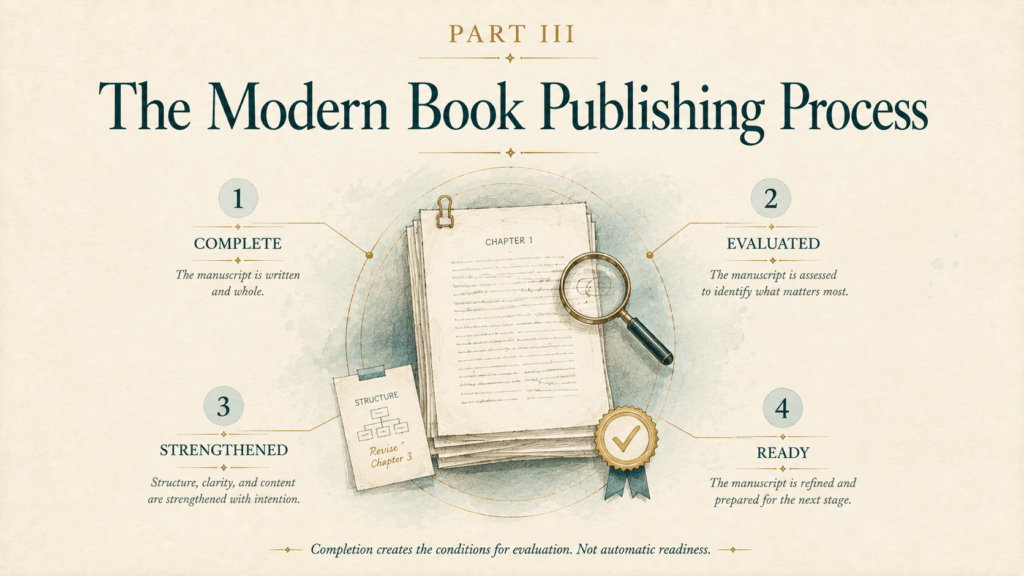
Once the difference between development and production is clear, the publishing process becomes easier to evaluate.
The goal is not to rush a manuscript through a checklist.
It is to move the book through a sequence of decisions that gradually increase confidence in what is being published.
That process begins with a manuscript complete enough to be examined as a whole.
Stage One: Complete the Manuscript
A manuscript is complete when enough of the intended book exists to evaluate its full logic, structure, and reader experience.
That does not mean every sentence is final.
It does not mean the book is polished.
And it certainly does not mean it is ready for production.
It means the manuscript has reached a point where the book can be assessed as a complete intellectual experience rather than as a collection of unfinished parts.
At minimum, that requires enough material to evaluate:
- The central argument — what the book is ultimately trying to establish.
- The chapter progression — whether the sequence of ideas builds logically.
- The major examples — whether the evidence and stories support the argument.
- The reader journey — whether the reader can follow the movement from problem to understanding.
- The intended outcome — whether the manuscript appears capable of delivering the change, insight, or result it promises.
This is the first real threshold in the modern book publishing process.
Before this point, feedback often remains too local.
A chapter can be improved.
A paragraph can be rewritten.
An example can be sharpened.
But the book itself is still difficult to judge because the full system is not yet visible.
Once the manuscript is substantially complete, different questions become possible.
Does the argument hold together across chapters?
Does the middle support the ending?
Do examples reinforce the same promise?
Does the reader experience accumulate toward the intended outcome?
Those are whole-book questions.
And they require a whole-enough manuscript.
Complete Enough to Evaluate Is Not Ready to Publish
This distinction is easy to miss.
A manuscript can be complete enough to evaluate while still being far from publication-ready.
That is not a contradiction.
It is the point.
Completion creates the conditions for development.
It gives the author and editorial team something stable enough to examine, test, and strengthen.
The goal of Stage One is therefore not perfection.
It is evaluability.
The manuscript should be complete enough that the book can finally be judged on what it actually is, not on what the author still intends to add later.
That is when meaningful development can begin.
Complete enough to evaluate does not mean ready to publish.
Stage Two: Evaluate Editorial Readiness
Once the manuscript is complete enough to evaluate as a whole, the next step should not be production.
It should be diagnosis.
Editorial readiness is the process of identifying what must become stronger before the manuscript can credibly function as the finished book.
The goal is not to start revising everything at once.
It is to understand the manuscript first.
A useful evaluation should look across the entire book and ask where the experience is already working, where it is fragile, and where unresolved issues could weaken the final result.
That means examining several dimensions at once:
- Structure — Do the chapters build in a logical order, or does the book feel assembled rather than designed?
- Audience — Is the manuscript written for a clearly defined reader, with the right level of context, examples, and explanation?
- Argument — Are the central claims clear, coherent, and sufficiently supported?
- Positioning — Does the way the book is described match what the manuscript actually delivers?
- Reader transformation — Is there a clear change in understanding, capability, or perspective by the end of the book?
- Progression — Does each section move the reader forward, or do ideas repeat without adding new value?
- Major gaps — Is anything essential missing, underdeveloped, or assumed rather than explained?
The point of this evaluation is not to create a list of flaws.
It is to create a hierarchy of what matters most.
A manuscript may contain hundreds of sentences that could be improved, but only a few issues may determine whether the book truly works.
A weak chapter sequence is more consequential than a clumsy sentence.
An unclear promise is more consequential than a minor wording problem.
A missing explanation that breaks the reader’s understanding is more consequential than surface polish.
Editorial readiness helps distinguish those priorities.
Diagnosis Before Revision
This is why development should begin with evaluation rather than immediate editing.
Without diagnosis, authors can spend significant time improving pages that may later be moved, rewritten, or removed.
With diagnosis, the work becomes more focused.
The manuscript can be strengthened in the order that creates the greatest improvement to the book as a whole.
The core question for Stage Two is:
What must become stronger before this manuscript can represent the finished book?
Until that question has been answered clearly, production is premature.
Stage Three: Structural Development, Strengthen the Manuscript
Editorial evaluation identifies what is preventing the manuscript from working at its strongest.
Structural development is where those findings are turned into focused changes to the book.
The goal is not broad revision for its own sake.
It is to strengthen the parts of the manuscript that most affect the argument, progression, and reader experience.
That usually means prioritizing a small number of high-leverage issues rather than treating every page as equally important.
Structural development may focus on:
- Organization — making sure ideas appear in the right place and in the right order.
- Clarity — strengthening explanations so readers can follow the author’s reasoning without unnecessary effort.
- Evidence — supporting important claims with sufficient proof, context, or examples.
- Progression — ensuring each chapter advances the reader rather than repeating what has already been established.
- Examples — choosing stories, cases, and illustrations that genuinely clarify the argument.
- Reader experience — reducing friction, confusion, and unnecessary cognitive load.
- Argument strength — tightening the logic so the book’s central claims feel earned rather than asserted.
The important question is not:
What kind of editing does this manuscript need?
It is:
What specifically must become stronger for this book to work?
That distinction keeps structural development focused on the manuscript’s needs rather than editorial labels.
A weak middle may require chapters to be reorganized.
A strong argument with thin support may require better evidence.
A clear thesis buried beneath repetitive explanation may require compression.
A sophisticated idea written for readers without the necessary context may require stronger framing.
Different problems require different interventions.
Structural development should respond to the problem the manuscript actually has.
Strengthen the Book in Order of Consequence
Not every weakness deserves equal attention.
A useful way to prioritize structural development is to work from the issues with the greatest consequences for the book as a whole:
- Book-level problems first. Resolve issues with the central argument, overall structure, promise, and reader progression.
- Chapter-level problems next. Strengthen sequencing, explanations, evidence, examples, and transitions within the larger structure.
- Local improvements last. Refine smaller passages and details once the larger architecture is stable.
This order matters.
A structural change can affect several chapters at once. A weak argument can undermine the book’s central promise. A confusing example may affect only a page.
Improving smaller details before resolving larger structural problems can create unnecessary work because later changes may undo earlier polishing.
Structural development moves in the opposite direction:
Strengthen the architecture first. Then strengthen what sits inside it.
The purpose of Stage Three is not to make the manuscript perfect.
It is to make the book materially stronger in the places that determine whether it works.
Editorial evaluation identifies the weaknesses.
Structural development changes them.
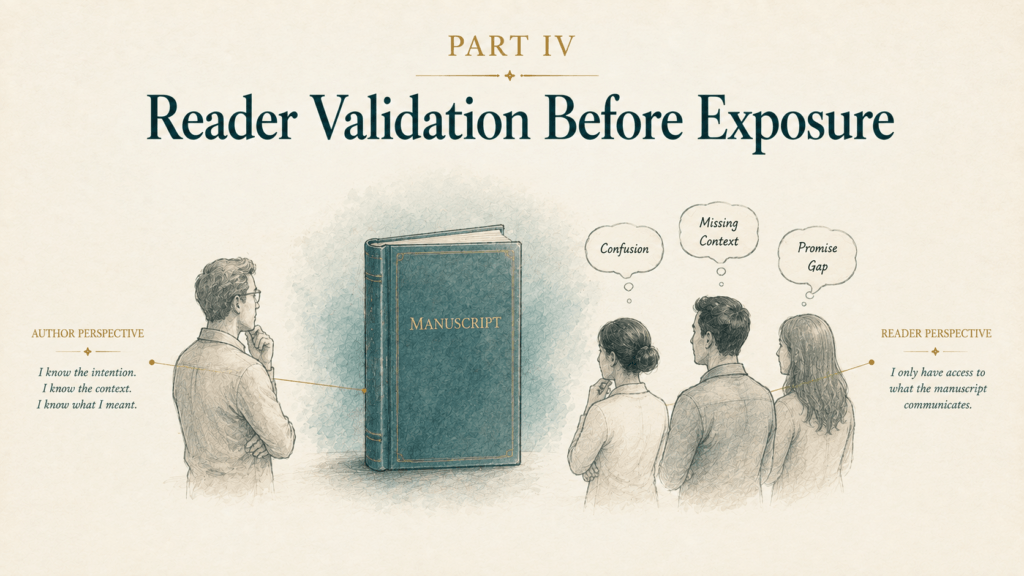
Part IV — Reader Validation Before Exposure
A manuscript can be editorially stronger and still contain problems the author cannot see from inside the work.
That is because authors read with knowledge readers do not have.
They know the intended meaning.
They know the backstory behind an example.
They know why one chapter connects to the next.
They know what a term is supposed to mean.
Readers know none of that unless the manuscript makes it clear.
That difference is why publication readiness cannot be established by internal judgment alone.
Authors Cannot Fully Simulate the Reader Experience
The closer you are to a manuscript, the harder it becomes to experience it the way a reader will.
Authors carry context automatically.
Readers do not.
An author may read a paragraph and understand it immediately because they already know the argument behind it.
A reader encounters only the words on the page.
An author may see why an example matters because they remember the conversation, event, or idea that inspired it.
A reader sees only the explanation that was actually included.
An author may move between chapters without difficulty because the connection feels obvious.
A reader may experience a gap.
This is not a failure of expertise.
It is a limitation of perspective.
The author knows:
- what they intended to communicate
- what specialized terminology means
- why an example was chosen
- how one idea connects to another
The reader knows only what the manuscript successfully communicates.
That gap matters because intention is invisible.
Readers cannot give the author credit for clarity that exists only in the author’s mind.
They cannot infer missing context reliably.
They cannot know which interpretation is the “right” one unless the manuscript makes it clear.
Understanding Must Be Visible on the Page
This is why a manuscript can feel perfectly clear to the person who wrote it and still create friction for someone encountering the ideas for the first time.
The author experiences both the manuscript and the knowledge behind it.
The reader experiences only the manuscript.
Publication readiness therefore requires more than asking:
Do we understand what this section means?
It requires asking:
Can the intended reader understand what this section means without access to everything we already know?
That is a much higher standard.
And it is the standard that matters.
Because once the book is published, readers will not have access to the author’s intentions.
They will only have the book.
Intent cannot substitute for reader understanding.
Stage Four: Validate With Representative Readers
Once the manuscript has been strengthened internally, the next question is whether the intended reader experiences it the way the author expects.
That requires outside evidence.
A representative reader is someone who reasonably resembles the audience the book is designed to serve.
Their role is not to judge whether they personally like the book.
It is to reveal where the manuscript creates friction.
That distinction matters.
Reader validation is not a popularity test.
It is a way to learn whether the book is understandable, coherent, and aligned with its promise before publication.
What Representative Readers Can Reveal
Because readers do not share the author’s internal context, they often expose problems that remain difficult to detect from inside the manuscript.
Validation can reveal:
- Confusion — places where the argument becomes difficult to follow.
- Weak explanations — ideas that make sense to the author but are not sufficiently developed on the page.
- Unclear terminology — words or concepts that require more definition than the author assumed.
- Missing context — background information the reader needs but the manuscript does not provide.
- Repetition — ideas that feel necessary to the author but redundant to the reader.
- Promise gaps — places where the reading experience does not match what the book appears to offer.
- Structural friction — chapters or sections that interrupt momentum, arrive too early, or feel disconnected from what came before.
These signals are valuable because they convert assumptions about the reader experience into observable evidence.
An author may believe a concept is clear.
A representative reader can show whether it actually is.
An editor may believe the sequence works.
A reader can reveal where the progression breaks down.
A positioning statement may sound accurate internally.
A reader can show whether the manuscript delivers the experience that statement implies.
Validation Is a Development Activity
This kind of reader involvement should not be confused with audience building.
It is not about growing a platform.
It is not about creating launch momentum.
It is not about collecting endorsements or marketing reactions.
It is manuscript validation.
The purpose is to improve the book before it becomes fixed in production.
That means the most useful readers are not necessarily the most enthusiastic ones.
They are the ones whose experience can help answer a more practical question:
Where does this manuscript make the reader work harder than it should?
Those points of friction become evidence for further development.
The author and editorial team still decide what to change.
But representative readers provide something the internal team cannot fully generate on its own:
the experience of encountering the book without prior knowledge of what it was supposed to mean.
That is why reader validation belongs before publication.
It gives the manuscript a chance to learn from real reader experience before the market becomes the place where those problems are discovered.
Feedback Is Evidence, Not Instruction
Reader validation becomes useful when authors understand what feedback can, and cannot, tell them.
Feedback is valuable because it reveals where the reading experience is breaking down.
It does not automatically reveal why the problem exists.
And it does not automatically prescribe the correct fix.
That distinction protects the book from becoming a collection of reactions.
Look for Patterns, Not Preferences
A single reader may dislike an example.
Another may want more detail.
Another may prefer a different chapter order.
Those responses can be interesting, but they are not all equally useful.
The strongest signals are usually recurring ones.
Pay attention when:
- Several readers misunderstand the same idea.
- Readers consistently lose the argument at the same point.
- The same terminology repeatedly requires explanation.
- Readers expect an answer the manuscript never clearly provides.
- The promise readers perceive differs from the promise the author intended.
Those patterns suggest friction in the manuscript.
They tell you that something is not working as consistently as it should.
Readers Identify the Friction
What readers are best positioned to report is their experience.
They can tell you:
- where they became confused
- where they stopped following the logic
- where an explanation felt incomplete
- where the book seemed repetitive
- where expectations were not met
That evidence is extremely valuable because it comes from outside the author’s internal understanding of the material.
But the reader’s proposed solution may not be the right one.
A reader who says, “This chapter should be shorter,” may actually be responding to repetition.
A reader who says, “You need another example here,” may actually be missing context.
A reader who says, “This concept does not belong,” may be reacting to poor sequencing rather than the concept itself.
The feedback identifies the symptom.
Editorial judgment determines the cause.
Do Not Revise by Committee
A manuscript becomes weaker when every individual suggestion is treated as an instruction.
Different readers will often recommend contradictory changes.
One wants more detail.
Another wants less.
One wants a concept introduced earlier.
Another wants it removed entirely.
Trying to satisfy every response produces inconsistency rather than clarity.
The author’s job is not to obey the feedback.
It is to interpret it.
The editorial team’s job is to determine whether the issue is real, how significant it is, and what change, if any, best resolves it without weakening the book’s larger argument.
That preserves the author’s intellectual ownership while still allowing the manuscript to learn from reader evidence.
The principle is simple:
Readers reveal friction.
The author and editorial team determine the solution.
Part V — Refinement and Positioning
Reader validation has value only if the manuscript learns from it.
Once patterns of confusion, friction, or misalignment become visible, the next step is not to collect more reactions for their own sake.
It is to decide which signals matter and use them to improve the book.
This is where validation becomes development.
Stage Five: Refine What Validation Revealed
Reader validation produces evidence.
Refinement is the process of deciding how much the manuscript should change in response to that evidence.
That distinction matters because not every problem revealed by readers deserves the same kind of revision.
Some issues are local.
Others expose weaknesses that reach across a chapter, or the entire book.
The purpose of refinement is not to reopen everything.
It is to make the smallest sufficient change that resolves the underlying problem.
Match the Scale of the Change to the Scale of the Problem
A useful refinement process begins by determining how consequential the problem actually is.
Reader evidence may point to three different levels of change:
- Local refinement
The underlying idea works, but a specific passage needs improvement. A definition may need clarification, a transition may need strengthening, or unnecessary repetition may need to be removed. - Section or chapter refinement
The problem affects a larger portion of the reader experience. A section may need to move, an example may need to be replaced, supporting evidence may need to be strengthened, or a chapter may need to be reorganized. - Book-level refinement
The evidence reveals a problem with the larger architecture of the manuscript. The progression may need reconsideration, an important idea may be underdeveloped across several chapters, or the manuscript may not fully support the outcome it is intended to deliver.
The principle is simple:
The scale of the change should match the scale of the problem.
A local problem should not trigger an unnecessary rewrite of an entire chapter.
But a book-level problem should not be patched with a few sentence-level changes simply because those changes are easier to make.
Good refinement is proportional.
Revise the Cause, Not Just the Symptom
Reader evidence shows where the experience is not working as intended.
Refinement requires determining what in the manuscript is actually causing that problem.
That is why the first response to feedback should not always be to edit the exact passage a reader identified.
The underlying cause may sit somewhere else.
A problem that appears in one chapter may have been created because an idea was insufficiently established earlier. A section that feels unnecessarily long may not need better prose; it may contain material that no longer serves the book’s progression. A weak conclusion may reflect a larger argument that was never sufficiently developed.
The purpose of refinement is therefore not simply to make the criticized passage better.
It is to make the right part of the manuscript better.
Change the Manuscript, Not Just the Feedback File
It is easy for reader validation to become a research exercise.
Comments are collected.
Patterns are summarized.
Observations are discussed.
But unless those findings result in deliberate decisions about the manuscript, the book itself has not improved.
The value of validation appears in what happens next:
Evidence → Diagnosis → Proportional Revision
Sometimes the right response is one sentence of additional context.
Sometimes it is a rewritten section.
Sometimes a chapter needs to move.
Sometimes the evidence justifies a more substantial structural change.
And sometimes the correct editorial decision is to make no change at all because the feedback reflects an individual preference rather than a meaningful weakness.
Refinement does not mean revising more.
It means revising in proportion to what the evidence actually revealed.
That is what turns reader evidence into a stronger manuscript.
Validation without refinement is observation.
Development requires proportional iteration.
Positioning Must Match the Book That Actually Exists
Positioning is often treated as a marketing decision.
But for a serious nonfiction book, positioning is also a development decision.
It determines how the book is described, who it is for, what it promises, and how readers are expected to understand its value.
Those decisions should be based on the manuscript that now exists, not the book the author originally imagined before development began.
That distinction matters because manuscripts change.
Arguments become sharper.
Audiences become more specific.
Examples reveal where the book is strongest.
Reader feedback exposes where the promise is too broad or too vague.
By the time substantial development is complete, the most accurate positioning may be different from where the project started.
Position the Book You Actually Built
At this stage, positioning should bring several elements into alignment:
- Audience — Who is this book genuinely best suited to serve?
- Promise — What meaningful outcome or understanding does the book actually deliver?
- Title direction — Does the title signal the right problem, idea, or transformation?
- Messaging — Does the way the book is described reflect its strongest and most distinctive value?
- Differentiation — What does this book contribute that feels meaningfully different from adjacent books or ideas?
- Chapter alignment — Do the chapters collectively support the promise being made?
These are not cosmetic decisions.
They shape how the book will be understood before a reader opens it.
If the positioning overstates what the manuscript delivers, the reader begins with the wrong expectation.
If it undersells the strongest idea, the book may appear less distinctive than it really is.
If the stated audience is too broad, the manuscript may feel inconsistently targeted.
Strong positioning reduces those mismatches.
Positioning Should Follow Evidence
The goal is not to make the book sound more impressive.
It is to describe it more accurately.
That means positioning should respond to what the development process has revealed.
If representative readers consistently respond most strongly to one central idea, that may deserve more emphasis.
If the manuscript works best for a narrower audience than originally planned, the positioning should reflect that.
If the title points toward one promise while the chapters deliver another, the title direction should change.
The book should not be forced to fit an earlier positioning decision simply because that decision was made first.
The manuscript is now the source of truth.
The question is:
Does the way we describe this book accurately match the experience the manuscript delivers?
If the answer is no, the positioning is not finished.
Because positioning should not create a promise the manuscript cannot support.
It should make the book’s strongest value easier to recognize.
Promise Gaps Are Development Problems
A book makes a promise before the reader finishes the first chapter.
That promise may come from the title, subtitle, introduction, positioning, audience, or the problem the book claims it will help solve.
A promise gap appears when that expectation is stronger, broader, or different from what the manuscript actually delivers.
This is not primarily a marketing problem.
It is a development problem.
If the book promises one experience and provides another, stronger positioning cannot solve the mismatch.
The manuscript and the promise have to come back into alignment.
Where Promise Gaps Usually Appear
Promise gaps often become visible in a few predictable places:
- The title promises more specificity than the manuscript provides. The book sounds highly focused, but the content remains broad or general.
- The intended audience is broader than the examples support. The book claims relevance for several kinds of readers, while most of the evidence speaks to only one.
- The introduction promises a transformation the chapters do not complete. The opening establishes a clear destination, but the manuscript never fully gets the reader there.
- The positioning emphasizes an idea that is secondary in the manuscript. The book is described around one concept even though another idea carries most of the intellectual weight.
- The chapters work individually but do not accumulate toward the promised outcome. Each chapter may be useful on its own, yet the book as a whole does not produce the progression readers were led to expect.
These gaps are easy to miss because both sides can appear strong independently.
The positioning may sound compelling.
The manuscript may contain valuable ideas.
The problem is the relationship between them.
Resolve the Gap, Do Not Hide It
When a promise gap appears, there are two legitimate responses.
Strengthen the manuscript so it earns the promise.
Or adjust the promise so it accurately reflects the manuscript.
What should not happen is using sharper messaging to disguise the difference.
If the title promises a highly specific outcome, the book needs to deliver that specificity.
If the manuscript’s strongest value is narrower than originally intended, the positioning should become narrower too.
If the central idea changed during development, the description of the book should change with it.
This is why positioning belongs inside development rather than outside it.
It forces the author and editorial team to test whether the book being described is the same book readers will actually encounter.
The core question is simple:
Does the promise accurately describe the value the manuscript now delivers?
If not, the book is not yet aligned.
And alignment is part of readiness.
Positioning should not disguise the manuscript.
It should accurately reveal its strongest value.
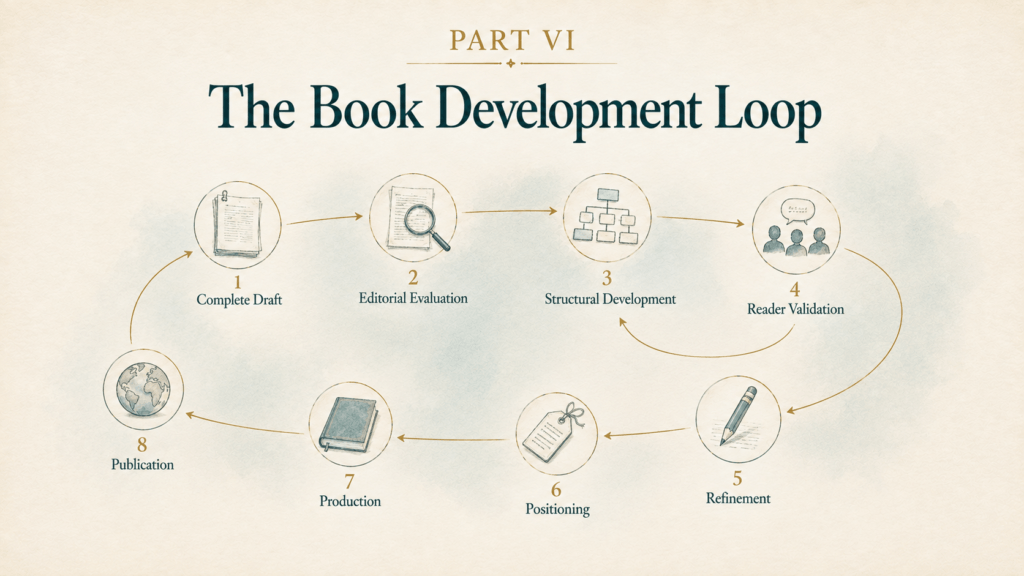
Part VI — The Book Development Loop
By this point, the development work can be viewed as one connected system rather than a series of separate editorial tasks.
Each stage has a different function, but they all serve the same purpose:
Reduce uncertainty before the book is exposed to the market.
That is what the Book Development Loop is designed to make visible.
Visual System Anchor — The Book Development Loop
The Book Development Loop is the complete path a manuscript moves through as it becomes publication-ready.
It begins with a complete draft and ends with publication, but the important work happens in the middle.
| Stage | What It Must Resolve |
| Complete Draft | Is there enough of the intended book to evaluate it as a whole? |
| Editorial Evaluation | What is structurally, intellectually, or experientially weak? |
| Structural Development | What must be reorganized, clarified, strengthened, or supported? |
| Reader Validation | Where does the intended reader experience confusion, friction, or mismatch? |
| Refinement | What should change in response to what the evidence revealed? |
| Positioning | Does the way the book is described accurately match what it now delivers? |
| Production | Is the developed book ready to be converted into final formats? |
| Publication | Is this the version the author is prepared to put into the world? |
The framework is not valuable because it adds more stages.
It is valuable because it changes what each stage is expected to prove.
A complete draft proves that the book exists.
Editorial evaluation reveals what needs attention.
Structural development strengthens the manuscript.
Reader validation tests whether those improvements work outside the author’s perspective.
Refinement responds to what was learned.
Positioning ensures the promise and manuscript are aligned.
Only then does production prepare the book for release.
The logic can be summarized as:
Complete Draft → Editorial Evaluation → Structural Development → Reader Validation → Refinement → Positioning → Production → Publication
Every Stage Should Reduce Uncertainty
The Book Development Loop is ultimately a decision system.
At each stage, the book should become easier to trust.
The major questions should become clearer:
- Does the reader understand it?
- Does the structure work?
- Does the promise match the experience?
- Is the positioning clear?
- Is the manuscript ready to represent the author?
Those questions are more important than whether a particular task has been checked off.
A manuscript should not move forward simply because a stage has been completed administratively.
It should move forward because the uncertainty that stage was designed to resolve has been meaningfully reduced.
That is what makes the framework different from a generic publishing checklist.
The sequence is not:
Do the work → move on.
It is:
Learn → strengthen → test → decide whether the book has earned the next stage.
And the governing principle remains constant throughout the entire loop:
Every stage should reduce uncertainty before exposure.
Development Is Iterative, Not Perfectly Linear
The Book Development Loop should not be read as a rigid sequence in which each stage is completed once and never revisited.
Development is more responsive than that.
New evidence can change what the manuscript needs.
A structural revision may improve the argument but expose a new gap in context.
Reader validation may show that a chapter is technically clear but still appears too early.
Positioning work may reveal that the strongest promise is not fully supported by the current manuscript.
When that happens, the correct response is not to keep moving forward simply because the previous stage was already “completed.”
It is to return to the part of the manuscript that now requires attention.
The Loop Responds to Evidence
A typical movement may look like this:
Evaluation → Development → Validation → New Evidence → Targeted Refinement → Revalidation
The important word is targeted.
Iteration should not mean reopening the entire manuscript every time new information appears.
It means identifying the specific uncertainty that remains and addressing the part of the book most responsible for it.
If several readers misunderstand one concept, the manuscript may need a clearer explanation.
If the revised chapter sequence creates a new transition problem, the structure may need another adjustment.
If refinement substantially changes the promise, the positioning may need to be checked again.
The process moves backward only when new evidence justifies it.
Iteration Is Different From Endless Revision
This distinction matters because development can easily be misunderstood as an invitation to keep improving forever.
That is not the goal.
A manuscript will never be free from every possible criticism, preference, or alternative interpretation.
Publication readiness does not require perfection.
It requires that the major uncertainties have been resolved well enough to move forward with confidence.
The question after each meaningful change is therefore not:
Can we make this even better?
It is:
Did this change resolve the problem we were trying to solve?
If the answer is yes, continue.
If the answer is unclear, revalidate where necessary.
If the evidence shows the problem remains, refine again.
That is what makes the Book Development Loop a loop rather than a checklist.
The process is allowed to respond to what it learns.
But it should always be moving toward a decision.
The goal is not endless revision.
The goal is informed iteration until the major uncertainties have been resolved.
Part VII — Production Should Be an Outcome of Readiness
Production is where the book begins to take its final public form.
But that transition should happen only after the manuscript’s major developmental questions have been resolved.
Up to this point, the work has been about improving the book itself.
Production begins when the focus shifts from:
What still needs to change?
to:
How should the finished book be prepared for readers?
That change in purpose is the threshold.
Stage Six: Prepare for Production
Production is the stage where a publication-ready manuscript is converted into its final physical and digital forms.
This is where the work moves into:
- Design
- Formatting
- Metadata
- Printing
- Distribution preparation
These activities do not determine what the book should become.
They formalize decisions that development has already resolved.
By the time production begins, the manuscript should be stable enough that the team is no longer making fundamental decisions about its structure, argument, reader experience, promise, or positioning.
That is the threshold between development and production.
Production Locks In Decisions Development Has Earned
Every major production asset depends on decisions made earlier.
The interior depends on a stable manuscript and chapter structure.
The cover depends on a sufficiently settled title, promise, and positioning.
Metadata depends on a clear understanding of the book, its audience, and how it should be described.
Print and digital files depend on content that is no longer undergoing substantial development.
Production therefore acts as a commitment point.
It takes decisions that were previously flexible and begins turning them into finished assets.
That is why readiness matters.
Production should not be used to create a sense of finality around a manuscript that still contains unresolved developmental questions. Its role is to formalize a book whose major decisions have already been made and earned.
The transition can be expressed simply:
Development resolves the major decisions.
Production locks them in.
A book should move into production when the remaining changes are refinements that do not threaten the integrity of those decisions.
That is the core principle:
Production should lock in decisions that development has already earned.
Stage Seven: Publish
Publication is the culmination of readiness.
By this stage, the major developmental questions have been resolved and the book has been prepared for release. Publication is no longer being used to discover whether the book works.
It is the point at which a book that has already earned readiness becomes available to readers.
A common publishing sequence assumes:
Finish → Produce → Publish → Learn
A development-first process moves the consequential learning earlier:
Finish → Evaluate → Develop → Validate → Refine → Position → Produce → Publish
That distinction changes the role of publication.
The book does not enter the market so the author can discover whether its structure, argument, reader experience, or positioning works. Those questions have already been addressed to the standard required to move forward.
Publication therefore has a narrower, and clearer, purpose:
Release the book that development and production have prepared for readers.
Publication is not another development stage.
It is the culmination of the work that established readiness.
Part VIII — What Happens When Development Is Skipped
Development preserves options.
Production starts turning those options into commitments.
That difference is easy to underestimate.
Before production, a chapter can still move. An explanation can still be rebuilt. Positioning can still change. A promise can still be narrowed. A weak example can still be replaced without creating downstream work.
Once the book enters production, those same decisions begin affecting formatted files, cover language, metadata, proofs, and distribution assets.
That is why unresolved development problems become more expensive the longer they survive.
Publishing Too Soon Makes Problems Expensive
Publishing too soon does not necessarily create new problems.
More often, it makes existing problems harder to fix.
A structural weakness that was flexible in manuscript form becomes more disruptive once the interior has been formatted.
An unclear explanation that could have been rewritten easily becomes part of a proof that now requires another production pass.
A positioning problem can affect the title, subtitle, cover copy, metadata, and description of the book at the same time.
The issue is not simply cost in dollars.
It is the cost of reversing decisions after other work has already been built around them.
Problems Compound After Production Begins
The kinds of issues that become more difficult after production include:
- Structural weaknesses — because changing chapter order or scope can affect pagination, references, and the interior layout.
- Unclear explanations — because substantive rewrites can disturb already-formatted pages.
- Inconsistent terminology — because corrections may need to be tracked across the manuscript and production files.
- Promise gaps — because the mismatch may already be reflected in the title, subtitle, cover, or book description.
- Positioning problems — because metadata and external messaging may have been built around assumptions that no longer hold.
- Reader confusion — because the problem is being discovered after the book has already been exposed.
- Weak examples — because replacing them can create ripple effects across surrounding sections.
- Unnecessary repetition — because cutting material late can affect layout and page structure.
None of these problems are impossible to fix after production begins.
They are simply more expensive to change because more decisions now depend on them.
Development Keeps Important Decisions Reversible
This is one of the practical reasons development belongs before production.
A manuscript should remain flexible while the major intellectual and reader-facing questions are still being resolved.
Flexibility makes learning cheaper.
If reader feedback reveals that a section is confusing, the manuscript can change.
If the argument needs a stronger example, it can be replaced.
If the promise is too broad, positioning can be corrected before it becomes embedded across the finished book.
Production changes the nature of those decisions.
What was once a manuscript revision becomes a production revision.
What was once one change may now require several coordinated changes.
That is the real cost of publishing too soon.
Not that the book can never be corrected.
But that problems which should have been inexpensive to solve during development become harder, slower, and more disruptive once the book is already being built for release.
Production can lock in decisions that should have remained flexible during development.
A Polished Book Can Still Be Underdeveloped
A book can look finished long before it is actually ready.
That is one of the risks of production.
Design, formatting, and clean prose create visible signals of professionalism. Once those elements are in place, the book begins to feel complete.
But presentation and development answer different questions.
Production asks:
Does this look and function like a finished book?
Development asks:
Does this work like a finished book?
Those are not the same standard.
A book can be:
- beautifully designed
- grammatically clean
- professionally formatted
- available in print and digital formats
and still contain:
- structural problems
- weak or insufficiently supported arguments
- unclear positioning
- unnecessary reader friction
None of those weaknesses disappears because the typography is strong or the cover looks credible.
Surface Quality Can Hide Deeper Problems
Production improves how the book is presented.
It does not determine whether the underlying ideas are organized well.
A professionally formatted chapter can still arrive in the wrong place.
A copy-polished paragraph can still make a weak argument.
A strong cover can still communicate a promise the manuscript does not fully deliver.
A clean interior can still ask the reader to work too hard to understand how the ideas connect.
This is why visible professionalism can become misleading.
The book looks resolved.
The deeper questions may not be.
Judge the Book Beneath the Presentation
Before treating polish as proof of readiness, separate the artifact from the intellectual experience inside it.
Ask whether the book still works when the production layer is mentally removed.
Does the structure hold?
Does the argument earn its conclusions?
Does the positioning accurately represent the manuscript?
Can readers follow the progression without unnecessary friction?
If those questions remain unresolved, improving the presentation does not solve the underlying problem.
It may simply make the problem look more finished.
For a serious nonfiction book, production quality matters.
But it matters after the book itself has earned that level of presentation.
Production quality cannot compensate for development problems.
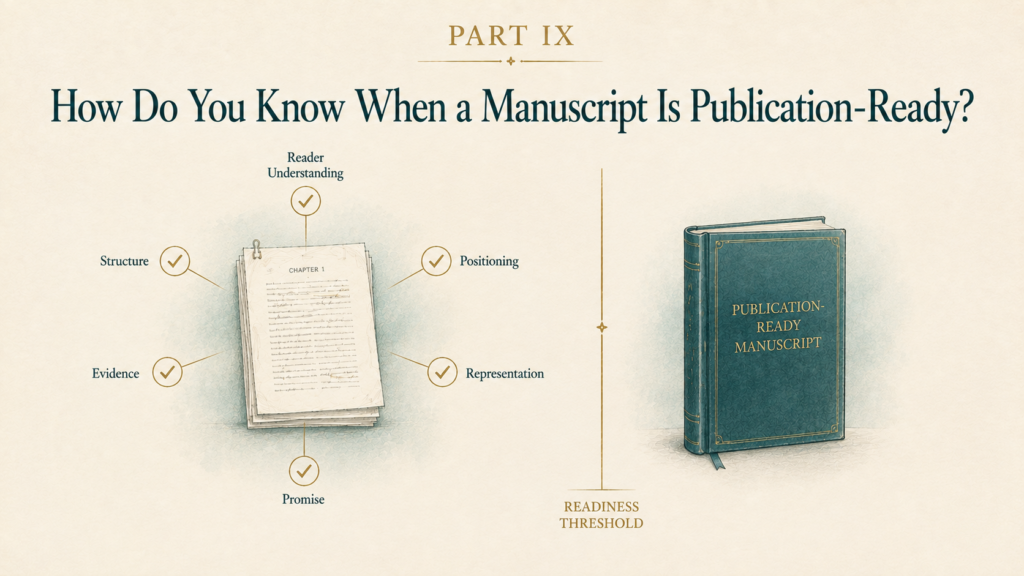
Part IX — How Do You Know When a Manuscript Is Publication-Ready?
At some point, development has to produce a decision.
Not a feeling that the author is tired of revising.
Not a sense that the manuscript has been “worked on enough.”
A decision that the book has reached a standard strong enough to move forward.
That is what publication readiness is.
It is not the absence of every possible improvement.
It is the point at which the major questions about the book have been resolved well enough that publication no longer depends on hope.
Readiness Is a Standard, Not a Feeling
A manuscript can feel finished for many reasons.
The author may have reached the end of the draft.
The editorial process may have taken months.
The team may be eager to move into design and production.
The book may already look substantially better than where it started.
None of those conditions, by themselves, establish readiness.
Publication readiness is the point at which the book meets clear editorial and reader-facing standards strongly enough to represent the author in public.
That standard should be observable.
Structure
The chapters build logically toward the intended outcome.
The reader should be able to understand why one section follows another and how the book accumulates toward its central purpose.
A manuscript is not structurally ready merely because every chapter is individually strong.
The whole book has to work.
Argument
Important claims are clear and sufficiently supported.
The book should not depend on authority of tone alone.
Its major ideas need enough explanation, reasoning, evidence, or illustration to earn the conclusions the author asks the reader to accept.
Reader Understanding
Representative readers can follow the ideas without unnecessary friction.
That does not mean every reader will agree with the book or interpret every sentence identically.
It means the intended reader can understand the argument, terminology, progression, and intended meaning without repeatedly compensating for gaps the manuscript should have resolved.
Promise
The book delivers what its positioning promises.
If the title, subtitle, introduction, or description creates an expectation, the manuscript must fulfill it.
A book is not ready when the promise is stronger than the experience.
Examples
Stories and evidence strengthen the argument rather than interrupt it.
Examples should clarify, substantiate, or deepen the ideas they support.
They should not simply make the manuscript longer or more interesting.
The question is whether each example helps the reader understand why the argument matters and how it works.
Positioning
The audience, message, and manuscript align.
The way the book is described should accurately reflect the book that now exists, not an earlier concept, a broader ambition, or a more marketable version of the idea.
Readers should receive the book they were led to expect.
Representation
The author is comfortable having the book represent their thinking publicly.
This final standard matters especially for a Modern Author.
A serious nonfiction book may be read by clients, colleagues, employees, investors, partners, conference organizers, journalists, or future collaborators.
The readiness question therefore extends beyond:
Is this good enough to publish?
It becomes:
Is this the version of my thinking I am prepared to have people encounter without me in the room to explain it?
That is a much stronger standard.
Publication readiness is not perfection.
It is sufficient resolution across the areas that determine whether the book works.
The structure holds.
The argument is supported.
Readers can follow it.
The promise is fulfilled.
The examples earn their place.
The positioning matches the manuscript.
And the author is prepared to let the book represent them.
When those conditions are true, readiness is no longer merely a feeling.
It is a standard the book has earned.
The Publication-Readiness Test
At some point, development has to produce a decision.
The question is not whether every possible improvement has been made. There will almost always be another sentence to sharpen, another example to consider, or another small refinement available.
The question is whether any unresolved uncertainty is still significant enough to keep the book in development.
Use six questions to make that decision:
- Does the reader understand it?
- Does the structure work?
- Does the evidence support the argument?
- Does the experience fulfill the promise?
- Does the positioning match the manuscript?
- Is this the version I want representing my expertise?
These questions are not a checklist where every concern carries equal weight.
They are a way to locate the uncertainties that still matter.
Judge the Weight of What Remains
A publication-ready manuscript does not need to be impossible to improve.
It needs to be free of unresolved issues significant enough to compromise the book.
That means distinguishing between refinement and development.
A sentence that could be clearer is a refinement.
A central concept that representative readers repeatedly misunderstand is a development issue.
An example that could be stronger is a refinement.
An important argument that still lacks sufficient support is a development issue.
A title that could be marginally sharper is a refinement.
Positioning that promises an experience the manuscript does not deliver is a development issue.
The number of possible improvements is therefore the wrong measure of readiness.
A manuscript could have twenty small refinements available and still be ready for production. It could have only one unresolved problem and still need another development cycle if that problem affects the structure, argument, promise, reader experience, positioning, or the author’s representation.
Readiness depends on the weight of the unresolved uncertainty, not the number of possible improvements.
The Decision
If an unresolved issue could materially weaken the book or change what the reader is being asked to trust:
Develop.
Resolve it while the manuscript is still flexible.
If the major uncertainties have been resolved and what remains would improve the book without fundamentally changing its integrity:
Produce.
That is the publication-readiness threshold.
Not perfect.
Not finished because the calendar says so.
Ready because the uncertainties that still remain no longer belong to development.
Why Great Publishing Creates a Flywheel
A strong publishing process does more than improve the manuscript.
It also produces better information for the decisions that follow.
When development is rigorous, reader feedback becomes more useful, positioning becomes more precise, and the response to the finished book provides clearer evidence about how the ideas are being understood.
The sequence looks like this:
Better Editorial Development
↓
Better Reader Feedback
↓
Stronger Manuscript
↓
Clearer Positioning
↓
Better Reader Response
↓
More Meaningful Insights
↓
Continuous Improvement
The value of this flywheel is the quality of information it creates.
A stronger manuscript produces more specific reader feedback. Clearer positioning makes reader response easier to interpret. Better evidence, in turn, supports better publishing decisions.
That is the reinforcing effect:
Better development produces better evidence. Better evidence improves the decisions that come next.
The Book Development Loop determines how the manuscript becomes publication-ready.
The publishing flywheel simply shows what that disciplined process leaves behind: better information for continuous improvement.
The Manuscript Is Complete. The Book Is Still Being Built.
Finishing a manuscript is a meaningful milestone.
The core argument exists. The chapters are written. The examples, ideas, and intended progression are finally visible as a complete work.
But that milestone answers only one question:
Has the book been written?
It does not answer the more consequential publishing question:
Is this the version of the book that should enter the world?
That is the distinction at the center of the book publishing process.
Manuscript completion is an author milestone. It tells you that the writing phase has produced something complete enough to evaluate as a whole.
Publication readiness is a reader and editorial standard. It tells you whether that manuscript has been developed to the point where it works as the intended book and can represent the author publicly.
Those are different achievements.
The assumption many authors begin with is:
Once my manuscript is finished, it is time to publish.
The stronger publishing model is:
Once my manuscript is finished, it is time to determine whether the book is actually ready, and develop it until it is.
That shift changes what happens after the final chapter is written.
Instead of asking how quickly the manuscript can move into design, formatting, and distribution, the process asks whether the book has earned that transition.
Has the manuscript become the book it was intended to be?
If the answer is not yet clear, the work is not to manufacture the book faster.
It is to keep building the book.
That is why the distinction between writing, development, and production matters:
Writing creates the manuscript.
Development creates readiness.
Production creates the published artifact.
Each stage has its own finish line.
Completing the manuscript ends the writing phase.
Establishing readiness ends the development phase.
Only then should production begin.
A completed manuscript, therefore, is not simply a signal that it is time to publish.
It is the moment when the author finally has enough of the book to ask the question that matters most:
Is this the version we are ready to put into the world?
Related Systems Inside the Manuscripts Ecosystem
This Guide focuses on one specific publishing question:
What should happen after a manuscript is finished but before it moves into production?
More specifically, it explains the development-before-production stage and the threshold a manuscript should meet before production begins.
Other publishing decisions sit around that question. They matter, but they require different frameworks and levels of detail.
The Manuscripts ecosystem separates those decisions so authors and their teams can go deeper where needed without collapsing the entire publishing process into one oversized checklist.
How to Publish a Book Independently
Use this Guide when the primary decision is how the book should be published.
It addresses publishing-path choices and the structure of an author-led publishing process rather than the developmental work required to make a manuscript publication-ready.
Steps for Publishing a Book
Use this resource when the priority is understanding the broader procedural sequence of publishing a book.
It explains how the major stages and decisions fit together as a book moves from manuscript toward publication.
The distinction is important:
Steps for Publishing a Book maps the broader publishing journey.
This Guide goes deeper into one critical part of that journey: what happens between manuscript completion and production, and how to determine when the book has earned readiness to move forward.
How to Build an Audience Before You Write Your Book
Use this Guide when the question shifts from manuscript development to reader and audience development.
Audience building is related to publishing, but it solves a different problem. It helps authors understand and reach the people around the book rather than determine whether the manuscript itself is ready for production.
Editing Guides
Use the Manuscripts editing resources when a specific editorial discipline requires deeper explanation.
Those Guides address the individual forms of editorial work that may sit inside the broader book development process. This Guide stays at the system level: determining what the manuscript needs before it can responsibly move into production.
The Modern Publishing Operating System
The Modern Publishing Operating System is the broader framework in which this development-before-production philosophy sits.
Its role here is contextual. The principle established in this Guide is one part of that larger system:
Do not move a book into production simply because the writing is complete. Move it into production when the book has earned readiness.
FAQs
What is the book publishing process?
The book publishing process turns a completed manuscript into a publication-ready book through editorial evaluation, book development, reader validation, refinement, positioning, production, and distribution. Publishing therefore includes much more than formatting, printing, or making a book available for sale.
What happens after you finish writing a book?
Once the manuscript is complete, the next step should be to evaluate whether the book is actually ready for production. This means identifying structural, argumentative, reader-experience, and positioning issues while the manuscript is still flexible enough to improve.
Is a finished manuscript ready to publish?
Not necessarily. A finished manuscript means the author has completed the writing; a publication-ready book has also been evaluated, strengthened, validated, refined, and aligned with the experience it promises readers.
What is the difference between publishing and printing?
Printing creates physical copies of a book, while publishing encompasses the broader process of developing, preparing, producing, and distributing the book. Printing is therefore one activity within publishing, not the publishing process itself.
Why should authors develop a book before publishing?
Book development helps identify and resolve important weaknesses before they become part of the published book. It allows authors to strengthen the structure, argument, clarity, reader experience, and positioning before production locks those decisions into final formats.
What role does editorial development play in publishing?
Editorial development strengthens the manuscript at the level of structure, argument, clarity, progression, evidence, and reader experience. Its purpose is to resolve substantive problems before the manuscript moves into production.
Why should readers review a manuscript before publication?
Representative readers can reveal confusion, missing context, structural friction, and promise gaps that authors and editorial teams may not see from inside the manuscript. Their feedback provides evidence about the actual reader experience before publication.
What is the difference between a manuscript and a finished book?
A manuscript is the complete written work created by the author. A finished book is a manuscript that has been developed to publication readiness and then prepared through production for distribution to readers.
How do you know when a manuscript is publication-ready?
A manuscript is publication-ready when its major uncertainties have been resolved: readers can understand it, the structure works, the evidence supports the argument, the experience fulfills the promise, the positioning matches the manuscript, and the author is comfortable having it represent their expertise publicly.
Does developing a book before publication make publishing take longer?
Development adds work before production, but its purpose is to resolve consequential problems while they are still easier to change. Addressing structural, reader-experience, or positioning issues before production can prevent more disruptive revisions after formatting, printing, or publication.
Ready to Determine What Your Manuscript Needs Before You Publish It?
Finishing the manuscript is a major milestone. But before committing that manuscript to production, the more important question is whether the book is genuinely ready to represent the author, the ideas, and the intended reader experience.
That is the point where Manuscripts can help.
If the manuscript is complete, the next step is not automatically formatting, design, or distribution. It is determining what still needs to become stronger before those decisions are locked in.
That may mean:
- evaluating the manuscript’s publication readiness
- strengthening structural or argumentative weaknesses
- testing whether representative readers understand the book as intended
- refining the alignment between the manuscript, audience, and promise
- preparing the book deliberately for production once the major uncertainties have been resolved
The goal is not to add unnecessary revision.
It is to make sure the version that reaches publication is the version the author is prepared to have represent their thinking publicly.
Manuscripts can help you evaluate where the book stands, identify what still needs development, and build a deliberate path from completed manuscript to publication-ready book.
If You’re Deciding What to Do Next
If this Guide clarified your thinking, the next step is usually not to move immediately into production.
It is to determine whether your manuscript has actually earned publication readiness.
That means identifying where the book stands now, and what, if anything, still needs to happen before design, formatting, printing, and distribution begin.
Depending on the manuscript, the next step may be to:
- Evaluate whether the structure, argument, reader experience, and positioning are strong enough.
- Develop the areas where meaningful uncertainty still remains.
- Produce the book if the major developmental questions have already been resolved.
The goal is not to add more process.
It is to make sure the next stage is determined by what the book needs, not simply by the fact that the manuscript is finished.
Here are three ways authors typically proceed.
Map Your Modern Author Strategy
If you want to:
- Pressure-test your author model
- Clarify realistic outcomes
- Understand where ROI is likely to show up
- Avoid unnecessary spend
A short strategy conversation can surface issues early, before they become expensive.
👉 Schedule a Modern Author Strategy Session
This is a working session, not a pitch.
Explore the Modern Publishing System
If you’re assessing:
- Whether to publish traditionally, hybrid, or independently
- How to structure presale and early activation
- What support actually reduces risk
You may want a clearer view of how the Modern Publishing System works in practice.
👉 Explore Manuscripts Publishing Services
Study Real Author Outcomes
(For internal validation and stakeholder alignment)
If you’re preparing a recommendation for leadership, concrete examples often help.
👉 See Modern Author Success Stories
About the Author
Eric Koester is an award-winning entrepreneurship professor at Georgetown University, bestselling author, and founder of Manuscripts. His work focuses on how ideas become assets, how books create leverage, and why modern authors need systems, not just publishing support.
He has worked with thousands of authors across traditional, hybrid, and modern publishing paths, helping them turn books into platforms, platforms into credibility, and credibility into durable business outcomes.
About Manuscripts
Manuscripts is the Modern Author OS for nonfiction experts.
We help founders, executives, coaches, and thought leaders design books as strategic assets, not standalone products. Our work spans positioning, author model design, developmental editing, AI-enhanced drafting tools, presale strategy, and long-term launch systems.
Manuscripts authors use their books to generate clients, speaking engagements, training programs, and enterprise opportunities, often before publication.
For readers who want to go deeper into specific mechanics, the following guides expand on topics referenced in this report:
- How to Write a Book if You’re Busy
- Modern Ghostwriting for Nonfiction Authors
- AI Tools for Authors in 2026
- How to Build an Audience Before You Write Your Book
- The Evergreen Launch System for Modern Authors
Powered by Codex, the Modern Author Intelligence Tool.