How Modern Authors Turn Expertise Into Intellectual Property with Strategic Frameworks (2026)
Most Experts Have Knowledge. Few Become Known for an Idea.
Every industry has experts.
People with decades of experience.
Deep technical knowledge.
Proven results.
Yet only a small number become known beyond the work they do.
They become associated with an idea.
This guide begins with a simple observation.
Expertise alone rarely creates lasting authority.
Many professionals assume that recognition naturally follows experience.
Work long enough.
Learn enough.
Write a book.
Eventually, people will recognize your expertise.
But that is rarely how authority develops.
Most experts become known for what they do.
Very few become known for the way they think.
That distinction changes everything.
People rarely remember every insight, story, or chapter from a book.
They remember the idea that reorganized their thinking.
The concept they continue referencing.
The language they adopt.
The framework they begin using to understand future problems.
That is why some books become enduring intellectual assets while others remain valuable but largely forgotten.
The difference is rarely the amount of knowledge they contain.
It is how that knowledge has been organized.
A collection of expertise informs.
A strategic framework gives people a memorable way to think.
Throughout this guide, we will explore why the most valuable asset a Modern Author creates is rarely the manuscript itself.
It is the strategic framework behind the manuscript—the organizing idea that transforms accumulated expertise into intellectual property people can understand, remember, apply, and associate with its creator.
Because in today’s knowledge economy, the professionals who create lasting authority are not simply the ones who know the most.
They are the ones who give the world a new way of thinking.
Why This Matters in an AI-Driven Knowledge Economy
The value of expertise has not disappeared.
But the environment in which expertise competes has fundamentally changed.
For most of history, information was scarce.
Knowledge was difficult to access.
Professionals created value by possessing information that others could not easily find.
Today, that advantage is becoming increasingly temporary.
Search engines can retrieve information in seconds.
AI can summarize research, explain complex concepts, and answer technical questions almost instantly.
Access to knowledge is no longer the primary constraint.
What remains scarce is the ability to organize that knowledge into something people can understand, remember, and continue using.
Information is abundant. Organized thinking is not.
The shift is not that expertise has become less valuable.
It is that expertise alone is no longer enough to create lasting differentiation.
Professionals can no longer compete simply by explaining what they know.
Increasingly, they compete by helping people make sense of what they know.
That requires more than information.
It requires:
- Organization that brings scattered ideas into a coherent whole.
- Language that gives people memorable terms they can easily repeat.
- Mental models that simplify complexity without oversimplifying it.
- Repeatable frameworks that people can apply long after the original explanation.
These are the assets that remain difficult to automate because they represent original thinking rather than accessible information.
The competitive advantage has changed
This changes what it means to become known for your expertise.
The question is no longer:
Who has the most information?
It is:
Who has the clearest way of organizing it?
That distinction separates experts from thought leaders.
Experts compete on information.
Thought leaders compete on frameworks.
Information answers today’s questions.
A strategic framework shapes how people approach tomorrow’s questions.
That is why framework thinking has become one of the most valuable capabilities a Modern Author can develop.
In an AI-driven knowledge economy, lasting authority belongs not to those who know the most, but to those who give others a memorable way to think.
The Decision in 60 Seconds
Not every author has the same challenge.
Some need more expertise.
Others already have decades of expertise but struggle to organize it into something readers can easily understand, remember, and apply.
This guide is designed to help you identify which problem you’re actually trying to solve.
This guide is for you if…
- You have deep expertise but struggle to explain it with clarity.
- Your ideas feel valuable but disconnected.
- You want your book to become more than a collection of chapters.
- You’re building long-term authority, not simply publishing a manuscript.
- You want your expertise to support speaking, consulting, research, or other professional opportunities.
This guide is probably not for you if…
- You’re looking primarily for writing techniques or drafting advice.
- You’re searching for publishing tactics or book marketing strategies.
- You believe accumulating more information will naturally create influence.
- Your goal is simply to finish a book rather than develop an enduring professional asset.
The real constraint
Many professionals assume their next step is learning more.
Often, it isn’t.
The constraint is not expertise.
It is organization.
Books communicate ideas.
Strategic frameworks organize those ideas into a memorable way of thinking that people can understand, repeat, and continue applying long after they’ve finished reading.
If you already possess meaningful expertise, this guide is not about helping you know more.
It is about helping you organize what you already know into an intellectual asset that can scale your authority far beyond the manuscript itself.
Why This Matters to Modern Authors
Writing a book has never been more accessible.
Building lasting authority has never been more demanding.
Modern Authors operate in an environment where information is abundant, publishing tools are widely available, and expertise is no longer enough to create meaningful differentiation.
The challenge is no longer getting ideas into a manuscript.
It is transforming those ideas into intellectual assets that continue creating value long after the book is published.
Modern authors publish more than expertise
Many professionals approach authorship as a publishing project.
They gather what they know.
Organize it into chapters.
Publish the manuscript.
Then move on to the next initiative.
Modern Authors approach the process differently.
They recognize that a book is not simply a way to document expertise.
It is an opportunity to organize that expertise into a strategic framework that can support an entire body of work.
That shift changes the objective.
Instead of asking:
How do I publish what I know?
The better question becomes:
How do I organize what I know into an intellectual asset?
From manuscript to intellectual asset
A book is valuable because it communicates knowledge.
A strategic framework is valuable because it allows that knowledge to continue creating value across multiple contexts.
When expertise is organized into a framework, it becomes easier to:
- explain consistently
- remember and discuss
- apply to new situations
- expand through future work
The result is more than a published manuscript.
It is a durable foundation that can support future books, speaking engagements, consulting, research, executive education, and other opportunities throughout an author’s career.
For Modern Authors, framework development is not an additional step in the publishing process.
It is the capability that transforms publishing from a one-time achievement into a long-term strategy for building authority, positioning, and enduring intellectual property.
What This Guide Will Teach You
This guide is not about writing a better manuscript.
It is about developing a different way of thinking about authorship.
Rather than treating a book as the final product, you’ll learn how to develop the strategic framework behind the book—the intellectual asset that continues creating value through publishing, speaking, consulting, research, and long-term authority.
By the end of this guide, you’ll understand how to:
- Recognize why memorable frameworks outperform isolated information. Learn why people rarely remember everything a book says, but often remember the organizing idea that changed how they think.
- Transform expertise into intellectual property. Discover how accumulated knowledge becomes a recognizable professional asset when it is organized into a repeatable framework.
- Understand the relationship between books and frameworks. See why books introduce ideas, while strategic frameworks allow those ideas to evolve, expand, and continue creating value long after publication.
- Extend a framework beyond the manuscript. Explore how the same framework can support speaking, consulting, workshops, research, future books, and other authority assets without starting from scratch.
- Recognize the framework already emerging from your experience. Learn how recurring patterns, conversations, and insights often point toward a distinctive way of thinking that can become the foundation of your long-term authority.
The goal is not simply to finish a manuscript.
It is to build a strategic framework that transforms your expertise into an enduring intellectual asset—one that people can remember, apply, and continue associating with your work for years to come.

PART I — Why Information Is No Longer Enough
For centuries, expertise created advantage because information was difficult to acquire.
Today, information is everywhere.
The challenge is no longer accessing knowledge.
It is making sense of it.
That shift changes what makes professionals memorable—and why strategic frameworks have become one of the most valuable intellectual assets a Modern Author can develop.
Information Is Easy to Find. Memorable Ideas Are Rare
The modern knowledge economy has fundamentally changed what expertise looks like.
Information is no longer scarce.
Research can be accessed instantly.
Books, articles, podcasts, and AI systems can explain almost any concept within seconds.
Simply knowing more than everyone else is becoming a weaker competitive advantage.
That does not make expertise less valuable.
It changes where its value comes from.
The new source of differentiation
When everyone has access to information, professionals are no longer distinguished by what they know alone.
They are distinguished by how they organize what they know.
The experts who become widely recognized are rarely those who share the greatest volume of information.
They are the ones who make complexity easier to understand.
They connect ideas that others see as unrelated.
They introduce language that people can remember.
They create models that help others think more clearly.
In other words, they organize knowledge into something people can continue using after the original explanation ends.
Why organization matters more than accumulation
Accumulating more knowledge has diminishing returns if that knowledge remains difficult to communicate.
Organizing knowledge creates the opposite effect.
It makes expertise:
- easier to explain
- easier to remember
- easier to apply
- easier to share with others
That is why memorable ideas often outperform larger collections of information.
People rarely recommend an expert because they know more.
They recommend an expert because that person’s way of thinking helped them understand something they had not understood before.
This is the shift that defines modern authorship.
The objective is no longer to accumulate expertise.
It is to organize expertise into a memorable way of thinking that continues creating value long after the original conversation—or the original book—has ended.
The Real Scarcity Is Organized Thinking
Information is no longer difficult to find.
Clarity is.
That is why the most valuable professionals are not always the ones who can provide the most information. They are the ones who can help others understand what matters, how ideas connect, and what to do next.
Experts often provide information.
They answer questions.
Explain concepts.
Share experience.
Clarify what they know.
That work is valuable, but it is not always memorable.
Thought leaders do something different.
They organize information into a structure that helps people make sense of complexity.
They do not simply add more ideas to the conversation.
They give the conversation shape.
Why organized thinking creates influence
Organized thinking is the ability to take scattered knowledge and arrange it into a clear, usable model.
It helps people understand:
- what matters most
- how ideas relate to each other
- what sequence to follow
- how to apply the thinking in a new situation
This is what separates useful information from lasting influence.
Information can answer a question in the moment.
A model can change how someone approaches the same category of problem in the future.
That is why frameworks are so powerful.
They reduce the effort required to understand complexity.
They give people a structure they can return to.
They make expertise easier to remember, repeat, and share.
A reader may forget a paragraph.
They may forget an example.
They may forget an entire chapter.
But if the book gives them a clear model, that model can remain with them for years.
This is the strategic reframe for Modern Authors:
People remember the model.
Not every explanation.
The goal is not to prove how much you know.
It is to organize what you know into a way of thinking others can carry forward.
Every Memorable Book Creates a New Language
The most influential books are rarely remembered as complete manuscripts.
They are remembered as language.
A reader may forget the chapter sequence.
They may forget the supporting examples.
They may even forget the exact argument.
But if the book gives them a phrase, model, or concept that changes how they understand a problem, that language can stay with them for years.
That is why certain ideas travel far beyond the books that introduced them.
People talk about Blue Ocean when describing uncontested market space.
They use Jobs to Be Done to explain customer motivation.
They reference Atomic Habits when discussing small behavioral changes.
They use Circle of Competence, Infinite Games, or Working Backwards as shorthand for larger ways of thinking.
In each case, the book did more than explain an idea.
It gave people a language they could use.
That is the difference between useful content and enduring influence.
Useful content helps a reader understand something once.
A strong framework gives the reader a concept they can return to, apply, and share with others.
This is what Modern Authors should pay attention to.
The goal is not simply to write a book filled with strong advice.
Advice can be valuable, but it is often consumed and forgotten.
Language travels.
A framework gives people a way to name what they are experiencing, describe what needs to change, and communicate the idea to someone else.
Randi Braun’s work illustrates this distinction.
Rather than writing another career advice book, she developed a new operating system for work: a framework that gave readers shared language for understanding ambition, burnout, leadership, and professional growth.
The framework became the organizing idea of the book.
That is what made the work more than a collection of insights.
It gave readers a way to think.
People rarely recommend a 300-page argument.
They recommend the framework that changed how they understand a problem.
When a book creates language, it gives readers something they can remember after the details fade.
That language is what allows the idea to move beyond the manuscript and become associated with the author’s expertise.

PART II — The Strategic Framework
Every influential idea has a structure behind it.
What makes an idea memorable is rarely the amount of information it contains.
It is the way that information has been organized.
That organizing structure is what transforms expertise into something people can understand, remember, apply, and share.
What Is a Strategic Framework? (And Why Every Modern Author Needs One)
A strategic framework is a repeatable structure that organizes expertise into a clear and memorable way of thinking.
It is more than a collection of insights.
More than professional experience.
More than a well-written explanation.
A strategic framework gives people a logical system for understanding a problem, making decisions, and applying new ideas across different situations.
That is why frameworks continue creating value long after individual pieces of information have been forgotten.
A framework is the bridge between expertise and intellectual property
Every expert possesses knowledge.
Not every expert develops a framework.
The difference is organization.
Without a framework, expertise often remains personal.
It lives inside conversations, presentations, consulting engagements, or individual explanations.
With a framework, that same expertise becomes structured, repeatable, and transferable.
Other people can understand it.
Apply it.
Teach it.
Reference it.
Over time, it becomes recognized as a distinctive way of thinking rather than simply accumulated knowledge.
That is the point where expertise begins to function as intellectual property.
Understanding the progression
The distinction becomes clearer when these concepts are viewed together.
| Concept | What It Represents |
| Information | Individual facts, ideas, or observations. |
| Expertise | Knowledge developed through experience and repeated application. |
| Strategic Framework | A repeatable structure that organizes expertise into a memorable model others can understand and apply. |
| Intellectual Property | The enduring professional asset created when a strategic framework becomes recognizable, reusable, and associated with its creator. |
Each stage builds upon the previous one.
Information contributes to expertise.
Expertise provides the raw material for a strategic framework.
The framework transforms that expertise into intellectual property capable of creating value far beyond the original manuscript.
This is why Modern Authors invest time in developing frameworks rather than simply documenting what they know.
Knowledge explains.
A strategic framework organizes.
Intellectual property endures.
That progression is what transforms expertise from something you possess into something the market remembers, applies, and associates with your work.
Why Strategic Frameworks Outlast Information
Information is valuable.
It helps people answer questions, solve immediate problems, and understand unfamiliar topics.
But information has a limitation.
Its value is often tied to the moment in which it is consumed.
Once the question has been answered, much of that information is forgotten or replaced by something newer.
Strategic frameworks create value differently.
Rather than providing isolated answers, they provide a reusable way of thinking.
That distinction is what allows frameworks to remain useful long after individual facts, examples, or explanations have faded from memory.
Information and frameworks serve different purposes
Although both communicate knowledge, they create value in fundamentally different ways.
| Information | Strategic Framework |
| Answers today’s questions | Organizes future thinking |
| Consumed once | Reused repeatedly |
| Often time-bound | Evolves through application |
| Easy to replace with newer information | Difficult to replicate because it reflects original thinking |
| Explains concepts | Creates a memorable language and mental model |
This difference explains why some ideas endure while others disappear.
Information is typically consumed.
Frameworks are continually applied.
They are refined through experience.
Expanded into new contexts.
Taught to other people.
Adapted as new challenges emerge.
Over time, the framework becomes stronger because each new application reinforces the same underlying way of thinking.
Why this matters for Modern Authors
Many authors focus on sharing everything they know.
The more durable strategy is to organize what they know into a framework others can continue using.
Readers may not remember every statistic.
Every story.
Or every chapter.
But they often remember the model that helped them understand a problem differently.
That is why strategic frameworks outlast information.
Information delivers answers.
Frameworks continue generating understanding.
They become intellectual assets that people return to, build upon, and associate with the author long after the original book has been read.
The Framework Is Often More Valuable Than the Manuscript
Many authors believe they are building a book.
Often, they are building something much larger.
The manuscript is the first visible expression of an idea.
The strategic framework behind it is the asset that continues creating value long after the final page has been written.
This distinction changes how Modern Authors think about publishing.
The book is important because it introduces the framework.
The framework is important because it can continue evolving far beyond the book itself.
A manuscript has boundaries. A framework does not.
A manuscript has a beginning and an end.
It is published in a finished form.
A strategic framework is different.
Every time it is applied, tested, refined, or taught, it becomes stronger.
It continues developing through new experiences, new audiences, and new opportunities.
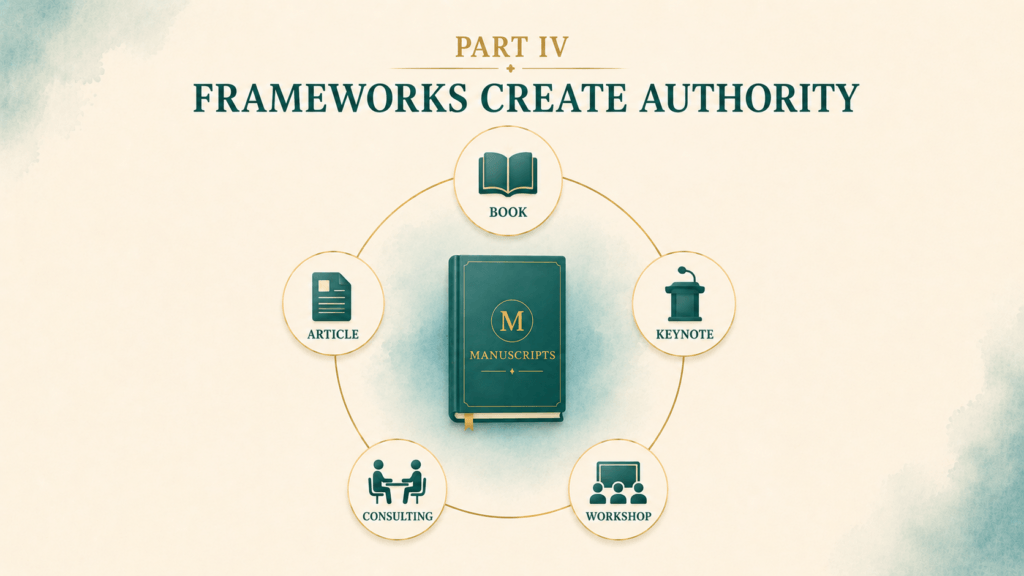
The same framework that gives structure to a book can also become the foundation for:
- consulting methodologies
- keynote presentations
- executive education
- workshops and training programs
- future books
- ongoing intellectual property
The manuscript introduces the idea.
The framework allows the idea to grow.
The real asset is what continues after publication
Publication is often viewed as the finish line.
For Modern Authors, it is the starting point.
Once readers begin applying a framework, discussing it with colleagues, and using its language to solve new problems, the framework takes on a life beyond the manuscript.
It becomes something people can reference without reopening the book.
Something organizations can teach.
Something clients can adopt.
Something future work can continue expanding.
That is why the framework frequently becomes more valuable than the manuscript itself.
The book remains an essential milestone.
But its greatest contribution is often introducing an idea capable of supporting years of future work.
This is the strategic shift at the heart of modern authorship.
Authors think they are building a book.
In many cases, they are building the foundation for a long-term platform of intellectual property, professional authority, and enduring influence.
Visual System Anchor — The Framework Development Ladder
Many professionals assume frameworks begin with a breakthrough idea.
In practice, they usually begin much earlier.
The strongest frameworks are rarely invented from nothing.
They are uncovered by recognizing the recurring patterns already embedded within years of experience.
Framework development is best understood as a progression rather than a moment of inspiration.
Understanding each stage
| Stage | What Happens |
| Experience | You accumulate knowledge by solving problems, making decisions, and working repeatedly within a particular domain. |
| Patterns | Over time, recurring situations, challenges, and successful approaches begin to emerge across that experience. |
| Principles | Those patterns are distilled into consistent observations that explain why certain approaches work better than others. |
| Strategic Framework | The principles are organized into a repeatable structure that others can understand, apply, and remember. |
| Intellectual Property | As the framework becomes associated with your thinking, it develops into a distinctive professional asset that differentiates your work. |
| Authority Assets | The framework extends naturally into books, speaking, consulting, workshops, executive education, research, and future publications. |
Notice where the transformation occurs.
Experience alone is valuable.
Patterns deepen understanding.
Principles create clarity.
But it is the strategic framework that turns accumulated expertise into something transferable.
Without that step, knowledge often remains dependent on the individual who possesses it.
With it, the same knowledge becomes teachable, repeatable, and recognizable beyond the original context.
This progression also explains why the most enduring frameworks rarely appear overnight.
They are not products of sudden creativity.
They are the result of carefully observing years of accumulated experience, identifying what consistently works, and organizing those insights into a structure others can continue using long after the original conversation—or the original book—has ended.
PART III — Building Intellectual Property
The strongest intellectual property rarely begins with invention.
It begins with observation.
Before a framework can become something others remember, it must first emerge from years of experience, repeated problems, and recurring insights that reveal a consistent way of thinking.
Frameworks Begin as Patterns
Many professionals believe they need a completely original idea before they can develop a meaningful framework.
In reality, most strategic frameworks are discovered rather than invented.
They already exist in fragments throughout an expert’s work.
The challenge is recognizing the patterns that connect them.
Years of experience naturally produce recurring themes.
The same questions surface in conversations.
The same challenges appear across different clients, teams, or organizations.
Certain solutions consistently outperform others.
Over time, those repetitions stop being isolated observations.
They begin to reveal an underlying structure.
Where patterns come from
Patterns emerge because experience is rarely random.
The longer someone works within a field, the more likely they are to notice what repeats.
These repetitions often appear as:
- Recurring conversations that reveal the same misunderstandings or questions.
- Recurring challenges that continue appearing despite changing circumstances.
- Recurring observations about why certain approaches succeed while others fail.
- Recurring solutions that consistently produce reliable outcomes.
Individually, these experiences may seem ordinary.
Collectively, they point toward something much more valuable.
They reveal the beginnings of a framework.
Patterns become principles
A pattern explains what keeps happening.
A principle explains why it keeps happening.
That distinction marks the beginning of framework development.
As recurring observations are tested across different situations, they become dependable principles that can guide future decisions rather than merely describe past experiences.
Instead of collecting isolated lessons, the author begins identifying the underlying logic that connects them.
Those principles become the building blocks of a strategic framework.
This is why Modern Authors do not begin by asking:
“What new idea should I invent?”
They begin by asking:
“What have I been seeing repeatedly that others have not yet organized?”
That question shifts the focus from creativity to discovery.
The strongest frameworks are rarely the result of sudden inspiration.
They are uncovered by recognizing the patterns already embedded within years of accumulated experience and refining them into principles that others can understand, apply, and remember.
Organizing Thinking Into a Repeatable Model
Recognizing patterns is only the beginning.
A collection of recurring observations does not automatically become a strategic framework.
The transformation happens when those observations are deliberately organized into a model that other people can understand, remember, and apply consistently.
This is where many experts stop too early.
They recognize the patterns.
They understand the principles.
But those insights remain scattered across presentations, conversations, client engagements, and personal experience.
The thinking is valuable.
The structure is missing.
What makes a framework repeatable?
A repeatable framework allows different people to reach a similar understanding because the thinking has been organized instead of improvised.
That organization depends on five essential elements.
| Element | Why It Matters |
| Clear language | Gives people memorable terms they can easily recall and discuss. |
| Relationships | Shows how concepts connect rather than presenting them as isolated ideas. |
| Sequencing | Arranges ideas in a logical progression that naturally builds understanding. |
| Internal logic | Ensures every part of the framework supports the same central way of thinking. |
| Memorable structure | Makes the framework easy to explain, teach, and apply across different situations. |
Each element strengthens the others.
Without clear language, people struggle to remember the framework.
Without relationships, ideas feel disconnected.
Without sequencing, readers are unsure where to begin.
Without internal logic, the framework becomes inconsistent.
Without a memorable structure, it becomes difficult to teach or recommend.
From insight to system
This is the difference between having a useful idea and building enduring intellectual property.
A useful idea can explain a problem.
A repeatable model helps people solve that problem again and again.
It provides a structure they can return to when facing new situations.
Instead of relying on the author’s presence, the framework begins guiding decisions on its own.
That is when expertise becomes scalable.
Not because more information has been added.
But because the underlying thinking has been organized into a system that others can consistently understand, apply, and share.
This is the objective of framework design.
Not simply to communicate what you know.
But to organize your thinking into a repeatable model that continues creating value every time someone uses it.
How Strategic Frameworks Become Intellectual Property
A strategic framework does more than organize expertise.
It transforms expertise into an asset that can continue creating value long after the original explanation, presentation, or book.
This is the point where knowledge begins to function as intellectual property.
Intellectual property is more than ownership of ideas.
In the context of modern authorship, it is a distinctive way of thinking that becomes recognizable, repeatable, and consistently associated with its creator.
That transformation does not happen because someone possesses expertise.
It happens because that expertise has been organized into a framework others can understand, apply, and continue using.
What changes when a framework becomes intellectual property?
As a framework matures, it becomes more than a useful model.
It develops characteristics that allow it to endure beyond the author’s direct involvement.
| The Framework Becomes… | What That Makes Possible |
| A methodology | Others can apply the same thinking to solve similar problems. |
| A shared vocabulary | Teams, clients, and readers develop common language around the ideas. |
| A repeatable system | The framework can be taught, refined, and used consistently across different contexts. |
| Recognizable intellectual property | The framework becomes associated with the author’s unique way of thinking rather than simply their expertise. |
Notice what has changed.
The value no longer comes from explaining the subject more effectively.
It comes from providing a distinctive structure that helps other people think more effectively.
That distinction is what separates expertise from intellectual property.
Differentiation comes from organization
Many professionals compete by sharing more knowledge.
The strongest thought leaders become recognizable because they organize knowledge differently.
Their frameworks create a unique lens through which people interpret familiar problems.
Over time, readers begin referencing the framework instead of individual explanations.
Clients adopt its language.
Organizations incorporate its methodology.
Future books expand the same underlying system instead of introducing disconnected ideas.
This is how strategic frameworks compound into enduring professional assets.
Knowledge explains.
Strategic frameworks differentiate.
And that differentiation is what transforms accumulated expertise into intellectual property that continues strengthening authority, influence, and professional leverage over time.
PART IV — Frameworks Create Authority
Authority is rarely created by explaining more.
It is created by helping people think differently.
Once a framework becomes part of how people understand a problem, it stops being just another idea inside a book and begins shaping how that problem is discussed, taught, and solved.
Why Readers Remember Frameworks More Than Books
Most readers do not remember books in their entirety.
They remember what changed the way they think.
Months or years after finishing a book, few people can recall every chapter, supporting argument, or example.
What often remains is something much simpler.
A phrase.
A mental model.
An organizing principle.
A new way of looking at a familiar problem.
This is how authority is created.
Not because readers retain more information.
But because they adopt a framework that continues influencing how they interpret future situations.
What readers actually retain
A strategic framework reduces complexity into a structure the mind can easily retrieve and apply.
That is why readers are far more likely to remember:
- Language that gives a problem a memorable name.
- Mental models that simplify complex decisions.
- Organizing principles that explain how ideas fit together.
These elements become mental shortcuts.
Instead of recalling dozens of pages, readers recall a single model that helps them make sense of an entire category of problems.
That model becomes the lasting value of the book.
Why this creates authority
Authority grows when your way of thinking becomes part of someone else’s thinking.
A framework makes that possible.
It gives people language they naturally use in conversations.
A model they reference in meetings.
A principle they apply when making decisions.
Over time, the framework becomes associated with its creator because it continues solving problems long after the book has been closed.
This is why strategic frameworks create lasting authority.
Books introduce ideas.
Frameworks keep those ideas alive.
Readers rarely remember an entire manuscript.
They remember the framework that permanently changed how they understand the problem.
Case Study — Randi Braun and Building a New Operating System for Work
The strongest frameworks rarely begin with the decision to write a book.
They begin years earlier.
Inside repeated conversations.
Recurring challenges.
Consistent observations.
And a growing realization that the same underlying problems continue appearing, even when the people and circumstances change.
Randi Braun’s work illustrates this progression.
After years of executive coaching, she recognized that many of the leaders she worked with were struggling with different symptoms but often the same underlying issues.
The organizations were different.
The industries were different.
The leadership challenges looked different on the surface.
Yet similar patterns kept emerging.
The conversations repeated.
The obstacles repeated.
The breakthroughs repeated.
Over time, those repetitions revealed something more valuable than individual coaching insights.
They revealed an underlying system.
That realization changed the objective.
Rather than writing another leadership book filled with observations and advice, Randi organized those recurring patterns into a coherent operating system for work—a strategic framework that helped readers understand ambition, burnout, leadership, and professional growth through a single, connected way of thinking.
From recurring experience to enduring framework
The transformation did not happen all at once.
It developed through a series of deliberate shifts.
| Stage | What Changed |
| Years of executive coaching | Repeated experience produced deep expertise across hundreds of conversations and real-world leadership challenges. |
| Recognition of recurring patterns | Similar problems continued appearing despite differences in industries, organizations, and individual leaders. |
| Identification of underlying principles | Those recurring patterns revealed consistent truths about how people experience work, leadership, ambition, and burnout. |
| Creation of a shared operating system | The principles were organized into a strategic framework that readers could easily understand, remember, and apply. |
| Framework became the organizing language of the book | Instead of presenting isolated advice, the book introduced a connected model that explained how its ideas fit together. |
| Authority expanded beyond the manuscript | The framework continued creating value through coaching, speaking, teaching, and ongoing professional application. |
Notice where the value was created.
It was not simply through experience.
Many professionals possess decades of experience.
It was not simply through publishing.
Many books contain valuable advice.
The transformation occurred when years of accumulated expertise were organized into a repeatable framework.
That framework became the intellectual asset.
Why the framework became the enduring asset
Readers rarely recommend books by summarizing every chapter.
Instead, they recommend the central idea that reshaped how they think.
That is exactly what a strategic framework makes possible.
It gives people:
- a shared language they can immediately recognize
- a mental model they can apply to new situations
- a structured methodology they can return to over time
- an organizing principle they can easily explain to someone else
This is why frameworks travel further than advice.
Advice is often tied to a specific situation.
A framework helps people interpret countless future situations through the same underlying model.
That shift is what transformed Randi Braun’s expertise from professional experience into enduring intellectual property.
The lesson for Modern Authors extends far beyond this single example.
The goal is not to collect more stories.
Not to publish more advice.
Not even to write a more comprehensive book.
The goal is to recognize the recurring patterns already embedded within your experience, organize them into a strategic framework, and give readers a memorable way of thinking that continues creating value long after they have finished the final chapter.
That is how expertise becomes intellectual property.
And that is how a book becomes the beginning of enduring professional authority rather than the end of a publishing project.
Why Frameworks Compound
Most professional work is additive.
A consulting engagement creates value for one client.
A keynote reaches one audience.
An article generates attention for a short period.
A workshop solves a specific problem.
Each accomplishment has value.
But once it ends, much of that value remains tied to that individual event.
Strategic frameworks create value differently.
Instead of producing isolated outcomes, they allow every new piece of work to strengthen the same underlying intellectual asset.
This is what makes frameworks compound.
Every application makes the framework stronger
Many professionals think they are repeating themselves when they teach the same core ideas across different formats.
In reality, they are doing something much more valuable.
They are continuously refining the framework itself.
Every time the framework is applied, it answers new questions.
It encounters new industries.
It solves new problems.
It is challenged by different audiences.
Each interaction exposes opportunities to improve the language, clarify the sequence, strengthen the principles, or expand the model.
The framework becomes more precise because it is being tested in the real world.
Unlike information, which often becomes outdated after it is consumed, a strategic framework becomes more valuable through repeated use.
Application is not repetition.
It is refinement.
One framework. Many expressions.
Perhaps the biggest misconception about authorship is that every new project requires a completely new idea.
Modern Authors operate differently.
They build one strong framework.
Then they express that framework through multiple forms.
The same underlying framework can become:
- a book that introduces the core thinking
- keynote presentations that communicate it to new audiences
- workshops that help people apply it
- consulting engagements that adapt it to complex organizations
- research that strengthens its credibility
- articles that explore individual principles
- future books that deepen and expand the same body of work
Each expression reaches a different audience.
But all of them strengthen the same intellectual property.
Instead of creating disconnected projects, the author builds a connected ecosystem where every new contribution reinforces the one before it.
Compounding creates authority
This is where frameworks become fundamentally different from books.
A book reaches readers.
A framework continues working after the book has been closed.
As more people apply it, teach it, discuss it, and reference it, the framework becomes increasingly recognizable.
Its language spreads.
Its principles become familiar.
Its methodology becomes associated with the author’s name.
Recognition grows because the same idea continues appearing in different contexts without losing its identity.
Over time, the author’s authority is no longer tied to a single publication.
It is tied to a distinctive way of thinking that people repeatedly encounter across books, articles, keynote presentations, consulting engagements, executive education, research, and future projects.
That is the power of compounding.
Each new contribution does more than create additional visibility.
It increases the value of everything that came before it.
Why this matters for Modern Authors
Many authors measure success one book at a time.
Modern Authors measure success one framework at a time.
Books eventually become part of a professional history.
A strategic framework becomes part of a professional identity.
That is why the most valuable outcome of writing a book is often not the manuscript itself.
It is creating a framework capable of supporting decades of publishing, teaching, speaking, consulting, research, and intellectual leadership.
Books create visibility.
Strategic frameworks create longevity.
And over time, longevity becomes one of the greatest sources of professional authority because every new expression continues strengthening the same enduring intellectual asset.
PART V — The Modern Author Framework System
A strategic framework is valuable because it can become intellectual property.
It becomes transformative when it serves as the foundation for everything an author creates.
Modern Authors do not build books, articles, presentations, and consulting engagements as separate projects.
They build a framework first.
Then they express that framework across every authority asset they create.
How Strategic Frameworks Power Every Authority Asset
One of the most common mistakes experts make is treating every new opportunity as a completely new project.
A conference requires a new presentation.
A client engagement requires a new methodology.
A book requires a new structure.
An article requires a new idea.
A course requires a new curriculum.
Over time, this creates a growing collection of disconnected work.
Each project may be valuable on its own.
But together, they fail to reinforce one another.
The author becomes known for many different outputs rather than one distinctive way of thinking.
A strategic framework solves this problem.
Instead of becoming one asset among many, it becomes the organizing system behind every asset the author creates.
The framework becomes the operating system
An operating system coordinates how every part of a computer works together.
A strategic framework performs a similar role for modern authorship.
Rather than allowing every project to evolve independently, it provides a common structure that connects books, speaking, consulting, research, education, and future publishing into a single body of intellectual property.
Every new project strengthens the same underlying framework instead of competing with it.
The result is not simply greater consistency.
It is cumulative authority.
People begin recognizing the same ideas across every interaction they have with your work.
The language is familiar.
The methodology is consistent.
The thinking becomes increasingly associated with your name.
That consistency is one of the defining characteristics of enduring thought leadership.
One framework. Many authority assets.
A single strategic framework can become the foundation for an entire professional ecosystem.
| Authority Asset | How the Framework Creates Value |
| Books | Introduce and develop the framework through a structured narrative. |
| Keynote presentations | Distill the framework into memorable ideas for live audiences. |
| Consulting engagements | Apply the framework to complex organizational challenges. |
| Workshops | Help participants practice and implement the framework. |
| Articles | Expand individual principles while reinforcing the larger model. |
| Courses and executive education | Teach the framework through structured learning experiences. |
| Research and future publications | Validate, refine, and expand the framework over time. |
Notice what remains constant.
The audience changes.
The format changes.
The level of detail changes.
The framework does not.
That consistency is what allows expertise to scale without becoming fragmented.
Why disconnected expertise rarely compounds
Without a strategic framework, every new project begins with a blank page.
Each presentation develops its own terminology.
Each article introduces different concepts.
Each workshop uses a different methodology.
Each consulting engagement produces isolated insights.
The expertise may be impressive.
But it accumulates horizontally rather than vertically.
The work expands.
The intellectual property does not.
A strategic framework changes that dynamic.
Instead of creating isolated assets, every new contribution reinforces the same core model.
Every article strengthens the book.
Every keynote clarifies the consulting methodology.
Every workshop improves the course.
Every research project deepens the framework.
Each new expression increases the value of everything that came before it because it contributes to the same intellectual foundation.
Building an integrated authority system
This is the defining shift from traditional publishing to modern authorship.
The objective is no longer to produce a successful book.
It is to build a coherent system where every authority asset contributes to the same recognizable body of work.
Readers begin recognizing the framework before they recognize individual projects.
Clients encounter the same methodology across consulting and speaking.
Organizations adopt a consistent language regardless of how they first discover your work.
Over time, the framework becomes the thread connecting every expression of your expertise.
That is why strategic frameworks are not simply communication tools.
They are the operating system behind modern authorship.
They transform individual outputs into a connected ecosystem of intellectual property where every book, article, keynote, workshop, consulting engagement, course, and research project strengthens the same enduring professional asset.
A Book Is One Expression of the Framework
Throughout this guide, we’ve examined strategic frameworks from different perspectives.
We’ve explored how they emerge from experience.
How they organize expertise.
How they become intellectual property.
How they create authority.
How they compound over time.
All of those ideas lead to one fundamental shift.
The relationship between the book and the framework is the opposite of what most authors assume.
Many professionals begin with the belief that the framework exists to support the book.
In reality, the book often exists to introduce the framework.
That distinction changes not only how you write.
It changes what you are actually building.
The traditional publishing model
Most authors approach a book as the primary asset.
The framework, if one exists, is created to make the manuscript easier to organize.
Once the book is finished, the framework has largely completed its job.
It served the manuscript.
The thinking often looks like this:
| Traditional Model | Modern Author Model |
| The book is the primary asset. | The strategic framework is the primary asset. |
| The framework exists to organize the manuscript. | The book exists to introduce the framework. |
| Publication marks the completion of the project. | Publication marks the beginning of the framework’s growth. |
| Future work often starts with new ideas. | Future work expands and strengthens the same framework. |
| Authority is tied to a successful book. | Authority is built through an enduring body of intellectual property. |
The traditional model is not wrong.
It simply limits the long-term value of the work.
Once the manuscript has been published, much of the effort remains attached to that single publication.
The Modern Author model
Modern Authors begin from a different premise.
They recognize that readers rarely encounter a framework only once.
A book may provide the first introduction.
But the framework continues developing every time it appears in a keynote, workshop, consulting engagement, executive education program, research project, article, or future publication.
The manuscript is therefore not the destination.
It is the first major expression of a much larger intellectual asset.
This perspective changes the role of the author.
Instead of asking:
How can I build a framework for this book?
The more valuable question becomes:
How can this book introduce a framework that will continue creating value for years to come?
That subtle shift changes every editorial decision.
The framework is no longer designed to serve the manuscript.
The manuscript is designed to reveal the framework.
Why this identity shift matters
This is one of the defining characteristics of modern authorship.
Books have natural boundaries.
They have a publication date.
A final chapter.
A finished manuscript.
Strategic frameworks do not.
They continue evolving as new research is conducted.
As new audiences engage with the ideas.
As new applications emerge.
As the author’s thinking becomes more refined through experience.
Every future project strengthens the same intellectual foundation rather than competing with it.
Over time, readers stop associating the author with a single publication.
They begin associating the author with a distinctive way of thinking.
That is the ultimate objective.
Not simply to publish a successful book.
But to build a strategic framework that can support an entire career of publishing, teaching, speaking, consulting, and intellectual leadership.
Because for Modern Authors, the book is never the final asset.
It is one expression of a framework designed to endure long after the final page has been read.
Related Systems Inside the Manuscripts Ecosystem
A strategic framework does not create value in isolation.
Its real value emerges when it becomes the foundation for every other part of an author’s professional ecosystem.
This is where many experts unintentionally limit the impact of their work.
They develop a valuable framework.
Then they treat it as something that belongs only inside a single book.
Modern Authors take a different approach.
They recognize that a strategic framework is not one asset within the ecosystem.
It is the system that allows the entire ecosystem to work together.
Frameworks connect the Modern Author ecosystem
Every authority asset answers a different question.
Publishing communicates ideas.
Audience building creates visibility.
Thought leadership establishes credibility.
Author positioning differentiates expertise.
Intellectual assets create long-term leverage.
Viewed independently, these can appear to be separate disciplines.
In reality, they become significantly more powerful when they are connected by the same strategic framework.
The framework provides the consistency that allows every asset to reinforce every other asset.
Without that consistency, each initiative develops independently.
With it, every initiative strengthens the same body of intellectual property.
One framework. Multiple systems.
The relationship becomes clearer when viewed across the Modern Author ecosystem.
| System | How the Strategic Framework Strengthens It |
| Modern Author Operating System | Organizes the author’s thinking into a repeatable intellectual foundation that guides long-term authority building. |
| Modern Publishing Operating System | Ensures every publishing decision reinforces the same core framework rather than introducing disconnected ideas. |
| Codex / Author Intelligence | Captures, organizes, and expands the author’s evolving body of knowledge around a consistent framework instead of isolated content. |
| Authority Positioning | Gives the market a distinctive way to recognize what the author stands for rather than simply what the author knows. |
| Audience Building | Creates consistent messaging that helps readers repeatedly encounter and remember the same core ideas across multiple channels. |
| Thought Leadership | Reinforces a recognizable point of view that becomes increasingly associated with the author’s name over time. |
| Intellectual Assets | Allows books, articles, presentations, courses, research, and future work to strengthen the same underlying intellectual property instead of existing as independent projects. |
Notice the pattern.
None of these systems replace the framework.
Each depends on it.
The framework provides the underlying logic that allows every other asset to remain aligned.
Why integration matters
Imagine two authors with the same level of expertise.
The first publishes books, writes articles, delivers keynote presentations, launches courses, and consults with clients.
Each project is valuable.
But each was created independently.
Different language.
Different models.
Different positioning.
The second author builds one strategic framework first.
Every book introduces it.
Every keynote reinforces it.
Every consulting engagement applies it.
Every article expands it.
Every research project refines it.
Every new contribution increases the value of everything that came before it.
Over time, the difference becomes profound.
The first author builds a portfolio of work.
The second author builds an integrated body of intellectual property.
The framework becomes the center of the ecosystem
This is why framework development should not be viewed as a publishing exercise.
It is an organizational capability.
It gives every future decision a common point of reference.
Should this article be written?
Does this keynote strengthen the framework?
Will this research deepen the methodology?
Does this new book expand the same body of thinking?
Instead of asking whether a project is worthwhile on its own, Modern Authors ask whether it strengthens the framework that sits at the center of their authority.
That is the defining characteristic of the Manuscripts ecosystem.
Books, publishing strategy, audience building, author positioning, thought leadership, and intellectual assets are not independent systems.
They are connected systems.
And the strategic framework is the architecture that allows them to operate as one enduring engine of professional authority.

PART VI — Becoming Known for an Idea
Every section of this guide has pointed toward a single conclusion.
Strategic frameworks are not simply tools for writing better books.
They are the mechanism through which expertise becomes enduring professional authority.
The final question is no longer how to build a framework.
It is what that framework ultimately allows you to become.
What This Means for Modern Professionals
For decades, professional success was closely tied to expertise.
The more experience you accumulated, the more valuable you became.
Knowledge created opportunities.
Credentials created credibility.
Experience created trust.
Those qualities still matter.
But they are no longer sufficient to create lasting authority.
Today’s knowledge economy rewards something different.
Not simply expertise.
But organized expertise.
The professionals who become widely recognized are rarely those who know the most.
They are the ones who have given their expertise a recognizable structure that other people can easily understand, remember, apply, and recommend.
That structure is the strategic framework.
The defining question has changed
Many professionals continue building their careers around a familiar question:
“What do I know?”
It is an important question.
It drives learning.
It deepens expertise.
It strengthens professional capability.
But it does not necessarily create recognition.
Authority begins to emerge when a different question takes its place:
“What idea am I known for?”
The distinction is subtle, but profound.
The first question focuses on accumulation.
The second focuses on organization.
One measures how much expertise you possess.
The other measures whether that expertise has become memorable enough to shape how other people think.
Expertise earns trust. Frameworks create recognition.
Think about the experts who have had the greatest influence in their industries.
People rarely remember them because they possessed more information than everyone else.
They remember them because they introduced a distinctive way of understanding a problem.
That distinction changes how professional authority develops.
| Expertise Builds… | Strategic Frameworks Build… |
| Knowledge | Recognition |
| Capability | Differentiation |
| Credibility | Memorability |
| Professional competence | Intellectual identity |
| Individual success | Enduring authority |
Expertise remains essential.
Without expertise, there is no foundation for a meaningful framework.
But expertise alone rarely creates a lasting professional identity.
A strategic framework gives people something to associate with your name long after individual conversations, presentations, or publications have been forgotten.
From being known for your work to being known for your thinking
This is one of the most important shifts a Modern Author can make.
Many professionals become known for what they do.
They are respected consultants.
Successful executives.
Experienced physicians.
Trusted coaches.
Accomplished researchers.
That reputation creates opportunities.
But it is often tied to the work they personally perform.
Strategic frameworks create a different kind of recognition.
They allow professionals to become known for how they think.
The distinction matters because thinking scales differently than execution.
People can adopt a framework without hiring its creator.
Organizations can teach it internally.
Leaders can reference it in meetings.
Researchers can expand it.
Authors can build future books upon it.
The framework continues influencing people even when the author is not present.
That is one of the defining characteristics of intellectual property.
Becoming known for an idea
Every Modern Author eventually faces a strategic choice.
One path is to continue accumulating expertise and expressing it through isolated projects.
The other is to organize that expertise into a framework that becomes the defining idea of an entire body of work.
The first path builds a successful career.
The second builds enduring authority.
Because careers are often remembered for accomplishments.
Ideas are remembered for generations.
That is why the defining question for Modern Authors is no longer:
“What do you know?”
It becomes:
“What idea are you known for?”
The answer to that question is rarely found in another credential, another presentation, or even another book.
It is found in the strategic framework that organizes your expertise into a memorable way of thinking—one that people continue associating with your name long after they have forgotten the details of the work that first introduced it.
From Expertise to Intellectual Property
Most professionals spend their careers trying to build more expertise.
More experience.
More credentials.
More knowledge.
More case studies.
The assumption is understandable.
If I know enough, eventually I’ll become known.
But that is not how enduring authority is created.
Throughout this guide, we’ve arrived at a different conclusion.
Expertise is essential.
It is the raw material from which every meaningful contribution begins.
Without expertise, there is no insight to organize, no principles to discover, and no framework to develop.
But expertise alone has a natural limitation.
It is often inseparable from the person who possesses it.
It lives inside conversations.
Client engagements.
Presentations.
Meetings.
Books.
Its value depends on the expert continuing to explain it.
A strategic framework changes that relationship.
Instead of remaining dependent on the individual, the thinking becomes independent of them.
It becomes something other people can understand without the author’s presence.
Something they can remember months later.
Teach to colleagues.
Apply to new situations.
Expand through their own experience.
Recommend without needing to summarize an entire book.
That is the moment expertise begins to function as intellectual property.
Everything we’ve explored throughout this guide points toward a single progression.
1. Expertise creates understanding.
Years of experience develop judgment.
You begin recognizing patterns that others overlook.
You solve problems with increasing consistency.
Expertise gives you the raw material.
By itself, however, it remains largely personal.
Its value is closely tied to your ability to explain, demonstrate, or apply it.
2. Strategic frameworks organize understanding.
This is where expertise becomes transferable.
Patterns become principles.
Principles become a repeatable model.
Ideas become structured.
Instead of relying on the expert to explain everything, the framework allows other people to understand the thinking for themselves.
It becomes easier to remember.
Easier to teach.
Easier to apply.
And easier to build upon.
3. Intellectual property allows understanding to scale.
Once a framework exists, every new contribution strengthens the same intellectual asset.
A keynote reinforces it.
An article expands it.
Consulting tests it.
Research refines it.
Future books deepen it.
Instead of producing disconnected work, every expression contributes to the same body of thinking.
That is why strategic frameworks compound while isolated expertise often does not.
Every new project increases the value of everything that came before it because every project strengthens the same underlying framework.
This is why Modern Authors stop measuring success by the amount of expertise they possess.
Expertise can always grow.
There is always another credential to earn.
Another book to read.
Another experience to accumulate.
Instead, they begin asking a different question.
Has my expertise become a recognizable way of thinking?
That question changes everything.
It changes how you write.
How you organize ideas.
How you teach.
How you build a business.
How you evaluate opportunities.
Because opportunities no longer exist simply to showcase what you know.
They become opportunities to strengthen the same enduring intellectual asset.
This is the identity shift at the heart of modern authorship.
The belief at the beginning of the journey is:
My expertise is my greatest asset.
The belief at the end is:
My strategic framework is the asset that allows my expertise to scale, endure, and compound.
Books eventually become part of your bibliography.
Your strategic framework becomes part of your professional identity.
And over time, that identity becomes the legacy people continue building upon long after they have finished reading your book.
Continue Building Your Strategic Framework
Finishing a manuscript is a meaningful milestone.
But if this guide has accomplished its purpose, you should now recognize that publishing a book is not the ultimate objective.
The greater opportunity is building a strategic framework that continues creating value long after the manuscript has been completed.
A book introduces your thinking.
A framework allows that thinking to endure.
It becomes the foundation for intellectual property, authority, discoverability, and future opportunities that continue compounding throughout your career.
The question is no longer simply:
“How do I write a better book?”
It becomes:
“How do I build a body of intellectual property that people will continue recognizing, applying, and expanding for years to come?”
That question sits at the center of the Manuscripts ecosystem.
Whether you’re still organizing decades of expertise or preparing to publish an established framework, every part of the ecosystem is designed to help Modern Authors move beyond publishing and toward long-term authority.
Your next step may include exploring:
- The Modern Author Operating System to understand how strategic frameworks become the foundation of an enduring author business.
- The Modern Publishing Operating System to publish in a way that strengthens long-term intellectual property rather than simply releasing a manuscript.
- Codex and Author Intelligence to capture, organize, and continually refine your evolving body of knowledge.
- Related Manuscripts Guides on authority positioning, intellectual assets, audience building, and thought leadership to deepen each layer of your author platform.
None of these systems exist independently.
They are designed to work together.
Each one strengthens the same strategic framework.
Each one reinforces the same intellectual property.
Each one helps transform expertise into a durable professional asset that becomes more valuable with every book, article, keynote, workshop, consulting engagement, and research project.
The goal was never simply to publish a book.
The goal is to become known for an idea.
Because books have publication dates.
Strategic frameworks have the potential to shape industries, influence organizations, and continue creating value long after the final chapter has been written.
That is the work of a Modern Author.
And it begins by building a strategic framework worth remembering.
FAQs
What is a strategic framework?
A strategic framework is a repeatable structure that organizes expertise into a clear, memorable way of thinking. Rather than simply explaining information, it helps people understand, apply, and remember ideas across different situations.
Why is a strategic framework important for authors?
A strategic framework transforms a book from a one-time publication into a long-term intellectual asset. It gives readers a memorable model they can continue using while creating opportunities for speaking, consulting, research, and future books.
How do you build a strategic framework?
Most strategic frameworks begin by recognizing recurring patterns across years of experience. Those patterns are refined into principles and then organized into a repeatable model with clear language, logical structure, and practical application.
What is the difference between expertise and a strategic framework?
Expertise is knowledge developed through experience. A strategic framework organizes that knowledge into a structured methodology that others can understand, teach, apply, and associate with your work.
Can a book become intellectual property?
Yes. While a manuscript communicates ideas, the strategic framework behind the book can become enduring intellectual property by evolving into methodologies, workshops, consulting, executive education, and future publications.
Why do frameworks outlast information?
Information answers immediate questions. Frameworks provide a reusable way of thinking that people continue applying long after individual facts, examples, or chapters have been forgotten.
What makes a framework memorable?
Memorable frameworks combine clear language, logical organization, repeatable principles, and a distinctive mental model. They simplify complexity without oversimplifying it, making ideas easier to remember and share.
What’s the difference between a strategic framework and a strategic plan?
A strategic plan outlines actions, priorities, and objectives for achieving a specific goal. A strategic framework organizes thinking, providing the underlying model that guides decisions, explains complex ideas, and supports long-term intellectual property.
How does a strategic framework create authority?
Authority grows when people begin using your framework to understand and solve problems. Instead of remembering isolated advice, they remember the model, language, and way of thinking that becomes associated with your expertise.
Can the same strategic framework support multiple books?
Yes. Many Modern Authors build one core strategic framework and expand it through books, articles, keynote presentations, workshops, consulting engagements, research, and other authority assets. Each new expression strengthens the same body of intellectual property rather than starting from scratch.
If You’re Deciding What to Do Next
If this report clarified your thinking, the next step is usually not “publishing.”
It’s pressure-testing your strategy before you commit time, budget, or reputation.
Here are three ways authors typically proceed.
Map Your Modern Author Strategy
If you want to:
- Pressure-test your author model
- Clarify realistic outcomes
- Understand where ROI is likely to show up
- Avoid unnecessary spend
A short strategy conversation can surface issues early, before they become expensive.
👉 Schedule a Modern Author Strategy Session
This is a working session, not a pitch.
Explore the Modern Publishing System
If you’re assessing:
- Whether to publish traditionally, hybrid, or independently
- How to structure presale and early activation
- What support actually reduces risk
You may want a clearer view of how the Modern Publishing System works in practice.
👉 Explore Manuscripts Publishing Services
Study Real Author Outcomes
(For internal validation and stakeholder alignment)
If you’re preparing a recommendation for leadership, concrete examples often help.
👉 See Modern Author Success Stories
About the Author
Eric Koester is an award-winning entrepreneurship professor at Georgetown University, bestselling author, and founder of Manuscripts. His work focuses on how ideas become assets, how books create leverage, and why modern authors need systems, not just publishing support.
He has worked with thousands of authors across traditional, hybrid, and modern publishing paths, helping them turn books into platforms, platforms into credibility, and credibility into durable business outcomes.
About Manuscripts
Manuscripts is the Modern Author OS for nonfiction experts.
We help founders, executives, coaches, and thought leaders design books as strategic assets, not standalone products. Our work spans positioning, author model design, developmental editing, AI-enhanced drafting tools, presale strategy, and long-term launch systems.
Manuscripts authors use their books to generate clients, speaking engagements, training programs, and enterprise opportunities, often before publication.
For readers who want to go deeper into specific mechanics, the following guides expand on topics referenced in this report:
- How to Write a Book if You’re Busy
- Modern Ghostwriting for Nonfiction Authors
- AI Tools for Authors in 2026
- How to Build an Audience Before You Write Your Book
- The Evergreen Launch System for Modern Authors
Powered by Codex, the Modern Author Intelligence Tool.