Should I Write a Book? A Strategic Framework for Choosing the Right Intellectual Asset (2026)
Most Professionals Are Asking the Wrong Question
At a certain point in a successful career, the idea appears almost automatically.
Maybe I should write a book.
It feels reasonable.
You have experience.
You have stories.
You have a point of view.
You have spent years solving problems other people are still trying to understand.
And in the professional world, a book still carries a certain kind of weight.
It suggests seriousness.
It signals depth.
It tells the market, this person has something worth paying attention to.
So the question sounds obvious:
Should I write a book?
But that is not actually the first question.
It is already a second-order question.
It assumes the format before clarifying the strategy.
It assumes authorship is the milestone before defining what the milestone is supposed to create.
It assumes the book is the right container before asking what kind of leverage the idea needs.
That is where many professionals make the decision too early.
A book can be an extraordinary intellectual asset.
It can organize years of expertise into a durable body of work.
It can create authority, open doors, support speaking, strengthen consulting, and become the foundation for future opportunities.
But a book is still one asset.
Not the only one.
And not always the first one.
The better question is not:
Should I write a book?
The better question is:
Which intellectual asset creates the greatest long-term leverage for what I am trying to build?
That question changes the entire decision.
Now the conversation is no longer about becoming an author.
It is about choosing the right vehicle for the future you want your ideas to create.
Sometimes that vehicle is a book.
Sometimes it is a research report.
Sometimes it is a keynote, a workshop, a newsletter, an essay series, a proprietary methodology, or an educational platform.
The strategic professional does not begin with the prestige of the format.
They begin with the leverage of the asset.
Because the goal is not to publish for the sake of publishing.
The goal is to build something that continues working after the first audience, first launch, first conversation, or first opportunity has passed.
That is the distinction this guide is built around.
A book may become the right answer.
But it should be the result of a strategic decision, not the default assumption.
Why This Question Matters More Than Ever
For most of modern history, professional authority was accumulated.
You built a career.
Earned credentials.
Held increasingly senior positions.
Developed expertise through years of experience.
Institutions amplified your reputation because your authority was closely tied to where you worked, what you had achieved, and the titles you held.
That model still exists.
But it is no longer the only way authority is created.
Today, ideas travel faster than institutions.
Professionals are discovered through articles before résumés.
Through interviews before introductions.
Through podcasts before conferences.
Through books, newsletters, research, and other intellectual assets long before someone ever schedules a meeting.
The question is no longer simply whether you have expertise.
It is whether your expertise exists in a form that other people can continually discover, share, and build upon.
The advantage belongs to owned intellectual assets
This is one of the defining shifts of the modern knowledge economy.
Knowledge by itself has become increasingly abundant.
Access to information is no longer the constraint.
The professionals creating disproportionate opportunities are often those who have transformed their thinking into assets they own.
An intellectual asset is more than knowledge.
It is knowledge organized into a form that continues creating value beyond the moment it was created.
The strongest intellectual assets share four characteristics.
They are:
- Owned — They become part of your professional body of work rather than remaining inside conversations or client engagements.
- Reusable — The same underlying ideas can be applied repeatedly across different audiences, industries, and opportunities.
- Discoverable — People can continue finding your thinking months or years after it was first published.
- Scalable — The asset can influence more people without requiring your direct participation every time it is used.
These characteristics are what separate intellectual assets from professional activity.
One depends on your presence.
The other continues working even when you’re not in the room.
Format is a strategic decision
Once you begin viewing your work through this lens, the decision to publish changes.
It is no longer about asking which format sounds the most impressive.
It becomes a question of leverage.
Every intellectual asset creates different kinds of opportunity.
Some are designed to explore ideas while they are still developing.
Others teach a process.
Some establish credibility with a specific audience.
Others become enduring reference points that continue shaping how people think for years.
The format you choose determines not only how your expertise is presented, but also how it grows, spreads, and creates future opportunities.
Choosing the wrong format is not necessarily a failure.
But it can delay momentum by investing significant time and energy into an asset that does not support the future you are trying to build.
Choosing the right one has the opposite effect.
It creates a foundation that every future article, presentation, partnership, conversation, and publication can continue strengthening.
That is why this question matters more than ever.
The decision is not simply whether to publish.
It is whether you are investing in the intellectual asset that will create the greatest long-term leverage for the future you want to build.
The Decision in 60 Seconds
Not every expert should write a book.
At least, not yet.
And not every idea deserves to become a manuscript.
Sometimes the highest-leverage decision is to write a book.
Sometimes it is to continue developing the idea through another intellectual asset until the book becomes the obvious next step.
That is the decision this guide is designed to help you make.
This guide is for you if…
You are less interested in becoming an author than in making the right long-term strategic decision.
More specifically, this guide is for you if:
- You’re deciding whether a book is the right next move for your expertise or business.
- You have valuable knowledge but see multiple ways to package and share it.
- You’re building an authority platform that should continue creating opportunities over many years.
- You want to choose the intellectual asset that produces the greatest long-term leverage—not simply the most visible one.
This guide is not for you if…
This guide is not about writing techniques or publishing mechanics.
It is also not intended to persuade everyone to become an author.
You may find another resource more useful if:
- You’ve already committed to writing a book and are looking for help drafting or publishing it.
- You’re searching for writing tactics, editing advice, or publishing workflows.
- You’ve already decided on the format and are no longer evaluating the strategic decision behind it.
The decision you actually need to make
Most professionals think their first decision is:
Should I publish a book?
This guide argues that an even more important decision comes first.
Which intellectual asset deserves to exist first?
That distinction may seem small.
It changes everything.
Once you begin with the asset instead of the format, your thinking becomes strategic rather than procedural.
You stop asking what successful people usually publish.
You begin asking what will create the greatest long-term leverage for your ideas, your expertise, and the future you’re trying to build.
That is the question this guide will help you answer.
If a book is the strongest strategic investment, you should pursue it with confidence.
If another intellectual asset creates greater leverage first, that may be the decision that ultimately leads to a stronger book, and a stronger body of work.
Why This Matters to Modern Authors
The word author has never been more accessible.
The word authorship has never required more discernment.
Today, almost anyone can publish.
Books can be self-published in weeks.
Articles can reach thousands of readers overnight.
Newsletters can build audiences without a publisher.
Research can be distributed globally.
Content is no longer difficult to create.
The strategic challenge is deciding what deserves to be created first.
This is where the philosophy of the Modern Author begins.
Modern Authors do not define themselves by the format they publish.
They define themselves by the future they are trying to build.
The book, the newsletter, the keynote, the research report, or the workshop is never the objective.
It is the vehicle.
The objective is creating an enduring body of intellectual work that continues opening opportunities long after the original asset has been published.
That distinction changes how every decision is made.
Instead of asking:
“How do I become an author?”
Modern Authors ask:
“What am I trying to build, and which intellectual asset moves me closest to that future?”
Sometimes the answer is a book.
Sometimes it isn’t.
Both can be the right decision.
Because the measure of success is not whether you published.
The measure is whether the asset creates the leverage your future requires.
A founder building enterprise credibility may discover that a book is the strongest foundation.
A researcher may begin with original research.
A consultant may first develop a proprietary methodology.
A speaker may refine ideas through keynote presentations before ever writing a manuscript.
The sequence changes.
The strategy does not.
The format follows the future.
Not the other way around.
That is one of the defining differences between traditional publishing and modern authorship.
Traditional publishing often begins with the question:
“What should I publish?”
Modern authorship begins much earlier.
It begins by understanding where you want your ideas to take you.
Only then do you decide which intellectual asset deserves to exist first.
Because the strongest authors rarely become influential simply because they published a book.
They become influential because every intellectual asset they create serves a larger strategic direction.
That is why Modern Authors begin with strategy.
The format follows the future they want to build.
What This Guide Will Teach You
This guide is not designed to convince you to write a book.
It is designed to help you make a better strategic decision.
By the end, you should be able to evaluate a book the same way you would evaluate any other long-term business investment, not by how impressive it appears, but by the leverage it creates.
More specifically, you’ll learn how to answer five questions that every Modern Author should resolve before committing to authorship.
1. Why did books become the default intellectual asset?
Books have earned a unique place in professional culture.
They signal expertise.
Commitment.
Depth of thinking.
But this section explores why books became the default answer, and whether that assumption still holds in today’s knowledge economy.
2. How should different intellectual assets be evaluated?
Not every valuable idea belongs in a book.
Some ideas are better developed through newsletters, research reports, workshops, keynote presentations, or proprietary methodologies.
You’ll learn how to evaluate intellectual assets based on the opportunities they create rather than the prestige they carry.
3. When does a book create the greatest leverage?
Books remain one of the most powerful intellectual assets a professional can build.
The question is not whether books matter.
The question is when they become the highest-leverage investment.
We’ll examine the conditions that make a book the right strategic choice, and just as importantly, when it is not.
4. When is another asset the better place to start?
Many ideas become stronger before they become books.
You’ll learn how to recognize when another intellectual asset should come first, allowing your thinking, your audience, or your framework to mature before investing in a manuscript.
Sometimes the best way to write a successful book is not to start with one.
5. How does a book become part of a larger authority system?
The strongest books rarely stand alone.
They become the foundation for broader systems that include research, speaking, consulting, newsletters, future publications, and other intellectual assets.
Rather than viewing a book as the finish line, you’ll learn how to evaluate it as one strategic component within a long-term authority-building system.
By the time you finish this guide, the question will no longer be:
“Should I write a book?”
Instead, you’ll be able to ask the question that matters far more:
“Which intellectual asset creates the greatest long-term leverage for the future I’m trying to build?”
Everything that follows is designed to help you answer that question with clarity and confidence.
PART I — The Wrong Question
Every meaningful strategic decision begins by asking the right question.
The problem is that many professionals begin their publishing journey with the wrong one.
Not because writing a book is a poor decision.
But because they decide on the format before they decide what they are ultimately trying to build.
This section examines why that distinction matters, and why choosing the right intellectual asset should always come before choosing the format.
Why “Should I Write a Book?” Is the Wrong Starting Point
On the surface, “Should I write a book?” sounds like a thoughtful question.
It suggests ambition.
Reflection.
A desire to contribute something meaningful.
For many accomplished professionals, it feels like the logical next step after years of building expertise.
But hidden inside that question is an assumption that often goes unnoticed.
It assumes the format before it defines the objective.
In other words, the decision has already been partially made.
The conversation begins with book rather than with strategy.
That distinction may seem subtle.
In practice, it changes everything.
A strategic professional rarely begins by asking what they should publish.
They begin by asking what they are trying to build.
That future might involve greater authority.
A stronger consulting practice.
A speaking platform.
Enterprise credibility.
A recognizable body of intellectual property.
Or a lasting contribution to their industry.
Only after that destination becomes clear does it make sense to ask which intellectual asset is most capable of getting them there.
The format is not the strategy
Imagine asking:
“Should I build a website?”
Without first asking what the business needs the website to accomplish.
Or deciding to hire employees before understanding what kind of company you are building.
Most leaders instinctively recognize that those decisions come too early.
The same principle applies to authorship.
A book is not a strategy.
It is a strategic choice.
Like every significant investment, its value depends on the outcome it is intended to create.
The same manuscript can represent an extraordinary investment for one professional and a poor strategic decision for another, not because the quality of the writing is different, but because the objectives are different.
The right format is always contextual.
The shift from publishing to leverage
This is where Modern Authors think differently.
Rather than beginning with the question:
“What should I publish?”
They begin with a more foundational one:
“What kind of long-term leverage do I want my ideas to create?”
Leverage is the ability for today’s intellectual work to continue creating tomorrow’s opportunities.
Sometimes that leverage is best created through a book.
Sometimes it begins with research.
Sometimes through a newsletter, a workshop, a proprietary methodology, or another intellectual asset that allows an idea to mature before it becomes a manuscript.
The format is selected because it serves the strategy, not because it carries the most prestige.
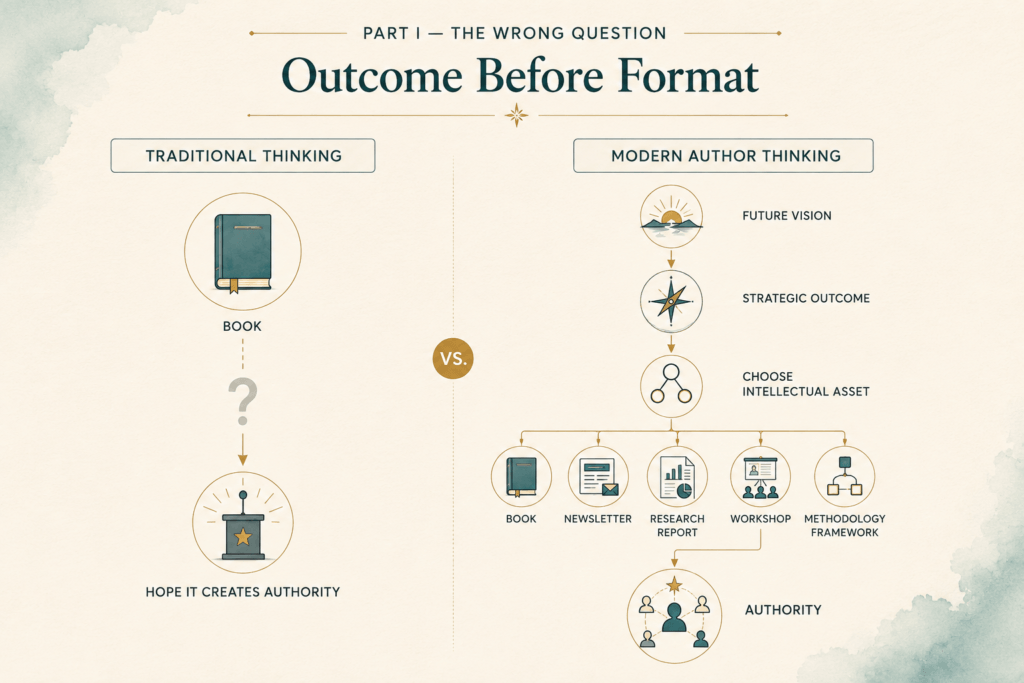
Start with the future, then choose the asset
This is the inversion that shapes the rest of this guide.
Most professionals move from format → outcome.
Modern Authors move from outcome → format.
That single reversal leads to better decisions because it forces every publishing choice to answer a larger strategic question:
What future am I trying to build, and which intellectual asset gives me the strongest foundation for building it?
Sometimes the answer will be a book.
Sometimes it will not.
The goal is not to become an author as quickly as possible.
The goal is to choose the intellectual asset that creates the greatest long-term leverage—and to write a book only when it becomes the strongest strategic expression of that decision.
Why Professionals No Longer Build Authority Through Credentials Alone
For a long time, professional authority followed a relatively predictable path.
You earned a degree.
Joined a respected institution.
Worked your way into leadership.
Accumulated experience.
Built a résumé that reflected years of accomplishment.
Authority was closely connected to the organizations you represented and the titles you held.
If someone wanted to evaluate your credibility, they often started by asking questions like:
Where do you work?
What position do you hold?
What are your credentials?
Those signals still matter.
They communicate experience, discipline, and professional achievement.
But they are no longer sufficient to create lasting influence on their own.
Institutional authority is no longer the only authority
One of the defining changes of the modern knowledge economy is that expertise is no longer confined to institutions.
Ideas now travel independently of the organizations where they were created.
A thoughtful article can reach more people than a conference presentation.
A well-developed framework can influence leaders who have never met its creator.
A book can introduce someone’s thinking to readers across industries and continents.
Professionals are increasingly discovered through what they publish, not simply where they work.
That does not diminish the importance of institutions.
It changes their role.
Employers, universities, and professional organizations still help establish credibility.
Increasingly, however, they are where expertise is developed, not where authority permanently resides.
Authority grows when expertise becomes visible beyond the institution itself.
Borrowed credibility and owned credibility
This shift is easier to understand by distinguishing between two kinds of professional credibility.
| Borrowed Credibility | Owned Credibility |
| Built through employers, institutions, titles, and credentials. | Built through ideas, intellectual assets, and published thinking. |
| Exists primarily within the context of an organization. | Travels wherever the work is discovered. |
| Often depends on your current role. | Remains attached to your name regardless of role or employer. |
| Can change when your position changes. | Continues growing as your body of work expands. |
Most professionals spend years building borrowed credibility.
Modern Authors intentionally invest in owned credibility.
Neither replaces the other.
The strongest professional reputations combine both.
But only one continues expanding independently of your job title.
Ideas have become professional assets
This is why intellectual assets matter.
An intellectual asset is expertise organized into a form that other people can discover, apply, and continue learning from without requiring your direct participation.
A book is one example.
So is original research.
A proprietary methodology.
A newsletter.
A recurring keynote.
Or any enduring body of published thinking that continues creating value over time.
These assets make expertise visible.
They make it searchable.
They make it portable.
Most importantly, they make it independent.
Instead of existing only inside client meetings, boardrooms, classrooms, or executive conversations, your thinking becomes something that continues reaching new people long after the original interaction has ended.
That is one of the defining characteristics of modern authority.
From credentials to contribution
The professionals who create the greatest long-term influence are rarely those with the longest list of credentials.
They are the ones who consistently contribute ideas that other people return to, reference, and build upon.
Their expertise becomes discoverable.
Their thinking becomes recognizable.
Their work continues creating opportunities regardless of where they work or what title they hold.
That is the shift Modern Authors recognize.
Credentials may open the first door.
Institutions may establish initial trust.
But enduring authority is increasingly built through intellectual assets that transform private expertise into public contribution.
In today’s knowledge economy, people are remembered not only for the positions they held, but for the ideas they chose to leave behind.
The Rise of the Intellectual Asset Economy
Something fundamental has changed in the way professional value is created.
For much of the last century, careers were built by accumulating credentials, experience, and increasingly important responsibilities.
The underlying assumption was straightforward:
The more knowledge you acquired, the more valuable you became.
That is still true.
Knowledge remains the foundation of expertise.
But expertise alone is no longer where the greatest professional leverage is created.
Today, the professionals creating the most enduring influence are not simply accumulating knowledge.
They are converting knowledge into assets.
That shift marks the emergence of what we can think of as the Intellectual Asset Economy, an environment where the greatest long-term value comes not only from what you know, but from what you build with what you know.
Knowledge creates expertise. Intellectual assets create leverage.
Experience has always been valuable.
What has changed is the ability for expertise to exist independently of the expert.
Years ago, much of a professional’s knowledge remained locked inside meetings, consulting engagements, classrooms, executive roles, or client relationships.
Its impact was largely limited to the people in the room.
Today, the same expertise can be transformed into assets that continue creating value long after the original work has been completed.
A research report can shape industry conversations for years.
A keynote can evolve into a training program.
A methodology can become the foundation of a consulting practice.
A newsletter can build an audience before a book is ever written.
A book can continue introducing new readers to an author’s thinking long after publication.
The expertise has not changed.
The way it creates value has.
What makes an intellectual asset valuable?
Not every piece of content becomes an intellectual asset.
An intellectual asset is valuable because it continues producing opportunities beyond the effort required to create it.
The strongest intellectual assets tend to share four characteristics.
| Characteristic | Why It Matters |
| Owned | The ideas become part of your professional body of work rather than remaining inside someone else’s organization or platform. |
| Reusable | The same thinking can be applied across multiple audiences, formats, and opportunities without starting from scratch. |
| Scalable | The asset continues reaching and influencing more people without requiring your direct participation every time. |
| Discoverable | People can continue finding your work months or years after it is first created, allowing opportunities to compound over time. |
Viewed together, these characteristics explain why intellectual assets create a different kind of professional value than expertise alone.
Expertise is essential.
Intellectual assets allow that expertise to travel.
The shift from accumulation to creation
Many professionals spend their careers asking:
What else do I need to learn?
It is an important question.
But eventually another question becomes even more valuable.
What should I build with everything I’ve already learned?
That shift represents one of the defining characteristics of modern professional strategy.
Knowledge continues to matter.
Experience continues to matter.
Credentials continue to matter.
But their value increasingly depends on whether they are transformed into assets that other people can discover, apply, reference, and build upon.
The professionals who create lasting authority are rarely those who simply know the most.
They are the ones who intentionally convert years of accumulated expertise into intellectual assets that continue creating influence long after the original work is finished.
That is the opportunity created by the Intellectual Asset Economy.
And it is the strategic context for every decision explored throughout the rest of this guide.
PART II — Understanding the Intellectual Asset Landscape
Before deciding whether a book is the right investment, we need to clarify what we’re actually trying to build.
Throughout this guide, we’ve used the phrase intellectual asset repeatedly.
Not because every professional should create the same kind of work.
But because every strategic publishing decision begins with understanding the asset behind the format.
A book is an intellectual asset.
So is a research report.
A proprietary methodology.
A newsletter.
A workshop.
Even a well-developed framework.
The format may differ.
The strategic purpose is the same: to create something that continues generating value long after the original work has been completed.
What Is an Intellectual Asset?
Most professionals already possess expertise.
Many also possess knowledge.
Increasingly, they produce content.
Yet relatively few build intellectual assets.
Those terms are often used interchangeably.
They should not be.
They represent different stages in how professional knowledge creates value.
Understanding that distinction is essential because this guide is not about creating more content.
It is about building assets.
Four different kinds of professional value
The progression looks like this.
| Concept | What It Is | Primary Value |
| Knowledge | Facts, information, and understanding acquired through learning and experience. | Increases personal capability. |
| Expertise | The ability to apply knowledge consistently to solve meaningful problems. | Creates professional credibility. |
| Content | Individual expressions of knowledge, such as articles, presentations, videos, or social posts. | Shares ideas with an audience. |
| Intellectual Asset | A durable body of work that continues creating authority, opportunity, and professional leverage long after it is created. | Builds long-term value that compounds over time. |
Each stage builds upon the one before it.
Knowledge becomes expertise through application.
Expertise becomes visible through content.
But content becomes an intellectual asset only when it continues creating value beyond the moment it is published.
That is the defining difference.
The difference is durability
Most content has a relatively short life.
It answers today’s question.
Supports this week’s presentation.
Generates attention for a campaign.
Then it gradually disappears beneath whatever comes next.
An intellectual asset behaves differently.
It continues working.
People discover it months later.
Reference it years later.
Teach it to colleagues.
Recommend it to peers.
Build new work upon it.
Its value is not exhausted after a single interaction because it was designed to endure rather than simply inform.
That is why books, enduring frameworks, proprietary methodologies, and landmark research reports often become foundational assets within a professional career.
They continue creating opportunities long after the effort required to produce them has been forgotten.
An intellectual asset is designed to compound
The defining characteristic of an intellectual asset is not that it exists.
It is that it keeps producing value.
A well-designed intellectual asset creates leverage because it can be:
- Owned instead of remaining inside someone else’s organization or platform.
- Reusable across different audiences, industries, and professional opportunities.
- Discoverable by people long after its original publication.
- Expandable into future books, research, speaking, consulting, education, or other intellectual work.
Each new expression strengthens the asset instead of replacing it.
Over time, the value becomes cumulative.
Not because more content is being produced.
But because every new contribution reinforces the same underlying body of work.
A different way to evaluate your ideas
This distinction changes the question professionals should ask themselves.
Instead of asking:
“What should I publish next?”
A more strategic question is:
“What am I building that will still create value five years from now?”
That is the lens through which every intellectual asset should be evaluated.
Because the most valuable work is rarely the piece that attracts the most immediate attention.
It is the piece that continues generating authority, opportunities, and professional leverage long after it has been created.
That is what makes something an intellectual asset.
And it is the standard against which every format, including books, should be measured throughout the rest of this guide.
The Expanding Landscape of Intellectual Assets
One of the reasons so many professionals struggle with the question, “Should I write a book?” is that they evaluate the book in isolation.
A book feels like a single decision.
In reality, it is one option within a much broader landscape of intellectual assets.
That distinction matters.
You cannot determine whether a book is the right strategic investment until you understand what it is being compared against.
The question is not whether books are valuable.
The question is whether they are the highest-leverage asset for the outcome you are trying to create.
Different assets solve different strategic problems
Professionals often assume every intellectual asset serves the same purpose.
It doesn’t.
Each format excels at solving a different problem.
Some help you develop ideas.
Some validate them.
Some teach them.
Others establish long-term authority.
Thinking of intellectual assets as interchangeable often leads to investing significant time in the wrong format.
A more strategic approach is to ask:
What is this asset designed to do?
The answer becomes much clearer when the landscape is viewed together.
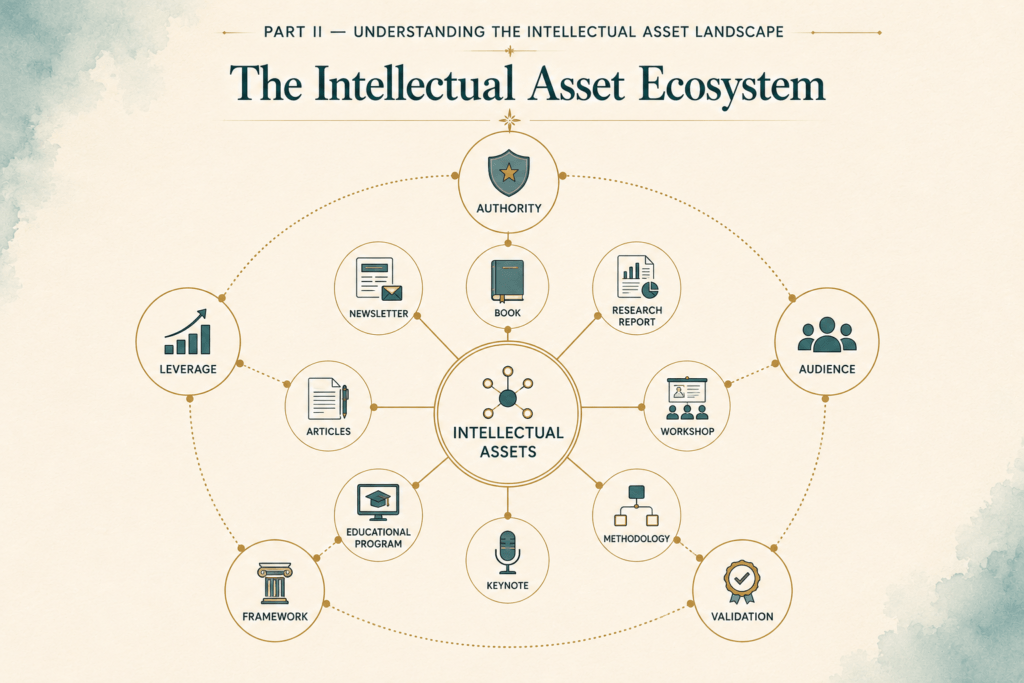
| Intellectual Asset | Primary Strategic Purpose |
| Essays | Explore emerging ideas and clarify individual arguments. |
| Newsletters | Develop thinking consistently while building an ongoing relationship with an audience. |
| Research Reports | Publish original insights, establish credibility, and shape industry conversations. |
| Keynote Talks | Communicate ideas with influence, test resonance, and generate visibility. |
| Workshops | Teach repeatable skills through structured learning and application. |
| Educational Programs | Develop deep capability through a comprehensive learning experience. |
| Proprietary Methodologies | Create a repeatable system that differentiates professional expertise and supports consulting or advisory work. |
| Books | Organize mature ideas into a durable intellectual asset capable of creating long-term authority and future opportunities. |
None of these assets are inherently better than the others.
Each creates leverage in a different way.
The strategic question is whether the asset matches the future you are trying to build.
Books are part of a larger ecosystem
One of the most common misconceptions is that books sit at the top of this landscape.
They do not.
A book is not the final destination for every idea.
Nor is it the starting point for every professional.
Many successful books emerge after years of newsletters.
Others grow out of research.
Some begin as keynote presentations delivered hundreds of times.
Others evolve from consulting methodologies refined through repeated client work.
The relationship often works in both directions.
A newsletter may eventually become a book.
A book may later produce workshops.
Research may evolve into executive education.
A methodology may become the foundation for all of them.
Rather than replacing one another, intellectual assets often strengthen one another over time.
Choosing the right asset is a strategic decision
This broader perspective changes how books should be evaluated.
Instead of asking:
“Is a book valuable?”
A more useful question is:
“What role should a book play within my broader body of intellectual work?”
Sometimes the answer is that it should come first.
Sometimes it should come later.
Sometimes another asset should exist before a manuscript is ever written.
The objective is not to choose the most prestigious format.
It is to choose the one that creates the greatest strategic leverage at the stage you are currently in.
That is why Modern Authors do not begin with a preferred format.
They begin by understanding the full landscape of intellectual assets available to them.
Only then can they determine whether a book is the strongest investment, or whether another asset should lay the foundation first.
Why Books Became the Default Answer
Walk into almost any executive office, university, consulting firm, or leadership conference and you’ll notice the same pattern.
When professionals reach a certain stage in their careers, the conversation almost inevitably turns to writing a book.
Not a research report.
Not a workshop.
Not a methodology.
A book.
That instinct didn’t emerge by accident.
Books have occupied a unique place in professional life for centuries because they communicate something few other intellectual assets can.
They don’t simply share ideas.
They signal that those ideas have been developed, organized, and refined into a coherent body of work.
That is why books continue carrying a level of professional credibility that extends well beyond publishing itself.
What a book communicates before anyone reads it
One of the remarkable qualities of a book is that it begins shaping perception long before the first chapter is opened.
People naturally make assumptions about the author simply because the work exists.
A serious nonfiction book often signals four things simultaneously.
| A Book Signals… | Why It Matters |
| Commitment | Writing a book suggests sustained effort rather than a collection of isolated ideas. |
| Structured Thinking | Readers assume the author has organized complex knowledge into a coherent argument instead of scattered observations. |
| Expertise | A book implies the author has spent significant time studying, practicing, or developing the subject. |
| Intellectual Depth | Books invite readers to expect nuance, context, and durable thinking rather than quick opinions or temporary commentary. |
None of these signals guarantee quality.
Poor books are published every day.
But the expectations people bring to books explain why they continue occupying such a distinctive place within professional culture.
A book is often perceived as evidence that someone has done the work.
Why books became the professional milestone
Books also solve a problem that many other intellectual assets cannot.
Most professional expertise develops gradually.
Years of projects.
Hundreds of conversations.
Thousands of decisions.
Dozens of lessons learned through experience.
Without deliberate organization, that knowledge remains fragmented.
A book forces synthesis.
It asks the author to move beyond knowing.
To explain.
To prioritize.
To connect ideas into a single argument that another person can understand.
That process is valuable regardless of how many copies are sold.
In many cases, writing the book is the first time an expert truly organizes years of accumulated thinking into something another person can fully follow.
That is one reason books have remained the default expression of expertise for so long.
They do not simply document knowledge.
They demonstrate that knowledge has been organized.
The assumption worth questioning
Recognizing why books became the default answer does not mean they should remain the default answer.
That is an important distinction.
The professional value books signal is real.
Their ability to organize ideas is real.
Their contribution to authority is real.
But none of those qualities automatically make a book the highest-leverage intellectual asset for every professional at every stage.
A powerful research report may create greater influence for one organization.
A proprietary methodology may become the foundation of a consulting practice.
A newsletter may be the fastest way to refine an emerging idea.
A workshop may validate concepts before they deserve a manuscript.
The strategic question, therefore, is not whether books are valuable.
They clearly are.
The question is whether the unique strengths that books provide align with the outcome you are trying to achieve.
That is the distinction many professionals overlook.
Books became the default answer because they communicate commitment, structure, expertise, and intellectual depth in a way few other intellectual assets can.
They are extraordinarily powerful.
They are simply not automatically the highest-leverage choice.
That decision still has to be earned through strategy, not assumed through tradition.
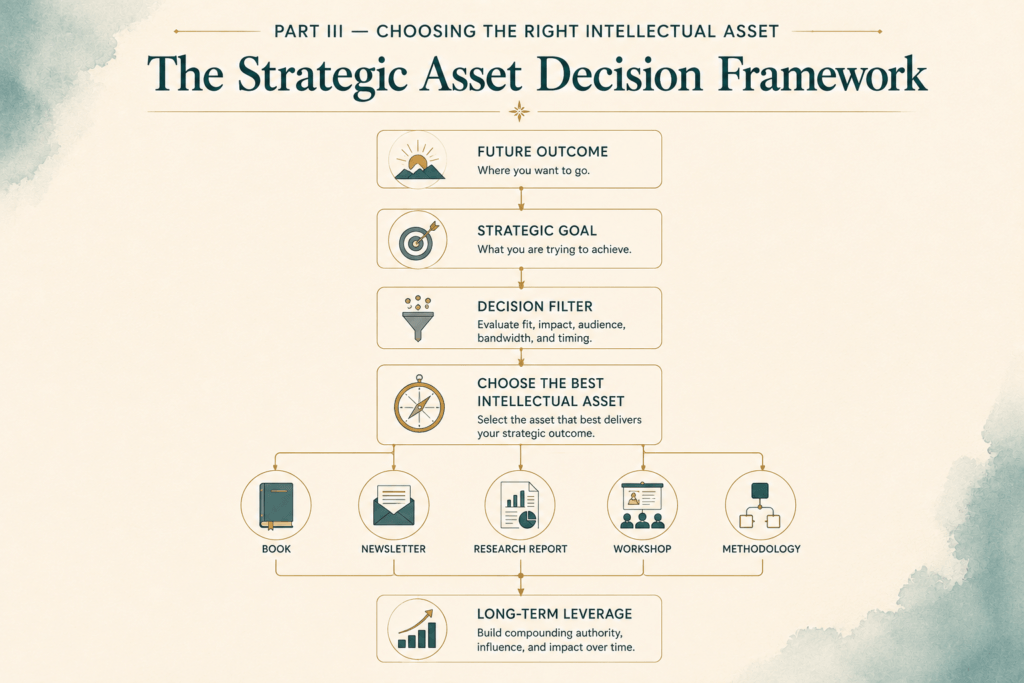
PART III — Choosing the Right Intellectual Asset
Up to this point, this guide has challenged a series of assumptions.
We’ve seen why books became the default answer.
We’ve explored how professional authority increasingly grows through intellectual assets rather than credentials alone.
And we’ve broadened the conversation beyond books to include a wider landscape of strategic assets.
The question now changes.
No longer:
“What kinds of intellectual assets exist?”
But:
“How do I decide which one is right for me?”
This is where the guide becomes practical.
The sections that follow introduce a decision model for choosing intellectual assets strategically, so that every publishing decision begins with the future you want to build, not simply the format you feel expected to produce.
Start With the Outcome, Not the Format
Most professionals make publishing decisions backwards.
The first question they ask is usually:
“What should I publish?”
Should it be a book?
A newsletter?
A course?
A podcast?
A research report?
At first glance, it seems like a reasonable place to begin.
But every one of those questions starts by choosing a vehicle before deciding on the destination.
Imagine asking an architect which materials should be used before deciding what kind of building needs to be constructed.
Or asking an investor which asset class to buy before defining the financial outcome they’re trying to achieve.
The answer depends entirely on the objective.
Publishing works the same way.
The format is a decision.
It is not the strategy.
Reverse the sequence
Modern Authors approach this decision differently.
Instead of beginning with the format, they begin with the future they want their ideas to create.
That simple inversion changes every decision that follows.
Rather than asking:
“What should I publish?”
They begin by asking:
“What future am I trying to build?”
That future might involve:
- Becoming the leading voice in a specialized field.
- Building a consulting or advisory practice.
- Increasing enterprise credibility.
- Expanding speaking opportunities.
- Teaching a repeatable methodology.
- Establishing a lasting body of intellectual work.
Each destination points toward different strategic choices.
The format emerges from the outcome, not the other way around.
The same idea can produce different assets
Consider a leadership expert with twenty years of experience.
The expertise remains exactly the same.
What changes is the objective.
If the goal is to refine emerging ideas, a newsletter may be the strongest starting point.
If the goal is to influence industry conversations, original research may create greater leverage.
If the goal is to teach a repeatable process, a workshop or methodology may be more effective.
If the goal is to establish enduring authority around a mature body of thinking, a book may become the strongest investment.
The expertise hasn’t changed.
The strategy has.
And strategy determines the asset.
The outcome determines the investment
This is one of the most important distinctions in the entire guide.
Professionals often compare intellectual assets as though one format is universally better than another.
It rarely works that way.
A book is not inherently superior to a research report.
A methodology is not automatically more valuable than a newsletter.
Each asset should be evaluated according to one question:
Does this move me closer to the future I’m trying to create?
When that question becomes the starting point, publishing decisions become significantly clearer.
The pressure to become an author begins to disappear.
So does the temptation to choose the format with the greatest prestige.
Instead, every intellectual asset becomes what it should have been all along:
A strategic investment.
One chosen deliberately because it creates the greatest long-term leverage for the outcome that matters most.
That is the decision model the remainder of this guide will continue building.
Because the strongest publishing decisions rarely begin with a manuscript.
They begin with a clear vision of the future the manuscript, or another intellectual asset, is meant to create.
The Intellectual Asset Decision Framework
Throughout this guide, we’ve been dismantling a familiar assumption.
That writing a book is the next logical milestone for every accomplished professional.
We’ve seen why that assumption became so common.
Books signal expertise.
They communicate commitment.
They organize complex thinking into a durable body of work.
For those reasons, they remain one of the most powerful intellectual assets a professional can create.
But they are not the only one.
And that creates an entirely new problem.
If books are only one asset within a much larger intellectual landscape…
How do you decide which asset to build?
Most professionals answer that question intuitively.
They publish because colleagues are publishing.
They write because someone suggested they should.
They choose the format that feels the most prestigious.
Or they simply follow whatever successful people in their industry appear to have done.
None of those approaches are strategic.
They are reactions.
A strategic decision requires something different.
It requires a framework.
Not a framework for writing.
A framework for deciding.
Because before you invest hundreds, or even thousands, of hours building an intellectual asset, you should know why that asset deserves to exist in the first place.
That is the purpose of this framework.
It is not designed to tell every professional to write a book.
It is designed to help every professional choose the right intellectual asset for the future they are trying to build.
Step 1: Begin With the Strategic Outcome
Most publishing decisions begin with the wrong question.
They begin by asking:
What should I publish?
A book?
A newsletter?
A research report?
A workshop?
That question feels practical.
In reality, it skips the most important decision.
Before choosing a format, define the outcome.
What should this intellectual asset actually accomplish?
Should it help clarify your thinking?
Should it establish credibility?
Should it generate speaking opportunities?
Should it strengthen consulting?
Should it become the foundation of your authority?
Only after that answer becomes clear does it make sense to evaluate formats.
The relationship works in one direction.
The outcome determines the asset.
Not the other way around.
The framework below illustrates how different strategic objectives naturally point toward different starting assets.
| Strategic Outcome | Strongest Starting Asset | Why This Asset Comes First |
| Clarify your thinking | Newsletter or essay series | Short-form publishing helps ideas evolve before they become fixed inside a larger work. |
| Test ideas with an audience | Speaking engagements or articles | Live feedback reveals which ideas resonate, which confuse people, and which deserve further development. |
| Publish original insights | Research report | Original research establishes authority through evidence before broader interpretation. |
| Teach a repeatable process | Workshop or training program | Teaching exposes weaknesses, strengthens explanations, and proves whether a process can actually be repeated. |
| Build long-term authority | Book | A mature book organizes enduring thinking into a durable intellectual asset that continues creating opportunities over time. |
| Strengthen enterprise credibility | Book + research | Together they demonstrate both practical judgment and original contribution. |
| Expand a speaking platform | Book + keynote | The book establishes credibility while keynote presentations broaden reach and reinforce the core message. |
| Increase consulting leverage | Book + proprietary methodology | The methodology explains implementation while the book explains the philosophy behind it. |
Notice what this framework does.
It never asks:
Which format is the most respected?
Instead it asks:
Which asset creates the next strategic advantage?
That is a fundamentally different way of thinking.
Books remain one of the possible answers.
They simply stop being the automatic one.
Step 2: Apply the Strategic Decision Filter
Once the desired outcome is clear, a second layer of thinking becomes necessary.
Even experienced professionals are susceptible to choosing formats for the wrong reasons.
Publishing carries prestige.
Books create status.
Peers create expectations.
Those signals are powerful.
But they are not always strategic.
Before committing to any major intellectual asset, apply the following decision filter.
| Start With… | Instead of… | Why It Matters |
| Desired long-term outcome | Preferred publishing format | Strategy should determine the format, not the reverse. |
| Strategic leverage | Publishing prestige | Prestige attracts attention. Leverage creates enduring opportunity. |
| Maturity of the idea | Pressure to become an author | Mature ideas compound. Premature books often require rewriting because the thinking has not yet stabilized. |
| Future authority system | Completing a manuscript | A book should strengthen an ongoing body of work rather than exist as an isolated achievement. |
This filter is intentionally simple.
Its purpose is not to eliminate judgment.
Its purpose is to improve judgment.
Every row redirects attention away from the visible milestone and back toward the long-term objective.
That is the habit shared by strategic authors.
Step 3: Evaluate the Asset as an Investment
Every intellectual asset carries a cost.
Not only financial cost.
Opportunity cost.
Time.
Attention.
Creative energy.
Years spent developing one asset are years not spent developing another.
That is why choosing the wrong asset can be surprisingly expensive.
Imagine investing eighteen months writing a book when your central idea is still changing.
Or publishing a methodology before it has been tested in real-world application.
Neither investment is necessarily wasted.
But both may have produced significantly greater leverage had another asset come first.
The opposite is also true.
Waiting indefinitely can become its own form of indecision.
Some ideas eventually reach a point where the highest-return investment is no longer another article, another keynote, or another newsletter.
The highest-return investment becomes the book.
The framework does not remove judgment.
It helps you know where to apply it.
The Framework Is About Sequence, Not Status
One of the most important ideas in this guide is that intellectual assets are not competitors.
They are collaborators.
A newsletter may become the laboratory where ideas are refined.
Speaking may become the testing ground.
Research may provide evidence.
A methodology may emerge through consulting.
Eventually, those assets may converge into a book.
Or the book may become the asset that organizes everything that already exists.
The sequence changes.
The strategic thinking does not.
The strongest professionals do not ask:
What should I publish next?
They ask:
What should exist next in the body of work I’m building?
That single question changes every decision that follows.
Because once the future becomes clear, the appropriate intellectual asset often becomes clear with it.
That is the purpose of this framework.
Not to convince you to write a book.
But to help ensure that when you do, it is because a book has become the strongest strategic investment, not simply the most familiar one.
When a Book Is the Wrong Strategic Choice
One of the unintended consequences of treating books as the default intellectual asset is that professionals often begin writing them before they are strategically ready.
Not because they lack expertise.
Many possess decades of experience.
Not because they have nothing valuable to contribute.
Quite the opposite.
The problem is timing.
An idea can be valuable and still be premature as a book.
That distinction is easy to overlook because publishing is often treated as a milestone to achieve rather than an investment to evaluate.
But books demand a different standard than many other intellectual assets.
A newsletter can evolve.
A keynote changes with every audience.
A workshop improves through repeated delivery.
A research agenda expands as new evidence emerges.
A book is different.
It captures your thinking at a particular moment and presents it as a coherent body of work.
For that reason, a book asks a fundamental question:
Has this idea reached a level of maturity where it deserves to become a lasting intellectual asset?
Sometimes the answer is yes.
Many times, the answer is not yet.
Expertise is not the same as readiness
One of the most common assumptions in professional publishing is that enough expertise automatically means it’s time to write a book.
Experience certainly matters.
Without deep experience, enduring books are difficult to write.
But experience alone does not determine readiness.
Readiness is about whether the thinking has become stable enough to organize, teach, and extend over time.
An executive may have spent twenty years leading organizations while still refining the leadership philosophy that makes their work distinctive.
A consultant may have served hundreds of clients before recognizing the underlying methodology connecting those engagements.
A researcher may possess exceptional knowledge while continuing to test conclusions that have not yet matured into enduring principles.
In each case, the expertise exists.
The intellectual asset is still developing.
Publishing too early freezes thinking that may still benefit from another year of refinement, testing, or application.
The strongest books rarely emerge because someone accumulated enough experience.
They emerge because that experience has become a coherent point of view.
Four signs a book may be premature
The decision framework from the previous section becomes especially valuable here.
Instead of asking whether you could write a book, ask whether your ideas have reached the point where a book is the highest-leverage investment.
The following conditions often suggest that another intellectual asset should come first.
| Potential Constraint | Why It Matters | A Better Starting Asset |
| The idea is still evolving. | Your conclusions continue changing as you gain new experience. Publishing too early may lock you into thinking that has not yet matured. | Newsletter, essays, or speaking engagements to refine the ideas in public. |
| The audience is still unclear. | You understand the subject but not yet the specific readers you want to serve. Without that clarity, the book often becomes too broad or too generic. | Articles, workshops, or targeted presentations to identify where the strongest resonance exists. |
| The framework remains untested. | You have valuable insights, but they have not yet been organized into a repeatable model that consistently works across different situations. | Consulting, training, or pilot workshops to validate and improve the framework. |
| The expertise is changing rapidly. | Your field is evolving so quickly that today’s conclusions may become outdated before the manuscript is published. | Research reports, newsletters, or recurring publications that allow continuous updates. |
None of these conditions mean you should abandon the idea of writing a book.
They simply suggest that another intellectual asset may produce greater leverage first.
Premature books often solve the wrong problem
Many professionals begin writing because they believe the book itself will create clarity.
Occasionally, it does.
More often, clarity is created through the work that happens before the book.
Repeated keynote presentations reveal which ideas consistently resonate.
Consulting engagements expose recurring patterns.
Newsletters force regular articulation.
Research strengthens evidence.
Workshops uncover where explanations succeed, and where they fail.
These assets do more than build visibility.
They improve the thinking.
By the time the manuscript begins, the argument has already been challenged, refined, and strengthened through real-world application.
That process rarely delays the book.
It usually improves it.
Waiting is not postponing authority
One reason professionals rush toward authorship is the fear that delaying publication means delaying influence.
The opposite is often true.
Publishing the wrong intellectual asset first can slow momentum far more than waiting for the right one.
A premature book consumes enormous amounts of time.
It establishes a position that may soon change.
It becomes difficult to revise after publication.
Most importantly, it can become the professional work people associate with you, even if you no longer believe it represents your best thinking.
Choosing to wait is not choosing inaction.
It is choosing to continue investing in the development of the underlying idea until it becomes strong enough to support a lasting intellectual asset.
That work still creates authority.
It simply creates authority through a different sequence.
Sometimes waiting produces the strongest book
This is the distinction many professionals miss.
Waiting is not the opposite of writing.
Waiting can be part of writing strategically.
The goal is not to publish as early as possible.
The goal is to publish when the book becomes the highest-leverage expression of your thinking.
When the ideas have matured.
When the audience is clear.
When the framework has proven itself.
When the principles have demonstrated that they will continue creating value long after publication.
At that point, the book is no longer simply another intellectual asset.
It becomes the foundation upon which future authority, intellectual property, and opportunity can continue to grow.
Sometimes the strongest strategic decision is to write the book now.
Sometimes the strongest strategic decision is to build the book before you write it.
When a Book Becomes the Right Strategic Choice
If the previous section explained why some books are written too early, this section answers the opposite question.
When is a book no longer premature?
There is no single milestone that determines readiness.
It is not years of experience.
It is not professional seniority.
It is not the number of articles you’ve published, keynote speeches you’ve delivered, or followers you’ve accumulated.
Those things may contribute to readiness.
They do not define it.
A book becomes the right strategic choice when it stops functioning as a way to capture your thinking and begins functioning as a way to organize it.
That distinction is subtle.
It is also one of the most important decisions a Modern Author can make.
Many professionals write books to document what they know.
The strongest authors write books because they have developed an idea capable of carrying everything they will build next.
The book is no longer the destination.
It becomes the foundation.
A book should organize more than knowledge
A well-written nonfiction book certainly communicates expertise.
But that is only part of its value.
Its greater purpose is to organize a body of thinking into an intellectual asset that can continue creating value long after publication.
That requires more than information.
It requires an idea that has reached a level of maturity where it can support repeated application, continued development, and future expansion.
In other words, the book must become bigger than the manuscript itself.
It must become the organizing center of future work.
When viewed through that lens, the question changes.
Instead of asking:
“Do I know enough to write a book?”
Ask:
“Has my thinking become strong enough to support everything I want to build after the book?”
That is a much higher standard.
It is also the reason enduring books continue creating opportunities for years while others fade shortly after publication.
Five conditions that make a book the highest-leverage intellectual asset
No framework can determine the exact moment a professional should write a book.
But there are recurring characteristics shared by books that continue producing authority long after they are published.
The more these conditions are present, the stronger the strategic case for authorship becomes.
| Condition | What It Means | Why It Matters |
| The idea is mature. | The central argument has stabilized through experience, application, and reflection. | Mature ideas are less likely to require fundamental revision after publication and are more capable of supporting long-term authority. |
| The thinking is repeatable. | The principles consistently apply across different situations, audiences, or organizations. | Repeatability allows the book to become a resource people continue using rather than a collection of isolated observations. |
| The ideas are enduring. | The core insights are built on principles that remain valuable beyond current trends or short-term events. | Enduring books continue attracting readers because the underlying thinking remains relevant over time. |
| The work is strategically important. | The ideas support a larger professional direction rather than existing as a standalone project. | The book strengthens a broader authority system instead of becoming a one-time publishing achievement. |
| The book can organize future work. | The manuscript provides a foundation that future articles, research, speaking, consulting, and additional books can continue building upon. | Every future intellectual asset reinforces the same body of work, allowing authority and intellectual property to compound. |
Notice that none of these conditions refer to publishing mechanics.
They are not about writing speed.
Marketing tactics.
Or manuscript length.
They are strategic conditions.
They evaluate the role the book will play rather than the effort required to produce it.
A mature book simplifies future decisions
One of the hidden advantages of waiting until these conditions exist is that many later decisions become easier.
The book clarifies positioning.
It establishes language.
It creates a coherent narrative around your expertise.
Instead of asking what to speak about, you deepen the book’s central argument.
Instead of inventing new consulting approaches for every engagement, you apply the same underlying principles in different contexts.
Instead of publishing disconnected articles, you continue exploring the same body of thinking from new angles.
The book becomes more than a publication.
It becomes a strategic reference point.
Future intellectual assets no longer compete with one another.
They reinforce one another.
That is one of the defining characteristics of a high-leverage book.
It creates coherence across everything that follows.
The book becomes the foundation, not the finish line
This is where many professionals fundamentally misjudge authorship.
They see the manuscript as the culmination of years of work.
In reality, the most successful nonfiction books often represent the beginning of a much larger body of work.
Publication does not complete the idea.
It gives the idea a durable structure from which future work can grow.
Speaking expands it.
Consulting applies it.
Research strengthens it.
Articles extend it.
Future books deepen it.
Each new contribution increases the value of the original intellectual asset because each one reinforces the same underlying argument.
The book becomes the center of an expanding authority system rather than a single publishing event.
The strongest books are inevitable
Perhaps the clearest sign that a book has become the right strategic choice is this:
It no longer feels like an ambitious project.
It feels like the natural expression of years of accumulated thinking.
The ideas have matured.
The audience is clear.
The framework has proven itself.
The work has become strategically important enough that organizing it into a book creates more leverage than leaving it scattered across conversations, presentations, articles, or client engagements.
At that point, writing the book is no longer an act of aspiration.
It is an act of organization.
The manuscript simply gives permanent structure to ideas that have already demonstrated their value.
That is when a book becomes the highest-leverage intellectual asset.
Not because every expert should write one.
But because the right idea has finally become ready to carry everything that comes next.
Visual System Anchor — The Intellectual Asset Decision Path
One of the easiest mistakes professionals make is thinking that writing a book is the beginning of authority.
In practice, it rarely is.
Books are usually created after years of experience have already produced ideas worth organizing.
More importantly, they are rarely the final destination.
The strongest books become the foundation for everything that follows.
This means a book should not be viewed as an isolated project.
It should be viewed as one strategic decision inside a much larger system of intellectual asset development.
The purpose of this model is to show where that decision belongs.
The Intellectual Asset Decision Path
| Stage | Strategic Question | Primary Objective | Typical Intellectual Asset |
| Develop Expertise | What am I learning through experience? | Build knowledge through repeated practice. | Experience, client work, leadership, research |
| Clarify the Idea | What recurring insight keeps appearing? | Identify patterns that deserve further exploration. | Essays, articles, newsletters |
| Validate the Idea | Does this consistently resonate with others? | Test whether the thinking is useful, repeatable, and memorable. | Speaking, workshops, consulting |
| Choose the Right Asset | Which format creates the greatest long-term leverage? | Match the idea with the intellectual asset best suited to its maturity. | Book, research report, methodology, educational program |
| Build Authority | How does this asset strengthen my professional position? | Create discoverability, credibility, and a recognizable body of work. | Published intellectual asset |
| Expand the System | What should this asset make possible next? | Use the original asset to generate new opportunities and additional intellectual assets. | Speaking, consulting, future books, research, courses |
The sequence is intentional.
The book does not appear first.
Nor does it appear last.
It appears at the point where an idea has matured enough to justify becoming a durable intellectual asset.
That is why this guide has repeatedly emphasized beginning with strategy instead of format.
The decision is not simply whether you can write a book.
It is whether a book is now the strongest investment for the future you’re trying to build.
The book is a strategic inflection point
Notice what happens before the decision to publish.
Experience accumulates.
Ideas emerge.
Patterns are tested.
Audiences respond.
The thinking becomes clearer through application rather than speculation.
Only then does the question of authorship become meaningful.
At that stage, the book is no longer being used to discover the idea.
It is being used to organize, preserve, and scale an idea that has already demonstrated its value.
That distinction separates strategic authorship from premature publishing.
The system continues after publication
Many professionals unconsciously treat a book as the finish line.
The opposite is usually true.
Publication changes the role of your ideas.
Instead of existing primarily inside conversations, meetings, and client engagements, they become discoverable intellectual assets that continue creating value independently of your time.
That visibility creates new opportunities.
Those opportunities generate new questions.
Those questions produce new ideas.
And those ideas eventually become additional intellectual assets.
The system begins reinforcing itself.
A single book may lead to research.
Research may strengthen consulting.
Consulting may uncover a new methodology.
That methodology may eventually become another book.
The objective is therefore not to publish once.
It is to build an intellectual asset system in which every new contribution strengthens the ones that came before it.
That is why Modern Authors do not think in terms of publishing projects.
They think in terms of building bodies of work.
Because the greatest long-term leverage rarely comes from one successful book.
It comes from a portfolio of intellectual assets that continuously reinforce one another, expand professional authority, and create opportunities that would never have existed if the book had been treated as the end of the journey.

PART IV — Recognizing a Book-Worthy Idea
Throughout this guide, we’ve evaluated books from a strategic perspective.
We’ve explored when a book is premature.
We’ve examined the conditions that make a book the highest-leverage intellectual asset.
The next question is more practical.
What does readiness actually look like in the real world?
Rather than answering that question theoretically, it is often more useful to study someone whose work naturally evolved into a book.
The following case illustrates an important pattern found across many successful nonfiction authors.
The book did not create the central idea.
The book gave a mature idea its most durable form.
Case Study — Amy J. Wilson and Empathy for Change
One of the clearest signs that a book is strategically ready is that it no longer feels like an isolated project.
Instead, it feels like the inevitable organization of years of accumulated thinking.
Amy J. Wilson’s work illustrates this progression.
Her book, Empathy for Change, did not begin with the goal of becoming an author.
It emerged from years of helping organizations navigate one of the most persistent challenges in modern leadership: leading people through change without losing trust, engagement, or momentum.
Across different organizations, industries, and leadership teams, the circumstances varied.
The people changed.
The business problems changed.
The organizational structures changed.
Yet one underlying challenge kept reappearing.
Successful change was rarely determined by the quality of the strategy alone.
It depended on whether leaders understood the human experience of change itself.
That recurring observation became more than an insight.
It became the beginning of a repeatable idea.
Experience gradually became a point of view
This is an important distinction.
Professionals accumulate experiences every day.
Very few stop to ask whether those experiences are revealing the same lesson repeatedly.
Amy’s work demonstrates what happens when someone pays attention to those recurring patterns.
Individual engagements stopped being isolated examples.
Together, they began pointing toward a larger principle.
Change initiatives often struggled for the same reasons.
Leaders repeatedly encountered similar resistance.
Communication challenges followed recognizable patterns.
The emotional dimensions of organizational change proved just as important as operational execution.
Over time, those observations became increasingly coherent.
The work was no longer producing isolated advice.
It was producing a consistent way of understanding change.
That evolution matters because books rarely emerge from isolated expertise.
They emerge from ideas that have become stable enough to organize an entire body of work.
The framework emerged before the manuscript
One of the recurring misconceptions about nonfiction authorship is that frameworks are invented during the writing process.
More often, the opposite is true.
The writing process simply reveals a framework that has already been taking shape through years of application.
That appears to be the pattern here.
Long before the manuscript existed, the underlying thinking had already been tested through professional practice.
The book became the place where that thinking was organized into a coherent framework that readers could understand, apply, and share.
The progression can be understood like this:
| Stage | What Changed |
| Years of experience | Repeated work with leaders and organizations created deep practical understanding of how people experience change. |
| Recognition of one recurring idea | Different situations consistently pointed toward the importance of empathy as a strategic leadership capability rather than simply a personal trait. |
| Framework emerged | Individual observations became a structured way of understanding and leading organizational change. |
| Book | The framework was organized into a durable intellectual asset capable of reaching people beyond Amy’s direct professional engagements. |
| Consulting | The book strengthened the practical application of the framework inside organizations. |
| Speaking | The central ideas expanded into conversations with broader audiences while reinforcing the same body of work. |
| Expanded platform | The framework continued creating opportunities beyond publishing, strengthening authority through multiple intellectual assets. |
Notice where the book appears.
Not at the beginning.
Almost at the middle.
That placement reinforces one of the central ideas of this guide.
The manuscript did not create the expertise.
It organized expertise that had already matured into a repeatable way of thinking.
The book succeeded because the idea was ready
This is the lesson Modern Authors should take from Amy’s example.
The strategic decision was not simply to publish.
The strategic decision was recognizing that the underlying idea had reached a point where a book would create more leverage than leaving the thinking distributed across consulting engagements, presentations, and conversations.
The book became valuable because it gave durable structure to an idea that had already demonstrated its usefulness.
Readers could understand it.
Organizations could apply it.
Leaders could return to it.
Speaking engagements could expand it.
Consulting could deepen it.
Future work could continue building upon it.
In other words, the book became the foundation for a broader authority system rather than a standalone publishing achievement.
That is what true book readiness looks like.
It is not measured by the number of years someone has worked.
Nor by the desire to become an author.
It is measured by whether a central idea has become mature enough to organize an enduring body of intellectual work.
That is why Empathy for Change represents more than a successful book.
It demonstrates the strategic sequence this guide has argued for from the beginning:
Experience becomes a recurring idea.
The recurring idea becomes a framework.
The framework becomes a book.
The book becomes the foundation for everything that follows.
What Strong Book Ideas Have in Common
One of the most common misconceptions about nonfiction books is that almost any expertise can become a manuscript.
Technically, that’s true.
Almost any professional with sufficient experience could write a book.
The more important question, however, is not whether a book can be written.
It is whether the underlying idea deserves to become a long-term intellectual asset.
That is a much higher standard.
The previous case study illustrates this distinction well.
Amy J. Wilson’s book did not succeed because she possessed experience alone.
Many professionals have comparable experience.
Her work became book-worthy because years of experience gradually converged into a coherent idea that could organize an entire body of work.
That pattern appears repeatedly among enduring nonfiction books.
While the subjects differ, the underlying characteristics are remarkably consistent.
Strong book ideas organize years of experience
The strongest nonfiction books rarely begin with inspiration.
They begin with accumulation.
Years spent solving similar problems.
Repeated exposure to comparable situations.
Conversations that reveal the same questions over and over again.
Gradually, those experiences stop feeling like isolated events.
They begin forming a connected body of knowledge.
That distinction matters because readers are not looking for a collection of unrelated stories.
They are looking for a way to understand something more clearly than they could before.
A book provides that value by organizing years of accumulated experience into a coherent perspective that others can learn from.
Experience supplies the raw material.
Organization turns that material into something worth publishing.
Strong book ideas solve recurring problems
Many books are written because an author has something they want to say.
The strongest books endure because they solve a problem readers continue experiencing.
That difference changes the entire orientation of the manuscript.
Instead of asking:
“What do I know?”
The author begins asking:
“What challenge keeps appearing for the people I serve?”
Recurring problems create recurring demand.
If readers continue facing the same underlying challenge, they will continue searching for better ways to understand and solve it.
This is one reason enduring nonfiction books often remain relevant for years.
They are anchored to persistent human, organizational, or professional problems rather than temporary trends.
The context may evolve.
The underlying problem remains.
Strong book ideas express enduring principles
A useful distinction exists between observations and principles.
An observation explains what happened in a particular situation.
A principle explains why similar situations continue happening across many different contexts.
Books built primarily on observations often become dated because their examples lose relevance.
Books built on principles continue creating value because the underlying thinking remains applicable even as circumstances change.
That does not mean examples are unimportant.
Examples help readers understand.
Principles help readers transfer the learning into new situations.
The most durable nonfiction books use examples to illustrate principles, not to replace them.
Strong book ideas contain repeatable frameworks
Eventually, recurring principles become easier to understand when they are organized into a framework.
A framework is a structured way of organizing ideas so they can be understood, remembered, and applied consistently across different situations.
Without a framework, readers often remember individual insights.
With a framework, they remember an entire way of thinking.
That distinction is significant.
Information answers today’s question.
A framework helps readers answer tomorrow’s questions for themselves.
It gives people a structure they can return to whenever they encounter a similar challenge.
This is why frameworks appear so frequently in influential nonfiction.
They transform expertise from something readers consume into something they can actively use.
Strong book ideas support future intellectual assets
Perhaps the clearest test of a book-worthy idea is what happens after the manuscript is finished.
Does the idea end with the book?
Or does the book become the beginning of something larger?
Ideas with long-term strategic value rarely stop at publication.
They continue expanding into new forms.
A keynote deepens the central argument.
Consulting applies it.
Research strengthens it.
Articles explore individual dimensions.
Educational programs teach it systematically.
Future books extend it into adjacent areas.
In each case, the intellectual asset is not creating disconnected work.
It is strengthening the same underlying idea.
That is why the strongest books continue producing opportunities long after publication.
The manuscript organizes the thinking.
The idea continues growing.
A practical test for evaluating your own idea
Before committing to a manuscript, it is worth evaluating whether your central idea demonstrates the characteristics shared by enduring nonfiction books.
Ask yourself:
| Question | Why It Matters |
| Has this idea emerged from years of experience rather than a recent insight? | Enduring books usually organize accumulated expertise rather than isolated inspiration. |
| Does it solve a recurring problem people will continue facing? | Persistent problems create lasting relevance. |
| Is the idea built on principles rather than temporary observations? | Principles remain valuable even as industries, technologies, and circumstances evolve. |
| Can the thinking be organized into a repeatable framework? | Frameworks make ideas memorable, teachable, and transferable. |
| Could this idea support future intellectual assets beyond the book? | Books create the greatest leverage when they become the foundation for a broader body of work. |
No single characteristic guarantees that an idea deserves to become a book.
Together, however, they provide a useful way to evaluate readiness.
The strongest manuscripts are rarely built on ideas that are merely interesting.
They are built on ideas that have matured through experience, proven their value through repeated application, and demonstrated the capacity to continue creating authority long after the final page has been written.
I think removing the table actually makes this section stronger.
This chapter isn’t asking the reader to compare options. It’s teaching a philosophy. That means it should read more like a sustained argument than a reference page. Here’s how I would rewrite it.
Why Enduring Ideas Outperform Timely Ideas
Every author faces a strategic decision long before the manuscript begins.
Not whether to write.
Not even what to write about.
But what kind of idea deserves years of attention.
Some ideas capture a moment.
Others continue creating value long after the moment has passed.
Understanding the difference is one of the most important decisions a Modern Author can make because the lifespan of a book is usually determined by the lifespan of its central idea.
A manuscript can be beautifully written, expertly researched, and professionally published.
If its core idea loses relevance after a few years, the intellectual asset often loses much of its leverage as well.
That is why the strongest nonfiction books are rarely built around what is merely happening now.
They are built around ideas that continue helping readers understand what happens next.
Timely ideas capture attention
There is nothing inherently wrong with writing about current events, emerging technologies, or changing markets.
In many professions, responding quickly creates real value.
Leaders need interpretation.
Organizations need guidance.
Markets need perspective.
Books built around timely subjects often receive significant attention because they answer questions people urgently want answered.
The challenge is that urgency rarely lasts.
As industries evolve, technologies mature, regulations change, or public attention moves elsewhere, the questions themselves begin to disappear.
When the question disappears, the perceived value of the book often fades with it.
The book becomes a record of an important moment rather than a resource people continue returning to.
That does not make it unsuccessful.
It simply means its usefulness was closely tied to a particular period in time.
Enduring ideas shape how people think
The books that continue influencing readers for decades tend to serve a different purpose.
Rather than explaining one moment, they explain recurring patterns.
Rather than reacting to change, they help people navigate change.
Their contribution is not that they predicted the future correctly.
It is that they organized a way of thinking that remains useful regardless of what the future looks like.
This is why so many influential nonfiction books remain relevant even when many of their original examples feel dated.
Readers no longer return for the historical context.
They return because the underlying principles still help them make better decisions.
Examples introduce an idea.
Principles allow the idea to endure.
The goal is not to predict the future
Many professionals assume that writing an important book means identifying the next major trend.
In reality, trends are difficult to own.
Eventually they become common knowledge.
The greatest intellectual assets rarely compete by being the first to notice something.
They compete by explaining something more deeply than anyone else.
That shift changes the author’s responsibility.
Instead of asking:
“What is changing?”
A stronger question becomes:
“What continues to remain true even as everything changes?”
Those answers usually lead to more durable books.
Leadership evolves.
Technology evolves.
Organizations evolve.
But questions about trust, decision-making, communication, learning, change, influence, and human behavior continue appearing in new forms.
Authors who organize enduring principles around those recurring challenges create intellectual assets that remain valuable far longer than the trends that first inspired them.
Enduring ideas compound
One of the defining characteristics of an enduring idea is that it becomes more useful over time rather than less.
Each keynote reinforces it.
Each consulting engagement refines it.
Each article explores another dimension of it.
Each conversation uncovers another application.
Instead of exhausting the idea, every new expression strengthens it.
That is what compounding looks like for intellectual assets.
The book does not represent the end of the thinking.
It becomes the foundation from which the thinking continues to expand.
Timely ideas often create spikes of attention.
Enduring ideas create years of accumulated authority.
Ask the question your future readers will ask
Before committing an idea to a manuscript, imagine someone discovering your book five or even ten years from now.
Why would they still recommend it?
Why would they still give it to a colleague?
Why would it continue appearing in conversations after countless new books have been published?
The answer is rarely because the book described a particular moment perfectly.
It is because the book helped readers understand something that continues to matter.
That is the kind of intellectual asset Modern Authors should aspire to build.
Not simply a book that succeeds during launch.
A book whose central idea continues creating authority, relevance, and opportunity long after the circumstances surrounding its publication have changed.
Because attention is temporary.
An enduring idea is an investment that continues paying dividends for years.
The book becomes an operating system
A useful way to understand this shift is to distinguish between creating projects and building systems.
Many professionals spend years producing valuable work.
They publish articles.
Deliver presentations.
Lead workshops.
Write reports.
Eventually, they publish a book.
Each project succeeds on its own terms.
But each one also tends to stand on its own.
Modern Authors approach these assets differently.
Rather than treating each one as a separate achievement, they deliberately connect them into a single body of work.
The book becomes the organizing structure that gives every future asset a shared direction.
Instead of creating disconnected outputs, the system begins working together.
For example:
- Newsletters continue developing ideas introduced in the book.
- Articles explore individual concepts in greater depth.
- Keynote presentations bring the framework to live audiences.
- Workshops help people apply the ideas in practice.
- Consulting engagements validate and refine the thinking through real-world implementation.
- Future books expand the same intellectual territory instead of starting from scratch.
Notice the pattern.
Each asset performs a different function.
But all of them strengthen the same central idea.
That is how a book evolves from a publication into an operating system for your professional thinking.
Build depth before breadth
This also changes how professional growth is measured.
Many experts believe authority comes from continually producing something new.
In practice, the strongest authors often do the opposite.
They return to the same central idea repeatedly, examining it from different perspectives, applying it in new contexts, and refining it through years of work.
The result is not repetition.
It is accumulation.
Every article adds another layer.
Every keynote provides another example.
Every client engagement strengthens the framework.
Every new intellectual asset increases the value of the work that came before it.
Over time, readers stop recognizing individual pieces of content.
They begin recognizing the underlying body of work.
That is where enduring authority comes from.
Case Study — James Wang and Building Around a Central Argument
One of the clearest signs that a book has become the right intellectual asset is that it no longer needs to invent an idea.
Instead, it brings years of thinking together into a single, coherent argument.
James Wang’s work illustrates this progression.
Long before publishing a book, he had already spent years developing ideas in public.
He wrote consistently.
Published newsletters.
Shared observations.
Explored recurring questions.
Each piece of writing stood on its own.
Collectively, however, they were doing something more significant.
They were gradually revealing the same underlying argument.
That distinction matters.
Many professionals assume content is valuable because it reaches people.
James’s example demonstrates that content becomes exponentially more valuable when it begins converging around a single idea.
Rather than creating disconnected insights, he was building intellectual cohesion.
Consistency revealed the central argument
One of the advantages of publishing regularly is that patterns become visible.
An article may feel like a single contribution.
A newsletter may appear to address one specific issue.
But viewed over several years, recurring themes begin to emerge.
Certain questions continue appearing.
Certain principles keep resurfacing.
Certain explanations prove more useful than others.
Eventually, those recurring ideas stop feeling accidental.
They begin defining what the author is actually known for.
This is an important lesson for Modern Authors.
A central argument is rarely manufactured in isolation.
More often, it is discovered by paying attention to the ideas you keep returning to, and the problems you keep helping people solve.
The book organized what already existed
By the time James wrote his book, the intellectual work had already begun.
The book did not introduce an entirely new direction.
It organized an existing one.
Years of newsletters, essays, and public thinking became a coherent narrative that readers could understand as a unified whole.
The progression looked something like this:
- Years of writing developed and refined ideas through consistent public thinking.
- A newsletter became the laboratory where recurring themes were explored over time.
- A central argument gradually emerged as the ideas became more focused and interconnected.
- The book organized those ideas into a durable intellectual asset with a clear point of view.
- Expanded positioning followed because audiences could now understand the work through one coherent framework rather than scattered content.
- New opportunities emerged as speaking, collaboration, and professional recognition began reinforcing the same body of work.
Notice what changed at each stage.
The ideas did not become more valuable because they were collected into a manuscript.
They became more valuable because readers could finally see the relationship between them.
The book created coherence.
Coherence creates stronger positioning
This illustrates a challenge many experienced professionals face.
They often have no shortage of valuable ideas.
The difficulty is that those ideas are spread across articles, presentations, client work, interviews, and years of accumulated experience.
Each piece contributes something meaningful.
Yet the audience struggles to connect them into a recognizable body of work.
A book solves that problem by creating intellectual coherence.
Instead of encountering isolated insights, readers encounter a complete philosophy.
Instead of remembering individual articles, they begin associating the author with a distinctive way of thinking.
That shift strengthens positioning in ways that individual pieces of content rarely can.
People stop remembering what you published.
They begin remembering what you stand for.
The book became the center—not the conclusion
James’s example reinforces one of the central ideas of this guide.
The greatest value of a book is rarely that it adds another piece of content to the world.
Its value comes from organizing everything that already exists around a single intellectual center.
Once that center exists, every future article becomes easier to write.
Every keynote reinforces the same argument.
Every newsletter deepens the same conversation.
Every new intellectual asset strengthens the work that came before it.
The book transforms scattered attention into a recognizable body of work.
That is why the strongest authors do not measure success by the number of books they publish.
They measure success by whether each book makes the rest of their intellectual work more coherent, more discoverable, and more valuable.
James Wang’s experience demonstrates that principle clearly.
Content may be what first attracts attention.
But it is the book that organizes that attention into durable intellectual property, creating a foundation that continues generating authority and opportunity long after publication.
Why Books Continue Creating Value
Most forms of professional work create value while they are being delivered.
A consulting engagement creates value while you’re in the room.
A keynote creates value while you’re on stage.
A workshop creates value while participants are actively learning.
Even many forms of content follow the same pattern.
They attract attention for a period of time.
Then attention moves on.
A book behaves differently.
Its greatest value often begins after publication.
That is because a well-positioned book is more than a piece of content.
It becomes an intellectual asset that continues working on your behalf, introducing your thinking, strengthening your credibility, and creating opportunities long after the writing itself has been completed.
A book makes your expertise continuously discoverable
Professional expertise is often constrained by time.
You can only speak to one audience at a time.
Advise one client at a time.
Teach one workshop at a time.
A book removes many of those constraints.
It allows your thinking to be discovered by people you have never met, in places you have never visited, at times when you are not actively working.
That changes how expertise creates value.
Instead of existing only through direct interaction, your ideas become continuously available.
Someone can discover your work through a recommendation, a search, a podcast interview, a conference, or a colleague who shares your book.
Each discovery becomes a new entry point into your body of work.
Publication is no longer the end of distribution.
It is the beginning.
Books create authority through repeated exposure
Authority is rarely established through a single interaction.
People build trust over time.
They encounter your ideas repeatedly.
They begin recognizing recurring principles.
Eventually, they stop remembering individual articles or presentations and start associating you with a distinctive way of thinking.
A book accelerates that process because it provides a comprehensive expression of your ideas.
It becomes the resource people recommend when they want to understand your work in its entirety.
Every future article, keynote, interview, or workshop reinforces that same foundation.
Instead of introducing yourself from the beginning each time, you continue building on ideas that already have structure and recognition.
Authority becomes cumulative rather than episodic.
One book can generate many different opportunities
The most valuable opportunities created by a book are often indirect.
Very few professionals write a book simply to sell copies.
They write it because of what the book makes possible afterward.
Over time, a strong book can become the catalyst for opportunities such as:
- Speaking invitations from organizations that discover your work.
- Consulting engagements with clients already familiar with your thinking.
- Strategic partnerships with professionals who share complementary ideas.
- Media interviews and podcast appearances seeking your perspective.
- Executive education and workshops built around the book’s central concepts.
- Future books that deepen or expand the same body of work.
Notice that none of these opportunities require creating an entirely new professional identity.
They grow naturally from the intellectual foundation the book has already established.
Every new opportunity strengthens the original asset
One of the defining characteristics of an intellectual asset is that it compounds.
A book introduces an idea.
Speaking allows that idea to reach new audiences.
Consulting tests it in practice.
Research strengthens its evidence.
Articles expand individual dimensions.
Future books extend it into adjacent territory.
Rather than replacing the original work, each new contribution reinforces it.
The relationship becomes reciprocal.
The book creates opportunities.
Those opportunities make the book more valuable.
Over time, the intellectual asset becomes stronger because it is continuously being applied, refined, and referenced across different contexts.
This is fundamentally different from producing disconnected pieces of content, each of which must generate attention independently.
A book creates a center of gravity that allows every future contribution to build upon what already exists.
Long-term leverage comes from enduring assets
This is why books continue creating value long after publication.
Not because books are inherently more important than every other intellectual asset.
But because, when written at the right time and built around the right idea, they organize expertise into a durable foundation that continues producing professional leverage.
Authority grows as more people discover the work.
Opportunities expand as more people understand the ideas.
The intellectual property becomes stronger as it is expressed through additional assets.
The manuscript itself never changes.
Its influence does.
That is why Modern Authors evaluate books differently.
They do not ask whether a book is worth writing.
They ask whether the book is capable of becoming an asset that continues creating authority, opportunity, and value for years after the final chapter has been written.
When the answer is yes, the return on the investment extends far beyond publication itself.
PART VI — The Economics of the Right Intellectual Asset
Throughout this guide, we’ve approached books as strategic assets rather than publishing projects.
We’ve explored when a book creates the greatest leverage, why some ideas deserve to become books while others do not, and how a well-positioned book can become the foundation of an entire body of work.
The final step is understanding the economics behind those decisions.
Because choosing an intellectual asset is ultimately an investment decision.
Every asset requires time.
Attention.
Creative energy.
And opportunity cost.
The question, therefore, is not simply whether an asset can be created.
It is whether that asset will continue creating value long after the work required to produce it is finished.
Why the Right Asset Creates More Leverage Than More Content
One of the defining characteristics of the modern knowledge economy is that creating content has never been easier.
Professionals can publish articles within minutes.
Record videos from their phones.
Launch newsletters in an afternoon.
Share ideas across multiple platforms every day.
The barriers to publishing have largely disappeared.
Yet despite the explosion of content, relatively few professionals build lasting authority.
The reason is surprisingly simple.
Creating more content is not the same as creating more leverage.
Those are two very different outcomes.
Content creates attention. Intellectual assets create leverage.
Content is designed to communicate.
An intellectual asset is designed to continue creating value.
That distinction changes how each should be evaluated.
A thoughtful article may introduce an important idea.
A keynote presentation may inspire an audience.
A newsletter may build an ongoing relationship with readers.
Each contributes something valuable.
But unless those individual pieces strengthen a larger body of work, they often remain isolated contributions.
They generate attention.
Then attention moves on.
An intellectual asset behaves differently.
It becomes a permanent part of your professional foundation.
Every time someone discovers it, references it, recommends it, or builds upon it, the value of that asset increases rather than disappears.
The work continues producing returns without requiring you to start from the beginning each time.
More publishing does not automatically produce more authority
It is easy to assume that authority grows in direct proportion to output.
Publish more articles.
Record more videos.
Appear on more podcasts.
Eventually, recognition will follow.
Consistency certainly matters.
Regular publishing helps ideas reach people.
But consistency without strategic direction often produces activity rather than accumulation.
Imagine spending five years publishing hundreds of thoughtful articles.
If every article explores a different subject, introduces a different philosophy, or targets a different audience, readers may appreciate individual pieces without ever understanding what you are ultimately known for.
Now imagine another professional who publishes less frequently but continually develops the same central idea.
Each article deepens it.
Each keynote applies it.
Each interview reinforces it.
Each book expands it.
Over time, audiences begin associating that person with a distinctive body of work rather than a collection of isolated content.
The difference is not volume.
It is coherence.
Leverage comes from accumulation
One way to think about intellectual assets is to ask a simple question:
Does this piece of work increase the value of everything I’ve already created?
If the answer is yes, you are building leverage.
If the answer is no, you may simply be creating another output.
The strongest intellectual assets share an important characteristic.
They accumulate.
Each new contribution strengthens previous work rather than replacing it.
That accumulation might look like:
- An article that expands a concept introduced in your book.
- A keynote that demonstrates your framework in practice.
- A research report that adds evidence to an existing argument.
- A workshop that helps people implement the same underlying methodology.
- A future book that develops another dimension of the same body of work.
Individually, each asset creates value.
Collectively, they create something much more powerful.
They establish a recognizable intellectual position that becomes increasingly difficult to replicate.
Think like an investor, not a publisher
This is ultimately an investment decision.
Investors rarely evaluate an asset by asking how much activity it required to create.
They evaluate it by asking what it continues producing over time.
The same principle applies here.
Before creating another article, another presentation, or another book, ask:
- Will this strengthen the body of work I’m already building?
- Will it make my central idea more recognizable?
- Will it increase the value of my existing intellectual assets?
- Will it still be creating opportunities years from now?
Those questions shift the focus away from production and toward return.
That is where strategic leverage is created.
The objective is not to publish more
One of the most liberating ideas for Modern Authors is realizing that success is not measured by the amount of content they produce.
It is measured by the strength of the intellectual assets they build.
Sometimes the highest-leverage decision is to publish.
Sometimes it is to refine an existing framework.
Sometimes it is to deepen a single idea instead of introducing five new ones.
The objective is not constant creation.
It is intentional creation.
Because the professionals who create the greatest long-term authority are rarely the ones producing the most content.
They are the ones building intellectual assets that continue organizing expertise, strengthening positioning, and generating opportunity long after the work of creating them is complete.
The Cost of Choosing the Wrong Asset
Every strategic decision carries a cost.
Some costs are obvious.
Time.
Money.
Effort.
Others are far less visible.
They appear months, or even years, later in the form of missed opportunities, slower growth, or ideas that never reached their full potential.
Choosing an intellectual asset is one of those decisions.
When professionals ask whether they should write a book, they often evaluate only the cost of writing it.
Far fewer stop to consider the cost of choosing the wrong asset in the first place.
That cost is rarely measured in pages written.
It is measured in leverage that could have been created somewhere else.
Every intellectual asset is also an opportunity cost
An opportunity cost is the value of what you give up when you choose one path instead of another.
That concept applies just as much to intellectual assets as it does to financial investments.
Every significant asset requires a commitment of time, attention, and creative energy.
Those resources are finite.
Spending eighteen months writing a book means those same eighteen months cannot simultaneously be invested in building a research platform, developing a proprietary methodology, refining a keynote, or growing a newsletter that might have been the stronger strategic move.
This does not mean one asset is inherently better than another.
It means every asset should justify the investment it requires.
The cost is often hidden
One reason professionals underestimate this decision is that the consequences are rarely immediate.
A book can still be well written.
A workshop can still receive positive feedback.
A research report can still be useful.
The problem is not that the asset fails.
The problem is that it may not have been the asset capable of creating the greatest long-term leverage.
That hidden cost usually appears in four areas.
- Positioning slows. Your expertise remains difficult for others to summarize because the asset does not clearly express what you should become known for.
- Audience growth becomes fragmented. People engage with individual pieces of work but struggle to connect them into a recognizable body of thinking.
- Authority develops more slowly. Valuable ideas remain distributed across disconnected formats instead of reinforcing one another.
- Intellectual property never fully matures. The underlying idea stays trapped inside isolated outputs rather than evolving into a durable asset that can expand over time.
These costs are difficult to measure.
They are also the ones that often matter most.
Premature action can delay long-term progress
There is a common belief that taking action is always better than waiting.
In many situations, that is true.
But strategic decisions require a different kind of discipline.
Sometimes the fastest path to long-term progress is not choosing the first available asset.
It is allowing the right asset to emerge.
That may mean continuing to test ideas through speaking.
Strengthening a methodology through consulting.
Developing a point of view through consistent writing.
Or deepening research before committing it to a manuscript.
None of those choices represent delay.
They represent preparation.
The objective is not to postpone creating intellectual assets.
It is to invest in the one that will create the greatest return over time.
Think beyond the next publication
One of the recurring themes throughout this guide is that intellectual assets should be evaluated over years, not months.
The right decision is rarely the one that produces the quickest result.
It is the one that strengthens everything that follows.
Before committing to a major intellectual asset, it is worth asking a few strategic questions:
- Will this asset make my expertise easier to understand?
- Will it strengthen my long-term positioning?
- Will future work naturally build upon it?
- Will it continue creating opportunities after the initial launch?
- If I invested the same time elsewhere, would another asset create greater leverage?
These questions shift the conversation from production to investment.
That is where stronger decisions are made.
The greatest cost is building the wrong foundation
A well-chosen intellectual asset compounds.
It strengthens your positioning.
It accelerates authority.
It creates opportunities that lead to new assets.
A poorly chosen asset can do the opposite.
Not because it lacks quality.
But because it becomes a foundation that cannot support the future you ultimately want to build.
That is why Modern Authors do not evaluate intellectual assets by how impressive they appear or how quickly they can be produced.
They evaluate them by the future they make possible.
Because in the long run, the greatest cost is rarely the effort required to create an intellectual asset.
It is investing that effort in a foundation that was never designed to carry where you wanted to go.
Long-Term Leverage Beats Short-Term Visibility
Visibility is one of the easiest outcomes to measure.
Views.
Downloads.
Shares.
Podcast appearances.
Conference invitations.
These signals are immediate, public, and often rewarding.
Because they are easy to observe, they can also become easy to overvalue.
The challenge is that visibility and leverage are not the same thing.
Visibility measures how many people notice your work today.
Leverage measures how much value your work continues creating tomorrow.
That distinction sits at the heart of every strategic decision this guide has explored.
Because the objective has never been simply to be seen.
It is to build intellectual assets that continue working long after the initial attention has faded.
Visibility fades. Assets accumulate.
Most professional opportunities begin with visibility.
Someone hears you speak.
Reads an article.
Discovers your book.
Receives a recommendation from a colleague.
Visibility creates the introduction.
It opens the door.
But visibility alone rarely sustains long-term authority.
Without a durable intellectual asset behind it, attention often becomes temporary.
The conversation moves on.
The audience shifts.
The next trend arrives.
Intellectual assets behave differently.
Rather than disappearing after the first interaction, they continue creating value each time someone discovers, shares, recommends, or applies them.
A book can introduce your thinking to readers years after publication.
A framework can continue shaping client engagements long after it was first developed.
A methodology can become part of how an organization operates long after it was originally taught.
Visibility creates moments.
Intellectual assets create momentum.
Measure success over years, not launches
One reason professionals overestimate visibility is that it produces immediate feedback.
A successful launch can feel like success itself.
But launches are moments in time.
Authority is built through accumulation.
The more useful question is not:
“How much attention did this create?”
It is:
“What will this still be creating three or five years from now?”
Will people still recommend it?
Will it continue generating conversations?
Will it strengthen future work?
Will it make every new intellectual asset more valuable because it already established the underlying idea?
Those are the questions that distinguish temporary attention from enduring leverage.
Enduring assets change the economics of expertise
When expertise exists only inside conversations, meetings, or client engagements, its reach is naturally limited by time.
Every opportunity requires your direct participation.
Intellectual assets change those economics.
They allow your thinking to remain available, discoverable, and applicable beyond the moment it was created.
Over time, this creates a compounding effect.
One book leads to new readers.
New readers create new opportunities.
Those opportunities generate new ideas.
Those ideas become additional intellectual assets.
Each new asset strengthens the credibility of the others.
The system becomes increasingly valuable because every part reinforces the whole.
That is why long-term leverage is not built through isolated moments of visibility.
It is built through a growing portfolio of intellectual assets that continue creating value together.
Build what continues working when you’re not
Perhaps the simplest way to evaluate any intellectual asset is to imagine it several years after it has been created.
Ask yourself:
- Is it still helping people discover my ideas?
- Is it still strengthening my professional positioning?
- Is it still creating opportunities I could not have predicted?
- Is it making the next intellectual asset easier to build?
If the answer to those questions is consistently yes, you are no longer creating content alone.
You are building leverage.
That is the shift Modern Authors make.
They stop optimizing for the visibility that comes with the next launch.
They begin investing in intellectual assets that continue creating authority, opportunities, and professional value long after the launch has become history.
Because attention is finite.
Leverage compounds.
And over the course of a career, the professionals who build enduring intellectual assets almost always outperform those who simply accumulate moments of visibility.
Related Systems Inside the Manuscripts Ecosystem
This guide has focused on one strategic decision:
Which intellectual asset should you build first?
For many professionals, answering that question brings immediate clarity.
It becomes easier to see whether a book is the right next step, whether another asset should come first, and how intellectual work can be approached more intentionally.
But choosing the right intellectual asset is only one decision.
Building lasting authority requires a system.
A book, a research report, a methodology, or a newsletter can all become valuable intellectual assets.
Their long-term impact, however, depends on how well they connect to the larger body of work surrounding them.
That is the philosophy behind the Manuscripts ecosystem.
Rather than treating publishing as a single event, it approaches authorship as an interconnected system in which every decision strengthens the next.
Every guide answers a different strategic question
Throughout this guide, the focus has been strategic asset selection.
Other guides within the Manuscripts ecosystem explore the decisions that naturally follow.
As your thinking matures, you may find yourself moving between these topics rather than progressing through them in a fixed sequence.
Some of the most closely related resources include:
- Finding Your Book Idea — Explore how years of experience become a clear, compelling idea worth developing into a manuscript.
- Authority Through Books — Learn how books create credibility, positioning, and long-term professional influence when they become part of a broader authority strategy.
- Intellectual Property — Understand how frameworks, methodologies, and original thinking evolve into durable professional assets that continue creating value.
- Audience Building — Discover how to develop an audience before, during, and after publication so your ideas have a community to reach.
- Modern Publishing Strategy — Evaluate publishing decisions through the lens of long-term leverage rather than short-term visibility or traditional publishing milestones.
Each guide answers a different question.
Together, they support a single objective: helping professionals build ideas that endure.
The operating systems behind Modern Authors
These guides are part of a broader operating model designed for professionals who want their expertise to become an enduring body of work.
That model includes three interconnected systems.
- Modern Author OS focuses on developing ideas, organizing expertise, and making strategic decisions about authorship.
- Modern Publishing OS focuses on turning those ideas into professionally published intellectual assets capable of creating long-term authority.
- Codex / Author Intelligence supports the ongoing development, organization, and expansion of an author’s intellectual capital so ideas can continue evolving long after publication.
Each system addresses a different stage of the journey.
Together, they help ensure that publishing is not treated as an isolated achievement, but as one component of a larger authority strategy.
Think beyond the next book
One of the central ideas of this guide is that professionals should stop asking only whether they should write a book.
An equally important question is:
What system am I building around my expertise?
That question naturally leads beyond a single manuscript.
It encourages you to think about how your ideas connect.
How your intellectual assets reinforce one another.
How today’s publishing decision supports the opportunities you hope to create years from now.
Because long-term authority is rarely built through one successful book.
It is built through a connected body of intellectual assets, each strengthening the others over time.
That is the broader purpose of the Manuscripts ecosystem.
Not simply to help professionals publish.
But to help them build enduring ideas, durable intellectual property, and authority systems capable of creating value throughout an entire career.
FAQs
Should I write a book?
You should write a book when your idea has become mature enough to create long-term leverage. A book is the right choice when it can organize your expertise, strengthen your authority, and become the foundation for future opportunities such as speaking, consulting, partnerships, research, or additional intellectual assets.
How do I know if I should write a book?
Start by asking whether a book is the strongest intellectual asset for the future you are trying to build. If your idea is mature, repeatable, enduring, strategically important, and capable of supporting future work, a book may be the right next step.
When is a book the wrong strategic choice?
A book may be premature if your idea is still evolving, your audience is unclear, your framework is untested, or your expertise is changing too quickly. In those cases, another intellectual asset such as a newsletter, research report, workshop, keynote, or methodology may create more leverage first.
What should I do before writing a book?
Before writing a book, clarify the outcome you want the book to create. Decide whether you are trying to build authority, strengthen consulting, expand speaking, publish original research, clarify your thinking, or create a broader body of intellectual work.
What is an intellectual asset?
An intellectual asset is knowledge organized into a form that continues creating value after it is created. Books, research reports, newsletters, workshops, keynote talks, proprietary methodologies, and educational programs can all become intellectual assets when they create authority, opportunity, and long-term leverage.
Is writing a book worth it?
Writing a book is worth it when the book becomes more than a publication. Its value comes from what it makes possible: stronger positioning, greater discoverability, speaking opportunities, consulting leverage, partnerships, future publishing, and a more coherent body of work.
What makes a book idea strong?
Strong book ideas usually emerge from years of experience, solve recurring problems, express enduring principles, contain repeatable frameworks, and support future intellectual assets. The best book ideas are not merely interesting, they are durable enough to keep creating value over time.
Should I write a book or start with another asset?
Start with another asset if your idea needs more testing, refinement, evidence, or audience feedback. Essays, newsletters, workshops, research reports, and speaking engagements can help strengthen an idea before it becomes a book.
Why do books create authority?
Books create authority because they organize expertise into a durable, discoverable form. A well-positioned book helps people understand your thinking, remember your point of view, and associate your expertise with a clear body of work.
What is the best intellectual asset to build first?
The best intellectual asset depends on your strategic outcome. If you need to clarify your thinking, an essay series or newsletter may come first. If you need evidence, a research report may be stronger. If you need long-term authority around a mature idea, a book may be the best foundation.
How do I choose the right intellectual asset?
Choose the asset that best serves the future you want to build. Evaluate each option based on its ability to create leverage, strengthen positioning, reach the right audience, and support future opportunities rather than choosing the format with the most prestige.
Can a newsletter become a book?
Yes. A newsletter can help develop ideas over time, reveal recurring themes, build an audience, and test which concepts resonate. Many strong books emerge after years of consistent public thinking.
Can a research report become a book?
Yes. A research report can establish original insight and credibility before a broader book is written. In some cases, research gives a future book stronger evidence, sharper positioning, and greater authority.
Can a methodology become a book?
Yes. A proprietary methodology can become the foundation of a book when it has been tested, refined, and proven useful across different situations. In that case, the book helps explain the philosophy and structure behind the methodology.
What is the difference between content and an intellectual asset?
Content communicates an idea in the moment. An intellectual asset continues creating value over time. Content may attract attention, but an intellectual asset builds authority, strengthens positioning, and supports future opportunities.
Why does more content not always create more authority?
More content does not automatically create authority if each piece is disconnected. Authority compounds when articles, newsletters, keynotes, books, and other assets reinforce the same central idea or body of work.
What does it mean to build a body of work?
Building a body of work means creating connected intellectual assets that strengthen one another over time. Instead of producing isolated content, you build a recognizable set of ideas that supports long-term authority and professional leverage.
When does a book become the right foundation?
A book becomes the right foundation when it can organize mature thinking into a durable intellectual asset. It should clarify your positioning, make your expertise more discoverable, and support future work across speaking, consulting, research, and publishing.
What should a book unlock professionally?
A strategic book should unlock more than book sales. It may support authority, consulting, speaking, partnerships, media opportunities, executive education, audience growth, future publishing, and long-term intellectual property.
How can I decide whether my idea is book-worthy?
Ask whether the idea has emerged from real experience, solves a problem people repeatedly face, expresses enduring principles, can be organized into a repeatable framework, and supports future intellectual assets beyond the book itself.
Build the Right Foundation for Your Ideas
One of the central arguments of this guide is that the first strategic decision is not whether to write a book.
It is deciding which intellectual asset will create the greatest long-term leverage for the future you want to build.
For some professionals, that next step may be a book.
For others, it may be a newsletter that sharpens their thinking, a research report that establishes original insight, a methodology that can be taught repeatedly, or a framework that is still taking shape through years of experience.
The format matters.
But only because of what it makes possible afterward.
That is why Modern Authors begin with strategy before they begin with publishing.
They focus first on building ideas that are clear, durable, and capable of creating value across an entire career, not simply producing another piece of content.
If this guide has helped you see your expertise differently, the next step is not necessarily to start writing.
It is to continue developing the intellectual foundation that everything else will be built upon.
Within the Manuscripts ecosystem, you’ll find resources to help you:
- Evaluate which intellectual asset best fits your long-term goals.
- Develop stronger ideas, frameworks, and intellectual property.
- Build authority through connected systems rather than isolated projects.
- Publish strategically, with a book becoming the foundation only when the idea is ready.
The strongest professional careers are rarely defined by a single publication.
They are shaped by a body of work that becomes more valuable with every new contribution.
Whether that journey begins with a book or another intellectual asset, the objective remains the same:
Build ideas that endure.
Build intellectual assets that compound.
And create an authority system that continues working long after the work itself is finished.
Final Thought
In today’s knowledge economy, the professionals who create the greatest long-term leverage are not necessarily the ones who publish the most.
They are the ones who choose the right intellectual asset at the right time.
A book remains one of the most powerful intellectual assets you can build.
But its value comes not from becoming an author.
It comes from becoming the foundation of an idea that continues creating authority, opportunity, and intellectual property for years to come.
The objective has never been to write a book by default.
The objective is to build the right foundation for the future you want to create.
If You’re Deciding What to Build Next
If this guide has clarified your thinking, the next step is usually not to begin writing immediately.
It is to make sure you’re investing in the intellectual asset that creates the greatest long-term leverage.
Before committing your time, attention, and expertise, ask yourself:
- Is a book truly the right intellectual asset, or should another asset come first?
- Has my central idea matured enough to support a lasting body of work?
- Will the asset I build today strengthen everything I want to create tomorrow?
The clearer those answers become, the clearer your publishing strategy becomes.
Because the most successful Modern Authors do not begin by asking,
“How do I write a book?”
They begin by asking,
“What foundation am I building?”
And when the answer is clear, the right intellectual asset usually becomes clear as well.
Map Your Modern Author Strategy
If you want to:
- Pressure-test your author model
- Clarify realistic outcomes
- Understand where ROI is likely to show up
- Avoid unnecessary spend
A short strategy conversation can surface issues early, before they become expensive.
👉 Schedule a Modern Author Strategy Session
This is a working session, not a pitch.
Explore the Modern Publishing System
If you’re assessing:
- Whether to publish traditionally, hybrid, or independently
- How to structure presale and early activation
- What support actually reduces risk
You may want a clearer view of how the Modern Publishing System works in practice.
👉 Explore Manuscripts Publishing Services
Study Real Author Outcomes
(For internal validation and stakeholder alignment)
If you’re preparing a recommendation for leadership, concrete examples often help.
👉 See Modern Author Success Stories
About the Author
Eric Koester is an award-winning entrepreneurship professor at Georgetown University, bestselling author, and founder of Manuscripts. His work focuses on how ideas become assets, how books create leverage, and why modern authors need systems, not just publishing support.
He has worked with thousands of authors across traditional, hybrid, and modern publishing paths, helping them turn books into platforms, platforms into credibility, and credibility into durable business outcomes.
About Manuscripts
Manuscripts is the Modern Author OS for nonfiction experts.
We help founders, executives, coaches, and thought leaders design books as strategic assets, not standalone products. Our work spans positioning, author model design, developmental editing, AI-enhanced drafting tools, presale strategy, and long-term launch systems.
Manuscripts authors use their books to generate clients, speaking engagements, training programs, and enterprise opportunities, often before publication.
For readers who want to go deeper into specific mechanics, the following guides expand on topics referenced in this report:
- How to Write a Book if You’re Busy
- Modern Ghostwriting for Nonfiction Authors
- AI Tools for Authors in 2026
- How to Build an Audience Before You Write Your Book
- The Evergreen Launch System for Modern Authors
Powered by Codex, the Modern Author Intelligence Tool.