How to Write a Book Outline (Step-by-Step Using the Working Backwards Framework)
How to Outline a Book for Clear Structure, Flow, and a Strong Nonfiction Outcome
Why Most Book Outlines Fail
Most authors do not struggle with outlining because they lack ideas.
They struggle because they start in the wrong place.
When learning how to write a book outline, many authors begin with chapters instead of outcomes.
The default approach is to build forward from structure:
• Brainstorm chapter ideas
• Group related concepts
• Arrange them into a sequence
This feels productive because it creates structure quickly.
But structure is not the same as direction.
An outline built this way often looks complete, but fails to guide the book:
- Chapters exist, but do not clearly build toward a result
- New ideas are added without a clear filter
- The direction of the book becomes harder to maintain
The outline grows, but the book does not become clearer.
An outline is not a container for ideas.
It is a system for delivering a specific outcome.
Most outlines fail because they prioritize structure over purpose.
When purpose is undefined:
- Structure becomes arbitrary
- Chapters cannot be evaluated for relevance
- Progression cannot be measured
The book may be organized, but it does not hold.
The starting point is not chapters.
It is outcome.
Instead of asking:
- “What should this book include?”
The better question is:
- “What should the reader be able to do, understand, or become by the end?”
That answer defines the outcome.
And the outcome determines what belongs in the outline, and what does not.
Most outlines fail not because they are incomplete.
They fail because they are built forward from ideas, rather than backward from results.
The Modern Author Reframe
Most outlining advice focuses on organizing content.
The Modern Author approach starts from a different premise:
An outline is not a way to arrange ideas.
It is a system designed to deliver a transformation for the reader.
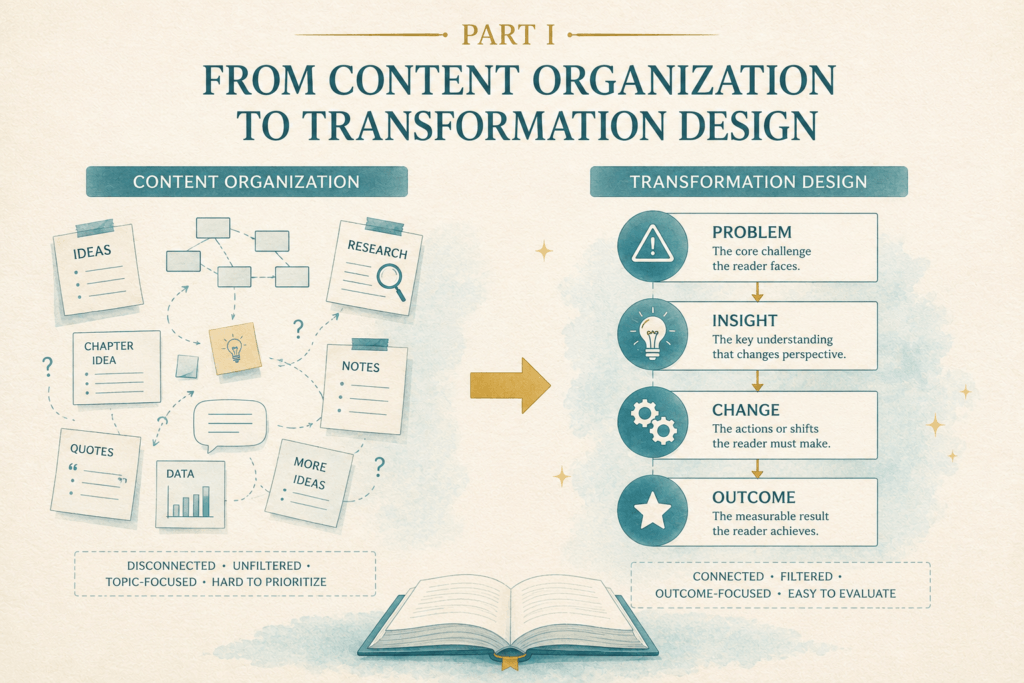
From content organization to transformation design
The traditional model treats outlining as a structural exercise:
- Identify topics
- Group related ideas
- Build a logical sequence
This produces order, but not necessarily direction.
The Modern Author model treats outlining as a design problem:
- Define the desired outcome for the reader
- Map the progression required to reach it
- Build structure to support that progression
The difference is not stylistic.
It determines whether the book works.
The operating shift
This shift can be summarized as a change in starting point:
| Old Model | Modern Author Model |
| Start with chapters | Start with outcome |
| Organize ideas | Design progression |
| Structure first | Purpose first |
In the old model, structure leads and purpose follows.
In the Modern Author model, purpose defines structure.
What changes in practice
When outlining is approached as transformation design:
- Chapters are not standalone topics, they are steps in a progression
- Content is selected based on relevance to the outcome
- The outline becomes a tool for decision-making, not just organization
This creates a constraint:
Every part of the outline must contribute to the defined result.
If it does not, it does not belong.
The reframe is simple but decisive:
Outlining is not about what to include.
It is about what must happen to the reader from beginning to end, and building structure to make that change inevitable.
60-Second Decision Box
The core decision
Before building or refining an outline, three elements must be clearly defined:
- Who the book is for
The specific reader the book is designed to serve - What problem it solves
The primary challenge or constraint the reader is facing - What outcome it delivers
The measurable change the reader should experience by the end
If any of these are unclear, the outline will not hold.
Quick viability check
Use this to assess whether your outline is structurally viable:
- Can you clearly identify the intended reader?
- Can you state the core problem in one sentence?
- Can you define the outcome as a specific transformation?
If the answer to any of these is no, stop outlining.
Refine these inputs first.
What this enables
When these elements are defined:
- The outline has a clear direction
- Chapters can be evaluated for relevance
- Progression can be designed intentionally
This allows you to:
- Define a precise outcome
- Map the milestones required to reach it
- Build an outline that aligns to that progression
This is not a preliminary step.
It is the condition that determines whether the outline will work at all.
What This Guide Will Teach You
This guide is not a collection of outlining tips.
It is a system for building a book outline that produces a clear, structured outcome.
The system you will apply
You will learn how to construct an outline by working backward from the result the book is meant to deliver.
This includes:
- Back cover method
Define the book at the level of outcome, audience, and promise before outlining begins - Audience and outcome clarity
Specify who the book is for, what problem it solves, and what transformation it creates - Working Backwards Framework
Build the outline in sequence:
Outcome → Milestones → Chapters → Sections - Chapter structuring
Translate each milestone into a clear, non-redundant chapter - Flow and validation
Ensure the outline progresses logically and each part contributes to the defined outcome
What this enables
By applying this system, you will be able to:
- Define a clear outcome before creating structure
- Map the progression required to reach that outcome
- Build an outline where each chapter has a defined role
- Identify and remove elements that do not contribute to the result
This guide is designed to replace guesswork with a repeatable process.
Each component builds on the previous one, so the outline functions as a cohesive system rather than a collection of ideas.
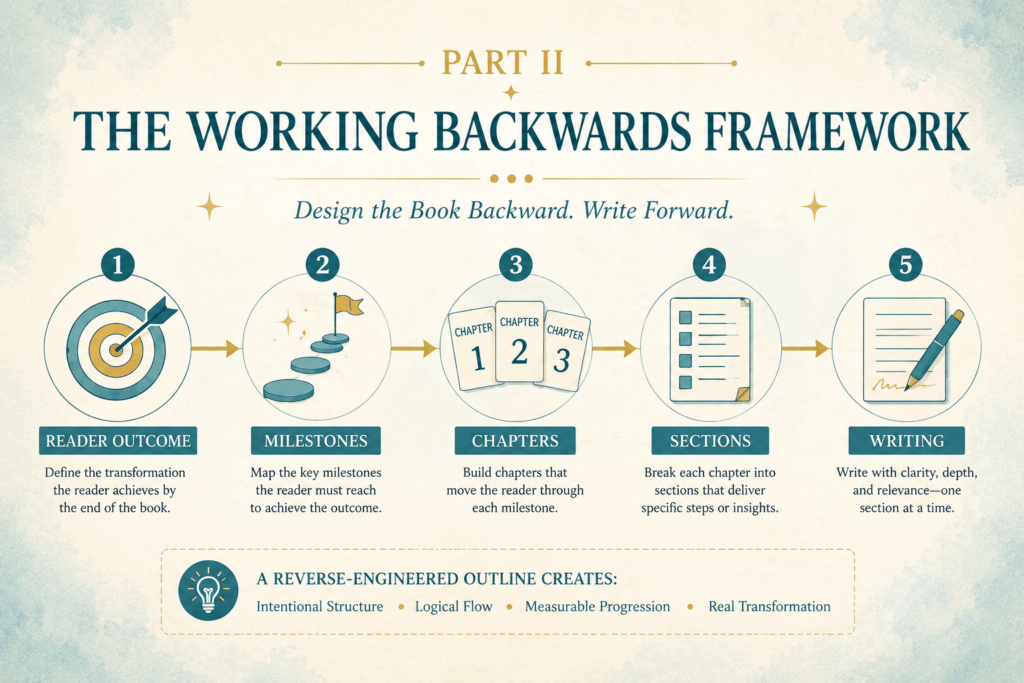
The Working Backwards Framework
Most outlines fail because they are built forward.
The Working Backwards Framework reverses that logic.
It starts with the end state, and forces every part of the book to justify how it contributes to that result.
The model
At its core, the framework is a dependency system:
- Outcome → what the reader must achieve by the end
- Milestones → the critical shifts required to get there
- Chapters → the structure that delivers each shift
- Sections → the supporting elements that make each chapter work
Each layer is derived, not invented.
You do not decide chapters first.
You derive them from what must happen to the reader.
The direction of construction
Most authors build like this:
- Start with ideas
- Turn them into chapters
- Try to create flow afterward
This creates structure without logic.
The Working Backwards Framework enforces a different direction:
Outcome
← Milestones
← Chapters
← Sections
- The outcome defines the destination
- The milestones define the required progression
- The chapters exist only to deliver those milestones
- The sections support the execution of each chapter
Nothing is added unless it moves the reader forward.
The constraint it introduces
This framework removes a common source of failure: arbitrary inclusion.
Every element must answer a single question:
- Does this move the reader toward the defined outcome?
If not:
- It is removed
- Or it does not belong in the book
This is what turns an outline into a decision system.
When the framework is used correctly:
- Chapters are no longer topics, they are steps in a progression
- Flow is built into the structure, not added later
- Gaps become visible early, before writing begins
The outline stops being a list.
It becomes a system that produces a predictable result.
This is the operating model for the entire guide.
Everything that follows is an application of this framework.
Insert it after you establish the system, but before you move into decision control. That’s where it reinforces, not interrupts, the logic.
Here is your section with the exact placement applied cleanly:
PART I — The Purpose of an Outline
What a Book Outline Is Really For
Most explanations of what a book outline is focus on structure.
They describe it as a way to organize chapters, sequence ideas, or plan content.
That description is incomplete.
A book outline is not just a way to arrange ideas.
It is the system that determines whether the book will work.
Structure without a system fails
You can organize chapters, group ideas, and build a logical sequence, and still end up with a weak book.
Why?
Because structure alone does not create direction.
It does not tell you:
- what belongs in the book
- what should be removed
- whether the book is actually moving toward a result
This is where most outlines break down.
They look complete.
But they do not guide decisions.
The role of an outline changes when it is used correctly
A strong outline does three things simultaneously.
It defines the strategy of the book, aligns every part to a single outcome, and surfaces problems before writing begins.
This is what turns it from a planning document into a working system.
- It acts as a strategic framework by connecting the reader, the problem, and the intended transformation
- It functions as an alignment mechanism, ensuring chapters are steps in a progression, not isolated ideas
- It operates as early detection, exposing gaps, redundancy, and broken flow before drafting begins
These are not separate benefits.
They are the same function viewed from different angles.
Expert pattern: defining the journey before writing
Strong authors do not start by writing chapters.
They start by defining the core message and the path the reader will follow.
Video
(Insert video here)
What this shows
The sequence is consistent:
- Core message is defined first
- The reader journey is mapped through the outline
- Writing only begins once the structure is clear
The outline acts as the canvas.
It determines the direction, structure, and coherence of the book before drafting begins.
The real function: decision control
The primary purpose of an outline is to control decisions.
Every part of the book is evaluated against a single standard:
- Does this move the reader toward the defined outcome?
From that, three decisions become clear:
- What to include — only content that advances the progression
- What to exclude — ideas that are interesting but not necessary
- What to refine — sections that are required but not yet clear
Without this, outlines expand without improving.
More content gets added.
But the book becomes harder to complete, and weaker as a result.
What this prevents in practice
When an outline functions as a decision system:
- Writing does not drift
- Chapters do not compete with each other
- Major structural problems are resolved before they become expensive
Most importantly, the author is no longer deciding what to write every time they sit down.
The outline has already made those decisions.
A book outline is not a preliminary step.
It is the control system for the entire manuscript.
When it works, writing becomes execution.
When it doesn’t, writing becomes constant rethinking.
The Three Anchors of a Strong Outline
Every effective book outline is built on three non-negotiable inputs.
Before structure is created, these must be clear:
- Reader
- Problem
- Outcome
Without them, the outline cannot function as a system.
Why these anchors matter
An outline only works if it is anchored to a defined transformation.
- The reader defines who the book is for
- The problem defines what needs to be resolved
- The outcome defines what success looks like
Together, they establish direction.
Without this, structure becomes arbitrary, chapters may be organized, but they do not lead anywhere.
What each anchor controls
Each input governs a different part of the outline:
- The reader determines relevance
→ what language, examples, and depth are appropriate - The problem determines focus
→ what belongs in the book and what does not - The outcome determines progression
→ how the book moves from beginning to end
If any one of these is unclear, the outline loses coherence.
The execution constraint
These anchors are not optional.
They are prerequisites.
If any of the following is unclear:
- Who the book is for
- What problem it solves
- What outcome it delivers
Stop outlining.
Refining structure without these inputs will produce an outline that looks complete but fails during writing.
A strong outline does not begin with chapters.
It begins with clarity.
These three anchors define that clarity, and everything else is built from them.
PART II — The Working Backwards Framework (Start from the End)
Outlining becomes effective when it follows a defined sequence.
The Working Backwards Framework provides that sequence by starting with the final outcome and reverse-engineering the structure required to achieve it.
This ensures that every part of the outline is aligned to a specific transformation, not just organized for readability.
Step 1 — Define the outcome of your book
The starting point is not chapters.
It is clarity.
Before outlining begins, three elements must be explicitly defined:
- Target reader — who the book is for
- Current situation — the problem or constraint the reader is facing
- Desired outcome — the transformation the book will deliver
A practical way to capture this is:
“This book helps [reader] go from [problem] to [outcome] by [method].”
A vague outcome produces a weak outline.
A specific transformation creates direction.
If this step is unclear, do not proceed.
Step 2 — Break the outcome into milestones
Once the outcome is defined, it must be broken into meaningful stages.
Milestones represent the key shifts the reader must go through to reach the final result.
Each milestone should reflect a clear movement:
- from confusion to clarity
- from fragmentation to structure
- from uncertainty to confidence
Avoid broad or generic categories.
Each milestone should represent a distinct step in the transformation.
Clarity at this level determines the strength of the outline.
Step 3 — Reverse the sequence
With milestones defined, the next step is to order them correctly.
This is done by working backward:
- Start from the final outcome
- Move step-by-step toward the starting point
- Ensure each step logically depends on the previous one
This creates a sequence where each part prepares the next.
It removes gaps and prevents disjointed progression.
Step 4 — Convert milestones into chapters
Each milestone becomes a chapter.
This translates the transformation into structure.
At this stage:
- Remove overlapping ideas
- Ensure each chapter has a clear role
- Maintain a logical progression from start to finish
Chapters are not topics.
They are steps in a defined process.
Step 5 — Expand chapters into sections
The final step is to build depth within each chapter.
This is done by adding sections that support the core idea:
- Explanations that clarify the concept
- Examples that make it concrete
- Supporting points that complete the argument
Sections should strengthen the chapter, not introduce unrelated ideas.
When applied correctly, this framework turns outlining into a system.
Each step builds on the previous one, ensuring that the final structure is coherent, complete, and aligned to the intended outcome.
Quick validation: does your outline hold?
Before moving forward, pressure-test your outline against the framework:
- Can you state the outcome in one clear sentence?
- Do your milestones represent real shifts, not just topics?
- Does each step logically depend on the previous one?
- Can every chapter be traced back to a specific milestone?
- Does each section support the chapter without introducing new direction?
If any answer is unclear, the issue is not execution.
It is the structure.
Return to the step where clarity breaks down and resolve it before continuing.
Case Study — Vague vs Clear Outcome
A book outline is only as strong as the inputs that define it.
The difference between a weak outline and a focused one is not effort.
It is clarity.
Starting point: broad audience, unclear result
The initial concept is loosely defined:
- The audience is broad or undefined
- The problem is explored but not clearly articulated
- The outcome is vague or aspirational
This leads to predictable friction:
- Progress is slow or inconsistent
- Chapters are formed but lack cohesion
- The structure does not guide the writing
The outline exists, but it does not produce direction.
Action: define reader and transformation
Instead of refining chapters, the focus shifts to defining the inputs:
- A specific reader is identified
- A clear problem is articulated
- A concrete outcome is defined
The transformation is expressed in a usable form:
- From a current state → to a defined result
This creates a fixed point that the outline must support.
“The book took years of thinking and research and finally turned it into a coherent framework I could stand behind…”
Result: clear, focused outline
With these inputs defined, the outline changes immediately:
- Chapters align to distinct milestones
- Redundant or irrelevant content is removed
- Progression becomes logical and sequential
The outline is no longer a list of ideas.
It becomes a system designed to move the reader from problem to outcome.
The shift is not structural.
It is definitional.
When the outcome is clear, structure follows.
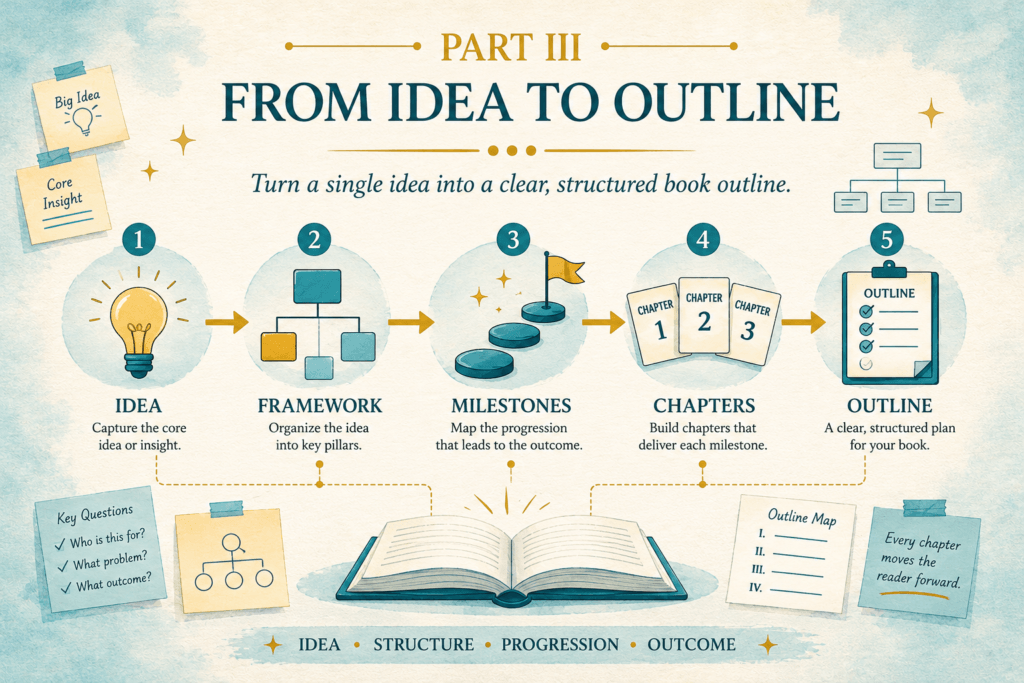
PART III — Applying the Working Backwards Framework
The Working Backwards Framework is only useful if it can be applied as a complete system.
This section shows how each step connects, so the outline is built as a coherent progression rather than a set of disconnected parts.
Outcome defined
The process begins by defining the end state.
This includes:
- A specific reader
- A clearly articulated problem
- A concrete outcome
The outcome is the reference point for every decision that follows.
If it is vague, every downstream step will be unstable.
Milestones mapped
Once the outcome is clear, it is broken into milestones.
Milestones represent the key shifts the reader must go through to reach the final result.
Each milestone must:
- Represent a meaningful change
- Build on the previous step
- Move directly toward the outcome
At this stage, the transformation becomes visible.
Chapters created
Each milestone is translated into a chapter.
This converts the progression into structure.
The goal is not to list topics, but to define steps:
- One milestone per chapter
- No overlap between chapters
- Clear progression from beginning to end
Chapters exist to deliver movement—not to organize ideas.
Sections expanded
Each chapter is then expanded into sections.
Sections provide the internal clarity needed to support the chapter’s role.
They include:
- Supporting ideas that explain the concept
- Examples that make it concrete
- Proof or reasoning that strengthens the argument
Sections should deepen the chapter, not introduce new direction.
When these steps are applied together, the outline becomes a complete system.
- The outcome defines the destination
- Milestones define the path
- Chapters structure the journey
- Sections support execution
Each layer is connected.
This is what ensures the outline holds as the book is written.
Forward vs Working Backwards
Outlining methods differ not in format, but in starting point.
The distinction is whether the outline is built from ideas, or from an intended outcome.
The two approaches
| Forward Approach | Working Backwards |
| Start with chapters | Start with outcome |
| Organize ideas | Design transformation |
| Risk drift | Maintain direction |
| Reactive | Intentional |
What “forward” outlining means
A forward approach begins with available material:
- Existing ideas, notes, or expertise
- Potential chapter topics
- A rough sense of structure
The outline is then built by organizing and sequencing these elements.
This creates structure quickly.
But it introduces a constraint: the outline is shaped by what exists, not by what is required.
As a result:
- Chapters may be logical but not necessary
- Progression may feel ordered but not directional
- The book can expand without improving
This is why forward outlines often drift.
What “working backwards” means
The Working Backwards approach begins with a defined outcome.
The outline is constructed by determining:
- What the reader must achieve
- What steps are required to get there
- What structure is needed to support those steps
This reverses the logic:
- Chapters are derived, not chosen
- Content is selected based on relevance to the outcome
- Progression is intentional from the start
The outline is not built from ideas.
It is built from requirements.
Why the difference matters
Both approaches can produce a complete outline.
Only one produces a functional system.
- A forward outline organizes what you know
- A backward outline ensures the reader gets where they need to go
This is the difference between:
- a structured document
- and a structured transformation
The method determines the outcome.
If the starting point is unclear, the structure will be unstable.
If the starting point is defined, the outline becomes a reliable system for building the book.
From Idea to Outline
A strong outline is not created by expanding an idea.
It is created by defining the outcome and building backward from it.
This section shows how a vague concept becomes a structured outline using the Working Backwards Framework.
Final outcome
Start by defining what the book must achieve.
This includes:
- A specific reader
- A clearly defined problem
- A concrete outcome
Example:
This book helps experienced managers go from leading teams reactively to operating with a clear leadership system they can apply consistently.
The outcome establishes the destination.
Without it, structure cannot be evaluated.
Reverse steps
Once the outcome is defined, identify the key shifts required to reach it.
These become milestones.
Example progression:
- Reactive management → understanding leadership constraints
- Understanding constraints → building a repeatable system
- System creation → applying it across real situations
Each step must:
- Represent a meaningful change
- Build on the previous step
- Move directly toward the outcome
This creates the path from start to finish.
Resulting outline
Translate each milestone into a chapter.
This converts the transformation into structure:
- Chapter 1 — Recognizing reactive leadership patterns
- Chapter 2 — Understanding the underlying constraints
- Chapter 3 — Designing a leadership system
- Chapter 4 — Applying the system in practice
Each chapter exists to deliver a specific shift.
Together, they form a coherent progression.
Execution scaffold
Use this sequence to move from idea to outline:
- Define the outcome
- Break it into milestones
- Convert milestones into chapters
This ensures that:
- Structure is derived from purpose
- Chapters are necessary, not arbitrary
- The outline functions as a system
A vague idea becomes actionable only when the outcome is clear.
Once the outcome is defined, the outline follows as a logical sequence of steps.
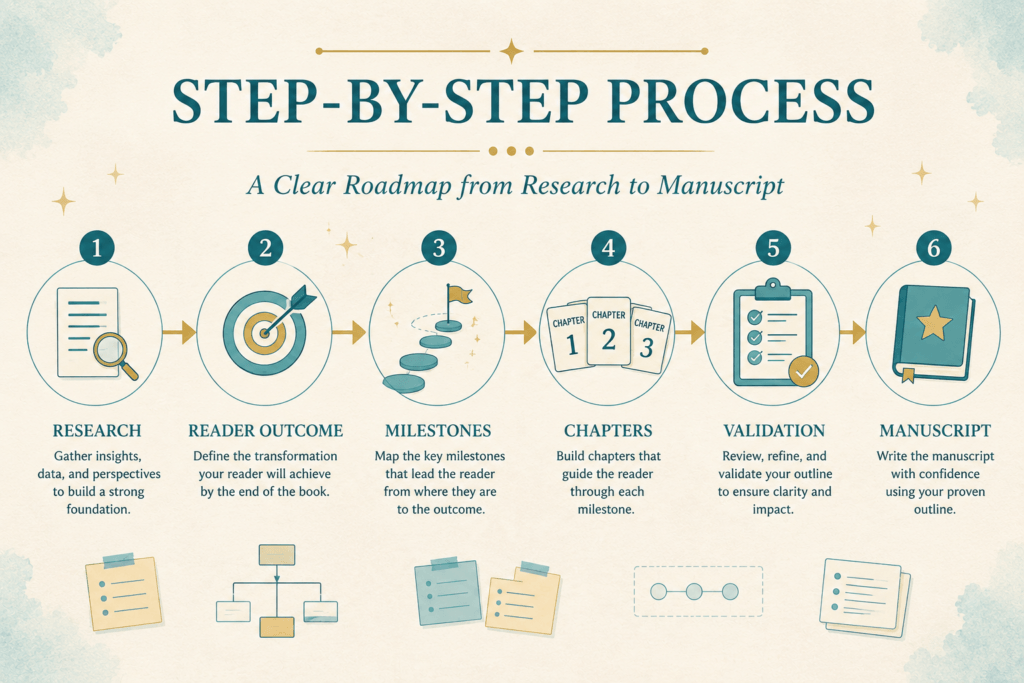
PART IV — Building a Strong Book Outline
From Milestones to Chapters
A strong outline is created by translating milestones into structure.
Milestones define the transformation.
Chapters deliver it.
Each milestone becomes a chapter
A milestone represents a specific shift the reader must make.
To convert this into structure:
- Assign one milestone to one chapter
- Ensure the chapter’s purpose is to deliver that shift
- Avoid combining multiple milestones into a single chapter
This creates clarity.
Each chapter has a defined role and a clear outcome.
Maintain logical progression
Chapters must follow a sequence where each step depends on the previous one.
This ensures the reader can move through the material without gaps.
To maintain progression:
- Start from the reader’s current state
- Build toward the final outcome step by step
- Ensure each chapter prepares the next
If chapters can be rearranged without affecting the outcome, the progression is weak.
A strong outline has a fixed order because each step builds on the last.
Remove redundancy
Redundancy occurs when multiple chapters attempt to do the same work.
This weakens the structure and slows the reader’s progression.
To eliminate redundancy:
- Check if two chapters address the same shift
- Consolidate overlapping ideas into a single chapter
- Remove content that does not directly support the milestone
Each chapter must justify its existence.
If it does not move the reader forward, it does not belong.
When milestones are translated correctly:
- Chapters become precise and purposeful
- Progression becomes clear and predictable
- The outline functions as a system
This is the point where structure is no longer a draft artifact.
It becomes the architecture of the book.
How to Structure Chapters in a Book
A chapter is not a container for ideas.
It is a unit designed to deliver a specific milestone in the reader’s progression.
When structured correctly, each chapter moves the reader forward in a clear and measurable way.
One milestone per chapter
Each chapter should be anchored to a single milestone.
A milestone is a defined shift the reader must make to move toward the final outcome.
To structure this correctly:
- Assign one milestone to one chapter
- Define the shift the chapter is responsible for delivering
- Avoid combining multiple milestones into a single chapter
This ensures that:
- The purpose of the chapter is clear
- The progression of the book remains intact
- The reader can track their movement from one step to the next
If a chapter attempts to do multiple things, it weakens clarity and slows progression.
Internal sections
Within each chapter, structure is created through sections.
A section is a component that supports the chapter’s milestone by clarifying, explaining, or reinforcing the core idea.
Effective sections typically include:
- A clear explanation of the concept
- A breakdown of how it works
- Supporting logic or reasoning
Each section should serve the chapter’s purpose.
If a section introduces a new direction that does not support the milestone, it does not belong.
Supporting examples
Examples are used to make the chapter actionable and concrete.
They should:
- Illustrate the milestone in practice
- Clarify abstract ideas
- Reinforce understanding without adding new concepts
Examples are not additional content.
They are supporting elements that strengthen comprehension.
A well-structured chapter is focused, aligned, and purposeful.
- It delivers one clear shift
- It is supported by sections that reinforce that shift
- It uses examples to make the shift understandable
When every chapter is structured this way, the book becomes a coherent progression rather than a collection of ideas.
Maintaining Flow in Your Book Outline
A strong outline does more than organize chapters.
It creates a sequence where each part depends on the one before it and leads naturally to the next.
Without this, chapters may be clear individually, but disconnected as a whole.
Flow is built through continuity
Each chapter should begin from an assumed level of understanding.
- Earlier concepts are used, not re-explained
- Ideas build instead of restarting
- The reader’s understanding compounds over time
This creates momentum.
The reader moves forward instead of resetting at each chapter.
Flow is maintained through forward pressure
A chapter should not feel complete in isolation.
It should create a reason to continue.
This happens when:
- The current idea exposes a limitation
- A new question naturally emerges
- The next step becomes necessary
This is what pulls the reader through the book.
Flow requires structural dependency
Chapters should not function as standalone topics.
They should depend on each other.
- Each chapter builds on the previous one
- Each chapter prepares the next
- The sequence cannot be rearranged without breaking the outcome
If chapters can be moved without consequence, the structure is weak.
Quick check: does your outline hold?
- Does each chapter assume the reader has completed the previous one?
- Does it create a clear need for what comes next?
- Would reordering chapters break the progression?
If not, the flow is fragmented.
Flow is not about smooth transitions.
It is about dependency.
When each step requires the one before it, and creates the need for the next, the outline becomes a coherent progression rather than a collection of parts.
Case Study — Cohesive vs Fragmented Outline
An outline can look complete and still fail to guide the reader.
The difference is not structure, it is what the structure is built from.
Starting point: chapter-first structure
The outline is created by organizing ideas:
- Topics are grouped
- Chapters are named
- Content is distributed
This creates order.
But not progression.
- Chapters do not depend on each other
- The sequence can be rearranged
- The reader’s movement is unclear
The outline is organized, but fragmented.
Action: rebuild from milestones
Instead of refining chapters, the structure is rebuilt from the outcome.
- Define the transformation
- Break it into milestones
- Assign one milestone per chapter
Then enforce sequence:
- Each step depends on the previous one
- Redundancy is removed
- The progression becomes fixed
The structure shifts from topics to required shifts.
Result: cohesive progression
With milestones defining the outline:
- Each chapter has a clear role
- The order becomes necessary
- The reader moves through a defined sequence
The outline becomes a guided progression, not a collection of parts.
The difference is not the number of chapters.
It is how they are defined.
Built from topics → fragmented
Built from milestones → cohesive
PART V — Validating and Improving
Alignment Check
An outline is only effective if it holds under pressure.
Validation ensures that the structure you’ve built actually delivers the intended outcome, not just a well-organized set of chapters.
What alignment means
Alignment is the relationship between the outcome and the structure.
Every chapter must contribute directly to the transformation the book is designed to deliver.
If a chapter cannot be tied to that outcome, it is misaligned.
This is not a stylistic issue.
It is a structural failure.
Core validation questions
Use these questions to evaluate whether your outline holds:
- Does each chapter move the reader toward the outcome?
- Is anything disconnected from the progression?
- Is the sequence logically necessary?
These questions test whether the outline functions as a system.
Alignment template
Use this simple structure to validate each chapter:
Chapter: [Title]
Milestone: What shift does this chapter create?
Before: What does the reader believe or do before this chapter?
After: What changes after they complete it?
Dependency: What prior chapter does this rely on?
Next step: What does this make possible?
If any field is unclear, the chapter is not fully aligned.
What this reveals
A proper alignment check exposes issues that are not visible at the surface level:
- Chapters that are clear but unnecessary
- Ideas that are valuable but misplaced
- Sequences that are ordered but not dependent
This is where most outlines break.
They appear complete, but they do not hold under scrutiny.
Validation is not a final step.
It is a structural check.
If alignment fails, the issue is not in the writing.
It is in the outline, and it must be corrected before moving forward.
The Elimination Rule
A strong outline is not defined by what it includes.
It is defined by what it removes.
Core rule
If a chapter does not move the reader toward the outcome, it does not belong.
This applies regardless of:
- how well the chapter is written
- how valuable the idea is
- how much effort has gone into it
Relevance to the outcome is the only standard.
What to remove
The elimination rule targets three types of content:
- Tangential ideas
Concepts that are interesting but do not directly support the transformation - Redundant chapters
Multiple chapters attempting to deliver the same shift - Irrelevant depth
Detailed explanations that do not change the reader’s state
These often appear useful in isolation.
But they weaken the structure when included.
Why authors struggle
Most authors resist removal for two reasons:
- Emotional attachment
Ideas feel valuable because they are hard-earned or personally meaningful - Fear of loss
Removing content feels like discarding work or missing an opportunity
This leads to accumulation instead of refinement.
The outline expands, but clarity decreases.
Execution constraint
Every chapter must justify its existence.
To evaluate this:
- What specific shift does this chapter create?
- How does it move the reader closer to the outcome?
- What would be lost if this chapter were removed?
If the answer is unclear, the chapter is not necessary.
The elimination rule converts validation into action.
It ensures that the outline remains focused, coherent, and aligned to the outcome, by removing anything that does not directly contribute to it.
Book Outline Mistakes That Break Structure (And How to Fix Them)
Most outlining problems are not technical.
They are the result of starting from the wrong assumptions.
These mistakes create structure, but not direction.
Starting with chapters → Start with outcome
A common approach is to begin by listing potential chapters.
This organizes ideas quickly.
But it skips the most important step: defining what the book must achieve.
Without a clear outcome:
- Chapters are based on available ideas, not required steps
- The progression is assumed rather than designed
- The outline becomes difficult to validate
The correct starting point is the outcome.
Chapters are derived from it, not chosen independently.
Broad audience → Narrow focus
A vague audience leads to a vague outline.
When the reader is not clearly defined:
- Problems are generalized
- Examples lack relevance
- The structure becomes unfocused
A precise audience creates constraints.
These constraints make it possible to:
- define a specific problem
- design a clear transformation
- build a focused outline
Clarity of audience determines clarity of structure.
Over-detailing → Keep structure flexible
It is common to overbuild the outline too early.
This includes:
- adding excessive subpoints
- detailing sections before structure is stable
- attempting to fully draft within the outline
This creates rigidity.
Instead of guiding the writing, the outline becomes difficult to adjust.
A strong outline is defined at the level of:
- outcome
- milestones
- chapters
Detail should be added after the structure holds.
Rigid outline → Allow iteration
An outline is a system, not a fixed document.
As the book develops:
- ideas will evolve
- clarity will improve
- structure may need adjustment
Treating the outline as final too early leads to:
- forced structure
- unnecessary constraints
- reduced clarity over time
A strong outline is stable in direction, but flexible in execution.
These mistakes are predictable.
They occur when structure is prioritized over purpose.
Avoiding them ensures that the outline remains aligned, adaptable, and capable of delivering the intended outcome.
PART VI — How to Write a Book Outline (Step-by-Step)
This is where the outline is built.
Not by organizing ideas, but by constructing a system that delivers a clear outcome.
Follow this sequence exactly. Each step defines the next.
Step 1 — Write the back cover first
Before outlining, define what the book is about in its simplest form.
The back cover acts as a constraint.
It forces clarity on:
- Who the book is for
- What problem it solves
- What outcome it delivers
If you cannot clearly describe the book here, the outline will not hold.
Step 2 — Define your target reader
A book outline is built for a specific reader.
Not a general audience.
Define:
- Who they are
- What situation they are in
- What they are trying to achieve
A precise reader sharpens every decision in the outline.
Step 3 — Define the outcome of your book
This is the most important step.
The outline must be built around a clear transformation.
Use this structure:
This book helps [reader] go from [problem] to [outcome].
The outcome should be:
- Specific
- Measurable
- Actionable
If the outcome is vague, the structure will be weak.
Step 4 — Break the outcome into milestones
Now define the steps required to reach the outcome.
Each milestone represents a shift in the reader’s understanding or capability.
Examples:
- Unclear thinking → structured framework
- Reactive decisions → repeatable system
These milestones form the foundation of your outline.
Step 5 — Reverse the sequence (Working Backwards)
Start from the final outcome and work backward.
Ask:
- What must the reader understand right before achieving this?
- What must happen before that?
This ensures:
- Logical progression
- No missing steps
- No unnecessary content
This is what makes the outline coherent.
Step 6 — Convert milestones into chapters
Each milestone becomes a chapter.
This is how you structure a book outline:
- One milestone = one chapter
- No overlap between chapters
- Clear progression from start to finish
Chapters are not topics.
They are steps in a transformation.
Step 7 — Validate and refine the outline
Before writing, test the structure.
- Does each chapter move the reader toward the outcome?
- Can any chapter be removed without breaking the progression?
- Does each step depend on the previous one?
Then apply the elimination rule:
- Remove anything that does not directly support the outcome
Final check: does your outline work?
A strong book outline should:
- Have a clear reader and outcome
- Follow a logical, irreversible sequence
- Contain only necessary chapters
- Move the reader step-by-step toward a defined result
If these conditions are met, the outline is ready.
This is how to write a book outline that is clear, structured, and outcome-driven.
Once the outline holds, writing becomes execution, not exploration.
When to Refine vs Move Forward
A common failure point in outlining is not starting, it is not knowing when to stop refining.
An outline can always be improved.
But it does not need to be perfect to be usable.
Clarity threshold
An outline is ready when the structure holds.
This means:
- The outcome is clearly defined
- Each chapter represents a specific milestone
- The sequence is logical and necessary
At this point, the outline provides direction.
It does not need additional detail to begin writing.
If these conditions are met, the structure is sufficient.
Avoid over-iteration
Over-refinement occurs when effort shifts from structure to unnecessary detail.
This includes:
- expanding sections before writing begins
- repeatedly adjusting wording without changing structure
- adding depth that does not improve clarity
These actions do not strengthen the outline.
They delay execution.
Once the structure is clear, further iteration produces diminishing returns.
Maintain flexibility
An outline should guide the writing, not constrain it.
As the book develops:
- insights may sharpen
- examples may change
- sections may need adjustment
This is expected.
A strong outline is stable in direction but flexible in execution.
Refinement should happen when new clarity emerges, not as a substitute for writing.
The goal is not to perfect the outline.
It is to reach a point where the structure is clear enough to execute.
When the outcome is defined, the milestones are aligned, and the sequence holds, the next step is to write.
Deeper Story Example
From Stalled Draft to Structured Book
Video
(Insert full video here)
What this illustrates
For years, progress remained limited despite sustained effort.
- Nearly 7 years of work produced only partial output
- The manuscript lacked a clear structure
- Forward outlining created friction and slow progress
The constraint was not effort.
It was the absence of a usable framework.
The turning point
Progress changed when structure was introduced.
- A clear framework defined what the book needed to become
- The outline shifted from ideas to a structured progression
- Writing moved from exploration to execution
With a defined structure to write toward, output accelerated.
What had stalled for years was completed within months.
The result
- A complete manuscript
- A coherent structure aligned to the author’s ideas
- A finished book that reached publication and market success
The shift was not about writing more.
It was about defining the structure that made writing possible.
Conclusion: Start with the Outcome. Then Write the Book.
A strong book outline is not created by organizing ideas.
It is created by defining the outcome and building the structure required to achieve it.
The principle
The sequence is fixed:
- Define the outcome
- Build the structure
- Write forward
Each step depends on the one before it.
If the outcome is unclear, the structure will be unstable.
If the structure is unstable, writing becomes inefficient.
What this changes
When the outline is built using the Working Backwards Framework:
- Chapters are defined by purpose, not preference
- The sequence becomes necessary, not arbitrary
- Decisions are made before writing begins
This reduces:
- rework during drafting
- structural revisions late in the process
- uncertainty about what to write next
Writing becomes execution of a defined system.
What to carry forward
Before writing, ensure:
- The reader is clearly defined
- The outcome is specific and actionable
- The milestones create a logical progression
- Each chapter contributes directly to the result
If these conditions are met, the outline holds.
The goal is not to create a perfect outline.
It is to create a structure that works.
When the outcome is clear and the structure is aligned, writing becomes focused, efficient, and directed toward a defined result.
FAQ
What is a book outline?
A book outline is a structured plan that defines how a book moves a reader from a current state to a desired outcome.
It is not simply a list of chapters. It is a system that defines the transformation, sequences the necessary steps, and ensures each part contributes to the final result. A strong outline is built from the outcome, not from topics.
How detailed should a book outline be?
A book outline should be detailed enough to provide direction, but not so detailed that it restricts execution.
At a minimum, it should clearly define the outcome, the milestones required to reach it, and the chapters that deliver those shifts. Additional detail can be developed once the structure holds. Over-detailing too early reduces flexibility without improving clarity.
How many chapters should a book have?
There is no fixed number of chapters.
The number is determined by how many shifts are required to deliver the outcome. Each chapter should represent one meaningful step in the progression. The structure is driven by necessity, not convention.
What’s the difference between an outline and a synopsis?
An outline defines the structure of the book by mapping the progression into milestones, chapters, and sections.
A synopsis summarizes the book. It describes the concept and scope without detailing the structure. The outline is used to build the book. The synopsis is used to describe it.
Can I write a book without an outline?
It is possible, but it introduces structural risk.
Without an outline, structure is developed during writing. Decisions are repeated, and revisions increase as inconsistencies emerge. An outline reduces this by defining direction before drafting begins.
How long does it take to create a book outline?
The timeline depends on how quickly the core inputs are defined.
Most of the effort is not in building the outline itself, but in clarifying the reader, the problem, and the outcome. Once these are clear, the outline can be developed quickly. If they are not, the process will extend regardless of time spent outlining.
Build a Book Outline That Holds
A strong outline is not created by organizing ideas.
It is built by defining a clear outcome and structuring every part of the book to deliver it.
If that structure is unclear, the writing process becomes slow, repetitive, and difficult to complete.
If it is clear, writing becomes execution.
At Manuscripts, this is not treated as a drafting step.
It is treated as a system.
The process focuses on:
- defining the right outcome
- structuring the book around required milestones
- ensuring each chapter contributes to a coherent progression
This removes guesswork and reduces structural revision later in the process.
If you are working with an executive or building a book with a defined outcome, the outline is the leverage point.
Getting it right determines everything that follows.
Working with a team that applies this framework ensures the structure is sound before writing begins
If You’re Deciding What to Do Next
If this report clarified your thinking, the next step is usually not “publishing.”
It’s pressure-testing your strategy before you commit time, budget, or reputation.
Here are three ways authors typically proceed.
Map Your Modern Author Strategy
If you want to:
- Pressure-test your author model
- Clarify realistic outcomes
- Understand where ROI is likely to show up
- Avoid unnecessary spend
A short strategy conversation can surface issues early, before they become expensive.
👉 Schedule a Modern Author Strategy Session
This is a working session, not a pitch.
Explore the Modern Publishing System
If you’re assessing:
- Whether to publish traditionally, hybrid, or independently
- How to structure presale and early activation
- What support actually reduces risk
You may want a clearer view of how the Modern Publishing System works in practice.
👉 Explore Manuscripts Publishing Services
Study Real Author Outcomes
(For internal validation and stakeholder alignment)
If you’re preparing a recommendation for leadership, concrete examples often help.
👉 See Modern Author Success Stories
About the Author
Eric Koester is an award-winning entrepreneurship professor at Georgetown University, bestselling author, and founder of Manuscripts. His work focuses on how ideas become assets, how books create leverage, and why modern authors need systems, not just publishing support.
He has worked with thousands of authors across traditional, hybrid, and modern publishing paths, helping them turn books into platforms, platforms into credibility, and credibility into durable business outcomes.
About Manuscripts
Manuscripts is the Modern Author OS for nonfiction experts.
We help founders, executives, coaches, and thought leaders design books as strategic assets, not standalone products. Our work spans positioning, author model design, developmental editing, AI-enhanced drafting tools, presale strategy, and long-term launch systems.
Manuscripts authors use their books to generate clients, speaking engagements, training programs, and enterprise opportunities, often before publication.
For readers who want to go deeper into specific mechanics, the following guides expand on topics referenced in this report:
- How to Write a Book if You’re Busy
- Modern Ghostwriting for Nonfiction Authors
- AI Tools for Authors in 2026
- How to Build an Audience Before You Write Your Book
- The Evergreen Launch System for Modern Authors
Powered by Codex, the Modern Author Intelligence Tool.