Author Branding in 2026: How to Position Yourself as a Category Leader
The Ultimate Modern Author Positioning & Category-Creation Playbook
Most professionals assume they have a branding problem.
They don’t.
Author branding is usually where the symptoms appear, not where the problem begins.
The real issue reveals itself in a much simpler moment.
Someone encounters your work, your book, your content, your ideas, and silently asks:
“What is this?”
Not whether it’s insightful.
Not whether it’s well designed.
Not whether it’s worth reading.
But where it belongs.
Because every market instinctively organizes new ideas into familiar categories. It tries to answer a simple question:
“What kind of thing am I looking at?”
If the answer isn’t immediate, the market supplies one for you.
It places you inside:
- an existing category
- an existing conversation
- an existing comparison
- a position someone else already owns
This is where most authors lose.
Not because they lack expertise.
Not because they lack original ideas.
But because they never define the space their work is meant to occupy before they try to amplify it.
So they optimize everything around the edges.
- More content.
- Better branding.
- Clearer messaging.
- A stronger website.
- A more polished LinkedIn profile.
None of those things solve the underlying problem.
Because amplification without definition doesn’t create authority.
It simply spreads ambiguity faster.
The shift isn’t from weak branding to strong branding.
It’s from:
- improving how you’re perceived → defining how you’re understood
- participating in a conversation → owning the frame of the conversation
- competing inside a category → creating one others recognize
Because authority is rarely a visibility problem.
It is almost always a placement problem.
The professionals who shape industries don’t simply communicate their expertise more effectively.
They change the framework through which their expertise is understood.
They introduce a new language.
They give people a new way to think.
And once that happens, the market no longer asks where they fit.
It begins using them as the reference point.
You Don’t Have a Brand Problem. You Have a Category Problem
Most authors assume their problem is branding.
They focus on:
- Visual identity (logos, colors, design)
- Content output (posts, newsletters, podcasts)
- Personal presence (voice, tone, personality)
These are surface-level signals. They can improve perception, but they do not create authority.
Authority comes from owning a category.
A category is the distinct space you define and lead in the market. It answers:
- What is the conversation you own?
- What problem do you uniquely define?
- What lens do you use to interpret it?
Without a category, branding becomes decoration. With a category, branding becomes reinforcement.
The Real Constraint: Undefined Position
When a reader, buyer, or stakeholder encounters your work, they are not asking:
“Is this well-designed?”
They are asking:
“What is this about, and why does it matter?”
If the answer is unclear, three things happen:
- You are grouped with everyone else in your topic area
- Your ideas are interchangeable with existing content
- Your work becomes optional, not necessary
This is a positioning failure, not a branding failure.
Positioning is the act of defining how you are understood relative to alternatives.
If you don’t define it, the market defaults you into an existing category.
Why Branding Alone Fails (Especially Now)
Branding worked when attention was scarce and distribution was limited.
That is no longer true.
AI systems now:
- Summarize, remix, and generate content at scale
- Collapse differences between similar ideas
- Reward clarity of concepts over volume of content
If your work lives inside a broad, existing topic, it becomes easier to replicate and harder to distinguish.
More content does not solve this. Better visuals do not solve this.
Only clearer category definition does.
The Shift: From Expression to Ownership
Branding is about expression, how you show up.
Category creation is about ownership, you own.
This is the shift:
- From “How do I present myself?”
→ To “What distinct space do I define?” - From “How do I get attention?”
→ To “What conversation becomes mine?” - From “How do I stand out?”
→ To “What am I the reference point for?”
When you define a category, you are no longer competing on visibility alone. You are shaping how the problem itself is understood.
Key Anchor
Branding amplifies. Category creation defines.
If what you’re amplifying isn’t clearly defined, amplification only spreads ambiguity.
The Modern Author Reframe — From Branding to Category Leadership
Most authors approach their book as a branding asset.
They ask:
- How do I position myself?
- What content should I create?
- How do I build visibility?
This frames the work too narrowly.
The modern author does not build a brand. They define and own a category.
A category is a clearly defined space in which a specific problem, perspective, and solution are organized.
Owning a category means becoming the reference point for how that space is understood.
The Three Shifts That Change Everything
This is not a tactical adjustment. It is an identity shift.
1. From Brand → Category
A brand is how you are perceived.
A category is the space you define and lead.
- Brand asks: How do I stand out?
- Category asks: What am I the leader of?
Without a category, a brand competes.
With a category, a brand anchors.
2. From Content → Worldview
Content is output.
A worldview is a consistent way of interpreting a problem.
- Content reacts to existing conversations
- Worldview defines how the conversation should be understood
A worldview creates coherence across everything you publish. It ensures your work compounds instead of fragmenting.
3. From Visibility → Ownership
Visibility is being seen.
Ownership is being selected.
- Visibility increases awareness
- Ownership drives preference and decision
You can be visible without being chosen.
You cannot be chosen without owning a clear position.
The Role of the Book: A Leverage Asset, Not a Marketing Asset
A book is not primarily a branding tool.
It is a leverage asset, a structured expression of your category, worldview, and thinking.
A well-positioned book does three things:
- Defines the category you operate in
- Encodes your worldview in a durable format
- Establishes a reference point others can adopt, share, and build on
This is what allows authority to scale beyond your direct presence.
The Practical Reframe
| Instead of (Brand Thinking) | Shift to (Category Leadership Thinking) |
| How do we build the author’s brand? | What category does this author define and lead? |
| What content should we produce? | What worldview are we making clear and repeatable? |
| How do we increase visibility? | How do we become the default reference in this space? |
This is the modern author’s role.
Not a content creator.
Not a personal brand.
A category leader.
60-Second Decision Box
Who This Shift Is For…
This applies if the author:
- Is investing in content, branding, or visibility, but not seeing authority translate into opportunities
- Is competing inside crowded topics without clear differentiation
- Wants their book to create positioning, not just awareness
If the goal is to become a reference point in a space, not just another voice in it, this distinction is not optional.
The Core Distinction…
Brand building improves how you are perceived.
Category creation defines what you are known for.
You do not become authoritative by being more visible.
You become authoritative by owning a clear space others recognize and adopt.
What This Means in Practice…
Operating at the brand level:
- Focus stays on output, messaging, and reach
- Differentiation is incremental
- Growth depends on continued visibility
Operating at the category level:
- Focus shifts to defining a category, worldview, and system
- Differentiation is structural
- Authority compounds as others adopt the language and frameworks
Decision Check
If the current strategy is:
- “We need more content”
- “We need better branding”
- “We need more visibility”
The author is operating as a brand builder.
If the strategy is:
- “We need to define the category”
- “We need to structure and name our thinking”
- “We need to become the reference point”
The author is operating as a category creator.
PART I — You Don’t Have a Brand Problem. You Have a Positioning Problem
Most authors think they have a visibility problem.
They don’t.
They have a positioning problem.
Branding improves how you show up.
Positioning determines how you are understood.
Without clear positioning, more content, better design, and increased visibility only amplify confusion, not authority.
Why Most Authors Stay Invisible (They Choose Topics, Not Categories)
Most authors start by choosing a topic.
A topic is a broad subject area (e.g., leadership, marketing, culture).
It is already defined, already crowded, and already organized around someone else’s thinking.
This creates a structural constraint most authors don’t see:
you are entering a conversation where the rules, language, and expectations are already set.
From there, the pattern is predictable:
- Mistake: Choose a broad, existing topic
Consequence: You are immediately grouped with everyone operating in that space - Mistake: Add ideas to an existing conversation
Consequence: Your work is interpreted as variation, not definition - Mistake: Increase content output to stand out
Consequence: You become more visible inside the same undifferentiated pool - Mistake: Refine branding, messaging, or positioning
Consequence: Perception improves, but the underlying category remains unchanged
The issue is not execution quality.
It is that the starting point guarantees sameness.
A category, by contrast, is not a topic.
It is a defined space you create by:
- Isolating a specific problem
- Applying a distinct perspective
- Structuring that perspective into a clear way of thinking
This changes how your work is interpreted.
You are no longer one of many voices within a topic.
You become the reference point for a specific way of understanding it.
When you choose a topic, you enter a market.
When you define a category, you shape it.
This is why most authors remain invisible:
they optimize within existing structures instead of defining a new one others must recognize and adopt.
Why Category Is the Only Defensible Advantage in 2026
In 2026, most forms of differentiation are no longer durable.
Content can be generated.
Ideas can be summarized.
Expertise can be replicated at scale.
AI systems can take a body of knowledge, reorganize it, and reproduce it in seconds.
This collapses the value of:
- Volume
- Consistency
- Even clarity, at a basic level
If your positioning depends on producing content or sharing insights within an existing space, it becomes easier to replace.
What cannot be easily replicated is category ownership.
A category is not just what you talk about.
It is how a problem is defined, structured, and understood.
When you define a category:
- You set the language others use
- You frame the problem others recognize
- You establish the standard others reference
This creates a structural advantage.
Instead of competing on output, you control interpretation.
Instead of being compared, you become the benchmark.
AI can generate content within a category.
It cannot originate and own the category itself.
In a world where content is abundant and expertise is reproducible, the only durable advantage is defining the space others must operate within.
That is what category creation does.
PART II — The Positioning Triangle: How Category Leaders Are Built
Category creation is not abstract. It is a system.
The authors who consistently achieve authority are not more visible or more prolific.
They are more structured in how they define and communicate their position.
That structure can be reduced to a repeatable model.
The System Behind Category Leadership
Category leadership is not the result of better content, stronger branding, or more visibility.
It is the result of structure.
Specifically, a system that defines:
- where you operate
- how you think
- why your work matters
Without this structure, positioning fragments:
ideas feel disconnected
messaging becomes inconsistent
and the market struggles to place you
With it, everything aligns:
your book
your content
your offers
your conversations
All point back to the same core logic.
This system can be reduced to three components.
Not ten. Not a complex methodology.
Three.
And when these three are clear and aligned, positioning becomes:
- understandable
- repeatable
- adoptable by others
This is the system category leaders use, whether they realize it or not.
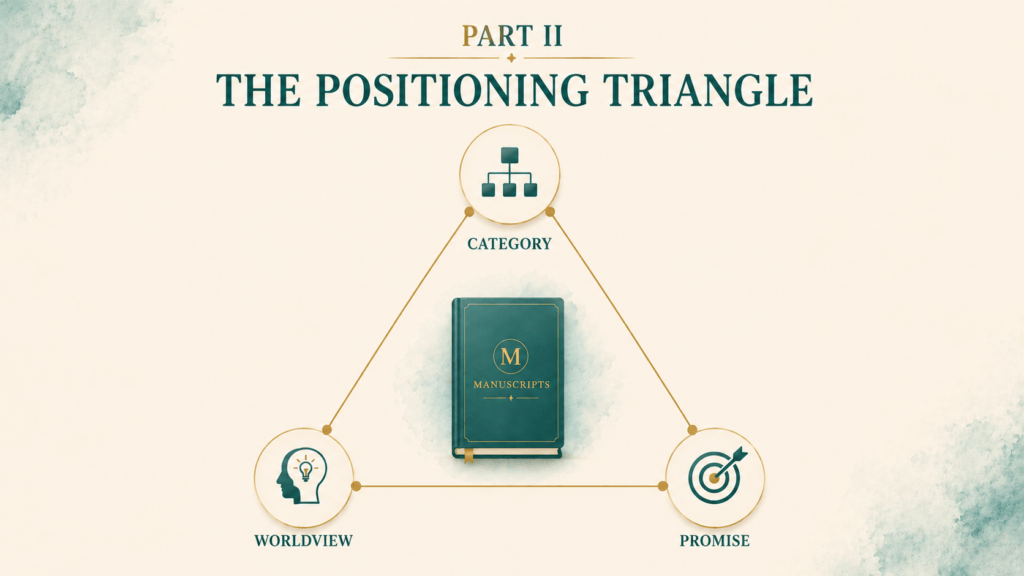
The Positioning Triangle (Category × Worldview × Promise)
Category leadership is built on three components:
- Category — the space you define
- Worldview — the way you interpret the problem
- Promise — the outcome you make possible
These are not independent elements. They work together as a system.
Category — The Space You Define
A category is the specific domain you create and lead.
It is not a topic.
It is a defined space with clear boundaries.
A strong category:
- Narrows the field of competition
- Signals what you are the reference point for
- Creates immediate context for your work
If the category is unclear, everything else becomes harder to interpret.
Worldview — The Way You See the Problem
A worldview is the core belief that shapes how you understand the category.
It answers:
- What do you believe that others don’t?
- What are others getting wrong?
This is where differentiation comes from.
A clear worldview:
- Challenges default assumptions
- Creates tension with existing thinking
- Makes your perspective identifiable and repeatable
Without a defined worldview, your work blends into existing narratives.
Promise — The Outcome You Make Possible
A promise is the specific result your category and worldview enable.
It answers:
- What changes for the reader, client, or organization?
- What is now possible because of this way of thinking?
A strong promise:
- Is clear and outcome-focused
- Connects directly to a meaningful problem
- Makes the value of your work immediately understandable
Without a clear promise, positioning remains theoretical.
System Anchor
Category defines where you play.
Worldview defines how you think.
Promise defines why it matters.
Together, they form the Positioning Triangle, the system that turns ideas into category leadership.
When One Element Is Missing, Positioning Breaks
This system only works when all three elements are present.
If one is weak or missing, the positioning collapses:
- Clear category, weak worldview
→ You are understood, but not differentiated - Strong worldview, unclear category
→ You are interesting, but hard to place - Clear category and worldview, weak promise
→ You are understood, but not chosen
Strong positioning is not about optimizing one element.
It is about aligning all three.
Category Design — Naming the Game You’re Playing
A category is not discovered by accident.
It is designed.
If you cannot clearly name the category you operate in, the market will place you into an existing one by default.
That is how most authors end up competing in spaces they did not choose.
Category design is the act of explicitly defining:
- What game you are playing
- What makes that game different
- Why it needs to exist
The Three Ways Categories Are Created
There are only three ways to define a category:
| Approach | What It Does | Example Pattern |
| New | Creates a completely new space | Introduces a problem or model that did not previously exist |
| Reframe | Redefines an existing space | Challenges how a familiar problem is understood |
| Upgrade | Evolves an existing category | Introduces a better, more specific version of a known approach |
Each approach achieves the same outcome:
you move from participating in a topic to defining a space.
What Strong Category Design Looks Like
A well-defined category has three properties:
- Specific
It is narrow enough that it clearly excludes adjacent topics - Distinct
It signals a different way of thinking, not just a different label - Nameable
It can be expressed in a short, repeatable phrase others can adopt
If your category is too broad, it collapses into a topic.
If it is unclear, it cannot spread.
The Category Clarity Test
Before committing to a category, apply a simple test:
- Can someone immediately understand what this is, and what it is not?
- Does it signal a different way of approaching the problem?
- Could this become a phrase others use to describe their work?
If the answer is no, the category is not yet defined.
The Shift
When you name a category, you are not labeling your work.
You are defining the game others must recognize to engage with it.
Worldview — The Idea That Makes You Different
A category becomes credible when it is anchored in a clear worldview.
A worldview is the single core belief that shapes how you interpret a problem.
It is not a slogan, a theme, or a collection of opinions.
It is the idea underneath the category:
the belief that explains why you see the space differently, and why your approach leads to a different result.
Without a clear worldview, a category can sound well-labeled but interchangeable.
With one, it becomes distinct.
One Belief, Not Many
Most authors weaken their positioning by trying to include too many ideas.
They want to say:
- The market is changing
- The old model is broken
- Their method is better
- Their approach is more practical
- Their book offers a new way forward
Some of that may be true.
But strong positioning does not require more beliefs. It requires one clear belief that organizes the rest.
A strong worldview should:
- Challenge a common assumption
- Clarify what you believe instead
- Change how the reader interprets the problem
If it does not create contrast, it does not create differentiation.
POV Matrix
| Common Belief | Your Belief | Implication |
| Author branding is about visibility, aesthetics, and content consistency | Authority comes from defining and leading a category | The goal is not to look more established, but to own a distinct space |
| A book is primarily a marketing asset | A book is a leverage asset that encodes a worldview | The book should clarify and scale a category, not just promote the author |
| Differentiation comes from better messaging | Differentiation comes from a different way of understanding the problem | Positioning must start with belief, not copy |
The Test of a Real Worldview
A real worldview does not simply describe your work.
It changes the frame around the work.
Someone should be able to read it and understand:
- What you reject
- What you believe instead
- Why that shift matters
If the worldview feels agreeable to everyone, it is probably too weak.
If it is clear enough to create contrast, it can anchor the category.
The goal is not to have many opinions.
It is to have one belief strong enough to organize the entire positioning system.
Signature Framework — Making Your Idea Usable and Ownable
A worldview creates differentiation.
A framework makes that differentiation usable.
A signature framework is a structured way of expressing your idea so others can understand it, apply it, and repeat it.
Without a framework, your thinking remains abstract.
With one, it becomes actionable and transferable.
From Idea → Framework → Category
Most authors stop at the idea level.
They have:
- Insights
- Perspectives
- Strong opinions
But without structure, those ideas:
- Are difficult to explain clearly
- Cannot be easily adopted by others
- Do not scale beyond direct interaction
A framework changes this.
It translates your worldview into:
- A sequence
- A model
- A system
This is what allows your thinking to move from:
- Idea → understood
- Framework → applied
- Category → adopted
What Makes a Framework “Signature”
Not all frameworks create ownership.
A signature framework has three properties:
- Structured
It organizes your thinking into clear components (steps, stages, or elements) - Repeatable
Others can apply it without your presence - Nameable
It can be referred to consistently and recognized over time
If it cannot be explained simply, it will not spread.
If it cannot be repeated, it will not scale.
The Napkin Test
A simple test to validate your framework:
Can it be sketched and explained on a blank page in under a minute?
If not, it is likely:
- Too complex
- Not clearly structured
- Not yet ready to be adopted
Strong frameworks reduce complexity without losing meaning.
They make the idea easier to carry.
The Role of the Book
A book is where the framework is fully expressed.
It:
- Expands the logic behind the framework
- Provides examples and applications
- Reinforces the language and structure
But the book is not the framework itself.
The framework is the core.
The book is the container that makes it durable and distributable.
When your idea becomes a framework, it becomes teachable.
When it becomes teachable, it becomes ownable.
Naming — How Categories Spread
A category does not spread because it is insightful.
It spreads because it is nameable.
Naming is what turns an idea into language other people can use, repeat, and remember.
If people cannot easily refer to the category, they cannot adopt it.
This is why strong ideas often stall:
the thinking may be clear, but the language is weak.
A strong name does three things:
- Makes the category easy to recognize
- Makes the idea easy to repeat
- Makes the origin easy to associate with you
Without naming, a category stays private.
With naming, it becomes portable.
Naming Filter
| Criteria | Pass-Fail | Example |
| Clear enough to understand quickly | Pass if someone can infer the idea without explanation | “Pre-Sales Authority Loop” |
| Specific enough to feel distinct | Pass if it does not sound like a generic business phrase | “Category Leadership” |
| Memorable enough to repeat | Pass if it can be recalled after one exposure | “Positioning Triangle” |
| Compact enough to travel | Pass if it can be said, written, and reused easily | “Modern Author” |
| Aligned with the worldview | Pass if the name reflects the underlying belief, not just the topic | “Authority Loop” passes more than “Marketing System” |
A weak name is usually:
- Too vague
- Too clever
- Too long
- Too similar to existing language
The goal is not originality for its own sake.
The goal is adoption.
If the name is difficult to say, hard to remember, or easy to confuse, the category will not spread cleanly.
The category does not spread when people understand it. It spreads when they start using its language.
Category Narrative — Why You See the World Differently
A category becomes credible when it is grounded in a clear narrative.
A category narrative explains why your perspective exists, and why it leads to a different conclusion.
It is not storytelling for its own sake.
It is structure.
Without a narrative:
- the category can feel abstract
- the worldview can feel unproven
With one:
- the thinking becomes coherent
- the position becomes credible
What the Narrative Must Do
A category narrative answers one question:
Why should this way of thinking be trusted?
It does this by making three things clear:
- where the perspective came from
- what was consistently observed
- why that led to a different conclusion
If this is unclear, the positioning weakens, regardless of how strong the idea is.
The Structure Behind a Strong Narrative
A category narrative follows a consistent structure:
- Context — where the perspective was formed
- Observation — what kept showing up
- Tension — what did not align with conventional thinking
- Insight — the realization that changed the interpretation
- Conclusion — the belief or framework that emerged
This is not a storytelling format.
It is an explanatory structure.
Each part exists to make the worldview make sense.
The Constraint Most Authors Miss
Strong positioning does not require a long narrative.
It requires a focused one.
A narrative should support:
- one category
- one worldview
If it tries to explain multiple ideas, it loses clarity.
If it drifts into storytelling without explanation, it loses relevance.
The Standard
A strong category narrative is:
- relevant to the problem
- focused on a single belief
- explanatory, not descriptive
Its role is not to entertain.
Its role is to make the thinking behind the category clear, and difficult to dismiss.
The 5-Part Category Narrative Structure
A strong category narrative follows a clear structure:
- Context
The environment or domain you were operating in - Observation
What you consistently saw happening - Tension
What did not align with the conventional approach - Insight
The realization that changed how you understood the problem - Conclusion
The belief or framework that emerged
Each part builds on the previous one.
Together, they explain why your worldview exists.
Category Narrative Template
Use this to structure your narrative:
- In [context], I kept seeing [observation].
- What stood out was [tension].
- This led me to realize [insight].
- As a result, I believe [worldview].
- This is what led to [framework or category name].
This format keeps the narrative focused on explanation, not storytelling.
What Makes a Narrative Effective
A strong category narrative is:
- Relevant
It directly connects to the problem your category addresses - Focused
It supports a single worldview, not multiple ideas - Explanatory
It shows how your thinking developed, not just what happened
If the narrative does not clearly support the worldview, it weakens the positioning.
The goal is not to tell a compelling story.
It is to make your way of thinking make sense.
PART III — The Visibility Engine: How Category Leaders Become Known
This only matters if it changes how people see and choose you.
A strong category can be well-defined, well-named, and well-structured, and still remain invisible.
Positioning only becomes valuable when it is expressed in the market consistently enough to shape recognition.
That is the role of the visibility engine.
The Visibility Engine — How Categories Gain Traction
Categories do not gain traction through more content.
They gain traction through structured repetition.
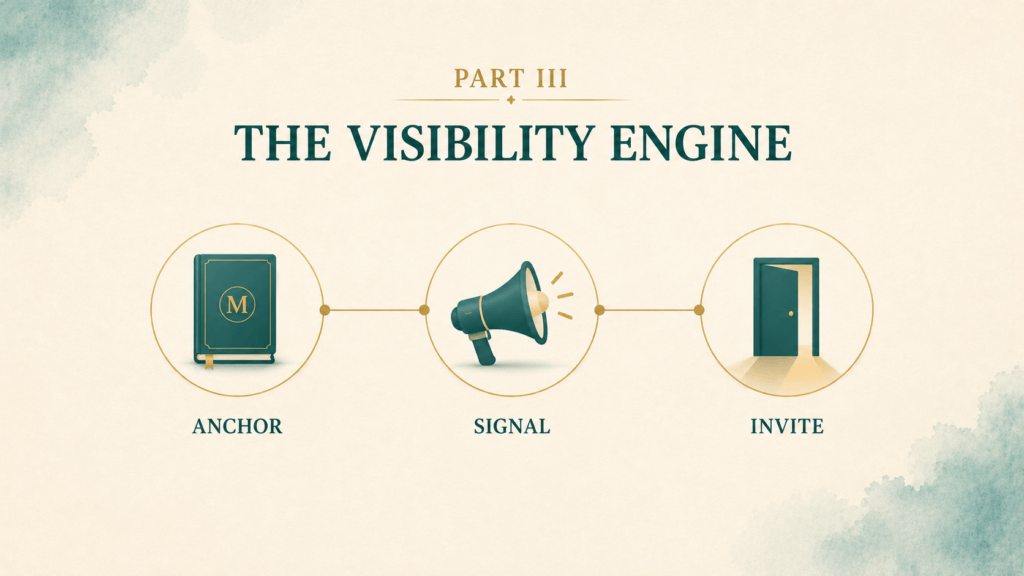
The visibility engine has three parts:
- Anchor — the core idea you want to be known for
- Signal — repeated expressions of that idea
- Invite — a clear next step for engagement
Together, these create recognition, familiarity, and selection.
Anchor — The Core Idea Everything Points Back To
The anchor is the central concept the market should associate with you.
In practice, this is usually:
- The category name
- The signature framework
- The core worldview expressed in a repeatable form
The anchor creates consistency.
Without an anchor, visibility fragments.
You may be active, but the market does not build a clear association between you and a specific idea.
Signal — Repetition That Builds Recognition
A signal is any visible expression of the anchor.
This includes:
- Articles
- Interviews
- Talks
- Short-form content
- Conversations
- Sales materials
The goal of signaling is not variety.
It is reinforcement.
Each signal should do at least one of three things:
- Clarify the category
- Reinforce the worldview
- Repeat the framework language
This is how recognition compounds over time.
Invite — The Step That Converts Attention Into Movement
An invite is the mechanism that turns recognition into engagement.
It gives the audience a way to go deeper:
- Read the book
- Join a workshop
- Enter a sales conversation
- Explore the framework in a structured way
Without an invite, visibility stays passive.
It may generate awareness, but it does not move people into action.
Content Mix
| Type | Purpose | Example |
| Anchor Content | Defines the core idea clearly and fully | Book, long-form guide, keynote |
| Signal Content | Repeats and reinforces the core idea in smaller forms | Posts, interviews, short insights |
| Invite Content | Creates a path from awareness to engagement | Workshop invitation, strategy call, book share with prospects |
How the Engine Works
The anchor creates coherence.
Signals create familiarity.
Invites create movement.
When these three are aligned, the category stops being an internal idea and becomes an external market reality.
That is how category leadership becomes visible:
not through constant novelty, but through consistent reinforcement of the same idea in forms the market can recognize, repeat, and act on.
The Pre-Sales Authority Loop
A book does more than create visibility.
At its best, it becomes a mechanism that turns positioning into trust before a sales conversation begins.
This is the Pre-Sales Authority Loop:
a repeatable system in which a book encodes your thinking, shapes how prospects understand your value, and increases the likelihood of conversion.
The sequence works like this:
Book → Thinking → Prospect → Trust → Conversion → Authority
Book
The book is the delivery vehicle.
It packages the category, worldview, and framework into a form someone can engage with on their own time.
This makes your thinking portable.
Thinking
The book does not just share information.
It encodes how you think.
That matters because clients are rarely buying information alone.
They are buying interpretation, judgment, and a structured way of solving a problem.
Prospect
When the right prospect receives the book, they are not encountering a pitch first.
They are encountering the underlying logic behind your work.
This changes the quality of the interaction.
The prospect is no longer asking:
“What do you do?”
They are starting to understand:
“How do you think, and is that the way we want to solve this problem?”
Trust
Trust builds faster when the thinking is already clear.
A book can:
- Reduce ambiguity
- Clarify your method
- Demonstrate depth before a formal sales process begins
This creates a different kind of credibility than content alone.
It is not borrowed attention.
It is structured trust.
Conversion
When trust is established earlier, conversion improves.
Not because the book “sells” in a direct sense, but because it pre-qualifies the relationship.
The right prospects arrive with:
- Better context
- Higher conviction
- Stronger alignment with the way you work
This leads to more efficient conversations and stronger engagements.
Authority
Each successful conversion reinforces authority.
The book clarifies the thinking.
The thinking improves trust.
Trust improves conversion.
Conversion strengthens market authority.
This is a loop, not a one-time tactic.
Case Study — Nate Androsky
Using a Book to Increase Deal Size and Conversion
Context
Founder / Consultant operating in high-value advisory engagements
Shift
Integrated his book directly into the sales process
What Changed
- Book sent during active deal conversations
- Prospects engaged with thinking before deciding
- Sales conversations started with context, not explanation
Outcome
- Increased deal size from six figures to seven figures
- Higher alignment before calls
- Faster, more decisive conversions
Why This Worked
The book made his thinking explicit before the sales conversation.
Instead of relying on:
- calls
- proposals
- explanations
the prospect encountered a structured version of:
- how he approaches problems
- how decisions are made
- what outcomes to expect
This reduced uncertainty.
It also changed the nature of the interaction.
The prospect was no longer asking:
“What do you do?”
They were evaluating:
“Is this the way we want to solve this problem?”
That shift is what increased both deal size and conversion.
What Category Leadership Looks Like in Practice
Category leadership is not theoretical.
When the category is clear, the worldview is distinct, and the framework is usable, it changes how the market responds.
The pattern is consistent:
clear positioning leads to better opportunities, stronger alignment, and higher-leverage outcomes.
Case Study — Framework-Led Internal Transformation
Context
Senior operator leading transformation inside an organization
Shift
Introduced a named framework to structure change
What Changed
- Teams aligned around shared language
- Decisions became more consistent
- Framework spread across departments
Outcome
- Expanded influence beyond formal authority
- Increased adoption of the system
- More scalable decision-making
Why This Worked
The framework turned abstract thinking into something usable.
Instead of relying on:
- meetings
- explanations
- alignment efforts
the organization had:
- a shared structure
- a repeatable model
- a common language
This allowed the idea to scale without constant reinforcement.
PART IV — The Category Leader Playbook (How to Execute This System)
This is how category leaders are built intentionally.
Clear thinking matters, but category leadership does not happen through insight alone.
It happens when the category, worldview, framework, and visibility system are turned into disciplined execution.
That is what this playbook is for.
The 90-Day Category Leader Plan
A 90-day plan is long enough to build real momentum and short enough to force clarity.
The goal is not to do everything at once.
It is to sequence the right work in the right order:
define the category, structure the thinking, and make it visible.
| Phase | Focus | Output |
| Days 1–30 | Define the category and worldview | Clear category statement, core belief, initial promise |
| Days 31–60 | Structure the thinking into usable assets | Signature framework, naming system, category narrative |
| Days 61–90 | Express and distribute the system consistently | Anchor content, signal content, invite path |
Days 1–30 — Define the Position
The first phase is about precision.
This is where the work moves from:
- broad topic
- loose expertise
- general positioning
into a clear category and point of view.
By the end of this phase, the author should be able to state:
- what category they are defining
- what belief anchors it
- what outcome it makes possible
If this phase is weak, the rest of the system becomes harder to build.
Days 31–60 — Turn the Thinking Into a System
Once the position is clear, the next step is to make it usable.
This phase focuses on:
- structuring the idea into a framework
- naming the core components
- developing the narrative that explains why the thinking exists
The objective is simple:
make the positioning transferable.
By the end of this phase, the thinking should be clear enough to teach, explain, and repeat without improvisation.
Days 61–90 — Make the Category Visible
The final phase is about market expression.
This is where the system becomes visible through:
- anchor content that defines the idea
- signal content that reinforces it
- invite mechanisms that move people into engagement
The purpose is not constant output.
It is structured repetition.
By the end of 90 days, the author should not just have a clearer position.
They should have a visible one.
Common Failure Points (and How to Fix Them)
Most category leadership efforts do not fail because the ideas are weak.
They fail because execution drifts.
The pattern is usually predictable:
the category becomes too broad, the worldview becomes diluted, or the visibility system turns into disconnected content.
The goal is not perfection.
It is staying aligned with the system long enough for the market to recognize it.
| Mistake | Why It Happens | Fix |
| Choosing a topic instead of a category | Broad topics feel safer and easier to explain | Narrow the space until it clearly defines what you are not |
| Trying to communicate too many beliefs | Authors want to capture the full complexity of their thinking | Identify one core belief that organizes the rest |
| Building a framework that is too complex | Expertise gets translated into too many steps, models, or concepts | Reduce the framework until it can be explained simply and repeated بسهولة |
| Publishing content without an anchor | Output becomes reactive instead of structured | Make every visible asset point back to the same category, worldview, or framework |
| Treating the book as an endpoint | The book is seen as the finish line rather than part of a larger system | Use the book as a mechanism to reinforce the category and move people into deeper engagement |
These mistakes matter because category leadership is cumulative.
If the category is unclear, the market cannot place you.
If the worldview is diluted, the positioning loses contrast.
If the framework is weak, the idea cannot spread.
If the visibility system is fragmented, recognition never compounds.
Strong execution comes from staying disciplined:
one category, one worldview, one framework, expressed consistently over time.
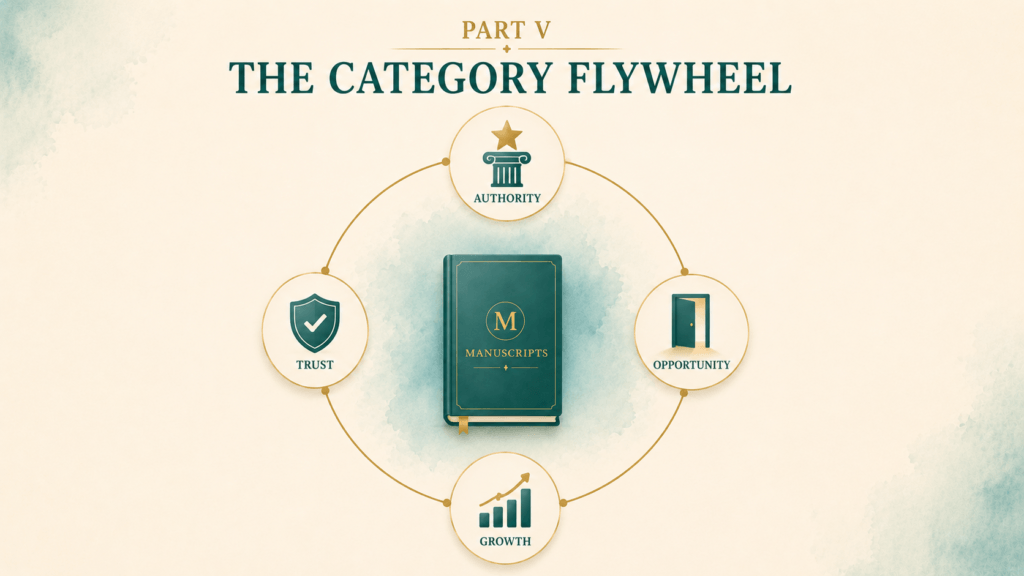
PART V — What Happens When You Own a Category
This is what happens when this is done right.
When a category is clearly defined, consistently expressed, and reinforced over time, the impact is not incremental.
It changes how the market understands you, and how decisions are made around you.
At this point, the system is no longer something you are building.
It is something working on your behalf.
What follows are the outcomes that emerge when category, worldview, framework, and visibility are fully aligned.
What Happens When You Do This Right
Positioning shifts
- You stop being compared to everyone else in the topic
- You become the reference point for a specific problem and perspective
- Authority becomes tied to a defined space, not personal visibility
Market perception changes
- Prospects understand your thinking before the sales conversation begins
- The right clients arrive with stronger alignment and higher conviction
- Opportunities become more relevant because the market knows what you are known for
Your ideas start to scale
- Your framework becomes easier to teach, share, and adopt
- Your language starts spreading beyond your direct audience
- Your book reinforces a category instead of simply reflecting expertise
Your system compounds
- Your content compounds instead of resetting the conversation each time
- Visibility turns into recognition, not just reach
- Positioning starts working for you even when you are not in the room
Why Category Creation Drives Real ROI
Category creation changes how value is understood before a commercial interaction begins.
Most revenue systems rely on:
- explaining value during the sales process
- persuading prospects in real time
- competing within existing categories
Category creation shifts this upstream.
It defines the problem, frames the solution, and encodes the thinking before the conversation, so the economics improve as a result.
This is the role of the Pre-Sales Authority Loop:
the book carries the thinking, the prospect internalizes it, and the decision becomes easier to make.
How Category Creation Changes the Economics
| Metric | Outcome | Implication |
| Conversion rate | Prospects arrive already aligned with the thinking | Sales becomes confirmation, not persuasion |
| Deal size | Higher-value engagements become easier to justify | The category reframes the scope and importance of the problem (as seen in Nate Androsky’s shift to seven-figure deals) |
| Sales cycle | Fewer steps required to reach a decision | Clarity reduces back-and-forth and removes the need for repeated explanation |
| Lead quality | Inbound interest becomes more selective | The category filters for fit before the first interaction |
| Pricing power | Reduced sensitivity to cost comparisons | The work is evaluated within your defined category, not against alternatives |
| Demand consistency | Ongoing, compounding interest over time | The category becomes a stable reference point the market returns to |
The Underlying Mechanism
Each of these outcomes follows the same pattern:
- The category defines how the problem is understood
- The worldview creates contrast and differentiation
- The framework makes the solution usable and repeatable
- The book distributes and reinforces all three
As this system compounds, value is no longer established during the sale.
It is established before the sale begins.
That is why category creation drives real ROI:
it reduces the cost of explanation and increases the perceived value of the work at the same time.
Final Reframe — You’re Not Building a Brand. You’re Defining a Category
Most authors try to improve how they are perceived.
They refine their messaging.
They increase their output.
They invest in visibility.
But perception does not create authority on its own.
It only amplifies what is already clear.
If the category is undefined, more visibility does not solve the problem.
It makes the confusion more visible.
The shift is this:
You are not trying to become a better-known version of something that already exists.
You are defining a space that did not exist in a clear way before.
That is what changes how the market responds.
When the category is clear:
- The work is easier to understand
- The value is easier to recognize
- The decision is easier to make
This is why branding alone is not enough.
Branding operates inside existing categories.
Category creation defines the frame those categories sit within.
The goal is not to improve how you show up.
It is to change how you are understood.
That is how authority becomes durable:
not by being more visible, but by being the reference point for a defined space.
Build Your Category or Compete Inside Someone Else’s
At some point, every expert faces the same decision.
Not whether to create more content.
Not whether to improve their brand.
But whether they want to compete inside an existing category—or define one of their own.
There is no neutral position.
If you don’t define the category around your work, the market will define it for you.
It will compare your ideas to something familiar.
It will evaluate your work using someone else’s standards.
And once that happens, differentiation becomes much harder.
The conversation shifts from “What makes this different?” to “How is this better than what’s already here?”
That is a fundamentally different game.
When the market relies on comparison, everything begins to compress.
- Price becomes easier to compare.
- Expertise becomes harder to distinguish.
- Perceived value becomes tied to existing alternatives instead of original thinking.
Category creation changes the evaluation itself.
Instead of competing within someone else’s framework, you introduce a new one.
You define:
- how the problem should be understood,
- what questions people should ask,
- what criteria matter most,
- and ultimately, how solutions are evaluated.
This is why positioning creates leverage.
It doesn’t simply make your work more visible.
It changes the context in which your work is understood.
Once that happens, everything else becomes easier.
Your book stops being just another publication.
It becomes the reference point for the framework.
Your language becomes shorthand for your ideas.
Your models become tools other people adopt.
And every article, keynote, workshop, or client conversation reinforces the same intellectual foundation.
This isn’t something you publish once.
It’s something you build deliberately over time.
The category becomes clearer.
The positioning becomes stronger.
The language becomes more recognizable.
And the opportunities begin to reinforce one another instead of competing for attention.
That’s the advantage of strategic category creation.
You aren’t just producing more content.
You’re creating a structure that makes every future piece of work more valuable than the last.
Premium CTA
If you want to build this with a system behind it,
not as an idea, but as a fully structured asset,
Manuscripts exists to help you do exactly that.
To:
- define a category you can own
- structure your thinking into a framework
- build a book that distributes that thinking
- and turn it into a system that drives authority, opportunity, and growth
This is not about producing a book.
It is about building something the market recognizes, and returns to.