How to Find Your Book Idea: A Framework for Turning Expertise Into a Book Worth Writing
Most people begin the search for a book idea the same way.
They look for inspiration.
They search for breakthroughs.
They wait for a compelling concept to appear.
The assumption is that successful books begin with a great idea.
And that the challenge is finding one.
For many professionals, the opposite is true.
The Problem Is Rarely a Lack of Ideas
Experts rarely suffer from idea scarcity.
They suffer from idea abundance.
Years of experience naturally generate potential books.
They accumulate:
- Lessons learned
- Frameworks developed
- Problems solved
- Observations collected
- Conversations repeated
- Perspectives refined over time
What often feels like a lack of clarity is actually an excess of possibility.
The challenge is not that there is nothing to write about.
The challenge is deciding what deserves to be written about.
Why More Ideation Creates More Uncertainty
When an expert already possesses dozens of viable directions, generating additional ideas rarely improves the situation.
It usually creates more complexity.
Each new possibility introduces another decision.
Another path not taken.
Another opportunity competing for attention.
The result is a paradox:
The more ideas available, the harder it becomes to choose.
Many authors misdiagnose this uncertainty as a creativity problem.
It is usually a prioritization problem.
Writing a Book Is a Strategic Decision
This is where book development changes from creativity to strategy.
A book is not simply a writing project.
It is an investment of time, attention, expertise, and reputation.
It becomes part of how the market understands your work.
Part of how opportunities find you.
Part of the body of work that represents your thinking.
Choosing a book idea is not merely deciding what to write.
It is deciding what deserves years of commitment.
Most experts do not need another idea.
They already have enough material for multiple books.
What they need is a way to determine which idea creates the greatest value if fully developed.
The challenge is not generating ideas.
The challenge is selecting the right one.
Why Most Book Idea Advice Fails
Most book idea advice assumes the author has a creativity problem.
The recommendations tend to sound familiar:
- Brainstorm more ideas
- Use writing prompts
- Explore your passions
- Capture random inspiration
- Generate a larger list of possibilities
This advice can be useful for someone staring at a blank page.
It is often far less useful for expertise-rich professionals.
Many professionals do not struggle because they lack ideas.
They struggle because they have too many.
Years of experience naturally create potential book material.
A consultant may see several books inside client engagements.
A founder may see books inside company-building lessons.
An executive may see books inside leadership experiences, frameworks, and decision-making patterns.
The challenge is rarely idea generation.
The challenge is deciding which idea deserves years of effort.
When someone already possesses multiple viable directions, generating additional ideas rarely creates clarity.
It creates more options.
And more options create more complexity.
The real bottleneck becomes evaluation.
Which idea has the strongest foundation?
Which idea creates the greatest value if fully developed?
Which idea deserves sustained commitment?
These are judgment questions, not creativity questions.
How to Choose the Right Book Idea
Most experts already have enough material for several books.
What they lack is a reliable way to assess those opportunities.
Without filters, every idea can appear equally promising.
Without evaluation criteria, decisions become driven by novelty, excitement, or temporary interest rather than long-term value.
The goal is not to generate more possibilities.
The goal is to identify the strongest possibility.
This is where discernment becomes more important than creativity.
Discernment is the ability to distinguish between ideas that are merely interesting and ideas that are worth developing.
The strongest authors are not necessarily the most creative people in the room.
They are often the most selective.
They understand that choosing a book idea is not simply a creative exercise.
It is a strategic decision about where to invest expertise, attention, and effort.
A strong book idea is rarely the first idea that appears.
It is the idea that remains valuable after careful evaluation.
The strongest authors are often not the most creative.
They are the most discerning.
The Decision in 60 Seconds
This Guide Is For You If
- You have multiple possible book ideas and struggle to choose between them.
- You know you have expertise worth sharing but are unsure where to focus.
- You want a book that creates long-term value beyond publication.
- You are waiting for complete clarity before committing to a direction.
This Guide Is Not For You If
- You are looking for creative writing prompts.
- You want fiction ideation techniques.
- You believe the best book ideas arrive through inspiration alone.
- You are searching for more ideas rather than a way to evaluate the ideas you already have.
The Core Insight
Most experts do not have an idea problem.
They have a selection problem.
The challenge is not generating another possibility.
It is determining which possibility deserves years of effort, becomes part of your body of work, and creates the greatest long-term value.
The Question This Guide Answers
How do you identify the book idea that sits at the intersection of your expertise, audience needs, long-term leverage, and enduring relevance?
That is the question this guide is designed to answer.
Why This Matters to Modern Authors
Most people treat a book idea as a writing decision.
Modern Authors treat it as a strategic decision.
That distinction matters because books rarely remain isolated projects.
They become part of how expertise is understood, remembered, and evaluated over time.
A Book Is More Than a Manuscript
A book is not merely:
- A manuscript
- A project
- A creative exercise
A book becomes:
- An authority asset
- A positioning mechanism
- A leverage tool
- Part of a permanent body of work
Once published, a book begins influencing how the market perceives the author and their expertise.
Every Book Creates a Signal
Whether intentional or not, every book communicates something.
It signals what the author knows.
What problems they solve.
What ideas they stand for.
And how they want to be understood.
This is why book selection matters.
The topic becomes part of the author’s public identity.
It shapes discoverability, credibility, and future opportunities.
Choosing a Book Idea Is Choosing a Future Asset
Modern Authors do not evaluate book ideas solely by asking:
“Would this be interesting to write?”
They also ask:
“What will this become if it succeeds?”
A strong book can continue creating value long after publication.
It can support authority.
Strengthen positioning.
Expand visibility.
And contribute to a larger body of work.
The decision is not simply what book to write.
The decision is which asset is worth building.
That is why choosing a book idea deserves strategic thought before the writing begins.
What This Guide Will Teach You
Most book idea advice focuses on generating possibilities.
This guide focuses on evaluating them.
Its premise is simple:
The strongest nonfiction book ideas are rarely discovered through brainstorming.
They are identified through a process of recognizing expertise, evaluating opportunities, and selecting ideas that create long-term value.
Inside this guide, you’ll learn:
- Why most experts already have enough book ideas
- How strong nonfiction books emerge from existing expertise
- Why waiting for complete clarity often delays progress
- How to evaluate ideas strategically rather than emotionally
- A practical framework for comparing competing book concepts
- How to identify ideas with long-term authority and leverage potential
- How Modern Authors choose books that are worth writing, and worth finishing
The goal is not to help you generate another idea.
The goal is to help you determine which idea deserves years of effort, becomes part of your body of work, and creates the greatest long-term value.

PART I — Why Most Experts Already Have Their Book Idea
Most professionals begin the search for a book idea by looking for something new.
A new insight.
A new framework.
A new breakthrough.
The assumption is that the right book has not been discovered yet.
For many experts, the opposite is true.
The challenge is rarely a lack of material.
It is recognizing the value of material that already exists.
This section explores why expertise naturally creates an abundance of potential book ideas, and why choosing between them is often harder than finding them in the first place.
The Problem Is Not a Lack of Ideas
Many professionals believe they need a book idea.
What they often need is a way to evaluate the ideas they already have.
Years of experience naturally generate potential book material.
A career spent solving problems, leading teams, building organizations, advising clients, conducting research, or developing frameworks creates a large inventory of possible directions.
Book ideas frequently emerge from:
- Client work
- Leadership experience
- Frameworks developed over time
- Observations gathered through practice
- Lessons learned through success and failure
- Questions answered repeatedly
- Conversations that continue resurfacing
Each of these can become the foundation of a nonfiction book.
The challenge is that experts often overlook this material because it feels familiar.
What feels obvious to the person who has lived it can be highly valuable to someone encountering it for the first time.
Expertise Creates Idea Abundance
The more expertise someone accumulates, the more potential book territory they create.
A consultant may identify several books inside years of client engagements.
A founder may discover multiple books hidden within lessons from building a company.
An executive may find book ideas inside leadership decisions, organizational challenges, and recurring management questions.
The problem is rarely the absence of ideas.
The problem is the abundance of them.
The Hidden Challenge: Too Many Directions
This is where many professionals become stuck.
Not because they cannot think of a book.
Because they can think of too many.
Each possibility competes for attention.
Each direction appears viable.
Each idea carries potential.
As the number of options increases, certainty often decreases.
The result is a paradox:
The more expertise someone possesses, the harder it can become to choose where to focus.
The Real Diagnosis
Most experts already possess enough material for several books.
The challenge is not finding something to write about.
The challenge is determining which direction is most worth pursuing.
That shift, from searching for ideas to evaluating them, changes the entire conversation.
The Shift From Ideation to Selection
Most aspiring authors ask the same question:
“What book should I write?”
At first glance, it seems like the right question.
If the challenge is writing a book, finding a topic appears to be the logical starting point.
But for most expertise-rich professionals, this question points attention in the wrong direction.
It assumes the problem is a lack of ideas.
More often, the problem is choosing among the ideas that already exist.
When authors focus on finding a book idea, they naturally begin searching for more possibilities.
They:
- Brainstorm new concepts
- Collect potential topics
- Explore additional directions
- Wait for inspiration to reveal the perfect idea
The result is often the opposite of what they intended.
More ideas create more options.
More options create more uncertainty.
And more uncertainty makes commitment harder.
What feels like a creativity problem is often a decision problem.
A more useful question is:
“Which idea creates the most value if fully developed?”
This changes the objective completely.
Instead of generating possibilities, the author begins evaluating opportunities.
Instead of searching for a breakthrough, they begin assessing what already exists.
The focus shifts from invention to judgment.
This is the central shift of the guide.
The goal is not inspiration.
The goal is selection.
Selection means identifying which idea deserves the investment required to become a book.
Not every interesting idea deserves years of commitment.
Not every viable topic deserves a place in your body of work.
The challenge is not finding an idea.
The challenge is determining which idea is most worth pursuing.
Modern Authors understand that choosing a book idea is not primarily a creative decision.
It is a strategic decision.
The question is no longer:
“What book should I write?”
The question becomes:
“Which opportunity creates the greatest value if I fully commit to developing it?”
This gives the section one visual break without disrupting the flow of the argument.
The Hidden Cost of Choosing the Wrong Book
Many professionals approach book selection as if the decision is low risk.
If one idea does not work, they can always write another book later.
In practice, the decision is often more consequential than it appears.
A serious nonfiction book requires substantial investment.
Not just money.
Not just writing.
But time, attention, expertise, and sustained effort.
Every book consumes resources that could have been invested elsewhere.
Every Book Carries an Opportunity Cost
Opportunity cost is the value of what must be given up in order to pursue something else.
Choosing one book idea means not pursuing another.
It means allocating finite energy toward a specific direction.
A book can require months, or years, of attention.
During that time, the author is making an implicit decision about where to focus expertise and what ideas deserve development.
This is why book selection matters.
The decision is not merely what to write.
It is what to prioritize.
Every Book Becomes Part of Your Professional Identity
A book does not disappear after publication.
It becomes part of how the market understands the author.
Part of how expertise is interpreted.
Part of how future opportunities are created.
Every book eventually becomes:
- Part of your reputation
- Part of your positioning
- Part of your body of work
Positioning refers to how others understand your expertise and the problems they associate you with solving.
Whether intentional or not, a book influences that perception.
The Cost of the Wrong Book
A weak book idea can still become a finished manuscript.
That does not mean it was the right decision.
A book that lacks strategic value may consume significant effort while creating little long-term leverage.
It may attract the wrong audience.
Reinforce the wrong positioning.
Or fail to support the opportunities the author ultimately wants to create.
This is why book selection deserves more attention than most authors give it.
The cost of writing the wrong book is often greater than the cost of not writing at all.
A book can become a long-term asset.
But only if the underlying idea is worth building upon.

PART II — Where Strong Nonfiction Books Actually Come From
Once authors stop asking, “What book should I write?” a more important question emerges:
Where do strong book ideas actually come from?
Many people assume successful books begin with inspiration.
In reality, the strongest nonfiction books are often discovered rather than invented.
They emerge from expertise that has already been tested, refined, and proven valuable through experience.
This is why the search for a book idea rarely begins with creativity.
It usually begins with paying closer attention to what already exists.
The Best Book Ideas Start With Existing Expertise
One of the most common misconceptions about nonfiction books is that they begin with a breakthrough idea.
A sudden insight.
A moment of inspiration.
A topic nobody has explored before.
While those stories are memorable, they are not how most strong nonfiction books are created.
More often, they emerge from expertise that has been developing for years.
Expertise Leaves Clues
Professionals rarely build expertise in isolation.
Over time, patterns begin to emerge.
Certain problems appear repeatedly.
Certain conversations happen again and again.
Certain frameworks become useful across multiple situations.
These patterns often reveal where a book already exists.
Strong nonfiction books frequently emerge from:
- Repeated problems
- Recurring conversations
- Tested frameworks
- Accumulated experience
- Lessons learned through practice
- Ideas explained consistently over time
The more often a concept proves useful in the real world, the stronger its foundation as potential book material.
Where Weak Ideas Often Come From
By contrast, weaker book concepts are often built around:
- Random inspiration
- Trend chasing
- Temporary market excitement
- Isolated observations
These ideas can feel compelling in the moment.
But they often lack the depth that comes from sustained experience.
Without a strong foundation, it becomes harder to develop meaningful insights, practical guidance, and durable value for readers.
The Advantage of Existing Expertise
When a book grows out of existing expertise, much of the underlying work has already been done.
The author has encountered the problems.
Tested the ideas.
Refined the thinking.
Observed what works and what does not.
The book becomes an act of organizing and communicating knowledge rather than inventing it from scratch.
This does not make the work easy.
But it does make the foundation stronger.
The strongest nonfiction books are rarely built on ideas that appeared yesterday.
They are usually discovered inside expertise that has been accumulating for years.
Repetition Is Often the Signal
Many professionals assume the best book ideas announce themselves through inspiration.
In practice, they often reveal themselves through repetition.
The same question appears again and again.
The same problem continues resurfacing.
The same explanation keeps proving useful.
What feels routine to the expert can be highly valuable to everyone else.
Where Repetition Appears
One of the simplest ways to identify promising book territory is to look for patterns that continue repeating across time, situations, and audiences.
Ask yourself:
- What do people repeatedly ask me?
- What problems do I repeatedly solve?
- What ideas do I repeatedly explain?
- What perspective feels uniquely mine?
The goal is not to find something new.
It is to recognize what has already demonstrated relevance.
Repetition Creates Evidence
Every repeated question is a signal.
Every recurring problem is evidence.
Every framework that continues proving useful is a clue.
When an idea repeatedly appears in conversations, projects, leadership situations, client engagements, or teaching moments, it often indicates that the topic matters beyond a single circumstance.
The pattern itself becomes data.
It suggests that the idea may already possess audience relevance and practical value.
What Feels Obvious May Be Valuable
This is where many experts overlook their strongest opportunities.
Because they have explained an idea hundreds of times, it no longer feels novel.
Because they solve a particular problem routinely, it no longer feels remarkable.
Familiarity can make expertise appear less valuable than it actually is.
The author assumes everyone knows what they know.
Often, they do not.
What feels obvious to the expert may be precisely what others need help understanding.
Repetition Is a Discovery Tool
Strong nonfiction books do not always begin with breakthrough insights.
They often begin with patterns.
Patterns reveal where expertise already exists.
Patterns reveal what audiences already care about.
Patterns reveal where a body of knowledge has accumulated over time.
Repetition is not a sign that an idea lacks originality.
It is often a sign that the idea matters.
The strongest book opportunities are frequently hidden inside the conversations, problems, and explanations that keep returning.
What You Are Uniquely Positioned to Explore
One of the most common mistakes aspiring authors make is trying to define the book too early.
They ask:
“What’s my book about?”
It seems like a reasonable question.
But it often creates unnecessary pressure.
The author feels compelled to identify the exact concept, audience, positioning, structure, and promise before the work has had a chance to develop.
As a result, many promising ideas are abandoned before they have been properly explored.
A Better Question
A more useful question is:
“What am I uniquely positioned to explore?”
This shifts the focus away from premature certainty and toward genuine expertise.
Instead of forcing a conclusion, it invites investigation.
Instead of demanding a finished concept, it creates space for discovery.
The goal is not to immediately define the book.
The goal is to identify territory worth exploring.
Unique Positioning Comes From Experience
Every professional accumulates a combination of experiences, observations, insights, and perspectives that nobody else possesses in exactly the same way.
You may be uniquely positioned to explore:
- A problem you have spent years solving
- A framework you have refined through practice
- A perspective shaped by a distinctive career path
- A question you continue returning to
- A pattern you have observed that others overlook
The value is not necessarily in having a completely original topic.
The value is in bringing a distinctive perspective to a topic that matters.
Exploration Creates Better Books
When authors begin with exploration rather than premature positioning, they gain important advantages.
It creates flexibility.
It encourages curiosity.
It allows patterns, themes, and connections to emerge naturally.
Most importantly, it gives the book room to become what it needs to become.
Many strong nonfiction books begin as a broad area of interest and become more focused through development.
The final concept often emerges from the process rather than appearing at the beginning.
The Goal Is Not Immediate Precision
Early in the process, certainty is often overrated.
What matters is identifying territory where your expertise gives you a legitimate right to contribute.
A book does not need to begin with a perfectly defined concept.
It often begins with a meaningful area of exploration.
The strongest authors do not always start by knowing exactly what the book is about.
They start by recognizing what they are uniquely positioned to explore.
Chris Mader and the Book He Didn’t Expect to Write
Many aspiring authors assume successful books begin with complete clarity.
They imagine the author identifying the topic, defining the thesis, building the structure, and then simply executing the plan.
But strong nonfiction books often emerge differently.
Chris Mader’s experience illustrates why.
He did not begin with nothing.
He had expertise.
He had experience.
He had a plausible book concept.
At first, the book appeared to be about leadership.
That made sense.
It fit his background.
It aligned with problems he had spent years helping people navigate.
By most standards, the idea was already viable.
But viability is not the same as clarity.
As the work developed, a deeper pattern began to surface.
The book was not only about leadership.
It was about:
- Change
- Reinvention
- Adjustment
- Transformation
It was about what happens when people find themselves operating in conditions that no longer resemble the environment where their previous success was created.
That deeper book did not appear fully formed at the beginning.
It emerged through development.
The Book Behind the Book
This pattern appears more often than many authors realize.
Writers frequently begin with a visible topic and discover a deeper argument underneath it.
The process often looks something like this:
- A topic creates the starting point.
- Writing reveals recurring patterns.
- Patterns expose a deeper theme.
- The deeper theme becomes the true book.
The visible topic attracts attention.
The underlying insight gives the book its meaning.
Writing becomes the process through which the author discovers what the work is actually trying to say.
Why This Matters
Many professionals delay writing because they believe they need complete clarity before they begin.
They want:
- The perfect concept
- The exact thesis
- The finished structure
- The fully formed promise
But Chris Mader’s experience suggests that expectation is often unrealistic.
The initial idea matters.
It needs to be strong enough to begin.
But it does not need to contain the entire book from the start.
In many strong nonfiction books, development is not merely an execution phase.
It is a discovery phase.
The strongest books are not always planned in advance.
They are often revealed through the act of creating them.
That is why waiting for perfect clarity can become one of the biggest obstacles to finding the book that is already trying to emerge.
Books Are Often Found Through Writing
Many aspiring authors believe their job is to discover the book before they begin writing.
They want complete clarity.
A finished concept.
A defined thesis.
A fully formed structure.
Only then do they feel ready to start.
The problem is that many of the most important discoveries happen after the writing begins.
Writing Is Not Just Execution
Authors often treat writing as the process of documenting what they already know.
In practice, writing frequently becomes a process of discovery.
The act of organizing ideas forces deeper thinking.
Connections become visible.
Assumptions are challenged.
Insights that felt separate begin to form a coherent whole.
The work does not simply express clarity.
It often creates it.
What Writing Reveals
As a manuscript develops, authors frequently discover:
- Patterns they had not previously noticed
- Themes connecting seemingly unrelated experiences
- Relationships between ideas
- A stronger structure than the one they originally imagined
What begins as a collection of observations often evolves into a more unified argument.
The book becomes clearer because the author is actively engaging with the material.
The Process Teaches the Author
This is one of the paradoxes of nonfiction authorship.
Many professionals believe they must fully understand the book before they write it.
Yet the writing process is often what teaches them what the book is actually about.
The initial idea provides a starting point.
The development process reveals the deeper meaning.
In many cases, the author learns alongside the manuscript.
Why Uncertainty Is Normal
Uncertainty is not necessarily evidence that the idea is weak.
It is often evidence that the work is still developing.
Strong books rarely arrive fully formed.
They emerge through exploration, refinement, and iteration.
The goal is not to eliminate uncertainty before beginning.
The goal is to engage the work long enough for clarity to emerge.
Many authors assume they must find the book before they write.
More often, they find the book by writing.
Why Waiting for Complete Clarity Becomes a Trap
Many aspiring authors assume they should wait until they have complete confidence in four things before beginning serious work on a book:
- the concept
- the audience
- the positioning
- the structure
On the surface, this seems reasonable.
A book is a significant investment of time and effort. It feels responsible to eliminate uncertainty before committing to the process.
The problem is that many of the answers authors are searching for cannot be fully discovered in advance.
The Illusion of Perfect Certainty
A common assumption is that successful authors begin with a fully formed vision:
- a perfectly articulated concept
- a clearly defined audience
- a differentiated market position
- a complete chapter structure
In practice, this is rarely how serious nonfiction books develop.
Authors often begin with a promising idea, a body of expertise, and a general direction.
The deeper clarity emerges through engagement with the work itself.
Why Analysis Eventually Stops Helping
Analysis is valuable early in the process.
It helps authors:
- evaluate opportunities
- identify promising directions
- avoid weak ideas
- reduce unnecessary risk
But analysis has limits.
At a certain point, additional thinking produces diminishing returns because the information required to make better decisions does not yet exist.
Questions such as:
- What is the strongest angle?
- Which ideas deserve greater emphasis?
- What resonates most with readers?
- What is the book really about?
are often answered through development rather than speculation.
Clarity Is Often a Byproduct of Progress
Many important publishing decisions become easier after an author begins organizing ideas, outlining concepts, and testing arguments.
As the work develops:
- patterns become visible
- themes become clearer
- priorities emerge
- positioning sharpens
The process itself generates information.
This is why clarity often follows action rather than precedes it.
A Better Standard Than Certainty
The goal is not complete certainty.
The goal is sufficient conviction.
An author does not need perfect clarity around every aspect of a book before beginning.
They need enough evidence to believe the idea is worth exploring further.
A strong starting point is often more valuable than a perfect plan.
The Strategic Reframe
Waiting for complete clarity assumes that clarity is something you discover before you begin.
For most nonfiction authors, clarity is something you build through the act of developing the book.
Progress creates information.
Information creates clarity.
And clarity grows far more reliably through movement than through waiting.

PART IV — The Four Filters Framework
Many authors approach book selection through intuition.
They ask:
- Which idea feels most exciting?
- Which topic am I most passionate about?
- Which concept seems most interesting right now?
Those questions can be useful, but they are often incomplete.
A strong nonfiction book is not simply an idea worth exploring.
It is an idea worth investing years into developing, publishing, and building upon.
That requires a more rigorous evaluation process.
The goal is not to identify the most interesting idea.
The goal is to identify the idea with the greatest potential to create value for readers and leverage for the author over time.
The Four Filters Framework provides a practical way to evaluate potential book ideas before committing significant resources to them.
A Better Framework for Choosing Your Book Idea
The strongest nonfiction books tend to sit at the intersection of four conditions:
- Expertise
- Audience
- Leverage
- Longevity
When all four are present, a book idea becomes significantly more likely to create meaningful results.
The Book Idea Evaluation Framework
| Filter | Core Question |
| Expertise | Do I have meaningful experience, insight, or perspective to contribute? |
| Audience | Is there a clear group of people who need this information? |
| Leverage | Will this book create opportunities beyond book sales? |
| Longevity | Will this idea remain relevant over time? |
1. Filter One: Expertise
Expertise refers to the knowledge, experience, observations, frameworks, and lessons an author has accumulated through sustained engagement with a topic.
This does not require being the world’s leading authority.
It requires possessing insights that can help readers solve problems, make decisions, or understand something more clearly.
A useful question is:
What have I spent enough time doing, studying, building, or observing that I can teach it with confidence?
Without expertise, a book often lacks depth.
2. Filter Two: Audience
Audience refers to the specific group of people who would benefit from the book.
A strong idea solves a meaningful problem, answers an important question, or helps readers achieve a desired outcome.
Questions to consider include:
- Who needs this information?
- What challenge does it help them address?
- Why would they care enough to invest time in reading it?
Without audience relevance, even well-developed ideas struggle to create impact.
3. Filter Three: Leverage
Leverage refers to the opportunities a book can create beyond the book itself.
For many Modern Authors, a book supports larger objectives such as:
- authority building
- speaking opportunities
- business development
- consulting engagements
- leadership positioning
This does not mean the book should become a sales tool.
It means the idea should contribute meaningfully to the broader body of work the author wants to build.
Without leverage, a book may create limited long-term value.
4. Filter Four: Longevity
Longevity refers to how durable the core idea is likely to be over time.
Some ideas are highly dependent on trends, technologies, or temporary market conditions.
Others remain useful for years because they address enduring human, organizational, or professional challenges.
Questions to consider:
- Will this idea still matter in five years?
- Is the insight tied to a temporary moment?
- Does the underlying problem persist over time?
Without longevity, a book’s usefulness can decline quickly.
Why the Framework Matters
Many book ideas score highly on one or two dimensions.
Fewer score highly across all four.
An idea may be exciting but lack audience demand.
It may have audience demand but little connection to the author’s expertise.
It may be relevant today but unlikely to remain useful in the future.
The strongest nonfiction books typically emerge when expertise, audience need, leverage, and longevity reinforce one another.
That intersection is often where the most promising book opportunities are found.
Comparison Table: Interesting Ideas vs Strategic Ideas
Not every book idea deserves the same level of investment.
Some ideas are interesting.
Some are strategically valuable.
The difference matters.
Interesting ideas often capture attention in the moment.
Strategic ideas create value long after the initial excitement fades.
The purpose of the Four Filters Framework is not to eliminate creativity.
It is to help distinguish between ideas that are merely appealing and ideas that are worth building upon.
Interesting Ideas vs Strategic Book Ideas
| Interesting Idea | Strategic Book Idea |
| Novel | Valuable |
| Timely | Durable |
| Personally exciting | Audience relevant |
| Easy to start | Worth finishing |
| Trend-driven | Expertise-driven |
| Standalone project | Long-term asset |
Why the Difference Matters
Many authors choose book ideas because they feel interesting.
The topic is new.
The concept feels exciting.
The timing appears right.
Those factors can be useful signals, but they are rarely sufficient on their own.
Strategic book ideas tend to survive deeper scrutiny.
They solve meaningful problems.
They draw upon genuine expertise.
They remain relevant beyond temporary market conditions.
And they contribute to a larger body of work rather than existing as isolated projects.
A Simple Test
When evaluating a potential book idea, ask:
Would this still be worth writing if the initial excitement disappeared?
If the answer is no, the idea may be driven primarily by novelty.
If the answer is yes, the idea may possess the durability, relevance, and strategic value required to become a meaningful book.
The goal is not to find the most interesting idea.
The goal is to identify the idea that remains valuable after the excitement wears off.

PART V — The Modern Author’s Selection Process
By this point, the challenge should look different.
The question is no longer:
“How do I come up with a book idea?”
The question becomes:
“How do I determine which idea is worth pursuing?”
This is the transition from ideation to selection.
And for most expertise-rich professionals, it is the transition that matters most.
The Goal Is Selection, Not Ideation
Many aspiring authors assume progress comes from generating more ideas.
If they feel uncertain, they brainstorm.
If they feel stuck, they search for inspiration.
If they cannot decide, they create additional possibilities.
The assumption is that the solution to uncertainty is more ideation.
For many experts, the opposite is true.
The problem is rarely a lack of ideas.
The problem is a lack of selection.
Modern Authors Usually Have Enough Ideas
Years of experience naturally produce potential book material.
Frameworks.
Observations.
Lessons learned.
Recurring questions.
Problems solved.
The challenge is not creating more possibilities.
It is determining which possibility deserves investment.
This is why many accomplished professionals can identify five, ten, or even twenty potential books and still struggle to decide where to begin.
The constraint is not creativity.
It is prioritization.
Better Books Begin With Better Filters
Selection requires judgment.
Judgment requires criteria.
Without criteria, every idea can appear equally promising.
The Four Filters Framework exists to provide those criteria.
Rather than asking:
“Do I like this idea?”
The author begins asking:
- Do I have meaningful expertise here?
- Does this solve a problem people care about?
- Can it create opportunities beyond the book itself?
- Will it remain valuable over time?
Those questions produce better decisions than inspiration alone.
The Real Skill
Many people assume successful authors are better at generating ideas.
In reality, they are often better at evaluating them.
They know how to distinguish between:
- An interesting idea and a valuable one
- A timely opportunity and a durable one
- A book that sounds appealing and a book worth building
This is the skill that sits at the center of strategic authorship.
Not ideation.
Selection.
The strongest authors are rarely the people with the most ideas.
They are the people who know which idea deserves to become a book.
Every Book Becomes Part of Your Body of Work
Many authors evaluate book ideas as if they are making a temporary decision.
They ask:
- What sounds interesting right now?
- What topic am I most excited about?
- What feels easiest to write?
Those questions are understandable.
But they often overlook a more important reality.
A book is rarely an isolated project.
It becomes a permanent part of how the market understands the author.
Books Outlast the Writing Process
The writing process eventually ends.
The book remains.
Years after publication, a book can continue influencing how people perceive an author’s expertise, interests, and areas of authority.
For many readers, the book becomes the first introduction to the author’s thinking.
For others, it becomes the reference point through which future work is interpreted.
The decision is not simply what to write.
It is what to become known for.
Every Book Creates a Signal
Whether intentional or not, every book communicates something.
It signals:
- What the author understands
- What problems they help solve
- What ideas they care about
- What expertise they want associated with their name
Over time, those signals shape professional identity.
They influence reputation.
They affect positioning.
They contribute to authority.
And they impact discoverability, the ability for people to find and understand someone’s expertise through search, recommendations, and shared ideas.
The Long-Term View
This is why strategic authors evaluate book ideas differently.
They do not ask only:
“Would I enjoy writing this?”
They also ask:
“Will I be glad this represents my work five years from now?”
A book can become an enduring asset.
Or it can become a distraction from the expertise an author ultimately wants to be known for.
The difference often begins at the idea-selection stage.
Choose Ideas That Deserve Permanence
Every published book becomes part of a larger body of work.
It joins everything else the author creates, teaches, publishes, and stands for.
That reality raises the standard for selection.
The strongest book ideas are not merely interesting enough to write.
They are important enough to deserve a permanent place in the author’s professional identity.
That is why choosing a book idea is not simply a writing decision.
It is a career decision.
The Modern Author Chooses Before They Write
One of the defining characteristics of a Modern Author is that they do not treat book selection as an afterthought.
They understand that the quality of the decision often determines the quality of the outcome.
Before committing to the writing process, they invest time in evaluating the opportunity itself.
Not every idea deserves a book.
Not every topic deserves years of effort.
And not every opportunity deserves a permanent place in a body of work.
1. The Old Model
The traditional approach often looks like this:
- Find an idea.
- Get excited about it.
- Start writing.
- Hope it becomes a valuable book.
The process is driven primarily by inspiration.
The assumption is that identifying a topic is enough.
Everything else can be figured out later.
Sometimes that works.
Often it leads to books that are difficult to finish, difficult to position, or difficult to connect to larger professional goals.
2. The Modern Model
Modern Authors approach the process differently.
They begin with evaluation.
They assess opportunities before committing resources.
The sequence looks more like this:
- Evaluate opportunities.
- Apply strategic filters.
- Select intentionally.
- Develop strategically.
The goal is not simply to find a topic.
The goal is to identify the strongest opportunity available.
Selection Creates Direction
Once a book idea has been selected intentionally, many other decisions become easier.
Positioning becomes clearer.
Audience becomes easier to define.
The role of the book within a larger body of work becomes easier to understand.
Selection creates direction.
Direction creates momentum.
Momentum creates progress.
The Identity Shift
This is the shift at the center of the guide.
Aspiring authors often search for ideas.
Modern Authors evaluate opportunities.
They understand that books are not built solely through inspiration.
They are built through judgment.
The strongest books rarely emerge because an author stumbled upon the perfect idea.
They emerge because the author identified an opportunity worth pursuing and developed it with intention.
PART VI — Building a Book Idea System
By this point, it should be clear that strong book ideas rarely emerge from inspiration alone.
They emerge from a combination of expertise, judgment, positioning, and strategic thinking.
This is why successful authors do not rely on isolated decisions.
They build systems.
A system creates consistency.
It connects individual decisions to larger objectives.
And it increases the likelihood that a book contributes to long-term authority rather than existing as a standalone project.
Related Systems Inside the Manuscripts Ecosystem
A book idea does not exist in isolation.
It sits inside a broader ecosystem of decisions about expertise, positioning, audience, publishing, and long-term value creation.
The stronger those systems become, the easier it becomes to identify ideas worth pursuing.
Modern Author OS
The Modern Author Operating System focuses on how books become authority assets.
An authority asset is a piece of intellectual property that continues creating value beyond its initial creation.
Within this framework, a book is not simply a manuscript.
It becomes part of a larger strategy for:
- Authority
- Visibility
- Positioning
- Opportunity creation
Book selection improves when authors understand the role the book is expected to play within that larger system.
Modern Publishing OS
The Modern Publishing Operating System focuses on the relationship between positioning and publishing success.
Positioning refers to how the market understands an author’s expertise and the problems they are associated with solving.
A strong book idea reinforces positioning.
A weak book idea can dilute it.
Evaluating book concepts through a positioning lens often leads to stronger publishing decisions.
Codex and Author Intelligence
Codex and Author Intelligence focus on transforming expertise into structured intellectual property.
Intellectual property is knowledge that has been organized into reusable assets such as frameworks, methodologies, models, research, and published content.
Many authors possess valuable expertise.
Fewer possess systems for extracting, organizing, and developing that expertise into durable assets.
Strong book ideas often emerge from this process of structured knowledge development.
Related Guides
Several resources within the Manuscripts ecosystem expand on ideas introduced throughout this guide.
1. From Expertise to IP: How Modern Authors Turn Ideas Into Frameworks That Power Books, Businesses, and Authority
2. Why Most Experts Have Too Many Ideas (And Not Enough Intellectual Capital): The Importance of Idea Development
3. From Book Ideas to Idea Development: What Modern Authors Actually Need in 2026
4. How to Build an Audience Before You Write Your Book: The Essential Playbook for 200 True Fans, Presales, and Reader-First Publishing
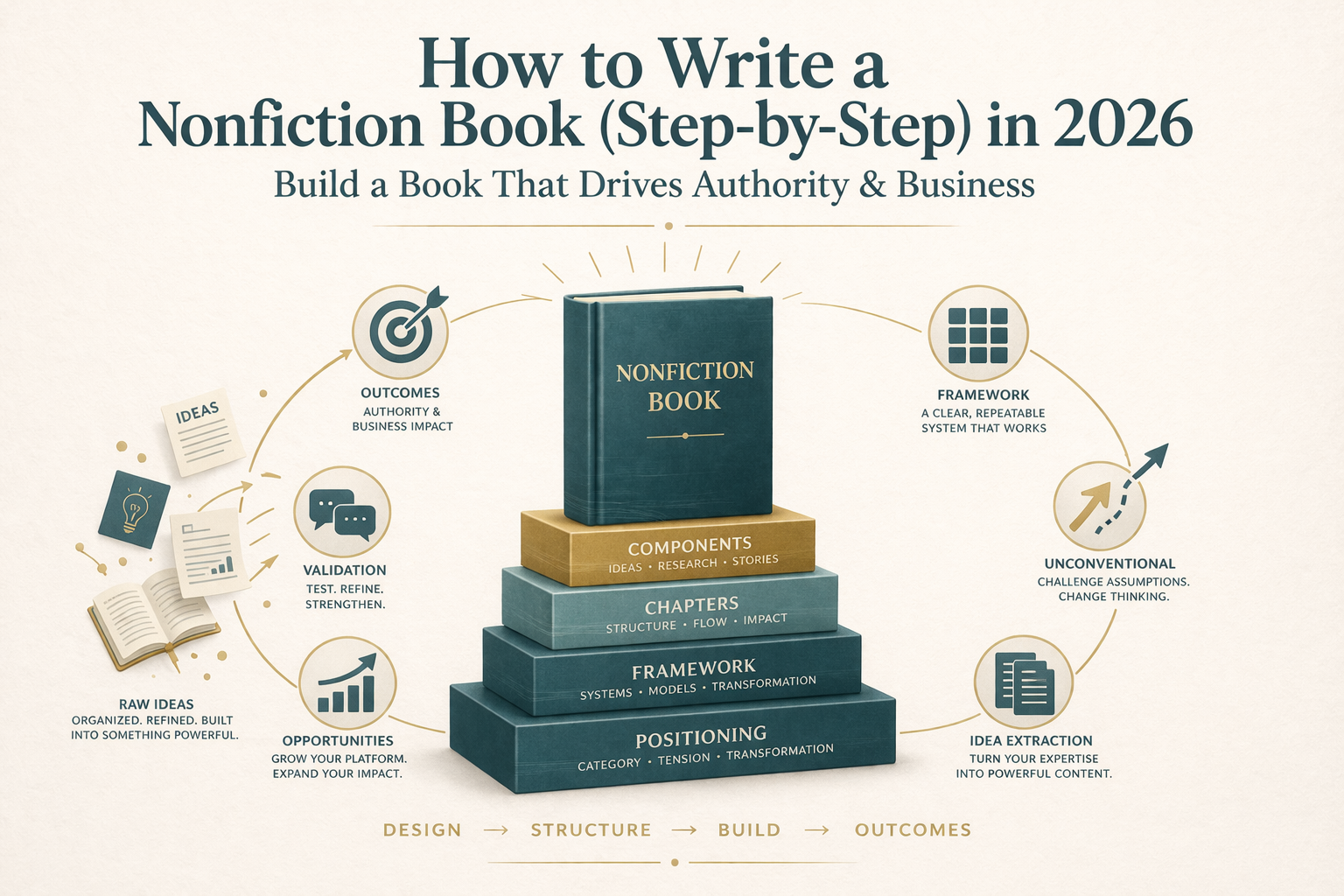
4. How to Write a Nonfiction Book (Step-by-Step) in 2026 | Build a Book That Drives Authority & Business
Together, these resources reinforce a central principle of the Modern Author approach:
Strong book ideas do not emerge from isolated inspiration.
They emerge when expertise, idea development, audience understanding, positioning, and authority-building systems work together.
The strongest books are rarely discovered by searching for ideas.
They are uncovered through a process that helps authors recognize, evaluate, and develop the expertise they already possess.
The Strategic Reframe
Many people search for book ideas as though the idea itself is the solution.
Modern Authors approach the process differently.
They build systems that make strong ideas easier to recognize.
The strongest nonfiction books rarely emerge from isolated inspiration.
They emerge from systems that help expertise become visible, valuable, and strategically aligned over time.
Conclusion — The Best Book Ideas Are Usually Already There
Many aspiring authors begin their search for a book idea by looking outward.
They search for inspiration.
They search for trends.
They search for breakthroughs.
They assume the right idea has not yet been found.
For most expertise-rich professionals, the opposite is often true.
The strongest book ideas are rarely waiting somewhere else.
They are usually already present.
Hidden inside years of experience.
Embedded within recurring questions.
Visible in frameworks that have been developed over time.
Contained within problems that have been solved repeatedly.
The Challenge Is Not Finding an Idea
Throughout this guide, a different picture has emerged.
Most experts do not suffer from idea scarcity.
They suffer from idea abundance.
The challenge is not generating another possibility.
It is recognizing which possibility deserves attention.
Which idea has the strongest foundation.
Which idea creates the greatest value for readers.
Which idea contributes meaningfully to a larger body of work.
Which idea deserves years of investment.
Those are selection questions.
Not creativity questions.
Strong Books Are Discovered, Not Invented
The strongest nonfiction books are rarely created from nothing.
More often, they are discovered.
An author notices a pattern.
A recurring problem.
A framework.
A perspective that continues proving useful.
Over time, that accumulated expertise becomes visible as book territory.
The work is not inventing the idea.
The work is recognizing its significance.
The Modern Author’s Advantage
Modern Authors understand that authorship begins before the writing process.
It begins with discernment.
The ability to distinguish between ideas that are merely interesting and ideas that are strategically worth developing.
They understand that a book is more than a manuscript.
It is an asset.
A signal.
A contribution to a larger body of work.
That is why they approach book selection intentionally.
The Final Reframe
The question is not:
“How do I find a book idea?”
The question is:
“Which idea is already present in my expertise, experience, and observations, and most worth developing?”
For many professionals, the best book idea is not waiting to be discovered.
It is waiting to be recognized.
The strongest nonfiction books are rarely invented from scratch.
They are uncovered inside the knowledge, insights, frameworks, and questions the author already carries.
Next Step: Turn the Right Idea Into the Right Book
Choosing a book idea is an important decision.
But it is only the beginning.
The strongest authors do not stop at identifying a promising idea.
They develop systems for turning expertise into intellectual property, intellectual property into authority assets, and authority assets into long-term professional leverage.
This is the difference between writing a book and building an authorship strategy.
Build Beyond the Idea
Once you have identified a book idea worth pursuing, the next questions become:
- How do you transform expertise into a compelling book?
- How do you position that book within your larger body of work?
- How do you build authority before publication?
- How do you ensure the book creates opportunities beyond book sales?
- How do you publish in a way that supports long-term ownership and leverage?
These questions sit at the center of the Modern Author approach.
Explore the Manuscripts Ecosystem
The Manuscripts ecosystem is designed to help experts move from ideas to authority.
Key frameworks include:
Modern Author OS
A system for turning expertise into authority assets that support visibility, positioning, speaking, business development, and long-term professional leverage.
Modern Publishing OS
A framework for approaching publishing as a strategic business and authority decision rather than a one-time production project.
Together, these systems help authors move beyond writing a manuscript and toward building a durable body of work.
The Strategic Opportunity
Most professionals already possess more expertise than they realize.
The challenge is not creating something from nothing.
The challenge is recognizing what is already there, developing it intentionally, and transforming it into an asset that creates value over time.
The right book idea is rarely the finish line.
It is the starting point.
A starting point for authority.
A starting point for intellectual property.
A starting point for a body of work that continues creating value long after the book is published.
Explore the Modern Author OS, Modern Publishing OS, and the broader Manuscripts Guide ecosystem to continue building the systems that turn expertise into lasting authority.