AI Decision Making Starts With Better Questions, Not Better Prompts (2026)
Why Inquiry Is Becoming the Most Valuable Skill in the Age of AI
Most professionals using AI eventually reach the same conclusion:
“I need to get better at writing prompts.”
It feels like the obvious next step.
After all, every article, video, and LinkedIn post seems to promise the same thing:
- Learn better prompts.
- Master prompt engineering.
- Build a prompt library.
- Use the latest AI framework.
The message is remarkably consistent.
If you can learn to instruct AI more effectively, you’ll produce better results.
There is truth in that.
A well-written prompt usually produces a better response than a vague one.
But this growing obsession with prompts is quietly pointing professionals toward the wrong competitive advantage.
A prompt is simply an instruction.
It tells AI what to generate, summarize, analyze, compare, or explain.
By the time you’re writing a prompt, however, one of the most important decisions has already been made.
You’ve already decided what deserves to be asked.
That decision rarely receives the same attention.
Yet it is the one that shapes everything that follows.
Before an AI system can produce a useful answer, someone must first determine:
- Which problem actually needs solving.
- Which assumption deserves to be challenged.
- Which uncertainty is worth exploring.
- Which comparison might change the decision.
- Which question is important enough to investigate.
Those choices do not happen inside the AI.
They happen before the prompt is ever written.
This distinction matters because professionals often mistake better instructions for better thinking.
They assume that if AI produces an unhelpful answer, the prompt simply needs to become more precise.
Sometimes that’s true.
Just as often, the problem lies further upstream.
An exceptionally crafted prompt cannot compensate for a weak question.
If the underlying inquiry is superficial, AI will simply produce a more polished version of a shallow answer.
That is why this Guide takes a different position from most conversations about AI.
It is not a Guide about prompt engineering.
It is not a collection of prompt templates.
It is not another catalog of AI shortcuts or productivity techniques.
Instead, it begins with a more fundamental capability:
The ability to identify what is worth asking before deciding how to ask it.
As AI becomes increasingly capable of generating answers, summaries, explanations, and content, the professional advantage shifts elsewhere.
It shifts toward the human ability to recognize meaningful problems, define worthwhile lines of inquiry, and ask questions that lead to better thinking.
The future belongs less to the people who become experts at instructing AI.
It belongs to the people who become experts at directing inquiry.
Because better prompts improve responses.
Better questions improve decisions.
AI Decision Making Starts Before the Prompt
Most discussions about AI assume that decision making begins the moment a prompt is written.
It doesn’t.
By the time someone asks AI to analyze a market, summarize research, compare strategies, or generate ideas, several important decisions have already been made.
Someone has already decided what deserves attention.
Those decisions shape the quality of every answer that follows.
This is the central reframe of this Guide:
AI decision making begins before the prompt.
It begins with inquiry.
Inquiry is the deliberate process of deciding what deserves to be understood before attempting to solve it. It defines the direction of thinking by identifying the problems, uncertainties, and assumptions that require exploration.
Only after that work is done does the prompt have a meaningful role.
This is why prompts and questions should not be treated as interchangeable.
A prompt is an instruction.
It tells AI what action to perform.
A question serves a different purpose.
It determines what deserves investigation in the first place.
That distinction may seem subtle, but it fundamentally changes where professionals should focus their attention.
Consider the decisions that exist before any prompt is written:
- Which problem is actually worth solving?
- Which assumption should be questioned?
- What evidence is still missing?
- Which comparison would improve the decision?
- What uncertainty needs further exploration?
None of these decisions can be delegated to AI.
They require human judgment.
Once those decisions have been made, AI can contribute meaningfully by analyzing information, exploring possibilities, identifying patterns, or organizing knowledge.
But AI cannot reliably determine whether the original inquiry was the right one.
A precise prompt built on a weak question still produces work centered on the wrong problem.
A thoughtful question, by contrast, creates the conditions for better exploration, stronger analysis, and ultimately better decisions.
This is why the relationship between questions and prompts is not equal.
Questions come first.
Prompts come second.
The prompt determines how AI responds.
The question determines what deserves to be understood.
For professionals making strategic decisions, that order matters.
The greatest value does not come from becoming increasingly skilled at instructing AI.
It comes from becoming increasingly skilled at identifying the questions that make AI worth using in the first place.
Why This Matters More Than Ever
The shift from better prompts to better questions is not simply a different way of using AI.
It reflects a much larger change in how professional value is created.
For most of modern history, expertise was closely tied to possessing information.
Professionals created value because they knew things that were difficult to access, difficult to organize, or difficult to explain. Specialized knowledge, research, and experience gave them an advantage that relatively few people could replicate.
Artificial intelligence changes that equation.
Today, AI can generate explanations in seconds.
It can summarize lengthy reports.
It can compare competing viewpoints.
It can organize research.
It can produce competent first drafts across countless subjects.
In other words, AI has dramatically reduced the cost of producing information.
What was once scarce is becoming increasingly abundant.
- Answers are abundant.
- Summaries are abundant.
- Explanations are abundant.
- Information is abundant.
As the supply of answers continues to grow, the source of professional advantage begins to shift.
The differentiator is no longer access to information alone.
It is the ability to determine which information is worth seeking in the first place.
Professionals create greater value when they can:
- Define meaningful problems before searching for solutions.
- Identify uncertainty that others overlook.
- Recognize assumptions that deserve to be challenged.
- Distinguish important questions from interesting ones.
- Direct attention toward inquiries that improve decisions.
These capabilities cannot be automated simply by asking AI to generate another response.
They depend on human judgment.
This is why the economics of expertise are changing.
When answers become easier to produce, they become less effective at differentiating professionals.
Questions become more valuable because they determine the quality of every analysis, every decision, and every idea that follows.
The professionals who create the most value in the age of AI will not be those with unlimited access to answers.
They will be the ones who consistently identify the questions worth pursuing before everyone else does.
The Decision in 60 Seconds
If you’ve read this far, you may already have a sense of whether this Guide is addressing the challenge you’re trying to solve.
This quick assessment can help you decide.
This Guide Is for You If…
- You use AI to support research, analysis, or strategic decision making.
- You create ideas, frameworks, or intellectual property as part of your work.
- You want AI to strengthen your thinking, not simply accelerate your output.
- You believe professional expertise should remain a meaningful competitive advantage in the age of AI.
- You suspect that the quality of your questions matters more than the sophistication of your prompts.
This Guide Is Probably Not for You If…
- You’re primarily looking for prompt formulas or reusable prompt libraries.
- You want shortcuts for generating content more quickly.
- You’re trying to compare AI models or choose between AI tools.
- Your primary goal is increasing productivity rather than improving decision making.
- You expect AI to replace the work of defining problems, making judgments, or developing original ideas.
The Core Decision
Every professional who uses AI eventually makes a choice, whether they realize it or not.
One path treats AI primarily as a faster way to produce answers.
The other treats AI as a way to explore better questions before reaching an answer.
This Guide is built around the second approach.
Its purpose is not to help you write more sophisticated prompts.
Its purpose is to help you develop the thinking that makes every prompt more valuable.
If you remember only one idea from this Guide, let it be this:
Don’t begin with the prompt.
Begin with the question.
Why This Matters to Modern Authors
The shift toward better questions matters to every professional.
It matters even more to Modern Authors.
A Modern Author is not defined by publishing a book. A Modern Author is someone who develops original ideas that continue creating value long after the book is finished. The book is simply one expression of a larger body of intellectual work.
That work does not begin with writing.
It begins with inquiry.
Modern Authors create value by discovering ideas others have overlooked, recognizing patterns across experience, challenging assumptions, understanding their audience, and developing frameworks that help people think differently.
Every one of those capabilities begins with a better question.
Not every valuable question produces a book.
But every valuable book begins with a question worth exploring.
The same is true for the other assets Modern Authors create.
| Modern Author Asset | Begins With |
| A book | A question worth answering |
| A framework | A pattern worth explaining |
| Research | An uncertainty worth exploring |
| A keynote | A belief worth challenging |
| Intellectual property | An idea worth developing |
This is why inquiry sits at the foundation of the Modern Author philosophy.
Writing does not create original thinking.
It reveals, refines, and communicates thinking that began much earlier through disciplined questioning.
As AI becomes increasingly capable of generating information, the value of that capability only grows.
AI can help develop an idea.
It cannot determine which idea is worth developing.
That decision, and the questions that lead to it, remain the defining advantage of the Modern Author.
What This Guide Will Teach You
This Guide is built around a simple premise:
As AI becomes better at generating answers, the ability to ask better questions becomes a more valuable professional skill.
Each section develops that idea from a different perspective, moving from understanding why this shift is happening to learning how to apply it in your own thinking and decision making.
By the end of this Guide, you will understand:
- Why AI changes the value of expertise. Learn why abundant information shifts professional advantage away from possessing answers and toward defining meaningful problems.
- The difference between questions and prompts. Develop a clear mental model for understanding why questions shape thinking while prompts simply direct AI to perform a task.
- How better questions improve AI decision making. See why stronger decisions are determined by the quality of the inquiry that exists before a prompt is ever written.
- Why inquiry reveals expertise. Understand how sustained questioning uncovers patterns, challenges assumptions, and leads to insights that cannot be produced by information alone.
- How AI can strengthen questioning. Learn how AI can support exploration by helping expand perspectives, surface blind spots, and deepen inquiry without replacing human judgment.
- How to build a question-first workflow. Discover a practical approach for integrating inquiry into research, strategic thinking, writing, and intellectual property development.
This is not a Guide about becoming better at prompting AI.
It is a Guide about becoming better at thinking with AI.
Because in the age of abundant answers, the professionals who create the greatest value will be the ones who consistently ask the questions that matter most.
Part I — Why Questions Are Becoming More Valuable Than Answers
The conversation about AI often focuses on what the technology can do.
This part asks a different question.
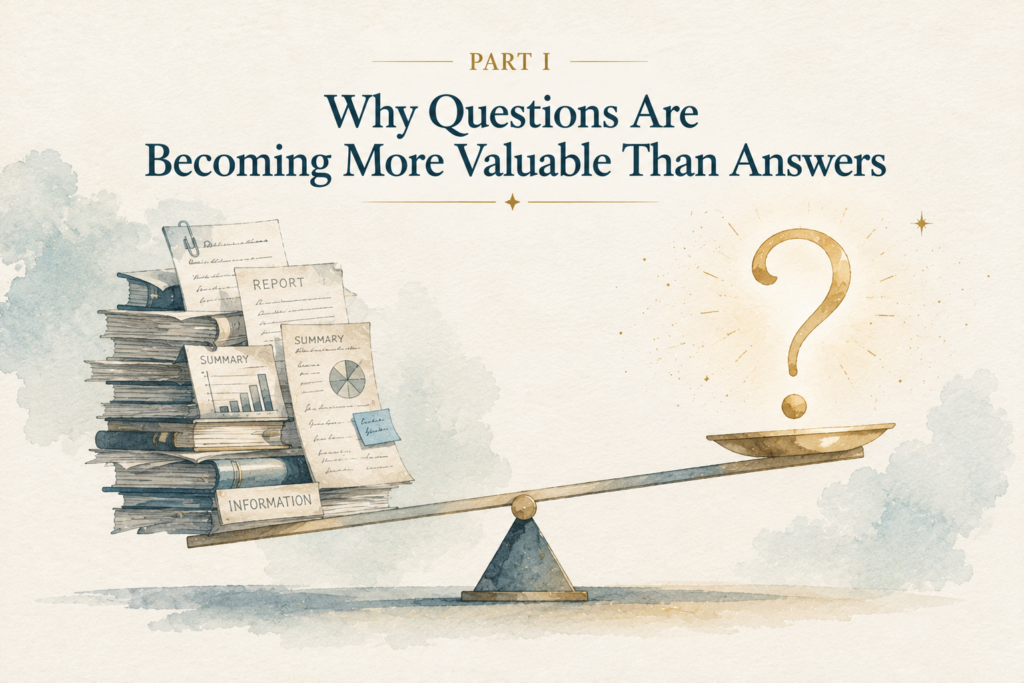
What happens to professional expertise when generating answers is no longer the scarce capability?
To answer that, we need to look beyond AI itself and examine how it changes where value is created.
As answers become easier to produce, the professionals who continue to stand out will not necessarily know more than everyone else.
They will become better at identifying the problems worth solving, the assumptions worth questioning, and the ideas worth exploring before anyone else does.
That is the shift this part explores.
AI Has Changed the Value of Expertise
For decades, expertise was closely associated with having answers.
Professionals earned trust because they possessed knowledge that other people did not.
They had accumulated experience.
They had conducted research.
They had developed specialized understanding that was difficult to acquire and even more difficult to communicate.
That scarcity created value.
If you knew something that few others knew, your expertise naturally became more valuable.
Artificial intelligence changes that relationship.
Today, AI can retrieve information, explain unfamiliar concepts, summarize research, compare alternatives, and generate competent first drafts in a matter of seconds.
Many of the activities that once demonstrated expertise have become widely accessible.
This does not mean expertise has become less important.
It means the source of its value has shifted.
The competitive advantage is moving away from producing answers and toward determining which answers are worth pursuing in the first place.
That distinction is subtle, but significant.
Producing an answer assumes that the right problem has already been identified.
Defining the problem requires deciding what deserves attention before any analysis begins.
Those are fundamentally different capabilities.
One generates information.
The other directs thinking.
As AI becomes increasingly capable of generating information, the ability to direct thinking becomes more valuable.
Professionals now create greater value when they can:
- Recognize problems that others fail to notice.
- Identify assumptions that deserve closer examination.
- Separate meaningful questions from interesting distractions.
- Determine what evidence is actually needed before reaching a conclusion.
- Frame an inquiry that leads to better decisions instead of merely faster answers.
These are not tasks that begin with AI.
They begin with judgment.
AI can accelerate exploration once a worthwhile direction has been established.
It cannot reliably determine whether that direction is worth pursuing in the first place.
This is why expertise should no longer be understood simply as possessing knowledge.
Increasingly, expertise is demonstrated by knowing where to direct attention before knowledge is gathered.
The professionals who create the greatest value will not always be the ones who produce the best answers.
More often, they will be the ones who ask the questions that make better answers possible.
Answers Scale. Questions Differentiate.
Throughout most of professional history, answers were difficult to produce.
Finding the right information often required years of experience, specialized education, extensive research, or access to resources that few people possessed.
That scarcity made answers valuable.
Today, that assumption is becoming less reliable.
AI can generate explanations, summarize research, compare alternatives, and synthesize information in seconds.
The ability to produce a competent answer is no longer rare.
It is increasingly available to everyone.
This is an example of commoditization, the process by which something that was once scarce becomes widely available and therefore less effective at creating competitive advantage.
Information is being commoditized.
Answers are being commoditized.
The ability to generate content is being commoditized.
That does not mean answers have lost their importance.
Organizations will always need accurate analysis, sound recommendations, and well-supported decisions.
What has changed is where those answers create value.
If nearly everyone can produce a reasonable answer with AI, then producing another reasonable answer is no longer enough to distinguish one professional from another.
Differentiation moves upstream.
It begins before the answer exists.
It begins with the questions that determine what gets explored in the first place.
Questions cannot be commoditized as easily because they require judgment.
A meaningful question reflects an understanding of context, priorities, tradeoffs, and uncertainty.
It requires someone to recognize that an assumption should be challenged, that a familiar problem has been framed incorrectly, or that an overlooked opportunity deserves investigation.
Those are not informational tasks.
They are intellectual ones.
This is why two professionals can use the same AI system, access the same information, and receive equally well-written responses, yet arrive at dramatically different outcomes.
The difference is rarely the quality of the technology.
It is the quality of the inquiry that guided it.
One person asks AI to answer the obvious question.
The other asks the question that everyone else overlooked.
The first produces information.
The second uncovers insight.
As AI continues to make answers faster, cheaper, and more accessible, the professionals who stand out will not simply know more.
They will consistently ask questions that reveal what others have not yet seen.
That is why answers scale.
Questions differentiate.
The New Competitive Advantage
Every major technological shift changes what professionals are rewarded for.
When information was difficult to obtain, those who possessed specialized knowledge held the advantage.
As search engines made information easier to access, the advantage shifted toward knowing how to find, evaluate, and apply that information effectively.
AI represents another shift.
The competitive advantage is moving again.
Not away from expertise.
Toward a different expression of expertise.
The professionals who create the most value are no longer distinguished primarily by how quickly they can produce answers.
They are distinguished by how effectively they direct inquiry before answers are produced.
This Guide uses the term inquiry to describe the disciplined process of deciding what deserves to be understood before attempting to solve it.
Inquiry is not curiosity alone.
Curiosity asks interesting questions.
Inquiry asks useful ones.
Useful questions create value because they improve everything that follows.
Specifically, they help professionals:
- Define the right problem before investing time in solving it.
- Challenge hidden assumptions that limit better thinking.
- Identify missing evidence before reaching conclusions.
- Recognize patterns that others overlook.
- Direct AI toward meaningful exploration instead of generic information.
Notice that none of these activities depend on producing an answer.
They determine whether the answer will matter in the first place.
This is why inquiry has become a competitive advantage.
It improves every stage of knowledge work because it improves the quality of thinking that precedes it.
Whether you’re conducting research, making strategic decisions, developing a framework, or writing a book, the sequence remains remarkably consistent:
Better inquiry → Better exploration → Better insight → Better decisions → Better outcomes
AI can accelerate exploration.
It can expand analysis.
It can surface additional information.
But those capabilities only create meaningful value when they are directed toward the right question.
The greatest opportunities rarely come from asking AI to work faster.
They come from asking it to explore questions that others never thought to ask.
As answers become increasingly abundant, professionals will compete less on their ability to generate information and more on their ability to generate direction.
Direction begins with inquiry.
And in the age of AI, inquiry is becoming one of the most valuable professional capabilities a person can develop.
Part II — Questions vs. Prompts
If Part I explained why questions are becoming more valuable, this part explains how they differ from prompts.
The distinction is easy to overlook because questions and prompts often appear in the same conversation with AI.
In practice, however, they perform fundamentally different roles.
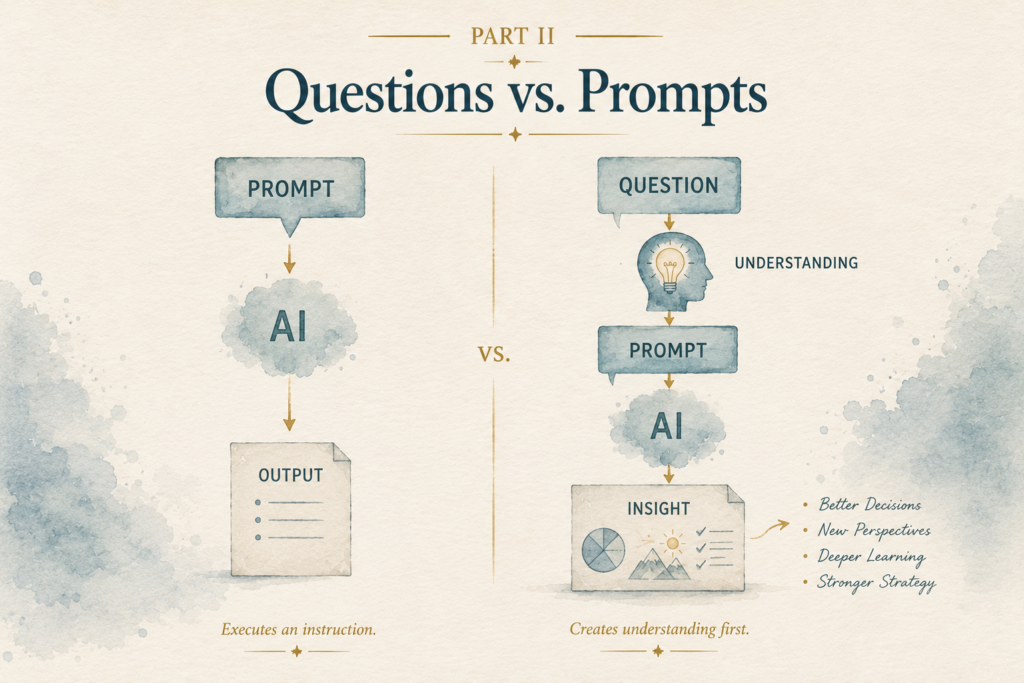
A prompt tells AI what to do.
A question determines what is worth understanding.
Once that distinction becomes clear, it changes how you use AI, and, more importantly, how you think before you use it.
A Prompt Gives Instructions. A Question Creates Understanding.
The terms prompt and question are often used interchangeably.
They shouldn’t be.
Although both are written into an AI interface, they serve very different purposes.
A prompt is an instruction.
Its purpose is to direct AI toward a specific task or output.
Examples include:
- Summarize this report.
- Write a LinkedIn post about leadership.
- Compare these two marketing strategies.
- Generate ten headline ideas.
Prompts focus on execution.
They tell AI what to produce.
A question, by contrast, is an act of inquiry.
Its purpose is not to generate content immediately, but to deepen understanding.
Questions shape what deserves exploration before any content is created.
Consider the difference.
| Prompt | Question |
| Write a chapter about leadership. | What misunderstanding about leadership causes capable managers to fail? |
Both can produce a chapter.
Only one is likely to produce an original idea.
The prompt begins with execution.
The question begins with understanding.
That distinction changes everything that follows.
A thoughtful question influences:
- What information is gathered.
- Which assumptions are challenged.
- What patterns become visible.
- Which insights emerge.
- What decisions are ultimately made.
The prompt simply communicates those decisions to AI.
This is why prompts are downstream of questions.
Before you can write an effective prompt, you must first determine what you are actually trying to understand.
The sequence looks like this:
Question → Understanding → Prompt → Output
Many professionals reverse that process.
They begin by searching for better prompts.
In reality, the quality of the prompt is limited by the quality of the thinking that produced it.
A sophisticated prompt cannot compensate for a shallow question.
But a meaningful question can often produce valuable insights, even through a relatively simple prompt.
This is one of the most important shifts in AI decision making.
The goal is not to become exceptionally good at telling AI what to do.
The goal is to become exceptionally good at deciding what is worth asking before AI does anything at all.
Why Better Prompts Cannot Replace Better Questions
As AI becomes more capable, it is easy to assume that better prompts naturally produce better results.
To a point, they do.
A clear, specific prompt will almost always outperform a vague one.
But prompt quality has a ceiling.
That ceiling is determined long before the prompt is ever written.
It is determined by the quality of the thinking behind it.
A prompt tells AI how to perform a task.
A question determines why the task matters and what should be explored.
No amount of prompt engineering can compensate for a weak question.
A sophisticated prompt built on a shallow question simply produces a more polished version of a limited idea.
The difference becomes obvious when you compare what each one is trying to accomplish.
| Better Prompt | Better Question |
| Improves the execution. | Improves the direction. |
| Produces clearer outputs. | Produces stronger insights. |
| Optimizes communication with AI. | Optimizes human thinking before AI. |
| Makes answers more useful. | Makes better answers possible. |
This is why prompt engineering is downstream of inquiry.
Before a prompt can be effective, someone must first decide:
- What problem is actually being solved?
- What assumption deserves to be challenged?
- What uncertainty needs investigation?
- What outcome would create genuine value?
Those decisions are not prompt-writing skills.
They are thinking skills.
Consider two professionals using the same AI model.
The first asks:
“Write a report about employee engagement.”
The second asks:
“Why do employee engagement initiatives often improve survey scores without improving employee behavior?”
Both can create an excellent prompt.
Only one begins with a question that has the potential to uncover an original insight.
The quality of the final output is shaped less by the wording of the prompt than by the thinking that preceded it.
This is why professionals who become obsessed with prompts often plateau.
They continue refining instructions without improving the inquiry those instructions are built upon.
The result is better execution without better ideas.
The strongest AI users work in the opposite direction.
They invest more time improving the question than improving the prompt, because they understand that a thoughtful question naturally leads to a stronger prompt.
A stronger prompt, however, does not necessarily lead to a better question.
That is the difference.
Prompts improve AI’s performance.
Questions improve yours.
The Question Advantage
Throughout this Guide, one idea has emerged repeatedly:
Questions determine the quality of what comes next.
They shape research before it begins, direct AI before it generates an answer, and influence decisions long before a final conclusion is reached.
This section brings those ideas together into a practical model.
We call it The Question Advantage.
It explains how expertise becomes insight, and how insight becomes something valuable enough to influence decisions, create intellectual property, or become original work.
The Question Advantage Framework
| Stage | Purpose | Key Question |
| Experience | Provides observations, expertise, and context. | What have I seen, learned, or noticed? |
| Question | Identifies what deserves deeper investigation. | What is worth understanding? |
| Exploration | Tests assumptions and gathers perspectives, evidence, and possibilities. | What else might explain this? |
| Insight | Reveals a meaningful conclusion or pattern. | What have I discovered that changes understanding? |
| Decision | Determines what action should be taken. | What should happen because of this insight? |
| Creation | Turns the decision into something useful for others. | How should this idea be expressed? |
Notice where the framework begins.
It does not begin with AI.
It does not begin with prompts.
And it certainly does not begin with content creation.
It begins with experience.
Experience alone, however, is not enough.
Professionals accumulate experiences every day.
Most never become ideas.
The transition happens when experience is examined through a meaningful question.
That question creates a direction for exploration.
Exploration transforms observations into understanding.
Understanding produces insight.
Insight informs decisions.
Only then does creation become valuable.
Without the question, the process often stalls.
Experience remains undocumented.
Research becomes unfocused.
AI generates information without direction.
Content becomes descriptive instead of original.
The framework also explains why AI is so effective when used well.
AI accelerates the Exploration stage.
It can generate alternatives, surface evidence, identify blind spots, and compare perspectives far more quickly than most individuals can on their own.
But AI cannot determine which experience deserves investigation or which question is important enough to ask.
Those decisions remain human.
That is the Question Advantage.
Professionals who consistently create original value are rarely distinguished by having more experiences than everyone else.
They are distinguished by asking better questions about the experiences they already have.
Everything that follows, exploration, insight, decisions, and creation, becomes stronger because the inquiry that initiated the process was stronger.
Part III — Better Questions Create Better Decisions
So far, this Guide has established two ideas.
First, AI has changed where professional value is created.
Second, questions determine the quality of prompts, not the other way around.
The next step is understanding what those questions actually influence.
Their greatest impact is not on AI.
It is on decisions.
Long before AI produces an answer, someone has already decided what problem deserves attention, what evidence matters, what assumptions will be tested, and what success looks like.
Those choices shape every answer that follows.
That is why better questions lead to better decisions.
Why AI Decision Making Begins With Framing
Many discussions about AI decision making focus on the quality of the model, the prompt, or the output.
Those elements matter.
But they all come after the most important decision has already been made.
They assume the right problem is being solved.
This earlier stage is called framing.
Framing is the process of defining a problem before attempting to solve it.
It determines the boundaries of the inquiry, the assumptions that will be examined, the evidence that will be gathered, and the criteria by which potential answers will be evaluated.
In other words, framing determines what AI is being asked to think about.
A well-framed question does more than produce a better answer.
It changes the entire direction of the investigation.
Consider the difference.
| Poorly Framed Problem | Better Framed Problem |
| How can we increase sales? | What is preventing our best prospects from becoming customers? |
| How can we improve employee engagement? | Which aspects of our workplace influence behavior more than engagement scores? |
| How can we write a better leadership book? | What misconception about leadership continues to hold capable managers back? |
The first question in each pair seeks a solution.
The second questions the problem itself.
That distinction is significant because AI can only explore within the boundaries it is given.
If the problem is framed too broadly, AI produces broad answers.
If the problem is framed around an incorrect assumption, AI will often generate highly convincing responses that remain constrained by that assumption.
Framing therefore determines the quality of everything that follows.
It influences:
- The evidence that is gathered.
- The comparisons that are explored.
- The assumptions that are challenged.
- The alternatives that are considered.
- The decisions that ultimately emerge.
This is why AI decision making begins before the first prompt is written.
It begins when someone asks:
- Are we solving the right problem?
- What assumption are we accepting without examining?
- What question would produce a fundamentally different conversation?
Those are framing decisions.
Everything that follows, including the prompt, the analysis, and the final recommendation, is built upon them.
AI can accelerate reasoning within a frame.
It cannot reliably determine whether the frame itself is the right one.
That responsibility remains with the professional asking the question.
The strongest AI users understand that their advantage does not begin when they interact with the model.
It begins earlier, when they define the problem well enough that the answers AI generates are worth acting upon.
Questions Improve Thinking Before They Improve Answers
It is tempting to judge a question by the answer it produces.
That is the wrong place to look.
The first job of a good question is not to improve AI’s output.
It is to improve the quality of the thinking that takes place before any output exists.
This is why experienced professionals often spend more time defining a problem than solving it. They understand that every investigation inherits the strengths and weaknesses of the questions that initiated it.
A better question changes the thinking process long before it changes the answer.
It influences where attention is directed, which assumptions are challenged, what evidence is collected, which alternatives are explored, and how seemingly unrelated observations are eventually connected into an insight.
In other words, a question does not simply begin an investigation.
It quietly establishes the conditions under which good thinking can occur.
Consider what happens before AI generates a single response.
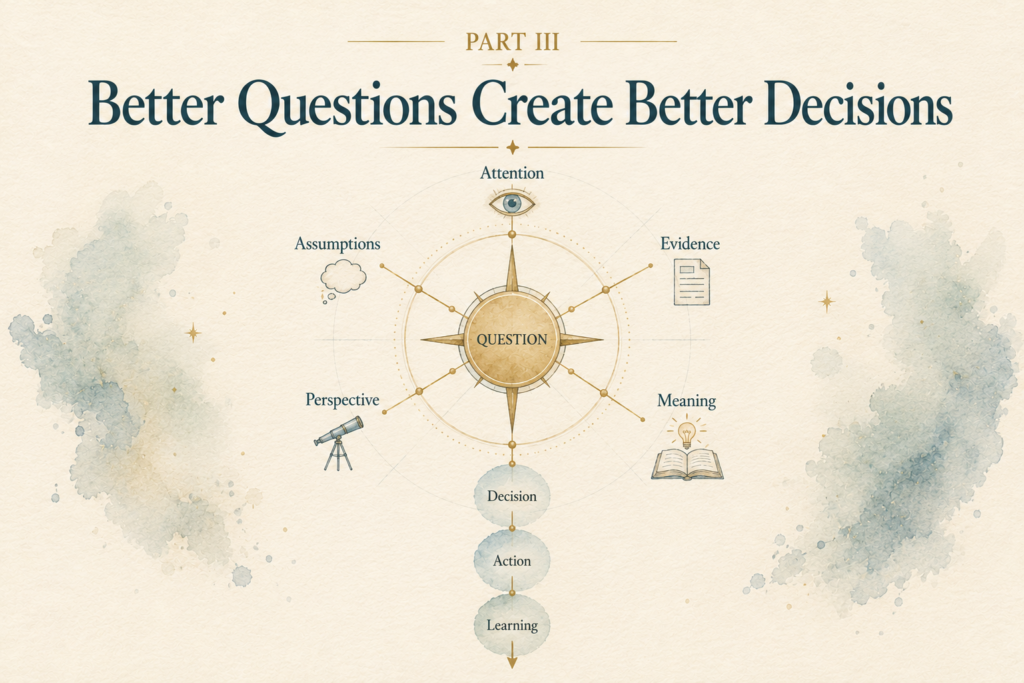
A well-formed question shapes:
- Attention. What deserves investigation, and what can safely be ignored?
- Assumptions. Which beliefs should be tested instead of accepted by default?
- Evidence. What information would genuinely support or challenge a conclusion?
- Perspective. Which alternative explanations deserve consideration?
- Meaning. How should individual observations be connected into a coherent understanding?
Notice that none of these activities depend on AI.
They are cognitive disciplines.
AI can strengthen them by accelerating exploration and surfacing additional possibilities, but it cannot perform the underlying intellectual work for you.
That work begins with inquiry.
This also explains why two professionals using the same AI system can arrive at very different conclusions.
The technology may be identical.
The prompts may even look similar.
What differs is the quality of thinking that shaped the interaction before the first prompt was ever written.
One professional investigates a problem.
The other investigates the assumptions beneath the problem.
One gathers information.
The other develops understanding.
That is why better questions do more than improve answers.
They improve the reasoning that makes better answers possible in the first place.
The Questions Experts Ask
Experience alone does not create expertise.
Many professionals spend decades in an industry without developing insights that change how others think.
What distinguishes experts is not simply the accumulation of knowledge.
It is the quality of the questions they learn to ask after years of observing the same problems.
Over time, experts begin to notice something that less experienced professionals often miss.
The obvious question is rarely the most important one.
It usually sits on top of a deeper question that explains why the problem exists in the first place.
That shift marks an important transition.
Instead of asking questions that seek information, experts increasingly ask questions that improve understanding.
Their inquiry becomes less concerned with finding immediate answers and more concerned with refining how they interpret the problem itself.
As a result, experienced professionals tend to return to the same kinds of inquiry again and again.
Not because they have a formula, but because these questions consistently reveal what others overlook.
The Questions That Reveal Expertise
1. They identify hidden assumptions.
Every field develops ideas that become accepted simply because they have been repeated for a long time.
Experts ask which of those assumptions still deserve to be believed.
2. They expose contradictions.
When evidence, behavior, and conventional wisdom fail to align, experts become curious instead of dismissive.
Contradictions often signal that an existing explanation is incomplete.
3. They recognize patterns.
Individual events may appear unrelated.
Experts look across experiences, searching for recurring structures that connect seemingly separate observations into a coherent explanation.
4. They redefine the problem.
Many difficult problems remain unsolved because everyone is attempting to solve the same version of the problem.
Experts frequently discover that progress begins by changing the question itself.
5. They challenge conventional thinking.
Every discipline has beliefs that are widely accepted but rarely examined.
Experts are willing to revisit those beliefs, not because they reject consensus for its own sake, but because meaningful advances often begin where accepted thinking is questioned.
Notice that none of these questions require AI.
They are products of experience, judgment, and intellectual curiosity.
AI can help investigate them.
It can surface evidence, generate alternative perspectives, and test competing explanations.
But it cannot determine which assumptions deserve examination or which contradiction is worth pursuing.
Those choices depend on professional judgment.
This is why expertise is becoming more valuable, not less, in the age of AI.
As information becomes increasingly accessible, the advantage shifts toward professionals who know where to direct attention before the search begins.
Their value comes less from possessing answers than from consistently asking the questions that uncover insights other people have not yet recognized.
In an age of abundant information, expertise is increasingly revealed by the quality of the inquiry that precedes the answer.
Case Study: Cole Brown — The Right Question Can Turn a Personal Story Into a Cultural Conversation
Many nonfiction books begin with an experience.
Far fewer begin with a question capable of extending that experience beyond the author.
Cole Brown’s work illustrates this distinction.
His story suggests that the writing process was not simply about recounting his own experiences with identity. It became an exploration of the larger questions those experiences revealed, questions that many readers recognized in their own lives.
That shift is significant.
A personal story becomes broadly valuable only when it stops asking, “What happened to me?” and begins asking, “What does this reveal about something larger?”
The experience provides credibility.
The question creates relevance.
When authors remain focused on documenting events, readers learn about the author.
When authors investigate the deeper questions beneath those events, readers begin to understand themselves.
That is the transition from memoir to insight, from experience to intellectual contribution.
In Cole Brown’s case, the emerging theme appears to be identity, not merely as a personal experience, but as a broader human question that extends beyond one individual’s circumstances. Rather than allowing the narrative to end with autobiography, the inquiry opened space for a larger cultural conversation.
This illustrates an important principle for every professional developing original ideas.
The experiences you have lived are rarely valuable because they are unique.
They become valuable when they help illuminate a question that many other people have struggled to articulate.
Readers may never share your circumstances.
They may, however, share the uncertainty, tension, or misunderstanding your question helps explain.
That is why meaningful nonfiction so often grows beyond personal storytelling.
Its lasting value comes from identifying a question that transforms individual experience into shared understanding.
Strategic Lesson
The strongest questions do more than help an author understand their own experience.
They reveal truths that allow many other people to understand theirs.
Watch:
Case Study: Jinny Uppal — Better Decisions Begin by Questioning the Problem
One of the clearest signs of expertise is recognizing that a problem may have been defined incorrectly.
Most professionals devote their energy to finding better solutions.
Experts often begin somewhere else.
They ask whether everyone is trying to solve the right problem.
Jinny Uppal’s work reflects this shift in thinking.
Rather than accepting one of leadership’s most common assumptions, that effective leadership requires constant action, her work suggests that she first examined whether that assumption deserved to remain unquestioned. That inquiry became the foundation for a different way of thinking about leadership itself.
This distinction is easy to underestimate.
Questioning a solution improves execution.
Questioning the problem changes the range of possible solutions.
Once the problem is reframed, decisions that previously seemed obvious often need to be reconsidered.
New evidence becomes relevant.
Different trade-offs emerge.
Possibilities that were previously invisible become easier to recognize.
That is why reframing is one of the highest forms of inquiry.
It does not make incremental improvements to an existing line of thinking.
It changes the direction of the thinking altogether.
Jinny’s example illustrates that leadership frameworks are rarely built by collecting more answers.
They are built by discovering that the prevailing question was too narrow, incomplete, or based on an assumption that no longer holds.
This principle extends well beyond leadership.
Whether the challenge involves strategy, organizational change, product development, or authorship, professionals create disproportionate value when they are willing to pause before solving a problem and ask whether the problem itself has been framed correctly.
That willingness is often what separates expertise from experience.
Experience accumulates observations.
Expertise reorganizes them around a better question.
Strategic Lesson
The strongest professionals do not compete to produce better answers to the same question.
They create value by asking a different question before everyone else begins searching for answers.
Watch:
AI Can Help You Think by Asking Better Questions
One of the most common misconceptions about AI is that its primary value lies in providing answers.
That is certainly one of its capabilities.
It is not necessarily its most valuable one.
For professionals whose work depends on judgment, strategy, research, or original thinking, AI is often more useful as an engine for expanding inquiry than as a machine for producing conclusions.
This changes the role AI plays in the thinking process.
Instead of replacing your reasoning, AI can help strengthen it in several ways.
It can help you:
- Expand your perspective. Surface alternative viewpoints, explanations, or interpretations that might otherwise remain overlooked.
- Challenge your assumptions. Expose beliefs that have quietly shaped your thinking without being intentionally examined.
- Deepen your investigation. Suggest follow-up questions, identify missing context, and reveal gaps in your reasoning.
- Test your conclusions. Explore counterarguments and competing explanations before committing to a decision.
Notice what all four activities have in common.
None of them involve outsourcing judgment.
They improve the quality of inquiry without replacing the responsibility to think.
That is a fundamentally different way of working with AI.
When AI is treated as an answer generator, the interaction often ends with the first plausible response.
When AI is treated as a thinking partner, the interaction continues.
Each response becomes an opportunity to refine the question, explore another possibility, uncover a hidden assumption, or investigate a direction that had not previously been considered.
The objective shifts from finding the answer to developing a more complete understanding of the problem.
That is where AI begins to complement expertise rather than compete with it.
Professionals still contribute the experience, judgment, and context that define the inquiry.
AI contributes speed, breadth, and the ability to explore possibilities at a scale that would otherwise require significantly more time.
Together, they create a deeper investigation than either human judgment or AI could produce alone.
Seen this way, the future of AI is not about asking fewer questions because technology has more answers.
It is about asking better questions because technology makes deeper inquiry more practical than ever before.
How AI Expands Inquiry
Once you begin treating AI as a thinking partner rather than an answer generator, a different set of capabilities becomes valuable.
The objective is no longer to obtain faster responses.
It is to improve the quality of the investigation itself.
Inquiry is rarely limited by a lack of intelligence.
More often, it is limited by blind spots.
We become attached to our first explanation.
We overlook missing context.
We fail to consider alternative interpretations.
We stop exploring once an answer feels plausible.
AI can help counter these tendencies, not by replacing human judgment, but by expanding the range of questions we are able to ask before reaching a conclusion.
Five Ways AI Expands Inquiry
AI is particularly valuable when it helps you investigate a problem from multiple directions rather than reinforcing your initial thinking.
It can help you:
- Uncover blind spots.
Every professional has assumptions shaped by experience. AI can highlight perspectives, considerations, or objections that may have been unintentionally overlooked, making it easier to recognize gaps in your own reasoning. - Generate alternative perspectives.
Most problems can be interpreted through more than one lens. AI can explore how the same situation might be viewed by different stakeholders, disciplines, or schools of thought, broadening the range of possible interpretations. - Surface missing context.
A decision is only as strong as the information supporting it. AI can suggest relevant background, adjacent ideas, historical examples, or comparable situations that help place a question within a larger context. - Identify assumptions worth testing.
Every line of reasoning rests on assumptions, whether explicit or implicit. AI can help make those assumptions visible so they can be examined instead of accepted without question. - Propose the next question.
Perhaps AI’s most valuable contribution is its ability to continue the investigation. Instead of ending the conversation with an answer, it can suggest follow-up questions that reveal deeper layers of the problem and encourage further exploration.
Notice that each capability serves the same purpose.
None of them attempts to replace expertise.
Each one expands the quality of inquiry before a decision is made.
That distinction matters because inquiry is cumulative.
A stronger question leads to a stronger investigation.
A stronger investigation produces a more complete understanding.
And a more complete understanding leads to better decisions.
AI accelerates that progression by making it easier to examine a problem from multiple angles in minutes instead of hours.
The result is not simply faster thinking.
It is more comprehensive thinking.
Professionals still determine which questions matter.
AI helps ensure they have explored those questions more thoroughly before deciding what to believe, what to create, or what to do next.
Thinking With AI, Not Just Asking AI
Most discussions about AI focus on interaction.
How do you ask a better prompt?
How do you generate a better response?
How do you produce better output?
Those are useful questions.
But they all assume the same relationship.
The human asks.
AI answers.
Then the work moves on.
For many forms of knowledge work, that model leaves much of AI’s value untapped.
The greatest benefit often comes not from asking AI, but from thinking with AI.
Thinking with AI means treating every response as part of an ongoing process of inquiry rather than the final destination.
Instead of using AI to complete your thinking, you use it to extend your thinking.
That shift changes how you evaluate every interaction.
Rather than asking, “Did AI give me a good answer?” you begin asking:
- Did this response help me see the problem more clearly?
- Did it expose an assumption I had not considered?
- Did it suggest a perspective worth investigating?
- Did it lead me to a better question than the one I started with?
These are fundamentally different measures of success.
They evaluate AI by the quality of the thinking it enables rather than the quality of the text it generates.
This also changes the rhythm of working with AI.
Instead of following a simple sequence,
Question → Answer
the process becomes iterative:
- Frame the question.
- Explore possibilities with AI.
- Reflect on what changed in your understanding.
- Refine the question based on what you learned.
- Repeat until the problem is understood well enough to make a sound decision.
Notice that AI occupies only one part of the process.
The professional still determines where the investigation begins, which ideas deserve further exploration, and when sufficient understanding has been reached.
Judgment remains human.
AI expands the environment in which that judgment develops.
This distinction becomes increasingly important as AI systems continue to improve.
If AI becomes capable of producing increasingly accurate answers, then the limiting factor is no longer the technology’s ability to respond.
It is the professional’s ability to direct inquiry toward questions that are meaningful, consequential, and worth answering.
That is why thinking with AI is a more durable capability than simply learning to use AI.
Tools will evolve.
Interfaces will change.
Models will become more capable.
The practice of using technology to deepen inquiry, strengthen reasoning, and improve judgment will remain valuable regardless of how AI continues to develop.
Professionals who consistently create the most value will not be those who know how to get answers from AI.
They will be those who know how to use AI to become better thinkers.
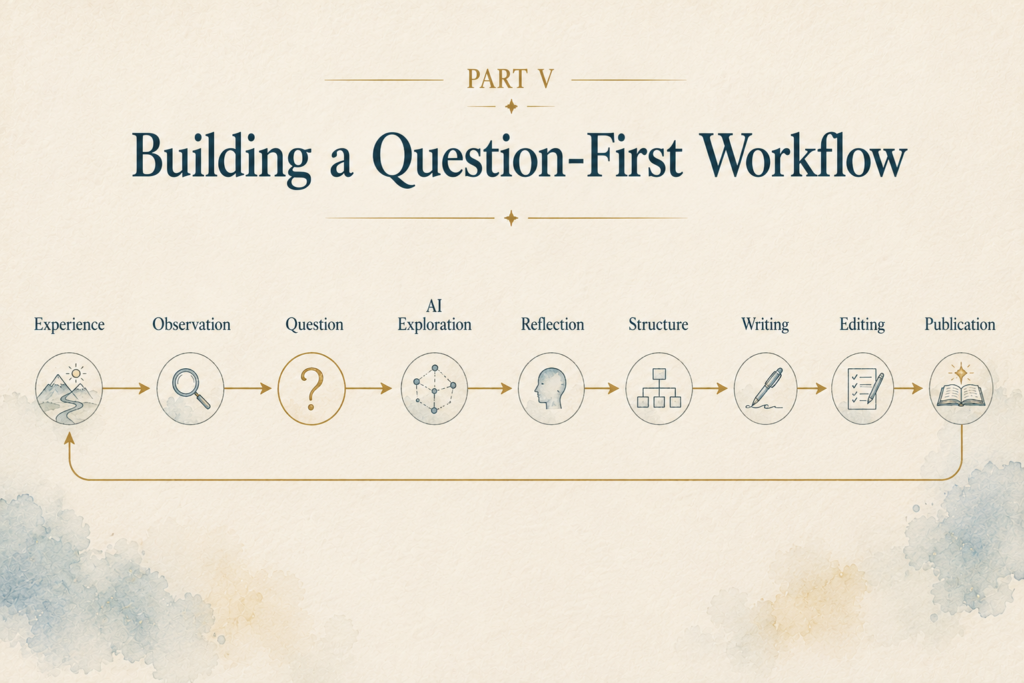
Part V — Building a Question-First Workflow
By now, this Guide has established that better questions create better thinking and that AI is most valuable when it expands inquiry rather than simply producing answers.
The next challenge is practical.
Where do meaningful questions come from?
It is tempting to think they begin with curiosity alone.
In reality, the strongest questions rarely appear in isolation.
They emerge from experience, sharpen through observation, and mature through repeated engagement with the same problems.
That is why building a question-first workflow is not about learning a questioning technique.
It is about creating a repeatable process that transforms experience into insight.
Experience Before Inquiry
A common misconception is that great questions begin with inspiration.
More often, they begin with attention.
Professionals who consistently ask valuable questions are rarely searching for clever prompts.
They are paying close attention to recurring patterns, persistent frustrations, unexpected outcomes, and assumptions that no longer seem adequate.
Over time, those observations accumulate.
Eventually, one of them becomes impossible to ignore.
That is where meaningful inquiry begins.
This explains why experience is the foundation of a question-first workflow.
Experience does more than provide information.
It provides context.
It reveals patterns that are invisible to someone encountering a problem for the first time.
It creates the intuition that something deserves a closer look, even before the answer is clear.
Without that foundation, questions often become abstract exercises.
With it, they become investigations into problems that genuinely matter.
This progression is remarkably consistent across fields.
Professionals first spend years observing.
Only then do they begin asking increasingly precise questions about what they have observed.
That sequence matters because each stage builds on the one before it:
- Experience creates exposure.
Repeated encounters with a problem reveal nuances that isolated events cannot. - Observation reveals patterns.
Similar situations begin to share common characteristics, making underlying structures easier to recognize. - Patterns generate questions.
Recurring observations naturally lead to inquiry: Why does this keep happening? What am I missing? What explains the difference? - Questions drive deeper investigation.
Inquiry transforms experience into understanding by testing assumptions, exploring alternatives, and refining explanations.
Seen this way, questions are not disconnected techniques.
They are the natural outcome of sustained engagement with meaningful work.
This is also why AI cannot manufacture expertise on its own.
AI can help expand inquiry once meaningful questions exist.
It cannot substitute for the experience that makes those questions worth asking in the first place.
The strongest professionals do not separate experience from inquiry.
They allow each experience to improve the quality of their questions, and each question to deepen the value of their experience.
Over time, that cycle becomes one of the most reliable sources of original thinking, stronger decisions, and ideas that others are unable to see.
Case Study: Ashlee Berghoff — The Right Question Reveals the Real Thesis
One of the biggest misconceptions about writing a nonfiction book is that the author’s central idea already exists before the first chapter is written.
In reality, clarity is often discovered rather than declared.
Years of experience may provide the raw material.
Writing helps organize it.
But what ultimately reveals the book’s thesis is a sustained process of inquiry.
Ashlee Berghoff’s experience appears to reflect this progression.
Rather than beginning with complete certainty about the book’s central message, her process suggests that the thesis emerged by continually questioning what she had learned, what problem she was truly trying to solve, and which idea connected her experiences into a coherent whole.
This distinction matters because authors frequently mistake information for insight.
They possess years of expertise, countless stories, and dozens of useful ideas.
Yet none of those elements automatically becomes the central argument of a book.
That argument is usually uncovered through questions such as:
- What do I believe that others consistently overlook?
- What problem connects all of these experiences?
- Which idea explains everything else?
- If readers remembered only one insight, what should it be?
Questions like these perform an editorial function long before editing begins.
They eliminate ideas that are interesting but secondary.
They expose assumptions that no longer fit.
They reveal recurring themes that were previously hidden beneath individual experiences.
Most importantly, they help separate the book’s supporting material from its organizing idea.
The result is not simply a clearer manuscript.
It is a clearer thesis.
That is why experienced authors rarely discover their strongest ideas by writing more pages alone.
They discover them by repeatedly questioning what those pages are actually trying to say.
Writing records thinking.
Inquiry refines it.
Together, they transform accumulated experience into a single idea that readers can understand, remember, and apply.
Strategic Lesson
A compelling thesis rarely appears fully formed at the beginning of the writing process.
It emerges through disciplined inquiry, asking progressively better questions until years of experience reveal the one idea capable of holding the entire book together.
Watch:
A Question-Driven Workflow
Many professionals treat questioning as something that happens at the beginning of a project.
They ask a few questions, gather enough information to move forward, and shift their attention to execution.
A question-first workflow works differently.
Inquiry is not a starting point.
It is the thread that connects every stage of thinking, from the first observation to the final published idea.
This matters because the quality of a finished book, article, framework, or strategic recommendation rarely depends on a single breakthrough question.
It depends on asking progressively better questions as understanding evolves.
The workflow below provides a repeatable way to do that.
The Question-Driven Workflow
| Stage | Purpose | Key Question |
| Experience | Observe recurring problems, patterns, and opportunities through real-world work. | What am I consistently seeing or experiencing? |
| Question | Turn observations into focused lines of inquiry worth investigating. | What deserves a deeper explanation? |
| AI Exploration | Expand the investigation by exploring alternative perspectives, testing assumptions, and identifying missing context. | What else should I consider before reaching a conclusion? |
| Reflection | Evaluate what changed in your thinking and determine which insights are genuinely meaningful. | What have I learned, and why does it matter? |
| Structure | Organize insights into a coherent argument that others can easily follow. | How do these ideas connect into one central thesis? |
| Writing | Express the refined thinking clearly while revealing any remaining gaps in understanding. | Can I explain this idea in a way others can understand and apply? |
| Editing | Strengthen the reasoning, clarify the thesis, and eliminate unnecessary complexity. | Is the argument complete, clear, and defensible? |
| Publication | Test ideas in the real world and use feedback to begin the next cycle of inquiry. | What new questions emerged after sharing this work? |
Why the Sequence Matters
Each stage prepares the next.
Skipping a stage weakens everything that follows.
- Without experience, questions become abstract.
- Without inquiry, AI accelerates shallow thinking.
- Without reflection, exploration produces information instead of insight.
- Without structure, writing becomes difficult because the argument is still unclear.
- Without editing, valuable ideas remain underdeveloped.
- Without publication, ideas never encounter the feedback that helps refine them further.
This is why the workflow is designed as a progression rather than a checklist.
Every stage increases the quality of the next.
More importantly, every stage is connected by inquiry.
Questions do not disappear after the research phase.
They evolve.
The question that begins with “What am I observing?” eventually becomes “What does this pattern mean?” and later “How can I explain this idea so someone else can use it?”
Professionals who consistently produce valuable intellectual property are rarely following a writing process alone.
They are following a thinking process, one in which every stage is guided by progressively better questions.
Better Books Begin With Better Questions
Many nonfiction authors assume the writing process begins with a topic.
A topic is only a subject.
It is not yet an idea.
Readers rarely remember books because of the subjects they discuss.
They remember books because those books changed how they understood a problem, challenged an assumption they had accepted, or gave them a more useful way to interpret their experience.
That kind of contribution almost always begins with a question.
The question becomes the intellectual foundation of the book.
It determines what the author investigates, which ideas deserve attention, what evidence matters, and ultimately what insight the reader takes away.
Without a meaningful question, writing often becomes an exercise in organizing information.
With one, writing becomes an exploration that produces original thinking.
This distinction explains why two books can cover the same topic yet create very different levels of value.
One summarizes what is already known.
The other helps readers see something they had not recognized before.
The difference is rarely access to more information.
It is the quality of the inquiry that shaped the book.
For Modern Authors, this has practical implications long before the first chapter is drafted.
Instead of beginning with “What should I write about?” begin by asking questions such as:
- What important problem do I understand differently?
- What assumption do I believe deserves to be challenged?
- What recurring pattern have I observed that others may not recognize?
- What question have I spent years trying to answer through my work?
Questions like these do more than generate ideas.
They define the book’s intellectual contribution.
Once that contribution is clear, the remaining decisions become easier.
The thesis becomes more focused.
The structure becomes more coherent.
Examples become easier to evaluate because they either strengthen the central idea or they do not.
Even the editing process improves because every chapter can be measured against the same guiding question.
Seen this way, a nonfiction book is not primarily a collection of information.
It is the written record of a sustained investigation.
Every chapter represents another step in answering a question that was meaningful enough to deserve years of observation, reflection, and refinement.
That is why better books begin with better questions.
Not because questions make writing easier.
Because they make the ideas behind the writing more original, more coherent, and ultimately more valuable to the people who read them.
Part VI — Becoming a Question-First Professional
Every section of this Guide has pointed toward the same conclusion.
AI has changed many aspects of knowledge work.
It has made information easier to access, research faster to conduct, and content simpler to produce.
But it has not changed where meaningful ideas come from.
Those still begin with people who notice something others have overlooked, question assumptions others have accepted, and investigate problems others have stopped examining.
That is why the future belongs not to professionals who become better at using AI, but to professionals who become better at thinking with it.
The distinction begins with the quality of the questions they ask.
Inquiry Is the New Professional Advantage
Throughout history, professional advantage has shifted toward whatever became scarce.
When information was difficult to obtain, access created value.
When specialized knowledge was rare, expertise became the differentiator.
Today, AI has dramatically reduced the cost of generating information, explanations, summaries, and even polished writing.
What remains scarce is the ability to determine what is worth understanding in the first place.
That capability is inquiry.
Inquiry is the disciplined practice of asking questions that deepen understanding before seeking conclusions. It is the habit of defining problems carefully, challenging assumptions, exploring alternatives, and refining thinking before acting.
This is why inquiry has become one of the most valuable professional capabilities in the age of AI.
It improves every stage of knowledge work.
A better question produces better research.
Better research produces better insight.
Better insight produces better decisions.
Better decisions produce more original books, stronger strategies, clearer frameworks, and more valuable intellectual property.
This represents an important shift in professional identity.
Many people begin their AI journey believing they need to master prompt writing.
By the end of this Guide, the more useful conclusion is different.
| The Starting Belief | The Better Question-First Mindset |
| I need better prompts. | I need better questions. |
| AI helps me generate answers. | AI helps me investigate ideas. |
| My advantage is producing content faster. | My advantage is developing stronger thinking. |
| Expertise is knowing more. | Expertise is asking questions that uncover what others have not yet seen. |
| Writing communicates what I know. | Writing communicates what disciplined inquiry has helped me discover. |
This shift is more than a change in technique.
It is a change in how professionals create value.
Instead of measuring success by how quickly AI can produce an answer, question-first professionals measure success by the quality of the thinking that preceded it.
They understand that answers have become increasingly abundant.
Original insight has not.
That is why inquiry is not simply another AI skill.
It is the capability that makes every other AI capability more valuable.
The professionals who create the strongest ideas, make the best decisions, and build the most enduring intellectual property will not necessarily be those with the most advanced tools.
They will be those who consistently ask the questions that others never think to ask.
Related Systems Inside the Manuscripts Ecosystem
A question-first mindset is not a standalone skill.
It is the capability that strengthens every stage of becoming a Modern Author.
Throughout this Guide, inquiry has been presented as the starting point for better thinking, stronger decisions, and more original ideas. That same principle extends across the broader Manuscripts ecosystem.
Whether you are developing intellectual property, identifying an audience, organizing a manuscript, or using AI to support your thinking, the quality of the outcome depends on the quality of the questions that shape the process.
The following Guides build on that foundation from different perspectives.
| Related Guide | How Inquiry Strengthens It |
| From Expertise to IP | Intellectual property does not emerge simply because you have experience. It develops when you investigate what your experience reveals that others have not yet recognized. Better questions uncover the original insights that become proprietary ideas, frameworks, and books. |
| Audience Before Book | Audience research begins with curiosity, not assumptions. Asking better questions about readers, their problems, motivations, misconceptions, and aspirations, creates books that resonate because they address meaningful needs rather than imagined ones. |
| Why Most Book Outlines Fail | Outline problems are often thinking problems. Strong outlines emerge after authors identify the central question their book is answering, giving every chapter a clear purpose within a coherent argument. |
| AI-Assisted Thinking vs. AI-Generated Content | AI creates its greatest value when it expands inquiry instead of replacing it. A question-first mindset ensures AI supports investigation, synthesis, and reasoning rather than simply accelerating content production. |
Although each Guide focuses on a different stage of the Modern Author journey, they share the same underlying principle.
Experience provides the raw material.
Inquiry transforms that experience into understanding.
Understanding becomes insight.
Insight becomes intellectual property.
Seen together, these Guides are not separate systems.
They are connected by a single discipline: consistently asking better questions before making decisions, building frameworks, or creating content.
That is why inquiry is more than a useful habit.
It is the common foundation beneath every enduring idea a Modern Author creates.
Frequently Asked Questions
What is AI decision making?
AI decision making is the use of artificial intelligence to analyze information, compare options, identify patterns, and support a judgment or action. The quality of the decision still depends on how well the problem is framed before AI begins generating answers.
How does AI improve decision making?
AI can improve decision making by processing information quickly, surfacing alternative perspectives, identifying patterns, and exposing missing context. Its greatest value comes from expanding inquiry, not replacing human judgment.
What is the difference between a question and a prompt?
A question determines what deserves to be understood. A prompt tells AI what task to perform. Questions shape the direction of thinking, while prompts shape the form of the output.
Why are better questions more important than better prompts?
Better prompts can improve clarity and execution, but they cannot compensate for a weak underlying inquiry. A well-written prompt built on the wrong question may only produce a more polished answer to the wrong problem.
What is a question-first approach to AI?
A question-first approach begins by defining the problem, testing assumptions, identifying missing evidence, and deciding what deserves investigation. AI is introduced only after the inquiry is clear enough to guide meaningful exploration.
How can AI help me ask better questions?
AI can help uncover blind spots, generate alternative viewpoints, surface missing context, identify assumptions, and propose useful follow-up questions. The professional still decides which questions are relevant and which conclusions are worth acting on.
What are some examples of AI decision making?
Examples include using AI to compare strategic options, analyze customer behavior, investigate employee engagement, assess market conditions, or test different explanations for a business problem. In each case, the quality of the result depends on how precisely the original question was framed.
Can AI replace human decision making?
AI can support analysis and exploration, but it should not replace the human responsibility to define priorities, interpret context, evaluate tradeoffs, and make consequential judgments. AI can expand the evidence considered; humans remain responsible for deciding what matters.
What is the role of human judgment in AI decision making?
Human judgment determines which problem deserves attention, which assumptions should be challenged, what evidence is credible, and when enough understanding exists to make a decision. These choices happen before and after AI produces an answer.
How does inquiry strengthen professional expertise?
Inquiry helps professionals move beyond possessing information and toward uncovering patterns, contradictions, and overlooked problems. Expertise becomes more valuable when it directs attention toward questions that others have not yet recognized.
How can authors use AI without losing originality?
Authors can use AI to explore competing ideas, test assumptions, uncover gaps, and deepen research while retaining control over the central question, thesis, judgment, and final argument. Originality comes from the inquiry guiding the work, not from the speed of content generation.
How do better questions lead to better books?
Better questions give a book a clear intellectual purpose. They help the author identify the central problem, refine the thesis, choose relevant evidence, organize chapters, and produce an idea that contributes more than a summary of existing information.
Continue Your Modern Author Journey
Asking better questions is not the end of the Modern Author journey.
It is the capability that makes every other stage of the journey more valuable.
The strongest books, frameworks, and intellectual property are usually the result of sustained inquiry long before the writing begins.
Once you learn to identify meaningful problems, challenge assumptions, and investigate ideas with greater discipline, the next challenge is turning those insights into assets that continue creating value long after the manuscript is finished.
The next Guides in the Modern Author system will help you do exactly that.
- Develop Original Frameworks — Learn how to transform observations and recurring patterns into distinctive models that readers can understand, remember, and apply.
- Strengthen Your Expertise — Discover how to organize years of professional experience into a clear point of view that differentiates your work and establishes lasting authority.
- Build Intellectual Property — Move beyond sharing information to creating original ideas, methodologies, and strategic assets that become part of your long-term professional advantage.
- Design Books Around Meaningful Problems — Structure your book around the questions and challenges your audience is actively trying to solve, creating work that remains relevant long after publication.
Each Guide explores a different part of the Modern Author system.
Across every Guide, the progression is consistent:
Experience becomes inquiry.
Inquiry produces insight.
Insight becomes intellectual property.
Because in the age of AI, sustainable professional advantage does not come from producing more content.
It comes from developing ideas worth publishing.
And every enduring idea begins with a question that was important enough to pursue.
If You’re Deciding What to Do Next
Understanding why better questions matter is only the beginning.
The next step is learning how to turn disciplined inquiry into original ideas, stronger frameworks, and intellectual property that continues creating value long after the work is published.
Here are three ways Modern Authors typically continue their journey.
Map Your Modern Author Strategy
If you want to:
- Pressure-test your author model
- Clarify realistic outcomes
- Understand where ROI is likely to show up
- Avoid unnecessary spend
A short strategy conversation can surface issues early, before they become expensive.
👉 Schedule a Modern Author Strategy Session
This is a working session, not a pitch.
Explore the Modern Publishing System
If you’re assessing:
- Whether to publish traditionally, hybrid, or independently
- How to structure presale and early activation
- What support actually reduces risk
You may want a clearer view of how the Modern Publishing System works in practice.
👉 Explore Manuscripts Publishing Services
Study Real Author Outcomes
(For internal validation and stakeholder alignment)
If you’re preparing a recommendation for leadership, concrete examples often help.
👉 See Modern Author Success Stories
About the Author
Eric Koester is an award-winning entrepreneurship professor at Georgetown University, bestselling author, and founder of Manuscripts. His work focuses on how ideas become assets, how books create leverage, and why modern authors need systems, not just publishing support.
He has worked with thousands of authors across traditional, hybrid, and modern publishing paths, helping them turn books into platforms, platforms into credibility, and credibility into durable business outcomes.
About Manuscripts
Manuscripts is the Modern Author OS for nonfiction experts.
We help founders, executives, coaches, and thought leaders design books as strategic assets, not standalone products. Our work spans positioning, author model design, developmental editing, AI-enhanced drafting tools, presale strategy, and long-term launch systems.
Manuscripts authors use their books to generate clients, speaking engagements, training programs, and enterprise opportunities, often before publication.
For readers who want to go deeper into specific mechanics, the following guides expand on topics referenced in this report:
- How to Write a Book if You’re Busy
- Modern Ghostwriting for Nonfiction Authors
- AI Tools for Authors in 2026
- How to Build an Audience Before You Write Your Book
- The Evergreen Launch System for Modern Authors
Powered by Codex, the Modern Author Intelligence Tool.