How Much Does It Cost to Edit a Book? A Smart Investment Guide for Serious Authors
How to invest in the right editing at the right stage, without wasting money
Most authors approach editing as a pricing decision.
When asking how much does it cost to edit a book, they compare quotes, evaluate rates, and try to minimize cost.
This approach is incomplete.
Editing is not a standardized service with a fixed outcome. It is a stage-dependent intervention applied to a manuscript that is still evolving.
When that intervention is applied at the wrong stage, the work does not compound.
It resets.
The Real Problem: Mis-Sequenced Investment
The primary driver of editing cost is not price.
It is sequencing.
Two authors can spend the same amount and get very different results:
One invests in structure first, then clarity, then correctness
Another invests in clarity before structure is stable
The first progresses.
The second rewrites.
The difference is not budget.
It is timing.
Editing Is an Intervention, Not a Service
Each type of editing solves a different constraint in the manuscript:
- Structural issues (how the book is organized and whether it works)
- Clarity issues (how the ideas read and flow)
- Technical issues (grammar, consistency, correctness)
- Surface errors (final polish before publication)
These are not interchangeable tasks.
They must be applied in sequence.
Applying the wrong intervention too early does not improve the manuscript. It creates rework.
When editing is mis-sequenced, costs increase in predictable ways:
- Work is done on sections that are later rewritten
- Improvements are undone by structural changes
- Multiple editing passes are required to reach the same endpoint
This is why editing can feel expensive.
Not because the rates are high, but because the same work is paid for more than once.
The Reframe
Editing is not something you buy.
It is something you sequence.
Cost is not only a function of how much you pay.
It is a function of when you invest relative to the manuscript’s stage.
A smaller investment at the right time moves the manuscript forward.
A larger investment at the wrong time increases total cost.
This guide is designed to help you make that distinction, and invest accordingly.
What Editing Actually Is
Editing is not a single task.
It is a staged transformation process that turns a draft into a functional intellectual asset, a book that works, reads clearly, and meets professional standards.
Each stage of editing solves a different constraint in the manuscript. These stages are distinct and must be applied in sequence.
The Four Functions of Editing
- Developmental editing → makes the book work
Focuses on structure, argument, and positioning.
It determines whether the ideas are organized correctly and whether the manuscript functions as a complete system. - Line editing → makes the book readable
Focuses on clarity, flow, and expression.
It improves how ideas are communicated at the sentence and paragraph level. - Copyediting → makes the book correct
Focuses on grammar, punctuation, and consistency.
It ensures the manuscript meets technical and stylistic standards. - Proofreading → makes the book publishable
Focuses on final surface errors.
It is the last quality check before publication.
The System Behind the Work
These are not interchangeable services.
They are layers in a system:
- Structure must be stable before clarity work begins
- Clarity must be resolved before technical correction
- Technical correctness must be in place before final polish
Editing is effective when each layer builds on the previous one.
When treated this way, editing moves the manuscript forward.
When treated as isolated tasks, it creates rework.
Economic Reality: Why Editing Costs Don’t Behave Like You Expect
Authors do not typically overspend on editing.
They mis-sequence it.
The same total budget can produce very different outcomes depending on when it is applied in the manuscript process.
Same Budget, Different Outcomes
Consider two scenarios with identical budgets:
- Scenario A (mis-sequenced)
Budget is spent on clarity and correction before structure is stable
→ Sections are later rewritten
→ Earlier edits are lost
→ Additional rounds of editing are required - Scenario B (properly sequenced)
Budget is applied first to structure, then clarity, then correctness
→ Each stage builds on the previous one
→ Minimal rework
→ Fewer total editing passes
The total spend may be the same.
The efficiency is not.
What Drives the Difference
Editing cost is not just about how much work is done.
It is about whether that work persists.
- Work applied too early is temporary
- Work applied at the right stage compounds
This is the core economic dynamic behind editing.
The Practical Implication
If editing is treated as a one-time purchase, cost will feel unpredictable.
If it is treated as a staged investment, cost becomes controllable.
The goal is not to reduce spend.
It is to ensure that each dollar moves the manuscript forward, once.
What You’ll Learn in This Guide
This guide is designed as a decision system.
It does not just explain editing. It helps you determine what to invest, when, and why, based on the current state of your manuscript.
What this guide will clarify
- What editing actually costs
Clear ranges by editing type, and what those costs represent in practice - Why editing costs vary
The underlying drivers that make pricing inconsistent across manuscripts and editors - What to invest based on your stage
How to match your current manuscript constraint to the correct type of editing - Where money gets wasted
The common sequencing mistakes that lead to rework and duplicated cost - How editing connects to outcomes
How editing decisions affect the quality, credibility, and usefulness of the final book
How to use this guide
Use each section to answer a specific question:
- Where is the manuscript right now?
- What problem needs to be solved next?
- What level of editing corresponds to that problem?
The goal is not to estimate a total budget upfront.
It is to make stage-aware decisions that move the manuscript forward efficiently.
60-Second Decision Box
| Editing Type | Typical Cost Range | What It Solves |
| Developmental | $3,000–$7,000 | Structure, argument, positioning |
| Line Editing | $2,000–$5,000 | Clarity, flow, readability |
| Copyediting | $2,000–$5,000 | Grammar, consistency |
| Proofreading | $1,000–$2,000 | Final errors before publication |
How to interpret this
Each editing type addresses a different stage of the manuscript:
- Developmental → Does the book work?
- Line → Does the writing read clearly?
- Copyediting → Is the manuscript technically correct?
- Proofreading → Is it ready to publish?
These are not cumulative by default.
The key decision
Most authors do not need all four.
They need the right type of editing based on the current state of the manuscript.
- Choosing correctly → efficient investment
- Choosing incorrectly → rework and wasted cost
Cost is not determined by how many services you use.
It is determined by whether you apply the right one at the right time.
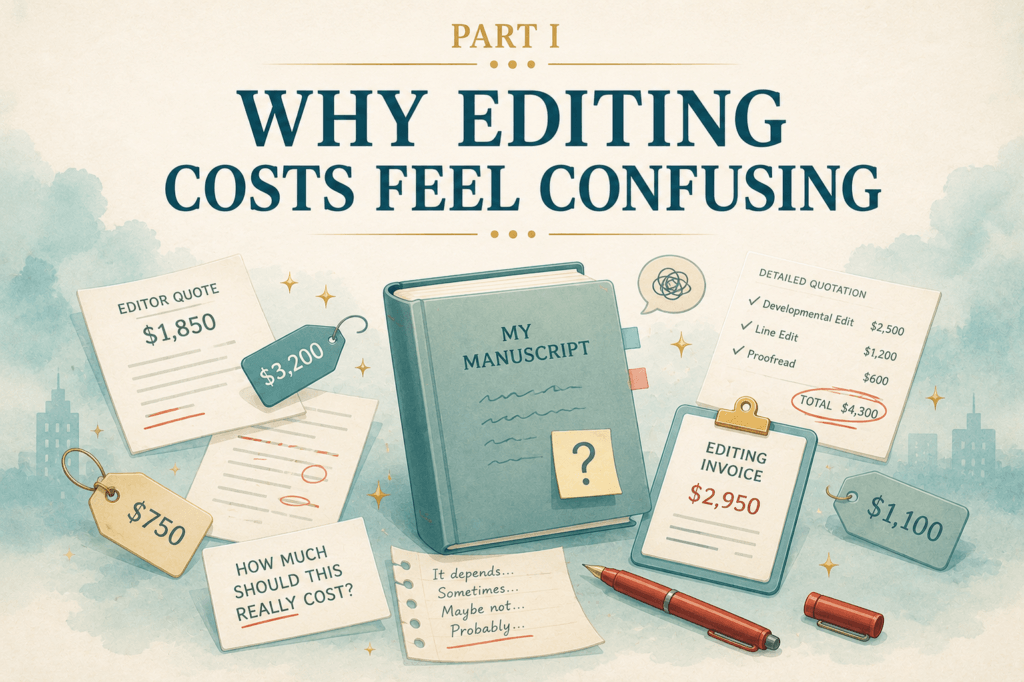
Part I — Why Editing Costs Feel Confusing
Why book editing costs vary so much
Editing costs vary because they reflect the level of transformation required, not a fixed unit of work.
A manuscript is not a standardized input. It differs in quality, completeness, and complexity. As a result, the effort required to improve it also varies.
This is why pricing appears inconsistent.
Editors are not pricing pages.
They are pricing the change needed to move the manuscript forward.
Core Cost Drivers
Four variables determine that level of change:
- Manuscript maturity
The current state of the draft.
Early or unstable manuscripts require deeper intervention than developed ones. - Word count
The total volume of content.
More words increase the scope of review, revision, and feedback. - Editor experience
The level of expertise applied to the manuscript.
More experienced editors bring higher-level judgment and problem-solving capability. - Editing type
The level of intervention required.
Structural editing, clarity editing, and technical correction each involve different depths of work.
These factors combine to determine both effort and cost.
Transformation Model
Editing cost increases with the depth of transformation required.
| Level of Work | Editor Effort | Cost Impact |
| Surface correction | Low | Low |
| Sentence clarity | Medium | Medium |
| Structural change | High | High |
- Surface correction focuses on minor technical fixes
- Sentence clarity improves readability and expression
- Structural change reshapes how the book works as a system
Each level requires a different type of intervention.
The Implication
If editing is treated as a fixed service, pricing will appear unpredictable.
If it is understood as a transformation process, the variation becomes logical.
Cost is not determined by a standard rate.
It is determined by how much the manuscript needs to change.
The 4 types of book editing (and what each one costs)
Editing is not a single service.
It is a sequence of distinct stages, each solving a different problem in the manuscript. Understanding these stages is what makes editing costs predictable and controllable.
Stage-Based Editing System
| Stage | Editing Type | Typical Cost | What Changes |
| Structure | Developmental | High | Book works |
| Clarity | Line | Medium | Book reads well |
| Correctness | Copy | Medium | Book is technically clean |
| Polish | Proof | Low | Book is publish-ready |
Each stage represents a different level of intervention:
- Developmental (Structure) ensures the book functions as a complete system
- Line (Clarity) improves how ideas are expressed and understood
- Copy (Correctness) ensures technical accuracy and consistency
- Proof (Polish) removes final surface errors before publication
These stages are not interchangeable. Each one assumes the previous stage is already resolved.
Wrong vs Right Sequence
| Scenario | What Happens | Cost Outcome |
| Wrong sequence | Copyediting before structure | Rework + double cost |
| Right sequence | Structure → clarity → correctness | Efficient investment |
Editing becomes expensive when it is applied out of order.
When applied in sequence, each stage builds on the previous one, and the total cost remains controlled.
Book editing cost per word, per page, and per project
Editors use different pricing models to quote their work.
These models do not change what is being done. They change how the cost is calculated and presented.
Understanding these models allows you to compare quotes accurately and avoid misinterpreting price differences.
Pricing Models
| Pricing Model | Typical Range | When Used |
| Per word | $0.02–$0.08 | Copyediting, line editing |
| Per page | $3–$15/page | Traditional editors |
| Per project | $1,000–$7,000+ | Developmental, full edits |
Per word
Cost is based on total word count.
This model is common when effort scales directly with manuscript length.- Per page
Cost is based on a standardized page.
A “page” typically equals 250–300 words. - Per project
Cost is based on the total scope of work.
This is common when the level of intervention varies and cannot be estimated by length alone.
Conversion Logic
To compare quotes, convert them into a common frame:
- Per word → total cost
Multiply the per-word rate by the manuscript’s total word count - Per page → total cost
Estimate total pages using 250–300 words per page, then multiply by the page rate - Per project → scope check
Clarify what is included in the project fee
(type of editing, number of passes, level of feedback)
The Practical Use
Pricing models can make similar work appear different.
- A low per-word rate on a long manuscript can exceed a higher project fee
- A per-page quote depends on how “page” is defined
- A project fee may include deeper structural work than length-based pricing
The model itself is not the decision.
The scope of work is.
Cost only becomes meaningful when you understand what level of editing is being delivered.

Part II — What editing should actually cost you (based on your stage)
Editing cost only makes sense when tied to the current state of the manuscript.
The same budget applied at the wrong stage creates rework.
A smaller, targeted investment at the right stage moves the manuscript forward.
The decision is not “how much should I spend.”
It is “what constraint am I solving right now?”
Stage 1: Early Draft (Structure Not Yet Solved)
Decision: Do not hire an editor, or use developmental editing only
Cost: $0–$5,000
Constraint: Structure
At this stage, the manuscript is still forming.
The structure, argument, and positioning are not yet stable.
- Line editing improves sentences that will be rewritten
- Copyediting cleans sections that may be removed
If you invest, it should be in developmental editing, focused on whether the book works.
The risk is not low quality.
It is paying for work that will not survive the next draft.
Stage 2: Mid-Stage Manuscript (Clarity Is the Bottleneck)
Decision: Line editing
Cost: $2,000–$5,000
Constraint: Clarity
The structure largely holds, but the writing may be difficult to follow.
The goal is to make the manuscript readable:
- Tighten sentences
- Improve flow
- Clarify ideas
If major structural changes are still happening, this investment will not hold.
Stage 3: Finished Manuscript (Correctness Is the Focus)
Decision: Copyediting
Cost: $2,000–$5,000
Constraint: Correctness
The manuscript is stable and readable.
The focus shifts to technical accuracy:
- Grammar and punctuation
- Consistency in tone and terminology
- Style alignment
At this stage, changes should refine, not reshape, the manuscript.
Stage 4: Ready to Publish (Final Polish Only)
Decision: Proofreading
Cost: $1,000–$2,000
Constraint: Polish
This is the final quality check before publication.
No structural or clarity changes should be happening.
The goal is precision:
- Typos
- Minor formatting issues
- Missed inconsistencies
Diagnostic Questions
Use these to identify your current stage:
- Do I know what the book is?
- Does the structure hold from beginning to end?
- Can a reader follow the argument without explanation?
- Is this ready to be published as-is?
Editing cost depends on stage, not budget.
Spending more does not improve outcomes if it is applied at the wrong point in the process.
The right investment is the one that matches the current constraint of the manuscript.
When you should NOT pay for editing yet
Editing is only effective when the manuscript is ready for the level of intervention being applied.
If that condition is not met, editing does not improve the manuscript.
It creates rework.
Before hiring an editor, the decision is not “who should I hire?”
It is “is the manuscript ready for editing yet?”
Not-Ready Conditions
There are three conditions where editing should be delayed:
- Unclear audience
The target reader is not clearly defined.
As a result, positioning, tone, and argument will continue to shift. - Weak structure
The organization of ideas is unstable.
Chapters may be added, removed, or reorganized, and the core argument may still be evolving. - Incomplete draft
The manuscript is not fully written.
Without a complete draft, flow, coherence, and progression cannot be properly evaluated.
In these conditions, editing work will not hold.
Cost of Premature Editing
| Action | Outcome | Cost Impact |
| Edit too early | Rewrite required | Double cost |
| Skip readiness | Inefficiency | Higher cost |
- Editing before the manuscript is stable leads to revisions that undo previous work
- Improvements made too early are often lost in later drafts
Editing is a multiplier, not a substitute for unfinished work.
If the manuscript is not ready, editing does not accelerate progress.
It increases total cost.
Part III — How Much Does a Book Editor Cost? Real-World Examples
What authors actually spend on editing (by stage and outcome)
Editing costs become clear when tied to real decisions.
Different authors invest differently, not because of budget alone, but because of manuscript stage and intended outcome.
The same manuscript could justify a limited investment or a full editing sequence depending on what the book is expected to do.
Coach / Consultant
Stage: Developmental + Line
Spend: $3k–$6k
Why: Clarity + positioning
The manuscript requires both structural alignment and readable expression.
Investment is focused on:
- Clarifying the core argument and positioning
- Ensuring ideas are accessible to the intended audience
First-Time Author
Stage: Line or Copy
Spend: $2k–$4k
Why: Cleanup + readability
The manuscript is largely complete but needs refinement.
Investment is focused on:
- Improving sentence-level clarity
- Ensuring technical correctness
Structural changes are minimal at this stage.
Executive / Premium Author
Stage: Full sequence
Spend: $5k–$10k+
Why: High-quality output
The book is expected to represent a high level of authority.
Investment spans multiple stages to ensure:
- The structure is sound
- The writing is clear
- The manuscript meets professional standards
Summary Table
| Author Type | Stage | Spend Range | Why It Made Sense |
| Coach | Dev + Line | $3k–$6k | Clarity + positioning |
| First-time author | Line / Copy | $2k–$4k | Cleanup |
| Executive | Full stack | $5k–$10k+ | High-quality outpu |
These scenarios are not fixed packages.
They illustrate how editing investment aligns with:
- Manuscript stage
- Level of refinement required
- Intended outcome of the book
What authors spend is not arbitrary.
It is a function of:
- Where the manuscript is
- What constraint needs to be solved
- What the book is expected to deliver
Cost varies because these factors vary.
The right investment is the one that matches them.
Where most authors waste money on editing
Editing becomes expensive when it is misaligned with the manuscript’s stage.
Most wasted spend does not come from high rates.
It comes from applying the right work at the wrong time, or the wrong work altogether.
Hiring Too Early
When editing is introduced before the manuscript is structurally stable, the work does not hold.
- Structure is not yet defined
- Core ideas and organization are still changing
As a result:
- Edited sections are later rewritten
- Feedback becomes obsolete
- Additional editing passes are required
The cost is not the initial edit.
It is paying again after the rewrite.
Hiring the Wrong Type
Each type of editing solves a different problem.
When the editing type does not match the manuscript’s stage, the work has limited impact.
- Line editing applied to a structural problem results in surface improvements only
- Copyediting applied too early cleans text that will change
This creates the illusion of progress without resolving the underlying issue.
Skipping Structure
Structure is the foundation of the manuscript.
If it is not resolved first:
- The argument remains unclear
- Chapters do not connect
- Clarity edits fail to improve the overall reading experience
Investing in clarity before structure leads to repeated revisions without meaningful improvement.
Paying Twice
Most cost compounding happens here.
- Multiple rounds of editing are required
- Earlier edits are undone by later changes
- The manuscript cycles through the same stages repeatedly
This is not a quality problem.
It is a sequencing problem.
The Pattern
These failure modes are consistent:
- Work applied before the manuscript is ready
- Mismatch between problem and intervention
- Skipping foundational stages
The Principle
Editing should move the manuscript forward once.
When it does not, cost compounds.
Avoiding these mistakes is not about spending less.
It is about applying the right intervention at the right stage.
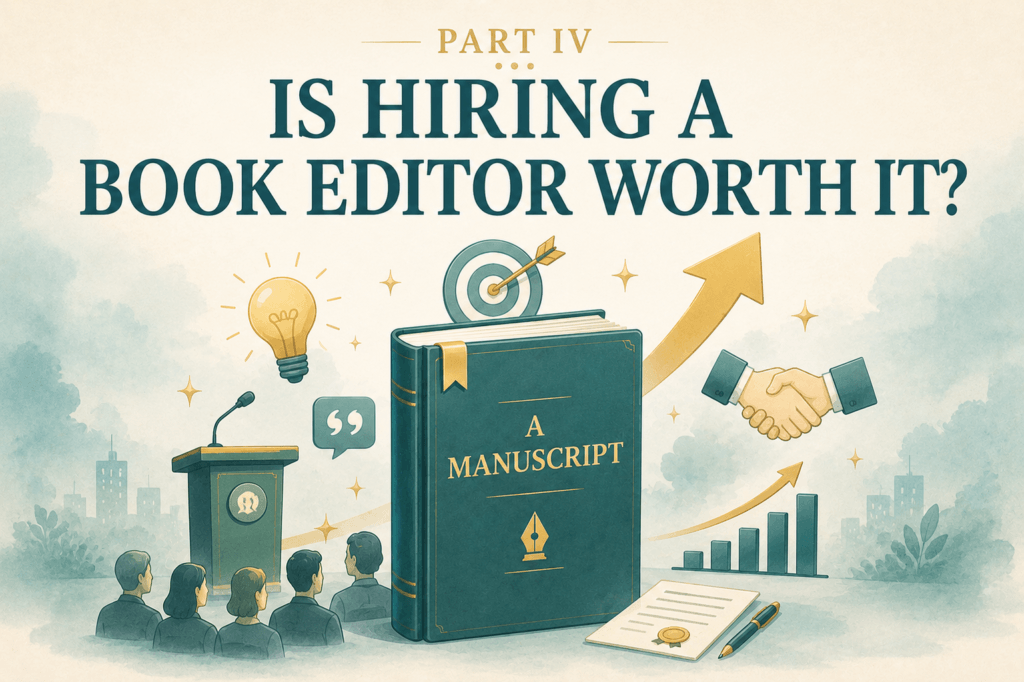
Part IV — Is Hiring a Book Editor Worth It? (ROI, Outcomes, and Strategic Impact)
Is hiring a book editor worth it?
Editing should not be evaluated as a cost alone.
It is a strategic investment that affects how the book performs in the market and what it enables beyond publication.
The question is not simply whether editing improves the manuscript.
It is whether it improves the outcomes the book is expected to produce.
ROI Drivers
Editing creates return by improving how the book performs as an asset.
That return does not come from editing itself.
It comes from how editing strengthens the outcomes the book is meant to produce.
There are three primary drivers.
Authority
Authority is the perception that the author’s ideas are credible, structured, and worth acting on.
Editing strengthens authority by:
- Clarifying the core argument
- Removing ambiguity and inconsistency
- Structuring ideas into a coherent system
A poorly structured or unclear book reduces trust, regardless of the underlying ideas.
Publishing quality
Publishing quality refers to whether the book meets professional standards.
This includes:
- Structural integrity (the book works as a whole)
- Readability (ideas are easy to follow)
- Technical correctness (grammar, consistency, formatting)
Editing ensures the manuscript is not just complete, but publishable at a professional level.
Business outcomes
For many authors, the book is not the final product.
It is a leverage asset used to create downstream opportunities.
Editing improves the effectiveness of the book in:
- Communicating ideas clearly in high-stakes contexts
- Supporting speaking, consulting, and partnerships
- Increasing perceived value in professional environments
A book that is unclear or structurally weak reduces its ability to create these outcomes.
Where ROI Comes From
The return on editing is not limited to book sales.
It comes from how the book performs in practice:
- Clarity increases understanding and application
- Structure improves retention and perceived value
- Quality strengthens credibility in high-stakes contexts
A technically correct but unclear book underperforms.
A clear but poorly structured book fails to hold.
Editing ensures both are resolved.
Editing is worth it when the book is intended to represent authority, create opportunities, and the manuscript is at the stage where editing work will hold.
It is not worth it when the manuscript is not ready, the wrong type of editing is applied, or the investment does not match the intended outcome.
Editing does not guarantee success.
It amplifies what is already present, making a strong manuscript more effective, and a misaligned one more expensive.
ROI Model
Editing impacts different outcomes in different ways.
Not all returns are equal.
Most authors evaluate editing based on book sales alone. This understates its actual value.
Outcome Impact
| Outcome Type | Impact from Editing |
| Book sales | Partial |
| Authority | High |
| Business ROI | Strong |
How to interpret this
- Book sales (Partial)
Editing improves readability and professionalism, which can support sales.
However, sales are driven by distribution, positioning, and demand, not editing alone. - Authority (High)
Editing directly strengthens how the author is perceived.
A clear, structured, and well-written book signals credibility and expertise. - Business ROI (Strong)
For many authors, the primary return comes from what the book enables.
This includes speaking, consulting, partnerships, and internal influence.
Editing increases the effectiveness of the book in these contexts by ensuring the ideas are clear, structured, and usable.
Practical implication
If editing is evaluated only against book revenue, it will appear overpriced.
If evaluated against authority and downstream outcomes, it becomes a high-leverage investment.
The return is not limited to what the book sells.
It is defined by what the book makes possible.
Book editor vs ghostwriter vs book coach (cost comparison)
Choosing the right type of support is a constraint decision, not a preference.
Each role solves a different problem at a different stage of the manuscript. Misalignment leads to wasted time and cost.
Role Comparison
| Role | Cost Range | Function |
| Editor | $1k–$7k | Improves manuscript |
| Coach | $2k–$10k | Guides process |
| Ghostwriter | $10k–$100k+ | Creates manuscript |
Role Breakdown
Editor
Works on an existing manuscript.
Focuses on improving what is already written:
- Strengthens structure, clarity, or correctness depending on the editing stage
- Identifies gaps, inconsistencies, and weak logic
- Refines the manuscript into a coherent, readable, and professional asset
An editor does not create the book.
They improve a draft that already exists.
Coach
Works alongside the author during the writing process.
Focuses on guiding how the book is developed:
- Helps define structure, positioning, and direction early
- Provides accountability and feedback as the manuscript evolves
- Reduces the risk of major rewrites later
A coach does not replace writing.
They help ensure the right book is being written from the start.
Ghostwriter
Creates the manuscript on behalf of the author.
Focuses on execution:
- Translates the author’s ideas, experience, and voice into a complete manuscript
- Handles drafting, structure, and often multiple revisions
- Delivers a finished book with minimal writing required from the author
A ghostwriter is used when the constraint is not clarity, but capacity.
How to Choose
Match the role to the constraint:
- No manuscript → not an editor problem
- No clear structure → coach problem
- No time or writing capacity → ghostwriter
Each role solves a different problem.
Using the wrong one does not move the manuscript forward.

Part V — How to Choose the Right Book Editor (Without Overpaying)
How to choose the right editor without overpaying
Choosing an editor is not a procurement decision.
It is a diagnostic decision: matching the current state of the manuscript to the type of expertise required to move it forward.
Most overpaying happens when this diagnosis is skipped.
Editors are hired based on availability, reputation, or price, rather than fit. The result is work that does not address the actual constraint, leading to rework.
Selection Process
The goal is not to “find a good editor.”
The goal is to find the right editor for this stage.
Follow this sequence:
1. Identify the manuscript stage
Determine where the manuscript actually is, not where you want it to be.
- Early draft → structure is unstable
- Mid-stage → structure holds, clarity is uneven
- Finished → clear but needs technical correction
- Pre-publication → only surface errors remain
Misidentifying the stage leads to misaligned editing.
2. Identify the primary constraint
At any point, one constraint dominates:
- Structure (does the book work?)
- Clarity (does the writing read well?)
- Correctness (is it technically clean?)
- Polish (is it ready to publish?)
Editing is effective only when it targets the primary constraint.
3. Match the editor to the constraint
Not all editors solve the same problems.
- Developmental editors → structure, argument, positioning
- Line editors → clarity, flow, readability
- Copyeditors → grammar, consistency, technical accuracy
- Proofreaders → final surface errors
Hiring a highly skilled editor of the wrong type still produces the wrong outcome.
4. Request a sample edit
A sample edit is the most reliable way to evaluate fit.
Look for:
- Whether the editor identifies the real issues (not just surface fixes)
- Whether feedback improves clarity and structure
- Whether suggestions align with the intent of the book
A sample reveals both capability and approach.
5. Align scope and expectations
Before committing, clarify:
- What level of editing is being provided
- What is included (number of passes, depth of feedback)
- What outcomes to expect after the edit
Misalignment here leads to dissatisfaction even when the work is technically correct.
Evaluation Criteria
When comparing editors, prioritize capability over price.
Quality of thinking
Does the editor improve how the manuscript works, or only how it reads?
Strong editors:
- Identify structural weaknesses
- Challenge unclear logic
- Strengthen positioning
Weak editors focus only on sentence-level changes.
Nonfiction expertise
Nonfiction editing requires more than grammar.
Evaluate whether the editor understands:
- Argument structure
- Reader progression
- Positioning and clarity of ideas
An editor without this context may improve sentences but miss the core issues.
Depth of intervention
Editors operate at different depths:
- Surface → grammar and minor clarity
- Mid-level → flow and readability
- Deep → structure, argument, and positioning
The depth must match the manuscript’s needs.
Practical filter
If the manuscript still has structural issues, do not optimize for price.
If the manuscript is structurally sound, do not overpay for structural work.
Cost becomes efficient only when the type of work matches the stage.
Choosing the right editor is not about finding the best person available.
It is about selecting the right intervention at the right time.
How to reduce your book editing cost
Editing cost is a function of how much the manuscript needs to change.
The less work required at the editing stage, the lower the cost.
Reducing cost is not about negotiating rates.
It is about reducing the level of intervention required before hiring an editor.
Cost Reduction Levers
Self-edit
Self-editing is the first pass of improvement before external input.
The goal is not perfection.
It is to remove obvious issues so the editor can focus on higher-value work.
Focus on:
- Eliminating repetition
- Tightening unclear sentences
- Removing sections that do not support the core argument
This reduces time spent on surface-level corrections.
Beta readers
Beta readers are early readers who provide feedback before professional editing.
They help identify:
- Confusing sections
- Gaps in logic
- Areas where the argument does not hold
This surfaces structural and clarity issues early, before paid editing begins.
Improve structure
Structure is the highest-leverage factor in editing cost.
A clear structure reduces the need for deep intervention.
Before hiring an editor, ensure:
- The core argument is defined
- Chapters follow a logical progression
- Each section serves a clear purpose
Fixing structure early prevents expensive rewrites later.
Refine draft
A refined draft is complete, coherent, and stable.
This means:
- The manuscript is fully written
- Major changes are unlikely
- The direction of the book is clear
Editors work more efficiently when the draft is stable.
Practical implication
Every improvement made before hiring an editor reduces the depth of work required.
- Cleaner draft → less correction
- Clearer structure → less restructuring
- Stable manuscript → fewer revisions
Lower cost is the result of better preparation.
Not lower-quality editing.
Where to find a qualified book editor
Finding an editor is not a sourcing problem.
It is a selection problem.
There is no shortage of editors. The constraint is identifying who can solve the specific problem the manuscript has right now.
Most poor decisions happen when authors optimize for convenience, price, or availability instead of fit.
Sources
Use sources that allow you to assess both capability and context.
Vetted editors
Editors who have been filtered through trusted systems, platforms, or prior professional work.
- Typically meet a baseline standard of quality
- More predictable in delivery and process
- Still require evaluation for stage fit
“Vetted” reduces risk. It does not guarantee alignment.
Agencies
Editorial agencies provide access to a pool of editors across different specialties.
- Useful when the required editing type is clear
- Can match manuscripts to editors based on scope
- Often more structured in process and pricing
The tradeoff is less direct control over who is assigned unless specified.
Referrals
Recommendations from authors or operators who have completed similar projects.
- Provide insight into how the editor works in practice
- Often include context on strengths and limitations
- Higher signal than directories or marketplaces
A strong referral is one where the manuscript, stage, and goals were similar.
Filtering Criteria
Once options are identified, selection depends on fit across three dimensions.
Nonfiction capability
Nonfiction editing requires more than technical correction.
Evaluate whether the editor can:
- Understand and strengthen an argument
- Improve clarity of thinking, not just wording
- Identify gaps in logic or positioning
An editor focused only on grammar will not improve the effectiveness of the book.
Category relevance
Editors do not need to be subject-matter experts, but they must understand the context.
- Familiarity with the audience improves clarity decisions
- Awareness of category standards improves positioning
- Experience with similar books increases efficiency
Lack of context leads to technically correct but strategically weak edits.
Stage alignment
This is the highest-leverage filter.
Match the editor to the manuscript’s current constraint:
- Structural issues → developmental editor
- Clarity issues → line editor
- Technical issues → copyeditor
- Final polish → proofreader
A mismatch here results in work that does not hold.
The objective is not to find the best editor available.
It is to find the editor who can apply the right level of intervention at the right stage.
The real cost of editing is choosing the wrong stage
Editing becomes expensive when it is applied at the wrong point in the process.
The issue is not the price of editing.
It is the timing.
A well-sequenced editing process compounds.
A mis-sequenced one creates rework.
- Structural issues addressed early prevent downstream revisions
- Clarity improvements hold only when structure is stable
- Technical corrections are efficient only when the text is final
When this sequence is followed, each stage builds on the previous one.
When it is not, work is repeated.
Key Takeaways
- Wrong timing = wasted money
Editing applied before the manuscript is ready leads to rewrites and duplicated cost - Right sequence = efficient investment
Each stage of editing compounds when applied in the correct order - Editing = leverage decision
The goal is not to minimize cost, but to maximize the effectiveness of each intervention
Editing cost is not defined by how much you spend.
It is defined by whether that spend moves the manuscript forward, once.
FAQs
How much does a book editor cost per word?
Most editors charge between $0.02 and $0.08 per word, depending on the level of editing required. Higher rates typically reflect deeper intervention, not just longer manuscripts.
How much does it cost to edit a 50,000-word book?
A 50,000-word manuscript typically costs between $1,000 and $4,000 for line or copyediting, and $3,000 to $7,000 for developmental editing. The final cost depends on how much the manuscript needs to change.
Do I need all four types of editing?
Most authors do not need all four types of editing, only the one that matches their current stage. Applying unnecessary stages increases cost without improving outcomes.
Why is developmental editing more expensive?
Developmental editing is more expensive because it addresses structure, argument, and positioning, which require deeper analysis and judgment. It involves reshaping the book, not just refining the text.
Can I skip editing to save money?
Skipping editing reduces upfront cost but increases the risk of a weak or unclear manuscript. For books intended to create authority or business outcomes, this tradeoff usually leads to lower overall effectiveness.
What is the cheapest way to edit a book?
The lowest-cost approach is to reduce how much editing is needed by improving structure and refining the draft before hiring an editor. Better preparation lowers cost without reducing quality.
How do I know which type of editing I need?
The correct type of editing depends on the manuscript’s primary constraint, whether that is structure, clarity, correctness, or final polish. Matching the intervention to the constraint is what makes editing efficient.