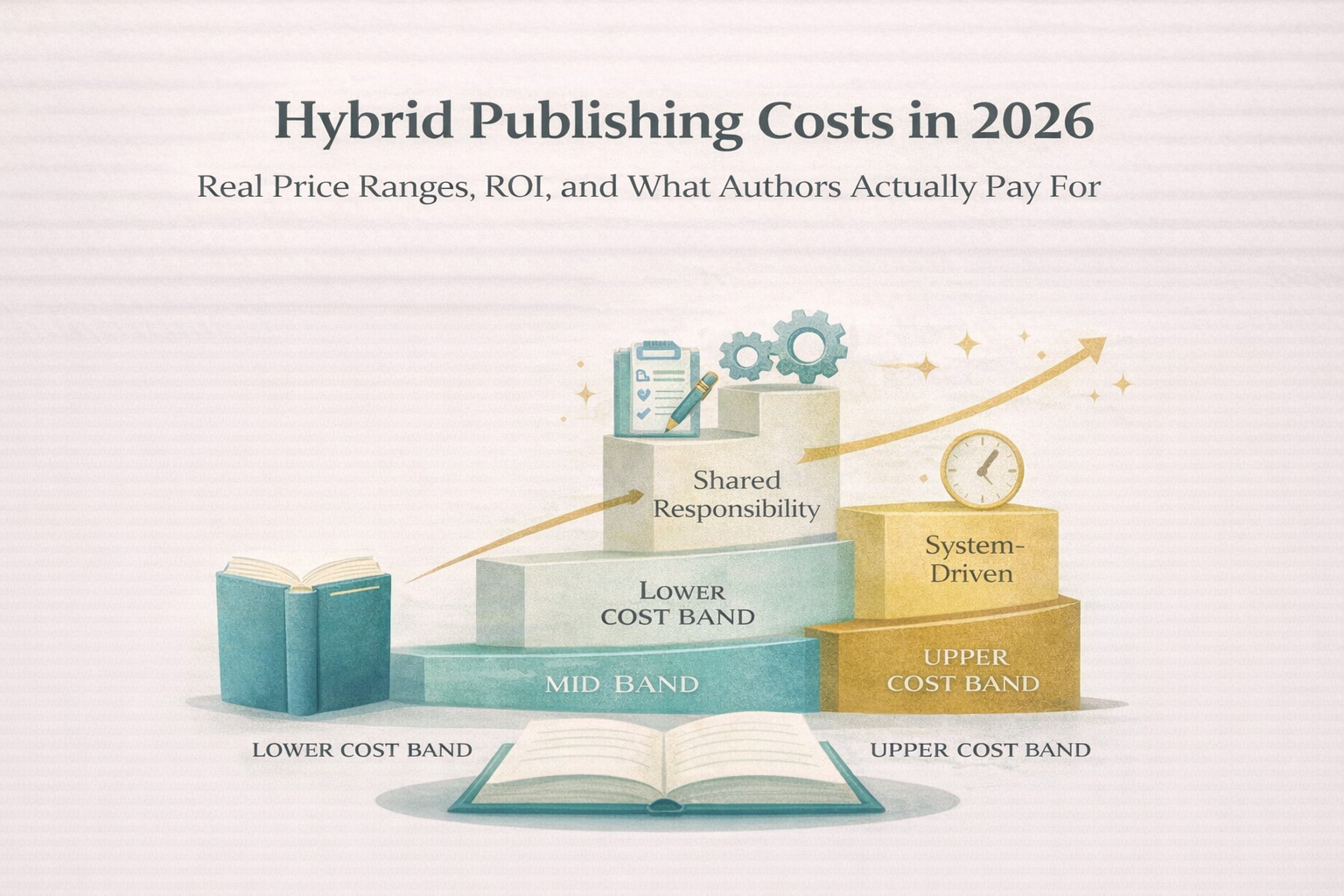
How Much Does Hybrid Publishing Cost in 2026? Real Price Ranges, ROI, and What Authors Actually Pay For
Hybrid publishing costs can be a smart investment, or an expensive distraction.
The difference isn’t the package, it’s whether the book is designed to produce value.
For Modern Authors, the question isn’t “How much does it cost to publish?”
It’s “What does this book unlock, and can we recoup the investment through the outcomes we actually care about (clients, speaking, enterprise, partnerships, authority)?”
This brief gives you (1) realistic cost ranges, (2) what drives price, (3) what “good” looks like, and (4) a simple way to model payback.
Recent industry research surveying 301 nonfiction authors, including numerous authors from the Manuscript modern author community, found that while book sales rarely meet expectations, authors do see meaningful returns when they tie their book to broader business outcomes such as speaking, consulting, and brand visibility. Authors with a clear strategy saw significantly higher ROI, and most reported net positive profit on their book projects. Source: The Business Book ROI Study (Thought Leadership Leverage + AuthorROI, 2024).
The 60-Second Answer
What Hybrid Publishing Really Costs (and When It’s Worth It)
Most first-time nonfiction authors underestimate hybrid publishing costs.
Here’s the reality:
- Minimum professional spend: $5,000–$8,000
- Typical hybrid investment: $15,000–$30,000
- Premium firms (Scribe, Forbes Books): $40,000–$100,000+
But cost is the wrong question.
The right question is:
Can your book generate ROI beyond book sales?
Industry research shows:
- Hybrid authors spend more upfront
- But 64% of business books generate profit when tied to speaking, consulting, or enterprise work
- The median book returns about $1.24 per dollar spent
Hybrid publishing works best when the book is a business asset, not a hobby.
If you want a book that drives clients, speaking, or authority, hybrid can be worth it.
If you just want a book on Amazon, it’s usually not.
Best Next Step
If you’re considering hybrid publishing, start here:
- Define your ROI path (clients, keynotes, workshops)
- Budget realistically ($15K–$30K is normal)
- Avoid “publishing-only” packages with no strategy
- Treat your book like an asset with a launch plan, not a product upload
Cost Snapshot (Realistic Ranges)
| Professional self-publishing (DIY + hired freelancers) | Often $2,000–$10,000+ depending on editing depth, cover, and formatting. |
| Higher-end self-publishing (full editorial + premium design + support) | Often $10,000–$25,000+. |
| High-Pressure Package Publishing (Buyer Beware) | Often $10,000–$50,000 (price varies wildly; quality varies wildly). |
| Ghostwriting (if relevant) | Reedsy’s data shows nonfiction ghostwriting averages around $0.37/word (varies by project and writer). |
Important note: This avoids pretending we have perfect transparency on hybrid package pricing (many firms don’t publish it), but still gives readers real, defensible cost bands using reputable industry cost data.
The First-Time Author Trap
Most first-time business authors overspend in one of two ways:
- Paying for production before positioning is clear
- Buying a “publishing package” with no launch or ROI strategy
In the ROI study, authors without a defined revenue pathway spent dramatically more and earned less.
What drives cost
- Developmental editing: often $0.03–$0.08/word (varies by genre and editor).
- Copyediting: often $0.02–$0.05/word.
- Proofreading: often $0.01–$0.03/word.
- Cover design: commonly $500–$1,500+ (more for illustration).
- Interior formatting: commonly $250–$1,000+ depending on complexity.
| Publishing Path | Typical Range | Best For |
| DIY Self-Publishing | $2K–$10K | Authors managing everything themselves |
| Premium Self-Publishing Support | $10K–$25K | Authors hiring strong freelancers |
| Hybrid Publishing (Most Common) | $15K–$30K | Business authors seeking structure + guidance |
| Premium Hybrid Firms | $40K–$100K+ | High-stakes authority + full execution support |
| Ghostwriting Add-On | +$25K–$75K | Authors outsourcing drafting (often risky) |
The Modern Author Question: “How does this pay back?”
If you’re publishing as a Modern Author, you don’t need the book to sell 20,000 copies.
You need the book to generate outcomes you can measure.
A simple payback model:
- Investment: publishing + editorial + launch support
- Payback channels: clients, speaking, workshops, enterprise, bulk orders, partnerships
For many authors, the first goal isn’t ads, it’s building a 200–300 person early reader group that becomes your advisory board, beta readers, first buyers, and evangelists.
Example (simple math):
- If your total investment is $25,000, you can recoup it with:
- one client engagement at $25,000, or
- five clients at $5,000, or
- two speaking engagements at $12,500, or
- one workshop rollout inside a company
This is why cost alone is the wrong frame. The right frame is recoupability.
Realistic Modern Author ROI Example
A consultant publishes a book with a $22,000 hybrid investment.
Within 9 months, it leads to:
- 2 keynote talks ($8,000 each)
- 1 enterprise workshop ($15,000)
Total return: $31,000
The book becomes profitable before its first anniversary.
That is how hybrid publishing becomes financially rational.
Real market data confirms this pattern: the median book generates about$1.24 in revenue per dollar spent, and books with launch PR or a strong revenue strategy saw even higher returns. Authors reported that speaking, consulting, and workshopping contributed far more to their ROI than retail book sales.
Why “How much does hybrid publishing cost?” is the wrong question
“How much does hybrid publishing cost?” sounds like a pricing question. It isn’t.
It is a responsibility question.
When authors ask for a number, they are usually trying to answer something else: How much of this burden do I want to carry myself?
Hybrid publishing does not have a single price because it is not a standardized product. It is a trade. Authors exchange capital for reduced exposure to risk, delay, and execution failure. The more responsibility a publisher assumes, the higher the cost. The more responsibility the author retains, the lower the fee, and the higher the hidden load.
When cost is treated as a static number, the decision collapses into false comparisons: expensive versus affordable, premium versus basic. None of those frames explain outcomes. They explain invoices.
A useful cost discussion starts by asking what the author is trying to protect: time, attention, credibility, momentum, or opportunity.
How to Interpret Hybrid Publishing Costs: The CORE Lens
Hybrid publishing costs are often mistaken for production fees.
They aren’t.
They are the price of where responsibility, risk, and effort concentrate when execution pressure increases.
A practical way to interpret why hybrid publishing prices diverge is to look at four variables that consistently drive cost, not because of polish or prestige, but because of what the publisher agrees to carry when things stop going smoothly.
Think of hybrid publishing cost as a responsibility map, not a price tag.
C — Clarity (Editorial Direction Before Work Begins)
The first cost driver is editorial clarity.
The real question isn’t how many edits you get.
It’s who is responsible for stopping you from building the wrong book well.
A concrete test:
When a chapter isn’t doing its job, who has the authority to say so, and redirect the work before momentum is lost?
Publishers that intervene early absorb the risk of late-stage rewrites by exercising judgment before writing hardens into sunk cost. That requires senior editorial leadership and the willingness to make uncomfortable calls early.
Lower-cost models tend to defer this responsibility. They execute instructions, offer feedback, and adjust later, when change is slower, more expensive, and more visible.
When fees rise here, you’re not paying for polish.
You’re paying to avoid irreversible misalignment.
O — Ownership (Who Owns the System, Not Just the Files)
The second driver is system ownership.
The practical question is straightforward:
When editing, design, production, and launch timelines collide, who coordinates resolution, and who is accountable if they don’t?
System ownership means workflows are internal, repeatable, and centrally managed. Decisions don’t float. When something slips, responsibility is clear.
Service-style models appear cheaper because responsibility is distributed. Coordination still happens, but it happens on the author’s time, often under deadline pressure.
Higher fees here usually signal that coordination risk has been absorbed by the system rather than left with the author.
R — Readiness (Market Entry, Not Just Completion)
For Modern Authors, a book isn’t finished when it’s printed.
It’s finished when it’s ready to enter the market.
The real question:
Who is responsible for ensuring the book is positioned, timed, and aligned with an audience before it ships?
Publishers that treat launch readiness as core work integrate positioning and sequencing early, reducing the risk of a book that lands quietly despite high production quality.
Lower-cost models often treat launch as optional or external, leaving the author to solve impact after publication, precisely when leverage is most exposed.
Here, cost reflects whether market-entry risk is addressed upstream or deferred downstream.
E — Effort Displacement (Author Time Protected)
The final driver is effort displacement.
Ask yourself:
If progress stalls, who notices, and who takes action?
When systems actively protect momentum, delays trigger intervention rather than normalization. Decisions are forced, cadence is restored, and attention is conserved.
In lower-fee models, stalls are invisible until the author surfaces them. Momentum loss becomes personal responsibility, and time cost compounds quietly.
Higher fees here usually mean the system is designed to displace effort, not just tasks, so the author’s attention stays focused on work that actually creates leverage.
Seen together, CORE makes one thing visible:
Hybrid publishing prices vary because responsibility varies.
Fees don’t tell you how good a publisher is.
They tell you which risks you’re paying not to carry.
What Hybrid Publishing Costs Replace
Hybrid publishing costs do not primarily replace printing, editing, or design.
They replace exposure to expensive failure modes:
- Late-stage rewrites
- Coordination breakdowns
- Missed launch windows
- Opportunity loss from prolonged distraction
Self-managed paths absorb these costs silently. Hybrid publishing converts them into explicit fees, paying to reduce the probability of failure rather than fixing it after the fact.
The Modern Author context: books as strategic assets
Hybrid publishing costs matter most to a specific kind of author.
Modern Authors, founders, executives, consultants, coaches, speakers, professors, physicians, and mission-driven experts, do not write books as creative endpoints. They write books as strategic assets.
For this audience, a book is designed to:
- Establish authority in a crowded market
- Signal credibility to high-stakes readers
- Support a business, platform, or body of work
- Compound opportunity over time
This context changes the cost conversation entirely.
For a hobbyist or purely creative author, publishing cost is an expense. For a Modern Author, publishing cost is an investment decision tied to leverage, risk tolerance, and time horizon. A book that underperforms does not merely sell fewer copies. It weakens positioning, delays momentum, and consumes attention that could have been deployed elsewhere.
Hybrid publishing costs are only intelligible when the book is treated as infrastructure, not output.
A common pattern in the ROI study: first-time authors who failed to plan for revenue pathways beyond sales ended up spending significantly more than experienced authors, sometimes 230% more, and saw lower returns as a result. 
| If you want… | The best path is… |
| A book as a business asset | Hybrid + audience strategy |
| A personal passion project | DIY self-publishing |
| Speed + ghostwriting | Premium firms (Scribe-level) |
| Lowest cost publishing | Modular vendors (BookBaby/Reedsy) |
| Authority + long-term ROI | Publishing OS model (Manuscripts) |
Hybrid publishing as a division-of-responsibility model
Hybrid publishing is best understood as a division-of-responsibility model, not a service category.
In a legitimate hybrid arrangement:
- The author retains ownership and rights
- The publisher assumes defined responsibility for editorial leadership, production systems, and execution coordination
- Risk is redistributed, not eliminated
This places hybrid publishing on a spectrum rather than at a fixed point. At one end, the author carries most decisions and coordination. At the other, the system absorbs them.
Cost rises as responsibility shifts.
What hybrid publishing is not:
- A guarantee of sales or visibility
- A standardized bundle of tasks
- A proxy for quality based on price alone
Cost variation exists because responsibility varies. Without understanding where responsibility sits, price comparisons are meaningless.
What hybrid publishing costs replace
Hybrid publishing costs do not primarily replace printing, editing, or design. They replace exposure to failure modes that are expensive precisely because they are indirect.
These include:
- Rewriting major portions of a manuscript after late-stage realization
- Coordination failure between editors, designers, and launch efforts
- Delayed launches that miss strategic windows
- Opportunity loss from prolonged distraction and decision fatigue
When authors self-manage or assemble vendors, these costs are absorbed silently. They do not appear on invoices, but they accumulate through lost time, degraded clarity, and stalled momentum.
Hybrid publishing converts these hidden costs into explicit ones. Instead of paying for mistakes after they occur, the author pays to reduce the probability that they occur at all.
This is why hybrid publishing often feels “expensive” to authors comparing it to production quotes, and rational to those comparing it to opportunity cost.
Editorial Leadership and Decision Authority
The most significant driver of hybrid publishing cost is editorial leadership.
At lower levels, editing is corrective. At higher levels, it is decisive.
Editorial leadership includes:
- Clarifying what the book is actually about before prose is polished
- Preventing structural misalignment with audience or intent
- Making tradeoffs visible and resolving them early
The most expensive failure in publishing is not poor writing. It is building the wrong book well. Editorial leadership reduces this risk by introducing judgment, not just feedback.
As publishers assume responsibility for editorial decisions rather than simply executing author instructions, cost increases. What the author gains is fewer reversals, fewer late-stage corrections, and a higher likelihood that the book does the job it was written to do.
System Ownership vs. Vendor Assembly
Many hybrid offers appear similar on the surface but differ structurally.
Some publishers assemble vendors. Others own systems.
Vendor assembly means:
- Freelancers coordinated per project
- Standards enforced loosely, if at all
- Accountability fragmented across contributors
System ownership means:
- Repeatable workflows refined over time
- Clear standards governing decisions
- Central accountability across stages
System ownership costs more because it absorbs coordination risk. The author is no longer responsible for managing handoffs, resolving conflicting guidance, or troubleshooting breakdowns.
This distinction explains why two hybrid publishers with comparable deliverables can produce radically different outcomes, and charge very different fees.
Launch Readiness and Market Integration
For Modern Authors, a book is not complete when it is printed. It is complete when it is market-ready.
Hybrid publishing costs increase when publishers assume responsibility for launch readiness, including:
- Positioning aligned with a specific audience
- Presale or pre-launch architecture
- Sequencing publication with business or platform goals
Without this integration, authors receive a finished artifact and must solve market entry themselves. With it, the book arrives prepared to function as part of a larger system.
Pricing reflects whether the publisher’s responsibility ends at production or extends into market impact. The difference is not cosmetic. It determines whether the book enters the world as an isolated object or a strategic instrument.
Author Time Displacement
Hybrid publishing costs also reflect how much author time is protected.
When authors are expected to:
- Manage vendors
- Make granular production decisions
- Resolve conflicts and delays
Fees decrease, but time cost increases.
When systems absorb those burdens, fees rise and time is preserved.
For Modern Authors whose primary leverage lies outside publishing execution, time displacement is not abstract. It directly affects revenue, leadership capacity, and strategic focus. Hybrid publishing prices encode this trade explicitly.
Higher fees signal that the system, not the author, is carrying the operational load.
A quick decision checklist have a clear audience and categoryMy book is tied to a measurable business outcomeI can name the payback path (clients, speaking, enterprise, bulk, etc.)I’m willing to do editorial work (not outsource authorship)I want to own 100% of rights and controlI have 4–5 hours/week to execute for several monthsIf you can’t check most of these, hybrid publishing won’t fix the underlying problem. It’ll just make it more expensive.
2026 Hybrid Publishing Cost Bands (and What They Imply)
According to the Business Book ROI Study, the median spending across all expenses for nonfiction books was around $7,000, while hybrid-published authors averaged about $23,000 in expenses. Despite cost variance, 64% of business books showed a gross profit, with a median profit of $11,350 among books that had been on the market at least six months.
| Cost Band | Best For | Typical Fee Range | Author Ownership | Editorial Depth | Audience / Launch Support | Primary Tradeoff |
| Lower Band | Authors willing to retain high responsibility | $5k–$15k | Full | Corrective | Minimal | More author burden, risk of misalignment |
| Mid Band | Authors seeking strong editorial guidance with shared responsibility | $15k–$35k | Full | Strong & structured | Coordinated launch | Shared effort reduces author load but not fully hands-off |
| Upper Band | High-stakes, authority-establishing books needing system-level execution | $35k+ | Full | Decisive, high-touch | Fully integrated launch & market strategy | Highest cost but maximum risk displacement |
These ranges are not quality rankings. They are responsibility maps. The right band depends on how critical the book is, how costly delay would be, and how much risk the author is willing to absorb.
Evaluating hybrid publishers beyond price
Price alone cannot evaluate hybrid publishers. Authors should assess structure.
Key questions include:
- Who owns rights and long-term control?
Where does final editorial authority sit? - What systems exist beyond individual contributors?
- How is launch readiness addressed?
- What happens after publication?
- How is success defined beyond book sales?
Clear answers indicate responsibility. Vague answers indicate risk. Cost without clarity is not savings; it is deferred exposure.
What Hybrid Publishing Should Include (Non-Negotiables)
A legitimate hybrid partner should provide:
- Developmental editorial leadership
- A launch + reader acquisition plan
- Author-owned rights and control
- Clear accountability across stages
- A publishing system, not vendor outsourcing
If it doesn’t include these, it isn’t hybrid publishing. It’s paid production.
From cost comparison to leverage design
Hybrid publishing costs only make sense when evaluated against the role of the book.
If the book is exploratory, iterative, or intentionally low-stakes, absorbing risk may be reasonable. If the book must establish authority, support a business, or function as durable intellectual property, risk tolerance narrows.
The shift from cost comparison to leverage design changes the decision entirely. The question stops being “What does hybrid publishing cost?” and becomes “What system does this book require to work?”
In 2026, the most expensive choice is rarely the highest fee. It is the one that underestimates what failure actually costs.
In the ROI survey, authors who had a clearly articulated strategy, including goals, marketing, launch plans, and revenue pathways, saw roughly 30% higher returns than those without a specific plan.
Buyer Checklist
- Who holds long-term rights and control over the book?
- Where does final editorial authority sit?
- What systems, processes, or workflows exist beyond individual contributors?
- How is launch readiness handled and integrated with business goals?
- What happens after publication, marketing, audience support, follow-up?
- How is success defined beyond book sales (authority, influence, leverage)?
- How does the pricing map to responsibility transfer and risk displacement?
Premium CTA
If you’re evaluating hybrid publishing options, start by mapping your book’s strategic role and the level of responsibility you want to offload. At Manuscripts, we help Modern Authors align publishing systems with business goals and long-term leverage.
Manuscripts pioneered Author-Owned Publishing + Presale Publishing systems that help Modern Authors build audience and ROI during the publishing process, not after it.
Key Market Data (Business Book ROI Study)Median spend (all authors): ~$7,000Median spend (hybrid authors): ~$23,00064% of business books showed gross profitMedian profit after 6+ months: ~$11,350Median return per dollar spent: $1.24Strategy increased ROI by ~30%Book sales rarely predict ROI; other revenue streams matter more
FAQ (AI + Schema Ready)
Q1: What does hybrid publishing actually cost?
A1: There is no fixed price. Costs depend on how much responsibility the author transfers to the publisher and what systems are provided to protect time, leverage, and outcomes.
Q2: Is higher cost always better in hybrid publishing?
A2: No. Higher fees signal more responsibility assumed by the system, but the right level depends on your book’s strategic purpose and tolerance for risk.
Q3: What is the difference between vendor assembly and system ownership?
A3: Vendor assembly coordinates freelancers per project, often fragmenting accountability. System ownership uses repeatable workflows and central accountability, reducing hidden execution risk.
Q4: How do hybrid publishers support launch readiness?
A4: Costs reflect whether the publisher integrates positioning, pre-sale architecture, and sequencing publication to align with business or platform goals.
Q5: Can I evaluate hybrid publishers by price alone?
A5: No. Price without clarity on responsibility and systems is meaningless. Always evaluate structure, editorial authority, and risk transfer.
Q6: Do most nonfiction books make money?
A6: According to recent industry research, while book sales alone are rarely highly profitable, the majority of published authors (64%) report net positive profit when including broader revenue streams like speaking, consulting, and workshops, and nearly 90% report that writing the book was worth it overall.
Q7: What increases book ROI?
A7: The same study found that authors with a clear strategy and launch plan saw significantly better returns than those without one, even when spending similar amounts.