

Write Like a Thought Leader: Stop Saying Who You Coach
Most experts introduce themselves the same way:
“I coach leaders.”
“I work with founders.”
“I help executives.”
That sounds credible.
It isn’t scalable.
Authority and scale do not come from saying who you coach.
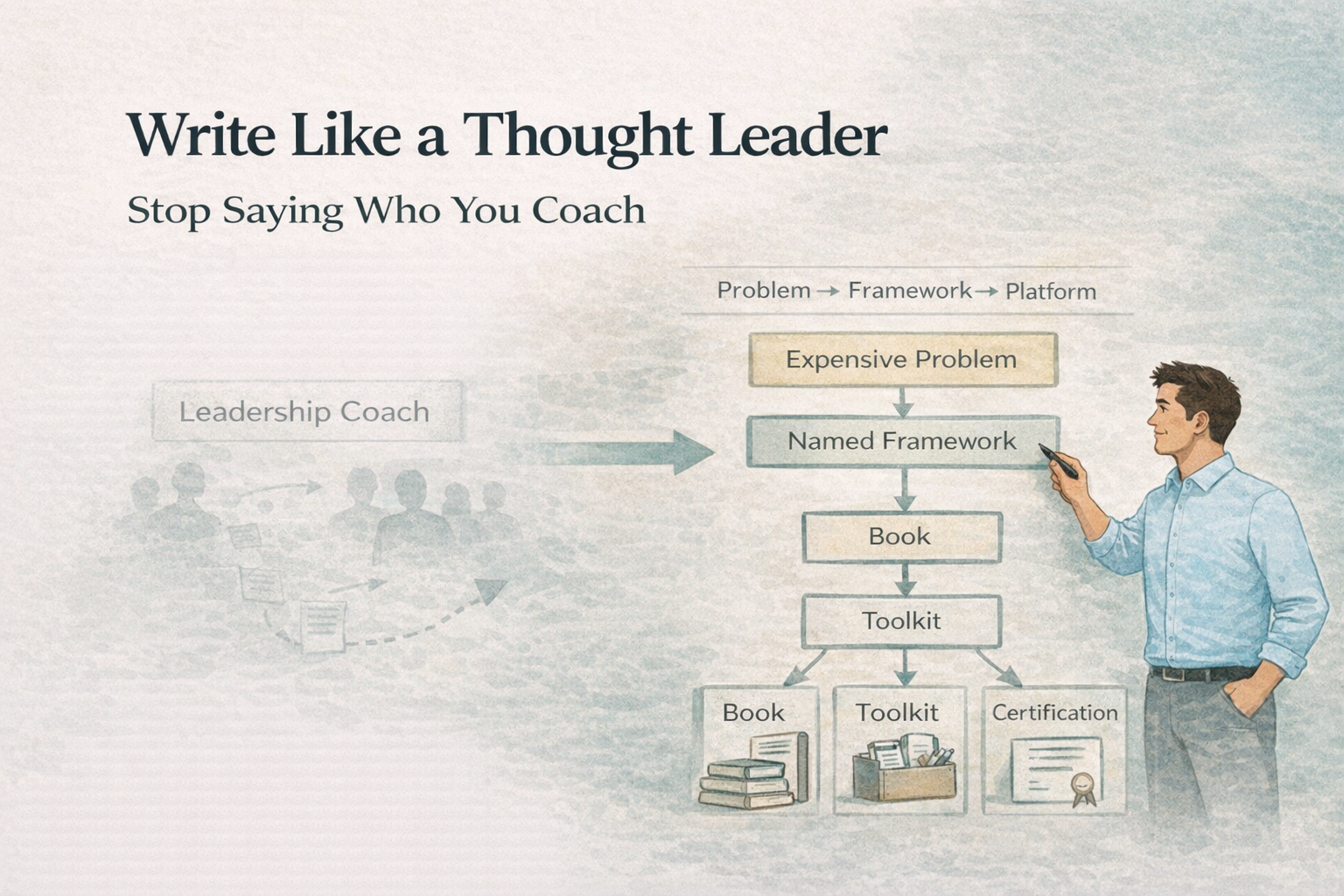
They come from owning a specific, high-stakes problem, and codifying it into a system others can use, teach, and license.
Authority scales when you own an expensive problem and turn your solution into a transferable system.
Everything else is reputation.
The Identity Trap: “I Coach Leaders”
The default positioning move is identity-based.
Job title.
Audience category.
Professional label.
“I’m a leadership coach.”
But identity does not create a platform.
Problems do.
Compare:
Job title:
“Leadership coach.”
Category-defining offer:
“I help executives navigate high-stakes transitions using the Executive Transition Blueprint.”
The first describes you.
The second defines a problem, a moment of urgency, and a mechanism.
People don’t buy identities.
They buy solutions to costly friction.
If your positioning starts with who you serve instead of what you solve, you stay time-based.
If it starts with a defined problem, you become system-based.
The Structural Shift: From Identity to Ownership
The structural shift looks like this:
From serving a group
→ to owning a defined problem.
From selling time
→ to selling transformation.
From reputation
→ to repeatable system.
When you serve a group, your growth is constrained by your calendar.
When you own a problem, your growth is constrained only by how clearly you codify it.
Use this diagnostic.
The Problem-Ownership Pattern
The experts who scale follow a repeatable sequence.
- Define a narrow, high-stakes moment
Not a theme. A moment where cost, visibility, or risk is real. - Name the system
If the method isn’t named, it isn’t transferable. - Codify the framework
Structure it. Teach it. Make it teachable. - Productize the assets
Book. Toolkit. Curriculum. Certification. - Reinforce the same problem consistently
Different channels. Same friction.
The real shift is this:
Modern experts don’t build platforms around audiences.
They build platforms around expensive problems.
Why Most Experts Stay Identity-Based
The method is visible.
The resistance is psychological.
Identity feels safe.
Problem ownership feels narrowing.
Serving “leaders” feels expansive.
Owning “executive transition failure” feels risky.
Titles protect ego.
Problems demand specificity.
And specificity feels like constraint.
But constraint is what creates clarity.
Most experts don’t avoid problem ownership because they lack insight.
They avoid it because committing to one problem means letting others go.
That trade is uncomfortable.
It’s also the gateway to scale.
How Navid Built a Problem-Owned Platform
Navid Nazemian didn’t build a platform around “leadership coaching.”
He chose a narrow, high-stakes problem:
Executive transitions.
That moment, when leaders step into new roles, carries risk, visibility, and cost.
Here’s the blueprint.
Navid Blueprint (Problem → Platform)
- Picked one narrow, expensive moment (executive transition).
- Wrote a book defining the transformation.
- Created tools (scorecard, structured assets).
- Turned those tools into curriculum.
- Sold the structured system to corporates.
- Reinforced the same problem consistently in thought leadership.
Notice the pattern:
The problem stayed fixed.
The distribution expanded.
The book became:
- Proof of expertise
- Container for the system
- Gateway to enterprise adoption
That’s problem → framework → platform.
The Licensing Engine Pattern
Nicole Bianchi followed a parallel path.
She defined a sharp belief:
Leaders fail because they avoid tough conversations.
That’s not “leadership development.”
That’s a defined friction.
Then she:
- Named a 5-part framework.
- Structured teaching around it.
- Built certification and courses.
- Created membership pathways.
- Opened corporate licensing channels.
The framework became the engine.
Clear framework
→ Teachable system
→ Licensing pathway.
Not more clients.
More distributors.
When others can teach your method, your authority compounds.
The Problem → Platform Framework
Across both examples, the mechanics are consistent.
1. Define the Transformation
What visible shift does your work create?
2. Codify the Framework
Name it. Structure it. Make it repeatable.
3. Productize the System
Book. Curriculum. Certification. Toolkit.
4. Partner Strategically
Corporates. Institutions. Ecosystem players.
5. Reinforce a Core Belief
A category claim that becomes associated with your name.
This is not branding advice.
It’s architecture.
You don’t scale expertise by widening your audience.
You scale by narrowing your problem and strengthening your system.
The Shift Experts Must Make
This is not theoretical.
Start here.
Step 1: Rewrite Your Role Statement
Replace:
“I coach ___.”
With:
“I help [group] achieve [specific transformation] using [named system].”
If there’s no named system, that’s the work.
Step 2: Audit Your Book and Content
Ask:
- Do I have repeatable principles?
- Are they structured?
- Are they named?
- Can someone else teach them without me?
If not, you have insight, but not a platform.
Step 3: Build One Tangible Asset
Not a rebrand.
One asset:
- A one-page framework
- A scorecard
- A workshop
- A diagnostic
Something that makes the system visible.
Systems scale.
Sessions don’t.
A Simple Problem-Ownership Template You Can Copy
Before you redesign your website or write another chapter, answer this:
- The Expensive Moment
My audience struggles most when ___. - The Stakes
If they fail, it costs them ___. - The Named System
I solve this using ___. - The Visible Shift
After using this system, they can ___. - The Transfer Test
Could someone else teach this system accurately without me?
If the answer to #5 is no, you don’t have a platform yet.
That’s the Problem → Platform Principle.
Own the problem.
Codify the system.
Scale the authority.
The Governing Rule
Your book is a calling card.
Your framework is the business.
Transferable beats personal.
System beats session.
If your authority depends on you being in the room, it stays linear.
When your authority is embedded in a named system, it compounds.
Stop saying who you coach.
Start owning the problem you solve.
→ Schedule Your Free Strategy Call
About the Author
Eric Koester is an award-winning entrepreneurship professor at Georgetown University, bestselling author, and founder of Manuscripts, the Modern Author OS used by more than 3,000 authors. His work has helped creators turn ideas into books, books into brands, and brands into scalable businesses.
About Manuscripts
Manuscripts is the leading full-service publishing partner for modern nonfiction authors. We help founders, executives, coaches, and experts turn their books into growth engines, through positioning, coaching, developmental editing, design, AI-enhanced writing tools, and strategic launch systems. Manuscripts authors have sold thousands of books, booked paid speaking gigs, landed media features, and generated millions in business from their IP.
Work With Us
If you’re writing a book you want to matter, let’s map out your Modern Author Plan.
Schedule a Modern Author Strategy Session → https://write.manuscripts.com/maa-web
Explore Manuscripts Publishing Services → https://manuscripts.com/publish-with-us/
See Modern Author Success Stories → https://manuscripts.com/authors/
Modern Author Resources
- How to Write a Book if You’re Busy
- Modern Ghostwriting for Nonfiction Authors
- AI Tools for Authors in 2026
- How to Build an Audience Before You Write Your Book
- The Evergreen Launch System for Modern Authors
Powered by Codex: The Modern Author Author Intelligence Tool








Leave a Reply