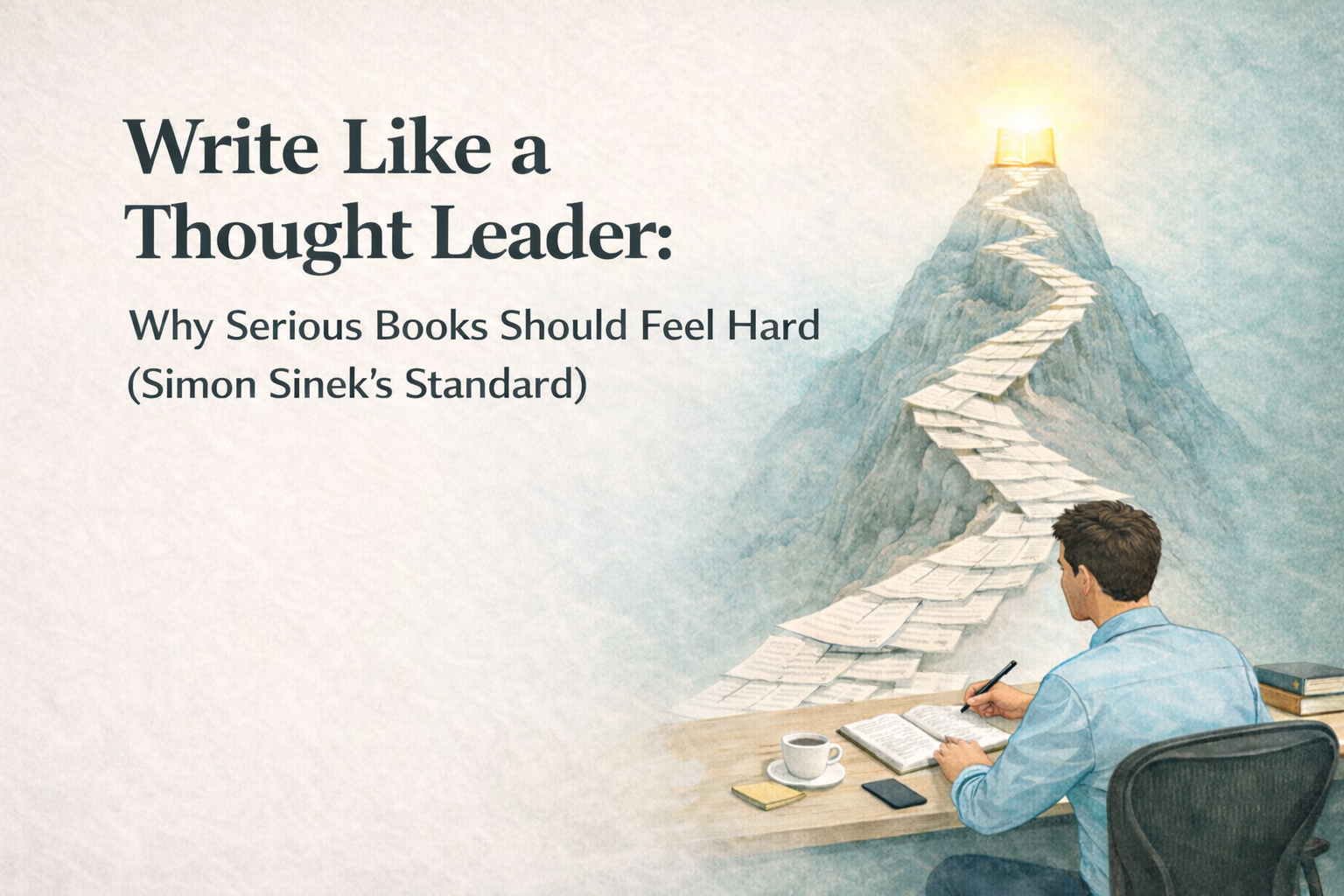
Write Like a Thought Leader: Why Serious Books Should Feel Hard (Simon Sinek’s Standard)
Most writers think a book should feel smoother the more experienced they become.
It shouldn’t.
If writing a serious book feels easy, it’s probably not deep enough.
Simon Sinek makes this standard uncomfortable but clear: depth is the value of a book. And depth is demanding.
That demand isn’t a flaw in the process.
It’s the point.
Serious books don’t just organize ideas. They reshape how readers think. And reshaping requires friction,for the reader and for the author.
Writers who endure understand this.
They embrace difficulty.
They reinvent their process.
They ignore short-term rankings.
They play the long game.
If it feels hard, you may be doing it right.
Writing Should Feel Hard
Most writers interpret difficulty as resistance.
Simon interprets it as signal.
A serious book does not simply explain an idea. It reshapes how someone sees the world. That level of reshaping requires intellectual and emotional strain.
Depth creates three kinds of pressure:
1. Cognitive pressure
You must refine, cut, and clarify beyond your first draft.
2. Structural pressure
The argument must hold over hundreds of pages, not a few paragraphs.
3. Personal pressure
You must decide what you truly believe, and stand behind it.
Surface-level work feels smooth.
Depth introduces friction.
If writing feels uncomfortable, it may mean you are moving beyond commentary into transformation.
Difficulty is not a warning.
It is the cost of depth.
Most Ideas Don’t Deserve a Book
Not every insight warrants a book.
Many ideas belong in:
- An article
- A keynote
- A thread
- A podcast
A book requires sustained depth.
Simon’s critique is blunt: social visibility does not equal intellectual weight.
Publishers often confuse audience size with substance.
Authors often do the same.
A book demands:
- An idea that can withstand expansion
- An argument that compounds across chapters
- A perspective that transforms the reader
If the concept exhausts itself quickly, it doesn’t need better marketing.
It needs more development, or a smaller format.
Raising the standard for what deserves a book is what separates serious authors from content producers.
Where You Start and Where You End Cannot Be the Same
A serious book must move the reader.
Transformation is the metric.
That transformation has structure:
Shift in understanding
The reader sees a problem differently.
Shift in standards
The reader raises what they expect of themselves.
Shift in behavior
The reader acts differently because of the new lens.
But you cannot produce that shift without undergoing it.
If the author remains unchanged by the writing process, the reader likely will too.
Depth is not about length.
It is about distance traveled.
A real book takes the reader somewhere new.
And the author must go there first.
Reinvent Your Writing Process Each Time
Writers often assume consistency equals discipline.
Simon challenges that.
Flow changes.
Life circumstances change.
Creative seasons change.
The process that worked before may no longer fit who you are now.
Writer’s block is not always laziness.
Sometimes it signals misalignment between your current demands and your old method.
Serious authors revisit:
- When they write
- Where they write
- How they draft
- How they revise
Reinvention is not instability.
It is responsiveness to growth.
If the book is meant to stretch you, your process may need to stretch too.
Stop Playing the Ranking Game
The publishing world rewards visible spikes.
Bestseller lists can be gamed.
Algorithms can be optimized.
Launch tactics can create artificial momentum.
But short-term spikes are finite games.
Word-of-mouth is infinite.
Simon’s mindset distinction matters here:
Finite goals chase rankings.
Infinite goals chase impact.
A serious author asks:
- Will this book still be recommended five years from now?
- Will it be referenced in conversations I’m not in?
- Will it continue to shape thinking after the launch fades?
Depth compounds over time.
Tactics decay.
If you measure success by rankings alone, difficulty feels irrational.
If you measure success by endurance, difficulty becomes necessary.
Worthy Rivals as Mirrors
Envy often signals comparison.
Simon reframes it as information.
A worthy rival exposes where you can grow.
Their strengths highlight your edges:
- Clarity
- Courage
- Depth
- Craft
The goal is not to defeat them.
It is to elevate yourself.
Serious writing is long-term development.
Rivals sharpen standards.
They remind you that mastery is an ongoing process, not a single launch.
If difficulty discourages you, rivalry will feel threatening.
If growth motivates you, rivalry becomes fuel.
The Real Standard of a Serious Author
A serious author operates by different rules.
They:
- Write ideas that can sustain depth
- Accept difficulty as part of value creation
- Adapt their process as they evolve
- Ignore vanity metrics
- Use rivalry as a mirror
- Play an infinite game
Writing a real book should feel consequential.
Because it is.
It requires intellectual rigor.
It demands personal clarity.
It asks for long-term commitment.
If the process feels light, the impact likely will be too.
Depth is demanding.
That is precisely why it matters.
What This Means for Writing Like a Thought Leader
Writing like a thought leader begins before the writing feels comfortable.
You decide what standard your ideas must meet.
Then you earn the right to publish them.
That means accepting a few uncomfortable rules.
First, difficulty is not a signal to simplify your ambition.
It’s a signal that the idea may finally be stretching far enough.
Second, not every insight deserves a book.
Modern authors don’t write books to express ideas.
They write books to reshape thinking.
If the idea cannot sustain depth across chapters, it belongs in a smaller format.
Third, transformation is the real metric.
A serious book changes how the reader sees the problem, how they set their standards, and how they act afterward.
If the reader finishes exactly where they started, the work was commentary, not authorship.
Finally, durability matters more than visibility.
Rankings measure a moment.
Recommendation measures impact.
The real test of a serious book is simple:
Will people still be telling others to read it years from now?
That is the standard Simon Sinek operates by.
And it’s the standard serious thought leaders adopt if they want their work to outlast the launch.
→ Schedule Your Free Strategy Call
About the Author
Eric Koester is an award-winning entrepreneurship professor at Georgetown University, bestselling author, and founder of Manuscripts, the Modern Author OS used by more than 3,000 authors. His work has helped creators turn ideas into books, books into brands, and brands into scalable businesses.
About Manuscripts
Manuscripts is the leading full-service publishing partner for modern nonfiction authors. We help founders, executives, coaches, and experts turn their books into growth engines, through positioning, coaching, developmental editing, design, AI-enhanced writing tools, and strategic launch systems. Manuscripts authors have sold thousands of books, booked paid speaking gigs, landed media features, and generated millions in business from their IP.
Work With Us
If you’re writing a book you want to matter, let’s map out your Modern Author Plan.
Schedule a Modern Author Strategy Session → https://write.manuscripts.com/maa-web
Explore Manuscripts Publishing Services → https://manuscripts.com/publish-with-us/
See Modern Author Success Stories → https://manuscripts.com/authors/
Modern Author Resources
- How to Write a Book if You’re Busy
- Modern Ghostwriting for Nonfiction Authors
- AI Tools for Authors in 2026
- How to Build an Audience Before You Write Your Book
- The Evergreen Launch System for Modern Authors
Powered by Codex: The Modern Author Author Intelligence Tool