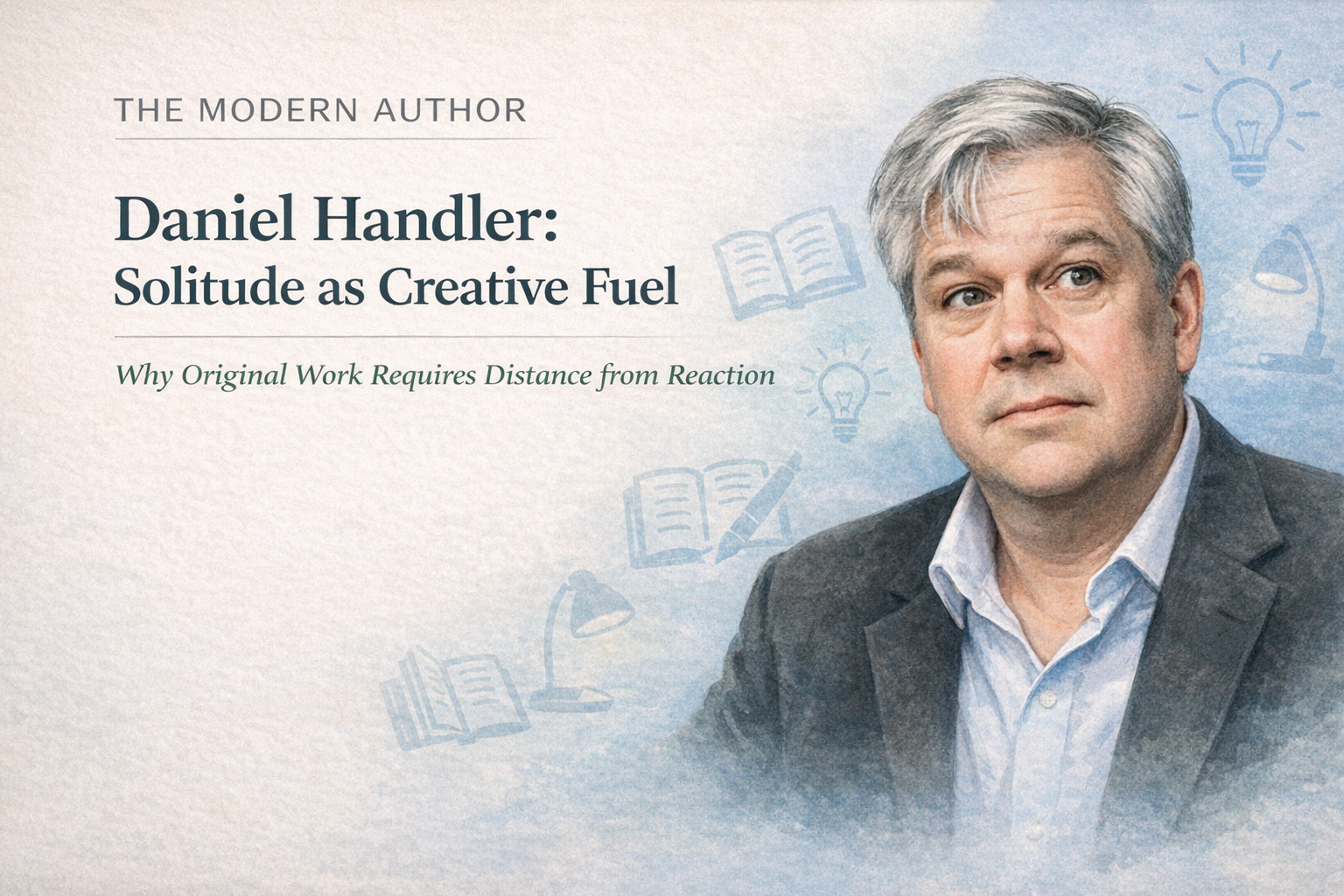
The Modern Author: Daniel Handler on Solitude, Risk, and Original Work
Daniel Handler has never treated solitude as a problem to be solved.
Across his work, both under his own name and as Lemony Snicket, long stretches of
aloneness are not explained away, filled, or apologized for. They are protected.
The work is not shaped in conversation. It is not refined in public. It does not begin with feedback.
Before it is shared, it is allowed to be strange, unresolved, and private.
This is not an accident of temperament. It is a working condition.
Handler’s career shows that solitude is not a creative deficit to escape,
but a necessary condition that enables original thinking, imaginative risk, and lasting literary work.
For the modern author, this reframes loneliness from a weakness into a strategic creative advantage.
What looks like withdrawal from the outside is better understood as insulation from premature influence.
Why most authors resist loneliness
Most authors experience loneliness as a warning signal.
If you are alone too much, something must be wrong.
- You are not networking enough.
- You are not visible enough.
- You are not collaborating enough.
- You are falling behind.
Solitude is easily confused with isolation, and isolation is easily confused with failure.
In a culture that equates productivity with interaction, being alone looks unproductive at best and suspicious at worst.
Silence feels like stagnation. Distance feels like disconnection.
So authors try to eliminate loneliness instead of understanding it.
They fill it with messages, meetings, feedback, and noise, often without noticing what disappears along with it.
The false promise of constant connection
Modern creative culture quietly teaches a simple equation:
- more connection equals better work.
- More feedback sharpens your thinking.
- More collaboration strengthens your ideas.
- More visibility keeps you relevant.
The promise sounds reasonable. It is also incomplete.
Constant connection optimizes for alignment, not originality. It rewards ideas that are legible, agreeable, and immediately intelligible.
It favors work that survives reaction rather than work that requires incubation.Literature does not emerge from consensus environments.
It emerges from conditions where ideas can develop without being instantly explained, defended, or improved by committee.
Daniel Handler’s operating principle
Handler, writing both as himself and as Lemony Snicket, treats solitude not as an accident of personality, but as a chosen creative constraint.
For him, solitude is not a mood or a preference. It is a functional requirement of serious imaginative work.
It creates space to think badly before thinking well.
To explore ideas before justifying them.
To let tone, voice, and moral ambiguity form without needing to make them socially acceptable.
This is not withdrawal from the world.
Handler is deeply engaged with readers, culture, and public life. But the work itself is shaped elsewhere.
Before it becomes shareable, it is allowed to be incoherent, uncomfortable, and unfinished.
Solitude as a mechanism for insight and risk
Solitude works because it removes premature social constraint.
When no one is watching, ideas can wander without needing a destination. A thought that feels strange, dark, or impractical is allowed to continue instead of being corrected.
That freedom enables:
- Intellectual play without explanation
- Emotional honesty without performance
- Experimentation without immediate judgment
In social settings, even generous ones, authors unconsciously pre-edit.
They sense what will confuse, offend, or bore. They soften edges before the work has a chance to find its shape.
Solitude delays reaction long enough for something truer to form.
Why solitude produces braver work
Bravery in writing is not confidence.
It is distance from reaction.
When feedback is immediate:
- Authors optimize for safety.
- They choose familiar structures.
- They explain too much.
- They resolve tension too quickly.
Solitude introduces a necessary delay between creation and response.
That delay allows risk to survive long enough to become coherent.
Handler’s work frequently trusts readers with discomfort, moral ambiguity, and unresolved tension.
Those choices are easier to sustain when they are not negotiated in real time.
Solitude does not make work better by default.
It makes work riskier. And risk is a prerequisite for originality.
Loneliness as a working condition, not a personal failure
The critical shift is interpretive.
Loneliness is often treated as a verdict:
something is wrong with you or your process.
Handler’s career suggests a different frame.
Loneliness is not a character flaw. It is a working condition.
It is what serious thinking feels like before it becomes communicable. It is the cost of sitting with ideas long enough to let them change shape.
This does not mean seeking isolation for its own sake.
It means refusing to treat the discomfort of being alone as evidence that you are failing.
Often, it is evidence that the work is underway.
What this means for modern authors
For modern authors:
1). the lesson is structural, not emotional.
2).Treat solitude as infrastructure, not a side effect.
That means designing time where no feedback is expected or allowed.
Allowing ideas to remain private until they are internally coherent.
Separating creation from reaction as distinct phases.
Resisting the urge to resolve loneliness with noise.Solitude is not where you withdraw from your audience.
It is where you earn something worth bringing back to them.
Authors who never tolerate loneliness produce work that feels crowded, shaped too early by expectation.
Authors who understand solitude use it deliberately.
They do not escape it.
They work inside it long enough to produce something that lasts.
Listen:
Watch:
About the Author
Eric Koester is an award-winning entrepreneurship professor at Georgetown University, bestselling author, and founder of Manuscripts. He has helped more than 3,000 nonfiction authors turn ideas into books, and books into platforms for speaking, media, and business growth.
About Manuscripts
Manuscripts is a modern publishing partner for nonfiction authors who want their books to drive real-world outcomes. We help founders, executives, coaches, and experts design, write, and launch books that build authority, attract opportunities, and compound into long-term business assets.
Work With Us
If you’re writing a book you want to matter, we’ll help you map the right strategy before you write another word.
Schedule a Modern Author Strategy Session